EP0114386B1 - Farbmittelpräparation - Google Patents
Farbmittelpräparation Download PDFInfo
- Publication number
- EP0114386B1 EP0114386B1 EP83113014A EP83113014A EP0114386B1 EP 0114386 B1 EP0114386 B1 EP 0114386B1 EP 83113014 A EP83113014 A EP 83113014A EP 83113014 A EP83113014 A EP 83113014A EP 0114386 B1 EP0114386 B1 EP 0114386B1
- Authority
- EP
- European Patent Office
- Prior art keywords
- colorant
- preparation
- support
- polyester
- granules
- Prior art date
- Legal status (The legal status is an assumption and is not a legal conclusion. Google has not performed a legal analysis and makes no representation as to the accuracy of the status listed.)
- Expired
Links
- 239000000203 mixture Substances 0.000 title claims abstract description 11
- 238000004040 coloring Methods 0.000 title claims abstract description 4
- 239000003086 colorant Substances 0.000 claims abstract description 56
- 229920000728 polyester Polymers 0.000 claims abstract description 31
- 238000001953 recrystallisation Methods 0.000 claims abstract description 11
- 238000002844 melting Methods 0.000 claims abstract description 8
- 238000009472 formulation Methods 0.000 claims abstract 4
- LYCAIKOWRPUZTN-UHFFFAOYSA-N Ethylene glycol Chemical compound OCCO LYCAIKOWRPUZTN-UHFFFAOYSA-N 0.000 claims description 21
- -1 polybutylene terephthalate Polymers 0.000 claims description 19
- 229920001634 Copolyester Polymers 0.000 claims description 18
- QQVIHTHCMHWDBS-UHFFFAOYSA-N isophthalic acid Chemical compound OC(=O)C1=CC=CC(C(O)=O)=C1 QQVIHTHCMHWDBS-UHFFFAOYSA-N 0.000 claims description 16
- KKEYFWRCBNTPAC-UHFFFAOYSA-N Terephthalic acid Chemical compound OC(=O)C1=CC=C(C(O)=O)C=C1 KKEYFWRCBNTPAC-UHFFFAOYSA-N 0.000 claims description 15
- 229920001707 polybutylene terephthalate Polymers 0.000 claims description 10
- 230000008018 melting Effects 0.000 claims description 7
- JXTHNDFMNIQAHM-UHFFFAOYSA-N dichloroacetic acid Chemical compound OC(=O)C(Cl)Cl JXTHNDFMNIQAHM-UHFFFAOYSA-N 0.000 claims description 4
- 229920000642 polymer Polymers 0.000 claims description 4
- 229960005215 dichloroacetic acid Drugs 0.000 claims description 2
- 238000002360 preparation method Methods 0.000 description 33
- 239000008187 granular material Substances 0.000 description 16
- 239000000049 pigment Substances 0.000 description 11
- 239000000975 dye Substances 0.000 description 10
- 239000000835 fiber Substances 0.000 description 10
- 229920000139 polyethylene terephthalate Polymers 0.000 description 9
- 239000005020 polyethylene terephthalate Substances 0.000 description 8
- MTHSVFCYNBDYFN-UHFFFAOYSA-N diethylene glycol Chemical compound OCCOCCO MTHSVFCYNBDYFN-UHFFFAOYSA-N 0.000 description 6
- 238000004043 dyeing Methods 0.000 description 6
- 238000004519 manufacturing process Methods 0.000 description 6
- 238000001035 drying Methods 0.000 description 5
- VDCOSJPGDDQNJH-JVSYPLCOSA-N (8s,9s,10r,11r,13s,14s)-11-hydroxy-13-methyl-1,2,6,7,8,9,10,11,12,14,15,16-dodecahydrocyclopenta[a]phenanthrene-3,17-dione Chemical compound O=C1CC[C@@H]2[C@H]3[C@H](O)C[C@](C)(C(CC4)=O)[C@@H]4[C@@H]3CCC2=C1 VDCOSJPGDDQNJH-JVSYPLCOSA-N 0.000 description 4
- WERYXYBDKMZEQL-UHFFFAOYSA-N butane-1,4-diol Chemical compound OCCCCO WERYXYBDKMZEQL-UHFFFAOYSA-N 0.000 description 4
- 238000000034 method Methods 0.000 description 4
- 238000002156 mixing Methods 0.000 description 4
- BDJRBEYXGGNYIS-UHFFFAOYSA-N nonanedioic acid Chemical compound OC(=O)CCCCCCCC(O)=O BDJRBEYXGGNYIS-UHFFFAOYSA-N 0.000 description 4
- OKTJSMMVPCPJKN-UHFFFAOYSA-N Carbon Chemical compound [C] OKTJSMMVPCPJKN-UHFFFAOYSA-N 0.000 description 3
- 238000004898 kneading Methods 0.000 description 3
- 238000006068 polycondensation reaction Methods 0.000 description 3
- KTEFLEFPDDQMCB-UHFFFAOYSA-N 1,4-bis(4-butylanilino)-5,8-dihydroxyanthracene-9,10-dione Chemical compound C1=CC(CCCC)=CC=C1NC(C=1C(=O)C2=C(O)C=CC(O)=C2C(=O)C=11)=CC=C1NC1=CC=C(CCCC)C=C1 KTEFLEFPDDQMCB-UHFFFAOYSA-N 0.000 description 2
- FAPWRFPIFSIZLT-UHFFFAOYSA-M Sodium chloride Chemical compound [Na+].[Cl-] FAPWRFPIFSIZLT-UHFFFAOYSA-M 0.000 description 2
- WNLRTRBMVRJNCN-UHFFFAOYSA-N adipic acid Chemical compound OC(=O)CCCCC(O)=O WNLRTRBMVRJNCN-UHFFFAOYSA-N 0.000 description 2
- 230000002411 adverse Effects 0.000 description 2
- CDQSJQSWAWPGKG-UHFFFAOYSA-N butane-1,1-diol Chemical compound CCCC(O)O CDQSJQSWAWPGKG-UHFFFAOYSA-N 0.000 description 2
- 230000000052 comparative effect Effects 0.000 description 2
- 238000001816 cooling Methods 0.000 description 2
- 229920001577 copolymer Polymers 0.000 description 2
- SWXVUIWOUIDPGS-UHFFFAOYSA-N diacetone alcohol Chemical compound CC(=O)CC(C)(C)O SWXVUIWOUIDPGS-UHFFFAOYSA-N 0.000 description 2
- 150000002009 diols Chemical class 0.000 description 2
- 230000001771 impaired effect Effects 0.000 description 2
- 238000005259 measurement Methods 0.000 description 2
- 239000000155 melt Substances 0.000 description 2
- 239000000047 product Substances 0.000 description 2
- 150000003839 salts Chemical class 0.000 description 2
- CXMXRPHRNRROMY-UHFFFAOYSA-N sebacic acid Chemical compound OC(=O)CCCCCCCCC(O)=O CXMXRPHRNRROMY-UHFFFAOYSA-N 0.000 description 2
- 238000009987 spinning Methods 0.000 description 2
- 238000009941 weaving Methods 0.000 description 2
- YIMQCDZDWXUDCA-UHFFFAOYSA-N [4-(hydroxymethyl)cyclohexyl]methanol Chemical compound OCC1CCC(CO)CC1 YIMQCDZDWXUDCA-UHFFFAOYSA-N 0.000 description 1
- 238000010521 absorption reaction Methods 0.000 description 1
- 239000002253 acid Substances 0.000 description 1
- 235000011037 adipic acid Nutrition 0.000 description 1
- 239000001361 adipic acid Substances 0.000 description 1
- 239000001000 anthraquinone dye Substances 0.000 description 1
- 125000003118 aryl group Chemical group 0.000 description 1
- 239000006229 carbon black Substances 0.000 description 1
- 239000000969 carrier Substances 0.000 description 1
- 239000007795 chemical reaction product Substances 0.000 description 1
- 238000004140 cleaning Methods 0.000 description 1
- 239000012141 concentrate Substances 0.000 description 1
- 238000002425 crystallisation Methods 0.000 description 1
- 230000008025 crystallization Effects 0.000 description 1
- 238000005520 cutting process Methods 0.000 description 1
- 230000007423 decrease Effects 0.000 description 1
- 150000001991 dicarboxylic acids Chemical class 0.000 description 1
- 238000009826 distribution Methods 0.000 description 1
- 150000002334 glycols Chemical class 0.000 description 1
- 238000000227 grinding Methods 0.000 description 1
- 239000004615 ingredient Substances 0.000 description 1
- 238000002347 injection Methods 0.000 description 1
- 239000007924 injection Substances 0.000 description 1
- 239000007788 liquid Substances 0.000 description 1
- 238000002074 melt spinning Methods 0.000 description 1
- 229910052751 metal Inorganic materials 0.000 description 1
- 239000002184 metal Substances 0.000 description 1
- HAPIXNBOBZHNCA-UHFFFAOYSA-N methyl 4-methyl-3-(4,4,5,5-tetramethyl-1,3,2-dioxaborolan-2-yl)benzoate Chemical compound COC(=O)C1=CC=C(C)C(B2OC(C)(C)C(C)(C)O2)=C1 HAPIXNBOBZHNCA-UHFFFAOYSA-N 0.000 description 1
- SLCVBVWXLSEKPL-UHFFFAOYSA-N neopentyl glycol Chemical compound OCC(C)(C)CO SLCVBVWXLSEKPL-UHFFFAOYSA-N 0.000 description 1
- 229920003023 plastic Polymers 0.000 description 1
- 239000004033 plastic Substances 0.000 description 1
- 229920002959 polymer blend Polymers 0.000 description 1
- 239000000843 powder Substances 0.000 description 1
- 239000011780 sodium chloride Substances 0.000 description 1
- 239000000758 substrate Substances 0.000 description 1
- XLYOFNOQVPJJNP-UHFFFAOYSA-N water Substances O XLYOFNOQVPJJNP-UHFFFAOYSA-N 0.000 description 1
Classifications
-
- C—CHEMISTRY; METALLURGY
- C08—ORGANIC MACROMOLECULAR COMPOUNDS; THEIR PREPARATION OR CHEMICAL WORKING-UP; COMPOSITIONS BASED THEREON
- C08J—WORKING-UP; GENERAL PROCESSES OF COMPOUNDING; AFTER-TREATMENT NOT COVERED BY SUBCLASSES C08B, C08C, C08F, C08G or C08H
- C08J3/00—Processes of treating or compounding macromolecular substances
- C08J3/20—Compounding polymers with additives, e.g. colouring
- C08J3/22—Compounding polymers with additives, e.g. colouring using masterbatch techniques
- C08J3/226—Compounding polymers with additives, e.g. colouring using masterbatch techniques using a polymer as a carrier
-
- C—CHEMISTRY; METALLURGY
- C08—ORGANIC MACROMOLECULAR COMPOUNDS; THEIR PREPARATION OR CHEMICAL WORKING-UP; COMPOSITIONS BASED THEREON
- C08K—Use of inorganic or non-macromolecular organic substances as compounding ingredients
- C08K5/00—Use of organic ingredients
- C08K5/0008—Organic ingredients according to more than one of the "one dot" groups of C08K5/01 - C08K5/59
- C08K5/0041—Optical brightening agents, organic pigments
-
- C—CHEMISTRY; METALLURGY
- C08—ORGANIC MACROMOLECULAR COMPOUNDS; THEIR PREPARATION OR CHEMICAL WORKING-UP; COMPOSITIONS BASED THEREON
- C08J—WORKING-UP; GENERAL PROCESSES OF COMPOUNDING; AFTER-TREATMENT NOT COVERED BY SUBCLASSES C08B, C08C, C08F, C08G or C08H
- C08J2367/00—Characterised by the use of polyesters obtained by reactions forming a carboxylic ester link in the main chain; Derivatives of such polymers
- C08J2367/02—Polyesters derived from dicarboxylic acids and dihydroxy compounds
-
- C—CHEMISTRY; METALLURGY
- C08—ORGANIC MACROMOLECULAR COMPOUNDS; THEIR PREPARATION OR CHEMICAL WORKING-UP; COMPOSITIONS BASED THEREON
- C08J—WORKING-UP; GENERAL PROCESSES OF COMPOUNDING; AFTER-TREATMENT NOT COVERED BY SUBCLASSES C08B, C08C, C08F, C08G or C08H
- C08J2467/00—Characterised by the use of polyesters obtained by reactions forming a carboxylic ester link in the main chain; Derivatives of such polymers
Definitions
- the invention relates to a colorant preparation comprising colorant and colorant carrier for dyeing in the mass of polyesters of the basic unit melting at more than 2003 ° C.
- a colorant preparation in granular form is added to the chips of the polyester to be colored, e.g. in a tumble dryer or continuously as the polyester chips to be colored are fed into the extruder.
- the colorant preparations known today often contain too little of a colorant and have the disadvantage that they tend to stick in the form of granules or powder when heated. If the proportion of the carrier in the colorant preparation is too large, the properties of the end products deteriorate, e.g. the technological properties of fibers and filaments can be impaired. Likewise, powdering the dye onto the polyester chips to be colored in the tumble dryer can easily lead to sticking if the tendency to stick is too great.
- European patent application 8373 A1 describes the preparation of a pigment preparation for the coloring of linear polyester in bulk, according to which 20 to 80 parts of pigment and 80 to 20 parts of a polyester which melts between 60 and 160 ° C. by solvent-salt kneading produces a pre-concentrate, which is fused with a spinnable linear polyester and processed into granules.
- the granules expediently contain 3 to 30% by weight of pigment.
- Polyesters are those made from aromatic and / or aliphatic dicarboxylic acids with aliphatic diols. Dicarboxylic acids are e.g.
- Terephthalic, isophthalic, azelaic, sebacic or adipic acid Possible glycols are: ethylene glycol, 1,4-butanediol, 1,4-di (hydroxymethyl) cyclohexane or neopentyl glycol. Polyesters of terephthalic and azelaic acid, butanediol and diethylene glycol are particularly suitable for the production of the granules.
- copolyesters are kneaded with the desired pigment, with sodium chloride and diacetone alcohol in a complicated salt kneading process, then aftertreated in water and ground, filtered, washed, dried and then mixed with polyethylene terephthalate and processed into granules in several processing steps.
- polyethylene terephthalate is the predominant component of the granules.
- 1,4-butanediol is also used in Examples 6 and 9, but only as a component of the preconcentrate and together with diethylene glycol as the second diol component; the copolyesters containing butanediol are amorphous here.
- a larger amount of polyethylene terephthalate is then always added to the preconcentrate than copolyester is contained therein.
- this known pigment preparation contains only up to 30% by weight of colorant, is not sufficiently safe against sticking and can adversely affect the lightfastness of the colored polyester.
- the object of the invention is to remedy the disadvantages mentioned and to provide a colorant preparation which makes it possible to dye polyester in the mass in a lightfast manner and which is easy to prepare and which contains large amounts of colorant and does not adhere to the granules during drying and processing leads to the disruptive bonds.
- the colorant carrier made of a linear polyester with a softening point of over 60 ° C and polybutylene terephthalate with a specific viscosity of 0.5 to 1.5, measured at a polymer concentration of 1 g / 100 ml in dichloroacetic acid at 25 ° C, and that the colorant preparation between 210 ° C and 150 ° C, preferably between 200 and 160 ° C, has a recrystallization exotherm from 8 to 55 Joule / g, preferably from 15-40 Jouie / g.
- the linear polyester is a copolyester of tere- / isophthalic acid and ethylene glycol.
- Polyesters with a melting point above 200 ° C. are, for example, those of terephthalic acid with diols of the formulas Ho (CH 2 ) " - OH or
- Linear polyester with a softening point of over 60 ° C.” is to be understood as meaning those polyesters and copolyesters which have previously been used in colorant carriers or colorant preparations.
- Polyesters suitable according to the invention are e.g. mentioned in German Offenlegungsschrift 1 965379, copolyesters suitable according to the invention in German Auslegeschrift 1183195.
- a copolyester of tere- and isophthalic acid with ethylene glycol is particularly particularly suitable, the acid component preferably containing 20-35 mol% of isophthalic acid.
- the molten sample to be examined is cooled at a rate of 20 ° C./min; is measured in the differential scanning calorimeter from Perkin Elmer (differential scanning calorimeter DSC 2-C).
- Suitable polybutylene terephthalate has a specific viscosity of 0.5 to 1.5, a suitable copolyester a specific viscosity of approx. 0.4-1.0.
- the specific viscosity ( T1 sp ezJ is determined in dichloroacetic acid at 25 ° C.
- the concentration of the polymers during the measurement is 1 g / 100 ml of liquid.
- the softening temperature was determined in accordance with method A of DIN 53460, but with a temperature increase of 5 ° C. per minute.
- Strand granules with an elliptical cross-section, large axis 3 mm, small axis 2 mm, cutting length 6 mm were used as test specimens. The measurements were made in air.
- the colorant preparation can be made in a known manner, e.g. by mixing the cold components, polybutylene terephthalate, linear polyester and colorants, melting, homogenizing, cooling and granulating.
- the preparation of the preparation is therefore very simple and also offers the ecological and economic advantage that there is no need for expensive and environmentally harmful salt kneading of the dye preparation, as is still necessary in the production of some products.
- the polymer mixture used as the colorant carrier ensures rapid absorption and homogeneous distribution of the colorant.
- the melting or softening point of the colorant carrier is equal to or lower than the melting point or softening point of the colorant, so that the mixture can also be easily and perfectly homogenized from this side. If necessary, the cooling can be carried out in such a way that the best possible recrystallization occurs.
- the colorants which can be used to prepare the colorant preparation according to the invention are preferably dyes soluble in polyethylene terephthalate. Pigments which are insoluble in polyester are also suitable, as are mixtures of different dyes and mixtures of dyes and pigments.
- the advantages of the colorant preparation according to the invention are particularly pronounced when soluble colorants are used.
- the colorant preparation according to the invention is also very useful, but the adhesions frequently occur less strongly when drying or when the colorant preparation is drawn into the extruder.
- the granules of the colorant preparation according to the invention are particularly suitable for mixing with the granules to be colored, e.g. in the dryer or when feeding into the extruder at high temperatures up to approx. 200 ° C.
- the colorant preparation thus offers economic advantages not only in its production, but also in that it can be used advantageously in the course of conventional processes for dyeing polyesters in bulk, without additional aids such as e.g. an injection device is necessary.
- the possibility of mixing the colorant preparation on the extruder; allows you to economically color even small production batches
- the carrier of the colorant preparation has a high solubility in polyethylene terephthalate and polybutylene terephthalate.
- the preparation melt is distributed very quickly and homogeneously in the polyester melt to be colored.
- the fibers can be used to produce high-quality products with good fastness properties and usage properties.
- the recrystallization exotherm was 23 J / g.
- the chips produced show no tendency to stick up to a drying temperature of 200 ° C.
- the granules were used in the manufacture of polyethylene terephthalate fibers for dyeing. When the granulate is added to the 200 ° C inlet area of the extruder, no sticking occurs. The fibers produced showed perfect color levelness and lightfastness. The mechanical properties of the fibers were not adversely affected; the fibers could be easily processed in spinning and weaving.
- Blue means that the copolyester consists of 60 parts IT copolyester and 40 parts Solvent Blue 122.
- IT copolyester black stands for the same copolymer of iso- and terephthalic acid and ethylene glycol as in Examples 2-4 and 8, but with 30% by weight of pigment black 7, based on the copolymer / dye mixture.
- Comparative examples 1 and 2 show that satisfactory results were not achieved with regard to the bonds if the recrystallization exotherm at 5.4 and 5.8 joules / g was too low. Already at 90 ° C or 160 ° C, sticking occurred. The flowability and meterability of the granules were severely impaired. An exact dosage of the colorant preparations was no longer possible.
Landscapes
- Chemical & Material Sciences (AREA)
- Chemical Kinetics & Catalysis (AREA)
- Medicinal Chemistry (AREA)
- Polymers & Plastics (AREA)
- Organic Chemistry (AREA)
- Health & Medical Sciences (AREA)
- Compositions Of Macromolecular Compounds (AREA)
- Processes Of Treating Macromolecular Substances (AREA)
- Medicinal Preparation (AREA)
- Artificial Filaments (AREA)
- Pharmaceuticals Containing Other Organic And Inorganic Compounds (AREA)
- Coloring (AREA)
- Developing Agents For Electrophotography (AREA)
- Non-Silver Salt Photosensitive Materials And Non-Silver Salt Photography (AREA)
Description
- Die Erfindung betrifft eine Farbmittelpräparation aus Farbmittel und Farbmittelträger zum Färben in der Masse von bei über 2003°C schmelzenden Polyestern der Grundeinheit


- Zum Färben von Polyestern in der Masse gibt es eine ganze Reihe von Verfahren. Die Zugabe des Farbmittels bereits bei der Polykondensation des Polyesters setzt, wegen der hohen Polykondensationstemperaturen, hochhitzebeständige Farbmittel voraus. Eine weitere Voraussetzung hierbei sind grosse Produktionschargen, da die Umstellung von einer Farbe zur anderen durch die erforderliche Reinigung der Polykondensationsanlage kostspielig und zeitraubend ist. Soweit Pigmente zum Einsatz kommen, müssen sie in Ethylenglykol dispergiert werden.
- Es besteht auch die Möglichkeit, das Farbmittel oder die Farbmittel-Präparation in geschmolzenem Zustand in den Schmelzfluss des zu färbenden Polymeren zu injizieren. Hierzu ist eine verhältnismässig aufwendige Einrichtung erforderlich.
- Einfacher und wirtschaftlicher ist es, wenn man insbesondere beim Färben kleinerer Mengen eine Farbmittel-Präparation in Granulatform den Schnitzeln des zu färbenden Polyesters beimischt, z.B. in einem Taumeltrockner oder kontinuierlich bei der Einspeisung der zu färbenden Polyesterschnitzel in den Extruder.
- Die heute bekannten Farbmittel-Präparationen enthalten oft einen zu geringen Anteil an Farbmitteln und haben den Nachteil, dass sie in Granulat-oder Pulverform beim Erwärmen zum Verkleben neigen. Ist der Anteil des Trägers in der Farbmittel-Präparation zu gross, verschlechtern sich die Eigenschaften der Endprodukte, z.B. können die textiltechnologischen Eigenschaften von Fasern und Filamenten beeinträchtigt werden. Ebenso kann das Aufpudern des Farbstoffes auf zu färbende Polyesterschnitzel im Taumeltrockner leicht zu Verklebungen führen, wenn die Neigung zum Verkleben zu gross ist.
- Das Färben von Polyestern in der Masse mit Hilfe von Pigmentzubereitungen auf der Grundlage von Copolyestern ist bekannt.
- So beschreibt die Europäische Patentanmeldung 8373 Al das Herstellen einer Pigmentpräparation für die Färbung linearer Polyester in der Masse, nach welchem man aus 20 bis 80 Teilen Pigment und 80 bis 20 Teilen eines Polyesters, der zwischen 60 und 160°C schmilzt, durch Lösungsmittel-Salzknetung ein Vorkonzentrat herstellt, welches mit einem spinnbaren linearen Polyester verschmolzen und zu Granulat verarbeitet wird. Das Granulat enthält zweckmässig 3 bis 30 Gew.-% Pigment. Polyester sind solche aus aromatischen und/oder aliphatischen Dicarbonsäuren mit alipathischen Diolen. Dicarbonsäuren sind z.B. Terephthal-, Isophthal-, Azelain-, Sebacin- oder Adipinsäure; als Glykole kommen in Betracht: Ethylenglykol, 1.4-Butandiol, 1.4-Di(hydroxymethyl)-cyclohexan oder Neopentylglykol. Besonders geeignet sind Polyester aus Terephthal- und Azelainsäure sowie Butandiol und Diethylenglykol für die Herstellung des Granulates. Diese Copolyester werden in einem komplizierten Salzknetprozess mit dem gewünschten Pigment, mit Natriumchlorid und Diacetonalkohol verknetet, dann in Wasser nachbehandelt und gemahlen, gefiltert, gewaschen, getrocknet und sodann mit Polyethylenterephthalat gemischt und über mehrere Verarbeitungsstufen zum Granulat verarbeitet. In allen Ausführungsformen ist Polyethylenterephthalat überwiegender Bestandteil des Granulats. 1.4-Butandiol wird zwar in Beispielen 6 und 9 auch eingesetzt, jedoch nur als Bestandteil des Vorkonzentrats und gemeinsam mit Diethylenglykol als zweiter Diolkomponente; die Butandiol enthaltenden Copolyester sind hier amorph. Ausserdem wird dem Vorkonzentrat dann stets eine grössere Menge Polyethylenterephthalat zugesetzt als Copolyester darin enthalten ist.
- Diese bekannte Pigmentpräparation enthält, wie die Beispiele zeigen, nur bis zu 30 Gew.-% Farbmittel, ist nicht ausreichend sicher gegen Verklebungen und kann die Lichtechtheit des gefärbten Polyesters negativ beeinflussen.
- Aufgabe der Erfindung ist es, die genannten Nachteile zu beheben und eine Farbmittelpräparation zur Verfügung zu stellen, die es gestattet, Polyester lichtecht in der Masse zu färben, und die einfach herzustellen ist, die hohe Farbmittelmengen enthält und deren Granulat bei Trocknung und Verarbeitung nicht zu den störenden Verklebungen führt.
- Diese Aufgabe wurde dadurch gelöst, dass der Farbmittelträger aus einem linearen Polyester mit einem Erweichungspunkt von über 60°C und Polybutylenterephthalat mit einer spezifischen Viskosität von 0,5 bis 1,5, gemessen bei einer Polymerkonzentration von 1 g/100 ml in Dichloressigsäure bei 25°C, besteht und dass die Farbmittelpräparation zwischen 210°C und 150°C, vorzugsweise zwischen 200 und 160°C, eine Rekristallisationsexotherme von 8 bis 55Joule/g, vorzugsweise von 15-40 Jouie/g aufweist.
- Insbesondere ist der lineare Polyester ein Copolyester aus Tere-/lsophthalsäure und Ethylenglykol.
- Polyester mit einem Schmelzpunkt über 200°C sind beispielsweise solche der Terephthalsäure mit Diolen der Formeln Ho(CH2)"-OH oder

- Unter «linearer Polyester mit Erweichungspunkt von über 60°C» sollen solche Polyester und Copolyester verstanden werden, die bislang schon in Farbmittelträgern bzw. Farbmittelpräparationen Verwendung gefunden haben. Erfindungsgemäss geeignete Polyester werden z.B. in der deutschen Offenlegungsschrift 1 965379 genannt, erfindungsgemäss geeignete Copolyester in der deutschen Auslegeschrift 1183195. Ganz besonders gut geeignet ist ein Copolyester aus Tere- und Isophthalsäure mit Ethylenglykol, wobei in der Säurekomponente bevorzugt 20-35 Mol-% Isophthalsäure enthalten sind.
- Diesen Polyestern oder Copolyestern, die das Farbmittel enthalten, wird nun soviel Polybutylenterephthalat zugesetzt, dass diese gesamte Farbmittelpräparation zwischen 210°C und 150°C, vorzugsweise zwischen 200 und 160°C, eine Rekristallisationsexotherme von 8 bis 55 Joule/g, vorzugsweise von 15 bis 40 Joule/g Farbmittel- präparation aufweist.
- Die Abkühlung der zu untersuchenden geschmolzenen Probe erfolgt mit einer Geschwindigkeit von 20°C/min; gemessen wird im Differential-Abtast-Kalorimeter der Fa. Perkin Eimer (Differential Scanning Calorimeter DSC 2-C).
- Geeignetes Polybutylenterephthalat hat eine spezifische Viskosität von 0,5 bis 1,5, ein geeigneter Copolyester eine spezifische Viskosität von ca. 0,4-1,0. Die Bestimmung der spezifischen Viskosität (T1spezJ erfolgt in Dichloressigsäure bei 25°C. Die Konzentration der Polymeren bei der Messung beträgt 1 g/100 ml Flüssigkeit.
- Die Bestimmung der Erweichungstemperatur erfolgte in Anlehnung an das Verfahren A der DIN 53460, jedoch mit einer Temperatursteigerung von 5°C pro Minute. Als Probekörper wurde Stranggranulat eingesetzt mit elliptischem Querschnitt, grosse Achse 3 mm, kleine Achse 2 mm, Schnittlänge 6 mm. Die Messungen erfolgten in Luft.
- Die Farbmittelpräparation kann in bekannter Art und Weise hergestellt werden, z.B. durch Vermischen der kalten Bestandteile, Polybutylenterephthalat, linearer Polyester und Farbmittel, Aufschmelzen, Homogenisieren, Abkühlen und Granulieren.
- Die Herstellung der Präparation ist daher sehr einfach und bietet ausserdem den ökologischen und wirtschaftlichen Vorteil, dass sich eine teure und umweltschädliche Salzknetung der Farbstoffzubereitung, wie sie bei der Herstellung von manchen Produkten noch notwendig ist, erübrigt.
- Das als Farbmittelträger verwendete Polymergemisch gewährleistet eine rasche Aufnahme und homogene Verteilung des Farbmittels. Der Schmelz- bzw. Erweichungspunkt des Farbmittelträgers ist gleich oder niedriger als der Schmelzpunkt oder Erweichungspunkt des Farbmittels, so dass auch von dieser Seite eine leichte und einwandfreie Homogenisierung der Mischung möglich ist. Die Abkühlung kann erforderlichenfalls so geführt werden, dass eine möglichst gute Rekristallisation eintritt.
- Die zur Herstellung der erfindungsgemässen Farbmittelpräparation verwendbaren Farbmittel sind vorzugsweise in Polyethylenterephthalat lösliche Farbstoffe. Es kommen aber auch in Polyester unlösliche Pigmente in Frage, sowie Mischungen verschiedener Farbstoffe und Mischungen aus Farbstoffen und Pigmenten.
- Die Vorteile der erfindungsgemässen Farbmittelpräparation treten besonders ausgeprägt zutage, wenn lösliche Farbmittel verwendet werden. Beim Einsatz von im Polyester unlöslichen Pigmenten ist die erfindungsgemässe Farbmittel- präparation ebenfalls sehr nützlich, jedoch treten häufig die Verklebungen beim Trocknen oder beim Einziehen der Farbmittelpräparation in den Extruder weniger stark auf.
- Das Granulat der erfindungsgemässen Farbmittelpräparation eignet sich besonders gut zum Mischen mit dem zu färbenden Granulat z.B. im Trockner oder beim Einspeisen in den Extruder bei hohen Temperaturen bis zu ca. 200°C.
- Die Farbmittelpräparation bietet somit nicht nur bei ihrer Herstellung wirtschaftliche Vorteile, sondern auch dadurch, dass sie im Rahmen herkömmlicher Verfahren zum Färben von Polyestern in der Masse vorteilhaft eingesetzt werden kann, ohne dass zusätzliche Hilfsmittel wie z.B. eine Injektionsvorrichtung notwendig sind. Die Möglichkeit, die Farbmittelzubereitung am Extruder beizumischen; erlaubt es, auch kleine Produktionschargen wirtschaftlich einzufärben
- Der Träger der Farbmittelpräparation besitzt in Polyethylenterephthalat und Polybutylenterephthalat eine hohe Löslichkeit. Die Präparationsschmelze verteilt sich in der zu färbenden Polyesterschmelze sehr rasch und homogen. Die Färbung beispielsweise von Polyesterfasern und Filamenten weist daher eine ausgezeichnete Egalität auf.
- Durch die hohe Farbmittelkonzentration der Farbmittelpräparation bzw. die geringe Menge des in den zu färbenden Polyester einzubringenden Farbmittelträgers und dessen sehr gute Löslichkeit im einzufärbenden Substrat beeinträchtigt sie die Fasereigenschaften so gut wie nicht und verbürgt eine ausgezeichnete Verarbeitbarkeit der daraus hergestellten Fasern sowohl in der Spinnerei als auch in der Weberei.
- Aus den Fasern lassen sich hochwertige Erzeugnisse mit guten Echtheiten und Gebrauchseigenschaften herstellen.
- Ebenso können hervorragend gleichmässig gefärbte Kunststoffgegenstände hergestellt werden.
- Anhand von Beispielen soll die Erfindung weiter erläutert werden.
- 300 g trockenes, gemahlenes Polyethylenterephthalat-coisophthalat (TJspez. = 0,7), bei dem Terephthalsäure und Isophthalsäure im Gewichtsverhältnis 75:25 enthalten sind, wurde mit 300g trockenem und gemahlenem Polybutylenterephthalat (ηspez. = 1,3) und 400g eines blauen Anthrachinonfarbstoffes (C.I. Solvent Blue 122) vom Schmelzpunkt 230°C gemischt. Diese Mischung wurde in einem Doppelschnekkenextruder oder Auspresskneter bei 230-240°C aufgeschmolzen und homogenisiert. Die homogenisierte Schmelze wurde als Strang ausgetragen, abgekühlt und granuliert.
- Das erhaltene Granulat besass eine Kristallisationstemperatur TK = 117°C und eine Rekristallisationstemperatur TRK = 177°C. Die Rekristallisationsexotherme betrug 23 J/g.
- Die hergestellten Chips zeigen bis zu 200°C Trockentemperatur keine Verklebungstendenzen.
- Das Granulat wurde bei der Herstellung von Polyethylenterephthalat-Fasern zum Färben eingesetzt. Bei der Zumischung des Granulats in den 200°C heissen Einlaufbereich des Extruders treten keine Verklebungen auf. Die hergestellten Fasern zeigten einwandfreie Farbegalität und Lichtechtheit. Die mechanischen Eigenschaften der Fasern wurden nicht negativ beeinflusst; die Fasern liessen sich ohne Schwierigkeiten in Spinnerei und Weberei verarbeiten.
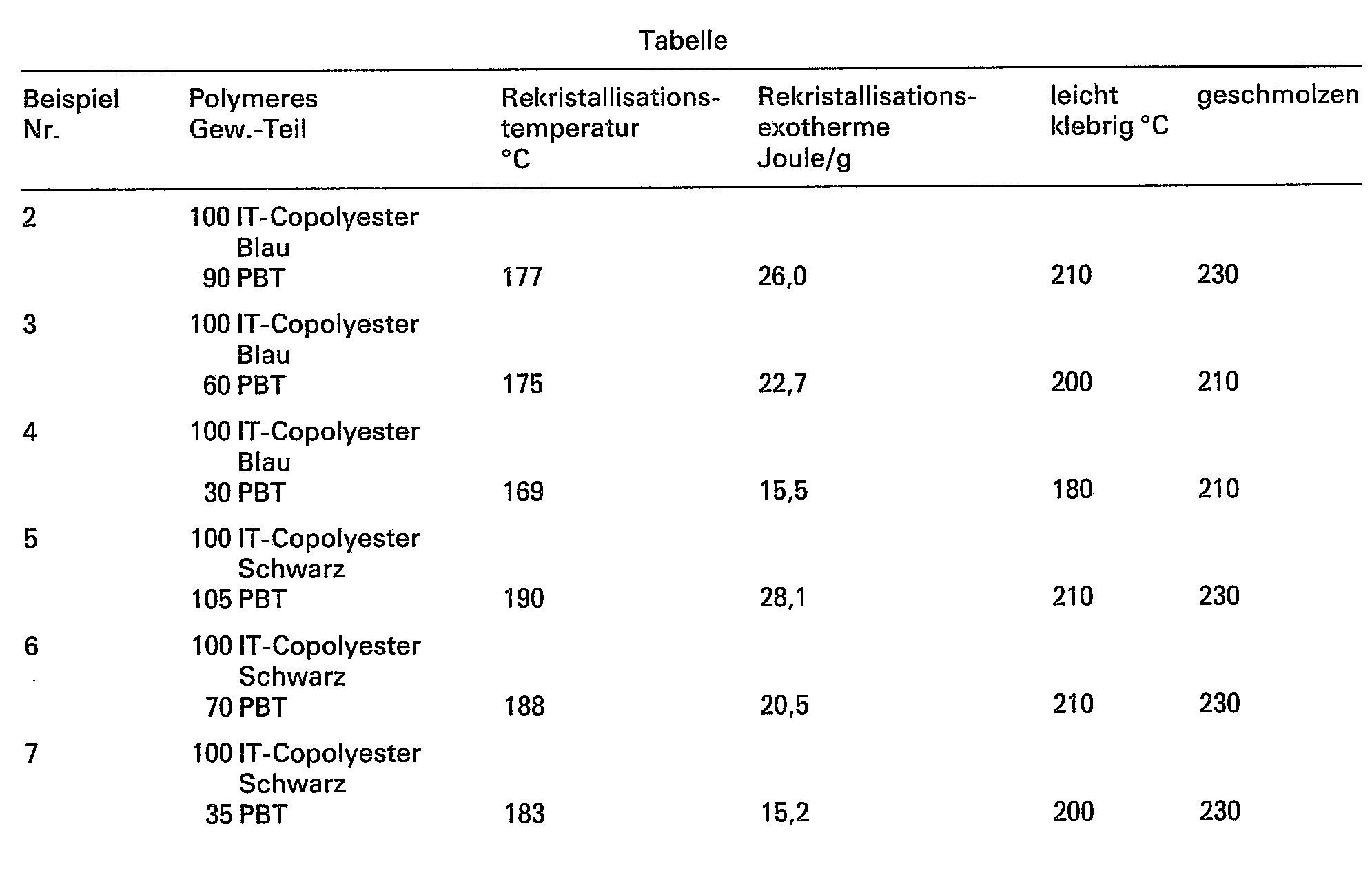
- In Beispielen 2-8 und Vergleichsbeispielen 1 und 2 wurden die Eigenschaften verschiedener Farbmittelpräparationen in Abhängigkeit von der Zusammensetzung und von der jeweiligen Rekristallisationsexotherme untersucht. IT-Copolyester bedeutet darin eine Copolyester aus Ethylenglykol und Isophthalsäure und Terephthalsäure im Gewichtsverhältnis 1:3 der spezifischen Viskosität (ηspez. = 0,7). Blau heisst, dass der Copolyester aus 60 Teilen IT-Copolyester und 40 Teilen Solvent Blue 122 besteht.
- PBT bedeutet Polybutylenterephthalat einer spezifischen Viskosität (ηspez. = 1,2).
- IT-Copolyester Schwarz steht für dasselbe Copolymer aus Iso- und Terephthalsäure sowie Ethylenglykol wie nach Beispielen 2-4 und 8, jedoch mit 30 Gew.-% an Pigment Black 7, bezogen auf die Mischung Copolymer/Farbstoff.
- Aus der Tabelle, in der Beispiele 2 bis 8 zusammengefasst sind, geht hervor, dass mit abnehmender Rekristallisationsexotherme der Farbmittelpräparation die Klebrigkeit zunimmt, weniger ausgeprägt, aber doch deutlich vorhanden, ist diese Erscheinung bei Anwesenheit eines Pigments (Russ) Beispiele 5, 6, 7 statt des löslichen Farbstoffes (Beispiele 1-4, 8).
- Vergleichsbeispiele 1 und 2 zeigen, dass hinsichtlich der Verklebungen keine befriedigenden Ergebnisse erzielt wurden, wenn die Rekristallisationsexotherme mit 5,4 bzw. 5,8 Joule/g zu niedrig ist. Bereits bei 90°C bzw. 160°C traten Verklebungen auf. Rieselfähigkeit und Dosierbarkeit des Granulats waren stark beeinträchtigt. Eine exakte Dosierung der Farbmittelpräparationen war nicht mehr möglich.
- Die Farbmittelpräparationen der Beispiele 1-8 führten dagegen beim Trocknen bzw. am Extrudereinlauf zu keinen nennenswerten Verklebungen.
- Zur Prüfung der Klebrigkeit wurden 100 Schnitzel bzw. Granulat im Trockenschrank 1 Stunde auf Prüftemperatur gebracht und bei dieser Temperatur mit einem Metallrührer umgerührt. Bei den mit «leicht klebrig» bezeichneten Schnitzeln ist ein Durchmischen mit dem Rührer erschwert bis nicht mehr möglich.

- In Anlehnung an das Beispiel 1 wurde eine Farbstoffkombination von
- 304 g Solvent Blue 122
- 20 g Solvent Green 28
- 56,4 g Pigment Black 7
-
- 131,6 g Copolyester und
- 488 g Polybutylenterephthalat
eingesetzt. Die Bestandteile wurden intensiv gemischt und wie in Beispiel 1 zu Granulat verarbeitet. Die Rekristallisationsexotherme betrug 28,9 Joule/g. Die hergestellten Chips zeigten bis zu 210°C keine Verklebungstendenzen. 4 Teile dieser Farbmittelpräparation wurden in 96 Teilen Polyethylenterephthalat durch Schmelzspinnen ohne Störung zu tief marineblau gefärbten Spinnfasern verarbeitet, die eine ausgezeichnete Farbegalität und hervorragende Echtheitseigenschaften aufwiesen.
Claims (2)

R = (̵CH2)̵x mit x = 2-6 oder

Priority Applications (1)
| Application Number | Priority Date | Filing Date | Title |
|---|---|---|---|
| AT83113014T ATE28754T1 (de) | 1982-12-29 | 1983-12-23 | Farbmittelpraeparation. |
Applications Claiming Priority (2)
| Application Number | Priority Date | Filing Date | Title |
|---|---|---|---|
| DE19823248492 DE3248492A1 (de) | 1982-12-29 | 1982-12-29 | Farbmittelpraeparation |
| DE3248492 | 1982-12-29 |
Publications (3)
| Publication Number | Publication Date |
|---|---|
| EP0114386A2 EP0114386A2 (de) | 1984-08-01 |
| EP0114386A3 EP0114386A3 (en) | 1985-05-15 |
| EP0114386B1 true EP0114386B1 (de) | 1987-08-05 |
Family
ID=6182066
Family Applications (1)
| Application Number | Title | Priority Date | Filing Date |
|---|---|---|---|
| EP83113014A Expired EP0114386B1 (de) | 1982-12-29 | 1983-12-23 | Farbmittelpräparation |
Country Status (7)
| Country | Link |
|---|---|
| US (1) | US4782111A (de) |
| EP (1) | EP0114386B1 (de) |
| JP (1) | JPH0629361B2 (de) |
| AT (1) | ATE28754T1 (de) |
| BR (1) | BR8307229A (de) |
| DE (2) | DE3248492A1 (de) |
| ZA (1) | ZA839592B (de) |
Families Citing this family (8)
| Publication number | Priority date | Publication date | Assignee | Title |
|---|---|---|---|---|
| AU573055B2 (en) * | 1984-12-20 | 1988-05-26 | Bip Chemicals Ltd. | Pigmented polyester composition |
| JPH0684465B2 (ja) * | 1988-05-31 | 1994-10-26 | ポリプラスチックス株式会社 | 改良着色ポリブチレンテレフタレート樹脂組成物の製造方法 |
| US5707566A (en) * | 1995-06-02 | 1998-01-13 | Hoechst Celanese Corp. | Process for preparing high performance polarizer films |
| US5686515A (en) * | 1995-11-13 | 1997-11-11 | The M.A. Hanna Company | Colored polyethylene terephthalate composition and process of its manufacture |
| DE102004045639A1 (de) | 2004-09-21 | 2006-04-06 | Clariant Masterbatch Gmbh & Co. Ohg | Polyester-Farbmittelkonzentrat |
| US20080292831A1 (en) * | 2007-03-06 | 2008-11-27 | Futuris Automotive Interiors (Us), Inc. | Tufted pet fiber for automotive carpet applications |
| CA2679963A1 (en) * | 2007-03-06 | 2008-09-12 | Futuris Automotive Interiors (Us), Inc. | Tufted pet fiber for automotive carpet applications |
| US20110177283A1 (en) * | 2010-01-18 | 2011-07-21 | Futuris Automotive Interiors (Us), Inc. | PET Carpet With Additive |
Family Cites Families (4)
| Publication number | Priority date | Publication date | Assignee | Title |
|---|---|---|---|---|
| NL228050A (de) * | 1957-05-29 | |||
| GB1391926A (en) * | 1972-10-27 | 1975-04-23 | Mitsubishi Rayon Co | Process for the production of shaped articles of a linear polyester |
| DE2444584C3 (de) * | 1974-09-18 | 1982-01-21 | Basf Ag, 6700 Ludwigshafen | Thermoplastische Polyesterformmassen |
| JPS5938264B2 (ja) * | 1976-12-09 | 1984-09-14 | 東レ株式会社 | 熱可塑性ポリエステル樹脂組成物 |
-
1982
- 1982-12-29 DE DE19823248492 patent/DE3248492A1/de not_active Withdrawn
-
1983
- 1983-12-23 EP EP83113014A patent/EP0114386B1/de not_active Expired
- 1983-12-23 DE DE8383113014T patent/DE3372866D1/de not_active Expired
- 1983-12-23 AT AT83113014T patent/ATE28754T1/de not_active IP Right Cessation
- 1983-12-27 ZA ZA839592A patent/ZA839592B/xx unknown
- 1983-12-28 JP JP58245586A patent/JPH0629361B2/ja not_active Expired - Lifetime
- 1983-12-28 BR BR8307229A patent/BR8307229A/pt not_active IP Right Cessation
-
1986
- 1986-12-05 US US06/939,261 patent/US4782111A/en not_active Expired - Lifetime
Also Published As
| Publication number | Publication date |
|---|---|
| ATE28754T1 (de) | 1987-08-15 |
| ZA839592B (en) | 1984-09-26 |
| EP0114386A3 (en) | 1985-05-15 |
| DE3372866D1 (en) | 1987-09-10 |
| JPS59149948A (ja) | 1984-08-28 |
| EP0114386A2 (de) | 1984-08-01 |
| JPH0629361B2 (ja) | 1994-04-20 |
| US4782111A (en) | 1988-11-01 |
| DE3248492A1 (de) | 1984-07-05 |
| BR8307229A (pt) | 1984-08-07 |
Similar Documents
| Publication | Publication Date | Title |
|---|---|---|
| DE3507128C2 (de) | ||
| DE1794333A1 (de) | Formbare Mischung und deren Verwendung | |
| CH628664A5 (de) | Feuerhemmende polyamid-grundmischung und -masse. | |
| EP0672706B1 (de) | Farbmittelzubereitung für die Herstellung von Masterbatches | |
| EP1794215B1 (de) | Polyester-farbmittelkonzentrat | |
| US4279802A (en) | Method for the production of a pigment preparation for coloring linear polyesters in the melt | |
| EP0114386A2 (de) | Farbmittelpräparation | |
| DE1544814A1 (de) | Mit Dispersionsfarbstoffen echt faerbbare Formmassen aus Poly-alpha-olefinen | |
| EP0074566B1 (de) | Verfahren zum Färben von thermoplastischen Kunststoffen in der Masse | |
| EP0003121B1 (de) | Verwendung von wasserunlöslichen Disazomethinverbindungen zum Färben von thermoplastischen Polyestern in der Masse, insbesondere in der Spinnfärbung | |
| DE68926129T2 (de) | Geformte Artikel aus Polyamid und Verfahren zu deren Herstellung | |
| DE69522841T2 (de) | Farbige Polymerzusammensetzung | |
| EP0003477B1 (de) | Konditionierungsfreie Polyamid-Formmassen | |
| EP0012241B1 (de) | Verwendung von Disazomethinverbindungen zum Masse-Färben von thermoplastischen Polyestern | |
| DE1183195B (de) | Verfahren zur Herstellung von spinngefaerbten Gebilden aus hochschmelzenden aromatischen Polyestern | |
| DE2646902C2 (de) | In der Masse gefärbte lineare, gesättigte, aromatische Polyester | |
| DE2619878C2 (de) | Pelletisierbares Pigmentkonzentrat | |
| DE3038899A1 (de) | Phthaloperinon-farbstoffe | |
| DE2312260A1 (de) | Verfahren zur herstellung mit farbstoffen oder additiven impraegnierten granulaten aus linearen polyamiden oder polyestern | |
| CA1070042A (en) | Process for the mass colouration or whitening of linear polyesters | |
| DE2708789B1 (de) | Spinnfaerben von Polyester- oder Polyamidfasern | |
| DE2502642C3 (de) | Fäden und Fasern mit erhöhter Anfärbbarkeit und Verfahren zu deren Herstellung | |
| DE2344075A1 (de) | Verfahren zum faerben von polyestern mittels eines farbstoffkonzentrates | |
| EP0006574A1 (de) | Verfahren zum Färben linearer Polyester in der Masse mit Anthrachinonfarbstoffen | |
| EP0165390A1 (de) | Gegen Thermooxidation stabile Formmassen auf Basis von hochmolekularem Poly(butylenterephthalat) |
Legal Events
| Date | Code | Title | Description |
|---|---|---|---|
| PUAI | Public reference made under article 153(3) epc to a published international application that has entered the european phase |
Free format text: ORIGINAL CODE: 0009012 |
|
| AK | Designated contracting states |
Designated state(s): AT CH DE FR GB IT LI NL |
|
| PUAL | Search report despatched |
Free format text: ORIGINAL CODE: 0009013 |
|
| AK | Designated contracting states |
Designated state(s): AT CH DE FR GB IT LI NL |
|
| 17P | Request for examination filed |
Effective date: 19850812 |
|
| 17Q | First examination report despatched |
Effective date: 19860303 |
|
| D17Q | First examination report despatched (deleted) | ||
| GRAA | (expected) grant |
Free format text: ORIGINAL CODE: 0009210 |
|
| AK | Designated contracting states |
Kind code of ref document: B1 Designated state(s): AT CH DE FR GB IT LI NL |
|
| REF | Corresponds to: |
Ref document number: 28754 Country of ref document: AT Date of ref document: 19870815 Kind code of ref document: T |
|
| REF | Corresponds to: |
Ref document number: 3372866 Country of ref document: DE Date of ref document: 19870910 |
|
| ITF | It: translation for a ep patent filed | ||
| ET | Fr: translation filed | ||
| PLBE | No opposition filed within time limit |
Free format text: ORIGINAL CODE: 0009261 |
|
| STAA | Information on the status of an ep patent application or granted ep patent |
Free format text: STATUS: NO OPPOSITION FILED WITHIN TIME LIMIT |
|
| 26N | No opposition filed | ||
| ITTA | It: last paid annual fee | ||
| REG | Reference to a national code |
Ref country code: CH Ref legal event code: PUE Owner name: HOECHST AKTIENGESELLSCHAFT TRANSFER- CLARIANT GMBH |
|
| REG | Reference to a national code |
Ref country code: FR Ref legal event code: TP |
|
| NLS | Nl: assignments of ep-patents |
Owner name: CLARIANT GMBH |
|
| REG | Reference to a national code |
Ref country code: GB Ref legal event code: 732E |
|
| REG | Reference to a national code |
Ref country code: GB Ref legal event code: IF02 |
|
| PGFP | Annual fee paid to national office [announced via postgrant information from national office to epo] |
Ref country code: DE Payment date: 20021019 Year of fee payment: 20 |
|
| PGFP | Annual fee paid to national office [announced via postgrant information from national office to epo] |
Ref country code: NL Payment date: 20021022 Year of fee payment: 20 |
|
| PGFP | Annual fee paid to national office [announced via postgrant information from national office to epo] |
Ref country code: FR Payment date: 20021024 Year of fee payment: 20 Ref country code: AT Payment date: 20021024 Year of fee payment: 20 |
|
| PGFP | Annual fee paid to national office [announced via postgrant information from national office to epo] |
Ref country code: GB Payment date: 20021025 Year of fee payment: 20 Ref country code: CH Payment date: 20021025 Year of fee payment: 20 |
|
| PG25 | Lapsed in a contracting state [announced via postgrant information from national office to epo] |
Ref country code: LI Free format text: LAPSE BECAUSE OF EXPIRATION OF PROTECTION Effective date: 20031222 Ref country code: GB Free format text: LAPSE BECAUSE OF EXPIRATION OF PROTECTION Effective date: 20031222 Ref country code: CH Free format text: LAPSE BECAUSE OF EXPIRATION OF PROTECTION Effective date: 20031222 |
|
| PG25 | Lapsed in a contracting state [announced via postgrant information from national office to epo] |
Ref country code: NL Free format text: LAPSE BECAUSE OF EXPIRATION OF PROTECTION Effective date: 20031223 Ref country code: AT Free format text: LAPSE BECAUSE OF EXPIRATION OF PROTECTION Effective date: 20031223 |
|
| REG | Reference to a national code |
Ref country code: GB Ref legal event code: PE20 |
|
| REG | Reference to a national code |
Ref country code: CH Ref legal event code: PL |
|
| NLV7 | Nl: ceased due to reaching the maximum lifetime of a patent |
Effective date: 20031223 |