EP0113327B1 - Gerät für die automatische Herstellung von Nahrungsmitteln wie Brot, Kuchen und dergleichen - Google Patents
Gerät für die automatische Herstellung von Nahrungsmitteln wie Brot, Kuchen und dergleichen Download PDFInfo
- Publication number
- EP0113327B1 EP0113327B1 EP83850344A EP83850344A EP0113327B1 EP 0113327 B1 EP0113327 B1 EP 0113327B1 EP 83850344 A EP83850344 A EP 83850344A EP 83850344 A EP83850344 A EP 83850344A EP 0113327 B1 EP0113327 B1 EP 0113327B1
- Authority
- EP
- European Patent Office
- Prior art keywords
- bag
- kneading
- mixing
- dough
- chamber
- Prior art date
- Legal status (The legal status is an assumption and is not a legal conclusion. Google has not performed a legal analysis and makes no representation as to the accuracy of the status listed.)
- Expired
Links
- 238000002360 preparation method Methods 0.000 title claims abstract description 29
- 235000008429 bread Nutrition 0.000 title claims abstract description 13
- 235000013305 food Nutrition 0.000 title claims abstract description 12
- 238000004898 kneading Methods 0.000 claims abstract description 39
- 238000010438 heat treatment Methods 0.000 claims abstract description 18
- 239000004615 ingredient Substances 0.000 claims abstract description 18
- 238000002156 mixing Methods 0.000 claims abstract description 14
- 238000013019 agitation Methods 0.000 claims abstract 2
- 239000007788 liquid Substances 0.000 claims description 19
- ATJFFYVFTNAWJD-UHFFFAOYSA-N Tin Chemical compound [Sn] ATJFFYVFTNAWJD-UHFFFAOYSA-N 0.000 claims description 13
- 239000000126 substance Substances 0.000 claims description 6
- 238000007789 sealing Methods 0.000 claims description 2
- 238000005192 partition Methods 0.000 claims 1
- 239000004033 plastic Substances 0.000 abstract description 49
- 238000000855 fermentation Methods 0.000 abstract description 10
- 230000004151 fermentation Effects 0.000 abstract description 10
- 238000003825 pressing Methods 0.000 description 13
- 238000005096 rolling process Methods 0.000 description 10
- 230000007246 mechanism Effects 0.000 description 5
- 238000000034 method Methods 0.000 description 5
- 239000000463 material Substances 0.000 description 3
- 235000013550 pizza Nutrition 0.000 description 3
- XLYOFNOQVPJJNP-UHFFFAOYSA-N water Substances O XLYOFNOQVPJJNP-UHFFFAOYSA-N 0.000 description 3
- 230000009471 action Effects 0.000 description 2
- 230000008901 benefit Effects 0.000 description 2
- 238000010276 construction Methods 0.000 description 2
- 238000005520 cutting process Methods 0.000 description 2
- 238000004519 manufacturing process Methods 0.000 description 2
- XAGFODPZIPBFFR-UHFFFAOYSA-N aluminium Chemical compound [Al] XAGFODPZIPBFFR-UHFFFAOYSA-N 0.000 description 1
- 229910052782 aluminium Inorganic materials 0.000 description 1
- 230000003190 augmentative effect Effects 0.000 description 1
- 230000000721 bacterilogical effect Effects 0.000 description 1
- 238000004140 cleaning Methods 0.000 description 1
- 239000004020 conductor Substances 0.000 description 1
- 238000010411 cooking Methods 0.000 description 1
- 238000013461 design Methods 0.000 description 1
- 238000009826 distribution Methods 0.000 description 1
- 239000013013 elastic material Substances 0.000 description 1
- 239000003779 heat-resistant material Substances 0.000 description 1
- 238000000265 homogenisation Methods 0.000 description 1
- 230000000977 initiatory effect Effects 0.000 description 1
- 239000000203 mixture Substances 0.000 description 1
- 238000012986 modification Methods 0.000 description 1
- 230000004048 modification Effects 0.000 description 1
- 230000002441 reversible effect Effects 0.000 description 1
- 239000007921 spray Substances 0.000 description 1
- 238000005507 spraying Methods 0.000 description 1
- 229920003051 synthetic elastomer Polymers 0.000 description 1
- 239000005061 synthetic rubber Substances 0.000 description 1
- 238000012360 testing method Methods 0.000 description 1
- 238000005406 washing Methods 0.000 description 1
Images




Classifications
-
- A—HUMAN NECESSITIES
- A21—BAKING; EDIBLE DOUGHS
- A21B—BAKERS' OVENS; MACHINES OR EQUIPMENT FOR BAKING
- A21B7/00—Baking plants
-
- A—HUMAN NECESSITIES
- A21—BAKING; EDIBLE DOUGHS
- A21B—BAKERS' OVENS; MACHINES OR EQUIPMENT FOR BAKING
- A21B1/00—Bakers' ovens
- A21B1/02—Bakers' ovens characterised by the heating arrangements
- A21B1/06—Ovens heated by radiators
- A21B1/22—Ovens heated by radiators by electric radiators
-
- A—HUMAN NECESSITIES
- A21—BAKING; EDIBLE DOUGHS
- A21C—MACHINES OR EQUIPMENT FOR MAKING OR PROCESSING DOUGHS; HANDLING BAKED ARTICLES MADE FROM DOUGH
- A21C1/00—Mixing or kneading machines for the preparation of dough
-
- B—PERFORMING OPERATIONS; TRANSPORTING
- B01—PHYSICAL OR CHEMICAL PROCESSES OR APPARATUS IN GENERAL
- B01F—MIXING, e.g. DISSOLVING, EMULSIFYING OR DISPERSING
- B01F31/00—Mixers with shaking, oscillating, or vibrating mechanisms
- B01F31/55—Mixers with shaking, oscillating, or vibrating mechanisms the materials to be mixed being contained in a flexible bag submitted to periodical deformation
Definitions
- the present invention concerns an apparatus for automatically making food products in piece form from dry and/or wet substances.
- Baking e.g. bread for household purposes is a relatively complicated, time consuming, work intensive and messy business. Since the quality of the bread depends so much on the fermentation time or more generally on the fermentation procedure being performed under the correct conditions, which takes a relatively long time, there are few people who have the privilege of eating fresh home-made bread at any time of the day.
- FR-A-2.152.618 is disclosed an apparatus for mixing materials such as food products and bacteriological samples.
- the material is contained in a flexible bag and motor-driven kneading means are arranged to exert a kneading action on the bag, so that its content is mixed.
- This apparatus is however designed only to perform a mixing and a homogenization of the material, which can be in the form of liquid or semi-liquid substances. It is not adapted to bring about an effective mixing and kneading of dough-like substances.
- the object of the invention is to provide a baking apparatus which can produce food products such as bread, without any real manual work involved, without soiling various vessels and utensils and which apparatus is capable of performing the mixing and kneading operations of the dough-like substance in a very effective way.
- Another object of the invention is to provide a baking apparatus the construction of which is simple and therefore relatively inexpensive to manufacture. It should also be compact, it should not require any more space than e.g. a coffee percolator, as it should be placed on a work bench or washing stand in the kitchen.
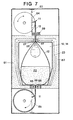
- the dough preparation station of the baking apparatus can be designed in many ways, and a first variant is shown in Figs. 1-2.
- the ingredients in the plastic bag 12 and the dough 24 are worked along a path, which principally has the same function as a rolling board.
- the path or the rolling board 38 is curved and forms a part of a circular arc in the center of which a pivot axle 39 is arranged, which transfers its movement to two arms 40.
- the rolling board 38 is fixedly attached in a housing 41 comprising the dough preparation station 13 with the driving means 42 for the arms 40 and a heat treatment station 14 or baking oven with a driving means 43 for linear movement of the baking oven 14 from a pushed-in to a drawn-out position.
- the housing 41 is further provided with a lid 44 pivoted about a hinge 45.
- a holding means 11 for carrying the upper opening of the plastic bag 12 is also pivoted about said hinge.
- the dough preparation station 13 consists of the above mentioned arms 40 placed on each side of the part-cylindrical rolling board 38. To the upper end of the arms 40 are attached kneading means 20 consisting of a roller 46 arranged at the free end of a pair of links 47 which are rotatably attached to a pressing roll 48 which is freely rotatably mounted at the free ends of the arms 40.
- the upper end of the rolling board 38 is formed with a somewhat larger radius than the rest of the rolling board so that a harder pressure by the pressing roll 48 against the rolling board 38 is obtained in that area.
- the arms are preferably in the form of telescoping arms in which is arranged a tension spring exerting a predetermined pressure on the pressing roll 48 against the rolling board 38.
- the roller 46 is appropriately made with fixation pieces 49 through which the lower end of the plastic bag 12 can be affixed to the roller.
- the roller 46 consists of an outer casing, for example of a somewhat elastic material, such as synthetic rubber, and an inner cylinder 51, which is rotatably mounted at the free ends of the links 47.
- Each of the outer casing 50 and the inner cylinder 51 is equipped with its own slit 52, 53 in which the lower end of the plastic bag can be inserted and fixed by moving the outer casing 50 relative to the cylinder 51.
- the lower end part of the plastic bag inserted in the slit may already be slitted and held closed by the fixation pieces 49, but it is also possible to equip the roller 46 with a cutting device 27 in the form of a slitted bushing 54 inside the inner cylinder, the slit being placed opposite the slits 53 and 52 so that the extreme end of the plastic bag can be inserted in the slit 55.
- the bushing 54 is longer than the inner cylinder 51 and actuating members 56 are attached to the portions outside the inner cylinder 51 which in a certain position of the roller 46 cooperates with fixed abutments (not shown) so that the bushing is turned in relation to the cylinder whereby the end of the plastic bag inserted in the slit 55 is cut off.
- the flexible vessel 12 which e.g. can be a plastic bag of a heat resistant material, can be used as a transportation package for the dry ingredients from the producer to the user and as a vessel during the preparation of the dough and therefore withstand rough mechanical treatment and possibly also contains a second plastic bag or the like, in which is contained the liquid required for preparation of the dough.
- the dough liquid can also be added through a nozzle 16, especially if the liquid is only water.
- the plastic bag 12 is attached to at least two holding means 11 which are so formed that the end pieces of the opening 18 of the plastic bag can be squeezed between gripping means 17.
- the baking apparatus After attaching the plastic bag 12 to the holding means 11 the baking apparatus is programmed by, for example, a punched card which is sensed by the programmer which then takes care of the whole production process.
- the punched card could possibly be supplied with the dry ingredients, attached to the package or alternatively be part of a program library belonging to the baking apparatus.
- the plastic bag 12 can either in a separate bag contain baking liquid, which separate bag through the action of the dough preparation station is opened so that its content is emptied into the plastig bag, or also it is possible to add the liquid manually as will be described below.
- Fig. 1 the upper end of the plastic bag is fixed in the holding means 11 of the baking apparatus, which holds the bag open so that an opening is formed.
- the kneading means 20 of the dough preparation station are placed in the position in which the plastic bag can be drawn under the pressing roll 48 while the lower end of the plastic bag can simultaneously be fixed to the roller 46.
- the arms 40 When the bag is in place the arms 40 are moved to their upper position in which the roller 48 exerts a pressure so great against the bag and rolling board 38 that an effective sealing is achieved. Then the dough liquid can be poured into the funnel-shaped upper part of the plastic bag 12 and the timer in the baking apparatus programmer is set to the desired initiation time.
- the arms are activated and moved downwards so that the liquid can run down and after a number of up and down movements about the axle 39 the dry ingredients have been mixed with the baking liquid to form a doughy mass.
- the kneading is repeated an appropriate number of times interrupted by fermentation periods.
- the programmer starts the drive mechanism which moves the baking oven 14 to the position in which the baking tin 28 is positioned under the lower end of the plastic bag 12.
- the arms 40 execute a much larger arcuate motion in comparison to the kneading motion, whereby the lower part of the plastic bag is cut off and released from the roller 46 while the pressing roll 48 presses the dough mass out of the lower opening of the plastic bag and into the baking form 28 during the rollers downward motion.
- the baking oven 14 is then drawn back to its original position where the actual baking takes place.
- the curved path i.e. the baking board 38
- the curved path i.e. the baking board 38
- the curved path i.e. the baking board 38
- the curved path i.e. the baking board 38
- the curved path i.e. the baking board 38
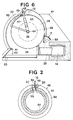
- this is equipped with a kneading means 20 rotatable from the center of a drum 58, which kneading means is equipped with fixation means 49 at its free end for holding the lower end of the plastic bag 12.
- the upper end of the bag is connected to a holding means 11 in such a way that a funnel-shaped opening is formed, whereby the attachment can be performed by drawing the folded edges of the plastic bag around the opening over a frame 59 fastened to the holding means 11.
- a pressing roll 48 is also rotatably affixed at the center of the drum 58 and is spring supported by two arms 40 whereby the springs draw the pressing roll 48 radially inwardly towards the envelope surface of the drum 58.
- the pressing roll 48 is further guided by guide means 60 which is curved along the curve of the drum and which is rotatable about a hinge 61 by a drive mechanism 62.
- the guide means 60 can also be formed by the front cover of the baking apparatus. It is possible that a rod means 63 can come from the drive mechanism 62 which together with manoeuver- ing the cover 60 moves the baking tin 28 from a position outside the heat treatment station 14 to a position within.
- the holding means 11 In the initial position (Fig. 4) the holding means 11 is placed on one side, the right side, of the highest point of the drum 58. In that position the plastic bag with the dry ingredients is attached to the holding means 11, at which upper part of the plastic bag is formed a funnel-like opening. Into this opening is poured the required amount of liquid to form the dough and then the baking apparatus timer is adjusted to the desired start time. In a programmer, not shown, a program card is inserted or a desired program is started. After the allotted time the drum 58 is turned slowly counter clockwise until the funnel-shaped opening is located at the highest point of the drum 58 and the liquid can flow over to that part of the plastic bag where the dry ingredients are located (Fig. 5).
- the kneading means 20 which is fixed to the lower end of the bag, will move.
- the kneading means 20 is activated and carries out a to and fro motion about the central drive axle 39 of the drum by means of a drive mechanism 42 placed in the drum.
- the kneading can be augmented by the pressing roll 48 which independently of the kneading means 20 is rotatable around a pipe axle 64 about the rotation axle 39.
- the pressing roll 48 can be held at an appropriate distance from the baking board 38 of the drum 58 by means of a spring 65 so that an appropriate redistribution of the dough mass in the plastic bag 12 is achieved.
- Working the dough through the kneading piece 20 is shown in Fig. 5.
- the guide 60 acting as a cover can be adjusted for light pressure on the plastic bag during the fermentation periods, whereby an effective distribution of the heat from the fermentation process is achieved.
- the cover is appropriately made of a heat conducting material, for example aluminum. During the fermentation itself the cover can only weakly contact the plastic bag and must give way when the dough expands.
- the drum 58 is rotated clockwise enough that the tunnel-shaped opening with the holding means 11 is located above the baking tin 28, as shown in Fig. 6.
- the kneading means 20 also partakes of this motion so that the plastic bag 12 is turned upside down. In this position the pressing roll 48 is activated, which has left the guide 60 and is biased by the spring 65 in the direction towards the rolling board 38 of the drum 58.
- the pressing roll 48 is moved over the whole length of the plastic bag up to the funnel-shaped holding means 11 pressing the dough out of the plastic bag opening and into the baking tin 28. Before the actual baking takes place a further fermentation can be performed. Finally the drive mechanism 62 moves the baking tin 28 into the heat treatment station 14 where it is possible for a final fermentation to take place and the baking is carried out. When the baking procedure is concluded it is possible that the baking tin 28 is again taken out of the baking oven so that the bread can cool outside the oven.
- the heat treatment station is adjusted also in accordance with those requirements. If the dough for example is to be boiled in water or fried in oil the baking tin is exchanged for an appropriate cooking vessel.
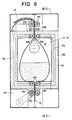
- the embodiment shown in Fig. 7 comprises a common dough preparation and heat treatment station 13,14 consisting of two housing halves 81, 82 of which the first one 81 is stationary while the second one 82 is displaceable or rotatable with respect to the stationary half.
- the movable housing half 82 is rotatable about a vertical hinge 83 so that the dough preparation and heat treament stations 13, 14 and the holding means can be reached.
- the mixing of the ingredients and the dough preparation is accomplished by attaching the upper end portion of the plastic bag 12 to a holding means 11 at an upper rotatable roll 84, while the lower end of the plastic bag in a corresponding way is attached to another holding means 11 at a lower rotatable roll 85.
- the rolls 84 and 85 are driven by a reversible motor (not shown) about one revolution, after which the motor is reversed. In this way the plastic bag 12 is given an oscillating up and downwards movement.
- the plastic bag must pass through an upper and a lower slit-shaped opening 86 between the housing halves 81 and 82, which only permits a substantially empty plastic bag to pass.
- the plastic bags with the ingredients are preferably delivered hermetically sealed and if the baking recipe prescribes that the preparation of the dough and/or the baking should be made under atmospheric conditions it is appropriate to arrange a perforation and/or cutting device 89, which can perforate the plastic bag in a certain position, so that the interior of the bag will communicate with the atmosphere.
- the device also can provide a cutting-off of the bag, which may be desired during the baking procedure, especially in cases where the interior space of the baking oven also should serve as a baking tin and where it is desired that the dough should spread over the entire baking tin and not be limited by an expanded bag 12.
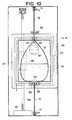
- the holding means 11 consist of driven rolls 91 provided with teeth 90, which engage perforations 92 at the side edges of the plastic bag, by which the plastic bag 12 can be transported up and down in the same way as was described with reference to the embodiment of Fig. 7.
- This new embodiment however has the advantage that the construction can be made even more compact, i.e. with a lower constructional height, and that the attachment of the plastic bag 12 to the attachment members of the combined holding-and transport device, i.e. the teeth 90, can be simplified further.
- FIG. 10 Another alternative embodiment of the baking apparatus shown in Figs. 7, 8 and 9 is shown in Fig. 10, where the plastic bag is stationary, i.e. it is at its upper and lower ends attached to appropriate holding means 11, while the combined dough preparation and heat treatment station 13, 14 in its two-piece design is movable in the longitudinal direction of the plastic bag 12.
- This displaceability of the baking oven is provided by means of two spindles 95 arranged on opposite sides of the baking oven and rotatable by means of a motor 42, the spindles cooperating with nuts 96 fixedly attached to the outer casing of the baking oven.
- a bag 97 with the baking liquid will in the same way as in the embodiment according to Figs.
- Fig. 1 a section through a baking apparatus which is constructed so that mixing of the ingredients and the kneading of the dough is made by the combined dough kneading-and heat treatment station 13, 14 located in vertical position, while the bread loaf or pizza is rolled out with the apparatus in certainal position.
- the baking oven is pivoted about a pivot 98, which by way of a gear 99 and a motor (not shown) can be turned from vertical to horizontal position and vice versa.
- the working of the dough is made by means of a kneading means 20 movable in the longitudinal direction of the dough kneading station 13 and which during its up- and downwards motion in the kneading station works the dough mass.
- a kneading means 20 movable in the longitudinal direction of the dough kneading station 13 and which during its up- and downwards motion in the kneading station works the dough mass.
- the liquid can be supplied to the ingredients at an appropriate time.
Landscapes
- Life Sciences & Earth Sciences (AREA)
- Engineering & Computer Science (AREA)
- Food Science & Technology (AREA)
- Chemical & Material Sciences (AREA)
- Chemical Kinetics & Catalysis (AREA)
- Manufacturing And Processing Devices For Dough (AREA)
- Baking, Grill, Roasting (AREA)
- Food-Manufacturing Devices (AREA)
- Bakery Products And Manufacturing Methods Therefor (AREA)
- Slide Fasteners, Snap Fasteners, And Hook Fasteners (AREA)
- Preliminary Treatment Of Fibers (AREA)
- Carpets (AREA)
- Cereal-Derived Products (AREA)
Claims (18)
dadurch gekennzeichnet,
Priority Applications (1)
| Application Number | Priority Date | Filing Date | Title |
|---|---|---|---|
| AT83850344T ATE32488T1 (de) | 1982-12-28 | 1983-12-27 | Geraet fuer die automatische herstellung von nahrungsmitteln wie brot, kuchen und dergleichen. |
Applications Claiming Priority (2)
| Application Number | Priority Date | Filing Date | Title |
|---|---|---|---|
| SE8207438A SE8207438D0 (sv) | 1982-12-28 | 1982-12-28 | Sett for tillverkning av matvaruprodukter sasom brod, kakor och liknande och bakautomat for tillverkning av sagda produkter |
| SE8207438 | 1982-12-28 |
Publications (3)
| Publication Number | Publication Date |
|---|---|
| EP0113327A2 EP0113327A2 (de) | 1984-07-11 |
| EP0113327A3 EP0113327A3 (en) | 1984-10-24 |
| EP0113327B1 true EP0113327B1 (de) | 1988-02-17 |
Family
ID=20349172
Family Applications (2)
| Application Number | Title | Priority Date | Filing Date |
|---|---|---|---|
| EP83850344A Expired EP0113327B1 (de) | 1982-12-28 | 1983-12-27 | Gerät für die automatische Herstellung von Nahrungsmitteln wie Brot, Kuchen und dergleichen |
| EP84900333A Pending EP0159991A1 (de) | 1982-12-28 | 1983-12-27 | Vorrichtung zur selbsttätigen herstellung von nahrungsmitteln wie brot, kuchen und ähnlichen |
Family Applications After (1)
| Application Number | Title | Priority Date | Filing Date |
|---|---|---|---|
| EP84900333A Pending EP0159991A1 (de) | 1982-12-28 | 1983-12-27 | Vorrichtung zur selbsttätigen herstellung von nahrungsmitteln wie brot, kuchen und ähnlichen |
Country Status (12)
| Country | Link |
|---|---|
| US (1) | US4550653A (de) |
| EP (2) | EP0113327B1 (de) |
| JP (1) | JPS60500319A (de) |
| AT (1) | ATE32488T1 (de) |
| AU (1) | AU568328B2 (de) |
| CA (1) | CA1223773A (de) |
| DE (1) | DE3375685D1 (de) |
| DK (1) | DK161553C (de) |
| ES (1) | ES8500010A1 (de) |
| FI (1) | FI76477C (de) |
| SE (1) | SE8207438D0 (de) |
| WO (1) | WO1984002449A1 (de) |
Families Citing this family (30)
| Publication number | Priority date | Publication date | Assignee | Title |
|---|---|---|---|---|
| KR850004186A (ko) * | 1983-12-27 | 1985-07-11 | 오더 아 퇸두리 | 베이킹 장치 |
| AT393771B (de) * | 1985-12-23 | 1991-12-10 | Heden Team Ag | Vorrichtung und verfahren zur automatischen herstellung von lebens- bzw. nahrungsmitteln in stueckform aus teigartigen substanzen |
| DE3761205D1 (de) * | 1986-03-10 | 1990-01-25 | Solly Katz | Ausgeber fuer fluessigkeiten. |
| US5146840A (en) * | 1989-11-22 | 1992-09-15 | Heden-Team Ag | Automatic baking apparatus and mixbag therefore |
| AT393932B (de) * | 1990-02-12 | 1992-01-10 | Mayerhofer Richard | Hufeiseneinlage |
| NO940868L (no) * | 1993-03-29 | 1994-09-30 | Bfe Ltd | Fremgangsmåte og anordning for brödbaking |
| US5544569A (en) * | 1993-05-21 | 1996-08-13 | Langhammer; Jerome | Griddle and heater bag |
| US5704277A (en) * | 1994-11-29 | 1998-01-06 | Yung; Simon K. C. | Breadmaker and a coding system therefor |
| US5967021A (en) * | 1994-11-29 | 1999-10-19 | Yung; Simon K. C. | Food appliance and a coding system therefor |
| FR2733124B1 (fr) * | 1995-04-21 | 1997-08-14 | Acknin Christian | Procede de fabrication mecanisee de mets sales ou sucres a base de pate et d'ingredients contenus dans des dosettes et machine a cet effet |
| TW391867B (en) | 1997-11-17 | 2000-06-01 | Heden Team Ag | Automatic baking apparatus and mixbag thereof |
| WO2003012027A1 (de) * | 2001-07-31 | 2003-02-13 | Ursula Erhardt | Bioreaktor mit einer apparatur mit flexiblen wandungen |
| US6634783B2 (en) | 2001-08-09 | 2003-10-21 | Vitality Beverages, Inc. | Apparatus for agitating a fluid suspension |
| US6957111B2 (en) * | 2001-08-24 | 2005-10-18 | Koninklijke Philips Electronics N.V. | Automated system for cooking and method of use |
| KR100471073B1 (ko) * | 2002-07-19 | 2005-03-10 | 삼성전자주식회사 | 제빵기 |
| KR100456587B1 (ko) * | 2002-07-20 | 2004-11-10 | 삼성전자주식회사 | 제빵기 |
| KR100471072B1 (ko) | 2002-07-20 | 2005-03-10 | 삼성전자주식회사 | 제빵기 |
| KR100473061B1 (ko) * | 2002-09-14 | 2005-03-10 | 삼성전자주식회사 | 제빵기 |
| EP1565257B1 (de) * | 2002-11-20 | 2007-01-10 | Unilever N.V. | Vorrichtung und verfahren zum mischen von komponenten |
| US8177415B1 (en) * | 2006-07-24 | 2012-05-15 | Tarpaulin.Com, Inc. | System for agitating pouched products |
| US20080178749A1 (en) * | 2007-01-25 | 2008-07-31 | Stutman Peter S | Remotely controlled system and method for the preparation of a user-defined food product or beverage |
| KR20090099802A (ko) * | 2008-03-18 | 2009-09-23 | 모영환 | 농업용 비닐피복기 |
| KR100903745B1 (ko) * | 2008-03-18 | 2009-06-19 | 웅진코웨이주식회사 | 배출장치 및 이를 구비한 음식물 처리기의 건조로 |
| US20110048246A1 (en) * | 2009-08-27 | 2011-03-03 | Kuei-Tang Chang | Inner pot assembly for hot-air baking oven and hot-air baking oven having such assembly |
| US9469426B2 (en) * | 2010-03-08 | 2016-10-18 | Therapeutic Proteins International, LLC | Single-use stationary bioreactors and mixing vessels |
| GB2506940B (en) * | 2012-10-15 | 2015-09-30 | Zendegii Ltd | Beverage dispensing machine |
| AR109602A1 (es) * | 2016-09-09 | 2018-12-26 | Fmc Corp | Sistema y método de dispersión química seco concentrado cerrado |
| US10492500B1 (en) | 2018-08-31 | 2019-12-03 | Samuel Siwak | Dispensing baked good container assembly and method |
| CN113710096A (zh) | 2019-02-05 | 2021-11-26 | 因文特赫姆有限责任公司 | 冷冻甜品机 |
| US11896158B2 (en) * | 2021-12-02 | 2024-02-13 | Gerald J. Block | Automated aseptic fryer |
Family Cites Families (18)
| Publication number | Priority date | Publication date | Assignee | Title |
|---|---|---|---|---|
| US2800269A (en) * | 1954-03-09 | 1957-07-23 | Milprint Inc | Valved bag |
| US3194185A (en) * | 1962-07-26 | 1965-07-13 | Milena C Lodico | Pie dough rolling and mixing bag |
| US3282412A (en) * | 1963-11-06 | 1966-11-01 | Wayne V Rodgers | Valved mixing container or package |
| SE329115B (de) * | 1967-12-27 | 1970-09-28 | Nitro Nobel Ab | |
| US3582263A (en) * | 1969-10-31 | 1971-06-01 | Sylvania Electric Prod | Solvent extraction process for separating gadolinium from terbium and dysprosium |
| US3873735A (en) * | 1971-05-04 | 1975-03-25 | Nabisco Inc | Food package for heating and venting |
| BE788274A (fr) | 1971-09-06 | 1973-02-28 | Unilever Nv | Dispositifs servant a melanger des matieres |
| US3771773A (en) * | 1971-11-30 | 1973-11-13 | K Schriever | Method of and device for intermixing two or more components to make up a substance, especially for dentistry |
| GB1414672A (en) | 1972-01-21 | 1975-11-19 | Platt Saco Lowell Ltd | Threading yarn through twisting bushes |
| US3882768A (en) * | 1974-02-25 | 1975-05-13 | Dunkin & 0 Donuts Inc | Automatic donut making system |
| FR2389947A1 (en) * | 1977-05-04 | 1978-12-01 | Ugarte Mendia Yves | Vending machine for various pastries - which are made and cooked on insertion of coin |
| JPS5435278A (en) | 1977-08-19 | 1979-03-15 | Shigeo Takeuchi | Bread making method and apparatus |
| FR2406392A1 (fr) * | 1977-10-21 | 1979-05-18 | Joulin Gerard | Produit panifie et son procede de fabrication |
| US4357356A (en) * | 1978-10-06 | 1982-11-02 | Gerard Joulin | Bread and method for making same |
| US4202257A (en) * | 1978-11-24 | 1980-05-13 | France Bed Co., Ltd. | Cooking apparatus |
| US4189992A (en) * | 1979-01-15 | 1980-02-26 | Barry John D A | Bread baking |
| US4241648A (en) * | 1979-04-02 | 1980-12-30 | Roberto G. Barrera | Apparatus for shaping and precooking of tortillas |
| GB2049604A (en) * | 1979-05-17 | 1980-12-31 | Parr T K | Pastry package |
-
1982
- 1982-12-28 SE SE8207438A patent/SE8207438D0/xx unknown
-
1983
- 1983-04-01 US US06/481,154 patent/US4550653A/en not_active Expired - Lifetime
- 1983-12-27 EP EP83850344A patent/EP0113327B1/de not_active Expired
- 1983-12-27 AU AU24176/84A patent/AU568328B2/en not_active Ceased
- 1983-12-27 AT AT83850344T patent/ATE32488T1/de active
- 1983-12-27 DE DE8383850344T patent/DE3375685D1/de not_active Expired
- 1983-12-27 EP EP84900333A patent/EP0159991A1/de active Pending
- 1983-12-27 WO PCT/SE1983/000481 patent/WO1984002449A1/en not_active Ceased
- 1983-12-27 ES ES528430A patent/ES8500010A1/es not_active Expired
- 1983-12-27 JP JP59500464A patent/JPS60500319A/ja active Granted
- 1983-12-28 CA CA000444321A patent/CA1223773A/en not_active Expired
-
1984
- 1984-08-28 DK DK409184A patent/DK161553C/da not_active IP Right Cessation
-
1985
- 1985-01-28 FI FI850359A patent/FI76477C/fi not_active IP Right Cessation
Also Published As
| Publication number | Publication date |
|---|---|
| JPS6112644B2 (de) | 1986-04-09 |
| EP0113327A3 (en) | 1984-10-24 |
| DK409184A (da) | 1984-08-28 |
| SE8207438D0 (sv) | 1982-12-28 |
| AU568328B2 (en) | 1987-12-24 |
| AU2417684A (en) | 1984-07-17 |
| FI76477B (fi) | 1988-07-29 |
| WO1984002449A1 (en) | 1984-07-05 |
| FI850359A0 (fi) | 1985-01-28 |
| ES528430A0 (es) | 1984-10-01 |
| ES8500010A1 (es) | 1984-10-01 |
| DK161553C (da) | 1992-01-06 |
| EP0113327A2 (de) | 1984-07-11 |
| FI850359L (fi) | 1985-01-28 |
| US4550653A (en) | 1985-11-05 |
| EP0159991A1 (de) | 1985-11-06 |
| JPS60500319A (ja) | 1985-03-14 |
| DK161553B (da) | 1991-07-22 |
| DE3375685D1 (en) | 1988-03-24 |
| DK409184D0 (da) | 1984-08-28 |
| ATE32488T1 (de) | 1988-03-15 |
| FI76477C (fi) | 1988-11-10 |
| CA1223773A (en) | 1987-07-07 |
Similar Documents
| Publication | Publication Date | Title |
|---|---|---|
| EP0113327B1 (de) | Gerät für die automatische Herstellung von Nahrungsmitteln wie Brot, Kuchen und dergleichen | |
| US4590850A (en) | Apparatus for automatically making of food products such as bread, cakes and the like | |
| US4550654A (en) | Apparatus for automatic preparation of food products such as bread, cakes and the like | |
| US5630358A (en) | Countertop appliance for making disc-shaped edibles | |
| US5146840A (en) | Automatic baking apparatus and mixbag therefore | |
| US4294166A (en) | Apparatus for mixing and baking of bread | |
| AT393771B (de) | Vorrichtung und verfahren zur automatischen herstellung von lebens- bzw. nahrungsmitteln in stueckform aus teigartigen substanzen | |
| JP4067764B2 (ja) | 自動ベーキング装置及び同装置用ミックスバッグ | |
| RU2120758C1 (ru) | Способ выпечки хлеба и устройство для его осуществления | |
| US10986844B2 (en) | Machines and methods for making flatbreads | |
| EP0243364B1 (de) | Vorrichtung zur automatischen herstellung von nähmitteln, wie brot, kekse und sonstiges | |
| WO1992010100A1 (en) | Automatic baking apparatus and mixbag therefor | |
| CN209814930U (zh) | 一种蛋挞运输装置及包含其的蛋挞自动制作装置 | |
| US5551333A (en) | Automatic cooking apparatus | |
| US3450067A (en) | Automatic egg roll machine | |
| KR200271788Y1 (ko) | 자동 반죽물 성형장치 | |
| CN210094484U (zh) | 一种蛋挞液制作装置及包含其的蛋挞自动制作装置 | |
| KR890000506B1 (ko) | 베이킹 장치 | |
| Cheng | FOOD MACHINERY CL | |
| NO163931B (no) | Anordning for automatisk tilvirkning av matvareprodukter,s som broed, kaker og lignende. | |
| CN210019029U (zh) | 一种烤盘进出装置及包含其的蛋挞自动制作装置 | |
| Bennion et al. | Bakery machinery and plant | |
| WO2020170016A1 (en) | A system for preparing and processing food |
Legal Events
| Date | Code | Title | Description |
|---|---|---|---|
| PUAI | Public reference made under article 153(3) epc to a published international application that has entered the european phase |
Free format text: ORIGINAL CODE: 0009012 |
|
| AK | Designated contracting states |
Designated state(s): IT |
|
| PUAL | Search report despatched |
Free format text: ORIGINAL CODE: 0009013 |
|
| AK | Designated contracting states |
Designated state(s): IT |
|
| 17P | Request for examination filed |
Effective date: 19850114 |
|
| RBV | Designated contracting states (corrected) |
Designated state(s): VE BU DE |
|
| XX | Miscellaneous (additional remarks) |
Free format text: VERBUNDEN MIT 84900333.0/0159991 (EUROPAEISCHE ANMELDENUMMER/VEROEFFENTLICHUNGSNUMMER) DURCH ENTSCHEIDUNG VOM 27.03.86. |
|
| RAP1 | Party data changed (applicant data changed or rights of an application transferred) |
Owner name: HEDEN-TEAM AKTIENGESELLSCHAFT |
|
| RAP1 | Party data changed (applicant data changed or rights of an application transferred) |
Owner name: HEDEN-TEAM AKTIENGESELLSCHAFT |
|
| GRAA | (expected) grant |
Free format text: ORIGINAL CODE: 0009210 |
|
| AK | Designated contracting states |
Kind code of ref document: B1 Designated state(s): AT BE CH DE FR GB IT LI LU NL SE |
|
| REF | Corresponds to: |
Ref document number: 32488 Country of ref document: AT Date of ref document: 19880315 Kind code of ref document: T |
|
| XX | Miscellaneous (additional remarks) |
Free format text: VERBUNDEN MIT 84900333.0/0159991 (EUROPAEISCHE ANMELDENUMMER/VEROEFFENTLICHUNGSNUMMER) DURCH ENTSCHEIDUNG VOM 27.03.86. |
|
| ITF | It: translation for a ep patent filed | ||
| REF | Corresponds to: |
Ref document number: 3375685 Country of ref document: DE Date of ref document: 19880324 |
|
| ET | Fr: translation filed | ||
| PLBE | No opposition filed within time limit |
Free format text: ORIGINAL CODE: 0009261 |
|
| STAA | Information on the status of an ep patent application or granted ep patent |
Free format text: STATUS: NO OPPOSITION FILED WITHIN TIME LIMIT |
|
| 26N | No opposition filed | ||
| ITTA | It: last paid annual fee | ||
| EPTA | Lu: last paid annual fee | ||
| EAL | Se: european patent in force in sweden |
Ref document number: 83850344.9 |
|
| PGFP | Annual fee paid to national office [announced via postgrant information from national office to epo] |
Ref country code: LU Payment date: 20001201 Year of fee payment: 18 |
|
| PGFP | Annual fee paid to national office [announced via postgrant information from national office to epo] |
Ref country code: FR Payment date: 20001212 Year of fee payment: 18 |
|
| PGFP | Annual fee paid to national office [announced via postgrant information from national office to epo] |
Ref country code: AT Payment date: 20001213 Year of fee payment: 18 |
|
| PGFP | Annual fee paid to national office [announced via postgrant information from national office to epo] |
Ref country code: DE Payment date: 20001218 Year of fee payment: 18 |
|
| PGFP | Annual fee paid to national office [announced via postgrant information from national office to epo] |
Ref country code: SE Payment date: 20001222 Year of fee payment: 18 Ref country code: CH Payment date: 20001222 Year of fee payment: 18 |
|
| PGFP | Annual fee paid to national office [announced via postgrant information from national office to epo] |
Ref country code: GB Payment date: 20001227 Year of fee payment: 18 |
|
| PGFP | Annual fee paid to national office [announced via postgrant information from national office to epo] |
Ref country code: NL Payment date: 20001231 Year of fee payment: 18 |
|
| PGFP | Annual fee paid to national office [announced via postgrant information from national office to epo] |
Ref country code: BE Payment date: 20010315 Year of fee payment: 18 |
|
| PG25 | Lapsed in a contracting state [announced via postgrant information from national office to epo] |
Ref country code: LU Free format text: LAPSE BECAUSE OF NON-PAYMENT OF DUE FEES Effective date: 20011227 Ref country code: GB Free format text: LAPSE BECAUSE OF NON-PAYMENT OF DUE FEES Effective date: 20011227 Ref country code: AT Free format text: LAPSE BECAUSE OF NON-PAYMENT OF DUE FEES Effective date: 20011227 |
|
| PG25 | Lapsed in a contracting state [announced via postgrant information from national office to epo] |
Ref country code: SE Free format text: LAPSE BECAUSE OF NON-PAYMENT OF DUE FEES Effective date: 20011228 |
|
| PG25 | Lapsed in a contracting state [announced via postgrant information from national office to epo] |
Ref country code: LI Free format text: LAPSE BECAUSE OF NON-PAYMENT OF DUE FEES Effective date: 20011231 Ref country code: CH Free format text: LAPSE BECAUSE OF NON-PAYMENT OF DUE FEES Effective date: 20011231 Ref country code: BE Free format text: LAPSE BECAUSE OF NON-PAYMENT OF DUE FEES Effective date: 20011231 |
|
| REG | Reference to a national code |
Ref country code: GB Ref legal event code: IF02 |
|
| BERE | Be: lapsed |
Owner name: HEDEN-TEAM A.G. Effective date: 20011231 |
|
| PG25 | Lapsed in a contracting state [announced via postgrant information from national office to epo] |
Ref country code: NL Free format text: LAPSE BECAUSE OF NON-PAYMENT OF DUE FEES Effective date: 20020701 |
|
| PG25 | Lapsed in a contracting state [announced via postgrant information from national office to epo] |
Ref country code: DE Free format text: LAPSE BECAUSE OF NON-PAYMENT OF DUE FEES Effective date: 20020702 |
|
| EUG | Se: european patent has lapsed |
Ref document number: 83850344.9 |
|
| GBPC | Gb: european patent ceased through non-payment of renewal fee |
Effective date: 20011227 |
|
| REG | Reference to a national code |
Ref country code: CH Ref legal event code: PL |
|
| PG25 | Lapsed in a contracting state [announced via postgrant information from national office to epo] |
Ref country code: FR Free format text: LAPSE BECAUSE OF NON-PAYMENT OF DUE FEES Effective date: 20020830 |
|
| NLV4 | Nl: lapsed or anulled due to non-payment of the annual fee |
Effective date: 20020701 |
|
| REG | Reference to a national code |
Ref country code: FR Ref legal event code: ST |