EP0110167B1 - Method for making high surface area bismuth-containing pyrochlores - Google Patents
Method for making high surface area bismuth-containing pyrochlores Download PDFInfo
- Publication number
- EP0110167B1 EP0110167B1 EP83110855A EP83110855A EP0110167B1 EP 0110167 B1 EP0110167 B1 EP 0110167B1 EP 83110855 A EP83110855 A EP 83110855A EP 83110855 A EP83110855 A EP 83110855A EP 0110167 B1 EP0110167 B1 EP 0110167B1
- Authority
- EP
- European Patent Office
- Prior art keywords
- carbonate
- dispersion
- solution
- finely divided
- mixtures
- Prior art date
- Legal status (The legal status is an assumption and is not a legal conclusion. Google has not performed a legal analysis and makes no representation as to the accuracy of the status listed.)
- Expired
Links
Images
Classifications
-
- H—ELECTRICITY
- H01—ELECTRIC ELEMENTS
- H01C—RESISTORS
- H01C17/00—Apparatus or processes specially adapted for manufacturing resistors
- H01C17/06—Apparatus or processes specially adapted for manufacturing resistors adapted for coating resistive material on a base
- H01C17/065—Apparatus or processes specially adapted for manufacturing resistors adapted for coating resistive material on a base by thick film techniques, e.g. serigraphy
- H01C17/06506—Precursor compositions therefor, e.g. pastes, inks, glass frits or green body
- H01C17/06513—Precursor compositions therefor, e.g. pastes, inks, glass frits or green body characterised by the resistive component
- H01C17/06533—Precursor compositions therefor, e.g. pastes, inks, glass frits or green body characterised by the resistive component composed of oxides
- H01C17/0654—Oxides of the platinum group
Definitions
- This invention is directed to a method for making bismuth-containing pyrochlores for use in thick film resistors.
- Thick film materials are mixtures of metal, glass and/or ceramic powders dispersed in an organic medium. These materials, which are applied to nonconductive substrates to form conductive, resistive or insulating films, are used in a wide variety of electronic and light electrical components.
- the conductive phase determines the electrical properties and influences the mechanical properties of the final film.
- the binder usually a glass and/or crystalline oxide, holds the thick film together and bonds it to the substrate, while the organic medium (vehicle) is the dispersing medium which influences the application characteristics of the composition and particularly its rheology.
- One of the most important and widely used class of materials for the conductive phase of thick film resistors are noble metal polyoxides which have the basic pyrochlore structure of A 2 B 2 0 7 , in which A is typically bismuth or lead, and B is ruthenium or iridium.
- the crystal lattice of this material can also be substituted with other metallic elements.
- Bouchard in U.S. Patent 3,583,931 discloses the use in thick film resistors of bismuth-containing pyrochlores having the structure (Bi 2-x M x )(M' y M" 2-y )O 7-z .
- M is yttrium, thalium, indium, cadmium, lead and certain rare earth metals
- M' is platinum, titanium, chromium, rhodium or antimony
- M" is iridium or ruthenium.
- a number of U.S. patents to Horowitz et al. disclose pyrochlores of the general formula A 2 [B 2-x A x ]O 7-y , in which A is bismuth or lead, and B is ruthenium or iridium.
- the above-described pyrochlores have been prepared by either of two methods.
- the first is a solid state reaction
- the second is a liquid phase reaction in an aqueous alkaline medium.
- Bouchard, US-A-3,583,931 discloses a solid state reaction process for making the bismuth-containing pyrochlores with the formula given above in which a mixture of the metal oxides or oxide precursors is fired at 600-1200°C, preferably 750°-1000°C, for from one to 30 hours.
- Horowitz et al., US-A-4,124,539 disclose a solid state reaction process for making lead-rich pyrochlores of the formula Pb 2 (B 2-x Pb x )O 7-y , where O ⁇ x ⁇ 1.2, in which a mixture of a powdered lead source such as lead nitrate and a powdered ruthenium and/or iridium source, chosen so that the molar ratio of Pb to Ru and/or Ir is at least 1:1 and preferably 1.3:1.0 to 5.0:1.0, is reacted at temperatures below about 600°C in an oxygen-containing atmosphere.
- a powdered lead source such as lead nitrate
- ruthenium and/or iridium source chosen so that the molar ratio of Pb to Ru and/or Ir is at least 1:1 and preferably 1.3:1.0 to 5.0:1.0
- the bismuth pyrochlore generally contains a second phase when prepared by a process similar to the solid state reaction of U.S. 4,124,539.
- the second method produces pyrochlores of quite high surface area, but the process is considerably less economical. Consequently, there is a real need for a bismuth pyrochlore manufacturing process which is both economical and which results in a high surface area product.
- the invention which is a process for making such pyrochlores wherein M is selected from the group consisting of cadmium, copper, lead, indium, gadolinium, silver and mixtures thereof, B is selected from the group consisting of ruthenium, iridium and mixtures thereof, x is from 0 to 0.5, and z is 0 to 1, said pyrochlores having a surface area exceeding 15 m 2 / g, comprising the sequential steps of:
- M is to be present in the product, it may be added as M nitrate or chloride in step (a).
- the intimate admixture of finely divided particles of BO z , Bi 2 0 z C0 3 and carbonate(s) of M is derived by:
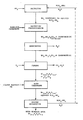
- the drawing consists of a single figure which is a block flow diagram showing the sequence of steps for the preferred process for carrying out the invention in which the admixture of Bi 2 O 2 CO 3 and B0 2 is derived from precipitation with alkaline carbonate of BiX 3 dissolved in an aqueous dispersion of finely divided particles of BO 2 .
- bismuth-containing pyrochlores we mean those pyrochlores having the formula (Bi 2-x M x )B 2 O 7-z as defined above.
- the admixture of B0 2 and Bi 2 O 2 CO 3 can be made in a variety of ways such as by either dry or wet blending the powders or by precipitation of the Bi 2 O 2 CO 3 in an aqueous dispersion of the BO z .
- the precise manner in which the reaction admixture is formed is, therefore, not so important as is the intimacy of the admixture of these materials. That is, the admixture must be formed of finely divided particles of both the oxide and carbonate materials, and the particles must be quite thoroughly mixed so as to form a compositionally uniform mixture.
- Bi/B mole ratio of at least 1.4:1 is considered essential, and a ratio of 4:1 is preferred.
- a Bi/ B mole ratio of at least 5:1 is preferred. Even higher ratios such as 10:1 can be used advantageously.
- ratios of Bi/B beyond about 5:1 are probably not justified because of their cost and because of the cost of extracting the excess oxide from the pyrochlore reaction product.
- the excess Bi is also advantageous in the following ways:
- BO 2 of the highest surface area which is available at reasonable cost because this results in a faster reaction rate. For this reason a particle size corresponding to a surface area of at least 20 m 2 /g is preferred. A particle size corresponding to a surface area of at least 30 m 2 /g is preferred even further. Typically, particles of average size corresponding to 30-60 m 2 /g have been used. Furthermore, when the BO 2 is admixed with Bi 2 O 2 CO 3 powders, it is similarly desirable to use high surface area Bi 2 O 2 CO 3 . Therefore, it is preferred that the particle size of the Bi 2 O 2 CO 3 also correspond to a surface area of at least 20 m2/ g .
- a preferred method for forming the intimate reaction admixture of Bi 2 O 2 CO 3 , M carbonate and B0 2 is by precipitation with alkaline carbonate of an aqueous dispersion of B0 2 in a solution of a soluble bismuth salt and, when x > O, a soluble M salt as well.
- either aqueous HCI or HN0 3 or mixtures thereof can be used as the dispersion medium.
- acid strength is not at all critical so long as the dispersion medium is sufficiently on the acid side to keep the bismuth chloride or bismuth nitrate in solution. Nevertheless, in order to minimize the amount of alkaline carbonate which must be added to precipitate Bi 2 O 2 CO 3 , it is preferred to keep the acidity to a minimal level.
- the bismuth nitrate or chloride can be added directly to the aqueous acid, or a suitable bismuth compound, e.g., Bi 2 O 3 or Bi 2 0 2 CO 3 , can be dissolved in HN0 3 or HCI solution to form the bismuth nitrate or chloride.
- a suitable bismuth compound e.g., Bi 2 O 3 or Bi 2 0 2 CO 3
- the soluble salt of the element M can be handled in the same manner. However, some adjustment of the relative amounts of the soluble M salts may be needed to accommodate differences in solubility which can be anticipated in the subsequent precipitation step.
- Suitable alkaline carbonates for the precipitation step include sodium, potassium and ammonium carbonates.
- ammonium carbonates cannot be used effectively as the precipitation agent when M is copper for the reason that they form a soluble complex with the copper compound which does not precipitate.
- M is copper
- sodium and potassium carbonate and sodium bicarbonate can be used.
- Sodium carbonate is preferred.
- the concentration of the alkali carbonate solution does not appear to be important. Either dilute or concentrated solutions can be used so long as the total amount of carbonate is sufficient to precipitate all of the Bi dissolved in the aqueous dispersion. In general, concentrated solutions will be preferred since smaller liquid volumes will have to be handled to precipitate a given quantity of Bi 2 O 2 CO 3 .
- a quite important aspect of the precipitation step is that the dispersion must be kept in a quite highly dispersed state so that the added carbonate precipitate is rapidly dispersed throughout the system and no significant localized concentration gradients are set up in the system. This is essential to avoid the formation of undesirable by-products such as other pyrochlore- related materials and to avoid leaving unreacted B0 2 in the dispersion.
- the rate of adding the alkali carbonate must be lowered with the degree of dispersion is less, but can be raised when the degree of dispersion is higher. That is, the precipitant can be added faster without adverse effect as the degree of agitation is increased.
- a suitably high degree of mixing is obtained by the use of high speed blenders and ultrasonic and jet stream type mixing devices.
- the temperature of the precipitation step is not at all critical and can be conducted at virtually any temperature at which the dispersion medium remains liquid.
- the temperature for the precipitation will usually be 20-100°C and frequently 50-70°C.
- the time for precipitation is not itself critical.
- the admixture of B0 2 and Bi 2 O 2 CO 3 is substantially dewatered prior to firing by centrifuging or filtering out the solids.
- the solids are then dried. It is preferred, but not essential, to wash the filtered precipitate with water to remove water-soluble by-products prior to firing.
- the firing step must be conducted above the decomposition temperature of the precipitated Bi 2 O 2 CO 3 and the carbonates of M, if they are present, but at a temperature no higher than about 650°C.
- Bismuth oxycarbonate decomposes at temperatures somewhat above 375°C.
- the carbonates of M such as PbC0 3 , C U C0 3 and A 92 CO 3 have decomposition temperatures below 375°C, the decomposition temperatures of some M carbonates may be higher.
- CdC0 3 decomposes at about 500°C, in which case the firing temperature must exceed 500°C.
- the minimum appropriate firing temperature can easily be determined by any one skilled in the art by examination of the fired material by X-ray diffraction to observe the presence of more than two solid state decomposition products.
- the rate of reaction during firing is directly related to the firing temperature. However, as the firing temperature is increased, especially above about 650°C, the surface area of the resultant particles is reduced.
- the firing time must be sufficient to effect complete decomposition of the oxycarbonate and the M carbonate, if it is present, and reaction with B0 2 .
- the firing time must be sufficient to effect complete decomposition of the oxycarbonate and the M carbonate, if it is present, and reaction with B0 2 .
- the firing step be conducted under oxidizing conditions to effect complete carbon removal from the reaction system.
- air will ordinarily be sufficient.
- Atmospheres containing less oxygen can be used by will require longer reaction time. Atmospheres having higher oxygen content might also be used, but are not significantly advantageous.
- the fired reaction product which is in finely divided form, is slurried in dilute aqueous HCI or HN0 3 .
- concentration of the acid is not critical. However, if the acid is too concentrated, it may chemically react with the pyrochlore. On the other hand, if the aqueous acid is too dilute, it will require an excessive time to remove all the Bi 2 0 3 and other oxides. In any event, enough acid of whatever strength is used must be applied to dissolve out all of the B l2 Og.
- the degree of agitation needed for this step is not high and need be only sufficient to assure contact of the fired particles with the acid. Size reduction of the reaction product of the firing step, e.g., by milling or grinding, is not required since the particles are already of sufficiently small size to facilitate ready dispersion with only mild mixing.
- the temperature of the acid treating step is not critical and it is generally preferred to use a temperature between 20-40°C.
- the time for washing out the Bi 2 0 3 and other oxides depends on the batch size and the amount of Bi 2 0 3 to be removed. Higher acid concentrations permit shorter washing times. A washing acid concentration of 5-50% by volume is preferred.
- the adequacy of the washing step is readily determined by X-ray defraction analysis of the washed product to determine that only the single pyrochlore phase is present.
- the final step of the process of the invention is to remove residual acid from the acid-washed product and to dry the product. This can easily be done by filtering out the acidic wash solution and washing the filtered solids with water until the pH of the wash water is substantially constant.
- the product may be separated and dried by various means, e.g., by filtration, centrifugation, vacuum drying, freeze drying and the like, as well as combinations of these. With any of the above methods, the product retains its very small particle size and does not require further size reduction for use in screen printable thick film compositions.
- the acid solutions used to wash out the Bi 2 0 3 and M oxides are a valuable source of Bi(N0 3 ) 2 or BiCl 3 and, thus, may be recycled after making suitable concentration adjustments. This will also help to lower product cost and reduce potential waste disposal problems.
- test substrates are mounted on terminal posts within a controlled temperature chamber and electrically connected to a digital ohm-meter.
- the temperature in the chamber is adjusted to 25°C and allowed. to equilibrate, after which the resistance of each substrate is measured and recorded.
- the temperature of the chamber is then raised to 125°C and allowed to equilibrate, after which the resistance of the substrate is again measured and recorded.
- TCR hot temperature coefficient of resistance
- R 25°c and Hot TCR are averaged and the R 25°c values are normalized to 25 ⁇ m dry printed thickness, and resistivity is reported as ohms per square at 25 ⁇ m dry print thickness. Normalization of the multiple test values is calculated with the following relationship:
- a 500 ml capacity glass separatory funnel was positioned above the glass mixing jar of a standard 1250 cm 3 Hamilton Beech® food blender. Attched to the outlet end of the separatory funel was a 10 mm OD glass tube of sufficient length to extend down through the jar cover to within 2" (1.27 cm) of the blender blades.
- the fine particle RuO 2 or IrO 2 powder can be introduced into the mixture by either slurry addition from the separatory funnel or by placement directly into the blender jar. If the RuO 2 or IrO 2 powder is placed in the separatory funnel along with the alkaline carbonate solution, then it is desirable to insert a glass tube into the separatory funnel so that gas bubbles can be used to stir the solution and thereby keep the Ru0 2 or IrO 2 in suspension during the addition of this slurry to the liquid in the blender jar. Combining the RuO 2 or IrO 2 directly with the Bi salt solution in the blender jar gave equivalent results.
- the contents of the separatory funnel were added slowly to the solution in the jar.
- the change in pH in the jar was followed by the use of a pH meter electrode mounted in the jar. By this means, it was possible to determine the degree of completion of the precipitation process during the high speed mixing.
- the mixing procedures took place over a 15-30 minute period. After the completion of the addition, stirring was maintained another 15-30 minutes. The resulting precipitate was then separated by filtration from the liquid and washed with distilled water to remove the water-soluble by-products. The precipitate was dried in air, followed by firing in air at temperatures ranging from 400° to 650°C for times ranging from 50 minutes to 16 hours.
- the fired samples were then treated with aqueous acid solvent using either mechanical or ultrasonic stirring.
- the process time ranged from 30 to 120 minutes.
- Acid concentration ranged from concentrated (65% vol.) acid down to a dilution as low as 2% vol. acid. Acids used were nitric, hydrochloric and combinations of these.
- the sample was dried overnight and then air fired at 520°C-530°C for one hour at maximum temperature. After cooling it was leached with 15 vol. % HN0 3 -85 vol. % H 2 0 for about one hour. This was followed by washing with pure water to remove all the nitrates. After drying, X-ray analysis of the product indicate single phase Bi 2 Ru 2 O 7 with an average particle size of 220 A (22 nm). Surface area was found to be 35 m2/ g.
- Bi 2 Ru 2 O 7 was prepared, starting with Bi 2 O 3 and HCl ⁇ H 2 O as the solvent rather than H NO 3 ⁇ H 2 O.
- the resultant slurry was then transferred to a fritted glass funnel and washed with distilled water to remove soluble chloride by-product. After drying, but before firing, the product was analyzed by X-ray and found to be essentially Bi 2 O 2 CO 3 . RuO 2 did not appear on the pattern.
- the powder was fired at 530°C in air for approximately 4 hrs., and it was leached with a solution containing 10 vol. % HN0 3 , 30 vol. % HCI, and 60 vol. % H 2 0. After washing with additional water, X-ray analysis indicate the product to be single phase B 2 Ru 2 O 7 , having a surface area of 45 m 2 /g.
- a sample of Bi 1.9 Cu 0.1 Ru 2 O 7 was prepared using Na 2 CO 3 as the precipitating agent.
- This product was leached with 10 vol. % HN0 3 , 90 vol. % H 2 0 using an ultrasonic bath and followed by water washing.
- the Bi 2 O 2 CO 3 reaction mixture was prepared by addition of RuO 2 suspended in a solution of Na 2 CO 3 to a solution of Bi(NO 3 ) 2 .
- the Bi 2 O 2 CO 3 reaction mixture was prepared by addition of aqueous Bi(NO 3 ) 2 solution to the suspension of RuO 2 in the saturated solution of Na 2 CO 3 .
- this change in procedure had no substantial effect on the properties of the bismuth ruthenate pyrochlore compositions made therefrom.
- Finely divided dry Bi 2 0 2 CO 3 powder was prepared in the following manner:
- reaction mixture of Bi 2 O 2 CO 3 and BO 2 was prepared by precipitation of the bismuth in the presence of the B0 2 suspended in the form of an aqueous slurry.
- reaction mixture can also be prepared by blending of the dry materials as is shown by the following examples.
- a reaction mixture of dry finely divided Ru0 2 (1.4 g 0.105 mol) and Bi 2 O 2 CO 3 (13.4 g, 0.26 mol) from Example 16 was prepared by placing these materials in a bottle which was agitated by hand for about 1 minute. The blend was then fired at 550°C for 5 hours. The resulting product was slurried in 400 cm 3 of 20% HN0 3 for 1 hour and then filtered. The pyrochlore product was then washed with 200 cm 3 of water and dried at 120°C for 1 hour. The yield was 3.81 g (99%). The product was characterized by X-ray diffraction and found to be pure Bi 2 Ru 2 O 7 .
- Particle size as measured by X-ray line broadening was 244 A (24 nm). Surface area was 36 m 2 /g. Scanning electron microscopic examination of the product showed the morphology to be identical to the product prepared by the slurry process desribed above.
- a series of screen printable compositions was formulated from the pyrochlore of Example 3 by dispersing a mixture of the pyrochlore and lead glass frit into an inert organic medium of the type normally used for thick film compositions.
- a series of resistors was prepared having a sheet resistance of from over 800,000 ohms per square down to as low as about 350 ohms per square.
- the resistors were fabricated by silk screen printing the above-described dispersions through a 200 mesh (0.074 mm) screen onto a 96% A1 2 0 3 substrate having identical prefired Pd/Ag terminations.
- the printed substrates were then fired in a belt furnace at a peak temperature of 850°C for about 10 minutes with a total firing cycle time of about 1 hour.
- the final thickness of the resistor layers was about 25 ⁇ m.
- a further series of screen printable compositions was formulated from the pyrochlore of Example 3 in the same manner as Examples 18-23 and used to form resistors, which were then tested to determine their laser trim stability.
- the as fired resistance of the members of the series ranged from over 200,000 to as low as 300. All resistors were then laser trimmed to 1.5X there as fired resistance values. All of the resistors exhibited acceptably low changes in resistance after 1178 hours at 150°C.
Landscapes
- Engineering & Computer Science (AREA)
- Manufacturing & Machinery (AREA)
- Microelectronics & Electronic Packaging (AREA)
- Inorganic Compounds Of Heavy Metals (AREA)
- Conductive Materials (AREA)
Applications Claiming Priority (2)
| Application Number | Priority Date | Filing Date | Title |
|---|---|---|---|
| US06/438,717 US4420422A (en) | 1982-11-01 | 1982-11-01 | Method for making high surface area bismuth-containing pyrochlores |
| US438717 | 1989-11-17 |
Publications (2)
| Publication Number | Publication Date |
|---|---|
| EP0110167A1 EP0110167A1 (en) | 1984-06-13 |
| EP0110167B1 true EP0110167B1 (en) | 1986-01-29 |
Family
ID=23741737
Family Applications (1)
| Application Number | Title | Priority Date | Filing Date |
|---|---|---|---|
| EP83110855A Expired EP0110167B1 (en) | 1982-11-01 | 1983-10-29 | Method for making high surface area bismuth-containing pyrochlores |
Country Status (9)
| Country | Link |
|---|---|
| US (1) | US4420422A (da) |
| EP (1) | EP0110167B1 (da) |
| JP (1) | JPS5997524A (da) |
| KR (1) | KR870000364B1 (da) |
| CA (1) | CA1192020A (da) |
| DE (1) | DE3362040D1 (da) |
| DK (1) | DK155630C (da) |
| GR (1) | GR78741B (da) |
| IE (1) | IE56320B1 (da) |
Cited By (1)
| Publication number | Priority date | Publication date | Assignee | Title |
|---|---|---|---|---|
| DE4127845C1 (da) * | 1991-08-22 | 1992-11-19 | W.C. Heraeus Gmbh, 6450 Hanau, De |
Families Citing this family (10)
| Publication number | Priority date | Publication date | Assignee | Title |
|---|---|---|---|---|
| DE3587333T2 (de) * | 1984-08-29 | 1993-08-12 | Du Pont | Verfahren zur herstellung von festen loesungen. |
| DE3914844A1 (de) * | 1989-05-05 | 1990-11-08 | Heraeus Gmbh W C | Pyrochlorverwandte oxide und sie enthaltende widerstandsmassen |
| DE3941283C1 (da) * | 1989-12-14 | 1991-01-31 | W.C. Heraeus Gmbh, 6450 Hanau, De | |
| JPH0540312U (ja) * | 1991-10-30 | 1993-06-01 | 積水樹脂株式会社 | 道路用視線誘導標識 |
| US5518663A (en) * | 1994-12-06 | 1996-05-21 | E. I. Du Pont De Nemours And Company | Thick film conductor compositions with improved adhesion |
| US6480093B1 (en) * | 2000-01-26 | 2002-11-12 | Yang-Yuan Chen | Composite film resistors and method of making the same |
| US7749321B2 (en) * | 2007-06-28 | 2010-07-06 | E. I. Du Pont De Nemours And Company | Black pigment compositions, thick film black pigment compositions, conductive single layer thick film compositions, and black and conductive electrodes formed therefrom |
| TWI451905B (zh) * | 2013-01-25 | 2014-09-11 | Univ Nat Chiao Tung | 乙醇重組器觸媒組成物及乙醇重組器觸媒之製備方法 |
| WO2015037395A1 (ja) * | 2013-09-12 | 2015-03-19 | 信越化学工業株式会社 | シンチレータ材料、放射線検出器及び放射線検査装置 |
| JP6740829B2 (ja) * | 2016-09-12 | 2020-08-19 | 住友金属鉱山株式会社 | 二酸化ルテニウム粉末とその製造方法、厚膜抵抗体ペースト、及び、厚膜抵抗体 |
Family Cites Families (9)
| Publication number | Priority date | Publication date | Assignee | Title |
|---|---|---|---|---|
| US3583931A (en) * | 1969-11-26 | 1971-06-08 | Du Pont | Oxides of cubic crystal structure containing bismuth and at least one of ruthenium and iridium |
| US4129525A (en) * | 1977-12-02 | 1978-12-12 | Exxon Research & Engineering Co. | Method of making lead-rich and bismuth-rich pyrochlore compounds using an alkaline medium |
| US4176094A (en) * | 1977-12-02 | 1979-11-27 | Exxon Research & Engineering Co. | Method of making stoichiometric lead and bismuth pyrochlore compounds using an alkaline medium |
| US4203871A (en) * | 1977-12-02 | 1980-05-20 | Exxon Research & Engineering Co. | Method of making lead and bismuth ruthenate and iridate pyrochlore compounds |
| US4163706A (en) * | 1977-12-02 | 1979-08-07 | Exxon Research & Engineering Co. | Bi2 [M2-x Bix ]O7-y compounds wherein M is Ru, Ir or mixtures thereof, and electrochemical devices containing same (Bat-24) |
| US4124539A (en) * | 1977-12-02 | 1978-11-07 | Exxon Research & Engineering Co. | Pb2 [M2-x Pbx ]O7-y compounds wherein M is Ru, Ir or mixtures thereof, and method of preparation |
| US4192780A (en) * | 1977-12-02 | 1980-03-11 | Exxon Research & Engineering Co. | Method of making lead-rich and bismuth-rich pyrochlore compounds using an alkaline medium and a reaction enhancing anodic potential |
| US4225469A (en) * | 1978-11-01 | 1980-09-30 | Exxon Research & Engineering Co. | Method of making lead and bismuth pyrochlore compounds using an alkaline medium and at least one solid reactant source |
| US4302362A (en) * | 1979-01-23 | 1981-11-24 | E. I. Du Pont De Nemours And Company | Stable pyrochlore resistor compositions |
-
1982
- 1982-11-01 US US06/438,717 patent/US4420422A/en not_active Expired - Fee Related
-
1983
- 1983-10-27 JP JP58200107A patent/JPS5997524A/ja active Granted
- 1983-10-28 IE IE2535/83A patent/IE56320B1/xx unknown
- 1983-10-29 EP EP83110855A patent/EP0110167B1/en not_active Expired
- 1983-10-29 DE DE8383110855T patent/DE3362040D1/de not_active Expired
- 1983-10-31 GR GR72830A patent/GR78741B/el unknown
- 1983-10-31 DK DK499083A patent/DK155630C/da not_active IP Right Cessation
- 1983-10-31 KR KR1019830005155A patent/KR870000364B1/ko not_active Expired
- 1983-11-01 CA CA000440179A patent/CA1192020A/en not_active Expired
Cited By (1)
| Publication number | Priority date | Publication date | Assignee | Title |
|---|---|---|---|---|
| DE4127845C1 (da) * | 1991-08-22 | 1992-11-19 | W.C. Heraeus Gmbh, 6450 Hanau, De |
Also Published As
| Publication number | Publication date |
|---|---|
| KR870000364B1 (ko) | 1987-03-06 |
| JPS5997524A (ja) | 1984-06-05 |
| KR840007220A (ko) | 1984-12-06 |
| IE56320B1 (en) | 1991-06-19 |
| GR78741B (da) | 1984-10-02 |
| DK499083A (da) | 1984-05-02 |
| CA1192020A (en) | 1985-08-20 |
| IE832535L (en) | 1984-05-01 |
| DE3362040D1 (en) | 1986-03-13 |
| EP0110167A1 (en) | 1984-06-13 |
| DK155630C (da) | 1989-09-18 |
| DK155630B (da) | 1989-04-24 |
| US4420422A (en) | 1983-12-13 |
| JPH0232206B2 (da) | 1990-07-19 |
| DK499083D0 (da) | 1983-10-31 |
Similar Documents
| Publication | Publication Date | Title |
|---|---|---|
| Arendt et al. | Lead zirconate titanate ceramics from molten salt solvent synthesized powders | |
| US5011804A (en) | Ceramic dielectric compositions and method for improving sinterability | |
| US4420422A (en) | Method for making high surface area bismuth-containing pyrochlores | |
| EP0176760B1 (en) | Process for forming solid solutions | |
| US5082810A (en) | Ceramic dielectric composition and method for preparation | |
| EP0249366B1 (en) | Process for the production of silver-palladium alloy fine powder | |
| JPH0612722B2 (ja) | 酸化ルテニウムベ−ス抵抗体組成物 | |
| DE69901854T2 (de) | Halbleitergassensor auf der Basis von wasserfreiem Zinkantimonat und Verfahren zur Herstellung desselben | |
| US3345158A (en) | Electrical conductor material and method of making same | |
| KR0130831B1 (ko) | 후막 레지스터 조성물(thick film resistor composition) | |
| KR910009476B1 (ko) | 세라믹 다층 전기 캐패시터 | |
| JP4934791B2 (ja) | ルテニウムメタルの回収方法 | |
| JP6740829B2 (ja) | 二酸化ルテニウム粉末とその製造方法、厚膜抵抗体ペースト、及び、厚膜抵抗体 | |
| JPH0742120B2 (ja) | 導電性パイロクロア系酸化物およびそれを含有する抵抗材料 | |
| JPH05234703A (ja) | 厚膜抵抗体を製造するための抵抗組成物 | |
| JP6895056B2 (ja) | ルテニウム酸ビスマス粉末の製造方法 | |
| US3717453A (en) | Powders of metal silver and gold and processes for making same | |
| JP4111000B2 (ja) | Ru−Ti−O微粉末、その製造方法、及びそれを用いた厚膜抵抗体組成物 | |
| JPH08119637A (ja) | ルテニウム酸鉛微粉末の製造方法 | |
| JP2007302498A (ja) | 酸化ルテニウム粉とその製造方法 | |
| JP2007302497A (ja) | 酸化ルテニウム粉とその製造方法 | |
| JP2009012992A (ja) | 導電粉とその製造方法 | |
| JPH05178619A (ja) | ペロブスカイト型化合物微粉末の製造方法 | |
| JPS63319241A (ja) | 高誘電率磁器組成物 | |
| JP2007302499A (ja) | 酸化ルテニウム粉とその製造方法 |
Legal Events
| Date | Code | Title | Description |
|---|---|---|---|
| PUAI | Public reference made under article 153(3) epc to a published international application that has entered the european phase |
Free format text: ORIGINAL CODE: 0009012 |
|
| AK | Designated contracting states |
Designated state(s): BE DE FR GB IT LU NL |
|
| 17P | Request for examination filed |
Effective date: 19840711 |
|
| GRAA | (expected) grant |
Free format text: ORIGINAL CODE: 0009210 |
|
| AK | Designated contracting states |
Designated state(s): BE DE FR GB IT LU NL |
|
| ITF | It: translation for a ep patent filed | ||
| REF | Corresponds to: |
Ref document number: 3362040 Country of ref document: DE Date of ref document: 19860313 |
|
| ET | Fr: translation filed | ||
| PLBE | No opposition filed within time limit |
Free format text: ORIGINAL CODE: 0009261 |
|
| STAA | Information on the status of an ep patent application or granted ep patent |
Free format text: STATUS: NO OPPOSITION FILED WITHIN TIME LIMIT |
|
| 26N | No opposition filed | ||
| PGFP | Annual fee paid to national office [announced via postgrant information from national office to epo] |
Ref country code: LU Payment date: 19910925 Year of fee payment: 9 |
|
| PGFP | Annual fee paid to national office [announced via postgrant information from national office to epo] |
Ref country code: BE Payment date: 19911003 Year of fee payment: 9 |
|
| ITTA | It: last paid annual fee | ||
| EPTA | Lu: last paid annual fee | ||
| PG25 | Lapsed in a contracting state [announced via postgrant information from national office to epo] |
Ref country code: LU Free format text: LAPSE BECAUSE OF NON-PAYMENT OF DUE FEES Effective date: 19921029 |
|
| PG25 | Lapsed in a contracting state [announced via postgrant information from national office to epo] |
Ref country code: BE Effective date: 19921031 |
|
| PGFP | Annual fee paid to national office [announced via postgrant information from national office to epo] |
Ref country code: NL Payment date: 19921031 Year of fee payment: 10 |
|
| BERE | Be: lapsed |
Owner name: E.I. DU PONT DE NEMOURS AND CY Effective date: 19921031 |
|
| PGFP | Annual fee paid to national office [announced via postgrant information from national office to epo] |
Ref country code: FR Payment date: 19930825 Year of fee payment: 11 |
|
| PGFP | Annual fee paid to national office [announced via postgrant information from national office to epo] |
Ref country code: GB Payment date: 19930920 Year of fee payment: 11 |
|
| PGFP | Annual fee paid to national office [announced via postgrant information from national office to epo] |
Ref country code: DE Payment date: 19930922 Year of fee payment: 11 |
|
| PG25 | Lapsed in a contracting state [announced via postgrant information from national office to epo] |
Ref country code: NL Effective date: 19940501 |
|
| NLV4 | Nl: lapsed or anulled due to non-payment of the annual fee | ||
| PG25 | Lapsed in a contracting state [announced via postgrant information from national office to epo] |
Ref country code: GB Effective date: 19941029 |
|
| GBPC | Gb: european patent ceased through non-payment of renewal fee |
Effective date: 19941029 |
|
| PG25 | Lapsed in a contracting state [announced via postgrant information from national office to epo] |
Ref country code: FR Effective date: 19950630 |
|
| PG25 | Lapsed in a contracting state [announced via postgrant information from national office to epo] |
Ref country code: DE Effective date: 19950701 |
|
| REG | Reference to a national code |
Ref country code: FR Ref legal event code: ST |