EP0109931A2 - Procédé pour la préparation de polyarylamines contenant des ponts de méthylène - Google Patents
Procédé pour la préparation de polyarylamines contenant des ponts de méthylène Download PDFInfo
- Publication number
- EP0109931A2 EP0109931A2 EP83810491A EP83810491A EP0109931A2 EP 0109931 A2 EP0109931 A2 EP 0109931A2 EP 83810491 A EP83810491 A EP 83810491A EP 83810491 A EP83810491 A EP 83810491A EP 0109931 A2 EP0109931 A2 EP 0109931A2
- Authority
- EP
- European Patent Office
- Prior art keywords
- formaldehyde
- condensate
- aniline
- acidic
- precondensate
- Prior art date
- Legal status (The legal status is an assumption and is not a legal conclusion. Google has not performed a legal analysis and makes no representation as to the accuracy of the status listed.)
- Withdrawn
Links
- 238000000034 method Methods 0.000 title claims description 25
- 238000002360 preparation method Methods 0.000 title claims description 3
- 150000001412 amines Chemical class 0.000 title description 2
- WSFSSNUMVMOOMR-UHFFFAOYSA-N Formaldehyde Chemical compound O=C WSFSSNUMVMOOMR-UHFFFAOYSA-N 0.000 claims abstract description 199
- PAYRUJLWNCNPSJ-UHFFFAOYSA-N Aniline Chemical compound NC1=CC=CC=C1 PAYRUJLWNCNPSJ-UHFFFAOYSA-N 0.000 claims abstract description 102
- 238000006243 chemical reaction Methods 0.000 claims abstract description 46
- YBRVSVVVWCFQMG-UHFFFAOYSA-N 4,4'-diaminodiphenylmethane Chemical compound C1=CC(N)=CC=C1CC1=CC=C(N)C=C1 YBRVSVVVWCFQMG-UHFFFAOYSA-N 0.000 claims abstract description 28
- 239000003377 acid catalyst Substances 0.000 claims abstract description 22
- 239000000203 mixture Substances 0.000 claims abstract description 20
- 229920000768 polyamine Polymers 0.000 claims abstract description 16
- 230000008707 rearrangement Effects 0.000 claims abstract description 7
- 229920000265 Polyparaphenylene Polymers 0.000 claims abstract 2
- 230000002378 acidificating effect Effects 0.000 claims description 45
- 239000002253 acid Substances 0.000 claims description 23
- 150000007513 acids Chemical class 0.000 claims description 14
- XLYOFNOQVPJJNP-UHFFFAOYSA-N water Substances O XLYOFNOQVPJJNP-UHFFFAOYSA-N 0.000 claims description 12
- 239000012266 salt solution Substances 0.000 claims description 6
- 238000009833 condensation Methods 0.000 claims description 5
- 230000005494 condensation Effects 0.000 claims description 5
- WSFSSNUMVMOOMR-NJFSPNSNSA-N methanone Chemical compound O=[14CH2] WSFSSNUMVMOOMR-NJFSPNSNSA-N 0.000 claims description 5
- -1 polymethylene Polymers 0.000 claims description 5
- 150000003839 salts Chemical class 0.000 claims description 5
- BVKZGUZCCUSVTD-UHFFFAOYSA-N carbonic acid Chemical compound OC(O)=O BVKZGUZCCUSVTD-UHFFFAOYSA-N 0.000 claims description 2
- 239000011949 solid catalyst Substances 0.000 claims description 2
- UTNMPUFESIRPQP-UHFFFAOYSA-N 2-[(4-aminophenyl)methyl]aniline Chemical compound C1=CC(N)=CC=C1CC1=CC=CC=C1N UTNMPUFESIRPQP-UHFFFAOYSA-N 0.000 claims 1
- NHOWLEZFTHYCTP-UHFFFAOYSA-N benzylhydrazine Chemical compound NNCC1=CC=CC=C1 NHOWLEZFTHYCTP-UHFFFAOYSA-N 0.000 claims 1
- 230000003197 catalytic effect Effects 0.000 abstract description 3
- 150000001875 compounds Chemical class 0.000 abstract description 3
- SYSQUGFVNFXIIT-UHFFFAOYSA-N n-[4-(1,3-benzoxazol-2-yl)phenyl]-4-nitrobenzenesulfonamide Chemical class C1=CC([N+](=O)[O-])=CC=C1S(=O)(=O)NC1=CC=C(C=2OC3=CC=CC=C3N=2)C=C1 SYSQUGFVNFXIIT-UHFFFAOYSA-N 0.000 abstract 1
- VEXZGXHMUGYJMC-UHFFFAOYSA-N Hydrochloric acid Chemical compound Cl VEXZGXHMUGYJMC-UHFFFAOYSA-N 0.000 description 25
- 239000000047 product Substances 0.000 description 24
- 238000004519 manufacturing process Methods 0.000 description 18
- 239000003054 catalyst Substances 0.000 description 14
- 239000000243 solution Substances 0.000 description 10
- AFVFQIVMOAPDHO-UHFFFAOYSA-N Methanesulfonic acid Chemical compound CS(O)(=O)=O AFVFQIVMOAPDHO-UHFFFAOYSA-N 0.000 description 8
- JLTDJTHDQAWBAV-UHFFFAOYSA-N N,N-dimethylaniline Chemical compound CN(C)C1=CC=CC=C1 JLTDJTHDQAWBAV-UHFFFAOYSA-N 0.000 description 6
- 239000007787 solid Substances 0.000 description 6
- 230000015572 biosynthetic process Effects 0.000 description 5
- 238000002156 mixing Methods 0.000 description 5
- 238000006386 neutralization reaction Methods 0.000 description 5
- MMCPOSDMTGQNKG-UHFFFAOYSA-N anilinium chloride Chemical compound Cl.NC1=CC=CC=C1 MMCPOSDMTGQNKG-UHFFFAOYSA-N 0.000 description 4
- 239000008346 aqueous phase Substances 0.000 description 4
- 229940098779 methanesulfonic acid Drugs 0.000 description 4
- 238000003756 stirring Methods 0.000 description 4
- SQMOOVFBFVTTGF-UHFFFAOYSA-N 1-benzyl-1-phenylhydrazine Chemical compound C=1C=CC=CC=1N(N)CC1=CC=CC=C1 SQMOOVFBFVTTGF-UHFFFAOYSA-N 0.000 description 3
- 230000005526 G1 to G0 transition Effects 0.000 description 3
- 238000004458 analytical method Methods 0.000 description 3
- 150000004985 diamines Chemical class 0.000 description 3
- 238000009826 distribution Methods 0.000 description 3
- 239000012948 isocyanate Substances 0.000 description 3
- 150000002513 isocyanates Chemical class 0.000 description 3
- 239000012071 phase Substances 0.000 description 3
- 230000005588 protonation Effects 0.000 description 3
- 238000000926 separation method Methods 0.000 description 3
- 238000012360 testing method Methods 0.000 description 3
- CPELXLSAUQHCOX-UHFFFAOYSA-N Hydrogen bromide Chemical compound Br CPELXLSAUQHCOX-UHFFFAOYSA-N 0.000 description 2
- QAOWNCQODCNURD-UHFFFAOYSA-N Sulfuric acid Chemical compound OS(O)(=O)=O QAOWNCQODCNURD-UHFFFAOYSA-N 0.000 description 2
- DTQVDTLACAAQTR-UHFFFAOYSA-N Trifluoroacetic acid Chemical compound OC(=O)C(F)(F)F DTQVDTLACAAQTR-UHFFFAOYSA-N 0.000 description 2
- GGFOZRQCNXQCLO-UHFFFAOYSA-N aniline;methanesulfonic acid Chemical compound CS(O)(=O)=O.NC1=CC=CC=C1 GGFOZRQCNXQCLO-UHFFFAOYSA-N 0.000 description 2
- 239000007864 aqueous solution Substances 0.000 description 2
- 230000001413 cellular effect Effects 0.000 description 2
- 238000000605 extraction Methods 0.000 description 2
- 230000002209 hydrophobic effect Effects 0.000 description 2
- 229910052500 inorganic mineral Inorganic materials 0.000 description 2
- 150000002500 ions Chemical class 0.000 description 2
- 239000011707 mineral Substances 0.000 description 2
- OHQOKJPHNPUMLN-UHFFFAOYSA-N n,n'-diphenylmethanediamine Chemical compound C=1C=CC=CC=1NCNC1=CC=CC=C1 OHQOKJPHNPUMLN-UHFFFAOYSA-N 0.000 description 2
- 239000012074 organic phase Substances 0.000 description 2
- 229920001228 polyisocyanate Polymers 0.000 description 2
- 239000005056 polyisocyanate Substances 0.000 description 2
- 239000011541 reaction mixture Substances 0.000 description 2
- 239000002904 solvent Substances 0.000 description 2
- ZEMCGIDMAMIJLF-UHFFFAOYSA-N 1-benzyl-2-phenylhydrazine Chemical class C=1C=CC=CC=1CNNC1=CC=CC=C1 ZEMCGIDMAMIJLF-UHFFFAOYSA-N 0.000 description 1
- WLXGQMVCYPUOLM-UHFFFAOYSA-N 1-hydroxyethanesulfonic acid Chemical compound CC(O)S(O)(=O)=O WLXGQMVCYPUOLM-UHFFFAOYSA-N 0.000 description 1
- 101100387923 Caenorhabditis elegans dos-1 gene Proteins 0.000 description 1
- MKYBYDHXWVHEJW-UHFFFAOYSA-N N-[1-oxo-1-(2,4,6,7-tetrahydrotriazolo[4,5-c]pyridin-5-yl)propan-2-yl]-2-[[3-(trifluoromethoxy)phenyl]methylamino]pyrimidine-5-carboxamide Chemical compound O=C(C(C)NC(=O)C=1C=NC(=NC=1)NCC1=CC(=CC=C1)OC(F)(F)F)N1CC2=C(CC1)NN=N2 MKYBYDHXWVHEJW-UHFFFAOYSA-N 0.000 description 1
- 238000005481 NMR spectroscopy Methods 0.000 description 1
- YGYAWVDWMABLBF-UHFFFAOYSA-N Phosgene Chemical compound ClC(Cl)=O YGYAWVDWMABLBF-UHFFFAOYSA-N 0.000 description 1
- 150000001447 alkali salts Chemical class 0.000 description 1
- 125000002947 alkylene group Chemical group 0.000 description 1
- 239000011260 aqueous acid Substances 0.000 description 1
- 150000004982 aromatic amines Chemical class 0.000 description 1
- 125000003118 aryl group Chemical group 0.000 description 1
- SUMDYPCJJOFFON-UHFFFAOYSA-N beta-hydroxyethanesulfonic acid Natural products OCCS(O)(=O)=O SUMDYPCJJOFFON-UHFFFAOYSA-N 0.000 description 1
- 239000006227 byproduct Substances 0.000 description 1
- 125000004432 carbon atom Chemical group C* 0.000 description 1
- 238000006555 catalytic reaction Methods 0.000 description 1
- 150000001768 cations Chemical class 0.000 description 1
- 239000007795 chemical reaction product Substances 0.000 description 1
- 239000013078 crystal Substances 0.000 description 1
- 230000001419 dependent effect Effects 0.000 description 1
- 238000013461 design Methods 0.000 description 1
- 239000000839 emulsion Substances 0.000 description 1
- 230000007613 environmental effect Effects 0.000 description 1
- 238000002474 experimental method Methods 0.000 description 1
- 239000008240 homogeneous mixture Substances 0.000 description 1
- 229910000042 hydrogen bromide Inorganic materials 0.000 description 1
- 239000007788 liquid Substances 0.000 description 1
- 238000013021 overheating Methods 0.000 description 1
- 229920000642 polymer Polymers 0.000 description 1
- 239000004814 polyurethane Substances 0.000 description 1
- 229920002635 polyurethane Polymers 0.000 description 1
- 239000002244 precipitate Substances 0.000 description 1
- 238000012545 processing Methods 0.000 description 1
- 230000035484 reaction time Effects 0.000 description 1
- 230000001105 regulatory effect Effects 0.000 description 1
- 150000003335 secondary amines Chemical class 0.000 description 1
- 239000007858 starting material Substances 0.000 description 1
- 239000000126 substance Substances 0.000 description 1
- 238000010626 work up procedure Methods 0.000 description 1
Images
Classifications
-
- C—CHEMISTRY; METALLURGY
- C07—ORGANIC CHEMISTRY
- C07C—ACYCLIC OR CARBOCYCLIC COMPOUNDS
- C07C209/00—Preparation of compounds containing amino groups bound to a carbon skeleton
- C07C209/68—Preparation of compounds containing amino groups bound to a carbon skeleton from amines, by reactions not involving amino groups, e.g. reduction of unsaturated amines, aromatisation, or substitution of the carbon skeleton
- C07C209/78—Preparation of compounds containing amino groups bound to a carbon skeleton from amines, by reactions not involving amino groups, e.g. reduction of unsaturated amines, aromatisation, or substitution of the carbon skeleton from carbonyl compounds, e.g. from formaldehyde, and amines having amino groups bound to carbon atoms of six-membered aromatic rings, with formation of methylene-diarylamines
Definitions
- the polyamines having methylene bridges are used in the production of isocyanates.
- the isocyanates in turn are used to produce various polyurethanes, polyisocyanates and other cellular and non-cellular polymers that can be derived from polyisocyanates.
- the properties of the above isocyanates depend on the composition of the isomers in monomeric methylenedianiline (MDA) and oligomeric polymethylene-polyphenylene-polyamines (PMPPA) in an aniline-free polyamine mixture.
- MDA monomeric methylenedianiline
- PMPPA oligomeric polymethylene-polyphenylene-polyamines
- aniline and formaldehyde in the presence of strong acids has already been extensively investigated. This takes place in three stages, whereby in the presence of strong acids the compounds of the methylenedianiline or anhydroformaldehydaniline type (also called precondensates) formed in the first stage immediately rearrange themselves into so-called N-phenylaminobenzylamines (ABA).
- methylenedianiline or anhydroformaldehydaniline type also called precondensates
- Methods are also known which are intended to promote the formation of MDA by adding a part of aniline to the more or less formed ABA / MDA / PMPPA (US Pat. No. 3,367,969).
- Processes are also known in which all of the aniline and formaldehyde are converted to so-called precondensates without acid catalysts and, if appropriate, after Separation of formaldehyde and water of reaction with acids, acid salts and similar or fixed to catalysts (cation exchangers, clays, etc.) rearranged directly or indirectly to MDA / PMPPA mixtures via ABA.
- the products thus obtained differ considerably from products of the reaction in the presence of strong acids with regard to the isomer distribution of the MDA and the ratio of MDA to PMPPA; in addition, it is difficult to obtain products which are free from polymeric, secondary amines by this process (NMR analysis).
- An acid catalyst is understood to mean water-soluble acids with a pKA value below 2.5, e.g. Hydrochloric acid, sulfuric acid, methanesulfonic acid, trifluoroacetic acid, hydrogen bromide, hydroxyethanesulfonic acid and the like.
- the acid catalyst is obtained as an aqueous amine salt solution.
- the remaining aniline and formaldehyde can be converted to the precondensate non-catalytically at temperatures of 5-100 ° C., preferably 20-80 ° C. After separation of water of reaction and / or formaldehyde, depending on the molar ratio of aniline / formaldehyde, this is a more or less viscous liquid which tends to form crystals at temperatures below 40 ° C.
- the pre-condensate can be processed as an emulsion (without water separation) or after simply decanting the water.
- aniline and formaldehyde can also be converted directly into intermediate condensate. This can be done in several ways, e.g. Aniline and formaldehyde can be reacted with aqueous acids in the presence of weak acids, acidic ion exchangers, basic salts or with strong acids and short residence times, thermally at temperatures above 100 ° C or heterogeneously.
- the concentration of the water in the acidic condensate is important. The higher the amount of water, the higher the temperature at which the intermediate condensate dissolves homogeneously, practically free of solids, with acidic condensate.
- Polyarylamines containing methylene bridges and containing considerable amounts of tri-, tetra- and higher polyarylamines can be obtained by particularly low aniline / formaldehyde molar ratios, e.g. to less than 1.4 moles of aniline / per mole of formaldehyde.
- the total molar ratio of aniline and formaldehyde is generally in the range from 1.3: 1-15: 1, preferably 1.4: 1-10: 1 mole of aniline per mole of formaldehyde.
- the rest of the addition should preferably be below 60 ° C, carried out at temperatures below 70 ° C.
- reaction times and temperatures of the residual addition or after-reaction are directly dependent on the amount of formaldehyde and the temperature: higher temperatures are responsible for the formation of undesired by-products (N-methyl compounds).
- the total molar ratio of aniline and formaldehyde is generally 1.5: 1 to 15: 1, preferably 2: 1 to 10: 1.
- the distribution of the currents can be 1:20 to 20: 1.
- the aniline / formaldehyde molar ratio in the streams can be the same or different in the entire process. This can also influence the composition of the desired products.
- the volume ratio of aniline / formaldehyde / acid to water when producing acidic condensate is generally from 5: 1 to 1:10. This parameter also influences the product quality.
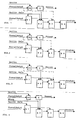
- the strands work as follows: Strand 1
- Measured currents in aniline and formaldehyde are converted non-catalytically in VR and then passed to the separator S, where they separate into organic and aqueous phases.
- a measured flow of aqueous aniline salt solution, produced from aniline and acid in the case of work with neutralization or as a solution obtained from the workup of the products by the processes with exchange for aniline or extraction with hydrophobic solvents and formaldehyde are in the reaction zone R 1 to the acidic condensate and then reacted in the reaction zone R 2 with the precondensate from the separator S to intermediate condensate.
- the solution then goes into reaction zone R 3 and / or reaction zone R 4 for one- or multi-stage rearrangement to desired products.
- Reaction zone R 3 metered in and then rearranged to desired products in this and other reaction zones.
- the rearranged product solution leaves the reaction zone R 4 for further processing according to the prior art.
- the pre-condensate is converted with part of the acid catalyst in reaction zone R 2 to intermediate condensate and only then mixed in reaction zone R 3 with the acidic condensate from reaction zone R 1. Then will rearranged this solution in the reaction zone R 4 to MDA / PMPPA and worked up as usual.
- the precondensate is converted into intermediate condensate with a partial stream of the acidic condensate from R 1, and only then is this product mixed or reacted with the rest of the acidic condensate from R 1 in the reaction zone R 3 and, if necessary, only rearranged in the reaction zone R 4 to desired products.
- reaction zone R 2 This works with neutralization of the catalyst, i.e. that free acid is used as the starting product. A large part of this acid is used in the form of aniline salt solutions for the production of acidic condensate in the reaction zone R 2 to intermediate condensate.
- the products from reaction zones R 1 and R 2 are then mixed together in reaction zone R 3 and rearranged to MDA / PMPPA in this or reaction zone R 4.
- reaction zones can be designed as stirred kettles, stirred cascades, flow tubes, columns, packed columns and the like.
- the homogeneous product formed after the addition is then kept at 60 ° C. for one hour, at 80 ° C. for one hour and at 103 ° C. for two hours.
- the analysis is carried out using GLC and SE-30 as the stationary phase on Chromosorb and 4,4'-methylene to N, N-dimethylaniline as the internal standard for determining the diamine content.
- aniline methanesulfonate solution in water contain 1.5 mol of aniline and 1.5 mol of methanesulfonic acid, are reacted with 54.7 g of 37% strength by weight formaldehyde (0.675 mol) at about 45 ° C. and then for one hour kept at 50 ° C.
- the batch corresponds to an aniline / formaldehyde / methanesulfonic acid ratio such as 1: 0.45: 1.0.
- the acidic condensate is then distributed into four heated stirred vessels according to Table II and heated to 90 ° C. After reaching the temperature, the intermediate condensate is added to the acidic condensates according to the table, which immediately dissolves homogeneously. Then hold at 90 ° C for one hour and at 103 ° C for two hours.
- the precondensate is prepared as in Example 1-4.
- the precondensate is added strength at about 40-45 0 C with 0.015 moles of 40% aniline methanesulphonate in water (acid catalyst) per mole of precondensate and held for one hour at about 50 ° C. Then, as already mentioned above, the intermediate condensate is added to the acidic condensate at 90 ° C according to the table.
- aniline 409.2 g
- aniline 409.2 g
- formaldehyde 1.98 mol
- An organic and an aqueous phase are formed.
- the lower phase is the precondensate, and according to Table III this is added to the acidic condensate and kept at 50 C for about 15 minutes.
- the product formed after the addition is then held at 60 ° C for one hour, at 80 ° C for one hour and at 103 ° C for two hours.
- the analysis is carried out using GLC and SE-30 as the stationary phase on Chromosorb and 4,4'-methylene to N, N-dimethylaniline as the internal standard for determining the diamine content.
- the product formed after the addition is then held at 60 ° C for one hour, at 80 ° C for one hour and at 103 ° C for two hours.
- the analysis is carried out using GLC and SE-30 as the stationary phase on Chromosorb and 4,4'-methylene to N, N-dimethylaniline as the internal standard for determining the diamine content.
Landscapes
- Chemical & Material Sciences (AREA)
- Organic Chemistry (AREA)
- Chemical Kinetics & Catalysis (AREA)
- Organic Low-Molecular-Weight Compounds And Preparation Thereof (AREA)
- Phenolic Resins Or Amino Resins (AREA)
Applications Claiming Priority (4)
| Application Number | Priority Date | Filing Date | Title |
|---|---|---|---|
| CH6188/82 | 1982-10-25 | ||
| CH618882 | 1982-10-25 | ||
| CH1368/83 | 1983-03-14 | ||
| CH136883 | 1983-03-14 |
Publications (2)
| Publication Number | Publication Date |
|---|---|
| EP0109931A2 true EP0109931A2 (fr) | 1984-05-30 |
| EP0109931A3 EP0109931A3 (fr) | 1984-10-03 |
Family
ID=25687464
Family Applications (1)
| Application Number | Title | Priority Date | Filing Date |
|---|---|---|---|
| EP83810491A Withdrawn EP0109931A3 (fr) | 1982-10-25 | 1983-10-24 | Procédé pour la préparation de polyarylamines contenant des ponts de méthylène |
Country Status (4)
| Country | Link |
|---|---|
| EP (1) | EP0109931A3 (fr) |
| BR (1) | BR8305870A (fr) |
| DD (1) | DD212524A5 (fr) |
| PT (1) | PT77551B (fr) |
Cited By (6)
| Publication number | Priority date | Publication date | Assignee | Title |
|---|---|---|---|---|
| EP0283757A1 (fr) * | 1987-02-26 | 1988-09-28 | The Dow Chemical Company | Procédé pour la préparation de MDA polymère, recyclage et produit final MDA polymère |
| EP0451442A3 (en) * | 1990-04-11 | 1991-11-27 | Mitsui Toatsu Chemicals, Incorporated | Methylene-crosslinked polyarylamine and process for preparing same |
| WO1998037124A3 (fr) * | 1997-02-24 | 1998-11-19 | Basf Ag | Procede de preparation de melanges de polyamines aromatiques |
| WO2002070581A1 (fr) * | 2001-03-08 | 2002-09-12 | Basf Aktiengesellschaft | Procede de production de mdi, en particulier de 2,4'-mdi |
| WO2005007613A1 (fr) * | 2003-07-11 | 2005-01-27 | Basf Aktiengesellschaft | Procede de production de diaminodiarylmethanes |
| WO2025073928A1 (fr) | 2023-10-06 | 2025-04-10 | Basf Se | Procédé de préparation de mda |
Family Cites Families (5)
| Publication number | Priority date | Publication date | Assignee | Title |
|---|---|---|---|---|
| US3676497A (en) * | 1968-08-06 | 1972-07-11 | Upjohn Co | Process for preparing di(aminophenyl)-methanes |
| GB1287141A (en) * | 1969-01-01 | 1972-08-31 | Ici Ltd | Manufacture of methylene-bridged polyarylamines |
| DE2127263A1 (de) * | 1971-06-02 | 1973-01-04 | Bayer Ag | Verfahren zur herstellung von aromatischen polyaminen |
| DE2426116B2 (de) * | 1973-06-01 | 1978-05-11 | Efim Freiburg Biller (Schweiz) | Verfahren zur Herstellung von Methylenbrücken aufweisenden PoIyarylaminen |
| DE2750975A1 (de) * | 1976-11-19 | 1978-05-24 | Mobay Chemical Corp | Verfahren zur herstellung von polyaminen der diphenylmethan-reihe |
-
1983
- 1983-10-24 DD DD25591383A patent/DD212524A5/de unknown
- 1983-10-24 PT PT7755183A patent/PT77551B/pt unknown
- 1983-10-24 EP EP83810491A patent/EP0109931A3/fr not_active Withdrawn
- 1983-10-24 BR BR8305870A patent/BR8305870A/pt unknown
Cited By (10)
| Publication number | Priority date | Publication date | Assignee | Title |
|---|---|---|---|---|
| EP0283757A1 (fr) * | 1987-02-26 | 1988-09-28 | The Dow Chemical Company | Procédé pour la préparation de MDA polymère, recyclage et produit final MDA polymère |
| EP0451442A3 (en) * | 1990-04-11 | 1991-11-27 | Mitsui Toatsu Chemicals, Incorporated | Methylene-crosslinked polyarylamine and process for preparing same |
| CN1034119C (zh) * | 1990-04-11 | 1997-02-26 | 三井东压化学株式会社 | 亚甲基交联的聚芳胺的制备方法 |
| WO1998037124A3 (fr) * | 1997-02-24 | 1998-11-19 | Basf Ag | Procede de preparation de melanges de polyamines aromatiques |
| US6410789B1 (en) | 1997-02-24 | 2002-06-25 | Basf Aktiengesellschaft | Process for preparing aromatic polyamine mixtures |
| WO2002070581A1 (fr) * | 2001-03-08 | 2002-09-12 | Basf Aktiengesellschaft | Procede de production de mdi, en particulier de 2,4'-mdi |
| KR100762760B1 (ko) * | 2001-03-08 | 2007-10-09 | 바스프 악티엔게젤샤프트 | Mdi, 특히 2,4'-mdi의 제조 방법 |
| WO2005007613A1 (fr) * | 2003-07-11 | 2005-01-27 | Basf Aktiengesellschaft | Procede de production de diaminodiarylmethanes |
| US7408083B2 (en) | 2003-07-11 | 2008-08-05 | Basf Aktiengesellschaft | Method for the production of diaminodiarylmethanes |
| WO2025073928A1 (fr) | 2023-10-06 | 2025-04-10 | Basf Se | Procédé de préparation de mda |
Also Published As
| Publication number | Publication date |
|---|---|
| EP0109931A3 (fr) | 1984-10-03 |
| PT77551A (de) | 1983-11-01 |
| DD212524A5 (de) | 1984-08-15 |
| BR8305870A (pt) | 1984-05-29 |
| PT77551B (de) | 1986-02-12 |
Similar Documents
| Publication | Publication Date | Title |
|---|---|---|
| EP1616890B1 (fr) | Procédé de préparation de polyamines de la série du diphénylméthane par faible protonation | |
| DE2623681A1 (de) | Verfahren zur herstellung eines gemisches aus di(aminophenyl)methan und oligomeren polymethylenpolyphenylpolyaminen | |
| DE2631034A1 (de) | Verfahren zur herstellung eines gemisches aus di(aminophenyl)methan und oligomeren polymethylenpolyphenylpolyaminen | |
| DE1242623B (de) | Verfahren zur Herstellung von primaeren Polyaminen | |
| EP0031423B1 (fr) | Procédé de préparation de polyamines polyphénylpolyméthylène | |
| EP0288892B1 (fr) | Procédé pour la préparation de polyamines aromatiques contenant plusieurs noyaux | |
| EP0014927B1 (fr) | Procédé pour la préparation de mélanges de polyamines de la série des polyamino-polyaryl-polyméthylènes | |
| DE3044389C2 (fr) | ||
| DE2426116B2 (de) | Verfahren zur Herstellung von Methylenbrücken aufweisenden PoIyarylaminen | |
| DE2500573A1 (de) | Verfahren zur herstellung von polyaminen | |
| EP0109931A2 (fr) | Procédé pour la préparation de polyarylamines contenant des ponts de méthylène | |
| EP0003303B1 (fr) | Procédé pour la préparation de polyamines de la série du diphénylméthane, riches en isomères ortho | |
| DE69213678T2 (de) | Verfahren zur Herstellung von Polyaminen für helleren auf Polyisocyanat basierenden Schaum | |
| DE2500574C3 (de) | Verfahren zur Herstellung von Polyaminen | |
| DE2238920C3 (de) | Verfahren zur Herstellung von Polyaminen | |
| DE2750975A1 (de) | Verfahren zur herstellung von polyaminen der diphenylmethan-reihe | |
| DE2343658C2 (de) | Verfahren zur Herstellung von Polyaminen | |
| DE2557500A1 (de) | Verfahren zur herstellung von polyaminen | |
| EP0043933B1 (fr) | Procédé pour la préparation de mélanges de polyamines ayant un taux élevé de 4,4'-diaminodiphénylméthane | |
| DE2227110C3 (de) | Verfahren zur Herstellung von Polyaminen | |
| DE2648982C2 (de) | Verfahren zur Herstellung von Methylenbrücken aufweisenden Polyarylaminen | |
| DE2736862A1 (de) | Verfahren zur hestellung von polyaminen der diphenylmethanreihe | |
| DE2238379A1 (de) | Verfahren zur herstellung von polyaminen | |
| DE2557501C2 (fr) | ||
| DE1793137A1 (de) | Verfahren zur Herstellung von Di(aminophenyl)methan |
Legal Events
| Date | Code | Title | Description |
|---|---|---|---|
| PUAI | Public reference made under article 153(3) epc to a published international application that has entered the european phase |
Free format text: ORIGINAL CODE: 0009012 |
|
| AK | Designated contracting states |
Designated state(s): BE DE FR GB IT |
|
| PUAL | Search report despatched |
Free format text: ORIGINAL CODE: 0009013 |
|
| AK | Designated contracting states |
Designated state(s): BE DE FR GB IT |
|
| STAA | Information on the status of an ep patent application or granted ep patent |
Free format text: STATUS: THE APPLICATION IS DEEMED TO BE WITHDRAWN |
|
| 18D | Application deemed to be withdrawn |
Effective date: 19850604 |
|
| RIN1 | Information on inventor provided before grant (corrected) |
Inventor name: BILLER, EFIM |