EP0097767A2 - Halbleitervorrichtung - Google Patents
Halbleitervorrichtung Download PDFInfo
- Publication number
- EP0097767A2 EP0097767A2 EP83102549A EP83102549A EP0097767A2 EP 0097767 A2 EP0097767 A2 EP 0097767A2 EP 83102549 A EP83102549 A EP 83102549A EP 83102549 A EP83102549 A EP 83102549A EP 0097767 A2 EP0097767 A2 EP 0097767A2
- Authority
- EP
- European Patent Office
- Prior art keywords
- base
- emitter
- layer
- junction
- collector
- Prior art date
- Legal status (The legal status is an assumption and is not a legal conclusion. Google has not performed a legal analysis and makes no representation as to the accuracy of the status listed.)
- Granted
Links
Images
Classifications
-
- H—ELECTRICITY
- H10—SEMICONDUCTOR DEVICES; ELECTRIC SOLID-STATE DEVICES NOT OTHERWISE PROVIDED FOR
- H10F—INORGANIC SEMICONDUCTOR DEVICES SENSITIVE TO INFRARED RADIATION, LIGHT, ELECTROMAGNETIC RADIATION OF SHORTER WAVELENGTH OR CORPUSCULAR RADIATION
- H10F71/00—Manufacture or treatment of devices covered by this subclass
- H10F71/127—The active layers comprising only Group III-V materials, e.g. GaAs or InP
- H10F71/1272—The active layers comprising only Group III-V materials, e.g. GaAs or InP comprising at least three elements, e.g. GaAlAs or InGaAsP
-
- H—ELECTRICITY
- H10—SEMICONDUCTOR DEVICES; ELECTRIC SOLID-STATE DEVICES NOT OTHERWISE PROVIDED FOR
- H10D—INORGANIC ELECTRIC SEMICONDUCTOR DEVICES
- H10D10/00—Bipolar junction transistors [BJT]
- H10D10/80—Heterojunction BJTs
- H10D10/821—Vertical heterojunction BJTs
-
- H—ELECTRICITY
- H10—SEMICONDUCTOR DEVICES; ELECTRIC SOLID-STATE DEVICES NOT OTHERWISE PROVIDED FOR
- H10F—INORGANIC SEMICONDUCTOR DEVICES SENSITIVE TO INFRARED RADIATION, LIGHT, ELECTROMAGNETIC RADIATION OF SHORTER WAVELENGTH OR CORPUSCULAR RADIATION
- H10F30/00—Individual radiation-sensitive semiconductor devices in which radiation controls the flow of current through the devices, e.g. photodetectors
- H10F30/20—Individual radiation-sensitive semiconductor devices in which radiation controls the flow of current through the devices, e.g. photodetectors the devices having potential barriers, e.g. phototransistors
- H10F30/21—Individual radiation-sensitive semiconductor devices in which radiation controls the flow of current through the devices, e.g. photodetectors the devices having potential barriers, e.g. phototransistors the devices being sensitive to infrared, visible or ultraviolet radiation
- H10F30/24—Individual radiation-sensitive semiconductor devices in which radiation controls the flow of current through the devices, e.g. photodetectors the devices having potential barriers, e.g. phototransistors the devices being sensitive to infrared, visible or ultraviolet radiation the devices having only two potential barriers, e.g. bipolar phototransistors
- H10F30/245—Bipolar phototransistors
-
- Y—GENERAL TAGGING OF NEW TECHNOLOGICAL DEVELOPMENTS; GENERAL TAGGING OF CROSS-SECTIONAL TECHNOLOGIES SPANNING OVER SEVERAL SECTIONS OF THE IPC; TECHNICAL SUBJECTS COVERED BY FORMER USPC CROSS-REFERENCE ART COLLECTIONS [XRACs] AND DIGESTS
- Y02—TECHNOLOGIES OR APPLICATIONS FOR MITIGATION OR ADAPTATION AGAINST CLIMATE CHANGE
- Y02E—REDUCTION OF GREENHOUSE GAS [GHG] EMISSIONS, RELATED TO ENERGY GENERATION, TRANSMISSION OR DISTRIBUTION
- Y02E10/00—Energy generation through renewable energy sources
- Y02E10/50—Photovoltaic [PV] energy
- Y02E10/544—Solar cells from Group III-V materials
Definitions
- the invention relates to a semiconductor device and a method of forming thereof.
- the technical field of the invention is in the transmission and detection of signals in a semiconductor device wherein internal losses of carriers produced by the signal are minimized within the device.
- the semiconductor device may be optimized for the system in which it operates.
- optical signal conversion there are limitations on efficiency by the available light output frequencies of the signal generating equipment, by the attenuation of the light signal by the transmission medium and by the detector which re-converts the optical signal.
- the material InAs has been shown to be a good detector material for wavelengths above .86 micrometers as described in U.S. Patent 4,096,511.
- a semiconductor device comprising emitter, base and collector regions, characterised in that said emitter region has an energy gap of a first magnitude and forms a first junction with a base region having an energy gap of a second magnitude narrower than said emitter energy gap, said collector region forming a second junction with said base region and said base energy gap decreasing with distance from said first junction to said second junction.
- a method of forming a semiconductor device characterised in that the method comprises the steps of providing a substrate layer of n conductivity type monocrystalline AB semiconductor material having two essentially parallel broad area surfaces, forming on a first said broad area surface to be exposed to an optical signal an epitaxial collector layer of A 1x C x B wherein x increases with distance from said substrate layer, forming on said collector layer an epitaxial base layer forming a base-collector p-n junction with said base layer, said base layer being of AlxC x B semiconductor material wherein x decreases with distance from said p-n junction, forming an emitter epitaxial layer on said base layer at an emitter-base p-n junction, said emitter layer being of A 1x D x B semiconductor material having a higher band gap and lattice matched to said base semiconductor material at said emitter-base p-n junction, and applying an electrical contact to each said substrate, said base and said emitter layers.
- the invention involves a signal conversion semiconductor structure wherein through the use of layers of multiple elemental semiconductor materials with common elements, signal transfer gains, lattice mismatch accommodation and carrier transport gains are achieved.
- the variation of elements provides lattice accommodation which minimizes carrier traps due to dislocations and a graded band gap which due to the accelerating effect on the carriers minimizes the effect of any dislocation carrier traps that do occur.
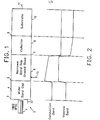
- the optical signal is delivered through an element 1, illustrated as an optical fibre, to a light receiving surface 2 of a semiconductor body 3.
- the semiconductor body 3 has an emitter region 4 of a wider band gap semiconductor material than the base region.
- the region 4 forms an emitter-base p-n junction 5 with a graded band gap base region 6 wherein the grading is from a wider band gap at the interface 5 to a narrower band gap at the base to collector p-n junction 7.
- the collector region 8 is epitaxial at the interface 9 with the substrate 10 and may be provided with a graded band gap for carrier influencing purposes and for lattice accommodation purposes with the substrate 10.
- An external electrical connection 11 is made to the substrate 9, an external electrical connection 12 is made to the surface 2 to transmit the detected electrical signals and an external electrical connection 13 is provided to the base region 6 to drain holes from the base region and for a base contact if electrical signals are being converted.
- the band energy diagram correlated with the regions of the device of FIG. 1.
- the wide band gap coupled with the smaller band gap in the base region provides high emitter injection efficiency.
- the graded band gap in the base region 6 provides a field to accelerate injected carriers to the collection p-n junction and to reduce carrier recombination at dislocations whose density is intolerably large for large lattice mismatch materials.
- the graded band gap in the collector reduces misfit dislocations at the interface 9 with the substrate 10.
- a four-layer structure is provided.
- a wider band gap semiconductor emitter region than the band gap of the base region is employed so that the light will penetrate to the base region without significant absorption yet the injection efficiency of carriers onto the base and potential current gain of the device will be high.
- the material in the base region is selected for optical conversion properties at the selected wavelength and will be provided with a graded band gap so as to produce a strong effective drift field in the base to accelerate carriers toward the collector and to reduce carrier recombination at dislocations where density is intolerably high in large lattice mismatched materials.
- Materials with large lattice mismatches are those which exhibit a change of more than 1% in lattice constant over the entire range of allowed composition change for the material.
- the lattice constants of GaAs and GaP are 5.663 and 5.451, respectively.
- the percent difference in lattice constant for this system is 3.6% and therefore GaAs 1-x P x would be a large lattice mismatch system.
- materials with large dislocation densities, i.e., >10 -10 cm 2 exhibit enhanced carrier recombination at dislocation sites with recombination lifetimes of ⁇ 10 -9 to 10 -10 sec.
- the steeply graded base layer overcomes this limitation. If the base layer contains a high density of dislocations, the drift field produced by grading is sufficient to sweep the carriers across the base-collector junction reducing the recombination by the mechanism involving dislocation sites.
- the transit time for a carrier transversing a 1 ⁇ graded base at a velocity of ⁇ 10 sec is 10 - 11 sec.
- the dislocation recombination lifetime is about 10 -9 to 10 - 10
- the ratio of transit time to carrier recombination lifetime is 0.1 to 0.01 which means that 10 to 100 times more carriers will cross the base-collector junction than will recombine at dislocation sites.
- grading composition in both the base and collector region reduces the detrimental effects of lattice mismatch, i.e., grading reduces the dislocation density. Reducing the dislocation density reduces noise due to carrier generation-recombination centres associated with those dislocations.
- the material In the collector region the material varies in composition so as to accommodate lattice differences between the material of the base and a substrate material.
- the structure of the invention will provide strong absorption in the base region for any light for the photon energies between the smallest band gap of the base region and the band gap of the emitter and the effective drift field will be such that electrons will move at something approaching the peak electron velocity of around 5x10 7 centimeters per second with a base transit time of around one picosecond. As a result, for a given base transit time, the gain obtained will be larger than that obtainable without a graded base.
- a preferred embodiment of the invention would involve the delivery of the optical signal by way of an optical fibre and to use selective grading of the ingredients of binary to ternary semiconductors in the base and collector regions to produce the drift field for the carriers and to accommodate the lattice matching with the substrate.
- the optical fibre I would be of a material which would have low absorption at the light wavelength involved.
- the light signal generator is preferably a solid state electrical to light converting device such as a laser.
- In,Ga In,Ga
- InP InP
- Examples of optical fibre materials suitable for operation at this wavelength are Si0 2 , Ge0 2 and a glassy mixture of germanium and silicon oxides.
- the optimum wavelength is somewhat influenced by the length of the link between the signal generator and the detector. The optimum wavelength for low absorption criteria will be less essential at short link lengths.
- the speed and sensitivity to the light delivered by the fibre 1 will be the main considerations. It is generally always desirable to have a semiconductor material with a low density of defects in order to reduce leakage currents and resulting noise.
- the semiconductor materials involved should have a high band to band absorption coefficient such that much of the light delivered by the fibre through the surface 2 can be absorbed in a base layer 6 which is of the order of 0.25 to 1 micrometers thick.
- FIGS. 1 and 2 While the illustration of FIGS. 1 and 2 is spread out for ease of illustration of the band energy gradients, it will be clear to one skilled in the art that there are semiconductor layer thicknesses which will optimize the light absorption characteristics, the minority carrier transit time, the noise control and the gain of the device.
- Semiconductor materials having a direct energy band gap below the energy of the photons they are absorbing will have higher absorption properties for photon energies.
- the measure is called the absorption coefficient.
- a desirable high absorption coefficient will be 10 4 cm -1 for photon energies of 0.1 electron volts or more greater than the band gap.
- Suitable direct band gap materials will include many of the III-V intermetallic semiconductors such as GaAs, InP, GaSb, InAs, InSb and their alloys.
- the contact 12 should be able to penetrate through the emitter region 4 to region 6 in which the absorption is to take place without first being significantly absorbed in any contacting layer.
- the contact layer material it is desirable that where the contact 12 is a layer that is transparent to the light involved it is preferable that the contact layer material have a larger band gap energy than the wave amplitude of the light.
- the region 4 will be of GaAlAs which has a band gap of about 1.7 electron volts (eV). Since the band gap of the GaAIAs will be larger than 1.4 eV which is the band gap of the GaAs base region 6 at the interface 5 so that the injection efficiency and potential current gain will be high.
- the lattice spacing of Ga 1-x Al x As is matched to that of GaAs in order to minimize the formation of defects which may act as recombination centres.
- a third ingredient, In is progressively introduced producing the semiconductor Ga In As with x progressively increasing so that a narrower band gap is produced at the base to collector p-n junction 7.
- the variation of the crystal composition is employed for band gap and lattice spacing adjustment and appropriate impurity concentration is introduced to provide the desired conductivity type.
- the structure will provide strong absorption in the base region for any light with a photon energy between 0.4 and 1.7 electron volts which translates to a wavelength of between 0.7 and 3 micrometers.
- An effective drift field in the base for a base that is 0.5 to 1 micrometer wide will be roughly 10 4 volts per centimeter. With such a field electrons produced will move at something approaching peak electron velocity which is in the vicinity of 5x10 7 centimeters per second and thus will have a transit time of about 1 picosecond. For a response time of 10 -10 seconds, the device could have a gain of " 100.
- a lattice spacing adjustment may be made by progressively decreasing x which is to decrease the quantity of the ingredient In so as to return to GaAs at interface 9 with a substrate which may be n-conductivity type GaAs.
- GaAlAs As the emitter material and GaInAs as the base-collector material
- IR infrared
- AlSb will serve as the emitter material, with a band gap of 1.6 eV
- Ga 1-x In x Sb will serve as the base-collector material, with a band gap of 0.18 to .7 eV.
- Ga 0.9 In 0.1 Sb can be lattice matched to AlSb and since the band gap of Ga 1-x In x Sb decreases with increasing x, a substrate of GaSb is satisfactory.
- Table I there is provided an illustrative system of a list of various emitter, base-collector and substrate materials which can be used in the practice of this invention.
- graded intermetallic semiconductor alloys permits the tailoring of the properties of the semiconductor in various regions without obtaining a high density of misfit dislocations in spite of a significant lattice mismatch between the various binary semiconductors.
- optical signal detection wherein through a combination of materials selection and of grading a third ingredient into a binary semiconductor optimum optical and structural properties are achieved.
Landscapes
- Light Receiving Elements (AREA)
Applications Claiming Priority (2)
| Application Number | Priority Date | Filing Date | Title |
|---|---|---|---|
| US06/393,923 US4518979A (en) | 1982-06-30 | 1982-06-30 | Semiconductor transistor with graded base and collector |
| US393923 | 1989-08-16 |
Publications (3)
| Publication Number | Publication Date |
|---|---|
| EP0097767A2 true EP0097767A2 (de) | 1984-01-11 |
| EP0097767A3 EP0097767A3 (en) | 1986-04-30 |
| EP0097767B1 EP0097767B1 (de) | 1989-08-09 |
Family
ID=23556804
Family Applications (1)
| Application Number | Title | Priority Date | Filing Date |
|---|---|---|---|
| EP83102549A Expired EP0097767B1 (de) | 1982-06-30 | 1983-03-15 | Halbleitervorrichtung |
Country Status (4)
| Country | Link |
|---|---|
| US (1) | US4518979A (de) |
| EP (1) | EP0097767B1 (de) |
| JP (1) | JPS599979A (de) |
| DE (1) | DE3380385D1 (de) |
Cited By (2)
| Publication number | Priority date | Publication date | Assignee | Title |
|---|---|---|---|---|
| EP0453945A1 (de) * | 1990-04-18 | 1991-10-30 | Fujitsu Limited | Heteroübergangsbipolartransistor |
| US5150186A (en) * | 1991-03-06 | 1992-09-22 | Micron Technology, Inc. | CMOS output pull-up driver |
Families Citing this family (11)
| Publication number | Priority date | Publication date | Assignee | Title |
|---|---|---|---|---|
| US4794440A (en) * | 1983-05-25 | 1988-12-27 | American Telephone And Telegraph Company, At&T Bell Laboratories | Heterojunction bipolar transistor |
| US5214297A (en) * | 1984-11-19 | 1993-05-25 | Fujitsu Limited | High-speed semiconductor device |
| JPH0669222A (ja) * | 1992-08-17 | 1994-03-11 | Matsushita Electric Ind Co Ltd | ヘテロ接合バイポーラトランジスタ及びその製造方法 |
| JP2771423B2 (ja) * | 1993-05-20 | 1998-07-02 | 日本電気株式会社 | バイポーラトランジスタ |
| US5576559A (en) * | 1994-11-01 | 1996-11-19 | Intevac, Inc. | Heterojunction electron transfer device |
| FR2780203B1 (fr) * | 1998-06-23 | 2003-07-04 | Thomson Csf | Detecteur a puits quantique avec couche de stockage des electrons photoexcites |
| US7345327B2 (en) | 2000-11-27 | 2008-03-18 | Kopin Corporation | Bipolar transistor |
| AU2002219895A1 (en) | 2000-11-27 | 2002-06-03 | Kopin Corporation | Bipolar transistor with lattice matched base layer |
| US6847060B2 (en) * | 2000-11-27 | 2005-01-25 | Kopin Corporation | Bipolar transistor with graded base layer |
| JP2004521492A (ja) * | 2001-01-08 | 2004-07-15 | コピン コーポレーション | リン化インジウムヘテロ接合バイポーラトランジスタの調製方法 |
| US7566948B2 (en) * | 2004-10-20 | 2009-07-28 | Kopin Corporation | Bipolar transistor with enhanced base transport |
Family Cites Families (11)
| Publication number | Priority date | Publication date | Assignee | Title |
|---|---|---|---|---|
| US3081370A (en) * | 1961-07-17 | 1963-03-12 | Raytheon Co | Solar cells |
| GB1478453A (en) * | 1971-11-29 | 1977-06-29 | Secr Defence | Photocathodes |
| US3995303A (en) * | 1975-06-05 | 1976-11-30 | Bell Telephone Laboratories, Incorporated | Growth and operation of a step-graded ternary III-V heterojunction p-n diode photodetector |
| US4075651A (en) * | 1976-03-29 | 1978-02-21 | Varian Associates, Inc. | High speed fet employing ternary and quarternary iii-v active layers |
| US4122476A (en) * | 1976-11-22 | 1978-10-24 | International Business Machines Corporation | Semiconductor heterostructure |
| JPS53135290A (en) * | 1977-04-28 | 1978-11-25 | Uni Konechikatsuto | Improved hetero junction and method of producing same |
| US4160258A (en) * | 1977-11-18 | 1979-07-03 | Bell Telephone Laboratories, Incorporated | Optically coupled linear bilateral transistor |
| DE2847451C2 (de) * | 1978-11-02 | 1986-06-12 | Telefunken electronic GmbH, 7100 Heilbronn | Halbleiterbauelement und Verfahren zum Herstellen |
| JPS561578A (en) * | 1979-06-18 | 1981-01-09 | Shunpei Yamazaki | Manufacture of semiconductor device |
| US4275404A (en) * | 1979-10-05 | 1981-06-23 | Bell Telephone Laboratories, Incorporated | Monolithic opto-isolator |
| US4383269A (en) * | 1980-09-19 | 1983-05-10 | Bell Telephone Laboratories, Incorporated | Graded bandgap photodetector |
-
1982
- 1982-06-30 US US06/393,923 patent/US4518979A/en not_active Expired - Lifetime
-
1983
- 1983-03-15 DE DE8383102549T patent/DE3380385D1/de not_active Expired
- 1983-03-15 EP EP83102549A patent/EP0097767B1/de not_active Expired
- 1983-04-20 JP JP58068508A patent/JPS599979A/ja active Granted
Cited By (2)
| Publication number | Priority date | Publication date | Assignee | Title |
|---|---|---|---|---|
| EP0453945A1 (de) * | 1990-04-18 | 1991-10-30 | Fujitsu Limited | Heteroübergangsbipolartransistor |
| US5150186A (en) * | 1991-03-06 | 1992-09-22 | Micron Technology, Inc. | CMOS output pull-up driver |
Also Published As
| Publication number | Publication date |
|---|---|
| EP0097767B1 (de) | 1989-08-09 |
| US4518979A (en) | 1985-05-21 |
| JPS6329423B2 (de) | 1988-06-14 |
| JPS599979A (ja) | 1984-01-19 |
| DE3380385D1 (en) | 1989-09-14 |
| EP0097767A3 (en) | 1986-04-30 |
Similar Documents
| Publication | Publication Date | Title |
|---|---|---|
| US3821777A (en) | Avalanche photodiode | |
| US4383269A (en) | Graded bandgap photodetector | |
| EP0097767B1 (de) | Halbleitervorrichtung | |
| US4119994A (en) | Heterojunction and process for fabricating same | |
| EP0159544B1 (de) | Lichtempfindliche Lawinendiode und deren Herstellungsmethode | |
| US6326654B1 (en) | Hybrid ultraviolet detector | |
| Capasso | New multilayer and graded gap optoelectronic and high speed devices by band gap engineering | |
| US5576559A (en) | Heterojunction electron transfer device | |
| CA1192976A (en) | Majority carrier photodetector | |
| Stillman et al. | Long-wavelength (1.3-to 1.6-µm) detectors for fiber-optical communications | |
| Matsushima et al. | Zn‐diffused In0. 53Ga0. 47As/InP avalanche photodetector | |
| US4160258A (en) | Optically coupled linear bilateral transistor | |
| USH667H (en) | Patterned tunnel junction | |
| EP0304048B1 (de) | Planare Avalanche-Photodiode mit Heterostruktur | |
| Jang et al. | Metamorphic graded bandgap InGaAs-InGaAlAs-InAlAs double heterojunction PiIN photodiodes | |
| EP0115591B1 (de) | Photodiode und Photodetektor mit einer Reihe integrierter Photodioden | |
| EP0113074B1 (de) | Verfahren zur logischen Kombination optischer Signale | |
| GB2100928A (en) | Long-wavelength avalanche photodetector | |
| Yeats et al. | Long‐wavelength InGaAsP avalanche photodiodes | |
| GB2083699A (en) | Phototransistor having an emitter-base heterojunction | |
| JPS63955B2 (de) | ||
| Kim et al. | Barrier height enhancement of InP-based n-Ga0. 47In0. 53As Schottky-barrier diodes grown by molecular beam epitaxy | |
| JPS63108782A (ja) | 半導体受光素子 | |
| JP2703167B2 (ja) | 受光素子及びその製造方法 | |
| JPH0437591B2 (de) |
Legal Events
| Date | Code | Title | Description |
|---|---|---|---|
| PUAI | Public reference made under article 153(3) epc to a published international application that has entered the european phase |
Free format text: ORIGINAL CODE: 0009012 |
|
| AK | Designated contracting states |
Designated state(s): DE FR GB |
|
| 17P | Request for examination filed |
Effective date: 19840426 |
|
| PUAL | Search report despatched |
Free format text: ORIGINAL CODE: 0009013 |
|
| AK | Designated contracting states |
Kind code of ref document: A3 Designated state(s): DE FR GB |
|
| 17Q | First examination report despatched |
Effective date: 19880217 |
|
| GRAA | (expected) grant |
Free format text: ORIGINAL CODE: 0009210 |
|
| AK | Designated contracting states |
Kind code of ref document: B1 Designated state(s): DE FR GB |
|
| REF | Corresponds to: |
Ref document number: 3380385 Country of ref document: DE Date of ref document: 19890914 |
|
| ET | Fr: translation filed | ||
| PLBE | No opposition filed within time limit |
Free format text: ORIGINAL CODE: 0009261 |
|
| STAA | Information on the status of an ep patent application or granted ep patent |
Free format text: STATUS: NO OPPOSITION FILED WITHIN TIME LIMIT |
|
| 26N | No opposition filed | ||
| PGFP | Annual fee paid to national office [announced via postgrant information from national office to epo] |
Ref country code: GB Payment date: 19920210 Year of fee payment: 10 |
|
| PGFP | Annual fee paid to national office [announced via postgrant information from national office to epo] |
Ref country code: FR Payment date: 19920227 Year of fee payment: 10 |
|
| PGFP | Annual fee paid to national office [announced via postgrant information from national office to epo] |
Ref country code: DE Payment date: 19920321 Year of fee payment: 10 |
|
| PG25 | Lapsed in a contracting state [announced via postgrant information from national office to epo] |
Ref country code: GB Effective date: 19930315 |
|
| GBPC | Gb: european patent ceased through non-payment of renewal fee |
Effective date: 19930315 |
|
| PG25 | Lapsed in a contracting state [announced via postgrant information from national office to epo] |
Ref country code: FR Effective date: 19931130 |
|
| PG25 | Lapsed in a contracting state [announced via postgrant information from national office to epo] |
Ref country code: DE Effective date: 19931201 |
|
| REG | Reference to a national code |
Ref country code: FR Ref legal event code: ST |