EP0092784A2 - Empfindungssimulator für Säuglinge - Google Patents
Empfindungssimulator für Säuglinge Download PDFInfo
- Publication number
- EP0092784A2 EP0092784A2 EP83103827A EP83103827A EP0092784A2 EP 0092784 A2 EP0092784 A2 EP 0092784A2 EP 83103827 A EP83103827 A EP 83103827A EP 83103827 A EP83103827 A EP 83103827A EP 0092784 A2 EP0092784 A2 EP 0092784A2
- Authority
- EP
- European Patent Office
- Prior art keywords
- sheet
- infant
- sensory system
- set forth
- sensory
- Prior art date
- Legal status (The legal status is an assumption and is not a legal conclusion. Google has not performed a legal analysis and makes no representation as to the accuracy of the status listed.)
- Withdrawn
Links
Images
Classifications
-
- A—HUMAN NECESSITIES
- A47—FURNITURE; DOMESTIC ARTICLES OR APPLIANCES; COFFEE MILLS; SPICE MILLS; SUCTION CLEANERS IN GENERAL
- A47D—FURNITURE SPECIALLY ADAPTED FOR CHILDREN
- A47D9/00—Cradles ; Bassinets
- A47D9/02—Cradles ; Bassinets with rocking mechanisms
-
- A—HUMAN NECESSITIES
- A47—FURNITURE; DOMESTIC ARTICLES OR APPLIANCES; COFFEE MILLS; SPICE MILLS; SUCTION CLEANERS IN GENERAL
- A47D—FURNITURE SPECIALLY ADAPTED FOR CHILDREN
- A47D9/00—Cradles ; Bassinets
- A47D9/016—Cradles ; Bassinets capable of being suspended from, or attached to, other articles or structures, e.g. adult's bed
-
- A—HUMAN NECESSITIES
- A47—FURNITURE; DOMESTIC ARTICLES OR APPLIANCES; COFFEE MILLS; SPICE MILLS; SUCTION CLEANERS IN GENERAL
- A47D—FURNITURE SPECIALLY ADAPTED FOR CHILDREN
- A47D9/00—Cradles ; Bassinets
- A47D9/02—Cradles ; Bassinets with rocking mechanisms
- A47D9/057—Cradles ; Bassinets with rocking mechanisms driven by electric motors
Definitions
- This invention concerns an infant transitional sensory system, one designed to expedite a smooth transition by an infant from the womb to full awareness of the physical world. While it may seem to be deceptively simple, consisting as it does of a hammock-like sheet and a sonic device on that sheet for generating heart beat-like sounds and vibrations, the transitional sensory system addresses basic problems of infant care and offers major advances in such care.
- the development of the human infant has been described as consisting of two distinct stages of gestation, the first being the nine -month period inside the womb, called uterogestation, and the second being the first nine months outside the womb, called exterogestation.
- exterogestation infants progress to the point at which they can crawl on all fours.
- stimulation of the infant's primary sensory systems appears to be of great importance; the kinesthetic stimuli provided an infant during exterogestation - the sights, sounds, smells, tastes and warm feelings that comprise the enfolding love that ought to be the birthright of every child - now appears to be of basic importance in the development of a normal, well adjusted human being.
- tactile stimulation appears to initiate all innate infant reflexes. Touch is the infant's number one teacher. Not only does it help the infant develop emotional security but actually it appears to also assist the body in development of the brain and nervous system. For this reason, holding the infant, messaging the infant, and providing the infant with different textures to touch are important. Tactile stimulation also seems to have a calming effect on the infant and to assist the infant in organizing its sensory systems, called sensory integration. As another example, handling the infant and providing it with the sensation of movement seems to be vital to the infant's growth, both social, emotional and intellectual. Stimulating the infant's movement sensory system, called the vestibular sensory system, provides the infant with joy and pleasure. Hugging and cuddling the infant develops its emotional security. It also appears to stimulate the thymus gland, a major determinant of the infant's growth and immune systems. Providing the infant with an environment which resists, but yields, to its movement allows the infant to stretch and exercise both its muscular and skeletal systems.
- a basic object, then, of the Infant Transitional sensory system of the present invention is to provide tactile kinesthetic stimulation for the primary senses of an infant, thereby encouraging and promoting the infant's normal body, brain and psychological development.
- To attain these objectives has always been of primary importance to parents. It appears that the present invention achieves major advances in this regard. It also has other objectives, and offers other advantages, all of which will be apparent from the following detailed description of a preferred embodiment of the system.
- the infant transitional sensory system of the present invention would appear, at first glance, to consist of simply a hammock that includes a sonic device simulating the human heart beat. As will be apparent from the detailed description of the invention, these two components cooperate in a simple yet remarkably effective way to provide an infant during its period of exterogestation with a rich environment of tactile kinesthetic stimulation, particularly for its primary senses. Such an environment is of great benefit in promoting the normal, natural development of the infant.
- the hammock comprises a sheet of flexible material that preferably is not only soft but also textured, both to offer tactile stimulation to the infant and to conform and deform to a variety of shapes permitting the infant to move, exercise and define its surrounding space.
- Support means are provided for the sheet to hold it in various positions from a relatively flat position to a deeply depressed or pocketed position.
- the sheet can be positioned to cradle and closely cuddle the infant, permitting a smooth transition from a pocket simulating the cuddling environment of a womb to a more open, flat position in which the infant is exposed to its surrounding environment.
- the support system permits the sheet to rock to and fro in response to movement by the infant, thus continuing the sensory stimulation provided by motion that was given the infant during its period of uterogestation.
- Such stimulation called vestibular sensory stimulation, excites the infant's nervous system and promotes development of the cerebellum; balance and muscular coordination are enhanced by this stimulation.
- the sheet may consist of a panel of stretchable terry cloth material in a polygonal shape, preferably sexagonal, and the support system of straps provided at the corners of the sheet to permit the sheet to be connected to the rails of a crib in any of various configurations.
- the sheet may have a panel of a deep plush pile material on one side.
- the sheet also includes a receptical or pocket for the sonic device.
- the sonic device of the invention generates both audible and vibratory impulses to well simulate the normal, natural human heart beat. It is self contained in a case and battery powered. Circuit means are included to drive a sonic generator, preferably a solenoid, to thump against the case in a manner simulating the human heart beat, the resulting audible and vibratory impulses being transmitted by the sheet to an infant cuddled thereon.
- the circuit means to achieve the necessary output sequence for simulation of the human heart beat preferably consist of a series of logic components that are electrically interrelated to produce a pair of closely spaced pulses followed by a delay substantially longer than the interval between the pulses, then another pair of closely spaced pulses followed by a reputation of the longer interval.
- the solenoid preferably consist of a coil that is energized by the output of the circuit means to generate a magnetic field in the armature surrounded by the coil and to attract an adjacent, magnetizable plate to the armature.
- the configuration and physical characteristics of the solenoid are such that the plate is attracted to the armature with force but not sufficiently to cause the plate to contact the armature.
- the plate is of a mass sufficient to generate, by its movements towards and away from the armature, vibrations in the case to which the solenoid is attached that are sufficient to produce both audible and tactile impulses.
- the infant transitional sensory system provided by the present invention is both simple and effective. It provides, in great measure, an ideal environment for an infant particularly during its period of exterogestation. As is discussed in greater detail subsequently in this application, the components of the system function together to provide the newborn with sufficient tactile kinesthetic stimulation for its primary senses during exterogestation. The infant's senses of touch, movement, space and sound are particularly well stimulated by the cooperation of the components of the system. Sensory integration by the infant is nurtured by the system. The system, in short, offers a uniquely enriched environment for the newborn, one essential to the infant's natural development.
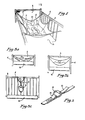
- the transitional sensory system consists of a sheet 2 attached by support means such as straps 3 to the rails 4 of a crib 6.
- sheet 2 is a soft yet textured, flexible material such as stretchable terry cloth to provide an infant with tactile stimulation.
- a central pocket or depression is provided to receive the infant.
- a fuzzy, fur-like deep pile panel 8 is provided to receive the infant.
- the terry cloth sheet and the panel providing the infant with a range of different sensory, tactile stimulation.
- Such an environment is far different than the flat, hard, cold and relatively smooth surface of the sheet or mattress in the usual crib or bassinette. The importance of factile stimulation in the development of the infant is described elsewhere in this application.
- a sonic device or generator 10 is received in a pocket 11 sown to the sheet 2.
- This sonic - device generates audible and tactile (or vibratory) . impulses simulating the human heart beat, thereby duplicating to a significant extent the dominate, normal and soothing sound patterns received by an infant during its period of uterogestation. Such simulation promotes sound, deep sleep by the infant and well may encourage an appreciation of music in the adult.
- the sonic device is further described in connection with FIGURES 4 through 6.
- the sheet is polygonal in shape, having relatively flat or arcuate sides terminating in corners, and the support system includes a member of simple, adjustable strap connection devices such as shown in FIGURE 2.
- the sheet may be of a sexagonal shape and have six such straps, one at each corner.
- the hammock Providing corners midway along the length of sheet gives the hammock longer side walls at this point, both for safety and for increased environmental space of the infant, promoting identification by the infant of the surrounding space. Since the portion of the sheet midway between each set of support straps does not change approximately when the infant is placed on the hammock, preferably the product for the sonic device is located in this area, and the pocket lightly receives the device to better transmit the vibrations to and along the sheet. Also, preferably the edges of the sheet are trimmed with a tape 12, the tape terminating at each corner of the - sheet in either a loop section or a strap section.
- FIGURE 2 is a perspective view of a portion of a strap 3 illustrating the preferred manner in which the corners of the sheet are adjustably attached to the rails of the crib.
- Each connection includes a tape loop section 13, formed at one end along the aide trim of the sheet, that attaches a pair of rings 14 to a corner of the sheet, and a tape strap section 15 formed at another end of the side trim of the sheet.
- This strap section may be looped over a rail of the crib and passed around-one of the rings and under the other of the rings, as shown, the rings cooperating with the strap to hold yet restrain the strap thereby providing a loop of adjustable size to attach the corner of the sheet to the crib rail.
- This support means is simply to fasten, yet safe. Increasing tension in the strap section will simply make the rings hold the strap more tightly. The tension of the strap and loop are distributed along the sheet by the side trim 11.
- the size of the sheet, and the length of the strap sections in relation to the crib permits the resulting hammock to be adjusted'among various positions from a relatively flat, spread position as shown in FIGURE 3a, to a more depressed sleeping position such as shown in FIGURE 3b, to a deep pocket position such as shown in FIGURE 3c.
- the deep pocket position of the sheet it may be conveniently connected cross-wise of the crib, the major longitudinal dimension of the sheet extending laterally of the crib, while in the spread position such as shown in FIGURE 3a the sheet may be connected to the rails of the crib with its major longitudinal dimension being parallel to the length of the crib and mattress 16 as illustrated in FIGURE 1.
- velcro 17 or other means of attachment are provided along the shorter sides of the sheet, as shown, to permit these sides of the sheet to be shortened when the sheet is in the pocket position as shown in FIGURE 3c.
- the hammock can provide a snug enclosure for the infant that is soft, warm, darkened and quiet. It resists movement of the infant, yet stretches and yeilds to permit the infant to move enough for exercise of the skeletal and muscular systems, as well as providing important tactile stimulation for the infant's sense of touch.
- the support means are simple enough to permit the sheet to be attached to a variety of other support systems, such as for example, between the sides of a porta-crib.
- the deep pile panel 8 is provided on only one side of the sheet, to permit the sheet to be reversed and the tactile stimulation offered the infant to be varied from time to time.
- both the panel 8 and the terry cloth sheet 2 are of a washable material.
- the position of the rails may be adjusted relative to the mattress to enable the infant to barely touch the mattress as illustrated in FIGURE 3a.
- This provides for the infant a flat stomach sleeping position, and a gradual transition from the closely enveloping and cuddling position such as illustrated in FIGURE 3c to a spread, more flattened position such as illustrated in FIGURE 3a and then, finally, to a fully flattened position such as may be provided by spreading the sheet flat on the surface of the mattress 16, by simply placing the infant directly upon the mattress 16 as is normally done at present. This results in a gradual and very beneficial transition from the womb to the world during the infant's exterogestational period of development.
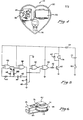
- FIGURE 4 The preferred sonic device or generator 10 is illustrated in FIGURE 4. As shown there, the components of the sonic device preferably are contained within a heart shaped housing 20 (although obviously any other shape or style of enclosure may be employed, if desired). In FIGURE 4 of upper sheet of the housing has been removed to reveal the lower shell and the various components it holds.
- the components of the sonic generator include a battery 22, a circuit board 24 bearing the major electrical components of the generator, and a solenoid vibration generator 26 that is attached to the side of the case, as by screws or adhesive, to transmit vibrations to the housing.
- a switch 28 also may be provided.
- FIGURE 5 The preferred electrical system is schematically illustrated in FIGURE 5. It is a simple, "syncopated" circuit. Its operation likely will be readily understood by those skilled in this art from an examination of the schematic. Nevertheless, it functions as follows: the positive potential of battery 22 is applied to bias one of the two inputs to each of exclusive or gates 32 and 34. Since the other input of gate 32 is at an acquiescent or lower voltage condition, gate 32 will produce a positive output. This output is applied to the other input of gate 34 causing it to produce a zero or grounded output. It is also applied to the series connected resistors 36 and 38, and through them charges capacitors 40 and 42 connected in series.
- the output of gate 52 is applied through resistor 60 to transistor 62 causing it to conduct current from the battery through the coil of solenoid 26 and to ground. A short time later, on the order of 2-3 milliseconds, when the output of gate 52 drops to zero, transistor 62 will cease conduction. The resulting electromotive force in the coil of solenoid 26 due to the collapse of the magnetic field generates a current that is shunted around the coil by diode 64, to prevent an adverse back bias condition from being applied to transistor 62. Since logic elements can be harmed quite easily by improper application of current, preferably the circuit includes a diode 66 in series with the battery and the various logic elements.
- the purpose of the circuit is to, in cooperation with the solenoid vibration generator, produce a thump-thump sound that closely simulates the audible and tactile (vibratory) impulses of the human heart.
- the sound is characterized by two pulses in rapid succession, then a long or pause, followed again by the two pulses in rapid succession.
- Each thump is produced by a conduction cycle of transistor 62.
- a first thump is initiated by conduction of gate 34, causing gate 52 to conduct.
- a short time later gate 54 conducts. Its output with the output of gate 34, causes gate 52 to terminate conduction.
- a short time later, gate 32 conducts, and conduction of gate 34 terminates, again causing gate 52 to conduct.
- Conduction of gate 52 terminates when capacitor 48 is discharged through resistor 46 to the grounded output of.gate 34 sufficiently to remove the positive bias to the input of gate 54, causing its output to match the grounded output of gate 34.
- the interval between these two conductions cycles is generally determined by the discharge rate of capacitors 40 and 42 through diode 68 and resistor 36 to the grounded output of gate 32.
- both inputs to gate 34 are positive, and the outputs of gates 34, 52 and 54 are all a zero or grounded state.
- the positive output of gate 32 resumes charging capacitors 40 and 42 through resistor chain 36 and 38.
- the value of these resistors, and particularly resistor 38 is chosen to result in approximately a 1.0-1.2 second delay between the termination of the last described cycle of conduction of transistor 62 and the moment when the positive potential on capacitor 40 reaches a state sufficient, when applied to the other input of gate 32 through resistor 44, to cause gate 32 to cease conduction. This re-initiates the conduction cycle just described.
- stage A, B, C and D can be diagrammatically represent as follows:
- the preferred solenoid device 26 is illustrated in FIGURE 6. It includes a coil 72 wrapped about a magnetizable armature or core 74, and a magnetizable plate 76 that is attached to a resilient mounting consisting of a spring-like armor panel 78 and a base 80, this mounting holding plate 76 spaced somewhat from the face of core 74.
- a weight or inertial element 82 may be attached, as by adhesive or any other convenient means, to the outer surface of plate 76.
- the electrical circuit is designed to produce a service of pulses, as has been described.
- the charactertics of the solenoid and circuit must be appropriately inter-related to achieve substantial movement of the plate yet to avoid causing it to impact upon the solenoid core 74. Should this occur, the resulting sound tends to be simply a click.
- the inertia provided by weight 82 assist in achieving this objective.
- Such characteristics conveniently may be adjusted by, for example, slightly bending bare 80 or arm 78 to adjust the spacing between plate 76 and core 74. By appropriately adjusting these characteristics, vibrations can be induced in the housing 20 that closely simulate the thump-thump vibrations of human heart beats.
- the current drain of the battery 22 is for the most part the current through the coil of solenoid 26 which occurs during conduction of transistor 62.
- each interval of conduction is on the order of 2-3 milliseconds.
- a typical nine volt battery will provide on the order of 800 hours of continuous operation, which is somewhat more than one month.
- the sonic device 10 preferably is received in a pocket 12 provided in sheet 2.
- the resulting vibrations of the sonic device are transmitted through sheet 2 to the infant supported thereby, and cooperate with the characteristics of the sheet to provide an excellent transitional environment for the infant.
- the sheet cuddles the infant, yet permits the infant to rock, kick and stretch; the sonic generator provides a rythmic heart beat simulating probably the most important sound in the womb, to both calm and reassure the infant.
- the infant transitional sensory system of the present invention promotes and encourages the body, brain and psychological development of the infant during exterogestation by stimulating the body's primary sensory systems, including at least the following basic systems:
- the transitional sensory system of the present invention provides an enriched environment that continues all the major stimulants during uterogestation and offers the infant a basic, necessary stimulation during the first vital few months of life in the world. It promotes exercise of the infant's joint and muscle systems as well as the infant's brain and nervous systems. It assists in the integration of the infant's senses, and the infant's relationship to gravity as well. It is a valuable and unique aid, both in the physical development of the infant and in the prevention of a number of psychological disorders that appear to be directly related to the lack of sensory stimulation and integration of the infant.
Landscapes
- Percussion Or Vibration Massage (AREA)
- Orthopedics, Nursing, And Contraception (AREA)
- Accommodation For Nursing Or Treatment Tables (AREA)
- Finger-Pressure Massage (AREA)
Applications Claiming Priority (2)
| Application Number | Priority Date | Filing Date | Title |
|---|---|---|---|
| US37199082A | 1982-04-26 | 1982-04-26 | |
| US371990 | 1989-06-27 |
Publications (2)
| Publication Number | Publication Date |
|---|---|
| EP0092784A2 true EP0092784A2 (de) | 1983-11-02 |
| EP0092784A3 EP0092784A3 (de) | 1984-10-17 |
Family
ID=23466251
Family Applications (1)
| Application Number | Title | Priority Date | Filing Date |
|---|---|---|---|
| EP83103827A Withdrawn EP0092784A3 (de) | 1982-04-26 | 1983-04-20 | Empfindungssimulator für Säuglinge |
Country Status (3)
| Country | Link |
|---|---|
| US (2) | US4941453A (de) |
| EP (1) | EP0092784A3 (de) |
| AU (1) | AU1142383A (de) |
Cited By (11)
| Publication number | Priority date | Publication date | Assignee | Title |
|---|---|---|---|---|
| FR2573312A1 (fr) * | 1984-11-22 | 1986-05-23 | Moreau Pierre | Nouveau dispositif de sedation mecanique des bebes et des jeunes enfants, notamment |
| GB2170100A (en) * | 1985-01-29 | 1986-07-30 | Sheila Diane Thody | Baby soothing apparatus |
| GB2172504A (en) * | 1985-03-18 | 1986-09-24 | David Henry Ferguson | Portable rocking vibrating massage device for divan bed |
| US4823418A (en) * | 1988-07-01 | 1989-04-25 | Downs Margaret C | Birth safety net |
| US4843665A (en) * | 1988-04-08 | 1989-07-04 | Cockel Ray S | Patient transport and bed comfort aid |
| US4893366A (en) * | 1984-12-10 | 1990-01-16 | Rosen Karl G | Crib with vibration attenuating means |
| US4963138A (en) * | 1988-06-13 | 1990-10-16 | Braun Jr Nohl A | Neo-natal net |
| US7475441B1 (en) * | 2007-04-09 | 2009-01-13 | Omar Soberal | Baby comforting apparatus |
| CN104644373A (zh) * | 2013-11-25 | 2015-05-27 | 朱妙庭 | 一种按摩器 |
| CN105686473A (zh) * | 2016-04-15 | 2016-06-22 | 翟凤平 | 模仿母亲心跳震动环境的新生儿睡床 |
| WO2017031784A1 (zh) * | 2015-08-27 | 2017-03-02 | 广东葫芦堡文化科技股份有限公司 | 一种可调婴儿床垫 |
Families Citing this family (78)
| Publication number | Priority date | Publication date | Assignee | Title |
|---|---|---|---|---|
| US5037375A (en) * | 1989-09-29 | 1991-08-06 | Infant Advantage, Inc. | Individual environmental control method |
| US5063912A (en) * | 1990-07-16 | 1991-11-12 | Hughes John S | Sleep inducing device |
| US5205811A (en) * | 1992-01-03 | 1993-04-27 | Fornarelli Belinda J | Baby blanket with heartbeat simulator |
| US5274863A (en) * | 1992-04-09 | 1994-01-04 | Fountain Roslyn B | Child's hammock |
| USD347328S (en) | 1992-06-23 | 1994-05-31 | Efthimiou Peter S | Cradle for infant carrier |
| US5479941A (en) * | 1993-10-18 | 1996-01-02 | Foundation Of Shamanic Studies | Device for inducing altered states of consciousness |
| US5518009A (en) * | 1994-11-28 | 1996-05-21 | Ruiz-Gonzalez; Susan | Apparatus for treating colic in infants |
| US6004259A (en) * | 1994-12-02 | 1999-12-21 | Sedaros; Shawky | Baby calmer kit using mother's heartbeat sound |
| US5845350A (en) * | 1996-02-16 | 1998-12-08 | Infant Advantage, Inc. | Cradle mattress |
| AU5085498A (en) * | 1996-10-22 | 1998-05-15 | Infant Advantage, Inc. | Dynamic mattress support and method of operation |
| WO1998039996A1 (en) * | 1997-03-14 | 1998-09-17 | Nims, Inc. | Reciprocating movement platform for shifting subject to and fro in headwards-footwards direction |
| US6155976A (en) * | 1997-03-14 | 2000-12-05 | Nims, Inc. | Reciprocating movement platform for shifting subject to and fro in headwards-footwards direction |
| US5855031A (en) * | 1997-11-12 | 1999-01-05 | Swift, Jr.; Wade | Crib with infant hammock |
| US6604980B1 (en) | 1998-12-04 | 2003-08-12 | Realityworks, Inc. | Infant simulator |
| US6428321B1 (en) * | 1997-12-08 | 2002-08-06 | Btio Educational Products, Inc. | Infant simulator |
| AP1060A (en) | 1998-01-02 | 2002-04-23 | Pfizer Prod Inc | Novel erythromycin derivatives. |
| US6092769A (en) * | 1998-02-03 | 2000-07-25 | Brown; Clark D. | Breast prosthesis protective cradle |
| USD435943S1 (en) | 1999-06-16 | 2001-01-02 | Dixson Greg W | Pet bed |
| US6494719B1 (en) * | 1999-10-20 | 2002-12-17 | Brent E. Logan | Method and system for reproducing a progressive or regressive pattern of sonic variations |
| NO315933B1 (no) * | 2000-12-22 | 2003-11-17 | Flexiped As | Treningsapparat med ubalanse for å opptrene en persons muskulatur |
| US6561915B2 (en) * | 2001-10-09 | 2003-05-13 | Mattel, Inc. | Infant swing and method of using the same |
| CA2472003C (en) * | 2002-01-04 | 2007-11-27 | Thomas F. Hennessy | Asymmetrical hammock |
| WO2003096953A2 (en) * | 2002-05-15 | 2003-11-27 | Non-Invasive Monitoring Systems, Inc. | Reciprocating movement platform for the external addition of pulses to the fluid channels of a subject |
| DE10259377B4 (de) * | 2002-12-18 | 2004-11-18 | Jörg, Wilhelm | Schaukel |
| US20050091744A1 (en) * | 2003-11-03 | 2005-05-05 | Nikolay Mayyak | Magnetically levitated rocking sleep system |
| US7614099B2 (en) * | 2005-06-08 | 2009-11-10 | Anne Goetz | Vibratable, sound-emitting, and inflatable sleeping bag for providing deep pressure |
| US8127384B2 (en) * | 2005-10-03 | 2012-03-06 | Christine Frances Carlton | Infant lulling device |
| US7485086B2 (en) * | 2005-12-01 | 2009-02-03 | 3699013 Canada Inc. | Rocking mechanism for children with associated sounds |
| US20070179334A1 (en) * | 2006-01-30 | 2007-08-02 | Groves Laurie L | Sleep aid |
| CA2544897C (en) | 2006-03-02 | 2013-08-06 | Mattel, Inc. | Repositionable child support device |
| US20080027694A1 (en) * | 2006-07-12 | 2008-01-31 | Yury Michael Gitman | Heartbeat Simulation Method And Apparatus |
| US20080201855A1 (en) * | 2007-02-27 | 2008-08-28 | Laurie Leslie Groves | Portable baby sleep system |
| US7814587B2 (en) * | 2008-01-23 | 2010-10-19 | Thomas Frank V | Apparatus for applying motion simulating a moving vehicle to an infant's carrier |
| US20100093251A1 (en) * | 2008-10-14 | 2010-04-15 | Viniotis Despina | Systems and Methods for 2-D and 3-D Soft Products Having Heartbeat Sound Emission |
| EP2364103B1 (de) | 2008-11-10 | 2013-01-02 | Kids II, Inc. | Elektromagnetische kinderwippe |
| US7614098B1 (en) | 2009-01-22 | 2009-11-10 | Veronica Quarry | Support system with repositionable bolsters |
| US7861337B1 (en) | 2009-06-04 | 2011-01-04 | Patel Bakulesh D | Hammock device for infants |
| US20110144416A1 (en) * | 2009-12-11 | 2011-06-16 | Joshua Waddell | Infant sleeping apparatus |
| US20110148155A1 (en) * | 2009-12-22 | 2011-06-23 | Mattel, Inc. | Collapsible Infant Support |
| CN203591093U (zh) * | 2010-09-08 | 2014-05-14 | 儿童二代公司 | 儿童弹跳装置控制设备及婴儿支撑装置控制设备 |
| IT1404058B1 (it) * | 2011-02-11 | 2013-11-08 | Piombino | Dispositivo di supporto per il comfort del neonato |
| WO2012145502A2 (en) * | 2011-04-19 | 2012-10-26 | The University Of Kansas | Medical device for therapeutic stimulation of the vestibular system |
| US9032573B2 (en) * | 2011-06-01 | 2015-05-19 | David Mijan | Bed vibration system and method |
| EP2768345B1 (de) | 2011-10-20 | 2019-05-15 | Happiest Baby, Inc. | Vorrichtung zum beruhigen und in-den-schlaf-wiegen von kleinkindern |
| US8769737B1 (en) * | 2012-05-16 | 2014-07-08 | Michael D. Duggins | Nest-like infant bed system |
| USD695467S1 (en) * | 2013-03-14 | 2013-12-10 | Cosmos Krejci | Pet hammock |
| EP3028605A1 (de) | 2013-03-15 | 2016-06-08 | Thorley Industries LLC | Angetriebener kindersitz |
| US10555858B2 (en) | 2013-03-15 | 2020-02-11 | Segars California Partners, Lp | Infant care transport device with shock and vibration system |
| EP3461374B1 (de) | 2013-07-31 | 2021-01-27 | HB Innovations, Inc. | Beruhigungs-/schlafhilfe für kleinkinder, vorrichtung zur vermeidung von plötzlichem kindstod und verfahren zur verwendung |
| US10463168B2 (en) | 2013-07-31 | 2019-11-05 | Hb Innovations Inc. | Infant calming/sleep-aid and SIDS prevention device with drive system |
| US20150366359A1 (en) * | 2014-04-24 | 2015-12-24 | Don Stewart Baldwin | Flying bed structure supported/suspended above the ground by six or more springs |
| USD768402S1 (en) * | 2014-06-27 | 2016-10-11 | Melissa Renee Acosta | Infant travel hammock |
| CN204318176U (zh) | 2014-08-08 | 2015-05-13 | 儿童二代公司 | 用于儿童弹跳装置及婴儿支撑装置的控制设备 |
| US10064499B2 (en) | 2014-09-05 | 2018-09-04 | Mattel, Inc. | Reconfigurable infant play yard |
| US20160081299A1 (en) * | 2014-09-22 | 2016-03-24 | Susan J. Wesley | Pet Confinement Apparatuses and Methods |
| USD772625S1 (en) | 2014-11-26 | 2016-11-29 | Mattel, Inc. | Infant support structure with a rocking device |
| USD780472S1 (en) | 2015-03-27 | 2017-03-07 | Happiest Baby, Inc. | Bassinet |
| US10470586B2 (en) * | 2015-10-14 | 2019-11-12 | Baby Trend, Inc. | Collapsible breathable mattress |
| US9943175B1 (en) | 2016-02-10 | 2018-04-17 | Crescent Womb, LLC | Infant support device |
| US10201236B1 (en) * | 2016-04-19 | 2019-02-12 | Deborah Cloud | Infant soothing system |
| USD866995S1 (en) | 2016-09-08 | 2019-11-19 | Kids2, Inc. | Play yard |
| WO2018075566A1 (en) | 2016-10-17 | 2018-04-26 | Happiest Baby, Inc. | Infant calming/sleep-aid device |
| CN106820777B (zh) * | 2016-12-14 | 2018-11-16 | 华安立高文具制品(深圳)有限公司 | 智能摇摆床及其控制方法 |
| JP2020520771A (ja) * | 2017-03-03 | 2020-07-16 | バヴェアス, ディミトラBAVEAS, Dimitra | 治療又は遊戯装置及び使用方法 |
| USD866122S1 (en) | 2017-04-04 | 2019-11-12 | Hb Innovations Inc. | Wingless sleep sack |
| CA3090808C (en) | 2018-02-21 | 2023-02-14 | Happiest Baby, Inc. | Infant sleep garment |
| WO2018127882A2 (en) * | 2018-03-26 | 2018-07-12 | Universidad Tecnológica De Panamá | Hammock device with sound system |
| CN109008434A (zh) * | 2018-08-15 | 2018-12-18 | 广西师范大学 | 一种能模拟父母怀抱的智能婴幼儿床及其模拟方法 |
| US20220288349A1 (en) * | 2019-02-12 | 2022-09-15 | GE Precision Healthcare LLC | Neonatal care system with sling sleep device |
| US11051630B1 (en) * | 2019-03-05 | 2021-07-06 | Sarah Barrott | Rocking bed base |
| EP3954253A4 (de) * | 2019-04-12 | 2023-01-04 | Kamei, Masamichi | Oszillierendes schlafinduktionsbett |
| US11497884B2 (en) | 2019-06-04 | 2022-11-15 | Hb Innovations, Inc. | Sleep aid system including smart power hub |
| US11700953B2 (en) * | 2019-09-18 | 2023-07-18 | Wonderland Switzerland Ag | Child care apparatus |
| WO2021119527A1 (en) * | 2019-12-11 | 2021-06-17 | Duncan Iii Richard Johnson | Dynamic furniture featuring pendulum-like motion |
| US11517123B2 (en) * | 2020-05-29 | 2022-12-06 | Way-Hong Chen | Spring swinging electromagnetic cradle |
| CN111920624A (zh) * | 2020-08-05 | 2020-11-13 | 山东省眼科研究所 | 一种婴幼儿眼部检查专用床 |
| US20240252781A1 (en) * | 2023-01-26 | 2024-08-01 | Paul Walker | Infant Mattress Assembly |
| WO2025264679A1 (en) * | 2024-06-18 | 2025-12-26 | Orlando Health, Inc. | Device for reducing vibration in neonatal transportation |
Family Cites Families (28)
| Publication number | Priority date | Publication date | Assignee | Title |
|---|---|---|---|---|
| US348809A (en) * | 1886-09-07 | Rocking furniture | ||
| US350878A (en) * | 1886-10-12 | Hammock | ||
| US1071954A (en) * | 1912-05-01 | 1913-09-02 | Matti Pietilaeinen | Hammock. |
| US2096913A (en) * | 1936-05-16 | 1937-10-26 | Walter J Munro | Sleeping garment |
| US2127710A (en) * | 1937-02-01 | 1938-08-23 | Ralph B Baker | Furniture construction |
| US2220330A (en) * | 1940-03-23 | 1940-11-05 | Joseph F Hilger | Safety baby hammock |
| US2389362A (en) * | 1944-10-12 | 1945-11-20 | Newman Agnes Morgan | Baby bathing cot |
| US2467890A (en) * | 1947-02-25 | 1949-04-19 | Gladys S Harvey | Baby hammock |
| US2916745A (en) * | 1954-09-17 | 1959-12-15 | Lesk Norman | Power actuated rhythmical movement accessories for children's cribs |
| FR1156226A (fr) * | 1956-08-31 | 1958-05-13 | Hamac pneumatique | |
| US3060461A (en) * | 1960-02-17 | 1962-10-30 | Gentle | Electric cradling basket |
| US3235891A (en) * | 1962-10-05 | 1966-02-22 | Chade Yamil | Child's musical mattress and support thereof |
| US3311935A (en) * | 1965-07-20 | 1967-04-04 | Robert H Petty | Bed vibrating device |
| US3419923A (en) * | 1965-12-06 | 1969-01-07 | Stuart C. Cowan | Baby environment simulator |
| US3412410A (en) * | 1967-04-12 | 1968-11-26 | Traudl M. Denfeld | Stroller blanket |
| US3659297A (en) * | 1970-07-22 | 1972-05-02 | Bernard Schutz | Baby dressing table pad replacement |
| US3849812A (en) * | 1971-08-27 | 1974-11-26 | F Walsh | Children{40 s or infants furniture |
| US3837019A (en) * | 1973-03-12 | 1974-09-24 | J Hoff | Modular cradle-like structure |
| IT1021311B (it) * | 1974-09-12 | 1978-01-30 | Bioengineering Research | Simulatore del rumore cardiaco |
| CH593654A5 (de) * | 1975-07-03 | 1977-12-15 | Schwager Hansjoerg | |
| US4028753A (en) * | 1975-10-16 | 1977-06-14 | Augusto Rios | Automatically rockable infant's crib |
| DE2559329A1 (de) * | 1975-12-31 | 1977-07-14 | Bahls Hans Joachim Ing Grad | Therapeutisches schwinggeraet zum ersatz und/oder imitation der beruhigenden schaukelbewegung von kinderwagen durch eine person |
| US4002368A (en) * | 1976-01-09 | 1977-01-11 | Ortize Eileen S | Hanging chair |
| US4066072A (en) * | 1976-02-12 | 1978-01-03 | Cummins Betty L | Comfort cushion for infants |
| US4055170A (en) * | 1976-07-22 | 1977-10-25 | Ryotaro Nohmura | Health promoting apparatus |
| US4124022A (en) * | 1977-01-14 | 1978-11-07 | Sam Gross | Heart novelty and relaxation device |
| US4064576A (en) * | 1977-02-09 | 1977-12-27 | Threatt Grace J | Combined baby bottle holder and mattress cover |
| JPS54102101A (en) * | 1977-10-27 | 1979-08-11 | Leitner Bernhard | Method of producing directional motion at echo passing through human body and device for executing same |
-
1983
- 1983-02-15 AU AU11423/83A patent/AU1142383A/en not_active Abandoned
- 1983-04-20 EP EP83103827A patent/EP0092784A3/de not_active Withdrawn
-
1986
- 1986-01-28 US US06/822,960 patent/US4941453A/en not_active Expired - Fee Related
-
1988
- 1988-03-04 US US07/168,597 patent/US4934997A/en not_active Expired - Fee Related
Cited By (14)
| Publication number | Priority date | Publication date | Assignee | Title |
|---|---|---|---|---|
| WO1986003109A1 (fr) * | 1984-11-22 | 1986-06-05 | Moreau, Pierre | Nouveau dispositif de sedation mecanique des bebes et des jeunes enfants, notamment |
| FR2573312A1 (fr) * | 1984-11-22 | 1986-05-23 | Moreau Pierre | Nouveau dispositif de sedation mecanique des bebes et des jeunes enfants, notamment |
| US4893366A (en) * | 1984-12-10 | 1990-01-16 | Rosen Karl G | Crib with vibration attenuating means |
| US5003651A (en) * | 1984-12-10 | 1991-04-02 | Rosen Karl G | Crib with vibration attenuating means |
| GB2170100A (en) * | 1985-01-29 | 1986-07-30 | Sheila Diane Thody | Baby soothing apparatus |
| GB2172504A (en) * | 1985-03-18 | 1986-09-24 | David Henry Ferguson | Portable rocking vibrating massage device for divan bed |
| US4843665A (en) * | 1988-04-08 | 1989-07-04 | Cockel Ray S | Patient transport and bed comfort aid |
| US4963138A (en) * | 1988-06-13 | 1990-10-16 | Braun Jr Nohl A | Neo-natal net |
| US4823418A (en) * | 1988-07-01 | 1989-04-25 | Downs Margaret C | Birth safety net |
| US7475441B1 (en) * | 2007-04-09 | 2009-01-13 | Omar Soberal | Baby comforting apparatus |
| CN104644373A (zh) * | 2013-11-25 | 2015-05-27 | 朱妙庭 | 一种按摩器 |
| WO2017031784A1 (zh) * | 2015-08-27 | 2017-03-02 | 广东葫芦堡文化科技股份有限公司 | 一种可调婴儿床垫 |
| CN105686473A (zh) * | 2016-04-15 | 2016-06-22 | 翟凤平 | 模仿母亲心跳震动环境的新生儿睡床 |
| CN105686473B (zh) * | 2016-04-15 | 2018-08-10 | 翟凤平 | 模仿母亲心跳震动环境的新生儿睡床 |
Also Published As
| Publication number | Publication date |
|---|---|
| AU1142383A (en) | 1983-11-03 |
| US4941453A (en) | 1990-07-17 |
| US4934997A (en) | 1990-06-19 |
| EP0092784A3 (de) | 1984-10-17 |
Similar Documents
| Publication | Publication Date | Title |
|---|---|---|
| US4941453A (en) | Infant transitional sensory system | |
| Lourie | The role of rhythmic patterns in childhood | |
| US4718876A (en) | Child calming toy with rythmic stimulation | |
| US3292611A (en) | Infant mattress with heating and ticking mechanisms | |
| AU651837B2 (en) | Sleep inducing device | |
| US4947832A (en) | Apparatus and method for treating or relieving colicky infants | |
| Bril et al. | The cultural context of motor development: Postural manipulations in the daily life of Bambara babies (Mali) | |
| US5385153A (en) | Infant environmental transition system and method | |
| US5395301A (en) | Kinesthetic system for promoting rhythmic breathing by tactile stimulation | |
| Wesecky et al. | Music therapy for children with Rett syndrome | |
| US20140275742A1 (en) | Infant Blanket with Insertable and Programmable Devices to Provide Stimulation and Soothing to an Infant | |
| US20020095103A1 (en) | Portable, vibrating relaxation device | |
| US20070037474A1 (en) | Child calming toy with rythmic stimulation | |
| EP0168435A1 (de) | Krankenhausbetteinheit für kinder | |
| EP0617907A1 (de) | Beruhigungsmatratze | |
| Chaze et al. | Sensory stimulation in the NICU | |
| JPH07275091A (ja) | 安静マットレス装置 | |
| Affonso | The newborn's potential for interaction | |
| Smith et al. | Sensory-feedback analysis of infant control of the behavioral environment | |
| JPS6131159A (ja) | 乳児保育装置 | |
| CA1272883A (en) | Child calming toy with rhythmic stimulation | |
| Pikler | The competence of the infant | |
| Koniak-Griffin et al. | Paradoxical effects of stimulation on normal neonates | |
| Garabedian | Itsy Bitsy Yoga: Poses to Help Your Baby Sleep Longer, Digest Better, and Grow Stronger | |
| US20250367565A1 (en) | Plush Comforting Device |
Legal Events
| Date | Code | Title | Description |
|---|---|---|---|
| PUAI | Public reference made under article 153(3) epc to a published international application that has entered the european phase |
Free format text: ORIGINAL CODE: 0009012 |
|
| AK | Designated contracting states |
Designated state(s): AT BE CH DE FR GB IT LI LU NL SE |
|
| PUAL | Search report despatched |
Free format text: ORIGINAL CODE: 0009013 |
|
| AK | Designated contracting states |
Designated state(s): AT BE CH DE FR GB IT LI LU NL SE |
|
| 17P | Request for examination filed |
Effective date: 19850201 |
|
| STAA | Information on the status of an ep patent application or granted ep patent |
Free format text: STATUS: THE APPLICATION IS DEEMED TO BE WITHDRAWN |
|
| 18D | Application deemed to be withdrawn |
Effective date: 19860304 |
|
| RIN1 | Information on inventor provided before grant (corrected) |
Inventor name: SHAKAS, PAULINE V. Inventor name: WOODWARD, JOHN STEWART |