EP0091768B1 - Messen der Eigenschaften von lebenden Geweben mittels Ultraschallwellen - Google Patents
Messen der Eigenschaften von lebenden Geweben mittels Ultraschallwellen Download PDFInfo
- Publication number
- EP0091768B1 EP0091768B1 EP83301893A EP83301893A EP0091768B1 EP 0091768 B1 EP0091768 B1 EP 0091768B1 EP 83301893 A EP83301893 A EP 83301893A EP 83301893 A EP83301893 A EP 83301893A EP 0091768 B1 EP0091768 B1 EP 0091768B1
- Authority
- EP
- European Patent Office
- Prior art keywords
- frequencies
- tissue
- logarithms
- obtaining
- energies
- Prior art date
- Legal status (The legal status is an assumption and is not a legal conclusion. Google has not performed a legal analysis and makes no representation as to the accuracy of the status listed.)
- Expired
Links
Images

Classifications
-
- A—HUMAN NECESSITIES
- A61—MEDICAL OR VETERINARY SCIENCE; HYGIENE
- A61B—DIAGNOSIS; SURGERY; IDENTIFICATION
- A61B8/00—Diagnosis using ultrasonic, sonic or infrasonic waves
- A61B8/08—Clinical applications
-
- G—PHYSICS
- G01—MEASURING; TESTING
- G01S—RADIO DIRECTION-FINDING; RADIO NAVIGATION; DETERMINING DISTANCE OR VELOCITY BY USE OF RADIO WAVES; LOCATING OR PRESENCE-DETECTING BY USE OF THE REFLECTION OR RERADIATION OF RADIO WAVES; ANALOGOUS ARRANGEMENTS USING OTHER WAVES
- G01S15/00—Systems using the reflection or reradiation of acoustic waves, e.g. sonar systems
- G01S15/88—Sonar systems specially adapted for specific applications
- G01S15/89—Sonar systems specially adapted for specific applications for mapping or imaging
- G01S15/8906—Short-range imaging systems; Acoustic microscope systems using pulse-echo techniques
- G01S15/895—Short-range imaging systems; Acoustic microscope systems using pulse-echo techniques characterised by the transmitted frequency spectrum
-
- G—PHYSICS
- G01—MEASURING; TESTING
- G01S—RADIO DIRECTION-FINDING; RADIO NAVIGATION; DETERMINING DISTANCE OR VELOCITY BY USE OF RADIO WAVES; LOCATING OR PRESENCE-DETECTING BY USE OF THE REFLECTION OR RERADIATION OF RADIO WAVES; ANALOGOUS ARRANGEMENTS USING OTHER WAVES
- G01S7/00—Details of systems according to groups G01S13/00, G01S15/00, G01S17/00
- G01S7/52—Details of systems according to groups G01S13/00, G01S15/00, G01S17/00 of systems according to group G01S15/00
- G01S7/52017—Details of systems according to groups G01S13/00, G01S15/00, G01S17/00 of systems according to group G01S15/00 particularly adapted to short-range imaging
- G01S7/52023—Details of receivers
- G01S7/52036—Details of receivers using analysis of echo signal for target characterisation
-
- G—PHYSICS
- G01—MEASURING; TESTING
- G01N—INVESTIGATING OR ANALYSING MATERIALS BY DETERMINING THEIR CHEMICAL OR PHYSICAL PROPERTIES
- G01N2291/00—Indexing codes associated with group G01N29/00
- G01N2291/02—Indexing codes associated with the analysed material
- G01N2291/024—Mixtures
- G01N2291/02475—Tissue characterisation
-
- G—PHYSICS
- G01—MEASURING; TESTING
- G01N—INVESTIGATING OR ANALYSING MATERIALS BY DETERMINING THEIR CHEMICAL OR PHYSICAL PROPERTIES
- G01N2291/00—Indexing codes associated with group G01N29/00
- G01N2291/02—Indexing codes associated with the analysed material
- G01N2291/028—Material parameters
- G01N2291/02872—Pressure
Definitions
- the present invention relates to the measuring of characteristic parameters of living tissues by transmitting ultrasonic waves into a living body and analyzing reflected waves therefrom.
- the tissue has such a microstructure that cells, capillary vessels, lymphatic vessels, muscular fibers and so forth intertwine complicatedly.
- a typical size of such a tissue is nearly equal to or smaller than the wavelength of ultrasonic waves.
- reflected waves from the microstructure are accompanied by complex interference owing to phase dispersion and pulse overlapping, introducing in a B-mode tomogram a speckled pattern commonly referred to as "speckle".
- the system * 1 conducts a second order differentiation by natural logarithms of their frequencies and a first order differentiation in the direction of depth, by which "a second order differentiated value of the attenuation coefficient of the ultrasonic waves by the natural logarithms of their frequencies" is obtained as a tissue characteristic parameter.
- energy (or power) values of the ultrasonic waves are obtained through utilization of three frequencies f" f 2 and f 3 and, as a difference value, "the second order differentiated value of the attenuation coefficient of the ultrasonic waves by the natural logarithms of their frequencies” is obtained in the form of a parameter.
- the attenuation coefficient is proportional to the first power of the frequency, the abovesaid parameter is in agreement with an attenuation constant.
- the abovesaid Hayakawa system requires complex processing corresponding to the second order differentiation by the natural logarithms of the frequencies, and hence is difficult of real-time processing and poor in SN ratio; further, tissue information on the reflection (backward scattering) is entirely lost. Moreover, the parameters thus obtained are insignificant from the physical viewpoint.
- the present invention pertains to the measuring of the frequency dependency of the reflection coefficient and that of the attenuation coefficient of the living tissue separately of each other.
- the present invention as defined in Claims 1 and 6, respectively, provides a method and apparatus which can enable separate measurement of tissue characteristic information on the attenuation and reflection coefficients of a living tissue to thereby permit non-invasive measurement of accurate internal living tissue information from the skin surface and which is therefore great utility when employed for a medical diagnosis, a medical checkup for geriatic diseases and so forth.
- the present invention can provide a method and an apparatus for obtaining tissue information on not only attenuation but also reflection (backward scattering) coefficients of a living tissue through simple processing which can be executed on the real-time basis, too, and does not introduce much noise.
- the present invention can provide a method and an apparatus which obtains energy (or power) values of reflected from a living tissue of ultrasonic waves of at least three frequency bands (or components) and performs arithmetic processing of the energy values to thereby obtain living tissue characteristic values (parameters) of clear physical meaning, such as a frequency slope of an attenuation coefficient of a living tissue and a spatial derivative of a frequency power exponent of its reflection coefficient, through simple processing which can be performed on the real-time basis and does not introduce much noise.
- the present invention provides a method in which energies of ultrasonic waves of at least three frequency bands (or components) reflected from a living tissue are obtained, and differences among their logarithms are obtained and then an attenuation slope and/or reflection power exponent derivative of the living tissue are obtained from at least two equations obtained by differentiating the differences in terms of the depth of measurement. Apparatus carrying out the method is also provided.
- the "power” mentioned herein is energy per unit time but, in this specification, it is included in the “energy”.
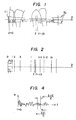
- Figure 1 shows the manner in which an ultrasonic transducer 11 formed by a piezoelectric element, for example, PZT sold by Clevite Inc., held in contact with the skin surface 0 of a living body, transmits thereinto and receives therefrom ultrasonic pulses in a direction Z.
- Reference numerals 0,1, 2, ... i, i+1, ... and m indicate boundaries of body tissues crossing the Z-axis. Intermediate portions between adjacent boundaries, for instance, 0-1, 1-2, 2-3, ... , i-i+1, ... show, for instance, the outer skin, fat, muscles, ... the liver,... and so forth.
- Reference numeral 51 designates a focused sound field that is determined by the radius of curvature of an aperture concave of the transducer 11 and the frequency of the ultrasonic waves used.
- the intensity of received waves reflected from a depth z varies as a function of the depth z with a factor determined by three-dimensional geometric conditions which are dependent on the convergence of a beam on both ways (in both directions) and the wavelength, such as the degree of focusing, even if the subject under test is not a living body but water or the like which does not attenuate ultrasonic waves.
- Transmitted ultrasonic waves having reached the boundary i are reflected back or scattered (reflected, refracted) and aside three-dimensionally since the living tissues on both sides of the boundary i have different acoustic impedances or the boundary i has irregularities; however, since the acoustic impedance and the speed of sound in the living body do not widely differ with tissues, the transmitted ultrasonic waves mostly pass through the boundary i.
- Letting the transmission factor, reflection factor and scattering factor of the boundary i with respect to the incident waves thereon be represented by ⁇ i, yi and 6i, respectively, they bear the following relationships: Therefore, even if yi and 6i somewhat have frequency dependence, T i can be regarded as having no frequency dependence.
- the voluminal tissue sandwiched between the boundaries i and i+1 has a microstructure of a typical size nearly equal to or smaller than the wavelength of the ultrasonic waves and having cells, capillary vessels, fibers, nerves and so forth intertwined complicatedly.
- the microstructure cannot theoretically be measured because of its size relative to the wavelength of the ultrasonic waves and only a spatial mean value of the microstructure can be measured. It has been proven experimentally that ultrasonic waves transmitted into a living body are subjected to attenuation which varies exponentially as the depth (z) increases, and that its attenuation constant a is proportional to the frequency f of the ultrasonic waves. That is, where ⁇ is a proportional constant.
- the proportional constant ⁇ is a frequency slope of the attenuation constant and referred to as an attenuation slope and it is a characteristic value of the tissue.
- a reflection from a voluminal tissue is statistically a speckled reflection commonly referred to as "speckle" and a reflection coefficient y is given experimentally as follows: where b and n are constants.
- the constant n is a frequency power exponent of the reflection coefficient and a characteristic value of the tissue.
- the following expression is a computational expression obtained from sound pressure measurement but, if the power of the waves can be directly measured, a direct representing expression can be used.
- F(f 1 ⁇ z) is a correcting term obtained by integrating frequency dependent components of reflection and attenuation in connection with a frequency variation from f 1 in the band 20.
- T 'i is the transmission factor of the reflected waves at the boundary i.
- the upper limit i is a maximum number from the skin surface to the depth z.
- E 1 , E 2 and E 3 are measured as functions of the depth z.
- ⁇ (z) frequency slope of attenuation coefficient, and spatial derivative of frequency power exponent of reflection coefficient
- the above is a description of the principle of the present invention.
- the present invention is free from the influence of the boundary transmission factors ⁇ i and T 'i, the constant b(z) of the reflection coefficient and the absolute values Q 1 , Q 2 and Q 3 of the amplitudes of respective frequency components. While in the foregoing Eq. (5) is set up using f 2 and f 3 , it may also be set up using f 3 and f 4 . Furthermore, if the value A of the attenuation compensating time control amplification degree (TGC) is held constant with respect to all frequencies, then become zero, making compensation unnecessary.
- TGC attenuation compensating time control amplification degree
- Eq. (1) and so on can be represented using the amplitude absolute value Q,(z) of the sound pressure but, in order to avoid a bad influence of the phase term, it is necessary to obtain E, first and then Q, from This is not so significant, and hence is not described in this specification.
- tissue characteristic value thus obtained as a function of the depth z on a certain scanning line is displayed on the corresponding scanning line on a CRT or the like as in the case of a B-mode graph, a two-dimensionally or three-dimensionally distributed image can be obtained. This is useful for finding out an abnormality, such as a cancer or the like, by visual examination.
- FIG 3 illustrates an example of apparatus suitable for carrying the present invention into practice.
- reference numeral 11 indicates a wide-band transducer, which is formed by piezoelectric elements of the aforementioned PZT or PVDF (polyvinylidene fluoride sold by Kureha Kogyo of Japan).
- the transducer 11 is shown to be a compound transducer which comprises a PZT transducer 11' and PVDF transducer 11" covering different frequency bands.
- the transducer is formed by three layers of center frequencies f 1 , f 2 and f 3 for covering frequency bands 2 ⁇ 1 , 20 2 and 20 3 (where ⁇ 1 , ⁇ 2 and ⁇ 3 are half-widths), respectively, and received waves are separated by filters to obtain energies E 1 , E 2 and E 3 .
- pulses of wide band are transmitted and the DFFT (Digital Fast Fourier Transformation) is used.
- Reference numeral 12 designates a driver, which may be arranged to drive the transducers 11' and 11" by impulses or in separately specified frequency bands.
- Reference numeral 13 identifies a wide-band amplifier for amplifying signals of received reflected waves.
- the reflected wave from a depth zi appears at such a time as follows: where C is the sound speed in the living body.
- a signal from a tissue between the depth zi and zi+Az appears in the following time interval: Accordingly, the tissue characteristic between the depths zi and zi+Az can be obtained by analyzing the signal received in the time interval ⁇ t.
- the amplification degree Z of the amplifier 13 is varied with an increase in the depth z or with the lapse of time t. This is called time-gain control or sensitivity-time control. This control is needed for retaining excellent SN ratio in subsequent signal processing.
- Reference numeral 14 denotes a gate, which is opened in the time phase of Eq. (12) and closed after the lapse of time given by Eq. (13).
- Reference numeral 16 shows a DFFT (Digital Fast Fourier Transformation) circuit, which analyzes the abovesaid 100 data to output real parts and imaginary parts of about 50 frequency components. For instance, in the case of the frequency f 1 , a component in-phase with cos2 ⁇ f 1 t is a real part R 1 and a component in-phase with sin2 ⁇ f 1 t is an imaginary part l 1 .
- DFFT Digital Fast Fourier Transformation
- Reference numerals 17-1, 17-2,... refer to calculating units, which are supplied with the real parts and the imaginary parts of components of the frequencies f 1 , f 2 , f 3 , f 4 , ... from the DFFT circuit 16. Since the calculating units 17-1, 17-2, ... are identical in construction and in operation, a detailed description will be given of the calculating unit 17-1 alone.
- the calculating unit 17-1 receives the real part R 1 and the imaginary part l 1 , ofthe frequency f 1 from the DFFT circuit 16.
- the real part R 1 and the imaginary part l 1 are squared by square circuits 171 and 172 to obtain R, 2 and l 1 2 , which are added by an adder 173, obtaining the sum R 1 2 +l 1 2 .
- This sum is equal to E 1 .
- InE is obtained by a logarithmic amplifier 74.
- InG 1 2 ⁇ A 1 2 is obtained as a function of the depth z (or the time t) and prestored in the form of a table in an ROM 178, from which is read out a value for the corresponding z (or t).
- the output InE, of the lorarithmic amplifier 174 and the output InG 1 2 ⁇ A 1 2 of the ROM 178 are applied to a subtractor 175, wherein a subtraction InE 1 -InG 1 2 ⁇ A 1 2 is carried out to output which is stored in a memory 176.
- the calculating unit 17-2 provides the following output:
- Reference numerals 18-1, 18-2, 18-3, ... signify subtractors.
- the subtractor 18-1 subtracts the output of the calculating unit 17-2 from the output of the calculating unit 17-1.
- the subtractor 18-2 subtracts the output of the calculating unit 17-3 from the output of the calculating unit 17-2. In a similar manner, the following subtractors operate.
- the output of the subtractor 18-2 similarly provides the left side of Eq. (5).
- Reference numeral 19-1 indicates an algebraic calculator which receives the outputs of the subtractors 18-1 and 18-2 and solves from Eqs. (4) and (5) a simultaneous equation with ⁇ (z) and unknown. Certain constants ⁇ 11 and a l2 determined by the frequencies f 1 , and f 2 are multiplied by the outputs of the subtractors 18-1 and 18-2 and then added together to obtain ⁇ (z).
- Reference numeral 20 designates an arithmetic mean circuit which comprises an adder 21 for adding the outputs of the algebraic calculators 19-1, 19-2, ... and a divider 22 for dividing the output of the adder 21 by the number N of inputs to the adder 22.
- the arithmetic mean circuit 20 obtains an arithmetic means value of the N values ⁇ (z) or sequentially obtained for each frequency component of the output of the DFFT circuit 16.
- Reference numeral 23 identifies a shift register which comprises L stacked registers 23-1, 23-2,... 23-L for storing the output of the arithmetic mean circuit 20.
- the output of the arithmetic mean circuit 20 for the depth zi is written into the register 23-1 and when the output of the arithmetic mean circuit 20 for the next depth zi+1 goes into the register 23-1, the content of the register 23-1 is shifted to the register 23-2.
- previous data are shifted upward through successive registers in the shift register 23.
- L data are stored in the shift register 23, with the oldest data in the register 23-L and the latest one in the register 23-1.
- Reference numeral 24 denotes an arithmetic mean circuit for obtaining an arithmetic mean value of L data.
- the arithmetic mean circuit 24 is also comprised of an adder 25 for adding L outputs from the registers 23-1 to 23-L and a divider 26 for dividing the output of the adder 25 by L. The outputs of the registers 23-1 to 23-L are added together by the adder 25 and its output is applied to the divider 26, wherein it is divided by L to obtain the arithmetic mean.
- the output of the arithmetic mean circuit 24 provides, for each scanning, a mean value of (LxN) ⁇ (z)'s or for each of the depths z 1 , z 2 , Z3 , ... z and z 1+1 , and the mean value is stored in a memory.
- the frequency components f 1 , f 2 , f 3 , ... correspond to the outputs of the DFFT circuit 16 in a sequential order but, by a suitable selection of the outputs of the DFFT circuit 16 in a manner to form a geometric or arithmetic progression as described previously, the calculating circuits of the algebraic calculators 19-1, 19-2, ... can be simplified although the number N decreases.
- ⁇ (z) By scanning one sectional area of a living body in successive scanning directions so that, for instance, ⁇ (z) may be obtained as a function of each of the depths z 1 , z 2 , ... z and z 1+1 as a mean value of the LxMxN measured values for each scanning direction, and then displaying the resulting values on the corresponding scanning lines of a CRT, it is possible to obtain a distribution diagram of j3(z) or on the sectional area of the living body. This is very useful for detecting an abnormal tissue as of a cancer.
Landscapes
- Engineering & Computer Science (AREA)
- Physics & Mathematics (AREA)
- Radar, Positioning & Navigation (AREA)
- Remote Sensing (AREA)
- Health & Medical Sciences (AREA)
- Life Sciences & Earth Sciences (AREA)
- Computer Networks & Wireless Communication (AREA)
- General Physics & Mathematics (AREA)
- Acoustics & Sound (AREA)
- Pathology (AREA)
- Surgery (AREA)
- Radiology & Medical Imaging (AREA)
- Biomedical Technology (AREA)
- Heart & Thoracic Surgery (AREA)
- Medical Informatics (AREA)
- Molecular Biology (AREA)
- Nuclear Medicine, Radiotherapy & Molecular Imaging (AREA)
- Animal Behavior & Ethology (AREA)
- General Health & Medical Sciences (AREA)
- Public Health (AREA)
- Veterinary Medicine (AREA)
- Biophysics (AREA)
- Ultra Sonic Daignosis Equipment (AREA)
Claims (10)
Applications Claiming Priority (2)
| Application Number | Priority Date | Filing Date | Title |
|---|---|---|---|
| JP57057573A JPS58173539A (ja) | 1982-04-07 | 1982-04-07 | 超音波による生体組織特性測定方法 |
| JP57573/82 | 1982-04-07 |
Publications (3)
| Publication Number | Publication Date |
|---|---|
| EP0091768A2 EP0091768A2 (de) | 1983-10-19 |
| EP0091768A3 EP0091768A3 (en) | 1985-06-26 |
| EP0091768B1 true EP0091768B1 (de) | 1989-07-26 |
Family
ID=13059585
Family Applications (1)
| Application Number | Title | Priority Date | Filing Date |
|---|---|---|---|
| EP83301893A Expired EP0091768B1 (de) | 1982-04-07 | 1983-04-05 | Messen der Eigenschaften von lebenden Geweben mittels Ultraschallwellen |
Country Status (4)
| Country | Link |
|---|---|
| US (2) | US4564019A (de) |
| EP (1) | EP0091768B1 (de) |
| JP (1) | JPS58173539A (de) |
| DE (1) | DE3380275D1 (de) |
Families Citing this family (46)
| Publication number | Priority date | Publication date | Assignee | Title |
|---|---|---|---|---|
| US4575799A (en) * | 1983-03-23 | 1986-03-11 | Fujitsu Limited | Ultrasonic living body tissue characterization system |
| JPS59203549A (ja) * | 1983-04-30 | 1984-11-17 | 中山 淑 | 超音波診断装置 |
| FR2554238B1 (fr) * | 1983-10-28 | 1986-02-28 | Labo Electronique Physique | Appareil d'exploration de milieux par echographie ultrasonore |
| JPS60122367A (ja) * | 1983-12-07 | 1985-06-29 | Terumo Corp | 超音波測定方法およびその装置 |
| JPS60176629A (ja) * | 1984-02-23 | 1985-09-10 | テルモ株式会社 | 超音波測定装置 |
| JPS60195473A (ja) * | 1984-03-17 | 1985-10-03 | Terumo Corp | 超音波測定装置 |
| JPS60203242A (ja) * | 1984-03-28 | 1985-10-14 | 富士通株式会社 | 反射型超音波非線形反射係数測定装置 |
| FR2563918B1 (fr) * | 1984-04-10 | 1987-06-05 | Labo Electronique Physique | Appareil d'exploration de milieux par echographie ultrasonore |
| JPS6111658A (ja) * | 1984-06-28 | 1986-01-20 | Terumo Corp | 超音波測定方法およびその装置 |
| JPS61135640A (ja) * | 1984-12-06 | 1986-06-23 | テルモ株式会社 | 超音波測定方法およびその装置 |
| US4777599A (en) * | 1985-02-26 | 1988-10-11 | Gillette Company | Viscoelastometry of skin using shear wave propagation |
| FR2579765B1 (fr) * | 1985-03-29 | 1988-05-06 | Labo Electronique Physique | Procede et appareil d'exploration de milieux par echographie ultrasonore |
| US4803994A (en) * | 1987-08-12 | 1989-02-14 | General Electric Company | Backscatter data collection technique for ultrasound |
| DE69222454T2 (de) * | 1991-03-08 | 1998-02-05 | Fujitsu Ltd | Ultraschall-Bildgerät |
| US5460595A (en) * | 1993-06-01 | 1995-10-24 | Dynatronics Laser Corporation | Multi-frequency ultrasound therapy systems and methods |
| GB2279742A (en) * | 1993-06-29 | 1995-01-11 | Cancer Res Inst Royal | Apparatus for monitoring ultrasonic surgical ablation |
| US5891038A (en) * | 1996-12-30 | 1999-04-06 | General Electric Company | Method, apparatus and applications for combining transmit wave functions to obtain synthetic waveform in ultrasonic imaging system |
| CA2309916C (en) | 1997-11-14 | 2007-10-09 | Colorado Seminary | Ultrasonic system for grading meat |
| US6385474B1 (en) | 1999-03-19 | 2002-05-07 | Barbara Ann Karmanos Cancer Institute | Method and apparatus for high-resolution detection and characterization of medical pathologies |
| US6213946B1 (en) | 1998-12-24 | 2001-04-10 | Agilent Technologies, Inc. | Methods and apparatus for speckle reduction by orthogonal pulse compounding in medical ultrasound imaging |
| US6835178B1 (en) * | 1999-06-23 | 2004-12-28 | Hologic, Inc. | Ultrasonic bone testing with copolymer transducers |
| US6685645B1 (en) * | 2001-10-20 | 2004-02-03 | Zonare Medical Systems, Inc. | Broad-beam imaging |
| US20020173721A1 (en) * | 1999-08-20 | 2002-11-21 | Novasonics, Inc. | User interface for handheld imaging devices |
| AU2003261073A1 (en) * | 2002-05-16 | 2003-12-02 | Barbara Ann Karmanos Cancer Institute | Combined diagnostic and therapeutic ultrasound system |
| US7285092B2 (en) | 2002-12-18 | 2007-10-23 | Barbara Ann Karmanos Cancer Institute | Computerized ultrasound risk evaluation system |
| US6837854B2 (en) * | 2002-12-18 | 2005-01-04 | Barbara Ann Karmanos Cancer Institute | Methods and systems for using reference images in acoustic image processing |
| US6926672B2 (en) * | 2002-12-18 | 2005-08-09 | Barbara Ann Karmanos Cancer Institute | Electret acoustic transducer array for computerized ultrasound risk evaluation system |
| US7998073B2 (en) * | 2003-08-04 | 2011-08-16 | Imacor Inc. | Ultrasound imaging with reduced noise |
| AU2004294945B2 (en) * | 2003-11-26 | 2011-05-26 | Imacor Inc. | Transesophageal ultrasound using a narrow probe |
| US7374569B2 (en) * | 2004-09-02 | 2008-05-20 | Dynatronics, Corporation | Dynamically distributing power of a light beam for use in light therapy |
| US20070208289A1 (en) * | 2006-03-03 | 2007-09-06 | Jay Walther | Systems and methods for providing light therapy traction |
| US20070208396A1 (en) * | 2006-03-03 | 2007-09-06 | Gary Whatcott | Systems and methods for providing a dynamic light pad |
| US10201324B2 (en) | 2007-05-04 | 2019-02-12 | Delphinus Medical Technologies, Inc. | Patient interface system |
| US8870771B2 (en) * | 2007-05-04 | 2014-10-28 | Barbara Ann Karmanos Cancer Institute | Method and apparatus for categorizing breast density and assessing cancer risk utilizing acoustic parameters |
| FR2917831B1 (fr) * | 2007-06-25 | 2009-10-30 | Super Sonic Imagine Sa | Procede de caracterisation rheologique d'un milieu viscoelastique |
| KR100983623B1 (ko) * | 2008-03-04 | 2010-09-24 | 광주과학기술원 | 초음파를 이용하여 정상 세포와 특이 세포를 선별 및분리하는 방법 |
| US9248318B2 (en) | 2008-08-06 | 2016-02-02 | Mirabilis Medica Inc. | Optimization and feedback control of HIFU power deposition through the analysis of detected signal characteristics |
| WO2010017419A2 (en) * | 2008-08-06 | 2010-02-11 | Mirabilis Medica Inc. | Optimization and feedback control of hifu power deposition through the analysis of detected signal characteristics |
| US8876716B2 (en) | 2010-02-12 | 2014-11-04 | Delphinus Medical Technologies, Inc. | Method of characterizing breast tissue using muliple ultrasound renderings |
| WO2011100691A1 (en) | 2010-02-12 | 2011-08-18 | Delphinus Medical Technologies, Inc. | Method of characterizing the pathological response of tissue to a treatmant plan |
| US9763641B2 (en) | 2012-08-30 | 2017-09-19 | Delphinus Medical Technologies, Inc. | Method and system for imaging a volume of tissue with tissue boundary detection |
| US10123770B2 (en) | 2013-03-13 | 2018-11-13 | Delphinus Medical Technologies, Inc. | Patient support system |
| US10143443B2 (en) | 2014-05-05 | 2018-12-04 | Delphinus Medical Technologies, Inc. | Method for representing tissue stiffness |
| US10743837B2 (en) | 2014-08-04 | 2020-08-18 | Delphinus Medical Technologies, Inc. | Ultrasound waveform tomography method and system |
| US10285667B2 (en) | 2014-08-05 | 2019-05-14 | Delphinus Medical Technologies, Inc. | Method for generating an enhanced image of a volume of tissue |
| US11726195B2 (en) | 2017-09-19 | 2023-08-15 | Koninklijke Philips N.V. | Ultrasound systems and methods for measuring acoustic attenuation coefficients |
Family Cites Families (2)
| Publication number | Priority date | Publication date | Assignee | Title |
|---|---|---|---|---|
| JPS57550A (en) * | 1980-06-03 | 1982-01-05 | Fujitsu Ltd | Identification systm for specimen |
| FR2514910A1 (fr) * | 1981-10-19 | 1983-04-22 | Labo Electronique Physique | Dispositif de traitement des echos dans un appareil d'exploration de milieux par echographie ultrasonore et appareil d'exploration de milieux comprenant un tel dispositif de traitement |
-
1982
- 1982-04-07 JP JP57057573A patent/JPS58173539A/ja active Pending
-
1983
- 1983-03-30 US US06/480,589 patent/US4564019A/en not_active Ceased
- 1983-04-05 EP EP83301893A patent/EP0091768B1/de not_active Expired
- 1983-04-05 DE DE8383301893T patent/DE3380275D1/de not_active Expired
-
1987
- 1987-04-29 US US07/044,066 patent/USRE33672E/en not_active Expired - Fee Related
Also Published As
| Publication number | Publication date |
|---|---|
| JPS58173539A (ja) | 1983-10-12 |
| EP0091768A3 (en) | 1985-06-26 |
| DE3380275D1 (en) | 1989-08-31 |
| US4564019A (en) | 1986-01-14 |
| USRE33672E (en) | 1991-08-27 |
| EP0091768A2 (de) | 1983-10-19 |
Similar Documents
| Publication | Publication Date | Title |
|---|---|---|
| EP0091768B1 (de) | Messen der Eigenschaften von lebenden Geweben mittels Ultraschallwellen | |
| EP0064399B1 (de) | Ultraschallmessmethode | |
| EP0066343B2 (de) | Verfahren und Vorrichtung zur Bestimmung von Ultraschall-Dämpfungseigenschaften | |
| EP3769690B1 (de) | Verfahren zur gewebecharakterisierung mittels ultraschallwellendämpfungsmessungen und ultraschallsystem zur gewebecharakterisierung | |
| EP0154869B1 (de) | Gerät zur Ultraschallmessung | |
| US4575799A (en) | Ultrasonic living body tissue characterization system | |
| EP0168565B1 (de) | Verfahren zur Ultraschallmessung und dazugehöriges Gerät | |
| US5010885A (en) | Ultrasonic echograph with controllable phase coherence | |
| EP0146707B1 (de) | Verfahren und Gerät zum Ultraschallmessen | |
| EP0139235B1 (de) | Verfahren zur Ultraschallmessung und Gerät dafür | |
| CN104013419B (zh) | 医疗超声波中的自适应声压估计 | |
| JPH0246213B2 (de) | ||
| US6293914B1 (en) | Ultrasonic system and method for measurement of fluid flow | |
| US11397167B2 (en) | Local speed of sound estimation method for medical ultrasound | |
| JPH0713631B2 (ja) | 媒体の超音波エコーグラフィック検査方法及び装置 | |
| CN113348378B (zh) | 具有置信度估计的声衰减系数的超声成像 | |
| Mensah et al. | Enhanced compressibility tomography | |
| US20190231320A1 (en) | Ultrasonic shear wave imaging with background motion compensation | |
| JPS6238982B2 (de) | ||
| Jones et al. | In vivo characterization of several lesions in the eye using ultrasonic impediography | |
| JPS62123354A (ja) | 超音波エコーグラフィによる物体の検査方法及び装置 | |
| Peters et al. | Compensation for receiver bandpass effects on ultrasonic backscatter power spectra using a random medium reference | |
| JPS6083645A (ja) | 超音波断層測定方法およびその装置 | |
| JPS60212150A (ja) | 超音波による生体組織特性測定方法 | |
| Sanabria et al. | Speed-of-Sound Dispersion Estimation from Pulse-Echo Data |
Legal Events
| Date | Code | Title | Description |
|---|---|---|---|
| PUAI | Public reference made under article 153(3) epc to a published international application that has entered the european phase |
Free format text: ORIGINAL CODE: 0009012 |
|
| AK | Designated contracting states |
Designated state(s): DE FR GB NL SE |
|
| PUAL | Search report despatched |
Free format text: ORIGINAL CODE: 0009013 |
|
| AK | Designated contracting states |
Designated state(s): DE FR GB NL SE |
|
| 17P | Request for examination filed |
Effective date: 19851125 |
|
| 17Q | First examination report despatched |
Effective date: 19871123 |
|
| GRAA | (expected) grant |
Free format text: ORIGINAL CODE: 0009210 |
|
| AK | Designated contracting states |
Kind code of ref document: B1 Designated state(s): DE FR GB NL SE |
|
| REF | Corresponds to: |
Ref document number: 3380275 Country of ref document: DE Date of ref document: 19890831 |
|
| ET | Fr: translation filed | ||
| PGFP | Annual fee paid to national office [announced via postgrant information from national office to epo] |
Ref country code: SE Payment date: 19900427 Year of fee payment: 8 |
|
| PGFP | Annual fee paid to national office [announced via postgrant information from national office to epo] |
Ref country code: NL Payment date: 19900430 Year of fee payment: 8 |
|
| PLBE | No opposition filed within time limit |
Free format text: ORIGINAL CODE: 0009261 |
|
| STAA | Information on the status of an ep patent application or granted ep patent |
Free format text: STATUS: NO OPPOSITION FILED WITHIN TIME LIMIT |
|
| 26N | No opposition filed | ||
| PG25 | Lapsed in a contracting state [announced via postgrant information from national office to epo] |
Ref country code: SE Effective date: 19910406 |
|
| PG25 | Lapsed in a contracting state [announced via postgrant information from national office to epo] |
Ref country code: NL Effective date: 19911101 |
|
| NLV4 | Nl: lapsed or anulled due to non-payment of the annual fee | ||
| PGFP | Annual fee paid to national office [announced via postgrant information from national office to epo] |
Ref country code: GB Payment date: 19930202 Year of fee payment: 11 |
|
| PGFP | Annual fee paid to national office [announced via postgrant information from national office to epo] |
Ref country code: FR Payment date: 19930429 Year of fee payment: 11 |
|
| PGFP | Annual fee paid to national office [announced via postgrant information from national office to epo] |
Ref country code: DE Payment date: 19930622 Year of fee payment: 11 |
|
| PG25 | Lapsed in a contracting state [announced via postgrant information from national office to epo] |
Ref country code: GB Effective date: 19940405 |
|
| GBPC | Gb: european patent ceased through non-payment of renewal fee |
Effective date: 19940405 |
|
| PG25 | Lapsed in a contracting state [announced via postgrant information from national office to epo] |
Ref country code: FR Effective date: 19941229 |
|
| PG25 | Lapsed in a contracting state [announced via postgrant information from national office to epo] |
Ref country code: DE Effective date: 19950103 |
|
| EUG | Se: european patent has lapsed |
Ref document number: 83301893.0 Effective date: 19911108 |
|
| REG | Reference to a national code |
Ref country code: FR Ref legal event code: ST |