EP0091598A2 - Fluorethoxyphenyl-(di)thiophosphorsäureester, Verfahren zu ihrer Herstellung und ihre Verwendung zur Bekämpfung von Schädlingen - Google Patents
Fluorethoxyphenyl-(di)thiophosphorsäureester, Verfahren zu ihrer Herstellung und ihre Verwendung zur Bekämpfung von Schädlingen Download PDFInfo
- Publication number
- EP0091598A2 EP0091598A2 EP83103055A EP83103055A EP0091598A2 EP 0091598 A2 EP0091598 A2 EP 0091598A2 EP 83103055 A EP83103055 A EP 83103055A EP 83103055 A EP83103055 A EP 83103055A EP 0091598 A2 EP0091598 A2 EP 0091598A2
- Authority
- EP
- European Patent Office
- Prior art keywords
- carbon atoms
- formula
- oder
- kohlenstoffatomen
- bis
- Prior art date
- Legal status (The legal status is an assumption and is not a legal conclusion. Google has not performed a legal analysis and makes no representation as to the accuracy of the status listed.)
- Granted
Links
- 0 C(C12)C1=CC2C(C12)C1C2C1*CCC1 Chemical compound C(C12)C1=CC2C(C12)C1C2C1*CCC1 0.000 description 2
Classifications
-
- C—CHEMISTRY; METALLURGY
- C07—ORGANIC CHEMISTRY
- C07F—ACYCLIC, CARBOCYCLIC OR HETEROCYCLIC COMPOUNDS CONTAINING ELEMENTS OTHER THAN CARBON, HYDROGEN, HALOGEN, OXYGEN, NITROGEN, SULFUR, SELENIUM OR TELLURIUM
- C07F9/00—Compounds containing elements of Groups 5 or 15 of the Periodic Table
- C07F9/02—Phosphorus compounds
- C07F9/06—Phosphorus compounds without P—C bonds
- C07F9/16—Esters of thiophosphoric acids or thiophosphorous acids
- C07F9/165—Esters of thiophosphoric acids
- C07F9/18—Esters of thiophosphoric acids with hydroxyaryl compounds
-
- A—HUMAN NECESSITIES
- A01—AGRICULTURE; FORESTRY; ANIMAL HUSBANDRY; HUNTING; TRAPPING; FISHING
- A01N—PRESERVATION OF BODIES OF HUMANS OR ANIMALS OR PLANTS OR PARTS THEREOF; BIOCIDES, e.g. AS DISINFECTANTS, AS PESTICIDES OR AS HERBICIDES; PEST REPELLANTS OR ATTRACTANTS; PLANT GROWTH REGULATORS
- A01N57/00—Biocides, pest repellants or attractants, or plant growth regulators containing organic phosphorus compounds
- A01N57/10—Biocides, pest repellants or attractants, or plant growth regulators containing organic phosphorus compounds having phosphorus-to-oxygen bonds or phosphorus-to-sulfur bonds
- A01N57/14—Biocides, pest repellants or attractants, or plant growth regulators containing organic phosphorus compounds having phosphorus-to-oxygen bonds or phosphorus-to-sulfur bonds containing aromatic radicals
Definitions
- the invention relates to fluoroethoxyphenyl (di) thiophosphoric acid esters, a process for their preparation and pesticides which contain these compounds as active ingredients.
- R 1 represent alkyl radicals having 1 to 3 carbon atoms, such as methyl, ethyl, n-propyl, i-propyl
- R 2 represents alkyl radicals having 1 to 5 carbon atoms, such as methyl, ethyl, n-propyl, i- Propyl, n-butyl, sec-butyl, i-butyl, n-pentyl, 1-methyl-n-butyl, 3-methyl-n-pentyl, for alkoxyalkyl or alkylthioalkyl radicals having 2 to 8, preferably 2 to 5, carbon atoms, such as 2-methoxyethyl, 2-ethoxyethyl, 2-isopropoxyethyl, 2-methylthioethyl, 2-ethylthioethyl, or for cycloalkyl radicals having 3 to 6 carbon atoms, such as cyclopentyl, cyclohex
- the fluoroethoxy group can be arranged in the 2-, 3- or 4-position, based on the phosphoric acid residue.
- the 2-position and in particular the 4-position is preferred.
- Formula III optionally in the presence of a diluent.
- the reaction of phosphoric acid ester chloride of the formula II with phenol of the formula III can be carried out in an organic diluent, such as acetone, acetonitrile, benzene, toluene, chlorobenzene, methyl ethyl ketone, or in two-phase systems, such as toluene / water, dichloromethane / water .
- organic diluent such as acetone, acetonitrile, benzene, toluene, chlorobenzene, methyl ethyl ketone
- the 1- to 2-molar amount of an acid-binding agent, based on the phenol of the formula III, is expediently added. An excess of about 10% is preferably used.
- Bases such as alkali metal carbonates, e.g. Potassium carbonate, alkali hydroxides, e.g. Sodium hydroxide, or tertiary amines, e.g. Triethylamine. Instead of base and phenol, a salt of the phenol can also be reacted with the phosphoric acid ester chloride.
- Suitable salts are alkali metal salts, alkaline earth metal salts or optionally substituted ammonium salts, such as alkylammonium salts, for example dimethylammonium salts, triethylammonium salts, sodium and calcium salts.
- the reaction is generally below 100 ° C, preferably between 20 and 70 o C. It is allowed the reaction is generally run under normal pressure.
- the starting materials are generally used in a stoichiometric ratio.
- An excess of one or the other reaction component can bring advantages in some cases.
- 0.9 to 1.1 moles of phosphoric acid ester chloride are used per mole of phenol.
- the reaction mixture is worked up in a conventional manner, e.g. by adding water and separating the phases.
- the crude products can be purified by distillation or column chromatography.
- S-dialkylphosphoric acid ester chlorides of the formula II are known and can be prepared by known processes (DE-OS 26 42 982; J. Org. Chem. 30, 3217 (1965)).
- fluoroethoxyphenols of the formula III are known (DE-OS 23 12 906) or can be obtained from corresponding anilines by diazotization and boiling (Houben-Weyl, volume 6 / lc, p. 247, 1976). Such anilines in turn are known, for example, from Z. Naturaba 28 c, 653, 1973 and Buil.Soc.chim., 5 ème memori, 1957, p. 581.
- the halogenation of the phenols can also be carried out by known processes (EP 22 954).
- the fluoroethoxyphenyl-thiophosphoric acid esters of the formula Ia can also be obtained by alkylating phosphoric acid ester ointments of the formula V with alkylating agents of the formula R 2 Z:
- R 1 , R 2 , R 3 , R 4 and R 5 and X have the meanings given above.
- Me ⁇ stands for a metal cation or an ammonium ion optionally substituted by alkyl groups and Y means halide, for example iodide, bromide, chloride, or alkyl sulfate, for example methyl sulfate.
- Y means halide, for example iodide, bromide, chloride, or alkyl sulfate, for example methyl sulfate.
- skimmed milk 4.5 ml each of skimmed milk was poured into 50 ml of pennicilling glasses and 0.5 ml of the aqueous active ingredient preparation were added to them. After a short mixing, a cotton ball (Hartmann, Maintal) was added and this was filled with about 50 egg larvae of the house fly. The glasses were stored covered at room temperature and the development was assessed after 7 days.
- Petri dishes with a diameter of 10 cm were lined with 1 ml of the acetone active ingredient solution. After the solvent had evaporated, the dishes were populated with 20 larvae of the penultimate stage and the effect was recorded after 24 hours.
- Leaves of young cabbage plants were immersed in the aqueous active ingredient emulsion for 3 seconds and, after a short drop, placed on a moistened filter in a petri dish. The leaf was then covered with 10 caterpillars of the 4th stage. The effect was assessed after 48 hours. It was between approximately 80 and 100% mortality for the substances of Examples 1, 2, 3, 4, 5, 6, 8, 10, 12, 13, 14, 15, 18, 19, 20, 21, 22, 24 , 26, 30, 33, 37, 45, 46, 47, 48, 49, 52, 53 and 54 when the application concentration was 0.0004 to 0.002%; the comparative agent achieved 80% effect at 0.04%.
- Potted bean plants (Vicia faba) with strong aphid colonies were sprayed to runoff point in the spray chamber with the aqueous active compound preparations. The evaluation was carried out after 24 hours.
- quartz sand 200 ml were placed in 250 ml polystyrene beakers on 8 pallets in pallets. Each cup was covered with 5 corn kernels, about 1 cm below the surface. It was then moistened with 50 ml of water and covered with a suitable transparent plastic hood. After 8 days the pallets were covered, treatment was given after 10 days. 40 ml of the aqueous preparation of active compound are poured onto the plants and, after a further day, covered with 50 ml of dry quartz sand. This is to prevent the test animals from coming into contact with the treated surface.
- a plastic cylinder (diameter 7 cm) is placed on each beaker, covered with 5 caterpillars in the 3rd larval stage and covered with a wire gauze cover.
- the active ingredient solution of Examples 1, 3, 4, 5, 8, 10, 13, 18, 19, 20, 22, 30 and 52 generally proved to be fully effective at 0.004 to 0.02% formulation, while the comparative agent at 0.1% was still ineffective (no systemic effect with technically suitable application rate).
- Potted bush beans which developed the first pair of follow-up leaves and bore a strong population of all stages of the spider mite Tetranychus telarius, were sprayed to runoff point in the spray booth with the aqueous active ingredient preparation.
- the plants were placed on a turntable and sprayed from all sides with 50 ml spray. The spraying process took about 22 seconds. After 8 days, the plants were examined for live spider mites.
- Potted bush beans which showed the second pair of subsequent leaves, were sprayed to runoff point in the spray booth with the aqueous active ingredient preparation.
- the plants were placed on the turntable and were sprayed from all sides with a total of 50 ml of spray mixture. The spraying process took about 22 seconds. After 24 hours, the plants were infected with leaf pieces that were heavily covered with spider mites. The effect was assessed after 10 days. Testing was carried out from 0.1% active ingredient in falling concentrations.
- the effect of the substances according to Examples 3, 5, 23, 32, 33, 37, 38, 39, 40, 46, 48, 51 and 53 was practically completely down to 0.002%.
- the comparative agent was at least 10 times less effective than the least active ingredient according to the invention.
- the test was carried out on young ticks that had first taken blood. 5 animals each were immersed in the TEEFIX bag for 5 seconds in the aqueous preparation of active ingredient. The bag was hung freely. The mortality rate was determined after 48 hours. The test temperature was 25 to 26 ° C.
- Young tomato plants were planted in 500 g of compost that was heavily infected with root bile nematodes. After 3 days, the treatment with the aqueous active ingredient preparation was carried out by spraying 50 ml preparation in the spray chamber. After 6 to 8 weeks, the roots were rated for gall formation.
Landscapes
- Life Sciences & Earth Sciences (AREA)
- Chemical & Material Sciences (AREA)
- Organic Chemistry (AREA)
- Health & Medical Sciences (AREA)
- General Health & Medical Sciences (AREA)
- Pest Control & Pesticides (AREA)
- Molecular Biology (AREA)
- Agronomy & Crop Science (AREA)
- Biochemistry (AREA)
- Plant Pathology (AREA)
- Engineering & Computer Science (AREA)
- Dentistry (AREA)
- Wood Science & Technology (AREA)
- Zoology (AREA)
- Environmental Sciences (AREA)
- Agricultural Chemicals And Associated Chemicals (AREA)
Abstract
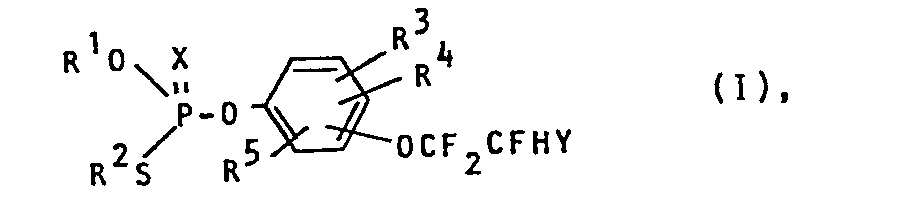
- R' einen Alkylrest mit 1 bis 3 Kohlenstoffatomen,
- R2 einen Alkylrest mit 1 bis 5 Kohlenstoffatomen, einen Alkoxyalkyl- oder Alkylthioalkylrest mit 2 bis 8 Kohlenstoffatomen oder einen Cycloalkylrest mit 3 bis 6 Kohlenstoffatomen,
- R3, R4, R5 unabhängig voneinander ein Wasserstoff-, Fluor-, Chlor- oder Bromatom, einen Cyanrest oder einen gegebenenfalls Halogen-, Cyano-, Alkoxy- oder Alkylthio-substituierten Alkylrest mit jeweils 1 bis 4 Kohlenstoffatomen mit 1 bis 4 Kohlenstoffatomen,
- X Sauerstoff oder Schwefel,
- Y ein Wasserstoff-, Fluor-, Chlor- oder Bromatom bedeuten,
deren Herstellung und Verwendung als Schädlingsbekämpfungsmittel.
Description
- Die Erfindung betrifft Fluorethoxyphenyl-(di)thiophosphorsäureester, ein Verfahren zu ihrer Herstellung und Schädlingsbekämpfungsmittel, die diese Verbindungen als Wirkstoffe enthalten.
- Es ist aus der US-PS 3 755 511 bekannt, daß 0,0-Dialkyl--0-(Fluorethoxyphenyl)-(thiono)phosphorsäureester als fungizide, herbizide und insektizide Mittel verwendet werden können.
- Es wurde gefunden, daß Fluorethoxyphenyl-(di)thiophosphorsäureester der Formel

- R1 einen Alkylrest mit 1 bis 3 Kohlenstoffatomen,
- R2 einen Alkylrest mit 1 bis 5 Kohlenstoffatomen, einen Alkoxyalkyl- oder Alkylthioalkylrest mit 2 bis 8 Kohlenstoffatomen oder einen Cycloalkylrest mit 3 bis 6 Kohlenstoffatomen,
- R 3, R4 3 R5 unabhängig voneinander ein Wasserstoff, Fluor-, Chlor- oder Bromatom, einen Cyanrest oder einen gegebenenfalls Halogen-, Cyano-, Alkoxy- oder Alkylthio-substituierten Alkylrest mit jeweils 1 bis 4 Kohlenstoffatomen mit 1 bis 4 Kohlenstoffatomen,
- X Sauerstoff oder Schwefel
- Y Wasserstoff oder Halogen (F, Cl, Br) bedeuten. Mu/HB
- Schädlinge aus der Klasse der Insekten, Spinnentiere und Nematoden wirksam bekämpfen. Sie sind den bekannten 0,0--Dialkyl-0-(Fluorethoxyphenyl)-(thiono)phosphorsäure--estern analoger Konstitution in ihrer Wirkung weit überlegen.
- In Formel I stehen die Substituenten R1 für Alkylreste mit 1 bis 3 Kohlenstoffatomen, wie Methyl, Ethyl, n-Propyl, i-Propyl, R2 für Alkylreste mit 1 bis 5 Kohlenstoffatomen, wie Methyl, Ethyl, n-Propyl, i-Propyl, n-Butyl, sec-Butyl, i-Butyl, n-Pentyl, 1-Methyl-n-butyl, 3-Methyl-n-pentyl, für Alkoxyalkyl- oder Alkylthioalkylreste mit 2 bis 8, vorzugsweise 2 bis 5 Kohlenstoffatomen, wie 2-Methoxyethyl, 2-Ethoxyethyl, 2-Isopropoxyethyl, 2-Methylthioethyl, 2-Ethylthioethyl, oder für Cycloalkylreste mit 3 bis 6 Kohlenstoffatomen, wie Cyclopentyl, Cyclohexyl, sowie R3, R4 und R5, die verschieden sein können, für Wasserstoff, Halogen, wie Chlor, Brom oder Fluor, für Alkyl mit 1 bis 4 Kohlenstoffatomen, vorzugsweise mit 1 und 2 Kohlenstoffatomen, wie Methyl, Ethyl, n-Propyl, tert.-Butyl, die ihrerseits durch Halogenatome, besonders Fluor- oder Chlor-, ferner Cyano-, Alkoxy- oder Alkylthioreste mit jeweils 1 bis 4 Kohlenstoffatomen, wie Methoxy, Methylthio, Ethoxy, Ethylthio, substituiert sein können.
- Die Fluorethoxygruppe kann, bezogen auf den Phosphorsäurerest, in 2-, 3- oder 4-Stellung angeordnet sein. Bevorzugt ist die 2-Position und insbesondere die 4-Position.
- Man erhält die Fluorethoxyphenyl-(di)thiophosphorsäureester der Formel I durch Umsetzung von O,S-Dialkylphos- phorsäureesterchloriden der Formel

- R1, R2 und X die oben angegebenen Bedeutungen haben, gegebenenfalls in Gegenwart eines säurebindenden Mittels und gegebenenfalls in Gegenwart eines Verdünnungsmittels mit einem Fluorethoxyphenol der Formel

- R3, R4 und R5 und Y die oben genannten Bedeutungen haben, oder mit einem Salz eines Fluorethoxyphenols der
- Formel III gegebenenfalls in Gegenwart eines Verdünnungsmittels.
- Der Reaktionsablauf kann durch das folgende Formelschema wiedergegeben werden:

- Die Umsetzung von Phosphorsäureesterchlorid der Formel II mit Phenol der Formel III kann in einem organischen Verdünnungsmittel, wie Aceton, Acetonitril, Benzol, Toluol, Chlorbenzol, Methylethylketon, oder in zwei-Phasen-Systemen, wie Toluol/Wasser, Dichlormethan/Wasser, durchgeführt werden.
- Zweckmäglgerweise setzt man die 1- bis 2-molare Menge eines säurebindenden Mittels, bezogen auf Phenol der Formel III, zu. Vorzugsweise wird ein Überschuß von etwa 10 % verwendet. Geeignet sind Basen, wie Alkalimetallcarbonate, z.B. Kaliumcarbonat, Alkalihydroxide, z.B. Natriumhydroxid, oder tertiäre Amine, z.B. Triäthylamin. Anstelle von Base und Phenol kann ebenso ein Salz des Phenols mit den Phosphorsäureesterchlorid umgesetzt werden. Als Salze kommen Alkalimetallsalze, Erdalkalimetallsalze oder gegebenenfalls substituierte Ammoniumsalze, wie Alkylammoniumsalze, beispielsweise Dimethylammoniumsalze, Triethylammoniumsalze, Natrium- und Calciumsalze, in Betracht.
- Die Umsetzung verläuft im allgemeinen unterhalb von 100°C, vorzugsweise zwischen 20 und 70oC. Man läßt die Umsetzung im allgemeinen unter Normaldruck ablaufen.
- Zur Durchführung des Verfahrens setzt man die Ausgangsstoffe grundsätzlich in stöchiometrischem Verhältnis ein. Ein Überschuß der einen oder anderen Reaktionskomponente kann in einigen Fällen Vorteile bringen. Zweckmäßigerweise verwendet man auf 1 Mol Phenol 0,9 bis 1,1 Mole Phosphorsäureesterchlorid.
- Das Reaktionsgemisch wird in üblicher Weise aufgearbeitet, z.B. durch Versetzen mit Wasser und Trennen der Phasen. Die Rohprodukte können durch Destillation oder Säulenchromatographie gereinigt werden.
- O,S-Dialkylphosphorsäureesterchloride der Formel II sind bekannt und können nach bekannten Verfahren hergestellt werden (DE-OS 26 42 982; J. Org. Chem. 30, 3217 (1965)).
- Die Fluorethoxyphenole der Formel III sind teilweise bekannt (DE-OS 23 12 906) oder können durch Diazotieren und Verkochen (Houben-Weyl, Band 6/lc, S. 247, 1976) aus entsprechenden Anilinen erhalten werden. Solche Aniline ihrerseits sind z.B. aus Z. Naturforschung 28 c, 653, 1973 und Buil.Soc.chim., 5ème serie, 1957, S. 581 bekannt.
- Die Halogenierung der Phenole kann ebenfalls nach bekannten Verfahren durchgeführt werden (EP 22 954).
- Folgende weitere Verfahren führen ebenfalls zu erfindungsgemäßen Verbindungen:
- Fluorethoxyphenyl-thiophosphorsäureester der Formel Ia lassen sich in einer Arbusow-Reaktion durch Umsetzung von Phosphorigsäureestern der Formel IV mit Sulfenylchloriden der Formel R2SC1 nach folgendem Reaktionsschema herstellen:

- Ebenso sind die Fluorethoxyphenyl-thiophosphorsäureester der Formel Ia durch Alkylierung von Phosphorsäureestersalben der Formel V mit Alkylierungsmitteln der Formel R2Z zugänglich:

- Außerdem lassen sich Phosphorsäureesterdichloride der Formel VI nacheinander mit Alkoholen und Mercaptanen der Formeln R1 OH bzw. R2SH zu Verbindungen der Formel I umsetzen:

- In diesen Reaktionsschemata haben die Substituenten R1, R 2, R3, R4 und R5 sowie X die oben genannten Bedeutungen. Me⊕ steht für ein Metallkation oder ein gegebenenfalls durch Alkylgruppen substituiertes Ammoniumion und Y bedeutet Halogenid, beispielsweise Jodid, Bromid, Chlorid, oder Alkylsulfat, beispielsweise Methylsulfat. Die Auswahl unter einem der vorgenannten Herstellverfahren wird i.a. nach wirtschaftlichen Gesichtspunkten getroffen.
- 278 g 4-Nitrophenol und 56 g Kaliumhydroxid wurden in 800 ml DMF gelöst. Bei 40°C wurden 179 g Bromtrifluorethylen nach und nach zugeführt und anschließend 2 Stunden bei 60°C nachgerührt. Das Lösungsmittel wurde unter vermindertem Druck in einem Rotationsverdampfer entfernt, der Rückstand in Eiswasser gegossen und mit 3 x 500 ml Methylenchlorid extrahiert. Der Extrakt wurde mit verdünnter Natronlauge und Wasser gewaschen, über Na2SO4 getrocknet, das Lösungsmittel entfernt. Bei der Destillation gehen bei 114°C/ 1,3 mbar 279,5 g reines Produkt über.
- Man verfährt wie vorstehend beschrieben unter Verwendung einer entsprechenden Menge Chlortrifluorethylen. Es wurden 327 g der Verbindung mit einem Siedepunkt von 800C/0,3 mbar, d.h. 64 % Ausbeute erhalten.
- 275 g 4-(2-Brom-1,1,2-trifluorethoxy)nitrobenzol wurden mit 700 ml absolutem Essigsäureethylester versetzt und mit Hilfe von 20 g Palladium auf Aktivkohle hydriert. Der Katalysator wurde abfiltriert und das Lösungsmittel entfernt. Es wurden 251 g der Verbindung erhalten, die nach NMR-Analyse rein war.
- Ebenso wurden hergestellt:

- In 400 ml 2,5 N Schwefelsäure wurden bei 10°C erst 40 g 4-(2-Brom-1,1,2-trifluorethoxy)anilin, dann bei 0°C 11 g Natriumnitrit in 30 ml Wasser eingetropft und eine Stunde bei 10°C nachgerührt.
- Es wurde eine Wasserdampfdestillation von 100 g CuS04 und 33 g Harnstoff in 500 ml Wasser in Gang gesetzt und die schwefelsaure Lösung nach und nach zugesetzt. Das Destillieren wurde noch bis 15 min nach Ende des Zutropfens fortgesetzt. Das Wasserdampfdestillat wurde dann in der Kälte mit Methylenchlorid ausgeschüttelt, die Lösung in Methylenchlorid einmal mit Eiswasser gewaschen, über Natriumsulfat getrocknet, das Lösungsmittel entfernt und bei 86°C/0,15 mbar destilliert.
- 22 g des Phenols wurden erhalten. In gleicher Weise wurden aus den oben beschriebenen Anilinen folgende Phenole hergestellt:

- 12,2 g 4-(2-Brom-1,1,2-trifluorethoxy)phenol und 5 Tropfen Diphenylsulfid wurden in 30 ml Eisessig gelöst und nach und nach 6,1 g Sulfurylchlorid bei 25°C zugesetzt. Nach 3 Stunden bei 25°C wurden die flüchtigen Bestandteile entfernt, mit 300 ml Methylenchlorid aufgenommen und mit je 100 ml 10 % NaHCO3-Lösung und Wasser gewaschen, über Na2SO4 getrocknet und bei 82°C/0,3 mbar destilliert. Ausbeute 12,6 g.
- Ebenso wurden hergestellt:

- Zu einer Lösung von 12,2 g 4-(2-Brom-1,1,2-trifluor- ethoxy)phenol in 100 ml wasserfreiem Chlorform wurden 7,2 g Brom in 30 ml Chloroform bei 25°C zugetropft und die Mischung 12 Stunden bei 25°C gerührt.
- Das Lösungsmittel wurde entfernt. Durch Destillation bei 100°C/0,4 mbar erhielt man 15,5 g reines Produkt.
- Ebenso wurden erhalten:


- Zu 6,3 g 4-(1,1,2,2-tetrafluorethoxy)phenol und 6,9 g Kaliumcarbonat in 100 ml Acetonitril wurden 6,1 g 0-Ethyl--S-propylthiophosphorsäureesterchlorid zugetropft. Dann wurde 14 Stunden bei 50°C und anschließend 12 Stunden bei Raumtemperatur gerührt.
- Dann wurde das Lösungsmittel im Rotationsverdampfer entfernt, der Rückstand mit 400 ml Toluol und 100 ml Wasser versetzt, die Phasen getrennt und die organische Phase mit 2 n Natronlauge und anschließend mit Wasser gewaschen. Nach dem Trocknen mit Natriumsulfat wurden das Lösungsmittel und flüchtige Verunreinigungen unter vermindertem Druck bei 40°C und 0,1 mbar entfernt. Als Rückstand wurden 8,1 g Produkt vom Brechungsindex n23 = 1,4671 erhalten.
- Zu 6,9 g 2-Brom-4-(2-Brom-1,1,2-trifluorethoxy)phenol und 6,9 g Kaliumcarbonat in 100 ml Acetonitril wurden 4,0 g 0-Ethyl-S-propylthiophosphorsäureesterchlorid zugetropft.
- Dann wurde 4 Stunden bei 50°C und anschließend 12 Stunden bei Raumtemperatur gerührt.
- Dann wurde das Lösungsmittel im Rotationsverdampfer entfernt, der Rückstand mit 400 ml Toluol und 100 ml Wasser versetzt, die Phasen getrennt und die organische Phase mit 2 n Natronlauge und anschließend mit Wasser gewaschen. Nach dem Trocknen mit Natriumsulfat wurden das Lösungsmittel und flüchtige Verunreinigungen unter vermindertem Druck entfernt. Als Rückstand wurden 7,0 g Produkt vom Brechungsindex

- Zu 4,9 g 2-Chloro-4-(2-Brom-1,1,2-trifluorethoxy)phenol und 6,9 g Kaliumcarbonat in 100 ml Acetonitril wurden 3,2 g 0-Ethyl-S-propylthiophosphorsäureesterchlorid zugetropft. Dann wurde 4 Stunden bei 50°C und anschließend 12 Stunden bei Raumtemperatur gerührt.
- Dann wurde das Lösungsmittel im Rotationsverdampfer entfernt, der Rückstand mit 400 ml Toluol und 100 ml Wasser versetzt, die Phasen getrennt und die organische Phase mit 2 n Natronlauge und anschließend mit Wasser gewaschen. Nach dem Trocknen mit Natriumsulfat wurden das Lösungsmittel und flüchtige Verunreinigungen unter vermindertem Druck entfernt. Als Rückstand wurden 6,0 g Produkt vom Brechungsindex

- Durch sinngemäße Verwendung anderer Ausgangsstoffe bzw. Zwischenprodukte wurden die in der nachstehenden Tabelle 1 aufgeführten Stoffe erhalten.


- ' Zur vergleichenden Prüfung der biologischen Wirkung der erfindungsgemäßen Wirkstoffe wurde als Vergleichsmittel das aus Beispiel 3 der US-PS 3 755 511 bekannte Mittel

- Der Boden eines 1 1-Weckglases wurde mit der acetonischen Lösung des Wirkstoffes behandelt. Nach Verdunsten des Lösungsmittels setzte man je Glas 5 adulte Schaben. Die Mortalitätsrate wird nach 48 Stunden bestimmt. Bei diesem Versuch erzielten die Wirkstoffe der Beispiele 1, 2, 4, 8, 9, 10, 13, 14, 15, 18, 19, 20, 21, 22, 23, 24, 25, 30, 44, 53 und 54 in einer Menge zwischen 0,02 und 0,1 mg eine vollständige Abtötung der Tiere während das Vergleichsmittel in einer Menge von 1 mg weniger als 50 % Mortalität erzielte.
- 200 ml Leitungswasser wurden mit der Wirkstoffaufbereitung versetzt und darauf mit 30 bis 40 Moskito-Larven im 4. Larvenstadium besetzt. Die Versuchstemperatur betrug 22°C. Nach 24 Stunden wurde die Wirkung ermittelt.
- Die Wirkung war bei den Stoffen der Beispiele 8, 9, 13, 14, 15, 21, 22, 28, 31, 34, 35, 37, 42, 43, 45, 47, 48, 49, 50, 51 und 54 vollständig - je nach Stoff - wenn die Anwendungskonzentration 0,0002 bis 0.01 ppm war, während das Vergleichsmittel in mindestens 100-fach stärkerer Konzentration nur 50 %ige Wirkung erzielte.
- Zuchtversuch mit Stubenfliegen-Larven (Musca domestica)
- Je-4,5 ml Magermilch füllte man in 50 ml Pennicillingläser und versetzte sie darauf mit 0,5 ml der wäßrigen Wirkstoffaufbereitung. Nach kurzem Mischen fügte man ein Wattebällchen (Firma Hartmann, Maintal) dazu und belegte dieses mit ca. 50 Ei-Larven der Stubenfliege. Die Gläser lagerte man abgedeckt bei Raumtemperatur und beurteilte die Entwicklung nach 7 Tagen.
- Bei den Beispielen 1, 2, 3, 5, 6, 7, 8, 10, 11, 12, 13, 14, 15, 18, 19, 20, 21, 22, 31, 32, 33, 34, 35, 37, 38, 39, 40, 41, 42, 43, 45, 46, 47, 48, 49, 50, 51, 52, 53 und 54 betrug die Konzentration zur Erzielung 100 %iger Mortalität 0,2 bis 2 ppm. Das Vergleichsmittel war noch bei 20 ppm unwirksam.
- Kontaktwirkung auf Baumwollwanzen (Dysdercus intermedius)
- Petrischalen von 10 cm Durchmesser wurden mit 1 ml der acetonischen Wirkstofflösung ausgekleidet. Nach Verdunsten des Lösungsmittels besetzte man die Schalen mit je 20 Larven des vorletzten Stadiums und registrierte die Wirkung nach 24 Stunden.
- Vollständige Wirkung erzielten die Stoffe der Beispiele 1, 2, 3, 4, 8, 9, 10, 13, 19, 52 und 53 bei 0,002 bis 0,01 mg; das Vergleichsmittel war erst bei 0,2 mg absolut wirksam.
- Blätter von jungen Kohlpflanzen wurden 3 Sekunden in die wäßrige Wirkstoffemulsion getaucht und nach kurzem Abtropfen auf einen angefeuchteten Filter in eine Petrischale gelegt. Das Blatt wurde darauf mit 10 Raupen des 4. Stadiums belegt. Nach 48 Stunden beurteilte man die Wirkung. Sie lag zwischen ca. 80 und 100 % Mortalität bei den Stoffen der Beispiele 1, 2, 3, 4, 5, 6, 8, 10, 12, 13, 14, 15, 18, 19, 20, 21, 22, 24, 26, 30, 33, 37, 45, 46, 47, 48, 49, 52, 53 und 54, wenn die Anwendungskonzentration 0,0004 bis 0,002 % betrug; das Vergleichsmittel erzielte 80 %ige Wirkung bei 0,04 %.
- Getopfte Bohnenpflanzen (Vicia faba) mit starken Blattlauskolonien wurden in der Spritzkammer mit den wäßrigen Wirkstoffaufbereitungen tropfnaß gespritzt. Die Auswertung erfolgte nach 24 Stunden.
- Die Stoffe der Beispiele 1, 2, 3, 4, 8, 9, 10, 12, 14, 15, 17, 18, 19, 20, 21, 22, 23, 24, 25, 30, 32, 33 und 45 erzielten i.a. vollständige Wirkung in einer Konzentration von 0,004 bis 0,02 %; das Vergleichsmittel hatte bei 0,1 % nur teilweise Wirkung.
- 200 ml Quarzsand wurden in 250 ml Polystyrolbecher in Paletten zu 8 Gefäßen gegeben. Man belegte jeden Becher mit 5 Maiskörnern, ca. 1 cm unter die Oberfläche. Darauf befeuchtete man mit je 50 ml Wasser und deckte mit einer passenden transparenten Kunststoffhaube ab. Nach 8 Tagen wurden die Paletten abgedeckt, nach 10 Tagen erfolgte die Behandlung. Dabei gießt man 40 ml der wäßrigen Wirkstoffaufbereitüng-an die Pflanzen und deckte nach einem weiteren Tag mit 50 ml trockenem Quarzsand ab. Hierdurch soll ein Kontakt der Versuchstiere mit der behandelten Oberfläche vermieden werden.
- Auf jeden Becher stellt man einen Plastik-Zylinder (Durchmesser 7 cm), belegt mit je 5 Raupen im 3. Larvenstadium und deckt den Zylinder mit einem Drahtgazedeckel ab.
- Die Wirkstofflösung der Beispiele 1, 3, 4, 5, 8, 10, 13, 18, 19, 20, 22, 30 und 52 erwies sich bei 0,004 bis 0,02 %igem Ansatz im allgemeinen als voll wirksam, während das Vergleichsmittel bei 0,1 % noch unwirksam war (keine systemische Wirkung bei technisch infragekommender Aufwandmenge).
- Wirkung auf Spinnmilben (Tetranychus telarius) A
- Getopfte Buschbohnen, die das erste Folgeblattpaar entwickelt haben und einen starken Besatz aller Stadien der Spinnmilbe Tetranychus telarius trugen, wurden in der Spritzkabine mit der wäßrigen Wirkstoffaufbereitung tropfnaß gespritzt. Die Pflanzen kamen dazu auf einen Drehteller und wurden von allen Seiten mit 50 ml Spritzbrühe besprüht. Der Sprühvorgang dauerte ca. 22 Sekunden. Nach 8 Tagen wurden die Pflanzen auf lebene Spinnmilben untersucht.
- Die Stoffe der Beispiele 1, 2, 3, 5, 13, 14, 21, 23, 24, 25, 26, 27, 29, 30, 31, 32, 33, 34, 37, 38, 39, 40, 44, 45, 46, 48, 49, 50, 51, 52, 53 und 54 waren bei 0,002 bis 0,01 %igem Wirkstoffansatz i.a. voll wirksam, während das Vergleichsmittel bei 0,1 % nur schlecht wirkte.
- rWirkung auf Spinnmilben (Tetranychus telarius) B
- Getopfte Büschbohnen, die das zweite Folgeblattpaar zeigten, wurden in der Spritzkabine mit der wäßrigen Wirkstoffaufbereitung tropfnaß gespritzt. Die Pflanzen kamen dazu auf den Drehteller und wurden von allen Seiten mit insgesamt 50 ml Spritzbrühe besprüht. Der Sprühvorgang dauerte ca. 22 Sekunden. Nach 24 Stunden infizierte man die Pflanzen mit Blattstücken, die stark mit Spinnmilben besetzt waren. Die Beurteilung der Wirkung erfolgte nach 10 Tagen. Geprüft wurde von 0,1 % Wirkstofgf an in fallenden Konzentrationen.
- Die Wirkung der Stoffe gemäß Beispiel 3, 5, 23, 32, 33, 37, 38, 39, 40, 46, 48, 51 und 53 war praktisch vollständig bis herunter zu 0,002 %. Das Vergleichsmittel war mindestens 10fach weniger wirksam als der geringstwirkende erfindungsgemäße Wirkstoff.
- Kontaktwirkung auf Zecken (Ornithodorus moubata)
- Die Prüfung erfolgte an jungen Zecken, die erst einmal Blut aufgenommen haben. Je 5 Tiere wurden in einem TEEFIX--Beutel 5 Sekunden in die wäßrige Wirkstoffaufbereitung getaucht. Der Beutel wurde frei aufgehängt. Nach 48 Stunden ermittelte man die Mortalitätsrate. Die Versuchstemperatur betrug 25 bis 26°C.
- Absolut wirksam waren die Stoffe der Beispiele 2, 3, 4, 8, 9, 10, 14, 20, 21, 22, 25, 26, 30, 33 und 53 in einer Konzentration von 0,02, teilweise 0,0004 bis 0,01 %; das Vergleichsmittel war bei 0,1 % noch unwirksam.
- Wirkung auf Wurzelgallennematoden (Meloidogyne incognita)
- Junge Tomatenpflanzen wurden in je 500 g Komposterde gepflanzt, die stark mit Wurzelgallennematoden infiziert war. Nach 3 Tagen erfolgte die Behandlung mit der wäßrigen Wirkstoffaufbereitung durch Spritzen von 50 ml Aufbereitung in der Spritzkammer. Nach 6 bis 8 Wochen bonitierte man die Wurzeln auf Gallenbildung.
- Die Stoffe der Beispiele 1, 3, 4, 5, 18, 19, 20, 21, 23, 24, 25, 26, 27, 46, 47, 48, 49, 50, 51, 52 und 53 hemmten die Gallenbildung i.a. vollständig bei 0,02 bis 0,1 %igem Ansatz; das Vergleichsmittel war noch bei 0,1 % ungenügend wirksam.
Claims (6)


Applications Claiming Priority (4)
| Application Number | Priority Date | Filing Date | Title |
|---|---|---|---|
| DE3213152 | 1982-04-08 | ||
| DE19823213152 DE3213152A1 (de) | 1982-04-08 | 1982-04-08 | Fluorethoxyphenyl-(di)thiophosphorsaeureester, verfahren zu ihrer herstellung und ihre verwendung zur bekaempfung von schaedlingen |
| DE19823225507 DE3225507A1 (de) | 1982-07-08 | 1982-07-08 | Fluorethoxyphenyl-(di)thiophosphorsaeureester, verfahren zu ihrer herstellung und ihre verwendung zur bekaempfung von schaedlingen |
| DE3225507 | 1982-07-08 |
Publications (3)
| Publication Number | Publication Date |
|---|---|
| EP0091598A2 true EP0091598A2 (de) | 1983-10-19 |
| EP0091598A3 EP0091598A3 (en) | 1983-12-14 |
| EP0091598B1 EP0091598B1 (de) | 1985-08-07 |
Family
ID=25800991
Family Applications (1)
| Application Number | Title | Priority Date | Filing Date |
|---|---|---|---|
| EP83103055A Expired EP0091598B1 (de) | 1982-04-08 | 1983-03-28 | Fluorethoxyphenyl-(di)thiophosphorsäureester, Verfahren zu ihrer Herstellung und ihre Verwendung zur Bekämpfung von Schädlingen |
Country Status (3)
| Country | Link |
|---|---|
| US (1) | US4551448A (de) |
| EP (1) | EP0091598B1 (de) |
| DE (1) | DE3360509D1 (de) |
Cited By (4)
| Publication number | Priority date | Publication date | Assignee | Title |
|---|---|---|---|---|
| JPS61194042A (ja) * | 1985-02-25 | 1986-08-28 | Nippon Tokushu Noyaku Seizo Kk | 新規置換フエノ−ル |
| EP0368008A1 (de) * | 1988-10-24 | 1990-05-16 | Bayer Ag | Fluor enthaltende Phenole |
| WO2010057691A3 (en) * | 2008-08-11 | 2010-10-14 | Solvay Solexis S.P.A. | Hydrofluoroalcohols with improved thermal and chemical stability |
| WO2014095036A1 (de) * | 2012-12-21 | 2014-06-26 | Merck Patent Gmbh | Fluortenside |
Family Cites Families (6)
| Publication number | Priority date | Publication date | Assignee | Title |
|---|---|---|---|---|
| JPS4924656B1 (de) * | 1970-03-13 | 1974-06-25 | ||
| US3933947A (en) * | 1970-03-25 | 1976-01-20 | Bayer Aktiengesellschaft | O-ethyl-S-propyl-S-benzyl-phosphorodithiolates |
| US3755511A (en) * | 1971-02-01 | 1973-08-28 | Dow Chemical Co | Haloalkoxy and haloalkylthio phenyl phosphates phosphorothioates and phosphorodithioates |
| DE2625764A1 (de) * | 1976-06-09 | 1977-12-29 | Bayer Ag | Trifluormethylthio-phenyl(di)-thio -phosphorsaeureester, verfahren zu ihrer herstellung und ihre verwendung als insektizide und akarizide |
| DE3047242A1 (de) * | 1980-12-16 | 1982-07-15 | Basf Ag, 6700 Ludwigshafen | Trifluormethoxyphenyl-(di)thiophosphorsaeureester, verfahren zu ihrer herstellung und ihre verwendung zur bekaempfung von schaedlingen |
| JPS57111317A (en) * | 1980-12-29 | 1982-07-10 | Kanegafuchi Chem Ind Co Ltd | Production of aromatic polyester |
-
1983
- 1983-03-28 DE DE8383103055T patent/DE3360509D1/de not_active Expired
- 1983-03-28 EP EP83103055A patent/EP0091598B1/de not_active Expired
- 1983-04-07 US US06/482,775 patent/US4551448A/en not_active Expired - Fee Related
Cited By (5)
| Publication number | Priority date | Publication date | Assignee | Title |
|---|---|---|---|---|
| JPS61194042A (ja) * | 1985-02-25 | 1986-08-28 | Nippon Tokushu Noyaku Seizo Kk | 新規置換フエノ−ル |
| EP0368008A1 (de) * | 1988-10-24 | 1990-05-16 | Bayer Ag | Fluor enthaltende Phenole |
| WO2010057691A3 (en) * | 2008-08-11 | 2010-10-14 | Solvay Solexis S.P.A. | Hydrofluoroalcohols with improved thermal and chemical stability |
| US8946136B2 (en) | 2008-08-11 | 2015-02-03 | Solvay Specialty Polymers Italy S.P.A. | Hydrofluoroalcohols with improved thermal and chemical stability |
| WO2014095036A1 (de) * | 2012-12-21 | 2014-06-26 | Merck Patent Gmbh | Fluortenside |
Also Published As
| Publication number | Publication date |
|---|---|
| DE3360509D1 (en) | 1985-09-12 |
| EP0091598B1 (de) | 1985-08-07 |
| EP0091598A3 (en) | 1983-12-14 |
| US4551448A (en) | 1985-11-05 |
Similar Documents
| Publication | Publication Date | Title |
|---|---|---|
| EP0096263B1 (de) | Difluormethoxiphenylthiophosphorsäureester | |
| DE2260015B2 (de) | Triazolylphosphor-derivate, verfahren zu ihrer herstellung und diese enthaltende schaedlingsbekaempfungsmittel | |
| DE2146904A1 (de) | Vinylphosphorverbindungen mit pestizider Wirkung | |
| EP0091598B1 (de) | Fluorethoxyphenyl-(di)thiophosphorsäureester, Verfahren zu ihrer Herstellung und ihre Verwendung zur Bekämpfung von Schädlingen | |
| EP0100528A2 (de) | Neue (Di)-thiophosphor- und -phosphonsäure-Derivate, Verfahren zu ihrer Herstellung, sie enthaltende Mittel und ihre Verwendung im Pflanzenschutz | |
| EP0109600B1 (de) | 3-Chlor-3-Phenylprop-2-enylthiophosphorsäureester, Verfahren zu ihrer Herstellung und ihre Verwendung zur Bekämpfung von Schädlingen | |
| DE2732930C2 (de) | Neue 0-Äthyl-S-n-propyl-O-2,2,2- trihalogenäthylphosphorthiolate (oder -thionothiolate), Verfahren zu ihrer Herstellung und ihre Verwendung als Insektizide, Akarizide und Nematizide | |
| CH635350A5 (de) | Substituierte pyrimidinyl(thio)-phosphor(phosphon)-saeureester bzw. -esteramide, verfahren zu ihrer herstellung und ihre verwendung als insektizide, akarizide und nematizide. | |
| EP0114625B1 (de) | O,S-Dialkyl-S-(carbamoyloxymethyl)-dithiophosphorsäureester, Verfahren zu ihrer Herstellung sowie ihre Verwendung als Schädlingsbekämpfungsmittel | |
| EP0150822B1 (de) | Oximinophosphorsäurederivate, Verfahren zu ihrer Herstellung und ihre Verwendung zur Bekämpfung von Schädlingen | |
| EP0107163B1 (de) | Dihalogenvinylphenyl-phosphorsäureester, Verfahren zu ihrer Herstellung und ihre Verwendung als Schädlingsbekämpfungsmittel | |
| EP0115318B1 (de) | Oximinophosphorsäurederivate, Verfahren zu ihrer Herstellung und ihre Verwendung zur Bekämpfung von Schädlingen | |
| EP0201807B1 (de) | Oximinophosphorsäurederivate, Verfahren zu ihrer Herstellung und ihre Verwendung zur Bekämpfung von Schädlingen | |
| EP0224217B1 (de) | Phosphorsäurederivate, Verfahren zu ihrer Herstellung und ihre Verwendung zur Bekämpfung von Schädlingen | |
| EP0201764B1 (de) | Oximinophosphorsäurederivate, Verfahren zu ihrer Herstellung und ihre Verwendung zur Bekämpfung von Schädlingen | |
| EP0204268B1 (de) | Bisthiolphosphate, Verfahren zu ihrer Herstellung und ihre Verwendung zur Bekämpfung von Schädlingen und Mittel dafür | |
| DE2422324C2 (de) | Diphenyläther-phosphorverbindungen, Verfahren zu ihrer Herstellung und diese enthaltende Schädlingsbekämpfungsmittel | |
| EP0087615A1 (de) | Halogenierte 1-Hydroxypyrazole und Verfahren zu ihrer Herstellung | |
| DE3205456A1 (de) | Halogenierte 1-hydroxipyrazole und verfahren zu ihrer herstellung | |
| DE3236431A1 (de) | Cyclopropyl-methyl-(thio)-phosphorsaeureamide, verfahren zu ihrer herstellung und ihre verwendung zur bekaempfung von schaedlingen | |
| DE3811006A1 (de) | Thionophosphorsaeureamidester | |
| DE2316733A1 (de) | Dithio- und trithiophosphonsaeureester, verfahren zu ihrer herstellung und ihre verwendung als insektizide, akarizide und nematozide | |
| DE3213152A1 (de) | Fluorethoxyphenyl-(di)thiophosphorsaeureester, verfahren zu ihrer herstellung und ihre verwendung zur bekaempfung von schaedlingen | |
| EP0240681A1 (de) | Dithiophosphate, Verfahren zu ihrer Herstellung und ihre Verwendung zur Bekämpfung von Schädlingen und Mittel dafür | |
| DE2002892A1 (de) | Verfahren zur Herstellung von 0,0-Dimethyl-thionophosphorsaeure-[0-chinoxalyl-(2)]-ester |
Legal Events
| Date | Code | Title | Description |
|---|---|---|---|
| PUAI | Public reference made under article 153(3) epc to a published international application that has entered the european phase |
Free format text: ORIGINAL CODE: 0009012 |
|
| PUAL | Search report despatched |
Free format text: ORIGINAL CODE: 0009013 |
|
| AK | Designated contracting states |
Designated state(s): BE CH DE FR GB IT LI NL |
|
| AK | Designated contracting states |
Designated state(s): BE CH DE FR GB IT LI NL |
|
| 17P | Request for examination filed |
Effective date: 19831223 |
|
| ITF | It: translation for a ep patent filed | ||
| GRAA | (expected) grant |
Free format text: ORIGINAL CODE: 0009210 |
|
| AK | Designated contracting states |
Designated state(s): BE CH DE FR GB IT LI NL |
|
| REF | Corresponds to: |
Ref document number: 3360509 Country of ref document: DE Date of ref document: 19850912 |
|
| ET | Fr: translation filed | ||
| PGFP | Annual fee paid to national office [announced via postgrant information from national office to epo] |
Ref country code: NL Payment date: 19860331 Year of fee payment: 4 |
|
| PLBE | No opposition filed within time limit |
Free format text: ORIGINAL CODE: 0009261 |
|
| STAA | Information on the status of an ep patent application or granted ep patent |
Free format text: STATUS: NO OPPOSITION FILED WITHIN TIME LIMIT |
|
| 26N | No opposition filed | ||
| PG25 | Lapsed in a contracting state [announced via postgrant information from national office to epo] |
Ref country code: LI Effective date: 19870331 Ref country code: CH Effective date: 19870331 |
|
| BERE | Be: lapsed |
Owner name: BASF A.G. Effective date: 19870331 |
|
| PG25 | Lapsed in a contracting state [announced via postgrant information from national office to epo] |
Ref country code: NL Effective date: 19871001 |
|
| NLV4 | Nl: lapsed or anulled due to non-payment of the annual fee | ||
| GBPC | Gb: european patent ceased through non-payment of renewal fee | ||
| PG25 | Lapsed in a contracting state [announced via postgrant information from national office to epo] |
Ref country code: FR Free format text: LAPSE BECAUSE OF NON-PAYMENT OF DUE FEES Effective date: 19871130 |
|
| REG | Reference to a national code |
Ref country code: CH Ref legal event code: PL |
|
| PG25 | Lapsed in a contracting state [announced via postgrant information from national office to epo] |
Ref country code: DE Effective date: 19871201 |
|
| REG | Reference to a national code |
Ref country code: FR Ref legal event code: ST |
|
| PG25 | Lapsed in a contracting state [announced via postgrant information from national office to epo] |
Ref country code: GB Effective date: 19881122 |
|
| PG25 | Lapsed in a contracting state [announced via postgrant information from national office to epo] |
Ref country code: BE Effective date: 19890331 |