EP0083299B2 - Verfahren zum Trichromie-Färben oder -Bedrucken - Google Patents
Verfahren zum Trichromie-Färben oder -Bedrucken Download PDFInfo
- Publication number
- EP0083299B2 EP0083299B2 EP82810052A EP82810052A EP0083299B2 EP 0083299 B2 EP0083299 B2 EP 0083299B2 EP 82810052 A EP82810052 A EP 82810052A EP 82810052 A EP82810052 A EP 82810052A EP 0083299 B2 EP0083299 B2 EP 0083299B2
- Authority
- EP
- European Patent Office
- Prior art keywords
- dye
- formula
- process according
- parts
- dyes
- Prior art date
- Legal status (The legal status is an assumption and is not a legal conclusion. Google has not performed a legal analysis and makes no representation as to the accuracy of the status listed.)
- Expired - Lifetime
Links
- 238000000034 method Methods 0.000 title claims abstract description 48
- 238000004043 dyeing Methods 0.000 title claims abstract description 19
- 239000000975 dye Substances 0.000 claims abstract description 139
- 239000000203 mixture Substances 0.000 claims abstract description 44
- -1 propionyl amino group Chemical group 0.000 claims abstract description 20
- 239000000463 material Substances 0.000 claims abstract description 15
- 229910052739 hydrogen Inorganic materials 0.000 claims abstract description 12
- 239000001257 hydrogen Substances 0.000 claims abstract description 12
- 125000002496 methyl group Chemical group [H]C([H])([H])* 0.000 claims abstract description 12
- 239000004952 Polyamide Substances 0.000 claims abstract description 11
- 229920002647 polyamide Polymers 0.000 claims abstract description 11
- UFHFLCQGNIYNRP-UHFFFAOYSA-N Hydrogen Chemical compound [H][H] UFHFLCQGNIYNRP-UHFFFAOYSA-N 0.000 claims abstract description 7
- 125000001495 ethyl group Chemical group [H]C([H])([H])C([H])([H])* 0.000 claims abstract description 4
- 150000002431 hydrogen Chemical class 0.000 claims abstract description 4
- 125000004178 (C1-C4) alkyl group Chemical group 0.000 claims abstract 4
- 125000000229 (C1-C4)alkoxy group Chemical group 0.000 claims abstract 2
- XLYOFNOQVPJJNP-UHFFFAOYSA-N water Substances O XLYOFNOQVPJJNP-UHFFFAOYSA-N 0.000 claims description 16
- 125000000738 acetamido group Chemical group [H]C([H])([H])C(=O)N([H])[*] 0.000 claims description 2
- 239000004615 ingredient Substances 0.000 claims 2
- 125000000113 cyclohexyl group Chemical group [H]C1([H])C([H])([H])C([H])([H])C([H])(*)C([H])([H])C1([H])[H] 0.000 abstract 1
- 125000004435 hydrogen atom Chemical group [H]* 0.000 abstract 1
- 125000001997 phenyl group Chemical group [H]C1=C([H])C([H])=C(*)C([H])=C1[H] 0.000 abstract 1
- QTBSBXVTEAMEQO-UHFFFAOYSA-N Acetic acid Chemical compound CC(O)=O QTBSBXVTEAMEQO-UHFFFAOYSA-N 0.000 description 14
- 239000006260 foam Substances 0.000 description 12
- 0 CC1C*(C)CC1 Chemical compound CC1C*(C)CC1 0.000 description 9
- AJDUTMFFZHIJEM-UHFFFAOYSA-N n-(9,10-dioxoanthracen-1-yl)-4-[4-[[4-[4-[(9,10-dioxoanthracen-1-yl)carbamoyl]phenyl]phenyl]diazenyl]phenyl]benzamide Chemical compound O=C1C2=CC=CC=C2C(=O)C2=C1C=CC=C2NC(=O)C(C=C1)=CC=C1C(C=C1)=CC=C1N=NC(C=C1)=CC=C1C(C=C1)=CC=C1C(=O)NC1=CC=CC2=C1C(=O)C1=CC=CC=C1C2=O AJDUTMFFZHIJEM-UHFFFAOYSA-N 0.000 description 8
- 239000001044 red dye Substances 0.000 description 8
- 239000001043 yellow dye Substances 0.000 description 8
- 239000001045 blue dye Substances 0.000 description 7
- 150000003839 salts Chemical class 0.000 description 5
- 239000002562 thickening agent Substances 0.000 description 5
- NAWXUBYGYWOOIX-SFHVURJKSA-N (2s)-2-[[4-[2-(2,4-diaminoquinazolin-6-yl)ethyl]benzoyl]amino]-4-methylidenepentanedioic acid Chemical compound C1=CC2=NC(N)=NC(N)=C2C=C1CCC1=CC=C(C(=O)N[C@@H](CC(=C)C(O)=O)C(O)=O)C=C1 NAWXUBYGYWOOIX-SFHVURJKSA-N 0.000 description 4
- 229920002125 Sokalan® Polymers 0.000 description 4
- 238000004040 coloring Methods 0.000 description 4
- 239000003995 emulsifying agent Substances 0.000 description 4
- 239000004744 fabric Substances 0.000 description 4
- 230000007935 neutral effect Effects 0.000 description 4
- 229920006395 saturated elastomer Polymers 0.000 description 4
- 210000002268 wool Anatomy 0.000 description 4
- HEMHJVSKTPXQMS-UHFFFAOYSA-M Sodium hydroxide Chemical compound [OH-].[Na+] HEMHJVSKTPXQMS-UHFFFAOYSA-M 0.000 description 3
- 239000000654 additive Substances 0.000 description 3
- 239000002518 antifoaming agent Substances 0.000 description 3
- 239000003795 chemical substances by application Substances 0.000 description 3
- 235000014113 dietary fatty acids Nutrition 0.000 description 3
- 239000000194 fatty acid Substances 0.000 description 3
- 229930195729 fatty acid Natural products 0.000 description 3
- 150000004665 fatty acids Chemical class 0.000 description 3
- 239000000835 fiber Substances 0.000 description 3
- 238000005187 foaming Methods 0.000 description 3
- USFZMSVCRYTOJT-UHFFFAOYSA-N Ammonium acetate Chemical compound N.CC(O)=O USFZMSVCRYTOJT-UHFFFAOYSA-N 0.000 description 2
- 239000005695 Ammonium acetate Substances 0.000 description 2
- RTZKZFJDLAIYFH-UHFFFAOYSA-N Diethyl ether Chemical compound CCOCC RTZKZFJDLAIYFH-UHFFFAOYSA-N 0.000 description 2
- IGFHQQFPSIBGKE-UHFFFAOYSA-N Nonylphenol Natural products CCCCCCCCCC1=CC=C(O)C=C1 IGFHQQFPSIBGKE-UHFFFAOYSA-N 0.000 description 2
- 229920002292 Nylon 6 Polymers 0.000 description 2
- 238000010521 absorption reaction Methods 0.000 description 2
- 235000010443 alginic acid Nutrition 0.000 description 2
- 229920000615 alginic acid Polymers 0.000 description 2
- 235000019257 ammonium acetate Nutrition 0.000 description 2
- 229940043376 ammonium acetate Drugs 0.000 description 2
- 150000003863 ammonium salts Chemical class 0.000 description 2
- 239000007859 condensation product Substances 0.000 description 2
- 238000010014 continuous dyeing Methods 0.000 description 2
- 238000010411 cooking Methods 0.000 description 2
- 230000009021 linear effect Effects 0.000 description 2
- BDAGIHXWWSANSR-UHFFFAOYSA-N methanoic acid Natural products OC=O BDAGIHXWWSANSR-UHFFFAOYSA-N 0.000 description 2
- 238000002156 mixing Methods 0.000 description 2
- SNQQPOLDUKLAAF-UHFFFAOYSA-N nonylphenol Chemical compound CCCCCCCCCC1=CC=CC=C1O SNQQPOLDUKLAAF-UHFFFAOYSA-N 0.000 description 2
- 239000003921 oil Substances 0.000 description 2
- 150000003254 radicals Chemical class 0.000 description 2
- 239000001488 sodium phosphate Substances 0.000 description 2
- 239000004753 textile Substances 0.000 description 2
- 238000005406 washing Methods 0.000 description 2
- 239000000080 wetting agent Substances 0.000 description 2
- ZLRFPQPVXRIBCQ-UHFFFAOYSA-N 2-$l^{1}-oxidanyl-2-methylpropane Chemical compound CC(C)(C)[O] ZLRFPQPVXRIBCQ-UHFFFAOYSA-N 0.000 description 1
- FKMHSNTVILORFA-UHFFFAOYSA-N 2-[2-(2-dodecoxyethoxy)ethoxy]ethanol Chemical compound CCCCCCCCCCCCOCCOCCOCCO FKMHSNTVILORFA-UHFFFAOYSA-N 0.000 description 1
- OSWFIVFLDKOXQC-UHFFFAOYSA-N 4-(3-methoxyphenyl)aniline Chemical compound COC1=CC=CC(C=2C=CC(N)=CC=2)=C1 OSWFIVFLDKOXQC-UHFFFAOYSA-N 0.000 description 1
- FHVDTGUDJYJELY-UHFFFAOYSA-N 6-{[2-carboxy-4,5-dihydroxy-6-(phosphanyloxy)oxan-3-yl]oxy}-4,5-dihydroxy-3-phosphanyloxane-2-carboxylic acid Chemical compound O1C(C(O)=O)C(P)C(O)C(O)C1OC1C(C(O)=O)OC(OP)C(O)C1O FHVDTGUDJYJELY-UHFFFAOYSA-N 0.000 description 1
- LSNNMFCWUKXFEE-UHFFFAOYSA-M Bisulfite Chemical compound OS([O-])=O LSNNMFCWUKXFEE-UHFFFAOYSA-M 0.000 description 1
- GJXAXHHQXYPXAN-NGQZWQHPSA-N C([C@H]12)[C@@H]1C21N=C1 Chemical compound C([C@H]12)[C@@H]1C21N=C1 GJXAXHHQXYPXAN-NGQZWQHPSA-N 0.000 description 1
- 244000060011 Cocos nucifera Species 0.000 description 1
- 235000013162 Cocos nucifera Nutrition 0.000 description 1
- 229920001353 Dextrin Polymers 0.000 description 1
- 239000004375 Dextrin Substances 0.000 description 1
- IAYPIBMASNFSPL-UHFFFAOYSA-N Ethylene oxide Chemical compound C1CO1 IAYPIBMASNFSPL-UHFFFAOYSA-N 0.000 description 1
- DGAQECJNVWCQMB-PUAWFVPOSA-M Ilexoside XXIX Chemical compound C[C@@H]1CC[C@@]2(CC[C@@]3(C(=CC[C@H]4[C@]3(CC[C@@H]5[C@@]4(CC[C@@H](C5(C)C)OS(=O)(=O)[O-])C)C)[C@@H]2[C@]1(C)O)C)C(=O)O[C@H]6[C@@H]([C@H]([C@@H]([C@H](O6)CO)O)O)O.[Na+] DGAQECJNVWCQMB-PUAWFVPOSA-M 0.000 description 1
- WHXSMMKQMYFTQS-UHFFFAOYSA-N Lithium Chemical compound [Li] WHXSMMKQMYFTQS-UHFFFAOYSA-N 0.000 description 1
- 229920000161 Locust bean gum Polymers 0.000 description 1
- 239000004677 Nylon Substances 0.000 description 1
- 229920002302 Nylon 6,6 Polymers 0.000 description 1
- 240000007817 Olea europaea Species 0.000 description 1
- 239000004743 Polypropylene Substances 0.000 description 1
- ZLMJMSJWJFRBEC-UHFFFAOYSA-N Potassium Chemical compound [K] ZLMJMSJWJFRBEC-UHFFFAOYSA-N 0.000 description 1
- PMZURENOXWZQFD-UHFFFAOYSA-L Sodium Sulfate Chemical compound [Na+].[Na+].[O-]S([O-])(=O)=O PMZURENOXWZQFD-UHFFFAOYSA-L 0.000 description 1
- VMHLLURERBWHNL-UHFFFAOYSA-M Sodium acetate Chemical compound [Na+].CC([O-])=O VMHLLURERBWHNL-UHFFFAOYSA-M 0.000 description 1
- GSEJCLTVZPLZKY-UHFFFAOYSA-N Triethanolamine Chemical compound OCCN(CCO)CCO GSEJCLTVZPLZKY-UHFFFAOYSA-N 0.000 description 1
- 230000000996 additive effect Effects 0.000 description 1
- 229940072056 alginate Drugs 0.000 description 1
- 229910052783 alkali metal Inorganic materials 0.000 description 1
- 150000001340 alkali metals Chemical class 0.000 description 1
- 229910052784 alkaline earth metal Inorganic materials 0.000 description 1
- 150000001342 alkaline earth metals Chemical class 0.000 description 1
- 125000003545 alkoxy group Chemical group 0.000 description 1
- 125000000217 alkyl group Chemical group 0.000 description 1
- 150000001412 amines Chemical class 0.000 description 1
- 125000000484 butyl group Chemical group [H]C([*])([H])C([H])([H])C([H])([H])C([H])([H])[H] 0.000 description 1
- 229920003086 cellulose ether Polymers 0.000 description 1
- 239000007795 chemical reaction product Substances 0.000 description 1
- 239000003086 colorant Substances 0.000 description 1
- 229920001577 copolymer Polymers 0.000 description 1
- 230000006378 damage Effects 0.000 description 1
- 235000019425 dextrin Nutrition 0.000 description 1
- BNIILDVGGAEEIG-UHFFFAOYSA-L disodium hydrogen phosphate Chemical compound [Na+].[Na+].OP([O-])([O-])=O BNIILDVGGAEEIG-UHFFFAOYSA-L 0.000 description 1
- 229910000397 disodium phosphate Inorganic materials 0.000 description 1
- 235000019800 disodium phosphate Nutrition 0.000 description 1
- 239000003063 flame retardant Substances 0.000 description 1
- 235000019253 formic acid Nutrition 0.000 description 1
- 125000002768 hydroxyalkyl group Chemical group 0.000 description 1
- 125000000959 isobutyl group Chemical group [H]C([H])([H])C([H])(C([H])([H])[H])C([H])([H])* 0.000 description 1
- 125000001449 isopropyl group Chemical group [H]C([H])([H])C([H])(*)C([H])([H])[H] 0.000 description 1
- 229910052744 lithium Inorganic materials 0.000 description 1
- 239000000711 locust bean gum Substances 0.000 description 1
- 235000010420 locust bean gum Nutrition 0.000 description 1
- 229910000403 monosodium phosphate Inorganic materials 0.000 description 1
- 235000019799 monosodium phosphate Nutrition 0.000 description 1
- 229920001778 nylon Polymers 0.000 description 1
- 239000001048 orange dye Substances 0.000 description 1
- 230000035515 penetration Effects 0.000 description 1
- 239000004014 plasticizer Substances 0.000 description 1
- 229920000151 polyglycol Polymers 0.000 description 1
- 239000010695 polyglycol Substances 0.000 description 1
- 229920001155 polypropylene Polymers 0.000 description 1
- 229910052700 potassium Inorganic materials 0.000 description 1
- 239000011591 potassium Substances 0.000 description 1
- 238000002360 preparation method Methods 0.000 description 1
- 125000001436 propyl group Chemical group [H]C([*])([H])C([H])([H])C([H])([H])[H] 0.000 description 1
- 239000005871 repellent Substances 0.000 description 1
- 230000002940 repellent Effects 0.000 description 1
- 125000002914 sec-butyl group Chemical group [H]C([H])([H])C([H])([H])C([H])(*)C([H])([H])[H] 0.000 description 1
- 229910052708 sodium Inorganic materials 0.000 description 1
- 239000011734 sodium Substances 0.000 description 1
- 239000001632 sodium acetate Substances 0.000 description 1
- 235000017281 sodium acetate Nutrition 0.000 description 1
- AJPJDKMHJJGVTQ-UHFFFAOYSA-M sodium dihydrogen phosphate Chemical compound [Na+].OP(O)([O-])=O AJPJDKMHJJGVTQ-UHFFFAOYSA-M 0.000 description 1
- 238000001228 spectrum Methods 0.000 description 1
- 238000001694 spray drying Methods 0.000 description 1
- 239000003381 stabilizer Substances 0.000 description 1
- 125000000999 tert-butyl group Chemical group [H]C([H])([H])C(*)(C([H])([H])[H])C([H])([H])[H] 0.000 description 1
Classifications
-
- D—TEXTILES; PAPER
- D06—TREATMENT OF TEXTILES OR THE LIKE; LAUNDERING; FLEXIBLE MATERIALS NOT OTHERWISE PROVIDED FOR
- D06P—DYEING OR PRINTING TEXTILES; DYEING LEATHER, FURS OR SOLID MACROMOLECULAR SUBSTANCES IN ANY FORM
- D06P3/00—Special processes of dyeing or printing textiles, or dyeing leather, furs, or solid macromolecular substances in any form, classified according to the material treated
- D06P3/02—Material containing basic nitrogen
- D06P3/04—Material containing basic nitrogen containing amide groups
- D06P3/06—Material containing basic nitrogen containing amide groups using acid dyes
-
- C—CHEMISTRY; METALLURGY
- C09—DYES; PAINTS; POLISHES; NATURAL RESINS; ADHESIVES; COMPOSITIONS NOT OTHERWISE PROVIDED FOR; APPLICATIONS OF MATERIALS NOT OTHERWISE PROVIDED FOR
- C09B—ORGANIC DYES OR CLOSELY-RELATED COMPOUNDS FOR PRODUCING DYES, e.g. PIGMENTS; MORDANTS; LAKES
- C09B1/00—Dyes with anthracene nucleus not condensed with any other ring
- C09B1/16—Amino-anthraquinones
- C09B1/20—Preparation from starting materials already containing the anthracene nucleus
- C09B1/26—Dyes with amino groups substituted by hydrocarbon radicals
- C09B1/32—Dyes with amino groups substituted by hydrocarbon radicals substituted by aryl groups
- C09B1/34—Dyes with amino groups substituted by hydrocarbon radicals substituted by aryl groups sulfonated
- C09B1/343—Dyes with amino groups substituted by hydrocarbon radicals substituted by aryl groups sulfonated only sulfonated in the anthracene nucleus
-
- D—TEXTILES; PAPER
- D06—TREATMENT OF TEXTILES OR THE LIKE; LAUNDERING; FLEXIBLE MATERIALS NOT OTHERWISE PROVIDED FOR
- D06P—DYEING OR PRINTING TEXTILES; DYEING LEATHER, FURS OR SOLID MACROMOLECULAR SUBSTANCES IN ANY FORM
- D06P1/00—General processes of dyeing or printing textiles, or general processes of dyeing leather, furs, or solid macromolecular substances in any form, classified according to the dyes, pigments, or auxiliary substances employed
- D06P1/96—Dyeing characterised by a short bath ratio
-
- Y—GENERAL TAGGING OF NEW TECHNOLOGICAL DEVELOPMENTS; GENERAL TAGGING OF CROSS-SECTIONAL TECHNOLOGIES SPANNING OVER SEVERAL SECTIONS OF THE IPC; TECHNICAL SUBJECTS COVERED BY FORMER USPC CROSS-REFERENCE ART COLLECTIONS [XRACs] AND DIGESTS
- Y10—TECHNICAL SUBJECTS COVERED BY FORMER USPC
- Y10S—TECHNICAL SUBJECTS COVERED BY FORMER USPC CROSS-REFERENCE ART COLLECTIONS [XRACs] AND DIGESTS
- Y10S8/00—Bleaching and dyeing; fluid treatment and chemical modification of textiles and fibers
- Y10S8/916—Natural fiber dyeing
- Y10S8/917—Wool or silk
-
- Y—GENERAL TAGGING OF NEW TECHNOLOGICAL DEVELOPMENTS; GENERAL TAGGING OF CROSS-SECTIONAL TECHNOLOGIES SPANNING OVER SEVERAL SECTIONS OF THE IPC; TECHNICAL SUBJECTS COVERED BY FORMER USPC CROSS-REFERENCE ART COLLECTIONS [XRACs] AND DIGESTS
- Y10—TECHNICAL SUBJECTS COVERED BY FORMER USPC
- Y10S—TECHNICAL SUBJECTS COVERED BY FORMER USPC CROSS-REFERENCE ART COLLECTIONS [XRACs] AND DIGESTS
- Y10S8/00—Bleaching and dyeing; fluid treatment and chemical modification of textiles and fibers
- Y10S8/92—Synthetic fiber dyeing
- Y10S8/924—Polyamide fiber
Definitions
- the object underlying the present invention was to find a process for dyeing or printing natural and synthetic polyamide materials with dyes suitable for combination according to the trichromatic principle.
- the dyes to be used in the process should show a uniform color build-up with constant shade in different concentrations and a good combinability.
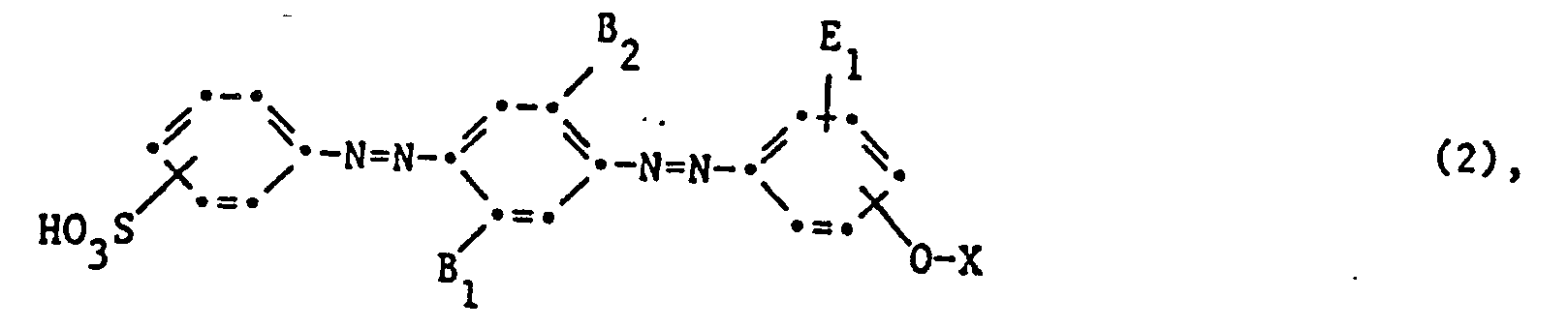
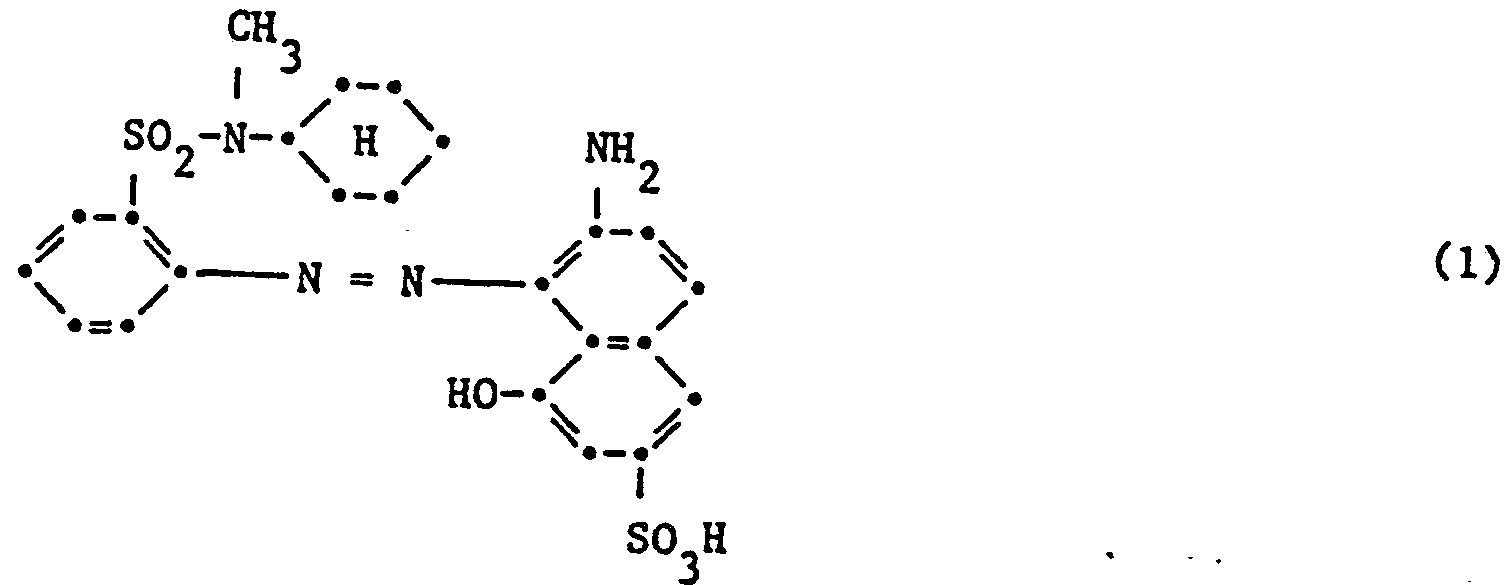
- the present invention thus relates to a process for trichromatic dyeing or printing of natural and synthetic polyamide materials with dye mixtures, which is characterized in that a dye of the formula together with at least one dye of the formula wherein B 1, B 2 and E 1 is hydrogen, C l - 1-4 alkyl or straight-chain or branched C 4 alkyl or C 1-4 alkoxy and X is straight-chain or branched C 2-4 hydroxyalkyl, and a dye of the formula or a mixture of the dyes of the formulas and wherein in formula (4) Y 1 is C 2 - 4 -hydroxyalkylsulphamoyl, or a dye of the formula in which Y 3 is hydrogen and Y 4 is acetylamino, or in which Y 3 is methyl and Y 4 is C 2 - 4 -hydroxyalkylsulphamoyl.
- Trichromatic is to be understood as the additive color mixture of suitably selected yellow, orange, red and blue coloring dyes, with which any desired shade of the visible color spectrum can be adjusted by a suitable choice of the proportions of the dyes.
- Suitable alkyl radicals for B 1 , B 2 , E 1 and X in formula (2), independently of one another, are straight-chain or branched alkyl radicals.
- Examples of B ' 1, B 2 , E 1 and X are: methyl, ethyl, propyl, isopropyl, butyl, sec-butyl, isobutyl and tert-butyl.
- Suitable alkoxy radicals for B 1 , B 2 and E 1 in formula (2) are, for example, the methoxy, ethoxy, propoxy, isopropoxy, butoxy, sec-butoxy, isobutoxy or tert-butoxy radical.
- a straight-chain or branched hydroxyalkyl radical such as, for example, the ⁇ -hydroxyethyl, ⁇ -hydroxypropyl, ⁇ -hydroxybutyl or the a-ethyl- ⁇ -hydroxyethyl radical, is suitable as the hydroxyalkyl radical for X in formula (2).
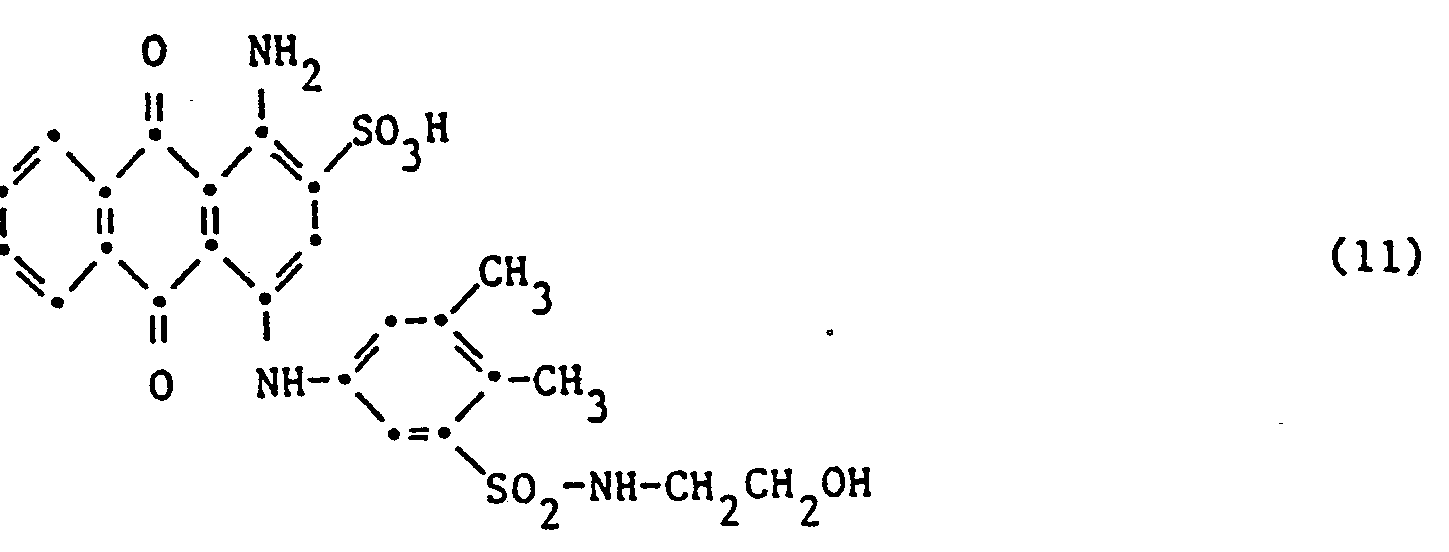
- Examples of suitable C 2 - 4 -hydroxyalkylsulphamoyl radicals for Y 1 in formula (4) are the ⁇ -hydroxyethylsulphamoyl, ⁇ -hydroxypropylsulfphamoyl, y-hydroxypropylsulphamoyl or the ⁇ -hydroxybutyulsulphamoyl radical.
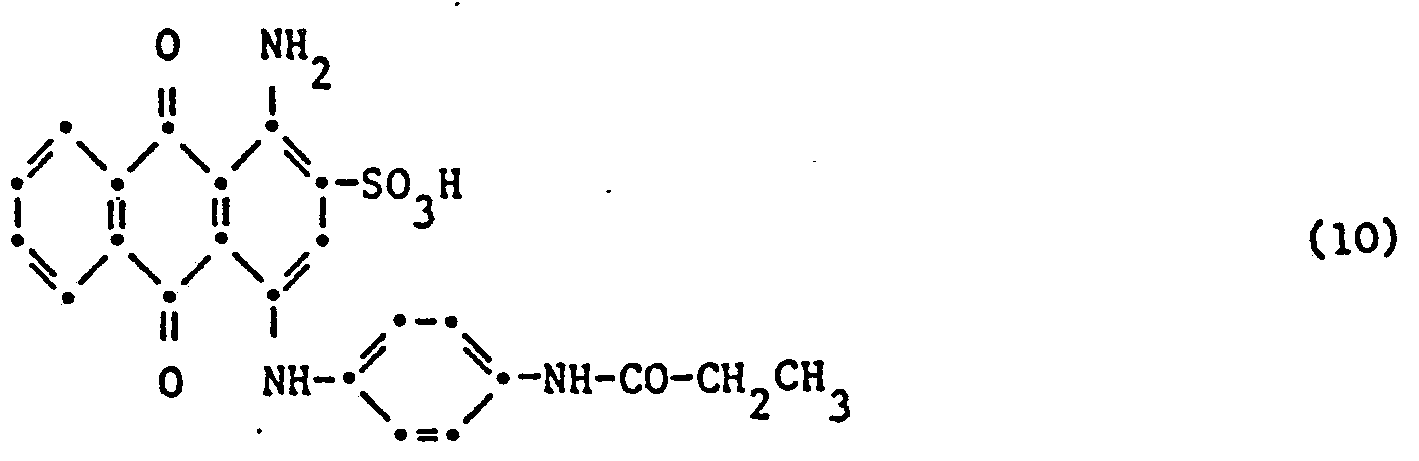
- the ratio of the dyes of the formulas (11) and (10) is preferably 60:40 to 40:60.
- the dyes of the formula are the dyes of the formula (2) wherein A 1 is hydrogen or methyl, F 1 is hydrogen or methyl and X 1 is methyl, ethyl, ⁇ -hydroxyethyl, ⁇ -hydroxypropyl, ⁇ -hydroxybutyl or a-ethyl-ß-hydroxyethyl, preferred in the process variants described above.
- the dyes of the formula (2) are in particular the dyes of the formulas and prefers.
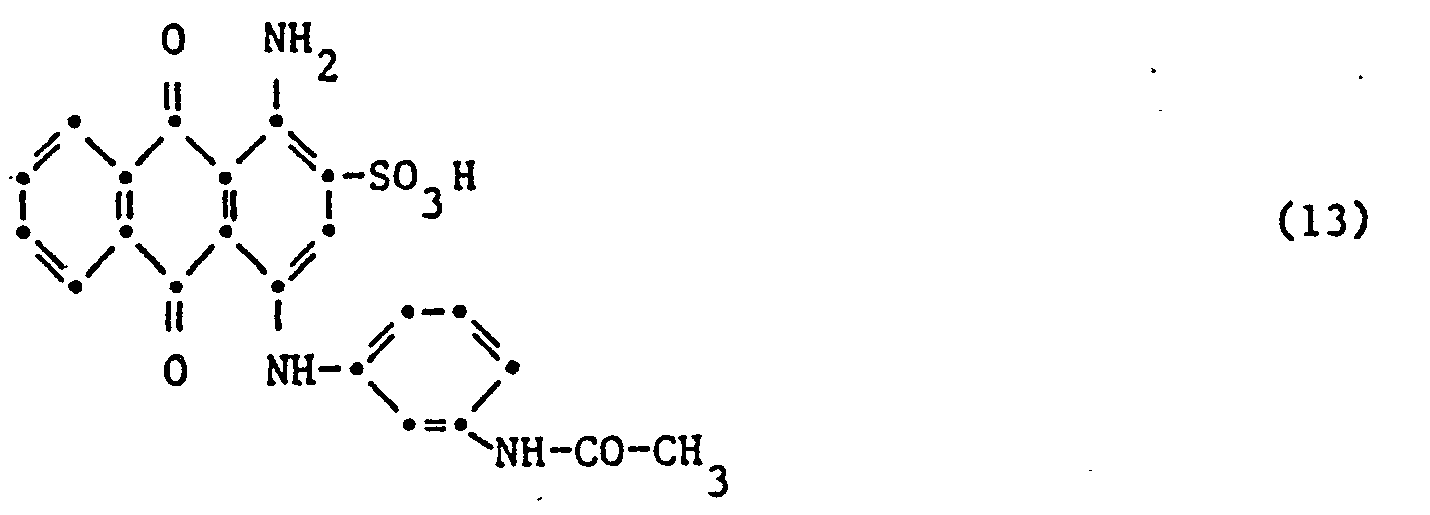
- the particularly preferred process variants are characterized in that the dye of the formula (1) together with the dye of the formula and with one of the dyes of the formulas (13) or (14), or with a dye mixture of the dyes of the formulas (11) and (10) in a ratio of 60:40 to 40:60.
- Another particularly preferred process variant is characterized in that the dye of the formula (1) together with the dye of the formula and a dye mixture of the dye of the formulas (11) and (10) in a ratio of 60:40 to 40:60.
- the dyes used in the process according to the invention for trichromatic dyeing or printing are known or can be prepared in analogy to known processes.
- the dye of the formula (1) according to the information from the German patent specification 20 63 907 the dyes of the formula (2) according to the information from the German patent application 21 42 412 and the colorants of the formulas (4), (6) and (7) according to the information from US Pat. No. 3,778,453 or, analogously thereto, German Patent 945,643 or analogously to German Patent 538 310.
- dye mixtures of the dyes of the formula (2) or of the formulas (4) and (10) are used in the process according to the invention, this can be prepared by mixing the individual dyes. This mixing process takes place, for example, in suitable mills, e.g. Ball and pin mills, as well as in kneaders or mixers.
- the dye mixtures of the dyes of the formula (2) or of the formulas (4) and (10) can be prepared by spray drying the aqueous dye mixtures.
- the dyes used in the process according to the invention are either in the form of their free sulfonic acid or preferably as their salts.
- suitable salts are the alkali metal, alkaline earth metal or ammonium salts or the salts of an organic amine.
- suitable salts include the sodium, lithium, potassium or ammonium salts or the salt of triethanolamine.
- the dye mixtures used in the process according to the invention generally contain further additives such as Cooking salt or dextrin.
- the process according to the invention for trichromatic dyeing or printing can be applied to the customary dyeing or printing processes.
- the dyeing liquors or printing pastes can contain other additives, for example wetting agents, anti-foaming agents, leveling agents or agents influencing the property of the textile material, such as e.g. Plasticizers, flame retardants or dirt, water and oil repellents as well as water softeners and natural or synthetic thickeners such as Alginates and cellulose ethers.
- the process according to the invention is particularly suitable for dyeing from short liquors, such as suitable for continuous dyeing processes or discontinuous and continuous foam coloring processes.
- the dyes used in the process according to the invention are distinguished in trichromatic dyeing or printing by uniform color build-up, good absorption behavior, good constancy of shades even in different concentrations, good fastness properties and in particular by very good combinability.
- the inventive method is suitable for dyeing or printing both natural polyamide materials such as Wool such as in particular synthetic polyamide materials such as Perlon or nylon and it is suitable for dyeing or printing wool and synthetic polyamide blended fabrics or yarns.
- the textile material mentioned can be in a wide variety of processing forms, such as as fiber, yarn, woven or knitted fabric and in particular in the form of carpets.
- Trichromatic processes are described in EP-A-00 30 919 and in DE-A-26 23 178, which, however, do not have the same good results as the process according to the invention. Further trichromatic processes with structurally different yellow components are known from EP-A-00 42 357 and CH-A-543 634.
- parts represent parts by weight.
- the temperatures are degrees Celsius.
- the relationship between parts by weight and parts by volume is the same as that between grams and cubic centimeters.
- helica tricot 10 parts are dyed in 500 parts of an aqueous liquor which contains 2 g / l of ammonium acetate and is adjusted to pH 5 with acetic acid. 0.27% of the yellow dye of the formula 0.12% of the red dye of the formula and 0.13% of the blue dye mixture B obtained according to Example (1b) is used, the amounts given being based on the fiber weight.
- the dyeing time at a temperature of 98 ° is 30 to 90 minutes.
- the colored Helanca piece is then removed and rinsed and dried as usual. You get a piece of fabric dyed in neutral brown shade that has no material-related streakiness.
- the yarn dyed in the specified shade is obtained with the dyes specified in Table 23 below.
- Example 5 The procedure is as described in Example 5 and 0.12% of the dye of the formula is used instead of 0.13% of the dye mixture B obtained in Example 1b) using the same procedure this gives you a yarn dyed in a neutral brown shade.
- the dye of the formula (14) used therein having the following constitution: so you get the yarn dyed in the specified shade.
- This foam is then applied from a foam container, which has an adjustable doctor blade for setting the desired foam thickness, via an application roller by means of a chute to the pole side of the carpet running through the dyeing system (running speed 9 m / minute).
- the layer height of the foam is 8 mm.
- the color foam application is 135%.
- the carpet then goes through a vacuum passage in which the foam layer is partially sucked into the carpet from the back (negative pressure of 0.1 bar), which slightly reduces the height of the foam layer.
- the carpet then runs over a transport roller into a damper (102 ° C, saturated steam), where a slight foaming and then destruction of the foam takes place.
- the carpet is then sprayed with water at about 80 ° C., then suctioned off and dried at 100 to 130 ° C. on a sieve drum dryer.
- the carpet material obtained is irrelevant, dyed in a beige color, shows an excellent through-coloring, the softness and bulk of the material is positively influenced by the foam coloring.
- a velor carpet made of polyamide 6 with a weight of 350 to 400 g / m 2 is impregnated with a padding liquor consisting of 988 parts of water, 10 parts of sodium hydroxide solution 36 °, Be and 2 parts of wetting agent on a padding machine and on a liquor holder squeezed by 80%.
- the material sprayed with the color paste is then treated with saturated steam at 101 ° for 5 minutes to fix the dyes, rinsed, neutralized, rinsed again and dried.
- a woolen is mixed with a liquor containing 2.6 parts of the yellow dye of the formula (18), 5.2 parts of the red dye of the formula (1), 15.7 parts of the blue dye mixture B, 2.0 parts of a thickener based on alginate, 22.0 parts of a coacervate-forming padding agent based on a condensation product of a higher molecular fatty acid with an oxyalkylamine and 8.0 parts of 80% formic acid in 1000 parts of water, a liquor absorption of 85%, based on the weight of wool. Then steam for 15 minutes in saturated steam from 98 to 100 ° and wash. A uniform olive color is obtained.
Landscapes
- Engineering & Computer Science (AREA)
- Textile Engineering (AREA)
- Chemical & Material Sciences (AREA)
- Organic Chemistry (AREA)
- Coloring (AREA)
- Heterocyclic Carbon Compounds Containing A Hetero Ring Having Oxygen Or Sulfur (AREA)
- Electrochromic Elements, Electrophoresis, Or Variable Reflection Or Absorption Elements (AREA)
Description
- Die der vorliegenden Erfindung zugrundeliegende Aufgabe war es, ein Verfahren zum Färben oder Bedrucken von natürlichen und synthetischen Polyamidmaterialien mit zur Kombination nach dem Trichromie-Prinzip geeigneten Farbstoffen zu finden. Die in dem Verfahren zu verwendenden Farbstoffe sollenn einen gleichmässigen Farbaufbau bei gleichzeitiger Nuancenkonstanz in verschiedenen Konzentrationen und eine gute Kombinierbarkeit zeigen.
- Es wurde nun gefunden, dass das unten beschriebene Verfahren den genannten Anforderungen genügt.
- Gegenstand der vorliegenden Erfindung ist somit ein Verfahren zum Trichromie-Färben oder -Bedrucken von natürlichen und synthetischen Polyamidmaterialien mit Farbstoffmischungen, welches dadurch gekennzeichnet ist, dass maneinen Farbstoff der Formel


- Unter Trichromie ist die additive Farbmischung passend gewählter gelb- bzw. orange-, rot- und blaufärbender.Farbstoffe zu verstehen, mit denen jede gewünschte Nuance des sichtbaren Farbspektrums durch geeignete Wahl der Mengenverhältnisse der Farbstoffe eingestellt werden kann.
- Als Alkylreste kommen für B1, B2, E1 und X in Formel (2) unabhängig voneinander geradkettig oder verzweigte Alkylreste in Betracht. Als Beispiele für B'1, B2, E1 und X seien genannt: Methyl, Aethyl, Propyl, Isopropyl, Butyl, sek.-Butyl, Isobutyl und tert.-Butyl.
- Als Alkoxyreste kommen für B1, B2 und E1 in Formel (2) beispielsweise der Methoxy-, Aethoxy-, Propoxy-, Isopropoxy-, Butoxy-, sek.-Butoxy-, Isobutoxy- oder tert.-Butoxyrest in Betracht.
- Als Hydroxyalkylrest kommt für X in Formel (2) ein geradkettig oder verzweigter Hydroxyalkylrest in Betracht, wie beispielsweise der β-Hydroxyäthyl-, β-Hydroxypropyl-, β-Hydroxybutyl- oder der a-Aethyl- β-hydroxyäthylrest.
- Als C2-4-Hydroxyalkylsulphamoylrest kommt für Y1 in Formel (4) beispielsweise der β-Hydroxyäthylsulphamoyl-, β-Hydroxypropylsulfphamoyl-, y-Hydroxypropylsulphamoyl- oder der β-Hydroxybutyulsulphamoylrest in Betracht.
- Die bevorzugten Verfahrensvarianten sind dadurch gekennzeichnet, dass man einen Farbstoff der Formel (1) zusammen mit mindestens einem Farbstoff der Formel (2) und
- a) einer Farbstoffmischung, die den Farbstoff der Formel


- b) dem Farbstoff der Formel

- c) dem Farbstoff der Formel (10), oder
- d) dem Farbstoff der Formel

- e) dem Farbstoff der Formel

- In den Verfahrensvarianten, worin eine Farbstoffmischung, der Farbsoffe der Formeln (11) und (10) verwendet wird, ist das Verhältnis der Farbstoffe der Formeln (11) und (10) vorzugsweise 60:40 bis 40:60.
- Als Farbstoffe der Formel (2) sind die Farbstoffe der Formel

- Als Farbstoffe der Formel (2) sind insbesondere die Farbstoffe der Formeln


- Die besonders bevorzugten Verfahrensvarianten sind dadurch gekennzeichnet, dass man den Farbstoff der Formel (1) zusammen mit dem Farbstoff der Formel

- Eine ebenfalls besonders bevorzugte Verfahrensvariante ist dadurch gekennzeichnet, dass man den Farbstoff der Formel (1) zusammen mit dem Farbstoff der Formel

- Die in dem erfindungsgemässen Verfahren zum Trichromie-Färben oder -Bedrucken verwendeten Farbstoffe sind bekannt oder können in Analogie zu bekannten Verfahren hergestellt werden. So kann beispielsweise der Farbstoff der Formel (1) gemäss den Angaben aus der deutschen Patentschrift 20 63 907, die Farbstoffe der Formel (2) gemäss den Angaben aus der deutschen Offenlegungsschrift 21 42 412 und die Farbstoffe der Formeln (4), (6) und (7) gemäss den Angaben aus der US-Patentschrift 3 778 453 bzw. in Analogie dazu, der deutschen Patentschrift 945,643 oder analog der deutschen Patentschrift 538 310 hergestellt werden.
- Werden in dem erfindungsgemässen Verfahren Farbstoffmischung der Farbstoffe der Formel (2) oder der Formeln (4) und (10) verwendet, so kann diese durch Mischung der Einzelfarbstoffe hergestellt werden. Dieser Mischprozess erfolgt beispielsweise in geeigneten Mühlen, z.B. Kugel- und Stiftmühlen, sowie in Knetern oder Mixern.
- Ferner können die Farbstoffmischungen der Farbstoffe der Formel (2) oder der Formeln (4) und (10) durch Zerstäubungstrocknen der wässrigen Farbstoffmischungen hergestellt werden.
- Die in dem erfindungsgemässen Verfahren verwendeten Farbstoffe liegen entweder in der Form ihrer freien Sulfonsäure oder vorzugsweise als deren Salze vor.
- Als Salze kommen beispielsweise die Alkali-, Erdalkali- oder Ammoniumsalze oder die Salze eines organischen Amins in Betracht. Als Beispiele seien die Natrium-, Lithium-, Kalium- oder Ammonium- salze oder das Salz des Triäthanolamins genannt.
- Die in dem erfindungsgemässen Verfahren verwendeten Farbstoffmischungen enthalten in der Regel weitere Zusätze wie z.B. Kochsalz oder Dextrin.
- Das erfindungsgemässe Verfahren zum Trichromie-Färben oder -Bedrucken kann auf die üblichen Färbe- bzw. Druckverfahren angewendet werden. Die Färbeflotten oder Druckpasten können ausser Wasser und den Farbstoffen weitere Zusätze, beispielsweise Netzmittel, Antischaummittel, Egalisiermittel oder die Eigenschaft des Textilmaterials beenflussende Mittel wie z.B. Weichmachungsmittel, Zusätze zum Flammfestausrüsten oder schmutz-, wasser- und öl-abweisende Mittel sowie wasserenthärtende Mittel und natürliche oder synthetische Verdicker, wie z.B. Alginate und Celluloseäther, enthalten.
- Das erfindungsgemässe Verfahren ist besonders zum Färben aus Kurzflotten, wie z.B. bei Kontinuefärbeverfahren oder diskontinuierlichen und kontinuierlichen Schaumfärbeverfahren, geeignet.
- Die in dem erfindungsgemässen Verfahren verwendeten Farbstoffe zeichnen sich beim Trichromie-Färben oder-Bedrucken durch gleichmässigen Farbaufbau, gutes Aufziehverhalten, gute Nuancenkonstanz auch in verschiedenen Konzentrationen, gute Echtheiten sowie insbesondere durch sehr gute Kombinierkeit aus.
- Das erfindungsgemässe Verfahren eignet sich zum Färben oder Bedrucken sowohl von natürlichen Polyamidmaterialien wie z.B. Wolle wie insbesondere von synthetischen Polyamidmaterialien wie z.B. Perlon oder Nylon und es ist geeignet zum Färben oder Bedrucken von Woll- und synthetischen Polyamid-Mischgeweben oder -Garnen.
- Das genannte Textilmaterial kann dabei in den verschiedensten Verarbeitungsformen vorliegen, wie z.B. als Faser, Garn, Gewebe oder Gewirke und insbesondere in Form von Teppichen.
- In der EP-A-00 30 919 und in der DE-A-26 23 178 werden Trichromieverfahren beschrieben, welche jedoch nicht gleich gute Resultate wie das erfindugsgemässe Verfahren aufweisen. Aus der EP-A-00 42 357 und der CH-A-543 634 sind weitere Trichromieverfahren mit strukturell verschiedenen Gelbkomponenten bekannt.
- In den folgenden Beispielen stehen Teile für Gewichtsteile. Die Temperaturen sind Celsiusgrade. Die Beziehung zwischen Gewichtsteilen und Volumenteilen ist dieselbe wie diejenige zwischen Gramm und Kubikzentimeter.
- Zur Herstellung der Farbstoffmischung; die einen Farbstoff der Formel


- a) 30,2 Teile des Farbstoffs der Formel (11) und 69,8 Teile des Farbstoffs der Formel (10) homogen gemischt und ergeben 100 Teile der Mischung, die im folgenden als Farbstoffmischung A bezeichnet wird;
- b) 56,6 Teile des Farbstoffs der Formel (11) und 43,4 Teile des Farbstoffs der Formel (10) homogen gemischt und ergeben 100 Teile der Mischung, die im folgenden als Farbstoffmischung B bezeichnet wird;
- c) 79,6 Teile des Farbstoffs der Formel (11) und 20,4 Teile des Farbstoffs der Formel (10) homogen gemischt und ergeben 100 Teile der Mischung, die im folgenden als Farbstoffmischung C bezeichnet wird:
- Man färbt 10 Teile Helancatrikot in 500 Teilen einer wässrigen Flotte, die 2 g/I Ammonacetat enthält und mit Essigsäure auf pH 5 gestellt wird. Als Farbstoffe werden 0,27% des gelben Farbstoffs der Formel


- Verwendet man anstelle von 0,27% des gelben Farbstoffs der Formel (18) und 0,12% des roten Farbstoffs der Formel (1) sowie 0,13% der blauen Farbstoffmischung B die in der folgenden Tabelle 1 angegebenen Farbstoffe der Formeln (18) und (1) sowie die Farbstoffmischungen aus Beispiel 1, so erhält man die in der angegebenen Nuance völlig egal gefärbten Gewebestücke.

- Man färbt 10 Teile Polyamid 66-Garn in 400 Teilen einer wässrigen Flotte, die 1,5 g/I Ammonacetat enthält und mit Essigsäure auf pH 5,5 gestellt wird. Als Farbstoffe werden 0,27% des Farbstoffs der Formel (18), 0,12% des Farbstoffs der Formel (1) und 0,13% der gemäss Beispiel 1 b) erhaltenen Farbstoffmischung B verwendet, wobei sich die Mengenangaben auf das Fasergewicht beziehen. Das Färbebad wird innerhalb von 30 Minuten auf 98° erhitzt und 60 Minuten bei 96° bis 98° gehalten. Das gefärbte Garn wird anschliessend herausgenommen und wie üblich gespült und getrocknet. Man erhält.ein in neutral brauner Nuance gefärbtes Garn.
- Verwendet man anstelle von 0,27% des gelben Farbstoffs der Formel (18) und 0,12% des roten Farbstoffs der Formel (1) sowie 0,13% der blauen Farbstoffmischung B die in der folgenden Tabelle 2 angegebenen Farbstoffe der Formeln (18) und (1) sowie die Farbstoffmischungen aus Beispiel 1, so erhält man das in der angegebenen Nuance gefärbte Garn.

- Verwendet man ferner anstelle des gelben Farbstoffs der Formel (18) den orangen Farbstoff der Formel


- Verfährt man wie in Beispiel 5 angegeben und verwendet bei sonst gleicher Verfahrensweise anstelle von 0,13% der gemäss Beispiel 1b) erhaltenen Farbstoffmischung B 0,12% des Farbstoffs der Formel

- Verwendet man anstelle von 0,12% des Farbstoffs der Formel (13) die in der folgenden Tabelle 4 angegebenen Farbstoffe, wobei der darin verwendete Farbstoff der Formel (14) die folgende Konstitution hat:


- 500 m24 eines Polyamid (6.6)-Schnittflorteppichs (Veloursware mit Polypropylenbändchenrücken) mit einem Quadratmetergewicht von 535 g werden in einer Flotte, die pro Liter 1 g des Umsetzungsprodukts aus 1 Mol Nonylphenol und 9 Mol Aethylenoxyd enthält, kontinuierich vorgenetzt und dann auf eine Flottenaufnahme von 40 Gewichtsprozent abgesaugt.
- In einer Verschäumgsvorrichtung (Mixer) wird aus folgender wässeriger Flotte ein Farbschaum hergestellt, dessen Verschäumungsgrad 1:10 beträgt:
- 0,6 g/l des Farbstoffs der Formel

- 0,35 g/I des Farbstoffs der Formel

- 0,40 g/I des Farbstoffs der Formel

- 2,5 g/l eines Schaumstabilisatorgemisches aus Kokosfettsäurediäthanolamid/Nonylphenolpoly- glykol(11)äther und Lauryltriglykoläthersulfat-Natrium,
- 0,6 g/1 des Siloxanoxyalkylen-Copolymerisates der Formel

- 1 g/I Natriumacetat, sowie Essigsäure zur Einstellung der Flotte auf eine pH-Wert von 6,0.
- Dieser Schaum wird dann aus einem Schaumbehälter, der eine verstellbare Rakel für die Einstellung der gewünschten Schaumdicke aufweist, über eine Auftragswalze mittels einer Rutsche auf die Polseite des durch die Färbeanlage laufenden Teppichs aufgebracht (Laufgeschwindigkeit 9 m/Minute). Die Schichthöhe des Schaums beträgt 8 mm. Der Farbschaumauftrag beträgt 135%.
- Anschliessend durchläuft der Teppich eine Vakuumpassage, in der von der Rückseite her die Schaumschicht teilweise in den Teppich eingesaugt wird (Unterdruck von 0,1 bar), wodurch die Höhe der Schaumschicht etwas reduziert wird. Ueber eine Transportwalze läuft der Teppich dann in einen Dämpfer (102°C, Sattdampf), wo ein leichtes Aufschäumen und dann ein Zerstören des Schaums erfolgt. Anschliessend wird der Teppich mit Wasser von etwa 80°C abgespritzt, dann abgesaugt und bei 100 bis 130°C auf einem Siebtrommeltrockner getrocknet.
- Das erhaltene Teppichmaterial ist egal, in einem beigen Farbton gefärbt, zeigt eine hervorragende Durchfärbung, die Weichheit und Bauschigkeit des Materials wird durch das Schaumfärben positiv beeinflusst.
- Ein Velours-Teppichboden aus Polyamid-6 mit einem Gewicht von 350 bis 400 g/m2 wird mit einer Klotzflotte, bestehend aus 988 Teilen Wasser, 10 teilen Natronlauge 36°, Be und 2 Teilen Netzmittel, auf einem Foulard imprägniert ud auf eine Flottenaufnahme von 80% abgequetscht.
- Auf denn so vorbehandelten Teppich wird mittels einer Düse eine Farbpaste der folgenden Zusammensetzung in Form eines Musters aufgespritzt:
- 942 Teile Wasser,
- 50 Teile Verdicker,
- 3 Teile Antischaumittel,
- 3 Teile des gelben Farbstoffes der Formel (18) von Beispiel 2,
- 1 Teil des roten Farbstoffes der Formel (1) von Beispiel 2, sowie 1 Teil der blauen Farbstoffmischung A von Beispiel 1.
- Der verwendete Verdicker weist die folgende Zusammensetzung auf:
- 240 Teile Lackbenzin,
- 50 Teile Wasser-in-Oel-Emulgator,
- 20 Teile Oel-in Wasser-Emulgator,
- 20 Teile Antischaummittel,
- 50 Teile vernetztes Carboxyvinylpolymer mit einem Molekulargewicht von ca. 4.000.000,
- 70 Teile lineares Carboxyvinylpolymer mit einem Molekulargewicht von ca. 1.00.000, und
- 550 Teile Wasser, dessen pH-Wert mit Essigsäure auf 4,5 gestellt wurde.
- Das mit der Farbpaste bespritzte Material wird anschliessend während 5 Minuten mit Sattdampf von 101° behandelt zur Fixierung der Farbstoffe, gespült, neutralisiert, erneut gespült und getrocknet.
- Man erhält einen Velours-Teppichboden mit einem braunen Muster mit sehr scharfen Konturen, welcher eine sehr gute Penetration und keinerlei "Frosting" aufweist.
- 2,7 Teile des gelben Farbstoffs der Formel (18) von Beispiel 2,1,2 Teile des roten Farbstoffs der Formel (1) von Beispiel 2 und 1,3 Teile der blauen Farbstoffmischung B von Beispiel 1 werden in 100 Teilen Wasser durch kurzes Kochen gelöst. Diese Lösung wird hierauf zu einer Lösung, enthaltend 3 Teile eines Verdickungsmittels auf der Basis von Johannisbrotkernmehl, 5,0 Teile eines koazervatbildenden Klotzhilfsmittels auf der Basis eines Kondensationsproduktes einer höher molekularen Fettsäure mit einem Oxyalkylamin, 2,0 Teile krist. Mononatriumphosphat und 1,0 Teile krist. Dinatriumphosphat in 500 Teilen kaltem Wasser zugegeben. Anschliessend wird mit kaltem Wasser auf 1000 Teile aufgefüllt. Von dieser, einen pH-Wert von 5,5 bis 6,5 aufweisenden Flotte werden 300%, bezogen auf das Teppichgewicht, auf einen Polyamid-Nadelflor-Rohteppich aufgetragen, bei einer Teppichgeschwindigkeit von 8 Meter pro Minute. Der getränkte Teppich gelangt in einen Schleifendämpfer, wo er während 10 Minuten mit Sattdampf von 98 bis 100°C behandelt wird.
- Nach dem Waschen in einer Breitwaschmaschine erhält man einen in neutral brauner Nuance gefärbten Teppich.
- Verwendet man anstelle von 2,7 Teilen des gelben Farbstoffs der Formel (18), 1,2 Teilen des roten Farbstoffs der Formel (1) und 1,3 Teilen der blauen Farbstoffmischung B die in der folgenden Tabelle 5 angegebenen Farbstoffe bzw. Farbstoffmischungen so erhält man in der angegebenen Nuance gleichmässig gefärbte Teppiche.

- Ein Wollstoff wird mit einer Flotte, enthaltend 2,6 Teile des gelben Farbstoffs der Formel (18), 5,2 Teile des roten Farbstoffs der Formel (1), 15,7 Teile der blauen Farbstoffmischung B, 2,0 Teile eines Verdickungsmittels auf der Basis von Alginat, 22,0 Teile eines koazervatbildenden Klotzmittels auf der Basis eines Kondensationsproduktes einer höher molekularen Fettsäure mit einem Oxyalkylamin und 8,0 Teile 80%ige Ameisensäure in 1000 Teilen Wasser foulardiert, wobei eine Flottenaufnahme von 85%, bezogen auf das Gewicht von Wolle, erreicht wird. Anschliessend dämpft man während 15 Minuten in Sattdampf von 98 bis 100° und wäscht. Man erhält eine gleichmässige Olivefärbung.
Claims (16)











Priority Applications (1)
| Application Number | Priority Date | Filing Date | Title |
|---|---|---|---|
| AT82810052T ATE20099T1 (de) | 1981-12-29 | 1982-02-05 | Verfahren zum trichromie-faerben oder -bedrucken. |
Applications Claiming Priority (2)
| Application Number | Priority Date | Filing Date | Title |
|---|---|---|---|
| CH834481 | 1981-12-29 | ||
| CH8344/81 | 1981-12-29 |
Publications (3)
| Publication Number | Publication Date |
|---|---|
| EP0083299A1 EP0083299A1 (de) | 1983-07-06 |
| EP0083299B1 EP0083299B1 (de) | 1986-05-28 |
| EP0083299B2 true EP0083299B2 (de) | 1990-06-13 |
Family
ID=4338884
Family Applications (1)
| Application Number | Title | Priority Date | Filing Date |
|---|---|---|---|
| EP82810052A Expired - Lifetime EP0083299B2 (de) | 1981-12-29 | 1982-02-05 | Verfahren zum Trichromie-Färben oder -Bedrucken |
Country Status (8)
| Country | Link |
|---|---|
| US (1) | US4402704A (de) |
| EP (1) | EP0083299B2 (de) |
| JP (3) | JPS607076B2 (de) |
| AT (1) | ATE20099T1 (de) |
| AU (1) | AU554084B2 (de) |
| CA (1) | CA1184705A (de) |
| DE (1) | DE3271290D1 (de) |
| DK (1) | DK153503C (de) |
Families Citing this family (28)
| Publication number | Priority date | Publication date | Assignee | Title |
|---|---|---|---|---|
| DE3466715D1 (en) * | 1983-05-25 | 1987-11-12 | Ciba Geigy Ag | Trichromatic dyeing or printing process |
| DE3329193A1 (de) * | 1983-08-12 | 1985-02-28 | Bayer Ag, 5090 Leverkusen | Verfahren zum faerben von amidgruppenhaltigen fasermaterialien |
| US4563192A (en) * | 1983-09-19 | 1986-01-07 | Ciba-Geigy Corporation | Process for dyeing fibre material made of synthetic polyamides with anionic dyes and an auxiliary mixture |
| DE3483129D1 (de) * | 1983-09-27 | 1990-10-11 | Ciba Geigy Ag | Verfahren und vorrichtung zum gleichzeitigen auftragen und fixieren von chemikalien auf ein textilsubstrat. |
| US4579561A (en) * | 1984-01-31 | 1986-04-01 | Crompton And Knowles Corporation | Process for trichromatic dyeing polyamide fibers |
| US4652269A (en) * | 1984-11-08 | 1987-03-24 | Ciba-Geigy Corporation | Process for the continuous trichromatic dyeing of synthetic polyamide materials: including a blue anthraquinone reactive dye |
| DE3600889A1 (de) * | 1986-01-15 | 1987-07-16 | Bayer Ag | Verfahren zum faerben von polyamidfasern |
| US4840643A (en) * | 1988-03-16 | 1989-06-20 | Crompton & Knowles Corporation | Trichromatic combination of dyes for nylon |
| EP0360735A1 (de) * | 1988-08-26 | 1990-03-28 | Ciba-Geigy Ag | Verfahren zum Trichromie-Färben oder -Bedrucken |
| DK0387201T3 (da) * | 1989-03-10 | 1994-03-07 | Ciba Geigy Ag | Farvestofblanding og dens anvendelse |
| GB2236542B (en) * | 1989-10-06 | 1992-04-15 | Sandoz Ltd | Dye mixtures and their use in trichromatic dyeing processes |
| DK0425434T3 (da) * | 1989-10-23 | 1995-12-18 | Ciba Geigy Ag | Farvestofblandinger og deres anvendelse |
| EP0425435A1 (de) * | 1989-10-23 | 1991-05-02 | Ciba-Geigy Ag | Verfahren zum Trichromie-Färben oder -Bedrucken |
| ES2099409T3 (es) * | 1992-12-03 | 1997-05-16 | Ciba Geigy Ag | Procedimiento para teñir o estampar por tricromia. |
| US5456727A (en) * | 1994-05-24 | 1995-10-10 | Hoechst Celanese Corporation | Dye compositions for polyamides |
| EP0859034B1 (de) * | 1997-02-10 | 2002-04-24 | Ciba SC Holding AG | Farbstoffmischungen und deren Verwendung |
| US6033445A (en) * | 1997-02-10 | 2000-03-07 | Ciba Specialty Chemicals Corporation | Dye mixtures and their use |
| EP0924266B1 (de) * | 1997-12-10 | 2003-01-22 | Ciba SC Holding AG | Farbstoffmischungen und deren Verwendung |
| TW472078B (en) * | 1997-12-10 | 2002-01-11 | Ciba Sc Holding Ag | A dye mixture comprising and a method for dyeing or printing natural or synthetic polyamide fiber materials |
| US7554586B1 (en) | 1999-10-20 | 2009-06-30 | Rochester Institute Of Technology | System and method for scene image acquisition and spectral estimation using a wide-band multi-channel image capture |
| US6990904B2 (en) | 2000-10-31 | 2006-01-31 | International Imaging Materials, Inc | Thermal transfer assembly for ceramic imaging |
| US6796733B2 (en) | 2000-10-31 | 2004-09-28 | International Imaging Materials Inc. | Thermal transfer ribbon with frosting ink layer |
| US6854386B2 (en) | 2000-10-31 | 2005-02-15 | International Imaging Materials Inc. | Ceramic decal assembly |
| PT1341853E (pt) * | 2000-12-05 | 2005-11-30 | Clariant Finance Bvi Ltd | Processo de tingimento tricromico |
| GB0124842D0 (en) | 2001-10-17 | 2001-12-05 | Clariant Int Ltd | Improvements relating to organic compounds |
| MXPA06011303A (es) * | 2004-04-06 | 2007-01-16 | Clariant Finance Bvi Ltd | Proceso de tenido. |
| CN1869130B (zh) * | 2006-06-20 | 2010-05-12 | 吴江市绿洲染料化工有限公司 | 一种酸性染料混合物 |
| DE102011079114A1 (de) * | 2011-07-14 | 2013-01-17 | Tesa Se | Klebeband mit textilem Träger für die Kabelbandagierung |
Family Cites Families (9)
| Publication number | Priority date | Publication date | Assignee | Title |
|---|---|---|---|---|
| CH487222A (de) * | 1967-04-05 | 1970-03-15 | Geigy Ag J R | Verfahren zur Herstellung von sauren Anthrachinonfarbstoffen |
| CH509385A (de) * | 1969-12-29 | 1971-06-30 | Ciba Geigy Ag | Verfahren zur Herstellung von roten Monoazofarbstoffen |
| GB1315237A (en) * | 1970-06-23 | 1973-05-02 | Ciba Geigy Ag | Dyeing and printing of polyamide fibres |
| CA926386A (en) * | 1970-08-25 | 1973-05-15 | Fasciati Alfred | Disazo compounds, their manufacture and use |
| BE785750A (fr) | 1971-06-30 | 1973-01-02 | Sandoz Sa | Procede de teinture de fibres, fils ou textiles synthetiques, susceptibles d'etre teints par des colorants acides |
| DE2434119A1 (de) * | 1973-07-20 | 1975-02-06 | Sandoz Ag | Verfahren zum faerben von voluminoesen textilen materialien |
| DE2710152C2 (de) * | 1977-03-09 | 1978-11-02 | Bayer Ag, 5090 Leverkusen | Färben von synthetischen Polyamiden |
| US4365967A (en) * | 1979-12-14 | 1982-12-28 | Ciba-Geigy Corporation | Method of treating, especially dyeing, whitening or finishing, textile fabrics |
| EP0042357B1 (de) * | 1980-06-13 | 1984-06-06 | Ciba-Geigy Ag | Azofarbstoffe, deren Herstellung und Verwendung |
-
1982
- 1982-02-05 AT AT82810052T patent/ATE20099T1/de not_active IP Right Cessation
- 1982-02-05 EP EP82810052A patent/EP0083299B2/de not_active Expired - Lifetime
- 1982-02-05 DE DE8282810052T patent/DE3271290D1/de not_active Expired
- 1982-02-08 US US06/346,978 patent/US4402704A/en not_active Expired - Lifetime
- 1982-02-10 CA CA000395916A patent/CA1184705A/en not_active Expired
- 1982-02-10 JP JP57019032A patent/JPS607076B2/ja not_active Expired
- 1982-02-10 DK DK055982A patent/DK153503C/da not_active IP Right Cessation
- 1982-02-18 AU AU80582/82A patent/AU554084B2/en not_active Expired
-
1983
- 1983-11-25 JP JP58220870A patent/JPS607077B2/ja not_active Expired
- 1983-11-25 JP JP58220871A patent/JPS6010149B2/ja not_active Expired
Also Published As
| Publication number | Publication date |
|---|---|
| EP0083299B1 (de) | 1986-05-28 |
| US4402704A (en) | 1983-09-06 |
| DK55982A (da) | 1983-06-30 |
| ATE20099T1 (de) | 1986-06-15 |
| JPS59173385A (ja) | 1984-10-01 |
| JPS6010149B2 (ja) | 1985-03-15 |
| JPS59173384A (ja) | 1984-10-01 |
| AU8058282A (en) | 1983-07-07 |
| JPS607077B2 (ja) | 1985-02-22 |
| DK153503B (da) | 1988-07-18 |
| DK153503C (da) | 1988-11-28 |
| AU554084B2 (en) | 1986-08-07 |
| JPS58120883A (ja) | 1983-07-18 |
| DE3271290D1 (en) | 1986-07-03 |
| JPS607076B2 (ja) | 1985-02-22 |
| EP0083299A1 (de) | 1983-07-06 |
| CA1184705A (en) | 1985-04-02 |
Similar Documents
| Publication | Publication Date | Title |
|---|---|---|
| EP0083299B1 (de) | Verfahren zum Trichromie-Färben oder -Bedrucken | |
| EP0127579B1 (de) | Verfahren zum Trichromie-Färben oder -Bedrucken | |
| EP0092512B1 (de) | Verfahren zum Trichromie-Färben oder -Bedrucken | |
| EP0387201B1 (de) | Farbstoffmischung und deren Verwendung | |
| EP0083300B1 (de) | Farbstoffmischungen und deren Verwendung | |
| EP0124679B1 (de) | Verfahren zum Färben oder Bedrucken von Polyamidfasern | |
| EP0197001A1 (de) | Hilfsmittelgemisch und seine Verwendung als Färberei- oder Textilhilfsmittel | |
| EP0181292B1 (de) | Verfahren zum Kontinuierlichen Trichromie-Färben von synthetischen Polyamidmaterialien | |
| EP0425434A2 (de) | Farbstoffmischungen und deren Verwendung | |
| EP0099859B1 (de) | Verfahren zum Färben von differential-dyeing-Fasern | |
| CH625544A5 (en) | Process for producing a commercial dye preparation | |
| EP0548014B1 (de) | Farbstoffmischungen und deren Verwendung | |
| EP0593392B1 (de) | Verfahren zum Färben von natürlichen und synthetischen Polyamidfasermaterialien mit Farbstoffmischungen | |
| EP0651028B1 (de) | Verfahren zum Trichromie-Färben oder -Bedrucken | |
| DE3108812A1 (de) | Faerbereihilfsmittel und deren verwendung zum gleichzeitigen faerben mit kationischen und anderen farbstoffen | |
| EP0601971B1 (de) | Verfahren zum Trichromie-Färben oder -Bedrucken | |
| CH635856A5 (de) | Neue disazofarbstoffe und deren herstellung. | |
| EP0425435A1 (de) | Verfahren zum Trichromie-Färben oder -Bedrucken | |
| EP0784117B1 (de) | Verwendung von acrylamid-homo- oder copolymeren als antisettingmittel | |
| DE1909518C3 (de) | Verfahren zum einbadigen Färben von Mischungen aus Polyester- und Cellulosefaser | |
| CH687355B5 (de) | Verfahren zum Färben von Cellulose-Textilmaterial. | |
| DE3202548A1 (de) | Faerbeverfahren unter verwendung salzhaltiger schaeume | |
| EP0430879B1 (de) | Farbstoffmischungen und deren Verwendung | |
| EP0045458A1 (de) | Verfahren zum kontinuierlichen oder halbkontinuierlichen Färben von voluminösen Geweben aus Cellulosefasern mit Azo-Entwicklungsfarbstoffen | |
| CH681055B5 (de) |
Legal Events
| Date | Code | Title | Description |
|---|---|---|---|
| PUAI | Public reference made under article 153(3) epc to a published international application that has entered the european phase |
Free format text: ORIGINAL CODE: 0009012 |
|
| 17P | Request for examination filed |
Effective date: 19820208 |
|
| AK | Designated contracting states |
Designated state(s): AT BE CH DE FR GB IT LI NL |
|
| GRAA | (expected) grant |
Free format text: ORIGINAL CODE: 0009210 |
|
| AK | Designated contracting states |
Kind code of ref document: B1 Designated state(s): AT BE CH DE FR GB IT LI NL |
|
| REF | Corresponds to: |
Ref document number: 20099 Country of ref document: AT Date of ref document: 19860615 Kind code of ref document: T |
|
| ET | Fr: translation filed | ||
| REF | Corresponds to: |
Ref document number: 3271290 Country of ref document: DE Date of ref document: 19860703 |
|
| ITF | It: translation for a ep patent filed | ||
| PLBI | Opposition filed |
Free format text: ORIGINAL CODE: 0009260 |
|
| 26 | Opposition filed |
Opponent name: SANDOZ AG Effective date: 19870224 |
|
| NLR1 | Nl: opposition has been filed with the epo |
Opponent name: SANDOZ AG |
|
| PUAH | Patent maintained in amended form |
Free format text: ORIGINAL CODE: 0009272 |
|
| STAA | Information on the status of an ep patent application or granted ep patent |
Free format text: STATUS: PATENT MAINTAINED AS AMENDED |
|
| 27A | Patent maintained in amended form |
Effective date: 19900613 |
|
| AK | Designated contracting states |
Kind code of ref document: B2 Designated state(s): AT BE CH DE FR GB IT LI NL |
|
| EN | Fr: translation not filed | ||
| ET3 | Fr: translation filed ** decision concerning opposition | ||
| NLR2 | Nl: decision of opposition | ||
| ET | Fr: translation filed |
Free format text: BO 25/90 PAGE 197: ANNULATION |
|
| ITF | It: translation for a ep patent filed | ||
| NLR3 | Nl: receipt of modified translations in the netherlands language after an opposition procedure | ||
| ITTA | It: last paid annual fee | ||
| REG | Reference to a national code |
Ref country code: CH Ref legal event code: PUE Owner name: CIBA-GEIGY AG TRANSFER- CIBA SC HOLDING AG |
|
| BECN | Be: change of holder's name |
Effective date: 19961129 |
|
| NLS | Nl: assignments of ep-patents |
Owner name: CIBA SC HOLDING AG |
|
| REG | Reference to a national code |
Ref country code: FR Ref legal event code: TP |
|
| REG | Reference to a national code |
Ref country code: GB Ref legal event code: 732E |
|
| REG | Reference to a national code |
Ref country code: CH Ref legal event code: PFA Free format text: CIBA SC HOLDING AG TRANSFER- CIBA SPECIALTY CHEMICALS HOLDING INC. |
|
| NLT1 | Nl: modifications of names registered in virtue of documents presented to the patent office pursuant to art. 16 a, paragraph 1 |
Owner name: CIBA SPECIALTY CHEMICALS HOLDING INC. |
|
| PGFP | Annual fee paid to national office [announced via postgrant information from national office to epo] |
Ref country code: AT Payment date: 19980227 Year of fee payment: 17 |
|
| REG | Reference to a national code |
Ref country code: FR Ref legal event code: CD |
|
| PG25 | Lapsed in a contracting state [announced via postgrant information from national office to epo] |
Ref country code: AT Free format text: LAPSE BECAUSE OF NON-PAYMENT OF DUE FEES Effective date: 19990205 |
|
| PGFP | Annual fee paid to national office [announced via postgrant information from national office to epo] |
Ref country code: FR Payment date: 20010103 Year of fee payment: 20 Ref country code: CH Payment date: 20010103 Year of fee payment: 20 |
|
| PGFP | Annual fee paid to national office [announced via postgrant information from national office to epo] |
Ref country code: NL Payment date: 20010109 Year of fee payment: 20 |
|
| PGFP | Annual fee paid to national office [announced via postgrant information from national office to epo] |
Ref country code: DE Payment date: 20010112 Year of fee payment: 20 |
|
| PGFP | Annual fee paid to national office [announced via postgrant information from national office to epo] |
Ref country code: GB Payment date: 20010131 Year of fee payment: 20 |
|
| PGFP | Annual fee paid to national office [announced via postgrant information from national office to epo] |
Ref country code: BE Payment date: 20010402 Year of fee payment: 20 |
|
| BE20 | Be: patent expired |
Free format text: 20020205 *CIBA SPECIALTY CHEMICALS HOLDING INC. |
|
| REG | Reference to a national code |
Ref country code: GB Ref legal event code: IF02 |
|
| PG25 | Lapsed in a contracting state [announced via postgrant information from national office to epo] |
Ref country code: LI Free format text: LAPSE BECAUSE OF EXPIRATION OF PROTECTION Effective date: 20020204 Ref country code: CH Free format text: LAPSE BECAUSE OF EXPIRATION OF PROTECTION Effective date: 20020204 Ref country code: GB Free format text: LAPSE BECAUSE OF EXPIRATION OF PROTECTION Effective date: 20020204 |
|
| PG25 | Lapsed in a contracting state [announced via postgrant information from national office to epo] |
Ref country code: NL Free format text: LAPSE BECAUSE OF EXPIRATION OF PROTECTION Effective date: 20020205 |
|
| REG | Reference to a national code |
Ref country code: GB Ref legal event code: PE20 Effective date: 20020204 |
|
| REG | Reference to a national code |
Ref country code: CH Ref legal event code: PL |
|
| NLV7 | Nl: ceased due to reaching the maximum lifetime of a patent |