EP0082949B1 - Hybride Cache-Steuerung - Google Patents
Hybride Cache-Steuerung Download PDFInfo
- Publication number
- EP0082949B1 EP0082949B1 EP82110566A EP82110566A EP0082949B1 EP 0082949 B1 EP0082949 B1 EP 0082949B1 EP 82110566 A EP82110566 A EP 82110566A EP 82110566 A EP82110566 A EP 82110566A EP 0082949 B1 EP0082949 B1 EP 0082949B1
- Authority
- EP
- European Patent Office
- Prior art keywords
- cache
- line
- flag
- store
- directory
- Prior art date
- Legal status (The legal status is an assumption and is not a legal conclusion. Google has not performed a legal analysis and makes no representation as to the accuracy of the status listed.)
- Expired
Links
Images

Classifications
-
- G—PHYSICS
- G06—COMPUTING OR CALCULATING; COUNTING
- G06F—ELECTRIC DIGITAL DATA PROCESSING
- G06F12/00—Accessing, addressing or allocating within memory systems or architectures
- G06F12/02—Addressing or allocation; Relocation
- G06F12/08—Addressing or allocation; Relocation in hierarchically structured memory systems, e.g. virtual memory systems
- G06F12/0802—Addressing of a memory level in which the access to the desired data or data block requires associative addressing means, e.g. caches
- G06F12/0806—Multiuser, multiprocessor or multiprocessing cache systems
- G06F12/0815—Cache consistency protocols
Definitions
- This invention relates to cache storage systems and their use in multiprocessing (MP) systems, where each processor (CP), has its own private cache.
- CPs i.e. CPUs
- cache hardware-managed buffer
- the cache is usually transparent to a programmer of the system.
- each CP is always required to use the most recently updated version of data in the MP.
- One type of cache is the store through (ST) cache which does not interfere with a CP storing data directly into the main storage, in order to always update main storage data when that data is changed by any CP in the MP.
- the ST cache is the type currently implemented in most commercial large CPs.
- the ST cache immediately sends to MS all stores (which usually average between ten and twenty percent of all CP storage requests).
- MS all stores which usually average between ten and twenty percent of all CP storage requests.
- the ST cache requires substantial main storage bandwidth to avoid significantly MP performance degradation.
- the MS bandwidth must be correspondingly increased, which can become prohibitively difficult and costly.
- SICs are described in U.S.A Patents 3 735 360 and 3 771 137.
- a SIC cache directory is described in detail in EP-A-51745 in which each line in a SIC has its MP shareability controlled by an exclusive/readonly (EX/RO) flag bit.
- EX/RO exclusive/readonly
- EP-A-49 387 filed on September 16, 1981 discloses a CP clear line command which bypasses a SIC cache and causes a specified byte to be stored in a propagated manner in specified line location(s) in main storage.
- a SIC handles stores the same as fetches.
- a line must be in a SIC before performing either a store or a fetch.
- a ST cache handles stores differently from fetches, wherein a store miss in a ST cache cannot occur because all stores go directly from the CP to main storage while simultaneously updating a copy of the corresponding line if it resides in the ST cache.
- a cache miss occurs. Only for a SIC, a cache miss due to a store request causes the requested line to be obtained from MS and sent to the SIC. For both a SIC and ST cache, a cache miss due to a CP fetch request causes the line to be obtained from MS and sent to the SIC or ST cache.
- the SIC requires a smaller number of main storage accesses compared to a ST cache, so that the SIC requires less MS bandwidth than the ST cache.
- a problem with using SIC caches in a multiprocessing system is that the data in main storage is not kept current with the corresponding data in the cache, because when stores are done in the cache they are not done in main storage. Consequently, to insure that each CP accesses the most current data, all SIC directories are cross-interrogated when a CP fetch or store request does not find the requested line in its local private cache (i.e. line miss), in order to determine if the line is presently contained in any other CP cache (i.e. a remote cache) where it may have been changed (i.e. stored into). If the line is not found in a remote cache, the line is fetched from MS to the requesting CP's cache.
- the line is invalidated in the remote cache by setting the line's valid flag to zero, and the line in MS is then known to be current and is transferred from MS to the requesting CPs cache. But, if the line is in a remote cache and is found to be changed, the line must first be castout of the remote cache to MS before invalidating the line in the remote cache; and then the requesting CP fetches the changed line from MS to its SIC, so it can thereafter perform the store or fetch request from the local CP.
- the present invention is particularly useful in a multiprocessing (MP) system in which the novel hybrid cache control is provided for each directory with each private CPU cache.
- the hybrid cache control selectively combines certain features found in a "store-in-buffer" cache- (SIC) and a "store through” (ST) cache to obtain a synergistic result of better system performance than when either type of cache is used alone. Yet, the hybrid cache control need not be more complicated or costly to implement than the prior SIC and its controls.
- the hybrid cache control provides a sharing (SH) flag with each line representation in each private cache directory in an MP to uniquely indicate for each line in the associated cache whether it is to be handled like a SIC line or like a ST line.
- SH sharing
- the hybrid cache can have some lines operating as ST lines, and other lines as SIC lines; usually most of its lines are operating as SIC lines, for example, perhaps 10% to 20% of the cache may on the average be designated as ST lines.
- a newly fetched line also has its SH flag set to non-sharing state in its newly selected location in the cache determined by the cache replacement selection circuits, but the SH flag sometimes may be set to sharing (ST) state by the current cross-interrogation (XI) operation in the following manner.
- Every store miss or fetch miss causes a cross-interrogation (XI) of all remote cache directories.
- a XI hit If a XI hit occurs, it signals that a conflicting version of the line has been found in a remote cache. If the conflicting line is changed, it must be castout of the remote cache to main storage (MS). But, on a XI hit, the setting of the sharing flag for the line in the remote cache directory is dependent on whether a store miss or fetch miss occurred in the local requesting cache.
- the remote copy of the conflicting line is always invalidated, because the requesting CP must store into the line after it is received by its local cache and therefore must have exclusive control over the line in the local cache. Therefore, the invalidation of the line in the remote cache avoids having two different versions of the same line in the MP. But only if the line was changed (CH flag is on) is the conflicting line castout to MS, and such castout occurs before the line is invalidated.
- the sharing fJag for the remote line is set to sharing state, since after the line is fetched into the local cache, it will not be changed by the current request, so that the line can therefor remain valid in the remote cache where it also can be fetched from.
- the sharing flag for the local line that is stored into remains in, or is set to, sharing state, even though the line is now only in the storing CPs cache, and it still operates as a ST line in order to keep the corresponding line in MS updated. Thus, if at a future time another CP requests this same line, no castout of this line is required from the storing cache.
- the switching of the sharing flag (e.g. setting it to zero or one) is automatically controlled by the hardware, and the system user is not aware of its operation.
- the sharing (SH) flag can replace and eliminate the need for the exclusive/readonly (EX/RO) flag bit with each line representation in each private cache directory of the SIC type described in EP-A-51745.
- the SH flag need not be set by an IE command, while the prior EX/RO flag is set by an IE command to either EX or RO state, because the SH flag is set dynamically to sharing state when a line is detected to reside in more than one cache.
- EX exclusive
- the sharing flag (SH) control provided by this invention differs significantly from the read-only flag (EX/RO) control disclosed in EP-A-51745.
- SH flag when the SH flag is set to sharing state, a cache line is not read-only because it is available there for being immediately stored into.
- a line's plural cache residence exists as long as fetch requests are being made to it in the plural caches, and the plural cache residency terminates after the first store request to the line is made to any of the plural caches.
- the first store request hitting the line in any of the plural caches invalidates all other copies of the line in the other of the plural caches, leaving the line exclusively in the cache of the first storing CP. No cache miss occurs and no change is made to the sharing state as a result of the store request.
- the dynamic control by this invention over the sharing flags eliminates the ping-ponging of castouts of lines between caches after any first castout, because the sharing flag will be in sharing state for the line in both the local and remote CPs which thereafter can store into the same line in main storage so that no future castout is needed for the line.
- cross-interrogation operations to remote CPs can thereafter only ping-pong the invalidation and line fetch operations from MS to the requesting CP cache, but no castout ping-ponging can occur, which correspondingly decreases: (1) the CP access time for a store request, (2) interference-time for the remote CP, and (3) MS traffic due to fewer castouts.
- the hybrid cache control achieves a reduction in main storage bandwidth when compared to a conventional ST cache, because the hybrid cache control is only occasionally required to send stores to MS since lines are only occasionally shared.
- the prior ST cache indiscriminately sent all stores to main storage, although it did not correspondingly store into the cache unless the required line was in the cache. With this invention, the required line must always be in the cache for a ST operation.
- Analysis of CP execution traces indicate that the hybrid cache control may eliminate about 75% of the store-throughs that occur with a conventional ST cache. Consequently, better MP performance is attainable with the invention when compared to conventional ST cache operation.
- the hybrid cache control also achieves a MP performance improvement over the prior SIC cache operation by providing a reduction in castout overhead, since in this invention a castout only occurs once for a changed line when it is dynamically set to sharing state, and hence castouts cannot ping-pong on later stores to the same line in different CP caches. This substantially decreases the average CP access time to MS for store misses.
- the concept found in this invention is that a line in backing main storage need not be kept current except for the special case where the line is subject to both sharing and changing. If either one of these two conditions is missing, there is no need to continuously update the line in backing storage; and the faster access time found with SIC caches can be obtained for CP store hit requests. Therefore, there is no store-through to any line in backing memory unless both the sharing and changing conditions dynamically exist for that line. Consequently, the traffic to backing storage is reduced, since there is no "store through" for changes to non-shared lines. By the same token, much of the line castout overhead occurring with SIC caches is avoided.
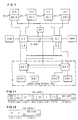
- Each CP has an instruction decoding and execution element (IE) and a buffer control element (BCE) containing a private CP cache, its directory and controls.
- IE instruction decoding and execution element
- BCE buffer control element
- Each BCE accesses a shared main storage (MS) through a storage (or system) controller (SC).
- the MS may instead be a second level (L2) cache (which may be a SIC type) which is shared by all CPs wherein the L2 cache in turn accesses MS; and the operation of such L2 cache will be the same as the MS operation described for this embodiment.
- L2 cache which may be a SIC type
- FIG 2 shows the internals of any BCE shown in Figure 1.
- the BCE includes a four-way set associative cache, its directory, directory replacement selection circuits and other logic associated with each CP of the type previously described in EP-A-51745 except for the novel sharing (SH) flags and their control circuits, of which an embodiment is provided in the subject specification.
- the entire specification of EP-A-51745 is incorporated herein by reference.
- the processor directory in EP-A-51745 is modified to provide a CP cache directory for the subject invention by replacing the prior EX/RO bit position with a novel sharing (SH) bit position in each line entry in the directory as shown in Figure 11 herein.
- SH novel sharing
- each SC in the subject embodiment includes copy directories (CDs) of the same type as described in EP-A-51745 except that each CD in this embodiment is modified by replacing the prior EX/RO bit position with the novel sharing (SH) bit position in each line entry in each CD as shown in Figure 12 herein.
- CDs copy directories
- SH novel sharing
- the subject invention revolves around the controls for the sharing (SH) flags and the change (CH) flags in all cache directories in an MP. These controls are particularly pertinent to store and fetch requests by any CP which fails to find requested data or instructions (both herein called data) in a private CP cache to cause cache misses, to remote CD cross-interrogation, to invalidation of entries in remote CDs and CP directories, and to storing either solely in a CP cache or in both the cache and MS.
- SH sharing
- CH change
- a changed line in a SIC indicates the change has not been made to the corresponding line in MS. Therefore, if a X) hit occurs to a remote SIC changed line, it must be castout to MS before invalidating it so that an updated version of the line is available in MS to all CPs in the MP.
- a store request in this application corresponds to the store interrogate (SI) request in EP-A-51745.
- the ability of the hybrid cache controls to permit the same line to reside in multiple caches until the first store occurs, as in a store-through cache, is particularly important for sharing instructions between CPs.
- LRU replacement selection circuits which select a directory entry location in a selected congruence class for a new line in the cache required by a fetch or store miss.
- a "fetch miss" results in a XI hit of a changed line in a remote cache
- the conflicting line is castout to MS and fetched by the requesting CP cache, but the remote line is not invalidated.
- the line can reside in both caches until after a store is made to either cache copy of the line, at which time a store-through status begins for the copy of the line in the store requesting CP cache, and a XI hit invalidates the copy of the line in every other cache.
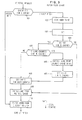
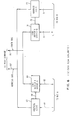
- Figure 3 shows the method steps 101-110 for a fetch request to a local CP cache directory and is self-explanatory for the various conditions, including: fetch hit or miss, XI hit or miss, conflicting remote line change (CH) bit existing states, and setting the sharing (SH) bit states.
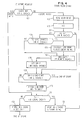
- Figure 4 shows the method steps 121-133 for a store request to a local CP cache directory and also is self-explanatory for the various conditions, including: stored hit or miss, XI hit or miss, conflicting remote line change (CH) bit existing states, and setting the sharing (SH) bit states.
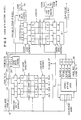
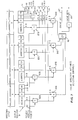
- Each SC in Figure 1 handles cross-interrogation (XI) requests from any CP in the MP for determining if a line requested by any CP is located in some other CP's cache. This is accomplished by cross-interrogating all copy directories (CDs) in all SCs for the other CPs. Each SC has two CDs for the two CPs (called A and B herein) which directly connect to the SC. In Figure 5, a miss by CP A cross-interrogates the copy directory 31 B for CP B, and a miss by CP B cross-interrogates the copy directory 31A for CP A.
- XI cross-interrogation
- the XI request also is sent on the XI bus shown in Figure 1 to the other SC in the manner described in application 81 107 928.4 wherein each CP cache miss is tested in all CDs in all SCs in the MP to determine if the requested line is in any other CD to determine if a Xi hit exists in any other CP cache.
- the line representations in directories 31A and 31 B are shown in Figure 12 and relate to corresponding line representations in the respective BCE private cache directories.
- No change (CH flag) is provided in the SC directories, because the change flag is switched by any CP store request rather than only by a less frequent cache miss and hence the CP caches can perform faster with the CH flags only in the CP directories.
- SC priority circuits 33 determine which of requesting CPs A or B or a remote SC request, respectively provided on lines 41, 42 or 40, will get the next SC cycle to handle a XI request in the manner described in prior application 81 107 928.4.
- Priority circuits 33 respond to one of these requests at a time to provide a SELECT CPU A, SELECT CPU B, or an XI for a remote SC by providing a gating signal on line 43, 44, or 45, respectively.
- Figure 5 shows details for handling a request from CP A or CP B, but does not show detailed circuits for handling the XI request which examines both CDs 31A and 31 B and signal the remote SC if a XI hit is found in either as well as signalling the CP A or CP B having such conflicting line.
- AND gates 34 and 35 are associated with copy directory 31A, and AND gates 37 and 38 are associated with copy directory 31 B.
- gate 38 is activated to provide a gating signal on CP B MS address bus out line 52 to the BCE for the requesting CP directory to have the address of its line location which has a conflicting copy in a remote CP.
- Line 57 also provides an input to the SC command circuits in Figure 8.
- line 57 also provides an input to an AND gate 55 which is conditioned by a CP A MS request on line 41.
- An AND gate 60 operates similarly to turn on the SH flag for a requested line in the directory for CP B when there is a line conflict with a remote CP cache.
- Figure 6 is a SC schematic for illustrating how data flows through the SC between a BCE and MS.
- the CP A address is provided on line 61 to SC address logic network 63 and one line 62 to or from line buffering and gating circuits 64.
- the address logic network 63 provides an address signal to the main storage address bus 67.
- Address gating information is provided on lines 68 to line buffer and gating network 64, which responds by gating the data between lines 62 and data bus 70 to or from main storage.
- CP B provides address information on bus 71 to address logic circuits 73 to address bus 67, and CP B receives or sends data on bus 72 to or from line buffer and gating circuits 74 and logic circuits 73 to main storage data bus 70.
- Figure 7 shows the entry format of pertinent information in the four associative entries in any selected congruence class in an output register 81 or any CP cache directory.
- a cache hit in the congruence class in register 81 then activates one of the input lines to an OR circuit 86 to enable a cache hit line 87. If none of the input lines to OR circuit 86 is activated, a cache miss line 88 is enabled by an inverter receiving no signal from OR circuit 86.
- the CP directories in the BCEs for CPs A and B have identical structure and control circuits.
- the copy directories 31A and 31 B in the SC are also similar in structure to their corresponding CP directories, except that no change (CH) flag is found in the SC directories.
- CH change
- the SC can determine if the requested line is in any of its CDs. If it is not, as indicated by a XI miss, the SC does not signal any CP. If there is a XI hit, then the SC sends an invalidation command to its related CP directory with the directory location of the conflicting line and also sends a conflict signal for the requesting CP's private cache directory.
- Figure 9 shows logic circuits in each BCE in Figure 1 for handling cache requests from the respective CP and determining if the request can be handled in the CP's private cache (i.e. hit) or if a MS line fetch request (i.e. miss) must be sent to the SC, which accesses MS.
- the CH flag is turned on by line 212.
- a fetch hit is controlled by a signal on line 211.
- Lines 216 and 217 provide store and fetch requests to an SC for a line fetch (LF) from MS.
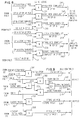
- Figure 8 shows SC to CP command logic circuits for receiving a line fetch (LF) storage request on line 216 or 217 or a store through request on line 214 from Figure 9 to provide an appropriate conflict signal command to the BCE control circuits in Figure 10.
- the BCE control circuits in Figure 10 respond by invalidating the conflicting line in its CP directory after casting out the line if it was changed.
- the circuits in Figure 8 are duplicated in the SC for each CD in the SC.
- Figure 9 for example, is the BCE for CP B, and it sends a store line fetch (LF) request on line 216B to the SC in Figure 9, and the SC signals an XI hit in CP A in another CP (e.g. on line 59, then gate 232 outputs a store request conflict in CP A signal on line 242 to the BCE for CPA.
- LF line fetch
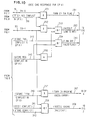
- Figure 10 shows the BCE command response circuits in each CP.
- a conflict signal from the SC to a particular BCE causes the BCE to access its CP directory to examine the status of the line's change (CH) and sharing (SH) flags in AND circuits 252 and 251, respectively.
- Line 268 from OR circuit 258 enables an access to the cache directory when any type of conflict is signalled on line 241, 242 or 243.
- a store conflict is signalled by an output line 264 from the OR circuit 254 to the conflicting cache directory to invalidate the conflicting line. If the CH flag is on for the conflicting line, it is castout to MS via the SC under control of a signal on line 263 from gate 253.
- the store-through request is received by gate 233 or 237 in Figure 5 which detects if the request caused a XI hit in another CP. If so, output line 243 or 247 signals a store-through request conflict to the conflicting CP.
- a store through conflict signal on line 243 passes through OR circuit 254 to turn off the valid flag, for the line in conflicting CP A, and AND gate 60 in Figure 5 sets on the SH flag for the requesting line in CP B.
- the CP When the related CP has completed the XI operations for the conflicting line, the CP signals the SC that the XI operation is complete.
- the flag SH can be controlled by special instructions in the application or system programs to change the operation of the cache system from store-in-cache to store-through and vice versa.
Landscapes
- Engineering & Computer Science (AREA)
- Theoretical Computer Science (AREA)
- Physics & Mathematics (AREA)
- General Engineering & Computer Science (AREA)
- General Physics & Mathematics (AREA)
- Memory System Of A Hierarchy Structure (AREA)
Claims (5)

Applications Claiming Priority (2)
| Application Number | Priority Date | Filing Date | Title |
|---|---|---|---|
| US06/335,971 US4484267A (en) | 1981-12-30 | 1981-12-30 | Cache sharing control in a multiprocessor |
| US335971 | 1981-12-30 |
Publications (3)
| Publication Number | Publication Date |
|---|---|
| EP0082949A2 EP0082949A2 (de) | 1983-07-06 |
| EP0082949A3 EP0082949A3 (en) | 1986-06-11 |
| EP0082949B1 true EP0082949B1 (de) | 1988-08-03 |
Family
ID=23314023
Family Applications (1)
| Application Number | Title | Priority Date | Filing Date |
|---|---|---|---|
| EP82110566A Expired EP0082949B1 (de) | 1981-12-30 | 1982-11-16 | Hybride Cache-Steuerung |
Country Status (4)
| Country | Link |
|---|---|
| US (1) | US4484267A (de) |
| EP (1) | EP0082949B1 (de) |
| JP (1) | JPS6042503B2 (de) |
| DE (1) | DE3278863D1 (de) |
Families Citing this family (58)
| Publication number | Priority date | Publication date | Assignee | Title |
|---|---|---|---|---|
| JPS5856277A (ja) * | 1981-09-29 | 1983-04-02 | Toshiba Corp | 情報処理装置ならびに方法 |
| JPS60138653A (ja) * | 1983-12-27 | 1985-07-23 | Hitachi Ltd | 階層記憶制御方式 |
| US4827401A (en) * | 1984-10-24 | 1989-05-02 | International Business Machines Corporation | Method and apparatus for synchronizing clocks prior to the execution of a flush operation |
| US4847804A (en) * | 1985-02-05 | 1989-07-11 | Digital Equipment Corporation | Apparatus and method for data copy consistency in a multi-cache data processing unit |
| US4755930A (en) * | 1985-06-27 | 1988-07-05 | Encore Computer Corporation | Hierarchical cache memory system and method |
| US4775955A (en) * | 1985-10-30 | 1988-10-04 | International Business Machines Corporation | Cache coherence mechanism based on locking |
| US4797814A (en) * | 1986-05-01 | 1989-01-10 | International Business Machines Corporation | Variable address mode cache |
| US4853846A (en) * | 1986-07-29 | 1989-08-01 | Intel Corporation | Bus expander with logic for virtualizing single cache control into dual channels with separate directories and prefetch for different processors |
| US4843542A (en) * | 1986-11-12 | 1989-06-27 | Xerox Corporation | Virtual memory cache for use in multi-processing systems |
| US4887204A (en) * | 1987-02-13 | 1989-12-12 | International Business Machines Corporation | System and method for accessing remote files in a distributed networking environment |
| JPS63257853A (ja) * | 1987-04-03 | 1988-10-25 | インターナシヨナル・ビジネス・マシーンズ・コーポレーシヨン | キヤツシユ・メモリ・システム |
| US4991090A (en) * | 1987-05-18 | 1991-02-05 | International Business Machines Corporation | Posting out-of-sequence fetches |
| US4959777A (en) * | 1987-07-27 | 1990-09-25 | Motorola Computer X | Write-shared cache circuit for multiprocessor system |
| US4974153A (en) * | 1987-09-04 | 1990-11-27 | Digital Equipment Corporation | Repeater interlock scheme for transactions between two buses including transaction and interlock buffers |
| ATE109910T1 (de) * | 1988-01-20 | 1994-08-15 | Advanced Micro Devices Inc | Organisation eines integrierten cachespeichers zur flexiblen anwendung zur unterstützung von multiprozessor-operationen. |
| DE68926466T2 (de) * | 1988-01-20 | 1996-10-17 | Advanced Micro Devices Inc | Integrierte Cachespeichereinheit |
| US5023776A (en) * | 1988-02-22 | 1991-06-11 | International Business Machines Corp. | Store queue for a tightly coupled multiple processor configuration with two-level cache buffer storage |
| GB8808353D0 (en) * | 1988-04-09 | 1988-05-11 | Int Computers Ltd | Data processing system |
| EP0343567A3 (de) * | 1988-05-25 | 1991-01-09 | Hitachi, Ltd. | Mehrprozessoranordnung und Cache-Speichervorrichtung zur Verwendung in dieser Anordnung |
| EP0348628A3 (de) * | 1988-06-28 | 1991-01-02 | International Business Machines Corporation | Cache-Speicheranordnung |
| US5317716A (en) * | 1988-08-16 | 1994-05-31 | International Business Machines Corporation | Multiple caches using state information indicating if cache line was previously modified and type of access rights granted to assign access rights to cache line |
| US5043886A (en) * | 1988-09-16 | 1991-08-27 | Digital Equipment Corporation | Load/store with write-intent for write-back caches |
| US5016168A (en) * | 1988-12-23 | 1991-05-14 | International Business Machines Corporation | Method for storing into non-exclusive cache lines in multiprocessor systems |
| US5202972A (en) * | 1988-12-29 | 1993-04-13 | International Business Machines Corporation | Store buffer apparatus in a multiprocessor system |
| EP0377970B1 (de) * | 1989-01-13 | 1995-08-16 | International Business Machines Corporation | Ein-/Ausgabecachespeicherung |
| US5404476A (en) * | 1989-02-10 | 1995-04-04 | Nec Corporation | Multiprocessing system having a single translation lookaside buffer with reduced processor overhead |
| US5130922A (en) * | 1989-05-17 | 1992-07-14 | International Business Machines Corporation | Multiprocessor cache memory system using temporary access states and method for operating such a memory |
| JPH0340046A (ja) * | 1989-07-06 | 1991-02-20 | Hitachi Ltd | キャッシュメモリ制御方式および情報処理装置 |
| US5230070A (en) * | 1989-09-08 | 1993-07-20 | International Business Machines Corporation | Access authorization table for multi-processor caches |
| JP3102495B2 (ja) * | 1989-12-28 | 2000-10-23 | 株式会社日立製作所 | 仮想記憶管理方法 |
| US5206941A (en) * | 1990-01-22 | 1993-04-27 | International Business Machines Corporation | Fast store-through cache memory |
| JPH03117506U (de) * | 1990-03-15 | 1991-12-04 | ||
| US5197139A (en) * | 1990-04-05 | 1993-03-23 | International Business Machines Corporation | Cache management for multi-processor systems utilizing bulk cross-invalidate |
| US5014195A (en) * | 1990-05-10 | 1991-05-07 | Digital Equipment Corporation, Inc. | Configurable set associative cache with decoded data element enable lines |
| US5291442A (en) * | 1990-10-31 | 1994-03-01 | International Business Machines Corporation | Method and apparatus for dynamic cache line sectoring in multiprocessor systems |
| US5313609A (en) * | 1991-05-23 | 1994-05-17 | International Business Machines Corporation | Optimum write-back strategy for directory-based cache coherence protocols |
| GB2260429B (en) * | 1991-10-11 | 1995-05-24 | Intel Corp | Versatile cache memory |
| US5301298A (en) | 1991-10-11 | 1994-04-05 | Intel Corporation | Processor for multiple cache coherent protocols |
| JP3309425B2 (ja) * | 1992-05-22 | 2002-07-29 | 松下電器産業株式会社 | キャッシュ制御装置 |
| US5809525A (en) * | 1993-09-17 | 1998-09-15 | International Business Machines Corporation | Multi-level computer cache system providing plural cache controllers associated with memory address ranges and having cache directories |
| US5590309A (en) * | 1994-04-01 | 1996-12-31 | International Business Machines Corporation | Storage protection cache and backing storage having system control element data cache pipeline and storage protection bits in a stack array with a stack directory for the stack array |
| US5539895A (en) * | 1994-05-12 | 1996-07-23 | International Business Machines Corporation | Hierarchical computer cache system |
| JP2634147B2 (ja) * | 1994-09-16 | 1997-07-23 | インターナショナル・ビジネス・マシーンズ・コーポレイション | コンピュータシステム、キャッシュヒットの判定方法 |
| US5895496A (en) * | 1994-11-18 | 1999-04-20 | Apple Computer, Inc. | System for an method of efficiently controlling memory accesses in a multiprocessor computer system |
| USRE38514E1 (en) | 1994-11-18 | 2004-05-11 | Apple Computer, Inc. | System for and method of efficiently controlling memory accesses in a multiprocessor computer system |
| US5544344A (en) * | 1994-12-06 | 1996-08-06 | Digital Equipment Corporation | Apparatus for caching smram in an intel processor based computer system employing system management mode |
| US5655103A (en) * | 1995-02-13 | 1997-08-05 | International Business Machines Corporation | System and method for handling stale data in a multiprocessor system |
| EP0882266A1 (de) * | 1996-02-20 | 1998-12-09 | Intergraph Corporation | Hochverfügbarer superserver |
| US7283991B1 (en) * | 1999-03-11 | 2007-10-16 | Microsoft Corporation | Caching system for path search optimization |
| JP2003076592A (ja) * | 2001-09-04 | 2003-03-14 | Hitachi Ltd | データ格納システム |
| US6792512B2 (en) * | 2002-08-06 | 2004-09-14 | International Business Machines Corporation | Method and system for organizing coherence directories in shared memory systems |
| US7991966B2 (en) * | 2004-12-29 | 2011-08-02 | Intel Corporation | Efficient usage of last level caches in a MCMP system using application level configuration |
| US8683139B2 (en) * | 2006-10-31 | 2014-03-25 | Hewlett-Packard Development Company, L.P. | Cache and method for cache bypass functionality |
| JP4888839B2 (ja) | 2008-10-03 | 2012-02-29 | 日本電気株式会社 | キャッシュメモリを備えるベクトル計算機システム、及びその動作方法 |
| CN101751245B (zh) * | 2010-01-18 | 2013-05-15 | 龙芯中科技术有限公司 | 基于访存历史学习的处理器Cache写失效处理方法 |
| US8516197B2 (en) * | 2011-02-11 | 2013-08-20 | International Business Machines Corporation | Write-through cache optimized for dependence-free parallel regions |
| US9086977B2 (en) | 2011-04-19 | 2015-07-21 | Freescale Semiconductor, Inc. | Cache memory with dynamic lockstep support |
| US9208036B2 (en) | 2011-04-19 | 2015-12-08 | Freescale Semiconductor, Inc. | Dynamic lockstep cache memory replacement logic |
Family Cites Families (8)
| Publication number | Priority date | Publication date | Assignee | Title |
|---|---|---|---|---|
| US4142234A (en) * | 1977-11-28 | 1979-02-27 | International Business Machines Corporation | Bias filter memory for filtering out unnecessary interrogations of cache directories in a multiprocessor system |
| US4399506A (en) * | 1980-10-06 | 1983-08-16 | International Business Machines Corporation | Store-in-cache processor means for clearing main storage |
| US4394731A (en) * | 1980-11-10 | 1983-07-19 | International Business Machines Corporation | Cache storage line shareability control for a multiprocessor system |
| US4400770A (en) * | 1980-11-10 | 1983-08-23 | International Business Machines Corporation | Cache synonym detection and handling means |
| DE3177181D1 (de) * | 1980-11-10 | 1990-06-21 | Ibm | Anordnung zur erkennung und verarbeitung von synonymen in cache-speichern. |
| US4410944A (en) * | 1981-03-24 | 1983-10-18 | Burroughs Corporation | Apparatus and method for maintaining cache memory integrity in a shared memory environment |
| US4445174A (en) * | 1981-03-31 | 1984-04-24 | International Business Machines Corporation | Multiprocessing system including a shared cache |
| US4410946A (en) * | 1981-06-15 | 1983-10-18 | International Business Machines Corporation | Cache extension to processor local storage |
-
1981
- 1981-12-30 US US06/335,971 patent/US4484267A/en not_active Expired - Lifetime
-
1982
- 1982-11-16 DE DE8282110566T patent/DE3278863D1/de not_active Expired
- 1982-11-16 EP EP82110566A patent/EP0082949B1/de not_active Expired
- 1982-11-17 JP JP57200528A patent/JPS6042503B2/ja not_active Expired
Also Published As
| Publication number | Publication date |
|---|---|
| EP0082949A3 (en) | 1986-06-11 |
| US4484267A (en) | 1984-11-20 |
| EP0082949A2 (de) | 1983-07-06 |
| DE3278863D1 (en) | 1988-09-08 |
| JPS6042503B2 (ja) | 1985-09-24 |
| JPS58118083A (ja) | 1983-07-13 |
Similar Documents
| Publication | Publication Date | Title |
|---|---|---|
| US4484267A (en) | Cache sharing control in a multiprocessor | |
| EP0088239B1 (de) | Mehrprozessor-Pufferspeicher-Ersatz unter Prozesssteuerung | |
| EP0062165B1 (de) | Mehrprozessoren mit privaten und gemeinsam benutzten Pufferspeichern | |
| US5119485A (en) | Method for data bus snooping in a data processing system by selective concurrent read and invalidate cache operation | |
| JP3269967B2 (ja) | キャッシュコヒーレンシ制御方法、および、これを用いたマルチプロセッサシステム | |
| US6839810B2 (en) | Consistency control device merging updated memory blocks | |
| US5740400A (en) | Reducing cache snooping overhead in a multilevel cache system with multiple bus masters and a shared level two cache by using an inclusion field | |
| EP0397994B1 (de) | Multiprozessor-Cachespeichersystem | |
| US6718839B2 (en) | Method and apparatus for facilitating speculative loads in a multiprocessor system | |
| US8301843B2 (en) | Data cache block zero implementation | |
| KR19990072600A (ko) | 재실행스누프히트시의순방향진행수행방법및시스템 | |
| JPH04227552A (ja) | ストアスルーキャッシュ管理システム | |
| KR19980079663A (ko) | Smp 버스의 최근 판독 상태에서의 캐시 라인들의 공유 개입 방법 | |
| EP1399823A2 (de) | Verfahren zur verwendung eines l2-verzeichnisses, um spekulatives laden in einem mehrprozessorsystem zu ermöglichen | |
| US5263144A (en) | Method and apparatus for sharing data between processors in a computer system | |
| US10628312B2 (en) | Producer/consumer paced data transfer within a data processing system having a cache which implements different cache coherency protocols | |
| US5987544A (en) | System interface protocol with optional module cache | |
| JPH11506850A (ja) | 多重レベルキャッシュシステムにおけるキャッシュ・スヌーピング・オーバヘッドを減少するための方法および装置 | |
| CA2048473C (en) | Data processor for maintaining coherency of cache memory data | |
| US7496715B1 (en) | Programmable cache management system and method | |
| JPH0467242A (ja) | プロセッサおよびそのキャッシュメモリ制御方法 | |
| JP2007533014A (ja) | ライトバックキャッシュにおいてスヌーププッシュ処理やスヌープキル処理が同時発生しているときのライトバック処理をキャンセルするためのシステムおよび方法 | |
| US5636365A (en) | Hierarchical buffer memories for selectively controlling data coherence including coherence control request means | |
| JPH05100952A (ja) | データ処理装置 | |
| JPH03230238A (ja) | キャッシュメモリ制御方式 |
Legal Events
| Date | Code | Title | Description |
|---|---|---|---|
| PUAI | Public reference made under article 153(3) epc to a published international application that has entered the european phase |
Free format text: ORIGINAL CODE: 0009012 |
|
| AK | Designated contracting states |
Designated state(s): DE FR GB |
|
| 17P | Request for examination filed |
Effective date: 19831021 |
|
| PUAL | Search report despatched |
Free format text: ORIGINAL CODE: 0009013 |
|
| AK | Designated contracting states |
Kind code of ref document: A3 Designated state(s): DE FR GB |
|
| 17Q | First examination report despatched |
Effective date: 19870216 |
|
| GRAA | (expected) grant |
Free format text: ORIGINAL CODE: 0009210 |
|
| AK | Designated contracting states |
Kind code of ref document: B1 Designated state(s): DE FR GB |
|
| REF | Corresponds to: |
Ref document number: 3278863 Country of ref document: DE Date of ref document: 19880908 |
|
| EN | Fr: translation not filed | ||
| ET | Fr: translation filed |
Free format text: BO 52/88 PAGE 189: ANNULATION |
|
| PLBE | No opposition filed within time limit |
Free format text: ORIGINAL CODE: 0009261 |
|
| STAA | Information on the status of an ep patent application or granted ep patent |
Free format text: STATUS: NO OPPOSITION FILED WITHIN TIME LIMIT |
|
| 26N | No opposition filed | ||
| PGFP | Annual fee paid to national office [announced via postgrant information from national office to epo] |
Ref country code: GB Payment date: 20011105 Year of fee payment: 20 |
|
| PGFP | Annual fee paid to national office [announced via postgrant information from national office to epo] |
Ref country code: FR Payment date: 20011116 Year of fee payment: 20 |
|
| PGFP | Annual fee paid to national office [announced via postgrant information from national office to epo] |
Ref country code: DE Payment date: 20011122 Year of fee payment: 20 |
|
| REG | Reference to a national code |
Ref country code: GB Ref legal event code: IF02 |
|
| PG25 | Lapsed in a contracting state [announced via postgrant information from national office to epo] |
Ref country code: GB Free format text: LAPSE BECAUSE OF EXPIRATION OF PROTECTION Effective date: 20021115 |
|
| REG | Reference to a national code |
Ref country code: GB Ref legal event code: PE20 Effective date: 20021115 |