EP0076163A2 - Verfahren zur Herstellung von metallenem Gallium - Google Patents
Verfahren zur Herstellung von metallenem Gallium Download PDFInfo
- Publication number
- EP0076163A2 EP0076163A2 EP82305166A EP82305166A EP0076163A2 EP 0076163 A2 EP0076163 A2 EP 0076163A2 EP 82305166 A EP82305166 A EP 82305166A EP 82305166 A EP82305166 A EP 82305166A EP 0076163 A2 EP0076163 A2 EP 0076163A2
- Authority
- EP
- European Patent Office
- Prior art keywords
- alkali metal
- solution
- aluminate solution
- precipitate
- liquor
- Prior art date
- Legal status (The legal status is an assumption and is not a legal conclusion. Google has not performed a legal analysis and makes no representation as to the accuracy of the status listed.)
- Granted
Links
Images
Classifications
-
- C—CHEMISTRY; METALLURGY
- C22—METALLURGY; FERROUS OR NON-FERROUS ALLOYS; TREATMENT OF ALLOYS OR NON-FERROUS METALS
- C22B—PRODUCTION AND REFINING OF METALS; PRETREATMENT OF RAW MATERIALS
- C22B58/00—Obtaining gallium or indium
Definitions
- the present invention realtes to a process for producing metallic gallium in high yield in a very economical and simple manner from an alkali (e.g. sodium) aluminate solution which is recyclically used in production of alumina from aluminum ores (e.g. bauxite) by the Bayer process or an improved process thereof.
- alkali e.g. sodium
- aluminum ores e.g. bauxite
- Gallium is widely distributed in the earth crust, but there is no specific ore therefor.
- Gallium resembles aluminum in its properties, dissolves together with alumina in production of alumina according to alkali digesting of bauxite by the Bayer process, and is accumulated in the circulating alkali aluminate solution in a concentration of 0.1 - 0.3 g/t in general during the recyclic use of the alkali aluminate solution. Therefore, production of metallic gallium in an industrial scale is now conducted mainly by using this Bayer liquor.
- An alkali aluminate solution separated at the aluminum hydroxide precipitation step of the Bayer process contains in general 50 - 500 mg/t vanadium, 50 - 500 mg/l phosphorus and 5 - 30 g/l organic carbon as impurities.
- these impurities interupt its electrolytical deposition, and as the result electricity (power) requirement is extremely increased or a gallium does not deposit at all. Therefore, conventional production of metallic gallium from an alkali aluminate solution containing gallium has been conducted according to the following methods:
- gallium is once converted to other compound, and the compound is treated with an alkali solution and then electrolysed.
- the resulting circulating alkali aluminate solution is usable as it is as an electrolyte for recovering gallium without making any specific treatment, and further the solution after the electrolysis treatment is recyclically usable in the Bayer process without making any specific treatment as an alkali aluminate solution for extracting alumina from bauxite, and have completed the present invention.
- the present invention relates to a process for producing metallic gallium from a circulating alkali aluminate solution in the Bayer process containing gallium, which comprises subjecting the alkali aluminate solution to electrolysis which solution is obtained (1) by cooling an alkali aluminate solution after-aluminum hydroxide separation step in the Bayer process in the presence or absence of at least one, as a seed, of alkali salts of an element selected from vanadium and phosphorus, or complexes containing the alkali salt to precipitate crystals of impurities containing vanadium, phosphorus, etc.
- the present invention is described in more detail below as to the case using a sodium aluminate solution as the alkali aluminate solution.
- the same procedure is applicable to the case using other alkali, e.g. potassium aluminate solution.
- a circulating sodium aluminate solution used in the present invention is such a solution that is obtained after precipitation of aluminum hydroxide in the Bayer process (the solution will be hereinafter referred to as a spent liquor) and contains impurities such as organic matters and inorganic matters, e.g. phosphorus, vanadium, etc., preferably, a circulating sodium aluminate solution obtained after after the precipitation and subsequent evaporation step where the sodium aluminate solution after passing through the precipitation is concentrated, is used as the circulating sodium aluminate solution.
- the spent liquor is first cooled in the presence or absence of at least one, as a seed, of sodium salts of an element selected from vanadium and phosphorus, or complexes containing the sodium salt to precipitate crystals of inorganic impurities in the liquor, which crystals are then removed.
- Equilibrium concentration of impurities in a spent liquor decreases in proportion to increase of sodium concentration. Therefore, the spent liquor after precipitation and separation of aluminum hydroxide is evaporated and cooled to make the sodium concentration in terms of Na 2 0 to 100 - 400 g/i, and the resulting spent liquor is cooled in the presence or absence of the seed crystals to precipitate impurities such as organic matters and inorganic matters, e.g. vanadium and phosphorus in the solution, which impurities are then removed.
- precipitation of the impurities is conducted in general at a temperature of 0° - 75°C, preferably 10° - 60°C.
- Precipitation time depends upon the presence of a seed and the seed amount, and the spent liquor is kept to stir for one day or more, preferably 2 - 4 days in case of the absence of the seed, and for 10 minutes or more in general, preferably 30 minutes - 24 hours in case of the presence of the seed.
- the amount is in general about 30 weight % or more based on that of vanadium + phosphorus, preferably about 50 - 50,000 weight %. It is undesirable because of a smaller effect as a seed that the amount of the sodium salt, the complex or a mixture thereof is less than 30 weight %. Upper limit of the amount is determined in consideration of economics.
- the sodium salt or complex or a mixture thereof is added as a solution to the spent liquor, it is desirable that the spent liquor after the addition has a supersaturation degree of the impurities: of 0.5 or more, preferably 1 or more.
- concentration of the impurities in the sodium aluminate solution is lowered approximately to its equilibrium concentration, and impurities are precipitated on the seed crystals in case of a seed being used, or precipitated to form new crystals in case of no use of a seed.
- These crystals of the impurities are separated from the aluminate solution by a conventional solid-liquid separation technique such as settling, filtration and centrifugation.
- a part of crystals obtained by the solid-liquid separation, after washing the surface, is recyclically usable as a seed for precipitating impurities.
- the amount of inorganic impurities such as vanadium and phosphorus in the spent liquor is adjusted to 450 mg/i or less in general, preferably 200 mg/i or less.
- the spent liquor after removal of the inorganic impurities is then subjected to removal of organic matters composed mainly of humic matters contained in the solution by oxidation-decomposition.
- a conventional oxidation-decomposition method such as a method using an oxidizing agent, e.g. potassium dichromate, potassium permanganate and hydrogen peroxide is applicable to the oxidation-decomposition of the organic matters without specific limitation, but from the viewpoint of economics and the fact that the sodium aluminate solution after the treatment is recycled in the Bayer step, the following wet oxidation treatment is preferable.
- the procedure (2) which has a high removal efficiency of the organic matters and an effect that in a step of recovering copper ion from the solution other impurities are removed at the same time, is appropriate for producing gallium in good efficiency.
- the aluminate solution is introduced in the step of the wet oxidation treatment, and subjected to oxidation in the presence of copper ion at a temperature of 180° - 350°C under a pressure of 20 - 150 kg/cm 2 under such a condition as to keep the solution at least partially in a liquid state.
- the amount of copper ion made to exist in the solution is 100 mg/l or more in general, preferably 300 - 5000 mg/k, and when the amount is lower than 100 mg/l, the effect by the addition is small and it takes a long time in the treatment.
- cupric salts such as cupric sulfate, cupric nitrate and cupric chloride, cupric sulfide which is usually water-insoluble but becomes watersoluble in an atmosphere of the wet oxidation treatment, etc.
- the temperature of the wet oxidation treatment is below 180°C, because the decomposition of the organic matters in the liquor to be treated is not adequate or it takes a long time in the treatment.
- the temperature is more than 350°C, because corrosion of the apparatus is considerable in cooperation with the liquor to be treated which is strongly alkaline.
- Molecular oxygen or a molecular oxygen-containing gas is used as a gas for the oxidation treatment, and above all air is preferable due to its economics.
- the amount of the gas to be supplied is a theoretical amount necessary for oxidizing almost all the amount of the organic matters contained in the liquor to be treated and making them harmless, or more.
- the compound offering copper ion remains in the sodium aluminate solution after the wet oxidation treatment.
- electrolytical efficiency of gallium deposition is extremely lowered.
- copper compounds are coprecipitated with aluminum hydroxide at the precipitation step of aluminum hydroxide to lower purity of the product aluminum hydroxide, at the same time resulting in loss of expensive copper ion-offering compound. Therefore, it is preferable to place a step for recovering the copper ion-offering compound.
- a compound which reacts with copper ion in the sodium aluminate solution after the oxidation treatment to form an insoluble compound, is added to the solution.
- a compound is exemplified by sulfides such as sodium sulfide and hydrogen sulfide, and the amount to be added is an amount stoichiometrical to copper ion supplied for the oxidation treatment, or more, preferably 2 to 3 times the stoichiometrical amount.
- the sulfide reacts with copper ion to form and precipitate an insoluble substance consisting mainly of copper sulfide.
- the precipitate is separated by a conventional solid-liquid separation method such as settling, filtration and centrifugation.
- the separated precipitate can be reused either after being subjected to oxidation in an oxidation step or by directly introducing it in the wet oxidation treatment step.
- the sodium aluminate solution after the oxidation decomposition and solid-liquid separation is usable as it is for the electrolysis treatment, but it is desirable that the solution is subjected to causticization treatment before the electrolysis. That is, carbonate and sulfate are formed and gradually accumulated in the liquor during the wet oxidation, and they lower the efficiency of gallium electrolysis.
- the liquor when the liquor is recycled to the Bayer process as a circulating sodium aluminate solution, the accumulated carbonate and sulfate make the rate of aluminum hydroxide precipitation lower. Therefore, it is desirable to contact the aluminate solution after the oxidation-decomposition and solid-liquid separation with an alkaline earth material such as calcium hydroxide to precipitate carbonate and sulfate as insoluble salts such as calcium carbonate and calcium sulfate respectively and at the same time regenerate sodium hydroxide in the solution, that is to conduct causticization treatment.
- an alkaline earth material such as calcium hydroxide
- the sodium aluminate solution thus obtained in a purified state containes 0.1 - 0.4 g/l gallium, 150 mg/L or less of vanadium, 100 mg/i or less of phosphorus, 15 g/t or less of organic carbon and trace of iron, etc., and usable as an electrolyte for recovering gallium by electrolysis.
- the sodium aluminate solution thus purified is then subjected to the electrolytic treatment for recovery of gallium.
- the electrolytic treatment in proportion as gallium concentration in the aluminate solution as an electrolyte is higher, the current efficiency is improved and the power consumption is lowered, and therefore, it is desirable to concentrate the solution.
- the concentration is too high, viscosity of the electrolyte is raised to make the handling difficult.
- the causticization treatment in the previous step is not conducted, or when the treatment is unadequate, sodium carbonate is in a supersaturation state due to the too high concentration and is precipitated, and separation thereof is difficult. Therefore, the evaporation ratio of 1 to 4 , preferably 1 to 3 times, in other words to make caustic Na 2 0 concentration after separation of sodium carbonate after evaporation to be 400 g/l or less, is appropriate from the practical viewpoint.
- the electrolysis is conducted at the electrolyte temperature of 30° - 80°C, a current density of 0 . 0 1 - 1 A/cm 2 and a current concentration of 1 - 100 A/ L using stainless steel or other known solid metal as an electrode. Further, it is preferable from the viewpoint of prevention of explosion due to mixing of oxygen and hydrogen and prevention of disruption of oxidation-reduction cycle by inhibitors during the electrolytic deposition of gallium to separate an anode and a cathode by means of a diaphragm made of unglazed pottery, porous ceramic, porous organic polymer, etc.
- a rate of electrolytic deposition of gallium is raised and current efficiency is improved by adding Zn, Sn, Pb, etc. to make its concentration lower than that of gallium prior to the start of the electrolysis.
- the spent liquor after the electrolytic treatment can be recycled to the Bayer process as a circulating sodium aluminate solution.
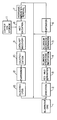
- the single Figure is a block diagram showing a process for production of gallium by electrolysis according to the present invention.
- each numeral has the folowing meaning:
- the aluminate solution is introduced to the catalyst recovery step 9, where a sulfide is added to the solution to precipitate cupric ion in the solution as cupric sulfide.
- the precipitate is removed and the resulting aluminate solution is introduced to the causticization step 10.
- the cupric sulfide as the precipitate is, if necessary, introduced to the wet oxidation step 8 for reuse.
- Caustic alkaline earth materials such as calcium hydroxide is added to the spent liquor at the causticization step 10, whereby the carbonate and sulfate in the liquor are converted to insoluble matters such as calcium carbonate and calcium sulfate.
- the filtrate is introduced to the evaporation step 12 where gallium concentration is more raised, and then to the electrolytic deposition step 13 where metallic gallium is produced.
- the sodium aluminate solution is recycled to the Bayer process as a circulating sodium aluminate solution (spent liquor).
- the oxidation step 8 it is preferable to conduct the evaporation step 12 from the viewpoint of energy economy.
- gallium can be produced in good efficiency without making any special treatment except that certain purification methods are only combined among various known purification methods of a circulating sodium aluminate solution conducted for the purpose of increase of purity and precipitation efficiency of the formed aluminum hydroxide.
- the aluminate solution after gallium extraction can be recycled to the Bayer process as a spent liquor.
- the present invention has a great industrial significance.
- the concentration of organic matters is shown in terms of carbon content by the elementary analysis.
- a spent liquor after the evaporation step of the Bayer process containing 161 g/k Na 2 0, 68 g/l A1 2 0 3 , 0.36 g/l V, 0.17 g/l P and 19.4 g/l organic matters was used in this example.
- the liquor was treated as follows and subjected to electrolysis using stainless steel as a cathode under a current density of 0.1 A/ cm 2 at a temperature 50°C for 10 hours. The results are shown in Table.
Landscapes
- Engineering & Computer Science (AREA)
- Chemical & Material Sciences (AREA)
- Manufacturing & Machinery (AREA)
- Materials Engineering (AREA)
- Mechanical Engineering (AREA)
- Metallurgy (AREA)
- Organic Chemistry (AREA)
- Electrolytic Production Of Metals (AREA)
- Manufacture And Refinement Of Metals (AREA)
Applications Claiming Priority (2)
| Application Number | Priority Date | Filing Date | Title |
|---|---|---|---|
| JP56156467A JPS5858239A (ja) | 1981-09-30 | 1981-09-30 | 金属ガリウムの製造方法 |
| JP156467/81 | 1981-09-30 |
Publications (3)
| Publication Number | Publication Date |
|---|---|
| EP0076163A2 true EP0076163A2 (de) | 1983-04-06 |
| EP0076163A3 EP0076163A3 (en) | 1983-11-16 |
| EP0076163B1 EP0076163B1 (de) | 1987-07-22 |
Family
ID=15628379
Family Applications (1)
| Application Number | Title | Priority Date | Filing Date |
|---|---|---|---|
| EP82305166A Expired EP0076163B1 (de) | 1981-09-30 | 1982-09-29 | Verfahren zur Herstellung von metallenem Gallium |
Country Status (6)
| Country | Link |
|---|---|
| US (1) | US4421615A (de) |
| EP (1) | EP0076163B1 (de) |
| JP (1) | JPS5858239A (de) |
| AU (1) | AU551935B2 (de) |
| CA (1) | CA1212077A (de) |
| DE (1) | DE3276824D1 (de) |
Families Citing this family (7)
| Publication number | Priority date | Publication date | Assignee | Title |
|---|---|---|---|---|
| JPS62153120A (ja) * | 1985-09-13 | 1987-07-08 | Sumitomo Metal Mining Co Ltd | 三塩化ガリウムの製造方法 |
| CN100383289C (zh) * | 2005-12-22 | 2008-04-23 | 中国铝业股份有限公司 | 金属镓电解生产中电解原液的脱钒方法 |
| JP4961603B2 (ja) * | 2006-07-14 | 2012-06-27 | Dowaメタルマイン株式会社 | ガリウム含有溶液の処理方法 |
| CN101864525A (zh) * | 2010-04-27 | 2010-10-20 | 中国神华能源股份有限公司 | 一种由粉煤灰提取镓的方法 |
| CN101838738A (zh) * | 2010-04-27 | 2010-09-22 | 中国神华能源股份有限公司 | 一种由粉煤灰提取镓的方法 |
| CN116282102B (zh) * | 2022-11-29 | 2024-11-08 | 山西华兴铝业有限公司 | 一种有机物脱除流程中添加种子的方法 |
| CN116732358A (zh) * | 2022-12-02 | 2023-09-12 | 西安建筑科技大学 | 一种对拜耳法赤泥全资源回收利用的方法 |
Family Cites Families (9)
| Publication number | Priority date | Publication date | Assignee | Title |
|---|---|---|---|---|
| US2582377A (en) * | 1947-04-11 | 1952-01-15 | Aluminum Co Of America | Recovery of gallium from alkali metal aluminate solutions |
| US2582378A (en) * | 1947-09-17 | 1952-01-15 | Aluminum Co Of America | Process of producing gallium |
| US2793179A (en) * | 1955-06-13 | 1957-05-21 | Ind De L Aluminium Sa | Method of recovering gallium from an alkali aluminate lye |
| US3468773A (en) * | 1966-08-09 | 1969-09-23 | Michal Ryczek | Method of obtaining metallic gallium from combustion gases resulting from any kind of black or brown coal combustion |
| US3988150A (en) * | 1975-10-03 | 1976-10-26 | Elena Leonidovna Shalavina | Process for extraction of gallium from sodium aluminate liquors |
| SU734305A1 (ru) * | 1976-12-22 | 1980-05-15 | Государственный Ордена Октябрьской Революции Научно-Исследовательский И Проектный Институт Редкометаллической Промышленности "Гиредмет" | Способ переработки алюминато-щелочных растворов |
| SU737488A1 (ru) * | 1976-12-22 | 1980-05-30 | Всесоюзный научно-исследовательский и проектный институт алюминиевой, магниевой и электродной промышленности | Способ переработки алюминатно- щелочных растворов |
| US4094753A (en) * | 1977-06-01 | 1978-06-13 | Cominco Ltd. | Recovery of gallium from gallium compounds |
| US4362606A (en) * | 1980-11-06 | 1982-12-07 | Magyar Aluminiumipari Troszt | Process for simultaneous recovery of vanadium, molybdenum and gallium from alumina factory aluminate liquors |
-
1981
- 1981-09-30 JP JP56156467A patent/JPS5858239A/ja active Granted
-
1982
- 1982-09-23 US US06/421,838 patent/US4421615A/en not_active Expired - Lifetime
- 1982-09-27 AU AU88741/82A patent/AU551935B2/en not_active Ceased
- 1982-09-29 CA CA000412496A patent/CA1212077A/en not_active Expired
- 1982-09-29 EP EP82305166A patent/EP0076163B1/de not_active Expired
- 1982-09-29 DE DE8282305166T patent/DE3276824D1/de not_active Expired
Also Published As
| Publication number | Publication date |
|---|---|
| AU8874182A (en) | 1983-04-14 |
| EP0076163A3 (en) | 1983-11-16 |
| DE3276824D1 (en) | 1987-08-27 |
| EP0076163B1 (de) | 1987-07-22 |
| CA1212077A (en) | 1986-09-30 |
| AU551935B2 (en) | 1986-05-15 |
| JPS5858239A (ja) | 1983-04-06 |
| US4421615A (en) | 1983-12-20 |
| JPS6256215B2 (de) | 1987-11-25 |
Similar Documents
| Publication | Publication Date | Title |
|---|---|---|
| US4215094A (en) | Method for the removal of organic substances from alkali metal aluminate solution | |
| EP1037854B1 (de) | Verfahren zur reinigung von lithiumcarbonat | |
| US4150976A (en) | Method for the recovery of metallic copper | |
| US3973949A (en) | Zinc recovery by chlorination leach | |
| US4094753A (en) | Recovery of gallium from gallium compounds | |
| US3752745A (en) | Recovery of metal values from ocean floor nodules | |
| US4421615A (en) | Process for producing metallic gallium | |
| US4124459A (en) | Process for removing mercury from brine sludges | |
| CA1113725A (en) | Process for extracting uranium from its ores by using alkaline earth carbonates and bicarbonates solutions in the presence of carbon dioxide | |
| US4654131A (en) | Recovery of tungsten valves from alkaline solutions | |
| US4152227A (en) | Method for extraction of gallium from aluminate-alkaline solutions in the production of alumina from aluminum-containing ores | |
| JPS6318026A (ja) | ケイ素、チタン、ジルコニウム又はウランの製法 | |
| US4135917A (en) | Process for recovering gallium from alkali aluminate solutions resulting from treatment of aluminum-containing ores | |
| US3980536A (en) | Process for producing magnesium metal from magnesium chloride brines | |
| US4061551A (en) | Process for extraction of gallium from alkaline gallium-containing solutions | |
| US6086744A (en) | Production of electrolytic copper from dilute solutions contaminated by other metals | |
| EP0039837B1 (de) | Verfahren zur Oxydation von Ferro-Ionen zu Ferri-Ionen in sulfatischen Auslaugelösungen | |
| US3914163A (en) | Recovery of metal and sulfate values from electrochemical mining electrolytes | |
| US4938852A (en) | Recovery of europium (II) values by electrolysis | |
| JPS6035415B2 (ja) | 銅および砒素の分離方法 | |
| US3843498A (en) | Recovery of aluminum fluoride | |
| US11691888B2 (en) | Process for the preparation of high purity alumina | |
| JPS59213622A (ja) | ガリウムの回収法 | |
| US3122491A (en) | Separating iron from aqueous aluminum salt solutions | |
| CA1105265A (en) | Method for the removal of organic substances from alkali metal aluminate solution |
Legal Events
| Date | Code | Title | Description |
|---|---|---|---|
| PUAI | Public reference made under article 153(3) epc to a published international application that has entered the european phase |
Free format text: ORIGINAL CODE: 0009012 |
|
| AK | Designated contracting states |
Designated state(s): DE FR GB IT |
|
| PUAL | Search report despatched |
Free format text: ORIGINAL CODE: 0009013 |
|
| AK | Designated contracting states |
Designated state(s): DE FR GB IT |
|
| 17P | Request for examination filed |
Effective date: 19840410 |
|
| ITF | It: translation for a ep patent filed | ||
| GRAA | (expected) grant |
Free format text: ORIGINAL CODE: 0009210 |
|
| AK | Designated contracting states |
Kind code of ref document: B1 Designated state(s): DE FR GB IT |
|
| REF | Corresponds to: |
Ref document number: 3276824 Country of ref document: DE Date of ref document: 19870827 |
|
| ET | Fr: translation filed | ||
| PLBE | No opposition filed within time limit |
Free format text: ORIGINAL CODE: 0009261 |
|
| STAA | Information on the status of an ep patent application or granted ep patent |
Free format text: STATUS: NO OPPOSITION FILED WITHIN TIME LIMIT |
|
| 26N | No opposition filed | ||
| ITTA | It: last paid annual fee | ||
| PGFP | Annual fee paid to national office [announced via postgrant information from national office to epo] |
Ref country code: GB Payment date: 19960920 Year of fee payment: 15 |
|
| PGFP | Annual fee paid to national office [announced via postgrant information from national office to epo] |
Ref country code: FR Payment date: 19960930 Year of fee payment: 15 |
|
| PGFP | Annual fee paid to national office [announced via postgrant information from national office to epo] |
Ref country code: DE Payment date: 19961127 Year of fee payment: 15 |
|
| PG25 | Lapsed in a contracting state [announced via postgrant information from national office to epo] |
Ref country code: GB Free format text: LAPSE BECAUSE OF NON-PAYMENT OF DUE FEES Effective date: 19970929 |
|
| PG25 | Lapsed in a contracting state [announced via postgrant information from national office to epo] |
Ref country code: FR Free format text: THE PATENT HAS BEEN ANNULLED BY A DECISION OF A NATIONAL AUTHORITY Effective date: 19970930 |
|
| GBPC | Gb: european patent ceased through non-payment of renewal fee |
Effective date: 19970929 |
|
| PG25 | Lapsed in a contracting state [announced via postgrant information from national office to epo] |
Ref country code: DE Free format text: LAPSE BECAUSE OF NON-PAYMENT OF DUE FEES Effective date: 19980603 |
|
| REG | Reference to a national code |
Ref country code: FR Ref legal event code: ST |