EP0075772B1 - Verfahren zur Isolierung von Polycarbonaten auf Basis von 4,4-Dihydroxidiphenylsulfonen - Google Patents
Verfahren zur Isolierung von Polycarbonaten auf Basis von 4,4-Dihydroxidiphenylsulfonen Download PDFInfo
- Publication number
- EP0075772B1 EP0075772B1 EP82108393A EP82108393A EP0075772B1 EP 0075772 B1 EP0075772 B1 EP 0075772B1 EP 82108393 A EP82108393 A EP 82108393A EP 82108393 A EP82108393 A EP 82108393A EP 0075772 B1 EP0075772 B1 EP 0075772B1
- Authority
- EP
- European Patent Office
- Prior art keywords
- formula
- bisphenols
- phase
- mol
- polycarbonates
- Prior art date
- Legal status (The legal status is an assumption and is not a legal conclusion. Google has not performed a legal analysis and makes no representation as to the accuracy of the status listed.)
- Expired
Links
- 239000004417 polycarbonate Substances 0.000 title claims description 25
- 229920000515 polycarbonate Polymers 0.000 title claims description 25
- 238000000034 method Methods 0.000 title claims description 13
- 238000002955 isolation Methods 0.000 title claims description 4
- VPWNQTHUCYMVMZ-UHFFFAOYSA-N 4,4'-sulfonyldiphenol Chemical class C1=CC(O)=CC=C1S(=O)(=O)C1=CC=C(O)C=C1 VPWNQTHUCYMVMZ-UHFFFAOYSA-N 0.000 claims description 17
- 239000012071 phase Substances 0.000 claims description 15
- 229930185605 Bisphenol Natural products 0.000 claims description 13
- XLYOFNOQVPJJNP-UHFFFAOYSA-N water Substances O XLYOFNOQVPJJNP-UHFFFAOYSA-N 0.000 claims description 12
- NBIIXXVUZAFLBC-UHFFFAOYSA-N Phosphoric acid Chemical compound OP(O)(O)=O NBIIXXVUZAFLBC-UHFFFAOYSA-N 0.000 claims description 11
- 230000007935 neutral effect Effects 0.000 claims description 8
- 239000012074 organic phase Substances 0.000 claims description 7
- 239000000203 mixture Substances 0.000 claims description 6
- 229910000147 aluminium phosphate Inorganic materials 0.000 claims description 5
- 238000006068 polycondensation reaction Methods 0.000 claims description 4
- 150000001412 amines Chemical class 0.000 claims description 3
- 239000000460 chlorine Substances 0.000 claims description 3
- 238000001704 evaporation Methods 0.000 claims description 3
- 230000008020 evaporation Effects 0.000 claims description 3
- 229910052739 hydrogen Inorganic materials 0.000 claims description 3
- 238000001556 precipitation Methods 0.000 claims description 3
- 238000000926 separation method Methods 0.000 claims description 3
- WKBOTKDWSSQWDR-UHFFFAOYSA-N Bromine atom Chemical compound [Br] WKBOTKDWSSQWDR-UHFFFAOYSA-N 0.000 claims description 2
- ZAMOUSCENKQFHK-UHFFFAOYSA-N Chlorine atom Chemical compound [Cl] ZAMOUSCENKQFHK-UHFFFAOYSA-N 0.000 claims description 2
- GDTBXPJZTBHREO-UHFFFAOYSA-N bromine Substances BrBr GDTBXPJZTBHREO-UHFFFAOYSA-N 0.000 claims description 2
- 229910052794 bromium Inorganic materials 0.000 claims description 2
- 125000004432 carbon atom Chemical group C* 0.000 claims description 2
- 239000003054 catalyst Substances 0.000 claims description 2
- 229910052801 chlorine Inorganic materials 0.000 claims description 2
- 125000004956 cyclohexylene group Chemical group 0.000 claims description 2
- FNIATMYXUPOJRW-UHFFFAOYSA-N cyclohexylidene Chemical group [C]1CCCCC1 FNIATMYXUPOJRW-UHFFFAOYSA-N 0.000 claims description 2
- 239000001257 hydrogen Substances 0.000 claims description 2
- 239000003960 organic solvent Substances 0.000 claims description 2
- 125000004435 hydrogen atom Chemical class [H]* 0.000 claims 1
- 238000005406 washing Methods 0.000 claims 1
- IISBACLAFKSPIT-UHFFFAOYSA-N bisphenol A Chemical compound C=1C=C(O)C=CC=1C(C)(C)C1=CC=C(O)C=C1 IISBACLAFKSPIT-UHFFFAOYSA-N 0.000 description 39
- HEMHJVSKTPXQMS-UHFFFAOYSA-M Sodium hydroxide Chemical compound [OH-].[Na+] HEMHJVSKTPXQMS-UHFFFAOYSA-M 0.000 description 21
- 150000003457 sulfones Chemical class 0.000 description 15
- YMWUJEATGCHHMB-UHFFFAOYSA-N Dichloromethane Chemical compound ClCCl YMWUJEATGCHHMB-UHFFFAOYSA-N 0.000 description 12
- ZMANZCXQSJIPKH-UHFFFAOYSA-N Triethylamine Chemical compound CCN(CC)CC ZMANZCXQSJIPKH-UHFFFAOYSA-N 0.000 description 12
- IJGRMHOSHXDMSA-UHFFFAOYSA-N Atomic nitrogen Chemical compound N#N IJGRMHOSHXDMSA-UHFFFAOYSA-N 0.000 description 6
- 238000005191 phase separation Methods 0.000 description 6
- 230000002378 acidificating effect Effects 0.000 description 5
- 238000004519 manufacturing process Methods 0.000 description 5
- 238000002360 preparation method Methods 0.000 description 5
- YGYAWVDWMABLBF-UHFFFAOYSA-N Phosgene Chemical class ClC(Cl)=O YGYAWVDWMABLBF-UHFFFAOYSA-N 0.000 description 4
- 230000005501 phase interface Effects 0.000 description 4
- 239000000843 powder Substances 0.000 description 4
- SDDLEVPIDBLVHC-UHFFFAOYSA-N Bisphenol Z Chemical class C1=CC(O)=CC=C1C1(C=2C=CC(O)=CC=2)CCCCC1 SDDLEVPIDBLVHC-UHFFFAOYSA-N 0.000 description 3
- 0 CCC(C)(CC)C(OC1C2(*)C=C(C)C=C(*)[C@]12)=O Chemical compound CCC(C)(CC)C(OC1C2(*)C=C(C)C=C(*)[C@]12)=O 0.000 description 3
- -1 Cyclohexyliden Chemical class 0.000 description 3
- OKKJLVBELUTLKV-UHFFFAOYSA-N Methanol Chemical compound OC OKKJLVBELUTLKV-UHFFFAOYSA-N 0.000 description 3
- YXFVVABEGXRONW-UHFFFAOYSA-N Toluene Chemical compound CC1=CC=CC=C1 YXFVVABEGXRONW-UHFFFAOYSA-N 0.000 description 3
- 230000015572 biosynthetic process Effects 0.000 description 3
- 238000006243 chemical reaction Methods 0.000 description 3
- 230000000052 comparative effect Effects 0.000 description 3
- 150000001875 compounds Chemical class 0.000 description 3
- 238000005336 cracking Methods 0.000 description 3
- 239000012153 distilled water Substances 0.000 description 3
- 239000000839 emulsion Substances 0.000 description 3
- 239000000835 fiber Substances 0.000 description 3
- 229910052757 nitrogen Inorganic materials 0.000 description 3
- YKPAABNCNAGAAJ-UHFFFAOYSA-N 1,1-Bis(4-hydroxyphenyl)propane Chemical compound C=1C=C(O)C=CC=1C(CC)C1=CC=C(O)C=C1 YKPAABNCNAGAAJ-UHFFFAOYSA-N 0.000 description 2
- PAMIQIKDUOTOBW-UHFFFAOYSA-N 1-methylpiperidine Chemical compound CN1CCCCC1 PAMIQIKDUOTOBW-UHFFFAOYSA-N 0.000 description 2
- VEORPZCZECFIRK-UHFFFAOYSA-N 3,3',5,5'-tetrabromobisphenol A Chemical compound C=1C(Br)=C(O)C(Br)=CC=1C(C)(C)C1=CC(Br)=C(O)C(Br)=C1 VEORPZCZECFIRK-UHFFFAOYSA-N 0.000 description 2
- ZEKCYPANSOJWDH-UHFFFAOYSA-N 3,3-bis(4-hydroxy-3-methylphenyl)-1H-indol-2-one Chemical compound C1=C(O)C(C)=CC(C2(C3=CC=CC=C3NC2=O)C=2C=C(C)C(O)=CC=2)=C1 ZEKCYPANSOJWDH-UHFFFAOYSA-N 0.000 description 2
- GXDIDDARPBFKNG-UHFFFAOYSA-N 4,4'-(Butane-1,1-diyl)diphenol Chemical compound C=1C=C(O)C=CC=1C(CCC)C1=CC=C(O)C=C1 GXDIDDARPBFKNG-UHFFFAOYSA-N 0.000 description 2
- ODJUOZPKKHIEOZ-UHFFFAOYSA-N 4-[2-(4-hydroxy-3,5-dimethylphenyl)propan-2-yl]-2,6-dimethylphenol Chemical compound CC1=C(O)C(C)=CC(C(C)(C)C=2C=C(C)C(O)=C(C)C=2)=C1 ODJUOZPKKHIEOZ-UHFFFAOYSA-N 0.000 description 2
- QHPQWRBYOIRBIT-UHFFFAOYSA-N 4-tert-butylphenol Chemical compound CC(C)(C)C1=CC=C(O)C=C1 QHPQWRBYOIRBIT-UHFFFAOYSA-N 0.000 description 2
- CSCPPACGZOOCGX-UHFFFAOYSA-N Acetone Chemical compound CC(C)=O CSCPPACGZOOCGX-UHFFFAOYSA-N 0.000 description 2
- RTZKZFJDLAIYFH-UHFFFAOYSA-N Diethyl ether Chemical compound CCOCC RTZKZFJDLAIYFH-UHFFFAOYSA-N 0.000 description 2
- ISWSIDIOOBJBQZ-UHFFFAOYSA-N Phenol Chemical compound OC1=CC=CC=C1 ISWSIDIOOBJBQZ-UHFFFAOYSA-N 0.000 description 2
- KYPYTERUKNKOLP-UHFFFAOYSA-N Tetrachlorobisphenol A Chemical compound C=1C(Cl)=C(O)C(Cl)=CC=1C(C)(C)C1=CC(Cl)=C(O)C(Cl)=C1 KYPYTERUKNKOLP-UHFFFAOYSA-N 0.000 description 2
- MVPPADPHJFYWMZ-UHFFFAOYSA-N chlorobenzene Chemical compound ClC1=CC=CC=C1 MVPPADPHJFYWMZ-UHFFFAOYSA-N 0.000 description 2
- AOGYCOYQMAVAFD-UHFFFAOYSA-N chlorocarbonic acid Chemical class OC(Cl)=O AOGYCOYQMAVAFD-UHFFFAOYSA-N 0.000 description 2
- 229910052740 iodine Inorganic materials 0.000 description 2
- 229910052751 metal Inorganic materials 0.000 description 2
- 239000002184 metal Substances 0.000 description 2
- 238000000465 moulding Methods 0.000 description 2
- 239000002904 solvent Substances 0.000 description 2
- XKZQKPRCPNGNFR-UHFFFAOYSA-N 2-(3-hydroxyphenyl)phenol Chemical compound OC1=CC=CC(C=2C(=CC=CC=2)O)=C1 XKZQKPRCPNGNFR-UHFFFAOYSA-N 0.000 description 1
- VWGKEVWFBOUAND-UHFFFAOYSA-N 4,4'-thiodiphenol Chemical class C1=CC(O)=CC=C1SC1=CC=C(O)C=C1 VWGKEVWFBOUAND-UHFFFAOYSA-N 0.000 description 1
- 125000004203 4-hydroxyphenyl group Chemical group [H]OC1=C([H])C([H])=C(*)C([H])=C1[H] 0.000 description 1
- 244000198134 Agave sisalana Species 0.000 description 1
- OKTJSMMVPCPJKN-UHFFFAOYSA-N Carbon Chemical compound [C] OKTJSMMVPCPJKN-UHFFFAOYSA-N 0.000 description 1
- 229920000742 Cotton Polymers 0.000 description 1
- UFHFLCQGNIYNRP-UHFFFAOYSA-N Hydrogen Chemical compound [H][H] UFHFLCQGNIYNRP-UHFFFAOYSA-N 0.000 description 1
- NHTMVDHEPJAVLT-UHFFFAOYSA-N Isooctane Chemical compound CC(C)CC(C)(C)C NHTMVDHEPJAVLT-UHFFFAOYSA-N 0.000 description 1
- 239000000654 additive Substances 0.000 description 1
- 230000002411 adverse Effects 0.000 description 1
- 150000001335 aliphatic alkanes Chemical class 0.000 description 1
- 125000000217 alkyl group Chemical group 0.000 description 1
- 125000002947 alkylene group Chemical group 0.000 description 1
- 125000001118 alkylidene group Chemical group 0.000 description 1
- 239000010425 asbestos Substances 0.000 description 1
- HTZCNXWZYVXIMZ-UHFFFAOYSA-M benzyl(triethyl)azanium;chloride Chemical compound [Cl-].CC[N+](CC)(CC)CC1=CC=CC=C1 HTZCNXWZYVXIMZ-UHFFFAOYSA-M 0.000 description 1
- CODNYICXDISAEA-UHFFFAOYSA-N bromine monochloride Chemical compound BrCl CODNYICXDISAEA-UHFFFAOYSA-N 0.000 description 1
- 229910052799 carbon Inorganic materials 0.000 description 1
- 238000006555 catalytic reaction Methods 0.000 description 1
- 238000004140 cleaning Methods 0.000 description 1
- 238000010924 continuous production Methods 0.000 description 1
- JVSWJIKNEAIKJW-UHFFFAOYSA-N dimethyl-hexane Natural products CCCCCC(C)C JVSWJIKNEAIKJW-UHFFFAOYSA-N 0.000 description 1
- 238000002845 discoloration Methods 0.000 description 1
- 239000000975 dye Substances 0.000 description 1
- 230000000694 effects Effects 0.000 description 1
- 150000002170 ethers Chemical class 0.000 description 1
- 239000000945 filler Substances 0.000 description 1
- 239000011521 glass Substances 0.000 description 1
- 239000003365 glass fiber Substances 0.000 description 1
- 239000008187 granular material Substances 0.000 description 1
- 239000010439 graphite Substances 0.000 description 1
- 229910002804 graphite Inorganic materials 0.000 description 1
- 229910052736 halogen Inorganic materials 0.000 description 1
- 150000002367 halogens Chemical class 0.000 description 1
- 150000002431 hydrogen Chemical group 0.000 description 1
- 230000007062 hydrolysis Effects 0.000 description 1
- 238000006460 hydrolysis reaction Methods 0.000 description 1
- 238000010348 incorporation Methods 0.000 description 1
- 150000002576 ketones Chemical class 0.000 description 1
- 239000000314 lubricant Substances 0.000 description 1
- 239000000155 melt Substances 0.000 description 1
- 238000002844 melting Methods 0.000 description 1
- 239000006082 mold release agent Substances 0.000 description 1
- 239000003208 petroleum Substances 0.000 description 1
- 150000002989 phenols Chemical class 0.000 description 1
- 239000000049 pigment Substances 0.000 description 1
- 239000004033 plastic Substances 0.000 description 1
- 229920003023 plastic Polymers 0.000 description 1
- 238000006116 polymerization reaction Methods 0.000 description 1
- 229920001343 polytetrafluoroethylene Polymers 0.000 description 1
- 239000004810 polytetrafluoroethylene Substances 0.000 description 1
- 230000008092 positive effect Effects 0.000 description 1
- 239000000047 product Substances 0.000 description 1
- 239000010453 quartz Substances 0.000 description 1
- 239000012429 reaction media Substances 0.000 description 1
- 229910052895 riebeckite Inorganic materials 0.000 description 1
- VYPSYNLAJGMNEJ-UHFFFAOYSA-N silicon dioxide Inorganic materials O=[Si]=O VYPSYNLAJGMNEJ-UHFFFAOYSA-N 0.000 description 1
- 239000003381 stabilizer Substances 0.000 description 1
- PTISTKLWEJDJID-UHFFFAOYSA-N sulfanylidenemolybdenum Chemical compound [Mo]=S PTISTKLWEJDJID-UHFFFAOYSA-N 0.000 description 1
- 125000001174 sulfone group Chemical group 0.000 description 1
Classifications
-
- C—CHEMISTRY; METALLURGY
- C08—ORGANIC MACROMOLECULAR COMPOUNDS; THEIR PREPARATION OR CHEMICAL WORKING-UP; COMPOSITIONS BASED THEREON
- C08G—MACROMOLECULAR COMPOUNDS OBTAINED OTHERWISE THAN BY REACTIONS ONLY INVOLVING UNSATURATED CARBON-TO-CARBON BONDS
- C08G64/00—Macromolecular compounds obtained by reactions forming a carbonic ester link in the main chain of the macromolecule
- C08G64/20—General preparatory processes
- C08G64/22—General preparatory processes using carbonyl halides
- C08G64/24—General preparatory processes using carbonyl halides and phenols
-
- C—CHEMISTRY; METALLURGY
- C08—ORGANIC MACROMOLECULAR COMPOUNDS; THEIR PREPARATION OR CHEMICAL WORKING-UP; COMPOSITIONS BASED THEREON
- C08G—MACROMOLECULAR COMPOUNDS OBTAINED OTHERWISE THAN BY REACTIONS ONLY INVOLVING UNSATURATED CARBON-TO-CARBON BONDS
- C08G64/00—Macromolecular compounds obtained by reactions forming a carbonic ester link in the main chain of the macromolecule
- C08G64/04—Aromatic polycarbonates
- C08G64/06—Aromatic polycarbonates not containing aliphatic unsaturation
- C08G64/08—Aromatic polycarbonates not containing aliphatic unsaturation containing atoms other than carbon, hydrogen or oxygen
-
- C—CHEMISTRY; METALLURGY
- C08—ORGANIC MACROMOLECULAR COMPOUNDS; THEIR PREPARATION OR CHEMICAL WORKING-UP; COMPOSITIONS BASED THEREON
- C08G—MACROMOLECULAR COMPOUNDS OBTAINED OTHERWISE THAN BY REACTIONS ONLY INVOLVING UNSATURATED CARBON-TO-CARBON BONDS
- C08G64/00—Macromolecular compounds obtained by reactions forming a carbonic ester link in the main chain of the macromolecule
- C08G64/40—Post-polymerisation treatment
Definitions
- phase interface polycondensation problems with the phase separation and isolation of the sulfone polycarbonates produced arise at contents of over 15 mol% of sulfonebisphenols. This also applies when the bis-chlorocarbonic acid esters of the sulfonebisphenols are used in the phase interface process (see, for example, US Pat. No. 3,271,367).
- the sulfone copolycarbonates according to the invention are notable for excellent gasoline resistance, high heat resistance and good mechanical properties.
- the copolycarbonates thus produced have an average weight average molecular weight M w of 10,000 to 200,000, preferably 20,000 to 80,000, and have the structural formula: where X, R, R l and m have the meaning given for I and la, the ratio b: a can be approximately 4.5: 1 to 1.2: 1 and n can assume values of 5-160.
- the bisphenols of the formula II which are suitable for the preparation of the copolycarbonates of the formula III are 4,4-dihydroxydiphenyls, bis- (4-hydroxyphenyl) -C 1 -C 8 -alkanes, bis- (4-hydroxyphenyl) cyclohexanes, bis- (4 -hydroxyphenyl) sulfides, ethers and ketones as well as core (C 1 -C 3 ) alkylated and / or core brominated and / or core chlorinated compounds.
- 2,2-bis (4-hydroxyphenyl) propane is very particularly preferred.
- a suitable and at the same time preferred sulfonebisphenol of the formula Ila is bis (4-hydroxyphenyl) sulfone.
- the polycarbonates can moreover by incorporating small amounts, preferably amounts between 0.05 and 2.0 mol% (based on the diphenols used), of three and more than three-functional compounds, in particular those with three or more than three phenolic compounds Hydroxy groups can be branched.
- Polycarbonates of this type are e.g. in German Offenlegungsschriften 1,570,533, 1,595,762, 2,116,974, 2,113,347, 2,500,092 of British Patent 1,079,821 and US Pat. No. 3,544,514.
- phase boundary method is, for example, from «Schnell, loc-cit.» known.
- Preferred solvents are chlorobenzene and CH 2 Cl 2 and mixtures thereof.
- the usual amine catalysts are e.g. Triethylamine or N-methyl-piperidine suitable; the usual chain breakers are e.g. (Alkyl and / or halogen) phenols suitable. Reaction temperatures, times, pressures and basicity of the reaction medium are to be set in the usual way.
- the amount of phosgene to be used is preferably 1.2 to about 2 mol, per molar sum II + IIa.
- the primary to produce chlorocarbonic acid esters of bisphenols II have average degrees of polymerization of up to 1-8 of structural units I and can be prepared in a known manner.
- phase separation takes place in the usual separating vessels used for the production of bisphenol A homopolycarbonates, which are familiar to the person skilled in the art.
- the sulfonebisphenol polycarbonates are isolated by precipitation using petroleum ether, alkanes, methanol or acetone as precipitants.
- the solvent can be evaporated in a conventional manner using known evaporation extruders.
- the sulfonbisphenol polycarbonates can be isolated and obtained as granules, film or strand.
- copolycarbonates are used as moldings wherever high temperature resistance and good stress cracking behavior, especially with regard to gasoline, are required.
- additives of all kinds can be added to the polycarbonates according to the invention during or after the production process.
- dyes, pigments, mold release agents, stabilizers against the moisture-, heat- 'and UV exposure lubricants
- fillers such as glass powders, quartz products, graphite, molybdenum sulphide, metal powders, powders of higher-melting plastics, such as polytetrafluoroethylene powder
- natural fibers are, such as cotton, sisal and asbestos, furthermore glass fibers of various kinds, metal threads as well as fibers which are stable and do not noticeably damage the polycarbonates while they are in the melt of the polycarbonates.
- the petrol resistance of the polycarbonate molding compounds is determined by storing the corresponding molded articles, e.g. standard small bars, which are under a defined tension, which is predetermined by a certain elongation, tested in test media.
- a mixture of toluene / isooctane in a volume ratio of 1: 1 is used as the test medium.
- the test specimens, which have an edge fiber elongation of 0.6%, are stored in the test medium for one hour. The products are then visually assessed for breakage, cracking and discoloration.
- the product is placed in a separator where, due to the formation of an emulsion, only incomplete phase separation occurs.
- the organic phase is separated as far as possible, acidified with phosphoric acid and washed several times with distilled water. Even in acidic and neutral media there is only incomplete phase separation.
- the polycarbonate obtained in this way is extruded and granulated.
- the yield and properties of the product are given in the table.
- the product is placed in a separator.
- the phases can be separated without any problems without the formation of emulsions.
- the organic phase is separated off, acidified with phosphoric acid and washed several times with distilled water. Complete and problem-free phase separation also takes place in acidic and neutral media.
- the polycarbonate obtained in this way is extruded and granulated. The yield and properties are given in the table.
Landscapes
- Chemical & Material Sciences (AREA)
- Health & Medical Sciences (AREA)
- Chemical Kinetics & Catalysis (AREA)
- Medicinal Chemistry (AREA)
- Polymers & Plastics (AREA)
- Organic Chemistry (AREA)
- Polyesters Or Polycarbonates (AREA)
Description
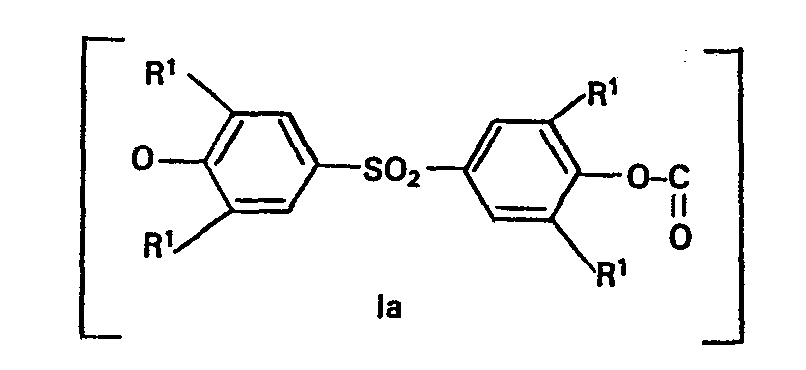
- Gegenstand der vorliegenden Erfindung ist ein Verfahren zur Isolierung von Polycarbonaten mit 18 bis 45 Mol-%, vorzugsweise 22-40 Mol-%, an Struktureinheiten der Formel la
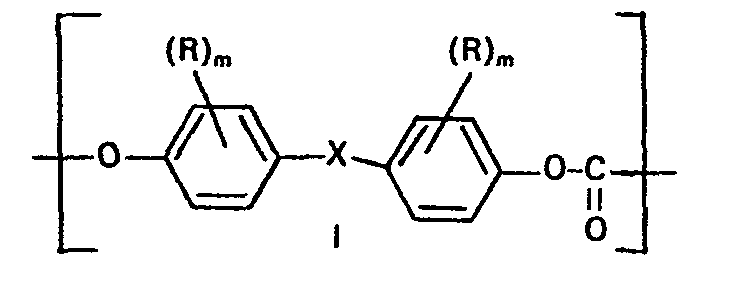
- X eine Bindung, C1-C8-Alkylen, C2-C8-Alkyliden, Cyclohexylen, Cyclohexyliden, S, 0 oder CO
- R Wasserstoff, Chlor, Brom, Alkylsubstituenten mit 1 bis 3 C-Atomen
- m 0, 1, 2 bedeuten, indem man 18 bis 45 Mol-%, vorzugsweise 22-40 Mol-% Sulfonbisphenole der Formel IIA
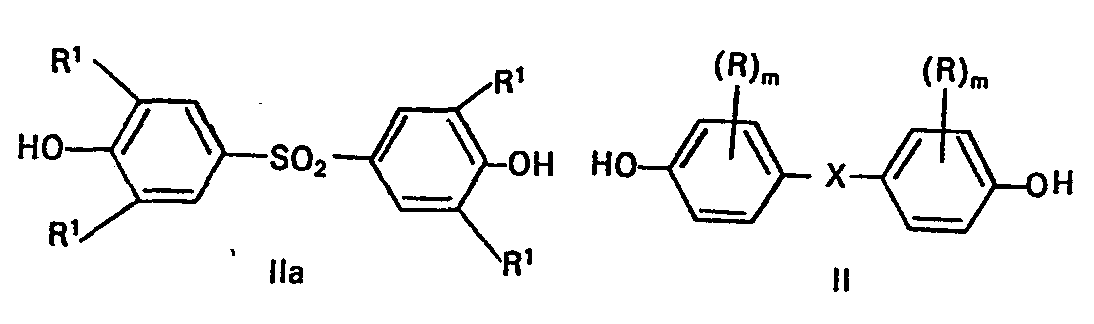
- Die Bedeutung für R1, R, X und m in den Formeln II und IIa entspricht der in den Formeln I und la.
- Die Herstellung von sulfonhaltigen Polycarbonaten ist seit langem bekannt (siehe US-PS 3 271 367 (Ue 1695), DE-AS 1 007 996 (Ue 1695), US-PS 3 271 364, US-PS 3 312 659, US-PS 3 312 662 und US-PS 3 419 526 (Le A 10078).
- Sofern bei diesem Verfahren die Methode der Phasengrenzflächenpolykondensation angesprochen ist, ergeben sich bei Gehalten von über 15 Mol-% an Sulfonbisphenolen Probleme mit der Phasentrennung und Isolierung der hergestellten Sulfonpolycarbonate. Dies trifft auch zu, wenn man die Bis-chlorkohlensäureester der Sulfonbisphenole im Phasengrenzflächenverfahren einsetzt (siehe beispielsweise US-PS 3 271 367).
- Somit musste man entweder auf wasserfreie Verfahren ausweichen (siehe US-PS 3 312 659 bzw. US-PS 3 312 662) oder konnte de facto etwa nur 15 Mol-% an Sulfonbisphenolen maximal kokondensieren (siehe beispielsweise US-PS 3 912 688 (Le A 13 804) und EP-A-547 (Mo 1741-EP)).
- In US-PS 3974126 bzw. FR-PS 2 235 150 wird ein kontinuierliches Verfahren zur Herstellung von Polycarbonaten nach dem Phasengrenzflächenverfahren beschrieben, wobei Chlorkohlensäureester von Oligocarbonaten mit Diphenolen unter speziellen Reaktionsbedingungen umgesetzt werden. Bis-(4-hydroxyphenyl)-sulfon kann als eines von mehreren Diphenolen sowohl in Form des Oligocarbonats als auch als Diphenolkomponente an der Reaktion beteiligt werden. Konkrete Ausführungsbeispiele unter Einbeziehung des Sulfonbisphenols sind in der US-PS 3 974126 nicht enthalten.
- Überraschenderweise zeigte sich nun, dass der erfindungsgemässe Vorteil der leichten Isolierung der Sulfonbisphenolpolycarbonate nur eintritt, wenn man die Bisphenole der Formel II und nicht etwa das Sulfonbisphenol vorab in Oligocarbonate überführt. Dieser selektive Befund war in Anbetracht der Lehre der US-PS 3 974 126 überraschend.
- Die erfindungsgemässen Sulfon-Copolycarbonate zeichnen sich durch eine hervorragende Benzinbeständigkeit, eine hohe Wärmeformbeständigkeit und gute mechanische Eigenschaften aus.
- Gerade der Bereich von 18-45 Mol-% an Sulfoneinheiten ist von technischem Interesse, da sich die positiven Effekte, die durch die Sulfongruppe bewirkt werden, z.B. hohe Wärmeformbeständigkeit und gutes Spannungsrissverhalten gegenüber Benzin, deutlich bemerkbar machen, während die bei höheren Sulfongehalten deutlich werdenden Nachteile, z.B. Hydrolyseinstabilität und schlechteres Fliessverhalten, sich noch nicht nachteilig auswirken.
- Die so hergestellten Copolycarbonate haben ein mittleres Gewichtsmittel-Molekulargewicht Mw von 10.000 bis 200.000 bevorzugt 20.000 bis 80.000 und weisen die Strukturformel:

- Die zur Herstellung der Copolycarbonate der Formel III geeigneten Bisphenole der Formel II sind 4,4-Dihydroxydiphenyle, bis-(4-hydroxyphenyl)-C1-C8-alkane, Bis-(4-hydroxyphenyl)-cyclohexane, Bis-(4-hydroxyphenyl)-sulfide, -ether und -ketone sowie kern-(C1-C3)-alkylierte und/oder kernbromierte und/oder kernchlorierte Verbindungen.
- Diese und weitere geeignete Bisphenole II sind z.B. in den US-Patentschriften 3028365, 2 999 835, 3 148 172, 2 991 273, 3 271 367 und 2999846, in den Deutschen Offenlegungsschriften 1 570 703, 2 063 050, 2 063 052, 2 211 956, 2 211 957, der Französischen Patentschrift 1 561 518 und in der Monographie «H. Schnell, Chemistry and Physics of Polycarbonates, Interscience Publishers, New York, 1964» beschrieben.
- Bevorzugte Bisphenole der Formel sind z.B.:
- 2,2-Bis(4-hydroxyphenyl)-propan
- 2,2-Bis-(3,5-dimethyl-4-hydroxyphenyl)-propan
- 2,2-Bis-(3,5-dichlor-4-hydroxyphenyl)-propan
- 2,2-Bis-(3,5-dibrom-4-hydroxyphenyl)-propan
- 1,1-Bis(4-hydroxyphenyl)-cyclohexan
- 1,1-Bis-(4-hydroxyphenyl)-propan und
- 1,1-Bis-(4-hydroxyphenyl)-butan.
- Ganz besonders bevorzugt ist 2,2-Bis-(4-hydroxyphenyl) -propan. Geeignetes und zugleich bevorzugtes Sulfonbisphenol der Formel Ila ist Bis-(4-hydroxyphenyl) -sulfon.
- Die Polycarbonate können darüber hinaus durch den Einbau geringer Mengen, vorzugsweise von Mengen zwischen 0,05 und 2,0 Mol-% (bezogen auf eingesetzte Diphenole), an drei-und mehr als dreifunktionellen Verbindungen, insbesondere solchen mit drei oder mehr als drei phenolischen Hydroxygruppen verzweigt sein.
- Polycarbonate dieser Art sind z.B. in den Deutschen Offenlegungsschriften 1 570533, 1 595 762, 2116 974, 2113 347, 2 500 092 der Britischen Patentschrift 1 079 821 und der US-Patentschrift 3 544 514 beschrieben.
- Die Bedingungen des Phasengrenzflächenverfahrens sind beispielsweise aus «Schnell, loc-cit.» bekannt. Bevorzugte Lösungsmittel sind Chlorbenzol und CH2Cl2 sowie deren Mischungen.
- Als Aminkatalysatoren sind die üblichen wie z.B. Triethylamin oder N-Methyl-piperidin geeignet; als Kettenabbrecher sind ebenfalls die üblichen wie z.B. (Alkyl und/oder Halogen) Phenole geeignet. Reaktionstemperaturen, = zeiten, = drücke sowie Basizität des Reaktionsmediums sind in üblicher Weise einzustellen. Die einzusetzende Phosgenmenge liegt vorzugsweise bei 1,2 bis ca. 2 Mol, pro Molsumme II + IIa.
- Die primär herzustellenden Chlorkohlensäureester der Bisphenole II haben mittlere Polymerisationsgrade von bis 1-8 der Struktureinheiten I und sind in bekannter Weise herstellbar.
- Die Phasentrennung erfolgt in den für die Herstellung von Bisphenol-A-homopolycarbonaten verwendeten üblichen Scheidegefässen, die dem Fachmann geläufig sind.
- Die Isolierung der Sulfonbisphenolpolycarbonte durch Fällung erfolgt mittels Petrolether, Alkanen, Methanol oder Aceton als Fällungsmitteln.
- Das Verdampfen des Lösungsmittels kann in üblicher Weise mittels bekannten Ausdampfextrudern erfolgen.
- Somit bereitet die Gewinnung Reinigung und Aufarbeitung der organischen Polycarbonat-haltigen Phase keine Schwierigkeiten. Die Sulfonbisphenolpolycarbonate können als Granulat, Folie oder Strang isoliert und gewonnen werden.
- Die Copolycarbonate werden überall dort als Formkörper eingesetzt, wo hohe Temperaturbeständigkeit und ein gutes Spannungsrissverhalten, insbesondere gegenüber Benzin, gefordert wird.
- Wie üblich, können den erfindungsgemässen Polycarbonaten Zusatzstoffe aller Art während oder nach dem Herstellungsvorgang zugegeben werden. Erwähnt seien in diesem Zusammenhang beispielsweise Farbstoffe, Pigmente, Entformungsmittel, Stabilisatoren gegen Feuchtigkeit-, Hitze- 'und UV-Einwirkung, Gleitmittel, Füllstoffe, wie Glaspulver, Quarzerzeugnisse, Graphit, Molybdänsulfid, Metallpulver, Pulver höherschmelzender Kunststoffe, z.B. Polytetrafluorethylenpulver, natürliche Fasern, wie Baumwolle, Sisal und Asbest, ferner Glasfasern der verschiedensten Art, Metallfäden sowie während des Verweilens in der Schmelze der Polycarbonate stabile und die Polycarbonate nicht merklich schädigende Fasern.
- Die Benzinbeständigkeit der PolycarbonatFormmassen wird durch Lagerung der entsprechenden Formkörper, z.B. Normkleinstäbe, die unter einer definierten Spannung stehen, die durch eine bestimmte Dehnung vorgegeben ist, in Testmedien geprüft. Als Testmedium wird eine Mischung aus Toluol/Isooctan im Volumenverhältnis von 1:1 verwendet. Die Probekörper, die eine Randfaserdehnung von 0,6% aufweisen, werden im Testmedium eine Stunde gelagert. Anschliessend werden die Produkte visuell hinsichtlich Bruch, Rissbildung und Verfärbung beurteilt.
- Die folgenden Beispiele sollen den Erfindungsgegenstand näher erläutern. Die angegebenen relativen Lösungsviskositäten werden in Methylenchlorid bei 25 °C und einer Konzentration von 5 g/I gemessen.
- Herstellung eines verzweigten Copolycarbonats aus Bisphenol A und 4,4'-Dihydroxydiphenylensulfon (Molverhältnis 80:20) durch gemeinsame Phosgenierung in der Phasengrenzfläche.
- 2,554 kg Bisphenol A, 0,701 kg 4,4'-Dihydroxydiphenylensulfon, 24,2 g Isatinbiskresol, 42,2 g Phenol, 3 kg 45%iger Natronlauge, 35 kg Wasser und 36,2 kg Methylenchlorid werden in einen 100 I Kessel gegeben. Es wird mit Stickstoff gespült. Danach werden bei Raumtemperatur 2,22 kg Phosgen innerhalb einer Stunde eingeleitet, wobei der pH-Wert durch Zugabe von 45%iger NaOH auf 12-13 gehalten wird. Nach Zugabe von 8,5 g Triethylamin wird noch 15 Minuten nachgerührt.
- Das Produkt wird in einen Separator gegeben, wo aufgrund von Emulsionsbildung nur eine unvollständige Phasentrennung auftritt. Die organische Phase wird, so weit möglich, abgetrennt, mit Phosphorsäure angesäuert und mehrmals mit destilliertem Wasser gewaschen. Auch im sauren und im neutralen Medium erfolgt nur eine unvollständige Phasentrennung. Das so gewonnene Polycarbonat wird extrudiert und granuliert. Die Ausbeute und Eigenschaften des Produkts sind in der Tabelle angegeben.
- Herstellung eines unverzweigten Copolycarbonats aus Bisphenol A und 4,4'-Dihydroxydiphenylsulfon (Molverhältnis 65-35) durch gemeinsame Phosgenierung in der Phasengrenzfläche.
- Die Arbeitsweise erfolgt analog zu Beispiel 1, wobei 2,078 kg Bisphenol A, 1,226 kg 4,4'-Dihydroxydiphenylensulfon und 45,2 g p-tert.-Butylphenol eingesetzt werden. Auch hier ergeben sich erhebliche Trennprobleme im alkalischen, sauren und im neutralen Medium. Die Ausbeute und Eigenschaften des Produktes sind in der Tabelle angegeben.
- Herstellung eines verzweigten Copolycarbonats aus Bisphenol A und 4,4'-Dihydroxydiphenylsulfon (Molverhältnis 80:20) durch Zugabe von 4,4'-Dihydroxydiphenylsulfon zum Vorphosgenat von Bisphenol A.
- 2,554 kg Bisphenol A, 24,2 g Isatinbiskresol, 42,2 g Phenol, 31,9 g Triethylbenzylammoniumchlorid, 2,4 kg 45%iger Natronlauge, 27,71 Wasser und 36,2 kg Methylenchlorid werden in einem 100 1 Kessel gegeben. Es wird mit Stickstoff gespült. Danach werden bei Raumtemperatur innerhalb von 1,5 Stunden 4,4 kg Phosgen eingeleitet, wobei der pH-Wert durch Zugabe von 45%iger NaOH auf 12 gehalten wird. Danach wird eine Lösung von 0,701 kg 4,4'-Dihydroxydiphenylensulfon in 1,035 kg 45%iger Natronlauge und 12,1 I Wasser zugepumpt. Nach Zugabe von 8,5 g Triethylamin wird noch 15 Minuten nachgerührt. Das Produkt wird in einen Separator gegeben. Die Phasen lassen sich problemlos trennen, ohne dass Emulsionsbildung auftritt. Die organische Phase wird abgetrennt, mit Phosphorsäure angesäuert und mehrmals mit destilliertem Wasser gewaschen. Auch im sauren und im neutralen Medium findet eine vollständige und problemlose Phasentrennung statt. Das so gewonnene Polycarbonat wird extrudiert und granuliert. Die Ausbeute und Eigenschaften sind in der Tabelle angegeben.
- Herstellung eines unverzweigten Copolycarbonats aus Bisphenol A und 4,4'-Dihydroxydiphenylensulfon (Molverhältnis 65:35) durch Zugabe von 4,4'-Dihydroxydiphenylensulfon zum Bis-chlorkohlensäureester von Bisphenoi A.
- 2,755 kg Bisphenol A-Bischlorkohlensäureester, 31,4 kg Methylenchlorid, 19,3 1 Wasser und 38,7 1 p-tert-Butylphenol werden in einen 100 Kessel gegeben. Es wird mit Stickstoff gespült. Danach wird eine Lösung von 1,051 kg Dihydroxydiphenylensulfon in 0,887 kg 45%iger Natronlauge und 10,4 1 Wasser zugepumpt. Nach Zugabe von 7,3 g Triethylamin wird 15 min. nachgerührt. Dabei wird durch Zugabe von 45%iger Natronlauge ein pH-Wert von 12 eingehalten.
- Das Produkt wird in einen Separator gegeben. Die Phasen lassen sich problemlos trennen, ohne dass Emulsionsbildung auftritt. Die organische Phase wird abgetrennt, mit Phosphorsäure angesäuert und mehrmals mit destilliertem Wasser gewaschen. Auch im sauren und im neutralen Medium findet eine vollständige und problemlose Phasentrennung statt. Das so gewonnene Polycarbonat wird extrudiert und granuliert. Die Ausbeute und Eigenschaften sind in der Tabelle angegeben.
- Vergleichsbeispiel gemäss US-PS 3 974 126:
- Herstellung eines verzweigten Copolycarbonats aus Bisphenol A und 4,4'-Dihydroxydiphenylensulfon (Molverhältnis 80:20) durch Zugabe von 20 Molteilen Bisphenol A zum Vorphosgenat aus Bisphenol A und 4,4'-Dihydroxydiphenylsulfon.
- Die Arbeitsweise erfolgt analog zu Beispiel 3, wobei 1,918 kg Bisphenol A und 0,701 kg 4,4'-Dihydroxydiphenylensulfon, vorphosgeniert werden. Zum Vorphosgenat wird eine Lösung aus 0,639 kg Bisphenol A und 12,1 I Wasser zugegeben. Auch hier ergeben sich erhebliche Trennprobleme im alkalischen, sauren und im neutralen Medium, sowie ein unvollständiger Einbau des 4,4'-Dihydroxydiphenylensulfons in Polycarbonat. Die Ausbeuten und Eigenschaften des Produktes sind in der Tabelle angegeben.
-

Claims (1)


Applications Claiming Priority (2)
| Application Number | Priority Date | Filing Date | Title |
|---|---|---|---|
| DE3138179 | 1981-09-25 | ||
| DE19813138179 DE3138179A1 (de) | 1981-09-25 | 1981-09-25 | Verfahren zur isolierung von polycarbonaten auf basis von 4,4'-dihydroxidiphenylsulfonen |
Publications (2)
| Publication Number | Publication Date |
|---|---|
| EP0075772A1 EP0075772A1 (de) | 1983-04-06 |
| EP0075772B1 true EP0075772B1 (de) | 1986-01-08 |
Family
ID=6142588
Family Applications (1)
| Application Number | Title | Priority Date | Filing Date |
|---|---|---|---|
| EP82108393A Expired EP0075772B1 (de) | 1981-09-25 | 1982-09-11 | Verfahren zur Isolierung von Polycarbonaten auf Basis von 4,4-Dihydroxidiphenylsulfonen |
Country Status (4)
| Country | Link |
|---|---|
| US (1) | US4404351A (de) |
| EP (1) | EP0075772B1 (de) |
| JP (1) | JPS5867720A (de) |
| DE (2) | DE3138179A1 (de) |
Families Citing this family (10)
| Publication number | Priority date | Publication date | Assignee | Title |
|---|---|---|---|---|
| US4489181A (en) * | 1983-11-07 | 1984-12-18 | Fox Daniel W | Thermoplastic polycarbonate-polysulfone carbonate molding compositions |
| US4698390A (en) * | 1984-03-20 | 1987-10-06 | Amoco Corporation | Miscible blends of polycarbonate with vinyl chloride derived polymers |
| US4594404A (en) * | 1984-03-20 | 1986-06-10 | Union Carbide Corporation | Polycarbonates having improved hydrolytic stability |
| US4535143A (en) * | 1984-08-06 | 1985-08-13 | Mobay Chemical Corporation | Process for the preparation of copolycarbonates of sulfonyl diphenol |
| EP0218064B1 (de) * | 1985-09-03 | 1989-02-01 | Bayer Ag | Verfahren zur Herstellung von Polyethersulfonen |
| US5037937A (en) * | 1987-02-13 | 1991-08-06 | Idemitsu Petrochemical Co., Ltd. | Novel polycarbonate resins, process for production of said resins, and compositions containing said resins |
| JPH0245557A (ja) * | 1988-08-05 | 1990-02-15 | Idemitsu Petrochem Co Ltd | ポリカーボネート樹脂組成物 |
| JPH0245559A (ja) * | 1988-08-05 | 1990-02-15 | Idemitsu Petrochem Co Ltd | ポリカーボネート樹脂組成物 |
| JPH0245556A (ja) * | 1988-08-05 | 1990-02-15 | Idemitsu Petrochem Co Ltd | ポリカーボネート樹脂組成物 |
| CN117209743B (zh) * | 2023-10-11 | 2024-03-29 | 江苏福赛乙德药业有限公司 | 一种改性双酚af聚碳酸酯材料及其制备方法 |
Family Cites Families (15)
| Publication number | Priority date | Publication date | Assignee | Title |
|---|---|---|---|---|
| US3312659A (en) * | 1967-04-04 | Catalytic preparation of polycarbon- ates from bisphenol and a carbonate precursor | ||
| DE1007996B (de) * | 1955-03-26 | 1957-05-09 | Bayer Ag | Verfahren zur Herstellung thermoplastischer Kunststoffe |
| GB1039921A (en) * | 1961-08-29 | 1966-08-24 | Gevaert Photo Prod Nv | Process for preparing polycarbonates |
| US3312662A (en) * | 1962-07-03 | 1967-04-04 | Union Carbide Corp | Catalytic process for preparing polycarbonates by self-condensation of bisphenol dichloroformate |
| DE1619478C3 (de) * | 1966-06-03 | 1974-11-07 | Bayer Ag, 5090 Leverkusen | Verfahren zum Färben und Bedrucken von Fasersubstraten |
| US3737409A (en) * | 1971-03-08 | 1973-06-05 | Gen Electric | Copolycarbonate of bis-3,5-dimethyl-4-hydroxyphenyl)sulfone with bisphenol-a |
| US3912688A (en) * | 1971-06-12 | 1975-10-14 | Bayer Ag | Flameproof polycarbonates |
| DE2211957C2 (de) * | 1972-03-11 | 1982-07-01 | Bayer Ag, 5090 Leverkusen | Hochmolekulare statistische Copolycarbonate |
| JPS5236554B2 (de) * | 1973-06-27 | 1977-09-16 | ||
| DE2346935C2 (de) * | 1973-09-18 | 1982-01-21 | Bayer Ag, 5090 Leverkusen | s-Triazinringe enthaltende Polycarbonate mit funktionellen Gruppen, ihre Herstellung und Verwendung |
| US3974127A (en) * | 1973-09-17 | 1976-08-10 | E. I. Du Pont De Nemours And Company | Alkylene oxide condensates of tetramethylpiperidine alcohols or glycols |
| DE2500092C3 (de) * | 1975-01-03 | 1978-10-12 | Bayer Ag, 5090 Leverkusen | Verzweigte, hochmolekulare, thermoplastische und lösliche Polycarbonate |
| US4043980A (en) * | 1976-05-18 | 1977-08-23 | Mobay Chemical Corporation | Flame retardant polycarbonate having improved critical thickness |
| EP0000547A1 (de) * | 1977-08-01 | 1979-02-07 | Mobay Chemical Corporation | Schwefel enthaltende aromatische Polycarbonate, Verfahren zu deren Herstellung und diese enthaltende glasfaserverstärkte Mischungen |
| DE2937332A1 (de) * | 1979-09-14 | 1981-04-09 | Bayer Ag, 5090 Leverkusen | Makrocyclische polycarbonate |
-
1981
- 1981-09-25 DE DE19813138179 patent/DE3138179A1/de not_active Withdrawn
-
1982
- 1982-09-11 EP EP82108393A patent/EP0075772B1/de not_active Expired
- 1982-09-11 DE DE8282108393T patent/DE3268422D1/de not_active Expired
- 1982-09-20 US US06/420,438 patent/US4404351A/en not_active Expired - Fee Related
- 1982-09-24 JP JP57165137A patent/JPS5867720A/ja active Pending
Also Published As
| Publication number | Publication date |
|---|---|
| DE3138179A1 (de) | 1983-04-14 |
| EP0075772A1 (de) | 1983-04-06 |
| US4404351A (en) | 1983-09-13 |
| DE3268422D1 (en) | 1986-02-20 |
| JPS5867720A (ja) | 1983-04-22 |
Similar Documents
| Publication | Publication Date | Title |
|---|---|---|
| US4506066A (en) | Thermoplastic polycarbonates, their preparation and their use as shaped articles and films | |
| EP0036080B1 (de) | Aromatische Polyestercarbonate, Verfahren zu ihrer Herstellung und ihre Verwendung zur Herstellung von Spritzgussartikeln, Folien und Überzügen | |
| EP0000904B1 (de) | Wiedergewinnung hochwertiger Polycarbonate aus Polycarbonat-Abfällen | |
| EP0006516B1 (de) | Verfahren zur Herstellung von aliphatisch-aromatischen Polycarbonaten mit Diphenolcarbonat-Endruppen, die nach dem Verfahren erhaltenen Polycarbonate und ihre Verwendung zur Herstellung von thermoplastisch verarbeitbaren, hochmolekularen, segmentierten, aliphatisch-aromatischen Polycarbonat-Elastomeren | |
| EP0013904B1 (de) | Verfahren zur Herstellung von Polycarbonaten | |
| DE3002762A1 (de) | Verfahren zur herstellung von heterocyclisch-aromatischen oligocarbonaten mit diphenolcarbonat-endgruppen und ihre verwendung zur herstellung von thermoplastischen, hochmolekularen heterocyclisch-aromatischen copolycarbonaten | |
| EP0075772B1 (de) | Verfahren zur Isolierung von Polycarbonaten auf Basis von 4,4-Dihydroxidiphenylsulfonen | |
| DE3035204A1 (de) | Tetraphenol-verbindungen und diese enthaltende massen | |
| EP0078943A1 (de) | Verfahren zur Herstellung von Polycarbonaten mit verbessertem Alterungsverhalten | |
| DE3308691A1 (de) | Willkuerlich verzweigtes polycarbonat aus einem bisphenol und einem polyolchlorformiat und verfahren zu seiner herstellung | |
| EP0065728B1 (de) | Neue Copolyestercarbonate und deren Abmischung mit bekannten Polycarbonaten zu thermoplastischen Formmassen | |
| CA1152532A (en) | Polycarbonates having sulfur containing phenolic diols incorporated therein | |
| EP0099990B1 (de) | Verfahren zur Herstellung von Polycarbonaten mit N-Alkyl-perfluoralkylsulfonamid-Endgruppen | |
| EP0423562B1 (de) | Polycarbonate mit verbesserter Wärmeformbeständigkeit | |
| EP0025928B1 (de) | Verfahren zur Herstellung von aromatischen Polycarbonaten nach dem Phasengrenzflächenverfahren | |
| EP1203043B1 (de) | Oligomere bischlorkohlensäureester aus ausgewählten cycloaliphatischen bisphenolen und anderen bisphenolen | |
| DE3513715A1 (de) | Polycarbonate mit dichlormaleinimid-endgruppen, ihre herstellung und modifizierung | |
| DE69423178T2 (de) | Verzweigte Copolyestercarbonate | |
| EP1655324B1 (de) | Verzweigte Polycarbonate | |
| DE2315888A1 (de) | Verfahren zur herstellung von halogensubstituierten aromatischen polycarbonaten | |
| EP1242501A1 (de) | Polyethercarbonate | |
| DE2556739C2 (de) | Neue halogenhaltige Polycarbonate, ihre Herstellung sowie ihre Verwendung | |
| DE2408068C3 (de) | Verfahren zur Herstellung von halogensubstituierten aromatischen Polycarbonaten | |
| DE2119779A1 (de) | Flammfeste Polycarbonate | |
| EP0413190A2 (de) | Polycarbonate aus n-Alkyl-substituierten Cyclohexylidenbisphenolen |
Legal Events
| Date | Code | Title | Description |
|---|---|---|---|
| PUAI | Public reference made under article 153(3) epc to a published international application that has entered the european phase |
Free format text: ORIGINAL CODE: 0009012 |
|
| 17P | Request for examination filed |
Effective date: 19820911 |
|
| AK | Designated contracting states |
Designated state(s): DE FR GB IT NL |
|
| GRAA | (expected) grant |
Free format text: ORIGINAL CODE: 0009210 |
|
| AK | Designated contracting states |
Designated state(s): DE FR GB IT NL |
|
| ITF | It: translation for a ep patent filed | ||
| ET | Fr: translation filed | ||
| REF | Corresponds to: |
Ref document number: 3268422 Country of ref document: DE Date of ref document: 19860220 |
|
| PLBE | No opposition filed within time limit |
Free format text: ORIGINAL CODE: 0009261 |
|
| STAA | Information on the status of an ep patent application or granted ep patent |
Free format text: STATUS: NO OPPOSITION FILED WITHIN TIME LIMIT |
|
| 26N | No opposition filed | ||
| PGFP | Annual fee paid to national office [announced via postgrant information from national office to epo] |
Ref country code: FR Payment date: 19900830 Year of fee payment: 9 |
|
| PGFP | Annual fee paid to national office [announced via postgrant information from national office to epo] |
Ref country code: GB Payment date: 19900831 Year of fee payment: 9 |
|
| ITTA | It: last paid annual fee | ||
| PGFP | Annual fee paid to national office [announced via postgrant information from national office to epo] |
Ref country code: NL Payment date: 19900930 Year of fee payment: 9 |
|
| PGFP | Annual fee paid to national office [announced via postgrant information from national office to epo] |
Ref country code: DE Payment date: 19910820 Year of fee payment: 10 |
|
| PG25 | Lapsed in a contracting state [announced via postgrant information from national office to epo] |
Ref country code: GB Effective date: 19910911 |
|
| PG25 | Lapsed in a contracting state [announced via postgrant information from national office to epo] |
Ref country code: NL Effective date: 19920401 |
|
| GBPC | Gb: european patent ceased through non-payment of renewal fee | ||
| NLV4 | Nl: lapsed or anulled due to non-payment of the annual fee | ||
| PG25 | Lapsed in a contracting state [announced via postgrant information from national office to epo] |
Ref country code: FR Effective date: 19920529 |
|
| REG | Reference to a national code |
Ref country code: FR Ref legal event code: ST |
|
| PG25 | Lapsed in a contracting state [announced via postgrant information from national office to epo] |
Ref country code: DE Effective date: 19930602 |