EP0068039B1 - Kraftübertragungssystem mit Hebelgestängen und Kurbelscheibe - Google Patents
Kraftübertragungssystem mit Hebelgestängen und Kurbelscheibe Download PDFInfo
- Publication number
- EP0068039B1 EP0068039B1 EP81105014A EP81105014A EP0068039B1 EP 0068039 B1 EP0068039 B1 EP 0068039B1 EP 81105014 A EP81105014 A EP 81105014A EP 81105014 A EP81105014 A EP 81105014A EP 0068039 B1 EP0068039 B1 EP 0068039B1
- Authority
- EP
- European Patent Office
- Prior art keywords
- rod
- lever
- force transmission
- transmission system
- crank wheel
- Prior art date
- Legal status (The legal status is an assumption and is not a legal conclusion. Google has not performed a legal analysis and makes no representation as to the accuracy of the status listed.)
- Expired
Links
- 230000005540 biological transmission Effects 0.000 title claims abstract description 15
- 238000004146 energy storage Methods 0.000 claims abstract description 8
- 125000004122 cyclic group Chemical group 0.000 claims abstract 2
- 210000000056 organ Anatomy 0.000 claims abstract 2
- 230000007704 transition Effects 0.000 claims description 2
- 239000007788 liquid Substances 0.000 description 5
- 210000000629 knee joint Anatomy 0.000 description 3
- 239000004575 stone Substances 0.000 description 3
- 238000002485 combustion reaction Methods 0.000 description 2
- 230000006835 compression Effects 0.000 description 1
- 238000007906 compression Methods 0.000 description 1
- 238000010276 construction Methods 0.000 description 1
- 239000013013 elastic material Substances 0.000 description 1
- 239000012530 fluid Substances 0.000 description 1
- 239000012528 membrane Substances 0.000 description 1
Images


Classifications
-
- F—MECHANICAL ENGINEERING; LIGHTING; HEATING; WEAPONS; BLASTING
- F16—ENGINEERING ELEMENTS AND UNITS; GENERAL MEASURES FOR PRODUCING AND MAINTAINING EFFECTIVE FUNCTIONING OF MACHINES OR INSTALLATIONS; THERMAL INSULATION IN GENERAL
- F16H—GEARING
- F16H21/00—Gearings comprising primarily only links or levers, with or without slides
- F16H21/10—Gearings comprising primarily only links or levers, with or without slides all movement being in, or parallel to, a single plane
- F16H21/16—Gearings comprising primarily only links or levers, with or without slides all movement being in, or parallel to, a single plane for interconverting rotary motion and reciprocating motion
- F16H21/18—Crank gearings; Eccentric gearings
- F16H21/22—Crank gearings; Eccentric gearings with one connecting-rod and one guided slide to each crank or eccentric
- F16H21/26—Crank gearings; Eccentric gearings with one connecting-rod and one guided slide to each crank or eccentric with toggle action
-
- F—MECHANICAL ENGINEERING; LIGHTING; HEATING; WEAPONS; BLASTING
- F03—MACHINES OR ENGINES FOR LIQUIDS; WIND, SPRING, OR WEIGHT MOTORS; PRODUCING MECHANICAL POWER OR A REACTIVE PROPULSIVE THRUST, NOT OTHERWISE PROVIDED FOR
- F03G—SPRING, WEIGHT, INERTIA OR LIKE MOTORS; MECHANICAL-POWER PRODUCING DEVICES OR MECHANISMS, NOT OTHERWISE PROVIDED FOR OR USING ENERGY SOURCES NOT OTHERWISE PROVIDED FOR
- F03G7/00—Mechanical-power-producing mechanisms, not otherwise provided for or using energy sources not otherwise provided for
- F03G7/10—Alleged perpetua mobilia
Definitions
- the invention relates to a dynamic transmission according to the preamble of claim 1.
- Dynamic gearboxes with a crank disc and lever linkage are required for various purposes such as short-term energy supply or bridging a short-term high energy requirement.
- a stone crusher is known, which is described in the book “Mechanism, Linkages and Mechanical Controls” by N. P. Chironis, 1965 McGraw-Hiil Verlag, on page 154 in FIG. 6.
- the stone crusher consists of a driven crank disk on which a one-armed lever arm for breaking stones is attached above a crank mechanism and knee joint. The power flow is always directed from the crank disc to the stone-breaking lever arm.
- the object of the invention is to create a dynamic transmission which, with the aid of an energy store, alternately permits a flow of force in one direction to the crank disk and in the other direction to the energy store.
- FIG. 1 shows the basic element of the invention, which can be combined to form further exemplary embodiments.
- the basic element contains several connecting rods 6, 7, 10, a lever 14, which are arranged in a certain way between the fixed points 1, 2 and a crank disk 12.
- the connecting rods 6, 7, 10 are connected to one another in the joint 3.
- the other sides of the connecting rods are articulated on the fixed point 1, the crank pin 11 of the crank disk 12 rotating about its axis 13 and on the lever 14, which can pivot about the other fixed point 2.
- the lever 14 has two lever parts 8, 9 of unequal length.
- the end 4 of one lever piece 8 is articulated on the connecting rod 7.
- This and the other connecting rods 6, 10 are designed as two knee joints, which are arranged with respect to one another in such a way that they pass at the transition support the energy flow per revolution of the crank disk 12 typical for the knee joints in the extended position into the kinked position or vice versa.
- the energy store 15 is arranged in FIG. 1 below the end 5 of the lever part 9. It can also be provided vertically above the end 5, as shown in FIG. 3.
- the following can be considered as energy stores: tension and / or compression springs, compressed air pistons, pneumatic membranes, weights, hydraulic storage means, fluid pressure or buoyancy forces. From this wealth of technical designs, two examples are explained in more detail with reference to FIGS. 9 and 10.
- FIG. 2 shows a partially sectioned illustration of a first exemplary embodiment with two basic elements from FIG. 1.
- the crank disks 12 of the two basic elements are fastened on an axis of rotation 13.
- One of the two crank disks serves as an output. Because of the better overview, only one basic element is completely drawn.
- the energy storage 15, the lever 14, fixed points 2 are not shown.
- the two crank drives 11 are arranged offset by 180 ° on the circumference of the crank disk 12. It is easily possible to combine the arrangement of the so-called twin crank disk of FIG. 2 in a larger number side by side.
- Each twin crank disk is connected to the neighboring twin crank disk via the corresponding crank pin 11, the crank pin being offset in the manner of a crankshaft in the internal combustion engine in the manner of a twin crank disk.
- FIG. 3 as a second embodiment shows the arrangement of two basic elements on one side of the crank disc 12.
- the two basic elements arranged on one side of the crank disk 12 are connected in an articulated manner with a single crank pin 11.
- the front crank pin 11 is offset by about 180 ° on the circumference of the crank disk 12 from the rear.
- Each of the two basic elements arranged on one side of the crank disk works together with an energy store 15, so that four energy stores are provided for the two crank disks.
- Each energy store 15 is connected via a lever linkage 16, 18 to the lever part 9 of the lever 14, which lever linkage is mounted at the fixed point 2 in such a way that the distance a for each basic element is offset or offset. increases.
- the mode of operation of the energy stores and the changes in the distances a are staggered in time.
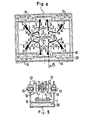
- FIG. 4 shows the third embodiment of the invention, which consists of four basic elements working on a common output
- each basic element of FIG. 4 has two crank disks 12, as the sectional illustration of FIG. 5 shows along the section lines AA.
- the eight crank disks 12 work together, with only a part of the eight shafts 13 representing the common output.
- the basic elements with their connecting rods 6, 7, 10, levers 14 are arranged in a double housing 18.
- Each basic element has its energy store 15, which acts on the end 5 of the lever 14.
- the energy storage device is designed as a bellows made of rubber-elastic material that is compressed and expanded. The bellows are surrounded by a gaseous or liquid medium 20 which exerts a pressure on them.
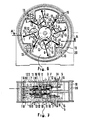
- FIG. 6 shows the fourth embodiment of the invention with eight basic elements, the eight crank disks 12 of which work on a common output 19.
- the reference numbers are the same as in the previous embodiments.
- FIG. 7 is the sectional view of the fourth embodiment and is intended to show the transmission of the energy flow between the crank disk 12 and the common output 19 in a round double housing 18 which, as is known, can absorb larger forces of the gaseous or liquid medium 20.
- the energy stores 15 are bellows trained and are under pressure of the gaseous or liquid medium 20th
- FIG. 8 shows a section through the fifth embodiment of the invention, which consists of an arrangement of several basic elements one behind the other within a drum 31.
- the crank disk 12 of each basic element has an outer toothing on its circumference and works on the inner toothing of the drum 31.
- the accumulator 15, which engages the end 5 of the lever 14, consists of a pressure vessel, which can be filled with a gaseous or liquid medium.
- the crank pins 11 of each crank disk 12 are offset from one another in a certain manner, as is customary in internal combustion engines with the crankshaft.
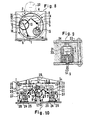
- FIG. 9 shows an embodiment of the energy store 15 in the form of a compressed air piston 21 which is movably guided in a cylinder 22.
- the pressure piston arranged in a housing 23 is moved downward in the direction of the arrow by the compressed air 24 and influences the lever 14 of a basic element. Since the compressed air 24 is under high pressure, the compressed air piston 21 has a lamellar seal.
- FIG. 10 shows another exemplary embodiment of the energy store 15, which consists of a piston 25 which is movable in a cylinder 26 by a gaseous or liquid medium 24 under pressure.
- the piston 25 is connected via a cable 27 with a deflection roller 28 to the end 5 of the lever 14 of a basic element of FIG. 1.
- the pressure of the medium 24 can be changed by means of an adjusting device 29, 30, which adjusting device moves the levers 30 in one direction or the other in order to increase or decrease the pressure. This can be done either manually and / or hydraulically, which is shown symbolically in FIG.
- FIG. 11 shows a simplified construction of the second embodiment of FIG. 3.
- the two basic elements, which are arranged on each side of the crank disk 12, are articulated at a single fixed point 1 via common connecting rods 6, 10.
- Each basic element is still articulated at its other fixed point 2.
- the mode of operation of the basic elements articulated on each crank disk 12 is the same as was described in connection with FIG. 3.
- the energy stores 15 are articulated in FIG. 11 below the lever part 9 directly at the end 5.
- FIG. 11 is also intended to show that the individual embodiments of FIGS. 2 to 8 have been structurally changed and the various energy stores, e.g. of Figures 9 and 10, can be used.
Landscapes
- Engineering & Computer Science (AREA)
- General Engineering & Computer Science (AREA)
- Chemical & Material Sciences (AREA)
- Combustion & Propulsion (AREA)
- Mechanical Engineering (AREA)
- Transmission Devices (AREA)
- Reciprocating Pumps (AREA)
Description
- Die Erfindung betrifft ein dynamisches Getriebe gemäss Oberbegriff des Patentanspruch 1.
- Dynamische Getriebe mit Kurbelscheibe und Hebelgestänge werden für verschiedene Zwecke benötigt wie z.B. kurzzeitige Energieabgabe oder Ueberbrückung eines kurzzeitigen hohen Energiebedarfs.
- Bekannt ist ein Steinbrecher, der im Buch "Mechanism, Linkages and Mechanical Controls" von N. P. Chironis, 1965 McGraw-Hiil Verlag, auf Seite 154 in Figur 6 beschrieben ist. Der Steinbrecher besteht aus einer angetriebenen Kurbelscheibe an der über einem Kurbeltrieb und Kniegelenk ein einarmiger Hebelarm zum Brechen von Steinen angebracht ist. Der Kraftfluss ist immer von der Kurbelscheibe zum steinbrechenden Hebelarm gerichtet.
- Die Erfindung hat die Aufgabe, ein dynamisches Getriebe zu schaffen, das unter Zuhilfenahme eines Energiespeichers wechselweise einen Kraftfluss in die eine Richtung zur Kurbelscheibe und in die andere Richtung zum Energiespeicher gestattet.
- Die Aufgabe wird durch die im kennzeichnenden Teil des Patentanspruchs 1 definierten Merkmale gelöst.
- Ausführungsbeispiele der Erfindung werden anhand der Zeichnungen näher erläutert. Es zeigen:
- Figur 1 das Grundelement der Erfindung,
- Figur 2 eine erste Ausführungsform mit zwei Grundelementen in Schnittdarstellung,
- Figur 3 eine zweite Ausführungsform mit der Anordnung mehrerer Grundelemente an einer Kurbelscheibe,
- Figur 4 eine dritte Ausführungsform mit der Anordnung mehrerer Grundelemente,
- Figur 5 eine Schnittdarstellung nach den Schnittlinien A-A der Figur 4,
- Figur 6 eine vierte Ausführungsform mit der Anordnung mehrerer Grundelemente an einem gemeinsamen Abtrieb,
- Figur 7 eine Schnittdarstellung der Anordnung der Figur 6 nach den Schnittlinien A-A,
- Figur 8 eine Schnittdarstellung einer fünften Ausführungsform,
- Figuren 9 & 10 zwei Ausführungsbeispiele des Energiespeichers,
- Figur 11 eine Vereinfachung der in Figur 3 gezeigten zweiten Ausführungsform.
- Die Figur 1 zeigt das Grundelement der Erfindung, das zu weiteren Ausführungsbeispielen kombiniert werden kann. Das Grundelement enthält mehrere Verbindungsstäbe 6, 7, 10, einen Hebel 14, die in bestimmter Weise zwischen den Fixpunkten 1, 2 und einer Kurbelscheibe 12 angeordnet sind. Die Verbindungsstäbe 6, 7,10 sind im Gelenk 3 miteinander verbunden. Die anderen Seiten der Verbindungsstäbe sind am Fixpunkt 1, Kurbelzapfen 11 der um ihre Achse 13 sich drehenden Kurbelscheibe 12 und am Hebel 14 angelenkt, des sich um den anderen Fixpunkt 2 verschwenken kann. Der Hebel 14 hat zwei ungleich lange Hebelteile 8, 9. Das Ende 4 des einen Hebelstücks 8 ist angelenkt am Verbindungsstab 7. Dieser und die anderen Verbindungsstäbe 6, 10 sind als zwei Kniegelenke ausgebildet, welche so zueinander angeordnet sind, dass sie bei Uebergang der für Kniegelenke typischen gestreckten Stellung in die geknickte Stellung oder umgekehrt den Energiefluss pro Umdrehung der Kurbelscheibe 12 unterstützen. Der Energiespeicher 15 ist in der Figur 1 unterhalb des Endes 5 des Hebelteils 9 angeordnet. Er kann auch senkrecht über dem Ende 5 vorgesehen sein, wie Figur 3 zeigt. Als Energiespeicher kommen in Btracht: Zug-und/oder Druckfedern, Pressluftkolben, pneumatische Membranen, Gewichte, hydraulische Speichermittel, Flüssigkeitsdruck oder Auftriebskrafte. Aus dieser Fülle der technischen Ausführungen werden anhand der Figuren 9 and 10 zwei Beispiele näher erklärt.
- Die Figur 2 zeigt in teilweise geschnittener Darstellung ein erste Ausführungsbeispiel mit zwei Grundelementen der Figur 1. Die Kurbelscheiben 12 der beiden Grundelemente sind auf einer Drehachse 13 befestigt. Eine der beiden Kurbelscheiben dient als Abtrieb. Wegen der besseren Uebersicht ist nur ein Grundelement vollständig gezeichnet. Die Energiespeicher 15, die Hebel 14, Fixpunkte 2 sind nicht gezeichnet. Die beiden Kurbeltriebe 11 sind um 180° am Umfang der Kurbelscheibe 12 versetzt angeordnet. Es ist ohne weiteres möglich, die Anordnung der sogenannten Zwilling-Kurbelscheibe der Figur 2 in einer grösseren Anzahl nebeneinander zu vereinigen. Jede Zwilling-Kurbelscheibe ist mit der Nachbar-Zwilling-Kurbelscheibe über den entsprechenden Kurbelzapfen 11 verbunden, wobei der Kurbelzapfen jede ZwiIIings-KurbeIsεheibe nach Art einer Kurbelwelle beim Verbrennungsmotor versetzt ist.
- Figur 3 als zweite Ausführun.gsform zeigt die Anordnung zweier Grundelemente auf einer Seite der Kurbelscheibe 12. Die anderen beiden Grundelemente, die auf der anderen Seite derselben Kurbelscheibenachse angeordnet sind, wurden nicht gezeichnet.
- Die auf einer Seite der Kurbelscheibe 12 angeordneten beiden Grundelemente sind mit einem einzigen Kurbelzapfen 11 gelenkig verbunden. Der vordere Kurbelzapfen 11 ist gegenüber den hinteren um ca. 180° auf dem Umfang der Kurbelscheibe 12 versetzt. Jedes der beiden auf einer Seite der Kurbelscheibe angeordneten Grundelemente arbeitet mit einem Energiespeicher 15 zusammen, sodass für die beiden Kurbelscheiben vier Energiespeicher vorgesehen sind. Jeder Energiespeicher 15 ist über ein Hebelgestänge 16, 18 mit dem Hebelteil 9 des Hebels 14 verbunden, welches Hebelgestänge am Fixpunkt 2 so gelagert ist, dass der Abstand a für jedes Grundelement ab-bzw. zunimmt. Die Arbeitsweise der Energiespeicher und die Aenderungen der Abstände a sind zueinander zeitlich versetzt.
- Die Figur 4 zeigt die dritte Ausführungsform der Erfindung, die darin besteht, dass vier Grundelemente auf einen gemeinsamen Abtrieb arbeiten. Im Unterschied zu den beiden Ausführungsbeispielen der Figuren zwei und drei hat jedes GrundelementderFigur4zwei Kurbelscheiben 12, wie die Schnittdarstellung der Figur fünf nach den Schnittlinien A-A zeigt. Die acht Kurbelscheiben 12 arbeiten zusammen, wobei nur ein Teil der acht Wellen 13 den gemeinsamen Abtrieb darstellen. Gemäss Figuren 4 und 5 sind in einem Doppelgehäuse 18 die Grundelemente mit ihren Verbindungsstangen 6, 7, 10, Hebeln 14 angeordnet. Jedes Grundelement hat seinen Energiespeicher 15, der am Ende 5 des Hebels 14 angreift. Der Energiespeicher ist als Balg aus gummielastischem Material ausgebildet, der zusammengedrückt und ausgedehnt wird. Die Bälge sind von einem gasförmigen bzw. flüssigen Medium 20 umgeben, welches auf sie einen Druck ausübt.
- Die Figur 6 zeigt die vierte Ausführungsform der Erfindung mit acht Grundelementen, deren acht Kurbelscheiben 12 auf einen gemeinsamen Abtrieb 19 arbeiten. Die Bezugszahlen sind gleich wie bei den früheren Ausführungsformen.
- Die Figur 7 ist die Schnittdarstellung der vierten Ausführungsform und soll die Uebertragung des Energieflusses zwischen Kurbelscheibe 12 und dem gemeinsamen Abtrieb 19 in einem runden Doppelgehäuse 18 zeigen, welches bekanntlich grössere Kräfte des gasförmigen oder flüssigen Mediums 20 aufnehmen kann.. Die Energiespeicher 15 sind als Bälge ausgebildet und stehen unter Druck des gasförmigen oder flüssigen Mediums 20.
- Figur 8 zeigt einen Schnitt durch die fünfte Ausführungsform der Erfindung, welche aus einer Anordnung von mehreren Grundelementen hintereinander innerhalb einer Trommel 31 besteht. Die Kurbelscheibe 12 eines jeden Grundelementes hat auf seinem Umfang eine Aussenverzahnung und arbeitet auf die Innenverzahnung der Trommel 31. Der Speicher 15, der am Ende 5 des Hebels 14 angreift, besteht aus einem Druckbehälter, welcher mit einem gasförmigen oder flüssigen Medium gefüllt sein kann. Die Kurbelzapfen 11 einer jeden Kurbelscheibe 12 sind in einer bestimmten Weise zueinander versetzt wie es bei Verbrennungsmotoren mit der Kurbelwelle üblich ist.
- Die Figur 9 zeigt ein Ausführungsbeispiel des Energiespeichers 15 in Form eines Druckluftkolbens 21, der in einem Zylinder 22 beweglich geführt ist. Der in einem Gehäuse 23 angeordnete Druckkolben wird durch die Pressluft 24 nach unten in Pfeilrichtung bewegt und beeinflusst den Hebel 14 eines Grundelementes. Da die Pressluft 24 unter hohem Druck steht, hat der Druckluftkolben 21 eine lamellenartige Dichtung.
- Die Figur 10 zeigt ein anderes Ausführungsbeispiel des Energiespeichers 15, der aus einem Kolben 25 besteht der durch ein unter Druck stehendes gasförmiges oder flüssiges Medium 24 in einem Zylinder 26 beweglich ist. Der Kolben 25 steht über einen Seilzug 27 mit Umlenkrolle 28 mit dem Ende 5 des Hebel 14 eines Grundelementes der Figur 1 in Verbindung. Der Druck des Mediums 24 kann mittels einer Verstelleinrichtung 29, 30 verändert werden, welche Verstelleinrichtung die Hebel 30 zur Druckerhöhung oder Druckerniedrigung in die eine oder andere Richtung bewegt. Dies kann entweder von Hand und/oder hydraulisch geschehen, was in der Figur 10 symbolisch dargestellt ist.
- Die Figur 11 zeigt eine vereinfachte Konstruktion der zweiten Ausführungsform der Figur 3. Die beiden Grundelemente, die auf jeder Seite der Kurbelscheibe 12 angeordnet sind, werden an einem einzigen Fixpunkt 1 über gemeinsame Verbindungsstäbe 6, 10 angelenkt. Jedes Grundelement ist nach wie vor an seinem anderen Fixpunkt 2 angelenkt. Die Arbeitsweise der an jeder Kurbelscheibe 12 angelenkten Grundelemente ist gleich wie im Zusammenhang mit der Figur 3 beschrieben wurde. Die Energiespeicher 15 sind in der Figur 11 unterhalb des Hebelteiles 9 direkt am Ende 5 angelenkt. Mit der Figur 11 soll auch gezeigt werden, dass die einzelnen Ausführungsformen der Figuren 2 bis 8 konstruktiv geändert und die verschiedenen Energiespeicher, z.B. der Figuren 9 und 10, verwendet werden können.
Claims (8)
Priority Applications (3)
| Application Number | Priority Date | Filing Date | Title |
|---|---|---|---|
| AT81105014T ATE32121T1 (de) | 1981-06-29 | 1981-06-29 | Kraftuebertragungssystem mit hebelgestaengen und kurbelscheibe. |
| EP81105014A EP0068039B1 (de) | 1981-06-29 | 1981-06-29 | Kraftübertragungssystem mit Hebelgestängen und Kurbelscheibe |
| DE8181105014T DE3176624D1 (en) | 1981-06-29 | 1981-06-29 | Force transmission system consisting of lever rods and a crank wheel |
Applications Claiming Priority (1)
| Application Number | Priority Date | Filing Date | Title |
|---|---|---|---|
| EP81105014A EP0068039B1 (de) | 1981-06-29 | 1981-06-29 | Kraftübertragungssystem mit Hebelgestängen und Kurbelscheibe |
Publications (2)
| Publication Number | Publication Date |
|---|---|
| EP0068039A1 EP0068039A1 (de) | 1983-01-05 |
| EP0068039B1 true EP0068039B1 (de) | 1988-01-20 |
Family
ID=8187792
Family Applications (1)
| Application Number | Title | Priority Date | Filing Date |
|---|---|---|---|
| EP81105014A Expired EP0068039B1 (de) | 1981-06-29 | 1981-06-29 | Kraftübertragungssystem mit Hebelgestängen und Kurbelscheibe |
Country Status (3)
| Country | Link |
|---|---|
| EP (1) | EP0068039B1 (de) |
| AT (1) | ATE32121T1 (de) |
| DE (1) | DE3176624D1 (de) |
Family Cites Families (4)
| Publication number | Priority date | Publication date | Assignee | Title |
|---|---|---|---|---|
| DE456717C (de) * | 1924-10-14 | 1928-02-29 | Russell J Reaney | Kraftuebertragungsgetriebe fuer Umformung einer Drehbewegung in eine hin und her gehende Bewegung |
| US2571153A (en) * | 1947-09-02 | 1951-10-16 | Moore Inc | Apparatus for converting reciprocating motion to rotary motion |
| DE1650689A1 (de) * | 1968-01-19 | 1970-01-29 | Olympia Buerosysteme Gmbh | Intermittierender Antrieb,insbesondere fuer den Transport von Aufzeichnungstraegern |
| US3693463A (en) * | 1970-08-03 | 1972-09-26 | Wilbur G Garman | Linkage for a reciprocating engine crankshaft |
-
1981
- 1981-06-29 DE DE8181105014T patent/DE3176624D1/de not_active Expired
- 1981-06-29 AT AT81105014T patent/ATE32121T1/de not_active IP Right Cessation
- 1981-06-29 EP EP81105014A patent/EP0068039B1/de not_active Expired
Non-Patent Citations (1)
| Title |
|---|
| NICHOLAS P. CHIRONIS; Mechanism, Linkages and Mechanical Controls, 1965 McGraw - Hill Book Company, New York, Seite 154, Figur 6. * |
Also Published As
| Publication number | Publication date |
|---|---|
| DE3176624D1 (en) | 1988-02-25 |
| ATE32121T1 (de) | 1988-02-15 |
| EP0068039A1 (de) | 1983-01-05 |
Similar Documents
| Publication | Publication Date | Title |
|---|---|---|
| DE2404352A1 (de) | Kupplung mit hydraulischer schaltung | |
| DE102009024308A1 (de) | Antriebsanordnung für einen länglichen Schwingkörper | |
| DE19811345A1 (de) | Richtungssteuerung für Vibrationsplatte | |
| DD155312A5 (de) | Vorrichtung zur beeinflussung des knickwinkels fuer gelenkzuege | |
| DE102007033008A1 (de) | Hydrostatisches Getriebe mit zwei Axialkolbentriebwerken | |
| DE2508861C2 (de) | Hydraulische Antriebsvorrichtung mit einem Mitnehmerelemente aufweisenden Antriebskranz | |
| DE3340733A1 (de) | Kolbenverdichter | |
| EP0068039B1 (de) | Kraftübertragungssystem mit Hebelgestängen und Kurbelscheibe | |
| DE3402100A1 (de) | Schwingungsisolierende lageranordnung fuer ein fahrzeug-antriebsaggregat | |
| DE613838C (de) | Fluessigkeitsgetriebe nach Art der Foettinger-Leitradtransformatoren, bei dem jede Turbindenschaufel oder jede Leitradschaufel oder jede Schaufel beider Raeder in eine Grndschaufel und eine oder mehrere Vorschaufeln eingeteilt ist | |
| DE2528774A1 (de) | Kupplung | |
| DE69204935T2 (de) | Verbund-Wechselgetriebe. | |
| DE4142352A1 (de) | Vorrichtung zum auswechseln von werkzeugsaetzen bei kunststoff-pulverpressen | |
| DE3215795C2 (de) | Druckmittelbeaufschlagbarer Arbeitszylinder | |
| DE2407925C2 (de) | Steuervorrichtung für eine Kraftübertragungseinrichtung an einem landwirtschaftlichen Schlepper | |
| DE4025213A1 (de) | Betaetigungsvorrichtung fuer eine trennkupplung | |
| DE3430514C1 (de) | Antriebsvorrichtung zur Umwandlung einer Rotationsbewegung in eine Oszillationsbewegung | |
| DE69108931T2 (de) | Steuereinrichtung für ein toroidal-reibradgetriebe. | |
| DE3328564A1 (de) | Pneumatischer zylindertrieb | |
| DE4026959A1 (de) | Elektromotorisch angetriebene lineareinheit mit hydraulischem druckuebersetzer | |
| DE656270C (de) | Leistungsschalter mit mehreren gemeinsam zu bewegenden Schaltbruecken | |
| DE2933283C2 (de) | Freiflugkolben-Brennkraftmaschine mit hydrodynamischer Kraftübertragung | |
| DE2717468C3 (de) | Druckmittelbetriebener Stellmotor | |
| DE1628143B2 (de) | Lagerung für Motorkompressoraggregat | |
| EP1952116A1 (de) | Prüfvorrichtung für fahrzeuge, um ein etwaiges achsspiel bzw. gelenkspiel sichtbar zu machen |
Legal Events
| Date | Code | Title | Description |
|---|---|---|---|
| PUAI | Public reference made under article 153(3) epc to a published international application that has entered the european phase |
Free format text: ORIGINAL CODE: 0009012 |
|
| AK | Designated contracting states |
Designated state(s): AT BE CH DE FR GB IT LI NL SE |
|
| 17P | Request for examination filed |
Effective date: 19830615 |
|
| RAP1 | Party data changed (applicant data changed or rights of an application transferred) |
Owner name: KOHL, FRANZ |
|
| GRAA | (expected) grant |
Free format text: ORIGINAL CODE: 0009210 |
|
| ITF | It: translation for a ep patent filed | ||
| AK | Designated contracting states |
Kind code of ref document: B1 Designated state(s): AT BE CH DE FR GB IT LI NL SE |
|
| REF | Corresponds to: |
Ref document number: 32121 Country of ref document: AT Date of ref document: 19880215 Kind code of ref document: T |
|
| REF | Corresponds to: |
Ref document number: 3176624 Country of ref document: DE Date of ref document: 19880225 |
|
| ET | Fr: translation filed | ||
| GBT | Gb: translation of ep patent filed (gb section 77(6)(a)/1977) | ||
| PLBE | No opposition filed within time limit |
Free format text: ORIGINAL CODE: 0009261 |
|
| STAA | Information on the status of an ep patent application or granted ep patent |
Free format text: STATUS: NO OPPOSITION FILED WITHIN TIME LIMIT |
|
| 26N | No opposition filed | ||
| ITTA | It: last paid annual fee | ||
| EAL | Se: european patent in force in sweden |
Ref document number: 81105014.5 |
|
| PGFP | Annual fee paid to national office [announced via postgrant information from national office to epo] |
Ref country code: FR Payment date: 19960610 Year of fee payment: 16 |
|
| PGFP | Annual fee paid to national office [announced via postgrant information from national office to epo] |
Ref country code: SE Payment date: 19960614 Year of fee payment: 16 Ref country code: AT Payment date: 19960614 Year of fee payment: 16 |
|
| PGFP | Annual fee paid to national office [announced via postgrant information from national office to epo] |
Ref country code: GB Payment date: 19960618 Year of fee payment: 16 |
|
| PGFP | Annual fee paid to national office [announced via postgrant information from national office to epo] |
Ref country code: NL Payment date: 19960620 Year of fee payment: 16 |
|
| PGFP | Annual fee paid to national office [announced via postgrant information from national office to epo] |
Ref country code: BE Payment date: 19960624 Year of fee payment: 16 |
|
| PGFP | Annual fee paid to national office [announced via postgrant information from national office to epo] |
Ref country code: DE Payment date: 19960626 Year of fee payment: 16 |
|
| PG25 | Lapsed in a contracting state [announced via postgrant information from national office to epo] |
Ref country code: GB Free format text: LAPSE BECAUSE OF NON-PAYMENT OF DUE FEES Effective date: 19970629 Ref country code: AT Effective date: 19970629 |
|
| PG25 | Lapsed in a contracting state [announced via postgrant information from national office to epo] |
Ref country code: SE Effective date: 19970630 Ref country code: BE Effective date: 19970630 |
|
| BERE | Be: lapsed |
Owner name: KOHL FRANZ Effective date: 19970630 |
|
| PG25 | Lapsed in a contracting state [announced via postgrant information from national office to epo] |
Ref country code: NL Effective date: 19980101 |
|
| REG | Reference to a national code |
Ref country code: CH Ref legal event code: PL |
|
| GBPC | Gb: european patent ceased through non-payment of renewal fee |
Effective date: 19970629 |
|
| PG25 | Lapsed in a contracting state [announced via postgrant information from national office to epo] |
Ref country code: FR Free format text: LAPSE BECAUSE OF NON-PAYMENT OF DUE FEES Effective date: 19980227 |
|
| EUG | Se: european patent has lapsed |
Ref document number: 81105014.5 |
|
| NLV4 | Nl: lapsed or anulled due to non-payment of the annual fee |
Effective date: 19980101 |
|
| PG25 | Lapsed in a contracting state [announced via postgrant information from national office to epo] |
Ref country code: DE Free format text: LAPSE BECAUSE OF NON-PAYMENT OF DUE FEES Effective date: 19980303 |
|
| REG | Reference to a national code |
Ref country code: CH Ref legal event code: AEN Free format text: DAS PATENT IST AUFGRUND DES WEITERBEHANDLUNGSANTRAGS VOM 05.02.1998 REAKTIVIERT WORDEN. |
|
| REG | Reference to a national code |
Ref country code: FR Ref legal event code: ST |
|
| REG | Reference to a national code |
Ref country code: FR Ref legal event code: ST |
|
| PGFP | Annual fee paid to national office [announced via postgrant information from national office to epo] |
Ref country code: CH Payment date: 19981130 Year of fee payment: 18 |
|
| PG25 | Lapsed in a contracting state [announced via postgrant information from national office to epo] |
Ref country code: LI Free format text: LAPSE BECAUSE OF NON-PAYMENT OF DUE FEES Effective date: 19990630 Ref country code: CH Free format text: LAPSE BECAUSE OF NON-PAYMENT OF DUE FEES Effective date: 19990630 |
|
| REG | Reference to a national code |
Ref country code: CH Ref legal event code: PL |