EP0044807B1 - N-Phenylsulfonyl-N'-pyrimidinyl- und -triazinylharnstoffe - Google Patents
N-Phenylsulfonyl-N'-pyrimidinyl- und -triazinylharnstoffe Download PDFInfo
- Publication number
- EP0044807B1 EP0044807B1 EP81810281A EP81810281A EP0044807B1 EP 0044807 B1 EP0044807 B1 EP 0044807B1 EP 81810281 A EP81810281 A EP 81810281A EP 81810281 A EP81810281 A EP 81810281A EP 0044807 B1 EP0044807 B1 EP 0044807B1
- Authority
- EP
- European Patent Office
- Prior art keywords
- formula
- phenylsulfonyl
- compound
- triazin
- alkyl
- Prior art date
- Legal status (The legal status is an assumption and is not a legal conclusion. Google has not performed a legal analysis and makes no representation as to the accuracy of the status listed.)
- Expired
Links
- 0 CC(C*)*(C)CN=C Chemical compound CC(C*)*(C)CN=C 0.000 description 9
Classifications
-
- C—CHEMISTRY; METALLURGY
- C07—ORGANIC CHEMISTRY
- C07D—HETEROCYCLIC COMPOUNDS
- C07D239/00—Heterocyclic compounds containing 1,3-diazine or hydrogenated 1,3-diazine rings
- C07D239/02—Heterocyclic compounds containing 1,3-diazine or hydrogenated 1,3-diazine rings not condensed with other rings
- C07D239/24—Heterocyclic compounds containing 1,3-diazine or hydrogenated 1,3-diazine rings not condensed with other rings having three or more double bonds between ring members or between ring members and non-ring members
- C07D239/28—Heterocyclic compounds containing 1,3-diazine or hydrogenated 1,3-diazine rings not condensed with other rings having three or more double bonds between ring members or between ring members and non-ring members with hetero atoms or with carbon atoms having three bonds to hetero atoms with at the most one bond to halogen, directly attached to ring carbon atoms
- C07D239/32—One oxygen, sulfur or nitrogen atom
- C07D239/42—One nitrogen atom
-
- C—CHEMISTRY; METALLURGY
- C07—ORGANIC CHEMISTRY
- C07D—HETEROCYCLIC COMPOUNDS
- C07D521/00—Heterocyclic compounds containing unspecified hetero rings
-
- A—HUMAN NECESSITIES
- A01—AGRICULTURE; FORESTRY; ANIMAL HUSBANDRY; HUNTING; TRAPPING; FISHING
- A01N—PRESERVATION OF BODIES OF HUMANS OR ANIMALS OR PLANTS OR PARTS THEREOF; BIOCIDES, e.g. AS DISINFECTANTS, AS PESTICIDES OR AS HERBICIDES; PEST REPELLANTS OR ATTRACTANTS; PLANT GROWTH REGULATORS
- A01N47/00—Biocides, pest repellants or attractants, or plant growth regulators containing organic compounds containing a carbon atom not being member of a ring and having no bond to a carbon or hydrogen atom, e.g. derivatives of carbonic acid
- A01N47/08—Biocides, pest repellants or attractants, or plant growth regulators containing organic compounds containing a carbon atom not being member of a ring and having no bond to a carbon or hydrogen atom, e.g. derivatives of carbonic acid the carbon atom having one or more single bonds to nitrogen atoms
- A01N47/28—Ureas or thioureas containing the groups >N—CO—N< or >N—CS—N<
- A01N47/36—Ureas or thioureas containing the groups >N—CO—N< or >N—CS—N< containing the group >N—CO—N< directly attached to at least one heterocyclic ring; Thio analogues thereof
-
- C—CHEMISTRY; METALLURGY
- C07—ORGANIC CHEMISTRY
- C07D—HETEROCYCLIC COMPOUNDS
- C07D251/00—Heterocyclic compounds containing 1,3,5-triazine rings
- C07D251/02—Heterocyclic compounds containing 1,3,5-triazine rings not condensed with other rings
- C07D251/12—Heterocyclic compounds containing 1,3,5-triazine rings not condensed with other rings having three double bonds between ring members or between ring members and non-ring members
- C07D251/14—Heterocyclic compounds containing 1,3,5-triazine rings not condensed with other rings having three double bonds between ring members or between ring members and non-ring members with hydrogen or carbon atoms directly attached to at least one ring carbon atom
Definitions
- the present invention relates to new, herbicidally active and plant growth-regulating N-phenylsulfonyl-N'-pyrimidinyl- and -triazinyl-ureas, processes for their preparation, agents containing them as active ingredients, and their use for controlling weeds, especially selectively in useful crops or to regulate and inhibit plant growth.
- the invention also relates to new phenylsulfonamides produced as intermediates.
- Urea compounds, triazine compounds and pyrimidine compounds with herbicidal activity are generally known.
- Arylsulfamoyl-heterocyclyl-aminocarbamoyl compounds with herbicidal and plant growth-regulating activity have recently been disclosed, for example, in European Patent Publications No. 1514, 1515, US Pat. 4127 405, in DT-OS 2 715 786 or in FR-PS 1 468 747.
- EP-A-35893 which has not been published beforehand, structure-like compounds of the same direction of action are disclosed to the substances according to the invention.
- alkyl is to be understood as straight-chain or branched alkyl; e.g. B.: methyl, ethyl, n-propyl, i-propyl, the four isomeric butyl, n-amyl, i-amyl, 2-amyl, 3-amyl, n-hexyl or i-hexyl, but preferably the alkyl radical is straight-chain .
- Alkoxy is understood to mean: methoxy, ethoxy, n-propyloxy, i-propyloxy and four isomeric butyloxy radicals, but especially methoxy or ethoxy.
- alkythio examples include methylthio, ethylthio, n-propylthio, i-propylthio and n-butylthio, but especially methylthio and ethylthio.
- alkenyl radicals are vinyl, allyl, isopropenyl, 1-propenyl, 1-butenyl, 2-butenyl, 3-butenyl, 1-isobutenyl, 2-isobutenyl, 1-pentenyl, 2-pentenyl, 3-pentenyl and 4-pentenyl, but especially vinyl, allyl and 4-pentenyl.
- alkylsulfinyl examples include methylsulfinyl, ethylsulfinyl, n-propylsulfinyl and n-butylsulfinyl, but especially methylsulfinyl and ethylsulfinyl.
- alkylsulfonyl examples include methylsulfonyl, ethylsulfonyl, n-propylsulfonyl and n-butylsulfonyl, but especially methylsulfonyl and ethylsulfonyl.
- Halogen in the definitions and in haloalkoxy, alkylsulfinyl, alkylsulfonyl, alkylthio and alkenyl are to be understood as fluorine, chlorine and bromine, but preferably fluorine and chlorine.
- the invention also includes the salts which the compounds of formula 1 can form with amines, alkali and alkaline earth metal bases or quaternary ammonium bases.
- alkali and alkaline earth metal hydroxides as salt formers, the hydroxides of lithium, sodium, potassium, magnesium or calcium are to be emphasized, but especially those of sodium or potassium.
- amines suitable for salt formation are primary, secondary and tertiary aliphatic and aromatic amines such as methylamine, ethylamine, propylamine, i-propylamine, the four isomeric butylamines, Dimethylamine, diethylamine, diethanolamine, dipropylamine, diisopropylamine, di-n-butylamine, pyrrolidine, piperidine, morpholine, trimethylamine, triethylamine, tripropylamine, quinuclidine, pyridine, quinoline and i-quinoline, but especially ethyl, propyl, diethyl or triethylamine , but above all iso-propylamine and diethanolamine.
- primary, secondary and tertiary aliphatic and aromatic amines such as methylamine, ethylamine, propylamine, i-propylamine, the four isomeric butylamines, Dimethylamine, die
- Examples of quaternary ammonium bases are in general the cations of halogenated ammonium salts, e.g. B. the tetramethylammonium cation, the trimethylbenzylammonium cation, the triethylbenzylammonium cation, the tetraethylammonium cation, the trimethylethylammonium cation, but also the ammonium cation.
- halogenated ammonium salts e.g. B. the tetramethylammonium cation, the trimethylbenzylammonium cation, the triethylbenzylammonium cation, the tetraethylammonium cation, the trimethylethylammonium cation, but also the ammonium cation.
- the compounds are preferred in which the radical -X-A is in the 2- or 3-position to the sulfonyl radical.
- the radical -X-A is in the 2-position.
- the compounds form a preferred group in which the two radicals -X-A are in the 2- and 5-positions relative to the sulfonyl group.
- R 2 represents hydrogen, halogen, C 1 -C 4 alkoxy, nitro or COOR 6 are preferred.
- R 2 is hydrogen, fluorine, nitro or C 1 -C 4 alkoxy and R 3 and R 4 are each hydrogen, C 1 -C 4 alkyl, C 1 -C 4 -Alkoxy, C 1 -C 4 -alkylthio, halogen or alkoxyalkyl, where R 3 and R 4 together contain at most 4 carbon atoms.
- R 2 is hydrogen and R 3 and R 4 are each C 1 -C 4 alkyl, C 1 -C 4 alkoxy, methylthio, halogen or alkoxyalkyl.
- A is C 2 are in turn - C 8 alkoxyalkyl, C 2 -C 4 haloalkenyl or C 2 -C 6 alkenyl.
- the compounds of the formula I are prepared in an inert, organic solvent.
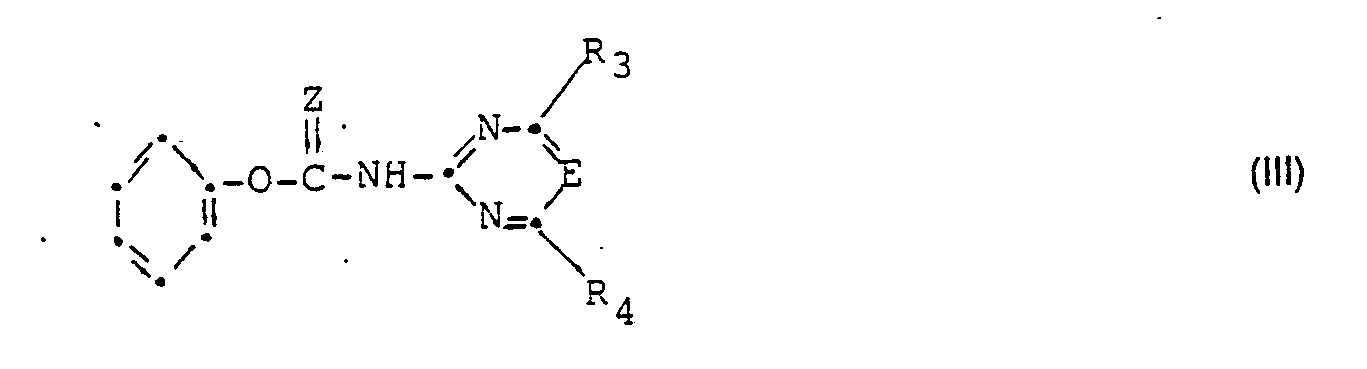
- the compounds of formula I are obtained by using a phenylsulfonamide of formula II wherein A, R 1 , R 2 , X and m have the meaning given under formula I, in the presence of a base with an N-pyrimidinyl or triazinyl carbamate of the formula III in which E, R 3 , R 4 and Z have the meaning given under formula I.
- a second process gives compounds of the formula I by using a phenylsulfonyl isocyanate or isothiocyanate of the formula IV wherein A, R 1 , R 2 , m, X and Z have the meaning given under formula 1, optionally in the presence of a base, with an amine of formula V. in which E, R 3 and R 4 have the meaning given under formula I.
- the compounds of the formula I are prepared by, if appropriate in the presence of a base, a sulfonamide of the formula II given above with an isocyanate or isothiocyanate of the formula VI in which E, R 3 , R 4 and Z have the meaning given under formula I.
- the compounds of the formula I can also be obtained by using an N-phenylsulfonylcarbamate of the formula VII wherein A, R 1 , R 2 , m and X have the meaning given under formula I, with an amine of formula V given above.
- the ureas of the formula I obtained can be converted into salts by means of amines, alkali metal or alkaline earth metal hydroxides or quaternary ammonium bases. This is done, for example, by reacting with the equimolar amount of base and evaporating the solvent.
- the compounds of formula II can also by oxygen or sulfur alkylation, respectively. Alkelnylation of hydroxy- or mercaptophenylsulfonamides with the corresponding halides, respectively. Sulfuric acid esters or by sales of ortho-halophenyl sulfonamides with metal alcoholates respectively. Mercaptides and optionally by their oxidation z. B. with period data respectively. Peracids to the corresponding sulfoxides and sulfones can be obtained.
- alkoxyphenylsulfonamides can in turn be obtained from the corresponding alkoxyanilides as already mentioned or by chlorosulfonylation of alkoxybenzenes and conversion of the phenylsulfonyl chlorides obtained with ammonium hydroxide solution. Such reactions are from J. Am. Chem. Soc. 62, 603 (1940).
- the phenylsulfonyl isocyanates of the formula IV can be obtained by reacting the sulfonamides of the formula II with phosgene in the presence of butyl isocyanate in a chlorinated hydrocarbon as solvent, at the reflux temperature. Similar representations are described in “Newer Methods of Preparative Organic Chemistry Volume VI, 223-241, Academic Press New York and London.
- the isothiocyanates of the formula IV are obtained by treating the sulfonamides of the formula II with carbon disulphide and potassium hydroxide and then reacting the dipotassium salt with phosgene. Such methods are described. In Arch Pharm. 299,. 174 (1966).
- N-phenylsulfonylcarbamates of the formula VII are obtained by reacting the sulfonamides of the formula II with diphenylcarbamate in the presence of a base. Similar processes are mentioned in Japanese Patent 61 169.
- the starting materials of the formulas III, V and VI are known or can be prepared by known methods.
- Isocyanates of the formula VI can be prepared by reacting amines of the formula V with oxalyl chloride in chlorinated hydrocarbons as solvents.
- Amines of the formula V are known and some are commercially available or they can be prepared by known methods, see “The Chemistry of Heterocyclic Compounds” Volume XIV, Interscience Publishers, New York, London.
- the reactions to compounds of formula I are advantageously carried out in aprotic, inert, organic solvents such as methylene chloride, tetrahydrofuran, acetonitrile, dioxane, toluene.
- aprotic, inert, organic solvents such as methylene chloride, tetrahydrofuran, acetonitrile, dioxane, toluene.
- the reaction temperatures are preferably between - 20 0 and + 120 ° C.
- the reactions are generally slightly exothermic and can be carried out at room temperature.
- the mixture is expediently warmed up briefly to the boiling point of the reaction mixture.
- the reaction times can also be accelerated by adding a few drops of base as a reaction catalyst.
- the end products can be isolated by concentrating and / or evaporating the solvent and can be purified by recrystallizing or triturating the solid residue in solvents in which they do not dissolve well, such as ethers, aromatic hydrocarbons or chlorinated hydrocarbons.
- the active ingredients of formula I are stable compounds. No precautionary measures are required to handle them.
- the compounds of the formula I have strong plant growth-regulating, in particular plant growth-inhibiting, properties. Both monocots and dicots are impaired in their growth.
- So z For example, the growth of legumes which are often cultivated in agriculture in tropical regions as cover crops is selectively inhibited by the compounds of the formula I, so that soil erosion between the crop plants is prevented. however, the cover crops cannot become a competition for culture.
- the compounds of the formula are also suitable for preventing the germination of stored potatoes.
- germs often develop, which result in shrinkage, weight loss and rot.
- the compounds of the formula I are distinguished by good selective growth-inhibiting and selective herbicidal properties which make them excellent for use in crops of useful plants, in particular in cereals, cotton, soybeans, corn and rice. Weeds are sometimes damaged, which previously could only be dealt with with total herbicides.
- the invention also relates to herbicidal and plant growth regulating compositions which comprise a new active ingredient of the formula 1, and to processes for pre- and post-emergent weed control and for inhibiting the growth of monocotyledonous and dicotyledonous plants, in particular grasses, tropical soil coverers and tobacco stingers.
- the compounds of formula I are used in unchanged form or preferably as agents together with the auxiliaries customary in formulation technology and are therefore used, for.
- the application methods, such as spraying, atomizing, dusting, scattering or pouring, are selected in the same way as the type of agent, in accordance with the desired objectives and the given conditions.
- the formulations i.e. H. the agents, preparations or compositions containing the active ingredient of formula 1 and optionally a solid or liquid additive are prepared in a known manner, for. B. by intimately mixing and / or grinding the active ingredients with extenders, such as. B. with solvents, solid carriers, and optionally surface-active compounds (surfactants).
- extenders such as. B. with solvents, solid carriers, and optionally surface-active compounds (surfactants).
- Aromatic hydrocarbons preferably fractions C 8 to C 12 , such as.
- xylene mixtures or substituted naphthalenes such as dibutyl or dicotyl phthalate
- aliphatic hydrocarbons such as cyclohexane or paraffins
- solid carriers e.g. B. for dusts and dispersible powders, natural rock flours are usually used, such as calcite, talc, kaolin, montmorillonite or attapulgite.
- highly disperse silica or highly disperse absorbent polymers can also be added.
- adsorptive granulate carriers come porous types such.
- pumice broken brick, sepiolite or bentonite, as non-sorptive support materials such.
- B. calcite or sand in question.
- a large number of pregranulated materials of inorganic or organic nature such as, in particular, dolomite or comminuted plant residues can be used.
- suitable surface-active compounds are nonionic, cationic and / or anionic surfactants with good emulsifying, dispersing and wetting properties.
- surfactants are also to be understood as mixtures of surfactants.
- Suitable anionic surfactants can be both so-called water-soluble soaps and water-soluble synthetic surface-active compounds.
- soaps are the alkali, alkaline earth or optionally substituted ammonium salts of higher fatty acids (C 1. -C 22 ), such as. B. the Na or K salts of oleic or stearic acid, or of natural fatty acid mixtures which, for. B. can be obtained from coconut or tallow oil.
- the fatty acid methyl taurine salts should also be mentioned.
- the fatty sulfonates or sulfates are generally in the form of alkali metal, alkaline earth metal or, if appropriate substituted ammonium salts and have an alkyl radical with 8 to 22 carbon atoms, alkyl also including the alkyl part of acyl radicals, for.
- This subheading also includes the salts of sulfuric acid esters and sulfonic acids from fatty alcohol / ethylene oxide adducts.
- the sulfonated benzimidazole derivatives preferably contain 2 sulfonic acid groups and a fatty acid residue with 8-22 carbon atoms.
- Alkylarylsulfonates are e.g. B. the Na, Ca or triethanolamine salts of dodecylbenzosulfonic acid, dibutylnaphthalenesulfonic acid or a naphthalenesulfonic acid-formaldehyde condensation product.
- Corresponding phosphates such as. B. salts of the phosphoric acid ester of a p-nonylphenol (4-14) ethylene oxide adduct in question.
- nonionic surfactants are polyglycol ether derivatives of aliphatic or cycloaliphatic alcohols, saturated or unsaturated fatty acids and alkylphenols, the 3 to 30 glycol ether groups and 8 to 20 carbon atoms in the (aliphatic) hydrocarbon radical and 6 to 18 carbon atoms in the alkyl radical of the alkylphenols can contain.
- nonionic surfactants are the water-soluble polyethylene oxide adducts containing 20 to 250 ethylene glycol ether groups and 10 to 100 propylene glycol ether groups with polypropylene glycol, ethylene diaminopolypropylene glycol and alkyl polypropylene glycol with 1 to 10 carbon atoms in the alkyl chain.
- the compounds mentioned usually contain 1 to 5 ethylene glycol units per propylene glycol unit.
- nonionic surfactants are nonylphenol polyethoxyethanols, castor oil polyglycol ethers, polypropylene-polyethylene oxide adducts, tributylphenoxypolyethanol, polyethylene glycol and octylphenoxypolyethanol.
- Fatty acid esters of polyoxyethylene sorbitan such as polyoxyethylene sorbitan trioleate, are also suitable.
- the cationic surfactants are, in particular, quaternary ammonium salts which contain at least one alkyl radical having 8 to 22 carbon atoms as N substituents and have lower, optionally halogenated alkyl, benzyl or lower hydroxyalkyl radicals as further substituents.
- the salts are preferably in the form of halides, methyl sulfates or ethyl sulfates, e.g. B. the stearyltrimethylammonium chloride or the benzyldi (2-chloroethyl) ethylammonium bromide.
- the pesticidal preparations generally contain 0.1 to 95%, in particular 1 to 80%, active ingredient of the formula I, 1 to 99% of a solid or liquid additive and 0 to 25%, in particular 0.1 to 25% of a surfactant.
- the use forms can be diluted down to 0.001% of active ingredient.
- the application rates are generally 0.01 to 10 kg ai / ha, preferably 0.025 to 5 kg ai / ha.
- the agents can also contain other additives such as stabilizers, defoamers, viscosity regulators, binders, adhesives and fertilizers or other active ingredients to achieve special effects.
- temperatures are in degrees Celsius, the pressures in millibars mb.
- Emulsions of any desired concentration can be prepared from such concentrates by dilution with water.
- the solutions are suitable for use in the form of tiny drops.
- the active ingredient is dissolved in methylene chloride, sprayed onto the carrier and the solvent is then evaporated off in vacuo.
- Ready-to-use dusts are obtained by intimately mixing the carrier substances with the active ingredient.
- the active ingredient is mixed well with the additives and ground well in a suitable mill.
- Spray powders are obtained which can be diluted with water to form suspensions of any desired concentration.
- Any desired concentration can be prepared from this concentrate by dilution with water.
- Ready-to-use dusts are obtained by mixing the active ingredient with the carrier and grinding it in a suitable mill.
- the active ingredient is mixed with the additives, ground and moistened with water. This mixture is extruded and then dried in an air stream.
- the finely ground active ingredient is applied evenly in a mixer to the kaolin moistened with polyethylene glycol. In this way, dust-free coating granules are obtained.
- the finely ground active ingredient is intimately mixed with the additives. This gives a suspension concentrate from which suspensions of any desired concentration can be prepared by dilution with water.
- a number of commercially available «Urgenta germ-free potatoes are washed and dried. The potatoes are then immersed in active ingredient emulsions of different concentrations for one minute each, placed in plastic trays on filter paper and kept at temperatures of 14 ° and 21 ° C. in the dark at 50% relative atmospheric humidity. The evaluation was carried out 34 days after the application. At the same time, the weight loss of the tubers and the weight of the germs are determined in comparison to the untreated control. Some of the compounds of Form I showed complete nucleation prevention in this experiment. At the same time, the weight loss of the potatoes was less than 10% of the weight loss of the control potatoes.
- test plants centrosema plumieri and centrosema pubescens
- the test plants are grown to the fully grown stage and cut back to a height of 60 cm. After 7 days, the active ingredient is injected as an aqueous emulsion.
- the test plants are kept at 70% relative air humidity and 6,000 lux artificial light, 14 hours a day, at temperatures of 27 ° during the day and 21 ° C at night.
- the test is evaluated 4 weeks after the application. However, the new growth compared to the control is estimated and weighed, and the phytotoxicity is assessed.
Landscapes
- Organic Chemistry (AREA)
- Chemical & Material Sciences (AREA)
- Life Sciences & Earth Sciences (AREA)
- Environmental Sciences (AREA)
- Agronomy & Crop Science (AREA)
- Engineering & Computer Science (AREA)
- Dentistry (AREA)
- General Health & Medical Sciences (AREA)
- Wood Science & Technology (AREA)
- Zoology (AREA)
- Plant Pathology (AREA)
- Pest Control & Pesticides (AREA)
- Health & Medical Sciences (AREA)
- Agricultural Chemicals And Associated Chemicals (AREA)
- Plural Heterocyclic Compounds (AREA)
- Organic Low-Molecular-Weight Compounds And Preparation Thereof (AREA)
- Pharmaceuticals Containing Other Organic And Inorganic Compounds (AREA)
- Spinning Or Twisting Of Yarns (AREA)
- Amplifiers (AREA)
- Magnetic Resonance Imaging Apparatus (AREA)
- Compositions Of Macromolecular Compounds (AREA)
- Low-Molecular Organic Synthesis Reactions Using Catalysts (AREA)
Description
- Die vorliegende Erfindung betrifft neue, herbizid wirksame und pflanzenwuchsregulierende N-Phenylsulfonyl-N'-pyrimidinyl- und -triazinyl-harnstoffe, Verfahren zu ihrer Herstellung, sie als Wirkstoffe enthaltende Mittel, sowie deren Verwendung zum Bekämpfen von Unkräutern, vor allem selektiv in Nutzpflanzenkulturen oder zum Regulieren und Hemmen des Pflanzenwachstums. Darüber hinaus betrifft die Erfindung auch als Zwischenprodukte hergestellte neue Phenylsulfonamide.
- Die erfindungsgemässen N-Phenylsulfonyl-N'-pyrimidinyl- und -triazinylharnstoffe entsprechen der allgemeinen Formel I

- A einem durch Cl-C4-Alkoxy, C1-C4-Alkyfthio, C1-C4-Alkylsulfinyl, C1-C4-Alkylsulfonyl, C1-C4-Halogenalkoxy, C1-C4-Halogenalkylthio, C1-C4-Halogenafkylsulfinyl oder Cl-C4-Halogenalkylsulfonyl substituierten C1-C6-Alkylrest oder einen gegebenenfalls durch die aufgezählten Substituenten substituierten C2-Cs-Alkenylrest oder einen C2-C6-Halogenalkenylrest,
- E die Methingruppe oder Stickstoff,
- X Sauerstoff, Schwefel, eine Sulfinyl- oder Sulfonylbrücke,
- Z Sauerstoff oder Schwefel,
- m die Zahl eins oder zwei,
- R1 Wasserstoff, Halogen, C1-C5-Alkyl, C2-C5-Alkenyl oder einen Rest -Y-R5,
- R2 Wasserstoff, Halogen, C1-C5-AIkyl, C2-C5-Alkenyl, C1-C4-Halogen-alkyl, oder einen Rest -Y-R5, ―COOR6, -N02 oder ―CO―NR7R8,
- R3 und R4 unabhängig voneinander Wasserstoff, C1-C4-Alkyl, C1-C4-Alkoxy, C1-C4-Alky(thio, C1-C4-Halogenalkyl, Halogen oder Alkoxyalkyl mit höchstens 4 Kohlenstoffatomen,
- Rs und R6 je C1-C5-Alkyl, C2-C5-Alkenyl oder C2-C6-Alkinyl,
- R7 und R8 unabhängig voneinander Wasserstoff, C1-C5-Alkyl, C2-C5-Alkenyl oder C6-C6-Alkinyl und
- Y Sauerstoff, Schwefel, eine Sulfinyl- oder Sulfonylbrücke bedeuten, mit der Massgabe, dass m die Zahl zwei bedeutet, wenn gleichzeitig X für Schwefel, eine Sulfinyl- oder Sulfonylbrücke und A für C3-C4-Alkenyl stehen, sowie den Salzen dieser Verbindungen.
- Harnstoffverbindungen, Triazinverbindungen und Pyrimidinverbindungen mit herbizider Wirkung sind allgemein bekannt. Kürzlich wurden Arylsulfamoyl-heterocyclyl-aminocarbamoylverbindungen mit herbizider und pflanzenwuchsregulierender Wirkung, beispielsweise in den europäischen Patentpublikationen Nr. 1514, 1515, dem US Patent No. 4127 405, in der DT-OS 2 715 786 oder in der FR-PS 1 468 747 beschrieben. In der nicht vorveröffenttichten europäischen Patentpublikation EP-A-35893 werden den erfindungsgemässen Substanzen strukturähnliche Verbindungen gleicher Wirkungsrichtung offenbart.
- In den Definitionen ist unter Alkyl geradkettiges oder verzweigtes Alkyl zu verstehen ; z. B. : Methyl, Aethyl, n-Propyl, i-Propyl, die vier isomeren Butyl, n-Amyl, i-Amyl, 2-Amyl, 3-Amyl, n-Hexyl oder i-Hexyl, vorzugsweise ist der Alkylrest jedoch geradkettig.
- Unter Alkoxy ist zu verstehen : Methoxy, Aethoxy, n-Propyloxy, i-Propyloxy und vier isomeren Butyloxyreste, insbesondere aber Methoxy oder Aethoxy.
- Beispiele für Alkythio sind Methylthio, Aethylthio, n-Propylthio, i-Propylthio und n-Butylthio, insbesondere aber Methylthio und Aethylthio.
- Beispiele für Alkenylreste sind Vinyl, Allyl, Isopropenyl, 1-Propenyl, 1-Butenyl, 2-Butenyl, 3-Butenyl, 1-Isobutenyl, 2-Isobutenyl, 1-Pentenyl, 2-Pentenyl, 3-Pentenyl und 4-Pentenyl, insbesondere aber Vinyl, Allyl und 4-Pentenyl.
- Beispiele für Alkylsulfinyl sind Methytsulfinyl, Aethylsulfinyl, n-Propylsulfinyl und n-Butylsulfinyl, insbesondere aber Methylsulfinyl und Aethylsulfinyl.
- Beispiele für Alkylsulfonyl sind Methylsulfonyl, Aethylsulfonyl, n-Propylsulfonyl und n-Butylsulfonyl, insbesondere aber Methylsulfonyl und Aethylsulfonyl.
- Unter Halogen in den Definitionen sowie in Halogenalkoxy, -alkylsulfinyl, -alkylsulfonyl, -alkylthio und -alkenyl sind Fluor, Chlor und Brom, vorzugsweise jedoch Fluor und Chlor zu verstehen.
- Die Erfindung umfasst ebenfalls die Salze, die die Verbindungen der Formel 1 mit Aminen, Alkali- und Erdalkalimetallbasen oder quaternären Ammoniumbasen bilden können.
- Unter Alkali- und Erdalkalimetallhydroxyden als Salzbildner sind die Hydroxyde von Lithium, Natrium, Kalium, Magnesium oder Calcium hervorzuheben, insbesondere aber die von Natrium oder Kalium.
- Beispiele für zur Salzbildung geeignete Amine sind primäre, sekundäre und tertiäre aliphatische und aromatische Amine wie Methylamin, Aethylamin, Propylamin, i-Propylamin, die vier isomeren Butylamine, Dimethylamin, Diäthylamin, Diäthanolamin, Dipropylamin, Diisopropylamin, Di-n-butylamin, Pyrrolidin, Piperidin, Morpholin, Trimethylamin, Triäthylamin, Tripropylamin, Chinuclidin, Pyridin, Chinolin und i-Chinolin, insbesondere aber Aethyl-, Propyl-, Diäthyl- oder Triäthylamin, vor allem aber iso-Propylamin und Diäthanolamin.
- Beispiele für quaternäre Ammoniumbasen sind im allgemeinen die Kationen von Halogenamminiumsalzen, z. B. das Tetramethylammoniumkation, das Trimethylbenzylammoniumkation, das Tri- äthylbenzylammoniumkation, das Tetraäthylammoniumkation, das Trimethyläthylammoniumkation, aber auch das Ammoniumkation.
- Unter der Verbindungen der Formel I sind diejenigen bevorzugt, in denen entweder
- a) Z Sauerstoff bedeutet oder
- b) die Reste R3 und R4 zusammen nicht mehr als 4 Kohlenstoffatome enthalten.
- Die Gruppe a kann aufgeteilt werden in zwei weitere Untergruppen, die aus Verbindungen bestehen, in denen
- aa) m die Zahl eins und
- ab) m die Zahl zwei bedeutet.
- Aus der Gruppe aa) sind die Verbindungen bevorzugt, in denen der Rest -X-A in der 2- oder 3-Position zum Sulfonylrest steht. Hierunter geniessen eine weitere Bevorzugung die Verbindungen, in denen der Rest -X-A in der 2-Position steht.
- Aus der Gruppe ab) bilden die Verbindungen eine bevorzugte Gruppe, in denen die beiden Reste -X-A in 2- und 5-Stellung zur Sulfonylgruppe stehen.
- Eine weitere Bevorzugung von Verbindungen der oben aufgelisteten Untergruppen der Gruppen aa) und ab) besteht darin, dass die Reste R3 und R4 zusammen höchstens 4 Kohlenstoffatome enthalten. Es bestehen somit die besonders bevorzugten Gruppen von Verbindungen darin, dass in Verbindungen der Formel I
- aab) nur ein Rest ―X―A in der 2-Stellung zum Sulfonylrest vorhanden ist, Z Sauerstoff bedeutet und die Reste R3 und R4 zusammen nicht mehr als 4 Kohlenstoffatome enthalten, und
- abb) zwei Reste -X-A in 2- und 5-Stellung zum Sulfonylrest vorhanden sind, Z Sauerstoff bedeutet und die Reste R3 und R4 zusammen nicht mehr als 4 Kohlenstoffatome enthalten.
- Aus der Gruppe aab) sind die Verbindungen bevorzugt, in denen R, Wasserstoff bedeutet, und der Rest R2 in der 5- oder 6-Stellung zur Sulfonylgruppe steht.
- Von diesen Verbindungen sind wiederum die bevorzugt, in denen R2 für Wasserstoff, Halogen, C1-C4-Alkoxy, Nitro oder COOR6 steht.
- Eine weitere Bevorzugung innerhalb der letztgenannten Gruppe geniessen die Verbindungen, in denen R2 Wasserstoff, Fluor, Nitro oder C1-C4-Alkoxy und R3 und R4 jeweils Wasserstoff, C1-C4-Alkyl, C1-C4-Alkoxy, C1-C4-Alkylthio, Halogen oder Alkoxyalkyl bedeuten, wobei R3 und R4 zusammen höchstens 4 Kohlenstoffatome enthalten.
- Unter diesen Verbindungen sind wiederum jene bevorzugt, in denen R2 Wasserstoff und R3 und R4 jeweils C1-C4-Alkyl, C1-C4-Alkoxy, Methylthio, Halogen oder Alkoxyalkyl bedeuten.
- Eine weitere Bevorzugung innerhalb der letztgenannten Gruppe geniessen die Verbindungen, in denen X für Sauerstoff oder Schwefel steht..
- Ganz besonders bevorzugt sind hiervon wiederum jene, in denen A für C2- C8-Alkoxyalkyl, C2-C4-Halogenalkenyl oder C2-C6-Alkenyl steht.
- Drei weiterhin aus der letzten Gruppe bevorzugte Untergruppen sind Gruppen von Verbindungen, in den
- a) A für C2-Ca-Alkoxyalkyl und R3 und R4 jeweils für Methyl, Aethyl, Chlor oder Methoxy,
- β) A für C2-C6-Alkenyl und R3 und R4 jeweils für Methyl, Aethyl, Chlor oder Methoxy und
- γ) A für die durch ein bis drei Halogenatome substituiertes Vinyl und R3 und R4 jeweils für Methyl, Aethyl, Chlor oder Methoxy stehen.
- Von den Verbindungen der Formel I, in denen Z für Schwefel steht, sind diejenigen bevorzugt, in denen X Sauerstoff, R3 und R4 jeweils unabhängig voneinander C1-C3-Alkyl, Cl-C3-Alkoxy oder C1-C3-Alkylthio mit zusammen höchstens 4 Kohlenstoffatomen bedeuten und A für -CH2-CH = CH2, ―CH2―CH = CH-CH3, -CH2-CH(CH3) = CH2, Methoxyäthyl, Methoxymethyl oder ―CC1 = CHCI steht und der Rest -X-A die 2-Stellung besetzt und m die Zahl 1 bedeutet.
- Als bevorzugte Einzelverbindung ist zu nennen :
- N-(2-Allyloxyphenylsulfonyl)-N'-(4-methoxy-6-methyl-1,3,5-triazin-2-yl)-harnstoff.
- Die Herstellung der Verbindungen der Formel I erfolgt in einem inerten, organischen Lösungsmittel.
- Nach einem ersten Verfahren werden die Verbindungen der Formel I erhalten, indem man ein Phenylsulfonamid der Formel II


- Nach einem zweiten Verfahren gelangt man zu Verbindungen der Formel I, indem man ein Phenylsulfonylisocyanat oder -isothiocyanat der Formel IV


- Nach einem weiteren Verfahren werden die Verbindungen der Formel I hergestellt, indem man ein Sulfonamid der oben angegebenen Formel II gegebenenfalls in Gegenwart einer Base mit einem isocyanat oder Isothiocyanat der Formel VI

- Schliesslich kann man die Verbindungen der Formel I auch erhalten, indem man ein N-Phenylsulfonylcarbamat der Formel VII

- Die erhaltenen Harnstoffe der Formel I können gewünschtenfalls mittels Aminen, Alkalimetall- oder Erdalkalimetallhydroxiden oder quaternären Ammoniumbasen in Salze übergeführt werden. Dieses geschieht beispielsweise durch Umsetzen mit der äquimolaren Menge Base und Verdampfen des Lösungsmittels.
- Die Ausgangsstoffe der Formeln Il, IV und VII sind zum Teil neu und können nach folgenden Methoden hergestellt werden :
- Die neuen und als Zwischenprodukte verwendeten Sulfonamide der Formel II werden aus den entsprechenden Anilinen durch Diazotierung und Austausch der Diazogruppe mit Schwefeldioxid in Gegenwart eines Katalysators wie Kupfer-I-chlorid in Salzsäure oder Essigsäure und Umsetzen des entstandenen Phenylsulfonylchlorids mit Ammoniumhydroxid-Lösung erhalten.
- Die Verbindungen der Formel II können auch durch Sauerstoff- oder Schwefel-Alkylierung resp. Alkelnylierung von Hydroxy- oder Mercaptophenylsulfonamiden mit den entsprechenden Halogeniden resp. Schwefelsäureestern oder durch Umsatz von ortho-Halogenphenylsulfonamiden mit Metall-Alkoholaten resp. Mercaptiden und gegebenenfalls durch deren Oxidation z. B. mit Perjodaten resp. Persäuren zu den entsprechenden Sulfoxiden und Sulfonen, erhalten werden.
- Substituierte ortho-Hydroxyphenyl- resp. ortho-substituierte Hydroxy- oder Mercaptophenylsulfonamide der Formel VIII,

- Die Alkoxyphenylsulfonamide wiederum können aus den entsprechenden Alkoxyaniliden wie bereits erwähnt oder durch Chlorsulfonylierung von Alkoxybenzolen und Umsatz der erhaltenen Phenylsulfonylchloriden mit Ammoniumhydroxid-Lösung gewonnen werden. Solche Reaktionen sind aus J. Am. Chem. Soc. 62, 603 (1940) bekannt geworden.
- Die als Zwischenprodukte verwendeten Verbindungen der Formeln II und VIII sind neu resp. z. T. neu und speziell für die Synthese von Verbindungen der Formel entwickelt worden. Diese Zwischenprodukte bilden einen weiteren Aspekt der vorliegenden Erfindung.
- Die Phenylsulfonylisocyanate der Formel IV können durch Umsetzungen der Sulfonamide der Formel II mit Phosgen in Anwesenheit von Butylisocyanat in einem chlorierten Kohlenwasserstoff als Lösungsmittel, bei Rückflusstemperatur erhalten werden. Aehnliche Darstellungen sind in « Newer Methods of Preparative Organic Chemistry Band VI, 223-241, Academic Press New York und London, beschrieben.
- Die Isothiocyanate der Formel IV werden durch Behandlung der Sulfonamide der Formel II mit Schwefelkohlenstoff und Kaliumhydroxid und anschliessender Umsetzung des Dikaliumsalzes mit Phosgen erhalten. Solche Verfahren sind in Arch. Pharm. 299,.174 (1966) beschrieben.
- Die N-Phenylsulfonylcarbamate der Formel VII werden durch Umsetzung der Sulfonamide der Formel II mit Diphenylcarbamat in Gegenwart einer Base erhalten. Aehnliche Verfahren sind in der japanischen Patentschrift 61 169 erwähnt.
- Die Ausgangsmaterialien der Formeln III, V und VI sind bekannt oder können nach bekannten Methoden hergestellt werden.
- Durch Umsetzung von Aminen der Formel V mit Oxalylchlorid in chlorierten Kohlenwasserstoffen als Lösungsmittel, lassen sich Isocyanate der Formel VI herstellen. Amine der Formel V sind bekannt und zum Teil im Handel erhältlich oder sie können nach bekannten Methoden hergestellt werden, siehe « The Chemistry of Heterocyclic Compounds» Band XIV, Interscience Publishers, New York, London.
- Die Umsetzungen zu Verbindungen der Formel I werden vorteilhafterweise in aprotischen, inerten, organischen Lösungsmitteln vorgenommen wie Methylenchlorid, Tetrahydrofuran, Acetonitril, Dioxan, Toluol.
- Die Reaktionstemperaturen liegen vorzugsweise zwischen - 200 und + 120 °C. Die Umsetzungen verlaufen im allgemeinen leicht exotherm und können bei Raumtemperetur durchgeführt werden. Zwecks Abkürzung der Reaktionszeit oder auch zum Einleiten der Umsetzung wird zweckdienlich für kurze Zeit bis zum Siedepunkt des Reaktionsgemisches aufgewärmt. Die Reaktionszeiten können ebenfalls durch Zugabe einiger Tropfen Base als Reaktionskatalysator beschleunigt werden.
- Die Endprodukte können durch Einengen und/oder Verdampfen des Lösungsmittels isoliert und durch Umkristallisieren oder Zerreiben des festen Rückstandes in Lösungsmitteln in denen sie sich nicht gut lösen, wie Aether, aromatischen Kohlenwasserstoffen oder chlorierten Kohlenwasserstoffen gereinigt werden.
- Die Wirkstoffe der Formel I sind stabile Verbindungen. Ihre Handhabung bedarf keiner vorsoglicher Massnahmen.
- Die Verbindungen der Formel I haben starke pflanzenwuchsregulierende, insbesondere pflanzenwuchshemmende, Eigenschaften. Es werden sowohl Monokotyledonen als auch Dikotyledonen in ihrem Wachstum beeinträchtigt.
- So können z. B. die in der Landwirtschaft in tropischen Gegenden häufig als « cover crops » (Bodenbedecker) angepflanzten Leguminosen durch die Verbindungen der Formel I in ihrem Wachstum selektiv gehemmt werden, so dass zwar die Bodenerosion zwischen den Kulturpflanzen verhindert wird. die « cover crops » jedoch nicht zur Konkurrenz für die Kultur werden können.
- Weiter eignen sich die Verbindungen der Formel um das Keimen von eingelagerten Kartoffeln zu verhindern. Bei Kartoffeln entwickeln sich bei der Einlagerung über den Winter häufig Keime, die Schrumpfen, Gewichtsverlust und Faulen zur Folge haben.
- Bei grösseren Aufwandmengen werden alle getesteten Pflanzen in ihrer Entwicklung so geschädigt, dass sie absterben.
- Bei geringeren Aufwendmengen zeichnen sich die Verbindungen der Formel I durch gute selektivwuchshemmende und selektiv-herbizide Eigenschaften aus, die sie ausgezeichnet zum Einsatz in Kulturen von Nutzpflanzen, insbesondere in Getreide, Baumwolle, Soja, Mais und Reis, befähigen. Es werden dabei teilweise auch Unkräuter geschädigt, welchen bisher nur mit Totalherbiziden beizukommen war.
- Die Wirkungsart dieser Wirkstoffe ist unüblich. Sie sind in vielen Fällen translozierbar, d. h. sie werden von der Pflanze aufgenommen und an andere Stellen transportiert, wo sie dann zur Wirkung kommen. Das unübliche daran ist, dass die Wirkstoffe nicht nur den Weg durch die Gefässbündel im Holzteil von den Wurzeln in die Blätter nehmen, sondern auch durch die Siebröhren im Bastteil von den Blättern zurück in die Wurzel transloziert werden können. So gelingt es beispielsweise durch Oberflächenbehandlung perenierende Unkräuter bis in die Wurzeln zu schädigen. Die neuen Verbindungen der Formel I wirken bereits bei - im Vergleich zu anderen Herbiziden und Wuchsregulatoren - sehr geringen Aufwandmengen.
- Die Erfindung betrifft auch herbizide und pflanzenwachstumsregulierende Mittel, welche einen neuen Wirkstoff der Formel 1 enthalten, sowie Verfahren zur pre- und post-emergenten Unkrautbekämpfung und zur Hemmung des Pflanzenwuchses von monokotylen und dikotylen Pflanzen, insbesondere Gräsern, tropischen Bodenbedeckern und Tabakgeiztrieben.
- Die Verbindungen der Formel I werden in unveränderter Form oder vorzugsweise als Mittel zusammen mit den in der Formulierungstechnik üblichen Hilfsmitteln eingesetzt und werden daher z. B. zu Emulsionskonzentraten, direkt versprühbaren oder verdünnbaren Lösungen, verdünnten Emulsionen, Spritzpulvern, löslichen Pulvern Stäubemitteln, Granulaten, auch Verkapselungen in z. B. polymeren Stoffen in bekannter Weise verarbeitet. Die Anwendungsverfahren wie Versprühen, Vernebeln, Verstäuben, Verstreuen oder Giessen werden gleich wie die Art der Mittel den angestrebten Zielen und den gegebenen Verhältnissen entsprechend gewählt.
- Die Formulierungen, d. h. die den Wirkstoff der Formel 1 und gegebenenfalls einen festen oder flüssigen Zusatzstoff enthaltenden Mittel, Zubereitungen oder Zusammensetzungen werden in bekannter Weise hergestellt, z. B. durch inniges Vermischen und/oder Vermahlen der Wirkstoffe mit Streckmitteln, wie z. B. mit Lösungsmitteln, festen Trägerstoffen, und gegebenenfalls oberflächenaktiven Verbindungen (Tensiden).
- Als Lösungsmittel können in Frage kommen : Aromatische Kohlenwasserstoffe, bevorzugt die Fraktionen C8 bis C12, wie z. B. Xylolgemische oder substituierte Naphthaline, Phthalsäureester wie Dibutyl- oder Dicotylphthalat, aliphatische Kohlenwasserstoffe wie Cyclohexan oder Paraffine, Alkohole und Glykole sowie deren Aether und Ester, wie Aethanol, Aethylenglykol, Aethylenglykolmonomethyl-oder äthyläther, Ketone wie Cyclohexanon, stark polare Lösungsmittel wie N-Methyl-2-pyrrolidon, Dimethylsulfoxid oder Dimethylformamid, sowie gegebenenfalls epoxidierte Pflanzenöle, wie epoxidiertes Kokosnussöl oder Sojaöl ; oder Wasser.
- Als feste Trägerstoffe, z. B. für Stäubemittel und dispergierbare Pulver, werden in der Regel natürliche Gesteinsmehle verwendet, wie Calcit, Talkum, Kaolin, Montmorillonit oder Attapulgit. Zur Verbesserung der physikalischen Eigenschaften können auch hochdisperse Kieselsäure oder Hochdisperse saugfähige Polymerisate zugesetzt werden. Als gekörnte, adsorptive Granulatträger kommen poröse Typen wie z. B. Bimsstein, Ziegelbruch, Sepiolit oder Bentonit, als nicht sorptive Trägermaterialien z. B. Calcit oder Sand in Frage. Darüberhinaus kann eine Vielzahl von vorgranulierten Materialien anorganischer oder organischer Natur wie insbesondere Dolomit oder zerkleinerte Pflanzenrückstande verwendet werden.
- Als oberflächenaktive Verbindungen kommen je nach der Art des zu formulierenden Wirkstoffes der Formel I nichtionogene, kation- und/oder anionaktive Tenside mit guten Emulgier , Dispergier- und Netzeigenschaften in Betracht. Unter Tensiden sind auch Tensidgemische zu verstehen.
- Geeignete anionische Tenside können sowohl sog. wasserlösliche Seifen als auch wasserlösliche synthetische oberflächenaktive Verbindungen sein.
- Als Seifen seien die Alkali-, Erdalkali- oder gegebenefalls substituierte Ammoniumsalze von höheren Fettsäuren (C1.-C22), wie z. B. die Na- oder K-Salze der Oel- oder Stearinsäure, oder von natürlichen Fettsäuregemischen, die z. B. aus Kokosnuss- oder Talgöl gewonnen werden können, genannt. Ferner sind auch die Fettsäure-methyl-taurinsalze zu erwähnen.
- Häufiger werden jedoch sogenannte synthetische Tenside verwendet, insbesondere Fettsulfonate, Fettsulfate, sulfonierte Benzimidazol-derivate oder Alkylarylsulfonate.
- Die Fettsulfonate oder -sulfate liegen in der Regel als Alkali-, Erdalkali- oder gegebenenfalls substituierte Ammoniumsalze vor und weisen einen Alkylrest mit 8 bis 22 C-Atomen auf, wobei Alkyl auch den Alkylteil von Acylresten einschliesst, z. B. das Na- oder Ca-Salz der Ligninsulfsonsäure, des Dodecylschwefelsäureesters oder eines aus natürlichen Fettsäuren hergestellten Fettalkoholsulfatgemisches. Hierher gehören auch die Salze der Schwefelsäureester und Sulfonsäuren von Fettalkohol-Aethylenoxid-Addukten. Die sulfonierten Benzimidazol-derivate enthalten vorzugswiese 2 Sulfonsäuregruppen und einen Fettsäurerest mit 8-22 C-Atomen. Alkylarylsulfonate sind z. B. die Na-, Ca- oder Triäthanolaminsalze der Dodecylbenzosulfonsäure, der Dibutylnaphthalinsulfonsäure oder eines Napthalinsulfonsäure-Formaldehydkondensationsproduktes.
- Ferner kommen auch entsprechende Phosphate wie z. B. Salze des Phosphorsäureesters eines p-Nonylphenol-(4-14)-Aethylenoxid-Adduktes in Frage.
- Als nicht ionische Tenside kommen in erster Linie Polyglykoläther-derivate von aliphatischen oder cycloaliphatischen Alkoholen, gesättigten oder ungesättigten Fettsäuren und Alkylphenolen in Frage, die 3 bis 30 Glykoläthergruppen und 8 bis 20 Kohlenstoffatome im (aliphatischen) Kohlenwasserstoffrest und 6 bis 18 Kohlenstoffatome im Alkylrest der Alkylphenole enthalten können.
- Weitere geeignete nichtionische Tenside sind die wasserlöslichen, 20 bis 250 Aethylenglykoläthergruppen und 10 bis 100 Propylenglykoläthergruppen enthaltenden Polyäthylenoxidaddukte an Polypropylenglykol, Aethylendiaminopolypropylenglykol und Alkylpolypropylenglykol mit 1 bis 10 Kohlenstoffatomen in der Alkylkette. Die genannten Verbindungen enthalten üblicherweise pro Propylenglykol-Einheit 1 bis 5 Aethylenglykoleinheiten.
- Als Beispiele nichtionischer Tenside seien Nonylphenolpolyäthoxyäthanole, Ricinusölpolyglykoläther, Polypropylen-Polyäthylenoxidaddukte, Tributylphenoxypolyäthanol, Polyäthylenglykol und Octylphenoxypolyäthanol erwähnt.
- Ferner kommen auch Fettsäureester von Polyoxyäthylensorbitan wie das Polyoxyäthylensorbitantrioleat in Betracht.
- Bei den kationischen Tensiden handelt es sich .vor allem um quaternäre Ammoniumsalze, welche als N-Substituenten mindestens einen Alkylrest mit 8 bis 22 C-Atomen enthalten und als weitere Substituenten niedrige, gegebenenfalls halogenierte Alkyl-, Benzyl- oder niedrige Hydroxyalkylreste aufweisen. Die Salze liegen vorzugsweise als Halogenide, Methylsulfate oder Aethylsulfate vor, z. B. das Stearyltrimethylammoniumchlorid oder das Benzyldi(2-chloräthyl)äthylammoniumbromid.
- Die in der Formulierungstechnik gebräuchlichen Tenside sind u. a. in folgenden Publikationen beschrieben :
- « Mc Cutcheon's Detergents and Emulsifiers Annual MC Publishing Corp., Ringwood, New Jersey, 1979. Sisely and Wood, « Encyclopedia of Surface Active Agents •, Chemical Publishing Co., Inc. New York, 1964.
- Die pestiziden Zubereitungen enthalten in der Regel 0,1 bis 95 %, insbesondere 1 bis 80 %, Wirkstoff der Formel I, 1 bis 99 % eines festen oder flüssigen Zusatzstoffes und 0 bis 25 %, insbesondere 0,1 bis 25 % eines Tensides.
- Insbesondere setzen sich bevorzugte Formulierungen folgendermassen zusammen : (% = Gewichtsprozent).

- Während als Handelsware eher konzentrierte Mittel bevorzugt werden, verwendet der Endverbraucher in der Regel verdünnte Mittel. Die Anwendungsformen können bis hinab zu 0,001 % an Wirkstoff verdünnt werden. Die aufwandmengen betragen in der Regel 0,01 bis 10 kg AS/ha, vorzugsweise 0,025 bis 5 kg AS/ha.
- Die Mittel können auch weitere Zusätze wie Stabilisatoren, Entschäumer, Viskositätsregulatoren, Bindemittel, Haftmittel sowie Dünger oder ander Wirkstoffe zur Erzielung spezieller Effekte enthalten.
- In den folgenden Beispielen sind die Temperaturen in Celsiusgraden °C, die Drücke in Millibar mb angegeben.
- Zu einer Suspension von 39 g 2-Methoxyphenylsulfonamid in 210 ml trockenem Methylenchlorid lässt man unter Stickstoffatmosphäre bei Raumtemperatur innerhalb von 15 Minuten 22,2 ml Bortribromid zutropfen. Die Reaktionsmischung wird danach für 1 Stunde bei Raumtemperatur gerührt. Anschliessend werden zur auf 0°C gekühlten Mischung innerhalb von 15 Minuten 200 ml Methanol zugesetzt und die klare Lösung eingedampft. Der ölige Rückstand wird in Aethylacetat aufgenommen, zweimal mit Wasser gewaschen, mit Natriumsulfat getrocknet und eingedampft. Durch Verreiben des Rückstandes mit Petroläther erhält man 25,1 g 2-Hydroxyphenylsulfonamid vom Schmelzpunkt 136-138 °C.
- In analoger Weise werden in in der folgenden Tabelle aufgelisteten Hydroxyphenylsulfonamide der Formel VIII erhalten.


- Eine Mischung von 3,5 g 2-Hydroxyphenylsulfonamid, 5,5 g Pottasche und 1,7 ml Allylbromid in 100 ml Methyläthylketon wird unter Stickstoffatmosphäre bei Rückflusstemperatur während 1 Stunde gerührt. Das Reaktionsgemisch wird auf Raumtemperatur abgekühlt, filtriert und eingedampft. Man erhält nach einmaligem Umkristallisieren aus Aethylacetat 3,27 g 2-Allyloxyphenylsulfonamid vom Schmelzpunkt 104-105 °C.
- Analog herzustellende Sulfonamide der Formel II sind in der anschliessenden Tabelle aufgelistet.


- Zur Suspension von 0,56 g Natriumhydrid (55 %) in 5 ml absolutem Dimethylformamid lässt man bei höchstens 20 °C unter einer Stickstoffatmosphäre innerhalb von 5 Minuten 2,76 g 2-Allyloxyphenylsulfonamid in 20 ml Dimethylformamid zutropfen und rührt vor dem tropfenweisen Zusatz von 2,91 g Diphenylcarbamat in 20 ml Dimethylformamid die Suspension für ca. 10 Minuten. Nach weiterem Rühren für 0,5 Stunden wird das Reaktionsgemisch mit einer Mischung von 80 ml Aethylacetat, 80 g Eis und 12,3 ml 2N Salzsäure aufgenommen. Die organische Phase wird zweimal mit Eiswasser gewaschen, über Natriumsulfat getrocknet und eingedampft. Kristallisation aus Aether/Petroläther (1 : 1) ergibt 3,5 g N-(2-Allyloxyphenyisulfonyl)-phenyl-carbamat, Smp. 140-141 °C.
- Eine Mischung von 3,33 g N-(2-Allyloxyphenylsulfonyl)-phenyl-carbamat und 1,4 g 2-Amino-4-methoxy-6-methyl-1,3,5-triazin in 30 ml absolutem Dioxan wird für 0,5 Stunden zum Rückfluss erhitzt, danach auf 20 °C abgekühlt, filtriert, eingedampft und aus Aether kristallisiert. Durch Umkristallissieren aus Aethylacetat/Petroläther (1 : 1) erhält man 2,0 g N-(2-Allyloxyphenylsulfonyl)-N'-(4-methoxy-6-methyl-1,3,5-triazin-2-yl)-hacnstoff, Smp. 146-147 °C.
- In analoger Weise werden die in der folgenden Tabelle aufgelisteten Verbindungen der Formel I hergestellt.


- Formulierungsbeispiele für flüssige Wirkstoffe der Formel I (% = Gewichtsprozent)

- Aus solchen Konzentraten können durch Verdünnen mit Wasser Emulsionen jeder gewünschten Konzentration hergestellt werden.

- Die Lösungen sind zur Anwendung in Form kleinster Tropfen geeignet.

- Der Wirkstoff wird in Methylenchlorid gelöst, auf den Träger aufgesprüht und das Lösungsmittel anschliessend im Vakuum abgedampft.

- Durch inniges Vermischen der Trägerstoffe mit dem Wirkstoff erhält man gebrauchsfertige Stäubemitel.
- Formulierungsbeispiele für feste Wirkstoffe der Formel I (% = Gewichtsprozent)

- Der Wirkstoff wird mit den Zusatzstoffen gut vermischt und in einer geeignete Mühle gut vermahlen. Man erhält Spritzpulver, die sich mit Wasser zu Suspensionen jeden gewünschten Konzentration verdünnen lassen.

- Aus diesem Konzentrat können durch Verdünnen mit Wasser Emulsionen jeden gewünschten Konzentration hergestellt werden.

- Man erhält anwendungsfertige Stäubemittel, indem der Wirkstoff mit dem Träger vermischt und auf einer geeigneten Mühle vermahlen wird.

- Der Wirkstoff wird mit den Zusatzstoffen vermischt, vermahlen und mit Wasser angefeuchtet. Dieses Gemisch wird extrudiert und anschliessend im Luftstrom getrocknet.

- Der fein gemahlene Wirkstoff wird in einem Mischer auf das mit Polyäthylenglykol angefeuchtete Kaolin gleichmässig aufgetragen. Auf diese Weise erhält man staubfreie Umhüllungs-Granulate.

- Der fein gemahlene Wirkstoff wird mit den Zusatzstoffen innig vermischt. Man erhält so ein Suspensions-Konzentrat, aus welchem durch Verdünnen mit Wasser Suspensionen jeder gewünschten Konzentration hergestellt werden können.

- Im Gewächshaus werden Pflanzensamen in Blumentöpfen von 12-15 cm Durchmesser gesät. Unmittelbar danach wird die Erdoberfläche mit einer wässrigen Dispersion oder Lösung der Wirkstoffe behandelt. Es werden verschiedene Konzentrationen mit Wirkstoffmengen pro Hextar angewendet. Die Töpfe werden dann im Gewächshaus bei einer Temperatur von 22-25 °C und 50-70 % relative Luftfeuchtigkeit gehalten. Nach 3 Wochen wird der Versuch ausgewertet und die Wirkung nach folgendem Massstab beurteilt :
- 1 : Pflanzen nicht gekeimt oder total abgestorben,
- 2-3 : sehr starke Wirkung,
- 4-6 mittlere Wirkung,
- 7-8 geringe Wirkung,
- 9 : keine Wirkung (wie unbehandelte Kontrolle).
-

- Eine Anzahl Unkräuter und Kulturpflanzen, sowohl monocotyle wie dicotyle, wurden nach dem Auflaufen, im 4- bis 6-Blattstadium mit einer wässrigen Wirkstoffdispersion in verschiedenen Dosierungen gespritzt und dann bei 24° bis 26 °C und 45-60 % relativer Luftfeuchtigkeit gehalten. 15 Tage nach der Behandlung wird der Versuch ausgewertet und die Wirkung nach dem gleichen Massstab wie im Beispiel 6 bewertet.
-

- Eine Anzahl im Handel erhältliche Kartoffeln der Sorte « Urgenta ohne Keime werden gewaschen und abgetrocknet. Danach werden die Kartoffeln für jeweils eine Minute in Wirkstoffemulsionen verschiedener Konzentration getaucht, in Kunststoffschalen auf Filterpapier ausgelegt und bei Temperaturen von 14° und 21 °C im Dunkeln bei 50 % relativer Luftfeuchtigkeit gehalten. Die Auswertung erfolgte 34 Tage nach der Applikation Gleichzeitig wird der Gewichtsverlust der Knollen und das Gewicht der Keime im Vergleich zur unbehandelten Kontrolle ermittelt. Einige der Verbindungen der Forme I zeigten in diesem Versuch eine vollständige Verhinderung der Keimbildung. Gleichzeitig betrug der Gewichtsverlust der Kartoffeln weniger als 10 % des Gewichtsverlustes der Kontrollkartoffeln.
- Die Versuchspflanzen (centrosema plumieri und centrosema pubescens) werden bis zum ausgewachsenen Stadium herangezogen und bis auf eine Höhe von 60 cm zurückgeschnitten. Nach 7 Tagen wird der Wirkstoff als wässrige Emulsion gespritzt. Die Versuchspflanzen werden bei 70 % relativer Luftfeuchtigkeit und 6 000 lux Kunstlicht, pro Tag 14 Stunden, bei Temperaturen von 27° bei Tag und 21 °C bei Nacht gehalten. 4 Wochen nach der Applikation wird der Versuch ausgewertet. Es werden daber der Neuzuwachs im Vergleich zur Kontrolle abgeschätzt und gewochen und die Phytotoxizität bewertet.
- In diesem Versuch zeigen die mit einigen der Wirkstoffe der Formel I behandelten Pflanzen eine deutliche Reduktion des Neuzuwachses (weniger als 20%) ohne dass dabei die Versuchspflanzen geschädigt wurden.
Claims (52)

mit der Massgabe, dass m die Zahl zwei bedeutet, wenn gleichzeitig X für Schwefel, eine Sulfinyl- oder Sulfonylbrücke und A für C3-C4-Alkenyl stehen, sowie die Salze dieser Verbindungen.



Priority Applications (1)
| Application Number | Priority Date | Filing Date | Title |
|---|---|---|---|
| AT81810281T ATE16555T1 (de) | 1980-07-17 | 1981-07-13 | N-phenylsulfonyl-n'-pyrimidinyl- und triazinylharnstoffe. |
Applications Claiming Priority (6)
| Application Number | Priority Date | Filing Date | Title |
|---|---|---|---|
| CH5481/80 | 1980-07-17 | ||
| CH5481/80A CH657849A5 (en) | 1980-07-17 | 1980-07-17 | N-Phenylsulfonyl-N'-pyrimidinyl- and -triazinyl ureas |
| CH8216/80 | 1980-11-05 | ||
| CH821680 | 1980-11-05 | ||
| CH399181 | 1981-06-17 | ||
| CH3991/81 | 1981-06-17 |
Publications (3)
| Publication Number | Publication Date |
|---|---|
| EP0044807A2 EP0044807A2 (de) | 1982-01-27 |
| EP0044807A3 EP0044807A3 (en) | 1982-04-07 |
| EP0044807B1 true EP0044807B1 (de) | 1985-11-21 |
Family
ID=27174660
Family Applications (3)
| Application Number | Title | Priority Date | Filing Date |
|---|---|---|---|
| EP81810282A Expired EP0044808B1 (de) | 1980-07-17 | 1981-07-13 | N-Phenylsulfonyl-N'-pyrimidinyl- und -triazinylharnstoffe |
| EP81810281A Expired EP0044807B1 (de) | 1980-07-17 | 1981-07-13 | N-Phenylsulfonyl-N'-pyrimidinyl- und -triazinylharnstoffe |
| EP81810283A Expired EP0044809B1 (de) | 1980-07-17 | 1981-07-13 | N-(2-substituierte Phenylsulfonyl)-N'-triazinylharnstoffe |
Family Applications Before (1)
| Application Number | Title | Priority Date | Filing Date |
|---|---|---|---|
| EP81810282A Expired EP0044808B1 (de) | 1980-07-17 | 1981-07-13 | N-Phenylsulfonyl-N'-pyrimidinyl- und -triazinylharnstoffe |
Family Applications After (1)
| Application Number | Title | Priority Date | Filing Date |
|---|---|---|---|
| EP81810283A Expired EP0044809B1 (de) | 1980-07-17 | 1981-07-13 | N-(2-substituierte Phenylsulfonyl)-N'-triazinylharnstoffe |
Country Status (25)
| Country | Link |
|---|---|
| US (11) | US4510325A (de) |
| EP (3) | EP0044808B1 (de) |
| KR (1) | KR850000495B1 (de) |
| AT (3) | ATE4526T1 (de) |
| AU (1) | AU545208B2 (de) |
| BG (2) | BG61518B2 (de) |
| BR (3) | BR8104619A (de) |
| CA (2) | CA1330438C (de) |
| CY (1) | CY1438A (de) |
| DD (2) | DD215461A5 (de) |
| DE (3) | DE3172974D1 (de) |
| DK (4) | DK163664C (de) |
| EG (1) | EG15401A (de) |
| ES (2) | ES8304553A1 (de) |
| GR (1) | GR74308B (de) |
| IL (3) | IL63324A (de) |
| KE (1) | KE3819A (de) |
| MA (1) | MA19205A1 (de) |
| MX (3) | MX170995B (de) |
| MY (2) | MY8600581A (de) |
| NZ (1) | NZ197733A (de) |
| PH (1) | PH18233A (de) |
| RO (1) | RO83456B (de) |
| TR (1) | TR21355A (de) |
| ZW (1) | ZW16681A1 (de) |
Families Citing this family (128)
| Publication number | Priority date | Publication date | Assignee | Title |
|---|---|---|---|---|
| US4452628A (en) * | 1979-07-26 | 1984-06-05 | E. I. Du Pont De Nemours And Company | Herbicidal sulfonamides |
| US4645531A (en) * | 1980-03-07 | 1987-02-24 | Du Pont | Alkyl sulfones |
| CA1330438C (en) * | 1980-07-17 | 1994-06-28 | Willy Meyer | N-phenylsulfonyl-n'-pyrimidinyl-and-triazinylureas |
| US4534789A (en) * | 1981-05-19 | 1985-08-13 | E. I. Du Pont De Nemours And Company | Herbicidal o-alkylsulfonyloxy- and o-alkylsulfonylaminobenzenesulfonamides |
| US4443243A (en) * | 1981-07-16 | 1984-04-17 | Ciba-Geigy Corporation | N-Phenylsulfonyl-N-triazinylureas |
| US4523944A (en) * | 1981-07-16 | 1985-06-18 | Ciba-Geigy Corporation | N-Phenylsulfonyl-N'-pyrimidinylureas |
| US4545811A (en) * | 1981-08-06 | 1985-10-08 | Ciba-Geigy Corporation | N-Phenylsulfonyl-N'-triazinyl-ureas |
| US4528024A (en) * | 1981-09-09 | 1985-07-09 | E. I. Du Pont De Nemours And Company | Herbicidal alkyl sulfones |
| US4579584A (en) * | 1981-10-13 | 1986-04-01 | Ciba-Geigy Corporation | N-phenylsulfonyl-N'-triazinylureas |
| CA1221698A (en) * | 1981-12-07 | 1987-05-12 | Rafael Shapiro | N-arylsulfonyl-n'-pyrimidinyl and triazinylureas |
| US4618363A (en) * | 1982-01-25 | 1986-10-21 | Ciba-Geigy Corporation | N-phenylsulfonyl-N'-triazinylureas |
| US4537618A (en) * | 1982-05-26 | 1985-08-27 | Ciba Geigy Corporation | N-phenylsulfonyl-N'-pyrimidinylureas |
| MA19797A1 (fr) * | 1982-06-14 | 1983-12-31 | Ciba Geigy Ag | N-heterocyclosulfonyl -n- pyrimidinyl et triazinylurees . |
| US4584011A (en) * | 1982-07-16 | 1986-04-22 | E. I. Du Pont De Nemours And Company | Triazinyl-amino carbonyl-benzene sulfonamides |
| US4518776A (en) * | 1982-07-19 | 1985-05-21 | Ciba Geigy Corporation | Process for producing sulfonylureas |
| EP0101670B1 (de) * | 1982-08-23 | 1988-03-09 | Ciba-Geigy Ag | Verfahren zur Herstellung von herbiziden und pflanzenwuchsregulierenden Sulfonylharnstoffen |
| US4780125A (en) * | 1982-09-01 | 1988-10-25 | Ciba-Geigy Corporation | N-phenylsulfonyl-N'-triazinylureas |
| US4579583A (en) * | 1982-09-08 | 1986-04-01 | Ciba-Geigy Corporation | Novel sulfonylureas |
| US4515626A (en) * | 1982-10-06 | 1985-05-07 | Ciba Geigy Corporation | N-(Cyclopropyl-triazinyl-n'-(arylsulfonyl) ureas having herbicidal activity |
| US4521597A (en) * | 1982-10-25 | 1985-06-04 | Ciba Geigy Corporation | Process for producing sulfonylureas having a herbicidal action |
| US4581059A (en) * | 1982-11-05 | 1986-04-08 | E. I. Du Pont De Nemours And Company | Herbicidal phenoxy esters of N-(heterocyclic)aminocarbonyl)sulfamic acid |
| USH168H (en) | 1982-12-13 | 1986-12-02 | E. I. Du Pont De Nemours And Company | Herbicidal sulfonamides |
| US4562210A (en) * | 1983-01-17 | 1985-12-31 | Ciba-Geigy Corporation | Bactericides |
| US4515624A (en) * | 1983-03-23 | 1985-05-07 | E. I. Du Pont De Nemours And Company | Herbicidal sulfonamides |
| EP0125205A1 (de) * | 1983-04-13 | 1984-11-14 | Ciba-Geigy Ag | N-Phenylsulfonyl-N'-pyrimidinyl- und -triazinylharnstoffe |
| IT1161220B (it) * | 1983-04-21 | 1987-03-18 | Montedison Spa | Diidro-benzofurano derivati ad attivita' erbicida |
| US4589911A (en) * | 1983-05-11 | 1986-05-20 | Ciba-Geigy Corporation | Fused N-phenylsulfonyl-N-triazinylureas |
| EP0132230B1 (de) * | 1983-07-18 | 1988-10-05 | Ciba-Geigy Ag | Verfahren zur Herstellung von Sulfonylharnstoffen |
| US4764204A (en) * | 1983-08-05 | 1988-08-16 | E. I. Du Pont De Nemours And Company | Herbicidal sulfonamides |
| AU575335B2 (en) * | 1983-08-05 | 1988-07-28 | E.I. Du Pont De Nemours And Company | Benzene sulfonamides |
| US4604131A (en) * | 1983-08-05 | 1986-08-05 | E. I. Du Pont De Nemours And Company | Herbicidal sulfonamides |
| US4705556A (en) * | 1984-07-12 | 1987-11-10 | E. I. Du Pont De Nemours And Company | Herbicidal sulfonamides |
| US4639264A (en) * | 1983-08-26 | 1987-01-27 | Ciga-Geigy Corporation | Herbicidal N-arylsulfonyl-N'-(4-mercaptomethylpyrimdinyl)-ureas |
| US4602936A (en) * | 1983-09-09 | 1986-07-29 | Ciba-Geigy Corporation | Herbicidal sulfonylureas |
| DE3332780A1 (de) * | 1983-09-10 | 1985-03-28 | Hoechst Ag, 6230 Frankfurt | 6-sulfoxyphenolderivate, ihre herstellung und ihre verwendung als cytoprotekiva |
| EP0151554A1 (de) * | 1984-02-03 | 1985-08-14 | Ciba-Geigy Ag | Neue Phenylsulfonamidderivate |
| US4685961A (en) * | 1984-02-14 | 1987-08-11 | Ciba-Geigy Corporation | Herbicidal sulfonylureas |
| US4588432A (en) * | 1984-02-27 | 1986-05-13 | E. I. Du Pont De Nemours And Company | Herbicidal selenylsulfonamides |
| US4840963A (en) * | 1984-03-14 | 1989-06-20 | Merck & Co., Inc. | 2-Sulfamoyl-1H-indole derivatives for the treatment of elevated intraocular pressure |
| EP0158600B1 (de) * | 1984-04-11 | 1991-04-03 | Ciba-Geigy Ag | Verfahren zur selektiven Unkrautbekämpfung in Nutzpflanzenkulturen |
| JPS60215660A (ja) * | 1984-04-11 | 1985-10-29 | Nippon Tokushu Noyaku Seizo Kk | ビフエニリルスルホニルウレア誘導体の製法、その中間体及び該中間体の製法 |
| US4637829A (en) * | 1984-04-27 | 1987-01-20 | Ciba-Geigy Corporation | Sulfonylureas |
| CA1229086A (en) * | 1984-05-09 | 1987-11-10 | Hugh M. Brown | Herbicidal halopyrimidines |
| US4710221A (en) * | 1985-04-10 | 1987-12-01 | E. I. Du Pont De Nemours And Company | Herbicidal sulfonamides |
| US4981509A (en) * | 1984-05-24 | 1991-01-01 | E. I. Du Pont De Nemours And Company | Herbicidal sulfonamides |
| US4849010A (en) * | 1985-04-10 | 1989-07-18 | E. I. Dupont De Nemours And Company | Herbicidal sulfonamides |
| US4871847A (en) * | 1984-05-24 | 1989-10-03 | E. I. Du Pont De Nemours And Company | Herbicidal sulfonamides |
| US4727187A (en) * | 1984-06-15 | 1988-02-23 | Ciba-Geigy Corporation | Process for the preparation of α, α-difluoroalkyl phenyl ether derivatives |
| US4656273A (en) * | 1984-07-09 | 1987-04-07 | Ciba-Geigy Corporation | Process for producing sulfonylureas |
| US4659369A (en) | 1984-08-27 | 1987-04-21 | E. I. Du Pont De Nemours And Company | Herbicidal acetals and ketals |
| US4780126A (en) * | 1984-08-30 | 1988-10-25 | Bayer Aktiengesellschaft | 3-substituted 1-(2-halogenoalkoxy-benzenesulphonyl)-3-heteroaryl-(thio)ureas |
| DE3431917A1 (de) * | 1984-08-30 | 1986-03-13 | Bayer Ag, 5090 Leverkusen | 1-(2-trifluormethoxy-phenylsulfonyl)-3- heteroaryl-(thio)-harnstoffe |
| US4678855A (en) * | 1985-10-09 | 1987-07-07 | Merck & Co., Inc. | Substituted benzenesulfonamides |
| CA1230119A (en) | 1985-11-22 | 1987-12-08 | Craig L. Hillemann | N-2-carboxylphenylsulfonyl-n'-pyrimidin-2-yl or triazin-2-yl-urea compounds |
| US4724039A (en) * | 1985-11-22 | 1988-02-09 | E. I. Du Pont De Nemours And Company | Herbicidal sulfonamides |
| DE3601801A1 (de) * | 1986-01-22 | 1987-07-23 | Bayer Ag | Herbizide mittel |
| US4798688A (en) * | 1986-03-05 | 1989-01-17 | Ciba-Geigy Corporation | 2-alkoxy-5-chloro-benzenesulfonates useful for the preparation of 2-alkoxybenzosulfonamides |
| US4709092A (en) * | 1986-03-05 | 1987-11-24 | Ciba-Geigy Corporation | Process for the preparation of 2-alkoxybenzosulfonamides |
| US4759792A (en) * | 1986-06-05 | 1988-07-26 | Ciba-Geigy Corporation | Phenylsulfonylureas |
| ATE71096T1 (de) * | 1986-09-26 | 1992-01-15 | Ciba Geigy Ag | Aminopyrazinone und aminotriazinone. |
| US5108487A (en) * | 1986-10-17 | 1992-04-28 | E. I. Du Pont De Nemours And Company | Herbicidal sulfonamides |
| US4927453A (en) * | 1986-10-17 | 1990-05-22 | E. I. Du Pont De Nemours And Company | Herbicidal sulfonamides |
| CH668530A5 (de) * | 1986-10-22 | 1989-01-13 | Ciba Geigy Ag | Synergistisches mittel und verfahren zur selektiven unkrautbekaempfung in reis. |
| US5217525A (en) * | 1986-10-22 | 1993-06-08 | Ciba-Geigy Corporation | Synergistic composition and method for selective weed control in rice |
| US5017215A (en) * | 1987-08-07 | 1991-05-21 | E. I. Du Pont De Nemours And Company | Herbicides for weed control in rice |
| US4959501A (en) * | 1987-09-04 | 1990-09-25 | Ciba-Geigy Corporation | Process for the preparation of 2-(2-chloroethoxy)-benzenesulfonamide |
| US4806528A (en) * | 1987-09-04 | 1989-02-21 | Hanreich Reinhard G | Process for the preparation of 2-(2-chloroethoxy)-benzenesulfonamide |
| DE3811777A1 (de) * | 1988-04-08 | 1989-10-19 | Hoechst Ag | Heterocyclisch substituierte alkyl- und alkenylsulfonylharnstoffe, verfahren zu ihrer herstellung und ihre verwendung als herbizide oder pflanzenwachstumsregulatoren |
| WO1989010921A1 (en) * | 1988-05-12 | 1989-11-16 | E.I. Du Pont De Nemours And Company | Herbicidal sulfonamides |
| DE3822841A1 (de) * | 1988-06-18 | 1989-12-21 | Hoechst Ag | Substituierte sulfonyldiamide, verfahren zu ihrer herstellung und ihre verwendung als herbizide und pflanzenwachstumsregulatoren |
| BR8907515A (pt) | 1988-06-28 | 1991-05-28 | Du Pont | Formulacoes de pesticidas em comprimidos |
| DE3831382A1 (de) * | 1988-09-15 | 1990-04-12 | Hoechst Ag | Verfahren zur herstellung von 2-alkoxy-benzolsulfonamid-verbindungen |
| US5215570A (en) * | 1988-10-20 | 1993-06-01 | Ciba-Geigy Corporation | Sulfamoylphenylureas |
| EP0378508B1 (de) * | 1989-01-11 | 1995-03-01 | Ciba-Geigy Ag | Antidots zur Verbesserung der Kulturpflanzenvertäglichkeit agrochemischer Wirkstoffe |
| US5272129A (en) * | 1989-03-18 | 1993-12-21 | Hoechst Aktiengesellschaft | Phenoxysulfonylureas based on 3-substituted alkyl salicylates, and their use as herbicides and plant growth regulators |
| EP0402316B1 (de) * | 1989-06-06 | 1994-09-14 | Ciba-Geigy Ag | Sulfonylharnstoffe |
| GR1000748B (el) * | 1989-08-07 | 1992-12-30 | Basf Ag | Αποφυλλωτικο μεσο για τη βαμβακια. |
| ES2062488T3 (es) * | 1989-09-29 | 1994-12-16 | Ciba Geigy Ag | Procedimiento para la preparacion de 2-(2-halogenetiltio)-fenilsulfonamidas. |
| US5062878A (en) * | 1989-11-13 | 1991-11-05 | Toby's Chemical Company | Method and apparatus for clearing flora from sewer lines |
| DE59006512D1 (de) * | 1989-12-08 | 1994-08-25 | Ciba Geigy Ag | Verfahren zur Herstellung von Phenylsulfonamiden. |
| DE59107185D1 (de) * | 1990-05-30 | 1996-02-15 | Ciba Geigy Ag | Sulfonylharnstoffe mit herbizider und pflanzenwuchsregulierender Wirkung |
| DK0463998T3 (da) * | 1990-06-29 | 1997-07-14 | Ciba Geigy Ag | Immunologisk påvisningsfremgangsmåde for triasulforon. |
| DE4021489A1 (de) * | 1990-07-06 | 1992-01-09 | Hoechst Ag | Substituierte sulfonalkylsulfonylharnstoffe, verfahren zu ihrer herstellung und ihre verwendung als herbizide und pflanzenwachstumsregulatoren |
| DE59106466D1 (de) * | 1990-08-15 | 1995-10-19 | Ciba Geigy Ag | Sulfonylharnstoffe als Herbizide. |
| MY136106A (en) * | 1990-09-06 | 2008-08-29 | Novartis Ag | Synergistic composition comprising a sulfonylurea anda thiadiazolo (3,4-a)pyridazine and method of selective weed control. |
| DE4038430A1 (de) * | 1990-12-01 | 1992-06-04 | Basf Ag | Herbizide n-((1,3,5-triazin-2-yl)-aminocarbonyl) benzolsulfonamide |
| EP0558448A1 (de) * | 1992-02-26 | 1993-09-01 | Ciba-Geigy Ag | 1,5-Diphenylpyrazol-3-Carbonsäure-Derivate als Antidots für Sulfonylharnstoffherbizide |
| DE4206146A1 (de) * | 1992-02-28 | 1993-09-02 | Basf Ag | Herbizide n-((1,3,5-triazin-2-yl)aminocarbonyl)benzolsulfonamide |
| DE4206145A1 (de) * | 1992-02-28 | 1993-09-02 | Basf Ag | Herbizide n-((pyrimidin-2-yl)aminocarbonyl)benzolfulfonamide |
| US6017851A (en) * | 1992-05-06 | 2000-01-25 | Novartis Corp. | Synergistic composition and process for selective weed control |
| AU661620B2 (en) * | 1992-05-06 | 1995-07-27 | Syngenta Participations Ag | Synergistic composition and process for selective weed control |
| US5244866A (en) * | 1992-07-31 | 1993-09-14 | American Cyanamid Company | Method of inhibiting sprout growth on agronomic crops using acetohydroxy acid synthase inhibiting herbicides |
| FR2711368B1 (fr) * | 1993-09-16 | 1996-01-05 | Roussel Uclaf | Nouveau procédé de préparation de dérivés soufrés de l'imidazole et les nouveaux intermédiaires obtenus. |
| LT3943B (en) | 1993-12-23 | 1996-05-27 | Ciba Geigy Ag | Remedy for cultured plants protection, use of sulphamoyl-phenyl-carbamides for cultured plant protection, herbicidal preparation, process for preparing sulphamoyl-phenyl-carbamides |
| EP0739164A1 (de) | 1994-01-10 | 1996-10-30 | Novartis AG | Herbizide benetzbare pulverformulierungen |
| PL317418A1 (en) * | 1994-06-01 | 1997-04-14 | Hoechst Schering Agrevo Gmbh | Formyloaminophenylosuphonyl ureas, method of obtaining them and their application as herbicides and plant growth controlling agents |
| CA2203011C (en) * | 1994-10-24 | 2001-12-11 | Korea Research Institute Of Chemical Technology | Herbicidal sulfonyl urea derivatives |
| DE19525162A1 (de) | 1995-07-11 | 1997-01-16 | Bayer Ag | Sulfonylamino(thio)carbonylverbindungen |
| KR100188339B1 (ko) * | 1995-11-24 | 1999-06-01 | 이서봉 | 방향족 염화물의 파라-이성체 제조용 촉매 |
| DE19608445A1 (de) | 1996-03-05 | 1997-09-11 | Bayer Ag | Substituierte Arylsulfonyl(thio)harnstoffe |
| US6225260B1 (en) * | 1996-11-22 | 2001-05-01 | Lonza Inc. | Quaternary ammonium salts of a sulfonylurea |
| AU744497B2 (en) * | 1996-11-22 | 2002-02-28 | E.I. Du Pont De Nemours And Company | Quaternary ammonium salts of a sulfonylurea |
| WO1998021963A1 (en) * | 1996-11-22 | 1998-05-28 | E.I. Du Pont De Nemours And Company | Quarternary ammonium salts and their use in agricultural formulations |
| US5721364A (en) * | 1996-12-13 | 1998-02-24 | Novartis Corporation | Process for making 2-amino-4, 6-dialkoxy-1, 3, 5-triazines |
| BE1012386A3 (fr) * | 1999-01-15 | 2000-10-03 | Univ Liege | Derives de sulfonamides benzeniques et leurs utilisations. |
| WO2000044226A1 (de) * | 1999-01-27 | 2000-08-03 | Aventis Cropscience Gmbh | Formulierung von herbiziden |
| DE19963383A1 (de) | 1999-12-28 | 2001-07-05 | Aventis Cropscience Gmbh | Formulierung von Herbiziden und Pflanzenwachstumsregulatoren |
| DE10111649A1 (de) | 2001-03-12 | 2002-09-19 | Bayer Ag | Substituierte Fluoralkoxyphenylsulfonylharnstoffe |
| DE10117673A1 (de) * | 2001-04-09 | 2002-10-10 | Bayer Ag | Substituierte Fluoralkoxyphenylsulfonylamino(thio)carbonyl-triazolin(thi)one |
| DE102005026620B4 (de) * | 2005-06-09 | 2012-05-16 | Ab Skf | Verfahren zur Herstellung eines Dichtungselements und Dichtungselement |
| EP2052606A1 (de) | 2007-10-24 | 2009-04-29 | Bayer CropScience AG | Herbizid-Kombination |
| EP2052604A1 (de) | 2007-10-24 | 2009-04-29 | Bayer CropScience AG | Salz des 2-lodo-N-[(4-methoxy-6-methyl-1,3,5-triazin-2-yl)carbamoyl] benzolsulfonamids,Verfahren zu deren Herstellung, sowie deren Verwendung als Herbizide und Pflanzenwachstumregulatoren |
| EP2110019A1 (de) | 2008-04-19 | 2009-10-21 | Bayer CropScience AG | Herbizide Verbindungen auf Basis von N-Azinyl-N'-phenylsulfonylharnstoffen |
| DE102008037620A1 (de) | 2008-08-14 | 2010-02-18 | Bayer Crop Science Ag | Herbizid-Kombination mit Dimethoxytriazinyl-substituierten Difluormethansulfonylaniliden |
| WO2010046423A2 (en) | 2008-10-22 | 2010-04-29 | Basf Se | Use of sulfonylurea herbicides on cultivated plants |
| EP2371823A1 (de) | 2010-04-01 | 2011-10-05 | Bayer CropScience AG | Cyclopropyl-substituierte Phenylsulfonylamino(thio)carbonyltriazolinone, ihre Herstellung und Verwendung als Herbizide und Pflanzenwachstumsregulatoren |
| HRP20211509T1 (hr) | 2010-10-15 | 2021-12-24 | Bayer Cropscience Aktiengesellschaft | Upotreba herbicida inhibitora als za suzbijanje neželjene vegetacije u biljkama beta vulgaris tolerantnim na herbicide inhibitore als |
| CN102461541B (zh) * | 2010-11-19 | 2013-09-18 | 南京华洲药业有限公司 | 一种含醚磺隆、禾草敌与环庚草醚的混合除草剂及其应用 |
| AU2012251597B2 (en) | 2011-05-04 | 2015-11-05 | Bayer Intellectual Property Gmbh | Use of ALS inhibitor herbicides for control of unwanted vegetation in ALS inhibitor herbicide tolerant Brassica, such as B. napus, plants |
| CN103039485A (zh) * | 2011-10-17 | 2013-04-17 | 南京华洲药业有限公司 | 一种含醚磺隆与二甲戊乐灵的混合除草剂及其应用 |
| CN103039482A (zh) * | 2011-10-17 | 2013-04-17 | 南京华洲药业有限公司 | 一种含醚磺隆与敌稗的混合除草剂及其应用 |
| US20130102469A1 (en) | 2011-10-20 | 2013-04-25 | Swartz family dba Olvidium | Method and compound for removing flora from sewer lines |
| RS57806B2 (sr) | 2012-12-13 | 2022-07-29 | Bayer Cropscience Ag | Upotreba als inhibitora herbicida za kontrolu neželjene vegetacije kod beta vulgaris biljaka tolerantnih na als inhibitore herbicida |
| CN102960358A (zh) * | 2012-12-17 | 2013-03-13 | 南开大学 | 旱田除草剂组合物及其田间除草方法 |
| CN103086966A (zh) * | 2012-12-28 | 2013-05-08 | 合肥久易农业开发有限公司 | 一种磺酰胺基甲酸酯的合成方法 |
| EP2821388A1 (de) * | 2013-07-05 | 2015-01-07 | Solvay SA | Fluorierungsverfahren |
| CN103508968B (zh) * | 2013-09-12 | 2015-09-09 | 江苏长青农化股份有限公司 | 除麦田阔叶草剂醚苯磺隆的绿色合成工艺 |
| US20260026505A1 (en) | 2022-07-25 | 2026-01-29 | Syngenta Crop Protection Ag | Herbicidal compositions |
Citations (1)
| Publication number | Priority date | Publication date | Assignee | Title |
|---|---|---|---|---|
| EP0035893A2 (de) * | 1980-03-07 | 1981-09-16 | E.I. Du Pont De Nemours And Company | Benzol- und Pyridin-sulfonamid-Derivate mit herbizider Wirkung |
Family Cites Families (24)
| Publication number | Priority date | Publication date | Assignee | Title |
|---|---|---|---|---|
| GB791923A (en) * | 1955-08-08 | 1958-03-12 | Ici Ltd | New sulphonamides |
| FR1468747A (fr) * | 1965-07-19 | 1967-02-10 | Benzène-sulfonyl-1 (pyrimidyl-2)-3 urées | |
| US4154753A (en) * | 1966-01-12 | 1979-05-15 | Imperial Chemical Industries Limited | Fluorinated compounds containing functional groups |
| IL40344A0 (en) * | 1971-09-22 | 1972-11-28 | Du Pont | Substituted benzenesulfonamides,their preparation and their use for controlling mites |
| US4169719A (en) * | 1976-04-07 | 1979-10-02 | E. I. Du Pont De Nemours And Co. | Herbicidal sulfonamides |
| CA1082189A (en) * | 1976-04-07 | 1980-07-22 | George Levitt | Herbicidal sulfonamides |
| US4190432A (en) * | 1977-08-01 | 1980-02-26 | E. I. Du Pont De Nemours And Company | Herbicidal sulfonamides |
| DK401978A (da) * | 1977-10-06 | 1979-04-07 | Du Pont | Herbicide sulfonamider |
| US4257802A (en) * | 1977-10-06 | 1981-03-24 | E. I. Du Pont De Nemours And Company | Herbicidal sulfonamides |
| US4339266A (en) * | 1977-10-06 | 1982-07-13 | E. I. Du Pont De Nemours And Company | Herbicidal sulfonamides |
| US4141916A (en) * | 1978-02-13 | 1979-02-27 | The Dow Chemical Company | 3,4,5-Trichloro-N,N-Di(loweralkyl)-2-((chloromethyl)thio)benzenesulfonamides |
| DK163123C (da) * | 1978-05-30 | 1992-06-09 | Du Pont | Benzensulfonylurinstoffer til anvendelse som herbicider eller plantevaekstregulatorer, praeparat indeholdende dem samt deres anvendelse |
| DK349479A (da) * | 1978-09-27 | 1980-03-28 | Du Pont | Sulfonamidderivater og deres anvendelse til regulering af plantevaekst |
| US4342587A (en) * | 1979-07-20 | 1982-08-03 | E. I. Du Pont De Nemours And Company | Herbicidal pyridinsulfonamides |
| US4310346A (en) * | 1980-03-14 | 1982-01-12 | E. I. Du Pont De Nemours And Company | N(Substituted phenylsulfonyl) N'(substituted cyumidin-2-yl) ureas |
| US4452628A (en) * | 1979-07-26 | 1984-06-05 | E. I. Du Pont De Nemours And Company | Herbicidal sulfonamides |
| US4301286A (en) * | 1979-08-20 | 1981-11-17 | E. I. Du Pont De Nemours And Company | Herbicidal O-alkyl sulfonylisoureas |
| DK455480A (da) * | 1979-11-30 | 1981-05-31 | Du Pont | Fremgangsmaade til fremstilling af herbicide n- (substituerede heterocycliske aminocarbonyl)-aromatiske sulfonamider |
| US4348220A (en) * | 1980-07-11 | 1982-09-07 | E. I. Du Pont De Nemours And Company | Herbicidal sulfonamides |
| US4368069A (en) * | 1980-07-11 | 1983-01-11 | E. I. Du Pont De Nemours And Company | Herbicidal sulfonamides |
| US4370480A (en) * | 1980-07-11 | 1983-01-25 | E. I. Du Pont De Nemours And Company | Herbicidal ureas and isoureas |
| CA1330438C (en) * | 1980-07-17 | 1994-06-28 | Willy Meyer | N-phenylsulfonyl-n'-pyrimidinyl-and-triazinylureas |
| US4487626A (en) * | 1980-08-22 | 1984-12-11 | E. I. Du Pont De Nemours And Company | Herbicidal sulfonamides |
| US4371391A (en) * | 1980-09-15 | 1983-02-01 | E. I. Du Pont De Nemours And Company | Herbicidal sulfonamides |
-
1980
- 1980-07-15 CA CA000381786A patent/CA1330438C/en not_active Expired - Lifetime
-
1981
- 1981-07-01 MA MA19405A patent/MA19205A1/fr unknown
- 1981-07-13 EP EP81810282A patent/EP0044808B1/de not_active Expired
- 1981-07-13 EP EP81810281A patent/EP0044807B1/de not_active Expired
- 1981-07-13 AT AT81810283T patent/ATE4526T1/de not_active IP Right Cessation
- 1981-07-13 DE DE8181810281T patent/DE3172974D1/de not_active Expired
- 1981-07-13 DE DE8181810282T patent/DE3173493D1/de not_active Expired
- 1981-07-13 DE DE8181810283T patent/DE3160818D1/de not_active Expired
- 1981-07-13 AT AT81810282T patent/ATE17431T1/de active
- 1981-07-13 EP EP81810283A patent/EP0044809B1/de not_active Expired
- 1981-07-13 AT AT81810281T patent/ATE16555T1/de not_active IP Right Cessation
- 1981-07-15 IL IL8163324A patent/IL63324A/xx not_active IP Right Cessation
- 1981-07-15 PH PH25917A patent/PH18233A/en unknown
- 1981-07-15 RO RO104891A patent/RO83456B/ro unknown
- 1981-07-15 IL IL8179463A patent/IL79463A/xx unknown
- 1981-07-15 EG EG402/81A patent/EG15401A/xx active
- 1981-07-15 ZW ZW166/81A patent/ZW16681A1/xx unknown
- 1981-07-16 NZ NZ197733A patent/NZ197733A/en unknown
- 1981-07-16 TR TR21355A patent/TR21355A/xx unknown
- 1981-07-16 ES ES504013A patent/ES8304553A1/es not_active Expired
- 1981-07-16 DD DD81231843A patent/DD215461A5/de not_active IP Right Cessation
- 1981-07-16 GR GR65532A patent/GR74308B/el unknown
- 1981-07-16 DD DD81269168A patent/DD220601A5/de not_active IP Right Cessation
- 1981-07-16 DK DK318681A patent/DK163664C/da not_active IP Right Cessation
- 1981-07-16 KR KR1019810002603A patent/KR850000495B1/ko not_active Expired
- 1981-07-16 AU AU73036/81A patent/AU545208B2/en not_active Expired
- 1981-07-17 BR BR8104619A patent/BR8104619A/pt not_active IP Right Cessation
- 1981-07-17 MX MX005729A patent/MX170995B/es unknown
- 1981-07-17 BR BR8104617A patent/BR8104617A/pt unknown
- 1981-07-17 MX MX819558U patent/MX6981E/es unknown
- 1981-07-17 BR BR8104618A patent/BR8104618A/pt unknown
- 1981-07-17 MX MX005728A patent/MX170994B/es unknown
-
1982
- 1982-09-13 US US06/417,743 patent/US4510325A/en not_active Expired - Lifetime
- 1982-09-24 US US06/423,344 patent/US4476321A/en not_active Expired - Lifetime
- 1982-12-16 ES ES518258A patent/ES8401950A1/es not_active Expired
-
1983
- 1983-01-17 US US06/458,696 patent/US4425154A/en not_active Expired - Lifetime
- 1983-01-17 US US06/458,694 patent/US4537619A/en not_active Expired - Lifetime
- 1983-01-17 US US06/458,594 patent/US4514212A/en not_active Expired - Lifetime
- 1983-01-17 US US06/458,695 patent/US4479821A/en not_active Expired - Lifetime
- 1983-01-17 US US06/458,691 patent/US4444583A/en not_active Expired - Lifetime
- 1983-01-17 US US06/458,584 patent/US4419121A/en not_active Expired - Lifetime
- 1983-01-17 US US06/458,693 patent/US4561878A/en not_active Expired - Lifetime
- 1983-03-23 CA CA000424330A patent/CA1205482A/en not_active Expired
-
1985
- 1985-01-22 US US06/693,481 patent/US4629810A/en not_active Expired - Lifetime
- 1985-08-02 US US06/761,941 patent/US4681619A/en not_active Expired - Lifetime
-
1986
- 1986-07-21 IL IL8679463A patent/IL79463A0/xx unknown
- 1986-12-30 MY MY581/86A patent/MY8600581A/xx unknown
-
1987
- 1987-12-30 MY MY138/87A patent/MY8700138A/xx unknown
-
1988
- 1988-05-11 KE KE3819A patent/KE3819A/xx unknown
-
1989
- 1989-03-10 CY CY1438A patent/CY1438A/xx unknown
-
1990
- 1990-06-13 DK DK144190A patent/DK165182C/da not_active IP Right Cessation
-
1991
- 1991-11-20 DK DK189391A patent/DK164901C/da not_active IP Right Cessation
-
1992
- 1992-01-08 DK DK002392A patent/DK166082C/da not_active IP Right Cessation
- 1992-06-15 BG BG096470A patent/BG61518B2/bg unknown
- 1992-06-15 BG BG096468A patent/BG60335B2/bg unknown
Patent Citations (1)
| Publication number | Priority date | Publication date | Assignee | Title |
|---|---|---|---|---|
| EP0035893A2 (de) * | 1980-03-07 | 1981-09-16 | E.I. Du Pont De Nemours And Company | Benzol- und Pyridin-sulfonamid-Derivate mit herbizider Wirkung |
Also Published As
Similar Documents
| Publication | Publication Date | Title |
|---|---|---|
| EP0044808B1 (de) | N-Phenylsulfonyl-N'-pyrimidinyl- und -triazinylharnstoffe | |
| EP0070802B1 (de) | N-Phenylsulfonyl-N'-pyrimidinyl- und -triazinylharnstoffe | |
| EP0103543B1 (de) | Neue Sulfonylharnstoffe | |
| EP0116518B1 (de) | N-Phenylsulfonyl-N'-pyrimidinyl- und -triazinylharnstoffe | |
| EP0099339B1 (de) | Anellierte N-Phenylsulfonyl-N'-pyrimidinyl- und -triazinylharnstoffe | |
| EP0120814B1 (de) | N-Phenylsulfonyl-N'-pyrimidinyl- und -triazinylharnstoffe | |
| EP0084020B1 (de) | N-Arylsulfonyl-N'-pyrimidinylharnstoffe | |
| EP0097122B1 (de) | N-Heterocyclosulfonyl-N'-pyrimidinyl- und -triazinylharnstoffe | |
| EP0072347B1 (de) | N-Phenylsulfonyl-N'-pyrimidinyl- und -triazinylharnstoffe | |
| EP0126711B1 (de) | Herbizid wirksame und pflanzenwuchsregulierende Pyrimidin-Derivate, deren Herstellung und Verwendung | |
| EP0096002B1 (de) | N-Phenylsulfonyl-N'-pyrimidinyl- und -triazinylharnstoffe | |
| DD212885A5 (de) | Herbizides und den pflanzenwuchs hemmendes mittel | |
| CH649081A5 (de) | Triaza-verbindungen. | |
| EP0085028A2 (de) | N-Phenylsulfonyl-N'-pyrimidinyl- und -triazinylharnstoffe | |
| EP0248245A2 (de) | 2-Fluoralkenyl-phenylsulfonsäure-Derivate | |
| EP0141777A2 (de) | Herbizide Sulfonylharnstoffe | |
| EP0082108B1 (de) | N-Phenylsulfonyl-N'-pyrimidinyl- und -triazinylharnstoffe | |
| EP0161211B1 (de) | N-Heterocyclosulfonyl-N'-pyrimidinyl- und -triazinylharnstoffe | |
| EP0128116B1 (de) | Anellierte N-Phenylsulfonyl-N'-pyrimidinyl- und -triazinylharnstoffe | |
| EP0125205A1 (de) | N-Phenylsulfonyl-N'-pyrimidinyl- und -triazinylharnstoffe | |
| EP0145664B1 (de) | Herbizide Sulfonylharnstoffe | |
| EP0169815B1 (de) | N-Arylsulfonyl-N'-triazinyl- und -pyrimidinylharnstoffe | |
| EP0102924B1 (de) | N-Azidophenylsulfonyl-N'-pyrimidinyl- und -triazinylharnstoffe | |
| EP0206995B1 (de) | N-Heterocyclosulfonyl-N'-pyrimidinyl-, N'-triazolyl- und N'-triazinyl-harnstoffe | |
| EP0159966B1 (de) | Sulfonylharnstoffe |
Legal Events
| Date | Code | Title | Description |
|---|---|---|---|
| PUAI | Public reference made under article 153(3) epc to a published international application that has entered the european phase |
Free format text: ORIGINAL CODE: 0009012 |
|
| 17P | Request for examination filed |
Effective date: 19810715 |
|
| AK | Designated contracting states |
Designated state(s): AT BE DE FR GB IT NL SE |
|
| PUAL | Search report despatched |
Free format text: ORIGINAL CODE: 0009013 |
|
| AK | Designated contracting states |
Designated state(s): AT BE DE FR GB IT NL SE |
|
| ITF | It: translation for a ep patent filed | ||
| GRAA | (expected) grant |
Free format text: ORIGINAL CODE: 0009210 |
|
| AK | Designated contracting states |
Designated state(s): AT BE DE FR GB IT NL SE |
|
| REF | Corresponds to: |
Ref document number: 16555 Country of ref document: AT Date of ref document: 19851215 Kind code of ref document: T |
|
| REF | Corresponds to: |
Ref document number: 3172974 Country of ref document: DE Date of ref document: 19860102 |
|
| ET | Fr: translation filed | ||
| PLBE | No opposition filed within time limit |
Free format text: ORIGINAL CODE: 0009261 |
|
| STAA | Information on the status of an ep patent application or granted ep patent |
Free format text: STATUS: NO OPPOSITION FILED WITHIN TIME LIMIT |
|
| 26N | No opposition filed | ||
| ITTA | It: last paid annual fee | ||
| EAL | Se: european patent in force in sweden |
Ref document number: 81810281.6 |
|
| REG | Reference to a national code |
Ref country code: GB Ref legal event code: 732E |
|
| NLS | Nl: assignments of ep-patents |
Owner name: NOVARTIS AG |
|
| REG | Reference to a national code |
Ref country code: FR Ref legal event code: CP Free format text: PRODUCT NAME: CINOSULFURON; NAT. REGISTRATION NO/DATE: 9200545 19930721; FIRST REGISTRATION: IT - 8026 19920316 Spc suppl protection certif: 97C0055 Filing date: 19970724 |
|
| REG | Reference to a national code |
Ref country code: FR Ref legal event code: TP |
|
| REG | Reference to a national code |
Ref country code: FR Ref legal event code: C1 Free format text: FRC1 97C0055, 19970724 |
|
| FITD | It: supplementary protection certificate for herbicidal products: granted |
Free format text: CCPF 28, 19970729; NOVARTIS AG. |
|
| REG | Reference to a national code |
Ref country code: FR Ref legal event code: CP |
|
| REG | Reference to a national code |
Ref country code: FR Ref legal event code: C2 Free format text: FRC2 97C0055, 970724 |
|
| REG | Reference to a national code |
Ref country code: FR Ref legal event code: CP |
|
| PGFP | Annual fee paid to national office [announced via postgrant information from national office to epo] |
Ref country code: FR Payment date: 20000614 Year of fee payment: 20 Ref country code: BE Payment date: 20000614 Year of fee payment: 20 |
|
| PGFP | Annual fee paid to national office [announced via postgrant information from national office to epo] |
Ref country code: SE Payment date: 20000619 Year of fee payment: 20 Ref country code: NL Payment date: 20000619 Year of fee payment: 20 Ref country code: DE Payment date: 20000619 Year of fee payment: 20 |
|
| PGFP | Annual fee paid to national office [announced via postgrant information from national office to epo] |
Ref country code: GB Payment date: 20000623 Year of fee payment: 20 |
|
| PGFP | Annual fee paid to national office [announced via postgrant information from national office to epo] |
Ref country code: AT Payment date: 20000626 Year of fee payment: 20 |
|
| BE20 | Be: patent expired |
Free format text: 20010713 *NOVARTIS A.G. |
|
| PG25 | Lapsed in a contracting state [announced via postgrant information from national office to epo] |
Ref country code: GB Free format text: LAPSE BECAUSE OF EXPIRATION OF PROTECTION Effective date: 20010712 |
|
| PG25 | Lapsed in a contracting state [announced via postgrant information from national office to epo] |
Ref country code: NL Free format text: LAPSE BECAUSE OF EXPIRATION OF PROTECTION Effective date: 20010713 Ref country code: AT Free format text: LAPSE BECAUSE OF EXPIRATION OF PROTECTION Effective date: 20010713 |
|
| PG25 | Lapsed in a contracting state [announced via postgrant information from national office to epo] |
Ref country code: SE Free format text: THE PATENT HAS BEEN ANNULLED BY A DECISION OF A NATIONAL AUTHORITY Effective date: 20010714 |
|
| REG | Reference to a national code |
Ref country code: GB Ref legal event code: PE20 Effective date: 20010712 |
|
| NLV7 | Nl: ceased due to reaching the maximum lifetime of a patent |
Effective date: 20010713 |
|
| EUG | Se: european patent has lapsed |
Ref document number: 81810281.6 |
|
| REG | Reference to a national code |
Ref country code: FR Ref legal event code: TP Spc suppl protection certif: 97C0055 |