EP0042081B1 - Fluid containers - Google Patents
Fluid containers Download PDFInfo
- Publication number
- EP0042081B1 EP0042081B1 EP81103978A EP81103978A EP0042081B1 EP 0042081 B1 EP0042081 B1 EP 0042081B1 EP 81103978 A EP81103978 A EP 81103978A EP 81103978 A EP81103978 A EP 81103978A EP 0042081 B1 EP0042081 B1 EP 0042081B1
- Authority
- EP
- European Patent Office
- Prior art keywords
- lining
- barrier layer
- alkali
- container
- processing composition
- Prior art date
- Legal status (The legal status is an assumption and is not a legal conclusion. Google has not performed a legal analysis and makes no representation as to the accuracy of the status listed.)
- Expired
Links
- 239000012530 fluid Substances 0.000 title description 7
- 239000000203 mixture Substances 0.000 claims description 42
- 230000004888 barrier function Effects 0.000 claims description 38
- 230000001070 adhesive effect Effects 0.000 claims description 23
- 239000000853 adhesive Substances 0.000 claims description 21
- 239000011888 foil Substances 0.000 claims description 21
- 239000003513 alkali Substances 0.000 claims description 20
- 238000007789 sealing Methods 0.000 claims description 15
- 239000005030 aluminium foil Substances 0.000 claims description 14
- 238000000034 method Methods 0.000 claims description 13
- 239000000463 material Substances 0.000 claims description 12
- 229910052751 metal Inorganic materials 0.000 claims description 11
- 239000002184 metal Substances 0.000 claims description 11
- 229920000728 polyester Polymers 0.000 claims description 11
- 125000000391 vinyl group Chemical group [H]C([*])=C([H])[H] 0.000 claims description 10
- 229920002554 vinyl polymer Polymers 0.000 claims description 10
- 229920001169 thermoplastic Polymers 0.000 claims description 9
- 239000004416 thermosoftening plastic Substances 0.000 claims description 9
- 229920000459 Nitrile rubber Polymers 0.000 claims description 8
- -1 polyethylene Polymers 0.000 claims description 7
- 239000004800 polyvinyl chloride Substances 0.000 claims description 4
- 229920000915 polyvinyl chloride Polymers 0.000 claims description 4
- 239000004698 Polyethylene Substances 0.000 claims description 3
- 229920000573 polyethylene Polymers 0.000 claims description 3
- 229920005989 resin Polymers 0.000 claims description 3
- 239000011347 resin Substances 0.000 claims description 3
- 239000004677 Nylon Substances 0.000 claims description 2
- 230000009969 flowable effect Effects 0.000 claims description 2
- 229920001778 nylon Polymers 0.000 claims description 2
- 239000005026 oriented polypropylene Substances 0.000 claims description 2
- 239000010410 layer Substances 0.000 description 42
- 239000004411 aluminium Substances 0.000 description 18
- 229910052782 aluminium Inorganic materials 0.000 description 18
- XAGFODPZIPBFFR-UHFFFAOYSA-N aluminium Chemical compound [Al] XAGFODPZIPBFFR-UHFFFAOYSA-N 0.000 description 18
- ZWEHNKRNPOVVGH-UHFFFAOYSA-N 2-Butanone Chemical compound CCC(C)=O ZWEHNKRNPOVVGH-UHFFFAOYSA-N 0.000 description 12
- 239000011133 lead Substances 0.000 description 12
- 239000002904 solvent Substances 0.000 description 12
- KAKZBPTYRLMSJV-UHFFFAOYSA-N Butadiene Chemical compound C=CC=C KAKZBPTYRLMSJV-UHFFFAOYSA-N 0.000 description 8
- 239000011248 coating agent Substances 0.000 description 6
- 238000000576 coating method Methods 0.000 description 6
- 239000007789 gas Substances 0.000 description 6
- 239000012790 adhesive layer Substances 0.000 description 5
- 229920001577 copolymer Polymers 0.000 description 5
- 238000006243 chemical reaction Methods 0.000 description 4
- 229920000139 polyethylene terephthalate Polymers 0.000 description 4
- 239000005020 polyethylene terephthalate Substances 0.000 description 4
- NLHHRLWOUZZQLW-UHFFFAOYSA-N Acrylonitrile Chemical compound C=CC#N NLHHRLWOUZZQLW-UHFFFAOYSA-N 0.000 description 3
- 238000010276 construction Methods 0.000 description 3
- 238000002788 crimping Methods 0.000 description 3
- 238000003860 storage Methods 0.000 description 3
- UFHFLCQGNIYNRP-UHFFFAOYSA-N Hydrogen Chemical compound [H][H] UFHFLCQGNIYNRP-UHFFFAOYSA-N 0.000 description 2
- XTXRWKRVRITETP-UHFFFAOYSA-N Vinyl acetate Chemical compound CC(=O)OC=C XTXRWKRVRITETP-UHFFFAOYSA-N 0.000 description 2
- BZHJMEDXRYGGRV-UHFFFAOYSA-N Vinyl chloride Chemical compound ClC=C BZHJMEDXRYGGRV-UHFFFAOYSA-N 0.000 description 2
- QVGXLLKOCUKJST-UHFFFAOYSA-N atomic oxygen Chemical compound [O] QVGXLLKOCUKJST-UHFFFAOYSA-N 0.000 description 2
- 239000003054 catalyst Substances 0.000 description 2
- 230000032798 delamination Effects 0.000 description 2
- 238000001035 drying Methods 0.000 description 2
- 239000001257 hydrogen Substances 0.000 description 2
- 229910052739 hydrogen Inorganic materials 0.000 description 2
- 238000004519 manufacturing process Methods 0.000 description 2
- 239000001301 oxygen Substances 0.000 description 2
- 229910052760 oxygen Inorganic materials 0.000 description 2
- 239000012858 resilient material Substances 0.000 description 2
- 239000000565 sealant Substances 0.000 description 2
- 230000035939 shock Effects 0.000 description 2
- 239000000126 substance Substances 0.000 description 2
- OFOBLEOULBTSOW-UHFFFAOYSA-N Propanedioic acid Natural products OC(=O)CC(O)=O OFOBLEOULBTSOW-UHFFFAOYSA-N 0.000 description 1
- 229920002433 Vinyl chloride-vinyl acetate copolymer Polymers 0.000 description 1
- 239000002253 acid Substances 0.000 description 1
- 150000004645 aluminates Chemical class 0.000 description 1
- 230000015572 biosynthetic process Effects 0.000 description 1
- 230000009172 bursting Effects 0.000 description 1
- 125000003178 carboxy group Chemical group [H]OC(*)=O 0.000 description 1
- 238000007334 copolymerization reaction Methods 0.000 description 1
- 238000004132 cross linking Methods 0.000 description 1
- 230000002950 deficient Effects 0.000 description 1
- 230000006866 deterioration Effects 0.000 description 1
- 238000009792 diffusion process Methods 0.000 description 1
- 238000009826 distribution Methods 0.000 description 1
- 239000007788 liquid Substances 0.000 description 1
- VZCYOOQTPOCHFL-UPHRSURJSA-N maleic acid Chemical compound OC(=O)\C=C/C(O)=O VZCYOOQTPOCHFL-UPHRSURJSA-N 0.000 description 1
- 239000011976 maleic acid Substances 0.000 description 1
- 238000002844 melting Methods 0.000 description 1
- 230000008018 melting Effects 0.000 description 1
- 150000002825 nitriles Chemical class 0.000 description 1
- 239000007800 oxidant agent Substances 0.000 description 1
- 229920002037 poly(vinyl butyral) polymer Polymers 0.000 description 1
- 230000037452 priming Effects 0.000 description 1
- 239000007965 rubber solvent Substances 0.000 description 1
- 239000004332 silver Substances 0.000 description 1
- 229910052709 silver Inorganic materials 0.000 description 1
- 239000000758 substrate Substances 0.000 description 1
- VZCYOOQTPOCHFL-UHFFFAOYSA-N trans-butenedioic acid Natural products OC(=O)C=CC(O)=O VZCYOOQTPOCHFL-UHFFFAOYSA-N 0.000 description 1
- XLYOFNOQVPJJNP-UHFFFAOYSA-N water Substances O XLYOFNOQVPJJNP-UHFFFAOYSA-N 0.000 description 1
- 230000004580 weight loss Effects 0.000 description 1
Images

Classifications
-
- G—PHYSICS
- G03—PHOTOGRAPHY; CINEMATOGRAPHY; ANALOGOUS TECHNIQUES USING WAVES OTHER THAN OPTICAL WAVES; ELECTROGRAPHY; HOLOGRAPHY
- G03C—PHOTOSENSITIVE MATERIALS FOR PHOTOGRAPHIC PURPOSES; PHOTOGRAPHIC PROCESSES, e.g. CINE, X-RAY, COLOUR, STEREO-PHOTOGRAPHIC PROCESSES; AUXILIARY PROCESSES IN PHOTOGRAPHY
- G03C8/00—Diffusion transfer processes or agents therefor; Photosensitive materials for such processes
- G03C8/32—Development processes or agents therefor
- G03C8/34—Containers for the agents
-
- Y—GENERAL TAGGING OF NEW TECHNOLOGICAL DEVELOPMENTS; GENERAL TAGGING OF CROSS-SECTIONAL TECHNOLOGIES SPANNING OVER SEVERAL SECTIONS OF THE IPC; TECHNICAL SUBJECTS COVERED BY FORMER USPC CROSS-REFERENCE ART COLLECTIONS [XRACs] AND DIGESTS
- Y10—TECHNICAL SUBJECTS COVERED BY FORMER USPC
- Y10T—TECHNICAL SUBJECTS COVERED BY FORMER US CLASSIFICATION
- Y10T428/00—Stock material or miscellaneous articles
- Y10T428/14—Layer or component removable to expose adhesive
- Y10T428/1471—Protective layer
-
- Y—GENERAL TAGGING OF NEW TECHNOLOGICAL DEVELOPMENTS; GENERAL TAGGING OF CROSS-SECTIONAL TECHNOLOGIES SPANNING OVER SEVERAL SECTIONS OF THE IPC; TECHNICAL SUBJECTS COVERED BY FORMER USPC CROSS-REFERENCE ART COLLECTIONS [XRACs] AND DIGESTS
- Y10—TECHNICAL SUBJECTS COVERED BY FORMER USPC
- Y10T—TECHNICAL SUBJECTS COVERED BY FORMER US CLASSIFICATION
- Y10T428/00—Stock material or miscellaneous articles
- Y10T428/28—Web or sheet containing structurally defined element or component and having an adhesive outermost layer
- Y10T428/2848—Three or more layers
Definitions
- This invention relates to a photographic product comprising a rupturable container holding an aqueous alkaline photographic processing composition, and to a method of forming such container.
- Rupturable containers for the storage and dispensing of aqueous alkaline photographic processing compositions are shown and described in US-A-2,543,181; 3,056,491; 3,056,492; 3,649,282; and others.
- Containers of this kind are employed in photographic products such as the Polaroid SX-70 film units made and sold by Polaroid Corporation of Cam- bridge, Massachusetts.
- the basic requirements of such a container are that it exclude oxygen from the processing composition, and prevent the escape of any appreciable quantity of water, until the composition is to be dispensed.
- Fluid containers disclosed in the above-cited patents essentially comprise an outer layer of paper, a polyester or the like adhered to a metal foil that serves as the required gas barrier.
- the metal foil is adhered to a liner of a material such as polyvinyl chloride that is in contact with the processing composition and functions to prevent contact between the processing composition and the metal foil gas barrier.
- Aluminium foil would be a highly desirable replacement for lead foil in processing fluid containers. Aluminium is not only considerably less expensive than lead on a weight basis, but is much lighter and can be obtained in reasonably pinhole-free foils of about one-half the thickness of a lead foil with a equivalent pinhole population. However, aluminium reacts readily with aqueous alkaline compositions, forming an aluminate and gaseous hydrogen. As pointed out in US-A-3,649,282, the hydrogen produced in such a reaction could cause rupture of the container.
- EP-A 1-0011481 relates to rupturable containers for fluids such as photographic processing fluids, having a preferentially bursting seal composed of specific methacrylate copolymers.
- the rupturable container is a laminated construction having an outer paper layer, a layer of metal foil such as lead or aluminium and an inner layer of a resin which is resistant to deterioration by the specific copolymers.
- the object of these specific copolymers is to provide sealing compositions which exhibit desired burst sealing strength over a wide sealing temperature, and retain this strength over a long period of time.
- the object of this invention is to provide a rupturable container holding an aqueous alkaline photographic processing composition including an aluminium gas and moisture barrier in which the aluminium is isolated.
- the object of this invention is to provide a container of aqueous alkaline processing composition including an aluminium gas and moisture barrier in which the aluminium is isolated from the alkaline composition to a degree that makes negligible the probability of any reaction between alkaline components of the composition and the aluminium.
- a method of forming a rupturable container adapted to release its contents through a predetermined, preferentially rupturable seal upon the application thereot of hydraulic pressure comprising the steps of forming an elongated, open-ended container including a preferentially rupturable seal, from a laminate comprising aluminium foil and an alkali re-- sistant, thermoplastic lining with said lining forming the inner wall of said container, charging said open-ended container with an aqueous alkaline photographic processing composition, and sealing the open ends of said open-ended container by the application of heat and pressure
- said laminate includes a tough resilient mechanical barrier layer positioned between and adhered to said aluminium foil and to said thermoplastic lining, said barrier layer being sealed to said foil by an adhesive substantially inert to alkali, said mechanical barrier layer being substantially non-flowable under the combined temperature and pressure conditions of forming said seals.
- the mechanical barrier layer serves to preclude mechanical intrusion of the aluminium gas barrier into the processing composition in the container, particularly during formation of the container.
- the invention relates to a photographic product comprising a rupturable container holding an aqueous alkaline photographic processing composition, said container comprising a laminar pouch having an alkali resistant polymeric lining in contact with said processing composition; and a layer of aluminium foil adhered to said lining; said lining forming an alkali barrier layer between said processing composition and said metal foil;
- this product is characterized in that a tough resilient mechanical barrier layer of puncture and flow resistant polymeric material is provided between said alkali barrier layer and said layer of aiuminium foil, and a layer of adhesive inert to alkali is adhering said barrier layer to said aluminium foil.
- Fig. 1 shows a blank 1 useful in forming rupturable fluid containers in accordance with the invention.
- the blank 1 comprises a laminate including an alkali resistant thermoplastic lining 2 of material chosen to be stable in contact with the processing composition to be enclosed and to be capable of forming a liquid impermeable seal with itself in selected regions to which heat and pressure are applied.
- the lining 2 may be a conventional vinyl pod lining material capable of being sealed to itself under heat and pressure and serving as an inert barrier to the passage of aqueous alkaline photographic processing compositions; e.g., vinyls such as polyvinyl chloride, polyvinyl butyral and the like as described in the above cited patents.
- Adhered to the lining 2 is a mechanical barrier layer 3 of tough resilient material resistant to puncture, shock and flow during the sealing operations; e.g., a polyester such as polyethylene terephthalate, on the order of 0.006 to 0.019 mm in thickness.
- a polyester such as polyethylene terephthalate
- suitable materials are oriented polypropylene, nylon and high melting polyethylene.
- Polyethylene is particularly desirable for its resistance to aqueous alkali.
- the mechanical barrier layer 3 is adhered to an aluminium gas and moisture barrier layer 4 by an adhesive that is inert to alkali.
- An outer cover 5 may be and preferably is adhered to the aluminium layer 4 for various purposes, as to contribute mechanical strength to the laminate, to impart a desired external appearance to the container, and the like.
- a stripe 6 of a selected sealant is adhered to one edge of the lining 2.
- the stripe 6 serves to adhere the opposed edges of the lining 2 together to form a preferentially rupturable seal in the manner and for the purposes fully described in the above-cited patents.
- the sealant 6 is selected to form a bond weaker than the bond formed by sealing the ends of the lining 2 together, so that pressure applied to the finished container will cause the container to open preferentially only along the edge sealed by the stripe 6.
- the weaker seal region can be attained without the use of a stripe 6, by sealing the liner material to itself in this area under lower temperatures and/or pressures than those used in forming the other seals, as described in US-A-3,173,580.
- the blank 1 is folded over with the lining 2 on the inside and sealed along edge 7 as indicated in Figs. 2, 3 and 4.
- the blank is also sealed along the folded edge 8, as is known in the art.
- two separate sheets could be joined by seal 8 along both edges in lieu of using a folded sheet.
- the blank 1 may be part of a longer length of laminate.
- the tube formed by sealing the blank along the edges 8 and 9 is next filled with aqueous alkaline processing composition 10.
- the container may then be closed by applying heat and pressure along the ends to form non-rupturable seals as indicated at 11, preferably while crimping the edges as best shown in Fig. 3.
- one or more intermediate, non-rupturable seals may be formed between selected confronting regions of the lining 2 and/or at spaced intervals along the rupturable seal 7.
- the particular arrangement of seals 11 shown in Fig. 2 corresponds to that shown and described in USA-3,833,381; such seals 1 1 divide the pod into three separate compartments.
- communicating passages allow flow between or around the intermediate, non-rupturable seals. The presence or absence of such intermediate seals, and their location if present, will be determined on the basis of considerations known to the art and not necessary to an understanding of this invention.
- the barrier layer 3 should be non-flowing at the temperatures and/or pressures used in forming and sealing the container, to prevent portions of it from being squeezed out in the seal area, thus permitting contact between the alkaline processing composition and the metal, or to allow the barrier layer to become so thin as to permit the flow or diffusion of reactive components of the composition into contact with the metal.
- end seals 11 are formed under conditions of temperature and pressure such that at least the facing surface portions of the alkali-impervious lining 2 fuse or soften and also tend to flow outwardly.
- the strata of the lining 2 in the end seals 11 may be significantly thinner than in areas not subjected to such vigorous sealing conditions; indeed, in extreme cases a predominant portion of this thermoplastic lining may be displaced.
- the end seals 11 also are subject to a crimping step to increase the seal strength, there is a real possibility that a portion of the aluminium foil may penetrate the vinyl lining 2 and be brought into contact, either immediately or with the passage of time, with the processing composition or with traces thereof entrapped during the sealing step.
- the provision of the mechanical barrier layer 3 substantially reduces the possibility of such a defective seal; this desirable improvement is believed to be due to the fact that the barrier layer 14 does not undergo any significant flow or thinning during the sealing step and/or that it acts to "cushion" the pressure from the crimp- ing/sealing dies.
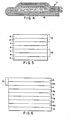
- Fig. 5 shows a laminate in accordance with one embodiment of the invention suitable for the construction of fluid containers of the type described in connection with Figs. 1-4.
- the cover 5a preferably comprises a sheet of paper 13, such as a tissue paper about 1 to 2 mils (around 25-55 micrometers) in thickness, adhered to the aluminium layer 4 by any suitable adhesive 14.
- the paper 13 provides strength to allow the laminate to be manipulated through the various steps in the construction of the finished container.
- it may be selected for colour; for example, a desired shade of white to match the border of a photographic product of which the container is to form a part.
- the adhesive 14 may be selected from any of those known in the art for the adhesion of paper to metal, but is preferably a cross-linkable polyester adhesive such as Adcote 503A0, made and sold by Morton Chemical Company, of Chicago, Illinois, with a suitable catalyst added prior to application.
- the layer 4 is of aluminium foil from 0.006 to 0.03 mm in thickness, and the 503A adhesive is coated on the foil in a suitable solvent such as methyl ethyl ketone. The solvent is removed by drying, and the coated foil is laminated to the paper under heat and pressure.
- the adhesive is coated to a dry weight of about 5 grams per square meter in accordance with a particular and presently preferred embodiment of the invention, though lesser or greater coverages may be employed so long as adequate adhesion is obtained.
- a mechanical barrier layer 3 of tough, resilient material resistant to puncture, shock and flow during the sealing operations is interposed between the aluminium layer 4 and the lining 2.
- the barrier layer 3 may be adhered to the aluminium layer 4 and to the lining 2 by any suitable conventional adhesives 15 and 16.
- the adhesives 15 and 16 may be chosen for adhesion both to the aluminium layer 4, or the lining 2, and to the mechanical barrier 3, for which purposes a cross-linked polyester such as Adcote 503A@ is well suited where the lining 2 is polyvinyl chloride, and the mechanical barrier layer 3 is polyethylene terephthalate.
- the adhesives 15 and 16 should be essentially inert to alkali.
- a presently preferred material for this purpose is a mixture of equal parts by weight of a carboxylated vinyl resin and a nitrile rubber comprising a copolymer of butadiene and acrylonitrile with a relatively high ratio of acrylonitrile to butadiene, preferably applied to the metal substrate from a suitable solvent.
- a preferred composition is made as a solution in a suitable solvent, such as methyl ethyl ketone or other conventional nitrile rubber solvent, of a mixture of the nitrile rubber with a copolymer of a vinyl chloride and vinyl acetate modified by the addition of carboxyl groups, as by the addition of about 1 percent of maleic acid to an 86/13 weight ratio vinyl chloride/vinyl acetate monomer mixture before copolymerization.
- the nitrile rubber may be a non-cross-linked buta- diene/acrylonitrile and 59 parts by weight of butadiene.
- the weight ratio of nitrile rubber/ carboxylated vinyl may be from 25/75 to 75/25, and is preferably 50/50.
- a presently preferred composition is available as Bostik 4048@ adhesive, as made and sold by Bostik Division, USM Corporation, of Middleton, Massachusetts.
- Additional peel strength, or resistance to delamination, between the mechanical barrier 3 and adjacent structure may be provided by including a thin primer coat, e.g., 1 to 3 ,um of an adhesive chosen primarily for its adhesion to the mechanical barrier 3 and to the adjacent layers 2 and 4, for example, if the mechanical barrier layer is of polyethylene terephthalate, and the adhesive layers 15 and 16 are of a nitrile rubber-carboxylated vinyl composition, a primer coat of a cross-linkable polyester, such as Adcote 1069@, as made and sold by Morton Chemical Company of Chicago, Illinois, on both surfaces of the layer 14 will materially increase adhesion. A catalyst is added to this material prior to coating in accordance with the manufacturer's instructions.
- a thin primer coat e.g., 1 to 3 ,um of an adhesive chosen primarily for its adhesion to the mechanical barrier 3 and to the adjacent layers 2 and 4, for example, if the mechanical barrier layer is of polyethylene terephthalate, and the adhesive layers 15 and 16 are of a
- Fig. 6 shows a laminate presently preferred for its high strength, alkali resistance, and resistance to delamination or puncture.
- the several layers of the structure may be of the preferred materials described above.
- the preferred cross-linked polyester adhesive layers are shown at 14a, 18 and 19. The method presently contemplated for the manufacture of the laminate of Fig. 6 is as next described.
- a 0.013 mm sheet of polyethylene terephthalate shown at 3a in Fig. 6, is coated with a solution of Adcote 10690 polyester adhesive in methyl ethyl ketone, to a dry coating weight of about 1.67 to 3.33 g/m 2 , and dried to remove the solvent.
- the layer 18 of adhesion primer is next coated with a solution of Bostik 4048@ nitrile rubber adhesive in methyl ethyl ketone to a dry coating weight of about 6.66 g/m 2 , and dried to remove the solvent.
- a coating 14a of about 5.0 g/m 2 of Adcote 503A@ adhesive is applied from a solvent solution as described above, and laminated under heat and pressure to a 0.03 mm sheet of white tissue paper 13, removing the solvent and acclerating the cure of the adhesive 14a in the process.
- the laminate 13, 14a, 4, 15a, 18, 3a is now solvent coated with a priming layer 19 of Adcote 1069@ polyester adhesive and dried to remove the solvent.
- a dried coating weight of about 1.67 to 3.33 g/m 2 is adequate.
- Over the layer 19 is solvent coated a layer 16a of the same nitrile rubber adhesive used to form the layer 1 5a to a dry coating weight of about 6.66 g/m 2.
- a 0.025 mm sheet of 85/15 vinyl chloride-vinyl acetate copolymer 2a is laminated to the adhesive layer 16a under heat and pressure to produce the final laminate.
- Pods of processing composition made in accordance with the preferred embodiment of the invention as just described have been tested by shelf storage for five months and shown to have performed equivalently to lead foil counterparts in terms of ease of processing into . pods; sensitometric compatibility with black and white and colour photosensitive products, and ability to contain developer at a low loss rate; i.e., 0.5 to 1.0 percent weight loss per year.
Landscapes
- Physics & Mathematics (AREA)
- General Physics & Mathematics (AREA)
- Laminated Bodies (AREA)
- Photographic Developing Apparatuses (AREA)
- Packaging Of Annular Or Rod-Shaped Articles, Wearing Apparel, Cassettes, Or The Like (AREA)
- Packages (AREA)
- Buffer Packaging (AREA)
Applications Claiming Priority (2)
| Application Number | Priority Date | Filing Date | Title |
|---|---|---|---|
| US159930 | 1980-06-16 | ||
| US06/159,930 US4303750A (en) | 1980-06-16 | 1980-06-16 | Alkaline fluid photographic processing composition containers |
Publications (2)
| Publication Number | Publication Date |
|---|---|
| EP0042081A1 EP0042081A1 (en) | 1981-12-23 |
| EP0042081B1 true EP0042081B1 (en) | 1984-12-27 |
Family
ID=22574714
Family Applications (1)
| Application Number | Title | Priority Date | Filing Date |
|---|---|---|---|
| EP81103978A Expired EP0042081B1 (en) | 1980-06-16 | 1981-05-23 | Fluid containers |
Country Status (7)
| Country | Link |
|---|---|
| US (1) | US4303750A (enExample) |
| EP (1) | EP0042081B1 (enExample) |
| JP (2) | JPS5762050A (enExample) |
| AU (1) | AU543530B2 (enExample) |
| CA (1) | CA1158909A (enExample) |
| DE (1) | DE3167912D1 (enExample) |
| IE (1) | IE51210B1 (enExample) |
Families Citing this family (4)
| Publication number | Priority date | Publication date | Assignee | Title |
|---|---|---|---|---|
| US4814260A (en) * | 1986-06-20 | 1989-03-21 | Konishiroku Photo Industry Co., Ltd. | Method of storing photographic processing solution in a package having specific oxygen permeability |
| US6199698B1 (en) * | 1999-12-03 | 2001-03-13 | Alusuisse Technology & Management, Ltd. | Pharmaceutical packaging with separation means |
| US20040159575A1 (en) * | 2001-12-26 | 2004-08-19 | Jutaro Shudo | Access resistant envelope |
| WO2007002920A2 (en) * | 2005-06-29 | 2007-01-04 | Celeste Industries Corporation | Dispensing pouch and a method of making the same |
Family Cites Families (11)
| Publication number | Priority date | Publication date | Assignee | Title |
|---|---|---|---|---|
| US2634886A (en) * | 1946-03-07 | 1953-04-14 | Polaroid Corp | Collapsible fluid container |
| US2543181A (en) * | 1947-01-15 | 1951-02-27 | Polaroid Corp | Photographic product comprising a rupturable container carrying a photographic processing liquid |
| US3056491A (en) * | 1958-08-29 | 1962-10-02 | Polaroid Corp | Fluid containers |
| US3173580A (en) * | 1962-09-21 | 1965-03-16 | Polaroid Corp | Fluid containers |
| GB1432831A (en) * | 1968-05-13 | 1976-04-22 | Polaroid Corp | Diffusion transfer photographic products |
| DE1772844C3 (de) * | 1968-07-11 | 1982-01-14 | Agfa-Gevaert Ag, 5090 Leverkusen | Fotografischer Filmverband |
| US3649282A (en) * | 1970-04-15 | 1972-03-14 | Polaroid Corp | Fluid containers having an inner acid reacting layer |
| US3694206A (en) * | 1970-12-29 | 1972-09-26 | Polaroid Corp | Photographic film unit |
| JPS4910251A (enExample) * | 1972-05-26 | 1974-01-29 | ||
| US3833381A (en) * | 1972-10-25 | 1974-09-03 | Polaroid Corp | Photographic products including rupturable containers |
| US4188219A (en) * | 1978-11-13 | 1980-02-12 | Eastman Kodak Company | Rupturable fluid container and elements containing same |
-
1980
- 1980-06-16 US US06/159,930 patent/US4303750A/en not_active Expired - Lifetime
-
1981
- 1981-05-23 DE DE8181103978T patent/DE3167912D1/de not_active Expired
- 1981-05-23 EP EP81103978A patent/EP0042081B1/en not_active Expired
- 1981-06-15 CA CA000379760A patent/CA1158909A/en not_active Expired
- 1981-06-15 AU AU71834/81A patent/AU543530B2/en not_active Ceased
- 1981-06-15 JP JP56092057A patent/JPS5762050A/ja active Pending
- 1981-06-15 IE IE1322/81A patent/IE51210B1/en not_active IP Right Cessation
-
1989
- 1989-08-14 JP JP1989095506U patent/JPH0224122Y2/ja not_active Expired
Also Published As
| Publication number | Publication date |
|---|---|
| CA1158909A (en) | 1983-12-20 |
| JPS5762050A (en) | 1982-04-14 |
| JPH0229043U (enExample) | 1990-02-23 |
| JPH0224122Y2 (enExample) | 1990-07-02 |
| EP0042081A1 (en) | 1981-12-23 |
| AU7183481A (en) | 1981-12-24 |
| IE811322L (en) | 1981-12-16 |
| AU543530B2 (en) | 1985-04-26 |
| US4303750A (en) | 1981-12-01 |
| DE3167912D1 (en) | 1985-02-07 |
| IE51210B1 (en) | 1986-10-29 |
Similar Documents
| Publication | Publication Date | Title |
|---|---|---|
| US4145001A (en) | Packaging for controlled release of volatile substances | |
| US5167974A (en) | Vacuum packaging with hermetic reclosure | |
| US3056491A (en) | Fluid containers | |
| US3454210A (en) | Easy opening and reclosable package,film therefor and process | |
| US4381848A (en) | Membrane closure structure | |
| EP1092526B1 (en) | Process for manufacturing a sealant layer for container lid and container | |
| US3511436A (en) | Easy opening heat sealed package | |
| US3750907A (en) | Fluid containers having both relatively strong and relatively weak seals | |
| US4303751A (en) | Rupturable photographic processing alkaline fluid container | |
| US4303750A (en) | Alkaline fluid photographic processing composition containers | |
| US3228168A (en) | Method of forming packages | |
| JP2020125148A (ja) | フタ材および容器 | |
| EP0011481B1 (en) | Rupturable containers for fluids such as photographic processing fluids and photographic film units including such containers of processing fluids | |
| US3173580A (en) | Fluid containers | |
| JPS6344635B2 (enExample) | ||
| US5952122A (en) | Battery label with primer layer | |
| AU5084090A (en) | Metal/polymer laminates | |
| JP5699333B2 (ja) | 蓋材 | |
| US3649282A (en) | Fluid containers having an inner acid reacting layer | |
| JPH0418273A (ja) | 食品包装体 | |
| JPH04505598A (ja) | 容器用内シールおよび密封容器 | |
| EP0628493A1 (en) | Inner sealing material | |
| JP3576287B2 (ja) | 紙製カップ用蓋材 | |
| AU452728B2 (en) | Composite material comprising a lead foil or sheet and fluid containers formed thereof | |
| JPH0417557Y2 (enExample) |
Legal Events
| Date | Code | Title | Description |
|---|---|---|---|
| PUAI | Public reference made under article 153(3) epc to a published international application that has entered the european phase |
Free format text: ORIGINAL CODE: 0009012 |
|
| AK | Designated contracting states |
Designated state(s): DE FR GB IT NL |
|
| 17P | Request for examination filed |
Effective date: 19811204 |
|
| ITF | It: translation for a ep patent filed | ||
| GRAA | (expected) grant |
Free format text: ORIGINAL CODE: 0009210 |
|
| AK | Designated contracting states |
Designated state(s): DE FR GB IT NL |
|
| REF | Corresponds to: |
Ref document number: 3167912 Country of ref document: DE Date of ref document: 19850207 |
|
| ET | Fr: translation filed | ||
| PLBE | No opposition filed within time limit |
Free format text: ORIGINAL CODE: 0009261 |
|
| STAA | Information on the status of an ep patent application or granted ep patent |
Free format text: STATUS: NO OPPOSITION FILED WITHIN TIME LIMIT |
|
| 26N | No opposition filed | ||
| ITTA | It: last paid annual fee | ||
| PGFP | Annual fee paid to national office [announced via postgrant information from national office to epo] |
Ref country code: FR Payment date: 19960411 Year of fee payment: 16 |
|
| PGFP | Annual fee paid to national office [announced via postgrant information from national office to epo] |
Ref country code: GB Payment date: 19960419 Year of fee payment: 16 |
|
| PGFP | Annual fee paid to national office [announced via postgrant information from national office to epo] |
Ref country code: DE Payment date: 19960424 Year of fee payment: 16 |
|
| PGFP | Annual fee paid to national office [announced via postgrant information from national office to epo] |
Ref country code: NL Payment date: 19970428 Year of fee payment: 17 |
|
| PG25 | Lapsed in a contracting state [announced via postgrant information from national office to epo] |
Ref country code: GB Effective date: 19970523 |
|
| GBPC | Gb: european patent ceased through non-payment of renewal fee |
Effective date: 19970523 |
|
| PG25 | Lapsed in a contracting state [announced via postgrant information from national office to epo] |
Ref country code: FR Free format text: LAPSE BECAUSE OF NON-PAYMENT OF DUE FEES Effective date: 19980130 |
|
| PG25 | Lapsed in a contracting state [announced via postgrant information from national office to epo] |
Ref country code: DE Free format text: LAPSE BECAUSE OF NON-PAYMENT OF DUE FEES Effective date: 19980203 |
|
| REG | Reference to a national code |
Ref country code: FR Ref legal event code: ST |
|
| PG25 | Lapsed in a contracting state [announced via postgrant information from national office to epo] |
Ref country code: NL Free format text: LAPSE BECAUSE OF NON-PAYMENT OF DUE FEES Effective date: 19981201 |
|
| NLV4 | Nl: lapsed or anulled due to non-payment of the annual fee |
Effective date: 19981201 |