EP0032731B1 - Polypropylenfolie mit verbesserter Haftung, deren Herstellung und Verwendung - Google Patents
Polypropylenfolie mit verbesserter Haftung, deren Herstellung und Verwendung Download PDFInfo
- Publication number
- EP0032731B1 EP0032731B1 EP81100280A EP81100280A EP0032731B1 EP 0032731 B1 EP0032731 B1 EP 0032731B1 EP 81100280 A EP81100280 A EP 81100280A EP 81100280 A EP81100280 A EP 81100280A EP 0032731 B1 EP0032731 B1 EP 0032731B1
- Authority
- EP
- European Patent Office
- Prior art keywords
- cellulose
- film
- film according
- process according
- styrene
- Prior art date
- Legal status (The legal status is an assumption and is not a legal conclusion. Google has not performed a legal analysis and makes no representation as to the accuracy of the status listed.)
- Expired
Links
Classifications
-
- C—CHEMISTRY; METALLURGY
- C08—ORGANIC MACROMOLECULAR COMPOUNDS; THEIR PREPARATION OR CHEMICAL WORKING-UP; COMPOSITIONS BASED THEREON
- C08J—WORKING-UP; GENERAL PROCESSES OF COMPOUNDING; AFTER-TREATMENT NOT COVERED BY SUBCLASSES C08B, C08C, C08F, C08G or C08H
- C08J7/00—Chemical treatment or coating of shaped articles made of macromolecular substances
- C08J7/12—Chemical modification
-
- C—CHEMISTRY; METALLURGY
- C08—ORGANIC MACROMOLECULAR COMPOUNDS; THEIR PREPARATION OR CHEMICAL WORKING-UP; COMPOSITIONS BASED THEREON
- C08J—WORKING-UP; GENERAL PROCESSES OF COMPOUNDING; AFTER-TREATMENT NOT COVERED BY SUBCLASSES C08B, C08C, C08F, C08G or C08H
- C08J5/00—Manufacture of articles or shaped materials containing macromolecular substances
- C08J5/18—Manufacture of films or sheets
-
- C—CHEMISTRY; METALLURGY
- C08—ORGANIC MACROMOLECULAR COMPOUNDS; THEIR PREPARATION OR CHEMICAL WORKING-UP; COMPOSITIONS BASED THEREON
- C08L—COMPOSITIONS OF MACROMOLECULAR COMPOUNDS
- C08L23/00—Compositions of homopolymers or copolymers of unsaturated aliphatic hydrocarbons having only one carbon-to-carbon double bond; Compositions of derivatives of such polymers
- C08L23/02—Compositions of homopolymers or copolymers of unsaturated aliphatic hydrocarbons having only one carbon-to-carbon double bond; Compositions of derivatives of such polymers not modified by chemical after-treatment
- C08L23/04—Homopolymers or copolymers of ethene
- C08L23/06—Polyethylene
-
- C—CHEMISTRY; METALLURGY
- C08—ORGANIC MACROMOLECULAR COMPOUNDS; THEIR PREPARATION OR CHEMICAL WORKING-UP; COMPOSITIONS BASED THEREON
- C08L—COMPOSITIONS OF MACROMOLECULAR COMPOUNDS
- C08L23/00—Compositions of homopolymers or copolymers of unsaturated aliphatic hydrocarbons having only one carbon-to-carbon double bond; Compositions of derivatives of such polymers
- C08L23/02—Compositions of homopolymers or copolymers of unsaturated aliphatic hydrocarbons having only one carbon-to-carbon double bond; Compositions of derivatives of such polymers not modified by chemical after-treatment
- C08L23/10—Homopolymers or copolymers of propene
- C08L23/12—Polypropene
-
- C—CHEMISTRY; METALLURGY
- C08—ORGANIC MACROMOLECULAR COMPOUNDS; THEIR PREPARATION OR CHEMICAL WORKING-UP; COMPOSITIONS BASED THEREON
- C08J—WORKING-UP; GENERAL PROCESSES OF COMPOUNDING; AFTER-TREATMENT NOT COVERED BY SUBCLASSES C08B, C08C, C08F, C08G or C08H
- C08J2323/00—Characterised by the use of homopolymers or copolymers of unsaturated aliphatic hydrocarbons having only one carbon-to-carbon double bond; Derivatives of such polymers
- C08J2323/02—Characterised by the use of homopolymers or copolymers of unsaturated aliphatic hydrocarbons having only one carbon-to-carbon double bond; Derivatives of such polymers not modified by chemical after treatment
- C08J2323/04—Homopolymers or copolymers of ethene
- C08J2323/06—Polyethene
-
- C—CHEMISTRY; METALLURGY
- C08—ORGANIC MACROMOLECULAR COMPOUNDS; THEIR PREPARATION OR CHEMICAL WORKING-UP; COMPOSITIONS BASED THEREON
- C08J—WORKING-UP; GENERAL PROCESSES OF COMPOUNDING; AFTER-TREATMENT NOT COVERED BY SUBCLASSES C08B, C08C, C08F, C08G or C08H
- C08J2323/00—Characterised by the use of homopolymers or copolymers of unsaturated aliphatic hydrocarbons having only one carbon-to-carbon double bond; Derivatives of such polymers
- C08J2323/02—Characterised by the use of homopolymers or copolymers of unsaturated aliphatic hydrocarbons having only one carbon-to-carbon double bond; Derivatives of such polymers not modified by chemical after treatment
- C08J2323/10—Homopolymers or copolymers of propene
- C08J2323/12—Polypropene
-
- C—CHEMISTRY; METALLURGY
- C08—ORGANIC MACROMOLECULAR COMPOUNDS; THEIR PREPARATION OR CHEMICAL WORKING-UP; COMPOSITIONS BASED THEREON
- C08L—COMPOSITIONS OF MACROMOLECULAR COMPOUNDS
- C08L1/00—Compositions of cellulose, modified cellulose or cellulose derivatives
-
- C—CHEMISTRY; METALLURGY
- C08—ORGANIC MACROMOLECULAR COMPOUNDS; THEIR PREPARATION OR CHEMICAL WORKING-UP; COMPOSITIONS BASED THEREON
- C08L—COMPOSITIONS OF MACROMOLECULAR COMPOUNDS
- C08L53/00—Compositions of block copolymers containing at least one sequence of a polymer obtained by reactions only involving carbon-to-carbon unsaturated bonds; Compositions of derivatives of such polymers
- C08L53/02—Compositions of block copolymers containing at least one sequence of a polymer obtained by reactions only involving carbon-to-carbon unsaturated bonds; Compositions of derivatives of such polymers of vinyl-aromatic monomers and conjugated dienes
Definitions
- the invention relates to a polypropylene film (PP film) with improved adhesion properties, a process for its production and its use.
- PP film polypropylene film
- PVC and special papers are mainly used for the surface treatment of materials, especially metal, wood and cellulose materials.
- the invention has for its object to improve the adhesion properties of PP films by permanently increasing the surface energy material data so that a suitable printing, painting and gluing is permanently possible.
- Another method is flame treatment of foils.
- the same disadvantages apply here as with corona treatment.
- Chemical treatment with ozone, fluorine, chlorine etc. is also known.
- the problematic use due to the chemical aggressiveness of these agents is particularly disadvantageous here.
- Another method is to irradiate with high energy rays such as electron beams, UV rays, laser beams and the like. These processes are relatively complex, usually require the use of sensitizers, and the durability of the effect varies.
- a permanent improvement of the surface adhesion can be achieved by chemical grafting using high-energy rays.
- this method is too complex to be suitable for the application area under consideration.
- the surface tension and the adhesion are permanently increased when the cellulose content in the PP film is high, using the pretreatment methods known for PP to increase the surface tension, which otherwise do not result in a permanent effect.
- the invention therefore relates to a polypropylene film with improved adhesion properties by surface activation, which is characterized by a content of cellulose with an average particle diameter of 5 to 100 f im and a greatest average length of the cellulose up to 200 f im.
- the invention is based on the surprising finding that a content of finely divided cellulose in PP improves the effectiveness and durability of the surface treatment.
- the effect can be increased if the cellulose is added in a PE batch.
- Another beneficial effect is the use of mineral fillers.
- FR-A 23 70 583 a composite material made of metal foils and a carboxylic acid-modified polyolefin, which contains cellulosic particles, is already known.
- the adhesion is essentially achieved by the carboxylic acid components of the polyolefin copolymer, and with respect to the cellulosic particles, for example, resin-rich wood fibers, straw and paper pulp are stated to be equally suitable, while pure cellulose is not mentioned.
- no foil is pressed there with the metal, but rather a web obtained using the paper manufacturing technique.
- Suitable for the purposes of the invention are finely divided cellulose, produced by the sulfite or sulfate process, which is preferred, and native or regenerated cellulose.
- the amount of cellulose is expediently between 3 and 50% by weight, based on the sum of PP and cellulose. If a content of 50% by weight is exceeded, the strength properties are deteriorated too much.
- the film preferably contains 3 to 30% by weight of cellulose.
- the degree of fine cellulose in the film according to the invention is advantageously between 1 and 100 ⁇ m with a fiber thickness of 10 to 30 ⁇ m.
- a finer degree of distribution is too complex, with larger particles there are problems in the production of smooth thin films.
- native and Regenerated cellulose can, however, also be used for particles up to 100 ⁇ m thick and with a maximum mean length of 200 ⁇ m, without any fundamental difficulties with regard to film formation. No comparable liability effect is achieved with wood flour.
- the commercially available grades are suitable as PP, including copolymers with ⁇ -olefins and graft copolymers with vinyl compounds.
- Random and block copolymers with 1 to 10 mol% of ethylene or mixtures with polyethylene (PE), in particular with 5 to 20% PE, which have a heat resistance VSP / A above 100 ° C., are preferred.
- the film according to the invention can also contain mineral fillers.
- mineral fillers for polymer films are known. Mica, talc, silicates and silicas in their various forms are particularly suitable and therefore preferred.
- examples of other usable mineral fillers are carbonates, in particular calcium carbonates, such as limestone and chalk, as well as magnesium carbonates and the like.
- the film expediently contains 3 to 30% by weight, preferably 3 to 20% by weight, based on the sum of polyolefin and cellulose.
- the film may also contain one or more organic modifiers. These are used to regulate toughness, calenderability, extrudability and similar properties.
- a preferred group for this are block polymers of styrene with elastomers such as e.g. Butadiene or isobutylene or isoprene.
- Other suitable modifiers are polymers based on styrene-butadiene, methacrylate-butadiene-styrene.
- Polyolefins which contain functional groups, e.g. copolymer or graft copolymer of ethylene with reactive monomers, are particularly suitable for influencing special physical properties and the ability to be bonded. Modification additives of this type are expediently present in an amount of 0.5 to 20% by weight, preferably 2 to 10% by weight, based in each case on the sum of polyolefin and cellulose.
- Another object of the invention is a process for producing a PP film with improved adhesion by shaping the film by conventional methods and using a surface activation treatment, which is characterized in that finely divided cellulose is added as a filler.
- finely divided cellulose is added as a filler.
- Cellulose fibers are suitable up to a length of 200 pm with an average diameter up to 100 ⁇ m.
- the surface activation can be carried out by radiation or by treatment with a flame or ozone.
- Corona treatment is particularly preferred, other radiation methods use electron beams, UV rays or laser beams.
- the invention significantly increases the surface adhesion of polypropylene films and thereby the use of such films for laminating, printing, painting and gluing, in particular in modern systems which use short process times and the highest possible temperatures, is substantially improved or even first enables.
- the film according to the invention was bonded, for example with UF resin, there was still no change in the adhesion even after months.
- the resistance of the surface activation to the influence of temperature is also considerably improved.
- the adhesions of films according to the invention, which were laminated to particleboard using UF resin show no difference at laminating temperatures between 80 and 140 ° C. with a pressing time of 30 seconds.
- Printing inks for example those based on terpolymers of vinyl chloride-vinyl acetate-maleic acid of vinyl polymers containing OH groups, but also the conventional PE printing inks, have just as good adhesion as reaction coatings, for example based on polyurethane melamine resins, and also UV-curing polyester Epoxy and polyurethane acrylates. Even after 1000 hours of Xenotest weathering and in the tropical test, a change in the adhesion according to ASTM standard D 2141-63T (cross-cut method) could not be determined.
- the properties of the film can be varied to a large extent and the advantageous adhesion properties can even be improved in some cases.
- the surface adhesion achieved by corona treatment of a film made of 95 parts of polypropylene and 5 parts of cellulose is advantageously influenced by the addition of 20 or 30 parts of talc.
- the films according to the invention can also be bonded directly by fusion bonding with metals, wood, polymers and copolymers with polar groups and the like without an adhesive and show good and permanent adhesion.
- the lamination is also at low temperatures, e.g. possible with epoxy resins and polyurethanes as well as vinyl acetate copolymers.
- the extruded film is subjected to a corona treatment.
- the corona treatment is carried out on the Demes-VM pre-treatment device at full power and a web speed of 5 m / min.
- the treated film has the following properties:
- the treated film was laminated on a commercial chipboard.
- a UF resin of the following composition is used for bonding:
- the peel force in the peel test is 1.6 kp / 2.4 cm (14.7 N / 2.4 cm)
- Example 1 The PP used in Example 1 is mixed in a ratio of 95: 5 with HD-PE (Hostalen GC 7260) without further additives and extruded, pretreated and pressed under the conditions specified.
- HD-PE Hostalen GC 7260
- a mixture of 80 parts by weight of a PP copolymer (Mfl 230/2 1.8 g / 10 min, density 0.92 g / cm 3 ) (Eltex K1 100) and 20 parts by weight of cellulose Arbocel ( B 600/50) and the usual additives is calendered at 200 ° C to a 100 ⁇ m thick film.
- the pretreatment and bonding are carried out in accordance with Example 1.
- a mixture of 80 parts by weight of PP in accordance with Example 3 and 40 parts by weight of a batch of 20 parts of cellulose (Arbocel B ⁇ 600/50) and 20 parts of HD-PE (Mfl 190/5 1 (g / 10 min) , Density 0.950 g / cm 3 ) (Eltex B 2008) is calendered, pretreated and pressed in accordance with Example 3. The following values are determined:
- Example 3 95 parts by weight of a mixture corresponding to Example 3 are added to 5 parts by weight of SBS block copolymer (Cariflex®1102) and processed according to Example 3. Calendering shows that a good film can still be produced at 20% higher speed.
- SBS block copolymer Cariflex®1102
- the measured mechanical and adhesion properties are not adversely affected.
- the film obtained is coated with a conventional polyurethane lacquer (based on Desmophen @ 1340 and Desmodur® H1).
- a mixture of 80 parts by weight of a PP copolymer according to Example 3 (K1 100), 20 parts by weight Parts of cellulose (Arbocel B 600/50), 20 parts by weight of talc and the usual additives are calendered at 200 ° C. to form a 100 ⁇ m thick film, activated in accordance with Example 1 and by means of a 50 ⁇ m thick film made from adhesion promoter KR 2683 at 130 ° C, 10 s and 10 kp / cm 2 ) pressed onto a particle board.
- a film according to Example 7 is pressed using an epoxy adhesive (Daubert International 1 TDC 8160 BHV + 1 TDC 8160 AHV) at room temperature and 5 kp / cm 2 (4.9 bar) for 24 hours.
- an epoxy adhesive (Daubert International 1 TDC 8160 BHV + 1 TDC 8160 AHV) at room temperature and 5 kp / cm 2 (4.9 bar) for 24 hours.
Landscapes
- Chemical & Material Sciences (AREA)
- Health & Medical Sciences (AREA)
- Chemical Kinetics & Catalysis (AREA)
- Medicinal Chemistry (AREA)
- Polymers & Plastics (AREA)
- Organic Chemistry (AREA)
- Manufacturing & Machinery (AREA)
- Engineering & Computer Science (AREA)
- General Chemical & Material Sciences (AREA)
- Materials Engineering (AREA)
- Manufacture Of Macromolecular Shaped Articles (AREA)
- Compositions Of Macromolecular Compounds (AREA)
- Laminated Bodies (AREA)
- Treatments Of Macromolecular Shaped Articles (AREA)
- Adhesive Tapes (AREA)
- Adhesives Or Adhesive Processes (AREA)
- Wrappers (AREA)
Description
- Die Erfindung betrifft eine Polypropylenfolie (PP-Folie) mit verbesserten Haftungseigenschaften, ein Verfahren zu ihrer Herstellung und ihre Verwendung.
- Für viele Einsatzgebiete von Werkstoffen müssen die Gebrauchseigenschaften durch Vergütung der Oberfläche, z.B. durch Lackieren oder durch Kaschierung mit dünnen Finishfolien, verbessert werden. Zur Oberflächenvergütung von Werkstoffen, insbesondere von Metall-, Holz- und Cellulosewerkstoffen werden derzeit vorwiegend PVC und Spezialpapiere eingesetzt.
- Bei Anwendung von Folien in verschiedenen Bereichen der Oberflächenvergütung ist davon auszugehen, daß die Kaschierung auf Trägermaterialien und anderen Filmen bei Temperaturen, die häufig über 100°C liegen, erfolgen soll und eine Abkühlung der Laminate in den Rollenkaschieranlagen und Pressen nicht wirtschaftlich ist, Eine höhere Wärmeformbeständigkeit ist auch notwendig bei der Kaschierung mit Reaktionsklebstoffen, die wegen der geforderten Lagerstabilität zweckmaßigerweise erste oberhalb 80°C reagieren sollten. Sie ist auch erforderlich bei Kaschierung mittels polymerer Filme, wenn im Bereich der Gebrauchstemperatur kein Delaminieren erfolgen Hinsichtlich der physilalischen Eigenschaften, insbesondere der Wärmeformbeständigkeit, von PP und seinen Copolymerisaten sowie seiner Umweltfreundlichkeit wäre PP für die Oberflächenvergütung sehr geeignet. Ein entscheidender Nachteil sind jedoch die oberflächenenergetischen Stoffdaten des PP, die eine ausreichend gute, permanente Haftung geeigneter Lacke, Klebstoffe und polymerer Filme verhindern.
- Der Erfindung liegt die Aufgabe zugrunde, die Haftungseigenschaften von PP-Folien durch permanente Erhöhung der oberflächenenergetischen Stoffdaten so zu verbessern, daß dauerhaft eine geeignete Bedruckung, Lackierung und Verklebung möglich wird.
- Verfahren zur Verbesserung der Haftungseigenschaften von Filmen, insbesondere PP-Filmen, sind bekannt. Ein Beispiel dafür ist die Coronabehandlung, vgl. Adhäsion 1979, Heft 12, S. 381-389. Diese Behandlung erhöht zwar die Oberflächenspannung vorübergehend, der Effekt verminder sich jedoch während der Lagerung und/oder Einwirkung höherer Temperaturen.
- Ein weiteres Verfahren besteht in der Flammbehandlung von Folien. Hier gelten die gleichen Nachteile wie bei der Corona-Behandlung. Weiter ist die chemische Behandlung mit Ozon, Fluor, Chlor etc. bekannt. Von Nachteil ist hier besonders die problematische Anwendung wegen der chemischen Aggressivität dieser Agenzien. Ein weiteres Verfahren besteht in der Bestrahlung mit energiereichen Strahlen, wie Elektronenstrahlen, UV-Strahlen, Laserstrahlen und dergleichen. Diese Verfahren sind relativ aufwendig, verlangen meist die Mitverwendung von Sensibilisatoren, und die Dauerhaftigkeit des Effekts ist dabei unterschiedlich.
- Eine permanente Verbesserung der Oberflächenadhäsion läßt sich durch chemische Pfropfung unter Anwendung energiereicher Strahlen erzielen. Dieses Verfahren ist jedoch zu aufwendig, um für das in Betracht kommende Anwendungsgebiet geeignet zu sein.
- Die permanente Erhöhung der Oberflächenspannung und der Haftung gelingt erfindungsgemäß bei einem Gehalt an feinteiliger Cellulose in der PP-Folie unter Anwendung der für PP bekannten Vorbehandlungsmethoden zur Erhöhung der Oberflächenspannung, welche sonst keinen dauerhaften Effekt ergeben.
- Gegenstand der Erfindung ist daher eine Polypropylenfolie mit durch Oberflächenaktivierung verbesserten Haftungseigenschaften, welche gekennzeichnet ist durch einen Gehalt an Cellulose mit einem mittleren Teilchendurchmesser von 5 bis 100 fim und einer größten mittleren Länge der Cellulose bis 200 fim.
- Der Erfindung liegt die überraschende Feststellung zugrunde, daß ein Gehalt an feinteiliger Cellulose im PP die Wirksamkeit und die Dauerhaftigkeit der Oberflächenbehandlung verbessert. Der Effekt kann noch erhöht werden, wenn die Cellulose in einem PE-Batch zugegeben wird. Einen weiteren günstigen Effekt gibt die Mitverwendung von mineralischen Füllstoffen.
- Aus der FR-A 23 70 583 ist bereits ein Verbundmaterial aus Metallfolien und einem mit Carbonsäure modifizierten Polyolefin, welches cellulosische Teilchen enthält, bekannt. Hierbei wird jedoch die Haftung im wesentlichen durch die Carbonsäureanteile des Polyolefincopolymers erzielt und bezüglich der cellulosischen Teilchen werden zum Beispiel harzreiche Holzfasern, Stroh- und Papierpulpe als in gleicher Weise geeignet angegeben, während reine Cellulose nicht erwähnt wird. Außerdem wird dort keine Folie mit dem Metall verpreßt sondern eine nach der Papierherstellungstechnik gewonnene Bahn.
- Im Rahmen der Erfindung geeignet sind feinteilige Cellulose, hergestellt nach dem Sulfit- oder Sulfatverfahren, die bevorzugt wird, sowie native oder regenerierte Cellulose.
- Die Cellulosemenge liegt zweckmäßig zwischen 3 und 50 Gew.-%, bezogen auf die Summe von PP und Cellulose. Wird ein Gehalt von 50 Gew.-% überschritten, so werden die Festigkeitseigenschaften zu stark verschlechtert.
- Bei einem Gehalt an Cellulose unter 3% ist die erzielte Verbesserung der Oberflächenaktivierung nicht ausgeprägt genug. Bevorzugt enthält die Folie 3 bis 30 Gew.-% Cellulose.
- Der Feinhertsgrad der Cellulose in der erfindungsgemäßen Folie liegt zweckmäßig zwischen 1 und 100 pm bei einer Faserdicke von 10 bis 30 ,um. Ein feinerer Verteilungsgrad ist zu aufwendig, bei größeren Partikeln treten Probleme bei der Herstellung glatter dünner Folien auf. Bei nativer und regenerierter Cellulose können jedoch auch Teilchen bis zu 100 µm Dicke und einer größten mittleren Länge von 200 µm verwendet werden, ohne daß hinsichtlich der Folienbildung grundsätzliche Schwierigkeiten auftreten. Mit Holzmehl wird kein vergleichbarer Haftungseffekt erreicht.
- Als PP eignen sich im Rahmen der Erfindung die handelsüblichen Qualitäten, einschließlich Copolymere mit a-Olefinen und Pfropfcopolymere mit Vinylverbindungen. Bevorzugt werden Random-und Block- Copolymere mit 1 bis 10 Mol-% Äthylen oder Mischungen mit Polyäthylen (PE), insbesondere mit 5 bis 20% PE, die eine Wärmebeständigkeit VSP/A über 100°C besitzen.
- Die erfindungsgemäße Folie kann zusätzlich auch mineralische Füllstoffe enthalten. Derartige Füllstoffe für Polymerfolien sind bekannt. Besonders geeignet und daher bevorzugt werden Glimmer, Talkum, Silikate und Kieselsäuren in ihren verschiedenen Formen. Beispiele für andere brauchbare mineralische Füllstoffe sind Carbonate, insbesondere Calciumcarbonate, wie Kalkstein und Kreide, sowie Magnesiumcarbonate und dergleichen.
- Durch den Zusatz geeigneter mineralischer Füllstoffe lassen sich Eigenschaften wie Vicatpunkt, Shorehärte, Haftung und Zugfestigkeit beeinflussen. Falls derartige mineralische Füllstoffe vorhanden sind, enthält die Folie zweckmäßig 3 bis 30 Gew.-%, vorzugsweise 3 bis 20 Gew.-%, bezogen auf die Summe von Polyolefin und Cellulose.
- Außerdem kann die Folie noch ein oder mehrere organische Modifizierungsmittel enthalten. Diese dienen zur Regelung von Zähigkeit, Kalandrierbarkeit, Extrudierbarkeit und ähnlichen Eigenschaften. Eine bevorzugte Gruppe hierfür sind Blockpolymere von Styrol mit Elastomeren wie z.B. Butadien oder Isobutylen oder Isopren. Andere geeignete Modifizierungsmittel sind Polymerisate auf Basis StyrolButadien, Methacrylat-Butadien-Styrol. Polyolefine, die funktionelle Gruppen enthalten, z.B.- Copolymerisat oder Pfropf-Copolymerisat von Äthylen mit reaktiven Monomeren, eignen sich besonders zur Beeinflussung spezieller physikalischer Eigenschaften und der Verklebbarkeit. Darartige Modifizierungs- .zusätze sind zweckmäßig in einer Menge von 0,5 bis 20 Gew.-%, vorzugsweise 2 bis 10 Gew.-%, bezogen jeweils auf die Summe von Polyolefin und Cellulose, vorhanden.
- Die Steigerung der Oberflächenspannung und ihrer Dauerhaftigkeit durch eine Coronabehandlung in Abhängigkeit des Celluloseanteils zeigen die in Tabelle 1 wiedergegebenen Versuchsergebnisse. Bei Herstellung der untersuchten Folien wurde die Cellulose mittels eines HD-PE-Masterbatch 1:1 zugegeben (HD-PE Hostalen@ GC7260).

- Da bei PP eine höhere Oberflächenspannung nicht immer gleichzeitig eine höhere Haftung ergibt (siehe Adhäsion 1979, Heft 12, S. 381-389), wurden die Haftungseigenschaften mittels eines handelsüblichen Harnstoff-Formaldehyd-Klebstoffs getestet. Dabei wurden die Folienproben unter gleichen Bedingungen hergestellt und coronabehandelt und bei 140°C mit 10 kp/cm2 (9,81 bar) 10 Sekunden verpreßt. Die Dauerhaftigkeit der Haftung wurde durch Wärmelagerung einen Tag bei 90°C beurteilt. Die Ergebnisse zeigt Tabelle 2.
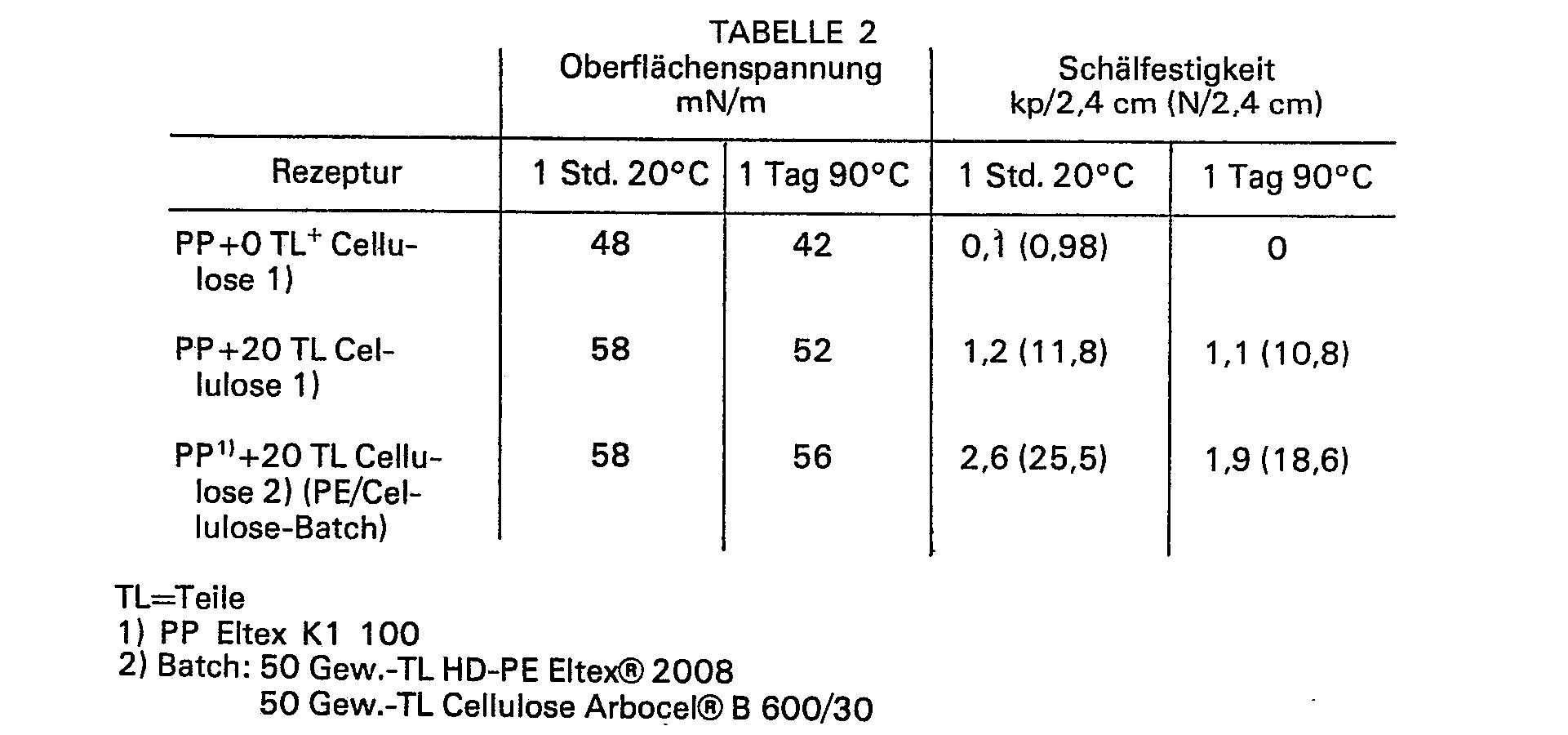
- Diese Ergebnisse zeigen, daß bei einem Gehalt an Cellulose der Effekt nicht nur wesentlich dauerhafter, sondern auch erheblich gesteigert wird, insbesondere wenn die Cellulose als PE-Batch zugegeben wird.
- Ein weiterer Gegenstand der Erfindung ist ein Verfahren zur Herstellung einer PP-Folie mit verbesserter Adhäsion durch Formung der Folie nach üblichen Methoden und Anwendung einer Oberflächenaktivierungsbehandlung, welches dadurch gekennzeichnet, ist, daß man als Füllstoff feinteilige Cellulose zusetzt. Vorzugsweise werden 3 bis 50 Gew.-%, besonders bevorzugt 3 bis 30 Gew.-% Cellulose zugesetzt, bezogen auf die Summe von Polyolefin und Cellulose. Cellulosefasern eignen sich bis zu einer Länge von 200 pm bei einem mittleren Durchmesser bis 100 µm.
- Bezüglich der bevorzugten Polypropylene gelten die obigen Ausführungen. Für die Herstellung der Folie eignen sich alle üblichen und dem Fachmann geläufigen Folienherstellungsmethoden und Michtechnologien.
- Bei der Folienherstellung können zusätzlich mineralische Füllstoffe oder/und Modifizierungsmittel zugesetzt werden. Hierfür gelten die obigen Angaben über die Folienzusammensetzung entsprechend.
- Die Ober flächenaktivierung kann durch Bestrahlung oder durch Behandlung mit einer Flamme oder Ozon erfolgen. Besonders bevorzugt wird die Corona-Behandlung, andere Bestrahlungsmethoden verwenden Elektronenstrahlen, UV-Strahlen oder Laserstrahlen.
- Durch die Erfindung wird, wie bereits erwähnt, die Oberflächenadhäsion von Polypropylenfolien wesentlich gesteigert und dadurch der Einsatz derartiger Folien zum Kaschieren, Bedrucken, Lackieren und Verkleben, insbesondere bei den modernen Anlagen, welche kurze Prozeßzeiten und möglichst hohe Temperaturen anwenden, wesentlich verbessert oder überhaupt erste ermöglicht. Bei Verklebungen der erfindungsgemäßen Folie mit beispielsweise UF-Harz ergab sich auch nach Monaten noch keine Veränderung der Haftung. Die Widerstandsfähigkeit der Oberflächenaktivierung gegenüber Temperatureinfluß wird ebenfalls erheblich verbessert. Beispielsweise zeigen die Haftungen von erfindungsgemäßen Folien, die mittels UF-Harz auf Spanplatten kaschiert wurden, bei Kaschiertemperaturen zwischen 80 und 140°C bei 30 Sekunden Preßzeit keinen Unterschied.
- Druckfarben, beispielsweise solche auf Basis von Terpolymeren aus Vinylchlorid-Vinylacetat-Maleinsäure von OH-Gruppen enthaltenden Vinylpolymeren, aber auch die üblichen PE-Druckfarben, weisen ebenso gute Haftung auf wie Reaktionslacke, beispielsweise auf Basis Polyurethan Melaminharzen, sowie auch UV-härtende Polyester-Epoxid und Polyurethanacrylate. Selbst nach 1000- stündiger Xenotestbewitterung und im Tropentest konnte eine Änderung der Haftung nach ASTM-Norm D 2141-63T (Gitterschnittmethod) nicht festgestellt werden.
- Durch Zusatz von mineralischen Füllstoffen und/oder organischen Modifizierungsmitteln können die Eigenschaften der Folie in weitem Umfang variiert werden und die vorteilhaften Haftungseigenschaften teilweise sogar verbessert werden. Beispielsweise wird die durch Corona-Behandlung einer Folie aus 95 Teilen Polypropylen und 5 Teilen Cellulose erzielte Oberflächenadhäsion durch Zusatz von 20 oder 30 Teilen Talkum vorteilhaft beeinflußt.
- Die üblichen Farbstoffe und Pigmente wirken sich nicht nachteilig aus.
- Die erfindungsgemäßen Folien können auch direkt durch Schmelzverklebung mit Metallen, Holz, Polymeren und Copolymeren mit polaren Gruppen und dergleichen ohne Klebstoff verbunden werden und zeigen gute und permanente Haftung.
- Die Kaschierung ist auch bei niedrigen Temperaturen, z.B. mit Epoxyharzen und Polyurethanen sowie Vinylacetat-Copolymeren möglich.
- Die folgenden Beispiele erläutern die Erfindung weiter.
- Polyäthylen (MFI 190/2=8 (g/10 min), Dichte 0,958) (Hostalen GC 7260) und Cellulose mit einer Teilchengröße <50 µ (Arbocel B 600/30) werden im Gewichtsverhältnis 1:1 gemischt, auf einem Walzwerk bei 160°C 10 Minuten homogenisiert und nach dem Abkühlen granuliert.
- Von dem so erhaltenen Batch werden 10 Gew.-Teile mit 90 Gew.-Teilen PP (Mfl 190/5=3 (g/10 min), Dichte 0,905 (g/cm3)) (Hostalen PPN 1060) vermischt und als 80 µm dikker Film bei 220°C Masse-Temperatur extrudiert.
- Die extrudierte Folie wird einer Corona-Behandlung unterworfen. Die Corona-Behandlung wird auf dem Demes-VM Vorbehandlungsgerät bei voller Leistung und einer Bahngeschwindigkeit von 5 m/min durchgeführt. Die behandelte Folie hat folgende Eigenschaften:

- Die behandelte Folie wurde auf einer handelsüblichen Spanplatte kaschiert.
- Für die Verklebung wird ein UF-Harz folgender Zusammensetzung verwendet:

- Die Abzugskraft im Schältest beträgt 1,6 kp/2,4 cm (14,7 N/2,4 cm)
- Das in Beispiel 1 verwendete PP wird im Verhältnis 95:5 mit HD-PE (Hostalen GC 7260) ohne weitere Zusätze vermischt und unter den sort angegebenen Bedingungen extrudiert, vorbehandelt und verpreßt.

- Eine Mischung aus 80 Gew.-Teilen von einem PP-Copolymer (Mfl 230/2=1,8 g/10 min, Dichte 0,92 g/cm3) (Eltex K1 100) und 20 Gew.-Teilen Cellulose Arbocel (B 600/50) und den üblichen Zusätzen wird bei 200°C zu einer 100 µm dicken Folie kalandriert. Die Vorbehandlung und Verklebung erfolgt entsprechend Beispiel 1.
- Folgende Werte werden gemessen:

- Eine Mischung aus 80 Gew.-Teilen PP entsprechend Beispiel 3 und 40 Gew.-Teilen eines Batch aus 20 Teilen Cellulose (Arbocel BÖ 600/50) und 20 Teilen HD-PE (Mfl 190/5=1 (g/10 min), Dichte 0,950 g/cm3) (Eltex B 2008) wird entsprechend Beispiel 3 kalandriert, vorbehandelt und verpreßt. Folgende Werte werden ermittelt:

- Eine Mischung aus 80 Gew.-Teilen PP entsprechend Beispiel 3 und 20 Gew.-Teilen Cellulose (Arbocel BÖ 600/50) und 20 Gew.-Teilen Calciumcarbonat (Omya@ BSH) wird entsprechend Beispiel 3 kalandriert und vorbehandelt. Folgende Ergebnisse werden ermittelt:

- 95 Gew.-Teile einer Mischung entsprechend Beispiel 3 werden 5 Gew.-Teilen SBS-Blockcopolymer (Cariflex®1102) zugesetzt und entsprechend Beispiel 3 verarbeitet. Beim Kalandrieren zeigt sich, daß bei 20% höherer Geschwindigkeit noch eine gute Folie hergestellt werden kann.
- Die gemessenen mechanischen und Haftungseigenschaften werden nicht nachteilig beeinflußt.
- Die erhaltene Folie wird mit einem üblichen Polyurethan-Lack (Basis Desmophen@ 1340 und Desmodur® H1) lackiert.
- Im Haftungstest nach ASTM D.2.1.4.1.-63 erfolgt keine Trennung der Lackschicht.
- Eine Mischung aus 80 Gew.-Teilen eines PP-Copolymeren gemäß Beispiel 3 (K1 100), 20 Gew.-Teilen Cellulose (Arbocel B 600/50), 20 Gew.-Teilen Talkum und den üblichen Zusätzen wird bei 200°C zu einer 100 µm dicken Folie kalandriert, entsprechend Beispiel 1 aktiviert und mittels einer 50 µm dicken Folie aus Haftvermittler KR 2683 bei 130°C, 10 s und 10 kp/cm2) auf eine Spanplatte verpreßt.
- Bei Abzug des Folienverbunds von der Spanplatte erfolgt Spanausriß.
- Eine Folie gemäß Beispiel 7 wird mittels eines Epoxyklebers (Firma Daubert International 1 TDC 8160 BHV+1 TDC 8160 AHV) bei Raumtemperatur und 5 kp/cm2 (4,9 bar) 24 Stunden verpreßt.
- Beim Abzugstest ist die Folie gerissen.
Claims (34)
Priority Applications (1)
| Application Number | Priority Date | Filing Date | Title |
|---|---|---|---|
| AT81100280T ATE10505T1 (de) | 1980-01-17 | 1981-01-15 | Polypropylenfolie mit verbesserter haftung, deren herstellung und verwendung. |
Applications Claiming Priority (2)
| Application Number | Priority Date | Filing Date | Title |
|---|---|---|---|
| DE3001636 | 1980-01-17 | ||
| DE3001636A DE3001636C2 (de) | 1980-01-17 | 1980-01-17 | Polyolefinfolie mit verbesserter Haftung, deren Herstellung und Verwendung |
Publications (2)
| Publication Number | Publication Date |
|---|---|
| EP0032731A1 EP0032731A1 (de) | 1981-07-29 |
| EP0032731B1 true EP0032731B1 (de) | 1984-11-28 |
Family
ID=6092325
Family Applications (2)
| Application Number | Title | Priority Date | Filing Date |
|---|---|---|---|
| EP81100280A Expired EP0032731B1 (de) | 1980-01-17 | 1981-01-15 | Polypropylenfolie mit verbesserter Haftung, deren Herstellung und Verwendung |
| EP81100278A Expired EP0032729B1 (de) | 1980-01-17 | 1981-01-15 | Polyäthylenfolie mit verbesserter Haftung, deren Herstellung und Verwendung |
Family Applications After (1)
| Application Number | Title | Priority Date | Filing Date |
|---|---|---|---|
| EP81100278A Expired EP0032729B1 (de) | 1980-01-17 | 1981-01-15 | Polyäthylenfolie mit verbesserter Haftung, deren Herstellung und Verwendung |
Country Status (6)
| Country | Link |
|---|---|
| EP (2) | EP0032731B1 (de) |
| JP (2) | JPS6029741B2 (de) |
| AT (2) | ATE10505T1 (de) |
| AU (2) | AU539720B2 (de) |
| CA (2) | CA1158010A (de) |
| DE (3) | DE3001636C2 (de) |
Families Citing this family (15)
| Publication number | Priority date | Publication date | Assignee | Title |
|---|---|---|---|---|
| DE3101479C2 (de) * | 1981-01-19 | 1990-08-23 | Alkor GmbH Kunststoffverkauf, 8000 München | Verfahren zur Verbesserung der Haftfestigkeitseigenschaften von Kunststoff-Folien |
| DE3122607A1 (de) * | 1981-06-06 | 1982-12-30 | Renolit-Werke GmbH, 6520 Worms | Verfahren zur herstellung einer thermoplastischen folie aus polyolefinen im kalanderverfahren |
| NZ218128A (en) * | 1985-11-01 | 1990-04-26 | Biotech Australia Pty Ltd | Etched substrate having improved binding capacity |
| WO1987005953A1 (en) * | 1986-03-26 | 1987-10-08 | Kurt Petersen | A laminated fabric coated plastic material |
| JPS62238732A (ja) * | 1986-04-10 | 1987-10-19 | Gunze Ltd | プリントラミネ−ト用フイルム及びその熱圧着方法 |
| NZ225556A (en) * | 1987-07-31 | 1992-02-25 | Dow Chemical Co | Reinforced laminates with a base layer of wood products |
| JPH0649787B2 (ja) * | 1990-01-23 | 1994-06-29 | 工業技術院長 | 成形品の表面処理及び塗装方法 |
| JP3195617B2 (ja) * | 1991-08-12 | 2001-08-06 | 住友化学工業株式会社 | ポリプロピレン系樹脂成形品の表面処理方法及び該成形品の塗装方法 |
| ES2439095T3 (es) * | 2003-09-05 | 2014-01-21 | Borealis Technology Oy | Conducto fabricado de una composición de polietileno a alta presión reticulable |
| DE102004061268A1 (de) * | 2004-12-10 | 2006-06-14 | Volkswagen Ag | Verfahren zur Aktivierung einer Kunststoffoberfläche |
| EP1907456A1 (de) * | 2005-06-24 | 2008-04-09 | DSMIP Assets B.V. | Styrolblockcopolymere als einfüllmaterial in kunstrasensystemen |
| AT512273B1 (de) * | 2011-11-16 | 2014-06-15 | Chemiefaser Lenzing Ag | Hydrophobe kunststoffe mit cellulosischer hydrophillierung |
| JP7107768B2 (ja) * | 2018-06-28 | 2022-07-27 | ポリプラスチックス株式会社 | 接着用樹脂組成物、複合成形品、結晶性樹脂の接着性向上方法、及び結晶性樹脂の印刷・塗装性向上方法 |
| CN111944189B (zh) * | 2020-08-14 | 2022-05-31 | 河南师范大学 | 一种含木质素铁的pe薄膜材料及其合成方法 |
| CN116478462A (zh) * | 2023-04-04 | 2023-07-25 | 华南理工大学 | 一种适用于弱溶剂墨水直接喷绘的印刷膜及其制备方法 |
Citations (4)
| Publication number | Priority date | Publication date | Assignee | Title |
|---|---|---|---|---|
| FR1196542A (fr) * | 1957-06-04 | 1959-11-24 | Montedison Spa | Procédé pour améliorer l'affinité vis-à-vis des encres d'imprimerie des objets formés de polymères d'alpha-oléfines |
| US3296046A (en) * | 1963-04-22 | 1967-01-03 | Union Carbide Corp | Method of tack sealing biaxially oriented polypropylene film |
| DE1911804A1 (de) * | 1968-03-08 | 1969-11-27 | Mitsubishi Petrochemical Co | Mischstoff-Zubereitung zur Ausformung in Formteile und Verfahren zu deren Herstellung |
| FR2370583A1 (fr) * | 1976-11-12 | 1978-06-09 | Solvay | Panneau composite comprenant une feuille metallique et une feuille polyolefinique |
Family Cites Families (12)
| Publication number | Priority date | Publication date | Assignee | Title |
|---|---|---|---|---|
| CA634179A (en) * | 1962-01-09 | E.I. Du Pont De Nemours And Company | Reinforced resins | |
| US3018189A (en) * | 1952-08-07 | 1962-01-23 | Traver Investments Inc | Method of conditioning polyethylene surfaces for the adhesion of materials coated thereon and resulting product |
| GB805897A (en) * | 1956-02-14 | 1958-12-17 | Ti Group Services Ltd | Improvements relating to the manufacture of plastics |
| US2961389A (en) * | 1957-12-10 | 1960-11-22 | Du Pont | Process for modifying polymers and products obtained thereby |
| NL276258A (de) * | 1961-03-23 | |||
| NL292846A (de) * | 1962-05-18 | |||
| BE657210A (de) * | 1963-12-24 | 1965-04-16 | ||
| FR1470190A (fr) * | 1965-03-02 | 1967-02-17 | Du Pont | Procédé de traitement des polymères synthétiques destinés à recevoir l'écriture à l'encre, et produits obtenus |
| US3666836A (en) * | 1969-09-26 | 1972-05-30 | Hercules Inc | Blends of polypropylene with hydrogenated hydrocarbon resins |
| DE2048311A1 (en) * | 1970-10-01 | 1972-04-06 | Basf Ag | Moulded articles especially sheets - comprising polyolefins and/or olefin copolymers, finely-divided wood and fibrous |
| DK136253B (da) * | 1972-12-28 | 1977-09-12 | Ato Chimie | Fremgangsmåde til fremstilling af klare folier med lille tendens til blokering. |
| JPS5188541A (ja) * | 1975-01-31 | 1976-08-03 | Kyokakobunshisoseibutsu oyobi sonoseizohoho |
-
1980
- 1980-01-17 DE DE3001636A patent/DE3001636C2/de not_active Expired
-
1981
- 1981-01-15 AU AU66224/81A patent/AU539720B2/en not_active Expired
- 1981-01-15 AT AT81100280T patent/ATE10505T1/de not_active IP Right Cessation
- 1981-01-15 EP EP81100280A patent/EP0032731B1/de not_active Expired
- 1981-01-15 AT AT81100278T patent/ATE13437T1/de not_active IP Right Cessation
- 1981-01-15 DE DE8181100278T patent/DE3170555D1/de not_active Expired
- 1981-01-15 AU AU66223/81A patent/AU539702B2/en not_active Ceased
- 1981-01-15 DE DE8181100280T patent/DE3167357D1/de not_active Expired
- 1981-01-15 EP EP81100278A patent/EP0032729B1/de not_active Expired
- 1981-01-16 JP JP56004930A patent/JPS6029741B2/ja not_active Expired
- 1981-01-16 JP JP492981A patent/JPS56104943A/ja active Granted
- 1981-01-19 CA CA000368762A patent/CA1158010A/en not_active Expired
- 1981-01-19 CA CA000368763A patent/CA1158011A/en not_active Expired
Patent Citations (4)
| Publication number | Priority date | Publication date | Assignee | Title |
|---|---|---|---|---|
| FR1196542A (fr) * | 1957-06-04 | 1959-11-24 | Montedison Spa | Procédé pour améliorer l'affinité vis-à-vis des encres d'imprimerie des objets formés de polymères d'alpha-oléfines |
| US3296046A (en) * | 1963-04-22 | 1967-01-03 | Union Carbide Corp | Method of tack sealing biaxially oriented polypropylene film |
| DE1911804A1 (de) * | 1968-03-08 | 1969-11-27 | Mitsubishi Petrochemical Co | Mischstoff-Zubereitung zur Ausformung in Formteile und Verfahren zu deren Herstellung |
| FR2370583A1 (fr) * | 1976-11-12 | 1978-06-09 | Solvay | Panneau composite comprenant une feuille metallique et une feuille polyolefinique |
Also Published As
| Publication number | Publication date |
|---|---|
| AU539720B2 (en) | 1984-10-11 |
| CA1158011A (en) | 1983-12-06 |
| EP0032729A1 (de) | 1981-07-29 |
| AU6622481A (en) | 1981-07-23 |
| DE3167357D1 (en) | 1985-01-10 |
| ATE13437T1 (de) | 1985-06-15 |
| AU6622381A (en) | 1981-07-23 |
| CA1158010A (en) | 1983-12-06 |
| DE3170555D1 (en) | 1985-06-27 |
| ATE10505T1 (de) | 1984-12-15 |
| JPS56104943A (en) | 1981-08-21 |
| JPS56104944A (en) | 1981-08-21 |
| JPS6029741B2 (ja) | 1985-07-12 |
| JPH0219137B2 (de) | 1990-04-27 |
| EP0032729B1 (de) | 1985-05-22 |
| EP0032731A1 (de) | 1981-07-29 |
| DE3001636C2 (de) | 1983-10-20 |
| AU539702B2 (en) | 1984-10-11 |
| DE3001636A1 (de) | 1981-07-23 |
Similar Documents
| Publication | Publication Date | Title |
|---|---|---|
| DE68929028T2 (de) | Polymerfilme | |
| EP0562166B1 (de) | Kantenband aus Kunststoff, Verfahren zu dessen Herstellung und Verwendung | |
| EP0032729B1 (de) | Polyäthylenfolie mit verbesserter Haftung, deren Herstellung und Verwendung | |
| DE4439350C3 (de) | Verfahren zur Herstellung eines mit UV-härtbarem Lack beschichteten flächenförmigen Trägermaterials | |
| EP0941259B1 (de) | Kaschierklebstoffe | |
| EP0138121B1 (de) | Formmasse auf der Basis von Vinylchloridpolymerisaten und Verfahren zur Herstellung von Folien aus diesen Formmassen für die Bereitung von fälschungssicheren Wertpapieren | |
| DE2426972A1 (de) | Verstaerkte polyolefinmassen | |
| DE2749764A1 (de) | Verbundmaterialien, umfassend eine metallfolie und eine polyolefinfolie | |
| DE2423809A1 (de) | Verfahren zur herstellung von kuenstlichem holz | |
| DE3306447A1 (de) | Modifizierte polyolefin-verbindung sowie verfahren zu ihrer herstellung | |
| EP0213441A2 (de) | Folie oder Folienbahn für Möbel | |
| DE68904438T2 (de) | Wasserdichtes laminiertes papier und verfahren zu dessen herstellung. | |
| DE3302599C2 (de) | ||
| US4751141A (en) | Process for the manufacture and use of a polypropylene foil with improved adhesion | |
| EP0900651A1 (de) | Verwendung wässriger Polyacrylatdispersionen als Kaschierklebstoffe | |
| DE3812121C2 (de) | Aus zwei Schichten bestehende Folienbahn sowie Verfahren zur Herstellung eines flächenförmigen Trägermaterials | |
| DE4301677C2 (de) | Formmassen zum Kalandrieren, thermoplastische Kaschierfolien sowie Verfahren zu deren Herstellung | |
| DE19542274C2 (de) | Flächengebilde aus nachwachsenden Rohstoffen | |
| DE3003658A1 (de) | Mischungen, enthaltend ein ethylen/vinylacetat-cobolymeres und ethylen/propylen-kautschuk, verfahren zu ihrer herstellung und ihre verwendung | |
| DE8525341U1 (de) | Betonschalungsplatte | |
| DE60031047T2 (de) | Bedruckbarer Artikel auf der Basis von Polyolefin | |
| DE3628322A1 (de) | Folie oder folienbahn fuer moebel | |
| DE3348232C2 (de) | ||
| DE60007908T2 (de) | Bedruckbare Polyolefin-Mehrschichtfolie | |
| DE10254731A1 (de) | Transparente biaxial orientierte Polyolefinfolie mit verbesserter Sauerstoffbarriere |
Legal Events
| Date | Code | Title | Description |
|---|---|---|---|
| PUAI | Public reference made under article 153(3) epc to a published international application that has entered the european phase |
Free format text: ORIGINAL CODE: 0009012 |
|
| AK | Designated contracting states |
Designated state(s): AT BE CH DE FR GB IT LI LU NL SE |
|
| 17P | Request for examination filed |
Effective date: 19810630 |
|
| ITF | It: translation for a ep patent filed | ||
| GRAA | (expected) grant |
Free format text: ORIGINAL CODE: 0009210 |
|
| AK | Designated contracting states |
Designated state(s): AT BE CH DE FR GB IT LI LU NL SE |
|
| REF | Corresponds to: |
Ref document number: 10505 Country of ref document: AT Date of ref document: 19841215 Kind code of ref document: T |
|
| REF | Corresponds to: |
Ref document number: 3167357 Country of ref document: DE Date of ref document: 19850110 |
|
| ET | Fr: translation filed | ||
| PLBE | No opposition filed within time limit |
Free format text: ORIGINAL CODE: 0009261 |
|
| STAA | Information on the status of an ep patent application or granted ep patent |
Free format text: STATUS: NO OPPOSITION FILED WITHIN TIME LIMIT |
|
| 26N | No opposition filed | ||
| ITTA | It: last paid annual fee | ||
| EPTA | Lu: last paid annual fee | ||
| EAL | Se: european patent in force in sweden |
Ref document number: 81100280.7 |
|
| PGFP | Annual fee paid to national office [announced via postgrant information from national office to epo] |
Ref country code: SE Payment date: 19951219 Year of fee payment: 16 |
|
| PGFP | Annual fee paid to national office [announced via postgrant information from national office to epo] |
Ref country code: CH Payment date: 19951222 Year of fee payment: 16 |
|
| PGFP | Annual fee paid to national office [announced via postgrant information from national office to epo] |
Ref country code: FR Payment date: 19951229 Year of fee payment: 16 |
|
| PGFP | Annual fee paid to national office [announced via postgrant information from national office to epo] |
Ref country code: LU Payment date: 19960101 Year of fee payment: 16 |
|
| PGFP | Annual fee paid to national office [announced via postgrant information from national office to epo] |
Ref country code: GB Payment date: 19960104 Year of fee payment: 16 |
|
| PGFP | Annual fee paid to national office [announced via postgrant information from national office to epo] |
Ref country code: AT Payment date: 19960105 Year of fee payment: 16 |
|
| PGFP | Annual fee paid to national office [announced via postgrant information from national office to epo] |
Ref country code: BE Payment date: 19960110 Year of fee payment: 16 |
|
| PGFP | Annual fee paid to national office [announced via postgrant information from national office to epo] |
Ref country code: NL Payment date: 19960131 Year of fee payment: 16 |
|
| PGFP | Annual fee paid to national office [announced via postgrant information from national office to epo] |
Ref country code: DE Payment date: 19961218 Year of fee payment: 17 |
|
| PG25 | Lapsed in a contracting state [announced via postgrant information from national office to epo] |
Ref country code: LU Free format text: LAPSE BECAUSE OF NON-PAYMENT OF DUE FEES Effective date: 19970115 Ref country code: GB Effective date: 19970115 Ref country code: AT Effective date: 19970115 |
|
| PG25 | Lapsed in a contracting state [announced via postgrant information from national office to epo] |
Ref country code: SE Effective date: 19970116 |
|
| PG25 | Lapsed in a contracting state [announced via postgrant information from national office to epo] |
Ref country code: LI Effective date: 19970131 Ref country code: CH Effective date: 19970131 Ref country code: BE Effective date: 19970131 |
|
| BERE | Be: lapsed |
Owner name: ALKOR G.M.B.H. KUNSTSTOFFVERKAUF Effective date: 19970131 |
|
| PG25 | Lapsed in a contracting state [announced via postgrant information from national office to epo] |
Ref country code: NL Effective date: 19970801 |
|
| GBPC | Gb: european patent ceased through non-payment of renewal fee |
Effective date: 19970115 |
|
| REG | Reference to a national code |
Ref country code: CH Ref legal event code: PL |
|
| PG25 | Lapsed in a contracting state [announced via postgrant information from national office to epo] |
Ref country code: FR Effective date: 19970930 |
|
| NLV4 | Nl: lapsed or anulled due to non-payment of the annual fee |
Effective date: 19970801 |
|
| EUG | Se: european patent has lapsed |
Ref document number: 81100280.7 |
|
| REG | Reference to a national code |
Ref country code: FR Ref legal event code: ST |
|
| PG25 | Lapsed in a contracting state [announced via postgrant information from national office to epo] |
Ref country code: DE Free format text: LAPSE BECAUSE OF NON-PAYMENT OF DUE FEES Effective date: 19981001 |