EP0031532A1 - Verfahren zur Herstellung eines Polysiloxan-Blockpolymerisats sowie dessen Verwendung als Schauminhibitor - Google Patents
Verfahren zur Herstellung eines Polysiloxan-Blockpolymerisats sowie dessen Verwendung als Schauminhibitor Download PDFInfo
- Publication number
- EP0031532A1 EP0031532A1 EP80107891A EP80107891A EP0031532A1 EP 0031532 A1 EP0031532 A1 EP 0031532A1 EP 80107891 A EP80107891 A EP 80107891A EP 80107891 A EP80107891 A EP 80107891A EP 0031532 A1 EP0031532 A1 EP 0031532A1
- Authority
- EP
- European Patent Office
- Prior art keywords
- weight
- parts
- groups
- component
- polysiloxane
- Prior art date
- Legal status (The legal status is an assumption and is not a legal conclusion. Google has not performed a legal analysis and makes no representation as to the accuracy of the status listed.)
- Granted
Links
- -1 polysiloxane Polymers 0.000 title claims abstract description 87
- 229920001296 polysiloxane Polymers 0.000 title claims abstract description 45
- 238000000034 method Methods 0.000 title claims abstract description 43
- 229920000642 polymer Polymers 0.000 title claims abstract description 30
- 238000004519 manufacturing process Methods 0.000 title description 6
- 239000002518 antifoaming agent Substances 0.000 title 1
- VYPSYNLAJGMNEJ-UHFFFAOYSA-N Silicium dioxide Chemical compound O=[Si]=O VYPSYNLAJGMNEJ-UHFFFAOYSA-N 0.000 claims abstract description 46
- 229920005989 resin Polymers 0.000 claims abstract description 38
- 239000011347 resin Substances 0.000 claims abstract description 38
- 239000006260 foam Substances 0.000 claims abstract description 32
- 239000003112 inhibitor Substances 0.000 claims abstract description 28
- 239000000203 mixture Substances 0.000 claims abstract description 25
- 229920000435 poly(dimethylsiloxane) Polymers 0.000 claims abstract description 24
- 239000000377 silicon dioxide Substances 0.000 claims abstract description 22
- 239000003054 catalyst Substances 0.000 claims abstract description 18
- 239000004205 dimethyl polysiloxane Substances 0.000 claims abstract description 14
- 235000012239 silicon dioxide Nutrition 0.000 claims abstract description 7
- 239000007788 liquid Substances 0.000 claims abstract description 6
- 239000003599 detergent Substances 0.000 claims description 28
- 235000013870 dimethyl polysiloxane Nutrition 0.000 claims description 23
- 239000002904 solvent Substances 0.000 claims description 20
- 238000006243 chemical reaction Methods 0.000 claims description 19
- 239000002253 acid Substances 0.000 claims description 18
- 125000002887 hydroxy group Chemical group [H]O* 0.000 claims description 14
- 238000005406 washing Methods 0.000 claims description 13
- 125000004432 carbon atom Chemical group C* 0.000 claims description 12
- 239000003795 chemical substances by application Substances 0.000 claims description 11
- 239000012459 cleaning agent Substances 0.000 claims description 10
- 125000000217 alkyl group Chemical group 0.000 claims description 9
- 239000000126 substance Substances 0.000 claims description 9
- 238000009835 boiling Methods 0.000 claims description 7
- 125000002496 methyl group Chemical group [H]C([H])([H])* 0.000 claims description 7
- 125000000286 phenylethyl group Chemical group [H]C1=C([H])C([H])=C(C([H])=C1[H])C([H])([H])C([H])([H])* 0.000 claims description 7
- 238000004061 bleaching Methods 0.000 claims description 6
- 239000003960 organic solvent Substances 0.000 claims description 6
- 238000002360 preparation method Methods 0.000 claims description 6
- 125000001997 phenyl group Chemical group [H]C1=C([H])C([H])=C(*)C([H])=C1[H] 0.000 claims description 5
- 239000002841 Lewis acid Substances 0.000 claims description 4
- 125000004122 cyclic group Chemical group 0.000 claims description 4
- 150000007517 lewis acids Chemical class 0.000 claims description 4
- 239000000376 reactant Substances 0.000 claims description 4
- 229920006395 saturated elastomer Polymers 0.000 claims description 4
- 150000008044 alkali metal hydroxides Chemical class 0.000 claims description 3
- 230000006698 induction Effects 0.000 claims description 3
- 230000035484 reaction time Effects 0.000 claims description 3
- 125000005373 siloxane group Chemical group [SiH2](O*)* 0.000 claims description 3
- 239000002585 base Substances 0.000 claims description 2
- 238000009833 condensation Methods 0.000 claims description 2
- 230000005494 condensation Effects 0.000 claims description 2
- 125000001453 quaternary ammonium group Chemical group 0.000 claims description 2
- 150000001338 aliphatic hydrocarbons Chemical class 0.000 claims 1
- 150000004945 aromatic hydrocarbons Chemical class 0.000 claims 1
- 125000003262 carboxylic acid ester group Chemical class [H]C([H])([*:2])OC(=O)C([H])([H])[*:1] 0.000 claims 1
- 238000010438 heat treatment Methods 0.000 abstract description 10
- 238000002156 mixing Methods 0.000 abstract description 7
- 239000004964 aerogel Substances 0.000 abstract description 5
- 229920001400 block copolymer Polymers 0.000 abstract 1
- YXFVVABEGXRONW-UHFFFAOYSA-N Toluene Chemical compound CC1=CC=CC=C1 YXFVVABEGXRONW-UHFFFAOYSA-N 0.000 description 36
- LYCAIKOWRPUZTN-UHFFFAOYSA-N ethylene glycol Natural products OCCO LYCAIKOWRPUZTN-UHFFFAOYSA-N 0.000 description 14
- 238000006116 polymerization reaction Methods 0.000 description 14
- 238000006460 hydrolysis reaction Methods 0.000 description 13
- 239000000843 powder Substances 0.000 description 13
- 150000001875 compounds Chemical class 0.000 description 11
- WGTYBPLFGIVFAS-UHFFFAOYSA-M tetramethylammonium hydroxide Chemical compound [OH-].C[N+](C)(C)C WGTYBPLFGIVFAS-UHFFFAOYSA-M 0.000 description 10
- QTBSBXVTEAMEQO-UHFFFAOYSA-N Acetic acid Chemical compound CC(O)=O QTBSBXVTEAMEQO-UHFFFAOYSA-N 0.000 description 9
- 230000000694 effects Effects 0.000 description 9
- 230000007062 hydrolysis Effects 0.000 description 9
- 150000003839 salts Chemical class 0.000 description 9
- 238000003756 stirring Methods 0.000 description 9
- 150000001298 alcohols Chemical class 0.000 description 7
- LIKFHECYJZWXFJ-UHFFFAOYSA-N dimethyldichlorosilane Chemical compound C[Si](C)(Cl)Cl LIKFHECYJZWXFJ-UHFFFAOYSA-N 0.000 description 7
- KPUWHANPEXNPJT-UHFFFAOYSA-N disiloxane Chemical class [SiH3]O[SiH3] KPUWHANPEXNPJT-UHFFFAOYSA-N 0.000 description 7
- HMMGMWAXVFQUOA-UHFFFAOYSA-N octamethylcyclotetrasiloxane Chemical compound C[Si]1(C)O[Si](C)(C)O[Si](C)(C)O[Si](C)(C)O1 HMMGMWAXVFQUOA-UHFFFAOYSA-N 0.000 description 7
- 239000002002 slurry Substances 0.000 description 7
- XLYOFNOQVPJJNP-UHFFFAOYSA-N water Substances O XLYOFNOQVPJJNP-UHFFFAOYSA-N 0.000 description 7
- IMROMDMJAWUWLK-UHFFFAOYSA-N Ethenol Chemical compound OC=C IMROMDMJAWUWLK-UHFFFAOYSA-N 0.000 description 6
- KWYUFKZDYYNOTN-UHFFFAOYSA-M Potassium hydroxide Chemical compound [OH-].[K+] KWYUFKZDYYNOTN-UHFFFAOYSA-M 0.000 description 6
- 150000007513 acids Chemical class 0.000 description 6
- 239000003513 alkali Substances 0.000 description 6
- 230000000052 comparative effect Effects 0.000 description 6
- 239000000243 solution Substances 0.000 description 6
- 239000004094 surface-active agent Substances 0.000 description 6
- 230000015572 biosynthetic process Effects 0.000 description 5
- 239000012299 nitrogen atmosphere Substances 0.000 description 5
- 238000012545 processing Methods 0.000 description 5
- 239000011734 sodium Substances 0.000 description 5
- 239000007858 starting material Substances 0.000 description 5
- IJGRMHOSHXDMSA-UHFFFAOYSA-N Atomic nitrogen Chemical compound N#N IJGRMHOSHXDMSA-UHFFFAOYSA-N 0.000 description 4
- PPBRXRYQALVLMV-UHFFFAOYSA-N Styrene Chemical compound C=CC1=CC=CC=C1 PPBRXRYQALVLMV-UHFFFAOYSA-N 0.000 description 4
- 239000000470 constituent Substances 0.000 description 4
- 235000014113 dietary fatty acids Nutrition 0.000 description 4
- 238000007046 ethoxylation reaction Methods 0.000 description 4
- 239000000194 fatty acid Substances 0.000 description 4
- 229930195729 fatty acid Natural products 0.000 description 4
- 150000004665 fatty acids Chemical class 0.000 description 4
- 238000000265 homogenisation Methods 0.000 description 4
- 238000010348 incorporation Methods 0.000 description 4
- 239000002736 nonionic surfactant Substances 0.000 description 4
- JDSQBDGCMUXRBM-UHFFFAOYSA-N 2-[2-(2-butoxypropoxy)propoxy]propan-1-ol Chemical group CCCCOC(C)COC(C)COC(C)CO JDSQBDGCMUXRBM-UHFFFAOYSA-N 0.000 description 3
- UHOVQNZJYSORNB-UHFFFAOYSA-N Benzene Chemical compound C1=CC=CC=C1 UHOVQNZJYSORNB-UHFFFAOYSA-N 0.000 description 3
- DGAQECJNVWCQMB-PUAWFVPOSA-M Ilexoside XXIX Chemical compound C[C@@H]1CC[C@@]2(CC[C@@]3(C(=CC[C@H]4[C@]3(CC[C@@H]5[C@@]4(CC[C@@H](C5(C)C)OS(=O)(=O)[O-])C)C)[C@@H]2[C@]1(C)O)C)C(=O)O[C@H]6[C@@H]([C@H]([C@@H]([C@H](O6)CO)O)O)O.[Na+] DGAQECJNVWCQMB-PUAWFVPOSA-M 0.000 description 3
- 239000004952 Polyamide Substances 0.000 description 3
- 150000001447 alkali salts Chemical class 0.000 description 3
- 229910000323 aluminium silicate Inorganic materials 0.000 description 3
- 239000001913 cellulose Substances 0.000 description 3
- 229920002678 cellulose Polymers 0.000 description 3
- KRKNYBCHXYNGOX-UHFFFAOYSA-N citric acid Chemical compound OC(=O)CC(O)(C(O)=O)CC(O)=O KRKNYBCHXYNGOX-UHFFFAOYSA-N 0.000 description 3
- 238000004140 cleaning Methods 0.000 description 3
- 238000009826 distribution Methods 0.000 description 3
- 239000000839 emulsion Substances 0.000 description 3
- 238000002474 experimental method Methods 0.000 description 3
- 229930195733 hydrocarbon Natural products 0.000 description 3
- 230000002401 inhibitory effect Effects 0.000 description 3
- 230000003993 interaction Effects 0.000 description 3
- 239000000463 material Substances 0.000 description 3
- 229920002647 polyamide Polymers 0.000 description 3
- 150000003254 radicals Chemical class 0.000 description 3
- 229910052708 sodium Inorganic materials 0.000 description 3
- 235000019832 sodium triphosphate Nutrition 0.000 description 3
- 238000001694 spray drying Methods 0.000 description 3
- 238000005507 spraying Methods 0.000 description 3
- 238000003860 storage Methods 0.000 description 3
- 238000012360 testing method Methods 0.000 description 3
- CXWXQJXEFPUFDZ-UHFFFAOYSA-N tetralin Chemical compound C1=CC=C2CCCCC2=C1 CXWXQJXEFPUFDZ-UHFFFAOYSA-N 0.000 description 3
- FMYXZXAKZWIOHO-UHFFFAOYSA-N trichloro(2-phenylethyl)silane Chemical compound Cl[Si](Cl)(Cl)CCC1=CC=CC=C1 FMYXZXAKZWIOHO-UHFFFAOYSA-N 0.000 description 3
- 229920002554 vinyl polymer Polymers 0.000 description 3
- RTZKZFJDLAIYFH-UHFFFAOYSA-N Diethyl ether Chemical compound CCOCC RTZKZFJDLAIYFH-UHFFFAOYSA-N 0.000 description 2
- 102000004190 Enzymes Human genes 0.000 description 2
- 108090000790 Enzymes Proteins 0.000 description 2
- VGGSQFUCUMXWEO-UHFFFAOYSA-N Ethene Chemical compound C=C VGGSQFUCUMXWEO-UHFFFAOYSA-N 0.000 description 2
- 239000005977 Ethylene Substances 0.000 description 2
- YLQBMQCUIZJEEH-UHFFFAOYSA-N Furan Chemical compound C=1C=COC=1 YLQBMQCUIZJEEH-UHFFFAOYSA-N 0.000 description 2
- AEMRFAOFKBGASW-UHFFFAOYSA-N Glycolic acid Chemical compound OCC(O)=O AEMRFAOFKBGASW-UHFFFAOYSA-N 0.000 description 2
- CTQNGGLPUBDAKN-UHFFFAOYSA-N O-Xylene Chemical compound CC1=CC=CC=C1C CTQNGGLPUBDAKN-UHFFFAOYSA-N 0.000 description 2
- 229910019142 PO4 Inorganic materials 0.000 description 2
- 229910004298 SiO 2 Inorganic materials 0.000 description 2
- FAPWRFPIFSIZLT-UHFFFAOYSA-M Sodium chloride Chemical compound [Na+].[Cl-] FAPWRFPIFSIZLT-UHFFFAOYSA-M 0.000 description 2
- 239000012190 activator Substances 0.000 description 2
- 238000007792 addition Methods 0.000 description 2
- 229910052783 alkali metal Inorganic materials 0.000 description 2
- 150000001414 amino alcohols Chemical group 0.000 description 2
- 125000000129 anionic group Chemical group 0.000 description 2
- 239000003945 anionic surfactant Substances 0.000 description 2
- 239000007844 bleaching agent Substances 0.000 description 2
- 150000001735 carboxylic acids Chemical class 0.000 description 2
- 125000002057 carboxymethyl group Chemical group [H]OC(=O)C([H])([H])[*] 0.000 description 2
- 150000008280 chlorinated hydrocarbons Chemical class 0.000 description 2
- IJOOHPMOJXWVHK-UHFFFAOYSA-N chlorotrimethylsilane Chemical compound C[Si](C)(C)Cl IJOOHPMOJXWVHK-UHFFFAOYSA-N 0.000 description 2
- 230000000536 complexating effect Effects 0.000 description 2
- 229920001577 copolymer Polymers 0.000 description 2
- RWGFKTVRMDUZSP-UHFFFAOYSA-N cumene Chemical compound CC(C)C1=CC=CC=C1 RWGFKTVRMDUZSP-UHFFFAOYSA-N 0.000 description 2
- NNBZCPXTIHJBJL-UHFFFAOYSA-N decalin Chemical compound C1CCCC2CCCCC21 NNBZCPXTIHJBJL-UHFFFAOYSA-N 0.000 description 2
- 230000007423 decrease Effects 0.000 description 2
- MTHSVFCYNBDYFN-UHFFFAOYSA-N diethylene glycol Chemical group OCCOCCO MTHSVFCYNBDYFN-UHFFFAOYSA-N 0.000 description 2
- 238000004821 distillation Methods 0.000 description 2
- 150000002148 esters Chemical class 0.000 description 2
- 150000002170 ethers Chemical class 0.000 description 2
- 239000000835 fiber Substances 0.000 description 2
- 238000005187 foaming Methods 0.000 description 2
- 239000008187 granular material Substances 0.000 description 2
- 238000005469 granulation Methods 0.000 description 2
- 230000003179 granulation Effects 0.000 description 2
- UQEAIHBTYFGYIE-UHFFFAOYSA-N hexamethyldisiloxane Chemical compound C[Si](C)(C)O[Si](C)(C)C UQEAIHBTYFGYIE-UHFFFAOYSA-N 0.000 description 2
- 150000002430 hydrocarbons Chemical class 0.000 description 2
- WGCNASOHLSPBMP-UHFFFAOYSA-N hydroxyacetaldehyde Natural products OCC=O WGCNASOHLSPBMP-UHFFFAOYSA-N 0.000 description 2
- YDSWCNNOKPMOTP-UHFFFAOYSA-N mellitic acid Chemical compound OC(=O)C1=C(C(O)=O)C(C(O)=O)=C(C(O)=O)C(C(O)=O)=C1C(O)=O YDSWCNNOKPMOTP-UHFFFAOYSA-N 0.000 description 2
- BDAGIHXWWSANSR-UHFFFAOYSA-N methanoic acid Natural products OC=O BDAGIHXWWSANSR-UHFFFAOYSA-N 0.000 description 2
- UAEPNZWRGJTJPN-UHFFFAOYSA-N methylcyclohexane Chemical compound CC1CCCCC1 UAEPNZWRGJTJPN-UHFFFAOYSA-N 0.000 description 2
- 230000007935 neutral effect Effects 0.000 description 2
- 229910052757 nitrogen Inorganic materials 0.000 description 2
- 230000003287 optical effect Effects 0.000 description 2
- CFJYNSNXFXLKNS-UHFFFAOYSA-N p-menthane Chemical compound CC(C)C1CCC(C)CC1 CFJYNSNXFXLKNS-UHFFFAOYSA-N 0.000 description 2
- 239000002245 particle Substances 0.000 description 2
- 235000021317 phosphate Nutrition 0.000 description 2
- 150000003013 phosphoric acid derivatives Chemical class 0.000 description 2
- 239000000344 soap Substances 0.000 description 2
- 239000003760 tallow Substances 0.000 description 2
- 239000004753 textile Substances 0.000 description 2
- ORVMIVQULIKXCP-UHFFFAOYSA-N trichloro(phenyl)silane Chemical compound Cl[Si](Cl)(Cl)C1=CC=CC=C1 ORVMIVQULIKXCP-UHFFFAOYSA-N 0.000 description 2
- ZDHXKXAHOVTTAH-UHFFFAOYSA-N trichlorosilane Chemical compound Cl[SiH](Cl)Cl ZDHXKXAHOVTTAH-UHFFFAOYSA-N 0.000 description 2
- 239000005052 trichlorosilane Substances 0.000 description 2
- 239000008096 xylene Substances 0.000 description 2
- ALSTYHKOOCGGFT-KTKRTIGZSA-N (9Z)-octadecen-1-ol Chemical compound CCCCCCCC\C=C/CCCCCCCCO ALSTYHKOOCGGFT-KTKRTIGZSA-N 0.000 description 1
- CIOXZGOUEYHNBF-UHFFFAOYSA-N (carboxymethoxy)succinic acid Chemical compound OC(=O)COC(C(O)=O)CC(O)=O CIOXZGOUEYHNBF-UHFFFAOYSA-N 0.000 description 1
- CFPOJWPDQWJEMO-UHFFFAOYSA-N 2-(1,2-dicarboxyethoxy)butanedioic acid Chemical compound OC(=O)CC(C(O)=O)OC(C(O)=O)CC(O)=O CFPOJWPDQWJEMO-UHFFFAOYSA-N 0.000 description 1
- JTXMVXSTHSMVQF-UHFFFAOYSA-N 2-acetyloxyethyl acetate Chemical compound CC(=O)OCCOC(C)=O JTXMVXSTHSMVQF-UHFFFAOYSA-N 0.000 description 1
- FEWFXBUNENSNBQ-UHFFFAOYSA-N 2-hydroxyacrylic acid Chemical compound OC(=C)C(O)=O FEWFXBUNENSNBQ-UHFFFAOYSA-N 0.000 description 1
- QWZHDKGQKYEBKK-UHFFFAOYSA-N 3-aminochromen-2-one Chemical class C1=CC=C2OC(=O)C(N)=CC2=C1 QWZHDKGQKYEBKK-UHFFFAOYSA-N 0.000 description 1
- MCGBIXXDQFWVDW-UHFFFAOYSA-N 4,5-dihydro-1h-pyrazole Chemical compound C1CC=NN1 MCGBIXXDQFWVDW-UHFFFAOYSA-N 0.000 description 1
- OSWFIVFLDKOXQC-UHFFFAOYSA-N 4-(3-methoxyphenyl)aniline Chemical compound COC1=CC=CC(C=2C=CC(N)=CC=2)=C1 OSWFIVFLDKOXQC-UHFFFAOYSA-N 0.000 description 1
- CVLHGLWXLDOELD-UHFFFAOYSA-N 4-(Propan-2-yl)benzenesulfonic acid Chemical compound CC(C)C1=CC=C(S(O)(=O)=O)C=C1 CVLHGLWXLDOELD-UHFFFAOYSA-N 0.000 description 1
- VXEGSRKPIUDPQT-UHFFFAOYSA-N 4-[4-(4-methoxyphenyl)piperazin-1-yl]aniline Chemical compound C1=CC(OC)=CC=C1N1CCN(C=2C=CC(N)=CC=2)CC1 VXEGSRKPIUDPQT-UHFFFAOYSA-N 0.000 description 1
- GZEYLLPOQRZUDF-UHFFFAOYSA-N 7-(dimethylamino)-4-methylchromen-2-one Chemical compound CC1=CC(=O)OC2=CC(N(C)C)=CC=C21 GZEYLLPOQRZUDF-UHFFFAOYSA-N 0.000 description 1
- NLHHRLWOUZZQLW-UHFFFAOYSA-N Acrylonitrile Chemical compound C=CC#N NLHHRLWOUZZQLW-UHFFFAOYSA-N 0.000 description 1
- 229910002012 Aerosil® Inorganic materials 0.000 description 1
- BVKZGUZCCUSVTD-UHFFFAOYSA-M Bicarbonate Chemical class OC([O-])=O BVKZGUZCCUSVTD-UHFFFAOYSA-M 0.000 description 1
- DKPFZGUDAPQIHT-UHFFFAOYSA-N Butyl acetate Natural products CCCCOC(C)=O DKPFZGUDAPQIHT-UHFFFAOYSA-N 0.000 description 1
- GAWIXWVDTYZWAW-UHFFFAOYSA-N C[CH]O Chemical group C[CH]O GAWIXWVDTYZWAW-UHFFFAOYSA-N 0.000 description 1
- BHPQYMZQTOCNFJ-UHFFFAOYSA-N Calcium cation Chemical compound [Ca+2] BHPQYMZQTOCNFJ-UHFFFAOYSA-N 0.000 description 1
- 239000004215 Carbon black (E152) Substances 0.000 description 1
- 229920002134 Carboxymethyl cellulose Polymers 0.000 description 1
- 235000013162 Cocos nucifera Nutrition 0.000 description 1
- 244000060011 Cocos nucifera Species 0.000 description 1
- 229920000742 Cotton Polymers 0.000 description 1
- XMSXQFUHVRWGNA-UHFFFAOYSA-N Decamethylcyclopentasiloxane Chemical compound C[Si]1(C)O[Si](C)(C)O[Si](C)(C)O[Si](C)(C)O[Si](C)(C)O1 XMSXQFUHVRWGNA-UHFFFAOYSA-N 0.000 description 1
- FEWJPZIEWOKRBE-JCYAYHJZSA-N Dextrotartaric acid Chemical compound OC(=O)[C@H](O)[C@@H](O)C(O)=O FEWJPZIEWOKRBE-JCYAYHJZSA-N 0.000 description 1
- RWSOTUBLDIXVET-UHFFFAOYSA-N Dihydrogen sulfide Chemical class S RWSOTUBLDIXVET-UHFFFAOYSA-N 0.000 description 1
- IUMSDRXLFWAGNT-UHFFFAOYSA-N Dodecamethylcyclohexasiloxane Chemical compound C[Si]1(C)O[Si](C)(C)O[Si](C)(C)O[Si](C)(C)O[Si](C)(C)O[Si](C)(C)O1 IUMSDRXLFWAGNT-UHFFFAOYSA-N 0.000 description 1
- 208000035859 Drug effect increased Diseases 0.000 description 1
- IAYPIBMASNFSPL-UHFFFAOYSA-N Ethylene oxide Chemical compound C1CO1 IAYPIBMASNFSPL-UHFFFAOYSA-N 0.000 description 1
- DBVJJBKOTRCVKF-UHFFFAOYSA-N Etidronic acid Chemical compound OP(=O)(O)C(O)(C)P(O)(O)=O DBVJJBKOTRCVKF-UHFFFAOYSA-N 0.000 description 1
- QHUFCAZXADDQDX-UHFFFAOYSA-N OP(=O)OP(O)=O.OCC1=CC=CC=C1 Chemical compound OP(=O)OP(O)=O.OCC1=CC=CC=C1 QHUFCAZXADDQDX-UHFFFAOYSA-N 0.000 description 1
- 239000004435 Oxo alcohol Substances 0.000 description 1
- 229920003171 Poly (ethylene oxide) Polymers 0.000 description 1
- 229920002845 Poly(methacrylic acid) Polymers 0.000 description 1
- ZLMJMSJWJFRBEC-UHFFFAOYSA-N Potassium Chemical compound [K] ZLMJMSJWJFRBEC-UHFFFAOYSA-N 0.000 description 1
- DNIAPMSPPWPWGF-UHFFFAOYSA-N Propylene glycol Chemical group CC(O)CO DNIAPMSPPWPWGF-UHFFFAOYSA-N 0.000 description 1
- GOOHAUXETOMSMM-UHFFFAOYSA-N Propylene oxide Chemical compound CC1CO1 GOOHAUXETOMSMM-UHFFFAOYSA-N 0.000 description 1
- PMZURENOXWZQFD-UHFFFAOYSA-L Sodium Sulfate Chemical compound [Na+].[Na+].[O-]S([O-])(=O)=O PMZURENOXWZQFD-UHFFFAOYSA-L 0.000 description 1
- 229920002125 Sokalan® Polymers 0.000 description 1
- QAOWNCQODCNURD-UHFFFAOYSA-L Sulfate Chemical compound [O-]S([O-])(=O)=O QAOWNCQODCNURD-UHFFFAOYSA-L 0.000 description 1
- FEWJPZIEWOKRBE-UHFFFAOYSA-N Tartaric acid Natural products [H+].[H+].[O-]C(=O)C(O)C(O)C([O-])=O FEWJPZIEWOKRBE-UHFFFAOYSA-N 0.000 description 1
- YDONNITUKPKTIG-UHFFFAOYSA-N [Nitrilotris(methylene)]trisphosphonic acid Chemical compound OP(O)(=O)CN(CP(O)(O)=O)CP(O)(O)=O YDONNITUKPKTIG-UHFFFAOYSA-N 0.000 description 1
- ADANNTOYRVPQLJ-UHFFFAOYSA-N [dimethyl(trimethylsilyloxy)silyl]oxy-[[dimethyl(trimethylsilyloxy)silyl]oxy-dimethylsilyl]oxy-dimethylsilane Chemical compound C[Si](C)(C)O[Si](C)(C)O[Si](C)(C)O[Si](C)(C)O[Si](C)(C)O[Si](C)(C)C ADANNTOYRVPQLJ-UHFFFAOYSA-N 0.000 description 1
- YFCGDEUVHLPRCZ-UHFFFAOYSA-N [dimethyl(trimethylsilyloxy)silyl]oxy-dimethyl-trimethylsilyloxysilane Chemical compound C[Si](C)(C)O[Si](C)(C)O[Si](C)(C)O[Si](C)(C)C YFCGDEUVHLPRCZ-UHFFFAOYSA-N 0.000 description 1
- 125000000738 acetamido group Chemical group [H]C([H])([H])C(=O)N([H])[*] 0.000 description 1
- 230000002378 acidificating effect Effects 0.000 description 1
- 239000013543 active substance Substances 0.000 description 1
- 239000000654 additive Substances 0.000 description 1
- 239000002156 adsorbate Substances 0.000 description 1
- 150000001340 alkali metals Chemical class 0.000 description 1
- 239000012670 alkaline solution Substances 0.000 description 1
- 125000003545 alkoxy group Chemical group 0.000 description 1
- 150000008051 alkyl sulfates Chemical class 0.000 description 1
- 229940045714 alkyl sulfonate alkylating agent Drugs 0.000 description 1
- 150000008052 alkyl sulfonates Chemical class 0.000 description 1
- 150000001412 amines Chemical class 0.000 description 1
- 238000013459 approach Methods 0.000 description 1
- 239000007864 aqueous solution Substances 0.000 description 1
- 150000001642 boronic acid derivatives Chemical class 0.000 description 1
- 229910001424 calcium ion Inorganic materials 0.000 description 1
- BVKZGUZCCUSVTD-UHFFFAOYSA-N carbonic acid Chemical class OC(O)=O BVKZGUZCCUSVTD-UHFFFAOYSA-N 0.000 description 1
- 150000004649 carbonic acid derivatives Chemical class 0.000 description 1
- 125000003178 carboxy group Chemical group [H]OC(*)=O 0.000 description 1
- 239000001768 carboxy methyl cellulose Substances 0.000 description 1
- 235000010948 carboxy methyl cellulose Nutrition 0.000 description 1
- 239000008112 carboxymethyl-cellulose Substances 0.000 description 1
- 238000005341 cation exchange Methods 0.000 description 1
- 239000003093 cationic surfactant Substances 0.000 description 1
- 238000005119 centrifugation Methods 0.000 description 1
- YGHUUVGIRWMJGE-UHFFFAOYSA-N chlorodimethylsilane Chemical class C[SiH](C)Cl YGHUUVGIRWMJGE-UHFFFAOYSA-N 0.000 description 1
- 238000003776 cleavage reaction Methods 0.000 description 1
- 235000019864 coconut oil Nutrition 0.000 description 1
- 239000003240 coconut oil Substances 0.000 description 1
- 239000008119 colloidal silica Substances 0.000 description 1
- 230000002860 competitive effect Effects 0.000 description 1
- 239000008139 complexing agent Substances 0.000 description 1
- 238000001816 cooling Methods 0.000 description 1
- AFYCEAFSNDLKSX-UHFFFAOYSA-N coumarin 460 Chemical compound CC1=CC(=O)OC2=CC(N(CC)CC)=CC=C21 AFYCEAFSNDLKSX-UHFFFAOYSA-N 0.000 description 1
- 238000004132 cross linking Methods 0.000 description 1
- 239000010730 cutting oil Substances 0.000 description 1
- 150000001923 cyclic compounds Chemical class 0.000 description 1
- 230000006378 damage Effects 0.000 description 1
- 238000013016 damping Methods 0.000 description 1
- 238000000354 decomposition reaction Methods 0.000 description 1
- 239000013530 defoamer Substances 0.000 description 1
- 230000001419 dependent effect Effects 0.000 description 1
- 238000010790 dilution Methods 0.000 description 1
- 239000012895 dilution Substances 0.000 description 1
- 230000003467 diminishing effect Effects 0.000 description 1
- 150000002009 diols Chemical group 0.000 description 1
- 239000001177 diphosphate Substances 0.000 description 1
- XPPKVPWEQAFLFU-UHFFFAOYSA-J diphosphate(4-) Chemical class [O-]P([O-])(=O)OP([O-])([O-])=O XPPKVPWEQAFLFU-UHFFFAOYSA-J 0.000 description 1
- 235000011180 diphosphates Nutrition 0.000 description 1
- VTIIJXUACCWYHX-UHFFFAOYSA-L disodium;carboxylatooxy carbonate Chemical compound [Na+].[Na+].[O-]C(=O)OOC([O-])=O VTIIJXUACCWYHX-UHFFFAOYSA-L 0.000 description 1
- 239000006185 dispersion Substances 0.000 description 1
- 239000000428 dust Substances 0.000 description 1
- 239000000975 dye Substances 0.000 description 1
- 239000003995 emulsifying agent Substances 0.000 description 1
- 230000001804 emulsifying effect Effects 0.000 description 1
- 238000005516 engineering process Methods 0.000 description 1
- 239000004744 fabric Substances 0.000 description 1
- 150000002191 fatty alcohols Chemical class 0.000 description 1
- 230000002349 favourable effect Effects 0.000 description 1
- 239000000945 filler Substances 0.000 description 1
- 238000001914 filtration Methods 0.000 description 1
- 238000005188 flotation Methods 0.000 description 1
- 230000009969 flowable effect Effects 0.000 description 1
- 235000019253 formic acid Nutrition 0.000 description 1
- 238000009472 formulation Methods 0.000 description 1
- 239000011521 glass Substances 0.000 description 1
- 150000004676 glycans Chemical class 0.000 description 1
- 238000000227 grinding Methods 0.000 description 1
- HTDJPCNNEPUOOQ-UHFFFAOYSA-N hexamethylcyclotrisiloxane Chemical compound C[Si]1(C)O[Si](C)(C)O[Si](C)(C)O1 HTDJPCNNEPUOOQ-UHFFFAOYSA-N 0.000 description 1
- FUZZWVXGSFPDMH-UHFFFAOYSA-N hexanoic acid Chemical compound CCCCCC(O)=O FUZZWVXGSFPDMH-UHFFFAOYSA-N 0.000 description 1
- 238000007172 homogeneous catalysis Methods 0.000 description 1
- PQPVPZTVJLXQAS-UHFFFAOYSA-N hydroxy-methyl-phenylsilicon Chemical class C[Si](O)C1=CC=CC=C1 PQPVPZTVJLXQAS-UHFFFAOYSA-N 0.000 description 1
- 125000002768 hydroxyalkyl group Chemical group 0.000 description 1
- 239000004615 ingredient Substances 0.000 description 1
- 230000005764 inhibitory process Effects 0.000 description 1
- 125000000959 isobutyl group Chemical group [H]C([H])([H])C([H])(C([H])([H])[H])C([H])([H])* 0.000 description 1
- 125000001972 isopentyl group Chemical group [H]C([H])([H])C([H])(C([H])([H])[H])C([H])([H])C([H])([H])* 0.000 description 1
- JMMWKPVZQRWMSS-UHFFFAOYSA-N isopropanol acetate Natural products CC(C)OC(C)=O JMMWKPVZQRWMSS-UHFFFAOYSA-N 0.000 description 1
- 229940011051 isopropyl acetate Drugs 0.000 description 1
- 125000001449 isopropyl group Chemical group [H]C([H])([H])C([H])(*)C([H])([H])[H] 0.000 description 1
- GWYFCOCPABKNJV-UHFFFAOYSA-N isovaleric acid Chemical compound CC(C)CC(O)=O GWYFCOCPABKNJV-UHFFFAOYSA-N 0.000 description 1
- 239000004816 latex Substances 0.000 description 1
- 229920000126 latex Polymers 0.000 description 1
- HCWCAKKEBCNQJP-UHFFFAOYSA-N magnesium orthosilicate Chemical compound [Mg+2].[Mg+2].[O-][Si]([O-])([O-])[O-] HCWCAKKEBCNQJP-UHFFFAOYSA-N 0.000 description 1
- 239000000391 magnesium silicate Substances 0.000 description 1
- 229910052919 magnesium silicate Inorganic materials 0.000 description 1
- 235000019792 magnesium silicate Nutrition 0.000 description 1
- MBKDYNNUVRNNRF-UHFFFAOYSA-N medronic acid Chemical compound OP(O)(=O)CP(O)(O)=O MBKDYNNUVRNNRF-UHFFFAOYSA-N 0.000 description 1
- CXHHBNMLPJOKQD-UHFFFAOYSA-N methyl hydrogen carbonate Chemical group COC(O)=O CXHHBNMLPJOKQD-UHFFFAOYSA-N 0.000 description 1
- XJRBAMWJDBPFIM-UHFFFAOYSA-N methyl vinyl ether Chemical compound COC=C XJRBAMWJDBPFIM-UHFFFAOYSA-N 0.000 description 1
- GYNNXHKOJHMOHS-UHFFFAOYSA-N methyl-cycloheptane Natural products CC1CCCCCC1 GYNNXHKOJHMOHS-UHFFFAOYSA-N 0.000 description 1
- 125000000250 methylamino group Chemical group [H]N(*)C([H])([H])[H] 0.000 description 1
- 125000004573 morpholin-4-yl group Chemical group N1(CCOCC1)* 0.000 description 1
- 238000006386 neutralization reaction Methods 0.000 description 1
- MGFYIUFZLHCRTH-UHFFFAOYSA-N nitrilotriacetic acid Chemical class OC(=O)CN(CC(O)=O)CC(O)=O MGFYIUFZLHCRTH-UHFFFAOYSA-N 0.000 description 1
- CXQXSVUQTKDNFP-UHFFFAOYSA-N octamethyltrisiloxane Chemical compound C[Si](C)(C)O[Si](C)(C)O[Si](C)(C)C CXQXSVUQTKDNFP-UHFFFAOYSA-N 0.000 description 1
- 239000003921 oil Substances 0.000 description 1
- 235000019198 oils Nutrition 0.000 description 1
- JRZJOMJEPLMPRA-UHFFFAOYSA-N olefin Natural products CCCCCCCC=C JRZJOMJEPLMPRA-UHFFFAOYSA-N 0.000 description 1
- 229940055577 oleyl alcohol Drugs 0.000 description 1
- XMLQWXUVTXCDDL-UHFFFAOYSA-N oleyl alcohol Natural products CCCCCCC=CCCCCCCCCCCO XMLQWXUVTXCDDL-UHFFFAOYSA-N 0.000 description 1
- 150000007524 organic acids Chemical class 0.000 description 1
- 235000005985 organic acids Nutrition 0.000 description 1
- 238000002103 osmometry Methods 0.000 description 1
- 239000004482 other powder Substances 0.000 description 1
- UFOIOXZLTXNHQH-UHFFFAOYSA-N oxolane-2,3,4,5-tetracarboxylic acid Chemical compound OC(=O)C1OC(C(O)=O)C(C(O)=O)C1C(O)=O UFOIOXZLTXNHQH-UHFFFAOYSA-N 0.000 description 1
- 125000003854 p-chlorophenyl group Chemical group [H]C1=C([H])C(*)=C([H])C([H])=C1Cl 0.000 description 1
- 229930004008 p-menthane Natural products 0.000 description 1
- 238000004806 packaging method and process Methods 0.000 description 1
- 239000012188 paraffin wax Substances 0.000 description 1
- HWGNBUXHKFFFIH-UHFFFAOYSA-I pentasodium;[oxido(phosphonatooxy)phosphoryl] phosphate Chemical compound [Na+].[Na+].[Na+].[Na+].[Na+].[O-]P([O-])(=O)OP([O-])(=O)OP([O-])([O-])=O HWGNBUXHKFFFIH-UHFFFAOYSA-I 0.000 description 1
- 150000002978 peroxides Chemical class 0.000 description 1
- 239000003208 petroleum Substances 0.000 description 1
- 239000005054 phenyltrichlorosilane Substances 0.000 description 1
- 239000004584 polyacrylic acid Substances 0.000 description 1
- 229920001083 polybutene Polymers 0.000 description 1
- 229920006149 polyester-amide block copolymer Polymers 0.000 description 1
- 229920001444 polymaleic acid Polymers 0.000 description 1
- 229920001451 polypropylene glycol Polymers 0.000 description 1
- 229920001282 polysaccharide Polymers 0.000 description 1
- 239000005017 polysaccharide Substances 0.000 description 1
- 229910052700 potassium Inorganic materials 0.000 description 1
- 239000011591 potassium Substances 0.000 description 1
- 159000000001 potassium salts Chemical class 0.000 description 1
- 230000001698 pyrogenic effect Effects 0.000 description 1
- 238000007670 refining Methods 0.000 description 1
- 238000010992 reflux Methods 0.000 description 1
- 230000000717 retained effect Effects 0.000 description 1
- 230000007017 scission Effects 0.000 description 1
- 150000003333 secondary alcohols Chemical class 0.000 description 1
- 150000004760 silicates Chemical class 0.000 description 1
- RMAQACBXLXPBSY-UHFFFAOYSA-N silicic acid Chemical compound O[Si](O)(O)O RMAQACBXLXPBSY-UHFFFAOYSA-N 0.000 description 1
- 239000005049 silicon tetrachloride Substances 0.000 description 1
- 239000011780 sodium chloride Substances 0.000 description 1
- 239000012418 sodium perborate tetrahydrate Substances 0.000 description 1
- 229940045872 sodium percarbonate Drugs 0.000 description 1
- 159000000000 sodium salts Chemical class 0.000 description 1
- 229910052938 sodium sulfate Inorganic materials 0.000 description 1
- 235000011152 sodium sulphate Nutrition 0.000 description 1
- IBDSNZLUHYKHQP-UHFFFAOYSA-N sodium;3-oxidodioxaborirane;tetrahydrate Chemical compound O.O.O.O.[Na+].[O-]B1OO1 IBDSNZLUHYKHQP-UHFFFAOYSA-N 0.000 description 1
- 239000007921 spray Substances 0.000 description 1
- 239000003381 stabilizer Substances 0.000 description 1
- 150000005846 sugar alcohols Polymers 0.000 description 1
- 125000005420 sulfonamido group Chemical group S(=O)(=O)(N*)* 0.000 description 1
- BDHFUVZGWQCTTF-UHFFFAOYSA-M sulfonate Chemical compound [O-]S(=O)=O BDHFUVZGWQCTTF-UHFFFAOYSA-M 0.000 description 1
- 150000003462 sulfoxides Chemical class 0.000 description 1
- 150000003467 sulfuric acid derivatives Chemical class 0.000 description 1
- 229920003002 synthetic resin Polymers 0.000 description 1
- 239000000057 synthetic resin Substances 0.000 description 1
- 235000002906 tartaric acid Nutrition 0.000 description 1
- 239000011975 tartaric acid Substances 0.000 description 1
- 150000005622 tetraalkylammonium hydroxides Chemical class 0.000 description 1
- 229940008424 tetradecamethylhexasiloxane Drugs 0.000 description 1
- 229940073455 tetraethylammonium hydroxide Drugs 0.000 description 1
- LRGJRHZIDJQFCL-UHFFFAOYSA-M tetraethylazanium;hydroxide Chemical compound [OH-].CC[N+](CC)(CC)CC LRGJRHZIDJQFCL-UHFFFAOYSA-M 0.000 description 1
- 125000003698 tetramethyl group Chemical group [H]C([H])([H])* 0.000 description 1
- MRYQZMHVZZSQRT-UHFFFAOYSA-M tetramethylazanium;acetate Chemical compound CC([O-])=O.C[N+](C)(C)C MRYQZMHVZZSQRT-UHFFFAOYSA-M 0.000 description 1
- 230000001988 toxicity Effects 0.000 description 1
- 231100000419 toxicity Toxicity 0.000 description 1
- 150000003628 tricarboxylic acids Chemical class 0.000 description 1
- 239000005051 trimethylchlorosilane Substances 0.000 description 1
- 239000001226 triphosphate Substances 0.000 description 1
- UNXRWKVEANCORM-UHFFFAOYSA-I triphosphate(5-) Chemical compound [O-]P([O-])(=O)OP([O-])(=O)OP([O-])([O-])=O UNXRWKVEANCORM-UHFFFAOYSA-I 0.000 description 1
- PXXNTAGJWPJAGM-UHFFFAOYSA-N vertaline Natural products C1C2C=3C=C(OC)C(OC)=CC=3OC(C=C3)=CC=C3CCC(=O)OC1CC1N2CCCC1 PXXNTAGJWPJAGM-UHFFFAOYSA-N 0.000 description 1
- 125000000391 vinyl group Chemical group [H]C([*])=C([H])[H] 0.000 description 1
- 238000004065 wastewater treatment Methods 0.000 description 1
- 229920003169 water-soluble polymer Polymers 0.000 description 1
- 238000009736 wetting Methods 0.000 description 1
- 238000010626 work up procedure Methods 0.000 description 1
Classifications
-
- C—CHEMISTRY; METALLURGY
- C11—ANIMAL OR VEGETABLE OILS, FATS, FATTY SUBSTANCES OR WAXES; FATTY ACIDS THEREFROM; DETERGENTS; CANDLES
- C11D—DETERGENT COMPOSITIONS; USE OF SINGLE SUBSTANCES AS DETERGENTS; SOAP OR SOAP-MAKING; RESIN SOAPS; RECOVERY OF GLYCEROL
- C11D3/00—Other compounding ingredients of detergent compositions covered in group C11D1/00
- C11D3/16—Organic compounds
- C11D3/37—Polymers
- C11D3/3703—Macromolecular compounds obtained otherwise than by reactions only involving carbon-to-carbon unsaturated bonds
- C11D3/373—Macromolecular compounds obtained otherwise than by reactions only involving carbon-to-carbon unsaturated bonds containing silicones
-
- B—PERFORMING OPERATIONS; TRANSPORTING
- B01—PHYSICAL OR CHEMICAL PROCESSES OR APPARATUS IN GENERAL
- B01D—SEPARATION
- B01D19/00—Degasification of liquids
- B01D19/02—Foam dispersion or prevention
- B01D19/04—Foam dispersion or prevention by addition of chemical substances
- B01D19/0404—Foam dispersion or prevention by addition of chemical substances characterised by the nature of the chemical substance
- B01D19/0409—Foam dispersion or prevention by addition of chemical substances characterised by the nature of the chemical substance compounds containing Si-atoms
-
- C—CHEMISTRY; METALLURGY
- C08—ORGANIC MACROMOLECULAR COMPOUNDS; THEIR PREPARATION OR CHEMICAL WORKING-UP; COMPOSITIONS BASED THEREON
- C08G—MACROMOLECULAR COMPOUNDS OBTAINED OTHERWISE THAN BY REACTIONS ONLY INVOLVING UNSATURATED CARBON-TO-CARBON BONDS
- C08G77/00—Macromolecular compounds obtained by reactions forming a linkage containing silicon with or without sulfur, nitrogen, oxygen or carbon in the main chain of the macromolecule
- C08G77/42—Block-or graft-polymers containing polysiloxane sequences
- C08G77/44—Block-or graft-polymers containing polysiloxane sequences containing only polysiloxane sequences
-
- C—CHEMISTRY; METALLURGY
- C08—ORGANIC MACROMOLECULAR COMPOUNDS; THEIR PREPARATION OR CHEMICAL WORKING-UP; COMPOSITIONS BASED THEREON
- C08K—Use of inorganic or non-macromolecular organic substances as compounding ingredients
- C08K3/00—Use of inorganic substances as compounding ingredients
- C08K3/34—Silicon-containing compounds
- C08K3/36—Silica
-
- C—CHEMISTRY; METALLURGY
- C11—ANIMAL OR VEGETABLE OILS, FATS, FATTY SUBSTANCES OR WAXES; FATTY ACIDS THEREFROM; DETERGENTS; CANDLES
- C11D—DETERGENT COMPOSITIONS; USE OF SINGLE SUBSTANCES AS DETERGENTS; SOAP OR SOAP-MAKING; RESIN SOAPS; RECOVERY OF GLYCEROL
- C11D3/00—Other compounding ingredients of detergent compositions covered in group C11D1/00
- C11D3/0005—Other compounding ingredients characterised by their effect
- C11D3/0026—Low foaming or foam regulating compositions
Definitions
- the present invention relates to a process for the preparation of a new polysiloxane oil-polysiloxane resin block polymer and its use as a foam inhibitor, in particular in detergents and cleaning agents.
- Silicone-based defoamers are known to consist of alkyl- or aryl-substituted polysiloxanes and colloidal silica. The effectiveness of these defoamers essentially depends on their stability in the solution to be defoamed and thus on their pretreatment.
- DE-AS 17 69 940 recommends alkaline catalysts for the same purpose, for example alkali or tetraalkylammonium hydroxides. In this process, the catalyst only acts at the interface between polysiloxane and filler, and there are no cleavage and polymerization reactions.
- Catalysts are not used, so that there is only a fixation on the silica, but not a crosslinking reaction between the dimethylpolysiloxane and the resinous polysiloxane.
- the process products therefore consist essentially of mixtures and not of block polymers.
- the foam inhibitors described above are effective in aqueous alkali or surfactant solutions and are sufficiently stable so that there is no loss of foam-inhibiting effect within the application period, for example during a washing and cleaning process. If, however, the inhibitors are mixed with detergents composed in the usual way, for example containing alkalis and surfactants, their effect diminishes to a greater or lesser extent as the storage time progresses, so that after storage of the detergents for several weeks, foam problems can occur during their use. This loss of effectiveness is even greater if the foam inhibitors - in the interest of a homogeneous distribution in the detergent - are mixed with the paste-like detergent formulation (slurry) and sprayed together with the other detergent components.
- DE-OS 20 50 768 suggests first emulsifying the polysiloxanes in an aqueous solution of a nonionic surfactant and adding this emulsion to the alkali-containing agents.
- the organopolysiloxanes are first applied to sodium tripolyphosphate and this premix is then combined with the other detergent components.
- the interactions between the foam inhibitors and the surfactants contained in detergents and cleaning agents are made responsible for the decrease in the foam-suppressing effect and are proposed to apply the polysiloxanes to a carrier substance and the granules obtained additionally with an impenetrable surfactant To provide wrapping material.
- the polysiloxanes proposed for this procedure preferably include mixtures of polydimethylsiloxanes, siloxane resins and silanized silica, which thus correspond to the process products according to DE-AS 16 19 859.
- the disadvantage of the processes or process products mentioned is that they cannot be distributed homogeneously in the detergent in the simplest possible manner, for example by introducing them into the detergent slurry and then spraying them. Rather, multi-stage granulation and mixing processes are required in order to prevent the foam inhibitors from diminishing in the production and storage of the compositions.
- Particular problems arise with regard to the last mixing stage, namely the homogeneous incorporation of the comparatively small amount of powder premix containing siloxane into the main amount of the detergent. Intensive mixing or grinding would inevitably lead to worse Powder qualities result from dust formation and destruction of the hollow spherical structure of the spray-dried powder components, while on the other hand, inhomogeneities can cause foam problems during use.
- Suitable liquid polydimethylsiloxanes are primarily cyclic polydimethylsiloxanes containing 3 to 6 or more siloxane groups, such as hexamethylcyclotrisiloxane, octamethylcyclotetrasiloxane, decamethylcyclopentasiloxane, dodecamethylcyclohexasiloxane and their gemasiloxane.
- Such mixtures consist for example of 30 to 80 percent by weight of cyclic and 20 to 70 percent by weight of the linear polydimethylsiloxanes described.
- the polysiloxane resins are known compounds which result from the hydrolysis of phenyl-, phenylethyl- or alkyltrichlorosilanes or their co-hydrolysis with dimethylchlorosilanes.
- the phenylethyltrichlorosilane is accessible by adding styrene to trichlorosilane.
- spatially crosslinked resins are formed which contain free, reactive hydroxyl groups. If the hydrolysis is carried out in the presence of lower alcohols of the formula C n H 2n-1 OH, hydroxyalkyl radicals can also form which are also reactive in the block polymerization carried out according to the invention.
- the molecular weight of the polysiloxane resins (B) is 1000 to 10000, preferably 1200 to 5000.
- the corresponding alkoxyl-substituted siloxanes with C 1 -C 4 -alkoxyl radicals can also be used in the hydrolysis or co-hydrolysis.
- polysiloxane resin (B) the proportion of such alkoxyl groups is generally less than 1 mol%.
- polydimethylsiloxane (A) For 100 parts by weight of polydimethylsiloxane (A) 2 to 25, preferably 3 to 20 and in particular 5 to 15 parts by weight of polysiloxane resin (B) are used. With an increasing proportion of (B) and an increasing molecular weight, combined with an increase in viscosity, the foam-inhibiting effect of the process products increases. However, since on the one hand the production of the polysiloxane resins is much more complex than that of the more easily accessible polydimethylsiloxanes, efforts will be made not to choose too high the proportion of (B), especially since - as will be shown - the degree of polymerization and, associated with this, the viscosity and effectiveness of the block polymers can be increased and optimized in a much simpler way.
- permethylated low molecular weight siloxanes which bring about chain termination such as hexamethyldisiloxane, octamethyltrisiloxane or decamethyltetrasiloxane, can optionally be added to control the degree of polymerization.
- Their amount depends on the intended degree of polymerization and can be up to 20 mol percent, preferably up to 10 mol percent, based on the reaction component (A) used. In the majority of cases, such additions are not required.
- the acid- or base-catalyzed block polymerization can take place in the absence of a solvent. If immiscible, one works in the presence of an organic solvent which does not enter into competitive reactions with the reactants.
- Suitable acidic catalysts are Lewis acids, such as AlCl 3 , BF 3 , ZnCl 2 , but especially acid-activated bleaching earths, for example acid-activated aluminosilicates of the Mbntmorillonite type. If necessary, the bleaching earths can be easily separated by filtration or centrifugation. 1 to 5, in particular 2 to 4 parts by weight of bleaching earth are advantageously used for 100 parts by weight of polydimethylsiloxane (A) used. In the presence of organic solvents, however, bleaching earths are less suitable, so that basic catalysts are preferred in such cases.
- Suitable basic catalysts are quaternary - ammonium bases with 1 to 4 carbon atoms-containing alkyl and / or hydroxyalkyl groups, in particular tetramethyl or tetraethylammonium hydroxide, and also alkali metal hydroxides, in particular potassium hydroxide. Further useful alkaline catalysts are mentioned in DE-AS 17 69 940. Preference is given to those which are sufficiently soluble or dispersible in organic solvents. Their amount, based on 100 parts by weight of the reaction component (A), is 0.001 to 1, preferably 0.03 to 0.2 parts by weight.
- Suitable organic solvents are hydrocarbons boiling above 80 ° C, for example paraffin hydrocarbons (boiling range 80 to 200 ° C), benzene, toluene, xylene, cumene, tetralin, decalin, methylcyclohexane and p-menthan, further esters, such as. Isopropyl acetate, butyl acetate and glycol diacetate.
- other solvents such as chlorinated hydrocarbons or high-boiling ethers, is also possible, but such substances are of little interest because of their toxicity (chlorinated hydrocarbons) or possible peroxide formation (ether) or their higher production costs.
- Solvents in which the catalyst dissolves are preferably used, since homogeneous catalysis promotes block polymerization. / 9
- the viscosity of the block polymers should be at least 200 mPa ⁇ s (20 ° C.) at the end of the reaction. If less than 10 parts by weight (B) are used per 100 parts by weight (A), the viscosity is preferably at least 400 mPa ⁇ s and in particular more than 500 mPa.s. When using 10 to 15 parts by weight (B), a viscosity of more than 300 mPa ⁇ s is recommended.
- the viscosity can be varied within a wide range by the choice of the solvent in which the block polymerization is carried out and in particular the amount thereof.
- a higher dilution leads to lower degrees of polymerization and accordingly lower viscosity increases, while more concentrated solutions promote the formation of higher molecular weight block polymers and lead to higher-viscosity products.
- 0.3 to 1.5 parts by volume (20 ° C.) of solvent can be used per part by weight of starting material used (sum of reaction components A and B).
- a starting mixture in which 100 parts by weight (A) make up less than 10 parts by weight (B), preferably less than 1.2 and in particular less than 1 part by volume are used per 1 part by weight of starting material (A + B). If the proportion of (B) in the starting material is higher, the amount of solvent can be increased.
- reaction components (A) and (B) are present in a homogeneous phase. If products with a very high viscosity, which complicates further processing, for example one of more than 10,000 mPa ⁇ s, are obtained, the amount of solvent can be increased beyond the minimum amount required to achieve a homogeneous phase. In this way it is possible to adapt the properties of the foam inhibitors to the particular circumstances.
- the reaction temperature is above 80 ° C. If one works at atmospheric pressure at the boiling point of the particular solvent, it is dependent on its boiling point. Temperatures above 200 ° C are not necessary. It is therefore preferred to work at temperatures between 80 and 200 ° C., in particular 100 to 160 ° C.
- the viscosity curve is not uniform.
- the viscosity of the reaction material is first. depends on the viscosity of the individual components and can take very different values.
- the influence of the block polymer becomes increasingly noticeable and the viscosity rises steadily and approaches a limit value which is given by the fact that all bondable groups are saturated.
- it is by no means necessary for all reactive groups to be saturated especially since the rate of reaction after the initially faster course steadily decreases as the degree of conversion progresses and the further increase in viscosity proceeds only very slowly.
- Useful products can be obtained after heating for at least two hours at temperatures above 100 ° C, but their properties can usually be significantly improved by extending the heating period to 4 to 20 hours. However, extending the reaction time beyond 25 to 30 hours no longer leads to a substantial increase in activity and is therefore unnecessary in general.
- the heating period in the temperature range from 100 to 160 ° C. is preferably 6 to 20 hours.
- alkaline block polymers are expediently inactivated by neutralization, in particular using organic acids, such as formic acid or acetic acid. If solvents were used, they are distilled off before further processing.
- Suitable silica is one with a particle size of about 6 to 30 m ⁇ and a specific surface area of at least 80 m2 / g, as can be obtained, for example, by pyrogenic hydrolysis of silicon tetrachloride. Preferably comes silanated, for example by pretreatment with trimethylchlorosilane, dimethyldichlorosilane or cyclic polydimethylsiloxanes. hydrophobized silica for use. Compared to unsilanized silica, it offers the advantage of faster and better homogenization.
- a block polymer made from 100 parts by weight of polydimethyldisiloxane and 2 to 20 parts by weight of polysiloxane resin 1 to 15, preferably 2 to 10 parts by weight of the preferably silanized silica are used by definition.
- the homogenization is carried out in a known manner, with intensive mechanical processing of the material to be mixed, initially at temperatures between 20 and 100 ° C. During the subsequent heating to temperatures between 100 and 250 ° C., preferably 120 to 200 ° C., the mixing is advantageously continued. In general, a heating period of 2 to 5 hours is sufficient for the formation of stable adducts.
- the block polymers produced according to the invention and their mixtures or adducts with silica are new products.
- the silica-free block polymers have, depending on the choice and amount of the starting materials and the reaction conditions, viscosities from 200 to 20,000, preferably from 300 to 10,000 mPa ⁇ s (at 20 ° C.). They are homogeneous, clear liquids.
- Your inventive stable mixtures with silicon dioxide aerogels are ideal as foam inhibitors for any application, such as paper industry, petroleum production, sugar refining, textile industry, waste water treatment, in latex and synthetic resin dispersions, cutting oil emulsions as well as distillation and flotation processes. They are stable to alkalis and are not inactivated by aqueous surfactant and alkali solutions. Therefore, they can be used with particular advantage in detergents, surprisingly incorporation into the detergent slurry and subsequent spraying do not lead to a loss of activity. Used in detergents and cleaning agents, they are 1 to 2 orders of magnitude more effective than the silicone-based foam inhibitors previously proposed for this purpose.
- Another subject of the request for protection is therefore the use of the process products in washing, rinsing, cleaning and textile aftertreatment agents.
- those cleaning agents which are used in closed dishwashers and washing machines with strong mechanical processing of the items to be cleaned, for example washing machines and dishwashers.
- the content of detergents, rinsing agents, cleaning agents and aftertreatment agents of this type in the process products according to the invention can be 0.001 to 1, preferably 0.005 to 0.5, percent by weight, depending on the foam intensity of the active substances present and the extent of the intended effect. Because of the excellent inhibitory effect of the process products compared to known polysiloxane-based inhibitors, very small amounts of foam inhibitor are generally sufficient.
- Detergents and cleaning agents of the type mentioned usually contain anionic, nonionic, zwitterionic and optionally also cationic surfactants, skeletal salts and alkalis as well as other accompanying substances which improve the washing and cleaning result or improve the application properties of the items to be cleaned.
- Anionic surfactants suitable for detergents and cleaning agents are those of the sulfonate or sulfate type, in particular alkylbenzenesulfonates, olefin sulfonates, alkyl sulfonates and X-sulfofatty acid esters, primary alkyl sulfates and the sulfates of ethoxylated, 2 to 3 glycol ether groups containing higher molecular weight alcohols.
- alkaline soaps from fatty acids of natural or synthetic origin for example the sodium soaps from coconut, palm kernel or tallow fatty acids.
- the anionic surfactants are preferably in the form of the sodium salts.
- anionic and zwitterionic compounds mentioned have an aliphatic hydrocarbon radical, this should preferably be straight-chain and have 8 to 22, preferably 12 to 18, carbon atoms.
- the preferably unbranched alkyl chains contain 6 to 16, in particular 10 to 14, carbon atoms.
- Suitable nonionic surfactants are, in particular, ethoxylation products of saturated or monounsaturated aliphatic primary alcohols having 12 to 24, preferably 12 to 18 carbon atoms and 3 to 20, in particular 4 to 15, ethylene glycol ether groups.
- Suitable alcohols from which the present ethoxylation products are derived are, for example, those of natural origin, such as coconut oil or tallow fatty alcohols or oleyl alcohol, furthermore oxo alcohols or synthetic alcohols obtained by ethylene polymerization.
- nonionic surfactants are ethoxylation products of secondary alcohols, vicinal diols and amino alcohols each having 12 to 18 carbon atoms and of alkylphenols with 6 to 12 carbon atoms in the alkyl radical, the number of glycol ether groups likewise being 3 to 20, preferably 4 to 15.
- the abovementioned ethoxylated alcohols, amino alcohols and alkylphenols can also be replaced in whole or in part by those which, in the preparation thereof, add the envisaged amount of ethylene oxide with 0.5 to 3 mol of propylene oxide per mol of starting compound and only in the second stage .
- nonionic surfactants can also be present which are derived from the abovementioned compounds and which have ethylene glycol and propylene glycol ether groups in a different order, for example alcohols with 10 to 30 ethylene glycol ether groups and 3 to 30 propylene glycol ether groups; also ethoxylation products of mercaptans, fatty acid amides and fatty acids.
- the water-soluble polyethylene oxide adducts containing 20 to 250 ethylene glycol ether groups and 10 to 100 propylene glycol ether groups on polypropylene glycol, ethylenediaminopolypropylene glycol and alkylpolypropylene glycol with 1 to 10 ′ carbon atoms in the alkyl chain can also be used.
- the compounds mentioned usually contain 1 to 5 ethylene glycol units per propylene glycol unit.
- Nonionic compounds of the amine oxide and sulfoxide type which can optionally also be ethoxylated, can also be used.
- Suitable builder substances are alkali metal polymer phosphates, in particular pentasodium triphosphate, furthermore diphosphates and higher condensed phosphates, for example tetraphosphates.
- Water-containing aluminosilicates of potassium or, in particular, of sodium of the general formula (Na 2 O) x capable of cation exchange can also be used.
- These aluminosilicates generally have a grain size of 0.1 to 20 ⁇ and are preferably crystalline .
- the skeleton salts also include salts of complexing aminopolycarboxylic acids, in particular alkali salts of nitrilotriacetic acid and ethylenediaminotetraacetic acid.
- the higher homologues of the aminopolycarboxylic acids mentioned are also suitable.
- Salts of nitrogen-free polycarboxylic acids which form complex salts with calcium ions, including polymers containing carboxyl groups, are also suitable. Examples are citric acid, tartaric acid, benzene hexacarboxylic acid and tetrahydrofuran tetracarboxylic acid.
- Polycarboxylic acids containing carboxymethyl ether groups can also be used, such as 2,2'-oxydisuccinic acid and polyhydric alcohols partially or completely etherified with glycolic acid or hydroxycarboxylic acids, for example triscarboxymethylglycerol, biscarboxymethylglyceric acid, carboxymethyloxysuccinic acid and carboxymethylaccharated or oxidized polysaccharide.
- polymeric carboxylic acids with a molecular weight of at least 350 in the form of the water-soluble sodium or potassium salts such as polyacrylic acid, polymethacrylic acid, poly- ⁇ -hydroxyacrylic acid, polymaleic acid, polyitaconic acid, polymesaconic acid, polybutene tricarboxylic acid and the copolymers of the corresponding monomeric carboxylic acids with one another or with ethylenically unsaturated compounds such as ethylene, propylene, isobutylene, vinyl methyl ether or furan.
- complexing polyphosphonic acid salts can be present, for example the alkali salts of aminopolyphosphonic acids, in particular aminotri- (methylenephosphonic acid), 1-hydroxyethane-1,1-diphosphonic acid, phenylhydroxymethane diphosphonic acid, methylene diphosphonic acid and salts of the higher homologues of the polyphosphonic acids mentioned. Mixtures of the aforementioned complexing agents can also be used.
- the other constituents that can be contained in the detergents include washing alkalis, neutral salts, graying inhibitors, optical brighteners, stabilizers such as magnesium silicate, substances which have an aerating effect and dyes, and further additives which improve the sprayability, for example alkali metal salts of toluene and xylene. or cumene sulfonic acid.
- Suitable washing alkalis are alkali carbonates, bicarbonates, borates and silicates with a Na 2 O: Si0 2 ratio of 1: 1 to 1: 3.5.
- Sodium sulfate and sodium chloride are suitable as neutral salts.
- Suitable graying inhibitors are, in particular, carboxymethyl cellulose and cellulose mixed ethers which have varying amounts of carboxymethyl, methyl and / or hydroxyethyl, hydroxypropyl and hydroxybutyl groups, in particular methylhydroxypropyl cellulose and methylhydroxybutyl cellulose, and also colloidally water-soluble polymers or copolymers of vinyl alcohol and vinyl alcohol and vinyl alcohol, vinyl alcohol and vinyl alcohols, vinyl alcohol and vinyl alcohols, vinyl alcohol and vinyl alcohols Acrylonitrile.
- Suitable optical brighteners are the alkali salts of 4,4-bis (-2 "-anilino-4" -morpholino-1,3,5-triazinyl-6 "- amino) -stilbene-2,2'-disulfonic acid or compounds of the same structure which carry a diethanolamino group, a methylamino group or a .beta.-methoxyethylamino group instead of the morpholino group.
- Also suitable as brighteners for polyamide fibers are those of the diarylpyrazoline type, for example 1- (p-sulfonamidophenyl) -3- (p-chlorophenyl) - ⁇ 2 -pyrazoline and compounds of the same structure which carry a carboxymethyl or acetylamino group instead of the sulfonamido group.
- Substituted aminocoumarins are also useful, for example 4-methyl-7-dimethylamino- or 4-methyl-7-diethylamino-coumarin.
- the compounds 1- (2-benzimidazolyl) -2- (1-hydroxyethyl-2-benzimidazolyl) ethylene and 1-ethyl-3-phenyl-7-diethylamino-carbostyryl are also useful as polyamide brighteners.
- the brighteners for polyester and polyamide fibers are the compounds 2,5-di- (2-benzoxyzolyl) -thiophene, 2- (2-benzoxyzolyl) -naphto- [2,3-b] -thiophene and 1,2-di- (5-methyl-2-benzoxyzolyl) ethylene suitable.
- Brighteners of the substituted diphenylstyryl type may also be present. Mixtures of the aforementioned brighteners can also be used.
- Any further powder component which may be present preferably contains a per compound, for example sodium percarbonate, but especially sodium perborate tetrahydrate.
- Additional powder components may also be present, which may contain enzymes or bleach activators, for example.
- enzymes or bleach activators for example.
- the detergents are advantageously produced by spray drying in a known manner from an aqueous slurry, it being possible for the process products according to the invention to be dispersed directly in the slurry and sprayed with the latter.
- Such spray powders usually have a liter weight of 300 to 600 g.
- the washing and cleaning agents can also be produced by known granulation processes.
- the process products according to the invention can be incorporated into the granules directly or in a mixture with surfactants and other constituents, which considerably simplifies processing.
- the powder detergents produced in the manner indicated are characterized by favorable foaming behavior.
- the small amounts of block polymers which are required for extensive foam inhibition have no negative influence on the wetting properties of the powder mixtures, which is why there are no problems with the detergent behavior when used in washing machines and dishwashers.
- Another advantage is that the foam-suppressing effect of the siloxanes does not suffer any losses when storing the powder mixtures. Even with repeated use of the agents, there is no graying of the fabrics or no impact on the washing machine parts. very difficult to remove siloxane film.
- the polysiloxane block polymers according to the invention can be dissolved in solvents or converted into emulsions with the addition of conventional emulsifiers. / 19th
- Examples 1 to 28 listed below relate to the preparation of the foam inhibitors.
- the application technology examples are summarized in Tables 5 and 6.
- the viscosity of the process products was determined at 20 ° C.
- Reaction component (A) consisted of a commercially available polydimethylsiloxane in which about 65 percent by weight was present as cyclic compounds and about 35 percent by weight as linear polydimethylsiloxanes with about 15 to 100 (CH 3 ) 2 SiO groups.
- Reaction component (B) consisted of a phenyl-methyl-siloxane resin with an average molecular weight of 1600 measured by osmometry, a molar ratio of phenyl to methyl groups of 1: 0.8 and a hydroxyl group content of 3.3% .-%.
- the block polymer was homogeneously mixed with 3% by weight of a silanized silica, obtainable by reacting a silica airgel with dimethyldichlorosilane, and heated to 200 ° C. under nitrogen for 3 hours with stirring.
- the product obtained had a viscosity of 2390 mPa ⁇ s (20 ° C).
- Example 220 g of the polydimethylsiloxane used in Example 1, 22 g of the methylphenylsiloxane resin used there and 235 mg of tetramethylammonium hydroxide were heated to 111 ° C. with stirring in 180 ml of toluene under nitrogen.
- Working up was carried out as indicated in Example 1.
- the respective reaction time and the viscosity at 20 ° C. of the block polymer which has not yet been silanized with silicon dioxide are shown in Table 1. After incorporation of 3 percent by weight of silanized silica, the defoaming effect increased with increasing viscosity (see application examples).
- Octamethylcyclotetrasiloxane was used as component (A), and a siloxane resin as component (B), produced by reacting styrene with trichlorosilane and subsequent hydrolysis in a mixture of toluene and water.
- the radicals R contained in the structural elements therefore had the following structure:
- the hydroxyl group content was 5% by weight.
- the resin had an average molecular weight of 4,400.
- siloxane resin 178 g of isobutyltrimethoxysiloxane, 200 ml of toluene, 1000 ml of water and 1.36 g of KOH were first stirred at room temperature for 3 hours and then heated at 100 ° C. under reflux for 2 hours. After cooling, the toluene phase was separated and washed free of alkali with water. After distillation, a polyisobutylsiloxane resin with an average molecular weight of 1600 remained, in which the proportion of the hydroxyl groups was 3% by weight.
- Example 1 100 mg octamethylcyclotetrasiloxane, 10 g of Methylphenylsiloxanharzes and used in Example 1 100 mg of tetramethylammonium hydroxide in each of 104 heated to 112 0 C ml of a solvent (see. Table 4) for 16 hours with stirring in a nitrogen atmosphere to 110 °.
- gasoline fractions the numbers indicate the boiling range in ° C
- the solutions were initially somewhat clouded by undissolved catalyst. This cloudiness subsided over the course of a few hours.
- block polymers with the viscosities given in Table 4 (in mPa ⁇ s) were obtained.
- the block polymers were worked up as described in Example 1 and homogenized with silanized silica.
- the inhibitors prepared according to the invention were incorporated into detergents in various ways.
- the foam properties of these detergents were tested under practical conditions in a commercial washing machine with a horizontally arranged drum at temperatures between 30 ° and 95 ° C.
- the machine was loaded with 3.5 kg of clean laundry (cotton).
- the detergent concentration was 7.5 g and the water hardness was 16 ° dH.
- the respective foam height was checked through the sight glass of the front door and graded as follows:
- composition of the detergent was (in percent by weight):
- the process products and the comparison products were adsorbed onto a granular, porous, water-soluble carrier which had been obtained by spray drying an aqueous tripolyphosphate solution (water content 35% by weight) and had a bulk density of 520 g and a particle size of 0.1 had up to 1.6 mm.
- the adsorbate containing 7.5 g of foam inhibitor and 92.5 g of carrier substance, was mixed uniformly with the washing powder in varying amounts.
- the foam inhibitors were incorporated into the slurry and sprayed together with it.
- Comparative Product V 1 Commercial foam inhibitors, "SAG 100” from Union Carbide Corp., served as comparison products. (referred to as Comparative Product V 1 ) and “Q 2-3008” by Dow Corning Corp. (Comparative product V 2 ), which are considered to be particularly suitable for detergents. To the applicant's knowledge, these are polydimethylsiloxanes containing silicon dioxide. Other comparison products were presented as follows.
- a mixture was used which had been obtained by heating polydimethylsiloxane and methylphenylsiloxane resin in toluene for 16 hours in the absence of a catalyst in accordance with the comparative experiment to Example 1 and then homogenized with 3% by weight of silanized silica at 200 ° C.
Landscapes
- Chemical & Material Sciences (AREA)
- Chemical Kinetics & Catalysis (AREA)
- Organic Chemistry (AREA)
- Health & Medical Sciences (AREA)
- Medicinal Chemistry (AREA)
- Engineering & Computer Science (AREA)
- Oil, Petroleum & Natural Gas (AREA)
- Wood Science & Technology (AREA)
- Life Sciences & Earth Sciences (AREA)
- Polymers & Plastics (AREA)
- Toxicology (AREA)
- Dispersion Chemistry (AREA)
- Silicon Polymers (AREA)
- Degasification And Air Bubble Elimination (AREA)
- Compositions Of Macromolecular Compounds (AREA)
- Processes Of Treating Macromolecular Substances (AREA)
- Manufacture Of Porous Articles, And Recovery And Treatment Of Waste Products (AREA)
Abstract
Description
- Gegenstand der vorliegenden Erfindung ist ein Verfahren zur Herstellung eines neuen Polysiloxanöl-Polysiloxanharz-Blockpolymerisates sowie dessen Verwendung als Schauminhibitor, insbesondere in Wasch- und Reinigungsmitteln.
- Entschäumungsmittel auf Silikonbasis bestehen bekanntlich aus alkyl- beziehungsweise arylsubstituierten Polysiloxanen und kolloidaler Kieselsäure. Die Wirksamkeit dieser Entschäumer hängt wesentlich von ihrer Stabilität in der zu entschäumenden Lösung und damit von ihrer Vorbehandlung ab.
- Aus der US-PS 3 113 930 ist ein Verfahren zur Herstellung stabiler Polysiloxan-Entschäumer bekannt, bei dem die verwendete feinteilige Kieselsäure zunächst mit niedermolekularen Siloxanen, wie Octamethylcyclotetrasiloxan oder Tetradecamethylhexasiloxan durch Erhitzen auf Temperaturen oberhalb 350 °C "silaniert" und anschließend in Dimethylpolysiloxan-öl suspendiert und mehrere Stunden auf Temperaturen von ca. 200 °C erhitzt wird. Die erhaltenen Entschäumer sind in alkalischen Lösungen stabil. Gemäß US-PS 3 235 509 werden Lewis-Säuren als Kondensationskatalysatoren während des Erhitzens zugesetzt, wobei sich eine vorherige Hydrophobierung der Kieselsäure erübrigt. Die DE-AS 17 69 940 empfiehlt für den gleichen Zweck alkalische Katalysatoren, zum Beispiel Alkali- beziehungsweise Tetraalkylammoniumhydroxide. Der.Katalysator wirkt bei diesem Verfahren nur an der Grenzfläche zwischen Polysiloxan und Füllstoff, und es kommt nicht zu Spaltungs- und Polymerisationsreaktionen.
- Ein anderer Weg wird in der DE-AS 16 19 859 (US-PS 3 455 839) beschritten. Zur Herstellung stabiler Schaumverhütungsmittel werden Gemische aus (I) Dimethylpolysiloxanen, die eine Viskosität von 20 bis 1500 cSt/25 °C aufweisen, (II) harzartigen, aus (CH3)3SiO½- und Si02-Einheiten im Verhältnis 0,6 : 1 bis 1,2 : 1 aufgebauten Organopolysiloxanen und (III) Kieselsäure-Aerogelen hergestellt, indem man die Einzelkomponenten in beliebiger Reihenfolge miteinander bei Raumtemperatur oder Temperaturen bis 170 °C miteinander verrührt. Katalysatoren werden nicht angewendet, so daß es lediglich zu einer Fixierung auf der Kieselsäure, nicht jedoch zu einer Vernetzungsreaktion zwischen dem Dimethylpolysiloxan und dem harzartigen Polysiloxan kommt. Die Verfahrensprodukte bestehen daher im wesentlichen aus Gemischen und nicht aus Blockpolymerisaten.
- Die vorstehend beschriebenen Schauminhibitoren sind zwar .in wäßrigen Alkali- beziehungsweise Tensidlösungen wirksam und so hinreichend stabil, so daß innerhalb des Anwendungszeitraumes, beispielsweise während eines Wasch- und Reinigungsprozesses keine Einbuße an schauminhibierender Wirkung eintritt. Vermischt man jedoch die Inhibitoren mit in üblicher Weise zusammengesetzten, beispielsweise Alkalien und Tenside enthaltenden Waschmitteln, so geht mit fortschreitender Lagerzeit ihre Wirkung mehr oder weniger stark zurück, so daß nach einer mehrwöchigen Lagerung der Mittel Schaumprobleme bei ihrer Anwendung auftreten können. Dieser Wirkungsverlust ist noch größer, wenn man die Schauminhibitoren - im Interesse einer homogenen Verteilung im Waschmittel - dem pastenförmigen Waschmittelansatz (Slurry) zumischt und zusammen mit den übrigen Waschmittelbestandteilen versprüht.
- Zur Vermeidung einer schädlichen Wechselwirkung des Polysiloxan-Entschäumers mit den alkalischen Bestandteilen eines Reinigungsmittels schlägt zum Beispiel die DE-OS 20 50 768 vor, zunächst die Polysiloxane in einer wäßrigen Lösung eines nichtionischen Tensids zu emulgieren und diese Emulsion den alkalihaltigen Mitteln zuzusetzen. Gemäß DE-OS 22 32 262 werden die Organopolysiloxane zunächst auf Natriumtripolyphosphat aufgebracht und dieses Vorgemisch anschließend mit den übrigen Waschmittelbestandteilen vereinigt. In der DE-OS 23 38 468 werden die Wechselwirkungen zwischen den Schauminhibitoren und den in Wasch- und Reinigungsmitteln enthaltenen Tensiden für den Rückgang der schaumdämpfenden Wirkung verantwortlich gemacht und vorgeschlagen, die Polysiloxane auf eine Trägersubstanz aufzubringen und die erhaltenen Granulate zusätzlich mit einem für Tenside undurchdringlichen Hüllmaterial zu versehen. Zu den für diese Arbeitsweise vorgeschlagenen Polysiloxanen zählen vorzugsweise Gemische aus Polydimethylsiloxanen, Siloxanharzen und silanierter Kieselsäure, die somit den Verfahrensprodukten gemäß DE-AS 16 19 859 entsprechen.
- Der Nachteil der angeführten Verfahren beziehungsweise Verfahrensprodukte besteht darin, daß sie nicht auf möglichst einfache Weise, beispielsweise durch Einbringen in den Waschmittelslurry und nachfolgendes Versprühen, in dem Waschmittel homogen verteilt werden können. Vielmehr sind mehrstufige Granulier- und Mischverfahren erforderlich, um zu verhindern, daß die Wirkung der Schauminhibitoren bei der Herstellung und Lagerung der Mittel nachläßt. Besondere Probleme ergeben sich hinsichtlich der letzten Mischstufe, nämlich der homogenen Einarbeitung der vergleichsweise geringen Menge an siloxanhaltigem Pulvervorgemisch in die Hauptmenge des Waschmittels. Ein intensives Mischen oder Vermahlen würde zwangsläufig zu schlechteren Pulverqualitäten infolge Staubbildung und Zerstörung der Hohlkugelstruktur der sprühgetrockneten Pulveranteile führen, während andererseits Inhomogenitäten Schaumprobleme bei der Anwendung bedingen können.
- Die aufgezeigten Nachteile werden durch die vorliegende Erfindung behoben. Gegenstand der Erfindung ist ein Verfahren zur Herstellung eines als Schauminhibitor geeigneten Polysiloxan-Blockpolymerisates, das dadurch gekennzeichnet ist, daß man ein Gemisch aus
- A) 100 Gewichtsteilen eines bei 20° C flüssigen Polydimethylsiloxans,
- B) 2 bis 20 Gewichtsteilen eines räumlich vernetzten Polysiloxanharzes mit einem Molekulargewicht von 1000 bis 10000, das aus Strukturelementen der allgemeinen Formel

- C) 0,5 bis 15 Gewichtsteilen eines Siliciumdioxid-Aerogels, das vorzugsweise silaniert ist, in an sich bekannter Weise vermischt und erhitzt.
- Als flüssige Polydimethylsiloxane (Reaktionskomponente A) eignen sich in erster Linie cyclische, 3 bis 6 oder auch mehr Siloxangruppen aufweisende Polydimethylsiloxane, wie Hexamethyleyclotrisiloxan, Octamethylcyclotetrasiloxan, Decamethylcyclopentasiloxan, Dodecamethylcyclohexasiloxan und deren Gemische. Geeignet sind ferner lineare Polydimethylsiloxan-α,Co-diole mit durchschnittlich 5 bis 100, vorzugsweise 30 bis 80 (CH3)2SiO-Einheiten sowie Polydimethylsiloxangemische,wie sie nach der Hydrolyse von Dimethyldichlorsilan anfallen. Solche Gemische bestehen beispielsweise zu 30 bis 80 Gewichtsprozent aus cyclischen und zu 20 bis 70 Gewichtsprozent aus den beschriebenen linearen Polydimethylsiloxanen.
- Die Polysiloxanharze (Reaktionskomponente B) sind bekannte Verbindungen, die bei der Hydrolyse von Phenyl-, Phenylethyl- oder Alkyltrichlorsilanen beziehungsweise deren Co-Hydrolyse mit Dimethylchlorsilanen entstehen. Das Phenylethyltrichlorsilan ist durch Anlagerung von Styrol an Trichlorsilan zugänglich. Bei der Hydrolyse bilden sich räumlich vernetzte Harze, die einen Gehalt an freien, reaktionsfähigen Hydroxylgruppen aufweisen. Wird die Hydrolyse in Gegenwart niederer Alkohole der Formel CnH2n-1OH durchgeführt, so können sich außerdem Hydroxyalkylreste ausbilden, die bei der erfindungsgemäß durchgeführten Blöckpolymerisation ebenfalls reaktionsfähig sind.
- Das Molekulargewicht der Polysiloxanharze (B) beträgt 1000 bis 10000, vorzugsweise 1200 bis 5000.
- Als besonders geeignet haben sich die folgenden Polysiloxanharze erwiesen:
- B1) Phenyl-methyl-polysiloxanharze mit einem Anteil von 1 bis 6 Gew.-%, insbesondere 2 bis 5 Gew.-% an Hydroxylgruppen und einem Molverhältnis von Phenylzu Methylgruppen von 2 : 3 bis 10 : 1, insbesondere 1 : 1 bis 5 : 1, erhältlich durch Co-Hydrolyse von Phenyltrichlorsilan und Dimethyldichlorsilan.
- B2) Phenylethyl-polysiloxanharze mit einem Anteil von 0,5 bis 8 Gew.-%, insbesondere 1 bis 5 Gew.-% an Hydroxylgruppen, erhältlich durch Hydrolyse von Phenylethyltrichlorsilan.
- B3) Alkylpolysiloxanharze, in denen die Alkylgruppen verzweigt sind und vorzugsweise 3 bis 8 C-Atome aufweisen, mit einem Anteil von 0,5 bis 8, insbesondere 1 bis 5 Gew.-% an Hydroxylgruppen, erhältlich durch Hydrolyse von Alkyltrichlorsilan.Geeignete Alkylgruppen sind zum Beispiel Isopropyl-, Isobutyl-, Isoamyl- und 2-Ethylhexylgruppen.
- B4) Phenylethyl-methyl-polysiloxane beziehungsweise C3-C8-Alkyl-methyl-polysiloxane (mit verzweigtem C3-C8-Alkylrest) mit einem Anteil von 1 bis 6, vorzugsweise 2 bis 5 Gew.-% an Hydroxylgruppen und einem Molverhältnis von Phenylethyl- beziehungsweise C3-C8-Alkylgruppen zu Methylgruppen von 2 : 3 bis 100 : 1, erhältlich durch Co-Hydrolyse von Phenylethyl- beziehungsweise C3-C8-Alkyltrichlorsilan mit Dimethyldichlorsilan.
- Anstelle der chlorsubstituierten Silane können bei der Hydrolyse beziehungsweise Co-Hydrolyse auch die entsprechenden alkoxyl-substituierten Siloxane mit C1-C4-Alkoxylresten eingesetzt werden. Im Polysiloxanharz (B) liegt der Anteil derartiger Alkoxylgruppen im allgemeinen unter 1 Mol-%.
- Auf 100 Gewichtsteile Polydimethylsiloxan (A) kommen 2 bis 25, vorzugsweise 3 bis 20 und insbesondere 5 bis 15 Gewichtsteile Polysiloxanharz (B) zur Anwendung. Mit steigendem Anteil an (B) sowie zunehmendem Molekulargewicht, verbunden mit einem Viskositätsanstieg, nimmt die schauminhibierende Wirkung der Verfahrensprodukte zu. Da aber einerseits die Herstellung der Polysiloxanharze sehr viel aufwendiger ist als die der leichter zugänglichen Polydimethylsiloxane, wird man bestrebt sein, den Anteil an (B) nicht zu hoch zu wählen, zumal - wie noch gezeigt werden wird - der Polymerisationsgrad und, damit verbunden, die Viskosität und Wirksamkeit der Blockpolymeren auf sehr viel einfachere Weise gesteigert und optimiert werden kann.
- Da neben der Blockpolymerisation auch eine Homopolymerisation des Polydimethylsiloxans stattfinden kann, können gegebenenfalls zur Steuerung des Polymerisationsgrades noch permethylierte niedermolekulare Siloxane, die einen Kettenabbruch bewirken, wie Hexamethyldisiloxan, Octamethyltrisiloxan oder Dekamethyltetrasiloxan, zugesetzt werden. Ihre Menge richtet sich nach dem beabsichtigten Polymerisationsgrad und kann bis zu 20 Mol-Prozent, vorzugsweise bis zu 10 Mol-Prozent, bezogen auf eingesetzte Reaktionskomponente (A) betragen. In der Mehrzahl der Fälle sind solche Zusätze nicht erforderlich.
- Die säuren- oder basenkatalyierte Blockpolymerisation kann, sofern die Reaktionspartner miteinander mischbar sind, in Abwesenheit eines Lösungsmittels erfolgen. Bei Nichtmischbarkeit arbeitet man in Gegenwart eines nicht mit den Reaktionspartnern in Konkurrenzreaktionen eintretenden organischen Lösungsmittels.
- Als saure Katalysatoren kommen Lewis-Säuren, wie AlCl3, BF3, ZnCl2, insbesondere jedoch säureaktivierten Bleicherden, zum Beispiel säureaktivierte Alumosilikate vom Mbntmorillonit-Typ in Frage. Die Bleicherden können, falls erforderlich, durch Filtration oder Zentrifugieren leicht abgetrennt werden. Auf 100 Gewichtsteile an eingesetztem Polydimethylsiloxan (A) kommen zweckmäßigerweise 1 bis 5, insbesondere 2 bis 4 Gewichtsteile Bleicherde zur Anwendung. In Gegenwart organischer Lösungsmittel sind Bleicherden jedoch weniger gut geeignet, so daß in solchen Fällen basische Katalysatoren vorzuziehen sind.
- Geeignete basische Katalysatoren sind quartäre-Ammoniumbasen mit 1 bis 4 C-Atomen aufweisenden Alkyl- und/oder Hydroxyalkylgruppen, insbesondere Tetramethyl- oder Tetraethylammoniumhydroxid, ferner Alkalihydroxide, insbesondere Kaliumhydroxid. Weitere brauchbare alkalische Katalysatoren sind in der DE-AS 17 69 940 genannt. Es werden solche bevorzugt, die in organischen Lösungsmitteln hinreichend löslich beziehungsweise dispergierbar sind. Ihre Menge, auf 100 Gewichtsteile der Reaktionskomponente (A) bezogen, beträgt 0,001 bis 1, vorzugsweise 0,03 bis 0,2 Gewichtsteile.
- Geeignete organische Lösungsmittel sind oberhalb 80 °C siedende Kohlenwasserstoffe, zum Beispiel Paraffinkohlenwasserstoffe (Siedebereich 80 bis 200 °C), Benzol, Toluol, Xylol, Cumol, Tetralin, Dekalin, Methylcyclohexan und p-Menthan, ferner Ester, wie. Isopropylacetat, Butylacetat und Glykoldiacetat. Prinzipiell ist auch die Verwendung anderer Lösungsmittel, wie Chlorkohlenwasserstoffe oder hochsiedender Ether möglich, jedoch sind derartige Stoffe wegen ihrer Toxizität (Chlorkohlenwasserstoffe) beziehungsweise möglicher Peroxidbildung (Ether) oder ihrer höheren Gestehungskosten von geringem Interesse. Vorzugsweise werden solche Lösungsmittel verwendet, in denen sich der Katalysator löst, da eine homogene Katalyse die Blockpolymerisation fördert. /9 Die Viskosität der Blockpolymeren soll bei Ende der Umsetzung mindestens 200, mPa·s (20 °C) betragen. Werden weniger als 10 Gewichtsteile (B) auf 100 Gewichtsteile (A) angewendet, beträgt die Viskosität vorzugsweise wenigstens 400 mPa·s und insbesondere mehr als 500 mPa.s. Bei Einsatz von 10 bis 15 Gewichtsteilen (B) empfiehlt sich eine Viskosität von mehr als 300 mPa·s. Die Viskosität kann durch die Wahl des Lösungsmittels, in dem die Blockpolymerisation durchgeführt wird und insbesondere dessen Menge innerhalb eines weiten Bereiches variiert werden. Eine stärkere Verdünnung führt zu niedrigeren Polymerisationsgraden und dementsprechend geringeren Viskositätsanstiegen, während konzentriertere Lösungen die Bildung höhermolekularer Blockpolymerisate fördert und zu höherviskosen Produkten führt. Pro Gewichtsteil an eingesetztem Ausgangsmaterial (Summe am Reaktionskomponenten A und B) können 0,3 bis 1,5 Volumenteile (20 °C) an Lösungsmittel angewendet werden. Bei Verwendung eines Ansgangsgemisches, in dem auf 100 Gewichsteile (A) weniger als 10 Gewichtsteile (B) entfallen, werden vorzugsweise weniger als 1,2 und insbesondere weniger als 1 Volumenteil auf 1 Gewichtsteil Ausgangsmaterial (A + B) eingesetzt. Ist der Anteil an (B) im Ausgangsmaterial höher, kann die Menge des Lösungsmittels gesteigert werden.
- In jedem Falle soll wenigstens soviel Lösungsmittel anwesend sein, daß die Reaktionskomponenten (A) und (B) in homogener Phase vorliegen. Werden dabei Produkte mit sehr hoher, die Weiterverarbeitung erschwerender Viskosität, beispielsweise einer solchen von mehr als 10000 mPa·s erhalten, kann die Lösungsmittelmenge über die Mindestmenge, die zur Erreichung einer homogenen Phase erforderlich ist, hinaus erhöht werden. Man hat auf diese Weise die Möglichkeit, die Eigenschaften der Schauminhibitoren den jeweiliegen Gegebenheiten anzupassen.
- Die Reaktionstemperatur liegt oberhalb 80 °C. Sie ist, sofern man bei atmosphärischem Druck bei der Siedetemperatur des jeweiligen Lösungsmittels arbeitet, von dessen Siedetemperatur abhängig. Temperaturen oberhalb 200 °C sind nicht erforderlich. Vorzugsweise arbeitet man daher bei Temperaturen zwischen 80 und 200 °C, insbesondere 100 bis 160 °C.
- Zu Beginn der Reaktion während einer Induktionsperiode, die je nach Temperatur 5 Minuten bis ca. 1 Stunde betragen kann, ist der Viskositätsverlauf uneinheitlich. In diesem Abschnitt ist die Viskosität des Reaktionsgutes zunächst . von der Viskosität der Einzelbestandteile abhängig und kann sehr unterschiedliche Werte annehmen. Mit fortschreitender Polymerisation macht sich in zunehmendem Maße der Einfluß des Blockpolymerisats bemerkbar und die Viskosität steigt stetig an und nähert sich einem Grenzwert, der dadurch gegeben ist, daß alle bindungsfähigen Gruppen abgesättigt sind. Für eine optimale Schaumdämpfung ist es aber keineswegs erforderlich, daß alle reaktionsfähigen Gruppen abgesättigt werden, zumal die Reaktionsgeschwindigkeit nach anfänglich schnellerem Verlauf mit fortschreitendem Umsetzungsgrad stetig abnimmt und der weitere Anstieg der Viskosität nur noch sehr langsam verläuft. Es können bereits nach mindestens zweistündiger Erhitzung auf Temperaturen oberhalb 100 °C brauchbare Produkte erhalten werden, jedoch lassen sich deren Eigenschaften durch Verlängern der Erhitzungsperiode auf 4 bis 20 Stunden meist erheblich verbessern. Eine Ausdehnung der Reaktionszeit über 25 bis 30 Stunden hinaus führt jedoch nicht mehr zu einer wesentlichen Wirkungssteigerung und erübrigt sich daher im allgemeinen.. Vorzugsweise beträgt die Erhitzungsperiode im Temperaturbereich von 100 bis 160 °C 6 bis 20 Stunden.
- ZR-FE/Patente Alkalische Blockpolymerisatoren werden nach beendeter Polymerisation zweckmäßigerweise durch Neutralisation, insbesondere mit organischen Säuren, wie Ameisensäure oder Essigsäure inaktiviert. Soweit Lösungsmittel verwendet wurden, werden diese vor der Weiterverarbeitung abdestilliert.
- Als Kieselsäure eignet sich eine solche mit einer Teilchengröße von etwa 6 bis 30 mµ und einer spezifischen Oberfläche von wenigstens 80 m2/g, wie sie beispielsweise durch pyrogene Hydrolyse von Siliciumtetrachlorid erhältlich ist. Vorzugsweise kommt silanierte, beispielsweise durch Vorbehandlung mit Trimethylchlorsilan, Dimethyldichlorsilan oder cyclischen Polydimethylsiloxanen. hydrophobierte Kieselsäure zur Anwendung. Gegenüber einer nichtsilanierten Kieselsäure bietet sie den Vorteil einer schnelleren und besseren Homogenisierung. Auf ein aus 100 Gewichtsteilen Polydimethyldisiloxan und 2 bis 20 Gewichtsteilen Polysiloxanharz hergestelltes Blockpolymerisat kommen definitionsgemäß 1 bis 15, vorzugsweise 2 bis 10 Gewichtsteile der vorzugsweise silanierten Kieselsäure zur Anwendung. Das Homogenisieren erfolgt in bekannter Weise unter intensiver mechanischer Bearbeitung des Mischgutes zunächst bei Temperaturen zwischen 20 und bis 100° C. Während des nachfolgenden Erhitzens auf Temperaturen zwischen 100 und 250° C, vorzugsweise 120 bis 200° C wird das Mischen zweckmäßigerweise fortgesetzt. Im allgemeinen reicht eine Erhitzungsdauer von 2 bis 5 Stunden für die Bildung stabiler Addukte aus.
- Die erfindungsgemäß hergestellten Blockpolymeren und ihre Gemische beziehungsweise Addukte mit Kieselsäure sind neue Produkte. Die kieselsäurefreien Blockpolymerisate weisen, je nach Wahl und Menge der Ausgangsstoffe sowie der Reaktionsbedingungen Viskositäten von 200 bis 20000, vorzugsweise von 300 bis 10000 mPa·s (bei 20° C) auf. Sie sind homogene, klare Flüssigkeiten.
- Ihre erfindungsgemäßen,
stabilen Mischungen mit Siliciumdioxid-Aerogelen sind hervorragend als Schauminhibitoren für beliebige Anwendungsgebiete geeignet, wie Papierindustrie, Erdölgewinnung, Zuckerraffination, Textilindustrie, Abwasserbehandlung, in Latex- und Kunstharzdispersionen, Schneidölemulsionen sowie Destillations- und Flotationsverfahren. Sie sind gegenüber Alkalien stabil und werden durch wäßrige Tensid- und Alkalilösungen nicht inaktiviert. Daher lassen sie sich mit besonderem Vorteil in Waschmitteln einsetzen, wobei überraschenderweise ein Einarbeiten in den Waschmittelslurry und anschließendes Versprühen nicht zu einer Wirkungseinbuße führt. In Wasch- und Reinigungsmitteln eingesetzt sind sie um 1 bis 2 Zehnerpotenzen wirksamer als die bisher für diesen Zweck vorgeschlagenen Schauminhibitoren auf Silikonbasis. - Ein weiterer Gegenstand des Schutzbegehrens ist daher die Verwendung der Verfahrensprodukte in Wasch-, Spül-, Reinigungs- und Textilnachbehandlungsmitteln. Von besonderem Interesse sind dabei solche reinigend wirkenden Mittel, die in geschlossenen Spül- und Waschmaschinen mit starker mechanischer Bearbeitung des Reinigungsgutes, zum Beispiel Wasch- und Geschirrspülautomaten, zur Anwendung kommen.
- Der Gehalt derartiger Wasch-, Spül-, Reinigungs- und Nachbehandlungsmittel an den erfindungsgemäßen Verfahrensprodukten kann je nach Schaumintensität der anwesenden Wirkstoffe und Ausmaß des beabsichtigten Effektes 0,001 bis 1 , vorzugsweise 0,005 bis 0,5 Gewichtsprozent betragen. Wegen der hervorragenden Inhibitorwirkung der Verfahrensprodukte im Vergleich zu bekannten Inhibitoren auf Polysiloxan-Basis kommt man im allgemeinen mit sehr geringen Mengen an Schauminhibitor aus.
- Wasch- und Reinigungsmittel der genannten Art enthalten üblicherweise anionische, nichtionische, zwitterionische und gegebenenfalls auch kationische Tenside, Gerüstsalze und Alkalien sowie sonstige, das Wasch- und Reinigungsergebnis verbessernde beziehungsweise die Anwendungseigenschaften des Reinigungsgutes verbessernde Begleitstoffe.
- Für Wasch- und Reinigungsmittel geeignete anionische Tenside sind solche vom Sulfonat- oder Sulfattyp, insbesondere Alkylbenzolsulfonate, Olefinsulfonate, Alkylsulfonate und X-Sulfofettsäureester, primäre Alkylsulfate sowie die Sulfate von ethoxylierten, 2 bis 3 Glykolethergruppen aufweisenden höhermolekularen Alkoholen. In Frage kommen .ferner Alkaliseifen von Fettsäuren natürlichen oder synthetischen Ursprungs, zum Beispiel die Natriumseifen von Cocos-, Palmkern- oder Talgfettsäuren. Die anionischen Tenside liegen vorzugsweise in Form der Natriumsalze vor. Sofern die genannten anionischen und zwitterionischen Verbindungen einen aliphatischen Kohlenwasserstoffrest be- si'tzen, soll dieser bevorzugt geradkettig sein und 8 bis 22, vorzugsweise 12 bis 18 Kohlenstoffatome aufweisen. In den Verbindungen mit einem araliphatischen Kohlenwasserstoffrest enthalten die vorzugsweise unverzweigten Alkylketten 6 bis 16, insbesondere 10 bis 14 Kohlenstoffatome.
- Geeignete nichtionische Tenside sind insbesondere Ethoxylierungsprodukte von gesättigten oder einfach ungesättigten aliphatischen primären Alkoholen mit 12 bis 24, vorzugsweise 12 bis 18 Kohlenstoffatomen und 3 bis 20, insbesondere 4 bis 15 Ethylenglykolethergruppen. Geeignete Alkohole, von denen sich die vorliegenden Ethoxylierungsprodukte ableiten, sind beispielsweise solche natürlichen Ursprungs, wie Cocos- oder Talgfettalkohole beziehungsweise Oleylalkohol, ferner Oxoalkohole oder durch Ethylenpolymerisation gewonnene Synthesealkohole.
- Weitere geeignete nichtionische Tenside sind Ethoxylierungsprodukte von sekundären Alkoholen, vicinalen Diolen und Aminoalkoholen mit jeweils 12 bis 18 Kohlenstoffatomen sowie von Alkylphenolen mit 6 bis 12 Kohlenstoffatomen im Alkylrest, wobei die Zahl der Glykolethergruppen ebenfalls 3 bis 20, vorzugsweise 4 bis 15 beträgt. Die vorstehend genannten ethoxylierten Alkohole, Aminoalkohole und Alkylphenole können auch ganz oder teilweise durch solche er- setzt sein, bei deren Herstellung mit 0,5 bis 3 Mol Propylenoxid pro Mol Ausgangsverbindung und erst in 2. Stufe die in Aussicht genommene Menge an Ethylenoxid angelagert wird.
- Gegebenenfalls können auch-solche nichtionischen Tenside anwesend sein, die sich von den vorgenannten Verbindungen ableiten und die Ethylenglykol- als auch Propylenglykolethergruppen in anderer Reihenfolge aufweisen, beispielsweise Alkohole mit 10 bis 30 Ethylenglykolethergruppen und 3 bis 30 Propylenglykolethergruppen; ferner Ethoxylierungs- produkte von Mercaptanen, Fettsäureamiden und Fettsäuren. Brauchbar sind auch die wasserlöslichen, 20 bis 250 Ethylenglykolethergruppen und 10 bis 100 Propylenglykolethergruppen enthaltenden Polyethylenoxidaddukte an Polypropylenglykol, Ethylendiaminopolypropylenglykol und Alkylpolypropylenglykol mit 1 bis 10'Kohlenstoffatomen in der Alkylkette. Die genannten Verbindungen enthalten üblicherweise pro Propylenglykol-Einheit 1 bis 5 Ethylenglykoleinheiten. Auch nichtionische Verbindungen vom Typ der Aminoxide und Sulfoxide, die gegebenenfalls auch ethoxyliert sein können, sind verwendbar.
- Geeignete Gerüstsubstanzen sind Alkalimetall-Polymerphosphate, insbesondere Pentanatriumtriphosphat, ferner Diphosphate und höherkondensierte Phosphate, zum Beispiel Tetraphosphate. Brauchbar sind ferner zum Kationenaustausch befähigte, wasserhaltige Alumosilikate des Kaliums oder insbesondere des Natriums der allgemeinen Formel (Na2O)x . Al2O3 . (SiO2)y . (H2O)z mit x = 0,9 bis 1,5, y = 1,3 bis 4,0 und z = 1 bis 6. Diese Alumosilikate weisen allgemein eine Korngröße von 0,1 bis 20µ auf und sind vorzugsweise kristallin.
- Zu den Gerüstsalzen zählen ferner Salze von komplexierend wirkenden Aminopolycarbonsäuren, insbesondere Alkalisalze der Nitrilotriessigsäure und Ethylendiaminotetraessigsäure. Geeignet sind ferner die höheren Homologen der genannten Aminopolycarbonsäuren. Auch Salze stickstofffreier, mit Calciumionen Komplexsalze bildender Polycarbonsäuren, wozu auch Carboxylgruppen enthaltende Polymerisate zählen, sind geeignet. Beispiele sind Citronensäure, Weinsäure, Benzolhexacarbonsäure und Tetrahydrofurantetracarbonsäure. Auch Carboxymethylethergruppen enthaltende Polycarbonsäuren sind brauchbar, wie 2,2'-Oxydibernsteinsäure sowie mit Glykolsäure teilweise oder vollständig veretherte mehrwertige Alkohole oder Hydroxycarbonsäuren, beispielsweise Triscarboxymethylglycerin, Biscarboxymethylglycerinsäure, Carboxymethyl-oxybernsteinsäure und carboxymethylierte bzw. oxydierte Polysaccharide. Weiterhin eignen sich die polymeren Carbonsäuren mit einem Molekulargewicht von mindestens 350 in Form der wasserlöslichen Natrium- oder Kaliumsalze, wie Polyacrylsäure, Polymethacrylsäure, Poly-α-hydroxyacrylsäure, Polymaleinsäure, Polyitaconsäure, Polymesaconsäure, Polybutentricarbonsäure sowie die Copolymerisate der entsprechenden monomeren Carbonsäuren untereinander oder mit ethylenisch ungesättigten Verbindungen wie Ethylen, Propylen, Isobutylen, Vinylmethylether oder Furan.
- Weiterhin können komplexierend wirkende polyphosphonsaure Salze anwesend sein, zum Beispiel die Alkalisalze von Aminopolyphosphonsäuren, insbesondere Aminotri-(methylen- phosphonsäure), 1-Hydroxyethan-1,1-diphosphonsäure, Phenylhydroxymethandiphosphonsäure, Methylendiphosphonsäure sowie Salze der höheren Homologen der genannten Polyphosphonsäuren. Auch Gemische der vorgenannten Komplexierungsmittel sind verwendbar.
- Zu den sonstigen Bestandteilen, die in den Waschmitteln enthalten sein können, zählen Waschalkalien, Neutralsalze, Vergrauungsinhibitoren, optische Aufheller, Stabilisatoren wie Magnesiumsilikat, avivierend wirkende Stoffe sowie Farbstoffe, ferner Zusätze, welche die Versprühbarkeit verbessern, zum Beispiel Alkalisalze der Toluol-, Xylol- oder Cumolsulfonsäure.
- Geeignete Waschalkalien sind Alkalicarbonate, -bicarbonate, -borate und -silikate mit einem Na2O : Si02-Verhältnis von 1 : 1 bis 1 : 3,5. Als Neutralsalze kommen Natriumsulfat und Natriumchlorid in Betracht.
- Als Vergrauungsinhibitoren eignen sich insbesondere Carboxymethylcellulose sowie Cellulosemischether, die wechselnde Mengen an Carboxymethyl-, Methyl- und/oder Hydroxyethyl-, Hydroxypropyl- und Hydroxybutylgruppen aufweisen, insbesondere Methylhydroxypropylcellulose und Methylhydroxybutylcellulose, ferner kolloidal in Wasser lösliche Polymere beziehungsweise Copolymere des Vinylalkohols, Vinylpyrrolidons, Acrylamids und Acrylnitrils.
- Geeignete optische Aufheller sind die Alkalisalze der 4,4-Bis(-2"-anilino-4"-morpholino-1,3,5-triazinyl-6"- amino)-stilben-2,2'-disulfonsäure oder gleichartig aufgebaute Verbindungen, die anstelle der Morpholinogruppe eine Diethanolaminogruppe, eine Methylaminogruppe oder eine ß-Methoxyethylaminogruppe tragen. Weiterhin kommen als Aufheller für Polyamidfasern solche vom Typ der Diarylpyrazoline in Frage, beispielsweise 1-(p-Sulfonamido- phenyl)-3-(p-chlorphenyl)- Δ2-pyrazolin sowie gleichartig aufgebaute Verbindungen, die anstelle der Sulfonamidogruppe eine Carboxymethyl- oder Acetylaminogruppe tragen, Brauchbar sind ferner substituierte Aminocumarine, zum Beispiel das 4-Methyl-7-dimethylamino- oder das 4-Methyl-7-diethyl- aminocumarin.
- Weiterhin sind als Polyamidaufheller die Verbindungen 1-(2-Benzimidazolyl)-2-(1-hydroxyethyl-2-benzimidazolyl)-ethylen und 1-Ethyl-3-phenyl-7-diethylamino-carbostyryl brauchbar. Als Aufheller für Polyester- und Polyamidfasern sind die Verbindungen 2,5-Di-(2-benzoxyzolyl)-thiophen, 2-(2-Benzoxyzolyl)-naphto- [2,3-b] -thiophen und 1,2-Di-(5-methyl-2-benzoxyzolyl)-ethylen geeignet. Weiterhin können Aufheller vom Typ der substituierten Diphenylstyryle anwesend sein. Auch Gemische der vorgenannten Aufheller können verwendet werden.
- Eine gegebenenfalls anwesende weitere Pulverkomponente enthält vorzugsweise eine Perverbindung, beispielsweise Natriumpercarbonat, insbesondere jedoch Natriumperborattetrahydrat.
- Weiterhin können noch zusätzliche Pulverkomponenten anwesend sein, die beispielsweise Enzyme oder Bleichaktivatoren enthalten können. Zum Schutz gegen Zersetzung oder Wechselwirkungen mit den übrigen Pulverbestandteilen des Waschmittels können die Enzyme und Bleichaktivatoren mit in Wasser löslichen beziehungsweise dispergierbaren Hüll- substanzen überzogen sein.
- Die Waschmittel werden vorteilhaft durch Sprühtrocknung in bekannter Weise aus einem wäßrigen Slurry hergestellt, wobei die erfindungsgemäßen Verfahrensprodukte unmittelbar im Slurry dispergiert und mit diesem zusammen versprüht werden können. Derartige Sprühpulver weisen üblicherweise ein Litergewicht von 300 bis 600 g auf. Gegebenenfalls können die Wasch- und Reinigungsmittel auch durch bekannte Granulierverfahren hergestellt werden. Auch in diesem Falle können die erfindungsgemäßen Verfahrensprodukte unmittelbar oder im Gemisch mit Tensiden und anderen Bestandteilen in die Granulate eingearbeitet werden, was die Verarbeitung erheblich vereinfacht.
- Die in der angegebenen Weise hergestellten pulverförmigen Waschmittel zeichnen sich durch ein günstiges Schaumverhalten aus. Die geringen Mengen an Blockpolymeren, die für eine weitgehende Schauminhibierung erforderlich sind, haben im Gegensatz zu den weniger wirksamen bekannten Polysiloxanentschäumern keinen negativen Einfluß auf die Benetzungseigenschaften der Pulvergemische, weshalb auch keine Schwierigkeiten im Einspülverhalten bei der Anwendung in Wasch- und Spülautomaten zu befürchten sind. Ein weiterer Vorteil ist, daß die schaumdämpfende Wirkung der Siloxane bei der Lagerung der Pulvergemische keine Einbußen erleidet. Auch bei wiederholter Anwendung der Mittel tritt keine Vergrauung der Gewebe beziehungsweise keine Beaufschlagung der Waschmaschinenteile mit einem nur. sehr schwer entfernbaren Siloxanfilm ein.
- Zwecks Konfektionierung für beliebige Einsatzgebiete können die erfindungsgemäßen Polysiloxan-Blockpolymerisate in Lösungsmitteln gelöst oder unter Zusatz üblicher Emulgatoren in Emulsionen überführt werden. /19
- Die im folgenden aufgeführten Beispiele 1 bis 28 betreffen die Herstellung der Schauminhibitoren. Die anwendungstechnischen Beispiele sind in Tabellen 5 und 6 zusammengestellt. Die Viskosität der Verfahrensprodukte wurde bei 20° C bestimmt.
- Die Reaktionskomponente (A) bestand aus einem handelsüblichen Polydimethylsiloxan, in dem etwa 65 Gewichtsprozent als cyclische Verbindungen und etwa 35 Gewichtsprozent als lineare Polydimethylsiloxane mit etwa 15 bis 100 (CH3)2SiO-Gruppen vorlagen. Die Reaktionskomponente (B) bestand aus einem'Phenyl-methyl-siloxanharz mit einer auf osmometrischem Wege gemessenen mittleren Molmasse von 1600, einem Molverhältnis von Phenyl- zu Methyl-Gruppen von 1 : 0,8 und einem Gehalt an Hydroxylgruppen von 3,3 Gew.-%.
- 6600 g des Polydimethylsiloxans (A) und 660 g Methylphenylsiloxanharz (B) wurden in 5500 ml Toluol gelöst, mit 7 g Tetramethylammoniumhydroxid versetzt und 16 Stunden in einer Stickstoffatmosphäre unter ständigem Rühren auf 1110 C erhitzt. Anschließend wurden der Katalysator durch Zusatz von 60 ml reiner Essigsäure neutralisiert und das Lösungsmittel sowie die überschüssige Essigsäure abdestilliert. Nach Entfernung flüchtiger Anteile bei 180° C im Vakuum wurde das erhaltene flüssige Blockpolymerisat zwecks Entfernung des Tetramethylammoniumacetats filtriert. Das Polymere war klar und homogen und wies eine Viskosität von 952 mPa·s auf.
- Wurde zum Vergleich die Umsetzung ohne Anwesenheit des Katalysators durchgeführt, so fiel nach Abdestillieren des Toluols das eingesetzte Polysiloxanharz praktisch unverändert aus. Es hatte demnach keine Blockpolymerisation stattgefunden.
- Zur Herstellung eines Schauminhibitors wurde das Blockpolymerisat mit 3 Gewichtsprozent einer silanierten Kieselsäure, erhältlich durch Umsetzung eines Kieselsäure-Aerogels mit Dimethyldichlorsilan, homogen vermischt und unter Rühren 3 Stunden auf 200 °C unter Stickstoff erhitzt. Das erhaltene Produkt wies eine Viskosität von 2390 mPa·s (20 °C) auf.
- 220 g des in Beispiel 1 verwendeten Polydimethylsiloxans, 22 g des dort verwendeten Methylphenylsiloxanharzes und 235 mg Tetramethylammoniumhydroxid wurden unter Rühren in 180 ml Toluol unter Stickstoff auf 111 °C erhitzt. Die Aufarbeitung erfolgte wie in Beispiel 1 angegeben. Die jeweilige Reaktionszeit und die Viskosität bei 20 °C des noch nicht mit silaniertem Siliciumdioxid versetzten Blockpolymeren sind in Tabelle 1 angeführt.
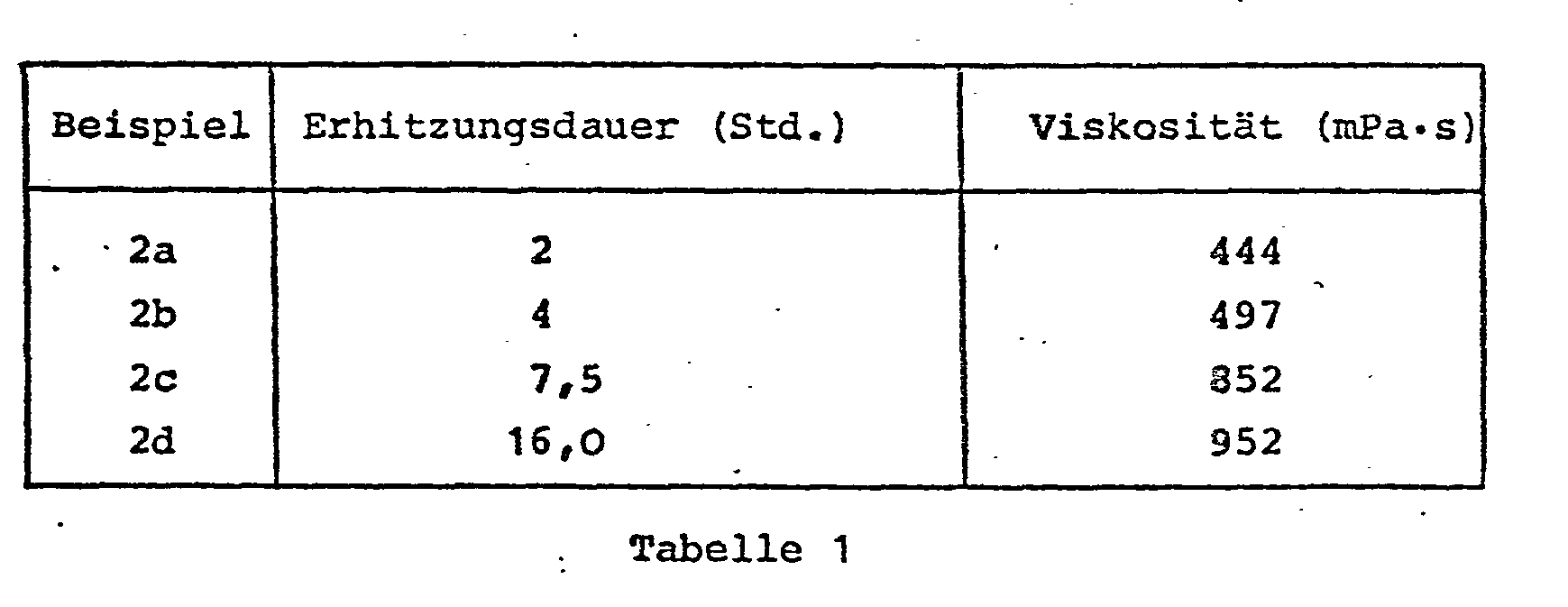
- Diese Beispiele zeigen den Einfluß der Lösungsmittelmenge und des Harzanteils auf die Viskosität der Verfahrensprodukte.
- 100 g Octamethylcyclotetrasiloxan (A) wurden mit wechselnden Mengen des in Beispiel 1 beschriebenen Methylphenylsiloxanharzes (B) und Toluol in Gegenwart von 100 mg Tetramethylammoniumhydroxid, wie in Beispiel 1 beschrieben, umgesetzt. Nach dem Abtrennen des Lösungsmittels und des neutralisierten Katalysators wurde'die Viskosität des Produktes bestimmt, eine weitere Viskositätsbestimmung erfolgte nach dem Einarbeiten der silanierten Kieselsäure. Die eingesetzten Mengen an Harz und Toluol sowie die Ergebnisse sind in Tabelle 2 aufgeführt.
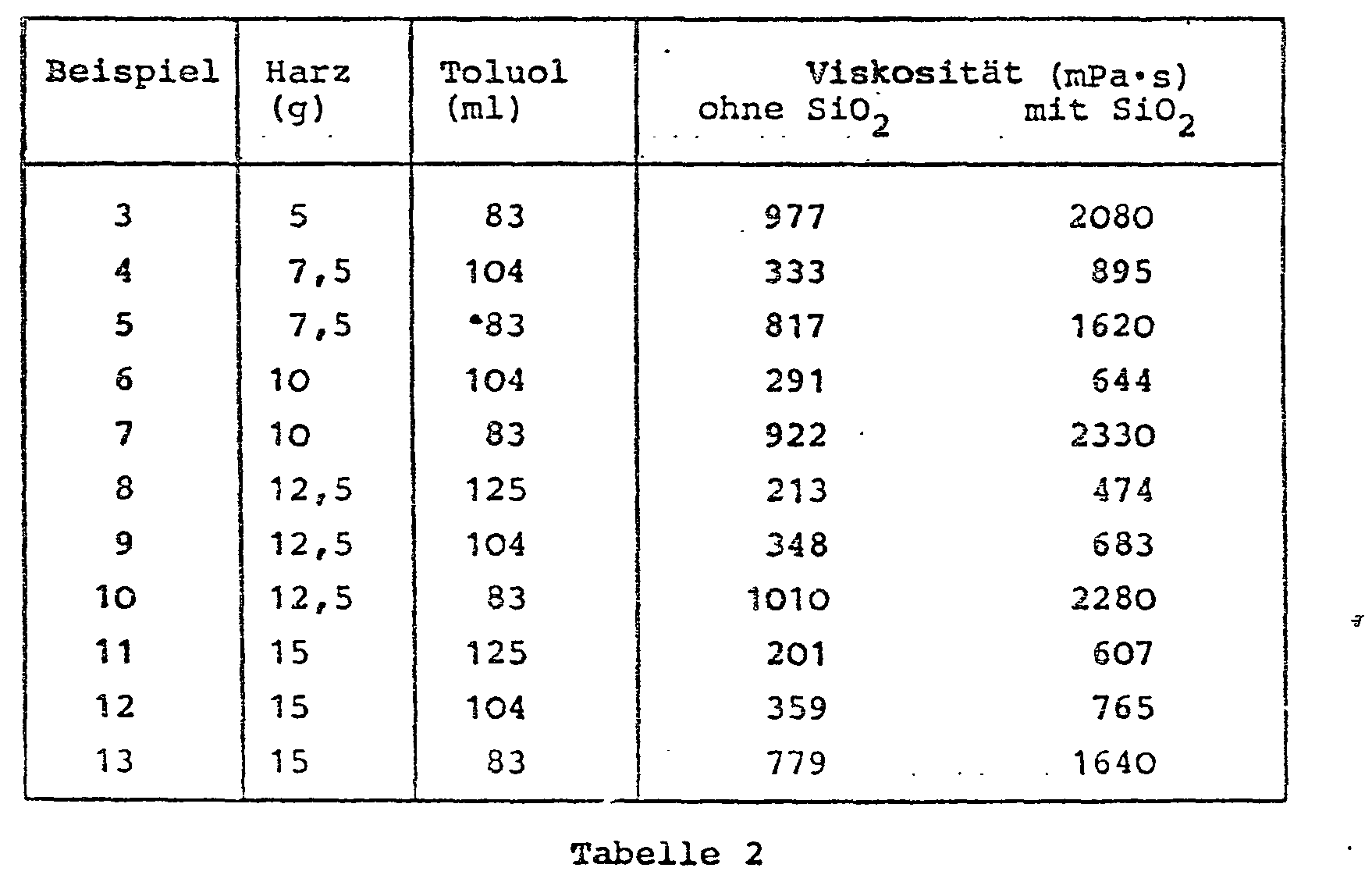
- Als Komponente (A) diente Octamethylcyclotetrasiloxan, als Komponente (B) ein Siloxanharz, hergestellt durch Umsetzung von Styrol mit Trichlorsilan und anschließende Hydrolyse in einem Gemisch von Toluol und Wasser. Die in den Strukturelementen enthaltenen Reste R wiesen demnach die folgende Struktur auf:

- Der Gehalt an Hydroxylgruppen betrug 5 Gew.-%. Das Harz wies ein mittleres Molekulargewicht von 4400 auf.
- Jeweils 100 Gewichtsteile Octamethylcyclotetrasiloxan wurden mit wechselnden Mengen Toluol und Siloxanharz und 0,13 Gewichtsteilen Tetramethylammoniumhydroxid in einer Stickstoffatmosphäre 18 Stunden unter Rühren auf 1110 C erhitzt. Die Aufarbeitung erfolgte wie in Beispiel 1 angegeben. Die Ergebnisse sind in Tabelle 3 zusammengefaßt.

- Zur Herstellung eines Siloxanharzes wurden 178 g Isobutyltrimethoxysiloxan, 200 ml Toluol, 1000 ml Wasser und 1,36 g KOH zunächst 3 Stunden bei Raumtemperatur gerührt und anschließend 2 Stunden auf 100 °C unter Rückfluß erhitzt. Nach dem Abkühlen wurde die Toluolphase abgetrennt und mit Wasser alkalifrei gewaschen. Nach Abdestillieren hinterblieb ein Polyisobutylsiloxan-Harz mit einem mittleren Molekulargewicht von 1600, in dem der Anteil der Hydroxylgruppen 3 Gew.-% betrug.
- 400 g Octamethylcyclotetrasiloxan, 8 g Hexamethyldisiloxan (als Kettenabbrecher) und 105 g des Polyisobutylsiloxanharzes wurden nach Zusatz von 15 g einer säureaktivierten, getrockneten Bleicherde unter Rühren in einer Stickstoffatmosphäre auf 130 C erhitzt. Das erhaltene Blockpolymere wurde noch warm filtriert und im Vakuum zur Entfernung flüchtiger Bestandteile kurze Zeit auf 150 °C erhitzt. Es wies eine Viskosität von 1570 mPa·s (20 °C) und nach dem Homogenisieren mit 3 Gewichtsprozent silanierter Kieselsäure (vgl. Beispiel 1) eine solche von 4080 mPa·s auf.
- Die folgenden Beispiele wurden unter Verwendung verschiedener Lösungsmittel durchgeführt.
- Zu diesem Zweck wurden 100 g Octamethylcyclotetrasiloxan, 10 g des in Beispiel 1 verwendeten Methylphenylsiloxanharzes und 100 mg Tetramethylammoniumhydroxid in jeweils 104 ml eines Lösungsmittels (vgl. Tabelle 4) während 16 Stunden unter Rühren in einer Stickstoffatmosphäre auf 110° bis 1120 C erhitzt. Bei Verwendung von Benzinfraktionen (die Zahlenangaben bezeichnen den Siedebereich in °C) als Lösungsmittel waren die Lösungen anfänglich durch ungelösten Katalysator etwas getrübt. Diese Trübung ging im Verlauf einiger Stunden zurück. Nach der gemäß Beispiel 1 durchgeführten Aufarbeitung wurden Blockpolymere mit den in Tabelle 4 angegebenen Viskositäten (in mPa·s) erhalten.

- Die Blockpolymeren wurden, wie in Beispiel 1 beschrieben, aufgearbeitet und mit silanierter Kieselsäure homogenisiert.
- Zur Prüfung des Schaumverhaltens wurden die erfindungsgemäB hergestellten Inhibitoren in verschiedener Weise in Waschmittel eingearbeitet. Die Schaumeigenschaften dieser Waschmittel wurden unter praxisnahen Bedingungen in einer handelsüblichen Waschmaschine mit horizontal angeordneter Trommel bei Temperaturen zwischen 30° und 95° C geprüft. Hierzu wurde die Maschine mit 3,5 kg sauberer Füllwäsche (Baumwolle) beschickt. Die Waschmittelkonzentration betrug 7,5 g und die Wasserhärte 16° dH. Die jeweilige Schaumhöhe wurde durch das Sichtglas der Fronttüre kontrolliert und wie folgt benotet:

- Die Zusammensetzung des Waschmittels lautete (in Gewichtsprozent):


- Mit Ausnahme des Perborats, das nachträglich dem Pulver zugemischt wurde, wurden alle Bestandteile in einen Slurry eingearbeitet und sprühgetrocknet.
- In einer 1. Versuchsreihe wurden die Verfahrensprodukte sowie die Vergleichsprodukte suf einem körnigen, porösen, wasserlöslichen Träger adsorbiert, der durch Sprühtrocknen einer wäßrigen Tripolyphosphatlösung (Wassergehalt 35 Gew.%) erhalten worden war und ein Schüttgewicht von 520 g und eine Korngröße von 0,1 bis 1,6 mm aufwies.
- Das Adsorbat mit einem Gehalt an 7,5 g Schauminhibitor und 92,5 g Trägersubstanz wurde in wechselnden Mengen mit dem Waschpulver gleichmäßig vermischt. In einer 2. Versuchsreihe wurden die Schauminhibitoren in den.Slurry eingearbeitet und mit diesem zusammen versprüht.
- Als Vergleichsprodukte dienten käufliche Schauminhibitoren, und zwar "SAG 100" der Union Carbide Corp. (als Vergleichsprodukt V1 bezeichnet) und "Q 2-3008" der Dow Corning Corp. (Vergleichsprodukt V2), die als für Waschmittel als besonders geeignet gelten. Es handelt sich dabei nach Kenntnis der Anmelderin um Siliciumdioxid enthaltende Polydimethylsiloxane. Weitere Vergleichs- .produkte wurden wie folgt dargestellt.
- 7850 eines Dimethylpolysiloxans mit einer Viskosität von 420 mPa· s (20° C) wurden in einer Stickstoffatmosphäre unter Rühren auf 100° C erhitzt, mit 1570 eines Polysiloxanharzes, das aus (CH3)3-SiO½- und SiO2-Einheiten im Verhältnis 0,67 : 1 aufgebaut war, versetzt und zwecks Homogenisierung weitere 3,5 Stunden bei 100° C verrührt. Nach Zusatz von 377 eines Kiesel-/27 säure-Aerogels (Aerosil R 972) wurde das Gemisch unter fortgesetztem Rühren weitere 5 Stunden auf 180° C erhitzt. Die Viskosität des Verfahrensproduktes betrug 3130 mPa·s.
- Herstellung und Zusammensetzung entsprechen den Angaben der DE-AS 16 19 859 beziehungsweise US-PS 3 455 839.
- Es wurde ein Gemisch verwendet, das durch 16-stündiges Erhitzen von Polydimethylsiloxan und Methylphenylsiloxanharz in Toluol bei Abwesenheit eines Katalysators entsprechend dem Vergleichsversuch zu Beispiel 1 erhalten und anschließend mit 3 Gew.% silanierter Kieselsäure bei 200° C homogenisiert worden war.
- Die Beispiele sind in der Tabelle 5, die Vergleichsversuche in Tabelle 6 zusammengefaßt.
- Die Ergebnisse zeigen, daß die erfindungsgemäß hergestellten Schauminhibitoren erheblich wirksamer sind als die bekannten Mittel, inbesondere bei sehr niedrigen Konzentrationen. Darüber hinaus bleibt ihre volle Wirksamkeit auch nach einer Sprühtrocknung erhalten, während die bekannten Schauminhibitoren auf Siliconbasis unter diesen Bedingungen einen erheblichen Wirkungsverlust erleiden. Bei Einsatz sehr geringer Mengen ist die Wirkung der erfindungsgemäßen Blockpolymeren nach dem Versprühen sogar noch größer als bei üblichem Zumischen, was möglicherweise auf die homogenere Verteilung der in sehr geringer Menge vorliegenden Schauminhibitoren im gesprühten Pulver zurückzuführen ist. Eine vergleichbare homogene und reproduzierbare Verteilung ist bei einem Vermischen vorgefertigter Pulver trotz des höheren Verfahrensaufwandes nicht zu erreichen.
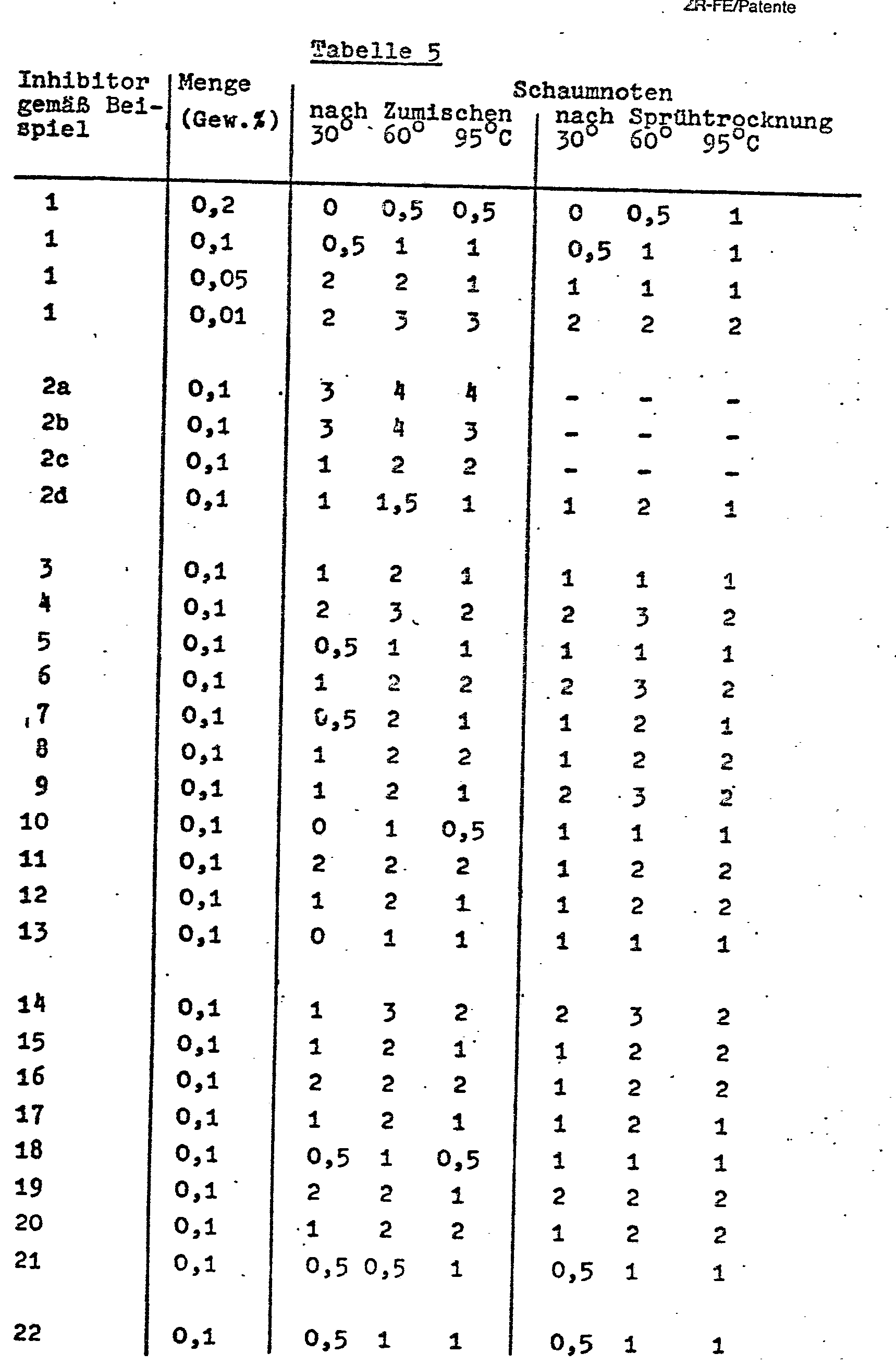
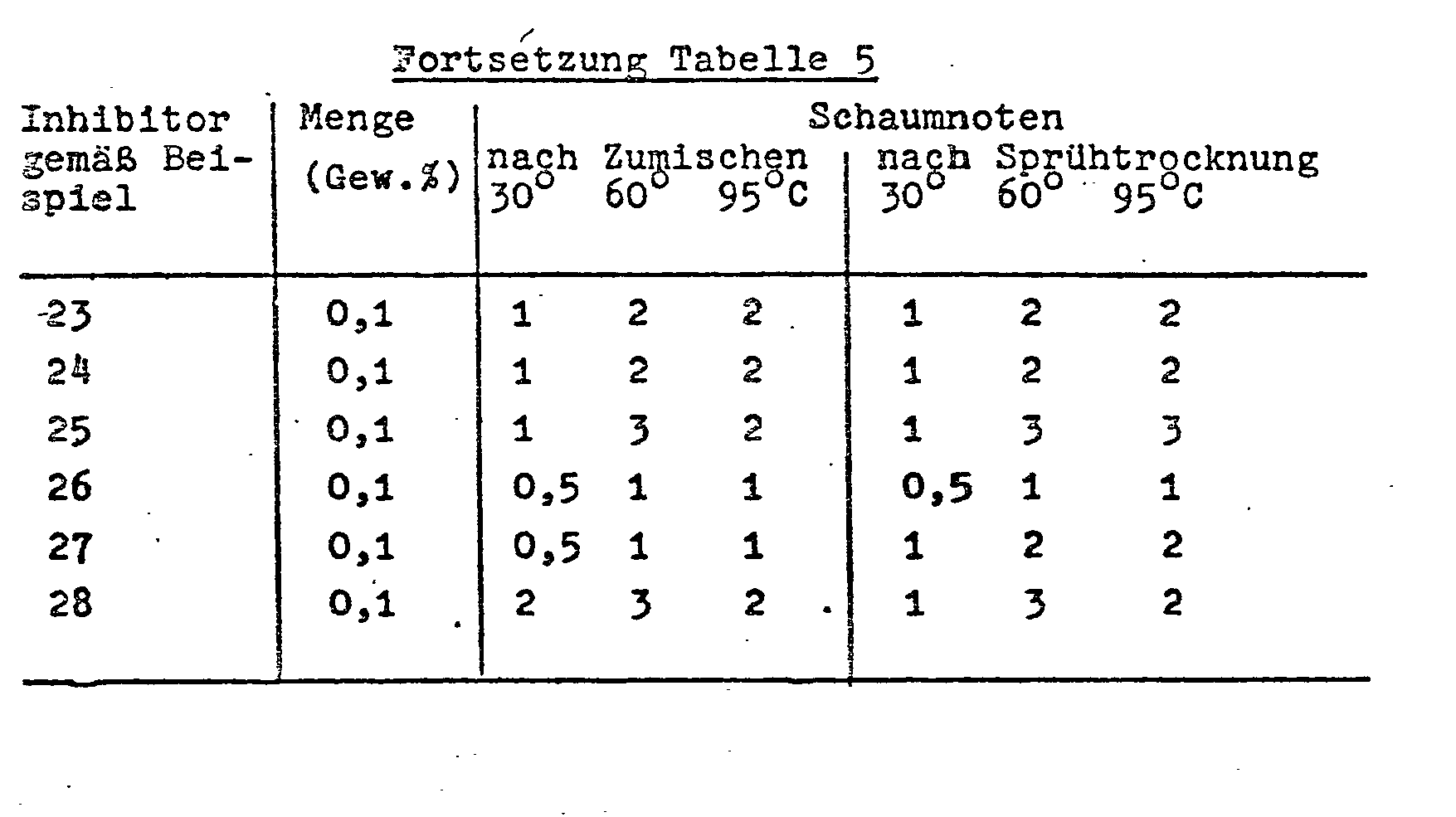

Claims (18)

Priority Applications (1)
| Application Number | Priority Date | Filing Date | Title |
|---|---|---|---|
| AT80107891T ATE7860T1 (de) | 1979-12-24 | 1980-12-13 | Verfahren zur herstellung eines polysiloxanblockpolymerisatssowie dessen verwendung als schauminhibitor. |
Applications Claiming Priority (2)
| Application Number | Priority Date | Filing Date | Title |
|---|---|---|---|
| DE19792952287 DE2952287A1 (de) | 1979-12-24 | 1979-12-24 | Verfahren zur herstellung eines polysiloxan-blockpolymerisates sowie dessen verwendung als schauminhibitor |
| DE2952287 | 1979-12-24 |
Publications (2)
| Publication Number | Publication Date |
|---|---|
| EP0031532A1 true EP0031532A1 (de) | 1981-07-08 |
| EP0031532B1 EP0031532B1 (de) | 1984-06-13 |
Family
ID=6089633
Family Applications (1)
| Application Number | Title | Priority Date | Filing Date |
|---|---|---|---|
| EP80107891A Expired EP0031532B1 (de) | 1979-12-24 | 1980-12-13 | Verfahren zur Herstellung eines Polysiloxan-Blockpolymerisats sowie dessen Verwendung als Schauminhibitor |
Country Status (6)
| Country | Link |
|---|---|
| US (1) | US4396524A (de) |
| EP (1) | EP0031532B1 (de) |
| JP (1) | JPS5698235A (de) |
| AT (1) | ATE7860T1 (de) |
| CA (1) | CA1167463A (de) |
| DE (2) | DE2952287A1 (de) |
Cited By (7)
| Publication number | Priority date | Publication date | Assignee | Title |
|---|---|---|---|---|
| FR2636985A1 (fr) * | 1988-09-28 | 1990-03-30 | Dow Corning Ltd | Composition assouplissante et procede pour le traitement de textiles |
| EP0718018A2 (de) | 1994-12-24 | 1996-06-26 | Dow Corning S.A. | Teilchenförmige Schaumkontrollmittel und ihre Verwendung |
| US5589449A (en) * | 1993-07-29 | 1996-12-31 | Dow Corning S.A. | Particulate foam control agents |
| EP1118655A1 (de) * | 2000-01-14 | 2001-07-25 | Dow Corning S.A. | Schaumregulierungsmittel |
| WO2007022866A1 (de) | 2005-08-24 | 2007-03-01 | Henkel Kommanditgesellschaft Auf Aktien | Schaumregulatorgranulate als ablagerungsverhinderer bei der maschinellen textilwäsche |
| US9815003B2 (en) | 2015-09-28 | 2017-11-14 | Wacker Chemical Corporation | Silicone defoamer compositions |
| CN110290848A (zh) * | 2017-02-22 | 2019-09-27 | Jxtg能源株式会社 | 消泡剂和润滑油组合物 |
Families Citing this family (17)
| Publication number | Priority date | Publication date | Assignee | Title |
|---|---|---|---|---|
| DE3200206A1 (de) * | 1982-01-07 | 1983-07-21 | Henkel KGaA, 4000 Düsseldorf | Organopolysiloxane und deren verwendung als antischaummittel in waessrigen dispersionen und loesungen von kunstharzen |
| DE3412091A1 (de) * | 1984-03-31 | 1985-10-10 | Henkel KGaA, 4000 Düsseldorf | Manuell und maschinell anwendbares kaltwaschmittel |
| DE3427496A1 (de) * | 1984-07-26 | 1986-01-30 | Henkel KGaA, 4000 Düsseldorf | Verfahren zur herstellung eines polysiloxan-blockpolymerisates |
| JPS61136406A (ja) * | 1984-12-05 | 1986-06-24 | Toray Silicone Co Ltd | 固形シリコ−ン消泡剤及びその製造方法 |
| JPS61200819A (ja) * | 1985-03-01 | 1986-09-05 | Shin Etsu Chem Co Ltd | 消泡剤組成物 |
| DE3805624A1 (de) * | 1988-02-24 | 1989-08-31 | Degussa | Pulverfoermiger waschmittelentschaeumer |
| JPH0779930B2 (ja) * | 1989-12-20 | 1995-08-30 | ダウコーニングアジア株式会社 | シリコーン消泡剤組成物 |
| GB9315671D0 (en) * | 1993-07-29 | 1993-09-15 | Dow Corning Sa | Foam control agents and their use |
| JPH07197086A (ja) * | 1993-12-29 | 1995-08-01 | Toray Dow Corning Silicone Co Ltd | 洗剤組成物 |
| DE4421270A1 (de) * | 1994-06-20 | 1995-12-21 | Henkel Kgaa | Wäßrige Fettalkoholdispersionen |
| DE19614933A1 (de) * | 1996-04-16 | 1997-10-23 | Helmut Buchmann | Kontaktschraubenzieher (manuell) |
| ATE286422T1 (de) * | 1999-08-13 | 2005-01-15 | Dow Corning Sa | Schaumregulierungsmittel auf basis von silikon |
| EP1075863B8 (de) * | 1999-08-13 | 2008-10-08 | Dow Corning Europe Sa | Silikonhaltiges Schaumregulierungsmittel |
| BRPI0721554B1 (pt) * | 2007-04-13 | 2017-11-28 | Ecolab Inc. | Floor cleaning composition with reduced foam properties, use solution containing same and surface cleaning method |
| CA2888341A1 (en) | 2012-10-24 | 2014-05-01 | The Procter & Gamble Company | Anti foam compositions comprising aryl bearing polyorganosilicons |
| EP2911761A1 (de) * | 2012-10-24 | 2015-09-02 | The Procter & Gamble Company | Antischaumzusammensetzungen mit teilweise phenylbeladenem polyorganosilicium |
| WO2018216443A1 (ja) * | 2017-05-24 | 2018-11-29 | 東レ・ダウコーニング株式会社 | 固体シリコーン材料、それを用いてなる積層体および発光デバイス |
Citations (1)
| Publication number | Priority date | Publication date | Assignee | Title |
|---|---|---|---|---|
| DE2506203A1 (de) * | 1974-11-22 | 1976-05-26 | Dow Corning | Entschaeumer |
Family Cites Families (11)
| Publication number | Priority date | Publication date | Assignee | Title |
|---|---|---|---|---|
| FR1240061A (fr) * | 1959-07-23 | 1960-09-02 | Rhone Poulenc Sa | Procédé de préparation d'émulsions aqueuses à propriétés antimousse améliorées |
| US3235509A (en) * | 1962-10-03 | 1966-02-15 | Wacker Chemie Gmbh | Method for producing antifoam agents |
| GB1051687A (de) * | 1963-05-06 | |||
| US3436439A (en) * | 1965-08-13 | 1969-04-01 | Dow Corning | Preparation of siloxane block copolymers |
| NL136759C (de) * | 1966-02-16 | |||
| US3560401A (en) * | 1967-08-11 | 1971-02-02 | Union Carbide Corp | Persistent antifoam compositions and methods of making same utilizing basic materials |
| GB1297087A (de) * | 1969-10-15 | 1972-11-22 | ||
| US3700400A (en) * | 1971-05-03 | 1972-10-24 | Ici Ltd | Silicone-polyalkylene oxide block copolymer suppressing foam in jet dyeing |
| US3819745A (en) * | 1972-03-27 | 1974-06-25 | Dow Corning | Coatings giving controlled release |
| GB1407997A (en) * | 1972-08-01 | 1975-10-01 | Procter & Gamble | Controlled sudsing detergent compositions |
| CH626915A5 (en) * | 1975-10-14 | 1981-12-15 | Procter & Gamble | Detergent and cleaner |
-
1979
- 1979-12-24 DE DE19792952287 patent/DE2952287A1/de not_active Withdrawn
-
1980
- 1980-12-13 DE DE8080107891T patent/DE3068267D1/de not_active Expired
- 1980-12-13 EP EP80107891A patent/EP0031532B1/de not_active Expired
- 1980-12-13 AT AT80107891T patent/ATE7860T1/de not_active IP Right Cessation
- 1980-12-22 US US06/218,575 patent/US4396524A/en not_active Expired - Fee Related
- 1980-12-24 JP JP18216880A patent/JPS5698235A/ja active Granted
- 1980-12-24 CA CA000367578A patent/CA1167463A/en not_active Expired
Patent Citations (1)
| Publication number | Priority date | Publication date | Assignee | Title |
|---|---|---|---|---|
| DE2506203A1 (de) * | 1974-11-22 | 1976-05-26 | Dow Corning | Entschaeumer |
Cited By (8)
| Publication number | Priority date | Publication date | Assignee | Title |
|---|---|---|---|---|
| FR2636985A1 (fr) * | 1988-09-28 | 1990-03-30 | Dow Corning Ltd | Composition assouplissante et procede pour le traitement de textiles |
| US5589449A (en) * | 1993-07-29 | 1996-12-31 | Dow Corning S.A. | Particulate foam control agents |
| EP0718018A2 (de) | 1994-12-24 | 1996-06-26 | Dow Corning S.A. | Teilchenförmige Schaumkontrollmittel und ihre Verwendung |
| US5767053A (en) * | 1994-12-24 | 1998-06-16 | Dow Corning S. A. | Particulate foam control agents and their use |
| EP1118655A1 (de) * | 2000-01-14 | 2001-07-25 | Dow Corning S.A. | Schaumregulierungsmittel |
| WO2007022866A1 (de) | 2005-08-24 | 2007-03-01 | Henkel Kommanditgesellschaft Auf Aktien | Schaumregulatorgranulate als ablagerungsverhinderer bei der maschinellen textilwäsche |
| US9815003B2 (en) | 2015-09-28 | 2017-11-14 | Wacker Chemical Corporation | Silicone defoamer compositions |
| CN110290848A (zh) * | 2017-02-22 | 2019-09-27 | Jxtg能源株式会社 | 消泡剂和润滑油组合物 |
Also Published As
| Publication number | Publication date |
|---|---|
| JPS5698235A (en) | 1981-08-07 |
| CA1167463A (en) | 1984-05-15 |
| US4396524A (en) | 1983-08-02 |
| DE3068267D1 (en) | 1984-07-19 |
| DE2952287A1 (de) | 1981-07-02 |
| ATE7860T1 (de) | 1984-06-15 |
| EP0031532B1 (de) | 1984-06-13 |
| JPH0120172B2 (de) | 1989-04-14 |
Similar Documents
| Publication | Publication Date | Title |
|---|---|---|
| EP0031532B1 (de) | Verfahren zur Herstellung eines Polysiloxan-Blockpolymerisats sowie dessen Verwendung als Schauminhibitor | |
| DE69421570T2 (de) | Teilchenförmige Schaumkontrollmittel und ihre Verwendung | |
| DE60017223T2 (de) | Schaumregulierungsmittel auf Basis von Silikon | |
| DE69329742T2 (de) | Schaumkontrollmittel auf Basis von Polyorganosiloxanen | |
| US4961753A (en) | Compositions and process for the treatment of textiles | |
| DE69532516T2 (de) | Schaumregulierendes Agens | |
| US4339342A (en) | Anti-foaming agents, the preparation thereof, and their use in aqueous systems | |
| CH624989A5 (de) | ||
| EP0322322B1 (de) | HQ-Harz enthaltendes schaumregulierendes Mittel | |
| DE2909757A1 (de) | Verfahren zur herstellung schaumregulierter waschmittel | |
| DE69421462T2 (de) | Teilchenförmige Schaumkontrollmittel | |
| EP0013028B1 (de) | Waschmittel mit einem Gehalt an schaumdämpfend wirkendem Polydimethylsiloxan und Verfahren zu dessen Herstellung | |
| DE60119596T2 (de) | Schaumregulierungsmittel | |
| EP2861319B1 (de) | Antischaummittel und deren verwendung in waschmitteln | |
| DE69332160T2 (de) | Verfahren zur Kontrolle von Schaum mittels Organopolysiloxanen | |
| DE60102980T2 (de) | In Waschmitteln stabile auf Silikon basierende Schaumregulierungszusammensetzungen | |
| DE2646127A1 (de) | Wasch- und reinigungsmittelzusammensetzungen | |
| DE60302883T2 (de) | Schaumregulierungsmittel | |
| DE2721238A1 (de) | Organosilicium-antischaummittel | |
| EP0169500A2 (de) | Verfahren zur Herstellung eines Polysiloxan-Blockpolymerisates | |
| DE19652524A1 (de) | Quarternäre Ammoniumgruppen tragende Organopolysiloxane, deren Herstellung und Verwendung in wäßrigen Systemen | |
| EP0719167B1 (de) | Estergruppenhaltige blockpolymere als entschäumer für wässrige systeme | |
| EP0719168B1 (de) | Estergruppenhaltige blockpolymere als entschäumer für wässrige systeme | |
| EP0436791B1 (de) | Mittel zum Entschäumen wässriger, insbesondere alkalischer Zubereitungen | |
| DE3933971C2 (de) | Flüssige Weichspülzusammensetzung und deren Verwendung |
Legal Events
| Date | Code | Title | Description |
|---|---|---|---|
| PUAI | Public reference made under article 153(3) epc to a published international application that has entered the european phase |
Free format text: ORIGINAL CODE: 0009012 |
|
| AK | Designated contracting states |
Designated state(s): AT BE CH DE FR GB IT LI NL |
|
| 17P | Request for examination filed |
Effective date: 19811029 |
|
| ITF | It: translation for a ep patent filed | ||
| GRAA | (expected) grant |
Free format text: ORIGINAL CODE: 0009210 |
|
| RBV | Designated contracting states (corrected) |
Designated state(s): AT BE CH DE FR GB IT LI NL |
|
| AK | Designated contracting states |
Designated state(s): AT BE CH DE FR GB IT LI NL |
|
| REF | Corresponds to: |
Ref document number: 7860 Country of ref document: AT Date of ref document: 19840615 Kind code of ref document: T |
|
| REF | Corresponds to: |
Ref document number: 3068267 Country of ref document: DE Date of ref document: 19840719 |
|
| ET | Fr: translation filed | ||
| PLBE | No opposition filed within time limit |
Free format text: ORIGINAL CODE: 0009261 |
|
| STAA | Information on the status of an ep patent application or granted ep patent |
Free format text: STATUS: NO OPPOSITION FILED WITHIN TIME LIMIT |
|
| 26N | No opposition filed | ||
| ITTA | It: last paid annual fee | ||
| PGFP | Annual fee paid to national office [announced via postgrant information from national office to epo] |
Ref country code: CH Payment date: 19921123 Year of fee payment: 13 |
|
| PGFP | Annual fee paid to national office [announced via postgrant information from national office to epo] |
Ref country code: GB Payment date: 19921202 Year of fee payment: 13 Ref country code: DE Payment date: 19921202 Year of fee payment: 13 |
|
| PGFP | Annual fee paid to national office [announced via postgrant information from national office to epo] |
Ref country code: AT Payment date: 19921207 Year of fee payment: 13 |
|
| PGFP | Annual fee paid to national office [announced via postgrant information from national office to epo] |
Ref country code: FR Payment date: 19921209 Year of fee payment: 13 |
|
| PGFP | Annual fee paid to national office [announced via postgrant information from national office to epo] |
Ref country code: NL Payment date: 19921231 Year of fee payment: 13 |
|
| PGFP | Annual fee paid to national office [announced via postgrant information from national office to epo] |
Ref country code: BE Payment date: 19930115 Year of fee payment: 13 |
|
| PG25 | Lapsed in a contracting state [announced via postgrant information from national office to epo] |
Ref country code: GB Effective date: 19931213 Ref country code: AT Effective date: 19931213 |
|
| PG25 | Lapsed in a contracting state [announced via postgrant information from national office to epo] |
Ref country code: LI Effective date: 19931231 Ref country code: CH Effective date: 19931231 Ref country code: BE Effective date: 19931231 |
|
| BERE | Be: lapsed |
Owner name: HENKEL K.G.A.A. Effective date: 19931231 |
|
| PG25 | Lapsed in a contracting state [announced via postgrant information from national office to epo] |
Ref country code: NL Effective date: 19940701 |
|
| GBPC | Gb: european patent ceased through non-payment of renewal fee |
Effective date: 19931213 |
|
| NLV4 | Nl: lapsed or anulled due to non-payment of the annual fee | ||
| PG25 | Lapsed in a contracting state [announced via postgrant information from national office to epo] |
Ref country code: FR Effective date: 19940831 |
|
| REG | Reference to a national code |
Ref country code: CH Ref legal event code: PL |
|
| PG25 | Lapsed in a contracting state [announced via postgrant information from national office to epo] |
Ref country code: DE Effective date: 19940901 |
|
| REG | Reference to a national code |
Ref country code: FR Ref legal event code: ST |