EP0010941B1 - 5-Fluoruracil-Derivate, deren Herstellung und ihre pharmazeutischen Zusammensetzungen - Google Patents
5-Fluoruracil-Derivate, deren Herstellung und ihre pharmazeutischen Zusammensetzungen Download PDFInfo
- Publication number
- EP0010941B1 EP0010941B1 EP19790302358 EP79302358A EP0010941B1 EP 0010941 B1 EP0010941 B1 EP 0010941B1 EP 19790302358 EP19790302358 EP 19790302358 EP 79302358 A EP79302358 A EP 79302358A EP 0010941 B1 EP0010941 B1 EP 0010941B1
- Authority
- EP
- European Patent Office
- Prior art keywords
- compound according
- alkyl
- substituted
- radical
- bicyclo
- Prior art date
- Legal status (The legal status is an assumption and is not a legal conclusion. Google has not performed a legal analysis and makes no representation as to the accuracy of the status listed.)
- Expired
Links
- 0 O=C(C(F)=CN1*[Rh])NC1=O Chemical compound O=C(C(F)=CN1*[Rh])NC1=O 0.000 description 4
- RAIRJKWTBBDDAR-UHFFFAOYSA-N O=C(C(CN1)F)NC1=O Chemical compound O=C(C(CN1)F)NC1=O RAIRJKWTBBDDAR-UHFFFAOYSA-N 0.000 description 1
Classifications
-
- C—CHEMISTRY; METALLURGY
- C07—ORGANIC CHEMISTRY
- C07D—HETEROCYCLIC COMPOUNDS
- C07D239/00—Heterocyclic compounds containing 1,3-diazine or hydrogenated 1,3-diazine rings
- C07D239/02—Heterocyclic compounds containing 1,3-diazine or hydrogenated 1,3-diazine rings not condensed with other rings
- C07D239/24—Heterocyclic compounds containing 1,3-diazine or hydrogenated 1,3-diazine rings not condensed with other rings having three or more double bonds between ring members or between ring members and non-ring members
- C07D239/28—Heterocyclic compounds containing 1,3-diazine or hydrogenated 1,3-diazine rings not condensed with other rings having three or more double bonds between ring members or between ring members and non-ring members with hetero atoms or with carbon atoms having three bonds to hetero atoms with at the most one bond to halogen, directly attached to ring carbon atoms
- C07D239/46—Two or more oxygen, sulphur or nitrogen atoms
- C07D239/52—Two oxygen atoms
- C07D239/54—Two oxygen atoms as doubly bound oxygen atoms or as unsubstituted hydroxy radicals
- C07D239/545—Two oxygen atoms as doubly bound oxygen atoms or as unsubstituted hydroxy radicals with other hetero atoms or with carbon atoms having three bonds to hetero atoms with at the most one bond to halogen, directly attached to ring carbon atoms
- C07D239/553—Two oxygen atoms as doubly bound oxygen atoms or as unsubstituted hydroxy radicals with other hetero atoms or with carbon atoms having three bonds to hetero atoms with at the most one bond to halogen, directly attached to ring carbon atoms with halogen atoms or nitro radicals directly attached to ring carbon atoms, e.g. fluorouracil
-
- C—CHEMISTRY; METALLURGY
- C07—ORGANIC CHEMISTRY
- C07C—ACYCLIC OR CARBOCYCLIC COMPOUNDS
- C07C265/00—Derivatives of isocyanic acid
-
- C—CHEMISTRY; METALLURGY
- C07—ORGANIC CHEMISTRY
- C07D—HETEROCYCLIC COMPOUNDS
- C07D317/00—Heterocyclic compounds containing five-membered rings having two oxygen atoms as the only ring hetero atoms
- C07D317/08—Heterocyclic compounds containing five-membered rings having two oxygen atoms as the only ring hetero atoms having the hetero atoms in positions 1 and 3
- C07D317/44—Heterocyclic compounds containing five-membered rings having two oxygen atoms as the only ring hetero atoms having the hetero atoms in positions 1 and 3 ortho- or peri-condensed with carbocyclic rings or ring systems
- C07D317/70—Heterocyclic compounds containing five-membered rings having two oxygen atoms as the only ring hetero atoms having the hetero atoms in positions 1 and 3 ortho- or peri-condensed with carbocyclic rings or ring systems condensed with ring systems containing two or more relevant rings
-
- C—CHEMISTRY; METALLURGY
- C07—ORGANIC CHEMISTRY
- C07D—HETEROCYCLIC COMPOUNDS
- C07D333/00—Heterocyclic compounds containing five-membered rings having one sulfur atom as the only ring hetero atom
- C07D333/02—Heterocyclic compounds containing five-membered rings having one sulfur atom as the only ring hetero atom not condensed with other rings
- C07D333/04—Heterocyclic compounds containing five-membered rings having one sulfur atom as the only ring hetero atom not condensed with other rings not substituted on the ring sulphur atom
- C07D333/26—Heterocyclic compounds containing five-membered rings having one sulfur atom as the only ring hetero atom not condensed with other rings not substituted on the ring sulphur atom with hetero atoms or with carbon atoms having three bonds to hetero atoms with at the most one bond to halogen, e.g. ester or nitrile radicals, directly attached to ring carbon atoms
- C07D333/38—Carbon atoms having three bonds to hetero atoms with at the most one bond to halogen, e.g. ester or nitrile radicals
Definitions
- This invention relates to 5-fluoroacil derivatives and to the pharmaceutically acceptable salts thereof.
- the present invention relates to 5-fluorouracil derivatives and to the pharmaceutically acceptable salts thereof which have antitumor activity, to processes for the preparation thereof and to pharmaceutical compositions comprising them.
- Another object of the present invention is to provides processes for the preparation of 5-fluorouracil derivatives and of the pharmaceutically acceptable salts thereof.
- a further object of the present invention is to provide pharmaceutical compositions comprising the 5-fluorouracil derivatives and/or the pharmaceutically acceptable salts thereof.
- the 5-fluorouracil derivatives of the present invention are compounds of the formula: wherein R is a substituted or unsubstituted bridged alicyclic radical selected from substituted and unsubstituted norbornyl, norbornenyl, bicyclo[2.2.2]octyl, bicyclo[2.2.2]-oct-2-enyl, bicyclo-[3.1.1 ]heptyl and adamantyl, the substituent(s) of said bridged alicyclic radical being selected from (C 1 ⁇ C 6 alkyl, carboxy, esterified carboxy, (C 1 -C 6 )alkylidenedioxy, N,N-di-(C 1 ⁇ C 6 )alkylcarbamoyl, amino and protected amino; or is a substituted (C 6 ⁇ C 6 )alky) radical, the substituent being selected from substituted and unsubstituted bridged alicyclic radicals selected from substituted and unsubstituted nor
- bridged alicyclic radicals include carboxynorbornyl, (e.g. 3-carboxy-2-norbornyl), (C 1 ⁇ C 6 )alkoxycarbonylnorbornyl (e.g. 3-methoxycarbonylnorborn-2-yl, 3-ethoxycarbonyl- norborn-2-yl or 3-isopropoxycarbonylnorborn-2-yl), [N,N-di(C 1 ⁇ C 6 )alkylcarbamoyl]norbornyl (e.g. (3-(N,N-diisopropylcarbamoyl)-2-norbornyl), aminonorbornyl (e.g.
- the alkyl moiety in the substituted (C l -C 6 )alkyl radical includes straight-chained and branched alkyl, such as methyl, ethyl, propyl, isopropyl, butyl, isobutyl, pentyl or hexyl, straight chained being preferred.
- (C 1 -C 6 )Alkoxy includes straight-chained and branched radicals, such as methoxy, ethoxy, propoxy, isopropoxy, butoxy, isobutoxy, t.-butoxy, pentyloxy or hexyloxy, the (C,-C 4 )alkoxy radicals being preferred.
- Acyl includes N-substituted carbamoyl, aliphatic acyl, acyl comprising an aromatic ring, (hereinafter referred to as aromatic acyl) and acyl comprising a heterocyclic ring (hereinafter referred to as heterocyclic acyl), preferred examples of which are as follows:
- the alkyl moiety in the (C 1 ⁇ C 6 )-alkylthio and cyano(C 1 ⁇ C 6 )-alkylthio radicals includes those illustrated hereinabove for (C 1 ⁇ C 6 )-alkyl in the substituted (C 1 ⁇ C 6 )-alkyl radical.
- Particularly preferred (C 1 ⁇ C 6 )-alkylthio radicals include methylthio, ethylthio, propylthio, isopropylthio, butylthio, isobutylthio, t-butylthio, pentylthio or hexylthio, and preferred cyano-(C 1 ⁇ C 6 )-alkylthio radicals include the corresponding cyano-(C 1 ⁇ c 6 )-alkylthio, for example, cyanomethylthio.
- Esterified carboxy includes (C 1 ⁇ C 6 )-alkoxycarbonyl (e.g. methoxycarbonyl, ethoxycarbonyl, propoxycarbonyl, isopropoxycarbonyl, butoxycarbonyl, tert-butoxycarbonyl or pentyloxycarbonyl).
- C 1 ⁇ C 6 alkoxycarbonyl
- alkenyl moiety in the substituted alkenyl radical may be straight or branched (e.g. vinyl, allyl, isopropenyl, butenyl, isobutenyl, pentenyl or hexenyl).
- the pharmaceutically acceptable salts of the compounds (I) are conventional non-toxic salts and include organic acid-addition salts (e.g. maleates, tartrates, methanesulfonates, benzenesulfonates or toluenesulfonates), inorganic acid addition salts (e.g. hydrochlorides, hydrobromides, sulfates or phosphates,), salts with amino acids (e.g. arginine, aspartic acid, lysine or glutamic acid), inorganic base salts (e.g.
- organic acid-addition salts e.g. maleates, tartrates, methanesulfonates, benzenesulfonates or toluenesulfonates
- inorganic acid addition salts e.g. hydrochlorides, hydrobromides, sulfates or phosphates,
- salts with amino acids e.g. arginine, aspartic acid,
- alkali metal salts such as sodium and potassium salts and alkaline earth metal salts, such as a calcium and magnesium salts
- ammonium salts salts with organic bases, for example amine salts (e.g. trimethylamine salts, triethylamine salts, ethanolamine salts, diethanolamine salts, triethanolamine salts, pyridine salts or dicyclohexylamine salts).
- amine salts e.g. trimethylamine salts, triethylamine salts, ethanolamine salts, diethanolamine salts, triethanolamine salts, pyridine salts or dicyclohexylamine salts.
- stereoisomeric pair(s) of these compounds such as optical and/or geometrical isomers
- asymmetric carbon atom(s) e.g. of bridged alicyclic group
- double bond(s) e.g. of alkenyl group
- This process is usually carried out in a conventional solvent, such as benzene, dimethyl sulfoxide, N,N-dimethylformamide, N,N-dimethylacetamide, tetrahydrofuran, acetonitrile, methylene chloride, ethylacetate, diethyl ether, methyl ethyl ketone, pyridine, or any other solvent which does not adversely influence to the reaction under an anhydrous condition.
- the reaction temperature is not critical and the reaction is preferably conducted at ambient temperature or with heating.
- the compounds (la) can be isolated from the reaction mixture and purified in a conventional manner.
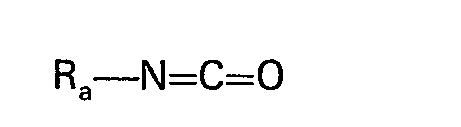
- This process may conveniently be carried out by adding 5-fluorouracil (II) directly to the reaction mixture containing the isocyanate (III), which can be prepared as illustrated in the following: wherein R a is as defined above.
- the first step of this process i.e. the preparation of the acid azide (VI), is conventionally carried out by reacting the carboxylic acid (IV) or a reactive derivative thereof on the carboxy group with the azide compound.
- Suitable reactive derivatives of the carboxylic acids (IV) include, for example, acid halides (e.g. acid chlorides, acid bromides), acid anhydrides, which include mixed acid anhydrides, such as mixed acid anhydrides with alkylcarbonic acids, which can be prepared by reacting the carboxylic acid (IV) with an alkyl halocarbonate (e.g. ethyl chlorocarbonate).
- acid halides e.g. acid chlorides, acid bromides
- acid anhydrides which include mixed acid anhydrides, such as mixed acid anhydrides with alkylcarbonic acids, which can be prepared by reacting the carboxylic acid (IV) with an alkyl halocarbonate (e.g. ethyl chlorocarbonate).
- the azide compound may be hydrazoic acid or a salt thereof, such as an alkali metal salt (e.g. sodium azide, potassium azide); a phosphoryl azide of the formula (V), which will be illustrated hereinafter.
- an alkali metal salt e.g. sodium azide, potassium azide
- a phosphoryl azide of the formula (V) which will be illustrated hereinafter.
- the reaction of the free form of carboxylic acid (IV) with an alkali metal salt of hydrazoic acid can be accelerated by a catalytic amount of a strong acid, such as sulfuric acid, and this first step can be preferably and conveniently carried out by reacting an acid halide or acid anhydride (preferably a mixed acid anhydride) derived from a carboxylic acid (IV) with an alkali metal salt of hydrazoic acid.
- a strong acid such as sulfuric acid
- the reaction of this step is usually carried out under hydrous conditions, i.e. in water or in an aqueous solution of water-miscible solvent, such as an alcohol (e.g. methanol or ethanol), dimethylformamide or ethyl acetate.
- the reaction is usually carried out with cooling or at ambient temperature.
- the second step of this process i.e. preparation of the isocyanate (III) is carried out by subjecting the acid azide (VI) to a so-called Curtius rearrangement.
- the Curtius rearrangement of this step is usually carried out under anhydrous conditions, with warming or heating, in a conventional solvent, such as benzene, dimethyl sulfoxide, N,N-dimethylacetamide, tetrahydrofuran, acetonitrile, methylene chloride, ethyl acetate, diethyl ether, methyl ethyl ketone, pyridine or any other solvent which does not adversely influence the reaction under anhydrous conditions.
- a conventional solvent such as benzene, dimethyl sulfoxide, N,N-dimethylacetamide, tetrahydrofuran, acetonitrile, methylene chloride, ethyl acetate, diethyl ether, methyl ethy
- a phosphoryl azide of general formula (V) is used as the azide compound
- the reaction is carried out under anhydrous conditions throughout the reaction so that the isocyanate (III) can be obtained by a one-pot reaction of a carboxylic acid (IV) and a phosphoryl azide (V), i.e. without isolating the intermediate of general formula (VI), as shown by the following reaction scheme and explained in detail in the following: wherein R a is as defined above and Rp is (C 1 ⁇ C 4 )-alkyl or aryl.
- the alkyl radical may be straight-chained or branched, such as methyl, ethyl, propyl, isopropyl or butyl, and preferred aryl which may be phenyl.
- the isocyanate (III) is prepared by reacting an acid of the general formula (IV) with a phosphoryl azide of general formula (V) in the presence of a base.
- the preferred phosphoryl azides (V) include di(C,-C s )-alkylphosphoryl azides (e.g. dimethyl-phosphoryl azide or diethylphosphoryl azide) and diaryl-phosphoryl azides (e.g. diphenyl phosphoryl azide).
- These phosphoryl azides can be prepared by reacting the corresponding phosphoryl halide (e.g. dimethyl-phosphoryl chloride, diethylphosphoryl chloride 6r diphenylphosphoryl chloride) with sodium azide according to methods described in the literature (for example, J. Org. Chem., 27, page 4255; and J. Amer. Chem. Soc., 94, page 6203).
- Preferred bases include organic tertiary amines, such as trialkylamines (e.g. trimethylamine, triethylamine, etc.), dialkylarylamines (e.g. N,N-dimethylaniline, etc.) and the like and nitroqen heterocyclic compounds (e.g. pyridine, picoline, N-methylpyrrolidine, N-methylpiperidine or N-methylmorpholine).
- trialkylamines e.g. trimethylamine, triethylamine, etc.
- dialkylarylamines e.g. N,N-dimethylaniline, etc.
- nitroqen heterocyclic compounds e.g. pyridine, picoline, N-methylpyrrolidine, N-methylpiperidine or N-methylmorpholine.
- reaction of this step is usually carried out with warming or heating in a conventional solvent, as exemplified in the afore-mentioned second step, the reaction being carried out under anhydrous conditions.
- reaction may be carried out by first preparing the acid azide of general formula (VI) and then subjecting it to a Curtius rearrangement under the described reaction conditions to give the isocyanate (III).
- the isocyanate (III) produced according to the above methods can be isolated from the reaction mixture by conventional methods.
- the reaction mixture per se comprising the isocyanate (III) and, in some cases, the acid azide (VI) can also be used directly in Process 1 as it is, i.e. without isolation of the isocyanate, and if a reaction mixture perse comprising the acid azide (VI) is also used in the above Process 1, the acid azide may be rearranged to give the isocyanate (III) under the reaction conditions of Process 1 and the latter (III) may be reacted with 5-fluorouracil (II) to give the 5-fluorouracil derivatives (I).
- the carboxylic acids (IV) to be used in this process include known and novel compounds.
- cyano-(C 1 ⁇ C 6 )-alkylthio-(C 1 ⁇ C 6 )-alkanoic acids [R a ⁇ COOH, wherein R a is a cyano-(C 1 ⁇ C 6 )-alkylthio (C 1 ⁇ C 6 )-alkyl radical]: a cyano-(C 1 ⁇ C 6 )-alkylthio-(C 1 ⁇ C 6 )-alkanoic acid can be prepared by reacting a cyano-(C 1 ⁇ C 6 )-alkyl halide [e.g.
- a cyano-(C 1 ⁇ C 6 )-alkyl chloride or cyano-(C 1 ⁇ C 6 )-alkyl bromide] with a mercapto-(C 1 ⁇ C 6 )-alkanoic acid is preferably carried out in the presence of a conventional alkaline catalyst.
- a cyanoethylthio-(C 1 ⁇ C 6 )-alkanoic acid can be prepared by reacting acrylonitrile with a mercapto-(C 1 ⁇ C 6 )-alkanoic acid (e.g. thioglycolic acid), as shown by the following equation:
- Mono-(C 1 ⁇ C 6 )-alkyl esters of 5-norbornene-2,3-dicarboxylic acid (R a ⁇ COOH, wherein R a is (C 1 ⁇ C 6 )-alkoxycarbonylnorbornenyl): a mono-(C 1 ⁇ C 6 )-alkyl ester of 5-norbornen-2,3-dicarboxylic acid can be' prepared by reacting a 5-norbornen-2,3-dicarboxylic anhydride with a lower alkanol. This reaction is preferably carried out with heating. Particular reference is made to Examples Nos. 23, 40, 41 and 44.
- 3-(C 1 ⁇ C 6 )alkoxycarbonylbicyclo[2.2.2]-octene-2-carboxylic acids [R a ⁇ COOH, wherein R a is (C 1 ⁇ C 6 )-alkoxycarbonylbicyclo[2.2.2]-octenyl]: a 3-C 1 -C 6 )alkoxycarbonylbicyclo[2.2.2]octene-2-carboxylic acid may be prepared from D,L-5-bicyclo-[2.2.2]octene-2,3-dicarboxylic acid anhydride by substantially the same method as that used for preparing 3-(C 1 ⁇ C 6 )-alkoxycarbonylnorbornene-2,3-dicarboxylic acids. Particular reference is made to Example No. 49.
- 3-(C 1 ⁇ C 6 )alkoxycarbonylbicyclo-[2.2.2]octane-2-carboxylic acids [R a ⁇ COOH, wherein R a is (C 1 ⁇ C 6 )-akloxycarbonylbicyclo[2.2.2]-octyl]: a 3-(C 1 ⁇ C 6 )-alkoxycarbonylbicyclo[2.2.2]octane-2-carboxylic acid may be prepared from a 3-(C 1 ⁇ C 6 )-alkoxycarbonylbicyclo[2.2.2]octene-2-carboxylic acid by substantially the same method as is used for preparing D,L-3-(C 1 ⁇ C 6 )alkoxycarbonyl- norbornane-2-carboxylic acid. Particular reference is made to Example No. 49.
- R b is a bridged alicyclic radical containing a protected amino group, the bridged alicyclic radical being selected from norbornyl, norbornenyl, bicyclo[2.2.2]octyl, bicyclo[2.2.2]oct-2-enyl, bicyclo(3.1.1]heptyl and adamantyl; or is a substituted (C 1 ⁇ C 6 )alkyl radical, the substituent being a protected amino group; to give a 5-fluorouracil derivative of the formula:- wherein R c is a bridged alicyclic radical containing an amino group, the bridged alicyclic radical being selected from norbornyl, norbornenyl, bicyclo[2.2.2]octyl, bicyclo[2.2.2]oct-2-enyl, bicyclo[3.1.1 ]heptyl and adamantyl; or is a substituted (C 1 ⁇ C 6
- R b and R c the particulars thereof are the same as the corresponding particulars explained and illustrated hereinabove for the corresponding definitions of R and are to be referred to.
- Particulars of the protected amino group in the definition of R b are the same as those of the protected amino group explained hereinabove for the substituents of both of the bridged alicylic radical and the substituted alkyl radical R.
- the hydrolysis reaction of this process may be carried out in a conventional manner, preferably under acidic conditions.
- acids which can be used for the acidic hydrolysis include organic or inorganic acids, such as formic acid, trifluoroacetic acid, benzenesulfonic acid, p-toluenesulfonic acid, hydrochloric acid, hydrobromic acid, sulfuric acid and acidic cation exchange resins.
- the acid is preferably one which can easily be removed from the reaction mixture in a conventional manner, such as neutralization or distillation under reduced pressure, for example, formic acid, trifluoroacetic acid or hydrochloric acid.
- the appropriate acid for the reaction can be selected having regard to the chemical properties of the starting compound and of the product, as well as the nature of the amino protective group to be eliminated.
- the acidic hydrolysis can be carried out in the presence or absence of a solvent.
- the solvent used may be a conventional organic solvent which does not adversely influence this reaction, water or a mixture thereof. Particularly when the hydrolysis is carried out with trifluoroacetic acid, the reaction may be accelerated by the addition of anisole.
- the reaction temperature is not critical but is preferably selected having regard to the chemical properties of the compound (Ib) and the product (lc), as well as the nature of the amino protective group and the method employed, the reaction preferably being carried out under mild conditions, such as with cooling, at ambient temperature or at a slightly elevated temperature.
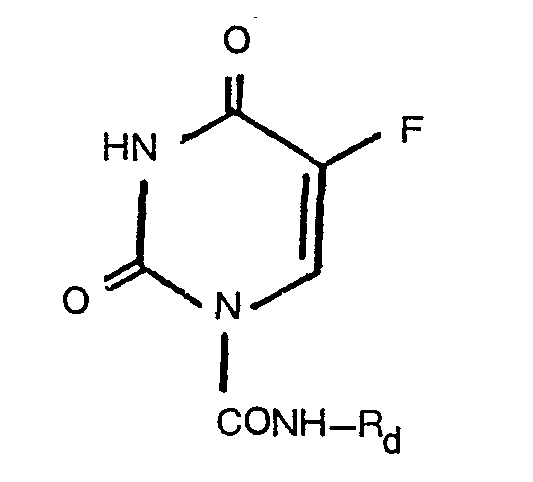
- R d is a bridged alicyclic radical containing an esterified carboxy group, the bridged alicyclic radical being selected from norbornyl, norbornenyl, bicyclo[2.2.2]octyl, bicyclo[2.2.2]oct-2-enyl, bicyclo[3.1.1]heptyl and adamantyl; or is a substituted (C 1 ⁇ C 6 )alkyl radical, the substituent being an esterified carboxy group, to give a 5-fluorouracil derivative of the formula: wherein R e is a bridged alicyclic radical containing a carboxy group, the bridge alicyclic radical being selected from norbornyl, norbornenyl, bicyclo[2.2.2]octyl, bicyclo[2.2.2]oct-2-enyl, bicyclo[3.1.1 Iheptyl and adamantyl; or is a substituted (C,-
- R d and R 8 the particulars thereof are the same as the corresponding particulars explained and illustrated hereinabove for the corresponding definitions of R and are to be referred to.
- Particulars of the esterified carboxy group in the definitions for R d are the same as those of the esterified carboxy group explained hereinabove for the substituents of both the bridged alicyclic radical and the substituted alkyl radical R.
- the hydrolysis of this process may be conducted by a conventional acidic hydrolysis.
- acids to be used in this acidic hydrolysis include organic or inorganic acids, such as formic acid, trifluoroacetic acid, benzenesulfonic acid, p-toluenesulfonic acid, hydrochloric acid or cation exchange resins.
- the acid is preferably one which can easily be removed from the reaction product in a conventional manner, such as neutralization or distillation under reduced pressure, for example, formic acid, trifluoroacetic acid or hydrochloric acid.
- the appropriate acid for the reaction can be selected having regard to the chemical properties of the starting compound and of the product, as well as the nature of the alkoxycarbonyl group to be hydrolyzed.
- the acidic hydrolysis can be conducted in the presence or absence of a solvent.
- the solvent used may be a conventional organic solvent which does not adversely influence this reaction, water or a mixture thereof. Particularly when the hydrolysis is carried out with trifluoroacetic acid, the reaction may be accelerated by the addition of anisole.
- the reaction temperature is not critical but is preferably selected having regard to the chemical properties of the compound (ld) and the product (le), as well as the nature of alkoxycarbonyl group and the method employed, the reaction preferably being carried out under mild conditions, such as with cooling, at ambient temperature or at a slight elevated temperature.
- the object compounds (I) of this invention and pharmaceutically acceptable salts thereof exhibit strong antitumor activity, and are useful as an antitumor agent for therapeutical treatment in human being and animals.
- the 5-fluorouracil derivatives (I) or their pharmaceutically acceptable salts of this invention may be used in the form of pharmaceutical preparation which comprises said compound, as an active ingredient, in admixture with a pharmaceutically acceptable carrier such as an organic or inorganic solid or liquid excipient suitable for the oral or parentical administration.
- a pharmaceutically acceptable carrier such as an organic or inorganic solid or liquid excipient suitable for the oral or parentical administration.
- auxiliary substances such as an organic or inorganic solid or liquid excipient suitable for the oral or parentical administration.
- stabilizing agents such as sodium bicarbonate
- wetting or emulsifying agents such as sodium bicarbonate
- buffers such as sodium bicarbonate
- other commonly used additives in addition to the above exemplified excipient.
- the pharmaceutical preparation may be prepared in solid form as capsule, tablet, dragee, granule or suppository, or in liquid form such as solution, suspension or emulsion.
- an average single dose of about 100 mg., 200 mg., 400 mg. and 1600 mg. of the compounds according to this invention may be effective for treating of tumors in human being and animals. In general amounts between about 200 mg. and about 4,000 mg. or even more may be administered to the patient per day.
- Diphenylphosphoryl azide (5.5 g.) was added to a solution of 4-pyridyl acetic acid (2.74 g.) with stirring at ambient temperature. The clear solution was stirred for 30 minutes at 80°C to give a solution comprising 4-pyridylmethyl isocyanate (I.R.: 2280 cm -1 ).
- trans-1,3-pentadienyl isocyanate was added a solution of 5-fluorouracil (2.6 g.) in N,N-dimethylacetamide (15 ml.) at 80°C and stirred for 3 hours at the same temperature.
- the resultant mixture was diluted with ethyl acetate (100 ml.), washed with water (4 times), dried over magnesium sulfate, filtered and evaporated in vacuo. The residue was recrystallized from diethyl ether to give 1-[N-(trans, trans-1,3-pentadienyl)carbamoyl]-5-fluorouracil.
- D,L-5-Norbornen-2,3-dicarboxylic acid monomethyl ester which was prepared in Example 23 (24.0 g.) was dissolved in ethanol (300 ml.), and hydrogenated over 10% palladium charcoal catalyst under hydrogen atmosphere of ordinary pressure at ambient temperature. The reaction mixture was filtrated and the filtrate was concentrated in vacuo. The oily residue was made solidified and dried to give D,L-norbornan-2,3-dicarboxylic acid monomethyl ester (24.3 g.), as powders.
- Diphenyl phosphoryl azide [N 3 ⁇ PO(OC 6 H 5 ) 2 ] (9.08 g.) was added dropwise to a solution of 4-(2-thienyl)butyric acid (5.53 g.) in dry pyridine (25 ml.) and stirred for one hour at 100°C to give a solution comprising - 3-(2-thienyl)propyl isocyanate (I.R.: 2260 cm -1 ).
- Glutaric anhydride 11.41 g. was added portionwise to a solution of potassium tert-butoxide (14.02 g.) in tetrahydrofuran (100 ml.) at ambient temperature. After the exothermic reaction was ceased, the reaction mixture was stirred at 40°C for 15 minutes. Tetrahydrofuran was distilled off under reduced pressure. The residue was dissolved in water. After ethyl acetate was added, the solution was adjusted to pH 9 with aqueous potassium carbonate solution under ice-cooling.
- the separated water layer was washed with ethyi acetate, treated with activated charcoal, overlapped with ethyl acetate, and then adjusted to pH 4.0 with 10% hydrochloric acid under ice-cooling.
- the ethyl acetate layer was dried over magnesium sulfate, treated with activated charcoal, filtered and concentrated under reduced pressure to give glutaric acid mono-tert-butyl ester (10 g.).
- Diphenylphosphoryl azide (12.25 g.) was added dropwise to a solution of glutaric acid mono-tert-butyl ester (8.38 g.) in dry pyridine (37 ml.) and stirred at 90°C for 40 minutes to give 3-tert-butoxycarbonylpropyl isocyanate (I.R.: 2270 cm -1 ).
- 5-Fluorouracil (4.83 g.) was added to the solution and stirred at 90°C for 3 hours. The resultant mixture was evaporated under reduced pressure. The residue was dissolved in ethyl acetate and washed with dilute hydrochloric acid and water. Ethyl acetate layer was dried over magnesium sulfate, treated with activated charcoal, filtered and concentrated under reduced pressure to give the crystals of 1-[N-(3-tert-butoxycarbonylpropyl)carbamoyl-5-fluorouracil. Recrystallization from ethanol gave the pure compound (411 mg.).
- Example 31 1-[N-(3-tert-Butoxycarbonylpropyl)carbamoyl]-5-fluorouracil (400 mg.) obtained in Example 31 was suspended in anisole (0.4 ml.). Trifluoroacetic acid (1.6 ml.) was added to the suspension under ice-cooling and stirred for 40 minutes at ambient temperature. The resultant solution was concentrated under reduced pressure to give residue, which was washed successively with ethanol, water, ethanol and diethyl ether to give the crystals of 1-[N-(3-carboxypropyl)carbamoyl]-5-fluorouracil (228 mg.). M.p. 146-147 0 C.
- 5-Fluorouracil (2.6 g.) was added to the solution and stirred at 100°C for 7 hours. The resultant mixture was evaporated to dryness under reduced pressure. The residue was dissolved in ethyl acetate, chromatographed on silica gel, and eluted with ethyl acetate to give 1-[N-(1-adamantyl)carbamoyl]-5-fluorouracil (0.85 g.). M.p. above 260°C.
- Diphenylphosphoryl azide (6.05 g.) was added dropwise to a solution of 3-(2-norbornyl)propionic acid (3.36 g.) in dry pyridine (20 ml.) and stirred at 80°C for 30 minutes to give 2-(2-norbornyl)ethyl isocyanate (I.R. 2260 cm -1 ).
- 5-Norbornen-2,3-dicarboxylic anhydride was treated with ethanol to provide D,L-5-norbornene-2,3-dicarboxylic acid monoethyl ester substantially in the similar manner described for the preparation of D,L-5-norbornene-2,3-dicarboxylic acid monomethyl ester described in Example 23.
- D,L-Norbornane-2,3-dicarboxylic acid monoethyl ester was prepared from D,L-5-norbornene-2,3-dicarboxylic acid monoethyl ester substantially in the similar manner to that of D,L-norbornane-2,3-dicarboxylic acid monomethyl ester described in Example 24.
- 5-Norbornene-2,3-dicarboxylic anhydride (20.0 g.) was added to a solution of sodium isopropoxide in isopropanol which was prepared from sodium (2.78 g.) and isopropanol (100 ml.). The solution was refluxed for 2 hours, and evaporated under reduced pressure. The residue was dissolved in water and overlapped with ethyl acetate. The mixture was adjusted to pH 1 with 10% hydrochloric acid under ice-cooling.
- D,L-Norbornane-2,3-dicarboxylic acid monoisopropyl ester was obtained by catalytic reduction of D,L-5-norbornene-2,3-dicarboxylic acid monoisopropyl ester substantially in the similar manner to that of D,L-norbornane-2,3-dicarboxylic acid monomethyl ester described in Example 24.
- Diphenylphosphoryl azide 13.48 g. was added dropwise to a solution of D,L-norbornane-2,3-dicarboxylic acid monoisopropyl ester (11.08 g.) in dry pyridine (41 ml.) and stirred at 100°C for one hour to give D,L-3-isopropoxycarbonylnorborn-2-yl isocyanate (I.R.: 2260 cm-').
- 5-Fluorouracil (5.31 g.) was added to the solution and stirred at 100°C for 4 hours. The resultant mixture was evaporated under reduced pressure. The residue was dissolved in ethyl acetate and washed with dilute hydrochloric acid and water. Ethyl acetate layer was dried over magnesium sulfate, treated with activated charcoal, filtered and concentrated under reduced pressure. The residue obtained was recrystallized from ethanol to give D,L-1-[N-(3-isopropoxycarbonylnorborn-2-yl)-5-fluorouracil (275 mg.). M.p. 135-136°C.
- Potassium tert-butoxide (50.0 g.) was dissolved in tert-butyl alcohol (200 ml.) under heating. To the solution was added portionwise 5-norbornene-2,3-dicarboxylic anhydride (58.53 g.). The mixture was refluxed and evaporated under reduced pressure. The residue was dissolved in aqueous sodium bicarbonate solution, overlapped with ethyl acetate and adjusted to pH 4.0 with 10% hydrochloric acid.
- D,L-3-tert-Butoxycarbonyl-norbornane-2-carboxylic acid was obtained by the catalytic reduction of D,L-3-tert-butoxycarbonyl-5-norbornene-2-carboxylic acid substantially in the similar manner to that of D,L-norbornane-2,3-dicarboxylic acid monomethyl ester described in Example 24.
- Diphenylphosphoryl azide (45.73 g.) was added dropwise to a solution of D,L-3-tert-butoxycarbonylnorbornane-2-carboxylic acid (36.30 g.) in dry pyridine (126 ml.) and stirred at 100°C for 40 minutes to give D,L-3-tert-butoxycarbonyl-2-norbornyl isocyanate (I.R.: 2270 cm -1 ).
- 5-Fluorouracil (16.39 g.) was added to the above solution and stirred for 100°C for 4 hours.
- the resultant mixture was treated substantially in the similar manner to that of D,L-1-[N-(3-ethoxycarbonyl-2-norbornyl)]-5-fluorouracil described in Example 35 to give D,L-1-[N-(3-tert-butoxycarbonyl-2-norbornyl)carbamoyl]-5-fluorouracil (10.35 g.). M.p. 161°C.
- the alkaline solution was acidified with 10% hydrochloric acid to pH 1.5 under ice-cooling to give the precipitates, which were filtered, washed with water and dried over phosphoric pentaoxide to give crystalline D,L-3-(N,N-diisopropylcarbamoyl)-5-norbornene-2-carboxylic acid (26.67 g.).
- Diphenylphosphoryl azide (11.32 g.) was added dropwise to a solution of D,L-3-(N,N-diisopropylcarbamoyl)-2-norbornanecarboxylic acid (10.0 g.) in dry pyridine (32 ml.) and stirred at 80°C for 35 minutes to give D,L-3-(N,N-diisopropylcarbamoyl)-2-norbornylisocyanate (I.R.: 2270 cm -1 ).
- 5-Fluorouracil (4.05 g.) was added to the solution and stirred at 80°C for 3 hours. The resultant mixture was evaporated under reduced pressure. The residue was dissolved in ethyl acetate. The precipitates partially formed during washing with dilute hydrochloric acid were filtered and washed with ethanol and diethyl ether. The ethyl acetate layer was washed with water, dried over magnesium sulfate, treated with activated charcoal, filtered and evaporated under reduced pressure to give crystals.
- Diphenylphosphoryl azide (14.4 g.) was added dropwise to a solution to D,L-5-norbornene-2,3-dicarboxylic acid monoethyl ester (10.0 g.) in dry pyridine (40 ml.) and stirred at 80°C for 50 minutes to give 3-ethoxycarbonyl -5-norbornen-2-yl isocyanate (I.R.: 2260 cm -1 ).
- 5-Fluorouracil (6.19 g.) was added to the solution and stirred at 80°C for 2 hours. The resultant mixture was evaporated under reduced pressure. The residue was dissolved in ethyl acetate and washed with dilute hydrochloric acid and water. The ethyl acetate layer was dried over magnesium sulfate, treated with activated charcoal, filtered and evaporated. The residue was washed with isopropyl ether, triturated with ethanol and crystallized from ethanol to give D,L-1-[N-(3-ethoxycarbonyl-5-norbornen-2-yl)carbamoyl]-5-fluorouracil (1.67 g.) M.p. 150-152°C.
- Diphenylphosphoryl azide (37.47 g.) was added dropwise to a solution of D,L-3-tert-butoxycarbonyl-5-norbornene-2-carboxylic acid (32.46 g.) prepared in Example 37 in dry pyridine (115 ml.) and stirred at 100°C for 40 minutes to give 3-tert-butoxycarbonyl-5-norbornen-2-yl isocyanate (I.R.: 2260 cm -1 ).
- 5-Fluorouracil 14.74 g. was added to the solution and stirred at 100°C for 4 hours. The resultant mixture was evaporated under reduced pressure. The residue was dissolved in ethyl acetate and washed with dilute hydrochloric acid and water, dried over magnesium sulfate, treated with activated charcoal, filtered and concentrated under reduced pressure. The residue was washed with petroleum ether and triturated with diethyl ether. The precipitates were crystallized from ethanol to give D,L-1-N-(3-tert-butoxycarbonyl-5-norbornen-2-yl)carbamoyl]-5-fluorouracil (1.55 g.). M.p. 146°C.
- D,L-1-[N-(3-carboxy5-norbornen-2-yl)carbamoyl]-5-fluorouracil was prepared from D,L-1-[N-(3-tert-butoxycarbonyl-5-norbornen-2-yl)carbamoyl]-5-fluorouracil prepared in Example 41 substantially in the similar manner to that of 1-[N-(3-carboxypropyl)carbamoyl]-5-fluorouracil described in Example 32. M.p. 169°C.
- 5-Fluorouracil (2.6 g.) was added to the solution and stirred at 100°C for 4 hours. The resultant mixture was evaporated under reduced pressure. The residue was dissolved in ethyl acetate and washed with water. The ethyl acetate layer was dried over magnesium sulfate, filtered and evaporated under reduced pressure. The residue was crystallized from ethanol to give 1-[N-[2-(5-norbornen-2-yl)ethenylcarbamoyl]-5-fluorouracil (0.3 g.). M.p. 130-132°C.
- Diphenylphosphoryl azide (24.5 g.) was added dropwise to a solution of D,L-5-norbornene-2,3-dicarboxylic acid monoisopropyl ester (20.0 g.) prepared in Example 36 in dry pyridine (100 ml.) and stirred for 40 minutes at 100°C to give a solution of D,L-3-isopropoxycarbonyl-5-norbornen-2-yl isocyanate [I.R: 2260 cm -1 ].
- 5-Fluorouracil (12.8 g.) was added to the solution of D,L-3-isopropoxycarbonyl-5-norbornen-2-yl isocyanate and stirred at 100°C for 2 hours. The resultant mixture was evaporated to dryness under reduced pressure. The residue was dissolved in ethyl acetate, washed with dilute hydrochloric acid and water, dried over magnesium sulfate, treated with activated charcoal, filtered and concentrated to dryness under reduced pressure. The residue was dissolved in ethyl acetate, chromatographed on silica gel, and eluted with ethyl acetate, to give crystalline powders.
- D,L-5-Norbornene-2,3-dicarboxylic acid monoethyl ester (18.0 g.) was dissolved in a solution of potassium hydroxide (12.0 g.) in water (130 ml.) at -3°C.
- Potassium permanganate (14.9 g.) was portionwise added to the solution during 25 minutes below -3°C.
- To the solution was added a mixture of sulfur dioxide (12 g.) and 50% sulfuric acid (40 g.). The mixture was heated to the boiling point, cooled to the room temperature. After filtration of the precipitates formed, the filtrate was overlayed with ethyl acetate, adjusted with 10% hydrochloric acid to pH 1.
- Diphenylphosphoryl azide (6.85 g.) was added to a solution of D,L,-5,6-isopropylidenedioxy- norbornane-2,3,-dicarboxylic acid monoethyl ester in dry pyridine (22 ml.). The solution was stirred for 45 minutes at 90°C to give a solution comprising D,L-5,6-isopropylidenedioxy-3-ethoxycarbonyl-2-norbornyl isocyanate [I.R.; 2270 cm -1 ].
- 5-Fluorouracil (2.71 g.) was added to the solution of D,L-5,6-isopropylidenedioxy-3-ethoxycarbonyl-2-norbornyl isocyanate and stirred at 90°C for 2 hours. The resultant solution was evaporated under reduced pressure. The residue was dissolved in ethyl acetate, washed with dilute hydrochloric acid and water, dried over magnesium sulfate, treated with activated charcoal, filtered and evaporated under reduced pressure. The residue was triturated with petroleum ether, to which ethanol was added, and filtered.
- Diphenylphosphoryl azide (6.41 g.) was added dropwise to a solution of 3-methyladamantan-1- ylacetic acid (4.85 g.) in dry pyridine (20 ml.) and stirred at 100°C for 40 minutes to give 3-methyl- adamantan-1-ylmethyl isocyanate [I.R.: 2260 cm - '].
- 5-Fluorouracil (2.52 g.) was added to the solution and stirred at 100°C for 2 hours. The resultant mixture was evaporated under reduced pressure. The residue was dissolved in ethyl acetate and washed with dilute hydrochloric acid and water.
- (+)-pinane-3-carboxylic acid and diphenyl phosphoryl azide in dry pyridine provided a solution comprising(+)-3-pinanyl isocyanate [I.R.: 2260 cm -1 ], which was reacted with 5-fluorouracil to provide (+)-1-[N-(3-pynanyl)carbamoyl]-5-fluorouracil substantially in the similar method to that of Example 45. M.p. 189°C.
- Methyl D,L-3-ethoxycarbonylaminonorbornan-2-carboxylate (1.34 g.) in 40% aqueous sodium hydroxide solution (5 ml.) was heated under reflux with stirring for 1 hour, liberating precipitate. The precipitate was filtered and dissolved in a small amount of water. The solution was adjusted to pH 3.5 with concentrated hydrochloric acid, liberating precipitate. The precipitate was filtered, washed with water and dried over phosphorus pentoxide to give 3-aminonorbornane-2-carboxylic acid (0.8 g.).
Landscapes
- Chemical & Material Sciences (AREA)
- Organic Chemistry (AREA)
- Pharmaceuticals Containing Other Organic And Inorganic Compounds (AREA)
- Plural Heterocyclic Compounds (AREA)
Claims (43)





Priority Applications (1)
| Application Number | Priority Date | Filing Date | Title |
|---|---|---|---|
| AT79302358T ATE1011T1 (de) | 1978-10-30 | 1979-10-29 | 5-fluoruracil-derivate, deren herstellung und ihre pharmazeutischen zusammensetzungen. |
Applications Claiming Priority (8)
| Application Number | Priority Date | Filing Date | Title |
|---|---|---|---|
| GB4242678 | 1978-10-30 | ||
| GB7842426 | 1978-10-30 | ||
| GB7902195 | 1979-01-22 | ||
| GB7909522 | 1979-03-19 | ||
| GB7909522 | 1979-03-19 | ||
| GB7919439 | 1979-06-04 | ||
| GB7919439 | 1979-06-04 | ||
| GB8002195 | 1980-01-23 |
Publications (2)
| Publication Number | Publication Date |
|---|---|
| EP0010941A1 EP0010941A1 (de) | 1980-05-14 |
| EP0010941B1 true EP0010941B1 (de) | 1982-05-12 |
Family
ID=27449090
Family Applications (1)
| Application Number | Title | Priority Date | Filing Date |
|---|---|---|---|
| EP19790302358 Expired EP0010941B1 (de) | 1978-10-30 | 1979-10-29 | 5-Fluoruracil-Derivate, deren Herstellung und ihre pharmazeutischen Zusammensetzungen |
Country Status (3)
| Country | Link |
|---|---|
| EP (1) | EP0010941B1 (de) |
| DE (1) | DE2962834D1 (de) |
| ES (1) | ES485554A0 (de) |
Families Citing this family (7)
| Publication number | Priority date | Publication date | Assignee | Title |
|---|---|---|---|---|
| FR2539412B1 (fr) * | 1983-01-13 | 1986-02-21 | Shoichiro Ozaki | Derives du 5-fluoruracile et leurs utilisations therapeutiques en tant qu'agents carcinostatiques |
| IL73840A (en) * | 1983-12-19 | 1988-11-15 | Uniroyal Chem Co Inc | 2-thio-5-(thio)carbamoyl barbituric acid derivatives,their preparation and pharmaceutical compositions containing them |
| JPS61204172A (ja) * | 1985-03-07 | 1986-09-10 | Nippon Kayaku Co Ltd | 5−フルオロウラシル誘導体 |
| US4810790A (en) * | 1986-10-09 | 1989-03-07 | Daikin Industries Ltd. | 5-fluorouracil derivatives useful as carcinostatic substances |
| EP1939186A1 (de) * | 2006-12-22 | 2008-07-02 | Sulfidris S.r.l. | 5-Fluorouracil Derivate als Anti-krebs Mitteln |
| CN109384730B (zh) * | 2017-08-10 | 2022-02-18 | 南京友怡医药科技有限公司 | 1-{3-[对-双-(2-氯乙基)胺基]苯丙胺基}甲酰-5-氟脲嘧啶及制备和应用 |
| CN115850190B (zh) * | 2023-01-10 | 2024-09-10 | 四川大学 | 一种5-氟尿嘧啶衍生物及其抗肿瘤用途 |
Family Cites Families (2)
| Publication number | Priority date | Publication date | Assignee | Title |
|---|---|---|---|---|
| JPS5324952B2 (de) * | 1973-11-28 | 1978-07-24 | ||
| JPS5285179A (en) * | 1976-01-08 | 1977-07-15 | Mitsui Toatsu Chem Inc | Preparation of carbamoylated 5-fluorouracils |
-
1979
- 1979-10-29 EP EP19790302358 patent/EP0010941B1/de not_active Expired
- 1979-10-29 DE DE7979302358T patent/DE2962834D1/de not_active Expired
- 1979-10-30 ES ES485554A patent/ES485554A0/es active Granted
Also Published As
| Publication number | Publication date |
|---|---|
| EP0010941A1 (de) | 1980-05-14 |
| ES8100275A1 (es) | 1980-11-01 |
| DE2962834D1 (en) | 1982-07-01 |
| ES485554A0 (es) | 1980-11-01 |
Similar Documents
| Publication | Publication Date | Title |
|---|---|---|
| US4349552A (en) | 5-Fluorouracil derivatives, and their pharmaceutical compositions | |
| EP1311478B1 (de) | Neue (thio)harnstoffverbindungen und arzneimittelkompositionen, die diese enthalten | |
| AU707283B2 (en) | Antiviral ethers of aspartate protease substrate isosteres | |
| JP3926983B2 (ja) | アリールスルホンアニリドウレア | |
| NO170883B (no) | Fremgangsmaate for fremstilling av 2-amino-5-hydroksy-4-metylpyrimidin-derivater | |
| US6117870A (en) | Cyclic amide derivatives | |
| JP6441830B2 (ja) | カテプシンcの置換2−アザ−ビシクロ[2.2.1]ヘプタン−3−カルボン酸(シアノ−メチル)−アミド阻害剤 | |
| CA2353635A1 (en) | Anilide derivative, production and use thereof | |
| US20020173515A1 (en) | Antiproliferative substituted 5-thiapyrimidinone and 5-selenopyrimidinone compounds | |
| KR20010014020A (ko) | 항전이성 및 항종양성 활성을 갖는 바르비투르산 유도체 | |
| HUT70039A (en) | Cyclic imino derivatives, process for preparing tkereof, and the pharmaceutical compositions comprising same compounds | |
| KR20010005627A (ko) | 아릴- 또는 헤테로아릴술폰아미드 치환된 히드록삼산 유도체, 그의 제조 방법 및 약제로서의 그의 용도 | |
| US4283418A (en) | Guanidinobenzoic acid derivatives and process for their preparation | |
| JPS63152371A (ja) | アミノチアゾール誘導体 | |
| US6548546B2 (en) | HIV integrase inhibitors | |
| US4224342A (en) | Guanidinobenzoic acid compounds and process for preparing the same | |
| JPH02157273A (ja) | アリールアルコキシクマリン、その製造方法及びこれを含有する治療剤 | |
| NZ198879A (en) | Tetra substituted benzene derivatives and pharmaceutical compositions | |
| RU2228330C2 (ru) | Омега-амиды n-арилсульфонил-аминокислот | |
| JP3892187B2 (ja) | 環状アミド誘導体 | |
| EP0010941A1 (de) | 5-Fluoruracil-Derivate, deren Herstellung und ihre pharmazeutischen Zusammensetzungen | |
| JPH07330761A (ja) | 置換クロマン類 | |
| KR101902567B1 (ko) | 플루오로치환된 (3r,4r,5s)-5-구아니디노-4-아세트아미도-3-(펜탄-3-일옥시)사이클로헥센-1-카복실릭 엑시드, 이의 에스테르 및 이의 용도 | |
| US20040006097A1 (en) | (E)-7(4-Fluorophenyl)-6isopropyl2-mesylaminopyrimidin-5-y)-(3r,5s)-dihydroxyhept-6-enoic acid. | |
| US3950525A (en) | Relaxation of smooth muscle in a mammal |
Legal Events
| Date | Code | Title | Description |
|---|---|---|---|
| PUAI | Public reference made under article 153(3) epc to a published international application that has entered the european phase |
Free format text: ORIGINAL CODE: 0009012 |
|
| AK | Designated contracting states |
Designated state(s): AT BE CH DE FR GB IT LU NL SE |
|
| 17P | Request for examination filed |
Effective date: 19801107 |
|
| ITF | It: translation for a ep patent filed | ||
| GRAA | (expected) grant |
Free format text: ORIGINAL CODE: 0009210 |
|
| AK | Designated contracting states |
Designated state(s): AT BE CH DE FR GB IT LU NL SE |
|
| REF | Corresponds to: |
Ref document number: 1011 Country of ref document: AT Date of ref document: 19820515 Kind code of ref document: T |
|
| PGFP | Annual fee paid to national office [announced via postgrant information from national office to epo] |
Ref country code: FR Payment date: 19820618 Year of fee payment: 4 |
|
| REF | Corresponds to: |
Ref document number: 2962834 Country of ref document: DE Date of ref document: 19820701 |
|
| PGFP | Annual fee paid to national office [announced via postgrant information from national office to epo] |
Ref country code: LU Payment date: 19820712 Year of fee payment: 4 |
|
| PGFP | Annual fee paid to national office [announced via postgrant information from national office to epo] |
Ref country code: AT Payment date: 19820818 Year of fee payment: 4 |
|
| PGFP | Annual fee paid to national office [announced via postgrant information from national office to epo] |
Ref country code: SE Payment date: 19820930 Year of fee payment: 4 Ref country code: BE Payment date: 19820930 Year of fee payment: 4 |
|
| PG25 | Lapsed in a contracting state [announced via postgrant information from national office to epo] |
Ref country code: LU Free format text: LAPSE BECAUSE OF NON-PAYMENT OF DUE FEES Effective date: 19821031 |
|
| PGFP | Annual fee paid to national office [announced via postgrant information from national office to epo] |
Ref country code: NL Payment date: 19821031 Year of fee payment: 4 |
|
| PGFP | Annual fee paid to national office [announced via postgrant information from national office to epo] |
Ref country code: DE Payment date: 19821231 Year of fee payment: 4 Ref country code: CH Payment date: 19821231 Year of fee payment: 4 |
|
| PG25 | Lapsed in a contracting state [announced via postgrant information from national office to epo] |
Ref country code: AT Effective date: 19831029 |
|
| PG25 | Lapsed in a contracting state [announced via postgrant information from national office to epo] |
Ref country code: SE Effective date: 19831030 |
|
| PG25 | Lapsed in a contracting state [announced via postgrant information from national office to epo] |
Ref country code: CH Effective date: 19831031 Ref country code: BE Effective date: 19831031 |
|
| PG25 | Lapsed in a contracting state [announced via postgrant information from national office to epo] |
Ref country code: NL Effective date: 19840501 |
|
| NLV4 | Nl: lapsed or anulled due to non-payment of the annual fee | ||
| PG25 | Lapsed in a contracting state [announced via postgrant information from national office to epo] |
Ref country code: FR Free format text: LAPSE BECAUSE OF NON-PAYMENT OF DUE FEES Effective date: 19840629 |
|
| REG | Reference to a national code |
Ref country code: CH Ref legal event code: PL |
|
| PG25 | Lapsed in a contracting state [announced via postgrant information from national office to epo] |
Ref country code: DE Effective date: 19840703 |
|
| REG | Reference to a national code |
Ref country code: FR Ref legal event code: ST |
|
| PG25 | Lapsed in a contracting state [announced via postgrant information from national office to epo] |
Ref country code: GB Effective date: 19881118 |
|
| EUG | Se: european patent has lapsed |
Ref document number: 79302358.1 Effective date: 19850607 |
|
| PLBE | No opposition filed within time limit |
Free format text: ORIGINAL CODE: 0009261 |
|
| STAA | Information on the status of an ep patent application or granted ep patent |
Free format text: STATUS: NO OPPOSITION FILED WITHIN TIME LIMIT |