EP0004624A2 - Neue Chromanon-Derivate, Verfahren zu ihrer Herstellung und ihre Verwendung als Arzneimittel und Wachstumsförderer - Google Patents
Neue Chromanon-Derivate, Verfahren zu ihrer Herstellung und ihre Verwendung als Arzneimittel und Wachstumsförderer Download PDFInfo
- Publication number
- EP0004624A2 EP0004624A2 EP79100905A EP79100905A EP0004624A2 EP 0004624 A2 EP0004624 A2 EP 0004624A2 EP 79100905 A EP79100905 A EP 79100905A EP 79100905 A EP79100905 A EP 79100905A EP 0004624 A2 EP0004624 A2 EP 0004624A2
- Authority
- EP
- European Patent Office
- Prior art keywords
- chromanon
- chromanone
- optionally substituted
- spirocyclohexa
- spirocyclopenta
- Prior art date
- Legal status (The legal status is an assumption and is not a legal conclusion. Google has not performed a legal analysis and makes no representation as to the accuracy of the status listed.)
- Granted
Links
- 0 *CCC(C(C1OCC=CC11)O)C2(CCCC2)C1=C Chemical compound *CCC(C(C1OCC=CC11)O)C2(CCCC2)C1=C 0.000 description 6
- FQCJVVXLHVBACZ-UHFFFAOYSA-N CCCC(CCC(C1O)C2(CCCC2)OC2=C1C=CCC2)O Chemical compound CCCC(CCC(C1O)C2(CCCC2)OC2=C1C=CCC2)O FQCJVVXLHVBACZ-UHFFFAOYSA-N 0.000 description 1
- ZUYKFEDZOBSUOA-UHFFFAOYSA-N Cc(cc1C)cc2c1OC1(CCCCC1)C(CCS(=O)=O)(CCS(C)(=O)=O)C2=O Chemical compound Cc(cc1C)cc2c1OC1(CCCCC1)C(CCS(=O)=O)(CCS(C)(=O)=O)C2=O ZUYKFEDZOBSUOA-UHFFFAOYSA-N 0.000 description 1
- XHNIHMNDGJIMFO-LJQANCHMSA-N N#CCC(CC#N)[C@@H](C1(CCCC1)OC1=C2CCc3c1cccc3)C2=O Chemical compound N#CCC(CC#N)[C@@H](C1(CCCC1)OC1=C2CCc3c1cccc3)C2=O XHNIHMNDGJIMFO-LJQANCHMSA-N 0.000 description 1
Classifications
-
- C—CHEMISTRY; METALLURGY
- C07—ORGANIC CHEMISTRY
- C07D—HETEROCYCLIC COMPOUNDS
- C07D491/00—Heterocyclic compounds containing in the condensed ring system both one or more rings having oxygen atoms as the only ring hetero atoms and one or more rings having nitrogen atoms as the only ring hetero atoms, not provided for by groups C07D451/00 - C07D459/00, C07D463/00, C07D477/00 or C07D489/00
- C07D491/02—Heterocyclic compounds containing in the condensed ring system both one or more rings having oxygen atoms as the only ring hetero atoms and one or more rings having nitrogen atoms as the only ring hetero atoms, not provided for by groups C07D451/00 - C07D459/00, C07D463/00, C07D477/00 or C07D489/00 in which the condensed system contains two hetero rings
- C07D491/10—Spiro-condensed systems
-
- A—HUMAN NECESSITIES
- A61—MEDICAL OR VETERINARY SCIENCE; HYGIENE
- A61P—SPECIFIC THERAPEUTIC ACTIVITY OF CHEMICAL COMPOUNDS OR MEDICINAL PREPARATIONS
- A61P19/00—Drugs for skeletal disorders
- A61P19/06—Antigout agents, e.g. antihyperuricemic or uricosuric agents
-
- C—CHEMISTRY; METALLURGY
- C07—ORGANIC CHEMISTRY
- C07D—HETEROCYCLIC COMPOUNDS
- C07D311/00—Heterocyclic compounds containing six-membered rings having one oxygen atom as the only hetero atom, condensed with other rings
- C07D311/02—Heterocyclic compounds containing six-membered rings having one oxygen atom as the only hetero atom, condensed with other rings ortho- or peri-condensed with carbocyclic rings or ring systems
- C07D311/04—Benzo[b]pyrans, not hydrogenated in the carbocyclic ring
- C07D311/22—Benzo[b]pyrans, not hydrogenated in the carbocyclic ring with oxygen or sulfur atoms directly attached in position 4
-
- C—CHEMISTRY; METALLURGY
- C07—ORGANIC CHEMISTRY
- C07D—HETEROCYCLIC COMPOUNDS
- C07D311/00—Heterocyclic compounds containing six-membered rings having one oxygen atom as the only hetero atom, condensed with other rings
- C07D311/02—Heterocyclic compounds containing six-membered rings having one oxygen atom as the only hetero atom, condensed with other rings ortho- or peri-condensed with carbocyclic rings or ring systems
- C07D311/04—Benzo[b]pyrans, not hydrogenated in the carbocyclic ring
- C07D311/22—Benzo[b]pyrans, not hydrogenated in the carbocyclic ring with oxygen or sulfur atoms directly attached in position 4
- C07D311/24—Benzo[b]pyrans, not hydrogenated in the carbocyclic ring with oxygen or sulfur atoms directly attached in position 4 with carbon atoms having three bonds to hetero atoms with at the most one bond to halogen, e.g. ester or nitrile radicals, directly attached in position 2
-
- C—CHEMISTRY; METALLURGY
- C07—ORGANIC CHEMISTRY
- C07D—HETEROCYCLIC COMPOUNDS
- C07D311/00—Heterocyclic compounds containing six-membered rings having one oxygen atom as the only hetero atom, condensed with other rings
- C07D311/02—Heterocyclic compounds containing six-membered rings having one oxygen atom as the only hetero atom, condensed with other rings ortho- or peri-condensed with carbocyclic rings or ring systems
- C07D311/04—Benzo[b]pyrans, not hydrogenated in the carbocyclic ring
- C07D311/22—Benzo[b]pyrans, not hydrogenated in the carbocyclic ring with oxygen or sulfur atoms directly attached in position 4
- C07D311/26—Benzo[b]pyrans, not hydrogenated in the carbocyclic ring with oxygen or sulfur atoms directly attached in position 4 with aromatic rings attached in position 2 or 3
- C07D311/28—Benzo[b]pyrans, not hydrogenated in the carbocyclic ring with oxygen or sulfur atoms directly attached in position 4 with aromatic rings attached in position 2 or 3 with aromatic rings attached in position 2 only
- C07D311/32—2,3-Dihydro derivatives, e.g. flavanones
-
- C—CHEMISTRY; METALLURGY
- C07—ORGANIC CHEMISTRY
- C07D—HETEROCYCLIC COMPOUNDS
- C07D311/00—Heterocyclic compounds containing six-membered rings having one oxygen atom as the only hetero atom, condensed with other rings
- C07D311/02—Heterocyclic compounds containing six-membered rings having one oxygen atom as the only hetero atom, condensed with other rings ortho- or peri-condensed with carbocyclic rings or ring systems
- C07D311/78—Ring systems having three or more relevant rings
- C07D311/92—Naphthopyrans; Hydrogenated naphthopyrans
-
- C—CHEMISTRY; METALLURGY
- C07—ORGANIC CHEMISTRY
- C07D—HETEROCYCLIC COMPOUNDS
- C07D311/00—Heterocyclic compounds containing six-membered rings having one oxygen atom as the only hetero atom, condensed with other rings
- C07D311/96—Heterocyclic compounds containing six-membered rings having one oxygen atom as the only hetero atom, condensed with other rings spiro-condensed with carbocyclic rings or ring systems
Definitions
- the chroman derivatives according to the invention have a significantly higher hypocholesterolemic activity than the clofibrate known from the prior art. They also show a surprisingly strong nutritional effect, which has not yet been found with compounds of this class.
- reaction sequence can be represented by the following formula:
- optionally substituted alkyl R 1 , R 2 , R 4 , R 5 , R 6 , R 7 , R 8, R 9 , R 10 , R 11 and R 12 straight-chain or branched alkyl radical having up to 18, preferably up to 12, particularly preferably up to 6 carbon atoms.
- alkyl radicals are: methyl, ethyl, propyl, isopropyl, butyl, isobutyl, tert-butyl, hexyl, 2-hexyl, 1,1-dimethylpentyl, 1,1-dimethylhexyl, 1,1-dimethylheptyl, nonyl, Decyl, undecyl, octadecyl.
- Alkenyl radicals R 1 , R 2 are straight-chain or branched alkenyl radicals having up to 18, preferably up to 12, particularly preferably up to 6 carbon atoms. It is also possible that the alkenyl radicals contain several double bonds. Examples include: ethenyl, propenyl- (1), propenyl- (2), butenyl- (3), 4-methylpentenyl- (3), 4,8-dimethylnondienyl- (3,7), 4,8,12- Trimethyltridecatrienyl (3,7,11).
- the optionally substituted cycloalkyl radicals R, R 2 , R 9 , R 10 and R 11 and R 5 , R 6 , R 7 and R 8 are preferably those with 3 to 18, preferably with 4 to 12, particularly preferably with 5 and 6, carbon atoms , such as cyclopropyl, cyclobutyl, cyclopentyl, cyclohexyl, cycloheptyl, cyclooctyl, cyclododecyl, cycloheptadecyl and cyclooctadecyl, particularly preferably cyclopentyl and cyclohexly.
- the optionally substituted cycloalkenyl radicals R, R 2 are preferably those with 3 to 18, preferably with 4 to 12, particularly preferably with 5 and 6 carbon atoms, preferably 5 and 6-membered alicycles with a double bond such as cyclopentyl- (1), cyclopentenyl- ( 2), Cyclopentenyl- (3), Cyclohexenyl- (1), Cyclohexenyl- (2), Cyclohexenyl- (3), 4-Methylcyclohexen- (3) -yl in question.
- Aryl R 1 , R 2, R 4 , R 9 , R 10 , R, R, R 5 , R, R 7 and R 8 which is optionally substituted is aryl having preferably 6 or preferably 6 to 10 carbon atoms in the Aryl part. Substituted phenyl or naphthyl may be mentioned as examples.
- R 1 , R 2 , R , R 9 , R 10 , R 11 , R 12 , R 5 , R 6 , R 7 and R 8 are preferably those with 7 to 18 carbon atoms, the aliphatic part 1 to 8 , preferably 1 to 4, contains carbons and the aromatic part of which represents a carbocyclic radical having 6 to 10 carbon atoms.
- the following aralkyl radicals may be mentioned, for example: benzyl, phenylethyl, phenylpropyl, phenylbutyl, naphthylmethyl and naphthylethyl, preferably benzyl.
- Optionally substituted oxy Alk R 9, R 10, R 11, R, R, R, R and R is straight-chain or branched alkoxy having preferably 1 to 6, particularly 1 to 4 carbon atoms.
- Examples include optionally substituted methoxy, ethoxy, n.- and i.-propoxy and n.-, i.- and t.-butoxy.
- the optionally substituted alkoxycarbonyl R 1 , R 2 , R 9 , R 10 , R 11 , R 5 , R 6 , R 7 and R 8 is straight-chain or branched alkoxycarbonyl preferably having 2 to 7, in particular 2 to 5, carbon atoms.
- Optionally substituted carbomethoxy, carboethoxy, carbo-n.- and i.-propyloxy and carbo-n.-, i.- and t.-butyloxy may be mentioned as examples.
- Preferred aryloxy groups R 12 , R, R, R and R are those with 6 or 10 carbon atoms, such as phenoxy and naphthoxy.
- Preferred aralkoxy groups R 12 , R 5 , R, R and R 8 are those with 7 to 10 carbon atoms such as benzyloxy, phenylethoxy, phenylpropoxy, phenylisopropoxy, phenylbutoxy, phenylisobutoxy and phenyl-tert-butoxy.
- Preferred alkylamino, alkenylamino, arylamino, aralkylamino and dialkylamino groups R 12 , R 5 , R, R and R 8 are those with up to 8 carbon atoms in the rest, such as methylamino, ethylamino, propylamino, isopropylamino, dimethylamino, diethylamino, Dipropylamino, Diisopropylamino, Phenyläthylamino, Anilino, Benzylamino called.
- Halogens R, R 6 and R are fluorine, chlorine, bromine and iodine, preferably bromine and chlorine.
- Acyl R, R, R is acyl having preferably 1 to 6, in particular 2 to 4, carbon atoms. Examples include: formyl, acetyl, n-propionyl, i-propionyl, n-butyryl, i-butyryl.
- acyl is preferably also cycloalkylcarbonyl or arylcarbonyl such as e.g. Cyclohexylcarbonyl or benzoyl.
- Dialkylaminoalkyl R 1 , R 2 is dialkylaminoalkyl with preferably 1 to 6, in particular 1 to 4, carbon atoms in the respective alkyl part. Examples include: N, N-dimethylaminomethyl, N, N-diethylaminomethyl, N, N-dimethylaminoethyl, N, N-diethylaminoethyl, N, N-methylethylaminomethyl.
- Optionally substituted heterocycle radicals R 1 , R 2 , R 12 are heteroparaffinic, heteroaromatic and heteroolefinic 5- to 7-membered, preferably 5 or 6-membered rings with preferably 1 to 3, in particular 1 or 2 identical or different heteroatoms.
- the heteroatoms are oxygen, sulfur or nitrogen.
- Examples include optionally substituted pyrrolidinyl, piperidinyl, furyl, thienyl, pyrazolyl, imidazolyl, 1,2,3- and 1,2,4-triazolyl, oxazolyl, isoxazolyl, thiazolyl, isothiazolyl, 1,2,3-, 1,3 , 4-, 1,2,4, - and 1,2,5-oxadiazolyl, azepinyl, pyrrolyl, isopyrrolyl, pyridyl, piperazinyl, pyridazinyl, pyrimidinyl, pyrazinyl, 1,3,5-, 1,2,4- and 1,2,3-triazinyl, oxepinyl, morpholinyl and thiepinyl.
- 5- to 12-membered rings are preferred, in particular 5- and 6-membered rings which, in addition to hydrocarbon members, contain one or more contain several heteroatoms such as nitrogen, oxygen and / or sulfur.
- the heterocyclic rings can contain 1 or 2 double bonds and can also be fused to one or more residues from the benzene series. Examples of heterocyclic radicals are: piperidine, N-methyl and N-benzylpiperidine, pyrollidine, tetrahydrofuran, tetrahydropyran and tetrahydrothiopyran.
- substituents of the alkyl, cycloalkyl, cycloalkenyl, aryl, aralkyl, alkoxy, alkoxycarbonyl radicals of the substituents R 1 , R 2 , R 4 , R 9 , R 10 , R11, R 12 , R 5 , R 6 , R 7 and R 8 are substituents which do not change under the reaction conditions.
- the halogens such as fluorine, chlorine, bromine and iodine, the cyano group, C 1 -C 6 alkyl group.
- chromanones (4) of the formula II used in the preparation of the compounds according to the invention are known (cf. in this regard the series Heterocyclic Compcunds "Chromenes, Chromanones and Chromones", 207 ff, Ed.GPEllis, New York, London , Sydney, Toronto 1977 and German Offenlegungsschrift 2,611,910). Incidentally, they can be produced by analog processes.
- the olefins of the formula (III) used for the preparation of the compounds I according to the invention are known; they are used technically very often and are accordingly richly documented in the literature, cf. e.g. Beilstein 1, 725 ff; 2, 397 ff; 4, 9 f; 1 III 1866 ff etc.
- the basic auxiliaries are preferably used in catalytic
- Base-stable solvents which are inert for the reaction according to the invention are used as solvents in question, preferably mentioned: alcohols such as methanol, ethanol, isopropanol or tert-butanol, ethers such as diethyl ether, diisopropyl ether, tetrahydrofuran or dioxane, hydrocarbons such as hexane, cyclohexane, benzene or toluene or mixtures of such solvents.
- alcohols such as methanol, ethanol, isopropanol or tert-butanol
- ethers such as diethyl ether, diisopropyl ether, tetrahydrofuran or dioxane
- hydrocarbons such as hexane, cyclohexane, benzene or toluene or mixtures of such solvents.
- reaction temperatures can be varied within a wide range. In general, you work between about 0 and about 200 ° C, preferably from about 20 - about 170 ° C.
- reaction products can be obtained by distillation, crystallization, concentration and redissolving or chromatographic separation.
- the chromanones of the formula (I) according to the invention surprisingly have the property of promoting and accelerating the growth in animals, so that these compounds can be used in all areas of animal husbandry and animal husbandry for the purposes mentioned.
- Chromanones of the formula (I) are preferably used in the rearing and keeping of ruminants such as calves, goats, sheep and also in pigs and chicks.
- the amount of chromanones of formula (I) which is administered to the animals to achieve the desired effect can be varied widely. It is preferably about 0.5 to 500, in particular 1 to 100 mg / kg of body weight per day.
- the duration of administration can range from a few hours or days to several years. The appropriate amount of active ingredient and the appropriate duration of administration depend in particular on the type, age, gender, health status and type of keeping of the animals and are easy to determine by any person skilled in the art.
- the compounds are administered to the animals by the usual methods.
- the method of administration depends in particular on the type, behavior and state of health of the animals.
- the administration can take place orally or parenterally once or several times a day at regular or irregular intervals.
- oral administration is preferred in most cases, in particular in the rhythm of the food and / or drink intake of the animals.
- the compounds can be administered as pure substances or in formulated form, that is to say in a mixture with non-toxic inert carriers, as such solid, semisolid or liquid diluents, fillers and formulation auxiliaries of all types are to be understood.
- Chromanones of the formula (I) can, if appropriate, also be administered in a suitable form in a suitable form together with pharmaceutical active ingredients, mineral salts, trace elements, vitamins, protein substances, fats, colorants and / or flavorings.
- Oral administration together with the feed and / or drinking water is recommended, the active ingredients being added to the total amount or only parts of the feed and / or drinking water as required.
- the compounds can be mixed as pure substances, preferably in finely divided form or in formulated form in a mixture with edible non-toxic carriers, optionally also in the form of a premix or a feed concentrate, to which feed and / or drinking water are added.
- the feed and / or drinking water can contain, for example, the active ingredient according to the invention in a concentration of about 5 to 500, in particular 5 to 50 ppm.
- the optimal level of the concentration of the active ingredient in the feed and / or drinking water depends in particular on the amount of feed and / or drinking water intake by the animals and can be easily determined by any person skilled in the art.
- the type of feed and its composition are irrelevant. All customary, commercially available or special feed compositions can be used, which preferably contain the usual balance of energy and building materials including vitamins and minerals necessary for a balanced diet.
- the feed can, for example, be composed of vegetable substances, e.g. Hay, beets, cereals, cereal by-products, animal substances, e.g. Meat, fats, bone meal, fish products, vitamins, e.g. Vitamin A, D complex and B complex, proteins, amino acids, e.g. DL-methionine and inorganic substances, e.g. Lime and table salt.
- Feed concentrates contain chromanones of formula (I) in addition to edible substances, for example rye flour, corn flour, soybean flour or lime, optionally with other nutrients and building materials, as well as proteins, mineral salts and vitamins. They can be produced using the usual mixing methods.
- the active ingredients can optionally also be covered by suitable agents covering their surface, e.g. with non-toxic waxes or gelatin in front of air. Protect light and / or moisture.
- the active ingredient premix contains chromanones of the formula (I) in the desired amount, e.g. 100 mg and an additional 1 g of DL-methionine and so much soybean meal that 2.5 g of premix are formed.
- the specified feed mixtures are preferably matched for rearing and fattening chicks or pigs, but they can also be used in the same or a similar composition for rearing and fattening other animals.
- the present invention also includes pharmaceutical preparations which, in addition to non-toxic, inert pharmaceutically suitable excipients, contain one or more compounds of the above formula or which consist of one or more compounds of the above formula, and processes for the preparation of these preparations.
- the present invention also includes pharmaceutical preparations in dosage units.
- the preparations in the form of individual parts e.g. Tablets, coated tablets, capsules, pills, suppositories and ampoules are present, the active ingredient content of which corresponds to a fraction or a multiple of a single dose.
- the dosage units can e.g. 1, 2, 3 or 4 single doses or 1/2, 1/3 or 1/4 of a single dose.
- a single dose preferably contains the amount of active ingredient which is administered in one application and which usually corresponds to a whole, a half or a third or a quarter of a daily dose.
- Non-toxic, inert pharmaceutically suitable excipients are to be understood as solid, semisolid or liquid diluents, fillers and formulation auxiliaries of all kinds.
- Tablets, dragees, capsules, pills, granules, suppositories, solutions, suspensions and emulsions, pastes may be mentioned as preferred pharmaceutical preparations.
- Tablets, coated tablets, capsules, pills and granules can contain the active ingredient (s) in addition to the usual carriers, such as (a) fillers and extenders, for example starches, Milk sugar, cane sugar, glucose, mannitol and silica, (b) binders. e.g. carboxymethyl cellulose, alginates, gelatin, polyvinylpyrrolidone, (c) humectants, e.g. glycerin, (d) disintegrants, e.g. agar-agar, calcium carbonate and sodium bicarbonate, (e) solution retarders, e.g. paraffin and (f) absorption accelerators, e.g.
- fillers and extenders for example starches, Milk sugar, cane sugar, glucose, mannitol and silica
- binders e.g. carboxymethyl cellulose, alginates, gelatin, polyvinylpyrrolidone
- humectants e.g.
- quaternary ammonium compounds ) Wetting agents, for example cetyl alcohol, glycerol non-stearate, (h) adsorbents, for example kaolin and bentonite and (i) lubricants, for example talc, calcium and magnesium stearate and solid polyethylene glycols or mixtures of the substances listed under (a) - (i).
- Wetting agents for example cetyl alcohol, glycerol non-stearate
- adsorbents for example kaolin and bentonite
- lubricants for example talc, calcium and magnesium stearate and solid polyethylene glycols or mixtures of the substances listed under (a) - (i).
- the tablets, dragées, capsules, pills and granules can be provided with the customary coatings and casings optionally containing opacifying agents and can also be composed such that they release the active ingredient (s) only or preferably in a certain part of the intestinal tract, optionally with a delay, where as Embedding materials, for example Polymer substances and waxes can be used.
- Embedding materials for example Polymer substances and waxes can be used.
- the active ingredient (s) can optionally also be in microencapsulated form with one or more of the above-mentioned excipients.
- suppositories can contain the usual water-soluble or water-insoluble carriers, for example polyethylene glycols, fats, for example cocoa fat, and higher esters (for example C 14 alcohol with C 16 fatty acid) or mixtures of these substances.
- water-soluble or water-insoluble carriers for example polyethylene glycols, fats, for example cocoa fat, and higher esters (for example C 14 alcohol with C 16 fatty acid) or mixtures of these substances.
- solutions and emulsions can contain the usual carriers, such as solvents, solubilizers and emulsifiers, e.g. Water, ethyl alcohol, isopropyl alcohol, ethyl carbonate, ethyl acetate, benzyl alcohol, benzyl benzoate, propylene glycol, 1,3-butylene glycol, dimethylformamide, oils, in particular cottonseed oil, peanut oil, corn oil, olive oil, castor oil and sesan oil, glycerin, glycerol alcohol and desulfuryl formaldehyde, fatty alcohol ester fatty alcohol, tetrahydrofuran desorbate or mixtures of these substances.
- solvents e.g. Water, ethyl alcohol, isopropyl alcohol, ethyl carbonate, ethyl acetate, benzyl alcohol, benzyl benzoate, propylene glycol, 1,3-butylene glycol, dimethylform
- solutions and emulsions can also be available in sterile and blood isotonic form.
- suspensions can contain the usual carriers, such as liquid diluents, e.g. Water, ethyl alcohol, propylene glycol, suspending agents e.g. contain ethoxylated isostearyl alcohols, polyoxyethylene sorbitol and sorbitan esters, microcrystalline cellulose, aluminum methoxide, bentonite, agar and tragacanth or mixtures of these substances.
- liquid diluents e.g. Water, ethyl alcohol, propylene glycol
- suspending agents e.g. contain ethoxylated isostearyl alcohols, polyoxyethylene sorbitol and sorbitan esters, microcrystalline cellulose, aluminum methoxide, bentonite, agar and tragacanth or mixtures of these substances.
- the formulation forms mentioned can also contain colorants, preservatives and additives which improve odor and speed, e.g. Peppermint oil and eucalyptus oil, and sweeteners, e.g. Saccharin.
- the therapeutically active compounds should be present in the pharmaceutical preparations listed above in a concentration of about 0.1 to 99.5, preferably about 0.5 to 95 percent by weight of the total mixture.
- the pharmaceutical preparations listed above can also contain other active pharmaceutical ingredients.
- the pharmaceutical preparations listed above are prepared in a conventional manner by known methods, e.g. by mixing the active substance or substances with the carrier substance or substances.
- the present invention also includes the use of the compounds of the above formula and the use of pharmaceutical preparations which contain one or more compounds of the above formula in human and veterinary medicine for preventing, ameliorating and / or curing cholesterolemias.
- the active substances or the pharmaceutical preparations can be administered orally, parenterally, intraperitoneally and / or rectally, preferably orally.
- the active ingredient (s) in amounts of about 0.05 to about 500, preferably 0.5 to 200 mg / kg body weight per 24 hours. , to be applied in 1 to 6 administrations, namely before or / and during or / and after the meal.
- a single dose ent holds the active ingredient (s) preferably in amounts of about 0.1 to about 100 mg / kg body weight.
Landscapes
- Chemical & Material Sciences (AREA)
- Organic Chemistry (AREA)
- Health & Medical Sciences (AREA)
- Nuclear Medicine, Radiotherapy & Molecular Imaging (AREA)
- Pharmacology & Pharmacy (AREA)
- Physical Education & Sports Medicine (AREA)
- Engineering & Computer Science (AREA)
- Chemical Kinetics & Catalysis (AREA)
- General Chemical & Material Sciences (AREA)
- Medicinal Chemistry (AREA)
- Rheumatology (AREA)
- Pain & Pain Management (AREA)
- Bioinformatics & Cheminformatics (AREA)
- Life Sciences & Earth Sciences (AREA)
- Animal Behavior & Ethology (AREA)
- General Health & Medical Sciences (AREA)
- Public Health (AREA)
- Veterinary Medicine (AREA)
- Pharmaceuticals Containing Other Organic And Inorganic Compounds (AREA)
- Plural Heterocyclic Compounds (AREA)
- Nitrogen Condensed Heterocyclic Rings (AREA)
- Pyrane Compounds (AREA)
- Acyclic And Carbocyclic Compounds In Medicinal Compositions (AREA)
Abstract
Description
- Durch die vorliegende Erfindung werden neue Chromanonderivate der Formel

- in welcher
- die Substituenten R und R gleich oder verschieden sind und für Wasserstoff, gegebenenfalls substituiertes Alkyl, Alkenyl, gegebenenfalls substituiertes Cycloalkyl, gegebenenfalls substituiertes Cycloalkenyl, gegebenenfalls substituiertes Aryl, gegebenenfa.lls substituiertes Aralkyl, Alkoxycarbonyl, Carboxyl, Dialkylaminoalkyl,
- einen gegebenenfalls substituierten Heterocyclus stehen oder in welcher die Substituenten Rund R zusammen mit dem durch sie eingeschlossenen Kohlenstoffatom einen gegebenenfalls substituierten carbocyclischen oder einen gegebenenfalls substituierten heterocyclischen Ring bilden
- R3 für den Substituenten

- wobei R 9, R10 und R11 gleich oder verschieden sind und für Wasserstoff, Cyano, Nitro, gegebenenfalls substituiertes Alkyl, gegebenenfalls substituiertes Cycloalkyl, gegebenenfalls substituiertes Aryl, Aralkyl, Alkoxy, Alkoxycarbonyl, gegebenenfalls substituiertes Aminocarbonyl, oder für Acyl stehen
- oder wobei R 9 und R10 zusammen mit dem durch sie eingeschlossenen Kohlenstoffatom oder wobei R10 und R11 zusammen mit dem durch sie eingeschlossenen Kohlenstoffatom einen carbocyclischen Ring bilden,
- X für Cyano, Nitro oder einen Rest der Formeln COR12, SO2-R12 oder PO(R12)2 stehen
- wobei R12 für Wasserstoff, Hydroxy, gegebenenfalls substituiertes Alkyl, gegebenenfalls substituiertes Aryl, Aralkyl, Alkoxy, Aryloxy, Alkenyloxy, Aralkoxy, Amino, Alkylamino, Alkenylamino, Arylamino, Dialkylamino, Alkylarylamino, einen gegebenenfalls substituierten Heterocyclus steht
- R 4 für Wasserstoff, R 1 oder R3 steht
- 8 R , R , R7 und R gleich oder verschieden sind und für Wasserstoff, Hydroxy, Nitro, Cyano, Carboxy, Halogen, gegebenenfalls substituiertes Alkyl, gegebenenfalls substituiertes Cycloalkyl, gegebenenfalls substituiertes Aryl, Aralkyl, Alkoxy, Aralkoxy, Aryloxy, Alkoxycarbonyl, Dialkylamino stehen oder
- wobei R5 und R6 zusammen mit den durch sie eingeschlossenen Kohlenstoffatomen einen carbocyclischen Ring bilden oder wobei R7 und R8 zusammen mit den durch sie eingeschlossenen Kohlenstoffatomen einen carbocyclischen Ring bilden,
- oder wobei R9 und R12 zusammen mit den durch sie eingeschlossenen Kohlenstoffatomen einen carbocyclischen Ring bilden oder wobei R11 und R12 zusammen mit den durch sie eingeschlossenen Kohlenstoffatomen einen carbocyclischen Ring bilden,
- vorbehaltlich, daß R1 und R9 nicht gleichzeitig für Phenyl stehen dürfen, falls X für CO-C6H5 steht.
-
- R1 und R2 die oben angegebene Bedeutung besitzen,
- R3 für den Substituenten

- R 9, R10 und R11 gleich oder verschieden sind und für Wasserstoff oder Alkyl (C1-C4) stehen,
- R 4 für Wasserstoff, R1 oder R3 steht, R5, R6, R 7 und R 8 gleich oder verschieden sind und für Wasserstoff, Halogen, Alkyl (C1-C4), Hydroxyl, Alkoxy, Aryloxy, Aralkyloxy steht,
- für die Cyanogruppe oder die Reste COR12 oder SO2R12 steht,
- wobei R12 für Alkyl (C1-C12), Phenyl oder Naphthyl steht.
- Die Chromanone der Formel (I) werden zweckmäßigerweise durch Umsetzung von
- Chromanonen der Formel

- mit Olefinen der Formel

- überraschenderweise zeigen die erfindungsgemäßen Chromanderivate eine erheblich höhere hypocholesterinämische Wirksamkeit als das aus dem Stand der Technik bekannte Clofibrat. Außerdem zeigen sie eine überraschend stark ausgeprägte nutritive Wirkung, welche bei Verbindungen dieser Stoffklasse bislang noch nicht gefunden wurde.
- Verwendet man 2-Spirocyclopenta-chromanon-(4) und Methylvinylketon als Ausgangsprodukte, so kann der Reak= tionsablauf durch das folgende Formelschema wiedergegeben werden:

- Als Alkenylreste R1, R2 stehen geradkettige oder verzweigte Alkenylreste mit bis zu 18, bevorzugt bis zu 12, besonders bevorzugt bis zu 6 Kohlenstoffatomen. Es ist auch möglich, daß die Alkenylreste mehrere Doppelbindungen enthalten. Beispielhaft seien genannt: Äthenyl, Propenyl-(1), Propenyl-(2), Butenyl-(3), 4-Methylpentenyl-(3), 4,8-Dimethylnondienyl-(3,7), 4,8,12-Trimethyltridecatrienyl (3,7,11).
- Als gegebenenfalls substituierte Cycloalkylreste R , R2, R9, R10 und R11 sowie R5, R6, R7 und R8 kommen vorzugsweise solche mit 3 bis 18, bevorzugt mit 4 bis 12, insbesondere bevorzugt mit 5 und 6 Kohlenstoffatomen, wie beispielsweise Cyclopropyl, Cyclobutyl, Cyclopentyl, Cyclohexyl, Cycloheptyl, Cyclooctyl, Cyclododecyl, Cycloheptadecyl und Cyclooctadecyl, insbesondere bevorzugt Cyclopentyl und Cyclohexly, in Frage.
- Als gegebenenfalls substituierte Cycloalkenylreste R , R 2 kommen vorzugsweise solche mit 3 bis 18, bevorzugt mit 4 bis 12, insbesondere bevorzugt mit 5 und 6 Kohlenstoffatomen, vorzugsweise 5 und 6-gliedrige Alicyclen mit einer Doppelbindung wie Cyclopentyl-(1), Cyclopentenyl-(2), Cyclopentenyl-(3), Cyclohexenyl-(1), Cyclohexenyl-(2), Cyclohexenyl-(3), 4-Methylcyclohexen-(3)-yl in Frage.
- Als gegebenenfalls substituiertes Aryl R 1, R2, R 4, R 9, R10, R , R , R5, R , R7 und R8 steht Aryl mit vorzugsweise 6 oder vorzugsweise 6 bis 10 Kohlenstoffatomen im Arylteil. Beispielhaft seien gegebenenfalls substituiertes Phenyl oder Naphthyl genannt.
- Als gegebenenfalls substituierte Aralkylreste R1, R2, R , R9, R10, R11, R12, R5, R 6, R 7 und R 8 kommen vorzugsweise solche mit 7 bis 18 Kohlenstoffatomen, deren aliphatischer Teil 1 bis 8, bevorzugt 1 bis 4, Kohlenstoffe enthält und deren aromatischer Teil einen carbocyclischen Rest mit 6 bis 10 Kohlenstoffatomen darstellt, in Frage. Beispielsweise seien die folgenden Aralkylreste genannt: Benzyl, Phenyläthyl, Phenylpropyl, Phenylbutyl, Naphthylmethyl und Naphthyläthyl, bevorzugt Benzyl.
- Als gegebenenfalls substituiertes Alkoxy R9, R10, R11, R , R , R , R und R steht geradkettiges oder verzweigtes Alkoxy mit vorzugsweise 1 bis 6, insbesondere 1 bis 4 Kohlenstoffatomen. Beispielhaft seien gegebenenfalls substituiertes Methoxy, Äthoxy, n.- und i.-Propoxy und n.-, i.- und t.-Butoxy genannt.
- Als gegebenenfalls substituiertes Alkoxycarbonyl R1, R2, R9, R10, R11, R5, R6, R7 und R8 steht geradkettiges oder verzweigtes Alkoxycarbonyl mit vorzugsweise 2 bis 7, insbesondere 2 bis 5 Kohlenstoffatomen. Beispielhaft seien gegebenenfalls substituiertes Carbomethoxy, Carboäthoxy, Carbo-n.- und i.-Propyloxy und Carbo-n.-, i.- und t.-Butyloxy genannt.
- Als bevorzugte Aryloxygruppen R12, R , R , R und R seien solche mit 6 oder 10 Kohlenstoffatomen wie Phenoxy und Naphthoxy genannt.
- Als bevorzugte Aralkoxygruppen R12, R5, R , R und R8 seien solche mit 7 bis 10 Kohlenstoffatomen wie Benzyloxy, Phenyläthoxy, Phenylpropoxy, Phenylisopropoxy, Phenylbutoxy, Phenylisobutoxy und Phenyl-tert.-butoxy genannt.
- Als bevorzugte Alkylamino-, Alkenylamino-, Arylamino-, Aralkylamino- und Dialkylaminogruppen R12, R5, R , R und R8 seien solche mit bis zu 8 Kohlenstoffatomen im Rest wie z.B. Methylamino, Äthylamino, Propylamino, Isopropylamino, Dimethylamino, Diäthylamino, Dipropylamino, Diisopropylamino, Phenyläthylamino, Anilino, Benzylamino genannt.
- Als Halogene R , R6, Rund R seien Fluor, Chlor, Brom und Jod, bevorzugt Brom und Chlor, genannt.
- Als Acyl R , R , R steht Acyl mit vorzugsweise 1 bis 6, insbesondere 2 bis 4 Kohlenstoffatomen. Beispielhaft seien genannt: Formyl, Acetyl, n-Propionyl, i-Propionyl, n-Butyryl, i-Butyryl. Außerdem steht Acyl vorzugsweise auch für Cycloalkylcarbonyl oder Arylcarbonyl wie z.B. Cyclohexylcarbonyl oder Benzoyl.
- Als Dialkylaminoalkyl R1, R2 steht Dialkylaminoalkyl mit vorzugsweise 1 bis 6, insbesondere 1 bis 4 Kohlenstoffatomen im jeweiligen Alkylteil. Beispielhaft seien genannt: N,N-Dimethylaminomethyl, N,N-Diäthylaminomethyl, N,N-Dimethylaminoäthyl, N,N-Diäthylaminoäthyl, N,N-Me- thyläthylaminomethyl.
- Als Alkenyloxyreste R12 stehen Alkenyloxyreste mit vorzugsweise 2 bis 6, insbesondere 2 bis 4 Kohlenstoffatomen im Alkenylteil; beispielhaft seien aufgeführt:
- Vinyloxy, Allyloxy, Methallyloxy.
- Als gegebenenfalls substituierte Heterocyclenreste R1,R2,R12 stehen heteroparaffinische, heteroaromatische und heteroolefinische 5- bis 7-gliedrige, vorzugsweise 5-oder 6-gliedrige Ringe mit vorzugsweise 1 bis 3, insbesondere 1 oder 2 gleichen oder verschiedenen Heteroatomen. Als Heteroatome stehen Sauerstoff, Schwefel oder Stickstoff. Als Beispiele seien gegebenenfalls substituiertes Pyrrolidinyl, Piperidinyl, Furyl, Thienyl, Pyrazolyl, Imidazolyl, 1,2,3- und 1,2,4-Triazolyl, Oxazolyl, Isoxazolyl, Thiazolyl, Isothiazolyl, 1,2,3-, 1,3,4-, 1,2,4,- und 1,2,5-Oxadiazolyl, Azepinyl, Pyrrolyl, Isopyrrolyl, Pyridyl, Piperazinyl, Pyridazinyl, Pyrimidinyl, Pyrazinyl, 1,3,5-, 1,2,4- und 1,2,3- Triazinyl, Oxepinyl, Morpholinyl und Thiepinyl genannt.
- Falls die jeweiligen Substituentenpaare R1 und R 2 zusammen mit dem durch sie eingeschlossenen Kohlenstoffatom, R 9 und R10 zusammen mit dem durch sie eingeschlossenen Kohlenstoffatom, R 10 und R11 zusammen mit den durch sie eingeschlossenen Kohlenstoffatomen, R5 und R 6 zusammen mit den durch sie eingeschlossenen Kohlenstoffatomen, R7 und R8 zusammen mit den durch sie eingeschlossenen Kohlenstoffatomen einen carbocyclischen Ring bilden, falls R9 und R 12 zusammen mit den durch sie eingeschlossenen Kohlenstoffatomen einen carbocyclischen Ring bilden oder falls R 11 und R 12 zusammen mit den durch sie eingeschlossenen Kohlenstoffatomen einen carbocyclischen Ring bilden, so kommen gesättigte oder ungesättigte Kohlenwasserstoffglieder enthaltende Ringe, bevorzugt 3- bis 12-gliedrige Ringe, in Frage. Es ist auch möglich, daß die carbocyclischen Ringe an einem oder mehrere Reste aus der Benzolreihe anelliert sind.
- Als carbocyclische Reste seien beispielsweise genannt: Cyclopropan, Cyclopentan, Cyclohexan, Cycloheptan, Cyclo= octun, Cyclononan, Cyclodecan, Cycloundecan, Cyclodode= can, Cyclohexen, Cycloocten, Cyclododecen und Tetralin.
- Falls die jeweiligen Substituentenpaare R1 und R zusammen mit dem durch sie eingeschlossenen Kohlenstoffatom einen gegebenenfalls substituierten heterocyclischen Ring bilden, so kommen vorzugsweise 5- bis 12-gliedrige Ringe, insbesondere 5- und 6-gliedrige Ringe in Frage, die außer Kohlenwasserstoffgliedern noch ein oder mehrere Heteroatome wie beispielsweise Stickstoff, Sauerstoff und/ oder Schwefel enthalten. Die heterocyclischen Ringe können 1 oder 2 Doppelbindungen enthalten und außerdem an einen oder mehrere Reste aus der Benzolreihe anelliert sein. Als heterocyclische Reste seien beispielsweise genannt: Piperidin, N-Methyl-und N-Benzylpiperidin, Pyrollidin, Tetrahydrofuran, Tetrahydropyran und Tetrahydrothiopyran.
- Als Substituenten der Alkyl-, Cycloalkyl-, Cycloalkenyl-, Aryl-, Aralkyl-, Alkoxy-, Alkoxycarbonyl-Reste der Substituenten R1, R 2, R 4, R9, R10, R11, R 12, R5, R6, R7 und R8 kommen Substituenten in Frage, die unter den Reaktionsbedingungen nicht verändert werden. Beispielsweise seien die Halogene, wie Fluor, Chlor, Brom und Jod, die Cyangruppe, C1-C6-Alkylgruppe. die C1-C6-Alkoxygruppe, die C1-C6-Alkoxycarbonylgruppe, die C1-C6-Alkoxycarbonylalkylgruppe, die Aminogruppe, die C1-C6-Alkylamino- und die C1-C6-Dialkylaminogruppe, Arylreste aus der Benzolreihe oder die Carbonsäuregruppe genannt.
- Die bei der Herstellung der erfindungsgemäßen Verbindungen eingesetzten Chromanone-(4) der Formel II sind zum großen Teil bekannt (vgl. hierzu in der Reihe Heterocyclic Compcunds "Chromenes, Chromanones and Chromones", 207 ff, Ed.G.P.Ellis, New York, London, Sydney, Toronto 1977 und die Deutsche Offenlegungsschrift 2 611 910). Sie können im übrigen nach analogen Verfahren hergestellt werden.
- Als mögliche Herstellungsverfahren für Chromanone-(4) seien beispielhaft aufgeführt:
- a) Kondensation von o-Hydroxyacetophenon mit Carbonylverbindungen in Gegenwart basischer Kondensationsmittel.
- b) Fries-Umlagerung der Phenolester α,β-ungesättigter Carbonsäuren.
- c) Cyclisierung von ß-Phenoxypropionsäuren mit sauren Kondensationsmitteln.
- d) Reduktion von Chromonen.
- Als Beispiele für Ausgangschromanone der Formel II seien genannt:
- Chromanon-(4), 3-Methyl-chromanon-(4), 6-Chlor-chromanon-(4),
- 7-Chlor-chromanon-(4), 6,8-Dichlor-chromanon-(4),
- 6-Methyl-chronanon-(4), 7-Methyl-chromanon-(4,,
- 6,7-Dimethyl-chromanon-(4), 6,8-Dimethyl-chrorcanon-(4),
- 6-Methoxy-chromanon-(4), 7-Methoxy-chromanon-(4),
- 6-Aethoxy-chromanon-(4), 7-Aethoxy-chromanon-(4),
- 6-Chlor-3-methyl-chromanon-(4), 7-Chlor-2-methyl-chromanon-(4),
- 2,5-Dimethyl-ehromanon-(4), 2,6,7-Trimethyl-chromanon-(4),
- 6-Methoxy-2-methyl-chromanon-(4),
- 7-Methoxy-methyl-chromanon-(4),
- 6-Chlcr-2-aethyl-chromanon-(4),
- 7-Chlor-2-aethyl-chrocanon-(4),
- 6-Methyl-2-aethyl-chromanon-(4), 2-Aethyl-chromanon-(4),
- 2-Propyl-chromanon-(4), 2-Isopropyl-chromanon-(4),
- 2-Butyl-chromanon-(4), 2-see.Butyl-ehromanon-(4),
- 2-tert-Butyl-chromanon-(4), 2,2-Diaethyl-chromanon-(4),
- 2,2-Dimethyl-chromanon-(4), 2-Methyl-2-propyl-chromanon-(4),
- 2-n-Hexyl-chromanon, 2-Aethyl-7-methoxy-chromanon-(4),
- 7-Methoxy-2-propyl-chromanon-(4),
- 2-Isopropyl-7-methoxy-chromanon-(4),
- 2-Dutyl-7-methoxy-chromanon-(4),
- 2-sec.Butyl-7-methoxy-chromanon-(4),
- 2-tert-Bntyl-7-methoxy-chromanon-(4),
- 2,3-Diaethyl-7-methoxy-chromanon-(4),
- 2,2-Dirnethyl-7-methoxy-chromunon-(4),
- 2-Spirocyclopenta-chromanon-(4),
- 2-Spirocyclohexa- chromanon-(4),
- 2-Phenyl-chromanon-(4), 2-Cyclohexyl-chromanon-(4),
- 2-Denzyl-chromanon-(4), 2-Phenylaothyl-chromanon-(4),
- 2-Phenylpropyl-chromanon-(4), 2-(4'-Chlorphenyl)-chromanon-(4),
- 2-(4'-Tolyl)-chroromanon-(4),
- 2-(ß-Dimethylaminoaethyl)-ehromanon-(4),
- 2-(β-Diaethylaminoaethyl)-chromanon-(4),
- 2-(y-Dimethylaminopropyl)-chromanon-(4),
- 2-(Y-Diaethylaminopropyl)-chromanon-(4),
- 2-(β-N-Pyrrolidinoaethyl)-chromanon-(4),
- 2-(β-N-Morpholinoaethyl )-chromanon-(4),
- 2-(ß-N-Piperidinoaethyl )-chromanon-(4),
- 2-(γ-N-Pyrrolidinoproyylj-chronanon-(4),
- 3-(γ-N-Morpholinopropyl)-chromanon-(4),
- 2-(γ-N-Piperidinopropyl)-chromanon-(4),
- 2-Hethyl-2-(γ-diaethylaminopropyl)-chromanon-(4),
- 2-Methyl-2-(y-N-pyrrolidinopropyl)-chromanon-(4),
- 2-Methyl-2-(γ-N-Morpholinopropyl)-chromanon-(4),
- 2-Methyl-2-(γ-N-Piperidinopropyl)-chromanon-(4),
- 3-(4'-Oxacyclohexyl-)chromanon-(4),
- 2-(4'-rsethylcyclohexyl)-ehromanon-(4),
- 2-(2'-methylcyclohexyl)-ehromanon-(4),
- 2-(4'-metayl-4'-azacyclohexyl)-chromanon-(4),
- 2-(4'-benzyl-4'-azacycl ohexyl)-chromaaon-(4),
- 2-)-4'-phenyl-4'-azacyclohexyl)-chromanon-(4),
- 2-(4'-Oxaspirocyclohexa)-chromanan-(4),
- 2-(4'-aethyl-4'-azaspirocyclohexa)-chromanon-(4),
- 2-(4'-benzyl-4'-azaspirocyclohexn)-chromanon-(4),
- 2-(4'-phenyl-4'-azaspirocyclohexa)-chromanon-(4),
- 2-(Cyclohexen -(3)-yl)-chromanon-(4),
- 6-Chlor-2-spirocyclopenta-ehromaaon-(4),
- 7-hlor-2-spirocyclopenta-chromanon-(4),
- 6,9-Dichlor-2-spirocyclopeata-chromanon-(4),
- 6-Methyl-2-spirocyclopenta-chromanon-(4),
- 6-Isopropyl-2-epirocyclopenta-chromanon-(4),
- 7-Methyl-2-spirocyclopenta-chromanon-(4),
- 7-Hydroxy-2-spiroccycclopenta-chromanon-(4),
- 7-Methoxy -2-spirocyclopenta-chromanon-(4),
- 7-Isoproroxy-2-spiroyclopenta-chromanon-(4),
- 7-Benzyloxy-2-spirocyclopenta-chromanon-(4),
- 7-Phcnyloxy-2-spirocyclopenta-chromanon-(4),
- 6,7-Dimethyl-3-spirocyclopenta-chromanon-(4),
- 5-Methoxy-2-spirocyclopenta-chromanon-(4),
- 5,6-Benzo-2-spirocyclopeiita-chromanon-(4),
- 7,8-Eenzo-2-spirocyclopenta-chromanon-(4),
- 7-Phenyl-2-spirocyclopenta-chromanon-(4),
- 6-Chior-6-methyl-sptroyclopenta-chromanon-(4),
- 5,7-Dihydroxy-2-spirocyclopenta-chromanon-(4),
- 6-Chlor-2-spirocyclohexa-chromanon-(4),
- 7-Chlor-2-spirocyclohexa-chromanon-(4),
- 6,8-Dichlor-2-spirocyclohexa-chromanon-(4),
- 6-Methyl-2-spirocyclohexa-chromanon-(4),
- 6-Isopropyl-2-spirocyclohexa-chromanon-(4),
- 7-Methyl-2-splrocyclohexa-chromanon-(4),
- 7-Hydroxy-2-spirocyclohexa-chromanon-(4),
- 7-Methoxy-2-apirocyclohexa-chromanon-(4),
- 7-Isopropoxy-2-spirocyclohexa-chromanon-(4),
- 7-Benzyloxy-2-spirocyclohexa-chromanon-(4),
- 7-Phenyloxy-2-spirocyclohexa-chromanon-(4),
- 6,7-Dimethyl-2-spirocyclohexa-chromanon-(4),
- 5-Methoxy-2-spirocyclohexa-chromanon-(4),
- 5,6-Benzo-2-spirocyclohexa-chromanon-(4),
- 7,8-Benzo-2-spirocyclohexa-chromanon-(4),
- 7-Phenyl-2-spirocyclohexa-chromanon-(4),
- 8-Chlor-6-methyl-2-spirocyclohexa-chromanon-(4),
- 5,7-Dihydroxy-2-spirocyclohexa-chromanon-(4),
- 2-Isopropyl-3-phenyl-6-chlorchromanon-(4),
- 2-Isopropyl-3-phenyl-7-methylchromanon-(4),
- 2-Isopropyl-3-phenyl-7-methoxychromanon-(4),
- 2-Isopropyl-3-p-methoxyphenyl-7-hydroxychromanon-(4).
- Die für die Herstellung der erfindungsgemäßen Verbindungen I verwendeten Olefine der Formel (III) sind bekannt; sie werden technisch sehr häufig eingesetzt und sind dementsprechend in der Literatur reich dokumentiert, vgl. z.B. Beilstein 1, 725 ff; 2, 397 ff; 4, 9 f; 1 III 1866 ff usw.
- Als Beispiele fUr die erfindungsgemäß zu verwendenden Olefine seien genannt:
- Acrolein, Crotonaldehyd, Metaorolein, Zimtaldehyd,
- 4-Chlorzintaldehyl, 4-ethoxyzimtaldehyd, Methylvinylketon,
- Aethyvingylketon, Methyl-isopropenylketon, Mesityloxid,
- 3-Methyl-3-pentenon-(2), 2-Methyl-1-pentenon-(3),
- 3-Fentenon-(2), 3-Heptenon-(2), Butyl-vinylketon,
- n-Amyl-vinylketon, n-Hexyl-vinylketon, n-Propyl-vinylketon,
- Phenylvinylketon, 4-Chlorphenyl-vinylketon,
- 4-Tolyl-vinylkoton, 4-Methoayphenyl-vinylketon,
- Benzylidinaceton, 2-Chlor-benzylidenaceton,
- 4-chlor-benzylidenaceton, 4-Methoxy-benzylidenaceton,
- 4-Isopropyl-benzylidenaceton, Aethylidenacetophenon,
- Aethyl-styryl-keton, Isopropyl-styrylketon,
- Eenzylidencyclohexanon, Benzylidencyclopentanon,
- 4-Methoxybenzylidencyclohexanon, 4-Chlorbenzylideneyclo=
- hexanon, Benzylidenacetophenon, Benzyliden-(4'chloraceto=
- phenon), Renzyliden-(4'-Methylacetophenon),
- Benzylinen-(4'-methoxy-ancetophenon),
- (4'-Chlorbenzyliden)-acetophenon,
- (4-Methylbenzyliden)-acetophenon,
- (4-Methoxybenzyliden)-acetophenon, Dibenzylidenaceton,
- Cyclopenter.-(2)-on-(1), Cyclohexen-(2)-on-(1),
- 1-Acetylcyclopenten, 1-Aeetylcyclohexen,
- 2-Methylencyclohexanon, 2-Methylcyclohexen-(2)-on-(1),
- Cyclopentylidenaceton, Cyclohexylidenaceton,
- Isophoron, Carvon, 1-Propionylcyclohexen,
- 1-Butyrylcyclohexen, 1-Denzoylcyclohexen,
- Cyclohexylidencyclohexanon, Acrylnitril, Crotonnitril,
- Methacrylnitril, Cyclopentylidenacetonitril,
- Vinyl-ß-methoxycarbonyläthylketon,
- vinyl-äthoxycarbonylpropylketon.
- Cyclohexylidenacetonitril, Zimtsäurenitril,
- p-Methoxyzimtsäurenitril, 1-Cyanocyclohexcn,
- 1-Cyanocyclopenten, Acrylamid, Methacrylanid, Crotonamid,
- Acrylsäuredimethylamid, Acrylsäureaethylsmid,
- Acrylsäureallylanid, Acrylsäure-tert-butylamid,
- Acrylsäureanilid, Acrylsäure-(4-aethoxyanilid),
- Acrylsäuremethylester, Acrylsäureaethylester,
- Acrylsäurecyclohexylester, Acrylsäurebenzylester,
- Methacrylsäuremethylester, Crotonsouremethylester,
- Acrylsäure, Methacrylsäure, Crotonsäure,
- Aethylidenmalonsäurediaethylester
- Dimethylmethylenmalonsäurediaethylester,
- Diaethylmethylenmalonsäuredinaethyle
- Maleinsäurediaethylester, Fumarsänredimethylester,
- Fumarsäurediaethylester, Aethylidencyanessigsäureaethylester,
- Aethylidcncynnessigsäureamid,
- Cyclohexylidencyanessigsäureaethylester,
- Aethylidenmalodinitril, Cyclohexylidenmalodinitril,
- Isobutyrilidencyanessigsäureäthylester,
- Isobutyrilidencyanessigsäureamid,
- Isobutyrilidenmalodinitril.
- Cyclopenten-(1)-carbonsäure-(1)-aethylester,
- Cyclohexen-(1)-carbonsäure-(1)-aethylester,
- Zimtsäureaethylester, Zimtsäure, Zimtsäureamid,
- Zimtsäurodiaethylamid, Zimtsäureanilid,
- 4-Mcthoxyzimtaäureaethylester,
- 4-Chlorzimtsäuresethylester,
- Benzylidennalonsäuredimethylester
- Benzylidenmalonsäurediaethylester
- Benzylidencyanessigsäureaethylester,
- Benzylidenxalodinitril, Benzylidencyanessigsäureamid,
- β-Acetylacrylsäuresethylester,
- Aethylidenacetessigsäureaethylester,
- Aethylidenacetessigsäureamid,
- Aethylidenacetessigsäureanilid,
- β-Benzoylacrylsäureaethylester,
- Benzylidenacetessigsäureaethylester,
- Benzylidenacetessigsäureamid,
- Benzylidenacetessigsäureanilid
- Benzylidenacetylaceton, Aethylidenacetylaceton,
- 1-Nitro-propen-(1), 2-Nitro-propen-(1),
- 1-Nitro-buten-(1) , 2-Nitro-buten-(1), ω-Vitrostyrol,
- α-Nitrostilben, Methylvinylsulfon, n-Butylvinylsulton,
- Isobutylvinylsulfon, Vinyl-4-tolylsulfon, Phenyl-vinylsulfon,
- Phenylstyrylsulfon, Vinylsulfonsäureamid,
- vinylsulfonsäurediaethylamid, Vinylsulfonsäureanilid,
- Vinylsulfonsäurepyrrolidid, Vinylsulfonsauremorpholid,
- Vinylphosphonsäurediaethylester, Vinylsulfonsäure.
- Die erfindungsgemäß verwendeten basischen Hilfsstoffe sind bekannt. Als Beispiele seien genannt Alkalihydroxyde wie Natrium- oder Kaliumhydroxyd, Alkalihydride wie Natrium- oder Kaliumhydrid, Alkalialkoholate wie Natriummethylat, Xatriumaethylat, Kaliummethylat, Kaliumaethy= lat, Kalium-tert-butylat, metallisches Natrium oder Kalium, Alkaliamide wie Satrium- oder Kaliumamid, Ammoniak sowie organische Stickstoffbasen wie Diaethyl= amin, Diisopropylamin, Pyridin, Pyrrolidin, Piperidin, Triäthylamin, Tributylamin, Benzyltrimethylammoniumhydroxyd, 1,4-Diaza- bicyclo-[2,2,2]-octan, 1,8-Diazabicyclo[5,4,0]-undecen-(7), 1,5-Diazabicyclo[4,3,0]-nonen-(5). Die basischen Hilfsstoffe werden vorzugsweise in katalytischen Mengen eingesetzt.
- Die erfindungsgemäße Reaktion kann oft mit Vorteil in Substanz ausgeführt werden. Sind der eine oder andere oder beide Ausgangsstoffe jedoch Festprodukte mit höherem Schmelzpunkt, so ist die Verwendung von Lösungsmitteln vorteilhaft. Als Lösungsmittel kommen basenstabile, für die erfindungsgemäBe Umsetzung inerte Lösungsmittel in Frage, vorzugsweise seien genannt: Alkohole wie Methanol, Äthanol, Isopropanol oder tert.-Butanol, Äther wie Diäthyläther, Diisopropyläther, Tetrahydrofuran oder Dioxan, Kohlenwasserstoffe wie Hexan, Cyclohexan, Benzol oder Toluol oder Mischungen solcher Lösungsmittel.
- Die Reaktionstemperaturen können in einem größeren Bereich variiert werden. Im allgemeinen arbeitet man zwischen ca. O und ca. 200°C, vorzugsweise von ca. 20 - ca. 170°C.
- Bei der Durchführung des erfindungsgemäßen Verfahrens setzt man vorzugsweise auf ein Mol Chromanon 1 oder 2 Mol Olefin ein. Überschreitung dieser Mengen ist möglich. Die Reaktionsprodukte können durch Destillation, Auskristallisieren, Einengen und Umlösen oder chromatographische Trennung qewonnen werden.
- Als neue Wirkstoffe seien im einzelnen genannt:
- 3-(γ-Oxopropyl)-2-spirocyclopenta-chromanon-(4),
- 3-(γ-Oxopropyl)-2-spirocyclohexa-chromanon-(4)
- 3-(γ-Oxobutyl)-2-spirocyclopenta-chromanon-(4),
- " -2-spiroccyclohexa-chromanon-(4),
- " -2,2-dimethyl-chromanon-(4),
- " -2-propyl-chromanon-(4),
- " -2-isopropyl-chromanon-(4),
- " -3,2-diaethyl-chromanon-(4),
- " -2-methyl-2-propyl-chromanon-(4),
- " -2-phenyl-chroccanon-(4),
- " -2-cyclohexyl-chromanon-(4),
- " -2-cyclohexen-(3)-yl-chromanon-(4),
- 3-(γ-Oxobutyl)-2-benzyl-chromanon-(4),
- " -2-phenyläthyl-chromanon-(4),
- " -2-ß-phenylpropyl-chlormanon-(4),
- " -2-(4'-chlorphenyl)-chromanon-(4),
- " -2-(4'-tolyl)-chromanon-(4),
- " -2-(ß-dimethylaminoäthyl)-chromanon-(4),
- " -2-(ß-diäthylaminoäthyl)-chromanon-(4),
- '' -2-(γ-dimethylaminopropyl)-chroromanon-(4),
- '' -2-(γ-diäthylaminopropyl)-chroaanon-(4),
- " -2-(β-N-pyrrolidinoäthyl)-chroromanon-(4),
- " -2-(β-N-morpholinoäthyl)-chromanon-(4),
- " -2-(β-N-piperidinoäthyl)-chromanon-(4),
- " -2-(γ-N-pyrrolidinopropyl)-ohromanon-(4), 3-(γ-Oxobutyl)-2-(γ-N-rineridinopropyl)-chromanon-(4),
- " -2-(γ-N-morpholinopropyl)-chromanon-(4),
- " -2-chromanon-(4),
- " -2-methyl-chromanon-(4),
- " -2-aethyl-chromanon-(4),
- " -2-methoxycarbonyl-2-methyl-chromanon-(4),
- " -2-methyl-2-(γ-diäthylaminopropyl)-chromanon-(4),
- " -2-methyl-3-(γ-N-pyrrolidinopropyl)-chromanon-(4)
- " -2-methyl-2-(γ-N-morpholinopropyl)-chronanon-(4),
- " -2-methyl-2-(y-N-piperidinopropyl)-chromanon-(4),
- " -2-(4'-Oxacyclohcxyl).chromanon-(4),
- " -3-(4'-methylcyclahexyl)-chromanon-(4),
- " -2-(2'-methylcyclohexyl)-chromanon-(4),
- " -2-(4'-methyl-4'-azacyclohexyl)-chromanon-(4),
- " -2-(4'-benzyl-4'-azacyclohexyl)-chronanon-(4),
- " -2-(4'-phenyl-4'-azacyclohexyl)-chromanon-(4),
- " -2-(4'-oxaspirocycloaexa)-chromanon-(4),
- " -2-(4'-methyl-4'-azaspirocyclohexa)-chromanon-(4),
- 3-(γ-Oxobutyl)-2-(4'-benzyl-4'-azaspirocyclohexa)-chromanon-(4),
- " -2-(4'-phenyl-4'-azaspirocyclohexa) -chromanon-(4),
- " -2-butyl-chromanon-(4),
- " -2-sec-butyl-chromanon-(4),
- " -2-isobutyl-chromanon-(4),
- " -2-tert-butyl-chromanon-(4),
- " -2-{cyclohoxen-(3)-Yl}-chromanon-(4),
- " -6-chlor-2-spirocyclopenta-chromanon-(4),
- " -7-chlor-2-spirocyclopenta-chromanon-(4),
- " -6,8-dichlor-2-spirocyclopenta-chromanon-(4),
- " -6-methyl-2-spirocyctepenta-chroomanon-(4),
- " -6-isorropyl-2-spirocyclopenta-chronanon-(4),
- " -7-methyl-2-spirocyelopenta-chromanon-(4),
- " -7-hydroxy-2-spirocyclopenta-chromanon-(4),
- " -7-methylxy-2-spirocyclopenta-chromanon-(4),
- " -7-isopropoxy-2-spirocyclopenta-chromanon-(4),
- " -7-benzyloxy-2-spirocyclopenta-chromanon-(4),
- " -7-phenyloxy-2-spirocyclopenta-chromanon-(4),
- 3-(γ-Oxobutyl)-6,7-dimethyl-2-spirocyclopenta-chromanon-(4),
- " -5-methoxy-2-srirocyclopenta-chromanon-(4),
- " -5,6-benzo-2-spiroeyclopenta-chromnnon-(4),
- " -7,8-benzo-2-spirocyclopenta-chromanon-(4),
- " -7-Phenyl-2-spirocyclopenta-ehromanon-(4),
- " -8-chlor-6-methyl-2-spirocyclopenta-chromanon-(4),
- " -5,7-dihydroxy-2-spirocyclopenta-chromanon-(4),
- " -6-chlor-2-spirocyclohexa-chromanon-(4),
- " -7-chlor-2-spirocyelohexa-chromanon-(4),
- " -6,8-dichlor-2-spirocyclohexa-chronanon-(4),
- " -6-nethyl-2-spirocyclohexa-chrotnanon-(4),
- 3-(γ-Oxobutyl-6-isopropyl-2-spirocyclohexa-chromanon-(4),
- " -7-methyl-2-spirocyclohexa-chromanon-(4),
- " -7-hydroxy-2-spirocyclohexa-ehromanon-(4),
- " -7-nethoxy-2-spirocyclohexa-chromanon-(4),
- " -7-insopropoxy-2-spirocyclohexa-chromanon-(4),
- " -7-benzyloxy-2-spirocyclehexa-chromanon-(4),
- " -7-phenyloxy-2-spirocyclohexa-chromanon-(4),
- " -6,7-dimethyl-2-spirocyclohexa-chromanon-(4),
- " -5-nethoxy-2-spirocyclohexa-chromanon-(4),
- " -5,6-benzo-2-spirocyclohexa-chromanon-(4),
- " -7,8-benzo-2-spirocyclohexa-chromanon-(4),
- " -7-phenyl-2-spirocyclohexa-chromanon-(4),
- " -8-chlor-6-methyl-2-spiroeyclohexa-chromanon-(4),
- " -5,7-dihydroxy-2-spirocyclohexa-chromanon-(4),
- " -6-ehlor-2,2-dinethyl-2-spirocyclohexa-chronanoa-(4)
- " -2,3,6-trimethyl-2-spiroeyclohexa-chromanon-(4),
- " -7-hydroxy-2-spirocyclohexa-chronancn-(4),
- " -7-methoxy-2-spirocyelohexa-chromanon-(4),
- " -5,6-ben-2-spirocyclohexa-chromanan-(4),
- -7,8-benzo-2-spfrocyclohexa-chromanon-(4)
- 3-(γ-Oxo-hexyl)-2-spirocyclopenta-chromanon-(4),
- " -2-spirocyclohexa-chromanon-(4),
- " -2,2-dimethyl-chromanon-(4),
- " -2-phenyl-chromanon-(4),
- " -2-cyclohexyl-chromanon-(4),
- " -2-[cyolohexen-(3)-yl]-chromanon-(4),
- " -2,2-diaethyl-chromanon-(4),
- " -2-propyl-chromanon-(4),
- 3-(γ-Oxo-hexyl)-2-ieopropyl-chromanon-(4),
- " -2-hexyl-chromanon-(4),
- 3-(γ-Oxo-nonyl)-2-spirooyclopenta-chromonon-(4),
- " -2-spirocyclohexa-chromanon-(4),
- " -2,2-dimethyl-chromanon-(4),
- " -2-phenyl-chromanon-(4),
- " -2-cyclohoxyl-chromanon-(4),
- " -2-(cyclohexen-(3')-yl)-chromanon-(4),
- " -2,2-diaethyl-chromanon-(4),
- " -2-propyl-chromanon-(4),
- " -2-isopropyl-chromanon-(4),
- " -2-hexyl-chromanon-(4),
- 3-(γ-Oxo-γ-phenylpropyl)-2-spirocyclopenta-chcomanon-(4),
- -2-spirocyclohexa-chromanon-(4),
- -3,2-dimethyl-chromanoo-(4),
- " -2-phenyl-chromanon-(4),
- -2-cyclohoxyl-chroanon-(4),
- " -2-(cyclohexen-(3)-yl)-chromanon-(4),
- -2,2-diäthyl- (3)-chromanon-(4),
- " -2-propyl-(3)ahromanon-(4),
- -2-isoproryl-(3)-chromanon-(4),
- " -2-hexyl-chromanon-(4),
- 3-(α-Methyl-γ-oxobutyl)-2-spirocyclbhexa-chromanon-(4),
- " -2-spirocyclopenta-chromanon-(4),
- 5-(β-Methyl-v-oxobutyl)-2-spirocyclopenta-chromanon-(4),
- " -2-spirocyclohexa-chroanon-(4),
- " -2,2-dimethyl-chronanon-(4),
- " -2-phenyl-chromanon-(4),
- " -2-cyclnhexyl-chromanon-(4),
- " -2-isopropyl-chromanon-(4),
- " -2-hexyl-chromanon-(4),
- 3-(α,α-Dimethyl-γ-oxobutyl)-2-spirocyclonenta-chromanon-(4),
- " -2-spirocyclohcxa-chrowanon-(4),
- 3-(α-Phenyl-7-oxobutyl)-2-spirocyelopenta-chromanon-(4),
- 3-[α-(4-Chlorphenyl)-Y-oxobnty-γ-spirocyclepenta-chrosanon-(4),
- " -2-spirocyclohexa-chromanon-(4),
- 3-[α-(4-Tolyl)-γ-oxobutyl]-2-spirocyclopenta-chromanon-(4),
- -2-spirocyclohexa-chromanon-(4),
- 3-(α,γ-Diphenyl- γ-oxobutyl)-2-spirocyclopenta-chromanon-(4),
- -2-spirocyclohexa-chromanon-(4),
- 3-[α-(4-Chlorphenyl)-γ-oxobutyl]-2-spirocyclopenta- chromanc n-(4),
- " -2-spirocyclohexa- chromanan- (4) ,
- 3-(α,α-Tetramethylen-γ-oxobutyl)-2-5pirocycloPenta-chromanon-(4),
- " -2-spirocyclohexa-chromanon-(4), 3-(α,α-pentamethylen-γ-exobutyl)-2-spirocyclopenta-chromanon-(4),
- " -2-spirocyclohexa-chromanon-(4), 3-(α,β-Trimethylen-γ-oxobutyl)-2-spirocyclopenta-chrodanon-(4),
- " -2-spirocyclohexa-chromanon-(4), 3-(α,β-tetraaethylen-β-oxobutyl)-2-spirocyclopenta-chromancn-(4),
- " -2-spirocyclohexa-chromanon-(4). 3,3-Di-(β-cyanäthyl)-2-spirocyclopenta-chromanon-(4),
- " -2-spirocyc1oliexa-chromanon-(4),
- " -2,2-dimethyl-chromanon-(4),
- " -2-propyl-chromanon-(4),
- " -2-isopropyl-chroinanon-(4)
- " -2,2-diaethyl-chromanon-(4),
- " -2-methyl-2-propyl-chromanon-(4),
- " -2-phenyl-chromanon-(4),
- " -2-cyclohexyl-chromanon-(4),
- " -2-benzyl-chromanon-(4),
- " -2-phenyläthyl-chromanon-(4),
- " -2-phenylpropyl-chromanon-(4),
- " -2-(4'-chlorphenyl)-chromanon-(4),
- " -2-(4'-tolyl)-chromanon-(4)
- " -2-(β-dimethylaminoäthyl )-chromanon-(4),
- 3,3-Di-(β-cyanäthyl)-2-(β-diäthylaminoäthyl)-chromanon-(4),
- " -2-(γ-dimethylaminopropyl )-chromanon-(4),
- " -2-(γ-diäthyluminopropyl)-chromanon-(4),
- " -3-(β-N-pyrrolidinoäthyl-)chromanon-(4),
- " -2-(β-N-piperidinosethyl)-chromanon-(4),
- " -2-(β-N-norpholinoaethyl)-chromanon-(4),
- " -2-(γ-N-pyrrolidinopropyl)-chromanon0(4),
- " -2-(γ-N-piperidinopropyl)-chromanon-(4)
- " -2-(7-morpholinopropyl)-chromanon-4()
- " -chromanon-(4),
- " -2-methyl-chromanon-(4),
- " -2-aethyl-chromanon-(4),
- " -2-methoxycarbonyl-2-methyl-chromanon-(4),
- " -2-methyl-3-(γ-diaethylaminopropyl-)chromanon-(4)
- " -2-methyl-2-(γ-N-pyrrolidinopropyl)-chromanon-(4),
- " -2-methyl-2-(γ-N-sorpholinopropyl)-- chromanon-(4),
- " -2-methyl-2-(γ-N-piperidinopropyl)-chromanon-(4),
- " -2-(4'-oxacyclohexyl)-chromanon-(4),
- 3,3-Di-(β-cyanaethyl)-2-(4'-methylcyclohexyl)-chromanon-(4),
- " -3-(2'-methylcyclohexyl)-chromanon-(4),
- " -2-(4'-methyl-4'-azacyclohexyl)-chromanon-(4),
- " -2-(4'-benzyl-4'-azacyclohexyl)-chromanon-(4),
- " -2-(4'-phenyl-4'-azacyclohexyl)-chromanon-(4),
- 3,3-Di-(ß-cyanäthyl)-2-(4'-oxaspirocyclohexa)-chromanon-(4),
- -2-(4'-methyl-4'-azaspirocyclohexa)-chromanon-(4),
- " -2-(4'-benxyl-4'-azaapirocyclohexa)-chromanon-(4),
- " -2-(4'-phenyl-4'-azaspirocyclohexa)-chromanon-(4),
- " -2 -butyl-chromanon-(4),
- -2-sec-butyl-chromanon-(4),
- " -2-isobutyl-chromanon-(4),
- " -2-tert-cutyl-chromanon-(4),
- -2-[cyclohexen-(3)-yl]-chromanon-(4),
- -6-chior-2-spirocyclopenta-chromanon-(4),
- " -7-chor-2-spirocyclopenta-chromanon-(4),
- " -6,8-dichlor-3-spirocyclopenta-chromanon-(4)
- -6-methyl-2-spirocyclopenta-chromanon-(4),
- " -6-isopropyl-2-spirocyclopenta-chromanon-(4)
- -7-methyl-2-spirocyclopenta-chromanon-(4),
- -7-hydroxy-2-spirocyclopenta-chromanon-(4),
- " -7-roethoxy-3-spirocyclopenta-chroaanon-(4),
- -7-isopropoxy-2-spirocyclopenta-chromanon-(4)
- " -7-benzyloxy-2-spirocyelopenla-chramanon-(4)
- " -7-phenyloxy-2-spirocyclopenta-chromanon-(4)
- -6,7-dimethyl-2-spirocyclopenta-chromanon-(4)
- " -5-methoxy-2-spiroeyclopenta-chromanon-(4),
- -5,6-benzo-2-spirocyclopenta-chromanon-(4),
- " -7,8-benzo-2-spirocyclopenta-chromanon-(4),
- -7-phenyl-2-spirocyclopenta-chromanon-(4),
- -8-chlor-6-methyl-2-spirocyclopenta-chromanon-(4),
- " -5,7-dihydroxy-2-spiroeyclopenta-chromanon-(4)
- 3,3-D1-(β-cyanaethyl)-6-chlor-2-apirocyclohexa-chromanon-(4)
- " -7-chlor-2-spirocyclohexa-chromanon-(4)
- " -6,8-Dichlor-2-spirocyclohexa-chromanon-(4)
- " -6-methyl-3-spiro-cyclohexa-chromanon-(4)
- " -6-isopropyl-2-spirocyclohexa-chromanon-(4)
- " -7-methyl-2-spirocyclohexa-chromanon-(4)
- " -7-hydroxy-2-spirocyclohexa-chromanon-(4)
- " -7-methoxy-2-spirocyclohcxa-chromanon-(4)
- " -7-isopropoxy-2-spironyclohexa-chromanon-(4)
- " -7-benzvloxy-2-spirocyclohexa-chromanon-(4)
- " -7-phenyloxy-3-spirocyclohexa-chromanon-(4)
- " -6,7-dimethyl-2-spirocyclohexa-chromanon-(4)
- " -5-methoxy-2-spirocyclohexa-chromanon-(4)
- " -5,6-benzo-3-spirocyclohexa-chromanon-(4)
- " -7,8-benzo-2-spirocyclohexa-chromanon-(4)
- " -7-phenyl-2-spirocyclohexa-chromanon-(4)
- " -8-chlor-6-methyl-2-spirocyclohexa- chromanon-(4)
- " -5,7-dihydroxy-2-spirocyclohexa-chromanon-(4)
- " -6-chlor-2,2-dimethyl-2-spirocyclohexa- chromanon-(4)
- " -6-methyl-2,2-2-spirocyclohexa-chromnon-(4)
- " -7-hydroxy-2-epirocyelohexa-chromanon-(4)
- " -7-methoxy-2-spirocyelohexa-chromanon-(4)
- " -5,6-benzo-2-spirocyelohexa-chromanon-(4)
- " -7,6-benzo-2-spirocyclohexa-chromanon-(4)
- 3-(β-Cyanaethyl)-2-spirocyclopenta-chromanon-(4)
- " -2-spirocyclohexa-chromanon-(4)
- " -2,2-dimethyl-chromanon-(4)
- " -2-phenyl-chromanon-(4)
- " -3-cyclohexyl-chromanon-(4)
- " -2-[cyclohexen-(3)-yl]-chromanon-(4)
- " -2,2-diaethyl-chromanon-(4)
- 3-(β-Cyanaethyl)-2-propyl-chromanon-(4)
- " -2-isopropyl-chromanon-(4)
- " -3-hexyl-chroaanon-(4)
- 3-(β-Cyanpropyl)-2-spirocyclopenta-chromanon-(4)
- -2-spirocyclohexa-chromanon-(4)
- " -2,2-dimethyl-chromanon-(4)
- n -2-phenyl-chromanon-(4)
- " -2-cyclohexyl-chromanon-(4)
- -2-[cyclohexen-(3)-yl]-chromanon-(4)
- " -2,2-dianethyl-chromanon-(4)
- " -2-propyl-chromanon-(4)
- -2-isopropyl-chromanon-(4)
- " -2-hexyl-chromanon-(4)
- 3,3-Di-(β-Cyanpropyl)-2-spirocyclopenta-chrolanon-(4)
- " -2-spirocyclohexa-chromanon-(4)
- n -2,2-dimethyl-chromanon-(4)
- " -2-phenyl-chromanon-(4)
- " -3-cyclohexyl-chromanon-(4)
- " -2,2-diaethyl-chromanon-(4)
- " -2-propyl-chromanon-(4)
- " -2-isopropyl-chromanon-(4)
- " -2-hexyl-chromanon-(4)
- 3-(β-Cyanisopropyl)-2-spirocyclopenta-chromanon-(4)
- " -2-spirocyclohexa-chronanon-(4)
- " -2,2-dimethyl-chromanon-(4)
- " -2-phenyl-chromanon-(4)
- " -2-cyclohexyl-chromanon-(4)
- " -2,2-diaethyl-chromamon-(4)
- " -2-propyl-chromanon-(4)
- " -2-isopropyl-chromanon-(4)
- " -2-hexyl-chromanon-(4)
- 3-(β-Cyan-α-phenylaethyl)-2-spirocyclopenta-chromanon-(4)
- " -2-spirocyclohexa-chromanon-(4)
- " -2,2-dinethyl-chromanon-(4)
- " -2-phenyl-chromanon-(4)
- " -2-cyclohexyl-chromanon-(4)
- " -2,2-diaethyl-chromanon-(4)
- 3-(ß-Cyan-a-phenylaethyl)-2-propyl-chromanon-(4)
- -2-isopropyl-chromanon-(4)
- -2-hexyl-chromanon-(4)
- 3-(β-Meethoxycarbonylaethyl)-2-spirocyclopenta-chromanon-(4)
- " -2-spirocyclohexa-chromanon-(4)
- -2-phenyl-chromanon-(4)
- " -2-cyclohexyl-chronanon-(4)
- " -2-[cyclohexen-(3)-yl]-chromanon-(4)
- " -2,2-diaethyl-chronanon-(4)
- -2-propyl-chromanon-(4)
- " -2-isopropyl-chromanon-(4)
- " -2-hexyl-chromanon-(4) 3-(β-Aethoxycarbonylaethyl)-2-spirocyclohexa-chromanon-(4)
- " -2-phenyl-chromanoa-(4)
- 3-(β-Allyloxycarbonylaethyl)-2-phenyl-chromanon-(4)
- 3-(β-Benzyloxycarbonylaethyl)-2-isopropyl-chromanon-(4)
- 3-(β-Methoxycarbonylpropyl)-2-spirocyclopenta-chromanon-(4)
- 3-(β-Methoxycarbonylisopropyl)-2-cyclohexyl-chromanon-(4)
- 3,3-Di-(β-methoxycarbonylaethyl)-2-spirocyclopenta-chromanon-(4)
- " -2-spirocyclohexa-chromanon-(4)
- " -2-phenyl-chromanon-(4)
- " -2-cyclohexyl-chromanon-(4)
- -2-propyl-chromanon-(4)
- -2-hexyl-chromanon-(4)
- 3-(β-aminocarbonyl-oethyl)-2-spirocyclopenta-chromanon-(4)
- " -2-spirocyclohexa-chromaaon-(4)
- -2,2-dimethyl-chroraanon-(4)
- " -2-phenyl-chromanon-(4)
- " -2-cyclohexyl-chromanon-(4)
- -2-[ctyclohexen-(3)-yl]-chromanon-(4)
- -2,2-diäthyl-chromanon-(4)
- -2-propyl-chromanon-(4)
- -2-isopropyl-chromanon-(4)
- -2-hexyl-chromanon-(4)
- 3-(β-Aminocarbonylpropyl)-2-spirocyclopenta-chromnnon-(4)
- " -2-phenyl-chromanon-(4)
- " -2-isoproryl-chromanon-(4)
- 3-(β-Aminocarbonylisopropyl)-2-spirocyclohexa-chromanon-(4)
- " -2-cyclohexyl-chromanon-(4)
- " -2-propyl-chromanon-(4)
- 3-(β-Dimethylaminocarbonylaethyl)-2-spirocyclopenta-chromanon-(4)
- n -2-phenyl-chromanon-(4)
- 3-(β-Allylaminocarbonylaethyl)-2-proryl-chromanon-(4)
- " -2-cyclohexyl-chromanon-(4)
- 3-(β-Pyrrolidinocarbonylaethyl)-2-spirocyclohexa-ahromanon-(4)
- " -2,2-dimethyl-chromanon-(4)
- 3-(tert-Butylaminocarbonylaethyl)-2,2-diaethyl-chromanon-(4)
- " -2-spirocyclopenta-chromanon-(4)
- 3-(β-Piperidinocarbonylaethyl)-2-methyl-chromanon-(4)
- 3-(β-Phenylaminocarbonyläthyl)―2-spirocyclopenta-chromanon-(4)
- 3-(β-N-Methylphenylaminocarbonyl―aethyl)-2-spirocyclopenta-chromanon-(4)
- 3,3-Di-(β-Aminocarbonylaethyl)-2-spirocyclopenta-chromanon-(4)
- " -2-spirocyclohexa-chromanon-(4)
- " -3-phenyl-chronanon-(4)
- " -2-benzyl-chromanon-(4)
- " -2, 3-dimethyl-chromanon-(4)
- 3-(β-Aminocarbonylpropyl)-2-spirocyclopenta-chromanon-(4)
- " -2-phcnyl-chromanon-(4)
- 3-(β-Aminacarbonyl-isopropyl)-2-spirocyclohexa-chromanon-(4)
- " -2-cyclohexyl-chromanon-(4)
- 3-(β-Aminocarbonyl-α-phenylaethyl)-2,2-dimethyl-chromanon-(4)
- -2,2-diaethyl-chromanon-(4)
- 3-(β-Nitro-α-phenylaethyl)-2-spirocyclopenta-chromanon-(4)
- -2-spirocyclohexa-chromanon-(4)
- " -2,2-dimethyl-chromanon-(4)
- -2-phenyl-chromanon-(4)
- -2-cyclohexyl-chromanon-(4)
- " -2-[cyclohexen-(3)-yl]-chromanon-(4)
- -2,2-diaethyl-chromanon-(4)
- 3-(β-Nitro-α-phenylaethyl)-2-propyl-chromano-(4)
- " -2-isopropyl-chromanon-(4)
- " -2-hexyl-chromanon-(4)
- 3-(β-Nitroisopropyl)-2-spirocyclopenta-chromanon-(4)
- " -2-phenyl-chromnnon-(4)
- 3-(β-Diaethoxyphosphonylaethyl)-2-spirocyclopenta-chromanon-(4)
- " -2-spirocyclohexa-chromanon-(4)
- " -2,2-dimethyl-chromanon-(4)
- " -2-phenyl-chromanon-(4)
- " -2-cyclohexyl-chromanon-(4)
- " -2-isopropyl-chromanon-(4)
- " -3-hexyl-chromanon-(4)
- 3-Di-(β-methylsulfonyläthyl)-2-spirocyclopenta-chromanono-(4)
- " -2-spirocyclohexa-chromanon-(4)
- " -2,2-dimethyl-chromanon-(4)
- " -2-propyl-chromanon-(4)
- " -2-isopropyl-chromanon-(4)
- " -2,2-diaethyl-chromanon-(4)
- " -3-methyl-2-propyl-chromanon-(4)
- " -3-phenyl-chromanon-(4)
- " -2-cyclohexyl-chromanon-(4)
- " -2-henzyl-chromanon-(4)
- " -2-phenylaethyl-chromanon-(4)
- " -2-phcnylpropyl-chromanon-(4)
- " -3-(4'-chlorphenyl)-chromanon-(4)
- " -3-(4'-tolyl)-chromanon-(4)
- " -2-(β-dimethyluminoaethyl)-chromanon-(4)
- " -2-(β-diaethylaminoaethyl)-chromanon-(4)
- " -2-(γ-dimethylaminopropyl)-chromanon-(4)
- " -2-(γ-diaethylaminopropyl)-chromanon-(4)
- " -2-(β-N-pyrrolidinoaethyl)-chromanon-(4)
- " -2-(β-N-piperidinosethyl)-chromanon-(4)
- " -2-(β-N-morpholinoaethyl)-chromanon-(4)
- 3-Di-(β-methylsulfonyläthyl)-2-methyl-2-(γ-diäthylaminopropyl)-chromanon-(4)
- " -2-methyl-3-(γ-N-pyrrolidinopropyl)-chromanon-(4)
- -2-methyl-2-(γ-N-piperidinopropyl)-chromanon-(4)
- -3-methyl-2-(γ-N-morpholinopropyl)-chromanon-(4) -chromanon-(4)
- -2-methyl-chromanon-(4)
- " -3-aethyl-chromanon-(4)
- -2-methoxycarbonyl-2-methyl-chromanon-(4)
- -3-(4'-oxacyclohexyl)-chromanon-(4)
- " -2-(4'-methylcyclohexyl)-chromanon-(4)
- " -2-(2'-methyl-cyclohexyl-chro= manon-(4)
- -2-(4'-methyl-4'-aaacyclehexyl)-chromanonn-(4)
- n -2-(4'-benzyl-4'-azacyclohexyl)-chromanon-(4)
- " -2-(4'-phenyl-4'-azacyclohexyl)-chromanon-(4)
- -3-(4'-oxaspirocyclohexa)-chro= manon-(4)
- -2-(4'-methylspirocyclohexa)-chromanon-(4)
- " -2-)4'-methyl-4'-azaspirocyclo= hexa)-chromanon-(4)
- " -2-(4'-benzyl-4'-azaspirocyclo= hea)-chromanon-(4)
- " -3-(4'-phenyl-4'-azaspirocyclohexa)-chromanon-(4)
- -2-butyl-chromanon-(4)
- " -2-aek.butyl-chroranon-(4)
- " -2-isahutyl-chromanon-(4)
- -2-tert-butyl-chromanon-(4)
- -2- [cyclohexa-(3)-yl]-chromanon-(4)
- -6-chlor-2-spirocyclopenta-chromanon-(4)
- " -7-chlor-2-spirocyclopenta-chromanon-(4)
- 3-Di-(B-methylsulfonylmethyl)-6,8-dichlor-2-spirocyclopenta-chromanon-(4)
- " -6-methyl-2-sptrocyclopenta- chromanon-(4)
- -6-isorropyl-2-spirocyclopenta-chromanon-(4)
- " -7-methyl-2-spirocyclopenta-chromanon-(4)
- " -7-hydroxy-2-spirocyclopenta-chromanon-(4)
- -7-methoxy-2-spirocyclopenta- ehromanon-(4)
- -7-isopropoxy-2-spirocyclopenta- chromnnon-(4)
- " -7-benzyloxy-2-spirocyclopenta-chromanon-(4)
- " -7-phenyloxy-2-spirocyclopenta- chromunon-(4)
- " -6,7-dimethyl-2-spiroeyclopenta- chromanon-(4)
- -5-methoxy-2-spirocyclopenta-chromanon-(4)
- " -5,6-benzo-2-spirocyclopenta-chromanon-(4)
- " -7,8-benzo-2-spirocyclopenta-chromanon-(4)
- -7-phenyl-2-spirocyclopenta- chronanon-(4)
- " -8-chlor-6-methyl-2-spirocyclo= penta-chromanon-(4)
- -5,7-dihydroxy-2-spirocyclopenta-chromanon-(4)
- " -6-chlor-2-spirocyclohexa-chro= manon-(4)
- -7-chlor-2-spirocyclohexa-chromanon-(4)
- -6,8-dichlor-2-spirocyclohexa- chromanon-(4)
- " -6-methyl-2-spirocyclohexa- ehromanon-(4)
- " -6-isopropyl-2-spirocyclohexa- chromanon-(4)
- -7-methyl-2-spirocyclohexa- chromanon-(4)
- -7-hydroxy-2-spirocyclohexa- . chromanon-(4)
- 3-Di-(B-methylsulfonyläthyl)-7-methoxy-2-spirocyclohexa- chromanon-(4)
- " -7-isopropoxy-3-spirocyclohexa- chromanon-(4)
- " -7-benzyloxy-2-spirocyclohexa- chromanon-(4)
- -7-phenyloxy-2-spirocyclohexa- chromanon-(4)
- " -6,7-dimethyl-2-spirocyclohexa- chromanon-(4)
- " -5-methoxy-2-apirocyclohexa- chromanon-(4)
- .-5,6-benzo-2-spirocyclohexa- clromanon-(4)
- " -7,8-benzo-2-spirocyclohexa- chromanon-(4)
- " -7-phenyl-2-spirocyclohexa- chromanon-(4)
- " -8-chlor-6-methyl-2-spirocyclo- hexs-chromanon-(4)
- " -5,7-dihydroxy-2-spirocyclohexa- chrcmanon-(4)
- " -6-chlor-2,2-dimethyl-chromanon-(4)
- " -2,2,6-trinethyl-chromanon-(4)
- " -7-hydroxy-2,2-dimethyl-chromanon-(4)
- " -7-methoxy-chromanon-(4)
- " -5,6-benzo-chromanon-(4)
- " -7,8-benzo-chromanon-(4)
- 3-(B-Phenylsulfonylaethyl)-2-spirocyclopenta-chronanon-(4)
- " -2-spirocyclohexa-chromanon-(4)
- " -2,2-dimethyl-chromanon-(4)
- " -2-propyl-chromanon-(4)
- " -2-isopropyl-chronanon-(4)
- " -2-cyclohexyl-chromanon-(4)
- -2-phenyl-chroaanon-(4)
- 3-(β-Dimethylaminosulionylaethyl)-2-spirocyclopenta-chromanon-(4)
- " -2-phenyl-chromanon-(4)
- 3-(β-Pyrrolidinosulionylaethyl)-2-spirocyclohexa-chromanon-(4)
- " -2-propyl-chromanon-(4)
- 3-(β-Morpholinosultonylaethyl)-2-epirocyclopenta-chromanon-(4)
- " -2-hexyl-chromanon-(4)
- 3-(α-Phenyl-β-pyrrolidinosulfonylaethyl)-2-spirocyclopenta- chromunon-(4)
- " -2,2-dimethyl-chromanon-(4)
- 3-(α-Phenyl-β-dimethylaminosulfonylaethyl)-2-spirocyclohexa- chromanon-(4)
- " -2-phenyl-chromanon-(4)
- 3-(8.β-Dicyanisopropyl)-2-spirocyclopenta-chromano-(4)
- " -2,2-dimethyl-chrooanon-(4)
- 3-(α-Phenyl-β-aethoxycarbonyl-β-cyanäthyl)-2-phenyl-chromanon-(4)
- " -2-hexyl-chromanon-(4)
- 3-(β-Carbonamido-β-cyanäthyl)-2-spirocyclohexa-chromanon-(4)
- " -2-propyl-chromanon-(4)
- 3-(α,β-Dicyanaethyl)-2,2-dioethyl-chromanon-(4)
- " -2-cyclohexyl-chromanon-(4)
- 3-(α,β-Dimethoxycarbonylaethyl)-2-methyl-2-propyl-chromanon-(4)
- " -2-isopropyl-chromanon-(4)
- 3-(ß-Acetyl-ß-aethoxycarbonylaethyl)-2-spirocyclopenta-chromanon-(4)
- " -2-phenyl-chromanon-(4)
- Die erfindungsgemäßen Chromanone der Formel (I) weisen überraschenderweise die Eigenschaft auf, bei Tieren das Wachstum zu fördern und zu beschleunigen, so daß diese Verbindungen in allen Bereichen der Tierzucht und Tierhaltung zu den genannten Zwecken eingesetzt werden können.
- Die Wirksamkeit der erfindungsgemäß verwendeten Verbindungen ist hierbei weitgehend unabhängig von der Art und dem Geschlecht der Tiere. Besonders wertvoll erweisen sich die erfindungsgemäßen Chromanone der Formel (I) bei der Aufzucht und Haltung von Jung- und Masttieren. Als Tiere, bei denen die Verbindung zur Förderung und Beschleunigung des Wachstums eingesetzt werden kann, seien beispielsweise folgende Nutz- und Ziertiere genannt:
- Warmblüter wie Rinder, Schweine, Pferde, Schafe, Ziegen, Katzen, Hunde, Kaninchen, Pelztiere, z.B. Nerze und Chinchilla, Geflügel, z.B. Hühner, Gänse, Enten, Truthähne, Broiler, Tauben, Papageien und Kanarienvögel und Kalblüter, wie Fische, z.B. Karpfen und Reptilien, z.B. Schlangen.
- Bevorzugte Anwendung finden Chromanone der Formel (I) bei der Aufzucht und Haltung von Wiederkäuern wie Kälber, Ziegen, Schafe sowie bei Schweinen und Küken.
- Die Menge von Chromanonen der Formel (I), die den Tieren zur Erreichung des gewünschten Effektes verabreicht wird, kann weitgehend variiert werden. Sie liegt vorzugsweise bei etwa O,5 bis 500, insbesondere 1 bis 100 mg/kg Körpergewicht pro Tag. Die Dauer der Verabreichung kann von wenigen Stunden oder Tagen bis zu mehreren Jahren betragen. Die passende Menge Wirkstoff sowie die passende Dauer der Verabreichung hängen insbesondere von der Art, dem Alter, dem Geschlecht, dem Gesundheitszustand und der Art der Haltung der Tiere ab und sind durch jeden Fachmann leicht zu ermitteln.
- Die Verbindungen werden den Tieren nach den üblichen Methoden verabreicht. Die Art der Verabreichung hängt insbesondere von der Art, dem Verhalten und dem Gesundheitszustand der Tiere ab. So kann die Verabreichung einmal oder mehrmals täglich in regelmäßigen oder unregelmäßigen Abständen oral oder parenteral erfolgen. Aus Zweckmäßigkeitsgründen ist in den meisten Fällen eine orale Verabreichung, insbesondere im Rhytmns der Nahrungs- und/oder Getränkeaufnahme der Tiere, vorzuziehen.
- Die Verbindungen können als reine Stoffe oder in formulierter Form, also in Mischung mit nichttoxischen inerten Trägerstoffen, als solche sind feste, halbfeste oder flüssige Verdünnungsmittel, Füllstoffe und Formulierungshilfsmittel jeder Art zu verstehen, verabreicht werden.
- Chromanone der Formel (I) können gegebenenfalls in formulierter Form auch zusammen mit pharmazeutischen Wirkstoffen, Mineralsalzen, Spurenelementen, Vitaminen, Eiweißstoffen, Fetten, Farbstoffen und/oder Geschmacksstoffen in geeigneter Form verabreicht werden.
- Empfehlenswert ist die orale Verabreichung zusammen mit dem Futter und/oder Trinkwasser, wobei je nach Bedarf die Wirkstoffe der Gesamtmenge oder nur Teilen des Futters und/oder Trinkwasser zugegeben werden.
- Die Verbindungen können nach üblichen Methoden durch einfaches Mischen als reine Stoffe, vorzugsweise in fein verteilter Form oder in formulierter Form in Mischung mit eßbaren nichttoxischen Trägerstoffen, gegebenenfalls auch in Form eines Prämix oder eines Futterkonzentrates, dem Futter und/oder Trinkwasser beigefügt werden.
- Das Futter und/oder Trinkwasser kann beispielsweise den erfindungsgemäßen Wirkstoff in einer Konzentration von etwa 5 bis 500, insbesondere 5 bis 50 ppm enthalten. Die optimale Höhe der Konzentration des Wirkstoffs in dem Futter und/oder Trinkwasser ist insbesondere abhängig von der Menge der Futter- und/oder Trinkwasseraufnahme der Tiere und kann durch jeden Fachmann leicht ermittelt werden.
- Die Art des Futters und seine Zusammensetzung ist hierbei ohne Belang. Es können alle gebräuchlichen, handelsüblichen oder speziellen Futterzusammensetzungen verwendet werden, die vorzugsweise das übliche, für eine ausgewogene Ernährung notwendige Gleichgewicht aus Energie-und Aufbaustoffen einschließlich Vitaminen und Mineralstoffen enthalten. Das Futter kann sich beispielsweise zusammensetzen aus pflanzlichen Stoffen, z.B. Heu, Rüben, Getreide, Getreidenebenprodukten, tierischen Stoffen, z.B. Fleisch, Fetten, Knochenmehl, Fischprodukten, Vitaminen, z.B. Vitamin A, D-Komplex und B-Komplex, Proteinen, Aminosäuren, z.B. DL-Methionin und anorganischen Stoffen, z.B. Kalk und Kochsalz.
- Futterkonzentrate enthalten Chromanone der Formel (I) neben eßbaren Stoffen, z.B. Roggenmehl, Maismehl, Sojabohnenmehl oder Kalk, gegebenenfalls mit weiteren Nähr-und Aufbaustoffen sowie Proteinen, Mineralsalzen und Vitaminen. Sie können nach den üblichen Mischmethoden hergestellt werden.
- Vorzugsweise in Praemixen und Futterkonzentrationen können die Wirkstoffe gegebenenfalls auch durch seine Oberfläche bedeckenden geeigneten Mittelt, z.B. mit nichttoxischen Wachsen oder Gelatine vor Luft. Licht und/oder Feuchtigkeit geschützt werden.
- Beispiel für die Zusammensetzung eines Kükenaufzuchtfutters, das Chromanone der Formel (I) enthält:
- 200 g Weizen, 340 g Mais, 361 g Sojaschrot, 60 g Rindertalg, 15 g Dicalciumphosphat, 10 g Calciumcarbonat, 4 g jodiertes Kochsalz, 7,5 g Vitamin-Mineral-Mischung und 2,5 g Wirkstoff-Praemix ergeben nach sorgfältigem Mischen 1 kg Futter.
- Die Vitamin-Mineral-Mischung besteht aus:
- 6000 I.E. Vitamin A, 1000 I.E. Vitamin D3, 10 mg Vitamin E, 1 mg Vitamin K3, 3 mg Riboflavin, 2 mg Pyridoxin, 20 mg Vitamin B12, 5 mg Calciumpantothenat, 30 mg Nikotinsäure, 200 mg Cholinchlorid, 200 mg Mn S04 x H20, 140 mg Zn S04 x 7 H20, 100 mg Fe S04 x 7 H20 und 20 mg Cu SO4 x 5 H2 0.
- Der Wirkstoff-Praemix enthält Chromanone der Formel (I) in der gewünschten Menge, z.B. 100 mg und zusätzlich 1 g DL-Methionin sowie so viel Sojabohnenmehl, daß 2,5 g Praemix entstehen.
- Beispiel für die Zusammensetzung eines Schweine.iufzucht- futters, das den erfindungsgemäßen Wirkstoff enthält:
- 630 g Futtergetreideschrot (zusammengesetzt aus 200 g Mais, 150 g Gerste-, 150 g Hafer- und 130 g Weizenschrot), 80 g Fischmehl, 60 g Sojaschrot, 60 g Tapiokamehl, 38 g Eierhefe, 50 g Vitamin-Mineral-Mischung für Schweine (Zusammensetzung z.B. wie beim Kükenfutter), 30 g Leinkuchenmehl, 30 g Maiskleberfutter, 10 g Sojaöl, 10 g Zuckerrohrmelasse und 2 g Wirkstoff-Praemix (Zusammensetzung z.B. wie beim Kükenfutter) ergeben nach sorgfältigem Mischen 1 kg Futter.
- Die angegebenen Futtergemische sind vorzugsweise zur Aufzucht und Mast von Küken bzw. Schweinen abgestimmt, sie können jedoch in gleicher oder ähnlicher Zusammensetzung auch zur Aufzucht und Mast anderer Tiere verwendet werden.
- 14-tägige Fütterungsversuche an Küken und 6-wöchige Fütterungsversuche an Broilern, die 5 ppm bis 50 ppm Verbindung der Formel (I) mit dem Futter enthielten, zeigten deutliche Gewichtszunahme bei den mit Chromanonen der Formel (I) behandelten Tiere im Vergleich zu den ohne Zusatz von Chromanonen der Formel (I) ernährten Tieren.
- Zur vorliegenden Erfindung gehören auch pharmazeutische Zubereitungen, die neben nichttoxischen, inerten pharmazeutisch geeigneten Trägerstoffen eine oder mehrere Verbindungen der obigen Formel enthalten oder die aus einer oder mehreren Verbindungen der obigen Formel bestehen sowie Verfahren zur Herstellung dieser Zubereitungen.
- Zur vorliegenden Erfindung gehören auch pharmazeutische Zubereitungen in Dosierungseinheiten. Dies bedeutet, daß die Zubereitungen in Form einzelner Teile, z.B. Tabletten, Dragees, Kapseln, Pillen, Suppositorien und Ampullen, vorliegen, deren Wirkstoffgehalt einem Bruchteil oder einem Vielfachen einer Einzeldosis entsprechen. Die Dosierungseinheiten können z.B. 1, 2, 3 oder 4 Einzeldosen oder 1/2, 1/3 oder 1/4 einer Einzeldosis enthalten. Eine Einzeldosis enthält vorzugsweise die Menge Wirkstoff, die bei einer Applikation verabreicht wird und die gewöhnlich einer ganzen, einer halben oder einem Drittel oder einem Viertel einer Tagesdosis entspricht.
- Unter nichttoxischen, inerten pharmazeutisch geeigneten Trägerstoffen sind feste, halbfeste oder flüssige Verdünnungsmittel, Füllstoffe und Formulierungshilfsmittel jeder Art zu verstehen.
- Als bevorzugte pharmazeutische Zubereitungen seien Tabletten, Dragees, Kapseln, Pillen, Granulate, Suppositorien, Lösungen, Suspensionen und Emulsionen, Pasten genannt.
- Tabletten, Dragees, Kapseln, Pillen und Granulate können den oder die Wirkstoffe neben den üblichen Trägerstoffen enthalten, wie (a) Füll- und Streckmittel, z.B. Stärken, Milchzucker, Rohrzucker, Glukose, Mannit und Kieselsäure, (b) Bindemittel. z.B. Carboxymethylcellulose, Alginate, Gelatine, Polyvinylpyrrolidon, (c) Feuchthaltemittel, z.B. Glycerin, (d) Sprengmittel, z.B. Agar-Agar, Calciumcarbonat und Natriumbicarbonat, (e) Lösungsverzögerer, z.B. Paraffin und (f) Resorptionsbeschleuniger, z.B. quarternäre Ammoniumverbindungen, (g) Netzmittel, z.B. Cetylakohol, Glycerinnonostearat, (h) Adsorptionsmittel, z.B. Kaolin und Bentonit und (i) Gleitmittel, z.B. Talkum-, Calcium- und Magnesiumstearat und feste Polyäthylenglykole oder Gemische der unter (a) - (i) aufgeführten Stoffe.
- Die Tabletten, Dragees, Kapseln, Pillen und Granulate können mit den üblichen gegebenenfalls Opakisierungsmittel enthaltenden Ueberzügen und Hüllen versehen sein und auch so zusammengesetzt sein, daß sie den oder die Wirkstoffe nur oder bevorzugt in einem bestimmten Teil des Intestinaltraktes, gegebenenfalls verzögert abgeben, wobei als Einbettungsmassen z.B. Polyrersubstanzen und Wachse verwendet werden können.
- Der oder die Wirkstoffe können gegebenenfalls mit einem oder mehreren der oben angegebenen Trägerstoffe auch in mikroverkapselter Form vorliegen.
- Suppositorien können neben dem oder den Wirkstoffen die üblichen wasserlöslichen oder wasserunlöslichen Trägerstoffe enthalten, z.B. Polyäthylenglykole, Fette z.B. Kakaofett und höhere Ester (z.B. C14-Alkohol mit C16-Fettsäure) oder Gemische dieser Stoffe.
- Lösungen und Emulsionen können neben dem oder den Wirkstoffen die üblichen Trägerstoffe, wie Lösungsmittel, Lösungsvermittler und Emulgatoren, z.B. Wasser, Aethylalkohol, Isopropylalkohol, Aethylcarbonat, Aethylacetat, Benzylalkohol, Benzylbenzoat, Propylenglykol, 1,3-Butylenglykol, Dimethylformamid, Oele, insbesondere Baumwollsaatöl, Erdnußöl, Maiskeimöl, Olivenöl, Ricinusöl und Sesanöl, Glycerin, Glycerinformal, Tetrahydrofurfurylalkohol, Polyäthylenglykole und Fettsäureester des Sorbitans oder Gemische dieser Stoffe enthalten.
- Zur parenteralen Applikation können die Lösungen und Emulsionen auch in steriler und blutisotonischer Form vorlieger..
- Suspensionen können neben dem oder den Wirkstoffen die üblichen Trägerstoffe, wie flüssige Verdünnungsmittel, z.B. Wasser, Aethylalkohol, Propylenglykol, Suspendiermittel z.B. äthoxylierte Isostearylalkohole, Polyoxyäthylensorbit- und -sorbitanester, mikrokristalline Cellulose, Aluminiummethanhydroxid, Bentonit, Agar-Agar und Traganth oder Gemische dieser Stoffe enthalten.
- Die genannten Formulierungsformen können auch Färbemittel, Konservierungsstoffe sowie geruchs- und geschnachsverbessernde Zusätze, z.B. Pfefferminzöl und Eukalyptusöl, und Süßmittel, z.B. Saccharin, enthalten.
- Die therapeutisch wirksamen Verbindungen sollen in den oben aufgeführten pharmazeutischen Zubereitungen in einer Konzentration von etwa 0,1 bis 99,5 , vorzugsweise von etwa 0,5 bis 95 Gewichtsprozent der Gesamtmischung, vorhanden sein.
- Die oben aufgeführten pharmazeutischen Zubereitungen können außer Verbindungen der obigen Formel auch andere pharmazeutische Wirkstoffe enthalten.
- Die Herstellung der oben aufgeführten pharmazeutischen Zubereitungen erfolgt in üblicher Weise nach bekannten Methoden, z.B. durch Mischen des oder der Wirkstoffe mit den oder den Trägerstoffen.
- Zur vorliegenden Erfindung gehört auch die Verwendung der Verbindungen der obigen Formel sowie die Verwendung von pharmazeutischen Zubereitungen, die eine oder mehrere Verbindungen der oben angegebenen Formel enthalten, in der Human- und Veterinärmedizin zur Verhütung, Besserung und/oder Heilung von Cholesterinämien.
- Die Wirkstoffe oder die pharmazeutischen Zubereitungen können oral, parenteral, intraperitoneal und/oder rectal, vorzugsweise oral, appliziert werden.
- Im allgemeinen hat es sich sowohl in der Hunan- als auch in der Veterinär-Medizin als vorteilhaft erwiesen, den oder die Wirkstoffe in Mengen von etwa 0,05 bis etwa 500, vorzugsweise O,5 bis 200 mg/kg Körpergewicht je 24 Stdn., verteilt auf 1 bis 6 Verabreichungen, und zwar vor oder/und während oder/und nach der Mahlzeit zu applizieren. Eine Einzelgabe enthält den oder die Wirkstoffe vorzugsweise in Mengen von etwa 0,1 bis etwa 100 mg/kg Körpergewicht. Es kann jedoch erforderlich sein, von den genannten Dosierungen abzuweichen, und zwar in Abhängigkeit von der Art und dem Körpergewicht des zu behandelnden Objekts, der Art und der Schwere der Erkrankung, der Art der Zubereitung und der Applikation des Arzneimittels sowie dem Zeitraum bzw. Intervall, innerhalb welchem die Verabreichur-g erfolgt. So kann es in einigen Fällen ausreichend sein, mit weniger als der o.g. Menge Wirkstoff auszukommen, während in anderen Fällen die oben angeführte Wirkstoffmenge überschritten werden muß. Die Festlegung der jeweils erforderlichen optimalen Dosierung und Applikationsart der Wirkstoffe kann durch jeden Fachmann aufgrund seines Fachwissens leicht erfolgen.
- Herstellungsbeispiele

- 1616 g (8 m) 2-Spirocyclopenta-chromanon-(4) werden mit einer Mischung von 22 com 1,5-Diazabicyclo[4,3,0]-nonen-(5) in 100 ccm abs. Alkohol vorgelegt. Sodann werden unter Rühren und mäßiger Kühlung mit Eis 1230 g (17,6 m) Methyl= vinylketon langsam zugetropft. Man hält bei 30° und rührt anschließend unter Kühlung 6 Stunden nach und läßt über Nacht steheu. Hierauf wird mit dem gleichen Volumen Me= thylenchlorid verrührt und das Gemisch erst mit 5giger Essigsäure, dann mit Bicurbonatlösung und schließlich mit Wasser gewaschen. Nach Trocknen mit Natriumsulfat und Einengen wird das Gemisch destilliert und erneut rektifiziert. Man erhält 927 g (42,7 % d.Theorie) eines schwach gefärbten öls vom Kp 158-167/0,15.

- 2-Spirocyclopenta-3,3-bis-(2-cyanoäthyl)-chromanon-(4) 202 g (1 m) 2-Spirocyclopenta-chromanon-(4) werden mit 0,8 g Natrium in 15 ml Alkohol vorgelegt. ßei 30-50°C werden 159 g (3 m) frisch destilliertes Acrylnitril zuge= tropft. Nach \bklingen der leicht exothermen Reartion wird noch eine Stunde nachgerührt. Nach Abkühlen wird mit wenig Methanol durchgerieben, wobei Kristallisation eintritt. Absaugen und Waschen mit Methanol ergibt 222 g (72% d.Th.). Die Substanz schmilzt nach Umlösen aus Alkohol bei 84-65°C, weiße Kristalle.

- 2-Spirocyclopenta-3-(2-cyanäthyl)-chromanon-(4)
- 40,4 g (0,2 m) 2-Spirocyclopenta-chromanon-(4) werden mit einer Lösung von 0,5 g Natrium in 2,5 ccm Alkohol vor= gelegt. Bei 15° werden unter Kühlen 15,9 g Acrylnitril zugetropft und unter weiterer Kühlung 2 Stunden nachge= rührt. Die Verbindung, durch Säulenchromatographie über Kieselgel mit Toluol/Methanol 100:5 in 8 g (15% d.Th.) gewonnen, schmilzt bei 60-62°C., weiße Kristalle.

- 2-Spirocyclopenta-3-(2-Carbomethoxyäthyl)-chromanon-(4) 202 g (1 m) 2-Spirocyclcpenta-chromanon-(4) werden mit 1,5 g Natriumhydrid versetzt. Bei 30-50°C werden 215 g (2,5 m) Acrylsäuremethylester zugetropft. Anschließend wird 16 Stunden gekocht, nach Abkühlen mit dem gleichen Volumen Methylenchlorid verrührt, mit 5%iger Essigsäure, Bicarbonatlosung und Wasser gewaschen, über Natriumsulfat getrocknet und eingeengt. Destillation im H.V. ergibt 130 g (45% d.Th.) eines schwach gefärbten Oels vom Kp 156°/0,1.

- 2-Spirocyclohexa-3,3-bis-(2-methylsulfonyläthyl)-6-chlor-8-methyl-chromanon-(4)
- 49,3 g (0,2 m) 2-Spirocyclohexa-6-chlor-8-methyl-chromanon-(4) un4 0,3 g Natrium in 50 com Alkohol werden mit 42,4 g (0,4 m) Vinylmethylsulfon versetzt und 2 Stunden zum Sieden erhitzt. Nach dem AbkUhlen werden die ausgefallenen Kristalle abgesaugt und mit Aether gewaschen. 55 g weiße Kristalle (60% d.Th.). Nach Umlösen aus Acetonitril Schmp. 209-10°.
- Entsprechend dem Verfahren aus den Beispielen 1 - 5 wurden hergestellt:






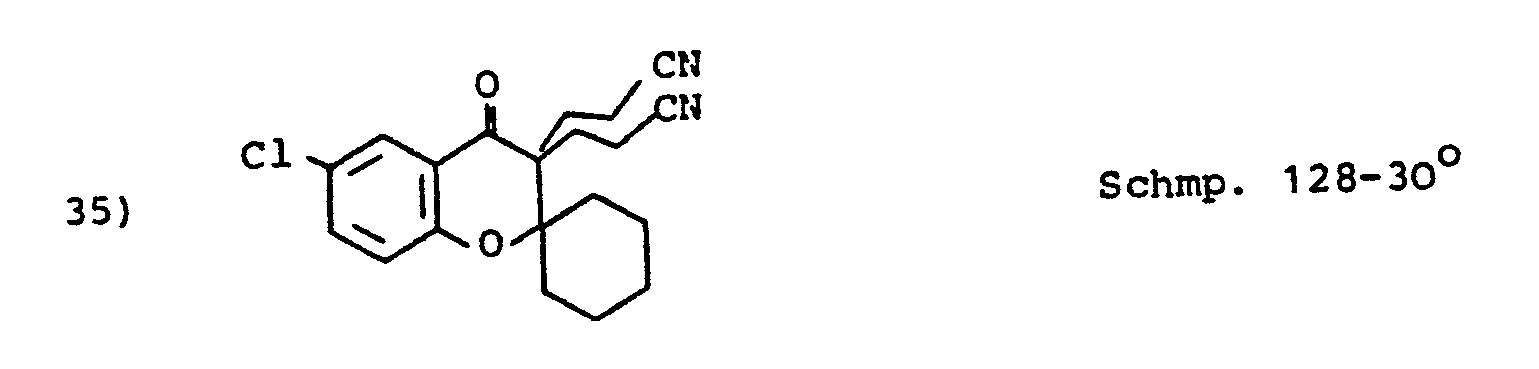


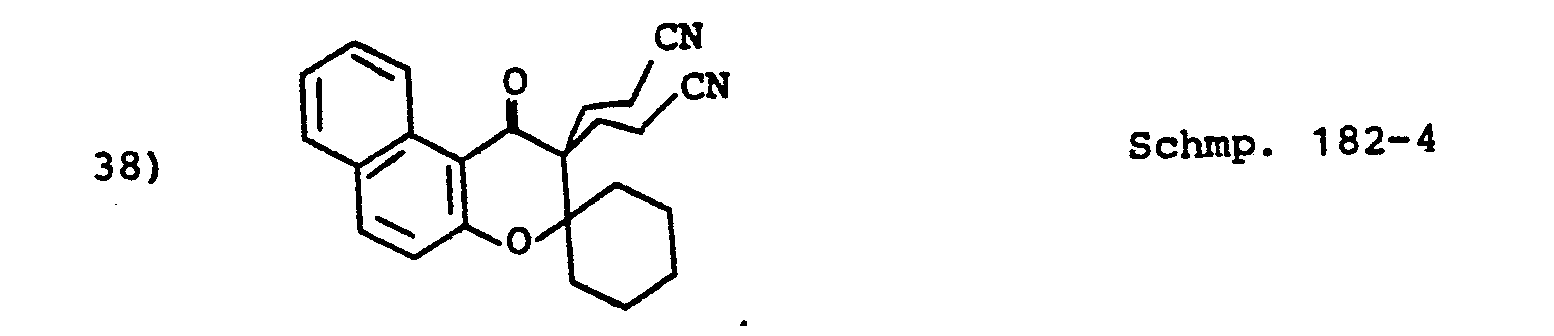


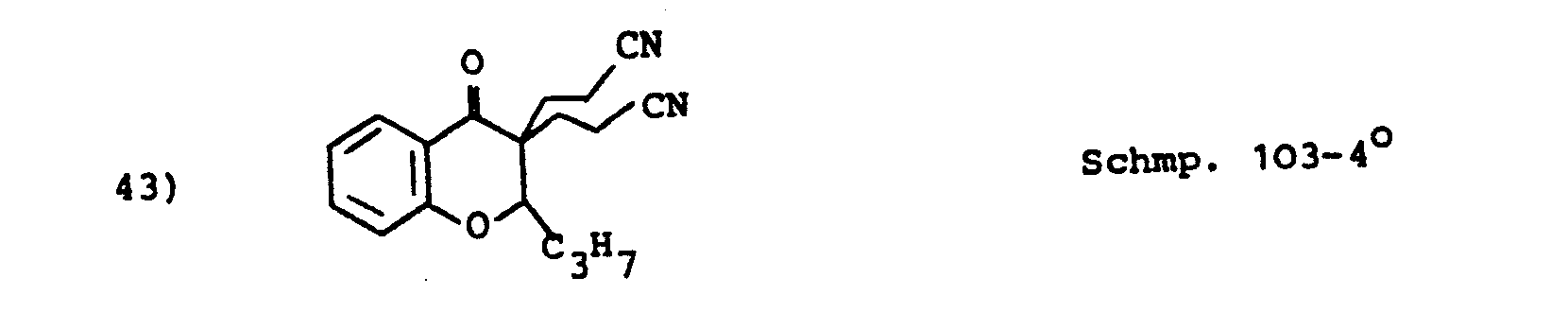





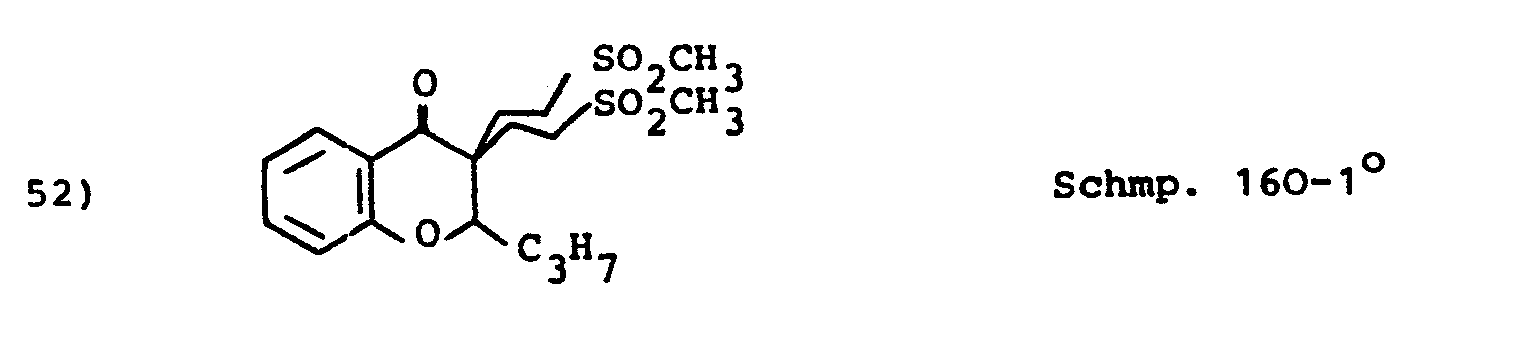


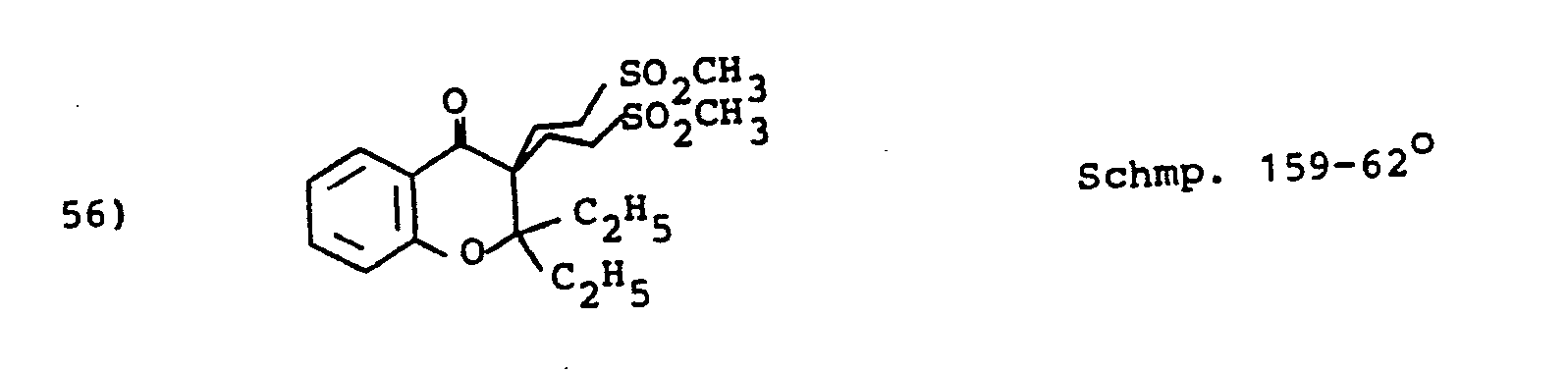


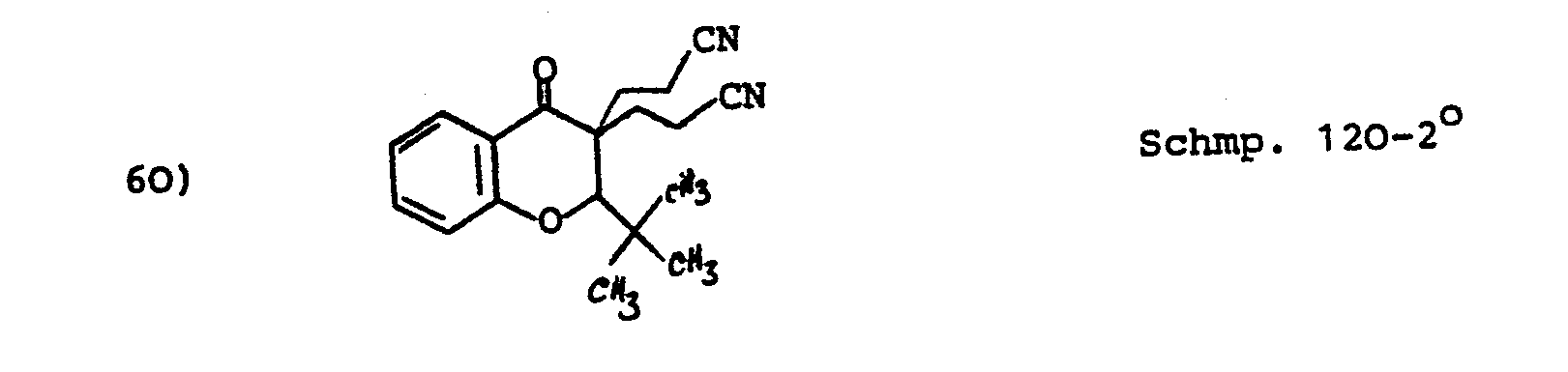
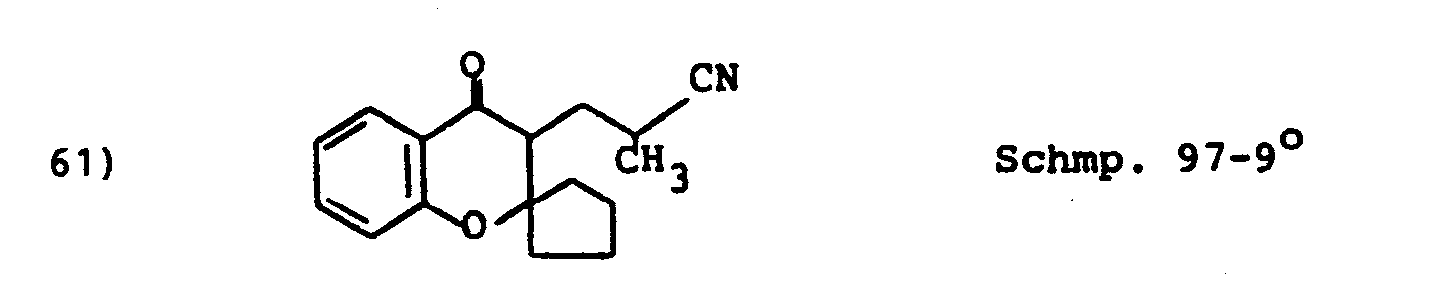


Claims (10)


Applications Claiming Priority (2)
| Application Number | Priority Date | Filing Date | Title |
|---|---|---|---|
| DE2814983 | 1978-04-07 | ||
| DE19782814983 DE2814983A1 (de) | 1978-04-07 | 1978-04-07 | Neue chromanon-derivate |
Publications (3)
| Publication Number | Publication Date |
|---|---|
| EP0004624A2 true EP0004624A2 (de) | 1979-10-17 |
| EP0004624A3 EP0004624A3 (en) | 1979-10-31 |
| EP0004624B1 EP0004624B1 (de) | 1982-02-24 |
Family
ID=6036342
Family Applications (1)
| Application Number | Title | Priority Date | Filing Date |
|---|---|---|---|
| EP79100905A Expired EP0004624B1 (de) | 1978-04-07 | 1979-03-24 | Neue Chromanon-Derivate, Verfahren zu ihrer Herstellung und ihre Verwendung als Arzneimittel und Wachstumsförderer |
Country Status (7)
| Country | Link |
|---|---|
| US (1) | US4261988A (de) |
| EP (1) | EP0004624B1 (de) |
| JP (1) | JPS54132576A (de) |
| AT (1) | AT361922B (de) |
| DE (2) | DE2814983A1 (de) |
| DK (1) | DK143979A (de) |
| ES (1) | ES479388A1 (de) |
Cited By (3)
| Publication number | Priority date | Publication date | Assignee | Title |
|---|---|---|---|---|
| WO2002020509A3 (de) * | 2000-09-06 | 2002-06-27 | Bayer Ag | Arzneimittel gegen virale erkrankungen |
| WO2004113317A1 (de) * | 2003-06-20 | 2004-12-29 | Ernst-Moritz-Arndt- Universität | Neue antimikrobielle chroman-4-one |
| US7410976B2 (en) | 2005-07-19 | 2008-08-12 | Merck & Co., Inc. | Spirochromanone derivatives |
Families Citing this family (4)
| Publication number | Priority date | Publication date | Assignee | Title |
|---|---|---|---|---|
| AU628331B2 (en) * | 1988-05-06 | 1992-09-17 | Merck Patent Gesellschaft Mit Beschrankter Haftung | Chroman derivatives |
| IL96507A0 (en) * | 1989-12-08 | 1991-08-16 | Merck & Co Inc | Nitrogen-containing spirocycles and pharmaceutical compositions containing them |
| CA2674530C (en) * | 2007-01-12 | 2014-09-16 | Banyu Pharmaceutical Co., Ltd. | Spirochromanon derivatives |
| PE20081559A1 (es) * | 2007-01-12 | 2008-11-20 | Merck & Co Inc | DERIVADOS DE ESPIROCROMANONA SUSTITUIDOS COMO INHIBIDORES DE ACETIL CoA CARBOXILASA |
Family Cites Families (6)
| Publication number | Priority date | Publication date | Assignee | Title |
|---|---|---|---|---|
| US3410851A (en) * | 1963-09-03 | 1968-11-12 | Miles Lab | Derivatives of flavone |
| US3553093A (en) * | 1965-03-19 | 1971-01-05 | Xerox Corp | Color photoelectrophoretic imaging process |
| US3825539A (en) * | 1967-09-26 | 1974-07-23 | Colgate Palmolive Co | 4h(1)benzopyrano(3,4-d)isoxazole derivatives |
| US3704323A (en) * | 1969-12-23 | 1972-11-28 | Squibb & Sons Inc | Indane derivatives |
| US3753985A (en) * | 1970-12-28 | 1973-08-21 | Miles Lab | 3-amino-flavanones |
| DE2535338A1 (de) * | 1975-08-07 | 1977-02-17 | Bayer Ag | Chromanone-(4) |
-
1978
- 1978-04-07 DE DE19782814983 patent/DE2814983A1/de not_active Withdrawn
-
1979
- 1979-03-13 US US06/020,119 patent/US4261988A/en not_active Expired - Lifetime
- 1979-03-24 DE DE7979100905T patent/DE2962169D1/de not_active Expired
- 1979-03-24 EP EP79100905A patent/EP0004624B1/de not_active Expired
- 1979-04-05 JP JP4040879A patent/JPS54132576A/ja active Pending
- 1979-04-06 ES ES479388A patent/ES479388A1/es not_active Expired
- 1979-04-06 DK DK143979A patent/DK143979A/da not_active IP Right Cessation
- 1979-04-06 AT AT257079A patent/AT361922B/de not_active IP Right Cessation
Cited By (4)
| Publication number | Priority date | Publication date | Assignee | Title |
|---|---|---|---|---|
| WO2002020509A3 (de) * | 2000-09-06 | 2002-06-27 | Bayer Ag | Arzneimittel gegen virale erkrankungen |
| WO2004113317A1 (de) * | 2003-06-20 | 2004-12-29 | Ernst-Moritz-Arndt- Universität | Neue antimikrobielle chroman-4-one |
| US7410976B2 (en) | 2005-07-19 | 2008-08-12 | Merck & Co., Inc. | Spirochromanone derivatives |
| US7935712B2 (en) | 2005-07-19 | 2011-05-03 | Merck Sharp & Dohme Corp. | Spirochromanone derivatives as acetyl coenzyme A carboxylase (ACC) inhibitors |
Also Published As
| Publication number | Publication date |
|---|---|
| EP0004624A3 (en) | 1979-10-31 |
| ES479388A1 (es) | 1982-12-01 |
| EP0004624B1 (de) | 1982-02-24 |
| AT361922B (de) | 1981-04-10 |
| JPS54132576A (en) | 1979-10-15 |
| DK143979A (da) | 1979-10-08 |
| US4261988A (en) | 1981-04-14 |
| ATA257079A (de) | 1980-09-15 |
| DE2962169D1 (en) | 1982-03-25 |
| DE2814983A1 (de) | 1979-10-18 |
Similar Documents
| Publication | Publication Date | Title |
|---|---|---|
| DE1620114A1 (de) | Verfahren zur Herstellung Schiffscher Basen | |
| EP0202538A1 (de) | Leistungsfördernde Mittel | |
| DE2432799C2 (de) | 7-substituierte 5-Methyl-isoflavone, Verfahren zu deren Herstellung und diese Verbindungen enthaltende Metabolica | |
| DE1443560B2 (de) | 3,5-bis(trifluorphenyl)-thioharnstoffe, verfahren zu ihrer herstellung und diese enthaltende futtermittel | |
| EP0004624B1 (de) | Neue Chromanon-Derivate, Verfahren zu ihrer Herstellung und ihre Verwendung als Arzneimittel und Wachstumsförderer | |
| EP0119446A2 (de) | Wachstumsfördernde Aminophenylethylamin-Derivate | |
| EP0209025B1 (de) | Arylethanolhydroxylamine, Verfahren zu ihrer Herstellung und ihre Verwendung zur Leistungsförderung | |
| DE3627663A1 (de) | Heteroarylethylamine, verfahren zu ihrer herstellung und ihre verwendung als leistungsfoerderer bei tieren | |
| DE3020470A1 (de) | Allyl- und propylderivate von recorcinylsaeurelakton-verbindungen und verfahren zu ihrer herstellung | |
| EP0154923A2 (de) | Monosilylierte Aminophenylethylamin-Derivate, Verfahren zu ihrer Herstellung und ihre Verwendung zur Wachstumsförderung | |
| EP0093949B1 (de) | Sulfinyl- und Sulfonyl-azacycloheptan-2-one, Verfahren zu ihrer Herstellung sowie ihre Verwendung als Futterzusatzstoffe | |
| EP0073390B1 (de) | Wirkstoffkombination aus Kitasamycin und Chinoxalin-di-N-oxiden | |
| EP0012725B1 (de) | Chinoxalin-Di-N-oxid-Derivate, Verfahren zu ihrer Herstellung, Mittel diese enthaltend und ihre Verwendung | |
| EP0225600A2 (de) | Verfahren zur Leistungsförderung bei Nutztieren, neue Aminophenylethylamin-Derivate und ihre Herstellung | |
| DE3534421A1 (de) | Verwendung von thienylaminen als leistungsfoerdernde mittel, neues thienylamin | |
| AT347456B (de) | Verfahren zur herstellung von neuen 5-methyl-7- hydroxy-isoflavon-derivaten | |
| EP0212479A1 (de) | Verwendung von Lactamamiden als Leistungsförderer bei Tieren | |
| EP0339345A2 (de) | 4-Brom-6-chlor-5-amino-2-pyridyl-ethanolamine, Verfahren zu ihrer Herstellung und ihre Verwendung als Leistungsförderer | |
| DE1692479B2 (de) | Oral zu verabreichendes veterinärmedizinisches Wurmbekämpfungsmittel | |
| DE2741376A1 (de) | 5-deazariboflavin oder seine derivate enthaltende zubereitungen fuer die behandlung von coccidiosis | |
| DD268687A5 (de) | Verfahren zur herstellung von kondensationsprodukten von 2,2,4-trimethyl-1,2-dihydrochinolin mit oxoverbindungen und deren derivaten | |
| AT360541B (de) | Verfahren zur herstellung von neuen nicotinamido- und nicotinamidoalkylbenzoesaeuren und deren derivaten | |
| DE2454094A1 (de) | Substituierte benzoylacrylanilide | |
| DE3543636A1 (de) | Neue aminophenylethylamin-derivate, verfahren zu ihrer herstellung sowie ihre verwendung zur leistungsfoerderung | |
| DE2251684A1 (de) | Verfahren zur herstellung von neuen 6-acyloximino-tetrahydro-1.3.4-thiadiazin-thionen-(2) |
Legal Events
| Date | Code | Title | Description |
|---|---|---|---|
| PUAI | Public reference made under article 153(3) epc to a published international application that has entered the european phase |
Free format text: ORIGINAL CODE: 0009012 |
|
| PUAL | Search report despatched |
Free format text: ORIGINAL CODE: 0009013 |
|
| 17P | Request for examination filed | ||
| AK | Designated contracting states |
Designated state(s): BE CH DE FR GB IT NL SE |
|
| AK | Designated contracting states |
Designated state(s): BE CH DE FR GB IT NL SE |
|
| ITF | It: translation for a ep patent filed | ||
| GRAA | (expected) grant |
Free format text: ORIGINAL CODE: 0009210 |
|
| AK | Designated contracting states |
Designated state(s): BE CH DE FR GB IT NL SE |
|
| PGFP | Annual fee paid to national office [announced via postgrant information from national office to epo] |
Ref country code: FR Payment date: 19820311 Year of fee payment: 4 |
|
| REF | Corresponds to: |
Ref document number: 2962169 Country of ref document: DE Date of ref document: 19820325 |
|
| PGFP | Annual fee paid to national office [announced via postgrant information from national office to epo] |
Ref country code: SE Payment date: 19820331 Year of fee payment: 4 Ref country code: NL Payment date: 19820331 Year of fee payment: 4 Ref country code: DE Payment date: 19820331 Year of fee payment: 4 |
|
| PGFP | Annual fee paid to national office [announced via postgrant information from national office to epo] |
Ref country code: BE Payment date: 19820630 Year of fee payment: 4 |
|
| PG25 | Lapsed in a contracting state [announced via postgrant information from national office to epo] |
Ref country code: BE Effective date: 19830324 |
|
| PG25 | Lapsed in a contracting state [announced via postgrant information from national office to epo] |
Ref country code: SE Effective date: 19830325 |
|
| PG25 | Lapsed in a contracting state [announced via postgrant information from national office to epo] |
Ref country code: CH Effective date: 19830331 |
|
| PG25 | Lapsed in a contracting state [announced via postgrant information from national office to epo] |
Ref country code: NL Effective date: 19831001 |
|
| GBPC | Gb: european patent ceased through non-payment of renewal fee | ||
| NLV4 | Nl: lapsed or anulled due to non-payment of the annual fee | ||
| PG25 | Lapsed in a contracting state [announced via postgrant information from national office to epo] |
Ref country code: FR Free format text: LAPSE BECAUSE OF NON-PAYMENT OF DUE FEES Effective date: 19831130 |
|
| REG | Reference to a national code |
Ref country code: CH Ref legal event code: PL |
|
| PG25 | Lapsed in a contracting state [announced via postgrant information from national office to epo] |
Ref country code: DE Effective date: 19831201 |
|
| REG | Reference to a national code |
Ref country code: FR Ref legal event code: ST |
|
| PG25 | Lapsed in a contracting state [announced via postgrant information from national office to epo] |
Ref country code: GB Effective date: 19881117 |
|
| EUG | Se: european patent has lapsed |
Ref document number: 79100905.3 Effective date: 19850610 |
|
| PLBE | No opposition filed within time limit |
Free format text: ORIGINAL CODE: 0009261 |
|
| STAA | Information on the status of an ep patent application or granted ep patent |
Free format text: STATUS: NO OPPOSITION FILED WITHIN TIME LIMIT |