EP0002510B1 - Cyclohexane, Verfahren zu deren Herstellung, deren Verwendung und diese enthaltende Kompositionen - Google Patents
Cyclohexane, Verfahren zu deren Herstellung, deren Verwendung und diese enthaltende Kompositionen Download PDFInfo
- Publication number
- EP0002510B1 EP0002510B1 EP78101620A EP78101620A EP0002510B1 EP 0002510 B1 EP0002510 B1 EP 0002510B1 EP 78101620 A EP78101620 A EP 78101620A EP 78101620 A EP78101620 A EP 78101620A EP 0002510 B1 EP0002510 B1 EP 0002510B1
- Authority
- EP
- European Patent Office
- Prior art keywords
- butyl
- methyl
- sec
- acetoxy
- cyclohexane
- Prior art date
- Legal status (The legal status is an assumption and is not a legal conclusion. Google has not performed a legal analysis and makes no representation as to the accuracy of the status listed.)
- Expired
Links
- 239000000203 mixture Substances 0.000 title claims description 28
- 238000000034 method Methods 0.000 title claims description 6
- 238000002360 preparation method Methods 0.000 title description 2
- 150000001934 cyclohexanes Chemical class 0.000 title 1
- GGBJHURWWWLEQH-UHFFFAOYSA-N butylcyclohexane Chemical compound CCCCC1CCCCC1 GGBJHURWWWLEQH-UHFFFAOYSA-N 0.000 claims description 36
- 150000001875 compounds Chemical class 0.000 claims description 23
- 239000003205 fragrance Substances 0.000 claims description 16
- 125000000484 butyl group Chemical group [H]C([*])([H])C([H])([H])C([H])([H])C([H])([H])[H] 0.000 claims description 13
- 125000000113 cyclohexyl group Chemical group [H]C1([H])C([H])([H])C([H])([H])C([H])(*)C([H])([H])C1([H])[H] 0.000 claims description 6
- BFMHEASWINLVIZ-UHFFFAOYSA-N (2-cyclohexyl-1-methylcyclohexyl) acetate Chemical compound CC(=O)OC1(C)CCCCC1C1CCCCC1 BFMHEASWINLVIZ-UHFFFAOYSA-N 0.000 claims description 2
- 239000012345 acetylating agent Substances 0.000 claims description 2
- 238000004519 manufacturing process Methods 0.000 claims 1
- 239000002585 base Substances 0.000 description 19
- RTZKZFJDLAIYFH-UHFFFAOYSA-N Diethyl ether Chemical compound CCOCC RTZKZFJDLAIYFH-UHFFFAOYSA-N 0.000 description 18
- XLYOFNOQVPJJNP-UHFFFAOYSA-N water Substances O XLYOFNOQVPJJNP-UHFFFAOYSA-N 0.000 description 13
- WFDIJRYMOXRFFG-UHFFFAOYSA-N Acetic anhydride Chemical compound CC(=O)OC(C)=O WFDIJRYMOXRFFG-UHFFFAOYSA-N 0.000 description 12
- -1 acetyl halides Chemical class 0.000 description 12
- 125000001495 ethyl group Chemical class [H]C([H])([H])C([H])([H])* 0.000 description 9
- VLKZOEOYAKHREP-UHFFFAOYSA-N n-Hexane Chemical compound CCCCCC VLKZOEOYAKHREP-UHFFFAOYSA-N 0.000 description 9
- LFQSCWFLJHTTHZ-UHFFFAOYSA-N Ethanol Chemical compound CCO LFQSCWFLJHTTHZ-UHFFFAOYSA-N 0.000 description 8
- GLZPCOQZEFWAFX-UHFFFAOYSA-N Geraniol Chemical compound CC(C)=CCCC(C)=CCO GLZPCOQZEFWAFX-UHFFFAOYSA-N 0.000 description 8
- JLTDJTHDQAWBAV-UHFFFAOYSA-N N,N-dimethylaniline Chemical compound CN(C)C1=CC=CC=C1 JLTDJTHDQAWBAV-UHFFFAOYSA-N 0.000 description 8
- 150000002148 esters Chemical class 0.000 description 8
- XMIIGOLPHOKFCH-UHFFFAOYSA-N 3-phenylpropionic acid Chemical compound OC(=O)CCC1=CC=CC=C1 XMIIGOLPHOKFCH-UHFFFAOYSA-N 0.000 description 7
- 239000000243 solution Substances 0.000 description 7
- 0 CC1(C(*)CCCC1)O Chemical compound CC1(C(*)CCCC1)O 0.000 description 6
- 150000001298 alcohols Chemical class 0.000 description 6
- 150000002576 ketones Chemical class 0.000 description 6
- 230000000694 effects Effects 0.000 description 5
- 150000002170 ethers Chemical class 0.000 description 5
- 239000000047 product Substances 0.000 description 5
- 239000000126 substance Substances 0.000 description 5
- 125000000391 vinyl group Chemical class [H]C([*])=C([H])[H] 0.000 description 5
- KSEZPRJUTHMFGZ-UHFFFAOYSA-N 1-(3-ethyl-5,5,8,8-tetramethyl-6,7-dihydronaphthalen-2-yl)ethanone Chemical compound CC1(C)CCC(C)(C)C2=C1C=C(C(C)=O)C(CC)=C2 KSEZPRJUTHMFGZ-UHFFFAOYSA-N 0.000 description 4
- JUJWROOIHBZHMG-UHFFFAOYSA-N Pyridine Chemical compound C1=CC=NC=C1 JUJWROOIHBZHMG-UHFFFAOYSA-N 0.000 description 4
- HEDRZPFGACZZDS-MICDWDOJSA-N Trichloro(2H)methane Chemical compound [2H]C(Cl)(Cl)Cl HEDRZPFGACZZDS-MICDWDOJSA-N 0.000 description 4
- RGIBXDHONMXTLI-UHFFFAOYSA-N chavicol Chemical compound OC1=CC=C(CC=C)C=C1 RGIBXDHONMXTLI-UHFFFAOYSA-N 0.000 description 4
- 238000006243 chemical reaction Methods 0.000 description 4
- NEHNMFOYXAPHSD-UHFFFAOYSA-N citronellal Chemical compound O=CCC(C)CCC=C(C)C NEHNMFOYXAPHSD-UHFFFAOYSA-N 0.000 description 4
- QMVPMAAFGQKVCJ-UHFFFAOYSA-N citronellol Chemical compound OCCC(C)CCC=C(C)C QMVPMAAFGQKVCJ-UHFFFAOYSA-N 0.000 description 4
- OSOIQJGOYGSIMF-UHFFFAOYSA-N cyclopentadecanone Chemical compound O=C1CCCCCCCCCCCCCC1 OSOIQJGOYGSIMF-UHFFFAOYSA-N 0.000 description 4
- 239000003599 detergent Substances 0.000 description 4
- RRAFCDWBNXTKKO-UHFFFAOYSA-N eugenol Chemical compound COC1=CC(CC=C)=CC=C1O RRAFCDWBNXTKKO-UHFFFAOYSA-N 0.000 description 4
- 229930195733 hydrocarbon Natural products 0.000 description 4
- 150000002430 hydrocarbons Chemical class 0.000 description 4
- CDOSHBSSFJOMGT-UHFFFAOYSA-N linalool Chemical compound CC(C)=CCCC(C)(O)C=C CDOSHBSSFJOMGT-UHFFFAOYSA-N 0.000 description 4
- 239000012074 organic phase Substances 0.000 description 4
- 239000002304 perfume Substances 0.000 description 4
- 239000002904 solvent Substances 0.000 description 4
- LCZUOKDVTBMCMX-UHFFFAOYSA-N 2,5-Dimethylpyrazine Chemical compound CC1=CN=C(C)C=N1 LCZUOKDVTBMCMX-UHFFFAOYSA-N 0.000 description 3
- QTBSBXVTEAMEQO-UHFFFAOYSA-N Acetic acid Chemical compound CC(O)=O QTBSBXVTEAMEQO-UHFFFAOYSA-N 0.000 description 3
- UHOVQNZJYSORNB-UHFFFAOYSA-N Benzene Chemical compound C1=CC=CC=C1 UHOVQNZJYSORNB-UHFFFAOYSA-N 0.000 description 3
- 241000402754 Erythranthe moschata Species 0.000 description 3
- VEXZGXHMUGYJMC-UHFFFAOYSA-N Hydrochloric acid Chemical compound Cl VEXZGXHMUGYJMC-UHFFFAOYSA-N 0.000 description 3
- OKKJLVBELUTLKV-UHFFFAOYSA-N Methanol Chemical compound OC OKKJLVBELUTLKV-UHFFFAOYSA-N 0.000 description 3
- 240000002505 Pogostemon cablin Species 0.000 description 3
- 235000011751 Pogostemon cablin Nutrition 0.000 description 3
- DNIAPMSPPWPWGF-UHFFFAOYSA-N Propylene glycol Chemical compound CC(O)CO DNIAPMSPPWPWGF-UHFFFAOYSA-N 0.000 description 3
- YXFVVABEGXRONW-UHFFFAOYSA-N Toluene Chemical compound CC1=CC=CC=C1 YXFVVABEGXRONW-UHFFFAOYSA-N 0.000 description 3
- WETWJCDKMRHUPV-UHFFFAOYSA-N acetyl chloride Chemical compound CC(Cl)=O WETWJCDKMRHUPV-UHFFFAOYSA-N 0.000 description 3
- 239000012346 acetyl chloride Substances 0.000 description 3
- 238000004821 distillation Methods 0.000 description 3
- GYUZHTWCNKINPY-UHFFFAOYSA-N dl-theaspirane Natural products O1C(C)CCC21C(C)(C)CCC=C2C GYUZHTWCNKINPY-UHFFFAOYSA-N 0.000 description 3
- XMGQYMWWDOXHJM-UHFFFAOYSA-N limonene Chemical compound CC(=C)C1CCC(C)=CC1 XMGQYMWWDOXHJM-UHFFFAOYSA-N 0.000 description 3
- ZRSNZINYAWTAHE-UHFFFAOYSA-N p-methoxybenzaldehyde Chemical compound COC1=CC=C(C=O)C=C1 ZRSNZINYAWTAHE-UHFFFAOYSA-N 0.000 description 3
- DTUQWGWMVIHBKE-UHFFFAOYSA-N phenylacetaldehyde Chemical compound O=CCC1=CC=CC=C1 DTUQWGWMVIHBKE-UHFFFAOYSA-N 0.000 description 3
- 230000035484 reaction time Effects 0.000 description 3
- 235000002020 sage Nutrition 0.000 description 3
- 238000000926 separation method Methods 0.000 description 3
- RUVINXPYWBROJD-ONEGZZNKSA-N trans-anethole Chemical compound COC1=CC=C(\C=C\C)C=C1 RUVINXPYWBROJD-ONEGZZNKSA-N 0.000 description 3
- CRDAMVZIKSXKFV-FBXUGWQNSA-N (2-cis,6-cis)-farnesol Chemical compound CC(C)=CCC\C(C)=C/CC\C(C)=C/CO CRDAMVZIKSXKFV-FBXUGWQNSA-N 0.000 description 2
- LJQUVZZEAACJFH-UHFFFAOYSA-N (2-tert-butyl-1-methylcyclohexyl) acetate Chemical compound CC(=O)OC1(C)CCCCC1C(C)(C)C LJQUVZZEAACJFH-UHFFFAOYSA-N 0.000 description 2
- 239000000260 (2E,6E)-3,7,11-trimethyldodeca-2,6,10-trien-1-ol Substances 0.000 description 2
- 239000001490 (3R)-3,7-dimethylocta-1,6-dien-3-ol Substances 0.000 description 2
- 239000001306 (7E,9E,11E,13E)-pentadeca-7,9,11,13-tetraen-1-ol Substances 0.000 description 2
- QMVPMAAFGQKVCJ-SNVBAGLBSA-N (R)-(+)-citronellol Natural products OCC[C@H](C)CCC=C(C)C QMVPMAAFGQKVCJ-SNVBAGLBSA-N 0.000 description 2
- CDOSHBSSFJOMGT-JTQLQIEISA-N (R)-linalool Natural products CC(C)=CCC[C@@](C)(O)C=C CDOSHBSSFJOMGT-JTQLQIEISA-N 0.000 description 2
- ZKVZSBSZTMPBQR-OWOJBTEDSA-N (Z)-9-Cycloheptadecen-1-one Chemical compound O=C1CCCCCCC\C=C\CCCCCCC1 ZKVZSBSZTMPBQR-OWOJBTEDSA-N 0.000 description 2
- DIYMHJUZZFRGHQ-UHFFFAOYSA-N 1,3-dioxacycloheptadecan-2-one Chemical compound O=C1OCCCCCCCCCCCCCCO1 DIYMHJUZZFRGHQ-UHFFFAOYSA-N 0.000 description 2
- KBIPDYYQSKEUOC-UHFFFAOYSA-N 2-tert-butyl-1-methylcyclohexan-1-ol Chemical compound CC(C)(C)C1CCCCC1(C)O KBIPDYYQSKEUOC-UHFFFAOYSA-N 0.000 description 2
- WXCMHFPAUCOJIG-UHFFFAOYSA-N 4'-tert-Butyl-2',6'-dimethyl-3',5'-dinitroacetophenone Chemical compound CC(=O)C1=C(C)C([N+]([O-])=O)=C(C(C)(C)C)C([N+]([O-])=O)=C1C WXCMHFPAUCOJIG-UHFFFAOYSA-N 0.000 description 2
- INIOTLARNNSXAE-UHFFFAOYSA-N 4,8-dimethyl-2-propan-2-ylidene-3,3a,4,5,6,8a-hexahydro-1h-azulen-6-ol Chemical compound CC1CC(O)C=C(C)C2CC(=C(C)C)CC12 INIOTLARNNSXAE-UHFFFAOYSA-N 0.000 description 2
- VUFZVGQUAVDKMC-UHFFFAOYSA-N Allyl phenoxyacetate Chemical compound C=CCOC(=O)COC1=CC=CC=C1 VUFZVGQUAVDKMC-UHFFFAOYSA-N 0.000 description 2
- ZCTQGTTXIYCGGC-UHFFFAOYSA-N Benzyl salicylate Chemical compound OC1=CC=CC=C1C(=O)OCC1=CC=CC=C1 ZCTQGTTXIYCGGC-UHFFFAOYSA-N 0.000 description 2
- 241001090476 Castoreum Species 0.000 description 2
- NPBVQXIMTZKSBA-UHFFFAOYSA-N Chavibetol Natural products COC1=CC=C(CC=C)C=C1O NPBVQXIMTZKSBA-UHFFFAOYSA-N 0.000 description 2
- IAZKGRRJAULWNS-UHFFFAOYSA-N Chavicol Natural products OC1=CC=C(CCC=C)C=C1 IAZKGRRJAULWNS-UHFFFAOYSA-N 0.000 description 2
- WTEVQBCEXWBHNA-UHFFFAOYSA-N Citral Natural products CC(C)=CCCC(C)=CC=O WTEVQBCEXWBHNA-UHFFFAOYSA-N 0.000 description 2
- ZKVZSBSZTMPBQR-UHFFFAOYSA-N Civetone Natural products O=C1CCCCCCCC=CCCCCCCC1 ZKVZSBSZTMPBQR-UHFFFAOYSA-N 0.000 description 2
- 239000005770 Eugenol Substances 0.000 description 2
- GLZPCOQZEFWAFX-YFHOEESVSA-N Geraniol Natural products CC(C)=CCC\C(C)=C/CO GLZPCOQZEFWAFX-YFHOEESVSA-N 0.000 description 2
- 239000005792 Geraniol Substances 0.000 description 2
- BJIOGJUNALELMI-ONEGZZNKSA-N Isoeugenol Natural products COC1=CC(\C=C\C)=CC=C1O BJIOGJUNALELMI-ONEGZZNKSA-N 0.000 description 2
- 241000234269 Liliales Species 0.000 description 2
- 235000007688 Lycopersicon esculentum Nutrition 0.000 description 2
- IMNFDUFMRHMDMM-UHFFFAOYSA-N N-Heptane Chemical compound CCCCCCC IMNFDUFMRHMDMM-UHFFFAOYSA-N 0.000 description 2
- GLZPCOQZEFWAFX-JXMROGBWSA-N Nerol Natural products CC(C)=CCC\C(C)=C\CO GLZPCOQZEFWAFX-JXMROGBWSA-N 0.000 description 2
- DYUQAZSOFZSPHD-UHFFFAOYSA-N Phenylpropanol Chemical compound CCC(O)C1=CC=CC=C1 DYUQAZSOFZSPHD-UHFFFAOYSA-N 0.000 description 2
- NBIIXXVUZAFLBC-UHFFFAOYSA-N Phosphoric acid Chemical compound OP(O)(O)=O NBIIXXVUZAFLBC-UHFFFAOYSA-N 0.000 description 2
- UVMRYBDEERADNV-UHFFFAOYSA-N Pseudoeugenol Natural products COC1=CC(C(C)=C)=CC=C1O UVMRYBDEERADNV-UHFFFAOYSA-N 0.000 description 2
- WTARULDDTDQWMU-UHFFFAOYSA-N Pseudopinene Natural products C1C2C(C)(C)C1CCC2=C WTARULDDTDQWMU-UHFFFAOYSA-N 0.000 description 2
- 240000003768 Solanum lycopersicum Species 0.000 description 2
- WYURNTSHIVDZCO-UHFFFAOYSA-N Tetrahydrofuran Chemical compound C1CCOC1 WYURNTSHIVDZCO-UHFFFAOYSA-N 0.000 description 2
- 244000284012 Vetiveria zizanioides Species 0.000 description 2
- 235000007769 Vetiveria zizanioides Nutrition 0.000 description 2
- 150000008065 acid anhydrides Chemical class 0.000 description 2
- 239000000853 adhesive Substances 0.000 description 2
- 230000001070 adhesive effect Effects 0.000 description 2
- 229910052783 alkali metal Inorganic materials 0.000 description 2
- 229910052784 alkaline earth metal Inorganic materials 0.000 description 2
- WUOACPNHFRMFPN-UHFFFAOYSA-N alpha-terpineol Chemical compound CC1=CCC(C(C)(C)O)CC1 WUOACPNHFRMFPN-UHFFFAOYSA-N 0.000 description 2
- QUKGYYKBILRGFE-UHFFFAOYSA-N benzyl acetate Chemical compound CC(=O)OCC1=CC=CC=C1 QUKGYYKBILRGFE-UHFFFAOYSA-N 0.000 description 2
- JGQFVRIQXUFPAH-UHFFFAOYSA-N beta-citronellol Natural products OCCC(C)CCCC(C)=C JGQFVRIQXUFPAH-UHFFFAOYSA-N 0.000 description 2
- UAHWPYUMFXYFJY-UHFFFAOYSA-N beta-myrcene Chemical compound CC(C)=CCCC(=C)C=C UAHWPYUMFXYFJY-UHFFFAOYSA-N 0.000 description 2
- BJIOGJUNALELMI-ARJAWSKDSA-N cis-isoeugenol Chemical compound COC1=CC(\C=C/C)=CC=C1O BJIOGJUNALELMI-ARJAWSKDSA-N 0.000 description 2
- 229940043350 citral Drugs 0.000 description 2
- 229930003633 citronellal Natural products 0.000 description 2
- 235000000983 citronellal Nutrition 0.000 description 2
- 235000000484 citronellol Nutrition 0.000 description 2
- SQIFACVGCPWBQZ-UHFFFAOYSA-N delta-terpineol Natural products CC(C)(O)C1CCC(=C)CC1 SQIFACVGCPWBQZ-UHFFFAOYSA-N 0.000 description 2
- 238000010790 dilution Methods 0.000 description 2
- 239000012895 dilution Substances 0.000 description 2
- 230000032050 esterification Effects 0.000 description 2
- 238000005886 esterification reaction Methods 0.000 description 2
- 229960002217 eugenol Drugs 0.000 description 2
- 239000000284 extract Substances 0.000 description 2
- 229940043259 farnesol Drugs 0.000 description 2
- 229930002886 farnesol Natural products 0.000 description 2
- 239000007789 gas Substances 0.000 description 2
- WTEVQBCEXWBHNA-JXMROGBWSA-N geranial Chemical compound CC(C)=CCC\C(C)=C\C=O WTEVQBCEXWBHNA-JXMROGBWSA-N 0.000 description 2
- 229940113087 geraniol Drugs 0.000 description 2
- WPFVBOQKRVRMJB-UHFFFAOYSA-N hydroxycitronellal Chemical compound O=CCC(C)CCCC(C)(C)O WPFVBOQKRVRMJB-UHFFFAOYSA-N 0.000 description 2
- SDQFDHOLCGWZPU-UHFFFAOYSA-N lilial Chemical compound O=CC(C)CC1=CC=C(C(C)(C)C)C=C1 SDQFDHOLCGWZPU-UHFFFAOYSA-N 0.000 description 2
- 229930007744 linalool Natural products 0.000 description 2
- UWKAYLJWKGQEPM-LBPRGKRZSA-N linalyl acetate Chemical compound CC(C)=CCC[C@](C)(C=C)OC(C)=O UWKAYLJWKGQEPM-LBPRGKRZSA-N 0.000 description 2
- 239000007788 liquid Substances 0.000 description 2
- 239000006210 lotion Substances 0.000 description 2
- NEDIAPMWNCQWNW-UHFFFAOYSA-N massoia lactone Chemical compound CCCCCC1CC=CC(=O)O1 NEDIAPMWNCQWNW-UHFFFAOYSA-N 0.000 description 2
- KVWWIYGFBYDJQC-UHFFFAOYSA-N methyl dihydrojasmonate Chemical compound CCCCCC1C(CC(=O)OC)CCC1=O KVWWIYGFBYDJQC-UHFFFAOYSA-N 0.000 description 2
- RUVINXPYWBROJD-UHFFFAOYSA-N para-methoxyphenyl Natural products COC1=CC=C(C=CC)C=C1 RUVINXPYWBROJD-UHFFFAOYSA-N 0.000 description 2
- SATCULPHIDQDRE-UHFFFAOYSA-N piperonal Chemical compound O=CC1=CC=C2OCOC2=C1 SATCULPHIDQDRE-UHFFFAOYSA-N 0.000 description 2
- UMJSCPRVCHMLSP-UHFFFAOYSA-N pyridine Natural products COC1=CC=CN=C1 UMJSCPRVCHMLSP-UHFFFAOYSA-N 0.000 description 2
- 239000000376 reactant Substances 0.000 description 2
- 239000011541 reaction mixture Substances 0.000 description 2
- 239000002453 shampoo Substances 0.000 description 2
- 239000000344 soap Substances 0.000 description 2
- 239000011734 sodium Substances 0.000 description 2
- 229940116411 terpineol Drugs 0.000 description 2
- 150000003512 tertiary amines Chemical class 0.000 description 2
- CXWXQJXEFPUFDZ-UHFFFAOYSA-N tetralin Substances C1=CC=C2CCCCC2=C1 CXWXQJXEFPUFDZ-UHFFFAOYSA-N 0.000 description 2
- 239000004753 textile Substances 0.000 description 2
- CRDAMVZIKSXKFV-UHFFFAOYSA-N trans-Farnesol Natural products CC(C)=CCCC(C)=CCCC(C)=CCO CRDAMVZIKSXKFV-UHFFFAOYSA-N 0.000 description 2
- BJIOGJUNALELMI-UHFFFAOYSA-N trans-isoeugenol Natural products COC1=CC(C=CC)=CC=C1O BJIOGJUNALELMI-UHFFFAOYSA-N 0.000 description 2
- XMLSXPIVAXONDL-UHFFFAOYSA-N trans-jasmone Natural products CCC=CCC1=C(C)CCC1=O XMLSXPIVAXONDL-UHFFFAOYSA-N 0.000 description 2
- MWOOGOJBHIARFG-UHFFFAOYSA-N vanillin Chemical compound COC1=CC(C=O)=CC=C1O MWOOGOJBHIARFG-UHFFFAOYSA-N 0.000 description 2
- FGQOOHJZONJGDT-UHFFFAOYSA-N vanillin Natural products COC1=CC(O)=CC(C=O)=C1 FGQOOHJZONJGDT-UHFFFAOYSA-N 0.000 description 2
- 235000012141 vanillin Nutrition 0.000 description 2
- WTARULDDTDQWMU-RKDXNWHRSA-N (+)-β-pinene Chemical compound C1[C@H]2C(C)(C)[C@@H]1CCC2=C WTARULDDTDQWMU-RKDXNWHRSA-N 0.000 description 1
- WTARULDDTDQWMU-IUCAKERBSA-N (-)-Nopinene Natural products C1[C@@H]2C(C)(C)[C@H]1CCC2=C WTARULDDTDQWMU-IUCAKERBSA-N 0.000 description 1
- GRWFGVWFFZKLTI-IUCAKERBSA-N (-)-α-pinene Chemical compound CC1=CC[C@@H]2C(C)(C)[C@H]1C2 GRWFGVWFFZKLTI-IUCAKERBSA-N 0.000 description 1
- 239000001352 (6R)-6-pentyl-5,6-dihydropyran-2-one Substances 0.000 description 1
- RCHLXMOXBJRGNX-UHFFFAOYSA-N 1-butylcyclohexan-1-ol Chemical compound CCCCC1(O)CCCCC1 RCHLXMOXBJRGNX-UHFFFAOYSA-N 0.000 description 1
- QACBYNLZEUNZSC-UHFFFAOYSA-N 1-methoxy-1-methylcyclododecane Chemical compound COC1(C)CCCCCCCCCCC1 QACBYNLZEUNZSC-UHFFFAOYSA-N 0.000 description 1
- 239000001074 1-methoxy-4-[(E)-prop-1-enyl]benzene Substances 0.000 description 1
- YEFXLHGZPHFOIH-UHFFFAOYSA-N 2,5,5,8a-tetramethyl-1-[4-methyl-6-(2,2,6-trimethylcyclohexyl)hexyl]-1,2,3,4,4a,6,7,8-octahydronaphthalene Chemical compound CC1CCC2C(C)(C)CCCC2(C)C1CCCC(C)CCC1C(C)CCCC1(C)C YEFXLHGZPHFOIH-UHFFFAOYSA-N 0.000 description 1
- 239000001934 2,5-dimethylpyrazine Substances 0.000 description 1
- WRMNZCZEMHIOCP-UHFFFAOYSA-N 2-Phenylethanol Natural products OCCC1=CC=CC=C1 WRMNZCZEMHIOCP-UHFFFAOYSA-N 0.000 description 1
- YUFBKEUKFQVKEO-UHFFFAOYSA-N 2-cyclohexyl-1-methylcyclohexan-1-ol Chemical compound CC1(O)CCCCC1C1CCCCC1 YUFBKEUKFQVKEO-UHFFFAOYSA-N 0.000 description 1
- GMOYUTKNPLBTMT-UHFFFAOYSA-N 2-phenylmethoxybenzoic acid Chemical compound OC(=O)C1=CC=CC=C1OCC1=CC=CC=C1 GMOYUTKNPLBTMT-UHFFFAOYSA-N 0.000 description 1
- ZRYDPLOWJSFQAE-UHFFFAOYSA-N 2-tert-butylcyclohexan-1-one Chemical compound CC(C)(C)C1CCCCC1=O ZRYDPLOWJSFQAE-UHFFFAOYSA-N 0.000 description 1
- VAJVDSVGBWFCLW-UHFFFAOYSA-N 3-Phenyl-1-propanol Chemical compound OCCCC1=CC=CC=C1 VAJVDSVGBWFCLW-UHFFFAOYSA-N 0.000 description 1
- OAKURXIZZOAYBC-UHFFFAOYSA-M 3-oxopropanoate Chemical compound [O-]C(=O)CC=O OAKURXIZZOAYBC-UHFFFAOYSA-M 0.000 description 1
- QTBSBXVTEAMEQO-UHFFFAOYSA-M Acetate Chemical compound CC([O-])=O QTBSBXVTEAMEQO-UHFFFAOYSA-M 0.000 description 1
- RANVDUNFZBMTBK-UHFFFAOYSA-N Amyl salicylate Chemical compound CCCCCOC(=O)C1=CC=CC=C1O RANVDUNFZBMTBK-UHFFFAOYSA-N 0.000 description 1
- 241000218645 Cedrus Species 0.000 description 1
- FKUPPRZPSYCDRS-UHFFFAOYSA-N Cyclopentadecanolide Chemical compound O=C1CCCCCCCCCCCCCCO1 FKUPPRZPSYCDRS-UHFFFAOYSA-N 0.000 description 1
- 240000006497 Dianthus caryophyllus Species 0.000 description 1
- 235000009355 Dianthus caryophyllus Nutrition 0.000 description 1
- VGGSQFUCUMXWEO-UHFFFAOYSA-N Ethene Chemical compound C=C VGGSQFUCUMXWEO-UHFFFAOYSA-N 0.000 description 1
- 239000005977 Ethylene Substances 0.000 description 1
- 244000153234 Hibiscus abelmoschus Species 0.000 description 1
- XPPALVZZCMPTIV-ARJAWSKDSA-N Jasmine lactone Chemical compound CC\C=C/CC1CCCC(=O)O1 XPPALVZZCMPTIV-ARJAWSKDSA-N 0.000 description 1
- XPPALVZZCMPTIV-UHFFFAOYSA-N Jasmine lactone Natural products CCC=CCC1CCCC(=O)O1 XPPALVZZCMPTIV-UHFFFAOYSA-N 0.000 description 1
- 241001465754 Metazoa Species 0.000 description 1
- ZOZIRNMDEZKZHM-UHFFFAOYSA-N Phenethyl phenylacetate Chemical compound C=1C=CC=CC=1CCOC(=O)CC1=CC=CC=C1 ZOZIRNMDEZKZHM-UHFFFAOYSA-N 0.000 description 1
- PMZURENOXWZQFD-UHFFFAOYSA-L Sodium Sulfate Chemical compound [Na+].[Na+].[O-]S([O-])(=O)=O PMZURENOXWZQFD-UHFFFAOYSA-L 0.000 description 1
- UIIMBOGNXHQVGW-UHFFFAOYSA-M Sodium bicarbonate Chemical class [Na+].OC([O-])=O UIIMBOGNXHQVGW-UHFFFAOYSA-M 0.000 description 1
- 229940022663 acetate Drugs 0.000 description 1
- 150000001242 acetic acid derivatives Chemical class 0.000 description 1
- 125000002777 acetyl group Chemical class [H]C([H])([H])C(*)=O 0.000 description 1
- 230000001476 alcoholic effect Effects 0.000 description 1
- 150000001299 aldehydes Chemical class 0.000 description 1
- 125000001931 aliphatic group Chemical group 0.000 description 1
- 239000003513 alkali Substances 0.000 description 1
- 150000001340 alkali metals Chemical class 0.000 description 1
- XCPQUQHBVVXMRQ-UHFFFAOYSA-N alpha-Fenchene Natural products C1CC2C(=C)CC1C2(C)C XCPQUQHBVVXMRQ-UHFFFAOYSA-N 0.000 description 1
- VYBREYKSZAROCT-UHFFFAOYSA-N alpha-myrcene Natural products CC(=C)CCCC(=C)C=C VYBREYKSZAROCT-UHFFFAOYSA-N 0.000 description 1
- 229910000147 aluminium phosphate Inorganic materials 0.000 description 1
- 229940062909 amyl salicylate Drugs 0.000 description 1
- 229940011037 anethole Drugs 0.000 description 1
- 239000001399 angelica archangelica l. seed absolute Substances 0.000 description 1
- 239000008346 aqueous phase Substances 0.000 description 1
- ZYGHJZDHTFUPRJ-UHFFFAOYSA-N benzo-alpha-pyrone Natural products C1=CC=C2OC(=O)C=CC2=C1 ZYGHJZDHTFUPRJ-UHFFFAOYSA-N 0.000 description 1
- 229940007550 benzyl acetate Drugs 0.000 description 1
- YSNRTFFURISHOU-UHFFFAOYSA-N beta-farnesene Natural products C=CC(C)CCC=C(C)CCC=C(C)C YSNRTFFURISHOU-UHFFFAOYSA-N 0.000 description 1
- 229930006722 beta-pinene Natural products 0.000 description 1
- 238000009835 boiling Methods 0.000 description 1
- 229930006737 car-3-ene Natural products 0.000 description 1
- BVKZGUZCCUSVTD-UHFFFAOYSA-N carbonic acid Chemical class OC(O)=O BVKZGUZCCUSVTD-UHFFFAOYSA-N 0.000 description 1
- BQOFWKZOCNGFEC-UHFFFAOYSA-N carene Chemical compound C1C(C)=CCC2C(C)(C)C12 BQOFWKZOCNGFEC-UHFFFAOYSA-N 0.000 description 1
- 229930007796 carene Natural products 0.000 description 1
- 239000003054 catalyst Substances 0.000 description 1
- 230000003197 catalytic effect Effects 0.000 description 1
- 229940119201 cedar leaf oil Drugs 0.000 description 1
- 239000010627 cedar oil Substances 0.000 description 1
- 150000001851 cinnamic acid derivatives Chemical class 0.000 description 1
- 239000001507 cistus ladaniferus l. oil Substances 0.000 description 1
- 239000001111 citrus aurantium l. leaf oil Substances 0.000 description 1
- 239000001926 citrus aurantium l. subsp. bergamia wright et arn. oil Substances 0.000 description 1
- 239000012141 concentrate Substances 0.000 description 1
- 239000010636 coriander oil Substances 0.000 description 1
- 239000002537 cosmetic Substances 0.000 description 1
- 235000001671 coumarin Nutrition 0.000 description 1
- 150000004775 coumarins Chemical class 0.000 description 1
- 239000006071 cream Substances 0.000 description 1
- 239000012043 crude product Substances 0.000 description 1
- 229940019836 cyclamen aldehyde Drugs 0.000 description 1
- 239000002781 deodorant agent Substances 0.000 description 1
- 238000009792 diffusion process Methods 0.000 description 1
- NYNCZOLNVTXTTP-UHFFFAOYSA-N ethyl 2-(1,3-dioxoisoindol-2-yl)acetate Chemical compound C1=CC=C2C(=O)N(CC(=O)OCC)C(=O)C2=C1 NYNCZOLNVTXTTP-UHFFFAOYSA-N 0.000 description 1
- 239000001148 ferula galbaniflua oil terpeneless Substances 0.000 description 1
- 238000009472 formulation Methods 0.000 description 1
- 238000004508 fractional distillation Methods 0.000 description 1
- 238000005194 fractionation Methods 0.000 description 1
- LCWMKIHBLJLORW-UHFFFAOYSA-N gamma-carene Natural products C1CC(=C)CC2C(C)(C)C21 LCWMKIHBLJLORW-UHFFFAOYSA-N 0.000 description 1
- 239000010651 grapefruit oil Substances 0.000 description 1
- 150000008282 halocarbons Chemical class 0.000 description 1
- 229910052736 halogen Inorganic materials 0.000 description 1
- 125000005843 halogen group Chemical group 0.000 description 1
- 238000010348 incorporation Methods 0.000 description 1
- 238000001802 infusion Methods 0.000 description 1
- 238000003780 insertion Methods 0.000 description 1
- 230000037431 insertion Effects 0.000 description 1
- 150000002596 lactones Chemical class 0.000 description 1
- 235000001510 limonene Nutrition 0.000 description 1
- 229940087305 limonene Drugs 0.000 description 1
- UWKAYLJWKGQEPM-UHFFFAOYSA-N linalool acetate Natural products CC(C)=CCCC(C)(C=C)OC(C)=O UWKAYLJWKGQEPM-UHFFFAOYSA-N 0.000 description 1
- 238000002844 melting Methods 0.000 description 1
- 125000002496 methyl group Chemical group [H]C([H])([H])* 0.000 description 1
- DVSDBMFJEQPWNO-UHFFFAOYSA-N methyllithium Chemical compound C[Li] DVSDBMFJEQPWNO-UHFFFAOYSA-N 0.000 description 1
- 238000004452 microanalysis Methods 0.000 description 1
- 230000004048 modification Effects 0.000 description 1
- 238000012986 modification Methods 0.000 description 1
- 239000002324 mouth wash Substances 0.000 description 1
- 230000007935 neutral effect Effects 0.000 description 1
- QJGQUHMNIGDVPM-UHFFFAOYSA-N nitrogen group Chemical group [N] QJGQUHMNIGDVPM-UHFFFAOYSA-N 0.000 description 1
- 231100000989 no adverse effect Toxicity 0.000 description 1
- 239000003921 oil Substances 0.000 description 1
- 235000019198 oils Nutrition 0.000 description 1
- 239000002674 ointment Substances 0.000 description 1
- 150000007530 organic bases Chemical class 0.000 description 1
- 239000012044 organic layer Substances 0.000 description 1
- 239000003960 organic solvent Substances 0.000 description 1
- 150000002902 organometallic compounds Chemical class 0.000 description 1
- 239000012071 phase Substances 0.000 description 1
- ISWSIDIOOBJBQZ-UHFFFAOYSA-N phenol group Chemical group C1(=CC=CC=C1)O ISWSIDIOOBJBQZ-UHFFFAOYSA-N 0.000 description 1
- 229940100595 phenylacetaldehyde Drugs 0.000 description 1
- 125000000286 phenylethyl group Chemical group [H]C1=C([H])C([H])=C(C([H])=C1[H])C([H])([H])C([H])([H])* 0.000 description 1
- 239000001738 pogostemon cablin oil Substances 0.000 description 1
- 239000004540 pour-on Substances 0.000 description 1
- 239000000843 powder Substances 0.000 description 1
- 150000003216 pyrazines Chemical class 0.000 description 1
- 238000001953 recrystallisation Methods 0.000 description 1
- 238000010992 reflux Methods 0.000 description 1
- 230000000717 retained effect Effects 0.000 description 1
- 239000010671 sandalwood oil Substances 0.000 description 1
- 229910000030 sodium bicarbonate Inorganic materials 0.000 description 1
- 229910052938 sodium sulfate Inorganic materials 0.000 description 1
- 235000011152 sodium sulphate Nutrition 0.000 description 1
- 239000007858 starting material Substances 0.000 description 1
- 238000012360 testing method Methods 0.000 description 1
- YLQBMQCUIZJEEH-UHFFFAOYSA-N tetrahydrofuran Natural products C=1C=COC=1 YLQBMQCUIZJEEH-UHFFFAOYSA-N 0.000 description 1
- 239000001789 thuja occidentalis l. leaf oil Substances 0.000 description 1
- DXNCZXXFRKPEPY-UHFFFAOYSA-N tridecanedioic acid Chemical compound OC(=O)CCCCCCCCCCCC(O)=O DXNCZXXFRKPEPY-UHFFFAOYSA-N 0.000 description 1
- 239000010679 vetiver oil Substances 0.000 description 1
- 229920002554 vinyl polymer Polymers 0.000 description 1
- 238000005406 washing Methods 0.000 description 1
- 239000002023 wood Substances 0.000 description 1
- ZFNVDHOSLNRHNN-UHFFFAOYSA-N xi-3-(4-Isopropylphenyl)-2-methylpropanal Chemical compound O=CC(C)CC1=CC=C(C(C)C)C=C1 ZFNVDHOSLNRHNN-UHFFFAOYSA-N 0.000 description 1
Classifications
-
- C—CHEMISTRY; METALLURGY
- C07—ORGANIC CHEMISTRY
- C07C—ACYCLIC OR CARBOCYCLIC COMPOUNDS
- C07C35/00—Compounds having at least one hydroxy or O-metal group bound to a carbon atom of a ring other than a six-membered aromatic ring
- C07C35/02—Compounds having at least one hydroxy or O-metal group bound to a carbon atom of a ring other than a six-membered aromatic ring monocyclic
- C07C35/08—Compounds having at least one hydroxy or O-metal group bound to a carbon atom of a ring other than a six-membered aromatic ring monocyclic containing a six-membered rings
-
- C—CHEMISTRY; METALLURGY
- C07—ORGANIC CHEMISTRY
- C07C—ACYCLIC OR CARBOCYCLIC COMPOUNDS
- C07C35/00—Compounds having at least one hydroxy or O-metal group bound to a carbon atom of a ring other than a six-membered aromatic ring
- C07C35/21—Compounds having at least one hydroxy or O-metal group bound to a carbon atom of a ring other than a six-membered aromatic ring polycyclic, at least one hydroxy group bound to a non-condensed ring
-
- C—CHEMISTRY; METALLURGY
- C11—ANIMAL OR VEGETABLE OILS, FATS, FATTY SUBSTANCES OR WAXES; FATTY ACIDS THEREFROM; DETERGENTS; CANDLES
- C11B—PRODUCING, e.g. BY PRESSING RAW MATERIALS OR BY EXTRACTION FROM WASTE MATERIALS, REFINING OR PRESERVING FATS, FATTY SUBSTANCES, e.g. LANOLIN, FATTY OILS OR WAXES; ESSENTIAL OILS; PERFUMES
- C11B9/00—Essential oils; Perfumes
- C11B9/0026—Essential oils; Perfumes compounds containing an alicyclic ring not condensed with another ring
- C11B9/0034—Essential oils; Perfumes compounds containing an alicyclic ring not condensed with another ring the ring containing six carbon atoms
Definitions
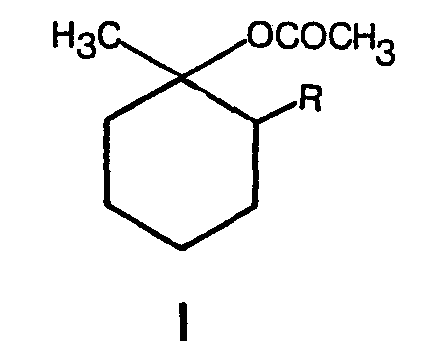
- the invention relates to new fragrances, namely compounds of the general formula where R sec. Butyl, tert. Represents butyl or cyclohexyl.
- the invention also relates to a process for the preparation of these new compounds of the formula I. It is characterized in that a compound of the general formula wherein R has the above meaning, treated with an acetylating agent.
- the esterification of the alcohols II is preferably carried out using the acetyl halides. It is convenient to work in the presence of tertiary amines, such as pyridine or dimethylaniline, or in the presence of alkali or alkaline earth metal acetates, or other organic bases. Pyridine and dimethylaniline are preferred.
- the acetates are thus accessible by reacting II with acetic anhydride at temperatures between 0-30 ° C. and reaction times of 2-5 days, catalytic amounts of phosphoric acid or any other conventional catalyst being used; however, the esterification can also be carried out with the aid of the acid anhydride at the reflux temperature (or generally between about 20-140 ° C.), optionally with the addition of an alkali metal salt of acetic acid; the reaction time can e.g. 2-30 hours. The reaction time naturally varies depending on the nature of the reactants used. In any case, the reactions can be carried out with the aid of solvents such as aromatics, e.g.
- Benzene, toluene, or aliphatics e.g. Hexane or heptane, or chlorinated aliphates can be carried out.
- aliphatics e.g. Hexane or heptane, or chlorinated aliphates
- a tertiary amine can also serve as the solvent.
- esters I are expediently purified by distillation under reduced pressure; they are colorless to slightly yellowish liquids or low-melting crystalline substances, are insoluble in water, but soluble in organic solvents, e.g. Alcohols, ethers, ketones, esters, hydrocarbons and halogenated hydrocarbons.
- the compounds of the general formula II which serve as starting materials for the process according to the invention can be obtained by adding a compound of the general formula wherein R has the above meaning, with an organometallic compound of the general formula wherein M is an alkali metal or the group MgX, where X is halogen.
- reaction of the ketone with the corresponding Grignard compound is preferred.
- solvent reaction temperature and amounts of the reactants to be reacted, one can use the literature to orient themselves.
- the Grignard compound and ketone will normally be used in stoichiometric amounts, although e.g. an excess of up to 20% of Grignard compound or ketone has no adverse effect on the course of the reaction.
- methyl metal compounds it is expedient to work with the customary solution of methyl lithium in diethyl ether in a temperature range from -75 ° C. to about 35 ° C., preferably at -35 ° C. to room temperature.
- the alcohols 11 can e.g. purified by distillation under reduced pressure (approximately 13.3-700 Pa). They are colorless to pale yellowish liquids, are insoluble in water, but soluble in alcohols, ketones, ethers, esters and hydrocarbons.
- esters I of the present invention exist as cis-trans stereoisomers and the olfactory properties of these isomers are somewhat different.
- the isomers can be separated by the customary methods known for the separation of such stereoisomers. It has been shown that fractional distillation of the corresponding alcohols under reduced pressure leads to the separation of the isomers, which in turn leads to stereoisomers by the methods described above Esters can be implemented. However, this separation is normally not necessary for the use of the new compounds I for perfume purposes.
- the esters I have special organoleptic properties, which make them ideal as fragrances.
- the invention accordingly also relates to the use of I as fragrances, and fragrance compositions which are characterized by a content of these esters I.
- the compounds I used according to the invention as odoriferous substances are distinguished in particular by interesting nuances of ambrane. It is of particular interest that these amber notes already appear in the top notes of the fragrance compositions. On the other hand, since the compounds I are not too volatile, the nuances are retained in the base note.
- the compounds can accordingly be used, for example, for perfuming products such as cosmetics (soaps, detergents, detergents, smokers' articles, mouthwashes, deodorants, shampoos, lotions, ointments, powders, eau de toilette, eau de cologne, 0.1s, etc.), where the compounds I are preferably not used alone, but in the form of compositions with other fragrances.
- Compounds I are suitable as fragrance substances on account of their high harmonic insertion capacity, in particular in combination with a number of natural and synthetic fragrance substances.
- fragrance compositions produced using I are particularly impressive due to their extraordinary radiance, naturalness and liveliness.
- the concentration of the compounds I can vary within wide limits, for example between about 0.5 (detergents) and about 10% by weight (alcoholic solutions).
- concentrations can of course also be higher.
- the perfume bases can be used in the usual way for perfuming Eaux de Cologne, Eaux de Toilette, lotions, creams, shampoos, soaps and detergents, etc.
- a solution of 360 ml of acetyl chloride and 153 ml of acetic anhydride is added dropwise at 0 ° C. to a solution of 576 g of crude 1-methyl-2-cyclohexylcyclohexanol in 750 ml of N, N-dimethylaniline.
- the mixture is first allowed to reach room temperature, then it is heated to 40 ° C. for 36 hours.
- the reaction mixture is then poured onto ice, diluted with 1 liter of ether, the organic phase is separated off and concentrated on a Rotavapor (fine vacuum).
- the crude product is 3.04 kg of 1-acetoxy-1-methyl-2-sec. butyl cyclohexane. Acetyl compound content> 85% (gas chromatogram).
- the ethyl derivative as a component only makes the same composition appear more powdery.
- Butyl-cyclohexane has the same effect as with 5 times the amount of ethyl derivative.
Landscapes
- Chemical & Material Sciences (AREA)
- Organic Chemistry (AREA)
- Life Sciences & Earth Sciences (AREA)
- Engineering & Computer Science (AREA)
- Chemical Kinetics & Catalysis (AREA)
- Oil, Petroleum & Natural Gas (AREA)
- Wood Science & Technology (AREA)
- Organic Low-Molecular-Weight Compounds And Preparation Thereof (AREA)
- Fats And Perfumes (AREA)
- Cosmetics (AREA)
Description
- Die Erfindung betrifft neue Riechstoffe, nämlich Verbindungen der allgemeinen Formel

- Die Erfindung betrifft auch ein Verfahren zur Herstellung dieser neuen Verbindungen der Formel I. Es ist dadurch gekennzeichnet, dass man eine Verbindung der allgemeinen Formel

- Die Veresterung der Alkohole II wird bevorzugt unter Verwendung der Acetylhalogenide durchgeführt. Man arbeitet zweckmässigerweise in Anwesenheit von tertiären Aminen, wie Pyridin oder Dimethylanilin, bzw. in Anwesenheit von Alkali- oder Erdalkaliacetaten, oder anderer organischer Basen. Bevorzugt sind Pyridin und Dimethylanilin.
- Man kann aber auch unter Verwendung des Säureanhydrides arbeiten ; die Acetate sind so durch Umsetzung von II mit Essigsäureanhydrid bei Temperaturen zwischen 0-30 °C und Reaktionszeiten von 2-5 Tagen zugänglich, wobei katalytische Mengen von Phosphorsäure oder auch irgend eines anderen üblichen Katalysators zur Verwendung gelangen ; die Veresterung kann aber auch durchgeführt werden unter Zuhilfenahme des Säureanhydrides bei Rückflusstemperatur (oder allgemein zwischen ungefähr 20-140 °C), gegebenenfalls unter Zusatz eines Alkalimetallsalzes der Essigsäure ; die Reaktionsdauer kann z.B. 2-30 Stunden betragen. Die Reaktionsdauer variiert selbstverständlich je nach der Natur der eingesetzten Reaktionspartner. Die Umsetzungen können in jedem Fall unter Zuhilfenahme von Lösungsmitteln, wie Aromaten, z.B. Benzol, Toluoi, oder Aliphaten, z.B. Hexan oder Heptan, oder chlorierten Aliphaten durchgeführt werden. Schliesslich kann auch ein tertiäres Amin als Lösungsmittel dienen.
- Die Ester I werden zweckmässig durch Destillation unter vermindertem Druck gereinigt ; sie stellen farblose bis leicht gelblich gefärbte Flüssigkeiten oder niedrigschmelzende kristalline Substanzen dar, sind unlöslich in Wasser, aber löslich in organischen Lösungsmitteln, wie z.B. Alkoholen, Aethern, Ketonen, Estern, Kohlenwasserstoffen und halogenierten Kohlenwasserstoffen.
- Die als Ausgangsmaterialien für das erfindungsgemässe Verfahren dienenden Verbindungen der allgemeinen Formel II können dadurch erhalten werden, dass man eine Verbindung der allgemeinen Formel


- Bevorzugt ist die Reaktion des Ketons mit der entsprechenden Grignardverbindung. In bezug auf Lösungsmittel, Reaktionstemperatur und Mengen der umzusetzenden Reaktionspartner kann man sich anhand der Literatur orientieren.
- Im Falle der Grignardverbindung also z.B. in Lösungsmitteln wie Aethern, z.B. Diäthyläther, Tetrahydrofuran, etc. bzw. in Kohlenwasserstoffen unter Zusatz von Aethern und bei Temperaturen von (Vorzugsweise) 0 °C bis 50 °C arbeiten.
- Man wird normalerweise die Grignardverbindung und das Keton in stöchiometrischen Mengen einsetzen, obschon z.B. ein Ueberschuss von bis zu 20 % an Grignardverbindung oder Keton keinen nachteiligen Einfluss auf den Ablauf der Reaktion hat.
- Im Falle der Methylmetallverbindungen arbeitet man zweckmässigerweise mit der üblichen Lösung von Methyllithium in Diäthyläther in einem Temperaturbereich von - 75 °C bis ca. 35 °C, vorzugsweise bei - 35 °C bis Raumtemperatur.
- Die Alkohole 11 können z.B. durch Destillation unter vermindertem Druck (ungefähr 13,3-700 Pa) gereinigt werden. Sie stellen farblose bis schwach gelblich gefärbte Flüssigkeiten dar, sind unlöslich in Wasser, aber löslich in Alkoholen, Ketonen, Aethern, Estern und Kohlenwasserstoffen.
- Die Ester I der vorliegenden Erfindung liegen als cis-trans-Stereoisomere vor, und die Geruchseigenschaften dieser Isomeren sind etwas verschieden. Die Isomeren können nach den üblichen Methoden, die für die Auftrennung von solchen Stereoisomeren bekannt sind, aufgetrennt werden. Es hat sich gezeigt, dass fraktionierte Destillation der entsprechenden Alkohole unter vermindertem Druck zur Auftrennung der Isomeren führt, welche ihrerseits wiederum nach den oben beschriebenen Methoden zu stereoisomeren Estern umgesetzt werden können. Für die Verwendung der neuen Verbindungen I zu parfümistischen Zwecken ist jedoch diese Auftrennung normalerweise nicht nötig.
- Die Ester I weisen besondere organoleptische Eigenschaften auf, auf Grund derer sie sich vorzüglich als Riechstoffe eignen.
- Die Erfindung betrifft demgemäss auch die Verwendung von I als Riechstoffe, und Riechstoffkompositionen, die durch einen Gehalt an diesen Estern I gekennzeichnet sind.
- Die erfindungsgemäss als Riechstoffe verwendeten Verbindungen I zeichnen sich insbesondere durch interessante Ambranuancen aus. Von besonderem Interesse ist, dass diese Ambranoten bereits in den Kopfnoten der Riechstoffkompositionen auftreten. Da andererseits die Verbindungen I nicht zu flüchtig sind, bleiben die Nuancen auch in der Fondnote erhalten.
- Die Verbindungen können demgemäss beispielsweise zur Parfümierung von Produkten, wie Kosmetika (Seifen, Waschmitteln, Detergentien, Raucherartikeln, Mundwässern, Desodorantien, Shampoos, Lotions, Salben, Pudern, Eau de Toilette, Eau de Cologne, Extraits, etc.), dienen, wobei die Verbindungen I vorzugsweise nicht allein, sondern in Form von Kompositionen mit andern Riechstoffen eingesetzt werden.
- Als Riechstoffeeignen sich die Verbindungen I auf Grund ihres hohen harmonischen Einfügungsvermögens, insbesondere in Kombination mit einer Reihe von natürlichen und synthetischen Riechstoffen.
- Die erfindungsgemässen Verbindungen harmonieren besonders gut mit folgenden Klassen von chemischen Substanzen bzw. mit folgenden natürlichen Gemischen :
- mit Bergamotteöl, Hysopöl, Patchouliblätteröl, Patchouliöl, Vetiveröl, Cedernholzöl, Cedernblätteröl, Galbanumöl, Angelikasamenöl, Petitgrainöl, Sandelholzöl, Eichenmoos, Labdanumöl, Corianderöl, Grapefruitöl, Castoreum abs., Vetiverol, Vetivenylacetat, nat. Moschus und Zibetextrakten sowie Ambregrisinfusion,
- mit Alkoholen, wie z.B. Aethanol, Propylenglykol, Phenyläthyl- und Phenylpropylalkohol, Geraniol, Nerol, Citronellol, Linalool, Santalol, Farnesol, Terpineol, Phenyldimethylcarbinyol,
- mit Ketonen, wie Jasmon, Dihydrojasmon etc., Jononen, Ironen, Raldeinen® (Methyljononen), Allyljononen, Muscon, Exalton, Zibeton, Versa- lide8 (7-Acetyl-1,1,4,4-tetramethyl-7-äthyl-1,2,3,4-tetralin), β-Mercaptopulegon,
- mit Aldehyden und ihren Acetalen, wie Citral, Citronellal, Hydroxycitronellal, Lilial, Cyclamenaldehyd, a-Hexylzimtaldehyd, Heliotropin, Vanillin, Phenylacetaldehyd, Anisaldehyd,
- mit Aethern, wie Theaspiran, 1-Methylcyclododecylmethyläther, Cedryläther, a- und β-lonyl-und Dihydrojonyläther, Gujacyläther, Oestragol, Anethol,
- mit Kohlenwasserstoffen, wie Limonen, Caren, a- und β-Pinen, Myrcen, Ocimen, Farnesen,
- mit phenolischen Körpern, wie Eugenol, Isoeugenol, Chavicol,
- mit Estern, wie Linalylacetat, Benzylacetat, Amylsalicylat, Zimtsäureestern, Benzylsalicylat, Methyldihydrojasmonat, Allylphenoxyacetat, Formylacetat, Styrallylacetat, Phenyläthylphenylacetat,
- mit Lactonen, wie a-Nonyllacton, Jasminlacton, Massoialacton, Oxahexadecanolid, Thibetolid, Aethylenbrassilat, Cumarinen, oder auch
- mit stickstoffhaltigen Körpern, wie Pyrazinen, z.B. 2,5-Dimethylpyrazin, Ambrettemoschus, z.B. Ketonmoschus.
- Die unter Verwendung von I hergestellten Riechstoffkompositionen bestechen insbesondere auch durch die ausserordentliche Strahlungskraft, Natürlichkeit und Lebhaftigkeit.
- Die Konzentration der Verbindungen I kann je nach dem Verwendungszweck innerhalb weiter Grenzen variieren, beispielsweise zwischen etwa 0,5 (Detergentien) und etwa 10 Gew. % (alkoholische Lösungen). In Parfümbasen bzw. Konzentraten können die Konzentrationen selbstverständlich auch höher liegen. Die Parfümbasen können in üblicher Weise zur Parfümierung von Eaux de Cologne, Eaux de Toilette, Lotionen, Cremes, Shampoos, Seifen und Detergentien, etc. verwendet werden.
- Bei niedrigen Dosierungen (z.B. 0,5-2 %) von I kann bereits eine deutliche Zunahme der Strahlungskraft festgestellt werden, ohne dass der Grundcharakter der Komposition wesentlich verändert wird. Bei höheren Dosierungen (z.B. 10-30 %) tritt zusätzlich eine den olfaktischen Eigenschaften der verwendeten Verbindung entsprechende Modifizierung ein.
- Zu einer Lösung von 576 g rohem 1-Methyl-2-cyclohexylcyclohexanol in 750 ml N,N-Dimethylanilin tropft man bei 0°C unter Rühren eine Mischung von 360 ml Acetylchlorid und 153 ml Acetanhydrid zu. Man lässt das Gemisch zunächst Raumtemperatur annehmen, danach erhitzt man es während 36 Stunden auf 40 °C. Das Reaktionsgemisch wird hierauf auf Eis gegossen, mit 1 Liter Aether verdünnt, die organische Phase abgetrennt und am Rotavapor (Feinvakuum) eingeengt. Dann wird in 2 Litern Aether aufgenommen, dreimal mit je 200 ml kalter 2 n HCI, darauf mit gesättigter Bicarbonatlösung und Wasser bis zur Neutralität gewaschen, mit wasserfreiem Mg S04 getrocknet und unter Vakuum eingedampft. Man erhält 646 g rohes 1-Acetoxy-1-methyl-2-cyclohexyl-cyclohexan.
- Durch Umkristallisation aus Methanol bei - 70 °C [oder aus Aethanol bei - 10 °C] erhält man 400 g eines Reinstkristallisates, Smp. 35°C ; Geruch : diffusive Ambranote, Moschus, Holz.
- Mikroanalyse : Cgef 75,57 % Ober 75,58 % Hgef 11,16 % Hber10,99 %
- IR (Film) : 2960, 2900, 2700, 1735, 1450, 1360, 1270, 1235, 1190, 1150, 1130, 1015, 982, 950, 925, 900, 860, 794, 740 cm-1.
- NMR (CDCl3+ TMS) : & = 3,1-2,4 ppm (m für 2H) ; 8 = 1,98 ppm (s, 3H) ; δ = 1,54 ppm (s, 3H).
- MS : m/e : 196 (M+ - CH2CO), 178 (M+ - ACOH), 163, 149, 136, 121, 109, 97, 81, 71, 67, 55, 43.
- Zu einer gerührten Lösung von 2,615 kg des 1-Methyl-2-sek. butyl-cyclohexanols in 3,6 kg N,N-Dimethylanilin tropft man bei 0 °C eine Mischung von 1,77 kg Acetylchlorid und 0,75 kg Acetanhydrid. Man lässt das Gemisch Raumtemperatur annehmen und rührt es 18 Stunden bei 40°C, worauf es langsam auf 6 kg Eis gegossen und mit 3 Litern Hexan verdünnt wird. Die wässrige Phase wird mit 1 Liter Hexan nachextrahiert. Die vereinigte organische Phase wird wie folgt gewaschen :
- 1 mal mit 1 Liter 2 n HCI + 1 kg Eis
- 2 mal mit 2 Litern 2 n HCI
- 1 mal mit 1 Liter 2 n HCI
- 2 mal mit 2 Litern Wasser
- 2 mal mit 1 Liter ges. NaHC03
- 1 mal mit 1 Liter Wasser ; nun wird die organische Phase mit 0,2 kg wasserfreiem Na2S04 getrocknet und eingedampft.
- Beim Rohprodukt handelt es sich um 3,04 kg 1-Acetoxy-1-methyl-2-sek. butyl-cyclohexan. Gehalt an Acetylverbindung > 85 % (Gaschromatogramm).
- Durch Fraktionierung an einer 1 m-Füllkörperkolonne (Raschigringe 7 m/m) erhält man 2,23 kg olfaktisch einwandfreies Produkt : Geruch : Ambra, holzig, animalisch warm, tabakartig. Sdp : 39°C/- 0.133 Pa ;
- IR (Film) : 2950, 2880, 1735, 1462, 1450, 1375, 1365, 1270, 1240, 1230, 1190, 1155, 1020, 945, 860 cm-1.
- NMR (CDCl3+ TMS) : 8 = 3,1-2,4 ppm (m, 2H); 8 = 1,98 ppm (s, 3H) ; 8 = 1,53 ppm und 1,50 ppm (s, 3H) ; 8 = 0,96 bis 0,82 ppm (Dubletts und Tripletts für isomere sek. und prim. Methylgruppen für 6H).
- MS: m/e 170 (M+ - CH2CO), 152 (M+- ACOH),141, 123, 110, 95, 81/82, 71, 67, 55, 43.
- Zu einer Lösung von 20 g des 1-Methyl-1-hydroxy-2-t-butyl-cyclohexans in 41,6 ml N,N-Dimethylanilin tropft man bei 0°C ein Gemisch von 16 ml Acetylchlorid und 8 ml Acetanhydrid. Man lässt das Reaktionsgemisch Raumtemperatur annehmen und rührt es 24 Stunden. Hierauf giesst man auf Eis und extrahiert mit Aether. Die organische Schicht wird anschliessend mit 2N Salzsäure und gesättigtem Natriumbicarbonat gewaschen und über Natriumsulfat getrocknet. Die organische Phase wird eingeengt. Das Rohgemisch enthält (Gaschromatogramm) 32 % 2-t-Butylcyclohexanon, 20,4 % 1-Methyl-1-hydroxy-2-t-butylcyclohexan und 47,5 % 1-Acetoxy-1-methyl-2-t-butylcyclohexan. Durch Destillieren bei 26.6 Pa erhält man neben weniger reinen Fraktionen 2 g 98 % iges 1-Acetoxy-1-methyl-2-t-butyl-cyclohexan ; Siedepunkt 48-53 °C/26.6 Pa.
- IR (liq) : 1730 cm-1,1360, 1260, 1230, 1150, 1180, 1015 cm-1.
- NMR (CDCI3) : 1 ppm (9H) s ; 1,7 ppm (3H) s ; 2 ppm (3H) s.
- MS : m/e : 212, 170, 137, 110, 96, 81, 71, 57, 43.
- Geruch : Ambraartig, holzig, cedrig, Patchouli, Vetiver.
- In den folgenden Formulierungsbeispielen sind die unerwarteten organoleptischen Eigenschaften des neuen sek. Butylderivats anhand typischer Riechstoffkompositionen mit dem strukturell naheliegenden 1-Acetoxy-1-äthyl-2-sek. butyl-cyclohexan, im folgenden « Aethylderivat » bezeichnet, bzw. dem 1-Acetoxy-1-vinyl-2-sek. butyl-cyclohexan (« Vinylderivat ») (US-Patentschriften No. 3 769 330 und 3 852 219) verglichen.
-

- Durch Zusatz von 2 % 1-Acetoxy-1-methyl-2- sek. butyl-cyclohexan wird in dieser würzig-grünen Komposition ein typischer warmer Salbeieffekt erzielt, der sich ausserordentlich gut für Herrenlinien eignet.
- Im Gegensatz dazu erzeugt derselbe Zusatz an Aethylderivat diesen gewünschten Salbeieffekt nicht, die Komposition wirkt in diesem Fall trocken-holzig und honigartig, d.h. es resultiert bloss eine Hervorhebung der Hysopöl-Note.
-

- Durch einen Zusatz von 3 % 1-Acetoxy-1-methyl-2-sek. butyl-cyclohexan zu obiger Komposition resultiert in der fruchtig-grünen Base eine überraschende Tomatenblätternote, welche andererseits mit dem Aethylderivat nicht erreicht werden kann. Letztere Verbindung unterstreicht bloss den ursprünglichen fruchtig-citrusartigen Charakter der Base.
-

- Durch 2 % Zusatz an 1-Acetoxy-1-methyl-2-sek. butyl-cyclohexan in obiger Grünbase erzielt man einen ausgeprägten Ambracharakter, der durch dieselbe Dosierung an Aethylderivat nicht erreicht werden kann. Das Aethylderivat kann andererseits in der Komposition nicht höher dosiert werden, da sich somit deren Charakter ändern würde.
-

- Setzt man obiger Colognebase 5 % 1-Acetoxy- . 1-methyl-2-sek. butyl-cyclohexan zu, so wirkt diese viel harmonischer, angenehm rosig und frischer.
- Derselbe Zusatz an Aethylderivat hat eine Unterdrückung der Colognenote zur Folge.
-

- Gibt man zu obiger Chypre-Komposition 3 % 1-Acetoxy-1-methyl-2-sek. butyl-cyclohexan, erhält diese einen ausgeprägt warmen Ambracharakter, der der Komposition wesentlich mehr Diffusion und zugleich Haftfestigkeit verleiht.
- Das Aethylderivat als Komponente lässt dieselbe Komposition bloss pudriger erscheinen.
-

- Durch Zugabe von 0,5-1 % 1-Acetoxy-l-methyl-2-sek. butyl-cyclohexan wird bereits der gleiche Effekt wie mit der 5-fachen Menge Aethylderivat erreicht.
-

- Gibt man zu diesem frischen Wald-Duft 20 Teile 1-Acetoxy-1-methyl-2-sek. butyl-cyclohexan, so wirkt die erhaltene Base viel wärmer, holziger, sie zeigt mehr Volumen. Eine neue Note Richtung Chypre tritt auf.
- Ein Zusatz von 20 Teilen des Vinylderivates erbringt andererseits keine Veränderung der ursprünglichen Base.
-

- Ein Zusatz von 40 Teilen 1-Acetoxy-1-methyl-2- sek. butyl-cyclohexan erbringt viel mehr Strahlungskraft und Volumen in der Komposition. Die Base wirkt viel wärmer, holziger und runder.
- Andererseits hat ein Zusatz von 40 Teilen Vinylderivat keinerlei Verbesserung der Komposition zur Folge.
-


- Gibt man zu obiger Base, welche sich bereits als solche für Herren-Linien eignet, 50 Teile 1-Acetoxy-1-methyl-2-sek. butyl-cyclohexan, so wirkt die neue Komposition wärmer, runder und voller. Es tritt nun eine sehr gesuchte, warmanimalische Note in Erscheinung.
- Ein Zusatz von 5 Teilen des Vinylderivats hat keinen Effekt auf die Base.
- Die Substantivität von 1-Acetoxy-1-methyl-2- sek. butyl- cyclohexan a), vom Aethylderivat
- b) und vom Vinylderivat c) wurde durch Waschversuche unter verschiedenen Bedingungen untersucht.

- Ein Panel von 10 Personen stellte fest, dass unter allen Bedingungen a) weitaus am besten abschnitt :
- a) erwies sich auf der gewaschenen Wäsche als kräftiger, haftfester, und die so behandelten Textilien hinterliessen den typischen Eindruck sauberer Wäsche.
- Ein Vergleich der Substantivität ergab folgendes Bild :

- Es wurden mit den Produkten a) b) und c) Verdünnungsreihen von 100 %, 10 %, 1 %, 0,1 % und 0,01 % erstellt. Es war so wiederum sofort ersichtlich, dass das Produkt a) auf dem Riechstreifen den bei weitem niedrigsten Geruchsschwellenwert aufwies : bei 0,1 und 0,01 % war nur noch a) wahrnehmbar.
- vom Typ Fougere, Moos und Ligne masculine ergab, dass Konzentrationen von 2, 3 und 4 Gew. % a) vollauf genügten, um diese Basen zu veredeln, währenddem dies im Falle von b) und c) nicht der Fall war. In den letzten Fällen waren 5-10 % nötig, um denselben Effekt zu erzielen.
Claims (11)


Applications Claiming Priority (4)
| Application Number | Priority Date | Filing Date | Title |
|---|---|---|---|
| LU78670A LU78670A1 (de) | 1977-12-12 | 1977-12-12 | Verfahren zur herstellung von neuen riechstoffen |
| LU78670 | 1977-12-12 | ||
| CH1117578 | 1978-10-30 | ||
| CH11175/78 | 1978-10-30 |
Publications (2)
| Publication Number | Publication Date |
|---|---|
| EP0002510A1 EP0002510A1 (de) | 1979-06-27 |
| EP0002510B1 true EP0002510B1 (de) | 1981-02-11 |
Family
ID=25707921
Family Applications (1)
| Application Number | Title | Priority Date | Filing Date |
|---|---|---|---|
| EP78101620A Expired EP0002510B1 (de) | 1977-12-12 | 1978-12-11 | Cyclohexane, Verfahren zu deren Herstellung, deren Verwendung und diese enthaltende Kompositionen |
Country Status (7)
| Country | Link |
|---|---|
| US (2) | US4277618A (de) |
| EP (1) | EP0002510B1 (de) |
| JP (1) | JPS5495547A (de) |
| BR (1) | BR7808067A (de) |
| CA (1) | CA1116180A (de) |
| DE (1) | DE2860495D1 (de) |
| ES (1) | ES475908A1 (de) |
Families Citing this family (9)
| Publication number | Priority date | Publication date | Assignee | Title |
|---|---|---|---|---|
| US4359395A (en) * | 1980-03-25 | 1982-11-16 | International Flavors & Fragrances Inc. | Process for enhancing the organoleptic properties of perfumed articles using alkyl esters of 1-alkanolyl cycloalkanols |
| US4501918A (en) * | 1982-04-26 | 1985-02-26 | International Flavors & Fragrances Inc. | Substituted methyl isopropyl oxocyclohexane derivatives, organoleptic uses thereof and process for preparing same |
| US4617145A (en) * | 1985-11-21 | 1986-10-14 | International Flavors & Fragrances Inc. | 1-methyl-2(2-methylbutyl) cyclohexanol derivatives and organoleptic uses thereof |
| NL8601541A (nl) * | 1986-06-13 | 1988-01-04 | Naarden International Nv | Cyclohexaan-, cyclohexeen- en cyclohexadieen-, bicyclo-2.2.1 heptaan- en bicyclo2.2.1hepteencarbonzure alkylesters, alsmede parfumcomposities en geparfumeerde produkten die een of meer van deze verbindingen als parfumgrondstof bevatten. |
| DE3629603A1 (de) * | 1986-08-30 | 1988-03-03 | Basf Ag | 2-tert-butyl-4-methyl-cyclohexanolderivate, deren herstellung und verwendung als riechstoffe |
| BR9307615A (pt) * | 1992-12-11 | 1999-06-15 | Quest Int | Perfume produtos perfumados e processo para preparar os mesmos |
| SG44770A1 (en) * | 1993-02-24 | 1997-12-19 | Givaudan Roure Int | Cyclic compounds |
| JP5745805B2 (ja) * | 2010-09-28 | 2015-07-08 | 株式会社 資生堂 | 鎮静効果付与剤及び鎮静剤並びに2r−テアスピランの使用 |
| EP3478328A1 (de) * | 2016-06-30 | 2019-05-08 | Firmenich SA | Parfümierende zusammensetzungen |
Family Cites Families (3)
| Publication number | Priority date | Publication date | Assignee | Title |
|---|---|---|---|---|
| US3769330A (en) * | 1970-11-10 | 1973-10-30 | Givaudan Corp | 2-butyl-1-alkynyl-cycloalkan-1-ols and derivatives thereof |
| GB1411785A (en) | 1972-04-18 | 1975-10-29 | Wilkinson Sword Ltd | Ingestible topical and other compositions |
| DE2819594A1 (de) * | 1978-05-05 | 1979-11-08 | Basf Ag | Octylcyclohexanderivate, ihre herstellung und ihre verwendung als riechstoff |
-
1978
- 1978-12-04 US US05/966,427 patent/US4277618A/en not_active Expired - Lifetime
- 1978-12-07 CA CA318,142A patent/CA1116180A/en not_active Expired
- 1978-12-08 BR BR7808067A patent/BR7808067A/pt unknown
- 1978-12-11 JP JP15212778A patent/JPS5495547A/ja active Granted
- 1978-12-11 DE DE7878101620T patent/DE2860495D1/de not_active Expired
- 1978-12-11 EP EP78101620A patent/EP0002510B1/de not_active Expired
- 1978-12-11 ES ES475908A patent/ES475908A1/es not_active Expired
-
1980
- 1980-09-17 US US06/187,880 patent/US4375428A/en not_active Expired - Lifetime
Also Published As
| Publication number | Publication date |
|---|---|
| JPS5495547A (en) | 1979-07-28 |
| DE2860495D1 (en) | 1981-03-26 |
| ES475908A1 (es) | 1980-05-16 |
| US4375428A (en) | 1983-03-01 |
| US4277618A (en) | 1981-07-07 |
| JPS62898B2 (de) | 1987-01-10 |
| EP0002510A1 (de) | 1979-06-27 |
| BR7808067A (pt) | 1979-08-07 |
| CA1116180A (en) | 1982-01-12 |
Similar Documents
| Publication | Publication Date | Title |
|---|---|---|
| DE2808817C2 (de) | ||
| DE69729809T2 (de) | Cyclopentanbutanolderivate | |
| DE1923223A1 (de) | Derivate des 1-AEthyl-3,3-dimethyl-cyclo-hexans und Verfahren zu deren Herstellung | |
| DE69527045T2 (de) | Tetrahydrofurane und tetrahydropyrane | |
| DE60009394T2 (de) | Cyclopentylalkylnitrile und die Verwendung von Cyclopentylalkyl-Derivaten als Duftstoffe | |
| EP0137419B1 (de) | Riechstoffkompositionen mit einem Gehalt an Benzyläthern | |
| DE69108314T2 (de) | Dihydro-Campholen-Aldehydderivate. | |
| EP0002510A1 (de) | Cyclohexane, Verfahren zu deren Herstellung, deren Verwendung und diese enthaltende Kompositionen | |
| EP0000771B1 (de) | 2,5,7-Trimethyloctan-3-ol und 2,4-Dimethylnonan-8-ol; Verfahren zu deren Herstellung, deren Verwendung als Riechstoffe; diese enthaltende Riechstoffkompositionen, sowie Herstellung solcher Riechstoffkompositionen | |
| DE2155671C3 (de) | Neue Riechstoffe | |
| CA1136552A (en) | Acetyl trimethyl bicyclo non-ene as perfume | |
| EP0669308B1 (de) | Isolongifolanol-Derivate, ihre Herstellung und ihre Verwendung | |
| EP0086945B1 (de) | Neue Alkenole(I), Verfahren zu deren Herstellung, Verwendung von (I) als Riechstoffe und Riechstoffkompositionen mit einem Gehalt an (I) | |
| EP0045861B1 (de) | Neue ungesättigte Verbindungen, (I), Verfahren zu deren Herstellung, Verwendung von I als Riechstoffe sowie Riechstoffkompositionen mit einem Gehalt an I | |
| DE2812288C2 (de) | ||
| EP0612840A2 (de) | Cyclische Verbindungen und ihre Anwendung als Riechstoffe | |
| DE2827636C2 (de) | ||
| DE1811289C3 (de) | cis-1,7,7-Trimethyl-bicyclo eckige Klammer auf 4,4,0 eckige Klammer zu decanon- (3), Verfahren zu dessen Herstellung und dessen Verwendung als Riechstoff | |
| EP0073771B1 (de) | Neue riechstoffe | |
| EP0330995B1 (de) | Bicyclische Aether | |
| DE2917450A1 (de) | Neue alicyclische ketone, ihre verwendung und verfahren zu ihrer herstellung | |
| DE2622611A1 (de) | Neue riechstoffgemische | |
| EP0011877B1 (de) | Neue Caranderivate (I), Verfahren zu deren Herstellung, Verwendung von I als Riechstoffe sowie Riechstoffkompositionen mit einem Gehalt an I. | |
| EP0586442B1 (de) | Verwendung isomerer 1,1,1-trialkyl-2-phenyl-ethan-derivate als riechstoffe, sowie diese enthaltende riechstoffkompositionen | |
| CH583035A5 (de) |
Legal Events
| Date | Code | Title | Description |
|---|---|---|---|
| PUAI | Public reference made under article 153(3) epc to a published international application that has entered the european phase |
Free format text: ORIGINAL CODE: 0009012 |
|
| AK | Designated contracting states |
Designated state(s): BE CH DE FR GB IT NL |
|
| 17P | Request for examination filed | ||
| ITF | It: translation for a ep patent filed | ||
| GRAA | (expected) grant |
Free format text: ORIGINAL CODE: 0009210 |
|
| AK | Designated contracting states |
Designated state(s): BE CH DE FR GB IT NL |
|
| REF | Corresponds to: |
Ref document number: 2860495 Country of ref document: DE Date of ref document: 19810326 |
|
| PGFP | Annual fee paid to national office [announced via postgrant information from national office to epo] |
Ref country code: BE Payment date: 19921021 Year of fee payment: 15 |
|
| ITTA | It: last paid annual fee | ||
| PG25 | Lapsed in a contracting state [announced via postgrant information from national office to epo] |
Ref country code: BE Effective date: 19931231 |
|
| REG | Reference to a national code |
Ref country code: CH Ref legal event code: PFA Free format text: GIVAUDAN-ROURE (INTERNATIONAL) S.A., VERNIER-GENEVE |
|
| BERE | Be: lapsed |
Owner name: L. GIVAUDAN & CIE S.A. Effective date: 19931231 |
|
| REG | Reference to a national code |
Ref country code: FR Ref legal event code: CD |
|
| NLT1 | Nl: modifications of names registered in virtue of documents presented to the patent office pursuant to art. 16 a, paragraph 1 |
Owner name: GIVAUDAN-ROURE (INTERNATIONAL) S.A. TE VERNIER-GEN |
|
| PGFP | Annual fee paid to national office [announced via postgrant information from national office to epo] |
Ref country code: GB Payment date: 19971118 Year of fee payment: 20 |
|
| PGFP | Annual fee paid to national office [announced via postgrant information from national office to epo] |
Ref country code: FR Payment date: 19971216 Year of fee payment: 20 Ref country code: CH Payment date: 19971216 Year of fee payment: 20 |
|
| PGFP | Annual fee paid to national office [announced via postgrant information from national office to epo] |
Ref country code: DE Payment date: 19971219 Year of fee payment: 20 |
|
| PGFP | Annual fee paid to national office [announced via postgrant information from national office to epo] |
Ref country code: NL Payment date: 19971231 Year of fee payment: 20 |
|
| PG25 | Lapsed in a contracting state [announced via postgrant information from national office to epo] |
Ref country code: GB Free format text: LAPSE BECAUSE OF EXPIRATION OF PROTECTION Effective date: 19981210 Ref country code: CH Free format text: LAPSE BECAUSE OF EXPIRATION OF PROTECTION Effective date: 19981210 |
|
| PG25 | Lapsed in a contracting state [announced via postgrant information from national office to epo] |
Ref country code: NL Free format text: LAPSE BECAUSE OF EXPIRATION OF PROTECTION Effective date: 19981211 |
|
| REG | Reference to a national code |
Ref country code: GB Ref legal event code: PE20 Effective date: 19981210 |
|
| REG | Reference to a national code |
Ref country code: CH Ref legal event code: PL |
|
| NLV7 | Nl: ceased due to reaching the maximum lifetime of a patent |
Effective date: 19981211 |
|
| PLBE | No opposition filed within time limit |
Free format text: ORIGINAL CODE: 0009261 |
|
| STAA | Information on the status of an ep patent application or granted ep patent |
Free format text: STATUS: NO OPPOSITION FILED WITHIN TIME LIMIT |