WO2025143201A1 - 印刷版の製造方法 - Google Patents
印刷版の製造方法 Download PDFInfo
- Publication number
- WO2025143201A1 WO2025143201A1 PCT/JP2024/046350 JP2024046350W WO2025143201A1 WO 2025143201 A1 WO2025143201 A1 WO 2025143201A1 JP 2024046350 W JP2024046350 W JP 2024046350W WO 2025143201 A1 WO2025143201 A1 WO 2025143201A1
- Authority
- WO
- WIPO (PCT)
- Prior art keywords
- resin composition
- photosensitive resin
- negative film
- printing plate
- composition layer
- Prior art date
- Legal status (The legal status is an assumption and is not a legal conclusion. Google has not performed a legal analysis and makes no representation as to the accuracy of the status listed.)
- Pending
Links
Images
Classifications
-
- B—PERFORMING OPERATIONS; TRANSPORTING
- B41—PRINTING; LINING MACHINES; TYPEWRITERS; STAMPS
- B41C—PROCESSES FOR THE MANUFACTURE OR REPRODUCTION OF PRINTING SURFACES
- B41C1/00—Forme preparation
- B41C1/055—Thermographic processes for producing printing formes, e.g. with a thermal print head
-
- B—PERFORMING OPERATIONS; TRANSPORTING
- B41—PRINTING; LINING MACHINES; TYPEWRITERS; STAMPS
- B41N—PRINTING PLATES OR FOILS; MATERIALS FOR SURFACES USED IN PRINTING MACHINES FOR PRINTING, INKING, DAMPING, OR THE LIKE; PREPARING SUCH SURFACES FOR USE AND CONSERVING THEM
- B41N1/00—Printing plates or foils; Materials therefor
- B41N1/12—Printing plates or foils; Materials therefor non-metallic other than stone, e.g. printing plates or foils comprising inorganic materials in an organic matrix
-
- G—PHYSICS
- G03—PHOTOGRAPHY; CINEMATOGRAPHY; ANALOGOUS TECHNIQUES USING WAVES OTHER THAN OPTICAL WAVES; ELECTROGRAPHY; HOLOGRAPHY
- G03F—PHOTOMECHANICAL PRODUCTION OF TEXTURED OR PATTERNED SURFACES, e.g. FOR PRINTING, FOR PROCESSING OF SEMICONDUCTOR DEVICES; MATERIALS THEREFOR; ORIGINALS THEREFOR; APPARATUS SPECIALLY ADAPTED THEREFOR
- G03F7/00—Photomechanical, e.g. photolithographic, production of textured or patterned surfaces, e.g. printing surfaces; Materials therefor, e.g. comprising photoresists; Apparatus specially adapted therefor
-
- G—PHYSICS
- G03—PHOTOGRAPHY; CINEMATOGRAPHY; ANALOGOUS TECHNIQUES USING WAVES OTHER THAN OPTICAL WAVES; ELECTROGRAPHY; HOLOGRAPHY
- G03F—PHOTOMECHANICAL PRODUCTION OF TEXTURED OR PATTERNED SURFACES, e.g. FOR PRINTING, FOR PROCESSING OF SEMICONDUCTOR DEVICES; MATERIALS THEREFOR; ORIGINALS THEREFOR; APPARATUS SPECIALLY ADAPTED THEREFOR
- G03F7/00—Photomechanical, e.g. photolithographic, production of textured or patterned surfaces, e.g. printing surfaces; Materials therefor, e.g. comprising photoresists; Apparatus specially adapted therefor
- G03F7/004—Photosensitive materials
- G03F7/09—Photosensitive materials characterised by structural details, e.g. supports, auxiliary layers
- G03F7/095—Photosensitive materials characterised by structural details, e.g. supports, auxiliary layers having more than one photosensitive layer
-
- G—PHYSICS
- G03—PHOTOGRAPHY; CINEMATOGRAPHY; ANALOGOUS TECHNIQUES USING WAVES OTHER THAN OPTICAL WAVES; ELECTROGRAPHY; HOLOGRAPHY
- G03F—PHOTOMECHANICAL PRODUCTION OF TEXTURED OR PATTERNED SURFACES, e.g. FOR PRINTING, FOR PROCESSING OF SEMICONDUCTOR DEVICES; MATERIALS THEREFOR; ORIGINALS THEREFOR; APPARATUS SPECIALLY ADAPTED THEREFOR
- G03F7/00—Photomechanical, e.g. photolithographic, production of textured or patterned surfaces, e.g. printing surfaces; Materials therefor, e.g. comprising photoresists; Apparatus specially adapted therefor
- G03F7/20—Exposure; Apparatus therefor
Definitions
- the present invention relates to a method for producing a printing plate.
- Patent Document 1 discloses the following method for producing a flexographic printing plate. First, a negative film having a desired pattern and a transparent protective film are laminated on a hard plate located below, a liquid photosensitive resin composition layer is laminated on the transparent protective film, a support is laminated if necessary, and then a hard plate is laminated above, and the photosensitive resin composition layer sandwiched between the lower laminate and the upper laminate is controlled to the desired uniform thickness.
- the photosensitive resin composition layer is exposed to ultraviolet light (back exposure) from the upper hard plate side corresponding to the hard plate located above, and then ultraviolet light is irradiated through the negative film and the transparent protective film from the uncured photosensitive resin composition layer side opposite to the UV-exposed side, i.e., the lower hard plate side corresponding to the hard plate located below, to perform relief exposure, thereby obtaining a flexographic printing original plate.
- the photosensitive resin composition in the unexposed areas of the flexographic printing plate precursor is then removed by washing or the like to develop the plate, forming a relief image, thereby obtaining a flexographic printing plate.
- the method for producing flexographic printing plates using a liquid photosensitive resin composition as described above allows the photosensitive resin composition in the unexposed areas to be recovered, reducing the amount of photosensitive resin composition that is discarded and the cost of producing flexographic printing plates, and is therefore widely used as a method for producing flexographic printing plates that is highly environmentally adaptable.
- solid density is known as an indicator of the appearance of a printed matter using a flexographic printing plate.
- a higher solid density is preferable, and a technique for forming "microcells" on the surface of a flexographic printing plate to improve the solid density is known (see, for example, Patent Document 2).
- the methods for producing flexographic printing plates proposed in Patent Documents 1, 3 and 4 have the problem that the film layer or release layer between the photosensitive resin composition layer and the negative film or image mask makes it easy for ultraviolet light to bend or scatter, resulting in a decrease in image reproducibility.
- the film layer or release layer between the photosensitive resin composition layer and the negative film or image mask makes it easy for ultraviolet light to bend or scatter, resulting in a decrease in image reproducibility.
- the bending or scattering of ultraviolet light by the film layer or release layer deteriorates the formability of the microcells, resulting in a decrease in the quality of the printing plate finally obtained.
- the present invention aims to provide a method for producing a printing plate that suppresses the elution and migration of a negative film into a photosensitive resin composition layer, is capable of forming microcells, and produces a printing plate with high solid density and excellent image reproducibility.
- the inventors have found that the above-mentioned problems of the conventional technology can be solved by directly laminating a liquid photosensitive resin composition layer and a negative film and performing pattern exposure, and by specifying the absolute value of the difference between the solubility parameter of the photosensitive resin composition and the solubility parameter of the negative film to be a predetermined value or more, thereby completing the present invention. That is, the present invention is as follows.
- a method for producing a printing plate comprising: In the lamination step, the photosensitive resin composition layer is directly laminated on the negative film,
- the solubility parameter SpA of the photosensitive resin composition constituting the photosensitive resin composition layer and the solubility parameter SpB of the negative film have a relationship represented by the following formula (I): A method for manufacturing a printing plate.
- a drawing step of forming a microcell pattern on the negative film In the drawing step, at least one method selected from the group consisting of an ablation method, a thermal method, an ink-jet method, and a silver salt method is used.
- the solubility parameter SpA of the photosensitive resin composition constituting the photosensitive resin composition layer is 10.0 or more and 14.0 or less, The method for producing a printing plate according to [1] or [2] above.
- the solubility parameter SpB of the negative film is greater than 14.0; The method for producing a printing plate according to any one of [1] to [3] above.
- the solubility parameter SpB of the negative film is less than 10.0; The method for producing a printing plate according to any one of [1] to [3] above.
- the negative film is Contains a resin having a structural unit represented by the following general formula (II): The method for producing a printing plate according to any one of [1] to [5] above.
- R 1 and R 2 each independently represent a non-polar group
- R 3 and R 4 each independently represent a hydrogen atom or a non-polar group.
- R 1 and R 2 are each independently any one selected from the group consisting of an alkyl group, an alkenyl group, and an alkynyl group
- R3 and R4 are each independently any one selected from the group consisting of a hydrogen atom, an alkyl group, an alkenyl group, and an alkynyl group
- R 1 and R 2 each independently represent an alkyl group.
- R3 and R4 are each independently a hydrogen atom or an alkyl group; The method for producing a printing plate according to [6] or [7] above.
- the resin having a structural unit represented by the general formula (II) is Further comprising a unit derived from a monovinyl-substituted aromatic hydrocarbon, The method for producing a printing plate according to any one of [6] to [8] above.
- the negative film is Contains at least one selected from the group consisting of polyurethane, polylactic acid, polycarbonate, polyester, polyamide, polybutyral, polyvinyl alcohol, poly(meth)acrylate, and modified or partially saponified products thereof; The method for producing a printing plate according to any one of [1] to [9] above.
- the present invention provides a method for producing a printing plate that suppresses the dissolution and migration of a negative film into a photosensitive resin composition layer, and also enables the formation of microcells, resulting in a printing plate with high solid density and excellent image reproducibility.
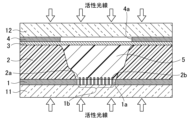
- FIG. 1 is a schematic diagram illustrating a method for producing a flexographic printing plate according to the present invention. 1 is a schematic cross-sectional view of an example of a negative film used in the method for producing a printing plate of the present invention.
- the method for producing a printing plate according to the present embodiment includes the steps of: The method includes a lamination step of sequentially laminating a negative film having a microcell pattern, a liquid photosensitive resin composition layer, a support, and a second hard plate located above on a first hard plate located below, and an exposure step of irradiating the photosensitive resin composition layer with active light from the side of the first hard plate and the second hard plate to cure the photosensitive resin composition layer.
- the photosensitive resin composition layer is directly laminated onto the negative film.
- the solubility parameter SpA of the photosensitive resin composition constituting the photosensitive resin composition layer and the solubility parameter SpB of the negative film have the relationship represented by the following formula (I).
- the method for producing a printing plate according to this embodiment can suppress the dissolution and migration of the negative film into the photosensitive resin composition layer, and can also form microcells, resulting in a flexographic printing plate with high solid density and excellent image reproducibility.
- FIG. 1 shows a schematic cross-sectional view for explaining the method for producing a printing plate according to the present embodiment.
- a negative film 1 having a predetermined pattern 1a for forming a desired printing pattern in the final printing plate and a predetermined microcell pattern 1b for forming microcells, a liquid photosensitive resin composition layer 2, a support 3, and a second hard plate 12 located above are sequentially laminated on a first hard plate 11 located below.
- a negative film 4 for back exposure having a pattern 4a for forming a shelf layer in back exposure may be provided.
- the liquid photosensitive resin composition layer 2 is directly laminated onto the negative film 1 without the use of a cover film or the like. This makes it possible to prevent bending and scattering of exposure light in the exposure step, and to obtain high image reproducibility.
- a negative film 1 used in the method for producing a printing plate of this embodiment has a predetermined printing pattern 1a for forming a desired relief, and a predetermined microcell pattern 1b for forming microcells.
- the printing plate obtained by the printing plate manufacturing method of this embodiment has, for example, a relief surface having a pattern 2a including microcells 2b which are multiple fine projections and recesses having a predetermined area and height and which are formed originating from the negative film 1.
- the use of a negative film 1 having a microcell pattern 1b makes it possible to improve the solid density.
- the solubility parameter SpA of the photosensitive resin composition constituting the photosensitive resin composition layer described below and the solubility parameter SpB of the negative film are related by the following formula (I):
- the absolute value of the difference between SpA and SpB is 2.0 or more, even if the negative film and the liquid photosensitive resin composition are directly laminated, elution and migration of the negative film into the photosensitive resin composition can be effectively suppressed.
- the upper limit of the absolute value of the difference between SpA and SpB is determined by the materials selected for the negative film and the photosensitive resin composition layer, and is 13.0 or less from a practical standpoint.
- elution and migration of the photosensitive resin composition from the negative film into the photosensitive resin composition layer can be suppressed, making it easier to isolate and recover the photosensitive resin composition in the unexposed areas, and also improving the quality of the printing plate. Furthermore, since the elution and migration of the negative film into the photosensitive resin composition layer can be suppressed, there is no need to provide a specific film layer between the negative film and the photosensitive resin composition layer, and bending and scattering of ultraviolet light due to the provision of the film layer can be prevented, thereby achieving excellent image reproducibility.
- the negative film has a microcell pattern, it is extremely effective from the viewpoint of improving the formability of microcells and the quality of the printing plate finally obtained to not provide a specific film layer between the negative film and the photosensitive resin composition layer.
- solubility parameter (Sp value) is defined as the following formula (1).
- Sp value ( ⁇ ) ( ⁇ E/V) 1/2 [(cal/cm 3 ) 1/2 ]...(1)
- V is the molar volume of the organic solvent
- ⁇ E is the cohesive energy (evaporation energy).
- the molar volume and cohesive energy of the organic solvent can be obtained from known values, for example, from the literature "POLYMER ENGINEERING AND SCIENCE, Vol. 14, 147-154, 1974.”
- turbidity point titration a technique in which the above parameters are not known, they can be actually measured using a technique called turbidity point titration. Specifically, a poor solvent having a lower SP value than the good solvent is dropped into a solution in which a sample with an unknown SP value is dissolved in a good solvent with a known SP value, and the volume of the poor solvent at which the solute begins to precipitate is measured. Next, a poor solvent having a higher SP value than the good solvent is dropped into a solution in which a newly prepared sample with an unknown SP value is dissolved in a good solvent with a known SP value, and the volume of the poor solvent at which the solute begins to precipitate is measured.
- the SP value ( ⁇ ) can be calculated by applying the volumes of the poor solvents calculated here to the following formula (2).
- SP value ( ⁇ ) (V ml 1/2 ⁇ ml +V mh 1/2 ⁇ mh )/(V ml 1/2 +V mh 1/2 )...(2)
- V ml is the volume of the poor solvent with a low SP value
- V mh is the volume of the poor solvent with a high SP value
- ⁇ ml is the SP value of the poor solvent with a low SP value
- ⁇ mh is the SP value of the poor solvent with a high SP value.
- All the SP values described in the examples below are values actually measured by the turbidity point titration method.
- the absolute value of the difference between the solubility parameter (SpB) of the negative film used in this embodiment and the solubility parameter (SpA) of the photosensitive resin composition can be controlled within the above-mentioned numerical range by selecting a combination of the negative film and the photosensitive resin composition having appropriate solubility parameters.
- the material for the negative film at least one selected from the group consisting of a resin having a structural unit represented by general formula (II) described later, polyurethane, polylactic acid, polycarbonate, polyester, polyamide, polybutyral, polyvinyl alcohol, poly(meth)acrylate, and modified or partially saponified products thereof, and by selecting, as the material for the photosensitive resin composition, a photosensitive material containing a polymer (b-1), an ethylenically unsaturated compound (b-2), and a photopolymerization initiator (b-3) described later, the absolute value of the difference from the solubility parameter (SpA) of the photosensitive resin composition can be controlled to 2.0 or more.
- a resin having a structural unit represented by general formula (II) described later polyurethane, polylactic acid, polycarbonate, polyester, polyamide, polybutyral, polyvinyl alcohol, poly(meth)acrylate, and modified or partially saponified products thereof
- the following good solvents and poor solvents and their respective SP values can be used.
- Good solvent Toluene (SP value: 8.9 [(cal/cm 3 ) 1/2 ]) p-xylene (SP value: 8.7 [(cal/cm 3 ) 1/2 ]) Butyl acetate (SP value: 8.5 [(cal/cm 3 ) 1/2 ]) Ethyl acetate (SP value: 9.1 [(cal/cm 3 ) 1/2 ]) Acetone (SP value: 9.8 [(cal/cm 3 ) 1/2 ])
- Antisolvent n-Hexane (SP value: 7.2 [(cal/cm 3 ) 1/2 ]) Ethanol (SP value: 12.9 [(cal/cm 3 ) 1/2 ]) Water (SP value: 23.4 [(cal/cm 3 ) 1/2 ])
- the solubility parameter SpA of the photosensitive resin composition constituting the photosensitive resin composition layer described later is usually specified by the material used as the photosensitive resin composition for manufacturing a flexographic printing plate.
- the solubility parameter SpA of the photosensitive resin composition is preferably 10.0 or more and 14.0 or less from the viewpoint of practical use. Therefore, in order to increase the absolute value of the difference in the solubility parameters of the photosensitive resin composition and the negative film and to suppress the dissolution and migration of the negative film into the photosensitive resin composition, when the solubility parameter SpB of the negative film is larger than the above-mentioned SpA, SpB is preferably 13.0 or more, more preferably 13.5 or more, even more preferably 14.0 or more, and even more preferably larger than 14.0.
- the material of the negative film is preferably, but not limited to, at least one selected from the group consisting of polyurethane, polylactic acid, polycarbonate, polyester, polyamide, polybutyral, polyvinyl alcohol, poly(meth)acrylate, and modified or partially saponified products thereof, particularly polyurethane and/or polybutyral.
- the SpB is larger than the SpA, the material constituting the blackened layer as a negative film tends to become highly polar, and the strength of the blackened layer and the adhesion to the hard plate in contact with the negative film are improved, so that the blackened layer tends to have better scratch resistance and solvent resistance.
- the solubility parameter SpA of the photosensitive resin composition can be determined by the material typically used as the photosensitive resin composition for manufacturing flexographic printing plates, and the absolute value of the difference between SpA and SpB can be controlled to 2.0 or more. This makes it possible to suppress dissolution and migration of the negative film into the photosensitive resin composition layer.
- the solubility parameter SpB of the negative film is smaller than the above-mentioned SpA
- SpB is preferably less than 10.0, more preferably 9.5 or less, and even more preferably 9.0 or less.
- the material of the negative film is preferably, but not limited to, one conventionally used in the manufacture of flexographic printing plates, such as thermoplastic elastomer block copolymers, fully or partially hydrolyzed polyvinyl esters, partially hydrolyzed polyvinyl acetates, polyvinyl alcohol derivatives, partially hydrolyzed vinyl acetate/alkylene oxide graft copolymers or polyvinyl alcohols subsequently acrylated by polymer-analogous reactions, polybutadienes, polyamides and mixtures thereof.
- the solubility parameter SpB of the negative film can be controlled to the above-mentioned range by appropriately selecting the resin material constituting the negative film. Specifically, the solubility parameter SpB can be controlled to be high by selecting a resin material with high polarity, and can be controlled to be low by selecting a resin material with low polarity.
- the solubility parameter SpA of the photosensitive resin composition can be determined by the material typically used as the photosensitive resin composition for manufacturing flexographic printing plates, and the absolute value of the difference between SpA and SpB can be controlled to 2.0 or more. This makes it possible to suppress dissolution and migration of the negative film into the photosensitive resin composition layer.
- ⁇ Negative film of the first embodiment> In the method for manufacturing a printing plate of this embodiment, a negative film having a structure including a substrate and an ablation layer laminated on the substrate can be used (hereinafter, this form of negative film may be referred to as the first form of negative film).
- the solubility parameter SpB of the negative film means the solubility parameter of the ablation layer.
- the negative film of the first embodiment preferably contains a resin having a structural unit represented by the following general formula (II): More specifically, the negative film preferably has a substrate and an ablation layer laminated on the substrate, and the ablation layer preferably contains a resin having a structural unit represented by the following general formula (II): It should be noted that the negative film used in the method for producing a printing plate according to this embodiment is not limited to the negative film of the first embodiment.
- R 1 and R 2 each independently represent a non-polar group
- R 3 and R 4 each independently represent a hydrogen atom or a non-polar group.
- FIG. 2 shows a schematic cross-sectional view of an example of a negative film used in the method for producing a printing plate of this embodiment.
- the negative film shown in FIG. 2 is formed by laminating a substrate 21 and an ablation layer 22 which functions as a mask when forming the intended uneven pattern and microcell pattern of the printing plate. Negative film will be explained in detail below.
- the negative film has a certain rigidity and dimensional stability. If the negative film is easily deformed, it will induce deformation or damage of the image formed on the negative film in the process before the relief exposure, and as a result, the image reproducibility tends to decrease. However, if the rigidity of the negative film is too high, it will tend to cause problems in compatibility with the device in the manufacturing process of the target printing plate, or excessive stress concentration on the ablation layer during handling will tend to cause irreversible damage such as scratches and wrinkles. From the above viewpoint, the thickness of the substrate 21 is preferably 10 ⁇ m or more and less than 100 ⁇ m. The above numerical range allows a negative film having excellent image reproducibility and moderate rigidity to be obtained.
- the thickness is preferably 20 ⁇ m or more, and more preferably 40 ⁇ m or more.
- the thickness of the substrate 21 is preferably less than 100 ⁇ m, more preferably 90 ⁇ m or less, and even more preferably 70 ⁇ m or less.
- the base material 21 contains a resin having a polyester or polyolefin skeleton.
- the resin contained in the base material 21 may be a mixture of a resin having a polyester skeleton and a resin having a polyolefin skeleton, or may be a copolymer.
- polyesters include, but are not limited to, polyethylene terephthalate, polybutylene terephthalate, and polyethylene naphthalate.
- Resins having a polyolefin skeleton include, but are not limited to, polyethylene, polypropylene, and copolymerized resins thereof.
- the substrate 21 is more preferably made of a resin having a polyester or polyolefin skeleton, and even more preferably made of a resin having a polyolefin skeleton.
- a resin having a polyolefin skeleton has high oxygen permeability.
- oxygen permeability is one of the physical properties of a film, and represents the amount of oxygen passing through per m2 of film per day under conditions of 1 atm (1 atmospheric pressure).
- the unit is cm3 / m2 ⁇ 24h ⁇ atm, and the larger the value, the easier it is to pass through, and the smaller the value, the harder it is to pass through.
- the curing of the photosensitive resin composition proceeds by radical polymerization. If oxygen is present during this radical polymerization, the radical generating compound reacts with oxygen, inhibiting the polymerization reaction. That is, by reducing the amount of oxygen present during exposure of the photosensitive resin composition layer, the degree of polymerization can be improved, and the image reproducibility of the final flexographic printing plate can be improved.
- the substrate 21 may be used in an untreated state, or may be subjected to a predetermined surface treatment as necessary, or may be provided with a function such as antistatic treatment. Examples of surface treatments include corona treatment and matte finish.
- the negative film shown in FIG. 2 has an ablation layer 22 laminated on a substrate 21 .
- the ablation layer 22 contains a specific resin, is ablatable with an infrared laser, and also functions as a light shielding layer for rays other than infrared rays.
- it is effective to improve the adhesion between the substrate 21 and the ablation layer 22 or to reduce the compatibility between the ablation layer 22 and the photosensitive resin composition layer.
- the absolute value of the difference between the solubility parameter SpA of the photosensitive resin composition and the solubility parameter of the negative film, i.e., the solubility parameter SpB of the ablation layer constituting the negative film is specified to be 2.0 or more. This makes it possible to effectively suppress the elution and migration of the ablation layer into the photosensitive resin composition layer even if the ablation layer of the negative film is directly laminated with the photosensitive resin composition.
- the ablation layer 22 contains a resin, an infrared absorbing material, and a material that blocks non-infrared rays such as ultraviolet rays. It is important to strengthen the interaction between the layers in order to improve the adhesion between the substrate 21 and the ablation layer 22.
- methods for strengthening the interaction between the layers include a method for improving chemical interaction and a method for improving physical interaction.
- An example of a method for improving the chemical interaction is to provide a similar molecular structure to the constituent materials of both the substrate 21 and the ablation layer 22.
- An example of a method for improving the physical interaction is to improve the flexibility of the ablation layer 22 or provide it with appropriate flexibility in order to suppress peeling when the film is bent.
- a method for improving the chemical interaction is also effective in which a similar molecular structure is provided to the constituent materials of both the substrate 21 and the ablation layer 22, thereby maintaining the adhesion between the layers and ensuring high ablation efficiency with an infrared laser. Furthermore, from the viewpoint of reducing the compatibility between the ablation layer 22 and the photosensitive resin composition layer, it is effective to select an appropriate resin material in the ablation layer 22 . From the above viewpoint, it is preferable that the ablation layer 22 of the negative film used in the method for manufacturing a printing plate of this embodiment contains a resin having a structural unit containing a quaternary carbon atom to which two non-polar groups are bonded, as represented by the following general formula (II). The resin may contain other structural units as necessary.
- monomer refers to a compound before polymerization
- structural unit refers to a specific repeating unit formed by polymerization of a monomer
- the ablation layer 22 of the negative film used in the method for producing a printing plate of this embodiment preferably contains a resin having a constitutional unit represented by general formula (II).
- the resin contained in the ablation layer 22 has a polar group in the main chain, strong non-covalent bonds are formed between the molecules, improving the strength of the ablation layer 22.
- the structure used for interaction with the constituent raw materials of the substrate 21 is reduced, and the adhesion between the substrate 21 and the ablation layer 22 tends to decrease.
- the rigidity of the ablation layer 22 becomes too high, and stress generated by bending or stretching tends to concentrate between the layers, easily causing interfacial peeling.
- the resin contained in the ablation layer 22 has a polar group in the side chain, this tends to be undesirable from the viewpoint of the efficiency of ablation layer 22 by laser ablation, as described below.
- “Depolymerization” is the reverse reaction of a polymerization reaction, and refers to a reaction in which a polymer breaks down into monomers.
- the ablation layer 22 instantaneously reaches a high temperature of several hundred degrees due to the irradiation of the infrared laser. At that time, the main chain in the resin decomposes, the molecular weight drops rapidly, and the resin is removed from the ablation layer 22.
- the resin remains in the ablation layer 22 even after irradiation of the infrared laser. It is known that resins obtained by condensation polymerization form ring structures during decomposition, and then the main chains are cut. In other words, the molecular weight is not easily reduced by infrared ablation, which is a heat treatment in a short time, and an ablation layer containing a resin obtained by such condensation polymerization tends to have poor ablation efficiency. From the above viewpoint, it is important that the ablation layer 22 contains a resin that is easily depolymerized.
- the non-polar group in the general formula (II) is preferably any one of an alkyl group, an aryl group, a cycloalkyl group, a phenyl group, an alkenyl group, an aralkyl group, a cycloalkenyl group, an alkynyl group, a silyl group, and a siloxanyl group. Note that the non-polar group does not include a hydrogen atom.
- a method for dispersing carbon black in the resin solution a method using forced stirring with a stirring blade in combination with stirring using ultrasonic waves or various mills is effective.
- a method in which the resin, carbon black, and dispersant are pre-kneaded using an extruder or kneader and then dissolved in a solvent is also effective for obtaining good dispersibility of carbon black.
- Another method is to forcefully disperse carbon black in a resin in the form of a latex dispersion.
- the solvent used to prepare the solution or dispersion for forming the ablation layer 22 can be appropriately selected in consideration of the solubility of the resin and infrared absorbing agent used. Only one type of solvent may be used, or two or more types of solvents may be mixed and used. In addition, for example, by mixing a solvent having a relatively low boiling point with a solvent having a relatively high boiling point and controlling the evaporation rate of the solvent, the film quality of the ablation layer 22 can also be improved.
- Solvents for forming the ablation layer 22 include, but are not limited to, toluene, xylene, cyclohexane, methyl acetate, ethyl acetate, propyl acetate, butyl acetate, amyl acetate, methyl ethyl ketone, acetone, cyclohexanone, ethylene glycol, propylene glycol, ethanol, water, propylene glycol monomethyl ether, propylene glycol monomethyl ether acetate, dimethylacetamide, dimethylformamide, n-propyl alcohol, i-propyl alcohol, 1,4-dioxane, tetrahydrofuran, diethyl ether, n-hexane, n-heptane, n-pentane, and acetonitrile and analogs thereof.
- a negative film having a UV printing polymer layer of a desired pattern on a predetermined UV printing base material can be used.
- the UV printing substrate is not limited to the following, but may be, for example, a substrate containing a transparent material selected from the group consisting of polyethylene terephthalate, polycarbonate, and polyethylene naphthalate.
- the thickness of the UV printing substrate is preferably 10 ⁇ m or more and less than 100 ⁇ m. The above numerical range allows a negative film having excellent image reproducibility and moderate rigidity to be obtained. Furthermore, 20 ⁇ m or more is preferable, and 40 ⁇ m or more is more preferable. By making the thickness of the UV printing substrate 10 ⁇ m or more, sufficient strength and rigidity for practical use can be obtained, and deformation and damage of the image can be suppressed during the manufacturing process of the printing plate.
- the thickness of the UV printing substrate is preferably less than 100 ⁇ m, more preferably 90 ⁇ m or less, and even more preferably 70 ⁇ m or less.
- the UV ink may contain one or more photoinitiators, monomers, binders, and pigment materials, including a four-color system including cyan, magenta, yellow, and black, and is preferably cured by exposure to at least one UV light source with a wavelength output in the range of about 365 nm to about 405 nm.
- a UV printed polymer layer has a predetermined pattern in a negative film, and after the above-mentioned exposure and curing, contains a polymer that is a polymer of the above-mentioned monomer.
- the absolute value of the difference between the solubility parameter SpA of the photosensitive resin composition and the solubility parameter SpB of the negative film, i.e., the UV printing polymer layer is specified to be 2.0 or more. This makes it possible to effectively suppress the elution and migration of the UV printing polymer layer into the photosensitive resin composition layer even when directly laminated with the photosensitive resin composition.
- a second form of negative film is obtained by dispersing a UV ink on said UV printed substrate in a desired pattern, for example using an inkjet printer, and curing said UV ink with a source of actinic radiation to crosslink and harden said UV ink and form a UV printed polymer layer in said desired pattern.
- a liquid photosensitive resin composition layer is directly laminated on the above-mentioned negative film.
- a liquid photosensitive resin composition has high fluidity and can easily change its shape, so when it is laminated on a negative film, the photosensitive resin composition is molded into a film of a certain thickness inside a dedicated device (plate making machine).
- a dedicated device plate making machine.
- FIG. 1 a negative film 1 is placed on an ultraviolet-transmitting first hard plate 11, a liquid photosensitive resin composition is poured onto it, a support 3 is attached to it so that the resulting plate has a constant thickness, and a negative film 4 for back exposure and a second hard plate 12 are pressed down from above to form a photosensitive resin composition layer 2.
- the negative film 1 In the process of forming the photosensitive resin composition layer 2, it is preferable to place the negative film 1 on the first hard plate 11, and then evacuate the negative film 1 in order to reliably fix the negative film 1 and remove oxygen inhibition factors.
- the mechanism for evacuating the negative film 1 is not particularly limited, but an example of the method is to evacuate the negative film 1 using a pump through a groove provided around the periphery of the first hard plate 11. If the negative film 1 lacks rigidity, wrinkles will form in the negative film 1 during the vacuuming process, and in severe cases, the wrinkles will remain and cannot be removed. The wrinkles will be transferred to the relief surface after curing, and there is a risk of significantly reducing image reproducibility.
- the negative film 1 lacks dimensional stability, the drawn pattern will be deformed, which is also a factor in reducing image reproducibility.
- the negative film 1 has too high rigidity, it cannot completely follow the lower glass during evacuation, leaving a gap and allowing air to remain. As a result, the effect of oxygen inhibition becomes greater, which may adversely affect image reproducibility.
- the stress generated by the deformation of the highly elastic negative film 1 may concentrate on the ablation layer, causing wrinkles and pinholes. In other words, it is extremely important that the negative film 1 has an appropriate range of rigidity.
- the photosensitive resin composition layer preferably contains, for example, a polymer (b-1), an ethylenically unsaturated compound (b-2), and a photopolymerization initiator (b-3), which will be described later. These can be used selectively as appropriate. Furthermore, the photosensitive resin composition layer may further contain auxiliary additive components, if necessary.
- the solubility parameter SpA of the photosensitive resin composition constituting the photosensitive resin composition layer is usually determined by the material used as the photosensitive resin composition for manufacturing a flexographic printing plate. From a practical viewpoint, the solubility parameter SpA of the photosensitive resin composition is 10.0 or more and 14.0 or less. Each component of the photosensitive resin composition layer will be described in detail below.
- the polymer (b-1) may be a linear, branched or dendritic polymer, and may be a homopolymer or a copolymer.
- the copolymer may be a random copolymer, an alternating copolymer or a block copolymer.
- plasticizers may have a hydroxyl group or a carboxyl group.
- these plasticizers may have a photopolymerizable reactive group such as a (meth)acryloyl group.
- the plasticizers may be used alone or in combination of two or more.
- the term "liquid" refers to a state having the property of being easily fluid and deformed, and being able to be solidified into the deformed shape by cooling.
- thermal polymerization inhibitor and the antioxidant those commonly used in the field of resin materials or rubber materials can be used, and examples thereof include phenol-based materials.
- examples of phenol-based materials that are thermal polymerization inhibitors and antioxidants include, but are not limited to, vitamin E, tetrakis-(methylene-3-(3',5'-di-t-butyl-4'-hydroxyphenyl)propionate)methane, 2,5-di-t-butylhydroquinone, 2,6-di-t-butyl-p-cresol, 3,9-bis- ⁇ 1,1-dimethyl-2-[3-(3-t-butyl-4-hydroxy-5-methylphenyl)propionyloxy]ethyl ⁇ -2,4,8,10-tetraoxaspiro(5,5)undecane, and 2-t-butyl-6-(3-t-butyl-2-hydroxy-5-methylbenzyl)-4-methylphenylacrylate.
- Examples of light stabilizers and ultraviolet absorbers include, but are not limited to, known benzophenone-based compounds, salicylate-based compounds, acrylonitrile-based compounds, metal complex salt-based compounds, and hindered amine-based compounds. Furthermore, the dyes and pigments shown below may be used as ultraviolet absorbents. Examples of such light stabilizers and ultraviolet absorbers include, but are not limited to, 2-ethoxy-2'-ethyloxalic acid bisanilide, 2,2'-dihydroxy-4-methoxybenzophenone, bis(1,2,2,6,6-pentamethyl-4-piperidyl)-decanedioate, and 1,2,3-benzotriazole. Dyes and pigments are effective as a coloring means for improving visibility.
- the dyes are not limited to the following, but examples thereof include water-soluble basic dyes, acid dyes, direct dyes, etc., and water-insoluble sulfur dyes, oil-soluble dyes, disperse dyes, etc.
- anthraquinone dyes, indigoid dyes, and azo dyes are preferred.
- pigments include, but are not limited to, natural pigments, synthetic inorganic pigments, synthetic organic pigments, etc.
- Examples of synthetic organic pigments include azo pigments, triphenylmethane pigments, quinoline pigments, anthraquinone pigments, and phthalocyanine pigments.
- the photosensitive resin composition constituting the photosensitive resin composition layer can be produced by mixing the above-mentioned materials, i.e., the polymer (b-1), the ethylenically unsaturated compound (b-2), the photopolymerization initiator (b-3), and, if necessary, auxiliary additive components.
- a support 3 is laminated on the liquid photosensitive resin composition layer 2 described above.
- the support include, but are not limited to, a polyester film, a polyamide film, a polyacrylonitrile film, and a polyvinyl chloride film. Of these, the support is preferably a polyester film.
- the polyester used for the support is not limited to the following, but examples thereof include polyethylene terephthalate, polybutylene terephthalate, and polyethylene naphthalate.
- the thickness of the support is not particularly limited, but is preferably 50 to 300 ⁇ m.
- a predetermined adhesive layer may be provided on the support.
- the adhesive layer is not particularly limited, but examples thereof include the adhesive layers described in International Publication No. 2004/104701, Japanese Patent No. 3094647, and Japanese Patent No. 2634429.
- an exposure step is performed in which active light is irradiated from the first hard plate 11 and the second hard plate side 12 to cure the photosensitive resin composition layer 2, as shown in FIG.
- active light for example, ultraviolet light
- the photosensitive resin composition layer 2 is irradiated with active light, for example, ultraviolet light, using the negative film 1 on which the desired printing pattern and microcell pattern are drawn as a mask, to perform pattern exposure.
- the light passing through the negative film 1 promotes the curing reaction of the photosensitive resin composition layer 2, and the printing pattern 1a and microcell pattern 1b formed on the negative film 1 are transferred to the photosensitive resin composition layer 2 with the unevenness inverted, thereby obtaining a pattern-exposed photosensitive resin composition layer.
- the surface on which the pattern is drawn on the negative film 1 is positioned so as to be in direct contact with the liquid photosensitive resin composition layer 2.
- a negative film 4 for back exposure having a desired pattern for forming a shelf layer is used as a mask to irradiate the photosensitive resin composition layer with active light rays to form a shelf layer 5.
- a shelf layer 5 is formed as a base on the upper second hard plate 12 side in order to compensate for the strength of the relief against the printing pressure during printing.
- back exposure may be performed to deposit a uniform thin cured resin layer (back deposition layer) over the entire surface from the second hard plate 12 side.
- the back deposition layer and the shelf layer are both formed by curing the photosensitive resin composition layer on the side opposite to the side on which the print pattern is formed.
- the method of irradiating the active light is not particularly limited, and can be performed using a known irradiation unit.
- the wavelength of the ultraviolet light to be irradiated is preferably 150 to 500 nm, more preferably 300 to 400 nm. Examples of light sources that can be used include, but are not limited to, low pressure mercury lamps, high pressure mercury lamps, extra high pressure mercury lamps, metal halide lamps, xenon lamps, zirconium lamps, carbon arc lamps, and ultraviolet fluorescent lamps.
- a development step is carried out to remove the unexposed areas of the photosensitive resin composition layer.
- the method for removing the unexposed portion is not particularly limited, and any conventionally known method can be used. Specific examples of the method include a method of exposing the photosensitive resin composition layer 2 to light, and then washing away the unexposed parts with a solvent for solvent development or a cleaning solution for water development, or a method of contacting the unexposed parts with a predetermined absorbing layer capable of absorbing the unexposed parts, and removing the absorbing layer to remove the unexposed parts.
- the unexposed parts may be removed in advance using a spatula or roll. Thereafter, a post-exposure treatment is performed as necessary to obtain a printing plate.
- the method for producing a printing plate according to this embodiment preferably further comprises a recovery step of recovering the unexposed area removed in the developing step and making it into a photosensitive resin composition for producing a new printing plate.
- the recovered photosensitive resin composition can be reused as a photosensitive resin composition in the production of a new printing plate.
- waste can be reduced and material costs can also be reduced.
- various problems such as scattering of actinic light may occur in the printing plate production process using the recovered photosensitive resin composition, which may impair the quality of the final printing plate obtained.
- the method for producing a printing plate of the present embodiment the elution and/or migration of the ablation layer into the photosensitive resin composition layer can be suppressed in the finally obtained printing plate, and therefore the photosensitive resin composition of quality comparable to that of an unused printing plate can be recovered at a high yield. Therefore, the quality, such as the improvement of the white outline depth, can be maintained even in a new printing plate produced using the recovered photosensitive resin composition.
- the method for producing a printing plate according to the present embodiment has the following advantages (1) to (4).
- flexographic printing plates were prepared and the elution and migration of the negative film into the photosensitive resin composition, as well as the solid density of the flexographic printing plates, were evaluated.
- Negative films 1 to 5 for producing flexographic printing plates were prepared as follows.
- a Teflon (registered trademark) liquid delivery tube was connected to a pressure-resistant glass liquefied sampling tube with a three-way cock containing 161.1 g (2871 mmol) of isobutylene monomer, and the isobutylene monomer was delivered into the polymerization vessel by nitrogen pressure.
- 0.647 g (2.8 mmol) of p-dicumyl chloride and 1.22 g (14 mmol) of N,N-dimethylacetamide were added.
- 8.67 mL (79.1 mmol) of titanium tetrachloride was further added to start polymerization.
- the film 1 for producing a flexographic printing plate was placed in a CDI Crystal 5080 manufactured by ESKO, and laser drawing was performed on the ablation layer with an MCWSI pattern under conditions of a resolution of 4000 dpi and a laser intensity of 2.4 J, thereby obtaining a negative film 1 on which a printing pattern having a microcell pattern was formed.
Landscapes
- Physics & Mathematics (AREA)
- General Physics & Mathematics (AREA)
- Engineering & Computer Science (AREA)
- Architecture (AREA)
- Structural Engineering (AREA)
- Optics & Photonics (AREA)
- Thermal Sciences (AREA)
- Manufacturing & Machinery (AREA)
- Materials For Photolithography (AREA)
Priority Applications (2)
| Application Number | Priority Date | Filing Date | Title |
|---|---|---|---|
| JP2025567326A JPWO2025143201A1 (cg-RX-API-DMAC7.html) | 2023-12-27 | 2024-12-27 | |
| CN202480074798.6A CN122270722A (zh) | 2023-12-27 | 2024-12-27 | 印刷版的制造方法 |
Applications Claiming Priority (2)
| Application Number | Priority Date | Filing Date | Title |
|---|---|---|---|
| JP2023-220270 | 2023-12-27 | ||
| JP2023220270 | 2023-12-27 |
Publications (1)
| Publication Number | Publication Date |
|---|---|
| WO2025143201A1 true WO2025143201A1 (ja) | 2025-07-03 |
Family
ID=96218098
Family Applications (1)
| Application Number | Title | Priority Date | Filing Date |
|---|---|---|---|
| PCT/JP2024/046350 Pending WO2025143201A1 (ja) | 2023-12-27 | 2024-12-27 | 印刷版の製造方法 |
Country Status (3)
| Country | Link |
|---|---|
| JP (1) | JPWO2025143201A1 (cg-RX-API-DMAC7.html) |
| CN (1) | CN122270722A (cg-RX-API-DMAC7.html) |
| WO (1) | WO2025143201A1 (cg-RX-API-DMAC7.html) |
Citations (12)
| Publication number | Priority date | Publication date | Assignee | Title |
|---|---|---|---|---|
| JP2634429B2 (ja) | 1988-05-11 | 1997-07-23 | 大日本印刷株式会社 | 感光性樹脂版の支持体 |
| JP3094647B2 (ja) | 1992-04-06 | 2000-10-03 | 旭化成工業株式会社 | 印刷版製造用感光性樹脂支持構造体 |
| WO2001018605A1 (en) | 1999-09-02 | 2001-03-15 | Toray Industries, Inc. | Photosensitive resin printing plate and method for producing photosensitive printing plate having projection |
| WO2004104701A1 (ja) | 2003-05-23 | 2004-12-02 | Asahi Kasei Chemicals Corporation | フレキソ印刷用感光性構成体 |
| JP2005301071A (ja) | 2004-04-14 | 2005-10-27 | Asahi Kasei Chemicals Corp | フレキソ印刷版の製造方法 |
| JP2009286113A (ja) * | 2007-12-18 | 2009-12-10 | Asahi Kasei Corp | 印刷用凸版及びそれを用いた印刷方法 |
| JP4971311B2 (ja) | 2005-05-16 | 2012-07-11 | イーストマン コダック カンパニー | 除去可能なフィルムを使用したレリーフ画像の製造 |
| WO2020175422A1 (ja) * | 2019-02-27 | 2020-09-03 | 旭化成株式会社 | フレキソ印刷原版及びフレキソ印刷版の製造方法 |
| WO2022158172A1 (ja) * | 2021-01-20 | 2022-07-28 | 旭化成株式会社 | フレキソ印刷版用感光性樹脂構成体、及びフレキソ印刷版の製造方法 |
| WO2023058406A1 (ja) * | 2021-10-06 | 2023-04-13 | 旭化成株式会社 | 印刷版の製造方法、及び印刷方法 |
| JP2023131035A (ja) * | 2022-03-08 | 2023-09-21 | 旭化成株式会社 | フレキソ印刷版用感光性樹脂構成体、及びフレキソ印刷版の製造方法 |
| WO2024009674A1 (ja) * | 2022-07-05 | 2024-01-11 | 旭化成株式会社 | フレキソ印刷版製造用フィルム、積層体、及びフレキソ印刷版の製造方法 |
-
2024
- 2024-12-27 JP JP2025567326A patent/JPWO2025143201A1/ja active Pending
- 2024-12-27 CN CN202480074798.6A patent/CN122270722A/zh active Pending
- 2024-12-27 WO PCT/JP2024/046350 patent/WO2025143201A1/ja active Pending
Patent Citations (12)
| Publication number | Priority date | Publication date | Assignee | Title |
|---|---|---|---|---|
| JP2634429B2 (ja) | 1988-05-11 | 1997-07-23 | 大日本印刷株式会社 | 感光性樹脂版の支持体 |
| JP3094647B2 (ja) | 1992-04-06 | 2000-10-03 | 旭化成工業株式会社 | 印刷版製造用感光性樹脂支持構造体 |
| WO2001018605A1 (en) | 1999-09-02 | 2001-03-15 | Toray Industries, Inc. | Photosensitive resin printing plate and method for producing photosensitive printing plate having projection |
| WO2004104701A1 (ja) | 2003-05-23 | 2004-12-02 | Asahi Kasei Chemicals Corporation | フレキソ印刷用感光性構成体 |
| JP2005301071A (ja) | 2004-04-14 | 2005-10-27 | Asahi Kasei Chemicals Corp | フレキソ印刷版の製造方法 |
| JP4971311B2 (ja) | 2005-05-16 | 2012-07-11 | イーストマン コダック カンパニー | 除去可能なフィルムを使用したレリーフ画像の製造 |
| JP2009286113A (ja) * | 2007-12-18 | 2009-12-10 | Asahi Kasei Corp | 印刷用凸版及びそれを用いた印刷方法 |
| WO2020175422A1 (ja) * | 2019-02-27 | 2020-09-03 | 旭化成株式会社 | フレキソ印刷原版及びフレキソ印刷版の製造方法 |
| WO2022158172A1 (ja) * | 2021-01-20 | 2022-07-28 | 旭化成株式会社 | フレキソ印刷版用感光性樹脂構成体、及びフレキソ印刷版の製造方法 |
| WO2023058406A1 (ja) * | 2021-10-06 | 2023-04-13 | 旭化成株式会社 | 印刷版の製造方法、及び印刷方法 |
| JP2023131035A (ja) * | 2022-03-08 | 2023-09-21 | 旭化成株式会社 | フレキソ印刷版用感光性樹脂構成体、及びフレキソ印刷版の製造方法 |
| WO2024009674A1 (ja) * | 2022-07-05 | 2024-01-11 | 旭化成株式会社 | フレキソ印刷版製造用フィルム、積層体、及びフレキソ印刷版の製造方法 |
Non-Patent Citations (1)
| Title |
|---|
| POLYMER ENGINEERING AND SCIENCE, vol. 14, 1974, pages 147 - 154 |
Also Published As
| Publication number | Publication date |
|---|---|
| JPWO2025143201A1 (cg-RX-API-DMAC7.html) | 2025-07-03 |
| CN122270722A (zh) | 2026-06-23 |
Similar Documents
| Publication | Publication Date | Title |
|---|---|---|
| EP2006737B1 (en) | Photosensitive resin composition for flexographic printing | |
| JPS5869235A (ja) | フレキソ印刷版用シンジオタクチツクポリブタジエン組成物 | |
| WO2024009674A1 (ja) | フレキソ印刷版製造用フィルム、積層体、及びフレキソ印刷版の製造方法 | |
| WO2006051863A1 (ja) | フレキソ印刷用感光性樹脂組成物 | |
| JP4651037B2 (ja) | フレキソ印刷版用感光性樹脂 | |
| JP7474875B2 (ja) | フレキソ印刷版用感光性樹脂構成体、及びフレキソ印刷版の製造方法 | |
| JP2020173308A (ja) | 印刷版用感光性樹脂組成物、印刷版用感光性樹脂構成体、及び印刷版の製造方法 | |
| JP7261089B2 (ja) | フレキソ印刷原版、及びフレキソ印刷版の製造方法 | |
| EP1881370B1 (en) | Photosensitive resin composition | |
| JP2019109444A (ja) | フレキソ印刷用感光性樹脂版の製造方法 | |
| JP4895900B2 (ja) | 感光性樹脂組成物 | |
| CN117980832B (zh) | 柔性印刷版的制造方法和印刷方法 | |
| WO2025143194A1 (ja) | フレキソ印刷版製造用フィルム、及びフレキソ印刷版の製造方法 | |
| JP4220057B2 (ja) | フレキソ印刷版用感光性構成体 | |
| WO2025143190A1 (ja) | フレキソ印刷版製造用フィルム、及びフレキソ印刷版の製造方法 | |
| JP4627001B2 (ja) | フレキソ印刷用感光性樹脂組成物 | |
| JP4166957B2 (ja) | 画像形成性が改良されたフレキソ版用感光性樹脂構成体 | |
| JP4703381B2 (ja) | フレキソ印刷用感光性樹脂組成物 | |
| JP2024029911A (ja) | フレキソ印刷版用感光性樹脂構成体、及びフレキソ印刷版の製造方法 |
Legal Events
| Date | Code | Title | Description |
|---|---|---|---|
| 121 | Ep: the epo has been informed by wipo that ep was designated in this application |
Ref document number: 24913087 Country of ref document: EP Kind code of ref document: A1 |
|
| ENP | Entry into the national phase |
Ref document number: 2025567326 Country of ref document: JP Kind code of ref document: A |
|
| WWE | Wipo information: entry into national phase |
Ref document number: 2025567326 Country of ref document: JP |