WO2025116025A1 - 組成物、成形体及びデバイス - Google Patents
組成物、成形体及びデバイス Download PDFInfo
- Publication number
- WO2025116025A1 WO2025116025A1 PCT/JP2024/042387 JP2024042387W WO2025116025A1 WO 2025116025 A1 WO2025116025 A1 WO 2025116025A1 JP 2024042387 W JP2024042387 W JP 2024042387W WO 2025116025 A1 WO2025116025 A1 WO 2025116025A1
- Authority
- WO
- WIPO (PCT)
- Prior art keywords
- group
- substituent
- composition
- resin
- pigment
- Prior art date
- Legal status (The legal status is an assumption and is not a legal conclusion. Google has not performed a legal analysis and makes no representation as to the accuracy of the status listed.)
- Pending
Links
Images
Classifications
-
- C—CHEMISTRY; METALLURGY
- C09—DYES; PAINTS; POLISHES; NATURAL RESINS; ADHESIVES; COMPOSITIONS NOT OTHERWISE PROVIDED FOR; APPLICATIONS OF MATERIALS NOT OTHERWISE PROVIDED FOR
- C09B—ORGANIC DYES OR CLOSELY-RELATED COMPOUNDS FOR PRODUCING DYES, e.g. PIGMENTS; MORDANTS; LAKES
- C09B23/00—Methine or polymethine dyes, e.g. cyanine dyes
- C09B23/10—The polymethine chain containing an even number of >CH- groups
-
- C—CHEMISTRY; METALLURGY
- C09—DYES; PAINTS; POLISHES; NATURAL RESINS; ADHESIVES; COMPOSITIONS NOT OTHERWISE PROVIDED FOR; APPLICATIONS OF MATERIALS NOT OTHERWISE PROVIDED FOR
- C09B—ORGANIC DYES OR CLOSELY-RELATED COMPOUNDS FOR PRODUCING DYES, e.g. PIGMENTS; MORDANTS; LAKES
- C09B47/00—Porphines; Azaporphines
- C09B47/04—Phthalocyanines abbreviation: Pc
- C09B47/06—Preparation from carboxylic acids or derivatives thereof, e.g. anhydrides, amides, mononitriles, phthalimide, o-cyanobenzamide
- C09B47/067—Preparation from carboxylic acids or derivatives thereof, e.g. anhydrides, amides, mononitriles, phthalimide, o-cyanobenzamide from phthalodinitriles naphthalenedinitriles, aromatic dinitriles prepared in situ, hydrogenated phthalodinitrile
-
- C—CHEMISTRY; METALLURGY
- C09—DYES; PAINTS; POLISHES; NATURAL RESINS; ADHESIVES; COMPOSITIONS NOT OTHERWISE PROVIDED FOR; APPLICATIONS OF MATERIALS NOT OTHERWISE PROVIDED FOR
- C09B—ORGANIC DYES OR CLOSELY-RELATED COMPOUNDS FOR PRODUCING DYES, e.g. PIGMENTS; MORDANTS; LAKES
- C09B5/00—Dyes with an anthracene nucleus condensed with one or more heterocyclic rings with or without carbocyclic rings
- C09B5/62—Cyclic imides or amidines of peri-dicarboxylic acids of the anthracene, benzanthrene, or perylene series
-
- C—CHEMISTRY; METALLURGY
- C09—DYES; PAINTS; POLISHES; NATURAL RESINS; ADHESIVES; COMPOSITIONS NOT OTHERWISE PROVIDED FOR; APPLICATIONS OF MATERIALS NOT OTHERWISE PROVIDED FOR
- C09B—ORGANIC DYES OR CLOSELY-RELATED COMPOUNDS FOR PRODUCING DYES, e.g. PIGMENTS; MORDANTS; LAKES
- C09B67/00—Influencing the physical, e.g. the dyeing or printing properties of dyestuffs without chemical reactions, e.g. by treating with solvents grinding or grinding assistants, coating of pigments or dyes; Process features in the making of dyestuff preparations; Dyestuff preparations of a special physical nature, e.g. tablets, films
- C09B67/006—Preparation of organic pigments
-
- C—CHEMISTRY; METALLURGY
- C09—DYES; PAINTS; POLISHES; NATURAL RESINS; ADHESIVES; COMPOSITIONS NOT OTHERWISE PROVIDED FOR; APPLICATIONS OF MATERIALS NOT OTHERWISE PROVIDED FOR
- C09K—MATERIALS FOR MISCELLANEOUS APPLICATIONS, NOT PROVIDED FOR ELSEWHERE
- C09K3/00—Materials not provided for elsewhere
-
- G—PHYSICS
- G02—OPTICS
- G02B—OPTICAL ELEMENTS, SYSTEMS OR APPARATUS
- G02B5/00—Optical elements other than lenses
- G02B5/20—Filters
- G02B5/22—Absorbing filters
Definitions
- the present invention relates to a composition, a molded body, and a device.
- This application claims priority based on Japanese Patent Application No. 2023-204091, filed on December 1, 2023, the contents of which are incorporated herein by reference.
- infrared cameras and infrared sensors have been used to visualize the infrared light emitted from an object as a change in the amount of infrared light caused by changes in the object's temperature, and are more stable in operation in dark places than when detecting with visible light, etc.
- Infrared cameras and infrared sensors are widely used in diagnosis in the medical field, non-destructive testing to detect deterioration in buildings and electrical equipment, night vision cameras in the security field, and personal authentication such as biometric cameras in bank ATMs and airports.
- LiDAR Light Detection and Ranging
- NIR near-infrared
- LiDAR Light Detection and Ranging
- ADAS advanced driving systems
- AD autonomous driving
- Optical glass or optical resin is used as the material for the optical components of the above cameras, sensors, etc.
- thermoplastic resin composition containing a high refractive index material, and an optical lens using the resin composition, as a material that blocks visible light and has infrared light transmittance.
- Patent Document 1 proposes a thermoplastic resin composition containing a thermoplastic resin and a coloring material, in which the refractive index at a wavelength of 894 nm is 1.60 or more and the thermoplastic resin composition has a thickness of 1 mm, the maximum transmittance at wavelengths of 380 nm to 630 nm is more than 0% and 1.00% or less, and the average transmittance at wavelengths of 840 nm to 940 nm is 80% or more.
- noise resulting from visible light can be reduced by setting the maximum visible light transmittance and the average infrared transmittance within the above-mentioned ranges, but there is no mention of improving the blackness, and there is still room for improvement.
- the present invention aims to provide a composition, molded body, and device that achieves both excellent blocking of visible light and excellent transmission of infrared light, as well as good heat resistance, and can achieve improved sensing accuracy and excellent sensing stability.
- a certain phthalocyanine pigment has high infrared transmittance, and discovered that adding the certain phthalocyanine pigment, which is a blue pigment, to a composition containing a certain black pigment and a resin improves the degree of blackness, thereby effectively blocking visible light, and the above-mentioned properties of the certain phthalocyanine pigment allow for good infrared transmission, and also provide good heat resistance, resulting in improved sensing accuracy and excellent, stable sensing.
- a composition comprising a phthalocyanine pigment, a black pigment, and a resin
- the phthalocyanine pigment is represented by the following general formula (Pc):
- M Pc represents X Pc -Al (trivalent aluminum), X Pc -Co (trivalent cobalt), Sn (divalent tin), Fe (divalent iron) or Cu (divalent copper);
- R 1 and R 2 each independently represent a hydrogen atom, a hydroxyl group, an alkyl group which may have a substituent, an aryl group which may have a substituent, an alkoxyl group which may have a substitu
- the resin is one or more selected from the group consisting of polyethylene terephthalate (PET) resin, polycarbonate (PC) resin, acrylonitrile styrene (AS) resin, polymethyl methacrylate (PMMA) resin, acrylonitrile/butadiene/styrene (ABS) copolymer resin, polyamide (PA) resin, and aminoalkyd resin.
- PET polyethylene terephthalate
- PC polycarbonate
- AS acrylonitrile styrene
- PMMA polymethyl methacrylate
- ABS acrylonitrile/butadiene/styrene
- PA polyamide
- composition according to any one of [1] to [4] above, wherein the composition is a composition for molding or a composition for coating.
- the present invention provides a composition, molded body, and device that achieves both excellent blocking of visible light and excellent transmission of infrared light, as well as good heat resistance, and can achieve improved sensing accuracy and excellent sensing stability.
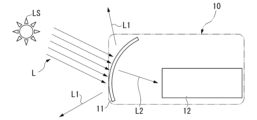
- FIG. 1 is a schematic diagram showing an example of a device including a molded body obtained by molding the composition for molded body of the present invention.
- composition is a composition containing a phthalocyanine pigment, a black pigment, and a resin.
- the phthalocyanine pigment contains one or more compounds represented by the following general formula (Pc) or dimers of said compounds:
- M Pc represents X Pc -Al (trivalent aluminum), X Pc -Co (trivalent cobalt), Sn (divalent tin), Fe (divalent iron) or Cu (divalent copper);
- R 1 and R 2 each independently represent a hydrogen atom, a hydroxyl group, an alkyl group which may have a substituent, an aryl group which may have a substituent, an alkoxyl group which may have a substituent, or an aryloxy group which may have a substituent;
- R 1 and R 2 may be bonded to each other to form a ring;
- R3 represents a hydrogen atom, an alkyl group which may
- aryl groups such as a phen
- an aryl group or an aryl group substituted with one chlorine atom, bromine atom or nitro group is preferred, an aryl group is more preferred, a tolyl group or a phenyl group is further preferred, and a phenyl group is particularly preferred.
- aryloxy groups such as a phenoxy group, a p-methylphenoxy group, a naphthyloxy group, and anthryloxy group
- aryloxy groups which have a substituent such as a p-nitrophenoxy group, a p-methoxyphenoxy group, a 2,4-dichlorophenoxy group, a pentafluorophenoxy group, and a 2-methyl-4-chlorophenoxy group.
- an aryloxy group or an aryloxy group substituted with one chlorine atom, bromine atom or nitro group is preferred, an aryloxy group is more preferred, a p-methylphenoxy group or a phenoxy group is further preferred, and a phenoxy group is particularly preferred.
- Cycloalkyl groups which may have a substituent include cyclopentyl, cyclohexyl, and adamantyl groups, as well as cycloalkyl groups having a substituent such as 2,5-dimethylcyclopentyl and 4-tert-butylcyclohexyl groups.
- heterocyclic group examples include heterocyclic groups such as a pyridyl group, an N-oxopyridyl group, a pyrazyl group, a piperidino group, a pyranyl group, a morpholino group, and an acridinyl group, and heterocyclic groups having a substituent such as a 3-methylpyridyl group, an N-methylpiperidyl group, and an N-methylpyrrolyl group. Of these, a pyridyl group or an N-oxopyridyl group is preferred.
- the phthalocyanine pigment is not particularly limited as long as it is a compound represented by the above general formula (Pc) or a dimer of the compound.
- M Pc in the above formula is X Pc -Al (trivalent aluminum), X Pc -Co (trivalent cobalt), Cu (divalent copper), Sn (divalent tin) or Fe (divalent iron)
- the phthalocyanine pigment is represented by the following structural formulas (Al-Cl/Pc), (Al-F/Pc), (Al-Br/Pc), (Al-I/Pc), (Co-Cl/Pc), (Co-F/Pc), (Co-Br/Pc), (Co-I/Pc), (Cu/Pc), (Sn/Pc), (Fe/Pc), (Al-OH/Pc), (Pc/Al-O-Al/Pc), (Co-OH/Pc) or (Pc/Co-O-Co/Pc
- the average particle diameter of the phthalocyanine pigment is not particularly limited, but may be 1 nm or more, 3 nm or more, 5 nm or more, or 15 nm or more.
- the average particle diameter of the phthalocyanine pigment may be 500 nm or less, 100 nm or less, 75 nm or less, or 45 nm or less.
- the average particle diameter in this embodiment refers to the crystallite diameter calculated from the half-width measured by powder X-ray diffraction method.
- the amount of phthalocyanine pigment is not particularly limited, but is preferably 5 to 95% by mass, more preferably 10 to 90% by mass, and even more preferably 15 to 85% by mass, based on 100% by mass of the total amount of pigments contained in the composition.
- black pigments examples include perylene-based black pigments and lactone-based black pigments. Examples of perylene-based black pigments include compounds represented by the following formulas (1) to (5). Examples of lactone-based black pigments include compounds represented by the following formula (6). In this embodiment, the black pigment contains one or more compounds selected from the compounds represented by the following formulas (1) to (6).
- the black pigment may contain two specific types, such as isomers, of the compounds represented by the above formulas (1) to (6), or may consist of the above two specific types.
- the molar ratio of the compound represented by formula (2) to the compound represented by formula (3) is preferably 99/1 to 1/99, and more preferably 40/60 to 60/40.
- the molar ratio of the compound represented by formula (4) to the compound represented by formula (5) is preferably 99/1 to 1/99, and more preferably 40/60 to 60/40.
- the ratio of the number of moles of the phthalocyanine pigment to the number of moles of the total amount of compounds represented by formulas (1) to (6) contained in the black pigment is not particularly limited, but is preferably 5/95 to 99/1, more preferably 5/95 to 95/5, even more preferably 45/55 to 95/5, and particularly preferably 70/30 to 90/10.
- the ratio be 5/95 to 99/1, the degree of blackness can be further improved, and by having the blending ratio of the phthalocyanine pigment to the black pigment be in an appropriate range, material efficiency can be improved.
- the resin is not particularly limited, but is preferably one or more selected from the group consisting of polyethylene terephthalate (PET) resin, polycarbonate (PC) resin, acrylonitrile styrene (AS) resin, polymethyl methacrylate (PMMA) resin, acrylonitrile/butadiene/styrene (ABS) copolymer resin, polyamide (PA) resin, and aminoalkyd resin.
- PET polyethylene terephthalate
- PC polycarbonate
- AS acrylonitrile styrene
- PMMA polymethyl methacrylate
- ABS acrylonitrile/butadiene/styrene
- PA polyamide
- aminoalkyd resin aminoalkyd resin
- the melting point of the resin is preferably 150 to 350°C, more preferably 200 to 300°C.
- the melting point of the resin in this embodiment is measured by placing about 5 mg of resin in an AL (aluminum) pan, placing it on the sample stage of a thermogravimetric differential thermal analyzer (TG-DTA, manufactured by Hitachi High-Tech Science Corporation), and gradually increasing the temperature from 30°C to 400°C. The melting point is measured from the temperature at which the sample begins to melt until it is completely melted.
- the use of the composition of the present embodiment is not particularly limited, but examples thereof include a composition for moldings and a composition for coatings.
- the content of the resin in the composition can be appropriately determined depending on the application of the composition.
- the amount is preferably 5,000 to 50,000 parts by mass, and more preferably 5,000 to 15,000 parts by mass, per 10 parts by mass of the total amount of the phthalocyanine pigment and the black pigment.
- the amount is preferably 50 to 500 parts by mass, more preferably 50 to 100 parts by mass, per 10 parts by mass of the total amount of the phthalocyanine pigment and the black pigment.
- the "total amount of phthalocyanine pigment and black pigment” refers to the mass of the pigment itself even if the purity of the pigment is, for example, 90%, and does not take into consideration the mass of the pigment in terms of purity.
- a dispersing aid such as a dye derivative or a surfactant
- a dispersing aid By using a dispersing aid, the blackness of the molded product can be further increased.
- the dye derivative is not particularly limited, but examples thereof include compounds in which a basic substituent, an acidic substituent, or a phthalimidomethyl group which may have a substituent has been introduced into an organic pigment, an anthraquinone, an acridone, or a triazine.
- the surfactant is not particularly limited, but examples thereof include anionic surfactants such as sodium lauryl sulfate, polyoxyethylene alkyl ether sulfate, sodium dodecylbenzene sulfonate, alkali salts of styrene-acrylic acid copolymers, sodium stearate, sodium alkyl naphthalene sulfonate, sodium alkyl diphenyl ether disulfonate, monoethanolamine lauryl sulfate, triethanolamine lauryl sulfate, ammonium lauryl sulfate, monoethanolamine stearate, monoethanolamine of styrene-acrylic acid copolymers, and polyoxyethylene alkyl ether phosphates; nonionic surfactants such as polyoxyethylene oleyl ether, polyoxyethylene lauryl ether, polyoxyethylene nonylphenyl ether, polyoxyethylene alkyl ether phosphates, polyoxyethylene sorb
- the composition of the present embodiment may contain an antioxidant and a mold release agent as additives.
- antioxidants include triethylene glycol-bis[3-(3-tert-butyl-5-methyl-4-hydroxyphenyl)propionate], 1,6-hexanediol-bis[3-(3,5-di-tert-butyl-4-hydroxyphenyl)propionate], pentaerythritol-tetrakis[3-(3,5-di-tert-butyl-4-hydroxyphenyl)propionate], octadecyl-3-(3,5-di-tert-butyl-4-hydroxyphenyl)propionate, 1,3,5-trimethyl-2,4,6-tris(3,5-di-tert-butyl-4-hydroxyphenyl)propionate, butyl-4-hydroxybenzyl)benzene, N,N-hexamethylenebis(3,5-di-tert-butyl-4-
- the release agent is preferably one that is composed of 90% by mass or more of an ester of alcohol and fatty acid.
- Specific examples of the ester of alcohol and fatty acid include ester of monohydric alcohol and fatty acid, and partial or full ester of polyhydric alcohol and fatty acid.
- the ester of monohydric alcohol and fatty acid is preferably an ester of monohydric alcohol having 1 to 20 carbon atoms and saturated fatty acid having 10 to 30 carbon atoms.
- the partial or full ester of polyhydric alcohol and fatty acid is preferably a partial or full ester of polyhydric alcohol having 1 to 25 carbon atoms and saturated fatty acid having 10 to 30 carbon atoms.
- esters of monohydric alcohols and saturated fatty acids include stearyl stearate, palmityl palmitate, butyl stearate, methyl laurate, and isopropyl palmitate.
- partial or full esters of polyhydric alcohols and saturated fatty acids include full or partial esters of dipentaerythritol, such as stearic acid monoglyceride, stearic acid monoglyceride, stearic acid diglyceride, stearic acid triglyceride, stearic acid monosorbitate, behenic acid monoglyceride, capric acid monoglyceride, lauric acid monoglyceride, pentaerythritol monostearate, pentaerythritol tetrastearate, pentaerythritol tetrapelargonate, propylene glycol monostearate, biphenyl biphenate, sorbitan monostearate, 2-ethyl
- composition of this embodiment may contain other additives such as processing stabilizers, UV absorbers, flow modifiers, crystal nucleating agents, reinforcing agents, dyes, antistatic agents, bluing agents, and antibacterial agents.
- the method for producing the composition according to this embodiment includes mixing a phthalocyanine pigment containing one or more compounds represented by the general formula (Pc) or dimers of the compound, a black pigment containing one or more compounds selected from the compounds represented by the formulas (1) to (6), and a resin.
- the method for producing the composition is not limited to the above, and may include, for example, a step of mixing a phthalocyanine pigment containing one or more compounds represented by the above general formula (Pc) or dimers of the compound with a black pigment containing one or more compounds selected from the compounds represented by the above formulae (1) to (6) to obtain a pigment mixture, and a step of mixing the pigment mixture with a resin to obtain a composition.
- other steps may be included before the step of obtaining the pigment mixture, between the step of obtaining the pigment mixture and the step of obtaining the composition, and/or after the step of obtaining the composition, within the scope of the invention.
- the molded body according to the present embodiment is obtained by molding the above-mentioned composition for molded body.
- the molding method is not particularly limited, and it is possible to use injection molding, extrusion molding, blow molding, compression molding, vacuum molding, etc.
- an injection molding method can be used, and if a plate-shaped product is to be manufactured, a flat press method can be used in addition to an extrusion molding method.
- a solution casting method can be used in addition to a melt extrusion method, and if a melt molding method is used, inflation film molding, cast molding, extrusion lamination molding, calendar molding, sheet molding, fiber molding, blow molding, injection molding, rotational molding, coating molding, etc. can be mentioned.
- a resin that is cured by active energy rays a cured product can be manufactured using various curing methods using active energy rays.
- a thermosetting resin is used as the main component of the matrix resin
- a molding method in which the molding material is made into a prepreg and pressurized and heated by a press or an autoclave can be mentioned.
- other examples include RTM (Resin Transfer Molding) molding, Vacuum Assist Resin Transfer Molding (VaRTM) molding, laminate molding, hand lay-up molding, and the like.
- the blackness (L * ) of the molded article according to this embodiment is not particularly limited, but is preferably less than 34, more preferably less than 32, and even more preferably less than 30. More specifically, it is preferably 25 to 33, and more preferably 25 to 30.
- the blackness (L * ) is determined using the CIE-L * a * b * color system. When the blackness (L * ) of the molded article is less than 34, visible light can be blocked more effectively.
- the infrared transmittance at a wavelength of 900 nm of the molded body according to this embodiment is not particularly limited, but is preferably 60% or more, more preferably 70% or more, and even more preferably 80% or more. More specifically, it is preferably 60 to 90%, and preferably 80 to 90%.
- the infrared transmittance at a wavelength of 900 nm of the molded body be 60% or more, infrared rays can be transmitted more effectively, and the sensing accuracy can be further improved.
- the color difference ⁇ E * ab value calculated from the following formula (A) using L * , a * , and b * in the CIE-L * a * b * color system is preferably less than 3, more preferably 0.05 to 2.5, and even more preferably 0.075 to 1.5.
- the color difference ⁇ E * ab value is less than 3
- color change due to light irradiation in the wavelength range from ultraviolet to infrared rays is small, heat stability is high, and good heat resistance can be realized.
- ⁇ E * ab [( ⁇ L * ) 2 +( ⁇ a * ) 2 +( ⁇ b * ) 2 ] 1/2 ...(A)
- ⁇ L * L 1 * -L 0 *
- ⁇ a * a 1 * -a 0 *
- ⁇ b * b 1 * -b 0 *
- L 0 * , a 0 * , and b 0 * represent the color coordinates of the molded body before irradiation with the xenon lamp
- L 1 * , a 1 * , and b 1 * represent the color coordinates of the molded body after irradiation with the xenon lamp.
- the device according to the present embodiment may include the above-mentioned molded body, and is not particularly limited, but is typically a sensor.
- the use of the sensor is also not particularly limited, and is, for example, a remote sensing method such as LiDAR.
- An example of a remote sensing sensor is a near-infrared (NIR) sensor used in ADAS/AD of a vehicle.
- NIR near-infrared
- a device 10 includes a reflector 11 formed from a molded body obtained by molding the above-mentioned composition for molded body, and an optical sensor 12 .
- the reflector 11 transmits light rays of a specific wavelength among the light rays L irradiated from the light source LS.
- the reflector 11 blocks visible light L1 and transmits infrared light L2 among the light rays L irradiated from the light source LS. This can improve the sensing accuracy of the optical sensor 12 and provide excellent sensing stability, thereby improving the reliability of the device 10.
- Example 1 to 14 Preparation of composition for molded body
- a pigment mixture was prepared by mixing the phthalocyanine pigment and the black pigment to obtain the molar ratio shown in Table 1. Next, 10,000 parts by mass of the resin was added to 10 parts by mass of the pigment mixture and mixed to obtain a composition for molding.
- the phthalocyanine pigment, black pigment, and resin used in each example are shown below. The purity of the phthalocyanine pigment and the resin was approximately 100%.
- Tin phthalocyanine pigment (Sn/Pc) Average particle diameter: 30 nm, M Pc : Sn, molecular weight: 631.25 Product name: Tin(II) Phthalocyanine Manufacturer: Tokyo Chemical Industry Co., Ltd.
- Al-Cl/Pc Average particle diameter: 13 nm, M Pc : Al, X Pc : Cl, molecular weight: 574.97
- Black pigment 1 contains a compound represented by formula (1) (molecular weight: 630.66).
- Black pigment 2 contains a compound represented by formula (2) (molecular weight: 536.55) and a compound represented by formula (3) (molecular weight: 536.55) in a molar ratio of 50:50.
- Black pigment 3 contains a compound represented by formula (4) (molecular weight: 636.67) and a compound represented by formula (5) (molecular weight: 636.67) in a molar ratio of 50:50.
- Black pigment 4 contains a compound represented by formula (6) (molecular weight: 448.39).
- n an integer other than 0.
- n an integer other than 0.
- Molded body 1 Molding temperature: 280°C Residence time: 0 minutes Dimensions: length 5 cm, width 4 cm, height 2 mm
- Molded body 2 Molding temperature: 280°C Residence time: 10 minutes Dimensions: length 5 cm, width 4 cm, height 2 mm
- Comparative Example 1 A composition for molding and a molded body were obtained in the same manner as in Example 1, except that no black pigment was used and the phthalocyanine pigment and resin were adjusted to the contents shown in Table 1.
- Comparative Example 2 A composition for molding and a molded body were obtained in the same manner as in Example 1, except that no phthalocyanine pigment was used and the black pigment and resin were adjusted to the contents shown in Table 1.
- the molded articles obtained in the above Examples and Comparative Examples were measured and evaluated by the following methods.
- the blackness (L * ) of the molded body 1 was measured using a spectrophotometer (manufactured by Suncolor, device name "Datacolor 650"). If the L * value is less than 34, it indicates good blackness, and it can be determined that the lower the L * value, the higher the degree of blackness.
- the infrared transmittance of the molded body 1 was measured using a spectrophotometer (manufactured by JASCO Corporation, device name "V-770").
- An integrating sphere manufactured by JASCO Corporation, device name "ISN-923" was used as an accessory device, and measurements were performed in 2 nm increments in the range of 300 nm to 2500 nm.
- An infrared transmittance of 60% or more indicates good infrared transmittance, and it can be determined that the higher the infrared transmittance value, the higher the infrared transmittance.
- the molded articles had an L * value of less than 34, an infrared transmittance at a wavelength of 900 nm of 60% or more, and a ⁇ E * ab value of less than 3, and thus had excellent visible light blocking properties and excellent infrared transmission due to the improved blackness, as well as good heat resistance.
- Comparative Example 1 the composition did not contain a black pigment, and the L * value was 39, and the infrared transmittance at a wavelength of 900 nm was 56%, indicating that the blackness and infrared transmittance were poor.
- Comparative Example 2 the composition did not contain a phthalocyanine pigment, and the L * value was 34, resulting in poor blackness.
Landscapes
- Chemical & Material Sciences (AREA)
- Organic Chemistry (AREA)
- Physics & Mathematics (AREA)
- General Physics & Mathematics (AREA)
- Optics & Photonics (AREA)
- Engineering & Computer Science (AREA)
- Materials Engineering (AREA)
- Chemical Kinetics & Catalysis (AREA)
- Compositions Of Macromolecular Compounds (AREA)
Priority Applications (1)
| Application Number | Priority Date | Filing Date | Title |
|---|---|---|---|
| JP2025529727A JP7810313B2 (ja) | 2023-12-01 | 2024-11-29 | 組成物、成形体及びデバイス |
Applications Claiming Priority (2)
| Application Number | Priority Date | Filing Date | Title |
|---|---|---|---|
| JP2023-204091 | 2023-12-01 | ||
| JP2023204091 | 2023-12-01 |
Publications (1)
| Publication Number | Publication Date |
|---|---|
| WO2025116025A1 true WO2025116025A1 (ja) | 2025-06-05 |
Family
ID=95896738
Family Applications (1)
| Application Number | Title | Priority Date | Filing Date |
|---|---|---|---|
| PCT/JP2024/042387 Pending WO2025116025A1 (ja) | 2023-12-01 | 2024-11-29 | 組成物、成形体及びデバイス |
Country Status (2)
| Country | Link |
|---|---|
| JP (1) | JP7810313B2 (https=) |
| WO (1) | WO2025116025A1 (https=) |
Citations (7)
| Publication number | Priority date | Publication date | Assignee | Title |
|---|---|---|---|---|
| JP2001133620A (ja) * | 1999-11-02 | 2001-05-18 | Toppan Printing Co Ltd | 着色組成物及びそれを用いたカラーフィルタ |
| JP2003161821A (ja) * | 2000-12-22 | 2003-06-06 | Mitsubishi Chemicals Corp | カラーフィルター用組成物及びカラーフィルター |
| WO2015015962A1 (ja) * | 2013-08-01 | 2015-02-05 | Dic株式会社 | カラーフィルタ用顔料組成物及びカラーフィルタ |
| JP2018185512A (ja) * | 2017-04-25 | 2018-11-22 | 東京応化工業株式会社 | ブラックカラムスペーサ形成用の感光性樹脂組成物、ブラックカラムスペーサ、表示装置、及びブラックカラムスペーサの形成方法 |
| JP2019159063A (ja) * | 2018-03-12 | 2019-09-19 | 互応化学工業株式会社 | 黒色感光性樹脂組成物、ドライフィルム及びプリント配線板 |
| WO2020031590A1 (ja) * | 2018-08-08 | 2020-02-13 | 富士フイルム株式会社 | 組成物、膜、赤外線透過フィルタ、構造体、光センサおよび画像表示装置 |
| KR20230072183A (ko) * | 2021-11-17 | 2023-05-24 | 한국과학기술연구원 | 신규한 암색 도료 조성물 및 이를 이용한 근적외선 반사 이중코팅층 |
Family Cites Families (3)
| Publication number | Priority date | Publication date | Assignee | Title |
|---|---|---|---|---|
| JP2000275429A (ja) | 1999-03-26 | 2000-10-06 | Fuji Xerox Co Ltd | フィルターの製造方法 |
| JP2001342374A (ja) | 2000-03-30 | 2001-12-14 | Dainippon Ink & Chem Inc | カラーフィルター用ハロゲン化銅フタロシアニン顔料組成物およびカラーフィルター |
| EP2543686B1 (en) | 2010-03-02 | 2016-05-25 | Dainichiseika Color & Chemicals Mfg. Co., Ltd. | Alkoxysilyl group-containing block copolymer, method for producing the same, resin-treated pigment, and pigment dispersion |
-
2024
- 2024-11-29 JP JP2025529727A patent/JP7810313B2/ja active Active
- 2024-11-29 WO PCT/JP2024/042387 patent/WO2025116025A1/ja active Pending
Patent Citations (7)
| Publication number | Priority date | Publication date | Assignee | Title |
|---|---|---|---|---|
| JP2001133620A (ja) * | 1999-11-02 | 2001-05-18 | Toppan Printing Co Ltd | 着色組成物及びそれを用いたカラーフィルタ |
| JP2003161821A (ja) * | 2000-12-22 | 2003-06-06 | Mitsubishi Chemicals Corp | カラーフィルター用組成物及びカラーフィルター |
| WO2015015962A1 (ja) * | 2013-08-01 | 2015-02-05 | Dic株式会社 | カラーフィルタ用顔料組成物及びカラーフィルタ |
| JP2018185512A (ja) * | 2017-04-25 | 2018-11-22 | 東京応化工業株式会社 | ブラックカラムスペーサ形成用の感光性樹脂組成物、ブラックカラムスペーサ、表示装置、及びブラックカラムスペーサの形成方法 |
| JP2019159063A (ja) * | 2018-03-12 | 2019-09-19 | 互応化学工業株式会社 | 黒色感光性樹脂組成物、ドライフィルム及びプリント配線板 |
| WO2020031590A1 (ja) * | 2018-08-08 | 2020-02-13 | 富士フイルム株式会社 | 組成物、膜、赤外線透過フィルタ、構造体、光センサおよび画像表示装置 |
| KR20230072183A (ko) * | 2021-11-17 | 2023-05-24 | 한국과학기술연구원 | 신규한 암색 도료 조성물 및 이를 이용한 근적외선 반사 이중코팅층 |
Also Published As
| Publication number | Publication date |
|---|---|
| JP7810313B2 (ja) | 2026-02-03 |
| JPWO2025116025A1 (https=) | 2025-06-05 |
Similar Documents
| Publication | Publication Date | Title |
|---|---|---|
| CN106104319B (zh) | 光学滤波器和摄像装置 | |
| CN112189153B (zh) | 近红外线吸收性组合物、近红外线吸收性膜及固体摄像元件用图像传感器 | |
| KR20070017131A (ko) | 블랙 페릴렌 안료 | |
| CN116348555B (zh) | 近红外线吸收组合物、膜、滤光器和图像传感器 | |
| JP2022008162A (ja) | 樹脂組成物および成形体 | |
| JP7810313B2 (ja) | 組成物、成形体及びデバイス | |
| US7879929B2 (en) | Quinophthalone compound, mixed colorant, laser ray transmitting colored resin composition, and laser-welded product | |
| US20210054533A1 (en) | Dark-colored and infrared-reflective fiber without metal composition, manufacturing method thereof, and textile | |
| KR101315512B1 (ko) | (메트)아크릴계 수지 조성물 및 이를 포함하는 광학 필름 | |
| WO2025116027A1 (ja) | 組成物、成形体及びデバイス | |
| CH718830A1 (de) | Transparente Polyamide mit guter Witterungsbeständigkeit. | |
| JP2019081896A (ja) | 近赤外線吸収性組成物、近赤外線吸収性膜及び固体撮像素子用イメージセンサー | |
| US12429637B2 (en) | Near-infrared-absorbing composition, near-infrared-absorbing film, and image sensor for solid-state imaging element | |
| KR100723559B1 (ko) | 레이저 용접용 열가소성 수지 조성물 및 그로부터 형성된 물품 | |
| TW202222948A (zh) | 近紅外線吸收性組成物、阻隔近紅外線之濾波器、固體攝像元件用影像感測器及相機模組 | |
| US11971563B2 (en) | Near-infrared absorbing composition, near-infrared absorbing film, and image sensor for solid-state imaging element | |
| JPS6210580B2 (https=) | ||
| CN112334796B (zh) | 近红外线吸收性组合物、近红外线吸收性膜以及固体摄像元件用图像传感器 | |
| US5422382A (en) | Substituted xanthene compounds | |
| KR101195588B1 (ko) | UV-c 밴드패스 필터용 조성물 및 이를 이용하여 제조된 광학필터용 필름 | |
| TW202536070A (zh) | 樹脂組成物、其製造方法、其用途、成形體之製造方法、及攝影元件之製造方法 | |
| JPH1045879A (ja) | 光半導体封止用エポキシ樹脂組成物 | |
| WO2023182121A1 (ja) | マスターバッチ、それを用いた樹脂組成物および成形体の製造方法 | |
| TW202440778A (zh) | 樹脂組成物及其用途 | |
| DE102016213372A1 (de) | NIR-Absorber Additive für das Laserstrahlschweißen von Kunststoffen |
Legal Events
| Date | Code | Title | Description |
|---|---|---|---|
| ENP | Entry into the national phase |
Ref document number: 2025529727 Country of ref document: JP Kind code of ref document: A |
|
| WWE | Wipo information: entry into national phase |
Ref document number: 2025529727 Country of ref document: JP |
|
| 121 | Ep: the epo has been informed by wipo that ep was designated in this application |
Ref document number: 24897706 Country of ref document: EP Kind code of ref document: A1 |