WO2025100499A1 - 複層塗膜およびその製造方法 - Google Patents
複層塗膜およびその製造方法 Download PDFInfo
- Publication number
- WO2025100499A1 WO2025100499A1 PCT/JP2024/039673 JP2024039673W WO2025100499A1 WO 2025100499 A1 WO2025100499 A1 WO 2025100499A1 JP 2024039673 W JP2024039673 W JP 2024039673W WO 2025100499 A1 WO2025100499 A1 WO 2025100499A1
- Authority
- WO
- WIPO (PCT)
- Prior art keywords
- coating film
- less
- mass
- glittering
- degrees
- Prior art date
- Legal status (The legal status is an assumption and is not a legal conclusion. Google has not performed a legal analysis and makes no representation as to the accuracy of the status listed.)
- Pending
Links
Images


Classifications
-
- B—PERFORMING OPERATIONS; TRANSPORTING
- B05—SPRAYING OR ATOMISING IN GENERAL; APPLYING FLUENT MATERIALS TO SURFACES, IN GENERAL
- B05D—PROCESSES FOR APPLYING FLUENT MATERIALS TO SURFACES, IN GENERAL
- B05D1/00—Processes for applying liquids or other fluent materials
- B05D1/36—Successively applying liquids or other fluent materials, e.g. without intermediate treatment
-
- B—PERFORMING OPERATIONS; TRANSPORTING
- B05—SPRAYING OR ATOMISING IN GENERAL; APPLYING FLUENT MATERIALS TO SURFACES, IN GENERAL
- B05D—PROCESSES FOR APPLYING FLUENT MATERIALS TO SURFACES, IN GENERAL
- B05D5/00—Processes for applying liquids or other fluent materials to surfaces to obtain special surface effects, finishes or structures
- B05D5/06—Processes for applying liquids or other fluent materials to surfaces to obtain special surface effects, finishes or structures to obtain multicolour or other optical effects
-
- B—PERFORMING OPERATIONS; TRANSPORTING
- B32—LAYERED PRODUCTS
- B32B—LAYERED PRODUCTS, i.e. PRODUCTS BUILT-UP OF STRATA OF FLAT OR NON-FLAT, e.g. CELLULAR OR HONEYCOMB, FORM
- B32B27/00—Layered products comprising a layer of synthetic resin
- B32B27/18—Layered products comprising a layer of synthetic resin characterised by the use of special additives
- B32B27/20—Layered products comprising a layer of synthetic resin characterised by the use of special additives using fillers, pigments, thixotroping agents
-
- B—PERFORMING OPERATIONS; TRANSPORTING
- B32—LAYERED PRODUCTS
- B32B—LAYERED PRODUCTS, i.e. PRODUCTS BUILT-UP OF STRATA OF FLAT OR NON-FLAT, e.g. CELLULAR OR HONEYCOMB, FORM
- B32B7/00—Layered products characterised by the relation between layers; Layered products characterised by the relative orientation of features between layers, or by the relative values of a measurable parameter between layers, i.e. products comprising layers having different physical, chemical or physicochemical properties; Layered products characterised by the interconnection of layers
- B32B7/02—Physical, chemical or physicochemical properties
- B32B7/023—Optical properties
Definitions
- the present invention relates to a multi-layer coating film and a method for producing the same.
- Patent Document 1 discloses a method for forming a multi-layer coating using two types of photoluminescent pigments.
- the objective of the present invention is to provide a multi-layer coating film that has a high brightness change and high saturation in the highlight area.
- a multi-layer coating film comprising a clear coating film formed on the glossy coating film,
- the chroma C * 45 based on the spectral reflectance of light I45 irradiated at an angle of 45 degrees to the surface of the multilayer coating film and received at an angle of 45 degrees to the specular reflected light is 10.0 or more and 25.0 or less, the ratio (L*5/L*15) of the lightness L * 5 based on the spectral reflectance when the light I 45 is received at an angle of 5 degrees with respect to the specular reflected light to the lightness L * 15 based on the spectral reflectance when the light I 45 is received at an angle of 15 degrees with respect to the specular reflected light is 1.0 or more and 4.0 or less;
- a colored coating material containing a white pigment and a black pigment is applied onto an object to form an uncured colored coating film; forming an uncured glittering coating film by applying a glittering pigment dispersion containing a glittering material and a chromatic pigment onto the uncured colored coating film; Applying a clear coating to the uncured glossy coating film to form an uncured clear coating film; and curing the uncured color coating film, the uncured glitter coating film, and the uncured clear coating film to obtain a multi-layer coating film.
- the chroma C * 45 based on the spectral reflectance of light I45 irradiated at an angle of 45 degrees to the surface of the multilayer coating film and received at an angle of 45 degrees to the specular reflected light is 10.0 or more and 25.0 or less, the ratio (L*5/L*15) of the lightness L * 5 based on the spectral reflectance when the light I 45 is received at an angle of 5 degrees with respect to the specular reflected light to the lightness L * 15 based on the spectral reflectance when the light I 45 is received at an angle of 15 degrees with respect to the specular reflected light is 1.0 or more and 4.0 or less;
- a method for producing a multilayer coating film, wherein the occupancy rate of the luster material as viewed from a normal direction of a surface of the multilayer coating film is 20% or more and 80% or less.
- the present invention makes it possible to provide a multi-layer coating film that has a high brightness change in the highlight area and vivid color tones in the mid-chromatic range.
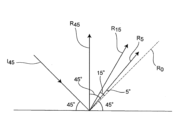
- FIG. 4 is a diagram illustrating the light receiving angle of the spectral reflectance.
- FIG. 1 is a cross-sectional view showing a schematic diagram of a multilayer coating film according to one embodiment of the present invention.
- 1 is a cross-sectional view showing a schematic diagram of a glittering coating film according to one embodiment of the present invention.
- 1 is a flowchart showing a method for producing a multi-layer coating film according to one embodiment of the present invention.
- the multilayer coating film according to the present disclosure comprises a colored coating film formed on a substrate and containing a white pigment and a black pigment, a glitter coating film formed on the colored coating film and containing a glittering material and a chromatic pigment, and a clear coating film formed on the glitter coating film.
- the multilayer coating film is provided, for example, as a part or the whole of the exterior of an automobile body.
- the colored coating contains white and black pigments, and the glitter coating contains chromatic pigments along with glittering materials, so the multi-layer coating has a mid-color tone (between a dark color and a light color) and a glittering feel.
- the percentage of the lustrous pigment when viewed from the normal direction of the multi-layer coating is between 20.0% and 80.0%. This allows the white and black pigments contained in the colored coating to be seen without passing through the lustrous pigment. This allows the mid-tones to be more clearly seen.
- the chroma C *45 based on the spectral reflectance of the light I45 irradiated at an angle of 45 degrees to the surface of the multilayer coating film (i.e., the surface of the clear coating film side of the multilayer coating film; the same applies below ) and received at an angle of 45 degrees to the regular reflected light is 10.0 or more and 25.0 or less. That is, since the chroma in the face region is high, a vivid medium color can be visually recognized.
- the ratio (L*5/L*15) between the brightness L * 5 based on the spectral reflectance of light I 45 received at an angle of 5 degrees to the specular reflected light and the brightness L * 15 based on the spectral reflectance of light I 45 received at an angle of 15 degrees to the specular reflected light is 1.0 or more and 4.0 or less.
- the ratio (L* 5/L* 15 ) indicates the change in brightness when the composite coating film is viewed from two predetermined directions.
- the ratio (L * 5/L * 15) being 1.0 or more and 4.0 or less means that the change in brightness between the specular reflected light viewed at an angle of 5 degrees and the specular reflected light viewed at an angle of 15 degrees is large. In other words, the flip-flop property in the highlight area is high.
- the multi-layer coating film disclosed herein has a high brightness change in the highlight area and vivid color tones in the mid-chromatic range.
- the chroma C * 45 is 10.0 or more and 25.0 or less.
- the chroma C * 45 may be 11.0 or more, and may be 13.0 or more.
- the chroma C * 45 may be 19.0 or less, and may be 17.0 or less.
- the ratio (L * 5/L * 15) is 1.0 or more and 4.0 or less. When the ratio (L * 5/L * 15) is in this range, the change in brightness in the highlight region is large. In other words, the flip-flop property in the highlight region is high.
- the ratio (L * 5/L * 15) may be 1.2 or more, or may be 1.3 or more.
- the ratio (L * 5/L * 15) may be 3.5 or less, or may be 3.0 or less.
- the chroma C * 45 is the chroma C* in the L * a * b * color system calculated from the spectral reflectance of the light I45 received at an angle of 45 degrees to the specular reflected light.
- the lightness L * 5 is the lightness L* in the L * a * b * color system (CIE1976L * a*b* color space ) calculated from the spectral reflectance of the light I45 received at an angle of 5 degrees to the specular reflected light.
- the lightness L * 15 is the lightness L * in the L * a * b * color system calculated from the spectral reflectance of the light I45 received at an angle of 15 degrees to the specular reflected light .
- the lightness L * 15 is 70 or more and 130 or less.
- the lightness L * 15 may be 80 or more, or may be 90 or more.
- the lightness L * 15 may be 120 or less, or may be 110 or less.
- An industrial microscope for example, ECLIPSE LV150N, manufactured by Nikon Instech Co., Ltd.
- ECLIPSE LV150N is used as the electron microscope.
- NIS-Elements Nakon Corporation, comprehensive image software
- NIS-A AMEAS NIS-A AMEAS
- the occupancy rate is the average value of the occupancy rates in five different observation fields.
- Graininess is known as an index for evaluating the brilliance of a coating film (see, for example, JP 2019-71825 A). The smaller the graininess, the stronger the impression that the composite coating film is dense, and the more the metallic texture is enhanced.
- the graininess (hereinafter referred to as graininess G) of the multilayer coating film is, for example, 2.0 or more and 6.0 or less.
- the graininess G may be 3.0 or more, or 4.0 or more.
- the graininess G may be 5.8 or less, or 5.5 or less.
- the graininess G is determined by imaging the composite coating film irradiated with diffuse light and analyzing it with a specific image analysis algorithm. Specifically, the composite coating film is irradiated with diffuse light from a light source installed inside a white-painted hemisphere. The composite coating film is imaged from its normal direction with a CCD camera and analyzed with a specific image analysis algorithm.
- the graininess G can be obtained using a multi-angle colorimeter (for example, product name: BYK-mac i 23 mm, manufacturing number 1238698, catalog number 7030, manufactured by BYK-Gardner).
- the graininess G is the average value of the graininess G of five different samples.
- the arrangement of the sparkle material is indicated, for example, by the sparkle intensity of the multilayer coating film.
- the Si 15 value is known as an index for evaluating the sparkle of the coating film (see, for example, International Publication No. WO 2022/176336).
- the Si 15 value is obtained by capturing an image of the multi-layer coating film normal to the multi-layer coating film, irradiating the multi-layer coating film from a direction inclined by 15 degrees, and analyzing the image with a specific image analysis algorithm.
- the image analysis algorithm uses a histogram of brightness levels.
- the Si 15 value can be obtained using a multi-angle colorimeter (for example, product name: BYK-mac i 23 mm, manufacturing number 1238698, catalog number 7030, manufactured by BYK-Gardner).
- the Si 15 value is the average value of the Si 15 values of five different samples.
- the arrangement of the scaly luster pigment (hereinafter referred to as the scaly luster material) can also be confirmed from the cross section of the multilayer coating film.
- the acute angle ⁇ can be obtained from the cross section of the multilayer coating film as follows. First, the cross section of the multilayer coating film is imaged with an electron microscope. The obtained cross section is placed on two-dimensional coordinates (xy coordinates) to obtain an approximate straight line L 0 of the surface of the luster coating film. Similarly, an approximate straight line L 1 of the surface of the scaly luster material is obtained. The surface of the scaly luster material is the main surface closer to the clear coating film. The angle between the approximate straight lines L 0 and L 1 is the angle ⁇ .
- the magnification is not particularly limited.
- the magnification of the electron microscope may be, for example, about 100 times or more and 200 times or less.
- the size of the observation field is also not particularly limited, and may be, for example, about 500 nm or more and 1000 nm or less in height and 1000 nm or more and 1500 nm or less in width.
- the magnification and observation field may be the same as those described above.
- the scaly lustrous materials do not overlap each other. This makes it easier for the scaly lustrous materials to be arranged parallel to the shiny coating film. Furthermore, even if the occupancy rate of the lustrous materials is low, the coating film gives a stronger impression of being dense, and the metallic texture is enhanced. "Scaly lustrous materials do not overlap each other" means that in the cross section of the multi-layer coating film, a scaly lustrous material does not overlap part or all of another scaly lustrous material in the thickness direction. It is not necessary for the scaly lustrous materials to be in contact with each other. For example, when the multi-layer coating film is viewed from the normal direction, if the scaly lustrous materials appear to overlap part or all of each other, then the scaly lustrous materials overlap each other in the thickness direction.
- the scale-like luminous materials contained in the lustrous coating do not overlap with other scale-like luminous materials.
- the overlapping ratio of scale-like luminous materials is determined as follows. First, the cross section of the multilayer coating is imaged with an electron microscope. In the obtained cross section, one or more scale-like luminous materials that are closest to the clear coating side of the lustrous coating are set as reference luminous materials. Mark the scale-like luminous materials that overlap the reference luminous materials in the thickness direction. Furthermore, mark the scale-like luminous materials that overlap the marked luminous materials in the thickness direction.
- overlapping luminous materials All scale-like luminous materials (hereinafter sometimes referred to as overlapping luminous materials) that are marked and can be seen in their entirety in the observation field are counted. At this time, one overlapping luminous material is not counted multiple times.
- the percentage of overlapping lustrous materials is calculated by dividing the number of overlapping lustrous materials by the number of scaly lustrous materials that can be seen in their entirety in the observation field (i.e., the total of the reference lustrous materials and overlapping lustrous materials).
- the specular gloss of the multilayer coating film is not particularly limited.
- the 60-degree specular gloss of the multilayer coating film may be 80% or more and 100% or less.
- the 60-degree specular gloss is measured in accordance with JIS Z 8741 Specular gloss-measurement method. Specifically, light is irradiated at an incident angle of 60 degrees with respect to the normal line of the multilayer coating film, and the luminous flux ⁇ S of the reflected light at a reflection angle of 60 degrees is measured. Under the same conditions, light is irradiated onto a flat surface of glass with a refractive index of 1.567, and the luminous flux ⁇ 0 of the reflected light is measured. The luminous flux ⁇ S is divided by the luminous flux ⁇ 0 and multiplied by 100 to obtain the 60-degree specular gloss.
- the 60-degree specular gloss is the average value of the 60-degree specular gloss of five different samples.
- the specular reflected light of light I 45 irradiated at an angle of 45 degrees to the surface of the multi-layer coating film is indicated by R 0.
- the light received at an angle of 5 degrees to the specular reflected light of light I 45 is indicated by R 5.
- the light received at an angle of 15 degrees to the specular reflected light of light I 45 is indicated by R 15.
- the light received at an angle of 45 degrees to the specular reflected light of light I 45 is indicated by R 45 .
- the material of the substrate is not particularly limited.
- the substrate include metal materials including iron, copper, aluminum, tin, zinc, and alloys thereof.
- the shape of the substrate is also not particularly limited.
- the substrate may be in the form of a plate or may have a three-dimensional shape.
- the substrate may constitute at least a part of the body of a vehicle such as a passenger car, truck, or bus.
- the substrate may be degreased and/or surface-treated.
- surface treatments include phosphate treatment, chromate treatment, zirconium conversion treatment, and composite oxide treatment.
- metal materials may be undercoated with an electrocoat paint.
- the electrocoat paint may be of the cationic or anionic type.
- Pigmented coatings conceal the texture and color of the substrate.
- the thickness of the colored coating film is not particularly limited. From the viewpoint of hiding power, the thickness of the colored coating film may be 15 ⁇ m or more and 50 ⁇ m or less, 18 ⁇ m or more and 45 ⁇ m or less, or 20 ⁇ m or more and 40 ⁇ m or less. When the thickness of the colored coating film is within this range, the texture and color of the coated object are easily concealed without showing through the colored coating film.
- the thickness of the colored coating film is measured, for example, by an electromagnetic coating thickness meter.
- the thickness of the colored coating film is the average value of the thicknesses of the colored coating film in five different samples. The thicknesses of the other layers can be measured and calculated in a similar manner.
- the black-and-white hiding film thickness of the colored coating film may be 80 ⁇ m or less, 10 ⁇ m to 70 ⁇ m or 15 ⁇ m to 60 ⁇ m.
- the black-and-white hiding film thickness is measured using a black-and-white checkered pattern hiding rate test paper specified in 4.1.2 of JIS K5600-4-1. Specifically, the hiding rate test paper is attached to a steel plate, and the paint is applied at an angle so that the film thickness changes continuously. After the paint has dried or hardened, the painted surface is visually observed under diffuse daylight. The minimum film thickness at which the black-and-white border of the checkered pattern on the hiding rate test paper becomes invisible is the black-and-white hiding film thickness. This film thickness can also be measured with an electromagnetic film thickness gauge.
- the lightness CL * 45 based on the spectral reflectance of the light IC 45 irradiated at an angle of 45 degrees to the surface of the colored coating film and received at an angle of 45 degrees to the regular reflected light may be 5 or more and 80 or less. This makes it easy for the multilayer coating film to exhibit a bright medium color.
- the lightness CL * 45 may be 6 or more, or 7 or more.
- the lightness CL * 45 may be 75 or less, or 70 or less.
- the colored coating film contains a white pigment.
- the white pigment is not particularly limited. Examples of the white pigment include titanium dioxide, zinc oxide, and silica. These may be used alone or in combination of two or more. Titanium dioxide may be used in terms of a high refractive index. Titanium dioxide may be of the rutile type or the anatase type. Among them, titanium dioxide of the rutile type may be used in terms of weather resistance. The surface of titanium dioxide may be treated with an inorganic compound such as silica, zirconium, or aluminum.
- the primary particle diameter of the white pigment is not particularly limited. From the viewpoint of hiding power, the primary particle diameter of the white pigment may be 100 nm or more and 500 nm or less, or 200 nm or more and 400 nm or less. The primary particle diameter can be measured from an electron microscope image of the cross section of the multilayer coating film using image processing software.
- the amount of the white pigment is not particularly limited.
- the white pigment is added so that the brightness CL * 45 is 5 or more and 80 or less.
- the amount of the white pigment may be specifically 10.0 mass% or more and 50.0 mass% or less of the colored coating film.
- the amount of the white pigment may be 12.0 mass% or more and 15.0 mass% or more of the colored coating film.
- the amount of the white pigment may be 48.0 mass% or less and 45.0 mass% or less of the colored coating film.
- the amount of the white pigment may be 10.0 mass parts or more and 40.0 mass parts or less with respect to 100 mass parts of the first resin described later.
- the colored coating film contains a black pigment.
- the black pigment is not particularly limited. Examples of the black pigment include carbon black; composite metal oxides such as iron chromium and bismuth manganese; perylene pigments; and azomethiazo pigments. These may be used alone or in combination of two or more.
- the black pigment may be carbon black.
- the primary particle diameter of the black pigment is not particularly limited. From the viewpoint of hiding power, the primary particle diameter of the black pigment may be 20.0 nm or more and 70.0 nm or less, or 30.0 nm or more and 60.0 nm or less.
- the amount of the black pigment is not particularly limited.
- the black pigment is added so that the brightness CL * 45 is 5 or more and 80 or less.
- the amount of the black pigment may be specifically 0.5% by mass or more and 5.0% by mass or less of the colored coating film.
- the amount of the black pigment may be 0.7% by mass or more and 0.9% by mass or more of the colored coating film.
- the amount of the black pigment may be 4.8% by mass or less and 4.6% by mass or less of the colored coating film.
- the amount of the black pigment may be 2.0 parts by mass or more and 10.0 parts by mass or less with respect to 100 parts by mass of the first resin described later.
- the ratio of the amount of the white pigment to the amount of the black pigment is not particularly limited. The two are added in a ratio such that the lightness CL * 45 is 5 or more and 80 or less.
- the ratio of the amount of the white pigment to the amount of the black pigment may be, for example, 99.9:0.1 to 1:99.
- the ratio (white:black) may be 99.8:0.2 to 10:90, or 99.8:0.2 to 30:70.
- the colored coating film contains, for example, a first resin as a vehicle.
- the white pigment and the black pigment are dispersed in the first resin.
- the first resin is not particularly limited.
- the first resin may include a cured product of a first thermosetting resin.
- the first resin is obtained, for example, by curing a first thermosetting resin formed from a crosslinkable functional group and a base resin.
- a first curing agent may be used for curing.
- crosslinkable functional groups include carboxy groups, hydroxyl groups, epoxy groups, silanol groups, and (meth)acryloyl groups.
- base resins examples include acrylic resin, polyester resin, alkyd resin, polyurethane resin, epoxy resin, and fluororesin.
- the epoxy resin may be a urethane-modified epoxy resin.
- the polyester resin may be a urethane-modified polyester resin.
- the acrylic resin may be a urethane-modified acrylic resin. Each urethane-modified resin has a urethane bond in the resin skeleton. These may be used alone or in combination of two or more. Of these, acrylic resin and urethane-modified polyester are preferred because of their improved chipping resistance.
- Acrylic resins can be obtained, for example, by copolymerizing ⁇ , ⁇ -ethylenically unsaturated carboxylic acids, (meth)acrylic acid esters having functional groups such as hydroxyl groups, amide groups, and methylol groups, other (meth)acrylic acid esters, and styrene.
- the urethane-modified polyester is obtained by reacting a hydroxyl-containing polyester with an aliphatic diisocyanate compound.
- the hydroxyl-containing polyester is prepared by polycondensation of an acid component such as a polycarboxylic acid and/or an acid anhydride with a polyhydric alcohol.
- acid component such as a polycarboxylic acid and/or an acid anhydride with a polyhydric alcohol.
- aliphatic diisocyanate compounds include hexamethylene diisocyanate, trimethylhexamethylene diisocyanate, cyclohexane-1,4-diisocyanate, dicyclohexylmethane-4,4-diisocyanate, and methylcyclohexane diisocyanate. These may be used alone or in combination of two or more.
- the amount of the first resin is not particularly limited. In order to facilitate the formation of a uniform coating film, the amount of the first resin may be 60.0% by mass or more and 95.0% by mass or less, or 70.0% by mass or more and 90.0% by mass or less, and 75.0% by mass or more and 85.0% by mass or less is even more preferable.
- the glass transition temperature (Tg) of the first resin is not particularly limited. From the viewpoint of coating hardness and smoothness, the Tg of the first resin may be from -40°C to 20°C, or from -30°C to 10°C. Tg is measured by a differential scanning calorimeter (DSC) in accordance with JIS K 7121.
- DSC differential scanning calorimeter
- the colored coating film may further contain other pigments depending on the hiding power, etc.
- the other pigments include metallic pigments, anti-rust pigments, color pigments other than white pigments and black pigments (chromatic pigments), and extender pigments.
- the extender pigments include calcium carbonate, barium sulfate, clay, and talc. These may be used alone or in combination of two or more.
- the amount of the chromatic pigment is not particularly limited as long as the multi-layer coating film exhibits a mesochromatic color tone.
- the amount of the chromatic pigment may be 2.0 mass% or more and 6.0 mass% or less of the colored coating film.
- the amount of the chromatic pigment may be 2.2 mass% or less and 5.8 mass% or less of the colored coating film.
- the amount of the chromatic pigment may be 2.0 mass% or more and 10.0 mass% or less with respect to 100 mass parts of the first resin described below.
- the colored coating film may also contain various additives as necessary.
- additives include ultraviolet absorbers, antioxidants, defoamers, surface conditioners, dispersants, and pinhole prevention agents.
- the glittering coating film gives the multi-layer coating film a metallic texture.
- the thickness of the glittering coating film is not particularly limited.
- the thickness of the glittering coating film may be 0.05 ⁇ m or more and 1.0 ⁇ m or less. This makes it easier for the glittering material to be arranged parallel to the coating film, and the chromatic pigment is sufficiently contained in the glittering coating film. Therefore, the brightness change becomes even larger, and C * 45 is more likely to be in the range of 10.0 to 25.0.
- the thickness of the glittering coating film may be 0.1 ⁇ m or more, or 0.3 ⁇ m or more.
- the thickness of the glittering coating film may be 0.8 ⁇ m or less, or 0.7 ⁇ m or less.
- the glittering coating film includes a glittering material.
- the glittering material is not particularly limited as long as it reflects light.
- a scaly glittering material may be used because it can make the glittering coating film thinner and can easily improve the metallic texture.
- the aspect ratio of the scaly glittering material is, for example, 2 or more.
- the aspect ratio is the ratio (long diameter/thickness) of the long diameter of one main surface of the scaly glittering material to the distance (thickness) between the two main surfaces of the scaly glittering material.
- the aspect ratio of the scaly glittering material may be 10 or more and 1000 or less.
- the lustrous coating film may contain, in addition to the scaly lustrous material, other lustrous materials (lustrous materials with an aspect ratio of less than 2) other than the scaly lustrous material.
- other lustrous materials lustrous materials with an aspect ratio of less than 2
- the content of the other lustrous materials may be 10.0% by mass or less of the total lustrous materials, and may be 5.0% by mass or less. This makes it easier for the scaly lustrous material to be aligned parallel to the coating film.
- the major axis of the luminous material is not particularly limited.
- the major axis of the luminous material may be 1.0 ⁇ m or more and 80.0 ⁇ m or less, or 3.0 ⁇ m or more and 50.0 ⁇ m or less.
- the major axis is calculated by observing the multilayer coating film from its normal direction with an electron microscope. In the observation field, the area corresponding to the luminous material and other areas are binarized using image processing software. Next, 20 luminous materials are randomly selected, and the longest diameter of each is measured. The average of these measured values is the major axis of the luminous material.
- the thickness of the lustrous material may be 0.05 ⁇ m or more and 0.3 ⁇ m or less. This allows the lustrous coating film to be made thinner.
- the thickness of the lustrous material may be 0.25 ⁇ m or less, or 0.2 ⁇ m or less. The thickness may be calculated by observing the cross section of the multi-layer coating film with an electron microscope. In the observation field, the area corresponding to the lustrous material and other areas are binarized using image processing software. Next, 20 lustrous materials are randomly selected and the length of each of their thickest parts is measured. The average of these measurements is the thickness of the lustrous material.
- the average particle diameter of the lustrous material is not particularly limited. In terms of facilitating improved lustre, the average particle diameter of the lustrous material may be 2.0 ⁇ m or more and 50.0 ⁇ m or less, or 5.0 ⁇ m or more and 35.0 ⁇ m or less.
- the average particle diameter refers to the volume average particle diameter D50.
- the volume average particle diameter D50 can be measured using a laser Doppler type particle size analyzer (for example, "Microtrack UPA150" manufactured by Nikkiso Co., Ltd.).
- the luminous material is not particularly limited.
- the luminous material may be one that does not use multiple reflection interference as a coloring function, since L * 5/L * 15 tends to become large.
- Examples of such luminous materials include metal particles. Specifically, examples include particles of aluminum, copper, zinc, iron, nickel, tin, aluminum oxide, and alloys containing these.
- the luminous material may be colored. These may be used alone or in combination of two or more. Mica is a typical luminous material that uses multiple reflection interference as a coloring function.
- Scaly metal particles are preferred.
- Scaly aluminum particles are preferred because a high level of brilliance can be achieved with a small amount.
- the amount of the lustrous material may be 10.0% by mass or more and 30.0% by mass or less of the lustrous coating film. This makes it easier for the occupancy rate of the lustrous material to be 20.0% by mass or more and 80.0% by mass or less.
- the amount of the lustrous material may be 12.0% by mass or more of the lustrous coating film, and may be 14.0% by mass or more.
- the amount of the lustrous material may be 28.0% by mass or less of the lustrous coating film, and may be 26.0% by mass or less.
- the glittering coating film contains a chromatic pigment.
- the chromatic pigment is a colored pigment other than a white pigment and a black pigment.
- examples of the chromatic pigment include organic pigments such as azo chelate pigments, insoluble azo pigments, condensed azo pigments, diketopyrrolopyrrole pigments, phthalocyanine pigments, indigo pigments, perinone pigments, perylene pigments, dioxane pigments, quinacridone pigments, isoindolinone pigments, and metal complex pigments; and inorganic pigments such as yellow lead, yellow iron oxide, and red iron oxide. These may be used alone or in combination of two or more.
- the amount of the chromatic pigment is not particularly limited.
- the chromatic pigment is added so that the chroma C * 45 is 10 or more and 25 or less.
- the amount of the chromatic pigment may be specifically 1.0 mass% or more and 10.0 mass% or less of the glittering coating film.
- the amount of the chromatic pigment may be 2.0 mass% or more and 3.0 mass% or more of the glittering coating film.
- the amount of the chromatic pigment may be 9.0 mass% or less and 7.0 mass% or less of the glittering coating film.
- the amount of the chromatic pigment may be 5.0 mass parts or more and 12.0 mass parts or less with respect to 100 mass parts of the second resin described later.
- the mixing ratio of the luster material to the chromatic pigment may be, for example, 90:10 to 10:90 by mass.
- the mixing ratio (luster material:chromatic pigment) may be 85:15 to 60:40, or 85:15 to 70:30.
- the glittering coating film may contain a viscosity modifier.
- the viscosity modifier adjusts the viscosity of the glittering pigment dispersion (Y), which is a material of the glittering coating film.
- the glittering material is aligned parallel to the coating film.
- the viscosity of the glittering pigment dispersion (Y) immediately after application, the glittering material is aligned parallel to the coating film.
- the liquid components contained in the glittering pigment dispersion (Y) flow, the glittering material also flows and its alignment is disturbed.
- the viscosity of the glittering pigment dispersion (Y) By appropriately adjusting the viscosity of the glittering pigment dispersion (Y), the flow of the liquid components is suppressed in the glittering coating film after application and before curing, and the disorder of the alignment of the glittering material is also suppressed. Therefore, the glittering material is easily maintained in a state aligned parallel to the coating film.
- the viscosity modifier is not particularly limited.
- examples of viscosity modifiers include silica-based fine powders, mineral-based viscosity modifiers, finely divided barium sulfate powder, polyamide-based viscosity modifiers, organic resin fine particle viscosity modifiers, diurea-based viscosity modifiers, urethane association-type viscosity modifiers, acrylic swelling-type polyacrylic acid-based viscosity modifiers, and cellulose-based viscosity modifiers. These may be used alone or in combination of two or more. Among these, cellulose-based viscosity modifiers are preferred because they are easy to disperse the glittering material in and have excellent quick-drying properties.
- mineral-based viscosity modifiers include swellable layered silicates having a 2:1 crystal structure.
- Specific examples include smectite clay minerals such as natural or synthetic montmorillonite, saponite, hectorite, stevensite, beidellite, nontronite, bentonite, and laponite; swellable mica clay minerals such as Na-type tetrasilicic fluorine mica, Li-type tetrasilicic fluorine mica, Na-salt-type fluorine taeniolite, and Li-type fluorine taeniolite; vermiculite; and substitutes and derivatives thereof. These may be used alone or in combination of two or more.
- polyacrylic acid viscosity modifiers include sodium polyacrylate and polyacrylic acid-(meth)acrylic acid ester copolymers.
- examples of commercially available polyacrylic acid viscosity modifiers include Primal ASE-60, Primal TT615, Primal RM5 (all manufactured by Dow Chemical Company), SN Thickener 613, SN Thickener 618, SN Thickener 630, SN Thickener 634, and SN Thickener 636 (all manufactured by San Nopco). These may be used alone or in combination of two or more.
- the solid acid value may be 30 mgKOH/g or more and 300 mgKOH/g or less, or 80 mgKOH/g or more and 280 mgKOH/g or less.
- Cellulose-based viscosity modifiers include, for example, cellulose acetate butyrate (CAB), carboxymethylcellulose, methylcellulose, hydroxyethylcellulose, hydroxyethylmethylcellulose, hydroxypropylmethylcellulose, methylcellulose, and cellulose nanofiber (CNF). These may be used alone or in combination of two or more. Of these, CAB or CNF may be used, or CNF may be used.
- CAB cellulose acetate butyrate
- CNF cellulose nanofiber
- the amount of the viscosity modifier is not particularly limited.
- the amount of the viscosity modifier may be, for example, 0.05 parts by mass or more and 10.0 parts by mass or less, relative to 100 parts by mass of the glittering pigment dispersion. This makes it easier to suppress disturbance in the arrangement of the glittering material.
- the amount of the viscosity modifier may be 0.07 parts by mass or more, 0.1 parts by mass or more, or 0.15 parts by mass or more.
- the amount of the viscosity modifier may be 5.0 parts by mass or less, or 3.0 parts by mass or less.
- the amount of the second resin may be 15% by mass or less of the glitter pigment dispersion, 10% by mass or less, or 5% by mass or less, so that a thin glitter coating film is easily formed.
- the glittering coating film may contain other pigments other than the glittering material and the chromatic pigment depending on the hiding power, etc.
- the other pigments include anti-rust pigments, white pigments, black pigments, and the above-mentioned extender pigments.
- the content of the other pigments may be 10.0% by mass or less of the glittering pigment dispersion, and may be 2.0% by mass or less.
- the content of the other pigments may be 0.01% by mass or more of the glittering pigment dispersion, and may be 0.1% by mass or more.
- the glossy coating film may contain various additives as necessary.
- additives include ultraviolet absorbers, antioxidants, defoamers, anti-settling agents, dispersants, and surface conditioners.
- the clear coating film protects the color coating film and the luster coating film.
- the clear coating film is not particularly limited, and has the same structure as the conventionally known clear coating film.
- the thickness of the clear coating is not particularly limited. From the viewpoint of scratch resistance, the thickness of the clear coating may be 10 ⁇ m or more, or 15 ⁇ m or more. From the viewpoint of not impairing the whiteness and metallic texture, the thickness of the clear coating may be 50 ⁇ m or less, or 40 ⁇ m or less.
- the clear coating film includes, for example, a third resin.
- the third resin may include a cured product of a third thermosetting resin. Specifically, the third resin is obtained by curing a third thermosetting resin formed of a crosslinkable functional group and a base resin. A second curing agent may be used for curing.
- the third thermosetting resin may be the same resin as exemplified as the first thermosetting resin.
- the Tg of the third resin is not particularly limited. From the viewpoint of coating hardness and smoothness, the Tg of the third resin may be -40°C or more and 20°C or less, or -30°C or more and 10°C or less.
- the clear coating film may contain a pigment to the extent that transparency is not impaired.
- the pigment is not particularly limited, and one or more of conventionally known pigments may be used in combination.
- the amount of pigment added is not particularly limited. The amount of pigment added may be, for example, 30.0 parts by mass or less, and may be 0.01 parts by mass or more and 10.0 parts by mass or less, relative to 100 parts by mass of the solid content of the third resin.
- the clear coating film may contain various additives as necessary.
- additives include ultraviolet absorbers, antioxidants, defoamers, surface conditioners, and pinhole inhibitors.
- FIG. 2 is a cross-sectional view showing a schematic of a portion of a painted article having a multilayer coating film according to the present disclosure.
- the painted article 100 comprises an object 10 to be painted and a multilayer coating film 20.
- the multilayer coating film 20 comprises, in this order, a colored coating film 21, a glossy coating film 22, and a clear coating film 23.
- the glossy coating film 22 contains a glossy material 221.
- FIG 3 is a cross-sectional view showing a schematic diagram of a portion of the glittering coating film according to the present disclosure.
- the acute angle between the approximate straight line L0 of the surface of the glittering coating film 22 and the approximate straight line L1 of the surface of the glittering material 221 is approximately 0 degrees.
- the glittering material 221 is parallel to the surface of the glittering coating film 22.
- the multi-layer coating film is manufactured by forming a color coating film, a glitter coating film and a clear coating film in this order on a substrate.
- the color coating film may be cured or uncured.
- the clear coating film may be formed, the glitter coating film may be cured or uncured.
- each coating film may be laminated without curing, and then heated to simultaneously cure these three uncured coating films.
- curing is a concept that includes solidification.
- curing in this specification means that the coating film loses its fluidity, regardless of whether or not a chemical reaction is involved.
- curing in this specification is synonymous with "cured and dried" as specified in JIS K 5500 (paint terminology).
- curing refers to a) a state in which, when the center of a test piece is firmly pinched between the thumb and index finger, there is no indentation from a fingerprint on the coating surface, no movement of the coating film is felt, and no scratches are left when the coating surface is rubbed rapidly and repeatedly with the fingertips (dry hard).
- uncured refers to a state other than the above-mentioned cured state, and includes a semi-cured state.
- the multilayer coating film is preferably produced by the following method: That is, the method for producing the multilayer coating film comprises applying a colored coating material onto a substrate to form an uncured colored coating film, applying a glittering pigment dispersion onto the uncured colored coating film to form an uncured glittering coating film, applying a clear coating material onto the uncured glittering coating film to form an uncured clear coating film, and curing the uncured colored coating film, the uncured glittering coating film, and the uncured clear coating film to obtain the multilayer coating film.
- FIG. 4 is a flow chart showing a method for producing a multi-layer coating film according to the present disclosure.
- a colored coating material (X) is applied onto an object to be coated to form an uncured colored coating film.
- the amount of colored paint (X) to be applied is not particularly limited.
- colored paint (X) is applied so that the thickness of the colored coating film after curing is 15 ⁇ m or more and 50 ⁇ m or less.
- preliminary drying also called preheating
- preliminary drying prevents the uncured colored coating film and the luster coating from mixing together, making it harder for a mixed layer to form. This makes it easier to improve the appearance of the resulting multi-layer coating film.
- pre-drying are not particularly limited. Examples of pre-drying include leaving the material at a temperature of 20°C to 25°C for 15 to 30 minutes, or heating the material at a temperature of 50°C to 100°C for 30 seconds to 10 minutes.
- the colored paint (X) contains the above-mentioned white pigment, black pigment, and first thermosetting resin.
- the colored paint (X) contains a first curing agent, a first solvent, various additives, etc., as necessary.
- the colored paint (X) is prepared by diluting a mixture of the white pigment, the black pigment, the first thermosetting resin, the first curing agent, various additives, etc., with the first solvent.
- the colored paint (X) may be a one-component paint, or may be a multi-component paint such as a two-component paint.
- the viscosity of the colored coating material (X) is not particularly limited.
- the viscosity of the colored coating material (X) measured at 20°C with a B-type viscometer is, for example, 500 cps/6 rpm or more and 6000 cps/6 rpm or less.
- the solids concentration of the colored paint (X) is not particularly limited.
- the solids concentration of the colored paint (X) may be 30.0% by mass or more and 70.0% by mass or less.
- the solids of the colored paint (X) are all the components of the colored paint (X) excluding the first solvent.
- thermosetting resin The first thermosetting resin is formed from a crosslinkable functional group and a base resin, the details of which are as described above.
- the amount of the first thermosetting resin is not particularly limited.
- the solid mass of the first thermosetting resin may be 60.0 mass% or more and 90.0 mass% or less of the total solid mass of the first thermosetting resin and the solid mass of the first curing agent, and may be 70.0 mass% or more and 85.0 mass% or less.
- the first curing agent is not particularly limited and may be appropriately selected according to the first thermosetting resin.
- the first curing agent include amino resins, urea resins, polyisocyanate compounds, epoxy group-containing compounds, carboxy group-containing compounds, carbodiimide group-containing compounds, hydrazide group-containing compounds, and semicarbazide group-containing compounds.
- the polyisocyanate compounds include blocked polyisocyanate compounds in which the isocyanate group is blocked with a blocking agent. These are used alone or in combination of two or more. Among them, amino resins and polyisocyanate compounds may be used in terms of the performance and cost of the resulting coating film.
- the amino resin is obtained, for example, by condensing an amino compound such as melamine, benzoguanamine, or urea with formaldehyde, and then etherifying with a lower monohydric alcohol. Details of the polyisocyanate compound will be described later.
- the amount of the first curing agent is not particularly limited.
- the solid mass of the first curing agent may be 10.0% by mass or more and 40.0% by mass or less of the total solid mass of the first thermosetting resin and the solid mass of the first curing agent, 15.0% by mass or more and 30.0% by mass or less, or 15.0% by mass or more and 25.0% by mass or less.
- the first solvent is not particularly limited.
- the first solvent may be water (deionized water), an organic solvent, or a combination thereof.
- water may be used.
- the proportion of water in the first solvent may be 50.0% by mass or more, or 80.0% by mass or more.
- organic solvent examples include ester solvents such as ethyl acetate, butyl acetate, isopropyl acetate, ethylene glycol monoethyl ether acetate, propylene glycol monomethyl ether acetate, and propylene glycol monoethyl ether acetate;
- solvent examples include ether solvents such as propylene glycol monomethyl ether, ethylene glycol monomethyl ether, methyl methoxybutanol, ethoxypropanol, ethylene glycol isopropyl ether, ethylene glycol t-butyl ether, ethylene glycol monoethyl ether, ethylene glycol monobutyl ether, methoxybutanol, and propylene glycol monobutyl ether; alcohol solvents such as methanol, ethanol, butanol, and propyl alcohol; ketone solvents such as acetone, methyl ethyl ketone, and methyl isobutyl ketone
- the amount of the first solvent is not particularly limited and is set appropriately depending on the solid content and viscosity of the colored paint (X).
- the first solvent is added so that the solid content of the colored paint (X) is 30.0% by mass or more and 70.0% by mass or less, and the viscosity of the colored paint (X) measured with a B-type viscometer at 20°C is 500 cps/6 rpm or more and 6000 cps/6 rpm or less.
- a first thermosetting resin having a hydrophilic group When water is used as the first solvent, a first thermosetting resin having a hydrophilic group may be used.
- the hydrophilic group of the first thermosetting resin is neutralized to form an alkaline salt, thereby making the first thermosetting resin water-soluble or water-dispersible.
- hydrophilic groups include carboxy groups, hydroxyl groups, methylol groups, amino groups, sulfonic acid groups, and polyoxyethylene bonds.
- neutralizing agents include alkaline substances such as sodium hydroxide and amine compounds.
- the first thermosetting resin can be prepared in a water-dispersed state by emulsion polymerization of the raw material monomers of the first thermosetting resin in the presence of a surfactant or a water-soluble resin.
- the first thermosetting resin may be dispersed in water using an emulsifier.
- the first thermosetting resin may not contain hydrophilic groups, or may contain only a small amount of hydrophilic groups.
- the colored coating material (X) further contains the pigments and various additives exemplified as those contained in the colored coating film.
- the coating method is not particularly limited. Examples of coating methods include methods similar to those used for coating colored paints. In particular, from the viewpoint of coating efficiency, rotary atomization electrostatic coating is preferred.
- the amount of photoluminescent pigment dispersion (Y) to be applied is not particularly limited. Photoluminescent pigment dispersion (Y) is applied, for example, so that the thickness of the photoluminescent coating film in the resulting multilayer coating film is 0.05 ⁇ m or more and 1.0 ⁇ m or less.
- pre-drying After applying the glitter pigment dispersion (Y), pre-drying may be performed. This will quickly reduce the fluidity of the glitter coating film, making it easier to suppress the fluidity of the glittering material.
- the conditions for pre-drying are not particularly limited and may be the same as those for pre-drying of the colored coating film.
- the glittering pigment dispersion (Y) contains a glittering material and a chromatic pigment.
- the glittering pigment dispersion (Y) contains a viscosity modifier and a second solvent, etc., as necessary.
- the glittering pigment dispersion (Y) is prepared by diluting a mixture of the glittering material, the chromatic pigment, the viscosity modifier, various additives, etc., with the second solvent.
- the viscosity of the glittering pigment dispersion (Y) is not particularly limited.
- the viscosity of the glittering pigment dispersion (Y) may be 20 cps/6 rpm or more and 3000 cps/6 rpm or less, as measured by a B-type viscometer at 20°C, in order to easily suppress disturbance of the arrangement of the glittering material.
- the solid content concentration of the glittering pigment dispersion (Y) may be 0.1% by mass or more and 12.0% by mass or less. This makes it easy to form a thin glittering coating film, and C * 45 is easily in the range of 10.0 to 25.0.
- the solid content concentration of the glittering pigment dispersion (Y) may be 9.0% by mass or less, 8.0% by mass or less, or 7.5% by mass or less.
- the solid content of the glittering pigment dispersion (Y) is all components of the glittering pigment dispersion (Y) excluding the second solvent.
- the solids concentration of the glittering pigment dispersion (Y) may be 3.5% by mass or more, 4.0% by mass or more, or 4.5% by mass or more.
- the solids concentration of the glittering pigment dispersion (Y) may be 11.0% by mass or less, 10.5% by mass or less, or 10.0% by mass or less.
- the solids concentration of the photoluminescent pigment dispersion (Y) may be 1.0% by mass or more, or 2.0% by mass or more.
- the solids concentration of the photoluminescent pigment dispersion (Y) may be 5.0% by mass or less, or 3.5% by mass or less.
- the amount of the lustrous material may be, for example, 0.1% by mass or more and 5.0% by mass or less of the lustrous pigment dispersion (Y). This makes it easier for the occupancy rate of the lustrous material to be 20% by mass or more and 80% by mass or less.
- the amount of the lustrous material may be 0.5% by mass or more, or 1.0% by mass or more.
- the amount of the lustrous material may be 3.0% by mass or less, 2.5% by mass or less, or 1.8% by mass or less.
- the amount of the chromatic pigment may be, for example, 0.1% by mass or more and 3.0% by mass or less of the glittering pigment dispersion (Y).
- the amount of the chromatic pigment may be 0.2% by mass or more, or 0.3% by mass or more.
- the amount of the chromatic pigment may be 2.0% by mass or less, or 1.0% by mass or less.
- the second solvent is not particularly limited.
- the second solvent may be water, an organic solvent, or a combination thereof.
- water may be used.
- the proportion of water in the second solvent may be 50% by mass or more, or 80% by mass or more.
- the organic solvent used in the second solvent may be the same organic solvent as exemplified as the first solvent.
- the amount of the second solvent is not particularly limited and is set appropriately depending on the solid content and viscosity of the glittering pigment dispersion (Y).
- the second solvent is added so that the solid content of the glittering pigment dispersion (Y) is 0.1% by mass or more and 12.0% by mass or less, and the viscosity of the glittering pigment dispersion (Y) measured with a B-type viscometer at 20°C is 20 cps/6 rpm or more and 3000 cps/6 rpm or less.
- the glittering pigment dispersion (Y) also contains various additives exemplified as those contained in the glittering coating film.
- a dispersant is added to increase the dispersibility of the luster material.
- the dispersant is selected appropriately depending on the second solvent, luster material, etc.
- examples of dispersants that can be used include inorganic dispersants such as phosphates and polyphosphates; polymeric dispersants such as polycarboxylic acid-based polyethylene glycol-based and naphthalenesulfonic acid-formaldehyde condensation-based; and low molecular weight dispersants such as alkylsulfonic acid-based, quaternary ammonium-based and higher alcohol alkylene oxide-based.
- examples of phosphates include sodium hexametaphosphate, sodium pyrophosphate, and sodium phosphate.
- the dispersant used may be, for example, a polymer-type dispersant such as a polycarboxylic acid partial alkyl ester-based, polyether-based, or polyalkylene polyamine-based dispersant.
- the amount of dispersant is not particularly limited.
- the amount of dispersant may be 0.01% by mass or more and 3.0% by mass or less of the glitter pigment dispersion (Y), or 0.1% by mass or more and 1.0% by mass or less.
- Surface conditioners are added to control the surface tension of the glittering coating. This makes it easier for the glittering material to align parallel to the coating. It also improves adhesion between layers.
- the surface conditioner is not particularly limited.
- surface conditioners include silicone-based, acrylic-based, vinyl-based, and fluorine-based surface conditioners. These may be used alone or in combination of two or more. Among them, silicone-based surface conditioners may be used from the viewpoint of the luster and water resistance of the glossy coating film.
- silicone-based surface conditioners include polydimethylsiloxane and modified silicones obtained by modifying this.
- modified silicones include polyether modified products, acrylic modified products, and polyester modified products.
- surface conditioners include, for example, the BYK series (manufactured by BYK-Chemie), the Tego series (manufactured by Evonik), the Granol series, the Polyflow series (all manufactured by Kyoeisha Chemical Co., Ltd.), and the Disparlon series (manufactured by Kusumoto Chemical Co., Ltd.).
- the amount of the surface conditioner is not particularly limited.
- the amount of the surface conditioner may be 0.1% by mass or more and 10.0% by mass or less, 0.2% by mass or more and 8.0% by mass or less, or 0.4% by mass or more and 6.0% by mass or less of the glittering pigment dispersion (Y).
- the surface conditioner is in this range, the surface tension of the glittering coating film decreases, and the wettability of the glittering pigment dispersion (Y) to the uncured colored coating film is easily improved.
- the coating method is not particularly limited. Examples of coating methods include methods similar to those used for coating colored paints. In particular, from the viewpoint of coating efficiency, rotary atomization electrostatic coating is preferred.
- the amount of clear paint (Z) to be applied is not particularly limited.
- the clear paint (Z) is applied so that the thickness of the clear coating film after curing is 25 ⁇ m or more and 45 ⁇ m or less.
- the clear coating material (Z) is not particularly limited, and a conventionally known clear coating material can be used.
- the form of the clear coating material (Z) is also not particularly limited.
- the clear coating material (Z) may be a powder, a water-based coating material, or a solvent-based coating material.
- the clear paint (Z) contains the third thermosetting resin described above.
- the clear paint (Z) contains a second curing agent, a third solvent, various additives, etc., as necessary.
- the clear paint (Z) is prepared by diluting a mixture of the third thermosetting resin, the second curing agent, various additives, etc., with the third solvent.
- the clear paint (Z) may be a one-component paint, or a multi-component paint such as a two-component paint.
- the viscosity of the clear coating material (Z) is not particularly limited.
- the viscosity of the clear coating material (Z) measured at 20°C with a B-type viscometer is, for example, 500 cps/6 rpm or more and 6000 cps/6 rpm or less.
- the solid content of the clear coating (Z) is not particularly limited.
- the solid content of the clear coating (Z) is, for example, 40.0% by mass or more and 60.0% by mass or less.
- thermosetting resin (Third thermosetting resin)
- the third thermosetting resin is formed from a crosslinkable functional group and a base resin, the details of which are as described above.
- the one-component clear coating (Z) contains, for example, polyepoxide and polyacid as the third thermosetting resin.
- the one-component clear coating (Z) contains, as the third thermosetting resin, an acrylic resin (1) containing an acid anhydride group, a polyester resin (2) containing a carboxyl group, and an acrylic resin (3) containing a hydroxyl group and an epoxy group.
- the acid anhydride group of the acrylic resin (1) may be half-esterified with a low molecular weight alcohol or the like.
- such a third thermosetting resin is referred to as an acid-epoxy curing resin composition.
- the acid-epoxy curing resin composition makes it easy to increase the solids concentration of the clear coating (Z). Furthermore, the acid-epoxy curing resin composition makes it easy to obtain a clear coating film with excellent acid resistance.
- the curing proceeds as the above three types of polymers react with each other.
- the curing mechanism of the acid-epoxy curing resin composition is as follows. First, by heating, the acid anhydride group in the acrylic resin (1) reacts with the hydroxyl groups in the polyester resin (2) and the acrylic resin (3) to form a carboxyl group. This carboxyl group and the carboxyl group in the polyester resin (2) react with the epoxy group present in the acrylic resin (3) to form a crosslinking point. The crosslinking reaction begins at this crosslinking point.
- the blending of the acrylic resin (1), polyester resin (2) and acrylic resin (3) is not particularly limited.
- the blending of the acid-epoxy curing resin composition is carried out in amounts and by methods well known to those skilled in the art.
- the molar ratio of the carboxy groups in the acrylic resin (1) and polyester resin (2) to the epoxy groups in the acrylic resin (3) may be 1.0/1.4 or more and 1.0/0.6 or less, or 1.0/1.2 or more and 1.0/0.8 or less. This makes it easier to improve the curing properties of the clear coating material (Z). Furthermore, it is easier to obtain a clear coating film that is less prone to yellowing.
- the molar ratio of the carboxyl groups in the acrylic resin (1) to the hydroxyl groups in the polyester resin (2) and the acrylic resin (3) may be 1.0/2.0 or more and 1.0/0.5 or less, or 1.0/1.5 or more and 1.0/0.7 or less. This makes it easier to improve the curing properties of the clear coating material (Z). Furthermore, it makes it easier to obtain a clear coating film with excellent water resistance.
- the two-component clear coating (Z) is preferred because it is easy to improve the physical properties of the coating film.
- the two-component clear coating (Z) contains a separated third thermosetting resin and a second curing agent.
- the third thermosetting resin and the second curing agent are mixed immediately before use.
- combinations of the third thermosetting resin/second curing agent include a carboxyl group-containing resin/epoxy group-containing resin, a hydroxyl group-containing resin/polyisocyanate compound, a hydroxyl group-containing resin/blocked isocyanate compound, and a hydroxyl group-containing resin/melamine resin. These are particularly suitable for forming a clear coating film.
- the two-component clear coating (Z) may contain a hydroxyl group-containing resin as the third thermosetting resin and a polyisocyanate compound as the second curing agent, in order to facilitate improvement of the physical properties of the coating film.
- hydroxyl-containing resins include hydroxyl-containing acrylic resins, hydroxyl-containing polyester resins, hydroxyl-containing polyether resins, and hydroxyl-containing polyurethane resins.
- hydroxyl-containing acrylic resins and hydroxyl-containing polyester resins may be used, or hydroxyl-containing acrylic resins may be used. These may be used alone or in combination of two or more.
- the hydroxyl value of the hydroxyl-containing acrylic resin is not particularly limited. From the viewpoint of the scratch resistance and water resistance of the coating film, the hydroxyl value of the hydroxyl-containing acrylic resin may be 80 mgKOH/g or more and 200 mgKOH/g or less, and more preferably 100 mgKOH/g or more and 180 mgKOH/g or less.
- the weight average molecular weight of the hydroxyl-containing acrylic resin is not particularly limited. From the viewpoint of the acid resistance and smoothness of the coating film, the weight average molecular weight of the hydroxyl-containing acrylic resin may be 2,500 or more and 40,000 or less, or 5,000 or more and 30,000 or less.
- the weight average molecular weight can be calculated from a chromatogram measured by gel permeation chromatography, based on the molecular weight of standard polystyrene. For example, HLC8120GPC (manufactured by Tosoh Corporation) is used as the gel permeation chromatograph.
- the second curing agent is not particularly limited and may be appropriately selected depending on the third thermosetting resin.
- Examples of the second curing agent include the same curing agents as those exemplified as the first curing agent.
- a polyisocyanate compound has at least two isocyanate groups in one molecule.
- polyisocyanate compounds include aliphatic polyisocyanates, alicyclic polyisocyanates, aliphatic polyisocyanates that have aromatic rings in the molecule that are not bonded to isocyanate groups (araliphatic polyisocyanates), aromatic polyisocyanates, and derivatives of these polyisocyanates.
- Aliphatic polyisocyanates include, for example, trimethylene diisocyanate, tetramethylene diisocyanate, hexamethylene diisocyanate, pentamethylene diisocyanate, 1,2-propylene diisocyanate, 1,2-butylene diisocyanate, 2,3-butylene diisocyanate, 1,3-butylene diisocyanate, 2,4,4- or 2,2,4-trimethylhexamethylene diisocyanate, dimer acid diisocyanate, methyl 2,6-diisocyanatohexanoate (common name: lysine) aliphatic diisocyanates such as 2,6-diisocyanatohexanoate 2-isocyanatoethyl, 1,6-diisocyanato-3-isocyanatomethylhexane, 1,4,8-triisocyanatooctane, 1,6,11-triisocyanatoundecane, 1,8-diis
- aromatic aliphatic polyisocyanates include aromatic aliphatic diisocyanates such as methylenebis(4,1-phenylene)diisocyanate (common name: MDI), 1,3- or 1,4-xylylene diisocyanate or mixtures thereof, ⁇ , ⁇ '-diisocyanato-1,4-diethylbenzene, 1,3- or 1,4-bis(1-isocyanato-1-methylethyl)benzene (common name: tetramethylxylylene diisocyanate) or mixtures thereof; and aromatic aliphatic triisocyanates such as 1,3,5-triisocyanatomethylbenzene.
- aromatic aliphatic diisocyanates such as methylenebis(4,1-phenylene)diisocyanate (common name: MDI), 1,3- or 1,4-xylylene diisocyanate or mixtures thereof, ⁇ , ⁇ '-diisocyanato-1,4-die
- Aromatic polyisocyanates include, for example, aromatic diisocyanates such as m-phenylene diisocyanate, p-phenylene diisocyanate, 4,4'-diphenyl diisocyanate, 1,5-naphthalene diisocyanate, 2,4-tolylene diisocyanate (common name: 2,4-TDI) or 2,6-tolylene diisocyanate (common name: 2,6-TDI) or mixtures thereof, 4,4'-toluidine diisocyanate, 4,4'-diphenyl ether diisocyanate; aromatic triisocyanates such as triphenylmethane-4,4',4''-triisocyanate, 1,3,5-triisocyanatobenzene, 2,4,6-triisocyanatotoluene; and aromatic tetraisocyanates such as 4,4'-diphenylmethane-2,2',5,5'-tetraisocyanate.
- polyisocyanate derivatives include dimers, trimers, biurets, allophanates, uretdione, uretoimine, isocyanurates, oxadiazinetriones, polymethylene polyphenyl polyisocyanates (crude MDI, polymeric MDI), and crude TDI of the above-mentioned polyisocyanates.
- Polyisocyanate compounds can be used alone or in combination of two or more.
- hexamethylene diisocyanate 4,4'-methylenebis(cyclohexyl isocyanate), or a derivative of hexamethylene diisocyanate may be used.
- the polyisocyanate compound a prepolymer of the above polyisocyanate or its derivative may be used.
- the prepolymer is obtained by reacting the polyisocyanate or its derivative with a compound that can react with it under conditions of an excess of isocyanate groups.
- the compound that can react with the polyisocyanate or its derivative is a compound that has an active hydrogen group such as a hydroxyl group or an amino group. Examples of the above compound include polyhydric alcohols, low molecular weight polyester resins, amines, and water.
- a blocked polyisocyanate compound may be used as the polyisocyanate compound.
- the blocked polyisocyanate compound is obtained by blocking the isocyanate groups in the above polyisocyanate or its derivatives with a blocking agent.
- Blocking agents include, for example, phenol compounds, lactam compounds, alcohols, ethers, oxime compounds, compounds with active methylene groups, mercaptan compounds, acid amide compounds, imide compounds, amine compounds, imidazole compounds, urea compounds, carbamic acid esters, imine compounds, sulfites, azole compounds, and ketone compounds.
- phenolic compounds include phenol, cresol, xylenol, nitrophenol, ethylphenol, hydroxydiphenyl, butylphenol, isopropylphenol, nonylphenol, octylphenol, and methyl hydroxybenzoate.
- lactam compounds include ⁇ -caprolactam, ⁇ -valerolactam, ⁇ -butyrolactam, and ⁇ -propiolactam.
- alcohols examples include methanol, ethanol, propyl alcohol, butyl alcohol, amyl alcohol, lauryl alcohol, benzyl alcohol, glycolic acid, methyl glycolate, ethyl glycolate, butyl glycolate, lactic acid, methyl lactate, ethyl lactate, butyl lactate, methylol urea, methylol melamine, diacetone alcohol, 2-hydroxyethyl acrylate, and 2-hydroxyethyl methacrylate.
- ethers include ethylene glycol monomethyl ether, ethylene glycol monoethyl ether, ethylene glycol monobutyl ether, diethylene glycol monomethyl ether, diethylene glycol monoethyl ether, propylene glycol monomethyl ether and methoxymethanol.
- oxime compounds include formamide oxime, acetamide oxime, acetoxime, methyl ethyl ketoxime, diacetyl monooxime, benzophenone oxime, and cyclohexane oxime.
- Examples of compounds having an active methylene group include dimethyl malonate, diethyl malonate, ethyl acetoacetate, methyl acetoacetate, and acetylacetone.
- mercaptan compounds include butyl mercaptan, t-butyl mercaptan, hexyl mercaptan, t-dodecyl mercaptan, 2-mercaptobenzothiazole, thiophenol, methylthiophenol, and ethylthiophenol.
- acid amide compounds include acetanilide, acetanisidide, acetotoluide, acrylamide, methacrylamide, acetate amide, stearic acid amide, and benzamide.
- imide compounds examples include succinimide, phthalimide, and maleimide.
- amine compounds include diphenylamine, phenylnaphthylamine, xylidine, N-phenylxylidine, carbazole, aniline, naphthylamine, butylamine, dibutylamine, and butylphenylamine.
- Imidazole compounds include, for example, imidazole and 2-ethylimidazole.
- urea compounds include urea, thiourea, ethyleneurea, ethylenethiourea, and diphenylurea.
- An example of a carbamic acid ester is N-phenyl phenylcarbamate.
- imine compounds examples include ethyleneimine and propyleneimine.
- sulfites examples include sodium bisulfite and potassium bisulfite.
- Azole compounds include, for example, pyrazole or pyrazole derivatives such as pyrazole, 3,5-dimethylpyrazole, 3-methylpyrazole, 4-benzyl-3,5-dimethylpyrazole, 4-nitro-3,5-dimethylpyrazole, 4-bromo-3,5-dimethylpyrazole, and 3-methyl-5-phenylpyrazole; imidazole or imidazole derivatives such as imidazole, benzimidazole, 2-methylimidazole, 2-ethylimidazole, and 2-phenylimidazole; and imidazoline derivatives such as 2-methylimidazoline and 2-phenylimidazoline.
- pyrazole or pyrazole derivatives such as pyrazole, 3,5-dimethylpyrazole, 3-methylpyrazole, 4-benzyl-3,5-dimethylpyrazole, 4-nitro-3,5-dimethylpyrazole, 4-bromo-3,5-dimethylpyrazole, and 3-
- ketone compounds include methyl ethyl ketone and methyl isobutyl ketone.
- blocked isocyanate compounds include, for example, the Duranate (blocked hexamethylene diisocyanate) series (manufactured by Asahi Kasei Corporation), Sumidur BL3175, Desmodur BL3272 MPA, Desmodur BL3475 BA/SN, Desmodur BL3575/1 MPA/SN, Desmodur BL4265 SN, Desmodur BL5375 MPA/SN, and Desmodur VP LS2078/2 (all manufactured by Bayer).
- Duranate blocked hexamethylene diisocyanate
- Sumidur BL3175 Sumidur BL3175
- Desmodur BL3272 MPA Desmodur BL3475 BA/SN
- Desmodur BL3575/1 MPA/SN Desmodur BL4265 SN
- Desmodur BL5375 MPA/SN Desmodur VP LS2078/2
- the clear coating material (Z) contains a third solvent as required.
- the third solvent is not particularly limited.
- the third solvent may be water, an organic solvent, or a combination thereof. In particular, from the viewpoint of low VOC, water may be used.
- the proportion of water in the third solvent may be 50.0 mass% or more, or 80.0 mass% or more.
- the organic solvent used in the third solvent may be the same organic solvent as exemplified as the first solvent.
- the amount of the third solvent is not particularly limited and is set appropriately depending on the solid content and viscosity of the clear coating (Z).
- the third solvent is added so that the solid content of the clear coating (Z) is 40.0% by mass or more and 60.0% by mass or less.
- the heating conditions are set appropriately depending on the composition of each coating film.
- the heating temperature is, for example, 70°C to 150°C, and may be 80°C to 140°C.
- the heating time is, for example, 10 minutes to 40 minutes, and may be 20 minutes to 30 minutes.
- Examples of heating devices include drying ovens such as hot air ovens, electric ovens, and infrared induction heating ovens.
- a multi-angle colorimeter (product name: BYK-mac i 23 mm, manufacturing number 1238698, catalog number 7030, manufactured by BYK-Gardner) was used to obtain the graininess G.
- the graininess G was determined as the average value of five different samples.
- the thickness of the glittering coating film was measured using an electromagnetic coating thickness meter (product name: FISCHERSCOPE (registered trademark) MMS PC2, manufactured by Fisher Instruments Co., Ltd.). The average value of five different samples was taken as the thickness of the glittering coating film.
- Occupancy rate The multilayer coating film was photographed from its normal direction with an industrial microscope (product name: ECLIPSE LV150N, manufactured by NIKON Corporation), and the area corresponding to the glittering material and the other areas were binarized using image processing software. The area of the observation field was set to 100%, and the area ratio of the glittering material was calculated. The magnification in the image was 200 times. The observation field was 480 nm vertically and 720 nm horizontally. The average value in five different observation fields was taken as the occupancy rate.
- Si 15 value Using a multi-angle colorimeter (product name: BYK-mac i 23 mm, serial number 1238698, catalog number 7030, manufactured by BYK-Gardner), light was irradiated from a direction inclined at 15 degrees to the normal direction of the multi-layer coating film, and an image was captured from the normal direction of the multi-layer coating film and analyzed to obtain the Si 15 value. The average value of five different samples was taken as the Si 15 value.
- a multi-angle colorimeter product name: BYK-mac i 23 mm, serial number 1238698, catalog number 7030, manufactured by BYK-Gardner
- Example 1 (I) Preparation of substrate A zinc phosphate-treated steel sheet having a cured electrodeposition coating film was prepared as a substrate.
- the cured electrodeposition coating film was formed by electrodeposition coating a cationic electrodeposition coating composition (product name: Powernics) manufactured by Nippon Paint Co., Ltd. on a zinc phosphate-treated steel sheet so that the dry film thickness was 20 ⁇ m, and then heating at 160° C. for 30 minutes.
- a cationic electrodeposition coating composition product name: Powernics
- Viscalex HV-30 manufactured by BASF, polycarboxylic acid-based viscosity modifier, non-volatile content 30%
- X-1 a colored paint
- a white pigment dispersion paste was obtained by premixing 4.5 parts of a dispersant (product name: Disperbyk 190, manufactured by BYK-Chemie, nonionic/anionic dispersant), 0.5 parts of BYK-011 (manufactured by BYK-Chemie) as an antifoaming agent, 22.9 parts of ion-exchanged water, and 72.1 parts of titanium dioxide, and then adding a glass bead medium in a paint conditioner and mixing at room temperature until the secondary particle diameter of the titanium dioxide became 5 ⁇ m or less.
- a dispersant product name: Disperbyk 190, manufactured by BYK-Chemie, nonionic/anionic dispersant
- BYK-011 manufactured by BYK-Chemie
- titanium dioxide titanium dioxide
- a black pigment dispersion paste was obtained by premixing 18.6 parts of a dispersant (product name: DIPEX ULTRA PA4550, manufactured by BASF Japan Co., Ltd.), 0.5 parts of BYK-011 (manufactured by BYK-Chemie Co., Ltd.) as an antifoaming agent, 36.0 parts of ion-exchanged water, 10.4 parts of a black pigment (carbon black), and 34.5 parts of a hydroxyl group-containing acrylic resin emulsion resin (30 parts in terms of resin solid content), and then adding a glass bead medium in a paint conditioner and mixing at room temperature until the secondary particle diameter of the black pigment (carbon black) became 60 nm or less.
- a dispersant product name: DIPEX ULTRA PA4550, manufactured by BASF Japan Co., Ltd.
- BYK-011 manufactured by BYK-Chemie Co., Ltd.
- a hydroxyl group-containing acrylic resin emulsion resin 30 parts in terms of resin
- a mixture of a monomer mixture containing 145 parts of methyl methacrylate, 50 parts of styrene, 220 parts of ethyl acrylate, 70 parts of 2-hydroxyethyl methacrylate, and 15 parts of methacrylic acid, 240 parts of water, and 30 parts of an emulsifier (trade name: New Coal 293) was emulsified using a homogenizer to obtain a monomer pre-emulsion.
- the monomer pre-emulsion was dropped over a period of 3 hours while stirring the inside of the reaction vessel.
- an aqueous solution in which 1 part of APS (ammonium persulfate) was dissolved in 50 parts of water as a polymerization initiator was dropped evenly into the reaction vessel until the dropping of the monomer pre-emulsion was completed. After the dropwise addition of the monomer pre-emulsion was completed, the reaction was continued for another hour at 80° C. After cooling the reaction mixture, an aqueous solution of 2 parts of dimethylaminoethanol in 20 parts of water was added to the reaction vessel to obtain a hydroxyl group-containing acrylic resin emulsion with a solid content concentration of 40.6% by mass.
- APS ammonium persulfate
- the solid content of the obtained hydroxyl-containing acrylic resin emulsion had an acid value of 20 mg KOH/g, a hydroxyl value of 60 mg KOH/g, and a glass transition temperature (Tg) of 30°C.
- the solid content concentration was measured according to JIS K 5601-1-2 Heating Residue Measurement Method.
- polyester resin with an acid value of 40. Furthermore, the polyester resin was cooled to 100 ° C., and then 11.2 parts of butyl cellosolve were added and stirred until it became uniform. Next, the polyester resin was cooled to 60 ° C., and then 98.8 parts of ion-exchanged water and 5.9 parts of dimethylethanolamine were added. This resulted in a hydroxyl group-containing polyester resin with a solid content of 50% by mass.
- the solid content of the hydroxyl-containing polyester resin had an acid value of 40 mgKOH/g, a hydroxyl value of 110 mgKOH/g, a number average molecular weight of 2870, and a glass transition temperature (Tg) of -3°C.
- the glass transition temperature (Tg) was measured using a differential scanning calorimeter (DSC220C) manufactured by Seiko Instruments Inc. (SII). The measurement conditions were a sample amount of 10 mg, a temperature rise rate of 10°C/min, and a measurement temperature range of -20°C to 100°C.
- the substrate was heated at 140°C for 20 minutes to obtain a coated object having a multi-layer coating film A1.
- the thickness of the colored coating film was 30 ⁇ m
- the black-and-white hiding film thickness of the colored coating film was 12 ⁇ m.
- the thickness of the glitter coating film was 0.5 ⁇ m.
- the thickness of the clear coating film was 30 ⁇ m.
- the multi-layer coating film of Example 1 had a large change in lightness in the highlights and also had high chroma.
- the multi-layer coating film of Comparative Example 1 had a small change in lightness and lacked chroma. This is believed to be due to the fact that both the ratio (L * 5/L * 15) and the occupancy rate of the glittering material were small.
- the multi-layer coating film of Comparative Example 2 lacked chroma. This is believed to be because the glitter coating film did not contain a chromatic pigment and had a low chroma C * 45.
- the multi-layer coating film of Comparative Example 3 lacked chroma. This is believed to be due to the small chroma C * 45.
- the glitter coating film was thick, the orientation of the glittering material was reduced, the graininess G was large, and the design was lacking in fineness.
- the multi-layer coating film of Comparative Example 4 lacked chroma. This is believed to be due to the small chroma C * 45.
- the solid content concentration of the glittering pigment dispersion was high, the orientation of the glittering material was reduced, the particle feeling G was large, and the design was lacking in fineness.
- the multi-layer coating film and the method for producing the multi-layer coating film of the present invention are particularly suitable for the outer panels of automobile bodies.
Landscapes
- Application Of Or Painting With Fluid Materials (AREA)
- Laminated Bodies (AREA)
Priority Applications (1)
| Application Number | Priority Date | Filing Date | Title |
|---|---|---|---|
| JP2025517204A JP7771473B2 (ja) | 2023-11-10 | 2024-11-07 | 複層塗膜およびその製造方法 |
Applications Claiming Priority (2)
| Application Number | Priority Date | Filing Date | Title |
|---|---|---|---|
| JP2023192024 | 2023-11-10 | ||
| JP2023-192024 | 2023-11-10 |
Publications (1)
| Publication Number | Publication Date |
|---|---|
| WO2025100499A1 true WO2025100499A1 (ja) | 2025-05-15 |
Family
ID=95695247
Family Applications (1)
| Application Number | Title | Priority Date | Filing Date |
|---|---|---|---|
| PCT/JP2024/039673 Pending WO2025100499A1 (ja) | 2023-11-10 | 2024-11-07 | 複層塗膜およびその製造方法 |
Country Status (2)
| Country | Link |
|---|---|
| JP (1) | JP7771473B2 (https=) |
| WO (1) | WO2025100499A1 (https=) |
Citations (5)
| Publication number | Priority date | Publication date | Assignee | Title |
|---|---|---|---|---|
| JP2005169385A (ja) * | 2003-11-17 | 2005-06-30 | Kansai Paint Co Ltd | 塗装方法 |
| JP2017019147A (ja) * | 2015-07-08 | 2017-01-26 | マツダ株式会社 | 積層塗膜及び塗装物 |
| WO2017135426A1 (ja) * | 2016-02-05 | 2017-08-10 | 関西ペイント株式会社 | 複層塗膜及び複層塗膜形成方法 |
| WO2019088201A1 (ja) * | 2017-11-01 | 2019-05-09 | 関西ペイント株式会社 | 複層塗膜形成方法 |
| WO2023219017A1 (ja) * | 2022-05-13 | 2023-11-16 | マツダ株式会社 | 自動車車体およびその製造方法 |
-
2024
- 2024-11-07 JP JP2025517204A patent/JP7771473B2/ja active Active
- 2024-11-07 WO PCT/JP2024/039673 patent/WO2025100499A1/ja active Pending
Patent Citations (5)
| Publication number | Priority date | Publication date | Assignee | Title |
|---|---|---|---|---|
| JP2005169385A (ja) * | 2003-11-17 | 2005-06-30 | Kansai Paint Co Ltd | 塗装方法 |
| JP2017019147A (ja) * | 2015-07-08 | 2017-01-26 | マツダ株式会社 | 積層塗膜及び塗装物 |
| WO2017135426A1 (ja) * | 2016-02-05 | 2017-08-10 | 関西ペイント株式会社 | 複層塗膜及び複層塗膜形成方法 |
| WO2019088201A1 (ja) * | 2017-11-01 | 2019-05-09 | 関西ペイント株式会社 | 複層塗膜形成方法 |
| WO2023219017A1 (ja) * | 2022-05-13 | 2023-11-16 | マツダ株式会社 | 自動車車体およびその製造方法 |
Also Published As
| Publication number | Publication date |
|---|---|
| JP7771473B2 (ja) | 2025-11-17 |
| JPWO2025100499A1 (https=) | 2025-05-15 |
Similar Documents
| Publication | Publication Date | Title |
|---|---|---|
| US11198150B2 (en) | Multi-layered coating film and method for forming multi-layered coating film | |
| JP6921822B2 (ja) | 光輝性顔料分散体 | |
| JP7536449B2 (ja) | 複層塗膜形成方法 | |
| JP7305545B2 (ja) | 複層塗膜形成方法 | |
| CN112739784B (zh) | 效应颜料分散体和形成多层涂膜的方法 | |
| JP7286632B2 (ja) | 光輝性顔料分散体及び複層塗膜形成方法 | |
| WO2017175468A1 (ja) | 光輝性顔料分散体及び複層塗膜形成方法 | |
| JP7341890B2 (ja) | 複層塗膜形成方法 | |
| WO2020044672A1 (ja) | 複層塗膜形成方法 | |
| WO2021065401A1 (ja) | 複層塗膜形成方法 | |
| CN119173387A (zh) | 汽车车身及其制造方法 | |
| CN115702220B (zh) | 光亮性颜料分散体以及多层涂膜形成方法 | |
| JP5603177B2 (ja) | 共重合体、該共重合体を含有する水性塗料組成物及び複層塗膜形成方法 | |
| JP7695495B1 (ja) | 複層塗膜およびその製造方法 | |
| JP7689257B1 (ja) | 複層塗膜およびその製造方法 | |
| JP7695494B1 (ja) | 複層塗膜およびその製造方法 | |
| JP7771473B2 (ja) | 複層塗膜およびその製造方法 | |
| TW202337570A (zh) | 複層塗膜形成方法 | |
| JP2024079351A (ja) | 塗装物品およびその製造方法 | |
| TW202339861A (zh) | 複層塗膜形成方法 | |
| TW202337571A (zh) | 複層塗膜形成方法 |
Legal Events
| Date | Code | Title | Description |
|---|---|---|---|
| ENP | Entry into the national phase |
Ref document number: 2025517204 Country of ref document: JP Kind code of ref document: A |
|
| WWE | Wipo information: entry into national phase |
Ref document number: 2025517204 Country of ref document: JP |
|
| 121 | Ep: the epo has been informed by wipo that ep was designated in this application |
Ref document number: 24888792 Country of ref document: EP Kind code of ref document: A1 |