WO2025100495A1 - 自己細菌の自己利用方法、自己利用システム、及び自己利用プログラム - Google Patents
自己細菌の自己利用方法、自己利用システム、及び自己利用プログラム Download PDFInfo
- Publication number
- WO2025100495A1 WO2025100495A1 PCT/JP2024/039655 JP2024039655W WO2025100495A1 WO 2025100495 A1 WO2025100495 A1 WO 2025100495A1 JP 2024039655 W JP2024039655 W JP 2024039655W WO 2025100495 A1 WO2025100495 A1 WO 2025100495A1
- Authority
- WO
- WIPO (PCT)
- Prior art keywords
- bacteria
- user
- self
- collected
- autologous
- Prior art date
- Legal status (The legal status is an assumption and is not a legal conclusion. Google has not performed a legal analysis and makes no representation as to the accuracy of the status listed.)
- Pending
Links
Images



Classifications
-
- A—HUMAN NECESSITIES
- A23—FOODS OR FOODSTUFFS; TREATMENT THEREOF, NOT COVERED BY OTHER CLASSES
- A23L—FOODS, FOODSTUFFS OR NON-ALCOHOLIC BEVERAGES, NOT OTHERWISE PROVIDED FOR; PREPARATION OR TREATMENT THEREOF
- A23L33/00—Modifying nutritive qualities of foods; Dietetic products; Preparation or treatment thereof
- A23L33/10—Modifying nutritive qualities of foods; Dietetic products; Preparation or treatment thereof using additives
- A23L33/135—Bacteria or derivatives thereof, e.g. probiotics
-
- A—HUMAN NECESSITIES
- A61—MEDICAL OR VETERINARY SCIENCE; HYGIENE
- A61K—PREPARATIONS FOR MEDICAL, DENTAL OR TOILETRY PURPOSES
- A61K35/00—Medicinal preparations containing materials or reaction products thereof with undetermined constitution
- A61K35/66—Microorganisms or materials therefrom
- A61K35/74—Bacteria
-
- A—HUMAN NECESSITIES
- A61—MEDICAL OR VETERINARY SCIENCE; HYGIENE
- A61K—PREPARATIONS FOR MEDICAL, DENTAL OR TOILETRY PURPOSES
- A61K35/00—Medicinal preparations containing materials or reaction products thereof with undetermined constitution
- A61K35/66—Microorganisms or materials therefrom
- A61K35/74—Bacteria
- A61K35/741—Probiotics
-
- A—HUMAN NECESSITIES
- A61—MEDICAL OR VETERINARY SCIENCE; HYGIENE
- A61K—PREPARATIONS FOR MEDICAL, DENTAL OR TOILETRY PURPOSES
- A61K35/00—Medicinal preparations containing materials or reaction products thereof with undetermined constitution
- A61K35/66—Microorganisms or materials therefrom
- A61K35/74—Bacteria
- A61K35/741—Probiotics
- A61K35/744—Lactic acid bacteria, e.g. enterococci, pediococci, lactococci, streptococci or leuconostocs
- A61K35/745—Bifidobacteria
-
- A—HUMAN NECESSITIES
- A61—MEDICAL OR VETERINARY SCIENCE; HYGIENE
- A61P—SPECIFIC THERAPEUTIC ACTIVITY OF CHEMICAL COMPOUNDS OR MEDICINAL PREPARATIONS
- A61P25/00—Drugs for disorders of the nervous system
-
- A—HUMAN NECESSITIES
- A61—MEDICAL OR VETERINARY SCIENCE; HYGIENE
- A61P—SPECIFIC THERAPEUTIC ACTIVITY OF CHEMICAL COMPOUNDS OR MEDICINAL PREPARATIONS
- A61P3/00—Drugs for disorders of the metabolism
- A61P3/02—Nutrients, e.g. vitamins, minerals
Definitions
- the present invention relates to a method, system, and program for the self-use of bacteria obtained from organs or parts of the body where bacteria normally reside, and in particular to a method, system, and program for the self-use of bacteria obtained from one's own body in order to promote physical and mental health, including improving one's constitution, by ingesting useful types of bacteria collected from one's own body.
- the human gut flora commonly called the “gut flora,” is a group of microorganisms found in the human gastrointestinal system (stomach, small intestine, and large intestine). A diverse range of bacteria make up the gut flora. Bacteria colonize the human intestine from the first day of life, and each individual forms their own unique flora. Although each person's microbial species are generally closely related bacterial species, the majority of each person's flora is host-specific. In other words, the human gut flora is unique to each individual and highly diverse.
- microorganisms and bacteria in the intestinal flora reach the intestine alive and improve the balance of the host's intestinal flora, providing a beneficial effect to the host.
- These microorganisms are known as probiotic bacteria, and include lactic acid bacteria, bifidobacteria, and short-chain fatty acid acid bacteria such as acetic acid bacteria, butyric acid-producing bacteria, and propionic acid bacteria.
- probiotic bacteria include lactic acid bacteria, bifidobacteria, and short-chain fatty acid acid bacteria such as acetic acid bacteria, butyric acid-producing bacteria, and propionic acid bacteria.
- lactic acid bacteria and bifidobacteria which are often used as probiotic bacteria as mentioned above, are vulnerable to oxygen and tend to die during storage. Therefore, the survival rate of probiotic bacteria when processed for oral use is not very high, and the effect of surviving bacteria in improving the intestinal flora has been limited.
- the inventor While the inventor was researching the relationship between the intestinal flora and health and nutritional status, he discovered that the bacteria in one's own intestinal flora are effective in improving one's physical constitution. Specifically, he discovered that even when commercially available probiotic bacteria were ingested, the expected bacterial species did not take root in the intestines, and were even excreted. As a result, the inventor conducted extensive research to more effectively utilize the bacteria normally present in one's own body, including the intestines.
- the present invention has been made in consideration of the above points, and relates to a method, system, and program for self-use of a user's own bacteria to increase the survival rate of bacteria normally present in the user's body and to increase the colonization rate when the bacteria are returned to the user, thereby improving the user's health.
- the method for self-use of the user's own bacteria in this embodiment is characterized by comprising a collection step of collecting bacteria normally present in the user's body from the user's body to obtain the collected bacteria, a culture step of seeding the collected bacteria in a medium and culturing the user's collected bacteria, an isolation step of isolating acid-resistant bacteria from the collected bacteria during culture, a processing step of culturing the isolated own bacteria and processing them into a bacterial product, and an administration step of administering the bacterial product to the user.
- the collected bacteria may be collected from the feces of the user in the collection step.
- an analysis step may be added before the culture step to analyze the type of autologous bacteria contained in the feces of the user.
- a notification step may be added in which the intestinal bacterial flora of the user is estimated based on the type of autologous bacteria contained in the user's feces, and advice is given to the user on how to promote the proliferation of bacteria that should be increased in the user's intestines.
- the advice may be nutritional guidance for the user.
- a preservation step may be added after the processing step to preserve the processed bacterial product according to the user.
- genetic modification may be performed on the isolated autologous bacteria.
- the steps from the collection step onwards may be repeated again.
- the medium may be under aerobic and acidic conditions.
- the autologous bacteria may be bifidobacteria.
- the collected bacteria may be collected from the vagina of the user in the collection process, or the collected bacteria may be collected from the skin of the user in the collection process.
- the system for self-use of the user's own bacteria is characterized by comprising a storage unit that stores a nutritional guidance table that associates the type of bacteria to be grown in the human intestine with nutrition, an estimation unit that cultures the user's own bacteria contained in the bacteria collected from the feces of the user and analyzes the bacteria to estimate the type of the user's own bacteria and the user's intestinal bacterial flora, a reception unit that receives the user's response regarding changes in physical condition when the user ingests a bacterial processed product of the user's own bacteria, an advice generation unit that responds to the response and generates advice on nutritional guidance for the user based on the nutritional guidance table and according to the user's intestinal bacterial flora, and a transmission unit that transmits the advice to the user.
- a storage unit that stores a nutritional guidance table that associates the type of bacteria to be grown in the human intestine with nutrition
- an estimation unit that cultures the user's own bacteria contained in the bacteria collected from the feces of the
- the method for self-use of the user's own bacteria of the present invention includes a collection step of collecting bacteria normally present in the user's body from the user's body to obtain the collected bacteria, a culture step of seeding the collected bacteria in a medium and culturing the user's collected bacteria, an isolation step of isolating acid-resistant bacteria from the collected bacteria during culture, a processing step of culturing the isolated self-bacteria and processing them into a bacterial product, and an administration step of administering the bacterial product to the user, thereby increasing the survival of the bacteria normally present in the user's body and increasing the colonization rate when the bacteria are returned to the user, leading to improved health for the user. Furthermore, the system and program for self-use of the user's own bacteria can also similarly lead to improved health for the user.
- FIG. 1 is a schematic diagram showing a method for self-utilization of autologous bacteria according to an embodiment.
- FIG. 13 is a schematic diagram showing an example of a nutritional guidance table.
- 1 is a schematic diagram showing the configuration of a system for self-utilization of self-produced bacteria according to an embodiment.
- Bacteria that normally inhabit the human body are found in a wide range of locations, including the large intestine, skin, vaginal cavity, and oral cavity. The majority of bacteria grow in the human intestine.
- the intestinal flora of each person is formed according to the type of intestinal bacteria that grow in the intestines, such as the large intestine.
- the properties of the intestinal flora i.e., the dominant bacterial species in the fungi, the type, amount, and ratio of useful bacterial species, suggest a relationship with the person's chronic diseases and illnesses, and it is becoming clear that mental states such as depression and mania, as well as physical activity and vitality, are influenced by intestinal bacteria.
- probiotic bacteria which are effective in improving diseases, illnesses, and mental states.
- probiotic bacteria which are effective in improving diseases, illnesses, and mental states.
- the method of self-utilization of autologous bacteria in this embodiment involves collecting the user's own bacteria (intestinal bacteria) as collected bacteria, multiplying and selecting them, and then returning them to the user.
- simple intake methods such as oral ingestion or application are adopted.
- Feces excreted by the user is a convenient source of collection for the collected bacteria.
- bacteria that normally reside on the inner wall of the vaginal cavity bacteria that normally reside on the skin surface (epidermis), and bacteria that normally reside in the oral cavity can also be collected.
- the following explanation will mainly exemplify collected bacteria (intestinal bacteria) collected from feces. Additional explanations will be given for collected bacteria from the vagina, skin, etc., as appropriate.
- FIG. 1 is a schematic diagram showing a method for self-utilization of autologous bacteria. Intestinal bacteria contained in the feces excreted by the user are used as the collected bacteria. First, feces 13 from a user 10 is collected ("collection process"). Generally, feces contains more intestinal bacteria than undigested food residues. The feces is sealed and then sent to the service provider 11.
- the type of bacteria contained in the user's feces sent to the service provider 11 is analyzed ("analysis process"). Analysis of the type of bacteria includes analysis of the morphological characteristics of the bacteria, for example, gram positive, gram negative, etc., as well as analysis of the gene sequence (genomic analysis). By including genomic analysis, detailed classification is possible. In this case, the presence or absence of useful bacterial species, their proportion in the bacterial flora, etc. are also analyzed. Furthermore, substances contained in the residue in the feces may also be analyzed at the same time. For example, the presence and amount of molecules such as short-chain fatty acids are analyzed.
- the feces of the user are seeded on a culture medium, and the user's own bacteria are cultured from the collected bacteria contained in the feces ("culture process"). Cultivation is to increase the amount of useful bacterial species.
- the culture medium used for cultivation is mainly acid-resistant.
- aerobic conditions may also be added in parallel in consideration of drying, which will be described later. Aerobic conditions are conditions in which the bacteria are exposed to oxygen. If necessary, sterilized air is aerated into the culture medium. By increasing the amount of oxygen in the culture medium, bacterial species that can grow and grow even under high oxygen stress are selected.
- the culture environment may be controlled from aerobic to anaerobic by adjusting the amount of oxygen during seeding (inoculation) and cultivation, and the growth may be adjusted.
- the selected bacteria may be in a dried form. Until administered to the user, the bacteria are in a dry state and are constantly exposed to oxygen. This is because it is necessary to avoid the death of the bacteria during the storage period.
- acidic conditions are added to the culture medium.
- a user ingests dried bacteria, they come into contact with gastric acid in the stomach.
- the stomach has an acidic condition of around pH 2, particularly pH 1-2, due to gastric acid.
- the pH is around 4.
- the ingested bacteria are broken down by gastric acid before they reach the small intestine or large intestine.
- a bacterial strain that is resistant to strong acids is selected from the start.
- there is no contact with gastric acid so extreme acid resistance is not required.
- the autologous bacteria contained in the feces are cultured and the acid-resistant autologous bacteria are isolated in parallel.
- oxygen resistance may be added as a selection condition. That is, an acid such as an organic acid is added to the medium to increase the acidity and create an acidic condition. Sterilized air is also introduced to create an aerobic condition. As a result, only bacterial species that are resistant to oxygen and acid can grow. Therefore, during culturing, the aerobic and acid-resistant autologous bacteria are isolated (the "isolation process").
- the medium used in the embodiment is a selective medium.
- antibiotics are not used when selecting the bacterial species, and the bacteria are selected by acid or by acid and oxygen, and isolated.
- a minimum amount of antibiotics may be used.
- the finally isolated self-bacteria are classified as bifidobacteria (genus Bifidobacterium), and the same genus includes B. longum, B. adolescentis, B. breve, etc., and are known as probiotic bacteria.
- the bacteria to be isolated are not limited to the genus Bifidobacterium, and short-chain fatty acid producing bacteria are also included.
- the isolated self-bacteria are highly likely to have characteristic characteristics. Therefore, if the bacteria are found to be new by analysis of the characteristics of the bacteria and analysis of the bacterial genome sequence, they can be registered as a new species. Furthermore, the user may name the new bacteria.
- the isolated autologous bacteria may be genetically modified. Using the autologous bacteria as a base, foreign genes may be introduced using plasmids, vectors, etc., and genome editing techniques such as CRISPR CAS9 may also be utilized. For example, acid resistance and oxygen resistance may be improved. In addition, the growth rate (division rate) may be increased. Other purposes of genetic modification of isolated autologous bacteria include, for example, improving metabolism and production capabilities, such as production of alcohol metabolizing enzymes, production of serotonin precursors, and drug metabolism.
- the oxygen- and acid-resistant bacteria are isolated, they are cultured to grow.
- the bacteria are then processed into a bacterial product 15 for ease of handling ("processing step").
- the bacterial product 15 is in various forms, such as a dried product, liquid, concentrated liquid, gel, etc.
- a dried product (bacterial dry product) is preferably used because of its ease of handling and storage.
- known methods such as vacuum freeze-drying are used. Although drying causes some bacteria to die, it improves storage stability. Although freezing and other methods are also considered, drying is preferable because it is difficult to store bacteria at the freezing temperature of the user's refrigerator.
- the dried bacteria derived from the user's intestinal environment are processed into a form that is easy for the user to take by sealing them in a known capsule or tableting them into tablets.
- the bacterial product 15 is manufactured in processing equipment 16, such as a factory with processing capabilities.
- processing equipment 16 such as a factory with processing capabilities.
- the bacterial processed product is sealed in a container such as a bottle or pack, and the user can open the liquid bacterial processed product and mix it with a beverage such as milk or soy milk to prepare a food such as yogurt by themselves.
- a beverage such as milk or soy milk
- the user can apply it directly to the skin or vagina.
- the bacterial processed product 15 contains the target bacteria and a nutrient source (such as dietary fiber) that is useful for the proliferation of the bacteria.
- the bacterial processed products are stored according to the user ("storage step").
- the prepared bacterial processed products may be provided to the user in their entirety, or may be provided (delivered) to the user in appropriate amounts at a time.
- isolated autologous bacteria and feces themselves are also included in the storage items.
- the user ingests the bacterial processed product derived from their own intestinal bacteria, sent by the service provider (the "administration step").
- the intake period lasts from one month to six months or one year.
- the user can answer a questionnaire 12 from the service provider at any time about changes in their physical condition, mental state, etc., and can inform the service provider of the effects of ingesting the bacterial processed product derived from their own intestinal bacteria. Based on the answers, if there is an effect, the user will continue, but if there is no effect, the current intake of the dried bacterial product will be discontinued.
- administration forms include application to the skin or vaginal cavity, or gargling in the mouth for the user's own bacteria outside the intestines.
- the user's own intestinal bacteria that constitute the intestinal flora growing in the intestines are isolated.
- bacteria that are resistant to gastric acid and oxygen are cultivated and processed into a form that is easy to take.
- the user's own intestinal bacteria are then delivered in the form of dried bacteria and taken.
- the ratio of useful bacteria in the intestinal flora is gradually increased, leading to improvement of the intestinal environment, and improvement of illness, disease, and mental state.
- the bacteria species are present in the user's own intestines from the beginning and are adapted to the intestinal environment of the user, the bacteria are highly adaptable to the environment and can settle and grow in the intestines more efficiently.
- the source of the autologous bacteria is diverse, including the user's own skin, vagina, oral cavity, etc., in addition to the user's own intestines.
- the source of the autologous bacteria is diverse, including the user's own skin, vagina, oral cavity, etc., in addition to the user's own intestines.
- the vaginal environment will improve, such as preventing menstrual irregularities and increasing the rate of implantation of fertilized eggs.
- isolating bacteria collected from one's own oral cavity it is expected that the effect of suppressing the bacteria that cause tooth decay (dental caries) and periodontal disease will be suppressed.
- the intestinal bacterial flora of the user is estimated based on the type of the user's own bacteria contained in the user's feces. Then, advice to promote the proliferation of bacteria (isolated bacteria) that should be increased in the user's intestines is notified to the user ("notification step").
- the nutrient source that activates the growth of isolated bifidobacteria and short-chain fatty acid producing bacteria can differ depending on their type. For example, are short-chain sugars better, what kind of oligosaccharides are preferable among sugars, or is starch acceptable? Or there are differences in the vitamins and minerals required. Furthermore, accumulated research has systematized foods that are rich in various nutrients and foods that reduce nutrition.
- a nutritional guidance table 20 is constructed in advance, as shown in the schematic diagram of Figure 2.
- the nutritional guidance table 20 is a list that associates the types of bacteria that should be grown in the human intestine with nutrients.
- sugars, vitamins, and minerals are presented as prebiotics (required nutrients) for B. breve, a member of the Bifidobacterium genus.
- Food ingredients that correspond to the required nutrients are then presented. In this way, if a user ingests B. breve (or closely related species) as their own intestinal bacteria, food ingredients that correspond to the required nutrients can be found.
- nutritional guidance advice (cooking menu, menu suggestions, etc.) is generated along with advice on improving lifestyle habits for the user.
- the advice (nutritional guidance) is then notified to the user.
- the types are diverse depending on the number of menus, so that the user does not become bored.
- the nutritional guidance menus may also be added to the nutritional guidance table 20.
- the nutritional advice may also be sent to restaurants, school meal providers, etc. that are affiliated with the service provider. Therefore, it is possible to configure the food, drink, and dishes that reflect the nutritional advice to be delivered from the restaurants, school meal providers, etc. to the user.
- a chef who prepares the food, drink, and dishes that reflect the nutritional advice may be dispatched to the user from the restaurants, school meal providers, etc. that are affiliated with the service provider.
- the method of self-use of autologous bacteria starts with the collection of the intestinal bacteria of the patient, followed by the selection, isolation, cultivation, and administration of useful bacteria, and even guidance on the growth and improvement of the bacterial flora.
- general drugs such as chronic diseases, allergies, and autoimmune diseases is not necessarily effective.
- the state of the intestinal environment affects the mental state of women during pregnancy and after childbirth due to changes in hormone secretion. Therefore, it is expected to contribute to improving the quality of life (QOL) by using the bacteria that originally exist in the intestine.
- the method for self-use of autologous bacteria is constructed as a system 1 for self-use of autologous bacteria provided by a service provider 11, as shown in the schematic diagram of FIG. 3.
- the analysis results (analysis information) 35 of intestinal bacteria and the answer results (answer information) 36 from the user are received (input) by a computer 30.
- the computer 30 is equipped with a calculation element 31 (such as a GPU), a ROM 32, a RAM 33, a storage unit 34, etc.
- the computer 30 is composed of various electronic computers (computing resources), such as publicly known personal computers, supercomputers, mainframes, workstations, cloud computing systems, etc.
- FIG. 3 shows an example of a case where bacteria (intestinal bacteria) collected in the subject's feces are selected and cultured, and then administered to the subject again.
- bacteria intestinal bacteria
- the system for self-use of autologous bacteria can also be applied to uses other than intestinal bacteria.
- each functional unit of the computer 30 of the self-use system 1 of the self-bacteria in Figure 3 is realized by software
- the computer 30 is realized by executing the instructions of a program, which is software that realizes each function.
- the recording medium that stores this program can be a "non-transitory tangible medium” such as a CD, DVD, semiconductor memory, or programmable logic circuit.
- this program may be supplied to the computer 30 of the self-use system 1 of the self-bacteria via any transmission medium (communications network, broadcast waves, etc.) that can transmit the program.
- the memory unit of the computer 30 of the self-use system 1 of self-bacteria is provided with a storage device such as an HDD or SSD.
- the memory unit 34 may be an external server (not shown).
- the memory unit 34 stores various data, information, programs, various data required to execute the programs, etc.
- each functional unit that executes various calculations, operations, etc. is a calculation element 31.
- input devices such as a keyboard and mouse (not shown), a display unit (display device such as a monitor), an output device that outputs data, etc. may also be appropriately connected to the computer 30.
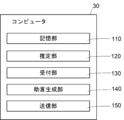
- the functional units in the computing element 31 of the computer 30 of the self-use system 1 of self-bacteria are shown as a schematic block diagram in Figure 4.
- Each functional unit comprises a memory unit 110, an estimation unit 120, a reception unit 130, an advice generation unit 140, a transmission unit 150, etc.
- Processing and execution in the self-use system 1 of self-bacteria are realized in software terms by a self-use program for self-bacteria loaded into the main memory, etc.
- the intestinal bacteria analysis results (analysis information) 35 are information on the identification of the type of bacteria in the collected bacteria, for example in the feces, and the results of genome analysis. It mainly identifies the state of the bacterial flora in the user's intestines (proportion of bacteria present) and the type of bacteria.
- the user's response results (response information) 36 are responses to the questionnaire 12 mentioned above, and the user's subjective sensory evaluation is quantified.
- Advice 14 corresponds to Figure 1, and is the content notified to the user by the self-use system 1 of own bacteria.
- the storage unit 110 stores a nutritional guidance table 20 (see FIG. 2) that associates the types of bacteria that should be grown in the intestines of humans, particularly the user, with nutrients. As explained in FIG. 2, the nutritional guidance table 20 is stored in advance. Of course, the contents are updated as needed.
- the estimation unit 120 cultivates the user's own bacteria contained in the feces collected from the user, analyzes the bacteria, and estimates the type of the user's bacteria and the user's intestinal bacterial flora. From the intestinal bacterial analysis results 35, it is possible to grasp trends in the types and amounts of bacteria. The user's intestinal bacterial flora is then estimated from the similarity to known human intestinal bacterial flora.
- the reception unit 130 receives responses regarding changes in the user's physical condition when the user administers (ingests) the bacterial processed product 15 (see FIG. 1) of the user's own bacteria.
- the responses are responses 17 to a questionnaire 12 sent to the user by the service provider 11. From the standpoint of speeding up the process and making it more convenient, the questionnaire is generated and the responses are received using application software or the like compatible with the user's smartphone, personal computer, or tablet device.
- the advice generating unit 140 responds to the answer and generates nutritional advice for the user according to the user's intestinal bacterial flora based on the nutritional advice table 20 (see FIG. 2). As explained in FIG. 2, advice for improving lifestyle habits and nutritional advice (menu) is generated based on the nutritional advice table 20 according to the user's isolated intestinal bacteria.
- the sending unit 150 sends the advice to the user. Specifically, it sends it to the user's smartphone or personal computer.
- the contents of the transmission may be email, message, SNS notification, or other appropriate form that the user can recognize, such as sending by facsimile, or mailing after printing by the service provider 11.
- related services provided by business operator 11 may include the registration of new species of new bacteria and the naming of new bacteria.
- Bacteria isolated from the user's own intestines, etc. are highly likely to have distinctive characteristics. For this reason, new species of bacteria may be discovered by analyzing the characteristics of the bacteria and the analysis of the bacterial genome sequence. If the genome analysis reveals that the bacteria is a new species, the user who provided the collected bacteria is notified that a new species of bacteria has been discovered, and the new species is registered through business operator 11. Additionally, new bacteria isolated from the user's own body may be named and registered through business operator 11.
- the program for self-use of bacteria in the computer 30 of the system 1 for self-use of bacteria will now be described with reference to the flow chart in Figure 5.
- the method for self-use of bacteria is executed by the computing element 31 of the computer based on the program for self-use of bacteria.
- the program for self-use of bacteria causes the computer 30 in Figures 3 and 4 to perform functions such as a memory function, an estimation function, a reception function, a advice generation function, and a transmission function. Note that each function overlaps with the description of the system 1 for self-use of bacteria described above, and therefore details will be omitted.
- the processing of the arithmetic element 31 of the computer 30 includes various steps, such as a storage step (S110), an estimation step (S120), a reception step (S130), an advice generation step (S140), and a transmission step (S150).
- steps such as a storage step (S110), an estimation step (S120), a reception step (S130), an advice generation step (S140), and a transmission step (S150).
- S110 storage step
- S120 estimation step
- S130 reception step
- S140 advice generation step
- S150 a transmission step
- the storage function stores a nutritional guidance table that associates the type of bacteria to be grown in the human intestine with nutrients (S110; storage step).
- the estimation function cultures the user's own bacteria contained in feces collected from the user, analyzes the bacteria, and estimates the type of the user's bacteria and the user's intestinal bacterial flora (S120; estimation step).
- the reception function receives a response regarding changes in the user's physical condition when the user ingests dried bacterial material of the user's own bacteria (S130; reception step).
- the advice generation function generates nutritional advice for the user based on the response and in accordance with the user's intestinal bacterial flora based on the nutritional guidance table (S140; advice generation step).
- the transmission function transmits the advice to the user (S150; transmission step).
- the computer program of the present invention described above may be recorded on a processor-readable recording medium, and the recording medium may be a "non-transitory tangible medium” such as a disk, card, semiconductor memory, or programmable logic circuit.
- the computer program can be implemented using, for example, a scripting language such as ActionScript or JavaScript (registered trademark), an object-oriented programming language such as Objective-C or Java (registered trademark), or a markup language such as HTML5.
- a scripting language such as ActionScript or JavaScript (registered trademark)
- object-oriented programming language such as Objective-C or Java (registered trademark)
- markup language such as HTML5.
- the inventor carried out the following experiment to evaluate the effects of administering to himself/herself bacteria collected from bacteria normally present in his/her (the user's) body.
- Bacteria of the genus Bifidobacterium were selected from bacteria collected from the feces of healthy individuals other than the inventors and cultured (alternative bacteria of the genus Bifidobacterium). The alternative bacteria were then multiplied and cultured until the number of bacteria reached approximately 10 billion per gram of culture solution.
- Bacteria of the genus Bifidobacterium were selected from bacteria collected from the inventor's feces and cultured (autologous bacteria of the genus Bifidobacterium). The autologous bacteria were then multiplied and cultured until the number of bacteria reached approximately 10 billion per gram of culture solution.
- the inventor ingested approximately 10 billion Bifidobacterium genus bacteria together with a commercially available sports drink.
- the percentage of Bifidobacterium genus species and the percentage of Bifidobacterium longum species among the types of intestinal bacteria contained in the subject's feces were measured through genome analysis before ingestion, one day after ingestion, and three days after ingestion. The results are shown in Table 1.
- useful bacteria derived from bacteria normally present in the user's body it is possible to obtain useful effects such as (1) enhancing efficacy by administering an autologous bacterial preparation, (2) suppressing side effects by administering an autologous bacterial preparation, and (3) improving efficacy through a synergistic effect of adding prebiotics (e.g., dietary fiber, oligosaccharides, etc.) to the autologous bacterial preparation.
- prebiotics e.g., dietary fiber, oligosaccharides, etc.
- (4) utilizing intestinal bacteria test data can be useful for predicting, analyzing, and evaluating efficacy and intestinal bacteria tests, efficacy, and side effects after administration of the autologous bacterial preparation.
- useful bacteria can be cultivated from bacteria normally present in the body of the user, and the user can utilize the bacteria.
- the user can also enjoy the benefits (1) to (4) described above.
Landscapes
- Health & Medical Sciences (AREA)
- Life Sciences & Earth Sciences (AREA)
- Mycology (AREA)
- Chemical & Material Sciences (AREA)
- Public Health (AREA)
- Microbiology (AREA)
- Medicinal Chemistry (AREA)
- Pharmacology & Pharmacy (AREA)
- Veterinary Medicine (AREA)
- Animal Behavior & Ethology (AREA)
- General Health & Medical Sciences (AREA)
- Engineering & Computer Science (AREA)
- Molecular Biology (AREA)
- Epidemiology (AREA)
- Chemical Kinetics & Catalysis (AREA)
- Nutrition Science (AREA)
- Organic Chemistry (AREA)
- Bioinformatics & Cheminformatics (AREA)
- Nuclear Medicine, Radiotherapy & Molecular Imaging (AREA)
- General Chemical & Material Sciences (AREA)
- Polymers & Plastics (AREA)
- Neurosurgery (AREA)
- Neurology (AREA)
- Biomedical Technology (AREA)
- Food Science & Technology (AREA)
- Diabetes (AREA)
- Hematology (AREA)
- Obesity (AREA)
- Medicines Containing Material From Animals Or Micro-Organisms (AREA)
Priority Applications (1)
| Application Number | Priority Date | Filing Date | Title |
|---|---|---|---|
| JP2025532017A JPWO2025100495A1 (https=) | 2023-11-09 | 2024-11-07 |
Applications Claiming Priority (2)
| Application Number | Priority Date | Filing Date | Title |
|---|---|---|---|
| JP2023-191726 | 2023-11-09 | ||
| JP2023191726 | 2023-11-09 |
Publications (1)
| Publication Number | Publication Date |
|---|---|
| WO2025100495A1 true WO2025100495A1 (ja) | 2025-05-15 |
Family
ID=95695244
Family Applications (1)
| Application Number | Title | Priority Date | Filing Date |
|---|---|---|---|
| PCT/JP2024/039655 Pending WO2025100495A1 (ja) | 2023-11-09 | 2024-11-07 | 自己細菌の自己利用方法、自己利用システム、及び自己利用プログラム |
Country Status (2)
| Country | Link |
|---|---|
| JP (1) | JPWO2025100495A1 (https=) |
| WO (1) | WO2025100495A1 (https=) |
Citations (4)
| Publication number | Priority date | Publication date | Assignee | Title |
|---|---|---|---|---|
| JP2018515138A (ja) * | 2015-05-06 | 2018-06-14 | エスエヌアイピーアール・テクノロジーズ・リミテッドSnipr Technologies Limited | 微生物集団の改変および微生物相の修飾 |
| JP2018525023A (ja) * | 2015-08-24 | 2018-09-06 | ニューバイヨタ エルエルシーNubiyota LLC | 標的細菌系からの細菌株を富化するためのシステムおよび方法 |
| US20200046777A1 (en) * | 2017-01-19 | 2020-02-13 | Pleonova Ab | Autologous fecal sample for use in the treatment of microbial dysbiosis |
| JP2024071876A (ja) * | 2022-11-15 | 2024-05-27 | SheepMedical株式会社 | 細菌組成物の製造方法及び細菌組成物の提供方法 |
Family Cites Families (1)
| Publication number | Priority date | Publication date | Assignee | Title |
|---|---|---|---|---|
| JP7016182B1 (ja) * | 2020-07-30 | 2022-02-04 | Noster株式会社 | 細菌提供システム |
-
2024
- 2024-11-07 JP JP2025532017A patent/JPWO2025100495A1/ja not_active Withdrawn
- 2024-11-07 WO PCT/JP2024/039655 patent/WO2025100495A1/ja active Pending
Patent Citations (4)
| Publication number | Priority date | Publication date | Assignee | Title |
|---|---|---|---|---|
| JP2018515138A (ja) * | 2015-05-06 | 2018-06-14 | エスエヌアイピーアール・テクノロジーズ・リミテッドSnipr Technologies Limited | 微生物集団の改変および微生物相の修飾 |
| JP2018525023A (ja) * | 2015-08-24 | 2018-09-06 | ニューバイヨタ エルエルシーNubiyota LLC | 標的細菌系からの細菌株を富化するためのシステムおよび方法 |
| US20200046777A1 (en) * | 2017-01-19 | 2020-02-13 | Pleonova Ab | Autologous fecal sample for use in the treatment of microbial dysbiosis |
| JP2024071876A (ja) * | 2022-11-15 | 2024-05-27 | SheepMedical株式会社 | 細菌組成物の製造方法及び細菌組成物の提供方法 |
Non-Patent Citations (3)
| Title |
|---|
| BULOW CHRISTOPHER, LANGDON AMY, HINK TIFFANY, WALLACE MEGHAN, RESKE KIMBERLY A, PATEL SANKET, SUN XIAOQING, SEILER SONDRA, JONES S: "Impact of Amoxicillin-Clavulanate followed by Autologous Fecal Microbiota Transplantation on Fecal Microbiome Structure and Metabolic Potential", MSPHERE, vol. 3, no. 6, 26 December 2018 (2018-12-26), pages 1 - 13, XP093314160, DOI: 10.1128/mSphereDirect * |
| CHEN KAINAN; FU YOUSI; WANG YALI; LIAO LANGXING; XU HONGZHI; ZHANG AIHUI; ZHANG JUNNAN; FAN LINA; REN JIANLIN; FANG BAISHAN: "Therapeutic Effects of the In Vitro Cultured Human Gut Microbiota as Transplants on Altering Gut Microbiota and Improving Symptoms Associated with Autism Spectrum Disorder", MICROBIAL ECOLOGY, vol. 80, no. 2, 26 February 2020 (2020-02-26), New York, pages 475 - 486, XP037196682, ISSN: 0095-3628, DOI: 10.1007/s00248-020-01494-w * |
| IJICHI, TETSUO ET AL.: "Special feature: current state of immunology research – effect of heat-killed bifidobacterium longum BR-108 on immune function", FOOD STYLE 21, vol. 17, no. 6, 1 January 2013 (2013-01-01), JP , pages 57 - 59, XP009563526, ISSN: 1343-9502 * |
Also Published As
| Publication number | Publication date |
|---|---|
| JPWO2025100495A1 (https=) | 2025-05-15 |
Similar Documents
| Publication | Publication Date | Title |
|---|---|---|
| Mojikon et al. | Probiotication of nutritious fruit and vegetable juices: An alternative to dairy-based probiotic functional products | |
| Tamime et al. | Probiotic dairy products | |
| US20230302063A1 (en) | Probiotic Formulations for Improving Athletic Performance | |
| Mohan et al. | Effect of honey in improving the gut microbial balance | |
| EP3035944B1 (en) | Probiotics for use in the treatment of bacterial vaginosis | |
| Madureira et al. | Protective effect of whey cheese matrix on probiotic strains exposed to simulated gastrointestinal conditions | |
| AU2008317000B2 (en) | Probiotic compositions and methods for inducing and supporting weight loss | |
| Koh et al. | Optimization of a fermented pumpkin-based beverage to improve Lactobacillus mali survival and α-glucosidase inhibitory activity: A response surface methodology approach | |
| CN109069549A (zh) | 用于断奶的食物组合物 | |
| JP5968655B2 (ja) | 石川県の伝統発酵食品から分離した乳酸菌及びその培養物の機能性とその利用 | |
| CN105249100B (zh) | 发酵果蔬汁与甜酒酿复合功能饮料的生产方法 | |
| CN107354097B (zh) | 一种在常温下提高液态乳酸菌存活率的乳酸菌保存剂及其应用 | |
| CN105567669A (zh) | 益生菌微胶囊制剂及其制备方法 | |
| CN105942527A (zh) | 一种益生菌和益生元复合制剂及其制备方法和应用 | |
| JP2013538827A (ja) | 腎機能を増強させるための組成物および方法 | |
| JP6793380B2 (ja) | スクロース摂取による血糖値上昇を抑制する物質の評価方法、スクリーニング方法及び製造方法 | |
| JPH07265064A (ja) | 腸内細菌叢改善組成物 | |
| WO2025100495A1 (ja) | 自己細菌の自己利用方法、自己利用システム、及び自己利用プログラム | |
| Garnås | Fermented vegetables as a potential treatment for irritable bowel syndrome | |
| RU2152792C1 (ru) | Диетическая абсорбируемая композиция, способная улучшать биологическое равновесие флоры кишечного тракта | |
| CN109943487A (zh) | 一种从粪菌中制备乳酸菌液的方法及其应用 | |
| CN101450083A (zh) | 酪酸梭菌在制备治疗新生儿喂养不耐受组合物中的应用 | |
| RU2364406C1 (ru) | Способ получения пробиотической закваски для животных | |
| Gul et al. | Harnessing the Power of Probiotics and Prebiotics: A Comprehensive Guide to Gut Health and Beyond | |
| Grigore et al. | Effects of using probiotics and prebiotics on calves health status: an review. |
Legal Events
| Date | Code | Title | Description |
|---|---|---|---|
| ENP | Entry into the national phase |
Ref document number: 2025532017 Country of ref document: JP Kind code of ref document: A |
|
| WWE | Wipo information: entry into national phase |
Ref document number: 2025532017 Country of ref document: JP |
|
| 121 | Ep: the epo has been informed by wipo that ep was designated in this application |
Ref document number: 24888788 Country of ref document: EP Kind code of ref document: A1 |