WO2025100342A1 - 効果顔料調製物、効果顔料調製物を含む熱可塑性樹脂組成物および効果顔料調製物を含む塗料又はインキの製造方法 - Google Patents
効果顔料調製物、効果顔料調製物を含む熱可塑性樹脂組成物および効果顔料調製物を含む塗料又はインキの製造方法 Download PDFInfo
- Publication number
- WO2025100342A1 WO2025100342A1 PCT/JP2024/039018 JP2024039018W WO2025100342A1 WO 2025100342 A1 WO2025100342 A1 WO 2025100342A1 JP 2024039018 W JP2024039018 W JP 2024039018W WO 2025100342 A1 WO2025100342 A1 WO 2025100342A1
- Authority
- WO
- WIPO (PCT)
- Prior art keywords
- effect pigment
- pigment preparation
- mass
- thermoplastic resin
- pao
- Prior art date
- Legal status (The legal status is an assumption and is not a legal conclusion. Google has not performed a legal analysis and makes no representation as to the accuracy of the status listed.)
- Pending
Links
Images


Classifications
-
- C—CHEMISTRY; METALLURGY
- C09—DYES; PAINTS; POLISHES; NATURAL RESINS; ADHESIVES; COMPOSITIONS NOT OTHERWISE PROVIDED FOR; APPLICATIONS OF MATERIALS NOT OTHERWISE PROVIDED FOR
- C09C—TREATMENT OF INORGANIC MATERIALS, OTHER THAN FIBROUS FILLERS, TO ENHANCE THEIR PIGMENTING OR FILLING PROPERTIES ; PREPARATION OF CARBON BLACK ; PREPARATION OF INORGANIC MATERIALS WHICH ARE NO SINGLE CHEMICAL COMPOUNDS AND WHICH ARE MAINLY USED AS PIGMENTS OR FILLERS
- C09C3/00—Treatment in general of inorganic materials, other than fibrous fillers, to enhance their pigmenting or filling properties
- C09C3/10—Treatment with macromolecular organic compounds
-
- C—CHEMISTRY; METALLURGY
- C09—DYES; PAINTS; POLISHES; NATURAL RESINS; ADHESIVES; COMPOSITIONS NOT OTHERWISE PROVIDED FOR; APPLICATIONS OF MATERIALS NOT OTHERWISE PROVIDED FOR
- C09D—COATING COMPOSITIONS, e.g. PAINTS, VARNISHES OR LACQUERS; FILLING PASTES; CHEMICAL PAINT OR INK REMOVERS; INKS; CORRECTING FLUIDS; WOODSTAINS; PASTES OR SOLIDS FOR COLOURING OR PRINTING; USE OF MATERIALS THEREFOR
- C09D11/00—Inks
-
- C—CHEMISTRY; METALLURGY
- C09—DYES; PAINTS; POLISHES; NATURAL RESINS; ADHESIVES; COMPOSITIONS NOT OTHERWISE PROVIDED FOR; APPLICATIONS OF MATERIALS NOT OTHERWISE PROVIDED FOR
- C09D—COATING COMPOSITIONS, e.g. PAINTS, VARNISHES OR LACQUERS; FILLING PASTES; CHEMICAL PAINT OR INK REMOVERS; INKS; CORRECTING FLUIDS; WOODSTAINS; PASTES OR SOLIDS FOR COLOURING OR PRINTING; USE OF MATERIALS THEREFOR
- C09D17/00—Pigment pastes, e.g. for mixing in paints
-
- C—CHEMISTRY; METALLURGY
- C09—DYES; PAINTS; POLISHES; NATURAL RESINS; ADHESIVES; COMPOSITIONS NOT OTHERWISE PROVIDED FOR; APPLICATIONS OF MATERIALS NOT OTHERWISE PROVIDED FOR
- C09D—COATING COMPOSITIONS, e.g. PAINTS, VARNISHES OR LACQUERS; FILLING PASTES; CHEMICAL PAINT OR INK REMOVERS; INKS; CORRECTING FLUIDS; WOODSTAINS; PASTES OR SOLIDS FOR COLOURING OR PRINTING; USE OF MATERIALS THEREFOR
- C09D201/00—Coating compositions based on unspecified macromolecular compounds
-
- C—CHEMISTRY; METALLURGY
- C09—DYES; PAINTS; POLISHES; NATURAL RESINS; ADHESIVES; COMPOSITIONS NOT OTHERWISE PROVIDED FOR; APPLICATIONS OF MATERIALS NOT OTHERWISE PROVIDED FOR
- C09D—COATING COMPOSITIONS, e.g. PAINTS, VARNISHES OR LACQUERS; FILLING PASTES; CHEMICAL PAINT OR INK REMOVERS; INKS; CORRECTING FLUIDS; WOODSTAINS; PASTES OR SOLIDS FOR COLOURING OR PRINTING; USE OF MATERIALS THEREFOR
- C09D7/00—Features of coating compositions, not provided for in group C09D5/00; Processes for incorporating ingredients in coating compositions
- C09D7/40—Additives
Definitions
- the present invention relates to an effect pigment preparation used in paints and inks for the purpose of imparting visual effects such as brilliance, and in particular to an effect pigment preparation that does not require heating when mixing the raw materials, is compatible with thermoplastic resins, and can be easily kneaded into thermoplastic resins, a thermoplastic resin composition containing the effect pigment preparation, and a method for producing a paint or ink containing the effect pigment preparation.
- Effect pigments have traditionally been used to impart visual effects, such as glitter, to surface coatings.
- effect pigments we mean all pigments that generally have a lamellar structure and provide special decorative color effects to surface coatings.
- Effect pigments include, for example, pure metal pigments such as aluminum, iron or copper, titanium dioxide-coated mica, iron oxide-coated mica, mixed oxide-coated mica, interference pigments such as metal oxide-coated aluminum or liquid crystal pigments.
- effect pigment preparations are commercially available in which solid wax is heated above its melting point, the effect pigment is added and kneaded, and then the wax is molded into pellets or granules.
- JP 2010-121092 A discloses a masterbatch formed into pellets using polyethylene wax and linear low-density polyethylene resin as an effect pigment preparation.
- Patent Document 2 discloses pellets formed by mixing a metal pigment with a water-soluble resin such as polyvinylpyrrolidone and compressing the mixture.
- the masterbatch described in Patent Document 1 melts the wax and resin used, so it is necessary to heat and knead them when mixing.
- the pellets described in Patent Document 2 use a water-soluble resin to be produced without heating, and there are cases where the compatibility with the resin used in the thermoplastic resin composition is insufficient.
- the present invention was made in consideration of the above-mentioned circumstances, and its purpose is to provide an effect pigment preparation that does not require heating when mixing the raw materials, is energetically advantageous, and is compatible with thermoplastic resins.
- an effect pigment preparation containing a total of 99% by weight or more of effect pigment and polyalphaolefin, the polyalphaolefin being liquid at 25°C, and characterized in that the effect pigment is present in an amount of 75% by weight or more and 95% by weight or less, the polyalphaolefin is present in an amount of 5% by weight or more and 25% by weight or less, and the volatile organic compounds are present in an amount of 1% by weight or less, based on the effect pigment preparation.
- the effect pigment preparation of the present invention does not require heating when mixing the raw materials, and is compatible with thermoplastic resins, so it can be easily kneaded into thermoplastic resins. Furthermore, the effect pigment preparation of the present invention can exhibit extremely excellent dispersibility not only when kneaded into thermoplastic resin compositions, but also when used in solvent-based paints.
- the kinematic viscosity of the polyalphaolefin at 40° C. is preferably 4000 mm 2 /s or less.
- the effect pigment is preferably a metal, a metal oxide, a metal hydroxide, or a mixture thereof. Also, the effect pigment is preferably coated with a resin, a metal oxide, a metal hydroxide, or a mixture thereof.
- the effect pigment has a chromatic pigment layer on its surface.
- the chromatic pigment layer contains a resin, a metal oxide, a metal hydroxide, or a mixture thereof.
- the effect pigment preparation of the present invention does not require heating when mixing the raw materials, and since it is compatible with thermoplastic resins, it can also be used as a thermoplastic resin composition by blending it with a thermoplastic resin.
- the present invention also relates to a method for producing a paint or ink comprising the effect pigment preparation as described above.
- the present invention provides an effect pigment preparation that does not require heating when mixing the raw materials, is compatible with thermoplastic resins, and can be easily kneaded into thermoplastic resins, a thermoplastic resin composition containing the effect pigment preparation, and a method for producing a paint or ink containing the effect pigment preparation. Furthermore, the effect pigment preparation of the present invention can provide the excellent effect of being uniformly dispersed not only when kneaded into a thermoplastic resin composition, but also when used in a solvent-based paint.
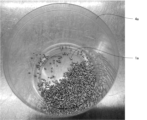
- FIG. 1 is a photograph of the effect pigment preparation of Example 1 (in pellet form).
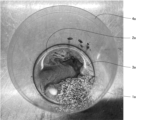
- FIG. 2 is a photograph of the mixture immediately after adding thinner to the effect pigment preparation of Example 1 shown in FIG. 1 .
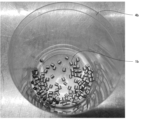
- FIG. 3 is a photograph of the test paint showing the state after stirring of the mixture of Example 1 shown in FIG. 2.
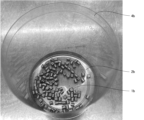
- 1 is a photograph of the effect pigment preparation of Comparative Example 1 (in pellet form).
- FIG. 5 is a photograph of the mixture immediately after adding thinner to the effect pigment preparation of Comparative Example 1 shown in FIG. 4 . 6 is a photograph of the mixture shown in FIG. 5 after stirring the mixture of Comparative Example 1.
- the effect pigment preparation of the present invention comprises an effect pigment and a polyalphaolefin (hereinafter also referred to as "PAO"), and is usually in the form of a solid.
- the total amount of the effect pigment and the PAO is 99% by weight or more.
- the effect pigment preparation does not contain volatile organic compounds, but since volatile organic compounds may be unavoidably contained, it is usually preferable that the amount is 1% by weight or less.
- the shape of the effect pigment preparation is not particularly limited, but it can be, for example, pellet-like, granular, tablet-like, noodle-like, etc.
- the effect pigment means any pigment that imparts a visual effect such as glitter.
- the effect pigment used in the present invention is not particularly limited and may be any known effect pigment, but it is preferable that the effect pigment has a glittering surface.
- the content of the effect pigment in the effect pigment preparation is preferably 75% to 95% by weight of the effect pigment preparation, more preferably 80% to 90% by weight. If the effect pigment content is less than 75% by weight, the content of components other than the effect pigment is relatively high, making it difficult to maintain a pellet-like shape, and therefore, when used in paints, thermoplastic resin compositions, etc., the freedom of design of the paints and thermoplastic resin compositions is greatly restricted. On the other hand, if the effect pigment content exceeds 90% by weight, the PAO is insufficient, causing dust generation and making it impossible to maintain the shape of the effect pigment preparation.
- effect pigments with lustrous properties include metal flakes such as aluminum, titanium, copper, brass, and stainless steel, as well as natural mica, synthetic mica, alumina flakes, and glass flakes.
- Aluminum and aluminum alloys in particular have high hiding power and are therefore suitable for use in the present invention.
- Effect pigments may also be treated with a phosphorus compound, a molybdenum compound, or the like to make them water-resistant, or may be coated with a resin, metal oxide, or the like.
- the shape of the effect pigment is not particularly limited, but is preferably, for example, flake-shaped, scale-shaped, disc-shaped, elliptical disc-shaped, etc.
- the size of the effect pigment is not particularly limited, but for example, particles having a D 50 of 1 ⁇ m to 200 ⁇ m in the volume distribution by laser diffraction method can be suitably used.
- the PAO used in the present invention is liquid at 25° C. Since the PAO is liquid at 25° C., it can be kneaded with the effect pigment without heating.
- the PAO content in the effect pigment preparation is preferably 5% by weight or more and 25% by weight or less, and more preferably 10% by weight or more and 20% by weight or less. If the PAO content is less than 5% by weight, the effect pigment preparation cannot be solidified, whereas if the PAO content exceeds 25% by weight, the effect pigment preparation may become fluid.
- PAO is a homopolymer or copolymer mainly made of alpha-olefins, in which the backbone or part of the side chain may be replaced with other substituents, or may be hydrotreated.
- Alpha-olefins that can be used include ethylene, propylene, 1-butene, 1-hexene, 1-octene, or longer chains, as well as 3-methyl-1-butene, vinylcyclohexane, and other olefins in which the carbon chain other than the terminal double bond has a branched or cyclic structure. Of these, 1-butene, 1-hexene, 1-octene, and other linear alpha-olefins with 4 or more carbon atoms are preferred. Any known catalyst, such as a Ziegler catalyst or a metallocene catalyst, can be used as the catalyst for polymerization.
- the kinetic viscosity of the PAO at 40° C. is preferably 4000 mm 2 /s or less, and more preferably 3500 mm 2 /s or less, for ease of handling.
- PAOs having the above-mentioned viscosity include the SpectraSyn (registered trademark) series, all manufactured by ExxonMobil Corporation. These PAOs may be used alone or in combination.
- the above-mentioned kinematic viscosity at 40°C can be measured using a Cannon-Fenske kinematic viscometer.
- the effect pigment preparation of the present invention may contain additives such as a pigment dispersant and a neutralizing agent as needed, provided that the effects of the present invention are not impaired.
- the effect pigment preparation of the present invention is prepared by mixing the effect pigment, the PAO, and, if necessary, other pigments and additives at room temperature to obtain a mixture, molding the mixture, and then drying it.
- Some effect pigments are commercially available as a paste containing a solvent, but since the solvent is removed during drying, the paste containing the effect pigment may be mixed as it is.
- the method for mixing the effect pigment and the PAO is not particularly limited, but a known method such as using a kneader mixer can be used as appropriate.
- the method for molding the mixture is not particularly limited, but known methods such as extrusion molding and injection molding can be used to obtain the desired shape, such as tablets, pellets, granules, or noodles. Drying depends on the type and amount of the solvent derived from the paste containing the effect pigment, as well as the shape and size of the molded pellets, but is usually done under reduced pressure or normal pressure at room temperature (about 23°C) to 200°C.
- the effect pigment preparation of the present invention can be added to a thermoplastic resin and kneaded into the thermoplastic resin to obtain a thermoplastic resin composition, which can be molded to produce a molded article having the desired brilliance.
- thermoplastic resin used in the thermoplastic resin composition of the present invention is not particularly limited as long as it is a known thermoplastic resin, but for example, at least one resin selected from polyethylene, ABS, polycarbonate, etc. can be used.
- the amount of thermoplastic resin in the thermoplastic resin composition is not particularly limited, but for example, when the thermoplastic resin composition is used to manufacture a molded body by injection molding or the like, it is preferable that the amount of effect pigment is 0.01 to 30 parts by mass per 100 parts by mass of thermoplastic resin. If the amount of thermoplastic resin is less than 0.01 parts by mass, the coloring power will be weak and the desired design may not be obtained. On the other hand, if the amount of thermoplastic resin is more than 30 parts by mass, the mechanical strength of the molded body tends to decrease significantly.
- the effect pigment preparation itself can be used as a masterbatch (solid additive for plastics), but when using a thermoplastic resin composition that has been mixed in advance with a specific thermoplastic resin depending on the application as a masterbatch, it is preferable that the amount of the effect pigment preparation is 20 parts by mass or more per 100 parts by mass of thermoplastic resin. (If the amount of the effect pigment preparation is less than 20 parts by mass, the coloring power will be weak and the desired design may not be obtained.)
- the effect pigment preparation of the present invention can also be used in paints or inks.
- the paints or inks are not particularly limited in terms of the composition other than the effect pigment preparation and the method for producing them, and known raw materials and production methods can be used.
- Example 1 Preparation of effect pigment preparations
- 500 g of a paste containing an aluminum flake pigment as an effect pigment product name: "7680NS", solid content 65% by weight, mineral spirit content 35% by weight, average particle size 11 ⁇ m, manufactured by Toyo Aluminum Co., Ltd.
- 35.0 g of SpectraSyn® Elite 65 (dynamic viscosity at 40°C 600 mm 2 /s, manufactured by ExxonMobil) as a PAO were added to a twin-axis kneader mixer and kneaded for 5 minutes.
- the resulting mixture was molded into pellets using an extrusion granulator (Multigran MG-55-2, manufactured by Dalton Co., Ltd.).
- the molded product was transferred to an inert oven (IPHH-201, manufactured by Espec Co., Ltd.) heated to 120°C and dried under a nitrogen atmosphere for 2 hours to obtain the effect pigment preparation of Example 1.
- the effect pigment content in the effect pigment preparation was 90.3% by mass.
- the heating residue in the obtained effect pigment preparation was measured according to JIS K 5906 and was found to be 99.9% by mass. In other words, the residual solvent content in the effect pigment preparation was 0.1% by mass.
- Example 2 500 g of a paste containing an aluminum flake pigment as an effect pigment (product name: "5620NS", solid content 71% by weight, mineral spirit content 29% by weight, average particle size 18 ⁇ m, manufactured by Toyo Aluminum Co., Ltd.) and 20.0 g of SpectraSyn® Elite 65 (dynamic viscosity at 40°C 600 mm 2 /s, manufactured by ExxonMobil) as a PAO were added to a twin-axis kneader mixer and kneaded for 5 minutes. The resulting mixture was molded into pellets using an extrusion granulator (Multigran MG-55-2, manufactured by Dalton Co., Ltd.). The molded product was transferred to an inert oven (IPHH-201, manufactured by Espec Co., Ltd.) heated to 120°C and dried under a nitrogen atmosphere for 2 hours to obtain an effect pigment preparation of Example 2.
- IPHH-201 inert oven
- the effect pigment content in the effect pigment preparation was 94.7% by mass.
- the heating residue in the obtained effect pigment preparation was measured according to JIS K 5906 and was found to be 100.0% by mass. In other words, the residual solvent content in the effect pigment preparation was 0.0% by mass.
- Example 3 500 g of a paste containing a colored aluminum flake pigment as an effect pigment (product name: "EMR-D46BLA", solid content 55% by weight, 2-propanol content 45% by weight, average particle size 18 ⁇ m, manufactured by Toyo Aluminum Co., Ltd.) and 80.0 g of SpectraSyn (registered trademark) Elite 65 (dynamic viscosity at 40°C 600 mm 2 /s, manufactured by ExxonMobil) as a PAO were added to a twin-axis kneader mixer and kneaded for 5 minutes. The resulting mixture was molded into pellets using an extrusion granulator (Multigran MG-55-2, manufactured by Dalton Co., Ltd.). The molded product was transferred to an inert oven (IPHH-201, manufactured by Espec Co., Ltd.) heated to 120°C and dried for 30 minutes under a nitrogen atmosphere to obtain an effect pigment preparation of Example 3.
- IPHH-201 inert oven
- the effect pigment content in the effect pigment preparation was 77.5% by mass.
- the heating residue in the obtained effect pigment preparation was measured according to JIS K 5906 and was found to be 100.0% by mass. In other words, the residual solvent content in the effect pigment preparation was 0.0% by mass.
- Example 4 500 g of a paste containing colored aluminum flake pigment as an effect pigment (product name: "EMR-D46GRA", solid content 55% by mass, 2-propanol content 45% by mass, average particle size 18 ⁇ m, manufactured by Toyo Aluminum Co., Ltd.) and 60.0 g of SpectraSyn (registered trademark) Elite 65 (dynamic viscosity at 40°C 600 mm 2 /s, manufactured by ExxonMobil Co., Ltd.) as a PAO were added to a twin-axis kneader mixer and kneaded for 5 minutes.
- EMR-D46GRA solid content 55% by mass, 2-propanol content 45% by mass, average particle size 18 ⁇ m, manufactured by Toyo Aluminum Co., Ltd.
- the resulting mixed aluminum product was molded into pellets using an extrusion granulator (Multigran MG-55-2, manufactured by Dalton Co., Ltd.).
- the molded product was transferred to an inert oven (IPHH-201, manufactured by Espec Co., Ltd.) heated to 120°C and dried for 30 minutes under a nitrogen atmosphere to obtain the effect pigment preparation of Example 4.
- the effect pigment content in the effect pigment preparation was 82.1% by mass.
- the heating residue in the obtained effect pigment preparation was measured according to JIS K 5906 and was found to be 100.0% by mass. In other words, the residual solvent content in the effect pigment preparation was 0.0% by mass.
- Example 5 500 g of a paste containing silica-coated aluminum flake pigment as an effect pigment (product name: "EMR-D5660", solid content 50% by weight, propylene glycol monomethyl ether content 50% by weight, average particle size 10 ⁇ m, manufactured by Toyo Aluminum Co., Ltd.) and 40.0 g of SpectraSyn (registered trademark) Elite 65 (dynamic viscosity at 40°C 600 mm 2 /s, manufactured by ExxonMobil) as a PAO were added to a twin-axis kneader mixer and kneaded for 5 minutes.
- EMR-D5660 solid content 50% by weight, propylene glycol monomethyl ether content 50% by weight, average particle size 10 ⁇ m, manufactured by Toyo Aluminum Co., Ltd.
- SpectraSyn registered trademark
- Elite 65 dynamic viscosity at 40°C 600 mm 2 /s, manufactured by ExxonMobil
- the resulting mixture was molded into pellets using an extrusion granulator (Multigran MG-55-2, manufactured by Dalton Co., Ltd.).
- the molded product was transferred to an inert oven (IPHH-201, manufactured by Espec Co., Ltd.) heated to 120°C and dried under a nitrogen atmosphere for 1 hour to obtain an effect pigment preparation of Example 5.
- the effect pigment content in the effect pigment preparation was 86.2% by mass.
- the heating residue in the obtained effect pigment preparation was measured according to JIS K 5906 and was found to be 100.0% by mass. In other words, the residual solvent content in the effect pigment preparation was 0.0% by mass.
- Example 6 500 g of a paste containing a colored aluminum flake pigment as an effect pigment (product name: "EMR-D5620", solid content 60% by weight, propylene glycol monomethyl ether content 40% by weight, average particle size 20 ⁇ m, manufactured by Toyo Aluminum Co., Ltd.) and 60.0 g of SpectraSyn (registered trademark) Elite 300 (dynamic viscosity at 40°C 3400 mm 2 /s, manufactured by ExxonMobil) as a PAO were added to a twin-axis kneader mixer and kneaded for 5 minutes.
- EMR-D5620 solid content 60% by weight, propylene glycol monomethyl ether content 40% by weight, average particle size 20 ⁇ m, manufactured by Toyo Aluminum Co., Ltd.
- SpectraSyn (registered trademark) Elite 300 dynamic viscosity at 40°C 3400 mm 2 /s, manufactured by ExxonMobil
- the resulting mixture was molded into pellets using an extrusion granulator (Multigran MG-55-2, manufactured by Dalton Co., Ltd.).
- the molded product was transferred to an inert oven (IPHH-201, manufactured by Espec Co., Ltd.) heated to 120°C and dried for 30 minutes under a nitrogen atmosphere to obtain an effect pigment preparation of Example 6.
- the effect pigment content in the effect pigment preparation was 83.3% by mass.
- the heating residue in the obtained effect pigment preparation was measured according to JIS K 5906 and was found to be 100.0% by mass. In other words, the residual solvent content in the effect pigment preparation was 0.0% by mass.
- Example 7 500 g of a paste containing a resin-coated aluminum flake pigment as an effect pigment (product name: "BP-5660", solid content 50% by weight, mineral spirit content 50% by weight, average particle size 10 ⁇ m, manufactured by Toyo Aluminum Co., Ltd.) and 50.0 g of SpectraSyn (registered trademark) Elite 65 (dynamic viscosity at 40°C 600 mm 2 /s, manufactured by ExxonMobil) as a PAO were added to a two-axis kneader mixer and kneaded for 5 minutes. The resulting mixture was molded into pellets using an extrusion granulator (Multigran MG-55-2, manufactured by Dalton Co., Ltd.). The molded product was transferred to an inert oven (IPHH-201, manufactured by Espec Co., Ltd.) heated to 120°C and dried under a nitrogen atmosphere for 2 hours to obtain an effect pigment preparation of Example 7.
- IPHH-201 inert oven
- the effect pigment content in the effect pigment preparation was 83.3% by mass.
- the heating residue in the obtained effect pigment preparation was measured in accordance with JIS K 5906 and was found to be 99.9% by mass. In other words, the residual solvent content in the effect pigment preparation was 0.1% by mass.
- the effect pigment content in the effect pigment preparation was 69.9% by mass.
- the heating residue in the obtained effect pigment preparation was measured according to JIS K 5906 and was found to be 99.7% by mass. In other words, the residual solvent content in the effect pigment preparation was 0.3% by mass.
- EMR-D5660 solid content 50% by weight, propylene glycol monomethyl ether content 50% by weight, average particle size 10 ⁇ m, manufactured by Toyo Aluminum Co., Ltd.
- SpectraSyn (registered trademark) Elite 65 dynamic viscosity at 40°C 600 mm 2 /s, manufactured by ExxonMobil
- the resulting mixture was molded into pellets using an extrusion granulator (Multigran MG-55-2, manufactured by Dalton Co., Ltd.).
- the molded product was transferred to an inert oven (IPHH-201, manufactured by Espec Co., Ltd.) heated to 120°C and dried for 5 hours under a nitrogen atmosphere.
- IPHH-201 manufactured by Espec Co., Ltd.
- the pellet state could not be maintained, but became a powder state, so the effect pigment preparation of Comparative Example 2 could not be obtained and the test was discontinued.
- EMR-D5660 solid content 50% by weight, propylene glycol monomethyl ether content 50% by weight, average particle size 10 ⁇ m, manufactured by Toyo Aluminum Co., Ltd.
- the resulting mixture was molded into pellets using an extrusion granulator (Multigran MG-55-2, manufactured by Dalton Co., Ltd.).
- the molded product was transferred to an inert oven (IPHH-201, manufactured by Espec Co., Ltd.) heated to 120°C and dried for 5 hours under a nitrogen atmosphere, whereupon the pellets adhered to each other and were too soft to maintain a pelletized state, so the effect pigment preparation of Comparative Example 3 could not be obtained and the test was discontinued.
- the resulting mixture was molded into pellets using an extrusion granulator (Multigran MG-55-2, manufactured by Dalton Co., Ltd.).
- the molded product obtained was transferred to an inert oven (IPHH-201, manufactured by Espec Co., Ltd.) heated to 120°C and dried for 5 hours under a nitrogen atmosphere, but it could not maintain a pellet state and became a powder state, so the effect pigment preparation of Comparative Example 4 could not be obtained and the test was discontinued.
- thermoplastic resin compositions were injection molded into a plate mold (50 mm x 80 mm x 3 mm) using an injection molding machine "FE80S1 2ASE" (manufactured by Nissei Plastic Industrial Co., Ltd.) under the following conditions: cylinder temperature: nozzle part 230°C, front part 230°C, middle part 225°C, rear part 220°C, and mold temperature: 60°C, to obtain molded bodies according to Examples 1 to 6 and Comparative Example 1.
- the obtained molded bodies were also visually inspected and evaluated for their finished state. Specifically, the molded product was rated as "good” if it had no defects such as unevenness, scratches, or cracks, and no color unevenness in luster, etc.
- a steel plate with an undercoat was prepared (a steel plate coated in the following order: substrate: iron, electrochemical layer: zinc treatment layer, undercoat layer: chipping-resistant layer, base coat layer: base concealing and decorative layer, and top coat layer: base coat protective layer), and the test paints according to the above-mentioned Examples 1 to 6 and Comparative Example 1 were applied to one surface of the steel plate using a spray gun (manufactured by Anest Iwata, product name: W-101-134G) so that the dry film thickness was 13 to 15 ⁇ m, and the steel plate was dried at 80°C for 20 minutes.
- a spray gun manufactured by Anest Iwata, product name: W-101-134G
- the coated surfaces of the steel plates coated with the test paints of Examples 1 to 6 and Comparative Example 1 were visually inspected and evaluated after drying. Specifically, the case where the test paint could be produced and the formed coating film was smooth and did not cause color unevenness in terms of luster, etc. was rated as "Good”, and the case where the test paint itself could not be produced, the coated surface of the steel plate was uneven, or color unevenness in terms of luster, etc. was rated as "Poor".
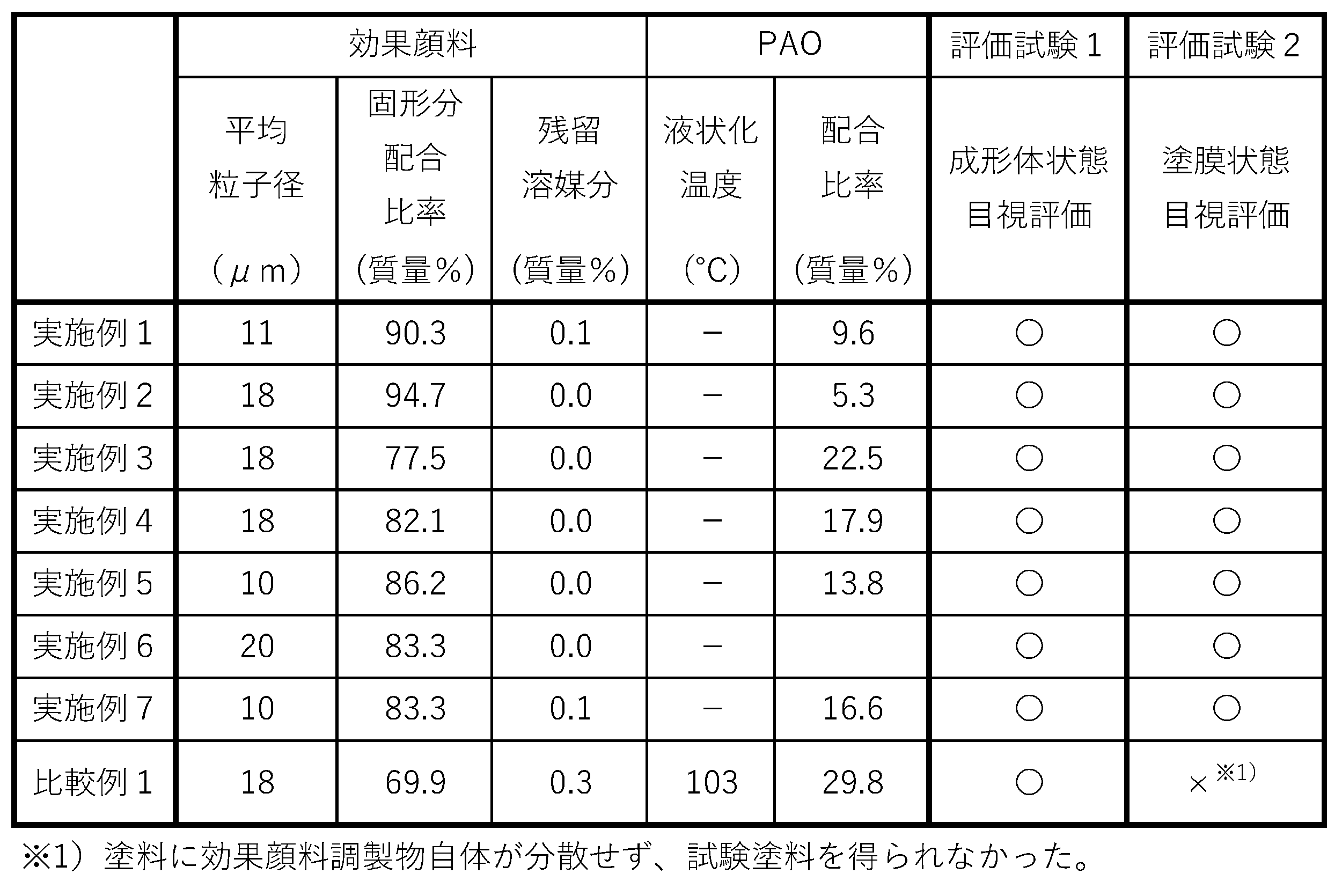
- Table 2 shows the blending ratios of the effect pigment (solid content) and PAO in the effect pigment preparations of Examples 1 to 6 and Comparative Example 1, and the test results of Evaluation Test 1 and Evaluation Test 2 conducted on the effect pigment preparations of each Example and Comparative Example.
- the effect pigment preparations of Examples 1 to 6 and the effect pigment preparation of Comparative Example 1 all produced molded products in Evaluation Test 1 that were free of defects such as unevenness, scratches, and cracks, and had good gloss and color uniformity.
- FIG. 1 shows a photograph of the effect pigment preparation of Example 1 (in pellet form).
- FIG. 2 shows a photograph of the effect pigment preparation of Example 1 shown in FIG. 1 immediately after thinner is added
- FIG. 3 shows a photograph of the mixture of Example 1 shown in FIG. 2 after stirring.
- FIG. 4 shows a photograph of the effect pigment preparation of Comparative Example 1 (in pellet form).
- FIG. 5 shows a photograph of the effect pigment preparation of Comparative Example 1 shown in FIG. 4 immediately after thinner is added
- FIG. 6 shows a photograph of the mixture of Comparative Example 1 shown in FIG. 5 after stirring.
- the pellet-shaped effect pigment preparation of Example 1 begins to disperse immediately after the thinner is added ( Figure 2), and after stirring, it disperses uniformly in the thinner ( Figure 3), making it possible to obtain a test paint.
- the pellet-shaped effect pigment preparation of Comparative Example 1 does not disperse even when the thinner is added ( Figure 5), and does not disperse at all in the thinner even when stirred ( Figure 6), making it impossible to obtain a test paint.
- the conditions for obtaining an effect pigment preparation that does not require heating when mixing the raw materials, is compatible with thermoplastic resins, and exhibits extremely excellent dispersibility not only when kneaded into a thermoplastic resin composition but also when used in a solvent-based paint are that the effect pigment and PAO are contained in total at 99% by mass or more, the PAO is liquid at 25°C, and the effect pigment in the effect pigment preparation is preferably 75% by mass or more and 95% by mass or less, more preferably 80% by mass or more and 90% by mass or less, and the PAO is preferably 5% by mass or more and 25% by mass or less, more preferably 10% by mass or more and 20% by mass or less, and are important.
- the kinetic viscosity of the PAO at 40° C. is preferably 4000 mm 2 /s or less, and more preferably 3500 mm 2 /s or less.
Landscapes
- Chemical & Material Sciences (AREA)
- Organic Chemistry (AREA)
- Life Sciences & Earth Sciences (AREA)
- Engineering & Computer Science (AREA)
- Materials Engineering (AREA)
- Wood Science & Technology (AREA)
- Paints Or Removers (AREA)
- Pigments, Carbon Blacks, Or Wood Stains (AREA)
- Inks, Pencil-Leads, Or Crayons (AREA)
Abstract
原料を混合する際に加熱を必要とせず、熱可塑性樹脂との相溶性がある効果顔料調製物、効果顔料調製物を含む熱可塑性樹脂組成物および効果顔料調製物を含む塗料又はインキの製造方法を提供する。本発明によれば、効果顔料とポリアルファオレフィン(PAO)とを合計で99質量%以上含有する効果顔料調製物において、PAOが40℃において液状であり、そして効果顔料調製物に対して、効果顔料が75質量%以上95質量%以下であり、PAOが5質量%以上25質量%以下であり、揮発性有機化合物が1質量%以下であることを特徴とする効果顔料調製物、効果顔料調製物を含む熱可塑性樹脂組成物および効果顔料調製物を含む塗料又はインキの製造方法が提供される。
Description
本発明は、光輝性などの視覚効果を付与する目的等で塗料やインキに用いられる効果顔料調製物に関し、特に、原料混合時に加熱を必要とせず、熱可塑性樹脂と相溶性を有し、熱可塑性樹脂に容易に練り込むことが可能な効果顔料調製物、効果顔料調製物を含む熱可塑性樹脂組成物および効果顔料調製物を含む塗料又はインキの製造方法に関する。
従来より、表面被覆に光輝性などの視覚効果を付与する目的で効果顔料が用いられている。効果顔料とは、一般的に薄板状構造を有し、表面被覆に特別な装飾的色効果を提供する全ての顔料を意味する。効果顔料としては、例えば、アルミニウム、鉄、又は、銅のような純粋な金属顔料、二酸化チタンでコートされた雲母、酸化鉄でコートされた雲母、混合酸化物でコートされた雲母、金属酸化物でコートされたアルミニウムのような干渉顔料又は液晶顔料が挙げられる。
また、効果顔料を熱可塑性樹脂組成物に投入するためには、効果顔料調製物として、固体状のワックスを融点以上まで熱し、そこへ効果顔料を投入して混錬した後、ペレット状や顆粒状に成形されたものが市販されている。
例えば、特開2010―121092号公報(特許文献1)には、効果顔料調製物として、ポリエチレンワックスと直鎖状低密度ポリエチレン樹脂を用いてペレット状に成形したマスターバッチが開示されている。他にも、例えばWO2015/169502号公報(特許文献2)のように、金属顔料をポリビニルピロリドンなどの水溶性樹脂と混合して圧縮したペレットが開示されている。
しかしながら、特許文献1に記載のマスターバッチは使用するワックスと樹脂を溶融させるため、混合する際に加熱して混錬を行う必要がある。一方、特許文献2に記載のペレットは加熱せずに製造するために水溶性樹脂を用いており、熱可塑性樹脂組成物に使用される樹脂との相溶性が不十分となる場合があった。
そこで、本発明は上記のような状況に鑑みてなされたものであって、その目的とするところは、原料を混合する際に加熱を必要とせず、エネルギー的に有利であり、熱可塑性樹脂との相溶性がある効果顔料調製物を提供することにある。
本発明者は、上記問題を解決するために効果顔料調製物の組成などについて鋭意研究を重ねた結果、効果顔料を特定の温度において液状であるポリアルファオレフィンと特定の割合で配合すれば上記課題を解決できることを見出し、本発明を完成するに至った。
すなわち、本発明によれば、効果顔料とポリアルファオレフィンとを合計で99質量%以上含有する効果顔料調製物において、ポリアルファオレフィンが25℃において液状であり、そして効果顔料調製物に対して、効果顔料が75質量%以上95質量%以下であり、ポリアルファオレフィンが5質量%以上25質量%以下であり、揮発性有機化合物が1質量%以下であることを特徴とする効果顔料調製物が提供される。
本発明の効果顔料調製物は、原料混合時に加熱を必要とせず、熱可塑性樹脂と相溶性を有しているので熱可塑性樹脂に容易に練り込むことが可能である。また、本発明の効果顔料調製物は、熱可塑性樹脂組成物への練り込みのみならず、溶剤系の塗料に用いても極めて優れ分散性を示すことができる。
本発明において、ポリアルファオレフィンの動粘度は、40℃において4000mm2/s以下であることが好ましい。
本発明において、効果顔料は、金属、金属酸化物、金属水酸化物又はこれらの混合物であることが好ましい。また、効果顔料は、樹脂、金属酸化物、金属水酸化物又はこれらの混合物によりコーティングされていることが好ましい。
さらに、効果顔料は、その表面に有彩色顔料層を備えていることが好ましい。また、有彩色顔料層は、樹脂、金属酸化物、金属水酸化物又はこれらの混合物を含有していることが好ましい。
本発明の効果顔料調製物は、原料混合時に加熱を必要とせず、熱可塑性樹脂との相溶性を有することから、熱可塑性樹脂に配合することにより熱可塑性樹脂組成物として用いることもできる。
また、本発明は、上述したような効果顔料調製物を含む塗料又はインキの製造方法にも係る。
本発明によれば、原料混合時に加熱を必要とせず、熱可塑性樹脂と相溶性を有し、容易に熱可塑性樹脂に練り込むことが可能な効果顔料調製物、効果顔料調製物を含む熱可塑性樹脂組成物および効果顔料調製物を含む塗料又はインキの製造方法が提供される。また、本発明の効果顔料調製物は、熱可塑性樹脂組成物への練り込みのみならず、溶剤系の塗料に用いても均一に分散されるという優れた効果を奏することができる。
以下、本発明の一実施形態に係る効果顔料調製物、効果顔料調製物を含む熱可塑性樹脂組成物および効果顔料調製物を含む塗料又はインキの製造方法について、図面を参照しながら詳細に説明する。なお、本発明は、以下に示される実施例に限定されるものではなく、本発明の技術的思想を逸脱しない範囲内で各種の変更が可能である。
<効果顔料調製物>
本発明の効果顔料調製物は、効果顔料とポリアルファオレフィン(以下、「PAO」ともいう。)とを含み、通常は固形の形態を有している。効果顔料とPAOの量は合計で99質量%以上である。また、効果顔料調製物は揮発性有機化合物を含まないことが理想であるが、揮発性有機化合物が不可避的に含まれることがあるので、通常は1質量%以下であることが好ましい。
本発明の効果顔料調製物は、効果顔料とポリアルファオレフィン(以下、「PAO」ともいう。)とを含み、通常は固形の形態を有している。効果顔料とPAOの量は合計で99質量%以上である。また、効果顔料調製物は揮発性有機化合物を含まないことが理想であるが、揮発性有機化合物が不可避的に含まれることがあるので、通常は1質量%以下であることが好ましい。
効果顔料調製物の形状は、特に限定されないが、例えばペレット状、顆粒状、タブレット状、麺状などの形状とすることができる。
<効果顔料>
効果顔料とは、光輝性などの視覚効果を付与する全ての顔料を意味する。本発明で使用する効果顔料は、特に限定されることなく公知の効果顔料を使用することができるが、その表面が光輝性を有する顔料であることが好ましい。効果顔料調製物中の効果顔料の含有量は、効果顔料調製物の75質量%以上95質量%以下であることが好ましく、80質量%以上90質量%以下であることがより好ましい。効果顔料の含有量が75質量%未満であると、相対的に効果顔料以外の成分の含有量が多くなるのでペレット状等の形態を保つことが困難となり、また、そのために塗料や熱可塑性樹脂組成物などに用いる場合、当該塗料や熱可塑性樹脂組成物の設計の自由度が大幅に制限されることになる。一方、効果顔料の含有量が90質量%を超えるとPAOが不足し、粉塵を発生したり、効果顔料調製物の形状を維持できなくなる。
効果顔料とは、光輝性などの視覚効果を付与する全ての顔料を意味する。本発明で使用する効果顔料は、特に限定されることなく公知の効果顔料を使用することができるが、その表面が光輝性を有する顔料であることが好ましい。効果顔料調製物中の効果顔料の含有量は、効果顔料調製物の75質量%以上95質量%以下であることが好ましく、80質量%以上90質量%以下であることがより好ましい。効果顔料の含有量が75質量%未満であると、相対的に効果顔料以外の成分の含有量が多くなるのでペレット状等の形態を保つことが困難となり、また、そのために塗料や熱可塑性樹脂組成物などに用いる場合、当該塗料や熱可塑性樹脂組成物の設計の自由度が大幅に制限されることになる。一方、効果顔料の含有量が90質量%を超えるとPAOが不足し、粉塵を発生したり、効果顔料調製物の形状を維持できなくなる。
光輝性を有する効果顔料としては、例えば、アルミニウム、チタン、銅、真鍮、ステンレススチールなどの金属フレークの他、天然マイカ、合成マイカ、アルミナフレーク、ガラスフレークなどが挙げられる。特にアルミニウム又はアルミニウム合金は隠蔽力が高いため、本発明に好適に用いることができる。また、効果顔料は、リン化合物、モリブデン化合物などにより耐水化処理されていたり、又は樹脂、金属酸化物等で被覆されていてもよい。
効果顔料の形状は、特に限定されないが、例えば、フレーク状、鱗片状、円盤状、楕円盤状などであることが好ましい。
効果顔料の大きさは、特に限定されないが、例えば、レーザー回折法による体積分布におけるD50が1μm~200μmである粒子を好適に用いることができる。
<ポリアルファオレフィン>
本発明で使用するPAOは、25℃において液状である。PAOは、25℃において液状であるため、効果顔料との混合時に加熱することなく混錬が可能となる。
本発明で使用するPAOは、25℃において液状である。PAOは、25℃において液状であるため、効果顔料との混合時に加熱することなく混錬が可能となる。
効果顔料調製物中のPAOの含有量は、5質量%以上25質量%以下であることが好ましく、10質量%以上20質量%以下であることがより好ましい。PAOの含有量が5質量%未満であると、効果顔料調製物を固めることができなくなり、一方、PAOの含有量が25質量%を超えると、効果顔料調製物が流動化してしまうおそれがある。
PAOは、アルファオレフィンを主として重合させたホモポリマー又はコポリマーで、骨格又は側鎖の一部が他の置換基に置き換わっていてもよいし、水素化処理されていてもよい。アルファオレフィンとしてはエチレン、プロピレン、1-ブテン、1-ヘキセンや1-オクテン、あるいはより長鎖のものの他、3-メチル-1-ブテンやビニルシクロヘキサンなど末端の二重結合以外の炭素鎖が分枝構造や環状構造を有するものも使用できる。中でも、1-ブテン、1-ヘキセンや1-オクテンなどの炭素数が4以上かつ直鎖状のアルファオレフィンであることが好ましい。また重合に使用する触媒としてはチーグラー触媒、メタロセン触媒等の公知のものを任意に使用できる。
PAOの40℃における動粘度は、取り扱い上4000mm2/s以下であることが好ましく、3500mm2/s以下であることがより好ましい。
上述のような粘度を有するPAOとして市販で入手できるものとしては、いずれもエクソンモービル社製の、SpectraSyn(登録商標)シリーズ等が挙げられる。また、これらのPAOは、単独で用いても、複数組み合わせて使用してもよい。なお、上記の40℃における動粘度は、キャノン・フェンスケ動粘度計を用いて測定することができる。
<その他の添加剤>
本発明の効果顔料調製物は、PAOの他に適宜必要に応じて、本発明の効果を損なわない範囲で顔料分散剤、中和剤などの添加剤を含んでいてもよい。
本発明の効果顔料調製物は、PAOの他に適宜必要に応じて、本発明の効果を損なわない範囲で顔料分散剤、中和剤などの添加剤を含んでいてもよい。
<効果顔料調製物の製造方法>
本発明の効果顔料調製物は、効果顔料とPAOと、必要に応じてその他の顔料や添加剤等を常温で混合して混合物を得、得られた混合物を成形した後、乾燥することにより調製される。効果顔料は、溶剤を加えたペーストとして市販されているものがあるが、乾燥の際に溶剤は除去されるため、前記効果顔料を含むペーストのまま混合してもよい。
本発明の効果顔料調製物は、効果顔料とPAOと、必要に応じてその他の顔料や添加剤等を常温で混合して混合物を得、得られた混合物を成形した後、乾燥することにより調製される。効果顔料は、溶剤を加えたペーストとして市販されているものがあるが、乾燥の際に溶剤は除去されるため、前記効果顔料を含むペーストのまま混合してもよい。
効果顔料とPAOを混合する方法は、特に限定されないが、例えば、ニーダーミキサーを用いるなど公知の方法を適宜使用することができる。混合物の成形方法は、特に限定されないが、タブレット状、ペレット状、顆粒状又はヌードル状など所望する形状に合わせて、押出成形や射出成形などの公知の方法を用いることができる。乾燥は、効果顔料を含むペーストに由来する溶剤の種類やその量並びに成形したペレット等の形状や大きさにもよるが、通常は室温(約23℃)~200℃の減圧下又は常圧下で乾燥させればよい。
<熱可塑性樹脂組成物>
本発明では、他の実施形態として、本発明の効果顔料調製物を熱可塑性樹脂に加えて練り込むことにより熱可塑性樹脂組成物を得ることができる。また、熱可塑性樹脂組成物を成形すれば、所望の光輝性を有する成形体を作製することができる。
本発明では、他の実施形態として、本発明の効果顔料調製物を熱可塑性樹脂に加えて練り込むことにより熱可塑性樹脂組成物を得ることができる。また、熱可塑性樹脂組成物を成形すれば、所望の光輝性を有する成形体を作製することができる。
本発明の熱可塑性樹脂組成物で使用される熱可塑性樹脂は、公知の熱可塑性樹脂であれば特に限定されないが、例えば、ポリエチレン、ABS、ポリカーボネートなどから選択される少なくとも一種の樹脂を用いることができる。
熱可塑性樹脂組成物中の熱可塑性樹脂の配合量は特に限定されないが、例えば、熱可塑性樹脂組成物を射出成形等による成形体の製造に用いる場合、熱可塑性樹脂100質量部に対して効果顔料の配合量が0.01質量部以上30質量部以下であることが好ましい。熱可塑性樹脂の配合量が0.01質量部未満であると、着色力が弱く所望の意匠が得られなくなるおそれがある。一方、熱可塑性樹脂の配合量が30質量部を超えると、成形体の機械的強度が著しく低下する傾向がある。
また、本発明では、効果顔料調製物自体をマスターバッチ(プラスチック用の固体添加剤)として用いることもできるが、用途に応じて所定の熱可塑性樹脂と予め混合した熱可塑性樹脂組成物とをマスターバッチとして用いる場合、熱可塑性樹脂100質量部に対して効果顔料調製物の配合量が20質量部以上であることが好ましい。(効果顔料調製物の配合量が20質量部未満であると、着色力が弱く所望の意匠が得られなくなるおそれがある。
<インキ、塗料>
本発明では、他の実施形態として、本発明の効果顔料調製物を塗料又はインキに用いることもできる。この場合、塗料又はインキは、効果顔料調製物以外の組成やそれらの製造方法について特に限定はなく、公知の原料や製造方法を使用することができる。
本発明では、他の実施形態として、本発明の効果顔料調製物を塗料又はインキに用いることもできる。この場合、塗料又はインキは、効果顔料調製物以外の組成やそれらの製造方法について特に限定はなく、公知の原料や製造方法を使用することができる。
以下、実施例を挙げて本発明をさらに詳細に説明するが、本発明はこれらに限定されるものではない。
<効果顔料調製物の作製>
[実施例1]
2軸ニーダーミキサーに効果顔料としてアルミニウムフレーク顔料を含むペースト(商品名:「7680NS」、固形分65質量%、ミネラルスピリット分35質量%、平均粒径11μm、東洋アルミニウム株式会社製)を500g、およびPAOとしてSpectraSyn(登録商標) Elite 65(40℃での動粘度600mm2/s、エクソンモービル製)35.0gを加え、5分間混錬した。得られた混合物は押出造粒機(マルチグランMG-55-2、株式会社ダルトン製)を用いてペレット状に成形した。120℃に加温されたイナートオーブン(IPHH-201、株式会社エスペック製)内に得られた成形物を移し、窒素雰囲気下で2時間乾燥させて実施例1の効果顔料調製物を得た。
[実施例1]
2軸ニーダーミキサーに効果顔料としてアルミニウムフレーク顔料を含むペースト(商品名:「7680NS」、固形分65質量%、ミネラルスピリット分35質量%、平均粒径11μm、東洋アルミニウム株式会社製)を500g、およびPAOとしてSpectraSyn(登録商標) Elite 65(40℃での動粘度600mm2/s、エクソンモービル製)35.0gを加え、5分間混錬した。得られた混合物は押出造粒機(マルチグランMG-55-2、株式会社ダルトン製)を用いてペレット状に成形した。120℃に加温されたイナートオーブン(IPHH-201、株式会社エスペック製)内に得られた成形物を移し、窒素雰囲気下で2時間乾燥させて実施例1の効果顔料調製物を得た。
効果顔料調製物中に含まれる効果顔料の含有量は90.3質量%であった。なお、得られた効果顔料調製物中の加熱残分をJIS K 5906に従って測定したところ99.9質量%である。すなわち、効果顔料調製物中の残留溶媒分は0.1質量%であった。
[実施例2]
2軸ニーダーミキサーに効果顔料としてアルミニウムフレーク顔料を含むペースト(商品名:「5620NS」、固形分71質量%、ミネラルスピリット分29質量%、平均粒径18μm、東洋アルミニウム株式会社製)を500g、およびPAOとしてSpectraSyn(登録商標) Elite 65(40℃での動粘度600mm2/s、エクソンモービル製)20.0gを加え、5分間混錬した。得られた混合物は押出造粒機(マルチグランMG-55-2、株式会社ダルトン製)を用いてペレット状に成形した。120℃に加温されたイナートオーブン(IPHH-201、株式会社エスペック製)内に得られた成形物を移し、窒素雰囲気下で2時間乾燥させて実施例2の効果顔料調製物を得た。
2軸ニーダーミキサーに効果顔料としてアルミニウムフレーク顔料を含むペースト(商品名:「5620NS」、固形分71質量%、ミネラルスピリット分29質量%、平均粒径18μm、東洋アルミニウム株式会社製)を500g、およびPAOとしてSpectraSyn(登録商標) Elite 65(40℃での動粘度600mm2/s、エクソンモービル製)20.0gを加え、5分間混錬した。得られた混合物は押出造粒機(マルチグランMG-55-2、株式会社ダルトン製)を用いてペレット状に成形した。120℃に加温されたイナートオーブン(IPHH-201、株式会社エスペック製)内に得られた成形物を移し、窒素雰囲気下で2時間乾燥させて実施例2の効果顔料調製物を得た。
効果顔料調製物中に含まれる効果顔料の含有量は94.7質量%であった。なお、得られた効果顔料調製物中の加熱残分をJIS K 5906に従って測定したところ100.0質量%である。すなわち、効果顔料調製物中の残留溶媒分は0.0質量%であった。
[実施例3]
2軸ニーダーミキサーに効果顔料として着色アルミニウムフレーク顔料を含むペースト(商品名:「EMR-D46BLA」、固形分55質量%、2-プロパノール分45質量%、平均粒径18μm、東洋アルミニウム株式会社製)を500g、およびPAOとしてSpectraSyn(登録商標) Elite 65(40℃での動粘度600mm2/s、エクソンモービル製)80.0gを加え、5分間混錬した。得られた混合物は押出造粒機(マルチグランMG-55-2、株式会社ダルトン製)を用いてペレット状に成形した。120℃に加温されたイナートオーブン(IPHH-201,株式会社エスペック製)内に得られた成形物を移し、窒素雰囲気下で30分乾燥させて実施例3の効果顔料調製物を得た。
2軸ニーダーミキサーに効果顔料として着色アルミニウムフレーク顔料を含むペースト(商品名:「EMR-D46BLA」、固形分55質量%、2-プロパノール分45質量%、平均粒径18μm、東洋アルミニウム株式会社製)を500g、およびPAOとしてSpectraSyn(登録商標) Elite 65(40℃での動粘度600mm2/s、エクソンモービル製)80.0gを加え、5分間混錬した。得られた混合物は押出造粒機(マルチグランMG-55-2、株式会社ダルトン製)を用いてペレット状に成形した。120℃に加温されたイナートオーブン(IPHH-201,株式会社エスペック製)内に得られた成形物を移し、窒素雰囲気下で30分乾燥させて実施例3の効果顔料調製物を得た。
効果顔料調製物中に含まれる効果顔料の含有量は77.5質量%であった。なお、得られた効果顔料調製物中の加熱残分をJIS K 5906に従って測定したところ100.0質量%である。すなわち、効果顔料調製物中の残留溶媒分は0.0質量%であった。
[実施例4]
2軸ニーダーミキサーに効果顔料として着色アルミニウムフレーク顔料を含むペースト(商品名:「EMR-D46GRA」、固形分55質量%、2-プロパノール分45質量%、平均粒径18μm、東洋アルミニウム株式会社製)を500g、およびPAOとしてSpectraSyn(登録商標) Elite 65(40℃での動粘度600mm2/s、エクソンモービル製)60.0gを加え、5分間混錬した.得られた混合アルミニ物は押出造粒機(マルチグランMG-55-2,株式会社ダルトン製)を用いてペレット状に成形した。120℃に加温されたイナートオーブン(IPHH-201、株式会社エスペック製)内に得られた成形物を移し、窒素雰囲気下で30分乾燥させて実施例4の効果顔料調製物を得た。
2軸ニーダーミキサーに効果顔料として着色アルミニウムフレーク顔料を含むペースト(商品名:「EMR-D46GRA」、固形分55質量%、2-プロパノール分45質量%、平均粒径18μm、東洋アルミニウム株式会社製)を500g、およびPAOとしてSpectraSyn(登録商標) Elite 65(40℃での動粘度600mm2/s、エクソンモービル製)60.0gを加え、5分間混錬した.得られた混合アルミニ物は押出造粒機(マルチグランMG-55-2,株式会社ダルトン製)を用いてペレット状に成形した。120℃に加温されたイナートオーブン(IPHH-201、株式会社エスペック製)内に得られた成形物を移し、窒素雰囲気下で30分乾燥させて実施例4の効果顔料調製物を得た。
効果顔料調製物中に含まれる効果顔料の含有量は82.1質量%であった。なお、得られた効果顔料調製物中の加熱残分をJIS K 5906に従って測定したところ100.0質量%である。すなわち、効果顔料調製物中の残留溶媒分は0.0質量%であった。
[実施例5]
2軸ニーダーミキサーに効果顔料としてシリカコートアルミニウムフレーク顔料を含むペースト(商品名:「EMR-D5660」、固形分50質量%、プロピレングリコールモノメチルエーテル分50質量%、平均粒径10μm、東洋アルミニウム株式会社製)を500g、およびPAOとしてSpectraSyn(登録商標) Elite 65(40℃での動粘度600mm2/s、エクソンモービル製)40.0gを加え、5分間混錬した。得られた混合物は押出造粒機(マルチグランMG-55-2、株式会社ダルトン製)を用いてペレット状に成形した。120℃に加温されたイナートオーブン(IPHH-201、株式会社エスペック製)内に得られた成形物を移し、窒素雰囲気下で1時間乾燥させて実施例5の効果顔料調製物を得た。
2軸ニーダーミキサーに効果顔料としてシリカコートアルミニウムフレーク顔料を含むペースト(商品名:「EMR-D5660」、固形分50質量%、プロピレングリコールモノメチルエーテル分50質量%、平均粒径10μm、東洋アルミニウム株式会社製)を500g、およびPAOとしてSpectraSyn(登録商標) Elite 65(40℃での動粘度600mm2/s、エクソンモービル製)40.0gを加え、5分間混錬した。得られた混合物は押出造粒機(マルチグランMG-55-2、株式会社ダルトン製)を用いてペレット状に成形した。120℃に加温されたイナートオーブン(IPHH-201、株式会社エスペック製)内に得られた成形物を移し、窒素雰囲気下で1時間乾燥させて実施例5の効果顔料調製物を得た。
効果顔料調製物中に含まれる効果顔料の含有量は86.2質量%であった。なお、得られた効果顔料調製物中の加熱残分をJIS K 5906に従って測定したところ100.0質量%である。すなわち、効果顔料調製物中の残留溶媒分は0.0質量%であった。
[実施例6]
2軸ニーダーミキサーに効果顔料として着色アルミニウムフレーク顔料を含むペースト(商品名:「EMR-D5620」、固形分60質量%、プロピレングリコールモノメチルエーテル分40質量%、平均粒径20μm、東洋アルミニウム株式会社製)を500g、およびPAOとしてSpectraSyn(登録商標) Elite 300(40℃での動粘度3400mm2/s、エクソンモービル製)60.0gを加え、5分間混錬した。得られた混合物は押出造粒機(マルチグランMG-55-2、株式会社ダルトン製)を用いてペレット状に成形した。120℃に加温されたイナートオーブン(IPHH-201,株式会社エスペック製)内に得られた成形物を移し、窒素雰囲気下で30分乾燥させて実施例6の効果顔料調製物を得た。
2軸ニーダーミキサーに効果顔料として着色アルミニウムフレーク顔料を含むペースト(商品名:「EMR-D5620」、固形分60質量%、プロピレングリコールモノメチルエーテル分40質量%、平均粒径20μm、東洋アルミニウム株式会社製)を500g、およびPAOとしてSpectraSyn(登録商標) Elite 300(40℃での動粘度3400mm2/s、エクソンモービル製)60.0gを加え、5分間混錬した。得られた混合物は押出造粒機(マルチグランMG-55-2、株式会社ダルトン製)を用いてペレット状に成形した。120℃に加温されたイナートオーブン(IPHH-201,株式会社エスペック製)内に得られた成形物を移し、窒素雰囲気下で30分乾燥させて実施例6の効果顔料調製物を得た。
効果顔料調製物中に含まれる効果顔料の含有量は83.3質量%であった。なお、得られた効果顔料調製物中の加熱残分をJIS K 5906に従って測定したところ100.0質量%である。すなわち、効果顔料調製物中の残留溶媒分は0.0質量%であった。
[実施例7]
2軸ニーダーミキサーに効果顔料として樹脂コートアルミニウムフレーク顔料を含むペースト(商品名:「BP-5660」、固形分50質量%、ミネラルスピリット分50質量%、平均粒径10μm、東洋アルミニウム株式会社製)を500g、およびPAOとしてSpectraSyn(登録商標) Elite 65(40℃での動粘度600mm2/s、エクソンモービル製)50.0gを加え、5分間混錬した。得られた混合物は押出造粒機(マルチグランMG-55-2、株式会社ダルトン製)を用いてペレット状に成形した。120℃に加温されたイナートオーブン(IPHH-201、株式会社エスペック製)内に得られた成形物を移し、窒素雰囲気下で2時間乾燥させて実施例7の効果顔料調製物を得た。
2軸ニーダーミキサーに効果顔料として樹脂コートアルミニウムフレーク顔料を含むペースト(商品名:「BP-5660」、固形分50質量%、ミネラルスピリット分50質量%、平均粒径10μm、東洋アルミニウム株式会社製)を500g、およびPAOとしてSpectraSyn(登録商標) Elite 65(40℃での動粘度600mm2/s、エクソンモービル製)50.0gを加え、5分間混錬した。得られた混合物は押出造粒機(マルチグランMG-55-2、株式会社ダルトン製)を用いてペレット状に成形した。120℃に加温されたイナートオーブン(IPHH-201、株式会社エスペック製)内に得られた成形物を移し、窒素雰囲気下で2時間乾燥させて実施例7の効果顔料調製物を得た。
効果顔料調製物中に含まれる効果顔料の含有量は83.3質量%であった。なお、得られた効果顔料調製物中の加熱残分をJIS K 5906に従って測定したところ99.9質量%である。すなわち、効果顔料調製物中の残留溶媒分は0.1質量%であった。
[比較例1]
比較のため、特許文献1に基づいて以下の条件にて効果顔料調製物を作製した。2軸ニーダーミキサーに効果顔料としてアルミニウムフレーク顔料を含むペースト(商品名:「5620NS」、固形分71質量%、ミネラルスピリット分29質量%、平均粒径18μm、東洋アルミニウム株式会社製)を700g、およびPAOとしてポリエチレンワックス(商品名:「サンワックス161-P」、融点103℃、溶融粘度4300mPa・s、三洋化成株式会社製)を192g、直鎖状低密度ポリエチレン樹脂(商品名:「エボリューSP2510」、株式会社プライムポリマー製)を22g投入し、加熱温度160℃で1時間混練し、その後脱気して、混合物を作製した。引き続き、得られた混合物を、クラッシャー等で予備粉砕し、ディスクペレタイザーにて円柱ペレット状の比較例1の効果顔料調製物を得た。
比較のため、特許文献1に基づいて以下の条件にて効果顔料調製物を作製した。2軸ニーダーミキサーに効果顔料としてアルミニウムフレーク顔料を含むペースト(商品名:「5620NS」、固形分71質量%、ミネラルスピリット分29質量%、平均粒径18μm、東洋アルミニウム株式会社製)を700g、およびPAOとしてポリエチレンワックス(商品名:「サンワックス161-P」、融点103℃、溶融粘度4300mPa・s、三洋化成株式会社製)を192g、直鎖状低密度ポリエチレン樹脂(商品名:「エボリューSP2510」、株式会社プライムポリマー製)を22g投入し、加熱温度160℃で1時間混練し、その後脱気して、混合物を作製した。引き続き、得られた混合物を、クラッシャー等で予備粉砕し、ディスクペレタイザーにて円柱ペレット状の比較例1の効果顔料調製物を得た。
効果顔料調製物中に含まれる効果顔料の含有量は69.9質量%であった。なお、得られた効果顔料調製物中の加熱残分をJIS K 5906に従って測定したところ99.7質量%である。すなわち、効果顔料調製物中の残留溶媒分は0.3質量%であった。
[比較例2]
2軸ニーダーミキサーに効果顔料としてシリカコートアルミニウムフレーク顔料を含むペースト(商品名:「EMR-D5660」、固形分50質量%、プロピレングリコールモノメチルエーテル分50質量%、平均粒径10μm、東洋アルミニウム株式会社製)を500g、およびPAOとしてSpectraSyn(登録商標) Elite 65(40℃での動粘度600mm2/s、エクソンモービル製)8.0gを加え、5分間混錬した。得られた混合物は押出造粒機(マルチグランMG-55-2、株式会社ダルトン製)を用いてペレット状に成形した。120℃に加温されたイナートオーブン(IPHH-201、株式会社エスペック製)内に得られた成形物を移し、窒素雰囲気下で5時間乾燥させるとペレット状態を保つことができず、パウダー状態となったので比較例2の効果顔料調製物を得ることができず、試験を中止した。
2軸ニーダーミキサーに効果顔料としてシリカコートアルミニウムフレーク顔料を含むペースト(商品名:「EMR-D5660」、固形分50質量%、プロピレングリコールモノメチルエーテル分50質量%、平均粒径10μm、東洋アルミニウム株式会社製)を500g、およびPAOとしてSpectraSyn(登録商標) Elite 65(40℃での動粘度600mm2/s、エクソンモービル製)8.0gを加え、5分間混錬した。得られた混合物は押出造粒機(マルチグランMG-55-2、株式会社ダルトン製)を用いてペレット状に成形した。120℃に加温されたイナートオーブン(IPHH-201、株式会社エスペック製)内に得られた成形物を移し、窒素雰囲気下で5時間乾燥させるとペレット状態を保つことができず、パウダー状態となったので比較例2の効果顔料調製物を得ることができず、試験を中止した。
[比較例3]
2軸ニーダーミキサーに効果顔料としてシリカコートアルミニウムフレーク顔料を含むペースト(商品名:「EMR-D5660」、固形分50質量%、プロピレングリコールモノメチルエーテル分50質量%、平均粒径10μm、東洋アルミニウム株式会社製)を500g、およびPAOとしてSpectraSyn(登録商標) Elite 65(40℃での動粘度600mm2/s、エクソンモービル製)157.0gを加え、5分間混錬した。得られた混合物は押出造粒機(マルチグランMG-55-2、株式会社ダルトン製)を用いてペレット状に成形した。120℃に加温されたイナートオーブン(IPHH-201、株式会社エスペック製)内に得られた成形物を移し、窒素雰囲気下で5時間乾燥させるとペレット同士が付着し、柔らか過ぎてペレット状態を保てなかったので比較例3の効果顔料調製物を得ることができず、試験を中止した。
2軸ニーダーミキサーに効果顔料としてシリカコートアルミニウムフレーク顔料を含むペースト(商品名:「EMR-D5660」、固形分50質量%、プロピレングリコールモノメチルエーテル分50質量%、平均粒径10μm、東洋アルミニウム株式会社製)を500g、およびPAOとしてSpectraSyn(登録商標) Elite 65(40℃での動粘度600mm2/s、エクソンモービル製)157.0gを加え、5分間混錬した。得られた混合物は押出造粒機(マルチグランMG-55-2、株式会社ダルトン製)を用いてペレット状に成形した。120℃に加温されたイナートオーブン(IPHH-201、株式会社エスペック製)内に得られた成形物を移し、窒素雰囲気下で5時間乾燥させるとペレット同士が付着し、柔らか過ぎてペレット状態を保てなかったので比較例3の効果顔料調製物を得ることができず、試験を中止した。
[比較例4]
2軸ニーダーミキサーに効果顔料としてアルミニウムフレーク顔料を含むペースト(商品名:「EMR-D5660、固形分50質量%、プロピレングリコールモノメチルエーテル分50質量%、平均粒径10μm、東洋アルミニウム株式会社製)を500g、および同じくエチレンもアルファオレフィンと共通することから、PAOとしてエチレン-アルファオレフィンコポリマー(商品名:「タフマー(登録商標) A」、融点66℃、三井化学株式会社製)62.5gを加え、5分間混錬した。得られた混合物は押出造粒機(マルチグランMG-55-2、株式会社ダルトン製)を用いてペレット状に成形した。120℃に加温されたイナートオーブン(IPHH-201、株式会社エスペック製)内に得られた成形物を移し、窒素雰囲気下で5時間乾燥させるとペレット状態を保つことができず、パウダー状態となったので比較例4の効果顔料調製物を得ることができず、試験を中止した。
2軸ニーダーミキサーに効果顔料としてアルミニウムフレーク顔料を含むペースト(商品名:「EMR-D5660、固形分50質量%、プロピレングリコールモノメチルエーテル分50質量%、平均粒径10μm、東洋アルミニウム株式会社製)を500g、および同じくエチレンもアルファオレフィンと共通することから、PAOとしてエチレン-アルファオレフィンコポリマー(商品名:「タフマー(登録商標) A」、融点66℃、三井化学株式会社製)62.5gを加え、5分間混錬した。得られた混合物は押出造粒機(マルチグランMG-55-2、株式会社ダルトン製)を用いてペレット状に成形した。120℃に加温されたイナートオーブン(IPHH-201、株式会社エスペック製)内に得られた成形物を移し、窒素雰囲気下で5時間乾燥させるとペレット状態を保つことができず、パウダー状態となったので比較例4の効果顔料調製物を得ることができず、試験を中止した。
以上の結果を表1に示す。

<効果顔料調製物の評価>
[評価試験1]
ペレット状に成形することができた実施例1~6および比較例1の効果顔料調製物を、透明ABS樹脂(製品名「CL-430」デンカ株式会社製)100質量部に対して固形分で1質量部配合し、230℃で混練して実施例1~6および比較例1に係る熱可塑性樹脂組成物を得た。得られた熱可塑性樹脂組成物を、射出成形機「FE80S1 2ASE」(日精樹脂工業株式会社製)を用いて、シリンダー温度をノズル部230℃、前部230℃、中間部225℃、後部220℃、金型温度を60℃の条件にて、プレート型(50mm×80mm×3mm)へ射出成形し、実施例1~6および比較例1に係る成形体を得た。得られた成形体も仕上がり状態を目視で確認をして評価した。具体的には、成形体に凹凸やキズ、割れ等の欠陥がなく光輝性などにおいて色ムラを生じてない(効果顔料の均一な分散が確認できる)場合を「〇」、成形体に凹凸やキズ、割れ等の欠陥が見られるか、又は光輝性などにおいて色ムラを生じている(効果顔料の凝集や不均一な分散が確認できる)場合を「×」として評価した。
[評価試験1]
ペレット状に成形することができた実施例1~6および比較例1の効果顔料調製物を、透明ABS樹脂(製品名「CL-430」デンカ株式会社製)100質量部に対して固形分で1質量部配合し、230℃で混練して実施例1~6および比較例1に係る熱可塑性樹脂組成物を得た。得られた熱可塑性樹脂組成物を、射出成形機「FE80S1 2ASE」(日精樹脂工業株式会社製)を用いて、シリンダー温度をノズル部230℃、前部230℃、中間部225℃、後部220℃、金型温度を60℃の条件にて、プレート型(50mm×80mm×3mm)へ射出成形し、実施例1~6および比較例1に係る成形体を得た。得られた成形体も仕上がり状態を目視で確認をして評価した。具体的には、成形体に凹凸やキズ、割れ等の欠陥がなく光輝性などにおいて色ムラを生じてない(効果顔料の均一な分散が確認できる)場合を「〇」、成形体に凹凸やキズ、割れ等の欠陥が見られるか、又は光輝性などにおいて色ムラを生じている(効果顔料の凝集や不均一な分散が確認できる)場合を「×」として評価した。
[評価試験2]
室温(23℃)において、ペレット状に成形することができた実施例1~6および比較例1の効果顔料調製物をそれぞれPP(ポリプロピレン)製カップ内に固形分として10g測り取り、効果顔料調製物を入れたカップヘシンナー(日本ペイント株式会社製、商品名: naxアドミラ500スタンダードシンナー)を20g加えてスパチュラにて掻き混ぜた。掻き混ぜた混合物ヘクリヤー(日本ペイント株式会社製、naxアドミラ280補正用クリヤー)を110g加え、攪拌機で500rpmの回転数で5分撹拌した。撹拌した混合物へ前述のシンナーを110gとnaxマルチ(10:1)#20ハードナー10gを加え、スパチュラにてさらに掻き混ぜることにより、実施例1~6および比較例1に係る試験用塗料を調製した。
室温(23℃)において、ペレット状に成形することができた実施例1~6および比較例1の効果顔料調製物をそれぞれPP(ポリプロピレン)製カップ内に固形分として10g測り取り、効果顔料調製物を入れたカップヘシンナー(日本ペイント株式会社製、商品名: naxアドミラ500スタンダードシンナー)を20g加えてスパチュラにて掻き混ぜた。掻き混ぜた混合物ヘクリヤー(日本ペイント株式会社製、naxアドミラ280補正用クリヤー)を110g加え、攪拌機で500rpmの回転数で5分撹拌した。撹拌した混合物へ前述のシンナーを110gとnaxマルチ(10:1)#20ハードナー10gを加え、スパチュラにてさらに掻き混ぜることにより、実施例1~6および比較例1に係る試験用塗料を調製した。
次に、中塗りが施された鋼板(基材:鉄、電着層:亜鉛処理層、中塗り層:耐チッピング層、ベースコート層:下地隠蔽および加飾層およびトップコート層:ベースコートの保護層の順で被覆された鋼板)を準備し、その鋼板の一方の表面に、スプレーガン(アネスト岩田製、商品名:W-101-134G)を用いて、乾燥膜厚が13~15μmとなるように、前述の実施例1~6および比較例1に係る試験用塗料を塗布し、80℃で20分間乾燥させた。
実施例1~6および比較例1に係る試験用塗料が塗布された鋼板の乾燥後の塗工面について目視で確認をして評価した。具体的には、試験用塗料を作製することができ、そして形成された塗膜が平滑で光輝性などにおいて色ムラを生じてない場合を「〇」、試験用塗料自体を作製することができない、鋼板の塗工面に凹凸が見られる又は光輝性などにおいて色ムラを生じている場合を「×」として評価した。
実施例1~6および比較例1の効果顔料調製物における効果顔料(固形分)とPAOの配合比率と、各実施例および各比較例の効果顔料調製物について行った上記評価試験1と評価試験2の試験結果を表2に示す。
<考察>
表1に示されるように、実施例1~7および比較例1では、ペレット状の効果顔料調製物を得ることができたのに対して、比較例2~4では、ペレット状の効果顔料調製物を得ることができなかった。
表1に示されるように、実施例1~7および比較例1では、ペレット状の効果顔料調製物を得ることができたのに対して、比較例2~4では、ペレット状の効果顔料調製物を得ることができなかった。
その詳細な理由は定かではないが、実施例1~7の場合、フレーク同士を結着させるPAO分が適当であるので、フレーク同士が樹脂を介して決着しペレット状態を保つことができたものと考えられる。また、比較例1の場合、室温で固体のPAOとフレークとを高温で混錬することでPAOが溶融し、PAO内にフレークが一様に分散した状態で室温へ戻した結果再び固化し、その混合物をディスクペレタイザーで押し出したのでペレット状態を保つことができたものと考えられる。
一方、比較例2の場合、フレーク同士を結着させるためPAO分が少な過ぎるため、フレーク同士が決着できずにパウダー状になったものと考えられる。比較例3の場合、フレーク同士を結着させるためのPAO分が過剰に多く、また室温でPAOが液状であるために、形態を維持できない流動性を有してしまったものと考えられる。また、比較例4の場合、室温で固体のPAOを使用しており、加熱せずに混錬しても室温で固体のPAOとフレークとは分離しており、その状態にて押出・乾燥を行ったのでペレット状態にはならず、パウダー状になったものと考えられる。
表2に示されるように、実施例1~6の効果顔料調製物および比較例1の効果顔料調製物は、いずれも評価試験1において成形体に凹凸やキズ、割れ等の欠陥がなく、光輝性などについても色ムラがなく良好な成形体を得られる結果となった。
図1には、実施例1の効果顔料調製物(ペレット状の状態)の写真が示されている。図2には、図1に示される実施例1の効果顔料調製物へシンナーを投入した直後の状態の写真が示されており、図3には、図2に示される実施例1の混合物を撹拌した後の状態の写真が示されている。一方、図4には、比較例1の効果顔料調製物(ペレット状の状態)の写真が示されている。図5には、図4に示される比較例1の効果顔料調製物へシンナーを投入した直後の状態の写真が示されており、図6には、図5に示される比較例1の混合物を撹拌した後の状態の写真が示されている。
図1~3を参照して理解されるように、実施例1のペレット状の効果顔料調製物(図1)は、シンナーを投入した直後から分散が始まり(図2)、撹拌した後はシンナーの中で均一に分散し(図3)、試験用塗料を得ることができる。一方、比較例1のペレット状の効果顔料調製物(図4)は、シンナーを投入しても分散せず(図5)、撹拌してもシンナーの中で分散することが全くなかったので(図6)、試験用塗料を得ることができなかった。
このように、評価試験2において、実施例1~6の効果顔料調製物はシンナーの中で容易に分散する(図1~3)。そのため、実施例1~6の効果顔料調製物に係る塗料を用いて塗工面は、平滑で光輝性などにおいて色ムラのない良好な塗膜を得ることができる。一方、比較例1の効果顔料調製物は、図4~6に示されるようにシンナーの中で全く分散することができず、鋼板塗工用の塗料を得られない結果となった。
そのため、実施例1~6の効果顔料調製物と比較例1の効果顔料調製物とを比較すると、原料混合時に加熱を必要とせず、熱可塑性樹脂と相溶性を有し、そして熱可塑性樹脂組成物への練り込みのみならず、溶剤系の塗料に用いても極めて優れ分散性を示す効果顔料調製物を得るための条件としては、効果顔料とPAOとを合計で99質量%以上含有し、PAOが25℃において液状であり、そして効果顔料調製物中の効果顔料が75質量%以上95質量%以下であることが好ましく、80質量%以上90質量%以下であることがより好ましく、PAOが5質量%以上25質量%以下であることが好ましく、10質量%以上20質量%以下であることがより好ましく、重要であることが判った。
また、表2より、40℃におけるPAOの動粘度が4000mm2/s以下であることが好ましく、3500mm2/s以下であることがより好ましいこと等も判った。
1a、1b・・・効果顔料調製物
2a、2b・・・シンナー
3a・・・・・・効果顔料調製物とシンナーの混合物
4a、4b・・・カップ
2a、2b・・・シンナー
3a・・・・・・効果顔料調製物とシンナーの混合物
4a、4b・・・カップ
Claims (8)
- 効果顔料とポリアルファオレフィンとを合計で99質量%以上含有する効果顔料調製物において、
前記ポリアルファオレフィンが25℃において液状であり、そして前記効果顔料調製物に対して
前記効果顔料が75質量%以上95質量%以下であり、
前記ポリアルファオレフィンが5質量%以上25質量%以下であり、
揮発性有機化合物が1質量%以下であることを特徴とする、効果顔料調製物。 - 40℃における前記ポリアルファオレフィンの動粘度が4000mm2/s以下であることを特徴とする、請求項1に記載の効果顔料調製物。
- 前記効果顔料は、金属、金属酸化物、金属水酸化物又はこれらの混合物であることを特徴とする、請求項1に記載の効果顔料調製物。
- 前記効果顔料は、樹脂、金属酸化物、金属水酸化物又はこれらの混合物によりコーティングされていることを特徴とする、請求項1に記載の効果顔料調製物。
- 前記効果顔料は、その表面に有彩色顔料層を備えていることを特徴とする、請求項1に記載の効果顔料調製物。
- 前記有彩色顔料層は、樹脂、金属酸化物、金属水酸化物又はこれらの混合物を含有することを特徴とする、請求項5に記載の効果顔料調製物。
- 請求項1から6のいずれか1項に記載の効果顔料調製物と、熱可塑性樹脂とを含む、熱可塑性樹脂組成物。
- 請求項1か6のいずれか1項に記載の効果顔料調製物を含む塗料又はインキの製造方法。
Applications Claiming Priority (2)
| Application Number | Priority Date | Filing Date | Title |
|---|---|---|---|
| JP2023-190791 | 2023-11-08 | ||
| JP2023190791A JP2025078318A (ja) | 2023-11-08 | 2023-11-08 | 効果顔料調製物、効果顔料調製物を含む熱可塑性樹脂組成物および効果顔料調製物を含む塗料又はインキの製造方法 |
Publications (1)
| Publication Number | Publication Date |
|---|---|
| WO2025100342A1 true WO2025100342A1 (ja) | 2025-05-15 |
Family
ID=95695682
Family Applications (1)
| Application Number | Title | Priority Date | Filing Date |
|---|---|---|---|
| PCT/JP2024/039018 Pending WO2025100342A1 (ja) | 2023-11-08 | 2024-11-01 | 効果顔料調製物、効果顔料調製物を含む熱可塑性樹脂組成物および効果顔料調製物を含む塗料又はインキの製造方法 |
Country Status (2)
| Country | Link |
|---|---|
| JP (1) | JP2025078318A (ja) |
| WO (1) | WO2025100342A1 (ja) |
Citations (7)
| Publication number | Priority date | Publication date | Assignee | Title |
|---|---|---|---|---|
| JPH02175768A (ja) * | 1988-12-28 | 1990-07-09 | Dainichiseika Color & Chem Mfg Co Ltd | プラスチック用着色剤の製造方法 |
| JP2001081183A (ja) * | 1999-09-13 | 2001-03-27 | Mitsui Chemicals Inc | オレフィン変性ポリオール及びその製造方法 |
| JP2002003745A (ja) * | 2000-05-12 | 2002-01-09 | Merck Patent Gmbh | 修飾コロホニー樹脂を含む顔料調製物 |
| JP2003055574A (ja) * | 2001-08-10 | 2003-02-26 | Nippon Koken Kogyo Kk | 高虹彩色酸化チタン組成物の被覆組成物及び高虹彩色酸化チタン組成物とその製法 |
| JP2004323708A (ja) * | 2003-04-25 | 2004-11-18 | Toyo Ink Mfg Co Ltd | 着色剤の製造方法 |
| JP2006117820A (ja) * | 2004-10-22 | 2006-05-11 | Toyo Ink Mfg Co Ltd | 印刷用着色剤組成物及びその成形品 |
| JP2018135530A (ja) * | 2018-04-16 | 2018-08-30 | 旭化成株式会社 | アルミニウム顔料組成物、それを含む樹脂組成物、及びその成形品 |
-
2023
- 2023-11-08 JP JP2023190791A patent/JP2025078318A/ja active Pending
-
2024
- 2024-11-01 WO PCT/JP2024/039018 patent/WO2025100342A1/ja active Pending
Patent Citations (7)
| Publication number | Priority date | Publication date | Assignee | Title |
|---|---|---|---|---|
| JPH02175768A (ja) * | 1988-12-28 | 1990-07-09 | Dainichiseika Color & Chem Mfg Co Ltd | プラスチック用着色剤の製造方法 |
| JP2001081183A (ja) * | 1999-09-13 | 2001-03-27 | Mitsui Chemicals Inc | オレフィン変性ポリオール及びその製造方法 |
| JP2002003745A (ja) * | 2000-05-12 | 2002-01-09 | Merck Patent Gmbh | 修飾コロホニー樹脂を含む顔料調製物 |
| JP2003055574A (ja) * | 2001-08-10 | 2003-02-26 | Nippon Koken Kogyo Kk | 高虹彩色酸化チタン組成物の被覆組成物及び高虹彩色酸化チタン組成物とその製法 |
| JP2004323708A (ja) * | 2003-04-25 | 2004-11-18 | Toyo Ink Mfg Co Ltd | 着色剤の製造方法 |
| JP2006117820A (ja) * | 2004-10-22 | 2006-05-11 | Toyo Ink Mfg Co Ltd | 印刷用着色剤組成物及びその成形品 |
| JP2018135530A (ja) * | 2018-04-16 | 2018-08-30 | 旭化成株式会社 | アルミニウム顔料組成物、それを含む樹脂組成物、及びその成形品 |
Also Published As
| Publication number | Publication date |
|---|---|
| JP2025078318A (ja) | 2025-05-20 |
Similar Documents
| Publication | Publication Date | Title |
|---|---|---|
| CN1163550C (zh) | 颜料制剂 | |
| JP3577576B2 (ja) | 表面処理剤、表面処理薄片状顔料及びその製造方法 | |
| CN102216374B (zh) | 合成树脂着色用母料 | |
| CN1243807C (zh) | 含有改性松香树脂的颜料制剂 | |
| CN101065454B (zh) | 复合粉体涂料、其制造方法及粉体涂料的调色方法 | |
| JP2003532777A (ja) | 塗料用ワックス混合物 | |
| ZA200007768B (en) | Powder coatings compositions. | |
| CN112300667B (zh) | 一种粉末涂料及其制备方法 | |
| EP0280749A1 (en) | A novel resin-coated metallic pigment, a process for its production and its use | |
| CN101117461A (zh) | 粉末涂料组合物的制造方法 | |
| JP7258709B2 (ja) | 中空粒子及びその用途 | |
| US20100179256A1 (en) | Highly Filled Colorant Composition For Coloring Olefinic And Also Nonolefinic Plastics | |
| JP2006511626A (ja) | 粉末塗料におけるメタロセンワックスの用途 | |
| CN1250791A (zh) | 颜料制剂 | |
| CN109503942A (zh) | 滑石粉母粒及其制备方法 | |
| WO2025100342A1 (ja) | 効果顔料調製物、効果顔料調製物を含む熱可塑性樹脂組成物および効果顔料調製物を含む塗料又はインキの製造方法 | |
| US20090105373A1 (en) | Highly Filled Colorant Composition for Colouring Olefinic and Non-Olefinic Plastics | |
| JP2001511832A (ja) | 粉末状のコーティング用着色組成物 | |
| JP6914672B2 (ja) | ポリプロピレン系樹脂組成物及び自動車外装用部品 | |
| JP4794055B2 (ja) | 樹脂添加用光輝性材料及び熱可塑性樹脂組成物 | |
| CN112980054A (zh) | 一种用于abs高白亮度的条状铝颜料及其制备方法 | |
| JPWO2020021735A1 (ja) | 樹脂被覆金属顔料 | |
| EP1582560A1 (en) | Method and derived product, for the preparation of chips, flakes, pastes, and similar items, containing particles, to be added to moulding polymers and paints | |
| EP1984298B1 (fr) | Argiles modifiees, procede d'obtention et applications | |
| CN115003734B (zh) | 液体添加剂组合物 |
Legal Events
| Date | Code | Title | Description |
|---|---|---|---|
| 121 | Ep: the epo has been informed by wipo that ep was designated in this application |
Ref document number: 24888639 Country of ref document: EP Kind code of ref document: A1 |