WO2025089149A1 - バッテリの保持構造 - Google Patents
バッテリの保持構造 Download PDFInfo
- Publication number
- WO2025089149A1 WO2025089149A1 PCT/JP2024/036791 JP2024036791W WO2025089149A1 WO 2025089149 A1 WO2025089149 A1 WO 2025089149A1 JP 2024036791 W JP2024036791 W JP 2024036791W WO 2025089149 A1 WO2025089149 A1 WO 2025089149A1
- Authority
- WO
- WIPO (PCT)
- Prior art keywords
- battery
- region
- base
- holding structure
- vehicle body
- Prior art date
- Legal status (The legal status is an assumption and is not a legal conclusion. Google has not performed a legal analysis and makes no representation as to the accuracy of the status listed.)
- Pending
Links
Images



Classifications
-
- B—PERFORMING OPERATIONS; TRANSPORTING
- B60—VEHICLES IN GENERAL
- B60R—VEHICLES, VEHICLE FITTINGS, OR VEHICLE PARTS, NOT OTHERWISE PROVIDED FOR
- B60R16/00—Electric or fluid circuits specially adapted for vehicles and not otherwise provided for; Arrangement of elements of electric or fluid circuits specially adapted for vehicles and not otherwise provided for
- B60R16/02—Electric or fluid circuits specially adapted for vehicles and not otherwise provided for; Arrangement of elements of electric or fluid circuits specially adapted for vehicles and not otherwise provided for electric constitutive elements
- B60R16/04—Arrangement of batteries
-
- H—ELECTRICITY
- H01—ELECTRIC ELEMENTS
- H01M—PROCESSES OR MEANS, e.g. BATTERIES, FOR THE DIRECT CONVERSION OF CHEMICAL ENERGY INTO ELECTRICAL ENERGY
- H01M50/00—Constructional details or processes of manufacture of the non-active parts of electrochemical cells other than fuel cells, e.g. hybrid cells
- H01M50/20—Mountings; Secondary casings or frames; Racks, modules or packs; Suspension devices; Shock absorbers; Transport or carrying devices; Holders
- H01M50/233—Mountings; Secondary casings or frames; Racks, modules or packs; Suspension devices; Shock absorbers; Transport or carrying devices; Holders characterised by physical properties of casings or racks, e.g. dimensions
- H01M50/242—Mountings; Secondary casings or frames; Racks, modules or packs; Suspension devices; Shock absorbers; Transport or carrying devices; Holders characterised by physical properties of casings or racks, e.g. dimensions adapted for protecting batteries against vibrations, collision impact or swelling
-
- H—ELECTRICITY
- H01—ELECTRIC ELEMENTS
- H01M—PROCESSES OR MEANS, e.g. BATTERIES, FOR THE DIRECT CONVERSION OF CHEMICAL ENERGY INTO ELECTRICAL ENERGY
- H01M50/00—Constructional details or processes of manufacture of the non-active parts of electrochemical cells other than fuel cells, e.g. hybrid cells
- H01M50/20—Mountings; Secondary casings or frames; Racks, modules or packs; Suspension devices; Shock absorbers; Transport or carrying devices; Holders
- H01M50/244—Secondary casings; Racks; Suspension devices; Carrying devices; Holders characterised by their mounting method
-
- H—ELECTRICITY
- H01—ELECTRIC ELEMENTS
- H01M—PROCESSES OR MEANS, e.g. BATTERIES, FOR THE DIRECT CONVERSION OF CHEMICAL ENERGY INTO ELECTRICAL ENERGY
- H01M50/00—Constructional details or processes of manufacture of the non-active parts of electrochemical cells other than fuel cells, e.g. hybrid cells
- H01M50/20—Mountings; Secondary casings or frames; Racks, modules or packs; Suspension devices; Shock absorbers; Transport or carrying devices; Holders
- H01M50/249—Mountings; Secondary casings or frames; Racks, modules or packs; Suspension devices; Shock absorbers; Transport or carrying devices; Holders specially adapted for aircraft or vehicles, e.g. cars or trains
-
- Y—GENERAL TAGGING OF NEW TECHNOLOGICAL DEVELOPMENTS; GENERAL TAGGING OF CROSS-SECTIONAL TECHNOLOGIES SPANNING OVER SEVERAL SECTIONS OF THE IPC; TECHNICAL SUBJECTS COVERED BY FORMER USPC CROSS-REFERENCE ART COLLECTIONS [XRACs] AND DIGESTS
- Y02—TECHNOLOGIES OR APPLICATIONS FOR MITIGATION OR ADAPTATION AGAINST CLIMATE CHANGE
- Y02E—REDUCTION OF GREENHOUSE GAS [GHG] EMISSIONS, RELATED TO ENERGY GENERATION, TRANSMISSION OR DISTRIBUTION
- Y02E60/00—Enabling technologies; Technologies with a potential or indirect contribution to GHG emissions mitigation
- Y02E60/10—Energy storage using batteries
Definitions
- This invention relates to a vehicle battery holding structure.
- Vehicles are equipped with electrical equipment and various other auxiliary devices that require electricity. To supply power to these auxiliary devices, the vehicle is equipped with a battery.
- Vehicles generally have a passenger compartment where passengers sit, and a space for mounting equipment (hereafter referred to as the equipment space) located in front of the passenger compartment.
- the passenger compartment and equipment space are separated by a dash panel, and the battery is located within the equipment space.
- the equipment space is also covered by a hood that can be opened and closed.
- the battery In the event of a vehicle collision, the battery may be pushed towards the rear of the vehicle body, which may cause the positive terminal of the battery to come into contact with a metal component that makes up the vehicle body. Because the negative terminal of the battery is connected (earthed) to the vehicle body, a short circuit may occur if the positive terminal of the battery comes into contact with a metal component of the vehicle body. A short circuit in the battery should be avoided, as it may disable various vehicle functions and may also cause a fire.
- the collision detection door unlock system uses power from the battery to activate the door lock actuator. For this reason, loss of power due to a short circuit in the battery during a collision must be prevented with certainty.
- Patent Document 1 places a buffer member made of an insulating material on the dash panel located behind the battery to prevent the battery from shorting out during a collision.
- Patent Document 2 discloses an example structure for holding the battery on the battery pan on the vehicle body side.
- Patent Document 1 it is possible to prevent battery short-circuiting to a certain extent in the event of a vehicle collision.
- considering the various types of collisions that can occur with a vehicle there is a demand to prevent battery short-circuiting more reliably.
- the objective of this invention is to more reliably prevent the battery from shorting out in the event of a vehicle collision while minimizing the increase in size of parts and the complexity of the structure.
- the present invention provides a battery holding structure for a vehicle, the battery holding structure comprising a battery pan member having a first area in which the battery is placed, a fixing member for fixing the battery to the first area, and a stopper member fixed to the battery pan member on the rear side of the vehicle body relative to the battery, the stopper member comprising a base fixed to a second area set at a position higher than the first area of the battery pan member, and a protruding piece facing the side portion of the battery on the rear side of the vehicle body to restrict movement of the battery (Configuration 1).
- the base can have recesses and protrusions arranged in parallel along the width direction of the vehicle body (configuration 2).
- the base can have a main base and a sub-base set at a lower position than the main base, and the main base and the sub-base can each be fixed to the second region (configuration 3).
- the stopper member may be configured to have legs that are fixed to a third region of the battery pan member that is set at a position lower than the second region (configuration 4).
- the battery is fixed to the first region via a battery tray, and the stopper member can have a recessed retaining portion into which the rear end of the battery tray fits when the battery approaches the stopper member due to a collision (configuration 5).
- an upper bar that crosses the width of the vehicle body is provided forward of the battery, and the upper bar faces the upper portion of the side portion of the battery on the forward side of the vehicle body (configuration 6).
- This invention makes it possible to more reliably prevent the battery from shorting out in the event of a vehicle collision while minimizing the increase in size of parts and the complexity of the structure.
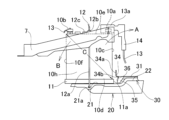
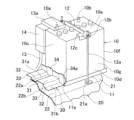
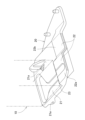
- FIG. 1 is a plan view showing a battery holding structure according to an embodiment of the present invention. Side view of the battery and surrounding structure from the left side of the vehicle FIG. 1 is an enlarged perspective view of a main portion showing a battery holding structure; FIG. 1 is a perspective view showing a battery pan; FIG. 11 is a plan view showing the attachment state of the battery pan and the stopper member; Right side view of FIG. Front view of FIG.
- FIG. 1 shows an equipment mounting space S (so-called engine room) for mounting various equipment such as an engine and auxiliary devices.
- a passenger compartment space T for passengers is provided on the rear side of the equipment mounting space S.
- the passenger compartment space T and the equipment space S are separated by a dash panel 4.
- the front side of the vehicle body will be referred to simply as the front side
- the rear side of the vehicle body will be referred to simply as the rear side
- the fore-aft direction of the vehicle body will be referred to simply as the fore-aft direction
- the width direction of the vehicle body will be referred to simply as the vehicle width direction.
- the vehicle 1 is described as a vehicle that uses the engine E as its only driving source for running, or a hybrid vehicle that uses the engine E and an electric motor as its driving sources for running, but the present invention is also applicable to electric vehicles that use an electric motor as their only driving source for running.
- the dash panel 4 is also called a bulkhead, and devices related to braking and accelerating operations (power boosters and various pedals) and devices related to steering operations are installed in front of and behind the dash panel 4.
- the vehicle 1 is equipped with a pair of side members 5, 5 extending in the front-to-rear direction, and a cross member 6 in the vehicle width direction connecting the side members 5, 5.
- the front ends of the pair of side members 5, 5 protrude forward from the dash panel 4, and this protruding portion forms a crushable zone that protects the passenger compartment space T in the event of a collision.
- upper bars 7, 7 are disposed above the side members 5, 5. As the upper bars 7, 7 move forward, they approach the center of the vehicle width and are connected to each other to close the front of the equipment mounting space S.
- a relay box 15 In the equipment mounting space S, in addition to the engine E and battery 10, a relay box 15, a resonator 16, an air cleaner (not shown), left and right strut towers (not shown), etc. are arranged.
- the left and right strut towers are provided between the side members 5 and the upper bar 7.
- a suspension device is arranged inside the strut towers, and the front wheels, which are the steered wheels, are supported via the suspension device.
- a cowl top panel 2 that protrudes forward is provided near the upper end of the dash panel 4.
- the cowl top panel 2 is a longitudinal member made of metal (steel) plate, and both ends in the longitudinal direction are connected to the left and right front pillars to support the lower part of the front windshield glass 8.
- the cowl top panel 2 also has cowl top extensions 2a that protrude significantly forward on both sides in the vehicle width direction.
- the cowl top extensions 2a are also made of metal (steel) plate, and protrude further forward than the other parts of the cowl top panel 2.
- a cowl top stay is provided below the cowl top panel 2.
- the cowl top stay bulges downward from the underside of the horizontally arranged cowl top panel 2.
- the cowl top stay is also a longitudinal member made of metal plate (steel plate) and is provided on both sides in the vehicle width direction, with its longitudinal direction extending along the vehicle width direction.
- the cowl top stay is fixed to the strut towers, cowl top panel 2, and upper bar 7, thereby increasing the rigidity of the vehicle body and suppressing twisting of the body.
- the battery 10 is disposed in the area on the left side of the vehicle body (the left half area in the vehicle width direction) of the equipment mounting space S.
- the battery 10 supplies power to the engine and auxiliary equipment mounted on the vehicle 1, and is disposed between the relay box 15 at the left end in the width direction and the engine and resonator 16 in the center in the width direction.
- the cowl top stay on the left side of the vehicle body is located behind the battery 10.
- the battery 10 is composed of a secondary battery with an output voltage of 12V or 24V. As shown in Figures 1 and 2, the battery 10 has a concave case that contains electrode plates, a separator, and an electrolyte, a top plate 10e that covers the upper opening of the case, and a positive terminal 10a and a negative terminal 10b that protrude from the top plate 10e.
- a harness 13 is connected to each of the positive terminal 10a and the negative terminal 10b.
- the positive terminal 10a is covered with a protective cover 13a made of a flexible insulating material.
- the harness 13 has a fusible link 14 that melts when an excessive current flows.
- a publicly known secondary battery can be used as the battery 10, and in this embodiment it is a 12V lead-acid battery.
- the case of the battery 10 is rectangular, and is placed vertically with six cells arranged in parallel in the fore-and-aft direction.
- the rear side portion 10c (rear side portion 10c) and the front side portion 10f (front side portion 10f) of the case each extend in the vehicle width direction.
- the other two side portions (inner side portion 10g and outer side portion 10h) extend in the fore-and-aft direction.
- the battery 10 may also be placed horizontally with multiple cells arranged in parallel in the vehicle width direction.
- the relay box 15 is a case that houses electrical components such as relays and fuses.
- the relay box 15 is located outward in the vehicle width direction relative to the battery 10 and slightly rearward of the battery 10.
- the case of the relay box 15 is rectangular and has an inner side surface 15a that extends in the front-rear direction on the inner side in the vehicle width direction. This inner side surface 15a comes into contact with the outer side surface portion 10h of the case of the battery 10 when the vehicle 1 is hit from the front side, and functions as a guide surface that guides the movement of the battery 10 toward the rear.
- the battery 10 is placed on the battery pan member 20.
- the battery pan member 20 is made of processed metal plate material and is fixed to the side member 5 via mounting brackets (not shown) joined to its underside by welding or the like.
- the battery pan member 20 has a first area 21 (battery mounting portion) on which the battery 10 is mounted, a second area 22 (base support portion) set at a higher position than the first area 21, and a third area 23 (leg support portion) set at a lower position than the second area 22.
- the height of the third area 23 is set to be the same as the height of the first area 21, but the third area 23 may be set lower than the first area 21, or conversely, higher than the first area 21.
- the second area 22 is provided on the rear side of the first area 21, and the third area 23 is provided rearward of the first area 21 and to the side of the second area 22 (in the embodiment, on the outer side in the vehicle width direction).
- the battery 10 is fixed to the first region 21 by a fixing member 12 called a battery holder (hereinafter referred to as the battery holder 12).
- the battery holder 12 is composed of a holder 12c that is attached to the top of the battery 10, two bolt shafts 12a, and two nuts 12b.
- the holder 12c is arranged across the center of the top of the battery 10, and guides are provided at both ends to restrain the corners of the top plate portion 10e of the case.
- a pair of through holes through which the bolt shaft 12a passes is formed at both ends of the holder 12c, and the bolt shaft 12a is inserted into these through holes.
- the lower end of the bolt shaft 12a is bent into a hook shape, and a male thread is formed at the upper end of the bolt shaft 12a.
- the lower end of the bolt shaft 12a inserted through the through hole of the holder 12c is engaged with the engagement hole 21a provided in the first area 21, and the nut 12b is screwed onto the upper end of the bolt shaft 12a and tightened, thereby fixing the battery 10 between the battery pan member 20 and the holder 12c.
- a stopper member 30 is fixed to the battery pan member 20 rearward of the battery 10.
- the stopper member 30 has a base 31 fixed to the second region 22 of the battery pan member 20, and a protruding piece 34 that faces the rear side surface 10c of the battery 10 and restricts the movement of the battery 10.
- the base 31 is fixed to the second region 22 by spot welding.
- the protruding piece 34 has a receiving portion 34a that is parallel to the surface direction of the rear side surface 10c of the case. In the event of a collision of the vehicle 1, the receiving portion 34a abuts against the rear side surface 10c to prevent the battery 10 from moving backward. This reduces the axial force generated in the bolt shaft 12a of the battery holder 12, thereby preventing the battery holder 12 from coming off. Note that slight movement of the battery 10 toward the receiving portion 34a is guided by the inner side surface 15a of the relay box 15.
- the stopper member 30 is fixed to the second region 22, which is higher than the first region 21 to which the battery 10 is fixed, the rising height of the stopper member 30 can be reduced. This makes the stopper member 30 compact in the vertical direction, and increases the rigidity of the member.
- the base 31 has concave portions 32 and convex portions 33 arranged alternately in parallel along the vehicle width direction, further increasing its rigidity.
- the stopper member 30 has legs 35 that are fixed to the third region 23 that is set at a position lower than the second region 22 of the battery pan member 20.
- the legs 35 are fixed to the third region 23 by spot welding.
- the base 31 includes a main base 31a and a sub-base 31b set at a lower position than the main base 31a, and the main base 31a and the sub-base 31b are each fixed to the second region 22.
- the second region 22 to which the main base 31a is fixed is shown as the main second region 22a
- the second region 22 to which the sub-base 31b is fixed is shown as the sub-second region 22b.
- welding bases 37 the locations where the main base 31a is spot welded to the main second region 22a and the sub-base 31b is spot welded to the sub-second region 22b are shown as welding bases 37.
- the underside of the welding base 37 is a flat surface that can come into surface contact with the main second region 22a and the sub-second region 22b.
- the battery 10 is fixed to the battery pan member 20 via a concave battery tray 11.
- the battery tray 11 is usually made of resin.
- the outer edge of the battery tray 11 protrudes outward beyond the rear side surface 11c, the front side surface 10f, the inner side surface 10g, and the outer side surface 10h of the battery 10 case.
- the stopper member 30 has a recessed holding portion 36 into which the protruding end portion 11a of the battery tray 11 on the rear side of the vehicle body fits when the battery 10 approaches the stopper member 30 due to a collision.
- the protruding piece 34 has a receiving portion 34a facing in the vertical direction and a horizontal root portion 34b that supports the receiving portion 34a on the base 31.
- the space below the root portion 34b forms the recessed holding portion 36.
- the end portion 11a of the battery tray 11 fits into the recessed holding portion 36 to restrain the battery 10, which is expected to have the effect of preventing the battery 10 from tipping over.
- the middle part of the battery 10 case in the height direction tends to be weaker than the parts closer to the bottom 10d and top plate 10e.
- the receiving part 34a of the protruding piece 34 is set to face the part of the rear side part 10c closer to the bottom 10d, i.e., the high strength part. This prevents damage to the case when the battery 10 comes into contact with the stopper member 30.
- FIG. 1 there is an upper bar 7 that runs across the vehicle width direction forward of the battery 10.
- the upper bar 7 faces the upper portion of the front side surface 10f of the battery 10 case. Therefore, in the event of a collision, when the upper bar 7 approaches the battery 10, the upper portion of the battery 10 near the front of the case abuts against the upper bar 7, and the lower portion of the battery 10 near the rear is restrained by the recessed retaining portion 36, resulting in a diagonal retaining structure as shown by arrow C in Figure 2. This further increases the effectiveness of preventing the battery 10 from tipping over.
- the battery 10 will not move backward even if it is pushed backward by a front part.
- the bolt shaft 12a of the battery holder 12 will not be pulled, and the hook at the lower end of the bolt shaft 12a will not come off. As a result, the battery 10 will not tip over. This makes it possible to avoid a short circuit in the battery 10 in the event of a collision while preventing the components from becoming larger and the structure from becoming more complicated.
- the battery 10 is prevented from falling over in the direction of the arrow B shown in FIG. 2 in order to prevent the fusible link 14 from being pulled. It is preferable to set the battery 10 so as to allow the battery 10 to tip over in the direction of the arrow A. From this viewpoint as well, it is preferable that the upper front portion and the lower rear portion of the battery 10 are diagonally restrained by the upper bar 7 and the recessed holding portion 36.
- This invention is not limited to the vehicle 1 shown in the above embodiment, but can be applied to all types of vehicles that have an equipment mounting space S in front of the passenger compartment space T in which the occupants sit, and that have a battery 10 mounted in the equipment mounting space S.
Landscapes
- Chemical & Material Sciences (AREA)
- Chemical Kinetics & Catalysis (AREA)
- Electrochemistry (AREA)
- General Chemical & Material Sciences (AREA)
- Engineering & Computer Science (AREA)
- Mechanical Engineering (AREA)
- Aviation & Aerospace Engineering (AREA)
- Battery Mounting, Suspending (AREA)
Priority Applications (1)
| Application Number | Priority Date | Filing Date | Title |
|---|---|---|---|
| JP2025553220A JPWO2025089149A1 (https=) | 2023-10-25 | 2024-10-16 |
Applications Claiming Priority (2)
| Application Number | Priority Date | Filing Date | Title |
|---|---|---|---|
| JP2023183397 | 2023-10-25 | ||
| JP2023-183397 | 2023-10-25 |
Publications (1)
| Publication Number | Publication Date |
|---|---|
| WO2025089149A1 true WO2025089149A1 (ja) | 2025-05-01 |
Family
ID=95515995
Family Applications (1)
| Application Number | Title | Priority Date | Filing Date |
|---|---|---|---|
| PCT/JP2024/036791 Pending WO2025089149A1 (ja) | 2023-10-25 | 2024-10-16 | バッテリの保持構造 |
Country Status (2)
| Country | Link |
|---|---|
| JP (1) | JPWO2025089149A1 (https=) |
| WO (1) | WO2025089149A1 (https=) |
Citations (7)
| Publication number | Priority date | Publication date | Assignee | Title |
|---|---|---|---|---|
| JPS5290828U (https=) * | 1975-12-27 | 1977-07-07 | ||
| JPS60156053U (ja) * | 1984-03-28 | 1985-10-17 | 日産自動車株式会社 | 自動車バツテリの取付構造 |
| JPH11297290A (ja) * | 1998-04-10 | 1999-10-29 | Nissan Motor Co Ltd | 車両用バッテリーの固定構造 |
| JP2018079843A (ja) * | 2016-11-17 | 2018-05-24 | トヨタ自動車株式会社 | 車両下部構造 |
| JP2019202639A (ja) * | 2018-05-23 | 2019-11-28 | トヨタ自動車株式会社 | バッテリの保持構造 |
| WO2022181312A1 (ja) * | 2021-02-26 | 2022-09-01 | 三菱自動車工業株式会社 | 車載機器の固定構造 |
| CN219789890U (zh) * | 2023-05-19 | 2023-10-03 | 重庆长安汽车股份有限公司 | 一种蓄电池防护结构、蓄电池防护结构总成及混合动力汽车 |
-
2024
- 2024-10-16 JP JP2025553220A patent/JPWO2025089149A1/ja active Pending
- 2024-10-16 WO PCT/JP2024/036791 patent/WO2025089149A1/ja active Pending
Patent Citations (7)
| Publication number | Priority date | Publication date | Assignee | Title |
|---|---|---|---|---|
| JPS5290828U (https=) * | 1975-12-27 | 1977-07-07 | ||
| JPS60156053U (ja) * | 1984-03-28 | 1985-10-17 | 日産自動車株式会社 | 自動車バツテリの取付構造 |
| JPH11297290A (ja) * | 1998-04-10 | 1999-10-29 | Nissan Motor Co Ltd | 車両用バッテリーの固定構造 |
| JP2018079843A (ja) * | 2016-11-17 | 2018-05-24 | トヨタ自動車株式会社 | 車両下部構造 |
| JP2019202639A (ja) * | 2018-05-23 | 2019-11-28 | トヨタ自動車株式会社 | バッテリの保持構造 |
| WO2022181312A1 (ja) * | 2021-02-26 | 2022-09-01 | 三菱自動車工業株式会社 | 車載機器の固定構造 |
| CN219789890U (zh) * | 2023-05-19 | 2023-10-03 | 重庆长安汽车股份有限公司 | 一种蓄电池防护结构、蓄电池防护结构总成及混合动力汽车 |
Also Published As
| Publication number | Publication date |
|---|---|
| JPWO2025089149A1 (https=) | 2025-05-01 |
Similar Documents
| Publication | Publication Date | Title |
|---|---|---|
| JP6181723B2 (ja) | 車体構造及び車載用バッテリー | |
| US11492044B2 (en) | Vehicle front structure | |
| JP6118381B2 (ja) | 車載用バッテリー | |
| KR102785684B1 (ko) | 고전압배터리가 장착되는 차체 | |
| JP6363656B2 (ja) | 車載用バッテリー | |
| JP5211081B2 (ja) | 電気自動車の電気部品搭載構造 | |
| JP6582025B2 (ja) | バッテリユニット | |
| JP7322790B2 (ja) | 車両の下部構造 | |
| CN110626184B (zh) | 电池固定结构 | |
| JP7769512B2 (ja) | 電池モジュールの保護構造 | |
| US11571957B2 (en) | Electric vehicle | |
| US20210371011A1 (en) | Electric powered vehicle | |
| JP2013119326A (ja) | 電装部品の保護構造 | |
| JP6460200B1 (ja) | 電動車両 | |
| WO2025089149A1 (ja) | バッテリの保持構造 | |
| JP2023107098A (ja) | 車載機器の保護構造 | |
| JP6332305B2 (ja) | 車両用の燃料電池システム | |
| JP7324420B2 (ja) | コネクタ保護構造 | |
| JP7432136B2 (ja) | 電動車両のパワーユニット搭載部構造 | |
| JP7563623B2 (ja) | 電動車両 | |
| JP2021160520A (ja) | 車両の下部構造 | |
| JP2017218036A (ja) | 電池パックの保護構造 | |
| WO2025089151A1 (ja) | 車両構造 | |
| JP2021191664A (ja) | 車両用インバータの固定構造 | |
| WO2022181314A1 (ja) | 車載機器の固定構造 |
Legal Events
| Date | Code | Title | Description |
|---|---|---|---|
| 121 | Ep: the epo has been informed by wipo that ep was designated in this application |
Ref document number: 24882262 Country of ref document: EP Kind code of ref document: A1 |
|
| ENP | Entry into the national phase |
Ref document number: 2025553220 Country of ref document: JP Kind code of ref document: A |
|
| WWE | Wipo information: entry into national phase |
Ref document number: 2025553220 Country of ref document: JP |