WO2025083844A1 - 回転子、電動機、送風機および空気調和装置 - Google Patents
回転子、電動機、送風機および空気調和装置 Download PDFInfo
- Publication number
- WO2025083844A1 WO2025083844A1 PCT/JP2023/037862 JP2023037862W WO2025083844A1 WO 2025083844 A1 WO2025083844 A1 WO 2025083844A1 JP 2023037862 W JP2023037862 W JP 2023037862W WO 2025083844 A1 WO2025083844 A1 WO 2025083844A1
- Authority
- WO
- WIPO (PCT)
- Prior art keywords
- rotor
- diameter side
- outer diameter
- core
- magnet insertion
- Prior art date
- Legal status (The legal status is an assumption and is not a legal conclusion. Google has not performed a legal analysis and makes no representation as to the accuracy of the status listed.)
- Pending
Links
Images












Classifications
-
- H—ELECTRICITY
- H02—GENERATION; CONVERSION OR DISTRIBUTION OF ELECTRIC POWER
- H02K—DYNAMO-ELECTRIC MACHINES
- H02K1/00—Details of the magnetic circuit
- H02K1/06—Details of the magnetic circuit characterised by the shape, form or construction
- H02K1/22—Rotating parts of the magnetic circuit
- H02K1/27—Rotor cores with permanent magnets
- H02K1/2706—Inner rotors
- H02K1/272—Inner rotors the magnetisation axis of the magnets being perpendicular to the rotor axis
- H02K1/274—Inner rotors the magnetisation axis of the magnets being perpendicular to the rotor axis the rotor consisting of two or more circumferentially positioned magnets
- H02K1/2753—Inner rotors the magnetisation axis of the magnets being perpendicular to the rotor axis the rotor consisting of two or more circumferentially positioned magnets the rotor consisting of magnets or groups of magnets arranged with alternating polarity
- H02K1/276—Magnets embedded in the magnetic core, e.g. interior permanent magnets [IPM]
Definitions
- This disclosure relates to rotors, electric motors, blowers and air conditioners.
- a rotor core is constructed by combining a first core in which the inner core portion and the outer core portion are integrated, a second core in which the inner core portion and the outer core portion are separated and have protrusions, and a third core in which the inner core portion and the outer core portion are separated and have no protrusions, which makes it easier to assemble the rotor and reduces leakage flux in the rotor.
- linkage magnetic flux in order to increase the magnetic flux that links with the stator winding (hereinafter, “linkage magnetic flux”), it is effective to improve the magnetic flux generated from the permanent magnets in addition to reducing the leakage magnetic flux in the rotor. To achieve this, it is necessary to increase the amount of permanent magnets used and increase the surface area of the points where the permanent magnets contact the rotor core.
- each magnet insertion hole extends linearly, so it is difficult to increase the surface area of the points where the permanent magnets inserted into each magnet insertion hole contact the rotor core.
- the outer core part of the first core is connected to the inner core part, the outer core parts of the second and third cores are separated from the inner core part.
- This disclosure has been made to solve the problems described above, and aims to provide a rotor, electric motor, blower, and air conditioner that can achieve high efficiency while ensuring an area for crimping the outer core portion.
- the rotor according to this disclosure comprises a first rotor core formed by stacking electromagnetic steel plates in the axial direction and having a plurality of first magnet insertion holes arranged in a line in the circumferential direction, and a plurality of permanent magnets inserted into the plurality of first magnet insertion holes, respectively, to form magnetic poles with a pole number P.
- the first rotor core has a plurality of first outer diameter side core portions located on the outer diameter side of the plurality of first magnet insertion holes, and a first inner diameter side core portion located on the inner diameter side of the plurality of first magnet insertion holes.
- Each of the multiple first outer diameter side core portions is fastened by at least one rivet, each of the multiple first outer diameter side core portions is separated from the first inner diameter side core portion, each of the multiple first magnet insertion holes is formed in a V-shape in a plane perpendicular to the axis that is the center of the rotation shaft, and a resin portion filled with resin is provided in a gap formed between a pair of adjacent first outer diameter side core portions.
- the present disclosure by forming the first magnet insertion hole in a V-shape, it is possible to secure the area required for crimping while also ensuring a large surface area for the permanent magnet, thereby increasing the amount of magnetic flux generated per unit axial length of the rotor. This makes it possible to improve the efficiency of the electric motor while preventing the first outer diameter side core portion from falling off during rotation.
- FIG. 2 is a partial cross-sectional view showing the structure of an electric motor according to each embodiment.
- 1 is a cross-sectional view showing a schematic structure of an electric motor according to a first embodiment
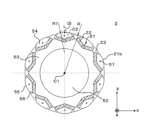
- 2 is a cross-sectional view showing the structure of a rotor according to the first embodiment.
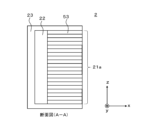
- FIG. 4 is a cross-sectional view taken along line AA in FIG. 3.
- FIG. 2 is a perspective view showing a state in which a shaft is provided on the rotor according to each embodiment.
- FIG. 1 is a cross-sectional view showing a structure of a conventional rotor.
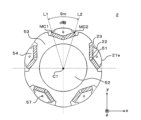
- 10 is a cross-sectional view showing a structure of a first rotor core according to Modification 1.
- FIG. 1 is a cross-sectional view showing a schematic structure of an electric motor according to a first embodiment
- 2 is a cross-sectional view showing the structure of a rotor according to the first embodiment.
- FIG. 4 is a cross-sectional view taken along line AA
- FIG. 11 is a cross-sectional view showing a structure of a first rotor core according to a second modified example.
- FIG. 11 is a cross-sectional view showing a structure of a first rotor core according to Modification 3.
- FIG. 11 is a cross-sectional view showing a structure of a first rotor core according to a fourth modified example.
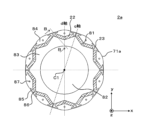
- FIG. 11 is a cross-sectional view showing the structure of a second rotor core according to embodiment 2.
- 12 is a cross-sectional view taken along line BB in FIG. 11.
- 12 is a cross-sectional view taken along line BB in FIG. 11.
- 12 is a cross-sectional view taken along line BB in FIG. 11.
- FIG. 11 is a cross-sectional view taken along line BB in FIG. 11.
- FIG. 11 is a cross-sectional view showing the structure of a third rotor core according to embodiment 3.
- 16 is a cross-sectional view taken along line CC in FIG. 15.
- FIG. 11 is a partial cross-sectional view showing the structure of an electric motor according to a fourth embodiment.
- 18 is a cross-sectional view taken along line DD in FIG. 17.
- FIG. 13 is a diagram illustrating a schematic view of a blower according to a fifth embodiment.
- FIG. 13 is a diagram illustrating the configuration of an air conditioning device according to a sixth embodiment.
- FIG. 13 is a refrigerant circuit diagram showing an air conditioning apparatus according to a sixth embodiment during cooling operation.
- FIG. 13 is a refrigerant circuit diagram showing an air conditioning apparatus according to a sixth embodiment during heating operation.
- the direction along the circumference of a circle centered on the axis C1, which is the center of rotation of the rotor 2, is called the "circumferential direction”
- the direction parallel to the axis C1 is called the “axial direction”
- the direction perpendicular to the axis C1 is called the "radial direction.”
- the drawings show an xyz orthogonal coordinate system to facilitate mutual understanding of the drawings.
- the z-axis is a coordinate axis parallel to the axis C1 of the rotor 2.
- the y-axis is a coordinate axis perpendicular to the z-axis.
- the x-axis is a coordinate axis perpendicular to both the y-axis and the z-axis.
- Embodiment 1 is a partial cross-sectional view showing the structure of an electric motor 1 according to the present embodiment 1.
- the electric motor 1 includes a rotor 2, a stator 3, a circuit board 4, a magnetic sensor 5, a bracket 6, bearings 7a and 7b, and a shaft 9 which is a rotating shaft.
- the rotor 2 has a shaft 9 that extends along the axis C1. The detailed configuration of the rotor 2 will be described later.
- FIG. 2 is a cross-sectional view that shows a schematic structure of the electric motor 1 according to the first embodiment.
- the stator 3 includes a stator core 31, a coil 32, and an insulator 33.
- the stator 3 is disposed radially outside the rotor 2, and an air gap of 0.2 to 1.5 mm is provided between the stator 3 and the rotor 2.
- the stator core 31 is annular about the axis C1, and is constructed by stacking multiple electromagnetic steel sheets with a thickness of 0.1 to 0.7 mm in the axial direction and fastening them by crimping.
- the stator core 31 also includes an annular back yoke 41 and multiple teeth 42 that protrude radially inward from the back yoke 41. Furthermore, slots 43 are formed between the teeth 42 in the circumferential direction, providing insertion spaces for the coils 32.
- the teeth 42 are arranged at regular intervals around the stator core 31, and in this embodiment 1, 12 teeth 42 are provided.
- the number of teeth 42 is not limited to 12, and it is sufficient that there are two or more.
- the coil 32 is constructed by winding a conducting wire composed of a conductor whose main component is copper (Cu) or aluminum (Al) and an insulating coating that covers the outer circumference of the conductor, around the teeth 42.
- the main component of the conductor is not limited to copper (Cu) or aluminum (Al), but may be silver (Ag) or iron (Fe).
- the coil 32 may be wound in a concentrated winding manner in which the coil 32 is wound on one tooth 42, or in a distributed winding manner in which the coil 32 is wound across multiple teeth 42.
- the insulator 33 is made of, for example, resin.
- the insulator 33 electrically insulates the stator core 31 and the coil 32.
- the stator core 31, the coil 32, and the insulator 33 are covered by a molded resin part 34.
- An opening is formed on one axial side of the molded resin part 34, and a bottom is formed on the other side.
- the circuit board 4 is provided inside the molded resin part 34.
- the circuit board 4 has the role of changing the operating rotation speed of the rotor 2. Note that the circuit board 4 is not limited to being provided inside the molded resin part 34, and may be provided outside the molded resin part 34.
- the magnetic sensor 5 detects the rotational position of the rotor 2.
- the magnetic sensor 5 may be mounted on the circuit board 4, for example.
- the means for detecting the rotational position of the rotor 2 is not limited to the above, and it is not necessarily necessary to have the magnetic sensor 5.
- the bracket 6 is attached to the opening of the molded resin part 34.
- a bearing 7a is held by the bracket 6, and a bearing 7b is held at the bottom of the molded resin part 34.
- the shaft 9 protrudes axially from the opening of the molded resin part 34 and is supported by the bearings 7a and 7b.
- ⁇ Rotor configuration> 3 is a cross-sectional view showing the structure of the rotor 2 according to the present embodiment 1.
- the rotor 2 is made up of a first rotor core 21a, a permanent magnet 22, and a resin portion 23.
- the first rotor core 21a is cylindrical and centered on the axis C1, and is constructed by stacking multiple electromagnetic steel sheets with a thickness t in the axial direction and fastening them by crimping at the crimping portion 57.
- the thickness t is, for example, 0.1 to 0.7 mm.
- the first rotor core 21a is also provided with multiple first magnet insertion holes 51 and shaft holes 52 that penetrate in the axial direction.
- the first magnet insertion holes 51 are provided on the d-axis, and the permanent magnets 22 are inserted into the first magnet insertion holes 51 to form magnetic poles.
- the d-axis refers to an axis that extends in the direction of the magnetic flux created by the permanent magnets 22 from the axis C1 of the rotor 2 in a plane perpendicular to the axis C1 of the rotor 2.
- ten first magnet insertion holes 51 are provided, but the number of first magnet insertion holes 51 is not limited to ten, and it is sufficient to have two or more.
- the first magnet insertion holes 51 are formed in a V-shape in a plane perpendicular to the axis C1. Two permanent magnets 22 are inserted into one first magnet insertion hole 51. In the case of FIG. 3, ten first magnet insertion holes 51 are provided, so the electric motor 1 is equipped with a total of twenty permanent magnets 22.
- the shaft hole 52 is a hole into which the shaft 9 is inserted.
- the shaft 9 may be inserted in close contact with the shaft hole 52, or a resin part 23 may be provided between the shaft 9 and the shaft hole 52 as shown in FIG. 5, which will be described later.
- the permanent magnet 22 may be a rare earth magnet whose main components are neodymium (Nd), iron (Fe), and boron (B), or a ferrite magnet whose main component is iron oxide (FeO).
- the permanent magnet 22 may be either a rare earth magnet or a ferrite magnet.
- the first rotor core 21a is composed of a first inner diameter side core portion 53 and multiple first outer diameter side core portions 54.
- the first inner diameter side core portion 53 is located on the inner diameter side of the first magnet insertion hole 51.
- the first outer diameter side core portion 54 is located on the outer diameter side of the first magnet insertion hole 51.
- the first inner diameter side core portion 53 and the first outer diameter side core portion 54 are separate.
- the first outer diameter side core portion 54 is configured by fastening with a crimp at the crimp portion 57. At least one crimp is provided on the first outer diameter side core portion 54.
- the first magnet insertion hole 51 is formed in a V-shape in a plane perpendicular to the axis C1, so that the surface area of the first outer diameter side core portion 54 is increased. As a result, the first rotor core 21a can secure a sufficient area required for crimping.
- a resin portion 23 filled with resin is provided in the gap formed between a pair of adjacent first outer diameter side iron core portions 54.
- the resin filled is, for example, unsaturated polyester resin.
- Figure 4 is a cross-sectional view taken along line A-A in Figure 3.
- the first rotor core 21a according to the first embodiment is constructed by stacking electromagnetic steel sheets in the axial direction.
- resin parts 23 are provided at the radial end and both axial ends of the first rotor core 21a.
- the first inner diameter side core portion 53 and the multiple first outer diameter side core portions 54 are separated from each other, so that the centrifugal force applied during rotation of the rotor 2 generates a force that causes the first outer diameter side core portion 54 to jump outward in the radial direction. Therefore, by providing the resin portion 23 at the radial end of the first rotor core 21a, the first outer diameter side core portion 54 and the permanent magnet 22 are supported by the resin portion 23, and it is possible to prevent the first outer diameter side core portion 54 and the permanent magnet 22 from falling off in the radial direction.
- both axial ends of the permanent magnet 22 are supported by the resin portion 23, and it is possible to prevent the permanent magnet 22 from falling off in the axial direction. As a result, it is possible to improve the reliability of the rotor 2.
- the first outer diameter side core portion 54 has an arc-shaped first outer peripheral surface 55 provided on the outer periphery of the magnetic pole center portion C2 that passes through the d-axis of the magnetic pole, and notches 56 at both ends of the first outer peripheral surface 55.
- the resin portion 23 can also be provided on the radial outside of the notch 56, so that both ends of the first outer diameter side core portion 54 can be held down by the resin portion 23 provided on the radial outside of the notch 56.
- the effect of preventing the first outer diameter side core portion 54 from falling off can be improved.
- the outer peripheral surface of the resin portion 23 provided in the gap formed between a pair of adjacent first outer diameter side iron core portions 54 is provided radially inward compared to the first outer peripheral surface 55.
- the resin portion 23 made of resin is more likely to deform due to aging than the metal first outer diameter side iron core portion 54. For this reason, it is expected that the outer peripheral surface of the resin portion 23 will bulge outward while the rotor 2 is rotating. Even in such a case, however, by providing the outer peripheral surface of the resin portion 23 radially inward compared to the first outer peripheral surface 55, a sufficient air gap can be secured between the rotor 2 and the stator 3. As a result, it is possible to prevent the resin portion 23 from coming into contact with the stator 3 while the rotor 2 is rotating.
- Figure 5 is a perspective view showing the rotor 2 according to each embodiment with a shaft 9.
- the resin portion 23 of the rotor 2 is configured to cover the axial end of the first rotor core 21a and the axial end of the permanent magnet 22 (not shown) as shown in Figure 5.
- the resin portion 23 at the axial end of the first rotor core 21a is, for example, ring-shaped.
- the resin portion 23 has multiple ribs 61 for connecting and holding the shaft 9 inserted into the shaft hole 52. Gaps are formed between adjacent ribs 61 in the circumferential direction. This configuration allows the first inner diameter side iron core portion 53 and the shaft 9 to be magnetically separated, thereby preventing the magnetic flux generated by the permanent magnet 22 from flowing into the shaft 9 and increasing the effective magnetic flux of the permanent magnet 22. In addition, by adjusting the circumferential width of the ribs 61, the vibration eigenvalue and inertia of the rotor 2 can be appropriately adjusted. This allows the vibration and noise during rotation of the rotor 2 to be appropriately adjusted.
- the first outer diameter side core portion 54 and the permanent magnet 22 are supported by the resin portion 23, so that the first outer diameter side core portion 54 and the permanent magnet 22 can be prevented from falling off during rotation of the rotor 2. Therefore, the rotor 2 can be configured without providing a thin-walled connecting portion that is a member for connecting a pair of adjacent first rotor cores 21a, so that leakage magnetic flux of the permanent magnet 22 can be sufficiently reduced.
- the first outer diameter side core portion 54 needs to be provided with at least one rivet to fasten the laminated electromagnetic steel sheets, but in the first embodiment, the first magnet insertion hole 51 is formed in a V-shape, so that the surface area of the first outer diameter side core portion 54 is expanded and a sufficient area for fastening the rivet can be secured.
- Figure 6 is a cross-sectional view showing the structure of a conventional rotor 2.
- the distance between the outer circumferential surface of the first outer diameter side core part 54 and the permanent magnet 22 becomes long, which causes a problem that the magnetic resistance between the outer circumferential surface of the first outer diameter side core part 54 and the permanent magnet 22 becomes large and the amount of magnetic flux decreases.
- the first magnet insertion hole 51 is formed in a V-shape, so that the surface area of the permanent magnet 22 can be increased while securing the area required for fastening the crimp, and the distance between the outer circumferential surface of the first outer diameter side core part 54 and the permanent magnet 22 can be shortened.
- the electric motor 1 according to the present embodiment 1 can improve the magnetic flux flowing from the permanent magnet 22 to the stator 3, thereby improving the efficiency of the electric motor.
- the magnetic flux generated by the rotor 2 can be improved, so the axial length of the electric motor 1 required to obtain the desired effective magnetic flux can be shortened.
- the reduction in the axial length of the electric motor 1 allows the circumferential length of the coil 32 to be shortened, so the electrical resistance of the coil 32 can be reduced and the efficiency of the electric motor 1 can be improved.
- FIG. 7 is a cross-sectional view showing another example of the first rotor core 21a according to the first embodiment.
- the first rotor core 21b according to the first modification has a first outer peripheral surface 55 with an arc shape of radius R1 provided on the outer periphery of the magnetic pole center C2 passing through the d-axis of the magnetic pole.
- R1 radius of the first outer peripheral surface 55
- R1 ⁇ R the relationship between the radius R1 of the first outer peripheral surface 55 and the distance R from the intersection IS of the d-axis of the magnetic pole and the first outer peripheral surface 55 to the axis C1 is R1 ⁇ R.
- the first rotor core 21b according to the first modification example has an air gap between the rotor 2 and the stator 3 that widens as it moves away from the magnetic pole center C2 in the circumferential direction.
- the air gap between the rotor 2 and the stator 3 near the magnetic pole center C2 becomes the narrowest, so that the magnetic flux generated from the permanent magnet 22 easily flows into the stator 3 through the magnetic pole center C2.
- the magnetic flux linking the coil 32 of the stator 3 approaches a sine wave, and the induced voltage waveform generated in the coil 32 also approaches a sine wave.
- the rotor 2 according to the first modification example can suppress the noise and vibration generated by the electric motor 1 by reducing the electromagnetic excitation force of the electric motor 1, so that a high-quality electric motor 1 can be configured.
- FIG. 8 is a cross-sectional view showing another example of the first rotor core 21a according to the first embodiment.
- the first rotor core 21c according to the second modification differs from the first embodiment in the shape of the first magnet insertion hole 51.
- the first magnet insertion hole 51 according to the second modification has a U-shape in a plane perpendicular to the axis C1. That is, the first magnet insertion hole 51 according to the second modification has a first hole portion 111 extending in the circumferential direction and two second hole portions 112 extending from each of both ends of the first hole portion 111 toward the radially outer periphery.
- first magnet insertion holes 51 Three permanent magnets 22 are inserted into each first magnet insertion hole 51.
- ten first magnet insertion holes 51 are provided, so the motor 1 is provided with a total of 30 permanent magnets 22.
- the number of first magnet insertion holes 51 is not limited to ten, and it is sufficient to have two or more.
- the first rotor core 21c according to the second modification can enlarge the surface area of the first outer diameter side core portion 54 compared to the first rotor core 21a of Fig. 3, so that an area for fastening the crimp can be further secured. Also, the first rotor core 21c according to the second modification can increase the total surface area of the three permanent magnets 22 inserted into the first magnet insertion hole 51 compared to the first rotor core 21a of Fig. 3, so that the effective magnetic flux flowing into the stator 3 can be improved.
- the electric motor 1 including the first rotor core 21c according to the second modification can shorten the axial length of the electric motor 1 to obtain the desired effective magnetic flux, so that the material usage of the first rotor core 21c, the stator core 31, and the coil 32 can be reduced, and the material cost can be reduced. Furthermore, in the electric motor 1 equipped with the first rotor core 21c relating to variant example 2, the circumferential length of the coil 32 can be shortened by reducing the axial length, thereby reducing the electrical resistance of the coil 32 and improving the efficiency of the electric motor 1.
- FIG. 9 is a cross-sectional view showing another example of the first rotor core 21d according to the first embodiment.
- the first rotor core 21d according to the third modification differs from the first embodiment in the configuration of the first magnet insertion hole 51.
- the first magnet insertion hole 51 according to the third modification is of a so-called consequent pole type. That is, the first rotor core 21d, which is a component of the rotor 2 with the pole number P, has P/2 magnetic poles formed by the permanent magnets 22 and P/2 virtual magnetic poles formed between adjacent magnetic poles by a part of the first rotor core 21d. In addition, the center of the magnetic pole and the center of the virtual pole adjacent to the magnetic pole are shifted by a mechanical angle of 360/P degrees in the circumferential direction.
- the first rotor core 21d shown in FIG. 9 has five magnet poles and five virtual poles.
- the magnet poles are north poles and the virtual poles are south poles.
- the magnet poles may be south poles and the virtual poles may be north poles.
- the number of poles is not limited to ten, and may be an even number of two or more poles.
- the first rotor core 21d according to the third modification the number of first magnet insertion holes 51 arranged in the circumferential direction is half the number of poles P. Therefore, compared to the first rotor core 21a in Fig. 3, the first rotor core 21d according to the third modification can reduce the number of permanent magnets 22 by half. This can reduce the time required to process the permanent magnets 22, improving the yield of the permanent magnets 22 and improving productivity.
- FIG. 10 is a cross-sectional view showing another example of the first rotor core 21a according to the first embodiment.
- the first rotor core 21e according to the fourth modification has a consequent pole type first magnet insertion hole 51 similar to that of the third modification. The differences from the third modification will be described.
- the permanent magnet 22 has a first corner MC1 that is farthest from the d-axis and faces the first outer diameter side core portion 54.
- the permanent magnet 22 also has a second corner MC2 that is farthest from the d-axis on the other side of the magnetic pole center line and faces the first outer diameter side core portion 54.
- the angle ⁇ m between the first straight line L1 passing through the first corner MC1 and the axis C1 and the second straight line L2 passing through the second corner MC2 and the axis C1 on a plane perpendicular to the axis C1 is configured to satisfy 540/P ⁇ ⁇ m ⁇ 360/P [degrees].
- the rotor 2 in FIG. 3 has magnetic poles formed only by the first magnet insertion holes 51 and the permanent magnets 22, so if ⁇ m is to be made larger than 360/P [degrees], adjacent permanent magnets 22 will interfere with each other, so ⁇ m is limited to ⁇ m ⁇ 360/P [degrees].
- the first rotor core 21e of variant 4 can be configured with ⁇ m larger than 360/P [degrees] because the first magnet insertion holes 51 can be formed in part of the virtual magnetic pole. This allows the surface area of the permanent magnets 22 to be increased, and the amount of magnetic flux generated by the permanent magnets 22 to be increased.
- the first rotor core 21e according to the fourth modification can increase the surface area of the permanent magnet 22 facing the first outer diameter side core portion 54, thereby improving the effective magnetic flux flowing into the stator 3. Therefore, the electric motor 1 including the first rotor core 21e according to the fourth modification can shorten the axial length required to obtain the desired effective magnetic flux, thereby reducing the material usage of the first rotor core 21e, the stator core 31, and the coil 32, thereby reducing the material cost. Furthermore, the electric motor 1 including the first rotor core 21e according to the fourth modification can shorten the circumferential length of the coil 32 by reducing the axial length, thereby reducing the electrical resistance of the coil 32 and improving the efficiency of the electric motor 1.
- Fig. 11 is a cross-sectional view showing the structure of the second rotor core 71a of the electric motor 1 according to the second embodiment.
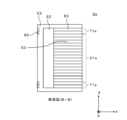
- Fig. 12 is a cross-sectional view taken along line B-B in Fig. 11.
- the second rotor core 71a is provided at the axial end of the first rotor core 21a shown in Fig. 3.
- the second rotor core 71a is not limited to being provided at the axial end, and may be provided midway in the axial direction of the first rotor core 21a.
- each configuration of the electric motor 1 according to the second embodiment is the same as or equivalent to that of the electric motor 1 according to the first embodiment, except for the second rotor core 71a.
- the rotor 2a according to the second embodiment is composed of a first rotor core 21a, a second rotor core 71a, a permanent magnet 22, and a resin part 23.
- the rotor 2a according to the second embodiment differs from the rotor 2 according to the first embodiment in that the rotor 2a is provided with a second rotor core 71a.
- the second rotor core 71a has a second magnet insertion hole 81, a shaft hole 82, a second inner diameter side core portion 83, a second outer diameter side core portion 84, a thin-walled connecting portion 85, and an inter-pole portion 86.
- the second inner diameter side core portion 83 is located on the inner diameter side of the second magnet insertion hole 81.
- the second outer diameter side core portion 84 is located on the outer diameter side of the second magnet insertion hole 81.
- a pair of adjacent second outer diameter side core portions 84 are connected by thin-walled connecting portions 85.
- the thin-walled connecting portions 85 and the second inner diameter side core portion 83 are also connected by inter-pole portions 86. Since the second outer diameter side core portion 84 is connected to the second inner diameter side core portion 83 by the thin-walled connecting portions 85 and the inter-pole portions 86, it is possible to prevent the second outer diameter side core portion 84 from falling off during rotation.
- the second outer diameter side core portion 84 is configured by fastening it with a crimp at the crimp portion 87. At least one crimp is provided on the second outer diameter side core portion 84.
- a resin portion 23 filled with resin is provided in the gap formed between a pair of adjacent second outer diameter side iron core portions 84 and the permanent magnets 22.
- resin portions 23 are provided at both axial ends of the second rotor iron core 71a.
- the second rotor core 71a differs from the first rotor core 21a in that it is provided with a thin-walled connecting portion 85 and an inter-pole portion 86.
- Most of the magnetic flux generated from the permanent magnet 22 can be used as effective magnetic flux flowing into the stator 3.
- part of the magnetic flux generated on the second outer diameter side core portion 84 side of the permanent magnet 22 passes through the thin-walled connecting portion 85 and the inter-pole portion 86 and returns to the second inner diameter side core portion 83 side of the permanent magnet 22.
- This magnetic flux passing through the thin-walled connecting portion 85 and the inter-pole portion 86 does not contribute to the torque generation of the electric motor 1, and is therefore known as leakage magnetic flux.
- the rotor 2a according to the second embodiment is provided with a second rotor core 71a having a thin-walled connecting portion 85 and an inter-pole portion 86 at only a portion of the axial end or midway in the axial direction.
- the ratio of the axial length of the second rotor core 71a to the axial length of the rotor 2a is, for example, 0.5% to 20%. Because the proportion of the first rotor core 21a that does not have the thin-walled connecting portion 85 and the inter-pole portion 86 is large, the rotor 2a according to the second embodiment can suppress leakage magnetic flux generated from the permanent magnet 22.
- the rotor 2a according to the second embodiment may be configured such that the relationship between the axial length Lr1 of the first rotor core 21a and the axial length Lm of the permanent magnet 22 satisfies Lr1 ⁇ Lm.
- the permanent magnet 22 is less likely to face the second rotor core 71a, thereby enhancing the effect of suppressing leakage magnetic flux generated from the permanent magnet 22.
- the rotor 2a can be configured to suppress axial movement of the permanent magnet 22.
- the rotor 2a may have a rotor core that does not have a second magnet insertion hole 81 at only one end of the first rotor core 21a.
- the rotor 2a may have a rotor core that has a magnet insertion hole with a narrower radial width than the second magnet insertion hole 81 at only one end of the first rotor core 21a. This configuration can prevent the permanent magnet 22 from moving axially and facing the second rotor core 71a, thereby enhancing the effect of suppressing leakage magnetic flux generated by the permanent magnet 22.
- the electric motor 1 according to the second embodiment has the second rotor core 71a only partially at the axial end or midway of the rotor 2a, the rotor 2a can be manufactured as a single unit. As a result, the rotor 2a according to the second embodiment can be manufactured with improved productivity.
- the electric motor 1 according to the second embodiment may use not only the first rotor core 21a, but also the first rotor cores 21b, 21c, 21d, and 21e described in the modified example 1-4.
- Fig. 15 is a cross-sectional view showing a third rotor core 91a of the electric motor 1 according to the third embodiment.
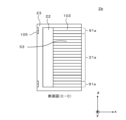
- Fig. 16 is a cross-sectional view taken along line CC in Fig. 15.
- the third rotor core 91a is provided at the axial end of the first rotor core 21a shown in Fig. 3.
- the third rotor core 91a is not limited to being provided at the axial end, and may be provided midway in the axial direction of the first rotor core 21a.
- Each configuration of the electric motor 1 according to the third embodiment is the same as or equivalent to that of the electric motor 1 according to the first embodiment, except for the third rotor core 91a.
- the rotor 2b according to the third embodiment is composed of a first rotor core 21a, a third rotor core 91a, a permanent magnet 22, and a resin part 23.
- the rotor 2b according to the third embodiment differs from the rotor 2 according to the first embodiment in that the rotor 2b is provided with a third rotor core 91a.
- the third rotor core 91a has a third magnet insertion hole 101, a shaft hole 102, a third inner diameter side core portion 103, a third outer diameter side core portion 104, a thin-walled connecting portion 105, an inter-pole portion 106, and a connection portion 107.
- the third inner diameter side core portion 103 is located on the inner diameter side of the third magnet insertion hole 101.
- the third outer diameter side core portion 104 is located on the outer diameter side of the third magnet insertion hole 101.
- the third inner diameter side core portion 103 and the third outer diameter side core portion 104 are connected by a connection portion 107 extending radially through the third magnet insertion hole 101.
- a pair of adjacent third outer diameter side core portions 104 are connected by a thin-walled connecting portion 105.
- the thin-walled connecting portion 105 and the third inner diameter side core portion 103 are connected by an inter-pole portion 106.
- the third outer diameter side core portion 104 is connected to the third inner diameter side core portion 103 by the thin-walled connecting portion 105, the inter-pole portion 106, and the connecting portion 107, so that the third outer diameter side core portion 104 can be prevented from falling off during rotation.
- the third outer diameter side core portion 104 is configured by fastening it by crimping at the crimp portion 108. At least one crimp is provided on the third outer diameter side core portion 104.
- a resin portion 23 filled with resin is provided in the gap formed between a pair of adjacent third outer diameter side iron core portions 104 and the permanent magnets 22.
- resin portions 23 are provided at both axial ends of the third rotor iron core 91a.
- the third rotor core 91a differs from the second rotor core 71a in that it is provided with a connection portion 107. Most of the magnetic flux generated from the permanent magnet 22 can be used as effective magnetic flux flowing into the stator 3. On the other hand, part of the magnetic flux generated on the third outer diameter side core portion 104 side of the permanent magnet 22 passes through the connection portion 107 and returns to the third inner diameter side core portion 103 side of the permanent magnet 22. This magnetic flux passing through the connection portion 107 does not contribute to the torque generation of the motor 1, and is therefore known as leakage magnetic flux.
- the rotor 2b according to the third embodiment has a third rotor core 91a with a connection portion 107 at only a portion of the axial end or midway in the axial direction.
- the ratio of the axial length of the third rotor core 91a to the axial length of the rotor 2b is, for example, 0.5% to 20%. Because the proportion of the first rotor core 21a without the connection portion 107 is large, leakage magnetic flux generated from the permanent magnet 22 can be suppressed.
- the electric motor 1 according to the third embodiment has only a part of the third rotor core 91a at the axial end or in the middle of the axial direction of the rotor 2b. Even if a radial load is applied to the outer circumferential surface of the rotor 2b during assembly of the rotor 2b, the electric motor 1 according to the third embodiment can suppress deformation of the third magnet insertion hole 101 because the third inner diameter side core portion 103 and the third outer diameter side core portion 104 are connected by the connection portion 107. As a result, in the third embodiment, a highly efficient electric motor 1 can be configured without compromising the quality of the rotor 2b during production.
- the electric motor 1 according to the third embodiment may use not only the first rotor core 21a, but also the first rotor cores 21b, 21c, 21d, and 21e described in the modified example 1-4.
- Fig. 17 is a partial cross-sectional view showing the structure of electric motor 1 according to the fourth embodiment.
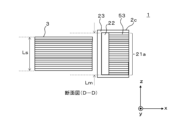
- Fig. 18 is a cross-sectional view taken along line D-D in Fig. 17.
- electric motor 1 according to the fourth embodiment is composed of a rotor 2c and a stator 3.
- the relationship between the axial length Ls of stator 3 and the axial length Lm of permanent magnet 22 is configured such that Ls ⁇ Lm.
- the axial length Lm of the permanent magnet 22 is made longer than the axial length Ls of the stator 3, thereby improving the effective magnetic flux flowing into the stator 3. As a result, the motor efficiency can be improved.
- the electric motor 1 according to the fourth embodiment may use not only the rotor 2c, but also the rotor 2 described in each of the modified examples of the first embodiment, the rotor 2a described in the second embodiment, or the rotor 2b described in the third embodiment.
- ⁇ Explanation of the blower> 19 is a diagram that shows a schematic of a blower 201 according to the fifth embodiment.
- the blower 201 has blades 202 and the electric motor 1 according to any one of the first to fourth embodiments.
- the blades 202 are formed of, for example, polypropylene (PP) containing glass fiber.
- the blades 202 are, for example, a sirocco fan, a propeller fan, a cross-flow fan, or a turbo fan.
- the blades 202 are fixed to the shaft 9 of the electric motor 1.
- the electric motor 1 drives the blades 202. Specifically, the electric motor 1 rotates the blades 202. When the electric motor 1 drives, the blades 202 rotate and an airflow is generated. This enables the blower 201 to blow air.
- the blower 201 according to the fifth embodiment has the motor 1 according to the first to fourth embodiments, and therefore can obtain the same advantages as those described in the first to fourth embodiments. As a result, a highly efficient blower 201 can be provided.
- Embodiment 6 An air-conditioning apparatus 250 according to the sixth embodiment will be described in detail below with reference to the drawings.
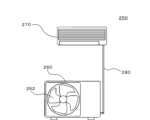
- ⁇ Description of Air Conditioning Device> 20 is a diagram showing a schematic configuration of an air-conditioning apparatus 250 according to Embodiment 6.
- the air-conditioning apparatus 250 according to Embodiment 6 is made up of an outdoor unit 260, an indoor unit 270, and refrigerant piping 280.
- Figures 21 and 22 are refrigerant circuit diagrams showing the flow of refrigerant in an air conditioning device 250 according to the sixth embodiment.
- Figure 21 shows the cooling operation
- Figure 22 shows the heating operation.
- the outdoor unit 260 is composed of an outdoor heat exchanger 261, an outdoor blower 262, a compressor 263, a four-way valve 264, and an expansion valve 265.
- the outdoor heat exchanger 261 functions as a condenser during cooling operation and as an evaporator during heating operation.
- the indoor heat exchanger 271 functions as an evaporator during cooling operation and as a condenser during heating operation. Switching between cooling operation and heating operation is performed by switching the flow path using the four-way valve 264.
- the compressor 263 has an electric motor, a compression mechanism driven by the electric motor, and a sealed container that covers the electric motor and the compression mechanism.
- the electric motor is, for example, the electric motor 1 according to embodiment 1-4.
- the compressor 263 compresses the refrigerant it draws in and discharges it.
- the four-way valve 264 changes the direction of the refrigerant flowing through the refrigerant circuit.
- the expansion valve 265 reduces the pressure of the refrigerant to expand it.
- the air conditioning device 250 passes high-temperature, high-pressure refrigerant gas sent out from the compressor 263 through the condenser, where it exchanges heat with a medium (e.g., air), condensing the refrigerant gas and sending it out as low-temperature, high-pressure liquid refrigerant.
- a medium e.g., air
- Heat exchange with the medium occurs when the refrigerant flows through the condenser and passes between two fins in a direction perpendicular to the axial direction of the heat transfer tube. This allows heat to be released outside the condenser in an amount equal to the amount of heat in the refrigerant reduced by condensation.
- heat is dissipated from the outdoor heat exchanger 261, which functions as a condenser, and warm air is expelled outside the outdoor unit 260 by the outdoor blower 262.
- heat is dissipated from the indoor heat exchanger 271, which functions as a condenser, and warm air is supplied to the room by the indoor blower 272.
- the function of the evaporator will now be explained.
- the low-temperature gas-liquid mixed refrigerant sent out from the expansion valve 265 is passed through the evaporator and heat exchanged with a medium (e.g., air), causing the gas-liquid mixed refrigerant to evaporate and be sent out as low-temperature refrigerant gas.
- Heat exchange with the medium is performed by the refrigerant flowing through the evaporator and passing between two fins in a direction perpendicular to the axial direction of the heat transfer tube. This cools the outside of the evaporator by the amount of heat added to the refrigerant by evaporation.
- cooling is provided by the outdoor heat exchanger 261, which functions as an evaporator, and the outdoor blower 262 blows the cool air outside the outdoor unit 260.
- cooling is provided by the indoor heat exchanger 271, which functions as an evaporator, and the indoor blower 272 supplies the cool air to the room.
- the refrigerant is a mixed refrigerant containing ethylene-based fluorohydrocarbons having carbon double bonds.
- a mixed refrigerant containing ethylene-based fluorohydrocarbons having carbon double bonds By using a mixed refrigerant containing ethylene-based fluorohydrocarbons having carbon double bonds, the operating pressure of the compressor 263 is reduced, and disproportionation reactions of the refrigerant can be prevented.
- the refrigerant is a mixed refrigerant containing R1123. Note that the refrigerant is not limited to R1123, and may be a mixed refrigerant containing other ethylene-based fluorohydrocarbons.
- the refrigerant may contain one or more types of ethylene-based fluorohydrocarbons, and may be a mixed refrigerant made by mixing an ethylene-based fluorohydrocarbon with another refrigerant.
- the refrigerant may be, for example, a mixed refrigerant made by mixing R1123 and R32.
- the ratio of R1123 in this mixed refrigerant is preferably set within the range of, for example, 40 wt% to 60 wt%. Note that R1123 is not limited to R32, and may be mixed with one or more of the following refrigerants: R1234yf, R1234ze(E), R1234ze(Z), R125, and R134a.
- the refrigerant may also be a refrigerant having two or more ethylenic fluorocarbons.
- R1123 may be mixed with one or more of the ethylenic fluorocarbons R1141, R1132a, R1132(E), and R1132(Z).
- the refrigerant may be a mixed refrigerant of R516A, R445A, R444A, R454C, R444B, R454A, R455A, R457A, R459B, R452B, R454B, R447B, R447A, R446A, and R459A.
- the refrigerant may also be a single refrigerant selected from the group consisting of R1234yf, R1234ze, R32, and R290.
- the electric motor described in the first to fourth embodiments is applied to at least one of the outdoor blower 262 and the indoor blower 272, and therefore the same advantages as those described in the first to fourth embodiments can be obtained. As a result, a highly efficient air conditioning device 250 can be provided.
- the electric motor 1 described in embodiments 1-4 can be installed in any electrical device that has a drive source, such as a machine tool, an electric vehicle, a drone, or a robot.
Landscapes
- Engineering & Computer Science (AREA)
- Power Engineering (AREA)
- Permanent Field Magnets Of Synchronous Machinery (AREA)
- Iron Core Of Rotating Electric Machines (AREA)
Priority Applications (2)
| Application Number | Priority Date | Filing Date | Title |
|---|---|---|---|
| PCT/JP2023/037862 WO2025083844A1 (ja) | 2023-10-19 | 2023-10-19 | 回転子、電動機、送風機および空気調和装置 |
| JP2025552553A JPWO2025083844A1 (https=) | 2023-10-19 | 2023-10-19 |
Applications Claiming Priority (1)
| Application Number | Priority Date | Filing Date | Title |
|---|---|---|---|
| PCT/JP2023/037862 WO2025083844A1 (ja) | 2023-10-19 | 2023-10-19 | 回転子、電動機、送風機および空気調和装置 |
Publications (1)
| Publication Number | Publication Date |
|---|---|
| WO2025083844A1 true WO2025083844A1 (ja) | 2025-04-24 |
Family
ID=95448747
Family Applications (1)
| Application Number | Title | Priority Date | Filing Date |
|---|---|---|---|
| PCT/JP2023/037862 Pending WO2025083844A1 (ja) | 2023-10-19 | 2023-10-19 | 回転子、電動機、送風機および空気調和装置 |
Country Status (2)
| Country | Link |
|---|---|
| JP (1) | JPWO2025083844A1 (https=) |
| WO (1) | WO2025083844A1 (https=) |
Citations (5)
| Publication number | Priority date | Publication date | Assignee | Title |
|---|---|---|---|---|
| JP2010206882A (ja) * | 2009-03-02 | 2010-09-16 | Mitsubishi Electric Corp | 電動機及び圧縮機及び空気調和機及び電気掃除機 |
| JP2013099064A (ja) * | 2011-10-31 | 2013-05-20 | Hitachi Appliances Inc | 永久磁石式電動機及びそれを利用した密閉形圧縮機 |
| WO2020090007A1 (ja) * | 2018-10-30 | 2020-05-07 | 三菱電機株式会社 | コンシクエントポール型回転子、電動機、送風機、及び冷凍空調装置、並びにコンシクエントポール型回転子の製造方法 |
| JP2021002958A (ja) * | 2019-06-24 | 2021-01-07 | 三菱電機株式会社 | 回転電機 |
| JP2023054248A (ja) * | 2020-02-26 | 2023-04-13 | 三菱電機株式会社 | 回転子、電動機、送風機、空気調和装置、及び回転子の製造方法 |
-
2023
- 2023-10-19 JP JP2025552553A patent/JPWO2025083844A1/ja active Pending
- 2023-10-19 WO PCT/JP2023/037862 patent/WO2025083844A1/ja active Pending
Patent Citations (5)
| Publication number | Priority date | Publication date | Assignee | Title |
|---|---|---|---|---|
| JP2010206882A (ja) * | 2009-03-02 | 2010-09-16 | Mitsubishi Electric Corp | 電動機及び圧縮機及び空気調和機及び電気掃除機 |
| JP2013099064A (ja) * | 2011-10-31 | 2013-05-20 | Hitachi Appliances Inc | 永久磁石式電動機及びそれを利用した密閉形圧縮機 |
| WO2020090007A1 (ja) * | 2018-10-30 | 2020-05-07 | 三菱電機株式会社 | コンシクエントポール型回転子、電動機、送風機、及び冷凍空調装置、並びにコンシクエントポール型回転子の製造方法 |
| JP2021002958A (ja) * | 2019-06-24 | 2021-01-07 | 三菱電機株式会社 | 回転電機 |
| JP2023054248A (ja) * | 2020-02-26 | 2023-04-13 | 三菱電機株式会社 | 回転子、電動機、送風機、空気調和装置、及び回転子の製造方法 |
Also Published As
| Publication number | Publication date |
|---|---|
| JPWO2025083844A1 (https=) | 2025-04-24 |
Similar Documents
| Publication | Publication Date | Title |
|---|---|---|
| JP6537623B2 (ja) | ステータ、電動機、圧縮機、及び冷凍空調装置 | |
| EP3767794B1 (en) | Electric motor, compressor, blower, and refrigeration and air-conditioning device | |
| US11101709B2 (en) | Electric motor, air blower, and air conditioner | |
| CN108886276B (zh) | 电动机、送风机、压缩机及空气调节装置 | |
| JP7195408B2 (ja) | ロータ、モータ、圧縮機、及び空気調和機 | |
| WO2019215865A1 (ja) | ロータ、電動機、圧縮機および空気調和装置 | |
| JP2001251825A (ja) | 永久磁石式同期電動機及びこれを用いた空気調和機 | |
| JP7204897B2 (ja) | ロータ、モータ、圧縮機、及び空気調和機 | |
| JP7204018B2 (ja) | ロータ、電動機、送風機および空気調和装置 | |
| JP7237178B2 (ja) | ロータ、電動機、圧縮機、及び空気調和機 | |
| JP7034328B2 (ja) | ロータ、モータ、圧縮機、及び冷凍空調装置 | |
| WO2025083844A1 (ja) | 回転子、電動機、送風機および空気調和装置 | |
| JP7094369B2 (ja) | ステータ、モータ、圧縮機、及び冷凍空調装置 | |
| JPWO2017208317A1 (ja) | 回転子、電動機、圧縮機、送風機、及び空気調和機 | |
| US12323000B2 (en) | Electric motor, fan, and air conditioner | |
| JP7559044B2 (ja) | 電動機、ファン、及び空気調和機 | |
| US20070290560A1 (en) | Motor and Electric Apparatus Using the Same Motor | |
| WO2023148949A1 (ja) | 電動機及び空気調和機 | |
| JP7471493B2 (ja) | 固定子、電動機、圧縮機、冷凍サイクル装置及び空気調和装置 | |
| JP7665013B2 (ja) | 電動機、ファン、及び空気調和機 | |
| WO2026094465A1 (ja) | 固定子、電動機、圧縮機および空気調和装置 | |
| WO2025210896A1 (ja) | 固定子、電動機、圧縮機および空気調和装置 | |
| JP2006353100A (ja) | 空気調和機 | |
| US20240235285A1 (en) | Motor, fan, and air conditioner | |
| WO2025158644A1 (ja) | 電動機、圧縮機および冷凍サイクル装置 |
Legal Events
| Date | Code | Title | Description |
|---|---|---|---|
| 121 | Ep: the epo has been informed by wipo that ep was designated in this application |
Ref document number: 23956092 Country of ref document: EP Kind code of ref document: A1 |
|
| ENP | Entry into the national phase |
Ref document number: 2025552553 Country of ref document: JP Kind code of ref document: A |