WO2025079328A1 - ガス濃度測定器及びガス濃度測定方法 - Google Patents
ガス濃度測定器及びガス濃度測定方法 Download PDFInfo
- Publication number
- WO2025079328A1 WO2025079328A1 PCT/JP2024/028495 JP2024028495W WO2025079328A1 WO 2025079328 A1 WO2025079328 A1 WO 2025079328A1 JP 2024028495 W JP2024028495 W JP 2024028495W WO 2025079328 A1 WO2025079328 A1 WO 2025079328A1
- Authority
- WO
- WIPO (PCT)
- Prior art keywords
- gas
- ultraviolet light
- light
- wavelength band
- gas concentration
- Prior art date
- Legal status (The legal status is an assumption and is not a legal conclusion. Google has not performed a legal analysis and makes no representation as to the accuracy of the status listed.)
- Pending
Links
Images


Classifications
-
- G—PHYSICS
- G01—MEASURING; TESTING
- G01N—INVESTIGATING OR ANALYSING MATERIALS BY DETERMINING THEIR CHEMICAL OR PHYSICAL PROPERTIES
- G01N21/00—Investigating or analysing materials by the use of optical means, i.e. using sub-millimetre waves, infrared, visible or ultraviolet light
- G01N21/17—Systems in which incident light is modified in accordance with the properties of the material investigated
- G01N21/25—Colour; Spectral properties, i.e. comparison of effect of material on the light at two or more different wavelengths or wavelength bands
- G01N21/31—Investigating relative effect of material at wavelengths characteristic of specific elements or molecules, e.g. atomic absorption spectrometry
- G01N21/33—Investigating relative effect of material at wavelengths characteristic of specific elements or molecules, e.g. atomic absorption spectrometry using ultraviolet light
-
- G—PHYSICS
- G01—MEASURING; TESTING
- G01N—INVESTIGATING OR ANALYSING MATERIALS BY DETERMINING THEIR CHEMICAL OR PHYSICAL PROPERTIES
- G01N21/00—Investigating or analysing materials by the use of optical means, i.e. using sub-millimetre waves, infrared, visible or ultraviolet light
- G01N21/17—Systems in which incident light is modified in accordance with the properties of the material investigated
- G01N21/59—Transmissivity
- G01N21/61—Non-dispersive gas analysers
Definitions
- This disclosure relates to a gas concentration measuring device and a gas concentration measuring method.
- Short-wavelength ultraviolet light such as vacuum ultraviolet light and deep ultraviolet light, specifically ultraviolet light with wavelengths between 115 nm and 320 nm (hereinafter, for convenience, may be referred to as ultraviolet light of a specific wavelength band), is strongly absorbed by many substances and is therefore suitable for use as light for measurements.
- ultraviolet light of a specific wavelength band due to the characteristic that ultraviolet light of a specific wavelength band is strongly absorbed by many substances, when used as light for measurements, it is easily affected by gases that absorb vacuum ultraviolet light, such as oxygen in the atmosphere. Therefore, when ultraviolet light of a specific wavelength band is used as a light source for measurements, sufficient sensitivity and noise resistance (high signal-to-noise ratio) may not be obtained during the measurements.
- the gas concentration measuring device comprises: a cell through which a gas to be measured containing a component to be measured and a carrier gas flows; a light source that irradiates the measurement target gas flowing through the cell with ultraviolet light having a wavelength of 115 nm or more and 320 nm or less; a light receiver that receives the ultraviolet light that has been transmitted through the measurement target gas; an optical filter disposed on an optical path of the ultraviolet light between the light source and the light receiver; The optical filter transmits only a specific wavelength band of the ultraviolet light.
- a gas concentration measurement method includes: a flowing step of flowing a gas to be measured, in which a component to be measured having an absorption wavelength in an ultraviolet light wavelength band of 115 nm or more and 320 nm or less is mixed with a carrier gas having no absorption wavelength in the ultraviolet light wavelength band, through a cell; an irradiation step of irradiating the measurement target gas flowing through the cell with the ultraviolet light; and receiving the ultraviolet light transmitted through the measurement target gas,
- the irradiating step or the receiving step includes a filtering step for selecting a specific wavelength band.
- ultraviolet light having a wavelength of 115 nm or more and 320 nm or less is used as the light source for measurement, it is possible to provide a gas concentration measuring device and a gas concentration measuring method that achieve both high sensitivity and noise resistance during measurement.
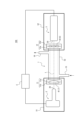
- FIG. 13 is an explanatory diagram of the configuration of another gas concentration measuring device.
- FIG. 1 shows an explanatory diagram of the configuration of a gas concentration measuring instrument 100 according to this embodiment.
- the gas concentration measuring instrument 100 includes a cell 1 through which a gas to be measured containing a component to be measured and a carrier gas flows, a light source unit 2 that irradiates the gas to be measured flowing through the cell 1 with ultraviolet light having a wavelength of 115 nm or more and 320 nm or less, a light receiver 3 that receives the ultraviolet light transmitted through the gas to be measured, and a filter window 6 as an optical filter disposed on the optical path L of the ultraviolet light between the light source unit 2 and the light receiver 3, and the filter window 6 transmits only a specific wavelength band of the ultraviolet light.
- the gas concentration measurement method includes a flow process in which a measurement target gas in which a measurement target component having an absorption wavelength in the ultraviolet light wavelength band of 115 nm or more and 320 nm or less is mixed with a carrier gas that has no absorption wavelength in this ultraviolet light wavelength band is passed through cell 1, an irradiation process in which ultraviolet light in this wavelength band is irradiated onto the measurement target gas passing through cell 1, and a light receiving process in which the transmitted ultraviolet light that has passed through the measurement target gas is received, and the irradiation process or the light receiving process includes a filter process for selecting a specific wavelength band.
- the gas concentration measuring device 100 can realize the above-mentioned gas concentration measuring method. According to the gas concentration measuring device 100 and this gas concentration measuring method, when ultraviolet light is used as the light source for measurement, it is possible to improve both high sensitivity and noise resistance during measurement.
- the gas concentration measuring device 100 and the gas concentration measuring method are described in detail below.
- the carrier gas is a gas in which the components to be measured are mixed.
- the gas concentration measuring device 100 measures the concentration of the components to be measured in the gas to be measured, assuming that the carrier gas does not have an absorption wavelength that overlaps with the components to be measured in a specific wavelength band.
- the carrier gas is preferably one that does not have an absorption wavelength in a specific wavelength band, particularly in the wavelength range of 130 nm to 320 nm.
- the carrier gas is preferably one that is inexpensively available. Examples of such carrier gases include N2 (nitrogen), H2 (hydrogen), and CO2 (carbon dioxide).
- B2H6 , N2H4 , Si2H6 , Ge2H6 and MoO2Cl2 have large absorption in specific wavelength bands, approximately 115 nm to 140 nm, 130 nm to 195 nm, 125 nm to 170 nm, 120 nm to 185 nm, and 245 nm to 315 nm , respectively.
- Cell 1 is a container through which the gas to be measured flows and through which ultraviolet light of a specific wavelength band passes through the gas to be measured.
- Cell 1 introduces ultraviolet light of a specific wavelength band irradiated from light source unit 2 into cell 1, transmits the light through the gas to be measured, and further guides the ultraviolet light of the specific wavelength band that has passed through the gas to be measured out of cell 1 and is received by receiver 3.
- the light source unit 2 and receiver 3 will be described later.
- the cell 1 has a cylindrical section 10 with a linear internal space, an entrance section 11 arranged at one end of the cylindrical section 10, an exit section 12 arranged at the end of the cylindrical section 10 opposite the entrance section 11, an inlet 15 for supplying the gas to be measured to the cylindrical section 10, and an outlet 16 for discharging the gas to be measured from the cylindrical section 10.
- the entrance section 11 is arranged on the side of the light source unit 2
- the exit section 12 is arranged on the side of the light receiver 3.
- ultraviolet light of a specific wavelength band is transmitted through the gas to be measured while the gas to be measured is passed through the cylindrical portion 10.
- the gas to be measured is supplied to the cylindrical portion 10 through the inlet 15.
- the gas to be measured supplied to the cylindrical portion 10 is discharged from the outlet 16.
- the gas to be measured is a manufacturing gas that includes raw material gas supplied to semiconductor manufacturing equipment
- the inlet 15 is connected to the upstream side of the manufacturing gas supply piping
- the outlet 16 is connected to the downstream side of the manufacturing gas supply piping.
- the inlet 15, the tube portion 10, and the outlet 16 may be part of the manufacturing gas supply piping, or may be a bypass pipe for the manufacturing gas supply piping.
- the gas concentration measuring instrument 100 can be used for both inline and online measurements.
- the incident section 11 is a light inlet that introduces ultraviolet light of a specific wavelength band irradiated from the light source unit 2 into the cell 1 (the internal space of the cell 1).
- the incident section 11 has a window section 41 that selectively transmits all wavelengths of ultraviolet light of the specific wavelength band or only a specific wavelength band of ultraviolet light of the specific wavelength band and introduces it into the cell 1.
- the window section 41 may have a flat shape such as a disk shape. Note that selecting and transmitting only a specific wavelength band can be rephrased as cutting off light of wavelength bands other than the specific wavelength band.
- the incident portion 11 may be formed, for example, in the shape of a flange that sandwiches and fixes the window portion 41.
- the incident portion 11 includes an annular, plate-shaped seat portion 11a whose inner periphery is fixed to the end of the tube portion 10, and an annular, plate-shaped lid portion 11b that is fixed to the seat portion 11a, for example, with bolts and nuts, and the window portion 41 is sandwiched between the seat portion 11a and the lid portion 11b, and fixed to the incident portion 11.
- the exit section 12 is a light outlet that guides the transmitted light from inside the cell 1 to the outside of the cell 1.
- the exit section 12 has a window section 42 that selectively transmits all wavelengths of ultraviolet light in a specific wavelength band or only a specific wavelength band of ultraviolet light in a specific wavelength band and guides the light to the outside of the cell 1.
- the window section 42 may be flat, like the window section 41.
- the emission section 12 may be formed in a flange shape that sandwiches and fixes the window section 42, similar to the incidence section 11.
- FIG. 1 shows a case in which the emission section 12 includes an annular, plate-shaped seat section 12a whose inner periphery is fixed to the end of the tube section 10, and an annular, plate-shaped lid section 12b that is fixed to the seat section 12a, for example, with bolts and nuts, and the window section 42 is sandwiched between the seat section 12a and the lid section 12b, and fixed to the emission section 12.
- At least one of the window portions 41 and 42 may be a filter window 6 having a substrate (window) formed of a material capable of transmitting ultraviolet light of a specific wavelength band, and an optical filter arranged on the substrate.
- the optical filter may be a bandpass filter that selects and transmits only a specific wavelength band within the specific wavelength band.
- the specific wavelength band transmitted by the optical filter (filter window 6) includes at least the absorption wavelength of the component to be measured.
- Both the window portion 41 and the window portion 42 may be filter windows 6, or only one of them may be a filter window 6.
- the filter window 6 in the gas concentration measuring device 100 allows the noise of the light received by the light receiver 3 described later to be reduced (the signal-to-noise ratio is improved).
- the window portion 42 is a window formed of a material capable of transmitting ultraviolet light of a specific wavelength band
- the window portion 41 is a filter window 6 having a substrate formed of a material capable of transmitting ultraviolet light of a specific wavelength band and an optical filter disposed on the substrate.
- the light source unit 2 is a unit equipped with a light source that emits ultraviolet light in a specific wavelength band.
- the light source unit 2 has a light source of ultraviolet light in a specific wavelength band, such as a deuterium lamp, and an irradiation window 20 that irradiates the window portion 41 with ultraviolet light in the specific wavelength band.
- the irradiation window 20 is arranged parallel to the plate surface of the window portion 41. It is preferable that the irradiation window 20 irradiates the window portion 41 with ultraviolet light in the specific wavelength band so that the optical path L is perpendicular to the plate surface of the window portion 41.
- the light source of light source unit 2 does not need to be capable of emitting light of all wavelengths of ultraviolet light in the specific wavelength band (continuous spectrum in the specific wavelength band), but it is preferable that it emits light in a wavelength band of at least 100 nm width (half width of 50 nm) in the specific wavelength band.
- such light sources include LED light sources that are not single wavelength and xenon lamps such as mercury xenon lamps. It is preferable that the light source of light source unit 2 includes light of wavelengths in the range of 115 nm to 320 nm inclusive continuously, that is, a continuous spectrum in the range of 115 nm to 320 nm inclusive.
- light source unit 2 is also acceptable if it emits light of wavelengths other than the specific wavelength band (for example, light of a wavelength band close to the specific wavelength band).
- the light source of the light source unit 2 may be a single-wavelength light source in a specific wavelength band, such as a laser light source having emission characteristics of a bright line spectrum, a light source that extracts only specific wavelengths using an optical filter, or a light source with a narrow wavelength band of about 20 nm (half-width 10 nm) in the specific wavelength band. In this case, the absorption wavelength of the component to be measured and the wavelength of the light source are made to overlap.
- the light source unit 2 may input ultraviolet light of a specific wavelength band to be irradiated from the irradiation window 20 into the condenser lens 7, and irradiate the window portion 41 with the ultraviolet light of the specific wavelength band condensed by the condenser lens 7.
- the condenser lens 7 is one that converts the ultraviolet light of the specific wavelength band condensed by the condenser lens 7 into parallel light, or one that causes the focus of the condensed light to be located at the light receiver 3 described below. This can improve the sensitivity of light reception at the light receiver 3.
- the receiver 3 does not have to be capable of detecting the spectrum of the transmitted light or emitting a signal corresponding to the spectrum. It is sufficient for the receiver 3 to receive transmitted light in a specific wavelength band and emit a signal corresponding to the intensity of the received transmitted light. This allows the gas concentration measuring instrument 100 to measure gas concentrations with high sensitivity. It is preferable that the receiver 3 has no sensitivity to wavelength bands other than the specific wavelength band. It is preferable that the receiver 3 has sensitivity to the entire wavelength band from 115 nm to 320 nm.
- the optical receiver 3 has sensitivity in the wavelength band (transmission wavelength band) that the filter window 6 transmits, and has no sensitivity in other wavelength bands. This allows the gas concentration measuring instrument 100 to perform gas concentration measurements with even higher sensitivity and higher noise resistance.
- the receiver 3 When the receiver 3 is a photomultiplier tube, the receiver 3 has a light guide window 30 that guides transmitted light into the tube.
- the light guide window 30 is arranged parallel to the plate surface of the window portion 42. It is preferable that the light guide window 30 is arranged so that the optical path L intersects it perpendicularly.
- the light received by the receiver 3 is not split into two beams.
- the irradiation window 20, the condenser lens 7, the window portion 41, the tube portion 10, the window portion 42 (filter window 6), and the light guide window 30 are preferably arranged in this order along the optical path L, overlapping with the optical path L (i.e., on the optical path L). Note that in this embodiment, it is permissible to refract the optical path L using something like a reflector. It is preferable that the axial direction of the tube of the tube portion 10 is arranged along the optical path L, as shown in FIG. 1. This makes it possible to increase the distance that ultraviolet light of a specific wavelength band transmits through the gas to be measured, thereby improving the sensitivity during measurement by the gas concentration measuring instrument 100.
- the irradiation window 20 and the window portion 41 should be arranged at a certain distance apart, without being in contact with each other.
- it should be arranged between the irradiation window 20 and the window portion 41.
- the irradiation window 20 and the condenser lens 7 should be arranged at a certain distance apart.
- the condenser lens 7 and the window portion 41 should be arranged at a certain distance apart.
- the window portion 42 and the light guide window 30 should be arranged at a certain distance apart, without being in contact with each other.
- the first container 51 is a container that encloses a space including the optical path L of ultraviolet light of a specific wavelength band between the light source unit 2 and the cell 1.
- the first container 51 can control the internal atmosphere to be a vacuum or filled with a specific gas by creating a vacuum inside the container, sealing a specific gas inside the container, or flowing a specific gas inside the container so that gases other than the specific gas do not enter the outside of the container.
- the first container 51 it is sufficient for the first container 51 to enclose at least the space including the optical path L between the irradiation window 20 and the entrance section 11, but it may enclose more than this range. It is preferable that the first container 51 encloses a space including the irradiation window 20, the optical path L between the irradiation window 20 and the entrance section 11, and the entrance section 11 (the end of the cell 1 on the light source unit 2 side). This ensures that the space including the optical path L between the irradiation window 20 and the entrance section 11 is evacuated or filled with a non-interfering gas.
- Figure 1 shows an example in which the first container 51 is a container that encloses the entrance section 11, the condenser lens 7, and the light source unit 2.
- the second container 52 is a container that encloses a space including the optical path L of ultraviolet light of a specific wavelength band between the cell 1 and the photodetector 3.
- the second container 52 can control the internal atmosphere to be a vacuum or filled with a specific gas by creating a vacuum inside the container, sealing a specific gas inside the container, or allowing a specific gas to flow inside the container so that gases other than the specific gas do not enter the outside of the container.
- the first container 51 is preferably fixed to a base on which the cell 1 and the photodetector 3 are placed as necessary, and is also preferably removable.
- the first container 51 is preferably formed of a material that is opaque to light (especially ultraviolet light of a specific wavelength band), such as metal.
- the gas concentration measuring device 100 described above can measure the concentration of a target component in a target gas in which the target component, which has an absorption wavelength in a specific wavelength band, is mixed with a carrier gas that does not have an absorption wavelength in the specific wavelength band, as follows. This measurement can be performed by the following procedure.
- the gas to be measured is passed through the cell 1 (an example of a passing process), and the gas to be measured passing through the cell 1 is irradiated with ultraviolet light of a specific wavelength band from the light source unit 2 via the focusing lens 7 and the window 41 (an example of an irradiation process).
- the light receiver 3 then receives the transmitted light that has passed through the gas to be measured through the window 42 (an example of a receiving process).
- a specific wavelength band can be selected and received by the receiver 3, reducing the noise of the received light at the receiver 3 (improving noise resistance, i.e., signal-to-noise ratio).
- the window 42 is a filter window
- the window 42 as a filter window can cut out the light emitted in the cell 1 (for example, light emitted by excitation with ultraviolet light of a specific wavelength band) and light other than that from the light source unit 2 that enters the cell 1, thereby reducing the noise of the received light at the receiver 3.
- the window 41 is a filter window, the decomposition and light emitted of the measurement target component in the cell 1 caused by ultraviolet light of a specific wavelength band can be reduced, thereby reducing the noise of the received light at the receiver 3.
- the sensitivity of the optical receiver 3 to receiving light can be improved and noise can be reduced.
- the gas to be measured contains only one type of component to be measured. By using only one type of component to be measured, it is possible to perform measurements with high sensitivity, resistance to noise, and a high signal-to-noise ratio.
- the gas concentration measuring device and the gas concentration measuring method according to the present embodiment are highly sensitive and resistant to noise, and can perform measurements with a high S/N ratio. Because the gas concentration measuring device and the gas concentration measuring method according to the present embodiment are highly sensitive and resistant to noise, and can perform measurements with a high S/N ratio, they are particularly suitable for managing the concentration of material gases used in semiconductor manufacturing processes, particularly for concentration management by inline or online measurement. In more detail, the gas concentration measuring device and the gas concentration measuring method according to the present embodiment achieve measurements with high sensitivity and a high S/N ratio, and therefore can achieve precise concentration management and detection of abnormalities (unexpected fluctuations in concentration) in a short time when managing the concentration of material gases by inline or online measurement.
- a measuring device or a measuring method with low sensitivity and low S/N ratio cannot perform precise concentration management, and it takes time to determine whether the measurement results are abnormal values affected by noise, making it difficult to achieve rapid feedback to the manufacturing process.
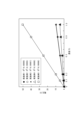
- the concentration of the component to be measured was changed in the range of 0.1% by volume (hereinafter, volume % is simply written as %) to 1.0%, the corresponding voltage output from the receiver was measured, and the relationship between the concentration of the component to be measured and the voltage output was obtained.
- the least squares method was then applied to the values of the concentration of the component to be measured and the voltage output, and an approximate straight line (approximation equation) between the concentration of the component to be measured and the voltage output was obtained using a linear function, and the detection limit value as the measurement sensitivity of the measuring device and the R2 value (coefficient of determination) as the measurement noise were obtained.
- the concentration of the component to be measured was changed in five levels, 0.1%, 0.2%, 0.5%, 0.8%, and 1.0%, and the voltage output was obtained.
- FIG. 2 shows the concentration of the component to be measured, the corresponding voltage output, the approximation line and the R2 value in this embodiment.
- the black circles are the graphs of the results of this embodiment.
- the R2 value exceeds 0.9999, and it was found that the measurement can be performed with a high S/N ratio and is resistant to noise.
- the detection limit calculated based on this approximation line was 10 ppm by volume (hereinafter simply referred to as ppm), which was found to be a detection sensitivity that is sufficiently high for practical use. In this embodiment, if the detection sensitivity is 20 ppm or more, it is evaluated as being a detection sensitivity that is sufficiently high for practical use.
- Example 4 This embodiment differs from Example 1 in that the component to be measured is replaced with vaporized IPA (isopropanol), the carrier gas is replaced with CO 2 (carbon dioxide), and the optical filter of the filter window of the measuring instrument is replaced with one that transmits only vacuum ultraviolet light with a wavelength near 135 nm, which is the central absorption wavelength of isopropanol (central wavelength: 135 nm, bandwidth: 10 nm, wavelength band: 130 nm to 140 nm).
- the other parts are the same as those of Example 1, and the detection limit value as the measurement sensitivity of the measuring instrument and the R 2 value as the measurement noise were obtained.
- the carrier gas (carbon dioxide) and the gas (nitrogen) in the atmosphere inside the first container and the second container are different.
- FIG. 2 shows the concentration of the component to be measured in this embodiment, the corresponding voltage output, their approximate straight line, and the R 2 value.
- the open triangle marks are graphs of the results of this embodiment.
- the R2 value exceeded 0.9999, indicating that the method was resistant to noise and had a high S/N ratio.
- the detection limit was 5 ppm, which was similar to Example 1 and showed that the detection sensitivity was sufficiently high for practical use.
- Example 5 This embodiment differs from Example 3 in that a condenser lens was installed between the light source unit and the cell of the measuring instrument, and otherwise the same as Example 3.
- the detection limit as the measurement sensitivity of the measuring instrument and the R2 value as the measurement noise were obtained.
- FIG. 2 shows the concentration of the component to be measured, the corresponding voltage output, their approximate straight line, and the R2 value in this embodiment.
- the open square marks are the graphs of the results of this embodiment.
- the R2 value exceeds 0.9999, and it was found that the measurement can be performed with a high S/N ratio and is resistant to noise.
- the detection limit is 1 ppm, which is a higher detection sensitivity than Example 3.
- Comparative Example 5 This comparative example differs from Example 1 in that the optical filter of the measuring instrument is not used, the window of the exit part is a transparent window formed of magnesium fluoride, the first container and the second container are removed, and the space including the light path between the irradiation window of the light source unit and the entrance part of the cell, and the space including the light path between the exit part of the cell and the light guide window of the light receiver are replaced with the air environment, and the rest is the same as Example 1, and the detection limit value as the measurement sensitivity of the measuring instrument and the R 2 value as the measurement noise were obtained.
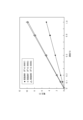
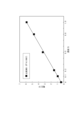
- Figure 5 shows the concentration of the component to be measured in this example, the corresponding voltage output, their approximate straight line and R 2 value.
- the R 2 value was less than 0.999, which was easily affected by noise and resulted in a measurement with a low S/N ratio.
- the detection limit value was at most 100 ppm, which was different from the cases of each example, and the detection sensitivity was low.
- Example 5 achieved higher detection sensitivity than Example 3, and it is believed that the focusing lens contributed to the improved sensitivity.
- ultraviolet light in the absorption wavelength band of hydrazine, molybdenum dichloride, and isopropanol does not attenuate on the optical path.
- an optical filter is placed on the optical path of ultraviolet light of a specific wavelength band between the light source unit and the receiver, ultraviolet light of wavelength bands other than the absorption wavelength bands of hydrazine, molybdenum dichloride dioxide, or isopropanol is cut.
- the gas concentration measuring instrument 100 has a cell 1 that has a cylindrical portion 10 having a linear internal space, and an entrance portion 11 and an exit portion 12 that are disposed at the ends of the cylindrical portion 10, and the cell 1 is configured such that, while the gas to be measured is caused to flow through the cylindrical portion 10, ultraviolet light of a specific wavelength band that is introduced from the entrance portion 11 is transmitted through the gas to be measured and is then guided out of the cell 1 from the exit portion 12.
- the configuration of the gas concentration measuring instrument 100 and its cell 1 is not limited to this configuration.
- cell 1 may be constructed on a transparent substrate that transmits ultraviolet light in a specific wavelength band.
- the transparent substrate may be formed from magnesium fluoride.
- Cell 1 may also be a so-called MEMS (Micro Electro Mechanical Systems).
- a fine flow path for passing the gas to be measured may be formed in the transparent substrate serving as the cell 1. Then, ultraviolet light of a specific wavelength band is irradiated from the light source unit 2 from one side of the plate surface of the cell 1 along an optical path that passes through this fine flow path, and the transmitted light is received by the optical receiver 3 on the other side of the plate surface of the cell 1, thereby making it possible to measure the concentration of the component to be measured.
- the irradiation window 20 of the light source unit 2, the entire cell 1, and the light guide window 30 of the receiver 3 are covered with a container, thereby enclosing the optical path L of the ultraviolet light of the specific wavelength band between the light source unit 2 and the cell 1 and the optical path L of the ultraviolet light of the specific wavelength band between the cell 1 and the receiver 3, and the internal atmosphere of the container may be controlled to a vacuum or filled with a specific gas.
- the gas concentration measuring device and gas concentration measuring method according to this embodiment can improve sensitivity during measurement, so that even if the optical path length of the ultraviolet light of a specific wavelength band that passes through the gas to be measured is shortened by miniaturizing the cell 1 or the flow path of the gas to be measured within the cell 1, it is possible to ensure practical measurement accuracy.
- the gas concentration measuring device and gas concentration measuring method according to this embodiment can be applied to a scale (large scale) that allows the gas to be measured to flow at a level required for in-line measurement, and also to a minute scale such as that known as MEMS.
- the condenser lens 7 is disposed on the optical path L of ultraviolet light of a specific wavelength band between the light source unit 2 and the cell 1 in the gas concentration measuring device 100. It has also been described that the irradiation window 20, the condenser lens 7, and the window portion 41 are disposed in this order along the optical path L, overlapping with the optical path L, and that the condenser lens 7 and the window portion 41 are disposed at a certain distance from each other.
- the arrangement of the condenser lens 7 is not limited to this example.
- the window portion 41 may also function as the condensing lens 7.
- FIG. 6 also illustrates a case where the window portion 42 is a filter window 6.
- the window portions 41 and 42 is a filter window 6 having a substrate (window) formed of a material that can transmit ultraviolet light of a specific wavelength band, and an optical filter arranged on the substrate.
- the optical filter does not necessarily have to be arranged on the window portion 41 or 42. It is sufficient that the optical filter is arranged on the optical path L of ultraviolet light of a specific wavelength band between the light source unit 2 and the photoreceiver 3.
- the irradiation window 20, the condensing lens 7, and the window portion 41 are arranged in this order along the optical path L so as to overlap with the optical path L.
- the window portion 41 is a filter window 6 having a substrate formed of a material capable of transmitting ultraviolet light of a specific wavelength band and an optical filter arranged on the substrate.
- the arrangement of the optical filter is not limited to these examples.
- the optical filter may be arranged between the irradiation window 20 and the condensing lens 7. That is, the irradiation window 20, the optical filter, the condensing lens 7, and the window portion 41 without an optical filter may be arranged in this order along the optical path L so as to overlap with the optical path L.
- This disclosure can be applied to gas concentration measuring devices and gas concentration measuring methods.
Landscapes
- Physics & Mathematics (AREA)
- Spectroscopy & Molecular Physics (AREA)
- Health & Medical Sciences (AREA)
- Life Sciences & Earth Sciences (AREA)
- Chemical & Material Sciences (AREA)
- Analytical Chemistry (AREA)
- Biochemistry (AREA)
- General Health & Medical Sciences (AREA)
- General Physics & Mathematics (AREA)
- Immunology (AREA)
- Pathology (AREA)
- Investigating Or Analysing Materials By Optical Means (AREA)
Priority Applications (3)
| Application Number | Priority Date | Filing Date | Title |
|---|---|---|---|
| CN202480059525.4A CN121889660A (zh) | 2023-10-13 | 2024-08-08 | 气体浓度测量器及气体浓度测量方法 |
| JP2025503012A JPWO2025079328A1 (https=) | 2023-10-13 | 2024-08-08 | |
| TW113138706A TW202526294A (zh) | 2023-10-13 | 2024-10-11 | 氣體濃度測定器及氣體濃度測定方法 |
Applications Claiming Priority (4)
| Application Number | Priority Date | Filing Date | Title |
|---|---|---|---|
| JP2023-177817 | 2023-10-13 | ||
| JP2023177817 | 2023-10-13 | ||
| JP2023-218578 | 2023-12-25 | ||
| JP2023218578 | 2023-12-25 |
Publications (1)
| Publication Number | Publication Date |
|---|---|
| WO2025079328A1 true WO2025079328A1 (ja) | 2025-04-17 |
Family
ID=95395340
Family Applications (2)
| Application Number | Title | Priority Date | Filing Date |
|---|---|---|---|
| PCT/JP2024/028495 Pending WO2025079328A1 (ja) | 2023-10-13 | 2024-08-08 | ガス濃度測定器及びガス濃度測定方法 |
| PCT/JP2024/028493 Pending WO2025079327A1 (ja) | 2023-10-13 | 2024-08-08 | ガス濃度測定器及びガス濃度測定方法 |
Family Applications After (1)
| Application Number | Title | Priority Date | Filing Date |
|---|---|---|---|
| PCT/JP2024/028493 Pending WO2025079327A1 (ja) | 2023-10-13 | 2024-08-08 | ガス濃度測定器及びガス濃度測定方法 |
Country Status (4)
| Country | Link |
|---|---|
| JP (1) | JPWO2025079328A1 (https=) |
| CN (2) | CN121889660A (https=) |
| TW (2) | TW202532835A (https=) |
| WO (2) | WO2025079328A1 (https=) |
Citations (5)
| Publication number | Priority date | Publication date | Assignee | Title |
|---|---|---|---|---|
| JPS5563744A (en) * | 1978-11-06 | 1980-05-14 | Keiichiro Fuwa | Non-dispersion type vacuum ultraviolet ray mercury analyzer |
| JP2000298094A (ja) * | 1999-03-06 | 2000-10-24 | Trace Analytical | フォトメータ及び水銀蒸気濃度を測定する方法 |
| JP2014074629A (ja) | 2012-10-03 | 2014-04-24 | Chino Corp | ガスセンサ |
| JP2015532433A (ja) * | 2012-10-18 | 2015-11-09 | ブイユーブイ・アナリティクス・インコーポレイテッドVUV Analytics,Inc. | 真空紫外吸収分光システムおよび方法 |
| JP2023503433A (ja) * | 2019-11-29 | 2023-01-30 | サーモ フィッシャー サイエンティフィック (エキュブラン) エスアーエールエル | 発光分光分析の改善 |
Family Cites Families (5)
| Publication number | Priority date | Publication date | Assignee | Title |
|---|---|---|---|---|
| JPH07128229A (ja) * | 1993-11-04 | 1995-05-19 | Mitsubishi Heavy Ind Ltd | 有機溶剤ガス濃度測定方法及び装置並びにドライクリーニング機械 |
| WO2001053806A1 (en) * | 2000-01-18 | 2001-07-26 | Radiometer Medical A/S | Apparatus, sample cuvette and method for optical measurements |
| JP4211983B2 (ja) * | 2004-02-24 | 2009-01-21 | セントラル硝子株式会社 | F2ガス濃度の測定方法並びに測定装置 |
| SG11202112241QA (en) * | 2019-11-27 | 2021-12-30 | Showa Denko Kk | Method for measuring concentration of fluorine gas contained in halogen fluoride-containing gas by ultraviolet spectroscopy |
| KR102733863B1 (ko) * | 2020-03-13 | 2024-11-26 | 가부시키가이샤 후지킨 | 농도 측정 방법 및 농도 측정 장치 |
-
2024
- 2024-08-08 CN CN202480059525.4A patent/CN121889660A/zh active Pending
- 2024-08-08 JP JP2025503012A patent/JPWO2025079328A1/ja active Pending
- 2024-08-08 WO PCT/JP2024/028495 patent/WO2025079328A1/ja active Pending
- 2024-08-08 WO PCT/JP2024/028493 patent/WO2025079327A1/ja active Pending
- 2024-08-08 CN CN202480059517.XA patent/CN121889659A/zh active Pending
- 2024-10-11 TW TW113138720A patent/TW202532835A/zh unknown
- 2024-10-11 TW TW113138706A patent/TW202526294A/zh unknown
Patent Citations (6)
| Publication number | Priority date | Publication date | Assignee | Title |
|---|---|---|---|---|
| JPS5563744A (en) * | 1978-11-06 | 1980-05-14 | Keiichiro Fuwa | Non-dispersion type vacuum ultraviolet ray mercury analyzer |
| JP2000298094A (ja) * | 1999-03-06 | 2000-10-24 | Trace Analytical | フォトメータ及び水銀蒸気濃度を測定する方法 |
| JP2014074629A (ja) | 2012-10-03 | 2014-04-24 | Chino Corp | ガスセンサ |
| JP2015532433A (ja) * | 2012-10-18 | 2015-11-09 | ブイユーブイ・アナリティクス・インコーポレイテッドVUV Analytics,Inc. | 真空紫外吸収分光システムおよび方法 |
| JP2016183972A (ja) | 2012-10-18 | 2016-10-20 | ブイユーブイ・アナリティクス・インコーポレイテッドVUV Analytics,Inc. | 真空紫外吸収分光システム |
| JP2023503433A (ja) * | 2019-11-29 | 2023-01-30 | サーモ フィッシャー サイエンティフィック (エキュブラン) エスアーエールエル | 発光分光分析の改善 |
Also Published As
| Publication number | Publication date |
|---|---|
| CN121889659A (zh) | 2026-04-17 |
| WO2025079327A1 (ja) | 2025-04-17 |
| JPWO2025079328A1 (https=) | 2025-04-17 |
| TW202526294A (zh) | 2025-07-01 |
| CN121889660A (zh) | 2026-04-17 |
| TW202532835A (zh) | 2025-08-16 |
Similar Documents
| Publication | Publication Date | Title |
|---|---|---|
| ES2235300T3 (es) | Procedimiento para medir la concentracion de vapor de peroxido de hidrogeno. | |
| US7132657B2 (en) | Infrared gas detector | |
| CN1103918C (zh) | 利用腔内激光光谱测量技术对气体中污染物的超灵敏检测 | |
| JP2022521295A (ja) | 分子種の光学検知のための分光デバイス、システム、及び方法 | |
| JPS6116010B2 (https=) | ||
| KR20010015308A (ko) | 레이저 분광 분석 장치 | |
| EP3748339B1 (en) | Device for gas analysis using raman spectroscopy | |
| JP2011158307A (ja) | ガス濃度測定装置 | |
| CN118056123A (zh) | 在露天构造中经由激光吸收光谱来同时高灵敏度测量甲烷和乙烷的系统和方法 | |
| US8610066B2 (en) | Device for radiation absorption measurements and method for calibration thereof | |
| KR20150115036A (ko) | 비분산자외선을 이용한 no/no2 멀티측정기 및 no/no2 멀티 측정방법 | |
| US5818598A (en) | Nondispersive optical monitor for nitrogen-oxygen compounds | |
| WO2025079328A1 (ja) | ガス濃度測定器及びガス濃度測定方法 | |
| CN120084772A (zh) | 一种地下水污染物荧光原位检测装置及方法 | |
| JP3872745B2 (ja) | 気体成分計測方法及び装置 | |
| EP0462755A1 (en) | Detecting the presence of a substance in a fluid | |
| CN114235701B (zh) | 一种实时自校准痕量气体浓度的检测装置 | |
| JP2000338039A (ja) | 溶融金属分析方法およびその装置 | |
| JP2006502399A (ja) | 色収差無発生型且つ吸収低減型の光収集システムで、特に光学的分光分析に適応させたシステム | |
| KR102809690B1 (ko) | 방사성 탄소 측정 장치 및 방사성 탄소 측정 방법 | |
| JPWO2025079328A5 (https=) | ||
| WO2001071320A1 (en) | Method and apparatus for analyzing vaporized metal | |
| CN223108078U (zh) | 一种用于大气臭氧探测的激光雷达系统 | |
| WO2025201928A1 (en) | Compact spectroscopic absorption cell | |
| KR102525096B1 (ko) | 고감도 가스 센서시스템 |
Legal Events
| Date | Code | Title | Description |
|---|---|---|---|
| ENP | Entry into the national phase |
Ref document number: 2025503012 Country of ref document: JP Kind code of ref document: A |
|
| WWE | Wipo information: entry into national phase |
Ref document number: 2025503012 Country of ref document: JP |
|
| 121 | Ep: the epo has been informed by wipo that ep was designated in this application |
Ref document number: 24876928 Country of ref document: EP Kind code of ref document: A1 |