WO2025057470A1 - コークスの製造方法 - Google Patents
コークスの製造方法 Download PDFInfo
- Publication number
- WO2025057470A1 WO2025057470A1 PCT/JP2024/016346 JP2024016346W WO2025057470A1 WO 2025057470 A1 WO2025057470 A1 WO 2025057470A1 JP 2024016346 W JP2024016346 W JP 2024016346W WO 2025057470 A1 WO2025057470 A1 WO 2025057470A1
- Authority
- WO
- WIPO (PCT)
- Prior art keywords
- biomass
- mass
- surface tension
- coke
- coal
- Prior art date
- Legal status (The legal status is an assumption and is not a legal conclusion. Google has not performed a legal analysis and makes no representation as to the accuracy of the status listed.)
- Pending
Links
Images

Classifications
-
- C—CHEMISTRY; METALLURGY
- C10—PETROLEUM, GAS OR COKE INDUSTRIES; TECHNICAL GASES CONTAINING CARBON MONOXIDE; FUELS; LUBRICANTS; PEAT
- C10B—DESTRUCTIVE DISTILLATION OF CARBONACEOUS MATERIALS FOR PRODUCTION OF GAS, COKE, TAR, OR SIMILAR MATERIALS
- C10B53/00—Destructive distillation, specially adapted for particular solid raw materials or solid raw materials in special form
- C10B53/02—Destructive distillation, specially adapted for particular solid raw materials or solid raw materials in special form of cellulose-containing material
-
- C—CHEMISTRY; METALLURGY
- C10—PETROLEUM, GAS OR COKE INDUSTRIES; TECHNICAL GASES CONTAINING CARBON MONOXIDE; FUELS; LUBRICANTS; PEAT
- C10B—DESTRUCTIVE DISTILLATION OF CARBONACEOUS MATERIALS FOR PRODUCTION OF GAS, COKE, TAR, OR SIMILAR MATERIALS
- C10B57/00—Other carbonising or coking processes; Features of destructive distillation processes in general
- C10B57/04—Other carbonising or coking processes; Features of destructive distillation processes in general using charges of special composition
-
- Y—GENERAL TAGGING OF NEW TECHNOLOGICAL DEVELOPMENTS; GENERAL TAGGING OF CROSS-SECTIONAL TECHNOLOGIES SPANNING OVER SEVERAL SECTIONS OF THE IPC; TECHNICAL SUBJECTS COVERED BY FORMER USPC CROSS-REFERENCE ART COLLECTIONS [XRACs] AND DIGESTS
- Y02—TECHNOLOGIES OR APPLICATIONS FOR MITIGATION OR ADAPTATION AGAINST CLIMATE CHANGE
- Y02E—REDUCTION OF GREENHOUSE GAS [GHG] EMISSIONS, RELATED TO ENERGY GENERATION, TRANSMISSION OR DISTRIBUTION
- Y02E50/00—Technologies for the production of fuel of non-fossil origin
- Y02E50/10—Biofuels, e.g. bio-diesel
Definitions
- the present invention relates to a method for producing coke that uses biomass as part of the raw material.
- Coke is a carbon-based lump-shaped product obtained by carbonizing coal.
- Coke used in blast furnaces functions as a heat source and reducing agent, as well as a support material that ensures air circulation and liquid permeability inside the blast furnace. Therefore, lump coke is required to have mechanical strength in order to ensure stable operation of the blast furnace.
- a coal blend consisting of several types of coal mixed in a specific ratio is used.
- the coal blend is either directly or molded and then carbonized at a temperature of 1000°C or higher to obtain lump-shaped coke in which the coal is bonded together.
- caking coal which has the property of easily softening and melting, as part of the coal blend, it is possible to obtain coke with high strength.
- Ro average maximum reflectance of vitrinite
- MF maximum fluidity
- Patent Document 1 previously filed by the applicant, describes how, when selecting a combination of coal types to make up a coal blend, the measured surface tension of the powder obtained by heating the coal to 500°C before blending, cooling and pulverizing it, is used as a new indicator. According to this, when coal powders with a small difference in weighted average values of surface tension are combined, the strength of the resulting coke is higher than when coal powders with a large difference in weighted average values of surface tension are combined.
- Patent Document 2 describes a method for producing coke in which woody biomass material that has been heat-treated at over 300 to 400°C is mixed with coal and carbonized in a coke oven.
- Patent Document 3 describes a method for producing highly reactive coke for blast furnaces in which biomass is heated to at least 1000°C or higher to cause pyrolysis, and the resulting biomass char, which is a solid component with a diameter of 1 mm or less, is added to blended coal.
- Ro and MF are effective indicators for managing the strength of coke, but both are indicators that are assumed to be measured for coal. For this reason, even if one attempts to measure Ro and MF for a sample consisting only of raw materials derived from biomass, it is either impossible to perform the measurement due to the large difference in properties between coal and biomass, or even if it were possible to measure, the measured value would not be appropriate to use as an indicator for managing the strength of coke containing raw materials derived from biomass.
- the surface tension previously proposed by the applicant as a new indicator is an indicator based on the weighted average value of the surface tensions measured individually for coal that softens and melts when heated to 500°C.
- biomass does not soften and melt when heated.
- surface tension alone cannot be used as an indicator for managing the strength of coke that contains biomass-derived raw materials. Therefore, a new indicator for managing the strength of coke that contains biomass-derived raw materials is needed.
- the present invention was made in consideration of the above problems, and its purpose is to present new indicators for biomass-derived raw materials that can replace part of the coal used to produce coke for blast furnaces, and to provide a means for producing high-strength coke even when biomass-derived raw materials are blended with coal.
- Type 1 defects are defects in which the softened and melted parts of coal do not fuse to the surface of the biomass-derived raw material, and the two remain separated. It is believed that Type 1 defects occur because, while coal is prone to softening and melting during the heating process of carbonization, biomass-derived raw materials are not carbonized and do not soften or melt.
- Type 2 defects are cracks that occur when raw materials derived from biomass are destroyed. The reason why type 2 defects occur is thought to be that there is a difference in the amount of shrinkage between the parts derived from coal and the parts derived from biomass during the shrinkage process after softening and melting coal resolidifies. Both type 1 and type 2 defects can be the starting point for the progression of coke destruction. For this reason, in order to increase the strength of coke, it is necessary to prevent the occurrence of these defects as much as possible.
- the lower limit value ⁇ min of the surface tension is greater than 35.0 ⁇ 3.0 mN/m, which is a mass average value in a mass distribution of the surface tension measured for a sample obtained by heating the blended coal to 450°C.
- the lower limit value ⁇ min of the surface tension is equal to 38.2 mN / m; A method for producing coke described in [1] above.
- the ratio of the carbonized biomass in the mixture is 1.0% by mass or more and 8.0% by mass or less, A method for producing coke described in any one of [1] to [4] above.
- the biomass that is the raw material for the carbonized biomass contains at least one of palm kernel shells and woody biomass, A method for producing coke described in any one of [1] to [5] above.
- the measurement of the mass distribution of surface tension for the carbonized biomass is carried out by a film flotation method.
- the proportion of the particle size of the carbonized biomass being 3.0 mm or less is 70% by mass or more, and the proportion of the particle size of the blended coal being 3.0 mm or less is 70% by mass or more.
- the present invention clarifies the properties of biomass-derived raw materials suitable for replacing part of the coal used in the production of coke for blast furnaces. This makes it possible to produce high-strength coke even when biomass-derived raw materials are blended with coal. It also makes it possible to reduce carbon dioxide emissions derived from fossil fuels.
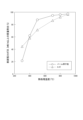
- 1 is a graph showing the relationship between heat treatment temperature and surface tension of carbonized biomass in an example. 1 is a graph showing the relationship between heat treatment temperature and volatile content of carbonized biomass in the examples.
- a method for producing coke according to the present invention is characterized in that, when producing coke by carbonizing a mixture obtained by blending a predetermined ratio of carbonized biomass produced by heat-treating biomass with a blended coal for coke production, the ratio of carbonized biomass having a surface tension value equal to or greater than a lower limit value ⁇ min in a mass distribution measured for the carbonized biomass is 60 mass% or more of the total, and the volatile content of the carbonized biomass on a dry basis is 4.0 mass% or more.
- biomass refers to organic industrial resources derived from plants and animals that exist in the current ecosystem.
- the organic matter that constitutes biomass circulates within the ecosystem while changing its form.
- the carbon dioxide generated when biomass is burned originates from the carbon that was originally absorbed into the living organisms of plants and animals when they grew, so it does not affect the increase or decrease of the total amount of carbon dioxide in the atmosphere and is considered to be in a so-called carbon neutral state.
- the carbon dioxide generated when fossil fuels are burned originates from underground resources isolated from the current ecosystem and is therefore not considered to be in a carbon neutral state. Therefore, fossil fuels such as coal and oil are not included in the biomass in this embodiment.
- the biomass used in this embodiment may be any type of biomass that can be used as an industrial resource among products produced in fields such as agriculture, forestry, livestock farming, and fisheries, and waste generated during the production process, as long as it satisfies the specified conditions described below.
- the biomass includes at least one of palm kernel shells and woody biomass.
- Palm kernel shells are biomass produced as a by-product after extracting coconut oil from palm kernels. They are suitable as biomass for use in this embodiment because they are inexpensive and have moderate strength.
- Examples of woody biomass include biomass made of wood from coniferous trees such as cedar, pine, and cypress, and broad-leaved trees such as zelkova, birch, and eucalyptus. The part of the wood is not limited.
- Woody biomass also includes unused parts such as waste wood from construction and papermaking, and thinning wood generated in forestry. Sawdust produced during lumber manufacturing is a typical example of woody biomass.
- the method for producing coke according to the present invention uses carbonized biomass produced by heat-treating biomass.
- the biomass When heat-treating biomass, the biomass is heat-treated in an air-tight atmosphere.
- the atmosphere when heat-treating biomass By setting the atmosphere when heat-treating biomass to an air-tight atmosphere, the progress of combustion of the biomass is hindered and the biomass can be carbonized.
- a container is prepared that prevents air from entering and forms a space through which an inert gas flows, and biomass is loaded into the container and heat-treated.
- the temperature at which the biomass is heat-treated may be adjusted appropriately depending on the type of biomass so that the surface tension and volatile content are in the appropriate range.
- a temperature of 400°C or higher is in the appropriate range for the surface tension described below, and a temperature of 700°C or lower is in the appropriate range for the volatile content described below, so a temperature of 400°C or higher and 700°C or lower is preferable.
- cedar is used as the biomass
- a temperature of 500°C or higher and 800°C or lower is preferable.
- a higher temperature at which the biomass is heat-treated is more preferable, and from the viewpoint of volatile content, a lower temperature is more preferable.
- the term "heat treatment temperature” refers to the maximum temperature reached by the biomass when heat-treated.
- the time for which heat treatment is performed varies depending on the type of biomass and the mass of biomass to be heat treated at one time, but is preferably 1 minute or more and 60 minutes or less. A more preferable heat treatment time is 10 minutes or more. A more preferable heat treatment time is 30 minutes or less.
- heat treatment time refers to the time from when the temperature of the biomass during heat treatment reaches the temperature at which heat treatment is performed to when the heat treatment temperature is stopped being maintained.
- the biomass that has been subjected to heat treatment is converted into carbonized biomass during the heat treatment process.
- the particle size of the carbonized biomass is preferably 70% by mass or more and 100% by mass or less of 3.0 mm or less, similar to the blended coal used in normal coke production. If the proportion of 3.0 mm or less is 70% by mass or more and 100% by mass or less, the carbonized biomass can be homogeneously mixed with the blended coal.
- a more preferable particle size range for the carbonized biomass is 100% by mass of 3.0 mm or less. There is no lower limit for the particle size. In other words, the particle size may be any size greater than 0 (zero).
- the proportion of the particle size of the carbonized biomass that is 3.0 mm or less is less than 70% by mass
- the proportion of the particle size of 3.0 mm or less can be adjusted to 70% by mass or more and 100% by mass or less by pulverizing the carbonized biomass.
- the particle size adjustment by pulverization may be performed on the biomass before heat treatment, on the carbonized biomass after heat treatment, or on both.
- a known pulverizer can be used to pulverize the biomass or carbonized biomass.
- powder size corresponds to the nominal mesh size of a test sieve as specified in Japanese Industrial Standards Z 8801-1:2019 "Test sieves - Part 1: Metal mesh sieves.”
- powders and granular materials with a particle size larger than X mm are powders and granular materials that remain on a sieve with a nominal mesh size of X mm when sieved through a sieve.
- Powders and granular materials with a particle size of Y mm or less are powders and granular materials that fall through a sieve with a nominal mesh size of Y mm when sieved through a sieve.
- the yield can be increased and production costs can be reduced by omitting the steps of sieving or adjusting the particle size by crushing, or both.
- the proportion of particles with a particle size of 3.0 mm or less in the particle size distribution of the carbonized biomass based on mass is 70 mass% or more. If particle size adjustment is not performed, the proportion of particles with a particle size of 3.0 mm or less is more preferably 80 mass% or more, and even more preferably 90 mass% or more.
- the upper limit of the proportion of particles with a particle size of 3.0 mm or less in the carbonized biomass is 100 mass%.
- the particle size distribution of the carbonized biomass based on mass can be determined by known methods, such as a method of measuring the weight of powder particles sieved using multiple sieves with different mesh openings for a sample taken from the large amount of carbonized biomass produced, or a method of irradiating a sample with a laser.
- a mixture obtained by blending a carbonized biomass with a coal blend for coke production in a predetermined ratio is carbonized to produce coke.
- the coal blend may be any coal blend suitable for coke production.
- a coal blend suitable for coke production refers to a coal blend that can produce high-strength coke by carbonizing only the coal blend as a raw material. Whether a coal blend is suitable for coke production or not can be predicted by measuring the Ro and MF values of the coal blend.
- the proportion of the coal blend used for coke production with a particle size of 3.0 mm or less is preferably 70% by mass or more and 100% by mass or less. If the particle size of the coal blend is coarse, a distribution of properties will occur in coke production using a mixture of coal components with different properties. Therefore, it is preferable to make the proportion of the coal blend with a particle size of 3.0 mm or less 70% by mass or more. More preferably, the proportion of the coal blend with a particle size of 3.0 mm or less is 75% by mass or more.
- the proportion of the coal blend with a particle size of 3.0 mm or less is preferably 90% by mass or less, and more preferably 85% by mass or less.
- the ratio of carbonized biomass in the mixture is 1.0 mass% or more, a significant effect in reducing carbon dioxide emissions can be obtained, and if it is 8.0 mass% or less, the strength of the obtained coke is not significantly reduced, so it is preferable that the ratio is 1.0 mass% or more and 8.0 mass% or less.
- a more preferable ratio of carbonized biomass is 2.0 mass% or more and 5.0 mass% or less.
- the mixture obtained by blending blended coal and carbonized biomass in a predetermined ratio may be sufficiently mixed without performing any special operation specialized for mixing.
- Specific examples of such cases include when the mixture transported by a belt conveyer falls onto the next belt conveyer, when blended coal and carbonized biomass are blended and then pulverized using pulverizing equipment, and when blended coal and carbonized biomass are blended and then the moisture content is adjusted while stirring using coal moisture control equipment. In such cases, the equipment and costs required for mixing can be reduced, which is preferable.
- the blended coal and carbonized biomass are mixed uniformly. This can prevent the problem of the carbonized biomass, which does not soften or melt when heated, being unevenly distributed in one place and remaining unsolidified even after the carbonization process.
- a coal mixer can be used to mix the blended coal and carbonized biomass.
- a coal mixer for example, a mixer that mainly performs convection mixing, a mixer that mainly performs shear mixing, or a mixer that performs a combination of convection mixing and shear mixing can be used.
- convection mixing is mixing that mainly involves convection and diffusion of the sample
- shear mixing is mixing that involves shearing, collision, grinding, etc. of the sample.
- a mixture obtained by blending a carbonized biomass with a blended coal for coke production in a predetermined ratio is carbonized to produce coke.
- the mixture is charged into a coke oven and carbonized by heating in an air-tight atmosphere.
- the carbonization temperature is 900°C or higher, coke of sufficient strength will be obtained. 950°C or higher is preferable.
- the carbonization temperature is preferably 1250°C or lower, and more preferably 1100°C or lower.
- the carbonization temperature refers to the maximum temperature reached by the mixture during carbonization.
- the proportion of carbonized biomass having a surface tension value equal to or greater than the lower limit ⁇ min is 60 mass % or greater of the total.
- Carbonized biomass is not a substance having a single component and structure, and there are variations in the degree of carbon concentration, the molecular weight of the constituent molecules, the content of volatile matter, etc. depending on the part. For this reason, the surface tension of the carbonized biomass cannot be determined to a single value, and has a distribution. Therefore, in this embodiment, first, the mass distribution of the surface tension is obtained for the carbonized biomass obtained by heat treatment.
- the "mass distribution of surface tension" refers to a graph in which the surface tension measured for the aggregate of carbonized biomass powder is on the horizontal axis and the mass or cumulative mass of the powder for each category is on the vertical axis. A specific method for measuring the mass distribution of the surface tension will be described later.
- the suitability of use is not judged based on a single representative value such as a weighted average value derived from the distribution of the surface tension of the carbonized biomass, but only carbonized biomass whose surface tension value is equal to or greater than the lower limit ⁇ min is used in a mass distribution of the surface tension of 60 mass % or more of the total.
- the suitability of use is preferably equal to or greater than 70 mass %, more preferably equal to or greater than 80 mass % of the total.
- the upper limit of the proportion of surface tension values equal to or greater than the lower limit ⁇ min is 100 mass % of the total.
- the lower limit value ⁇ min of the surface tension in this embodiment can be determined by preparing in advance multiple types of carbonized biomass with different lower limit values ⁇ min , blending each of them with blended coal, and then examining the strength of the coke obtained by carbonization.
- Patent Document 1 describes that when coals with similar weighted average values of surface tension are combined, the strength of the resulting coke is higher than when coals with a large difference in weighted average values of surface tension are combined. This means that with regard to adhesion between coals, the smaller the difference in surface tension, i.e., the magnitude of interfacial tension, the stronger the bond of the coal blend.
- carbonized biomass is a raw material that does not soften or melt like coal. For this reason, when considering the adhesion phenomenon at the interface between coal and carbonized biomass, a different approach is required than for conventional adhesion between coals.
- the liquid when the surface tension of the solid is greater than that of the liquid at the interface between the solid and the liquid, the liquid can wet the surface of the solid. If this is the case, when the surface tension of the carbonized biomass, which is a solid, is greater than that of the thermoplastic blended coal, which is a liquid, the thermoplastic blended coal in the carbonization process can wet and spread on the surface of the carbonized biomass, and as a result, it is considered that the strength of the obtained coke is high. If the lower limit value ⁇ min of the surface tension in this embodiment is determined experimentally or based on the surface tension of the blended coal, and 60 mass % or more of the carbonized biomass has a surface tension of the lower limit value ⁇ min or more, wetting occurs at many points in the mixture. This makes it possible to prevent the occurrence of the first type of defect in which the blended coal and the carbonized biomass are separated, and as a result, it is considered that coke with high strength can be produced.
- Non-Patent Document 1 To obtain the mass distribution of surface tension for carbonized biomass, it is preferable to use the film flotation method described in Non-Patent Document 1.
- the film flotation method makes it possible to know the surface tension distribution based on the mass of powder for a powder aggregate that has a distribution in the magnitude of surface tension, using a relatively simple procedure.
- the measurement of the mass distribution of surface tension using the film flotation method is outlined below.
- the film flotation method utilizes the property that when powder particles floating on the surface of a liquid with a known surface tension begin to settle, the surface tension of the powder is equal to the surface tension of the liquid.
- multiple types of liquids with different surface tensions are prepared.
- the surface tensions of the liquids are selected to cover the range of surface tension values of the powder to be measured. For example, when using an aqueous solution of ethanol as the liquid, the surface tension of ethanol at 20°C is 22.6 mN/m and the surface tension of pure water is 72.8 mN/m, so by adjusting the concentration of ethanol, it is possible to prepare a liquid with any surface tension between 22.6 mN/m and 72.8 mN/m.
- the number of divisions in the mass distribution of surface tension to be determined is determined by the number of types of liquid prepared.
- the number of types of liquid is not particularly limited, but since a number of 5 or more types of liquid increases the accuracy of the measurement, and a number of 20 or less allows the measurement to be completed in a short time, it is preferable that the number of divisions be 5 or more and 20 or less.
- a more preferable lower limit of the range of the number of divisions is 8 or more.
- a more preferable upper limit of the number of divisions is 15 or less. It is also preferable that the difference in surface tension between the liquids is as equal as possible.
- the particle size of the carbonized biomass sample is 53 ⁇ m or more, the sample is less likely to aggregate, and if it is 150 ⁇ m or less, the effect of gravity can be ignored, so it is preferable for the particle size to be 53 ⁇ m or more and 150 ⁇ m or less.
- the mass of the carbonized biomass sample with adjusted particle size is measured, and then it is sprayed onto the surface of the prepared liquid.
- the sample that has not settled and is floating on the surface of the liquid is collected, its mass after drying is measured, and its ratio to the mass of the sample before spraying is calculated.
- This calculated value indicates the proportion of the sample that has a surface tension smaller than that of the liquid.
- the mass distribution of surface tension can be represented by a graph with the surface tension on the horizontal axis and the mass or cumulative mass of powder for each category on the vertical axis.
- the percentage of samples whose surface tension value is equal to or greater than the lower limit ⁇ min can be calculated as the sum of the areas equal to or greater than the lower limit in a frequency distribution graph, and as the difference between the reading at the lower limit and 100% in a cumulative frequency graph.
- the reading at the midpoint can be estimated by interpolating the values on both sides.
- the mass distribution of surface tension measured by the above method shifts in the direction of increasing the surface tension value as the heat treatment temperature of the biomass in the carbonization step increases. This is thought to be because the higher the treatment temperature of the biomass, the more the carbonization of the biomass progresses, and the surface properties of the carbonized biomass change in the direction of increasing the surface tension. Therefore, if the proportion of samples whose surface tension value is equal to or greater than the lower limit ⁇ min in the mass distribution of surface tension measured for the carbonized biomass is less than 60 mass %, the heat treatment temperature of the biomass in the carbonization step can be changed to a higher temperature so that the proportion of samples whose surface tension value is equal to or greater than the lower limit ⁇ min is 60 mass % or more of the total.
- the lower limit value ⁇ min of the surface tension is greater than the mass average value ⁇ ave in the mass distribution of the surface tension measured for a sample obtained by heating the blended coal to its thermoplastic temperature.
- the wettability between the blended coal and the carbonized biomass becomes an issue when the mixture is heated to the thermoplastic temperature of the blended coal in the carbonization process. It is generally believed that the blended coal thermoplastically melts in a temperature range of 350° C. or more and 550° C. or less. Therefore, theoretically, if the surface tension of the carbonized biomass is greater than the surface tension of the blended coal in this temperature range, the wettability between the two is considered to be good.
- the film flotation method uses a liquid at 20° C., there is no known means for measuring the mass distribution of the surface tension in situ in a temperature range of 350° C. or more.
- the mass distribution of the surface tension of a sample obtained by heating the coal blend to the thermoplastic temperature is measured using a liquid at 20° C., and the mass average value (weighted average) ⁇ ave is obtained. Then, the lower limit value ⁇ min of the surface tension of the carbonized biomass is set to be larger than the above-mentioned mass average value ⁇ ave . In this way, the lower limit value ⁇ min of the surface tension can be determined with fewer steps based on rationally obtained measured values, rather than being determined experimentally by trial and error.
- the reason why the surface tension measured at 20°C is an indicator of wettability in the temperature range of 350°C or higher and 550°C or lower, where the surface of a coal blend softens and melts, is as follows. In a sample obtained by heating a coal blend to its softening temperature, the chemical components of the material change to such an extent that the measured surface tension changes due to the softening and melting of the coal. These changes remain in the coal blend as thermal history, and the changed state is maintained even after it is cooled to 20°C. Therefore, it is believed that the measured surface tension at 20°C reflects the change in state when heated to the softening temperature. Similarly, it is believed that the thermal history of heat-treated carbonized biomass at the heat treatment temperature is reflected in the measured surface tension at 20°C.
- the lower limit value ⁇ min of the surface tension is greater than 35.0 ⁇ 3.0 mN/m, which is the mass average value in the mass distribution of the surface tension measured for a sample obtained by heating the coal blend to 450° C.
- MF maximum value
- the lower limit value ⁇ min of the surface tension is set to a value greater than 35.0 ⁇ 3.0 mN/m. Since the surface tension of semi-coke varies in the range of ⁇ 3.0 mN/m, it is more preferable to set the lower limit value ⁇ min of the surface tension to a value greater than 38.0 mN/m. From the viewpoint of not excessively narrowing the application range of the carbonized biomass that can be used, it is preferable to set the lower limit value ⁇ min of the surface tension to a value of 40.0 mN/m or less.
- the lower limit value ⁇ min of the surface tension is equal to 38.2 mN/m.
- the surface tension of a water (80%)-ethanol (20%) mixed solution at 20° C. is 38.2 mN/m. This value happens to be greater than 38 mN/m. Moreover, a water (80%)-ethanol (20%) mixed solution can be easily prepared. Therefore, the value of the lower limit value ⁇ min of the surface tension in this preferred embodiment is set to 38.2 mN/m.
- the measurement of surface tension can be simplified by using only one type of water (80%)-ethanol (20%) mixed solution as the liquid. Specifically, the carbonized biomass sample whose particle size has been adjusted by the above method is sprayed on the surface of a water (80%)-ethanol (20%) mixed solution at 20°C. After a period of time, the sample that has not settled but is floating on the surface is collected and its mass after drying is measured. The mass of the settled sample is calculated by subtracting the mass of the floating sample from the mass of the sample before spraying. Since the surface tension value of the settled sample is 38.2 mN/m or more, if the proportion is 60 mass% or more, the surface tension condition of the present invention is met.
- the volatile content of the carbonized biomass on a dry basis is 4.0 mass% or more.
- the analysis of the volatile content of the carbonized biomass in the present embodiment is performed in accordance with the method specified in Japanese Industrial Standards M 8812:2004 "Coals and cokes - Industrial analysis method".
- the volatile content can be appropriately controlled even if moisture is subsequently attached to the carbonized biomass.
- the volatile content of the carbonized biomass is analyzed, and only the carbonized biomass with a volatile content of 4.0% by mass or more is selected, and only the selected carbonized biomass is used.
- the conditions of the heat treatment of the biomass may be adjusted so that the volatile content is 4.0% by mass or more.
- the volatile content of the carbonized biomass on an anhydrous basis is 5.0% by mass or more.
- defects consisting of cracks caused by destruction of the parts of the raw materials derived from the biomass. It is believed that the cause of these defects is the difference in the amount of shrinkage between the parts derived from the coal and the parts derived from the biomass during the shrinkage process after the softened and melted coal resolidifies. It is presumed that when the volatile content in the carbonized biomass is less than 4.0 mass%, the parts derived from the carbonized biomass hardly shrink, and the parts derived from the blended coal around it shrink, resulting in stress being applied to the parts derived from the carbonized biomass and causing cracks. In this embodiment, since the volatile content in the carbonized biomass is 4.0 mass% or more, the parts derived from the carbonized biomass and the parts derived from the blended coal around it shrink to the same extent, which is believed to prevent the occurrence of type 2 defects.
- the amount of volatile matter contained in carbonized biomass decreases the higher the heat treatment temperature of the biomass in the carbonization process. This is thought to be because the higher the treatment temperature of the biomass, the more volatile matter is released from the biomass. Therefore, if the volatile matter measured for the carbonized biomass is less than 4.0 mass%, the heat treatment temperature of the biomass can be changed to a lower temperature to adjust the volatile matter to 4.0 mass% or more. In addition to changing the heat treatment temperature, the volatile matter can also be adjusted by changing the heat treatment time or the type of biomass used. Of these means, the means of changing the heat treatment temperature are preferred because they are easier to control.
- the lower limit of the volatile content of the carbonized biomass on a dry basis is set to 4.0% by mass or more, but there is no particular upper limit.
- the volatile content is adjusted by changing the heat treatment temperature of the biomass in the carbonization step, as described above, the lower the heat treatment temperature of the biomass in the carbonization step, the lower the surface tension value. For this reason, it is not possible to lower the heat treatment temperature until the cumulative mass of the carbonized biomass whose surface tension value is equal to or greater than the lower limit ⁇ min becomes less than 60% by mass of the total. Taking this into consideration, it is preferable that the volatile content does not exceed 35% by mass.
- the heat treatment conditions that bring the surface tension and volatile content into the specified ranges vary greatly depending on the type of biomass used. For this reason, it is preferable to determine the heat treatment conditions individually for each type of biomass used.
- the temperature varies depending on the type of biomass and other heat treatment conditions, but in many cases, the surface tension and volatile content can be adjusted to the range in this embodiment by performing heat treatment at a temperature of approximately 400°C or higher and 800°C or lower.
- the effect of the present invention can be confirmed by evaluating the strength of the coke obtained by the coke manufacturing method according to the present embodiment.
- evaluating the strength of coke There are various methods for evaluating the strength of coke, but among them, the method of evaluating the strength of coke by the rotational strength by the drum method specified in the Japanese Industrial Standards K 2151:2004 "Cokes - Test Methods" is a test that simulates the generation of powder from coke, which is a problem when used in a blast furnace, and is currently the most widely used in Japan, and is therefore preferable.
- the drum method is a method in which a sample is inserted into a specified drum testing machine, rotated at a specified speed for a specified number of rotations, and then sieved through a specified sieve, the mass of each classification is determined, and the added percentage (%) of the sample is expressed as the drum strength index (symbol: DI).
- the drum rotation speed was set to 150 rpm, and the ratio of the mass of coke that did not pass through a sieve with a mesh size of 15 mm after rotation to the mass of coke inserted into the drum testing machine was defined as the drum strength index (%).
- the drum strength index indicates the mass ratio of coke that was not crushed to a size of 15 mm or less even when rotated in the drum testing machine. A higher DI value indicates a higher strength of the coke.
- a coal blend with an Ro of 1.0% and a common logarithm of MF (log(MF/ddpm)) of 2.5 was prepared. This coal blend was pulverized to produce a coal blend with a particle size of 3.0 mm or less adjusted to 100% by mass.
- the above measurement results show that the higher the heat treatment temperature of the carbonized biomass, the greater the mass proportion of samples with a surface tension of 38.2 mN/m or more and the lower the volatile content.
- the heat treatment temperatures at which the proportion of samples with a surface tension of 38.2 mN/m or more was 60 mass% or more of the total and the volatile content was 4.0 mass% or more were in the range of 400°C or more and 700°C or less for palm kernel shells, and 500°C or more and 800°C or less for cedar.
- the blended coal and the carbonized biomass were blended so that the blending ratio of the carbonized biomass in the mixture was 2.0%, 4.0%, or 5.0%, and the mixture was adjusted to have a moisture content of 8.0 mass%.
- 16 kg of each mixture was prepared for each type of carbonized biomass.
- the mixture was filled into a stainless steel container, inserted into an electric furnace through which nitrogen gas was circulated, heated, and carbonized.
- the bulk density of the mixture in the container was 775 kg/m 3 on an anhydrous basis.
- the container filled with the mixture was charged into an electric furnace set at a furnace wall temperature of 1050° C., and carbonized while maintaining the furnace wall temperature for 6 hours from the charging.
- the container was then transferred to a cooling facility through which nitrogen gas at room temperature was circulated and cooled to obtain coke containing biomass as a raw material.
- a cooling facility through which nitrogen gas at room temperature was circulated and cooled to obtain coke containing biomass as a raw material.
- the drum strength index (DI) of the obtained coke was measured under the conditions of a drum rotation speed of 150 revolutions and a sieve opening of 15 mm.
- the measured DI value of the base without carbonized biomass was 79.1.
- the difference ⁇ DI between the measured value and the drum strength index of the coke not containing biomass in the raw material was calculated.
- the calculated ⁇ DI values are shown in Table 2.
- Tables 1 and 2 show that in the cokes of Examples 1 to 9, which were made from mixtures containing carbonized biomass that satisfied the surface tension and volatile content ranges of the present invention, the ⁇ DI values did not fall by more than -2.0%. If the ⁇ DI does not fall by more than -2.0%, it is possible to adjust the strength of the coke by adjusting the quality of the blended coal and the production conditions, and therefore it can be said that the level is not problematic in practical use. On the other hand, the cokes of Comparative Examples 1 to 6, in which either the surface tension or the volatile content was outside the range of the present invention, showed a large decrease in drum rotation strength.
- the coke manufacturing method of the present invention it is possible to produce coke with high strength that can withstand use in blast furnaces, even if a portion of the coal, which is the raw material for the coke, is replaced with a raw material derived from biomass.
Landscapes
- Chemical & Material Sciences (AREA)
- Engineering & Computer Science (AREA)
- Oil, Petroleum & Natural Gas (AREA)
- Materials Engineering (AREA)
- Organic Chemistry (AREA)
- Solid Fuels And Fuel-Associated Substances (AREA)
- Coke Industry (AREA)
Priority Applications (3)
| Application Number | Priority Date | Filing Date | Title |
|---|---|---|---|
| JP2024553504A JP7792056B2 (ja) | 2023-09-13 | 2024-04-25 | コークスの製造方法 |
| EP24864979.0A EP4737535A1 (en) | 2023-09-13 | 2024-04-25 | Coke production method |
| AU2024339692A AU2024339692A1 (en) | 2023-09-13 | 2024-04-25 | Method of producing coke |
Applications Claiming Priority (2)
| Application Number | Priority Date | Filing Date | Title |
|---|---|---|---|
| JP2023-148698 | 2023-09-13 | ||
| JP2023148698 | 2023-09-13 |
Publications (1)
| Publication Number | Publication Date |
|---|---|
| WO2025057470A1 true WO2025057470A1 (ja) | 2025-03-20 |
Family
ID=95021145
Family Applications (1)
| Application Number | Title | Priority Date | Filing Date |
|---|---|---|---|
| PCT/JP2024/016346 Pending WO2025057470A1 (ja) | 2023-09-13 | 2024-04-25 | コークスの製造方法 |
Country Status (4)
| Country | Link |
|---|---|
| EP (1) | EP4737535A1 (https=) |
| JP (1) | JP7792056B2 (https=) |
| AU (1) | AU2024339692A1 (https=) |
| WO (1) | WO2025057470A1 (https=) |
Citations (6)
| Publication number | Priority date | Publication date | Assignee | Title |
|---|---|---|---|---|
| JP2004277452A (ja) * | 2003-03-12 | 2004-10-07 | Nippon Steel Corp | 高炉用コークスの製造方法 |
| JP2004307683A (ja) * | 2003-04-08 | 2004-11-04 | Kansai Coke & Chem Co Ltd | コークスの製造方法 |
| JP2005272569A (ja) | 2004-03-24 | 2005-10-06 | Nippon Steel Corp | 木質系バイオマスを用いた高炉用コークスの製造方法 |
| WO2013054526A1 (ja) * | 2011-10-14 | 2013-04-18 | Jfeスチール株式会社 | コークスの製造方法 |
| WO2013145680A1 (ja) | 2012-03-27 | 2013-10-03 | Jfeスチール株式会社 | コークス製造用石炭混合物の調製方法及び石炭混合物、並びに、コークス製造方法 |
| JP2014077086A (ja) | 2012-10-11 | 2014-05-01 | Nippon Steel & Sumitomo Metal | 高炉用高反応性コークスの製造方法 |
-
2024
- 2024-04-25 EP EP24864979.0A patent/EP4737535A1/en active Pending
- 2024-04-25 AU AU2024339692A patent/AU2024339692A1/en active Pending
- 2024-04-25 JP JP2024553504A patent/JP7792056B2/ja active Active
- 2024-04-25 WO PCT/JP2024/016346 patent/WO2025057470A1/ja active Pending
Patent Citations (6)
| Publication number | Priority date | Publication date | Assignee | Title |
|---|---|---|---|---|
| JP2004277452A (ja) * | 2003-03-12 | 2004-10-07 | Nippon Steel Corp | 高炉用コークスの製造方法 |
| JP2004307683A (ja) * | 2003-04-08 | 2004-11-04 | Kansai Coke & Chem Co Ltd | コークスの製造方法 |
| JP2005272569A (ja) | 2004-03-24 | 2005-10-06 | Nippon Steel Corp | 木質系バイオマスを用いた高炉用コークスの製造方法 |
| WO2013054526A1 (ja) * | 2011-10-14 | 2013-04-18 | Jfeスチール株式会社 | コークスの製造方法 |
| WO2013145680A1 (ja) | 2012-03-27 | 2013-10-03 | Jfeスチール株式会社 | コークス製造用石炭混合物の調製方法及び石炭混合物、並びに、コークス製造方法 |
| JP2014077086A (ja) | 2012-10-11 | 2014-05-01 | Nippon Steel & Sumitomo Metal | 高炉用高反応性コークスの製造方法 |
Non-Patent Citations (1)
| Title |
|---|
| M.C. WILLIAMSD.W. FUERSTENAU: "A Simple Flotation Method for Rapidly Assessing the Hydrophobicity of Coal Particles", INTERNATIONAL JOURNAL OF MINERAL PROCESSING, vol. 20, no. 1-2, June 1987 (1987-06-01), pages 153 - 157 |
Also Published As
| Publication number | Publication date |
|---|---|
| JP7792056B2 (ja) | 2025-12-25 |
| EP4737535A1 (en) | 2026-05-06 |
| AU2024339692A1 (en) | 2025-12-18 |
| JPWO2025057470A1 (https=) | 2025-03-20 |
Similar Documents
| Publication | Publication Date | Title |
|---|---|---|
| KR101864523B1 (ko) | 코크스의 제조 방법 및 코크스와 배합탄의 균질성 평가방법 | |
| JP6265015B2 (ja) | コークス製造方法 | |
| TWI486432B (zh) | A method for blending coal for making coke, and a method for producing coke | |
| JP7593537B1 (ja) | コークスの製造方法 | |
| JP5737473B2 (ja) | コークス製造用石炭混合物の調製方法及び石炭混合物、並びに、コークス製造方法 | |
| TR201809960T4 (tr) | Kok üretimine yönelik yöntem. | |
| JP2024025561A (ja) | コークスの製造方法 | |
| JP7792056B2 (ja) | コークスの製造方法 | |
| Mansor et al. | The effect of utilizing fly ash and bottom ash as a replacement of mineral filler in porous asphalt mixtures | |
| EP4737536A1 (en) | Coke production method | |
| TW202436602A (zh) | 焦炭的製造方法 | |
| CA3162218C (en) | Method for producing coal blend and method for producing coke | |
| RU2812777C1 (ru) | Способ подготовки угля или спекающей добавки и способ получения кокса | |
| CN116194772B (zh) | 煤或粘合材料的制备方法和焦炭的制造方法 | |
| WO2025115363A1 (ja) | コークスの製造方法 | |
| JP2026056483A (ja) | 成型コークスの製造方法 | |
| CN104204140B (zh) | 用于制造焦炭的煤混合物的制备方法及煤混合物、以及焦炭制造方法 | |
| AU2024390844A1 (en) | Method of producing coke | |
| Wnorowska et al. | Investigation on internal structure of pellets with halloysite additive and effect of moisture content before the pelletizing process | |
| WO2026042323A1 (ja) | コークスの製造方法 | |
| JP2026056484A (ja) | コークスの製造方法 | |
| Sienkiewicz et al. | The influence of rubber Recyclate morphology on the Properties of rubber-asphalt Composite | |
| Singh et al. | Effects of oxidative torrefaction on the fuel properties, grindability, and pelletization of rice straw | |
| Geckil et al. | Case Studies in Construction Materials | |
| WO2016056331A1 (ja) | 無灰炭配合量決定方法及び高炉用コークスの製造方法 |
Legal Events
| Date | Code | Title | Description |
|---|---|---|---|
| ENP | Entry into the national phase |
Ref document number: 2024553504 Country of ref document: JP Kind code of ref document: A |
|
| WWE | Wipo information: entry into national phase |
Ref document number: 2024553504 Country of ref document: JP |
|
| 121 | Ep: the epo has been informed by wipo that ep was designated in this application |
Ref document number: 24864979 Country of ref document: EP Kind code of ref document: A1 |
|
| WWE | Wipo information: entry into national phase |
Ref document number: AU2024339692 Country of ref document: AU |
|
| WWE | Wipo information: entry into national phase |
Ref document number: 202517121373 Country of ref document: IN |
|
| ENP | Entry into the national phase |
Ref document number: 2024339692 Country of ref document: AU Date of ref document: 20240425 Kind code of ref document: A |
|
| WWP | Wipo information: published in national office |
Ref document number: 202517121373 Country of ref document: IN |
|
| WWE | Wipo information: entry into national phase |
Ref document number: 2024864979 Country of ref document: EP |
|
| ENP | Entry into the national phase |
Ref document number: 2024864979 Country of ref document: EP Effective date: 20260129 |
|
| REG | Reference to national code |
Ref country code: BR Ref legal event code: B01A Ref document number: 112026001894 Country of ref document: BR |