WO2025047765A1 - 印刷配線板及びビルドアップ印刷配線板 - Google Patents
印刷配線板及びビルドアップ印刷配線板 Download PDFInfo
- Publication number
- WO2025047765A1 WO2025047765A1 PCT/JP2024/030576 JP2024030576W WO2025047765A1 WO 2025047765 A1 WO2025047765 A1 WO 2025047765A1 JP 2024030576 W JP2024030576 W JP 2024030576W WO 2025047765 A1 WO2025047765 A1 WO 2025047765A1
- Authority
- WO
- WIPO (PCT)
- Prior art keywords
- resin
- diameter
- metal layer
- insulating plate
- printed wiring
- Prior art date
- Legal status (The legal status is an assumption and is not a legal conclusion. Google has not performed a legal analysis and makes no representation as to the accuracy of the status listed.)
- Pending
Links
Images






Classifications
-
- H—ELECTRICITY
- H05—ELECTRIC TECHNIQUES NOT OTHERWISE PROVIDED FOR
- H05K—PRINTED CIRCUITS; CASINGS OR CONSTRUCTIONAL DETAILS OF ELECTRIC APPARATUS; MANUFACTURE OF ASSEMBLAGES OF ELECTRICAL COMPONENTS
- H05K1/00—Printed circuits
- H05K1/02—Details
- H05K1/11—Printed elements for providing electric connections to or between printed circuits
-
- H—ELECTRICITY
- H05—ELECTRIC TECHNIQUES NOT OTHERWISE PROVIDED FOR
- H05K—PRINTED CIRCUITS; CASINGS OR CONSTRUCTIONAL DETAILS OF ELECTRIC APPARATUS; MANUFACTURE OF ASSEMBLAGES OF ELECTRICAL COMPONENTS
- H05K3/00—Apparatus or processes for manufacturing printed circuits
- H05K3/40—Forming printed elements for providing electric connections to or between printed circuits
- H05K3/42—Plated through-holes or plated via connections
-
- H—ELECTRICITY
- H05—ELECTRIC TECHNIQUES NOT OTHERWISE PROVIDED FOR
- H05K—PRINTED CIRCUITS; CASINGS OR CONSTRUCTIONAL DETAILS OF ELECTRIC APPARATUS; MANUFACTURE OF ASSEMBLAGES OF ELECTRICAL COMPONENTS
- H05K3/00—Apparatus or processes for manufacturing printed circuits
- H05K3/46—Manufacturing multilayer circuits
Definitions
- This disclosure relates to printed wiring boards and build-up printed wiring boards.
- the purpose of this disclosure is to provide printed wiring boards and build-up printed wiring boards with higher connection reliability.
- An insulating plate having a first surface, a second surface located opposite the first surface, and a through hole having a first opening on the first surface and a second opening on the second surface; a first metal layer located as a single unit across the first surface, an inner wall surface of the through hole, and the second surface, and including a through hole conductor located on the inner wall surface of the through hole, a first wiring conductor located on the first surface, and a second wiring conductor located on the second surface; a resin located on the inner side of the through hole relative to the through hole conductor, and having a first end located on the first surface side in a thickness direction of the insulating plate and a second end located on the second surface side; a second metal layer covering the first wiring conductor and the first end of the resin; and a third metal layer covering the second wiring conductor and the second end of the resin, wherein at least one of the second metal layer and the third metal layer has a first portion located within the through hole between the
- the substrate further includes at least one of a first metal foil positioned between the first surface and the first wiring conductor and a second metal foil positioned between the second surface and the second wiring conductor.
- both the second metal layer and the third metal layer have the first portion;
- the resin has a first diameter at a center position of the insulating plate in a thickness direction of the insulating plate, the first diameter being equal to an inner diameter of the through-hole conductor at the center position;
- the resin has a second diameter, on the first opening side from the center position, the second diameter being a minimum diameter of the resin on the first opening side from the center position and smaller than the first diameter;
- the resin has a third diameter on the second opening side of the center position, the third diameter being the smallest diameter of the resin on the second opening side of the center position and smaller than the first diameter.
- the diameter of the resin has a portion where it gradually decreases from the first diameter to the second diameter in the thickness direction of the insulating plate, and has a portion where it gradually decreases from the first diameter to the third diameter in the thickness direction of the insulating plate.
- the resin When viewed in cross section in the thickness direction of the insulating plate, the resin has a curved shape between a position having the first diameter and a position having the second diameter, and has a curved shape between the position having the first diameter and a position having the third diameter.
- a distance from the first surface to the first end of the resin in a thickness direction of the insulating plate is greater than a distance from the first surface to a surface of the first wiring conductor; In a thickness direction of the insulating plate, the distance from the second surface to the second end of the resin is greater than the distance from the second surface to a surface of the second wiring conductor.
- a fourth diameter of the resin at the first end is greater than the second diameter; a diameter of the resin gradually decreases from the fourth diameter to the second diameter in a thickness direction of the insulating plate, a fifth diameter of the resin at the second end is greater than the third diameter; The diameter of the resin gradually decreases from the fifth diameter to the third diameter in the thickness direction of the insulating plate.
- the build-up printed wiring board is A printed wiring board according to any one of (1) to (8), a build-up structure in which insulating resin layers and conductor layers are alternately positioned on at least one of the first surface side and the second surface side of the printed wiring board; It has the following features.
- This disclosure makes it possible to further improve the connection reliability of printed wiring boards and build-up printed wiring boards.
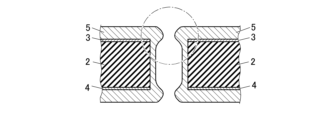
- FIG. FIG. FIG. 5A to 5C are cross-sectional views illustrating a method for manufacturing a printed wiring board.
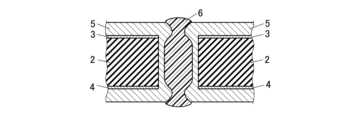
- 5A to 5C are cross-sectional views illustrating a method for manufacturing a printed wiring board.
- 5A to 5C are cross-sectional views illustrating a method for manufacturing a printed wiring board.
- 5A to 5C are cross-sectional views illustrating a method for manufacturing a printed wiring board.
- 5A to 5C are cross-sectional views illustrating a method for manufacturing a printed wiring board.
- 5A to 5C are cross-sectional views illustrating a method for manufacturing a printed wiring board.
- 5A to 5C are cross-sectional views illustrating a method for manufacturing a printed wiring board.
- 4A to 4C are enlarged cross-sectional views illustrating a method for manufacturing a printed wiring board.
- FIG. 2 is a cross-sectional view of a build-up printed wiring board.
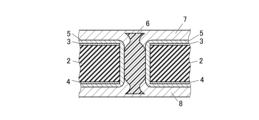
- FIG. 1 is a cross-sectional view of one embodiment of a printed wiring board 1 according to the present disclosure in the thickness direction of an insulating plate 2 passing through the central axis of a through hole 2c.
- the printed wiring board 1 of this embodiment has an insulating plate 2, a first metal layer 5, a resin 6, a second metal layer 7, and a third metal layer 8.
- the insulating plate 2 has a first surface 2a, a second surface 2b, and a through hole 2c.
- the second surface 2b is located on the opposite side of the insulating plate 2 from the first surface 2a.
- the through hole 2c penetrates the insulating plate 2 in the thickness direction, and has a first opening 2d on the first surface 2a and a second opening 2e on the second surface 2b.
- the material of the insulating plate 2 is, for example, an organic resin, but is not particularly limited.
- organic resins include epoxy resin, bismaleimide-triazine resin, polyimide resin, polyphenylene ether (PPE) resin, polyphenylene oxide (PPO) resin, phenol resin, polytetrafluoroethylene (PTFE) resin, silicon resin, polybutadiene resin, polyester resin, melamine resin, urea resin, polyphenylene sulfide (PPS) resin, cyanate ester resin, etc. Two or more of these organic resins may be mixed and used.
- the material of the insulating plate 2 is not limited to these, and may be other materials having insulating properties.
- the insulating plate 2 may have a reinforcing material such as glass cloth.
- the insulating plate 2 may be blended with inorganic fillers (inorganic particles) such as aluminum hydroxide, silica, barium sulfate, or organic fillers such as phenol resin, methacrylic resin, etc.
- the shape of the through hole 2c is, for example, a circular cylindrical shape in a plan view seen from above the first surface 2a, but is not particularly limited.
- the shape of the through hole 2c may or may not be uniform in the thickness direction of the insulating plate 2. Therefore, the diameter of the first opening 2d and the diameter of the second opening 2e may be the same or different.
- the diameter of the first opening 2d and the diameter of the second opening 2e are, for example, 0.25 to 0.40 mm when converted into the diameter of a circle with the same area, but is not particularly limited.
- the first metal layer 5 is located as a single piece across the first surface 2a, the inner wall surface of the through hole 2c, and the second surface 2b.
- the first metal layer 5 includes a through hole conductor 5a, a first wiring conductor 5b, and a second wiring conductor 5c.
- the through hole conductor 5a is located on the inner wall surface of the through hole 2c.
- the first wiring conductor 5b is located on the first surface 2a.
- the second wiring conductor 5c is located on the second surface 2b.
- the material of the first metal layer 5 is, for example, copper, but is not particularly limited.
- the thickness of the first metal layer 5 is, for example, 10 to 30 ⁇ m, but is not particularly limited.
- the resin 6 is located inside the through-hole 2c (closer to the central axis of the through-hole 2c) than the through-hole conductor 5a.
- the resin 6 has a first end 6a located on the first surface 2a side and a second end 6b located on the second surface 2b side in the thickness direction of the insulating plate 2.
- the resin 6 functions as a filling material for the through-hole 2c.
- the type of resin 6 is, for example, an organic resin such as an epoxy resin, but is not particularly limited.
- the second metal layer 7 covers the first wiring conductor 5b and the first end 6a of the resin 6.
- the third metal layer 8 covers the second wiring conductor 5c and the second end 6b of the resin 6.
- the second metal layer 7 and the third metal layer 8 may cover a part of the through-hole conductor 5a.
- the second metal layer 7 and the third metal layer 8 function as a cap plating for the through-hole 2c.
- the material of the second metal layer 7 and the third metal layer 8 is, for example, copper, but is not particularly limited.
- the thickness of the second metal layer 7 and the third metal layer 8 in the area excluding the through-hole 2c is, for example, several ⁇ m to 10 ⁇ m, but is not particularly limited.
- At least one of the second metal layer 7 and the third metal layer 8 has a first portion 9 located within the through hole 2c between the through hole conductor 5a and the resin 6.
- the thermal expansion coefficient of the filling resin is higher than that of the metal conductors corresponding to the first metal layer 5, the second metal layer 7, and the third metal layer 8. Therefore, generally, when a printed wiring board having a metal conductor, a filling resin, and a lid plating is heated, the lid plating is pushed up by the filling resin and receives stress in a direction to peel off from the metal conductor corresponding to the first metal layer 5.
- the filling resin near the opening of the through hole may expand toward the outside of the through hole (away from the central axis of the through hole) due to the rise in temperature, and may try to get between the wiring conductors corresponding to the first wiring conductor 5b and the second wiring conductor 5c and the lid plating. Due to these effects, in conventional printed wiring boards, peeling is easily caused between the wiring conductors and the lid plating, and connection reliability was insufficient.
- the stress applied to the lid plating when the printed wiring board is heated may exceed the yield stress of the lid plating. If the stress applied to the lid plating exceeds the yield stress of the lid plating, the lid plating will no longer follow the contraction of the filled resin even when the printed wiring board is cooled, and peeling may occur between the metal conductor corresponding to the first metal layer 5 and the lid plating. Furthermore, even if the stress applied to the lid plating does not exceed the yield stress of the lid plating, repeated application of stress to the lid plating may cause cracks in the lid plating due to metal fatigue. For these reasons, conventional printed wiring boards did not have sufficient connection reliability.
- the printed wiring board 1 of the present disclosure has a first portion 9 in which at least one of the second metal layer 7 and the third metal layer 8 is located within the through hole 2c between the through hole conductor 5a and the resin 6.
- the first portion 9 has the effect of suppressing the expansion of the resin 6 in the vicinity of the first opening 2d and/or the vicinity of the second opening 2e toward the outside of the through hole 2c (in the direction away from the central axis of the through hole 2c). Due to the effect of the first portion 9, the printed wiring board 1 of the present disclosure has reduced peeling between the through hole conductor 5a and the cover plating (the second metal layer 7 and/or the third metal layer 8), and has high connection reliability.
- both the second metal layer 7 and the third metal layer 8 may have the first portion 9. This reduces both the peeling between the through-hole conductor 5a and the second metal layer 7 and the peeling between the through-hole conductor 5a and the third metal layer 8, further improving the connection reliability.
- the dimension of the first portion 9 in the direction along the first surface 2a may become smaller from the first surface 2a or the second surface 2b toward the center position O of the insulating plate 2 in the thickness direction of the insulating plate 2.
- This allows the stress applied to the second metal layer 7 and/or the third metal layer 8 when the resin 6 expands to be distributed from the direction from the center position O toward the first surface 2a and/or the direction toward the second surface 2b to the direction pressing the through-hole conductor 5a (a direction inclined toward the central axis of the through-hole 2c). This further reduces peeling of the cover plating (the second metal layer 7 and/or the third metal layer 8).
- the dimension of the first portion 9 of the second metal layer 7 in the direction along the first surface 2a may decrease from the first surface 2a toward the center position O of the insulating plate 2 in the thickness direction of the insulating plate 2
- the dimension of the first portion 9 of the third metal layer 8 in the direction along the first surface 2a may decrease from the second surface 2b toward the center position O of the insulating plate 2 in the thickness direction of the insulating plate 2.
- the printed wiring board 1 may have a seed layer at least between the first surface 2a and the first wiring conductor 5b and between the second surface 2b and the second wiring conductor 5c.
- the seed layer is, for example, a metal foil, electroless plating, etc.
- the seed layer can form the first wiring conductor 5b on the first surface 2a of the insulating plate 2 and/or the second wiring conductor 5c on the second surface 2b of the insulating plate 2.
- the seed layer is a metal foil
- the adhesion between the insulating plate 2 and the first wiring conductor 5b and/or the second wiring conductor 5c is further improved. Therefore, the printed wiring board 1 may have at least one of the first metal foil 3 located between the first surface 2a and the first wiring conductor 5b and the second metal foil 4 located between the second surface 2b and the second wiring conductor 5c.
- the printed wiring board 1 may have both the first metal foil 3 and the second metal foil 4. This improves the adhesion between the insulating plate 2 and the first wiring conductor 5b and the second wiring conductor 5c, and further improves the connection reliability.
- the first metal foil 3 and the second metal foil 4 are, for example, copper foil, but are not particularly limited thereto.
- the thickness of each of the first metal foil 3 and the second metal foil 4 is, for example, 2 to 18 ⁇ m, but are not particularly limited thereto.
- the thickness of the first metal foil 3 and the second metal foil 4 does not have to be the same.
- the resin 6 is located inside the through-hole 2c relative to the through-hole conductor 5a, and has a first end 6a located on the first surface 2a side in the thickness direction of the insulating plate 2 and a second end 6b located on the second surface 2b side.
- the resin 6 may have the following shapes, but is not limited to these.
- FIG. 2 is an enlarged cross-sectional view of the resin 6 of the printed wiring board 1 shown in FIG. 1.
- the resin 6 may have a first diameter r1 at a center position O of the insulating plate 2 in the thickness direction of the insulating plate 2.
- the first diameter r1 is equal to the inner diameter of the through-hole conductor 5a at the center position O of the insulating plate 2.
- the resin 6 may have a second diameter r2 on the side S1 of the first opening 2d from the center position O of the insulating plate 2.
- the second diameter r2 is the minimum diameter of the resin 6 on the side S1 of the first opening 2d from the center position O of the insulating plate 2, and is smaller than the first diameter r1.
- the resin 6 may have a third diameter r3 on the side S2 of the second opening 2e from the center position O of the insulating plate 2.
- the third diameter r3 is the minimum diameter of the resin 6 on the side S2 of the second opening 2e from the center position O of the insulating plate 2, and is smaller than the first diameter r1. Since the resin 6 has the first diameter r1, the second diameter r2, and the third diameter r3 at the above-mentioned positions, the second metal layer 7 or the third metal layer 8 including the first portion 9 penetrates into the side of the resin 6 (the side of the central axis of the through hole 2c), thereby reducing the expansion of the resin 6 in the thickness direction of the insulating plate 2.
- the second radius r2 and the third radius r3 may be the same or different.
- the centers of the second radius r2 and the third radius r3 may be shifted from a central axis that includes the center point of the first radius r1.
- the diameter of the resin 6 may have a portion in which it gradually tapers from the first diameter r1 to the second diameter r2 in the thickness direction of the insulating plate 2, or may have a portion in which it gradually tapers from the first diameter r1 to the third diameter r3. This allows the printed wiring board 1 to distribute the direction of the stress that the first portion 9 receives from the resin 6.
- the resin 6 may have a curved shape between the position having the first radius r1 and the position having the second radius r2 in a cross-sectional view in the thickness direction of the insulating plate 2, or may have a curved shape between the position having the first radius r1 and the position having the third radius r3. This allows the stress that the first portion 9 receives from the resin 6 to be dispersed in more directions than when the radius linearly decreases from the first radius r1 to the second radius r2 or from the first radius r1 to the third radius r3.
- a fourth diameter r4 at the first end 6a of the resin 6 may be larger than the second diameter r2, and a fifth diameter r5 at the second end 6b of the resin 6 may be larger than the third diameter r3.
- the diameter of the resin 6 may be gradually tapered in the thickness direction of the insulating plate 2 from the fourth diameter r4 to the second diameter r2, or from the fifth diameter r5 to the third diameter r3.
- the fourth radius r4 and the fifth radius r5 may be the same or different.
- the distance from the first surface 2a to the first end 6a of the resin 6 in the thickness direction of the insulating plate 2 may be greater than the distance from the first surface 2a to the surface of the first wiring conductor 5b. That is, the first end 6a of the resin 6 may protrude from the surface of the first wiring conductor 5b.
- the distance from the second surface 2b to the second end 6b of the resin 6 may be greater than the distance from the second surface 2b to the surface of the second wiring conductor 5c. In other words, the second end 6b of the resin 6 may protrude from the surface of the second wiring conductor 5c.
- the distance from the surface of the first wiring conductor 5b to the first end 6a of the resin 6 and the distance from the surface of the second wiring conductor 5c to the second end 6b of the resin 6 are, for example, 2 to 5 ⁇ m, but are not particularly limited.
- the printed wiring board 1 according to this disclosure is not limited to the embodiment shown in FIG. 1.
- the fourth diameter r4 at the first end 6a of the resin 6 is the minimum diameter (second diameter r2) of the resin 6 on the side S1 of the first opening 2d from the center position O of the insulating plate 2
- the fifth diameter r5 at the second end 6b of the resin 6 is the minimum diameter (third diameter r3) of the resin 6 on the side S2 of the second opening 2e from the center position O of the insulating plate 2.
- the second metal layer 7 and the third metal layer 8 can more easily enter between the through-hole conductor 5a and the resin 6 in the through-hole, which is advantageous in reducing peeling between the through-hole conductor 5a and the second metal layer 7 and/or the third metal layer 8.
- a through hole 2c is formed in a laminate having an insulating plate 2, a first metal foil 3, and a second metal foil 4.
- the laminate may be a copper-clad laminate in which the first metal foil 3 and the second metal foil 4 are copper foils.
- the through hole 2c is formed, for example, by drilling.
- a first metal layer 5 including a through-hole conductor 5a, a first wiring conductor 5b, and a second wiring conductor 5c is formed.
- the first metal layer 5 is formed so that the corners near the first opening 2d and the corners near the second opening 2e protrude toward the central axis of the through-hole 2c.
- the corners near the first opening 2d and the second opening 2e protrude toward the central axis of the through-hole 2c, they may also protrude toward the surface side of the insulating plate 2.
- the first metal layer 5 is formed, for example, by electrolytic plating.
- electrolytic plating current density tends to concentrate at corners, which makes it easier for metal to be concentrated at the corners. This concentrated metal deposition at the corners can be reduced by adjusting the components of the plating solution.
- a plating solution that can reduce concentrated metal deposition at corners is generally used, for example to make it easier to make the thickness of the through-hole conductor uniform.
- a first metal layer 5 can be formed in which the corners protrude toward the central axis of the through-hole 2c.
- FIG. 5 is an enlarged view of the area surrounded by the dashed line in FIG. 4B.
- the arrow in FIG. 5 indicates that the corner of the first metal layer 5 near the first opening 2d protrudes toward the central axis A of the through hole 2c.
- the hole formed in the first metal layer 5, whose corners protrude toward the central axis A of the through hole 2c, may be annular or non-annular in plan view. If the hole is annular in plan view, it is easier to form the first portion 9 large, making it easier to manufacture a printed wiring board 1 in which the effects of expansion of the resin 6 are further reduced.
- the inside of the through-hole conductor 5a is filled with resin 6, and the resin 6 is then cured.
- the resin 6 is filled by screen printing, for example. After being filled and cured, the resin 6 has a constriction at a position corresponding to the protrusion toward the central axis of the through-hole 2c at the corner of the first metal layer 5 formed by the electrolytic plating process.
- polishing should be stopped just before the constriction formed by filling and hardening the resin 6.
- polishing should be stopped at the positions of the constriction near the first opening 2d and the constriction near the second opening 2e.
- a portion of the first metal layer 5 is removed by etching to adjust the thickness of the first wiring conductor 5b and the thickness of the second wiring conductor 5c, and to adjust the shape of the gap between the through-hole conductor 5a and the resin 6, which affects the shape of the first portion 9.
- an etching solution that easily penetrates into the interface between the through-hole conductor 5a and the resin 6, the protruding corners can be preferentially removed.
- An example of such an etching solution is a dichloromethane solution.
- the etching of the first metal layer 5 may be performed so that no protrusions remain at the corners of the first metal layer 5, or so that the protrusions remain to an extent that does not affect the formation of the first portion 9. If no protrusions remain after etching, plating will easily penetrate into the gap between the through-hole conductor 5a and the resin 6 when the cover plating (second metal layer 7 and third metal layer 8) is formed, making it easier to form the first portion 9.
- the first metal foil 3, the first wiring conductor 5b, and the second metal layer 7 are patterned to form a wiring pattern.
- the wiring pattern is formed, for example, by a subtractive process in which the steps of etching resist formation, exposure, development, etching, and etching resist removal are carried out in sequence.
- the second metal foil 4, the second wiring conductor 5c, and the third metal layer 8 are patterned in a similar manner.
- a semi-additive process SAP
- modified semi-additive process MSAP
- pattern plating instead of plating the entire surface of the laminate, pattern plating may be performed.
- FIG. 6 is a cross-sectional view of an embodiment of the buildup printed wiring board 12 according to the present disclosure in the thickness direction of the insulating plate 2.
- the buildup printed wiring board 12 of the present embodiment has a buildup structure 15 in which insulating resin layers 14 and conductor layers 13 are alternately positioned on both the surface on the first surface 2a side and the surface on the second surface 2b side of the printed wiring board 1 of the present disclosure. That is, the printed wiring board 1 of the present disclosure may be used as a core layer of the buildup printed wiring board 12.
- the build-up printed wiring board 12 may have the printed wiring board 1 (core layer) of the present disclosure and a build-up structure 15 in which insulating resin layers 14 and conductor layers 13 are alternately positioned on at least one of the surface on the first side 2a and the surface on the second side 2b.
- the build-up structure 15 has one or more build-up layers, each of which is a set of one insulating resin layer 14 and one conductor layer 13.
- the number of build-up layers can be determined according to the application, and is not particularly limited. In the embodiment shown in FIG. 6, the number of build-up layers is two in both the build-up structure 15 located on the surface on the first surface 2a side of the printed wiring board 1 (core layer) and the build-up structure 15 located on the surface on the second surface 2b side.
- Examples of materials for the insulating resin layer 14 include epoxy resin, bismaleimide-triazine resin, polyimide resin, polyphenylene ether (PPE) resin, phenolic resin, polytetrafluoroethylene (PTFE) resin, silicon resin, polybutadiene resin, polyester resin, melamine resin, urea resin, polyphenylene sulfide (PPS) resin, polyphenylene oxide (PPO) resin, cyanate ester resin, and the like. Two or more of these resins may be mixed.
- the insulating resin layer 14 may also contain inorganic fillers such as aluminum hydroxide, silica, barium sulfate, and the like, or organic fillers such as phenolic resin and methacrylic resin.
- the material of the conductor layer 13 is, for example, copper, but is not particularly limited.
- the thickness of the conductor layer 13 is, for example, 10 to 30 ⁇ m, but is not particularly limited.
- the insulating resin layer 14 may have via conductors 16 for electrically connecting the wiring pattern of the core layer and each conductor layer 13 of the build-up layer.
- the position and number of the via conductors 16 may be appropriately determined depending on the wiring pattern of each layer.
- Build-up printed wiring board 12 can be manufactured, for example, by the following procedure. Note that the following description does not limit the manufacturing method of build-up printed wiring board 12 according to the present disclosure.
- the prepreg or resin film that will become the insulating resin layer 14 and the copper foil that will become the conductor layer 13 are laminated on the upper surface of the printed wiring board 1 (core layer), and then heated and pressurized.
- a resin-coated copper foil having the prepreg or resin film that will become the insulating resin layer 14 and the copper foil that will become the conductor layer 13 is laminated on the first surface 2a side of the printed wiring board 1 (core layer), and then heated and pressurized.
- the prepreg or resin film melts once and then hardens, becoming the insulating resin layer 14, which hardens and adheres to the upper surface of the printed wiring board 1 (core layer).
- the resin contained in the prepreg or resin film is also filled into the gaps in the wiring pattern formed on the printed wiring board 1 (core layer).
- the insulating resin layer 14 and the conductor layer 13 on the second surface 2b side of the printed wiring board 1 (core layer) can also be formed.
- wiring patterns and via conductors 16 are formed on the formed conductor layer 13 using conventional methods.
- the printed wiring board 1 of the present embodiment includes the insulating plate 2, the first metal layer 5, the resin 6, the second metal layer 7, and the third metal layer 8.
- the insulating plate 2 includes the first surface 2a, the second surface 2b, and the through hole 2c.
- the second surface 2b is located on the opposite side of the insulating plate 2 from the first surface 2a.
- the through hole 2c has a first opening 2d on the first surface 2a and a second opening 2e on the second surface 2b.
- the first metal layer 5 is located in a continuous manner across the first surface 2a, the inner wall surface of the through hole 2c, and the second surface 2b.
- the first metal layer 5 includes a through hole conductor 5a, a first wiring conductor 5b, and a second wiring conductor 5c.
- the through hole conductor 5a is located on the inner wall surface of the through hole 2c.
- the first wiring conductor 5b is located on the first surface 2a.
- the second wiring conductor 5c is located on the second surface 2b.
- the resin 6 is located inside the through-hole conductor 5a of the through-hole 2c.
- the resin 6 has a first end 6a located on the first surface 2a side and a second end 6b located on the second surface 2b side in the thickness direction of the insulating plate 2.
- the second metal layer 7 covers the first wiring conductor 5b and the first end 6a of the resin 6.
- the third metal layer 8 covers the second wiring conductor 5c and the second end 6b of the resin 6.
- the second metal layer 7 and the third metal layer 8 may cover a part of the through-hole conductor 5a.
- At least one of the second metal layer 7 and the third metal layer 8 has a first portion 9 located between the through-hole conductor 5a and the resin 6 in the through-hole 2c.
- First portion 9 has the effect of suppressing expansion of resin 6 in the outward direction of through-hole 2c (direction away from the central axis of through-hole 2c) near first opening 2d and/or near second opening 2e. Due to this effect of first portion 9, printed wiring board 1 of the present disclosure has reduced peeling between through-hole conductor 5a and cover plating (second metal layer 7 and/or third metal layer 8), and has high connection reliability.
- the dimension of the first portion 9 in the direction along the first surface 2a may become smaller as one moves from the first surface 2a or the second surface 2b toward the center position of the insulating plate 2 in the thickness direction of the insulating plate 2.
- the stress is also dispersed in the direction pressing the first portion 9 of the cover plating (the second metal layer 7 and/or the third metal layer 8) against the through-hole conductor 5a (the direction inclined toward the central axis of the through-hole 2c), which further reduces peeling of the cover plating (the second metal layer 7 and/or the third metal layer 8).
- the printed wiring board 1 may further have at least one of a first metal foil 3 located between the first surface 2a and the first wiring conductor 5b and a second metal foil 4 located between the second surface 2b and the second wiring conductor 5c. This further improves the adhesion between the insulating plate 2 and the first and second wiring conductors 5b, 5c, and further improves the connection reliability.
- At least one of the second metal layer 7 and the third metal layer 8 has a first portion 9, and the resin 6 has a first diameter equal to the inner diameter of the through-hole conductor 5a at the center position of the insulating plate 2 in the thickness direction of the insulating plate 2, a second diameter that is the smallest diameter on the side of the first opening 2d rather than the center position of the insulating plate 2, and a third diameter that is the smallest diameter on the side of the second opening 2e rather than the center position of the insulating plate 2.
- the first portion 9 penetrates into the resin 6 (the side of the central axis of the through hole 2c), and the expansion of the resin 6 in the thickness direction of the insulating plate 2 is reduced.
- the diameter of the resin 6 may have a portion where it gradually decreases from a first diameter to a second diameter in the thickness direction of the insulating plate 2, and may have a portion where it gradually decreases from the first diameter to a third diameter in the thickness direction of the insulating plate 2. This allows printed wiring board 1 to distribute the direction of the stress that first portion 9 receives from resin 6 .
- resin 6 may have a curved shape between a position having the first diameter and a position having the second diameter when viewed in a cross-section in the thickness direction of insulating plate 2, and may also have a curved shape between a position having the first diameter and a position having a third diameter. This allows the stress that the first portion 9 receives from the resin 6 to be dispersed in more directions than if the radius gradually decreases linearly from the first radius r1 to the second radius r2 or from the first radius r1 to the third radius r3.
- the distance from the first surface 2a to the first end 6a of the resin 6 may be greater than the distance from the first surface 2a to the surface of the first wiring conductor 5b, and the distance from the second surface 2b to the second end 6b of the resin 6 may be greater than the distance from the second surface 2b to the surface of the second wiring conductor 5c.
- a fourth diameter at the first end 6a of the resin 6 may be larger than the second diameter, and the diameter of the resin 6 may gradually decrease from the fourth diameter to the second diameter in the thickness direction of the insulating plate 2, and a fifth diameter at the second end 6b of the resin 6 may be larger than the third diameter, and the diameter of the resin 6 may gradually decrease from the fifth diameter to the third diameter in the thickness direction of the insulating plate 2.
- the build-up printed wiring board 12 of this embodiment has the above-mentioned printed wiring board 1 and a build-up structure 15 in which insulating resin layers 14 and conductor layers 13 are alternately positioned on at least one of the surface on the first surface 2a side and the surface on the second surface 2b side of the printed wiring board 1.
- the build-up printed wiring board 12 of this embodiment has high connection reliability.
- the through hole 2c, the resin 6, the first portion 9, etc. are described as being symmetrical with respect to the central axis of the through hole 2c, but this is not limited thereto.
- the through hole 2c, the resin 6, the first portion 9, etc. may be asymmetrical with respect to the central axis of the through hole 2c.
- the dimension of the first portion 9 in the direction along the first surface 2a does not have to simply decrease from the first surface 2a or the second surface 2b toward the center position of the insulating plate 2 in the thickness direction of the insulating plate 2.
- the surface of the first portion 9 (the surface in contact with the resin 6) may have an uneven shape.
- the diameter of the resin 6 does not have to decrease gradually between the first diameter position and the second diameter position and between the first diameter position and the third diameter position, and may change discontinuously, for example.
- the resin 6 does not have to have a curved shape when viewed in cross section in the thickness direction of the insulating plate 2, and may have, for example, a straight line shape or a broken line shape.
- the cross-sectional shape of the resin 6 may be a combination of a curved shape, a straight line shape, and a broken line shape.
- the distance from the first surface 2a to the first end 6a of the resin 6 does not have to be greater than the distance from the first surface 2a to the surface of the first wiring conductor 5b. In other words, the first end 6a of the resin 6 does not have to protrude from the surface of the first wiring conductor 5b.
- the distance from the second surface 2b to the second end 6b of the resin 6 does not have to be greater than the distance from the second surface 2b to the surface of the second wiring conductor 5c. In other words, the second end 6b of the resin 6 does not have to protrude from the surface of the second wiring conductor 5c.
- the first end 6a and the second end 6b of the resin 6 do not have to be flat, and may have irregularities, for example.
- This disclosure can be used for printed wiring boards and build-up printed wiring boards.
Landscapes
- Engineering & Computer Science (AREA)
- Microelectronics & Electronic Packaging (AREA)
- Manufacturing & Machinery (AREA)
- Printing Elements For Providing Electric Connections Between Printed Circuits (AREA)
Priority Applications (1)
| Application Number | Priority Date | Filing Date | Title |
|---|---|---|---|
| JP2025543526A JPWO2025047765A1 (https=) | 2023-08-30 | 2024-08-28 |
Applications Claiming Priority (2)
| Application Number | Priority Date | Filing Date | Title |
|---|---|---|---|
| JP2023-139472 | 2023-08-30 | ||
| JP2023139472 | 2023-08-30 |
Publications (1)
| Publication Number | Publication Date |
|---|---|
| WO2025047765A1 true WO2025047765A1 (ja) | 2025-03-06 |
Family
ID=94819294
Family Applications (1)
| Application Number | Title | Priority Date | Filing Date |
|---|---|---|---|
| PCT/JP2024/030576 Pending WO2025047765A1 (ja) | 2023-08-30 | 2024-08-28 | 印刷配線板及びビルドアップ印刷配線板 |
Country Status (2)
| Country | Link |
|---|---|
| JP (1) | JPWO2025047765A1 (https=) |
| WO (1) | WO2025047765A1 (https=) |
Citations (4)
| Publication number | Priority date | Publication date | Assignee | Title |
|---|---|---|---|---|
| WO2005022970A1 (ja) * | 2003-08-28 | 2005-03-10 | International Business Machines Corporation | プリント配線板の製造方法及びプリント配線板 |
| JP2015211077A (ja) * | 2014-04-24 | 2015-11-24 | 新光電気工業株式会社 | 配線基板及び配線基板の製造方法 |
| WO2018110437A1 (ja) * | 2016-12-15 | 2018-06-21 | 凸版印刷株式会社 | 配線基板、多層配線基板、及び配線基板の製造方法 |
| JP2019021876A (ja) * | 2017-07-21 | 2019-02-07 | 日本特殊陶業株式会社 | 配線基板、プレーナトランス、及び配線基板の製造方法 |
-
2024
- 2024-08-28 JP JP2025543526A patent/JPWO2025047765A1/ja active Pending
- 2024-08-28 WO PCT/JP2024/030576 patent/WO2025047765A1/ja active Pending
Patent Citations (4)
| Publication number | Priority date | Publication date | Assignee | Title |
|---|---|---|---|---|
| WO2005022970A1 (ja) * | 2003-08-28 | 2005-03-10 | International Business Machines Corporation | プリント配線板の製造方法及びプリント配線板 |
| JP2015211077A (ja) * | 2014-04-24 | 2015-11-24 | 新光電気工業株式会社 | 配線基板及び配線基板の製造方法 |
| WO2018110437A1 (ja) * | 2016-12-15 | 2018-06-21 | 凸版印刷株式会社 | 配線基板、多層配線基板、及び配線基板の製造方法 |
| JP2019021876A (ja) * | 2017-07-21 | 2019-02-07 | 日本特殊陶業株式会社 | 配線基板、プレーナトランス、及び配線基板の製造方法 |
Also Published As
| Publication number | Publication date |
|---|---|
| JPWO2025047765A1 (https=) | 2025-03-06 |
Similar Documents
| Publication | Publication Date | Title |
|---|---|---|
| US5925206A (en) | Practical method to make blind vias in circuit boards and other substrates | |
| EP0028657B1 (en) | Hollow multilayer printed wiring board, and method of fabricating same | |
| US6531661B2 (en) | Multilayer printed circuit board and method of making the same | |
| US6426011B1 (en) | Method of making a printed circuit board | |
| KR100619348B1 (ko) | 무전해 니켈 도금을 이용한 패키지 기판의 제조 방법 | |
| US6599617B2 (en) | Adhesion strength between conductive paste and lands of printed wiring board, and manufacturing method thereof | |
| KR102078009B1 (ko) | 인쇄회로기판 및 그 제조방법 | |
| US9744624B2 (en) | Method for manufacturing circuit board | |
| JP6643956B2 (ja) | 印刷配線板およびその製造方法 | |
| TWI471073B (zh) | 線路基板及其製作方法 | |
| JP4480548B2 (ja) | 両面回路基板およびその製造方法 | |
| WO2025047765A1 (ja) | 印刷配線板及びビルドアップ印刷配線板 | |
| JP2008016482A (ja) | 多層プリント配線板の製造方法 | |
| KR20160002361A (ko) | 인쇄 배선판 및 그 제조 방법 | |
| CN100556247C (zh) | 用于制作具有嵌入电子元件的电路板的方法 | |
| JP2003124632A (ja) | 多層プリント配線板及びその製造方法 | |
| JP7397718B2 (ja) | 印刷配線板及び印刷配線板の製造方法 | |
| KR100462835B1 (ko) | 금속 범프를 이용한 인쇄 회로 기판 제조 방법 | |
| KR20100052259A (ko) | 매립패턴을 갖는 인쇄회로기판 및 그 제조방법 | |
| TWI912858B (zh) | 多層結構電路基板及其製作方法 | |
| JP4548047B2 (ja) | 配線基板の製造方法 | |
| JP3662892B2 (ja) | プリント配線板の製造方法及びプリント配線板 | |
| TWI916921B (zh) | 具有導電異質結構的多層電路基板及其製造方法 | |
| JP2017063139A (ja) | 印刷配線板およびその製造方法 | |
| US20190124766A1 (en) | Printed wiring board |
Legal Events
| Date | Code | Title | Description |
|---|---|---|---|
| 121 | Ep: the epo has been informed by wipo that ep was designated in this application |
Ref document number: 24859797 Country of ref document: EP Kind code of ref document: A1 |
|
| ENP | Entry into the national phase |
Ref document number: 2025543526 Country of ref document: JP Kind code of ref document: A |
|
| WWE | Wipo information: entry into national phase |
Ref document number: 2025543526 Country of ref document: JP |