WO2025041220A1 - Dispositif d'aide au déplacement, procédé d'aide au déplacement et support d'enregistrement - Google Patents
Dispositif d'aide au déplacement, procédé d'aide au déplacement et support d'enregistrement Download PDFInfo
- Publication number
- WO2025041220A1 WO2025041220A1 PCT/JP2023/029973 JP2023029973W WO2025041220A1 WO 2025041220 A1 WO2025041220 A1 WO 2025041220A1 JP 2023029973 W JP2023029973 W JP 2023029973W WO 2025041220 A1 WO2025041220 A1 WO 2025041220A1
- Authority
- WO
- WIPO (PCT)
- Prior art keywords
- driving
- lane
- vehicle
- route
- recommendation level
- Prior art date
- Legal status (The legal status is an assumption and is not a legal conclusion. Google has not performed a legal analysis and makes no representation as to the accuracy of the status listed.)
- Pending
Links
Images






Classifications
-
- G—PHYSICS
- G08—SIGNALLING
- G08G—TRAFFIC CONTROL SYSTEMS
- G08G1/00—Traffic control systems for road vehicles
- G08G1/09—Arrangements for giving variable traffic instructions
-
- G—PHYSICS
- G08—SIGNALLING
- G08G—TRAFFIC CONTROL SYSTEMS
- G08G1/00—Traffic control systems for road vehicles
- G08G1/16—Anti-collision systems
Definitions
- the present invention relates to a driving assistance device, a driving assistance method, and a recording medium.
- Patent Document 1 discloses an example of a driving assistance device that assists a moving object in driving.
- this driving assistance device determines the driving difficulty level, which indicates the difficulty of driving a moving object, into at least three or more stages based on moving object information including at least the position, speed, and orientation of the moving object, and sensing information including at least the positions and speeds of obstacles around the moving object. Then, this driving assistance device sets assistance information to be used for driving assistance of the moving object according to the determined driving difficulty level. Specifically, it is described that this driving assistance device performs control by manual driving or administrative control when the driving difficulty level is high.
- the present disclosure aims to provide a driving assistance device, a driving assistance method, and a recording medium that can prompt a target vehicle to respond according to road conditions.
- a driving assistance device includes an acquisition unit that acquires object information for each lane in a specified road section, a calculation unit that calculates a recommendation level for each lane for a vehicle that has a function for switching between an autonomous driving mode and a non-autonomous driving mode based on the object information, and a transmission unit that transmits the recommendation level for each lane to the vehicle entering the specified road section.
- a driving assistance method acquires object information for each lane in a specified road section, calculates a recommendation level for each lane for a vehicle having a function for switching between an autonomous driving mode and a non-autonomous driving mode based on the object information, and transmits the recommendation level for each lane to the vehicle entering the specified road section.
- This disclosure makes it possible to prompt the target vehicle to respond according to road conditions.
- FIG. 1 is a diagram illustrating a configuration of an embodiment of the present disclosure. 4 is a flow diagram illustrating the operation of one embodiment of the present disclosure.
- FIG. 13 is a diagram for explaining the operation of an embodiment of the present disclosure.
- FIG. 13 is a diagram for explaining the operation of an embodiment of the present disclosure.
- FIG. 13 is another diagram for explaining another operation of the embodiment of the present disclosure.
- FIG. 1 is a diagram illustrating a first configuration of the present disclosure.
- FIG. 2 is a diagram showing an example of a route created by the driving assistance device of the present disclosure.
- 1 is a diagram for explaining an example of driving support information created by a driving support device of the present disclosure;
- FIG. 2 is a sequence diagram showing the operation of the present disclosure.
- connection lines between blocks in the drawings and the like referred to in the following description include both bidirectional and unidirectional.
- One-way arrows are used to diagrammatically indicate the flow of the main signal (data), and do not exclude bidirectionality.
- the program is executed via a computer device, which includes, for example, a processor, a storage device, an input device, a communication interface, and a display device as necessary.
- the present disclosure can be realized by a driving support device 10 including an acquisition unit 11, a calculation unit 12, and a transmission unit 13, as shown in FIG. 1. More specifically, the acquisition unit 11 acquires object information for each lane of a predetermined road section.
- the object information is information on the type and position of an object OBJ, such as other moving objects that may impede the passage of a vehicle on the road, obstacles on the road, and people, and information on the lane in which the object OBJ is located.
- the object information can be acquired by photographing the road with the camera C in FIG. 1 and recognizing the object.
- various object detection sensors can be used instead of the camera C.
- the driving support device 10 instead of the driving support device 10 directly acquiring an image from the camera C, the driving support device 10 can acquire object information for each lane created by another device, such as a camera installed in the vehicle.
- the calculation unit 12 calculates the recommendation level for each lane for a specific vehicle based on the object information.
- the specific vehicle has a function for switching between an autonomous driving mode and a non-autonomous driving mode.
- the recommendation level for each lane is a quantitative expression of the ease of driving for the specific vehicle using a predetermined criterion.
- the transmission unit 13 transmits the recommendation level for each lane to the specific vehicle TV that is entering the specified road section.
- the vehicle TV that receives the recommendation level for each lane drives while referring to the recommendation level for each lane.
- the arrows in Figure 4 show the driving route taken based on the rule of avoiding lanes (segments) with low recommendation levels. In this way, by providing driving support information to the vehicle TV, it becomes possible for the vehicle TV to make autonomous decisions and drive stably.
- the vehicle TV that receives the driving support information may switch from the non-automatic driving mode to the automatic driving mode if the recommendation levels of all lanes are no longer below a predetermined threshold, i.e., if there is even one lane with a high recommendation level. This makes it possible to reduce the load on the control side.
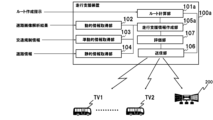
- FIG. 6 is a diagram showing one configuration of the present disclosure. Referring to Fig. 6, a configuration including a driving assistance device 100 capable of transmitting route information and driving assistance information to a vehicle TV and a control center 200 that controls the vehicle TV is shown.
- the driving support device 100 includes a route calculation unit 101, a dynamic information acquisition unit 102, a semi-dynamic information acquisition unit 103, a static information acquisition unit 104, a driving support information creation unit 105, and a transmission unit 106.
- the route calculation unit 101 calculates a driving route (path) from the departure point to the destination based on a route calculation instruction for determining a path from the position of the vehicle TV to which the service is to be provided to the destination, and sends the route to the driving support information creation unit 105.
- the route calculation instruction may be obtained from the vehicle TV, or may be received from the control center 200 that controls the operation of the vehicle TV.
- Such a route calculation unit 101 can be constructed using a route search engine used in car navigation systems, etc.
- Figure 7 is an example of the route calculation by the route calculation unit 101 from the position of the vehicle TV to the destination G.
- the route calculation unit 101 may calculate multiple paths from the position of the vehicle TV to the destination, and send them to the driving support information creation unit 105.
- the dynamic information acquisition unit 102, the semi-dynamic information acquisition unit 103, and the static information acquisition unit 104 acquire dynamic information, semi-dynamic information, and static information, respectively, from external devices, and send them to the driving support information creation unit 105.
- this dynamic information, semi-dynamic information, and static information for example, a dynamic map created for an automated driving or advanced driving support system may be used.
- the dynamic information, semi-dynamic information, and static information are managed by the control center 200, the dynamic information, semi-dynamic information, and static information may be acquired from the control center 200.
- FIG. 8 is a diagram for explaining the relationship between the dynamic information, semi-dynamic information, and static information and the driving support information created by the driving support device 100.
- the static information in the bottom row of FIG. 8 is information on immovable objects such as roads, structures and lanes on roads, and permanent regulations.
- the semi-dynamic information in the second row from the bottom of FIG. 8 is information on objects that change every hour to one minute, such as traffic regulations due to construction and congestion predictions.
- the dynamic information in the third row from the bottom of FIG. 8 is information on objects that change in real time, such as the positions of vehicles and pedestrians and traffic signal indications.
- the driving support device 100 may additionally use information obtained from images captured by a camera or the like connected to the device. Therefore, the dynamic information acquisition unit 102, the semi-dynamic information acquisition unit 103, and the static information acquisition unit 104 correspond to the acquisition unit 11 described above.
- the driving support information creation unit 105 uses the dynamic information, semi-dynamic information, and static information described above to create driving support information indicating the degree of recommendation for each lane on the driving route (path) of the vehicle TV.
- This driving support information can take the form of a map showing the ease of driving for each lane in several stages, as shown in the top row of Figure 8. This ease of driving can be obtained by calculating a score indicating the ease of driving for the vehicle TV from the types and positions of various objects contained in the dynamic information, semi-dynamic information, and static information, and ranking the vehicle according to this score. In the example of Figure 8, a map showing the ease of driving for the vehicle TV in four stages of shading is shown. By providing such driving support information to the vehicle TV, it becomes possible to allow the vehicle TV to drive safely. Therefore, the driving support information creation unit 105 corresponds to the calculation unit 12 described above.
- the transmitting unit 106 transmits the driving support information created as described above to the vehicle TV. Furthermore, the transmitting unit 106 transmits a notification to the control center 200 if the ease of driving on the driving route does not satisfy a predetermined condition.
- This predetermined condition may be that there is a section in the created driving route where the recommendation level of all lanes is below a predetermined threshold.
- the control center 200 can provide various types of support to the vehicle TV.
- this notification may include an image or schematic diagram of the road section that is determined not to satisfy the predetermined condition.
- FIG. 9 is a sequence diagram showing one operation of the present disclosure.
- the driving assistance device 100 calculates a driving route (path) from the departure point to the destination in response to receiving a route calculation instruction or the like (step S001).
- the driving assistance device 100 creates a recommended map for each lane of the road along the driving route (path) as driving assistance information (step S002-1).
- the driving assistance device 100 transmits a recommended map for each lane of the road on the created driving route (path) to the vehicle TV (step S003-1).
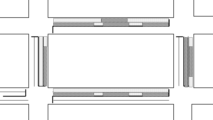
- FIG. 10 is an example of a recommended map for each lane of the road created by the driving assistance device 100 for the driving route (path) shown in FIG. 7.
- the darkly shaded areas represent lanes with a low degree of recommendation
- the lightly shaded areas represent lanes with a high degree of recommendation.
- the driving assistance information may be in the form of a map that shows the level of recommendation for each lane.
- the vehicle TV receives the recommended map for each lane of the road along the travel route and drives while referring to the recommended map (step S004-1).
- the driving assistance device 100 repeats the above process at predetermined time intervals until the vehicle TV reaches the destination, thereby supporting the driving of the vehicle TV.
- FIG. 11 shows the driving route actually taken by the vehicle TV using the recommended map for each lane of the road in FIG. 10. In this way, by selecting a lightly shaded area and driving, it is possible to safely reach the destination.
- the route actually selected by the vehicle TV may differ from the recommended map for each lane of the road in FIG. 10 and the driving route derived from this recommended map.
- the recommended map for each lane of the road may include a section in which all lanes in the section to the destination are low in recommendation.
- the area indicated by the thick arrow is shaded heavily, indicating that the two lanes above and below have a low recommendation.
- the driving assistance device 100 transmits a notification to the control center 200 requesting driving assistance.
- the control center 200 having received the notification, switches the vehicle TV from automatic driving mode to remote control mode and operates the vehicle TV. In this way, it becomes possible to respond to worsening road conditions that cannot be handled by changing lanes.
- the control center 200 may operate to automatically switch to remote control mode in response to the notification.
- the recommended maps for each lane of the road can not only be provided to the vehicle TV, but can also be used as information to determine whether or not assistance is required for the vehicle TV.
- FIG. 13 is a diagram showing another configuration of the present disclosure.
- the first difference from the configuration shown in FIG. 6 is that an evaluation unit 107 is added to the driving support device 100a.
- the second difference is that the operation of the route calculation unit 101a and the driving support information creation unit 105a is different, and the driving route is reviewed according to the evaluation of the evaluation unit 107.
- the other configurations are the same as those in FIG. 6, so the following description will focus on the differences.
- the evaluation unit 107 evaluates the driving support information created by the driving support information creation unit 105a. Specifically, the evaluation unit 107 evaluates whether or not there is a high possibility that a predetermined number or more of vehicles will simultaneously travel through a section with a low recommendation level. If it is determined that there is a high possibility that a predetermined number or more of vehicles will simultaneously travel through a section with a low recommendation level, the evaluation unit 107 requests the route calculation unit 101a to select vehicles traveling through a section with a low recommendation level and change the travel route.
- the driving support information creation unit 105a may create driving support information based on the static information and quasi-static information shown in FIG. 8.
- dynamic information is not suitable for long-term prediction because it can change in a very short period of time.
- information categorized as dynamic information that can be predicted with a relatively high degree of accuracy such as traffic light indications and vehicles activating their turn signals, may be used to create driving support information.
- the route calculation unit 101a calculates the driving route (path) from each of the positions of the vehicles TV1-TV2 to each of the destinations based on the route calculation instruction, and sends it to the driving support information creation unit 105a. In addition, when the route calculation unit 101a receives a request to change the driving route from the evaluation unit 107, it changes the driving route (path) of the specified vehicle and sends it to the driving support information creation unit 105a.
- the driving support information creation unit 105a uses the dynamic information, semi-dynamic information, and static information described above to create driving support information indicating the recommendation level for each lane on the driving route (path) of the multiple vehicles TV1-TV2. In addition, when there is a request from the evaluation unit 107 to change the driving route, the driving support information creation unit 105a creates driving support information indicating the recommendation level for each lane on the driving route (path) after the change.
- FIG. 14 is a sequence diagram showing another operation of the present disclosure.
- the driving assistance device 100a calculates driving routes (paths) from the departure points to the destinations of multiple vehicles TV1-TV2 in response to receiving a route calculation instruction or the like (step S101).
- the driving assistance device 100a creates a recommended map for each lane of the roads on each driving route (path) as driving assistance information (step S102-1).
- FIG. 15 is a diagram showing a situation in which it has been determined that there is a high possibility that a predetermined number or more vehicles will simultaneously travel through a section with a low recommendation level.
- the recommendation level of two lanes is low in sections A and B, and the simulation results show that vehicles TV1 and TV2 will simultaneously travel through sections with low recommendation levels.
- driving assistance device 100a instructs route calculation unit 101a to change the driving route (path).
- the arrows in FIG. 16 show the new driving route (path) of vehicle TV1 created in response to the instruction to change the driving route (path).
- the driving assistance device 100a creates a recommended map for each lane of the changed driving route (path) (step S106-1).
- FIG. 17 shows a recommended map for each lane of the changed driving route (path).
- the vehicle whose driving route is to be changed may be selected based on a certain criterion, such as the vehicle with the shortest total distance of sections with a low recommendation level or the vehicle with the longest total distance of sections with a low recommendation level.
- the driving assistance device 100a transmits a recommended map for each lane of the road on each driving route (path) to the vehicles TV1 to TV2 (step S107-1).
- the driving route (path) as shown in FIG. 18, the possibility that both vehicles TV1 to TV2 will simultaneously drive through a section with a low recommendation level is low.
- the number of vehicles TV1-TV2 is described as two, but there is no limit to the number of vehicles. For example, it is also possible to manage five or more vehicles, and limit the number of vehicles traveling simultaneously through sections with a low recommendation level to two or less.
- the driving assistance device 100 transmits a notification to the control center 200 requesting driving assistance, as in the first embodiment.
- the control center 200 which receives the notification, switches at least one of the vehicle TV1-TV2 from the automatic driving mode to the remote control mode and operates the vehicle TV. In this way, it becomes possible to respond to worsening road conditions that cannot be addressed by changing the driving route.
- the driving route (path) is changed when there is a high possibility that a predetermined number or more of vehicles will simultaneously travel through a section with a low recommendation level.
- the method of reducing the possibility that a predetermined number or more of vehicles will simultaneously travel through a section with a low recommendation level is not limited to this.
- the driving support device 100a can notify the control center 200 (a predetermined terminal), and the control center 200 can change the speed of the vehicles TV1 to TV2, so that a predetermined number or more of vehicles will not simultaneously travel through a section with a low recommendation level.
- the driving route (path) transmitted to the vehicles TV1 to TV2 can be provided with speed information, and at least one of the vehicles TV1 to TV2 can be made to increase or decrease speed, thereby reducing the possibility of simultaneously traveling through a section with a low recommendation level.
- FIG. 19 shows an example in which the vehicle TV1 is instructed to decelerate before section A, and the vehicle TV2 is instructed to increase speed before and after section B. The number of vehicles traveling through a section with a low recommendation level at the same time can also be adjusted by such speed instructions.
- FIG. 20 is a diagram showing another configuration of the present disclosure.
- the difference from the configuration shown in FIG. 6 is that the operation of the route calculation unit 101b and the driving support information creation unit 105b is different. Specifically, the driving support information creation unit 105b first creates a recommended map for each lane of the road, and then the route calculation unit 101b calculates a driving route (path) by referring to the recommended map for each lane of the road. Since the other configurations are the same as those of FIG. 6, the following description will focus on the differences.
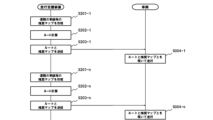
- FIG. 21 is a sequence diagram showing another operation of the present disclosure.
- the driving assistance device 100b creates, as driving assistance information, a recommended map for each lane of roads in a specified area (step S201-1).
- FIG. 22 is an example of a recommended map for each lane of roads in the specified area.
- the driving assistance device 100b refers to the recommendation map for each lane of the roads in the specified area, selects lanes with a high recommendation level, and calculates a driving route (path) from the departure point to the destination (step S202-1).
- Figure 23 shows an example of a driving route (path) created by selecting lanes with a high recommendation level using the recommendation map for each lane of the roads in the specified area.
- a driving route (path) may be created that has a section where the recommendation level of all lanes is below a specified threshold.
- the driving assistance device 100b notifies a specified terminal such as a terminal of the control center 200.
- the driving assistance device 100b transmits the driving route (path) and the recommended map for each lane of the road to the vehicle TV (step S203-1).
- the vehicle TV receives the recommended map for each lane of the road along the driving route (path), and drives while referring to the driving route (path) and the recommended map (step S204-1).
- the driving assistance device 100b repeats the above process at predetermined time intervals to assist the driving of the vehicle TV until the vehicle TV reaches the destination.
- the driving assistance device 100b may also be provided with a function equivalent to the evaluation unit 107, as in the second embodiment.
- the route calculation unit 101b may then determine whether or not it is possible to calculate a driving route that satisfies the condition that the multiple vehicles do not simultaneously travel through sections with a recommendation level below a predetermined threshold. If it is determined as a result of the determination that the condition that the multiple vehicles do not simultaneously travel through sections with a recommendation level below a predetermined threshold cannot be satisfied, the driving assistance device 100b notifies a predetermined terminal, such as a terminal in the control center 200.
- the driving assistance device has been described as creating a recommended map for each lane of the driving route (path) as driving assistance information, but the form of the driving assistance information is not limited to this.
- the driving assistance device it is also possible for the driving assistance device to create a recommended map for each lane of the roads in an entire specific area (see FIG. 22) and transmit the necessary parts of the map to the vehicle TV, TV1 to TV2.
- each component of each device represents a functional block.
- a part or all of each component of each device is realized by an arbitrary combination of an information processing device 900 and a program as shown in Fig. 22.
- Fig. 22 is a block diagram showing an example of a hardware configuration of the information processing device 900 that realizes each component of each device.
- the information processing device 900 includes, as an example, the following configuration.
- each device in each embodiment are realized by the CPU 901 acquiring and executing a program 904 that realizes these functions. That is, the CPU 901 in FIG. 22 executes an information acquisition program and a recommendation level calculation program, and performs an update process for each calculation parameter stored in the RAM 903, storage device 905, etc.
- the program 904 that realizes the function of each component of each device is, for example, stored in advance in the storage device 905 or ROM 902, and is read by the CPU 901 as necessary.
- the program 904 may be supplied to the CPU 901 via the communication network 909, or may be stored in advance in the recording medium 906, and the drive device 907 may read the program and supply it to the CPU 901.
- each device may be implemented by any combination of a separate information processing device 900 and a program for each component.
- multiple components of each device may be implemented by any combination of a single information processing device 900 and a program.
- each part (processing means, function) of the driving support device shown in the first to third embodiments can be implemented by a computer program that causes a processor mounted on the device to execute each of the above-mentioned processes using its hardware.
- each device is realized by other general-purpose or dedicated circuits, processors, etc., or a combination of these. These may be configured by a single chip, or may be configured by multiple chips connected via a bus.
- each device may be realized by a combination of the above-mentioned circuits and programs.
- the multiple information processing devices, circuits, etc. may be centrally located or distributed.
- the information processing devices, circuits, etc. may be realized as a client-server system, cloud computing system, etc., in a form in which each is connected via a communication network.
- the driving assistance device further includes: a route calculation unit that calculates candidate driving routes based on a current location of the vehicle and a destination of the vehicle; A transmission unit that transmits the calculated driving route to the vehicle; A configuration can be adopted that includes a notification unit that notifies a predetermined terminal when a travel route including a section in which the recommendation level of all lanes is equal to or lower than a predetermined threshold is transmitted.
- the driving assistance device further includes an evaluation unit that evaluates whether the driving route satisfies a condition that the plurality of vehicles do not simultaneously travel through a section having a recommendation level equal to or lower than a predetermined threshold value, When the travel route does not satisfy the condition, the notification unit may be configured to give a notification to the predetermined terminal.
- the evaluation unit of the above-described driving assistance device may be configured to instruct the route calculation unit to change the driving route of at least one vehicle when a driving route that satisfies the condition cannot be generated.
- the driving support device according to claim 1 , further comprising a route calculation unit that calculates a driving route to a destination for which a lane is specified, based on the recommendation level for each lane.
- a route calculation unit that calculates a driving route to a destination for which a lane is specified, based on the recommendation level for each lane.
- the driving support device further comprising: when a driving route including a section in which the recommendation level of all lanes is equal to or lower than a predetermined threshold is transmitted, a notification is sent to a predetermined terminal.
- the transmission unit of the driving assistance device described above may be configured to transmit the recommendation level for each lane in a map format that indicates the level of recommendation level for each lane.
Landscapes
- Physics & Mathematics (AREA)
- General Physics & Mathematics (AREA)
- Traffic Control Systems (AREA)
Abstract
La présente invention concerne un dispositif d'aide au déplacement, un procédé d'aide au déplacement et un support d'enregistrement pouvant inviter un véhicule cible à réagir à la situation d'une route. Ce dispositif d'aide au déplacement comprend : une unité d'acquisition qui acquiert des informations d'objet pour chaque voie d'un segment de route prescrit ; une unité de calcul qui, sur la base des informations d'objet, calcule le degré de recommandation pour chacune des voies pour un véhicule pourvu d'une fonction pour commuter entre un mode de conduite automatique et un mode de conduite non automatique ; et une unité de transmission qui transmet, au véhicule qui entre dans le segment de route prescrit, le degré de recommandation pour chacune des voies.
Priority Applications (3)
| Application Number | Priority Date | Filing Date | Title |
|---|---|---|---|
| PCT/JP2023/029973 WO2025041220A1 (fr) | 2023-08-21 | 2023-08-21 | Dispositif d'aide au déplacement, procédé d'aide au déplacement et support d'enregistrement |
| JP2025541181A JPWO2025041220A5 (ja) | 2023-08-21 | 走行支援装置、走行支援方法及びプログラム | |
| CN202380101589.1A CN121713223A (zh) | 2023-08-21 | 2023-08-21 | 行驶辅助装置、行驶辅助方法和记录介质 |
Applications Claiming Priority (1)
| Application Number | Priority Date | Filing Date | Title |
|---|---|---|---|
| PCT/JP2023/029973 WO2025041220A1 (fr) | 2023-08-21 | 2023-08-21 | Dispositif d'aide au déplacement, procédé d'aide au déplacement et support d'enregistrement |
Publications (1)
| Publication Number | Publication Date |
|---|---|
| WO2025041220A1 true WO2025041220A1 (fr) | 2025-02-27 |
Family
ID=94731808
Family Applications (1)
| Application Number | Title | Priority Date | Filing Date |
|---|---|---|---|
| PCT/JP2023/029973 Pending WO2025041220A1 (fr) | 2023-08-21 | 2023-08-21 | Dispositif d'aide au déplacement, procédé d'aide au déplacement et support d'enregistrement |
Country Status (2)
| Country | Link |
|---|---|
| CN (1) | CN121713223A (fr) |
| WO (1) | WO2025041220A1 (fr) |
Citations (3)
| Publication number | Priority date | Publication date | Assignee | Title |
|---|---|---|---|---|
| JP2017151041A (ja) * | 2016-02-26 | 2017-08-31 | 株式会社デンソー | 走行支援装置及びセンタ |
| JP2019090627A (ja) * | 2017-11-10 | 2019-06-13 | 本田技研工業株式会社 | 表示システム、表示方法、およびプログラム |
| JP2022107907A (ja) * | 2021-01-12 | 2022-07-25 | 本田技研工業株式会社 | 推奨レーンを判定する車両システム |
-
2023
- 2023-08-21 WO PCT/JP2023/029973 patent/WO2025041220A1/fr active Pending
- 2023-08-21 CN CN202380101589.1A patent/CN121713223A/zh active Pending
Patent Citations (3)
| Publication number | Priority date | Publication date | Assignee | Title |
|---|---|---|---|---|
| JP2017151041A (ja) * | 2016-02-26 | 2017-08-31 | 株式会社デンソー | 走行支援装置及びセンタ |
| JP2019090627A (ja) * | 2017-11-10 | 2019-06-13 | 本田技研工業株式会社 | 表示システム、表示方法、およびプログラム |
| JP2022107907A (ja) * | 2021-01-12 | 2022-07-25 | 本田技研工業株式会社 | 推奨レーンを判定する車両システム |
Also Published As
| Publication number | Publication date |
|---|---|
| CN121713223A (zh) | 2026-03-20 |
| JPWO2025041220A1 (fr) | 2025-02-27 |
Similar Documents
| Publication | Publication Date | Title |
|---|---|---|
| US12422267B2 (en) | Navigation method and apparatus | |
| US12223410B2 (en) | Lane selection using machine learning | |
| US20210191394A1 (en) | Systems and methods for presenting curated autonomy-system information of a vehicle | |
| US10254121B2 (en) | Dynamic routing for self-driving vehicles | |
| RU2754705C1 (ru) | Способ помощи при вождении и устройство помощи при вождении | |
| RU2726238C2 (ru) | Автономное транспортное средство с поддержкой направления | |
| JP6771566B2 (ja) | 操作権限管理装置 | |
| KR102518680B1 (ko) | 속력 프로파일 추정 | |
| US12116006B2 (en) | Dynamic route information interface | |
| US10540895B2 (en) | Management of mobile objects | |
| US20180267537A1 (en) | Hierarchical motion planning for autonomous vehicles | |
| RU2661963C1 (ru) | Устройство вычисления маршрута движения | |
| US11378950B2 (en) | Remote system for an autonomous vehicle | |
| US20230324188A1 (en) | Autonomous vehicle fleet scheduling to maximize efficiency | |
| US11626012B2 (en) | Hierarchical integrated traffic management system for managing vehicles | |
| KR102562381B1 (ko) | 차량 호라이즌에서 오브젝트를 컨텍스트화 하기 위한 시스템 및 방법 | |
| JP2022515420A (ja) | 自動車の支援方法 | |
| JP7687273B2 (ja) | 車両制御装置、車両制御方法、車両制御用コンピュータプログラム及び優先度設定装置ならびに車両制御システム | |
| JP2025170429A (ja) | 車載情報処理装置、自動運転システムおよび車載システム | |
| KR20230072294A (ko) | 교차로에서의 군집주행 방법 및 그를 위한 차량 제어장치 | |
| JP7761453B2 (ja) | 運行管理システム | |
| JP7605004B2 (ja) | 管制装置、及び管制システム | |
| WO2021171979A1 (fr) | Système de commande de flux de trafic, dispositif de commande, procédé de commande et programme d'ordinateur | |
| JP2022090190A (ja) | 走行支援方法及び走行支援装置 | |
| CN121713223A (zh) | 行驶辅助装置、行驶辅助方法和记录介质 |
Legal Events
| Date | Code | Title | Description |
|---|---|---|---|
| 121 | Ep: the epo has been informed by wipo that ep was designated in this application |
Ref document number: 23949681 Country of ref document: EP Kind code of ref document: A1 |
|
| ENP | Entry into the national phase |
Ref document number: 2025541181 Country of ref document: JP Kind code of ref document: A |
|
| WWE | Wipo information: entry into national phase |
Ref document number: 2025541181 Country of ref document: JP |