WO2025037457A1 - 分離膜複合体および分離膜複合体の製造方法 - Google Patents
分離膜複合体および分離膜複合体の製造方法 Download PDFInfo
- Publication number
- WO2025037457A1 WO2025037457A1 PCT/JP2024/016040 JP2024016040W WO2025037457A1 WO 2025037457 A1 WO2025037457 A1 WO 2025037457A1 JP 2024016040 W JP2024016040 W JP 2024016040W WO 2025037457 A1 WO2025037457 A1 WO 2025037457A1
- Authority
- WO
- WIPO (PCT)
- Prior art keywords
- separation membrane
- membrane
- membrane composite
- mof
- support
- Prior art date
- Legal status (The legal status is an assumption and is not a legal conclusion. Google has not performed a legal analysis and makes no representation as to the accuracy of the status listed.)
- Pending
Links
Images



Classifications
-
- B—PERFORMING OPERATIONS; TRANSPORTING
- B01—PHYSICAL OR CHEMICAL PROCESSES OR APPARATUS IN GENERAL
- B01D—SEPARATION
- B01D53/00—Separation of gases or vapours; Recovering vapours of volatile solvents from gases; Chemical or biological purification of waste gases, e.g. engine exhaust gases, smoke, fumes, flue gases, aerosols
- B01D53/22—Separation of gases or vapours; Recovering vapours of volatile solvents from gases; Chemical or biological purification of waste gases, e.g. engine exhaust gases, smoke, fumes, flue gases, aerosols by diffusion
- B01D53/228—Separation of gases or vapours; Recovering vapours of volatile solvents from gases; Chemical or biological purification of waste gases, e.g. engine exhaust gases, smoke, fumes, flue gases, aerosols by diffusion characterised by specific membranes
-
- B—PERFORMING OPERATIONS; TRANSPORTING
- B01—PHYSICAL OR CHEMICAL PROCESSES OR APPARATUS IN GENERAL
- B01D—SEPARATION
- B01D67/00—Processes specially adapted for manufacturing semi-permeable membranes for separation processes or apparatus
- B01D67/0039—Inorganic membrane manufacture
- B01D67/0051—Inorganic membrane manufacture by controlled crystallisation, e,.g. hydrothermal growth
-
- B—PERFORMING OPERATIONS; TRANSPORTING
- B01—PHYSICAL OR CHEMICAL PROCESSES OR APPARATUS IN GENERAL
- B01D—SEPARATION
- B01D67/00—Processes specially adapted for manufacturing semi-permeable membranes for separation processes or apparatus
- B01D67/0079—Manufacture of membranes comprising organic and inorganic components
-
- B—PERFORMING OPERATIONS; TRANSPORTING
- B01—PHYSICAL OR CHEMICAL PROCESSES OR APPARATUS IN GENERAL
- B01D—SEPARATION
- B01D67/00—Processes specially adapted for manufacturing semi-permeable membranes for separation processes or apparatus
- B01D67/0081—After-treatment of organic or inorganic membranes
- B01D67/0095—Drying
-
- B—PERFORMING OPERATIONS; TRANSPORTING
- B01—PHYSICAL OR CHEMICAL PROCESSES OR APPARATUS IN GENERAL
- B01D—SEPARATION
- B01D67/00—Processes specially adapted for manufacturing semi-permeable membranes for separation processes or apparatus
- B01D67/0081—After-treatment of organic or inorganic membranes
- B01D67/0097—Storing or preservation
-
- B—PERFORMING OPERATIONS; TRANSPORTING
- B01—PHYSICAL OR CHEMICAL PROCESSES OR APPARATUS IN GENERAL
- B01D—SEPARATION
- B01D69/00—Semi-permeable membranes for separation processes or apparatus characterised by their form, structure or properties; Manufacturing processes specially adapted therefor
- B01D69/02—Semi-permeable membranes for separation processes or apparatus characterised by their form, structure or properties; Manufacturing processes specially adapted therefor characterised by their properties
-
- B—PERFORMING OPERATIONS; TRANSPORTING
- B01—PHYSICAL OR CHEMICAL PROCESSES OR APPARATUS IN GENERAL
- B01D—SEPARATION
- B01D69/00—Semi-permeable membranes for separation processes or apparatus characterised by their form, structure or properties; Manufacturing processes specially adapted therefor
- B01D69/12—Composite membranes; Ultra-thin membranes
-
- B—PERFORMING OPERATIONS; TRANSPORTING
- B01—PHYSICAL OR CHEMICAL PROCESSES OR APPARATUS IN GENERAL
- B01D—SEPARATION
- B01D71/00—Semi-permeable membranes for separation processes or apparatus characterised by the material; Manufacturing processes specially adapted therefor
- B01D71/02—Inorganic material
- B01D71/028—Molecular sieves
- B01D71/0281—Zeolites
-
- B—PERFORMING OPERATIONS; TRANSPORTING
- B01—PHYSICAL OR CHEMICAL PROCESSES OR APPARATUS IN GENERAL
- B01D—SEPARATION
- B01D71/00—Semi-permeable membranes for separation processes or apparatus characterised by the material; Manufacturing processes specially adapted therefor
- B01D71/06—Organic material
-
- B—PERFORMING OPERATIONS; TRANSPORTING
- B01—PHYSICAL OR CHEMICAL PROCESSES OR APPARATUS IN GENERAL
- B01D—SEPARATION
- B01D2256/00—Main component in the product gas stream after treatment
- B01D2256/22—Carbon dioxide
-
- B—PERFORMING OPERATIONS; TRANSPORTING
- B01—PHYSICAL OR CHEMICAL PROCESSES OR APPARATUS IN GENERAL
- B01D—SEPARATION
- B01D2257/00—Components to be removed
- B01D2257/10—Single element gases other than halogens
- B01D2257/102—Nitrogen
-
- B—PERFORMING OPERATIONS; TRANSPORTING
- B01—PHYSICAL OR CHEMICAL PROCESSES OR APPARATUS IN GENERAL
- B01D—SEPARATION
- B01D2325/00—Details relating to properties of membranes
- B01D2325/02—Details relating to pores or porosity of the membranes
- B01D2325/0283—Pore size
-
- B—PERFORMING OPERATIONS; TRANSPORTING
- B01—PHYSICAL OR CHEMICAL PROCESSES OR APPARATUS IN GENERAL
- B01D—SEPARATION
- B01D2325/00—Details relating to properties of membranes
- B01D2325/02—Details relating to pores or porosity of the membranes
- B01D2325/0283—Pore size
- B01D2325/02831—Pore size less than 1 nm
-
- B—PERFORMING OPERATIONS; TRANSPORTING
- B01—PHYSICAL OR CHEMICAL PROCESSES OR APPARATUS IN GENERAL
- B01D—SEPARATION
- B01D2325/00—Details relating to properties of membranes
- B01D2325/04—Characteristic thickness
-
- Y—GENERAL TAGGING OF NEW TECHNOLOGICAL DEVELOPMENTS; GENERAL TAGGING OF CROSS-SECTIONAL TECHNOLOGIES SPANNING OVER SEVERAL SECTIONS OF THE IPC; TECHNICAL SUBJECTS COVERED BY FORMER USPC CROSS-REFERENCE ART COLLECTIONS [XRACs] AND DIGESTS
- Y02—TECHNOLOGIES OR APPLICATIONS FOR MITIGATION OR ADAPTATION AGAINST CLIMATE CHANGE
- Y02C—CAPTURE, STORAGE, SEQUESTRATION OR DISPOSAL OF GREENHOUSE GASES [GHG]
- Y02C20/00—Capture or disposal of greenhouse gases
- Y02C20/40—Capture or disposal of greenhouse gases of CO2
Definitions
- the present invention relates to a separation membrane composite and a method for producing a separation membrane composite.
- a zeolite intermediate membrane with a small average pore size is provided on a porous support, and a separation membrane that is a mesoporous silica membrane is provided on the intermediate membrane.
- Functional groups such as amino groups are introduced into the pores on the surface layer of the separation membrane.
- MOFs metal-organic frameworks
- zeolite membranes and mesoporous silica membranes are porous materials with a high surface area, and are expected to be applied to gas and liquid separation by forming a membrane on a porous support in the same way as zeolite membranes and mesoporous silica membranes.
- an Mg-MOF-74 membrane is formed as a MOF membrane on a support, and the MOF membrane is refluxed at 110°C in a solution in which ethylenediamine is dissolved in toluene, to obtain a separation membrane in which ethylenediamine is supported on the MOF membrane.
- a mesoporous silica membrane is chemically reacted with a silane coupling agent having a basic functional group by refluxing.
- ethylenediamine is introduced into the MOF membrane by refluxing.
- a large amount of amine permeates the entire membrane in the separation membranes of References 1 and 3, reducing the permeability of the target gas.
- the separation membrane in the document 2 has excellent CO 2 separation performance due to the presence of an intermediate membrane, but has a complex structure and it is not easy to reduce the manufacturing cost.
- the average pore size of the mesoporous silica membrane is 1 nm or more, and the amine is chemically bonded to the mesoporous silica membrane.
- the separation membrane in the document 3 is not suitable for separating CO 2 and N 2 because the average pore size of the MOF is 1 nm or more and nitrogen (N 2 ) permeates more than CO 2. In addition, it is thought that amines are also present in the support, which causes a large permeation resistance.
- the present invention aims to provide a separation membrane composite that has high separation performance for a specific gas while suppressing a decrease in fluid permeability, and a method for producing the same.
- Aspect 1 of the present invention is a separation membrane composite, comprising a porous support and a metal-organic framework membrane provided on the support, the membrane having an average pore diameter of 0.40 nm or more and 0.90 nm or less, and an amine supported on the surface and in the pores near the surface.
- aspect 1 of the present invention it is possible to provide a separation membrane composite that has high separation performance for a specific gas while suppressing a decrease in fluid permeability.
- a second aspect of the present invention is the separation membrane composite of the first aspect, wherein the metal ion that is a component of the metal organic framework is at least one selected from the group consisting of Al 3+ , Co 3+ , Co 2+ , Ni 2+ , Ni + , Cu 2+ , Cu + , Zn 2+ , Fe 3+ , Fe 2+ , Ti 3+ and Zr 4+ .
- aspects 3 of the present invention is the separation membrane composite of aspect 1 (or aspect 1 or 2), in which the organic ligand, which is a component of the metal-organic framework, is a bidentate ligand that is an ion of an organic molecule having two carboxy groups.
- Aspect 4 of the present invention is the separation membrane complex of aspect 1 (which may be any one of aspects 1 to 3), in which the amine includes one or more types of linear amine.
- Aspect 5 of the present invention is a separation membrane composite according to aspect 1 (which may be any one of aspects 1 to 4), in which the average pore diameter is 0.40 nm or more and 0.70 nm or less.
- a sixth aspect of the present invention is the separation membrane composite of the first aspect (which may be any one of the first to fifth aspects), wherein the ratio of the CO2 permeation rate to the target gas permeation rate to be separated from the CO2 is 5 or more.
- Aspect 7 of the present invention is a separation membrane composite according to aspect 1 (which may be any one of aspects 1 to 6), in which the average thickness of the separation membrane is 0.5 ⁇ m or more and 2 ⁇ m or less.
- Aspect 8 of the present invention is a separation membrane composite according to any one of aspects 1 to 7, in which the amount of the amine present per unit volume gradually decreases from the surface of the separation membrane toward the support.
- a ninth aspect of the present invention is a method for producing a separation membrane composite, comprising the steps of: a) attaching seed crystals of a metal-organic framework onto a porous support; b) preparing a raw material solution of the metal-organic framework; c) immersing the support in the raw material solution and forming a film of the metal-organic framework having an average pore diameter of 0.40 nm or more and 0.90 nm or less on the support by solvothermal synthesis; and d) contacting the surface of the film of the metal-organic framework with a solution containing an amine.
- aspect 9 of the present invention it is possible to provide a method for producing a separation membrane composite that has high separation performance for a specific gas while suppressing a decrease in fluid permeability.
- Aspect 10 of the present invention is a method for producing a separation membrane composite according to aspect 9, further comprising, between steps c) and d), steps e) of drying the film of the metal-organic framework, and f) of maintaining the film of the metal-organic framework in a high humidity environment.
- FIG. 2 is a cross-sectional view of a separation membrane composite.
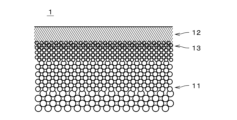
- FIG. 2 is an enlarged cross-sectional view showing a portion of the separation membrane composite.
- FIG. 2 is a diagram showing a flow of manufacturing a separation membrane composite.
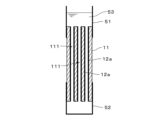
- FIG. 1 is a diagram showing the state of amine carrying treatment.
- FIG. FIG. 2 is a diagram showing the flow of separation of a mixed material by a separation device.
- FIG. 1 is a cross-sectional view of a separation membrane composite 1.
- FIG. 2 is a cross-sectional view showing an enlarged portion of the separation membrane composite 1.
- the separation membrane composite 1 includes a porous support 11 and a separation membrane 12 provided on the support 11.
- the separation membrane 12 is a metal-organic framework (MOF) membrane (hereinafter also referred to as a "MOF membrane”) on which an amine is supported, and the separation membrane composite 1 is a MOF membrane composite.
- the MOF membrane is at least a membrane formed of MOF on the surface of the support 11, and does not include a membrane in which MOF particles are simply dispersed in an organic membrane.
- the separation membrane 12 is emphasized by a thick line.
- the separation membrane 12 is shaded.
- the thickness of the separation membrane 12 is drawn thicker than it actually is.
- the support 11 is a porous member that is permeable to gas and liquid.
- the support 11 is a so-called monolithic support having a single continuous columnar body formed as an integral unit and multiple through holes 111 each extending in the longitudinal direction (i.e., the left-right direction in FIG. 1).
- the support 11 is approximately cylindrical.
- the cross section perpendicular to the longitudinal direction of each through hole 111 i.e., cell
- the diameter of the through holes 111 is drawn larger than the actual diameter, and the number of through holes 111 is drawn smaller than the actual number.
- the separation membrane 12 is formed on the inner circumferential surface of the through holes 111, and covers the inner circumferential surface of the through holes 111 over almost the entire surface.
- the length of the support 11 (i.e., the length in the left-right direction in FIG. 1) is, for example, 10 cm to 200 cm ("to" means equal to or greater than the value before it and equal to or less than the value after it).
- the outer diameter of the support 11 is, for example, 0.5 cm to 30 cm.
- the distance between the central axes of adjacent through holes 111 is, for example, 0.3 mm to 10 mm.
- the surface roughness (Ra) of the support 11 is, for example, 0.1 ⁇ m to 5.0 ⁇ m, and preferably 0.2 ⁇ m to 2.0 ⁇ m.
- the shape of the support 11 may be, for example, a honeycomb shape, a flat plate shape, a tubular shape, a cylindrical shape, a columnar shape, or a polygonal column shape.
- the thickness of the support 11 is, for example, 0.1 mm to 10 mm.
- the support 11 is made of ceramic.
- ceramic sintered bodies selected as the material for the support 11 include alumina, silica, mullite, zirconia, titania, yttria, silicon nitride, silicon carbide, and the like.
- the support 11 contains at least one of alumina, silica, and mullite.
- the support 11 may contain an inorganic binder.
- the inorganic binder at least one of titania, mullite, sinterable alumina, silica, glass frit, clay minerals, and sinterable cordierite can be used.
- the average pore diameter of the support 11 is, for example, 0.01 ⁇ m to 70 ⁇ m, preferably 0.05 ⁇ m to 25 ⁇ m.
- the average pore diameter of the support 11 near the surface where the separation membrane 12 is formed is 0.01 ⁇ m to 1 ⁇ m, preferably 0.05 ⁇ m to 0.5 ⁇ m.
- the average pore diameter can be measured, for example, by a mercury porosimeter, a perm porometer, or a nanoperm porometer.
- D5 is, for example, 0.01 ⁇ m to 50 ⁇ m
- D50 is, for example, 0.05 ⁇ m to 70 ⁇ m
- D95 is, for example, 0.1 ⁇ m to 2000 ⁇ m.
- the porosity of the support 11 near the surface where the separation membrane 12 is formed is, for example, 20% to 60%.
- the porosity can be determined as the percentage of the area in which voids exist in an SEM (scanning electron microscope) image of the cross section of the support 11.
- the support 11 has a multilayer structure in which, for example, multiple layers with different average pore diameters are stacked in the thickness direction.
- the average pore diameter and sintered grain size in the surface layer, including the surface on which the separation membrane 12 is formed, are smaller than the average pore diameter and sintered grain size in the layers other than the surface layer.
- the average pore diameter of the surface layer of the support 11 is, for example, 0.01 ⁇ m to 1 ⁇ m, and preferably 0.05 ⁇ m to 0.5 ⁇ m.
- the materials for each layer can be those described above.
- the materials of the multiple layers that form the multilayer structure may be the same or different. Note that when the support 11 has a multilayer structure, the average pore diameter of the support 11 refers to the average pore diameter of the surface layer, including the surface on which the separation membrane 12 is formed.
- Separation membrane 12 is a porous membrane having fine pores (micropores). Separation membrane 12 is capable of separating a specific substance from a mixture of multiple types of substances by utilizing molecular sieve action or the like. Other substances are less likely to permeate separation membrane 12 than the specific substance. In other words, the permeation rate of the other substances through separation membrane 12 is lower than the permeation rate of the specific substance.
- the average thickness of the separation membrane 12 is 2 ⁇ m or less. This allows a high permeation rate to be achieved.
- the lower limit of the average thickness of the separation membrane 12 is not particularly limited, but from the viewpoint of improving separation performance, it is preferably 0.5 ⁇ m, and more preferably 0.7 ⁇ m.
- a cross section perpendicular to the surface of the separation membrane 12 is exposed, for example, by cross-sectional polishing. In the cross section, randomly determined multiple fields of view (for example, seven fields of view) are observed by SEM. The magnification of the SEM is, for example, 5000 times.
- the average thickness of the separation membrane 12 in each field of view is calculated as the average value of the thickness at five appropriately selected points, and the arithmetic average of the field average thicknesses of the remaining fields of view excluding the fields of view with the maximum and minimum field average thickness values is obtained as the average thickness of the separation membrane 12.
- the surface roughness (Ra) of the separation membrane 12 is, for example, 2 ⁇ m or less, preferably 1 ⁇ m or less, and more preferably 0.5 ⁇ m or less.
- the average pore diameter of the MOF membrane constituting the separation membrane 12 is 0.40 nm or more and 0.90 nm or less.
- the "average pore diameter of the MOF” is the average value of the long and short diameters of the pore openings theoretically derived from the skeletal structure of the MOF.
- the long and short diameters of the pore openings may also be obtained by observation with a TEM (transmission electron microscope) to determine the average pore diameter. More precisely, the long and short diameters of the pore openings refer to the spacing between the lattices of a highly regular lattice structure formed by metal ions and organic ligands.
- MOFs have a unique pore structure consisting of channels (pores) and cages (internal spaces) depending on the structural type, and the pore diameter here refers to the pore diameter of the channel, with the maximum diameter in the cross section of the channel being the long diameter, the diameter of the cross section in a direction approximately perpendicular to the long diameter being the short diameter, and the arithmetic average of the short diameter and the long diameter being the average pore diameter.
- This average pore diameter is smaller than the average pore diameter of the support 11 near the surface where the separation membrane 12 is formed.
- the average particle size of the MOF constituting the separation membrane 12, i.e., the average diameter of the crystal grains, is, for example, 0.1 ⁇ m to 2 ⁇ m.
- the average particle size is preferably 1 ⁇ m or less, and more preferably 0.5 ⁇ m or less.
- grain boundary defects caused by excessively large gaps being formed between the MOF crystals are reduced, making it possible to improve separation performance.
- the average particle size of the MOF in this embodiment is the arithmetic average of the maximum diameters of multiple MOF particles (e.g., 30 particles) measured by observing the membrane surface using a SEM.
- the multiple particles to be measured may be randomly selected on the SEM image.
- a composite layer 13 is formed in which crystals of the MOF penetrate into the pores of the support 11.
- the composite layer 13 is shown by drawing parallel diagonal lines over a portion of the support 11.
- the composite layer 13 is part of the support 11.
- the thickness of the composite layer 13 is, for example, 2 ⁇ m or less. This makes it possible to suppress the decrease in permeation rate caused by the presence of the composite layer 13.
- the composite layer 13 does not have to be present, and the lower limit of the thickness of the composite layer 13 is 0.
- the boundary position of the composite layer 13 in the direction perpendicular to the interface between the support 11 and the separation membrane 12 is identified near one measurement position in the direction along the interface.
- the boundary position on the separation membrane 12 side of the composite layer 13 is the interface between the separation membrane 12 and the support 11.
- the boundary position on the opposite side of the separation membrane 12 in the composite layer 13 is the edge of the MOF that is farthest from the separation membrane 12 in the depth direction among the MOFs present in the pores of the support 11.
- the depth-wise distance between the boundary position on the separation membrane 12 side of the composite layer 13 and the boundary position on the opposite side of the separation membrane 12 is obtained as the thickness of the composite layer 13 at the measurement position. Then, the average of the thicknesses of the composite layer 13 at multiple different measurement positions (for example, 10 measurement positions) is determined as the thickness of the composite layer 13 in the separation membrane composite 1.
- the MOF constituting the separation membrane 12 is composed of a metal ion and an organic ligand (hereinafter simply referred to as "ligand") coordinated to the metal ion.
- the metal ion which is a component of the MOF, is preferably at least one selected from the group consisting of Al 3+ , Co 3+ , Co 2+ , Ni 2+ , Ni + , Cu 2+ , Cu + , Zn 2+ , Fe 3+ , Fe 2+ , Ti 3+ and Zr 4+ in practical terms. More preferably, the metal ion is at least one selected from the group consisting of Al 3+ , Zn 2+ , Ti 3+ and Zr 4+ .
- the number of types of metal ions contained in the MOF is one, but may be multiple.
- the ligand which is a component of the MOF, is preferably a bidentate ligand, which is an ion of an organic molecule having two carboxy groups. This makes it easy to form pores that are more permeable to a specific gas than to other specific gases.
- the structure other than the two carboxy groups is not particularly limited, but one suitable example is a ligand having a heterocycle.
- the ligand may have a pyridine group or a pyrrole group, which can coordinate to a metal ion, instead of a carboxy group.
- the separation membrane 12 is composed of MOFs on which amines are supported.
- the separation membrane 12 is a MOF membrane on which amines are supported.
- Amines are supported means that amine molecules are present in contact with the skeleton of the MOF, and that the amines are attached to the MOF with such a force that they are not easily separated from the skeleton of the MOF when the gas to be permeated through the separation membrane 12 permeates through the MOF. This state may be expressed as "amines are introduced into the MOF membrane” or "MOF membranes are modified with amines.”
- the amines are supported at least on the surface of the MOF membrane and in the pores near the surface.
- the amount of amine present gradually decreases from the surface of the MOF membrane (the surface opposite the support 11) toward the support 11.
- “Gradually decreasing” describes the overall appearance and excludes minute increases and decreases when viewed microscopically.
- the amine is preferably a linear amine.
- the linear amine supported on the MOF is not limited to one type, and may be one or more types of linear amine.
- no amine is present on the support 11 (including the case where a small amount is unintentionally present), and more preferably, no amine is present in the MOF membrane near the support 11 (including the case where a small amount is unintentionally present).
- step S11 seed crystals to be used in manufacturing the MOF membrane, which is the skeleton of the separation membrane 12, are prepared (step S11).
- the seed crystals are produced as MOF powder, for example, by solvothermal synthesis using water and/or an organic solvent (also called hydrothermal synthesis when the solvent is water).
- the MOF powder may be produced by any or known manufacturing method.
- the MOF powder may be used as the seed crystal as it is, or more preferable seed crystals may be obtained by processing the powder by crushing, etc.
- the average particle size (D50) of the seed crystals is preferably 0.5 ⁇ m or less. This makes it possible to suppress the occurrence of grain boundary defects in the MOF membrane caused by the average particle size of the MOF becoming excessively large.
- There is no particular lower limit to the average particle size of the seed crystals but for example, by setting the average particle size to 0.1 ⁇ m or more, it is possible to suppress a decrease in the crystallinity of the seed crystals.
- the average particle size (D50) of the seed crystals can be measured, for example, by a laser scattering method.
- the seed crystals are dispersed in a solvent (water and/or organic solvent) to create a 0.01 w% to 1 w% dispersion.
- a porous support 11 is immersed in the dispersion to attach the seed crystals to the support 11 (dip coating method) (step S12).
- the dispersion in which the seed crystals are dispersed in a solvent is brought into contact with the portion of the support 11 where the separation membrane 12 is to be formed, thereby attaching the seed crystals to the support 11.
- the solvent is then removed by drying to create a support with attached seed crystals.
- the seed crystals may also be attached to the support 11 by other methods.
- a raw material solution (also called a synthetic sol or synthetic solution) used to form the MOF membrane is prepared (step S13).
- the preparation of the raw material solution may be performed before step S12 or in parallel with step S12.
- a solvent water and/or organic solvent
- a ligand a metal ion source
- other raw materials are mixed.
- the ligand is added to the solvent, and the ligand is dissolved by ultrasonic treatment or heating in a thermostatic bath.
- Metal ions are then added to obtain a raw material solution.
- solvothermal synthesis MOFs with an average pore size of 0.40 nm or more and 0.90 nm or less grow using the seed crystals as nuclei, and a dense MOF membrane, which is the basic structure of the separation membrane 12, is formed on the support 11 (step S14).
- the synthesis temperature during solvothermal synthesis is, for example, 40 to 200°C, preferably 70 to 150°C.
- the solvothermal synthesis time is, for example, 1 to 100 hours, preferably 1 to 50 hours.
- the support 11 and the MOF membrane are washed with pure water, and then washed with ethanol or the like. Preferably, washing with water and ethanol or the like is repeated multiple times. After washing, the support 11 and the MOF membrane are dried, for example, at 100°C (step S15). "Drying” refers to removing molecules of the substances used for washing, such as water and ethanol, from within the pores of the MOF membrane.
- a humidification process is performed to hold the MOF membrane in a high humidity environment (step S16).
- "Holding the MOF membrane in a high humidity environment” means that the MOF membrane is placed in a high humidity environment (atmosphere).
- “High humidity” means that the humidity is high compared to the relatively dry environment in which experiments are performed, and does not mean the high humidity in a natural environment. In a high humidity environment, the gas around the MOF membrane may or may not flow.
- the humidification process is essentially a process of bringing water vapor into contact with the MOF membrane.
- the humidification process is not essential, it is believed that the amount of amine supported in the MOF membrane gradually decreases from the surface of the MOF membrane toward the support 11 in the next amine support process, and that the amine is prevented from being supported excessively on the MOF membrane. This makes it possible to achieve both high gas separation performance and high gas permeation rate.
- the MOF membrane is kept in an environment with a temperature of 10°C to 80°C, preferably 20°C to 50°C (close to room temperature) and a humidity of 30% or more (preferably 40% or more) and 100% or less, for 0.5 hours or more, preferably 1 hour or more, and more preferably 3 hours or more (preferably 10 hours or less).
- the amine is supported on the MOF membrane by contacting the surface of the MOF membrane with a solution containing an amine (step S17). That is, the amine is present on the surface of the MOF membrane and in the pores of the MOF membrane.
- the amine is supported on the surface of the MOF membrane and inside the MOF membrane near the surface by contacting only the surface of the MOF membrane opposite the support 11 with the solution containing an amine.
- the concentration of the amine in the solution obtained by dissolving the amine in an organic solvent is 0.001 mol/L or more and 1 mol/L or less. More preferably, the concentration of the amine is 0.05 mol/L or more and 0.5 mol/L or less.
- Contacting the surface of the MOF membrane with the solution containing an amine means that the solution is present on the surface. It is preferable that the solution containing an amine is present on the surface for a certain period of time or more, and “contacting" means that the surface is wetted with the solution containing an amine when viewed locally.
- the amine loading process is carried out in a mild environment of 10°C to 60°C.
- the amine loading process is carried out at 20°C to 40°C. More preferably, the amine loading process is carried out at room temperature. This allows the process to be carried out safely compared to the dangerous conventional techniques in which amines are loaded at high temperatures on zeolite or mesoporous silica membranes using organic solvents.
- the time for the amine loading process is preferably 1 hour to 72 hours, more preferably 5 hours to 30 hours.
- the support 11 is arranged so that the through-hole 111 is parallel to the direction of gravity, and silicone tubes 51, 52 are connected to the upper and lower end faces of the support 11.
- the tube 52 has a bottom.
- the inside of the tubes 51, 52 is filled with a solution 53 containing an amine, so that the inner surface of the through-hole 111 of the support 11 comes into contact with the solution.
- a solution 53 containing an amine a solution containing an amine
- the MOF membrane 12a is dried, and the MOF membrane 12a becomes the final separation membrane 12.
- amines are present on its surface and inside near the surface. More preferably, the density of amines in the MOF membrane gradually decreases from the surface toward the support 11. Preferably, no amines are present on the support 11 (including cases where a small amount of amines are unintentionally present), and more preferably, no amines are present in the MOF membrane near the support 11 (including cases where a small amount of amines are unintentionally present).
- the amine in the amine loading treatment i.e., the amine source in the solution, is preferably a linear amine.
- Linear means that the carbon atoms making up the hydrocarbon or its derivatives are bonded in a single chain without forming a cyclic or branched structure.
- the linear amine preferably has 1 to 6 amino groups, and the number of nitrogen atoms and carbon atoms connected in a linear chain is preferably 2 to 30. It is believed that the use of linear amines makes it easier for the amines to enter the pores of the MOF membrane 12a. It is also believed that the use of linear amines suppresses clogging of the pores of the MOF, resulting in high gas permeability.
- TOF-SIMS-depth is an abbreviation for Time-of-Flight Secondary Ion Mass Spectrometry.
- N element nitrogen element
- TOF-SIMS-depth the concentration of N element is measured in the depth direction from the surface of the separation membrane 12.
- the amine is not chemically bonded to the MOF membrane, so if the amine deteriorates, it is possible to remove the amine from the MOF membrane with a solvent and reload the membrane with a new amine.
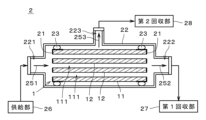
- Figure 5 is a diagram showing the separation device 2.
- Figure 6 is a diagram showing the flow of separation of a mixed substance by the separation device 2.
- a mixed substance containing multiple types of fluids i.e., gas or liquid
- highly permeable substances in the mixed substance are separated from the mixed substance by permeating the separation membrane composite 1. Separation in the separation device 2 may be performed, for example, for the purpose of extracting highly permeable substances from the mixed substance, or for the purpose of concentrating less permeable substances.
- the mixed substance (i.e., mixed fluid) may be a mixed gas containing multiple types of gas, a mixed liquid containing multiple types of liquid, or a gas-liquid two-phase fluid containing both gas and liquid.
- the mixture of substances may include, for example, one or more of the following: hydrogen ( H2 ), helium ( He ), nitrogen ( N2 ), oxygen (O2), water ( H2O ), carbon monoxide (CO), carbon dioxide ( CO2 ), nitrogen oxides, ammonia ( NH3 ), sulfur oxides, hydrogen sulfide ( H2S ), sulfur fluoride, mercury (Hg), arsine ( AsH3 ), hydrogen cyanide (HCN), carbonyl sulfide (COS), C1-C8 hydrocarbons, organic acids, alcohols, mercaptans, esters, ethers, ketones, and aldehydes.
- Nitrogen oxides are compounds of nitrogen and oxygen.
- the above-mentioned nitrogen oxides are gases called NOx (nox), such as nitric oxide (NO), nitrogen dioxide ( NO2 ), nitrous oxide (also called dinitrogen oxide) ( N2O ), dinitrogen trioxide ( N2O3 ), dinitrogen tetroxide ( N2O4 ), and dinitrogen pentoxide (N2O5 ) .
- NOx nox
- NO nitric oxide
- NO2 nitrogen dioxide
- N2O nitrous oxide
- N2O3 dinitrogen trioxide
- N2O4 dinitrogen tetroxide
- N2O5 dinitrogen pentoxide
- Sulfur oxides are compounds of sulfur and oxygen.
- the above-mentioned sulfur oxides are, for example, gases called SOx , such as sulfur dioxide ( SO2 ) and sulfur trioxide ( SO3 ).
- Sulfur fluoride is a compound of fluorine and sulfur.
- C1-C8 hydrocarbons are those with at least one carbon and no more than eight carbons.
- C3-C8 hydrocarbons may be straight-chain compounds, branched-chain compounds, or cyclic compounds.
- C2-C8 hydrocarbons may be either saturated hydrocarbons (i.e., those with no double bonds or triple bonds in the molecule) or unsaturated hydrocarbons (i.e., those with double bonds and/or triple bonds in the molecule).
- C1-C4 hydrocarbons are, for example, methane (CH 4 ), ethane (C 2 H 6 ), ethylene (C 2 H 4 ), propane (C 3 H 8 ), propylene (C 3 H 6 ), normal butane (CH 3 (CH 2 ) 2 CH 3 ), isobutane (CH(CH 3 ) 3 ), 1-butene (CH 2 ⁇ CHCH 2 CH 3 ), 2-butene (CH 3 CH ⁇ CHCH 3 ) or isobutene (CH 2 ⁇ C(CH 3 ) 2 ).
- the organic acid may be a carboxylic acid or a sulfonic acid.
- the carboxylic acid may be, for example, formic acid (CH 2 O 2 ), acetic acid (C 2 H 4 O 2 ), oxalic acid (C 2 H 2 O 4 ), acrylic acid (C 3 H 4 O 2 ), or benzoic acid (C 6 H 5 COOH).
- the sulfonic acid may be, for example, ethanesulfonic acid (C 2 H 6 O 3 S).
- the organic acid may be a chain compound or a cyclic compound.
- the above-mentioned alcohols are, for example, methanol (CH 3 OH), ethanol (C 2 H 5 OH), isopropanol (2-propanol) (CH 3 CH(OH)CH 3 ), ethylene glycol (CH 2 (OH)CH 2 (OH)) or butanol (C 4 H 9 OH).
- Mercaptans are organic compounds that have hydrogenated sulfur (SH) at the end, and are also called thiols or thioalcohols.
- Examples of the mercaptans include methyl mercaptan (CH 3 SH), ethyl mercaptan (C 2 H 5 SH), and 1-propanethiol (C 3 H 7 SH).
- esters are, for example, formates or acetates.
- ethers are, for example, dimethyl ether ((CH 3 ) 2 O), methyl ethyl ether (C 2 H 5 OCH 3 ) or diethyl ether ((C 2 H 5 ) 2 O).
- ketones are, for example, acetone ((CH 3 ) 2 CO), methyl ethyl ketone (C 2 H 5 COCH 3 ) or diethyl ketone ((C 2 H 5 ) 2 CO).
- aldehydes are, for example, acetaldehyde (CH 3 CHO), propionaldehyde (C 2 H 5 CHO) or butanal (butyraldehyde) (C 3 H 7 CHO).
- the mixed substance separated by the separation device 2 is described as a mixed gas containing multiple types of gas.
- the separation device 2 includes a separation membrane complex 1, a sealing section 21, a housing 22, two sealing members 23, a supply section 26, a first recovery section 27, and a second recovery section 28.
- the separation membrane complex 1, the sealing section 21, and the sealing members 23 are housed within the housing 22.
- the supply section 26, the first recovery section 27, and the second recovery section 28 are disposed outside the housing 22 and connected to the housing 22.
- the sealing portion 21 is attached to both ends of the support 11 in the longitudinal direction (i.e., the left-right direction in FIG. 5), and is a member that covers and seals both longitudinal end faces of the support 11 and the outer peripheral surfaces near these end faces.
- the sealing portion 21 prevents gas from flowing in and out from these end faces of the support 11.
- the sealing portion 21 is, for example, a plate-like member formed of glass or resin. The material and shape of the sealing portion 21 may be changed as appropriate. Note that the sealing portion 21 has multiple openings that overlap with the multiple through holes 111 of the support 11, and therefore both longitudinal ends of each through hole 111 of the support 11 are not covered by the sealing portion 21. Therefore, gas and the like can flow in and out of the through holes 111 from these ends.
- the shape of the housing 22 is not limited, but for example, it is a substantially cylindrical tubular member.
- the housing 22 is formed of, for example, stainless steel or carbon steel.
- the longitudinal direction of the housing 22 is substantially parallel to the longitudinal direction of the separation membrane composite 1.
- a supply port 221 is provided at one end of the longitudinal direction of the housing 22 (i.e., the left end in FIG. 5), and a first discharge port 222 is provided at the other end.
- a second discharge port 223 is provided on the side of the housing 22.
- a supply section 26 is connected to the supply port 221.
- a first collection section 27 is connected to the first discharge port 222.
- a second collection section 28 is connected to the second discharge port 223.
- the internal space of the housing 22 is a sealed space isolated from the space surrounding the housing 22.
- the two seal members 23 are arranged around the entire circumference between the outer circumferential surface of the separation membrane complex 1 and the inner circumferential surface of the housing 22 near both longitudinal ends of the separation membrane complex 1.
- Each seal member 23 is an approximately annular member made of a material that is gas impermeable.
- the seal member 23 is, for example, an O-ring made of a flexible resin.
- the seal member 23 adheres to the outer circumferential surface of the separation membrane complex 1 and the inner circumferential surface of the housing 22 around the entire circumference. In the example shown in FIG. 5, the seal member 23 adheres to the outer circumferential surface of the sealing portion 21 and indirectly adheres to the outer circumferential surface of the separation membrane complex 1 via the sealing portion 21.
- the seal member 23 and the outer circumferential surface of the separation membrane complex 1, and the seal member 23 and the inner circumferential surface of the housing 22 are sealed, and gas is hardly or completely unable to pass through.
- the supply unit 26 supplies the mixed gas to the internal space of the housing 22 via the supply port 221.
- the supply unit 26 is, for example, a blower or a pump that pressurizes the mixed gas toward the housing 22.
- the blower or pump has a pressure adjustment unit that adjusts the pressure of the mixed gas supplied to the housing 22.
- the first recovery unit 27 and the second recovery unit 28 are, for example, a storage container that stores the gas derived from the housing 22, or a blower or a pump that transports the gas.
- the separation device 2 described above is prepared, and thus the separation membrane composite 1 is prepared (step S21).
- the supply unit 26 supplies a mixed gas containing a plurality of types of gases having different permeabilities to the separation membrane 12 to the internal space of the housing 22.
- the main components of the mixed gas are CO 2 and N 2.
- the mixed gas may contain gases other than CO 2 and N 2.
- the pressure of the mixed gas supplied from the supply unit 26 to the internal space of the housing 22 i.e., the introduction pressure
- the temperature at which the mixed gas is separated is, for example, 10°C to 150°C.
- the mixed gas supplied from the supply unit 26 to the housing 22 is introduced into each through hole 111 of the support 11 from the left end of the separation membrane composite 1 in the figure, as shown by the arrow 251.
- a gas with high permeability in the mixed gas e.g., CO 2 , hereinafter referred to as a "highly permeable substance”
- CO 2 a gas with high permeability in the mixed gas
- the highly permeable substance is separated from a gas with low permeability in the mixed gas (e.g., N 2 , hereinafter referred to as a "lowly permeable substance”) (step S22).
- the gas discharged from the outer circumferential surface of the support 11 (hereinafter referred to as a "permeating substance") is collected by the second collection unit 28 through the second discharge port 223, as shown by the arrow 253.
- the pressure (i.e., permeation pressure) of the gas recovered by the second recovery section 28 via the second discharge port 223 is, for example, about 1 atmosphere (0.101 MPa).
- non-permeable substances gas other than the gas that has permeated the separation membrane 12 and the support 11
- the pressure of the gas recovered by the first recovery section 27 via the first exhaust port 222 is, for example, approximately the same as the introduction pressure.
- the non-permeable substances may also include highly permeable substances that have not permeated the separation membrane 12.
- the permeation rate of the high permeability material is preferably 5 times or more than the permeation rate of the low permeability material.
- the permeation rate (permeance) is the permeation rate of gas per unit membrane area and unit pressure difference.
- the ratio of the permeation rate of the high permeability material CO2 to the permeation rate of the target gas to be separated i.e., the low permeability material, for example, N2
- the ratio of the permeation rate of CO2 to the permeation rate of N2 is preferably 10 or more, more preferably 30 or more.
- Table 1 shows the manufacturing conditions and measurement results of the examples and comparative examples.
- Al Fumarate is known from Qiwei Liua and 5 others, "Fast synthesis of Al fumarate metal-organic framework as a novel tetraethylenepentamine support for efficient CO 2 capture", Colloids and Surfaces A, 579 (2019) 123645.
- 0.28 g of fumarate and 0.34 g of sodium formate, which are ligands, were added to 50 mL of deionized water to prepare a mixed solution.
- the mixed solution was stirred at 50 ° C for 3 hours, cooled to room temperature, and 0.83 g of aluminum sulfate 18-hydrate was added as a metal ion source.
- KMF-1 ⁇ Preparation of KMF-1 seed crystals>
- the MOF called “KMF-1” is known from Kyung Ho Cho and 11 others, "Rational design of a robust aluminum metal-organic framework for multi-purpose water-sorption-driven heat allocations", NATURE COMMUNICATIONS, (2020) 11: 5112, (https://doi.org/10.1038/s41467-020-18968-7).
- the mixed solution was stirred at 50 ° C for 3 hours, cooled to room temperature, and 3.333 g of aluminum sulfate 18-hydrate, which is a metal ion source, was added. Next, this solution was solvothermally synthesized at 120 ° C for 12 hours. The precipitate was separated by a centrifuge and washed three times with deionized water and ethanol. As a result, MOF powder was obtained as seed crystals for KMF-1.
- MIL-125-NH 2 (Ti) is known from Liang Zhang and 9 others, "NH 2 -MIL-53(Al) Metal-Organic Framework as the Smart Platform for Simultaneous High-Performance Detection and Removal of Hg 2+ ", Inorganic Chemistry 2019 58 (19), 12573-12581 (https://doi.org/10.1021/acs.inorgchem.9b01242).
- Example 1 (Supporting of seed crystals) 1 g of Al Fumarate seed crystals was dispersed in 10 mL of ethanol, which was a dispersion medium, and ground in a ball mill for 24 hours to obtain a dispersion of seed crystals with an average particle size (D50) of 250 nm. Then, ethanol was added so that the concentration of the dispersion became 0.01%. A porous alumina support was immersed in the dispersion to attach the dispersion to the support, and the solvent was volatilized in a dryer to support the seed crystals on the support surface. The support used had an average pore size of about 100 nm.
- MOF membrane composite in which a MOF membrane was formed on the support.
- This MOF membrane composite was washed three times with deionized water and ethanol. Then, the MOF membrane composite was dried in the air for 12 hours or more, and then dried at 100 ° C. for 12 hours.
- the MOF membrane composite was placed in a thermo-hygroscopic dryer and subjected to a humidification treatment at a temperature of 25° C. and a relative humidity of 50% for 72 hours.
- Tetraethylenepentamine (TEPA) was added as an amine source to 30 mL of ethanol, and the mixture was stirred for 10 minutes to prepare a 0.1 mol/L amine-containing ethanol solution.
- a silicone tube was connected to the MOF composite (see FIG. 4), and the amine-containing ethanol solution was contacted only with the membrane surface of the MOF for 24 hours. The membrane surface was then washed three times with ethanol alone and dried at 100° C. for 12 hours to support the amine on the MOF membrane. This resulted in a separation membrane composite.
- the average thickness of the MOF membrane in Example 1 was measured using the above method, and was found to be 1.8 ⁇ m.
- Example 1 The CO 2 /N 2 transmission rate ratio in Example 1 was measured by the above-mentioned method and was found to be 55.
- Example 2 The treatment conditions in Example 2 were the same as those in Example 1, except that the humidification treatment conditions were a temperature of 50° C. and a relative humidity of 20% for 0.5 hours. Therefore, the average membrane thickness of the MOF membrane was the same as that in Example 1. The CO 2 /N 2 permeation rate ratio was 50.
- Example 3 The treatment conditions in Example 3 were the same as those in Example 1, except that the humidification treatment conditions were a temperature of 30° C. and a relative humidity of 90% for 24 hours. Therefore, the average membrane thickness of the MOF membrane was the same as that in Example 1. The CO 2 /N 2 permeation rate ratio was 55.
- Example 4 The treatment conditions in Example 4 were the same as those in Example 1, except that in the amine loading treatment, the MOF membrane composite was contacted with the amine-containing ethanol solution for 2 hours. Therefore, the average membrane thickness of the MOF membrane was the same as that in Example 1.
- the CO 2 /N 2 permeation rate ratio was 40.
- Example 5 The treatment conditions in Example 5 were the same as those in Example 1, except that in the amine loading treatment, the MOF membrane composite was contacted with an amine-containing ethanol solution for 72 hours. Therefore, the average membrane thickness of the MOF membrane was the same as that in Example 1.
- the CO 2 /N 2 permeation rate ratio was 60.
- Example 6 The treatment conditions in Example 6 were the same as those in Example 1, except that ethylenediamine was used as the amine source in the amine carrying treatment. Therefore, the average membrane thickness of the MOF membrane was the same as that in Example 1.
- the CO 2 /N 2 permeation rate ratio was 40.
- Example 7 The treatment conditions in Example 7 were the same as those in Example 1, except that 2-(2-aminoethylamino)ethanol was used as the amine source in the amine carrying treatment. Therefore, the average membrane thickness of the MOF membrane was the same as that in Example 1. The CO 2 /N 2 permeation rate ratio was 60.
- Example 8 The treatment conditions in Example 8 were the same as those in Example 1, except that diethylenetriamine was used as the amine source in the amine carrying treatment. Therefore, the average membrane thickness of the MOF membrane was the same as that in Example 1. The CO 2 /N 2 permeation rate ratio was 40.
- Example 9 The treatment conditions in Example 9 were the same as those in Example 1, except that the solvothermal synthesis conditions for the MOF membrane were 100° C. for 10 hours, and the humidification treatment conditions were a temperature of 30° C. and a relative humidity of 80% for 12 hours.
- the average thickness of the MOF membrane was 1.0 ⁇ m.
- the CO 2 /N 2 permeation rate ratio was 55.
- Example 10 An MOF membrane was prepared in the same manner as in Example 1, and an amine-supporting treatment was carried out in the same manner as in Example 1. No humidification treatment was carried out. Therefore, the average membrane thickness of the MOF membrane was the same as in Example 1. The CO 2 /N 2 permeation rate ratio was 15.
- Example 11 (Supporting of seed crystals) A support carrying seed crystals was obtained in the same manner as in Example 1, except that KMF-1 was used as the seed crystals.
- the raw material solution of KMF-1 was prepared in the same manner as the seed crystal preparation. Next, the raw material solution and the support carrying the seed crystal were placed in a Teflon (registered trademark) container, and solvothermal synthesis was carried out at 100°C for 20 hours. The obtained MOF membrane composite was washed three times with deionized water and ethanol. The MOF membrane composite was then left to dry in the air for 12 hours or more, and then dried at 100°C for 12 hours.
- Example 12 The amine loading treatment in Example 12 was the same as that in Example 11, except that 2-(2-aminoethylamino)ethanol was used as the amine source. Therefore, the average membrane thickness of the MOF membrane was the same as that in Example 11. The CO 2 /N 2 permeation rate ratio was 30.
- Example 13> (Supporting of seed crystals) A support carrying a seed crystal was obtained in the same manner as in Example 1, except that MIL-125-NH 2 (Ti) was used as the seed crystal and water was used as the dispersion medium.
- MOF Membrane Production The raw material solution of MIL-125-NH 2 (Ti) was prepared in the same manner as the seed crystal preparation. Next, the raw material solution and the support carrying the seed crystal were placed in a Teflon (registered trademark) container, and solvothermal synthesis was carried out at 150°C for 10 hours. The obtained MOF membrane composite was washed three times with deionized water and ethanol. The MOF membrane composite was then left to dry in the air for 12 hours or more, and then dried at 100°C for 12 hours.
- Teflon registered trademark
- Example 14> (Supporting of seed crystals) A support carrying seed crystals was obtained in the same manner as in Example 1, except that UiO-66-NH 2 (Zr) was used as the seed crystals and water was used as the dispersion medium.
- MOF Membrane Production The raw material solution of UiO-66-NH 2 (Zr) was prepared using the same flow as the seed crystal preparation. Next, the raw material solution and the support carrying the seed crystal were placed in a Teflon (registered trademark) container, and solvothermal synthesis was carried out at 120°C for 20 hours. The obtained MOF membrane composite was washed three times with deionized water and ethanol. The MOF membrane composite was then left to dry in the air for 12 hours or more, and then dried at 100°C for 12 hours.
- Teflon registered trademark
- Example 15 (Supporting of seed crystals) A support carrying seed crystals was obtained in the same manner as in Example 1, except that CAU-10-H was used as the seed crystals and water was used as the dispersion medium.
- MOF Membrane Production The raw material solution of CAU-10-H was prepared in the same manner as the seed crystal preparation. Next, the raw material solution and the support carrying the seed crystal were placed in a Teflon (registered trademark) container, and solvothermal synthesis was carried out at 135°C for 20 hours. The obtained MOF membrane composite was washed three times with deionized water and ethanol. The MOF membrane composite was then left to dry in the air for 12 hours or more, and then dried at 100°C for 12 hours.
- Teflon registered trademark
- Example 16> Other than the method of supporting the amine, the procedure was the same as in Example 1. Therefore, the average thickness of the MOF membrane was the same as in Example 1.
- Tetraethylenepentamine (TEPA) was added as an amine source to 200 mL of ethanol, and the mixture was stirred for 10 minutes to prepare a 0.1 mol/L amine-containing ethanol solution.
- the entire separation membrane on which the MOF membrane was formed was immersed in the amine-containing ethanol solution for 24 hours.
- the entire separation membrane was then washed three times with ethanol alone and dried at 100°C for 12 hours to support the amine on the MOF membrane. This resulted in a separation membrane composite.
- a support carrying seed crystals was obtained in the same manner as in Example 1, except that Mg-MOF-74 seed crystals were used as the seed crystals and water was used as the dispersion medium.
- the raw material solution of Mg-MOF-7 was prepared in the same flow as the seed crystal preparation. Next, the raw material solution and the support carrying the seed crystal were placed in a Teflon (registered trademark) container, and solvothermal synthesis was carried out at 120°C for 20 hours. The obtained MOF membrane composite was washed three times with deionized water and ethanol. The MOF membrane composite was then left to dry in the air for 12 hours or more, and then dried at 100°C for 12 hours.
- the average pore diameter of Al Fumarate is 0.59 nm.
- the average pore diameter of KMF-1 is 0.60 nm.
- the average pore diameter of MIL-125-NH 2 (Ti) is 0.60 nm.
- the average pore diameter of UiO-66-NH 2 (Zr) is 0.60 nm.
- the average pore diameter of CAU-10-H is 0.40 nm.
- the average pore diameter of Mg-MOF-74 in the comparative example is 1.10 nm.
- a high CO 2 /N 2 permeation rate ratio can be obtained by supporting an amine on a MOF membrane having an average pore diameter of about 0.60 nm, that is, 0.40 nm or more and 0.70 nm or less.
- the type of gas to be separated by the separation membrane composite 1 is not limited to CO 2 , and can also be used to separate other gases.
- an amine-supported MOF membrane suitable for separating a specific fluid can be obtained if the average pore size is 0.90 nm or less, which is close to the average value of 0.60 nm and 1.10 nm. Note that the average pore size of the MOF membrane is 0.40 nm or more in practical use.
- a separation membrane 12 is realized that has high separation performance for specific gases while suppressing a decrease in fluid permeability. In particular, this effect is thought to be effectively achieved by the gradual decrease in the amount of amine present per unit volume from the surface of the separation membrane 12 toward the support 11.
- the separation membrane composite 1 achieves a CO 2 /N 2 permeation rate ratio of 10 or more. Furthermore, in some examples, the CO 2 /N 2 permeation rate ratio is 30 or more.
- the type of MOF in the seed crystals and the type of MOF in the MOF membrane do not have to be the same.
- the raw material solution may contain two or more types of ligands.
- the separation membrane composite 1 may be produced by a method other than the above production method.
- the separation membrane composite of the present invention can be used in a variety of fields to separate a variety of substances.
Landscapes
- Chemical & Material Sciences (AREA)
- Chemical Kinetics & Catalysis (AREA)
- Engineering & Computer Science (AREA)
- Inorganic Chemistry (AREA)
- Manufacturing & Machinery (AREA)
- Analytical Chemistry (AREA)
- General Chemical & Material Sciences (AREA)
- Oil, Petroleum & Natural Gas (AREA)
- Life Sciences & Earth Sciences (AREA)
- Geology (AREA)
- Crystallography & Structural Chemistry (AREA)
- Separation Using Semi-Permeable Membranes (AREA)
Priority Applications (4)
| Application Number | Priority Date | Filing Date | Title |
|---|---|---|---|
| JP2025540603A JPWO2025037457A1 (https=) | 2023-08-16 | 2024-04-24 | |
| DE112024002578.1T DE112024002578T5 (de) | 2023-08-16 | 2024-04-24 | Trennmembrankomplex und Verfahren zur Herstellung eines Trennmembrankomplexes |
| CN202480040508.6A CN121712582A (zh) | 2023-08-16 | 2024-04-24 | 分离膜复合体及分离膜复合体的制造方法 |
| US19/419,491 US20260102735A1 (en) | 2023-08-16 | 2025-12-15 | Separation membrane complex and method of producing separation membrane complex |
Applications Claiming Priority (2)
| Application Number | Priority Date | Filing Date | Title |
|---|---|---|---|
| JP2023132688 | 2023-08-16 | ||
| JP2023-132688 | 2023-08-16 |
Related Child Applications (1)
| Application Number | Title | Priority Date | Filing Date |
|---|---|---|---|
| US19/419,491 Continuation US20260102735A1 (en) | 2023-08-16 | 2025-12-15 | Separation membrane complex and method of producing separation membrane complex |
Publications (1)
| Publication Number | Publication Date |
|---|---|
| WO2025037457A1 true WO2025037457A1 (ja) | 2025-02-20 |
Family
ID=94632877
Family Applications (1)
| Application Number | Title | Priority Date | Filing Date |
|---|---|---|---|
| PCT/JP2024/016040 Pending WO2025037457A1 (ja) | 2023-08-16 | 2024-04-24 | 分離膜複合体および分離膜複合体の製造方法 |
Country Status (5)
| Country | Link |
|---|---|
| US (1) | US20260102735A1 (https=) |
| JP (1) | JPWO2025037457A1 (https=) |
| CN (1) | CN121712582A (https=) |
| DE (1) | DE112024002578T5 (https=) |
| WO (1) | WO2025037457A1 (https=) |
Citations (5)
| Publication number | Priority date | Publication date | Assignee | Title |
|---|---|---|---|---|
| CN103464001A (zh) * | 2013-08-05 | 2013-12-25 | 大连理工大学 | 一种用于co2分离的金属有机骨架膜的制备方法 |
| JP2018145032A (ja) * | 2017-03-02 | 2018-09-20 | 国立大学法人京都大学 | グラフェンナノリボン及びその製造方法 |
| WO2021261271A1 (ja) * | 2020-06-23 | 2021-12-30 | 株式会社村田製作所 | 複合膜構造体ならびに該複合膜構造体を用いたセンサ、ガス吸着フィルタおよびガス除去装置 |
| WO2022029888A1 (ja) * | 2020-08-04 | 2022-02-10 | 積水化学工業株式会社 | ガス製造装置、ガス製造システムおよびガス製造方法 |
| WO2022209002A1 (ja) * | 2021-03-31 | 2022-10-06 | 日本碍子株式会社 | 分離膜複合体および分離膜複合体の製造方法 |
Family Cites Families (1)
| Publication number | Priority date | Publication date | Assignee | Title |
|---|---|---|---|---|
| JP4212581B2 (ja) | 2005-08-12 | 2009-01-21 | 財団法人地球環境産業技術研究機構 | Co2分離用メソポーラス複合体およびそれを用いるco2分離法 |
-
2024
- 2024-04-24 DE DE112024002578.1T patent/DE112024002578T5/de active Pending
- 2024-04-24 JP JP2025540603A patent/JPWO2025037457A1/ja active Pending
- 2024-04-24 WO PCT/JP2024/016040 patent/WO2025037457A1/ja active Pending
- 2024-04-24 CN CN202480040508.6A patent/CN121712582A/zh active Pending
-
2025
- 2025-12-15 US US19/419,491 patent/US20260102735A1/en active Pending
Patent Citations (5)
| Publication number | Priority date | Publication date | Assignee | Title |
|---|---|---|---|---|
| CN103464001A (zh) * | 2013-08-05 | 2013-12-25 | 大连理工大学 | 一种用于co2分离的金属有机骨架膜的制备方法 |
| JP2018145032A (ja) * | 2017-03-02 | 2018-09-20 | 国立大学法人京都大学 | グラフェンナノリボン及びその製造方法 |
| WO2021261271A1 (ja) * | 2020-06-23 | 2021-12-30 | 株式会社村田製作所 | 複合膜構造体ならびに該複合膜構造体を用いたセンサ、ガス吸着フィルタおよびガス除去装置 |
| WO2022029888A1 (ja) * | 2020-08-04 | 2022-02-10 | 積水化学工業株式会社 | ガス製造装置、ガス製造システムおよびガス製造方法 |
| WO2022209002A1 (ja) * | 2021-03-31 | 2022-10-06 | 日本碍子株式会社 | 分離膜複合体および分離膜複合体の製造方法 |
Also Published As
| Publication number | Publication date |
|---|---|
| DE112024002578T5 (de) | 2026-04-02 |
| CN121712582A (zh) | 2026-03-20 |
| US20260102735A1 (en) | 2026-04-16 |
| JPWO2025037457A1 (https=) | 2025-02-20 |
Similar Documents
| Publication | Publication Date | Title |
|---|---|---|
| JP6845753B2 (ja) | ゼオライト膜複合体 | |
| JP7220087B2 (ja) | ゼオライト膜複合体、ゼオライト膜複合体の製造方法、および、分離方法 | |
| CN113613764B (zh) | 沸石膜复合体、沸石膜复合体的制造方法、沸石膜复合体的处理方法及分离方法 | |
| CN111902203B (zh) | 沸石膜复合体、沸石膜复合体的制造方法以及分离方法 | |
| WO2025052716A1 (ja) | Mof膜複合体の製造方法およびmof膜複合体 | |
| JP2023153913A (ja) | 支持体、ゼオライト膜複合体、ゼオライト膜複合体の製造方法、および、分離方法 | |
| WO2024190041A1 (ja) | 分離膜複合体および分離膜複合体の製造方法 | |
| JP6979548B2 (ja) | ゼオライト膜複合体の製造方法およびゼオライト膜複合体 | |
| JP7538325B2 (ja) | ゼオライト膜複合体、分離装置、膜反応装置およびゼオライト膜複合体の製造方法 | |
| WO2020179432A1 (ja) | ゼオライト膜複合体、ゼオライト膜複合体の製造方法、および、分離方法 | |
| WO2024157536A1 (ja) | 分離膜複合体および分離膜複合体の製造方法 | |
| WO2025037457A1 (ja) | 分離膜複合体および分離膜複合体の製造方法 | |
| JP7657517B2 (ja) | 分離膜複合体および分離膜複合体の製造方法 | |
| JP7629676B2 (ja) | ゼオライト膜複合体およびゼオライト膜複合体の製造方法 | |
| JP7757416B2 (ja) | ゼオライト膜複合体、膜反応装置およびゼオライト膜複合体の製造方法 | |
| WO2023162525A1 (ja) | ゼオライト膜複合体および分離方法 | |
| US11124422B2 (en) | Zeolite synthesis sol, method of producing zeolite membrane, and method of producing zeolite powder | |
| WO2025182507A1 (ja) | 分離膜複合体および分離膜複合体の製造方法 | |
| CN118201701A (zh) | 沸石膜复合体及膜反应装置 | |
| WO2025197200A1 (ja) | 分離膜複合体および分離膜複合体の製造方法 | |
| WO2025197219A1 (ja) | Mof膜複合体およびmof膜複合体の製造方法 | |
| WO2020184033A1 (ja) | 結晶性物質および膜複合体 | |
| US20240181399A1 (en) | Processing method of separation membrane complex and processing apparatus for separation membrane complex | |
| WO2025163983A1 (ja) | 分離膜複合体および分離膜複合体の製造方法 |
Legal Events
| Date | Code | Title | Description |
|---|---|---|---|
| 121 | Ep: the epo has been informed by wipo that ep was designated in this application |
Ref document number: 24854049 Country of ref document: EP Kind code of ref document: A1 |
|
| ENP | Entry into the national phase |
Ref document number: 2025540603 Country of ref document: JP Kind code of ref document: A |
|
| WWE | Wipo information: entry into national phase |
Ref document number: 2025540603 Country of ref document: JP |
|
| WWE | Wipo information: entry into national phase |
Ref document number: 112024002578 Country of ref document: DE |