WO2025033517A1 - 導電性シート及びその製造方法、並びに導電性成形品及びその製造方法 - Google Patents
導電性シート及びその製造方法、並びに導電性成形品及びその製造方法 Download PDFInfo
- Publication number
- WO2025033517A1 WO2025033517A1 PCT/JP2024/028545 JP2024028545W WO2025033517A1 WO 2025033517 A1 WO2025033517 A1 WO 2025033517A1 JP 2024028545 W JP2024028545 W JP 2024028545W WO 2025033517 A1 WO2025033517 A1 WO 2025033517A1
- Authority
- WO
- WIPO (PCT)
- Prior art keywords
- conductive
- conductive wire
- region
- opening
- base sheet
- Prior art date
- Legal status (The legal status is an assumption and is not a legal conclusion. Google has not performed a legal analysis and makes no representation as to the accuracy of the status listed.)
- Pending
Links
Images






Classifications
-
- H—ELECTRICITY
- H05—ELECTRIC TECHNIQUES NOT OTHERWISE PROVIDED FOR
- H05B—ELECTRIC HEATING; ELECTRIC LIGHT SOURCES NOT OTHERWISE PROVIDED FOR; CIRCUIT ARRANGEMENTS FOR ELECTRIC LIGHT SOURCES, IN GENERAL
- H05B3/00—Ohmic-resistance heating
- H05B3/02—Details
-
- H—ELECTRICITY
- H05—ELECTRIC TECHNIQUES NOT OTHERWISE PROVIDED FOR
- H05B—ELECTRIC HEATING; ELECTRIC LIGHT SOURCES NOT OTHERWISE PROVIDED FOR; CIRCUIT ARRANGEMENTS FOR ELECTRIC LIGHT SOURCES, IN GENERAL
- H05B3/00—Ohmic-resistance heating
- H05B3/02—Details
- H05B3/03—Electrodes
-
- H—ELECTRICITY
- H05—ELECTRIC TECHNIQUES NOT OTHERWISE PROVIDED FOR
- H05B—ELECTRIC HEATING; ELECTRIC LIGHT SOURCES NOT OTHERWISE PROVIDED FOR; CIRCUIT ARRANGEMENTS FOR ELECTRIC LIGHT SOURCES, IN GENERAL
- H05B3/00—Ohmic-resistance heating
- H05B3/20—Heating elements having extended surface area substantially in a two-dimensional [2D] plane, e.g. plate-heater
-
- H—ELECTRICITY
- H05—ELECTRIC TECHNIQUES NOT OTHERWISE PROVIDED FOR
- H05K—PRINTED CIRCUITS; CASINGS OR CONSTRUCTIONAL DETAILS OF ELECTRIC APPARATUS; MANUFACTURE OF ASSEMBLAGES OF ELECTRICAL COMPONENTS
- H05K1/00—Printed circuits
- H05K1/02—Details
Definitions
- This invention relates to a conductive sheet, and in particular to a conductive sheet used in vehicle heaters and a method for manufacturing the same.
- a conductive sheet that uses heat generated by supplying electricity to a conductive wire as a heater.
- the conductive sheet includes a conductive wire fixed onto a base sheet and an electrode member that is electrically connected to the conductive wire.
- Patent Document 1 describes a film heater in which conductive wires are embedded in a support sheet using ultrasonic fusion.
- Patent Document 1 required consideration of injection molding conditions such as the effects of heat and the pressure exerted on the conductive wire when it was attached to another molded product when electrically connecting the conductive wire to the metal plate, making it difficult to freely design.
- the present invention was made to solve the problems described above, and its purpose is to provide a conductive sheet that improves design freedom.
- the conductive sheet according to one embodiment of the present invention comprises a base sheet having an opening, a conductive wire fixed to one side of the base sheet so as to overlap at least a portion of the opening, and an electrode member provided on one or the other side of the base sheet so as to cover at least a portion of the opening, the conductive wire being electrically connected to the electrode member at the opening.
- the base sheet When configured in this manner, the base sheet has an opening, so there is no base sheet at the connection between the conductive wire and the electrode member. This allows the conductive wire and the electrode member to be formed on the desired side of the base sheet, improving design freedom. In addition, the conductive wire and the electrode member are electrically connected through the opening, i.e., the area where the base sheet is not provided, so it is possible to prevent the base sheet from being damaged by heat generated when making the connection.
- the conductive wire traverses the opening.
- the ends of the conductive wire are not exposed at the opening. This prevents the conductive wire from shifting out of position, allowing for a secure connection between the conductive wire and the electrode member.
- the electrode member is arranged to cover the conductive wire on one side of the base sheet.
- the base sheet has a first region that is covered by the electrode member at the periphery of the opening, and a second region that is not covered by the electrode member.
- the conductive wire has an embedded region that is embedded in one surface of the base sheet in the first region, and an exposed region that is exposed from one surface of the base sheet.
- the height dimension (t1) of the embedded region of the conductive wire in the first region is the same as or greater than the height dimension (t1') of the embedded region in the second region.
- This configuration improves the adhesion of the conductive wire located in the first region to the base sheet, and distributes the pressure on the conductive wire to the base sheet, preventing the conductive wire from being broken by the electrode member.
- the ratio (t1/t1') of the height dimension (t1) of the embedded region in the first region to the height dimension (t1') of the embedded region in the second region is 1.1 or more and 1.8 or less.
- This configuration can improve the adhesion between the conductive wire and the base sheet in the first region, making it difficult for external pressure to be transmitted to the conductive wire. It can also prevent excessive tension from being applied to the conductive wire in the first region, increasing the tolerance for external pressure. This makes it possible to prevent the conductive wire from being broken by the electrode member even when a strong load is applied, for example during injection molding.
- the electrode member further includes an adhesive layer that bonds the electrode member to the first region of the base sheet.
- This configuration increases the adhesion between the electrode member and the base sheet in the first region, and distributes the pressure on the electrode member throughout the base sheet, preventing the conductive wire from being broken by the electrode member.
- the thickness dimension (t4) of the adhesive layer is greater than the height dimension (t2) of the exposed region of the conductive wire.
- the conductive wire located in the first region is covered with an adhesive layer, which prevents the conductive wire from being broken by the electrode member.
- the thickness dimension (t4) of the adhesive layer in the first region is 0.1 mm or more and 0.5 mm or less.
- the conductive wire located in the first region can be covered with the adhesive layer. Furthermore, when heat or pressure is applied to the conductive sheet, the adhesive layer does not protrude from the first region, which prevents the adhesive strength between the base sheet and the electrode member from weakening.
- the height dimension (t1) of the conductive wire embedding region in the first region is 50% to 90% of the height dimension (t3) of the conductive wire.
- This configuration reduces the exposed area of the conductive wire in the first region, which can prevent the conductive wire from being broken by the electrode member when external pressure is applied to the electrode member or conductive wire.
- the height dimension (t1') of the conductive wire embedded region in the second region is 40% to 75% of the height dimension (t3') of the conductive wire.
- This configuration makes it possible to prevent the base sheet from being deformed by the stress of the conductive wire.
- a method for manufacturing a conductive sheet according to one embodiment of the present invention includes the steps of preparing a base sheet having an opening, adhering a conductive wire to one side of the base sheet so as to overlap at least a portion of the opening, forming an electrode member on one side of the base sheet so as to cover at least a portion of the opening and the conductive wire, and electrically connecting the electrode member and the conductive wire at the opening using heat or ultrasound.
- a method for manufacturing a conductive sheet according to another aspect of the present invention includes the steps of preparing a base sheet having an opening, forming an electrode member on one or the other side of the base sheet so as to cover at least a portion of the opening, adhering a conductive wire to one side of the base sheet so as to overlap at least a portion of the opening and the electrode member, and electrically connecting the electrode member and the conductive wire at the opening using heat or ultrasound.
- the conductive wire and the electrode member are connected in the opening, i.e., in the area where the base sheet is not present. This allows the conductive wire and the electrode member to be formed on the desired side of the base sheet. It also prevents the base sheet from being damaged by heat generated when electrically connecting the conductive wire and the electrode member.
- the method for manufacturing a resin molded product according to one embodiment of the present invention includes the steps of placing a conductive sheet according to one embodiment of the present invention on one of the cavity surfaces of an injection molding die having a fixed die and a movable die that forms a cavity between the fixed die and the movable die by clamping, clamping the injection molding die, injecting molten resin into the cavity to form a resin molded body while simultaneously adhering the conductive sheet to the surface of the resin molded body, and opening the injection molding die to remove the resin molded body.
- This manufacturing method uses insert molding and in-mold molding, making it possible to produce conductive molded products with complex shapes. In addition, the number of manufacturing steps is reduced, making it possible to reduce production costs and shorten production times.
- the conductive sheet of the present invention provides an opening in the base sheet portion that overlaps the connection between the conductive wire and the electrode member, allowing the conductive wire and electrode member to be provided on any desired one of the two sides of the base sheet, improving design freedom.
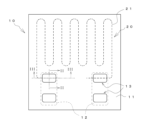
- FIG. 1 is a plan view showing a schematic configuration of a conductive sheet according to a first embodiment of the present invention.
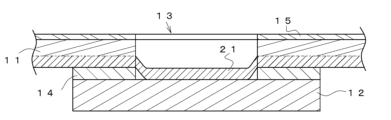
- FIG. 2 is a cross-sectional view taken along line II in FIG. 1 .
- FIG. 2 is a cross-sectional view taken along line III in FIG. 1 .
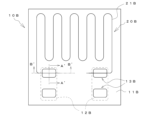
- FIG. 4 is a plan view showing a schematic configuration of a conductive sheet according to a second embodiment of the present invention.
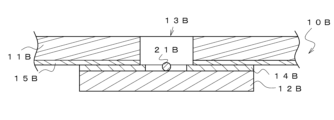
- FIG. 5 is a cross-sectional view taken along line V in FIG. 4 .
- FIG. 5 is a cross-sectional view taken along line VI in FIG. 4 .
- FIG. 8 is a cross-sectional view taken along line B' in FIG. 7.
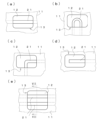
- 13A to 13E are partially enlarged plan views of an opening in another embodiment of the present invention.
- 10( e ) is a cross-sectional view taken along line VII in FIG. 1A to 1C are cross-sectional views showing a method for producing a conductive molded article according to an embodiment of the present invention.
- 5A and 5B are cross-sectional views showing a method for producing a conductive molded article according to another embodiment of the present invention.
- FIG. 13 is a plan view showing a schematic configuration of a conductive sheet according to a fourth embodiment of the present invention.
- FIG. 15 is a partial enlarged view of the area indicated by A in FIG. 14 .
- FIG. 15A is a cross-sectional view taken from line C' in FIG. 15, (b) is a cross-sectional view taken from line D' in FIG. 15, (c) is a cross-sectional view taken from line E' in FIG. 15, and (d) is a cross-sectional view taken from line F' in FIG. 15.
- FIG. 11 is a plan view showing a schematic configuration of a conductive sheet according to a modified example of the present invention.
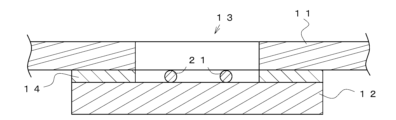
- the conductive sheet 10 of the first embodiment comprises a base sheet 11 having an opening 13, a conductive pattern 20 formed by a conductive wire 21 fixed to one surface of the base sheet 11, and an electrode member 12 formed on one surface of the base sheet 11 so as to cover the opening 13.
- the base sheet 11 has a rectangular shape in a plan view and includes one surface 11a and the other surface 11b.
- a conductive wire 21 is embedded in the one surface 11a, and a pattern layer 15 is provided on the other surface 11b.
- the base sheet 11 of this embodiment is formed from a thermoplastic resin, such as polycarbonate-based resin, ethylene-based resin, propylene-based resin, polyolefin-based resin, thermoplastic polyester-based resin, polyamide-based resin, polyvinyl chloride, ABS resin, etc.
- the base sheet 11 may contain two or more of these materials.
- the base sheet 11 may contain, as appropriate, dispersants, antioxidants, compatibilizers, UV stabilizers, antiblocking agents, antistatic agents, etc.
- the thickness of the base sheet 11 is preferably 100 ⁇ m or more and 1000 ⁇ m or less, and more preferably 375 ⁇ m or more and 500 ⁇ m or less. If it is 100 ⁇ m or more, the embedding process of the conductive wire 21 can be easily performed using ultrasonic waves. If it is 375 ⁇ m or more, it is less likely to twist during processing and has excellent handleability. If it is 500 ⁇ m or less, molding processing can be easily performed. If it is 1000 ⁇ m or more, the conductive sheet becomes more likely to crack, which may make it difficult to mold the resin molded product described below.
- the opening 13 in this embodiment is, for example, rectangular with rounded corners.
- the size and shape of the opening 13 are not limited as long as the conductive wire 21 can be electrically connected to the electrode member 12 using heat without any problems, and it may be rectangular or may be another shape such as circular or polygonal.
- a plurality of openings 13 may be formed in the base sheet 11, and the electrode member 12 may be electrically connected to an external electrical circuit at the openings 13.
- the electrode member 12 may also be connected to the outside at a location other than the openings using a conductive adhesive or the like.
- the conductive pattern 20 of this embodiment can have various patterns, such as a zigzag shape or a spiral shape. For example, referring to FIG. 1, it can be arranged at equal intervals in the short direction. That is, the conductive pattern 20 of this embodiment is a meandering pattern formed in one stroke from a single wire. The conductive pattern 20 is also formed from a single wire, and its end is formed to connect to a conductive member.
- the conductive wires 21 that form the conductive pattern 20 are electrically connected to the electrode members 12 at the openings 13 using heat or ultrasonic waves.
- Methods for "electrically connecting using heat” include, but are not limited to, soldering, resistance welding, and thermocompression bonding via anisotropic conductive resin.
- the conductive wire 21 is also connected to the electrode member 12 at the opening 13.
- the conductive wire 21 and the electrode member 12 are electrically connected at a portion that does not overlap with the base sheet 11 in a plan view, i.e., at the opening 13, so that both members can be formed on either the same side or different sides of the base sheet, improving design freedom. Furthermore, the heat generated when connecting the two members does not directly affect the base sheet 11, and damage to the base sheet 11 due to heat can be suppressed.
- the conductive wire 21 crosses the opening 13.
- Crossing here means that the conductive wire is arranged to pass through any two points on the periphery of the opening. Since the ends of the conductive wire 21 are not exposed at the opening 13, misalignment of the conductive wire 21 is suppressed, and the conductive wire 21 and the electrode member 12 can be reliably connected at the opening 13.
- the conductive wire 21 in this embodiment is a metal wire coated with a black polyurethane material and made of an alloy containing copper and silver.
- the material of the metal wire and the color and material of the coating are not limited to this.
- the metal wire may be made of a material that provides good characteristics such as electrical resistance and is easy to work with when embedded, such as copper or an alloy containing copper.
- the coating may be made of a material that provides good insulation and is easy to work with when embedded, such as a polyamideimide material.
- the color of the coating may be any color that makes the conductive wire 21 less noticeable even when fixed to the base sheet 11, and may match the color of the base sheet 11 or the pattern layer 15. This makes the conductive wire 21 fixed to the base sheet 11 even less noticeable.
- the diameter of the conductive wire 21 is, for example, 30 ⁇ m or more and 300 ⁇ m or less, and preferably 50 ⁇ m or more and 180 ⁇ m or less. If the diameter of the conductive wire 21 is 30 ⁇ m or more, good heat generation characteristics can be obtained from the viewpoint of electrical resistance. If the diameter of the conductive wire 21 is 50 ⁇ m or more, breakage due to heat during embedding can be made less likely to occur. If the diameter of the conductive wire 21 is 300 ⁇ m or less, embedding processing of the conductive wire 21 becomes easy, and good flexibility can be obtained when forming the conductive pattern 20. If the diameter of the conductive wire 21 is 180 ⁇ m or less, the conductive wire 21 becomes less noticeable.
- the electrode member 12 is a plate-shaped member, and its thickness is, for example, 0.05 mm or more and 1.00 mm or less, and preferably 0.10 mm or more and 0.30 mm or less. If the thickness of the electrode member 12 is 0.05 mm or more, good rigidity can be ensured for connection with the conductive wire 21, and the electrode member 12 and the conductive wire 21 can be easily connected. If the thickness of the electrode member 12 is 0.10 mm or more, good rigidity and durability can be obtained at the time of connection. If the thickness of the electrode member 12 is 1.00 mm or less, the shape of the electrode member 12 can be prevented from protruding from the surface of the resin molded product during processing or use of the conductive sheet 10, and the electrode member 12 can be prevented from peeling off. If the thickness of the electrode member 12 is 0.30 mm or less, the effect of the thickness of the electrode member 12 on the overall thickness of the conductive sheet 10 can be reduced, and the conductive sheet 10 can be made thinner.
- the electrode member 12 is electrically connected to an external electrical circuit using known methods such as heat, ultrasound, or a conductive adhesive.
- the electrode member 12 may also be connected to the outside at the opening 13.
- the electrode member 12 can be made of various materials that provide good heat resistance, electrical resistance, and rigidity, and is selected from conductive materials including, for example, phosphor bronze, aluminum, iron, and copper.
- the electrode member 12 may also be plated with one or more conductive materials selected from materials such as silver, tin, and nickel, in order to facilitate electrical connection with a conductive wire.
- the surface of the phosphor bronze is coated with a nickel underplating and a silver plating.
- the electrode member 12 of this embodiment is fixed to the base sheet 11 via an adhesive layer 14.
- the adhesive layer 14 may be made of, for example, a thermosetting resin, an ultraviolet-curing resin, or a pressure-sensitive adhesive, but is not limited to these.
- the adhesive layer 14 prevents the electrode member 12 from shifting out of position, ensuring a connection between the conductive wire 21 and the electrode member 12 in the opening 13.
- the conductive sheet 10 of this embodiment can improve its waterproof and dustproof properties by adhering the electrode member covering the opening 13 to the opening 13 of the base sheet 11 with the adhesive layer 14.
- the adhesive layer 14 is provided only in the area where the base sheet 11 is present in a plan view, but it may be provided so as to cover the area where the base sheet 11 is not present, i.e., a part of the opening 13, and the opening of the adhesive layer 14 does not have to coincide with the opening 13.
- the base sheet 11 of this embodiment has conductive wires 21 and electrode members 12 on one side, and a pattern layer 15 on the other side.
- the pattern layer 15 is formed, for example, by printing, and can represent designs, operation icons, etc.
- the conductive sheet 10A has a basic configuration in common with the conductive sheet 10 of the first embodiment, and therefore differences will be described below.
- the conductive sheet 10 of the first embodiment is different in that an electrode member 12 is provided on a conductive wire 21 on one surface of a base sheet 11, whereas the conductive sheet 10A of the second embodiment is different in that a conductive wire 21A is provided on an electrode member 12A on one surface of a base sheet 11A.
- the conductive wire 21A is not exposed at the opening 13A. With this configuration, it is possible to prevent the conductive wire 21A from peeling off or breaking from the electrode member 12A, particularly due to an external impact received on the other side of the base sheet 11A.
- the adhesive layer 14A is provided only in the area where the base sheet 11A is present in a plan view, but it may also be provided so as to cover the area where the base sheet 11A is not present, i.e., part or all of the opening 13A.
- a conductive sheet 10B according to the third embodiment will be described with reference to Figures 7 to 9.
- the conductive sheet 10B has a basic configuration in common with the conductive sheet 10 of the first embodiment, and therefore only differences will be described.
- the conductive sheet 10B differs in that the conductive wires 21B and the electrode members 12B are provided on different surfaces of the base sheet 11B.
- the conductive wire 21B and the electrode member 12B are not in contact with each other except at the opening 13B. This prevents external impacts from being applied intensively to a portion of the conductive wire 21B, and prevents the conductive wire 21B from being broken by being partially pressed down by the electrode member 12B.
- the adhesive layer 14B is provided only in the area where the base sheet 11B is present in a plan view, but it may also be provided so as to cover the area where the base sheet 11B is not present, i.e., part of the opening 13B.
- the conductive sheet 10 in each of the above embodiments is fixed onto the base sheet 11 so that the conductive wire 21 crosses the opening 13 in a straight line and connects the two opposing sides of the rectangular opening 13.
- the conductive sheet 10 of each of the above embodiments may be crossed so that the conductive wire 21 is bent within the opening 13.
- the conductive wire 21 may be fixed onto the base sheet 11 so as to connect any one or two sides of the rectangular opening 13.
- one end of the conductive wire 21 may be provided so as to enter the opening 13, i.e., remain on the opening.
- the conductive wire 21 must enter at least a length sufficient to be fixed to the electrode member 12 in the opening 13.
- the number of times the conductive wire 21 is sandwiched between the electrode member 12 and the base sheet 11 is reduced, thereby reducing the possibility of the conductive wire breaking.
- multiple conductive wires 21 may cross the opening 13.
- the opening 13 in each of the above embodiments may have multiple conductive wires 21 crossing over it.
- the number of crossing conductive wires may of course be three or more.
- the conductive wires 21 may be patterned so that they do not come into contact with each other, or they may be patterned so that they come into contact with each other at the opening.
- the conductive wire 21 is fixed to the base sheet 11, but other functional layers, such as a coating layer, may be provided between the conductive wire 21 and the base sheet 11.
- the pattern layer 15 in each of the above embodiments is provided on the other side of the base sheet 11, the pattern layer 15 can be provided on any side depending on the design of the product on which the conductive sheet 10 is provided.
- the conductive sheet 10 in each of the above embodiments is provided with an adhesive layer 14, this is not essential. If the adhesive layer 14 is not provided, the thickness of the conductive sheet can be made thinner.
- the conductive sheet 10 in each of the above embodiments is typically used as a wire heater for a vehicle, but the application is not particularly limited.
- the conductive sheet 10 can also be used, for example, as a temperature sensor, a strain sensor, an antenna, etc.
- a method for manufacturing the conductive sheet 10 of the first embodiment will be described.
- a base sheet 11 having openings 13 is prepared.
- a roll-shaped base sheet is prepared that has been punched in advance to form the openings.
- the conductive wire 21 is fixed to one surface of the base sheet 11 so as to overlap at least a portion of the opening 13.
- an ultrasonic welding device is used to fix the conductive wire so as to embed it on the base sheet 11.
- an electrode member 12 is formed on one surface of the base sheet 11 so as to cover at least a portion of the opening 13 and the conductive wire 21.
- an electrode member is prepared and attached to one surface of the base sheet. At this time, an adhesive layer may be prepared if necessary.
- the electrode member 12 and the conductive wire 21 are electrically connected at the opening 13 using heat or ultrasound.
- the connection can be made using a variety of techniques, such as soldering, resistance welding, thermocompression bonding via anisotropic conductive resin, and ultrasonic welding. This makes it possible to manufacture a conductive sheet in which the conductive wire and electrode member are securely attached to one side of the base sheet.
- the manufacturing method of the conductive sheet 10 of the first embodiment ensures that the conductive member and the conductive wire are electrically connected in the opening. This allows the conductive wire and the electrode member to be electrically connected in the opening, i.e., in the area where the base sheet is not provided, preventing the base sheet from being damaged by heat generated during the connection.
- the method for manufacturing the conductive sheets 10A and 10B of other embodiments is basically the same as the method for manufacturing the conductive sheet 10, but differs in that the conductive wires are provided after the electrode members are provided on the base sheet.
- the manufacturing method for the conductive sheet of this embodiment also allows the conductive wire to be placed on the electrode member in the opening. Also, as shown in Figures 7 to 9, the conductive wire and the electrode member can be placed on different sides of the base sheet. This allows the manufacturing method of this embodiment to form the conductive wire and electrode member on the desired side of the base sheet, improving design freedom.
- the conductive wire 21 is fixed to the base sheet 11 by ultrasonic embedding processing using an ultrasonic welding device.
- the method of fixing the conductive wire 21 is not limited to this.
- the conductive wire 21 may be fixed onto the base sheet 11 using a heat-resistant adhesive or the like. This eliminates the need for equipment used in ultrasonic embedding processing, thereby reducing the cost of the equipment.
- the conductive molded product 40 has a configuration in which a resin molded body 41 is laminated on the back side of the conductive sheet 10 of the first embodiment. That is, the electrode member 12 and the conductive wire 21 provided on the back side are covered with the resin molded body 41. This makes it possible to suppress peeling of the electrode member 12 and the conductive wire 21 from the base sheet 11, and to improve the durability, waterproofness, and dustproofness of the conductive molded product 40.
- the conductive molded product 40 of this embodiment is provided with a resin molded body 41 on the back side of the conductive sheet 10.
- the resin molded body 41 may be provided only on the front side of the conductive sheet 10, or on both sides.
- the resin molded product 40 of this embodiment is described as including the conductive sheet 10 and the resin molded body 41, it goes without saying that various layers can be provided depending on the desired design and function.
- an embossed surface layer can be provided on the upper surface of the resin molded body 41, or an adhesive layer can be provided between the conductive sheet 10 and the resin molded body 41.
- a method for manufacturing a conductive molded product 40 using the conductive sheet 10 will be described with reference to Fig. 12.
- the method for manufacturing a conductive molded product of this embodiment is characterized in that injection molding and fixing of the conductive sheet to a resin molded product are performed simultaneously.
- a conductive sheet 10 is placed on one of the cavity surfaces of an injection molding die 42 having a fixed die 44 and a movable die 43 that forms a cavity between the fixed die 44 and the movable die 43 by clamping.
- the conductive sheet 10 is placed so as to fit along the cavity surface of the movable die 43.
- the injection molding die 42 is clamped. Clamping is performed by moving the movable die 43.
- the fixed die 44 has a resin inlet (no number) for pouring molten resin into the cavity, and the molten resin is injected into the cavity formed by clamping.
- a conductive sheet 10 is provided on the cavity surface on the movable die 43 side. That is, by injecting molten resin into the cavity, the resin molded body 41 is formed and at the same time the conductive sheet 10 is fixed to the surface of the resin molded body 41.
- the injection molding die 42 is opened to remove the conductive molded product 40 to which the conductive sheet 10 and the resin molded body 41 are fixed.
- the mold is opened by moving the movable die 43.
- the manufacturing method for the conductive molded product 40 uses insert molding or in-mold molding to simultaneously perform "injection molding” and “bonding of the conductive sheet to the resin molded body," making it possible to manufacture the conductive molded product 40 in a complex shape. In addition, the production time can be shortened.
- the method for producing a conductive molded article in this embodiment is a method for bonding a preformed conductive sheet 10 and a resin molded body 41 together.
- a preform body 10 is prepared by folding a conductive sheet 10 according to one embodiment of the present invention into a desired shape.
- a resin molded body 41 having a shape corresponding to the shape of the preform body is prepared.
- the "shape corresponding to the shape of the preform body" mentioned here is not limited to the resin molded body 41 and the preform body 10 being the same shape. Specifically, it is intended to include a design that is completed by combining different corresponding shapes.
- a resin molded product 41 is fixed to at least one of the front and back surfaces of the preform body 10.
- the resin molded product 41 is fixed to the back surface of the preform body 10. This results in the formation of a conductive molded product 40.
- the manufacturing method of this embodiment does not involve injection molding, so compared to the manufacturing method of the conductive molded product 40 of embodiment 1, it is easier to create molds and jigs, and the costs of the molds and jigs can be reduced. In addition, there are fewer restrictions on molds and jigs, making it easier to produce large products.
- an adhesive layer may be provided between the preform body 10 and the resin molded product 41.
- the base sheet 11C according to the fourth embodiment has a first region X1 and a second region X2.
- the conductive wire 21C has an embedded region and an exposed region.
- the conductive sheet 10C has the same basic configuration as the conductive sheet 10 according to the first embodiment, but is characterized in that the conductive wire is embedded in the base sheet.
- the surface of the base sheet 11C according to the fourth embodiment is divided into a first region X1 that is covered by the electrode member 12C around the periphery of the opening 13C, and a second region X2 that is not covered by the electrode member 12C.
- the "first region” is the region that is covered by the electrode member 12C around the periphery of the opening
- the “second region” is the region on the surface of the base sheet 11 that is not covered by the electrode member 12C.
- the electrode member 12C is larger than the opening 13C and is disposed so as to cover the opening 13C.
- the electrode member 12C is fixed to the base sheet 11C so as to have a width dimension of at least 0.5 mm from the periphery of the opening 13C.
- the electrode member 12C is fixed to the base sheet 11C, and the first region X1 is formed so as to surround the periphery of the opening 13C with a width dimension of 0.5 mm or more. This makes it possible to secure a sufficient area for fixing the electrode member 12C to the opening 13C.
- the first region X1 has a width dimension of 5.0 mm or less from the periphery of the opening 13C.
- the conductive wire 21C is embedded in the base sheet 11C using ultrasonic waves while applying pressure or pulling force to the base sheet 11C.
- an ultrasonic welding device (not shown) melts one side of the base sheet 11C with ultrasonic waves while feeding out the conductive wire 21C, and embeds the conductive wire 21C in the base sheet 11C while applying pressure to the one side of the base sheet 11C.
- the conductive wire 21C according to the fourth embodiment has an embedded region embedded in one side of the base sheet 11C in the first region, and an exposed region exposed from one side of the base sheet 11C.
- the "embedded region” here refers to the region where the conductive wire is embedded in the base sheet. Additionally, the “exposed region” refers to the region where the conductive wire is exposed from the base sheet.
- the "height dimension t1 of the embedded region in the first region X1" is the same as or greater than the "height dimension t1' of the embedded region in the second region X2."
- the “height dimension of the embedded region” here refers to the height dimension from one surface of the base sheet as a reference plane to the lower end of the embedded conductive wire.
- the adhesion between the conductive wire 21C located in the first region X1 and the base sheet 11C is increased, and the pressure applied to the conductive wire 21C is distributed to the base sheet 11C, making it possible to prevent the conductive wire 21C from being broken by the electrode member 12C.
- the ratio (t1/t1') of the "height dimension t1 of the conductive wire embedding region in the first region X1" to the "height dimension t1' of the conductive wire embedding region in the second region X2" is preferably 1.0 or more and 1.8 or less, more preferably 1.1 or more and 1.8 or less, and even more preferably 1.1 or more and 1.5 or less. If t1/t1' is 1.0 or more, the adhesion between the conductive wire 21C and the base sheet 11C in the first region X1 is increased, thereby suppressing breakage of the conductive wire 21C.
- t1/t1' is 1.1 or more, the adhesion between the electrode member 12C and the base sheet 11C is improved, thereby suppressing peeling of the electrode member. Furthermore, if t1/t1' is 1.8 or less, the embedding depth of the wire changes gradually from the second region X2 to the first region X1, preventing excessive tension from being applied to the wire and suppressing breakage of the conductive wire. If t1/t1' is 1.5 or less, a conductive sheet with excellent formability can be obtained.
- the "height dimension t1 of the conductive wire embedded region in the first region” is preferably 50% to 90% of the "height dimension t3 of the conductive wire in the first region", and more preferably 60% to 80%.
- the cross-sectional shape of the conductive wire 21C changes slightly due to the pressure and heat applied during embedding.
- the "height dimension of the conductive wire” means the maximum dimension in the height direction in the cross-sectional view after embedding.
- the ratio (t1/t3) of the "height dimension of the conductive wire embedded region” to the "height dimension of the conductive wire” is 50% or more, the exposed region of the conductive wire 21C in the first region X1 is small, and when pressure is applied from the outside to the electrode member 12C or the conductive wire 21C, breakage of the conductive wire 21C by the electrode member 12C can be suppressed. Furthermore, if t1/t3 is 60% or more, the height difference between the surface of the base sheet 11C and the conductive wire 21C is reduced, improving the adhesion between the electrode member 12C and the base sheet 11C, and preventing the electrode member from peeling off. Also, if t1/t3 is 90% or less, the process of embedding the conductive wire 21C in the base sheet 11C can be easily performed. If t1/t3 is 80% or less, the yield rate can be improved, and productivity can be improved.
- the "height dimension t1' of the conductive wire embedding region in the second region” is preferably 40% to 75% of the "height dimension t3' of the conductive wire in the second region", more preferably 40% to 65% and even more preferably 50% to 65%. Since the conductive wire 21C in the second region X2 forms a pattern on one side of the base sheet, if the conductive wire 21C is embedded too much in the second region X2, the stress of the conductive wire 21C on the base sheet increases, and the base sheet is likely to be deformed, such as warped.
- the ratio (t1'/t3') of the "height dimension of the conductive wire embedding region" to the "height dimension of the conductive wire” is 75% or less, deformation of the base sheet 11C due to the stress of the conductive wire 21C can be suppressed. If t1'/t3' is 65% or less, a conductive sheet with excellent design and formability can be obtained. Furthermore, if t1'/t3' is 40% or more, the conductive wire 21C can be prevented from peeling off from the base sheet 11C. If t1'/t3' is 50% or more, a conductive sheet with excellent formability can be obtained.
- the adhesive layer 14C according to the fourth embodiment is preferably provided at least in the first region X1 of the base sheet 11C, and covers the exposed region of the conductive wire.
- the "thickness dimension t4 of the adhesive layer in the first region” is greater than the "height dimension t2 of the exposed region of the conductive wire in the first region.”
- the “height dimension of the exposed region” here refers to the height dimension from one surface of the base sheet to the upper end of the conductive wire that is not embedded in the base sheet, with the reference plane being one surface of the base sheet.
- the "thickness dimension t4 of the adhesive layer in the first region X1" is 0.1 mm or more and 0.5 mm or less. If t4 is 0.1 mm or more, good adhesive strength is obtained. Furthermore, by making t4 0.1 mm or more, the exposed region of the conductive wire can be covered with the adhesive layer 14, and the adhesive layer 14 can function as a "buffer member" between the conductive wire and the electrode member. If t4 is 0.5 mm or less, it is possible to prevent the adhesive layer from protruding from the first region X1 due to heat or pressure during insert molding, for example, and the thickness of the adhesive layer in the first region X1 from becoming thin.
- the opening 13C is intended to be an opening provided at least in the base sheet 11C.
- an opening for adhering the electrode member 12C and the conductive wire 21C must also be provided in the adhesive layer 14C. In this case, the opening in the adhesive layer 14C does not have to coincide with the opening 13C.
- the dimensions t1, t2, t3, and t4 in the first region X1 were measured at a position 3 mm away from the position where the conductive wire 21C overlaps with the end of the opening toward the first region X1. Also, the dimensions t1', t2', and t3' in the second region X2 were measured at a position 5 mm away from the position where the conductive wire 21C overlaps with the end of the electrode member 12C toward the second region X2.
- the reference surface for each dimension is the functional layer rather than the base sheet.
- the size and shape of the electrode member 12C are not particularly limited as long as it can electrically connect the conductive wire 21C to the electrode member 12C at the opening 13C.
- the electrode member 12C can have various shapes, such as a rectangle, a circle, or a polygon. It is also desirable that at least the portion of the electrode member 12C that contacts the conductive wire 21C is chamfered (chamfering is performed by cutting the edges if the electrode member is polygonal, or the circumference if the electrode member is circular, into an arc shape in cross section). This reduces the pressure applied to the conductive wire 21C from the edges of the electrode member 12C, and prevents the conductive wire 21C from being broken by the electrode member 12C.
- the conductive pattern 20D is formed asymmetrically by two conductive wires 21D.
- the electrode member 12D is provided so as to cover a plurality of openings 13D with one member.
- the electrode member 12E is provided so as to cover a portion of the opening 13E.
- the shape of the openings 13D, 13E is not limited to a rectangle, and 12D, 12E may cover at least a portion of one or more openings.
- Example 1 Conductive wires (copper wires, wire diameter 0.11 mm, coating layer 0.01 mm, total diameter 0.12 mm) were embedded in a base sheet (Covestro polycarbonate sheet Makrofol UV503, thickness 500 ⁇ m) with an opening of 5 mm in diameter using an ultrasonic welding device WCE150 wiring drawing device manufactured by Ruhlamat, forming a conductive pattern as shown in FIG. 14.
- An electrode member (copper plate, length 15 mm x width 15 mm, thickness 0.3 mm) was aligned on the surface of the base sheet in which the conductive wire was embedded so that the center of the electrode member overlapped the center of the opening.
- the conductive wire and the electrode member were connected by soldering at the opening of the base sheet.
- Examples 2 to 12, Comparative Examples 1 to 5 A conductive sheet was prepared in the same manner as in Example 1 except for the wire embedding depth.
- the conductive sheets of Examples 1 to 12 had t1/t1' of 1.1 or more and 1.8 or less.
- t1/t1' 1.1 or more it was possible to improve the adhesion between the conductive wire and the base sheet in the first region, and to make it difficult for stress during injection molding to be transmitted to the conductive wire.
- t1/t1' 1.8 or less it was possible to prevent excessive tension from being applied to the conductive wire in the first region, and to increase the tolerance for external pressure. In this way, by embedding the conductive wire deeper in the first region than in the second region, it was possible to prevent the conductive wire from breaking during injection molding.
Landscapes
- Engineering & Computer Science (AREA)
- Microelectronics & Electronic Packaging (AREA)
- Laminated Bodies (AREA)
- Injection Moulding Of Plastics Or The Like (AREA)
Priority Applications (2)
| Application Number | Priority Date | Filing Date | Title |
|---|---|---|---|
| JP2025539586A JPWO2025033517A1 (https=) | 2023-08-09 | 2024-08-08 | |
| CN202480052311.4A CN121666876A (zh) | 2023-08-09 | 2024-08-08 | 导电性片及其制造方法以及导电性成型品及其制造方法 |
Applications Claiming Priority (4)
| Application Number | Priority Date | Filing Date | Title |
|---|---|---|---|
| JP2023-130392 | 2023-08-09 | ||
| JP2023130392 | 2023-08-09 | ||
| JP2024130213 | 2024-08-06 | ||
| JP2024-130213 | 2024-08-06 |
Publications (1)
| Publication Number | Publication Date |
|---|---|
| WO2025033517A1 true WO2025033517A1 (ja) | 2025-02-13 |
Family
ID=94534446
Family Applications (1)
| Application Number | Title | Priority Date | Filing Date |
|---|---|---|---|
| PCT/JP2024/028545 Pending WO2025033517A1 (ja) | 2023-08-09 | 2024-08-08 | 導電性シート及びその製造方法、並びに導電性成形品及びその製造方法 |
Country Status (3)
| Country | Link |
|---|---|
| JP (1) | JPWO2025033517A1 (https=) |
| CN (1) | CN121666876A (https=) |
| WO (1) | WO2025033517A1 (https=) |
Citations (4)
| Publication number | Priority date | Publication date | Assignee | Title |
|---|---|---|---|---|
| JPH10234621A (ja) * | 1997-02-28 | 1998-09-08 | Dainippon Printing Co Ltd | 暖房便座の製造方法 |
| JP2003257597A (ja) * | 2002-02-28 | 2003-09-12 | Yukio Shiroo | 面状発熱体 |
| CN103582191A (zh) * | 2013-11-11 | 2014-02-12 | 王柏泉 | 包括组装式电极的电热板 |
| WO2020196417A1 (ja) * | 2019-03-28 | 2020-10-01 | 株式会社トッパンインフォメディア | フィルムヒータ |
-
2024
- 2024-08-08 JP JP2025539586A patent/JPWO2025033517A1/ja active Pending
- 2024-08-08 WO PCT/JP2024/028545 patent/WO2025033517A1/ja active Pending
- 2024-08-08 CN CN202480052311.4A patent/CN121666876A/zh active Pending
Patent Citations (4)
| Publication number | Priority date | Publication date | Assignee | Title |
|---|---|---|---|---|
| JPH10234621A (ja) * | 1997-02-28 | 1998-09-08 | Dainippon Printing Co Ltd | 暖房便座の製造方法 |
| JP2003257597A (ja) * | 2002-02-28 | 2003-09-12 | Yukio Shiroo | 面状発熱体 |
| CN103582191A (zh) * | 2013-11-11 | 2014-02-12 | 王柏泉 | 包括组装式电极的电热板 |
| WO2020196417A1 (ja) * | 2019-03-28 | 2020-10-01 | 株式会社トッパンインフォメディア | フィルムヒータ |
Also Published As
| Publication number | Publication date |
|---|---|
| JPWO2025033517A1 (https=) | 2025-02-13 |
| CN121666876A (zh) | 2026-03-13 |
Similar Documents
| Publication | Publication Date | Title |
|---|---|---|
| CN112154522B (zh) | 配线部件 | |
| US20100326722A1 (en) | Mesh sheet and housing for electronic devices | |
| KR102212801B1 (ko) | 복합 성형품 및 그 제조 방법 | |
| KR20150004429A (ko) | 사출 성형품 및 그 제조 방법 | |
| KR20110086644A (ko) | 금속 등 메시 접점 및 스위치 및 그의 제조방법 | |
| US12176670B2 (en) | Terminal, terminal-equipped electric wire, connection structure, and manufacturing method of terminal-equipped electric wire | |
| WO2025033517A1 (ja) | 導電性シート及びその製造方法、並びに導電性成形品及びその製造方法 | |
| US20210037614A1 (en) | Film Heater | |
| JP4060895B2 (ja) | 圧電振動板 | |
| JP2019091809A (ja) | 電子装置およびその製造方法 | |
| JP2012148554A (ja) | Icタグ一体成形品の製造方法 | |
| CN102480840A (zh) | 电路板的制作方法 | |
| TW201125093A (en) | Lead frame and intermediate product of semiconductor device | |
| JPH10200217A (ja) | プリント配線板製造用のフレキシブル基板 | |
| JP2006165079A (ja) | フレキシブルプリント基板 | |
| JP7726944B2 (ja) | 回路埋込基板の製造方法 | |
| CN101483271B (zh) | 平板天线及其制造方法 | |
| JP4260029B2 (ja) | 電磁調理用のプラスチック容器の製造方法 | |
| EP4679936A1 (en) | Electrically conductive sheet, resin molded article, and manufacturing method for same | |
| TWI656007B (zh) | 殼件模組的製法與其模具以及其製品 | |
| JP7593983B2 (ja) | 導電性シート、樹脂成形品及びその製造方法 | |
| JP5217287B2 (ja) | フラットケーブルの製造方法 | |
| JP2015012099A (ja) | フレキシブルプリント配線板及びフレキシブルプリント配線板の製造方法 | |
| CN212211516U (zh) | 一种抗撕耐热可反复折弯的fpc | |
| JPS5832795B2 (ja) | マトリツクス配線用連続基板 |
Legal Events
| Date | Code | Title | Description |
|---|---|---|---|
| 121 | Ep: the epo has been informed by wipo that ep was designated in this application |
Ref document number: 24851934 Country of ref document: EP Kind code of ref document: A1 |
|
| ENP | Entry into the national phase |
Ref document number: 2025539586 Country of ref document: JP Kind code of ref document: A |
|
| WWE | Wipo information: entry into national phase |
Ref document number: 2025539586 Country of ref document: JP |