WO2025033151A1 - 加硫ゴムの分解方法 - Google Patents
加硫ゴムの分解方法 Download PDFInfo
- Publication number
- WO2025033151A1 WO2025033151A1 PCT/JP2024/026168 JP2024026168W WO2025033151A1 WO 2025033151 A1 WO2025033151 A1 WO 2025033151A1 JP 2024026168 W JP2024026168 W JP 2024026168W WO 2025033151 A1 WO2025033151 A1 WO 2025033151A1
- Authority
- WO
- WIPO (PCT)
- Prior art keywords
- rubber
- vulcanized rubber
- decomposition
- soluble polymer
- peroxide
- Prior art date
- Legal status (The legal status is an assumption and is not a legal conclusion. Google has not performed a legal analysis and makes no representation as to the accuracy of the status listed.)
- Ceased
Links
Classifications
-
- C—CHEMISTRY; METALLURGY
- C08—ORGANIC MACROMOLECULAR COMPOUNDS; THEIR PREPARATION OR CHEMICAL WORKING-UP; COMPOSITIONS BASED THEREON
- C08C—TREATMENT OR CHEMICAL MODIFICATION OF RUBBERS
- C08C19/00—Chemical modification of rubber
- C08C19/085—Devulcanisation
-
- C—CHEMISTRY; METALLURGY
- C08—ORGANIC MACROMOLECULAR COMPOUNDS; THEIR PREPARATION OR CHEMICAL WORKING-UP; COMPOSITIONS BASED THEREON
- C08J—WORKING-UP; GENERAL PROCESSES OF COMPOUNDING; AFTER-TREATMENT NOT COVERED BY SUBCLASSES C08B, C08C, C08F, C08G or C08H
- C08J11/00—Recovery or working-up of waste materials
- C08J11/04—Recovery or working-up of waste materials of polymers
- C08J11/10—Recovery or working-up of waste materials of polymers by chemically breaking down the molecular chains of polymers or breaking of crosslinks, e.g. devulcanisation
- C08J11/18—Recovery or working-up of waste materials of polymers by chemically breaking down the molecular chains of polymers or breaking of crosslinks, e.g. devulcanisation by treatment with organic material
- C08J11/22—Recovery or working-up of waste materials of polymers by chemically breaking down the molecular chains of polymers or breaking of crosslinks, e.g. devulcanisation by treatment with organic material by treatment with organic oxygen-containing compounds
-
- C—CHEMISTRY; METALLURGY
- C08—ORGANIC MACROMOLECULAR COMPOUNDS; THEIR PREPARATION OR CHEMICAL WORKING-UP; COMPOSITIONS BASED THEREON
- C08J—WORKING-UP; GENERAL PROCESSES OF COMPOUNDING; AFTER-TREATMENT NOT COVERED BY SUBCLASSES C08B, C08C, C08F, C08G or C08H
- C08J2317/00—Characterised by the use of reclaimed rubber
-
- C—CHEMISTRY; METALLURGY
- C08—ORGANIC MACROMOLECULAR COMPOUNDS; THEIR PREPARATION OR CHEMICAL WORKING-UP; COMPOSITIONS BASED THEREON
- C08J—WORKING-UP; GENERAL PROCESSES OF COMPOUNDING; AFTER-TREATMENT NOT COVERED BY SUBCLASSES C08B, C08C, C08F, C08G or C08H
- C08J2319/00—Characterised by the use of rubbers not provided for in groups C08J2307/00 - C08J2317/00
-
- Y—GENERAL TAGGING OF NEW TECHNOLOGICAL DEVELOPMENTS; GENERAL TAGGING OF CROSS-SECTIONAL TECHNOLOGIES SPANNING OVER SEVERAL SECTIONS OF THE IPC; TECHNICAL SUBJECTS COVERED BY FORMER USPC CROSS-REFERENCE ART COLLECTIONS [XRACs] AND DIGESTS
- Y02—TECHNOLOGIES OR APPLICATIONS FOR MITIGATION OR ADAPTATION AGAINST CLIMATE CHANGE
- Y02W—CLIMATE CHANGE MITIGATION TECHNOLOGIES RELATED TO WASTEWATER TREATMENT OR WASTE MANAGEMENT
- Y02W30/00—Technologies for solid waste management
- Y02W30/50—Reuse, recycling or recovery technologies
- Y02W30/62—Plastics recycling; Rubber recycling
Definitions
- the present invention relates to a method for decomposing vulcanized rubber.
- Vulcanized rubber products such as tire rubber have often been recycled as fuel in cement plants, etc., which is one of the factors that increase carbon dioxide emissions.
- carbon dioxide emissions promote global warming
- Vulcanized rubber is basically cross-linked by sulfur, and is generally insoluble and difficult to process. Therefore, in order to efficiently reuse vulcanized rubber, it is important to develop a technology to decompose insoluble and difficult to process vulcanized rubber into soluble polymers that are highly soluble in solvents and easy to handle and process by a reaction such as devulcanization (hereinafter, decrosslinking may be referred to as devulcanization).
- Non-Patent Documents 1 and 2 Known methods of decomposing vulcanized rubber by devulcanization include (A) a method of heating to a high temperature (generally 180° C. or higher) (Patent Document 1), (B) a method of adding a thiol compound (Patent Document 2), (C) a method of adding an alkali metal (Patent Document 3), (D) a method of adding a microorganism (Patent Document 4), and (E) a method of swelling vulcanized rubber in a solvent and then adding a peroxide (Patent Document 5), or a method of adding a peroxide to vulcanized rubber in a solvent and heating to 80° C. or higher (Non-Patent Documents 1 and 2).
- the above methods (A) to (E) have the following problems.
- the method (A) of heating vulcanized rubber to high temperatures side reactions are likely to occur, making it difficult to maintain the basic structure of the vulcanized rubber.
- the sulfur content increases, limiting the uses of the product.
- the method (C) of adding an alkali metal alkali metals are highly reactive to moisture and therefore highly dangerous.
- the reaction rate is slow and production efficiency is low.
- a basic condition is that the ratio of the total solids (mg) other than the solvent after decomposition to the solvent (mL) is 1:30 or less, so a large amount of solvent is required. In addition, even in the method of heating to 80°C or higher, the yield of the desulfurized product is not high enough.
- the present invention aims to provide a method for decomposing vulcanized rubber that can solve the problems of the conventional technology and efficiently advance devulcanization.
- the gist and configuration of the present invention are as follows.
- a method for decomposing vulcanized rubber comprising reacting a radical initiator selected from peroxides in a solvent at 0 to 60°C in an atmosphere containing oxygen gas with vulcanized rubber or a composition containing the same, thereby converting the vulcanized rubber or a composition containing the same into a soluble decomposition product.
- a radical initiator selected from peroxides in a solvent at 0 to 60°C in an atmosphere containing oxygen gas
- vulcanized rubber or a composition containing the same thereby converting the vulcanized rubber or a composition containing the same into a soluble decomposition product.
- the rubber component of the vulcanized rubber is at least one rubber component selected from natural rubber (NR), synthetic isoprene rubber (IR), butadiene rubber (BR), and styrene-butadiene rubber (SBR).
- ⁇ 3> The decomposition method according to ⁇ 1> or ⁇ 2>, wherein the composition containing vulcanized rubber is a composition selected from tire rubber containing carbon black or silica.
- the peroxide is a peroxide selected from acyl peroxides.
- the acyl peroxide is selected from the group consisting of benzoyl peroxide, lauroyl peroxide, and acetyl peroxide.
- ⁇ 6> The decomposition method according to any one of ⁇ 1> to ⁇ 5>, wherein the decomposition method uses a chlorinated hydrocarbon or an aromatic hydrocarbon as a solvent.
- the chlorinated hydrocarbon is selected from chloroform and chlorobenzene.
- the aromatic hydrocarbon is ethylbenzene.
- the vulcanized rubber is a vulcanized rubber that has been subjected to a pretreatment step of washing with a solvent.
- the soluble decomposition products are soluble polymers derived from the rubber components in the vulcanized rubber and compositions containing them (hereinafter, sometimes referred to as soluble polymer compositions), and "soluble" means that they can be dissolved in the solvent used.
- soluble polymer compositions soluble polymers derived from the rubber components in the vulcanized rubber and compositions containing them
- the vulcanized rubber contains at least one selected from the group consisting of isoprene-skeleton rubber, styrene-butadiene rubber, and butadiene rubber.
- the decomposition method produces a soluble polymer containing an easily recyclable diene monomer such as isoprene or butadiene in its skeleton.
- the vulcanized rubber further contains carbon black. Even in this case, the vulcanized rubber can be efficiently decomposed, and the carbon black can be reused.
- the ratio of the total solid content (recovered carbon black component) (mg) to the solvent (mL) after decomposition of the compounded rubber is usually 1:25 or more, and the amount of solvent used can be kept to a minimum, which is advantageous from an economic and environmental perspective.
- the present invention provides an efficient method for decomposing vulcanized rubber, because the reaction can proceed under mild conditions and vulcanized rubber can be converted into soluble decomposition products.
- the method for decomposing vulcanized rubber of the present invention is characterized in that a radical initiator selected from peroxides is applied to vulcanized rubber or a composition containing the same in a solvent at 0 to 60°C in an atmosphere containing oxygen gas, thereby converting the rubber into soluble decomposition products.
- the peroxide used in the method for decomposing vulcanized rubber of the present invention is believed to essentially act on the cross-linking sites formed by sulfur, severing the cross-linking bonds. Therefore, in the case of diene rubber, it is believed that the main chain structure is essentially maintained even after the decomposition reaction.
- the radical initiator used in the present invention is selected from peroxides.
- the peroxide include acyl peroxide, percarboxylic acid, dialkyl peroxide, alkyl hydroperoxide, etc.
- acyl peroxide and percarboxylic acid are preferably used, and acyl peroxide is more preferably used.
- acyl peroxides such as benzoyl peroxide, toluoyl peroxide, chlorobenzoyl peroxide, dichlorobenzoyl peroxide, methoxybenzoyl peroxide, phthaloyl peroxide, acetyl peroxide, propanoyl peroxide, caprylyl peroxide, decanoyl peroxide, lauroyl peroxide, myristoyl peroxide, and stearoyl peroxide.
- acyl peroxides benzoyl peroxide, lauroyl peroxide, and acetyl peroxide are preferably used from the viewpoints of reaction rate, availability, and the like.
- lauroyl peroxide is more preferable than benzoyl peroxide.
- percarboxylic acids include perbenzoic acid, chloroperbenzoic acid, peracetic acid, and perpropionic acid.
- dialkyl peroxides include di-tert-butyl peroxide, dicumyl peroxide, and tert-butylcumyl peroxide.
- alkyl hydroperoxides include tert-butyl hydroperoxide and cumene hydroperoxide.
- a radical initiator selected from the above-mentioned peroxides is used to decompose vulcanized rubber or a composition containing the same.
- the vulcanized rubber to be decomposed by the decomposition method of the present embodiment contains, for example, a diene rubber having a crosslinking site containing a sulfur atom, and may further contain carbon black, silica, etc.
- the form of the vulcanized rubber is not particularly limited, and may be, for example, powdered rubber.
- the powdered rubber can be obtained by cutting and pulverizing used rubber products such as scrap tires.
- the pulverization process may include a plurality of processes such as a preliminary pulverization process and a fine pulverization process. Furthermore, the particle size of the powdered rubber used may be adjusted through a classification process after the pulverization process.
- the composition containing the vulcanized rubber may be waste rubber provided for recycling, used rubber products, etc.
- Waste rubber is not limited to that generated from rubber products, but refers to all discarded rubber including unnecessary scraps generated in the production or repair of rubber products.
- the scraps include buffing powder, peeled rubber, etc.
- Buffing powder is fine rubber generated in a buffing process for scraping the tread portion remaining on the base tire, for example, in tire retreading.
- Peeling rubber is a long piece of rubber, for example, 1 to 2 cm wide, peeled off from the surface of a rubber product such as a tire. Peeling rubber is generated by scraping the surface of a rubber product such as a tire using a knife with a U-shaped or V-shaped tip like a peeler.
- Rubber products include final products such as tires, rubber hoses, rubber conveyor belts, and rubber parts or components in the manufacturing stage of the final products.
- the used tires may be tires to be retreaded, or may be tires discarded for some reason, such as waste tires generated from tire replacement, scrapping of vehicles, and ELT (End-of-Life Tire) that has reached the end of its life as a tire.
- tire rubber containing carbon black or silica is preferable.
- the diene rubber is a rubber containing units derived from a diene monomer (diene units), and may further contain units derived from a copolymerizable comonomer.
- the diene monomer-derived units enable the diene rubber to be crosslinked (vulcanized), and can exhibit rubber-like elongation and strength.
- the diene rubber is usually present in a crosslinked state, but a part of the diene rubber may not be crosslinked.
- Specific examples of diene monomers (diene compounds) include 1,3-butadiene, isoprene, 1,3-pentadiene, and 2,3-dimethyl-1,3-butadiene.
- examples of the copolymerizable comonomer include aromatic vinyl compounds, etc.
- aromatic vinyl compounds include styrene, o-methylstyrene, m-methylstyrene, p-methylstyrene, o,p-dimethylstyrene, o-ethylstyrene, m-ethylstyrene, and p-ethylstyrene.
- examples of the diene rubber include isoprene skeleton rubber, styrene-butadiene rubber (SBR), butadiene rubber (BR), and chloroprene rubber (CR).
- the isoprene skeleton rubber is a rubber having an isoprene unit as the main skeleton, and specifically includes natural rubber (NR) and synthetic isoprene rubber (IR).
- the diene rubber preferably includes at least one selected from the group consisting of isoprene skeleton rubber, styrene-butadiene rubber, and butadiene rubber.
- the diene rubber includes at least one selected from the group consisting of isoprene skeleton rubber, styrene-butadiene rubber, and butadiene rubber, a diene-based soluble polymer that includes a skeleton such as isoprene or butadiene and is easy to reuse can be obtained.
- the content of the diene rubber in the vulcanized rubber is not particularly limited, and is preferably, for example, in the range of 10 to 100 mass %, and from the viewpoint of further improving the yield of the soluble polymer, is more preferably in the range of 30 to 100 mass %.
- the vulcanized rubber basically contains sulfur.
- the sulfur is usually present as a crosslink of the diene rubber by crosslinking the diene rubber, but a part of the sulfur may be free.
- the method for decomposing vulcanized rubber of the present invention mainly involves decomposing crosslinks by the action of a radical initiator, thereby decomposing the vulcanized rubber to give a soluble polymer.
- sulfur is believed to remain in the soluble polymer, but even if there is a free sulfur component in the solution, the sulfur component can be separated by a purification procedure such as reprecipitation to purify the soluble polymer.
- the content of sulfur in the vulcanized rubber is not particularly limited, and is, for example, in the range of 0.1 to 10 parts by mass, and preferably in the range of 1 to 5 parts by mass, per 100 parts by mass of the diene rubber.
- the vulcanized rubber may further contain carbon black.
- the vulcanized rubber is decomposed into a soluble polymer in the decomposition step. Therefore, even if the vulcanized rubber contains carbon black, the carbon black can be easily separated and recovered by, for example, solid-liquid separation after the decomposition step. Therefore, even if the vulcanized rubber contains carbon black, the vulcanized rubber can be efficiently decomposed.
- the amount of carbon black in the crosslinked rubber is not particularly limited, and is, for example, in the range of 10 to 150 parts by mass, and preferably in the range of 30 to 120 parts by mass, per 100 parts by mass of the diene rubber.
- the vulcanized rubber may contain, in addition to the diene rubber, carbon black, and sulfur described above, various components commonly used in the rubber industry, such as rubber components other than diene rubber, fillers other than carbon black (silica, calcium carbonate, etc.), silane coupling agents, antioxidants, softeners, processing aids, resins, surfactants, organic acids (stearic acid, etc.), zinc oxide (zinc white), vulcanization accelerators, crosslinking agents other than sulfur, etc.
- various components commonly used in the rubber industry such as rubber components other than diene rubber, fillers other than carbon black (silica, calcium carbonate, etc.), silane coupling agents, antioxidants, softeners, processing aids, resins, surfactants, organic acids (stearic acid, etc.), zinc oxide (zinc white), vulcanization accelerators, crosslinking agents other than sulfur, etc.
- the amount of the radical initiator used is preferably 0.1 parts by mass or more, more preferably 1 part by mass or more, and is preferably 30 parts by mass or less, and more preferably 20 parts by mass or less, based on 100 parts by mass of the vulcanized rubber. If the amount of the catalyst used is 0.1 parts by mass or more based on 100 parts by mass of the compounded rubber, the decomposition reaction of the vulcanized rubber will proceed further, and if the amount of the catalyst used is 30 parts by mass or less based on 100 parts by mass of the vulcanized rubber, it is preferable from the viewpoint of cost.
- the decomposition step is carried out in an oxygen gas-containing atmosphere, in a solvent, at a temperature of 0° C. or higher and 60° C. or lower.
- concentration (volume %) of oxygen gas in the reaction atmosphere is usually 1 to 100%, preferably 1 to 80%, and more preferably 5 to 50%, including the oxygen concentration in the atmosphere of about 20%.
- an inert gas such as nitrogen gas can be used as the remaining gas component.
- the higher the oxygen concentration the more advantageous the decomposition reaction is, but undesirable side reactions are more likely to occur, so when the oxygen concentration is high, it is necessary to appropriately control the reaction time, reaction temperature, etc.
- the reaction under an air atmosphere when the amount of vulcanized rubber is small, the reaction proceeds even in a closed vessel with a sufficiently large internal volume.
- the internal volume of the reaction vessel is generally 50 parts by volume or more, more preferably 100 parts by volume or more, per 1 part by volume of vulcanized rubber.
- the reaction in a non-closed system that allows the flow of air, etc.
- methods such as opening a part of the reaction vessel, attaching a membrane that allows the flow of air, etc., and allowing air, etc. to overflow can be considered.
- a method in which the reaction is carried out while continuously or intermittently blowing air, etc. into the solution is also an advantageous form.
- the blowing speed in this case is not particularly limited, but is usually 1 to 1000 mL/min, preferably 2 to 500 mL/min, and more preferably 3 to 200 mL/min per 1 g of vulcanized rubber.
- a solvent is used for the decomposition of the vulcanized rubber.
- Any solvent that does not inhibit the decomposition reaction can be used as the solvent, and examples of the solvent include aromatic hydrocarbons (aromatic solvents), chlorinated hydrocarbons, aliphatic hydrocarbons, alicyclic hydrocarbons, ethers, nitriles, etc.
- aromatic hydrocarbons include toluene, xylene, ethylbenzene, trimethylbenzene, and propylbenzene
- chlorinated hydrocarbons include chloroform, dichloromethane, dichloroethane, trichloroethane, tetrachloroethane, tetrachloroethene, chlorobenzene, and dichlorobenzene
- examples of aliphatic hydrocarbons include pentane, hexane, and octane
- examples of alicyclic hydrocarbons include cyclohexane and cyclooctane
- examples of ethers include tetrahydrofuran, methyltetrahydrofuran, tetrahydropyran, dioxane, and benzonitrile.
- aromatic hydrocarbons and chlorinated hydrocarbons are preferred from the viewpoints of reaction rate, availability, etc. Specific examples thereof include toluene, xylene, ethylbenzene, chloroform, chlorobenzene, dichlorobenzene, etc.
- aromatic hydrocarbons ethylbenzene is more preferred than toluene from the viewpoint of reaction rate.
- the solvent suitable for decomposition reaction also depends on the type of vulcanized rubber.
- aromatic hydrocarbons and chlorinated hydrocarbons are preferred from the viewpoint of reaction speed and solubility of product, and specific examples thereof include toluene, ethylbenzene, chloroform, and chlorobenzene.
- chlorinated hydrocarbons are more preferred from the viewpoint of reaction speed, and specific examples thereof include chloroform and chlorobenzene.
- the amount of the solvent used is preferably 2 mL or more, more preferably 10 mL or more, and more preferably 100 mL or less, and even more preferably 50 mL or less, per gram of the vulcanized rubber. If the amount of the solvent used is 2 mL or more per gram of the vulcanized rubber, the decomposition reaction of the vulcanized rubber is promoted, and if the amount of the solvent used is 50 mL or less per gram of the crosslinked rubber, it is preferable in terms of cost.
- the method for decomposing vulcanized rubber according to the present embodiment is carried out at 0 to 60° C.
- the decomposition step is preferably carried out at 5° C. or higher, more preferably at 10° C. or higher, and from the viewpoints of energy cost, environmental load, reaction equipment, etc., the decomposition step is preferably carried out at 50° C. or lower, more preferably at 40° C. or lower.
- the decomposition reaction of the present invention basically proceeds smoothly at about room temperature (20 to 30° C.), and therefore does not require any special equipment for heating or cooling, which is also an advantage of the decomposition method of the present invention.
- the decomposition process can be carried out at any pressure, including reduced pressure, normal pressure, and increased pressure.
- the reaction pressure is preferably 1 kPa to 10 MPa, more preferably 10 kPa to 1 MPa, and even more preferably 50 kPa to 500 kPa.
- the decomposition reaction of the present invention it is important to efficiently stir the raw materials, vulcanized rubber, radical initiator, and solvent.
- a stirring method various conventionally known methods can be used, such as a method using a magnetic stirrer, a method using a mechanical stirrer, a method using a shaking stirrer, etc.
- ultrasonic irradiation, microwave irradiation, light irradiation, etc. may be used in combination.
- the rubber component in the vulcanized rubber is decomposed into a soluble polymer having a weight average molecular weight of 200 to 200,000, and it is more preferable that the rubber component is decomposed into a soluble polymer having a weight average molecular weight of 300 to 150,000, through the decomposition step.
- the weight average molecular weight (Mw) can be measured by gel permeation chromatography (hereinafter, sometimes referred to as GPC).
- GPC gel permeation chromatography
- insoluble carbon black is recovered.
- the recovered carbon black usually contains organic matter derived from the vulcanized rubber.
- the ratio of the organic matter in the recovered carbon black is preferably 5 to 35% by mass, more preferably 7 to 25% by mass.
- the method for decomposing vulcanized rubber according to the present embodiment may further include other steps, such as a pretreatment step of the vulcanized rubber (e.g., a cutting step, a pulverization step), etc.
- the pretreatment process of vulcanized rubber also includes a process of washing with a solvent. By washing with a solvent, additives that are thought to inhibit the decomposition reaction, such as antioxidants remaining in the vulcanized rubber, can be removed, and the amount of initiator used can be reduced.
- the type of solvent used in the pretreatment process is not particularly limited, but a solvent that easily dissolves additives such as antioxidants is preferred, and specific examples include hydrocarbons such as toluene, ketones such as acetone, chlorinated hydrocarbons such as chloroform, and ethers such as tetrahydrofuran.
- the method for decomposing vulcanized rubber according to the present embodiment can be carried out in any type of reactor, such as a batch type or a flow type.
- the polymer product after the decomposition reaction can be recovered and purified by separating the insoluble components, mainly carbon black, by centrifugation, filtration, etc., followed by precipitation using a poor solvent, removing impurities by column chromatography or preparative GPC, etc.
- the obtained polymer product and the recovered carbon black, which is the insoluble component can be reused as raw materials for compounded rubber, etc.
- the ratio of recovered carbon black component (mg) to solvent (mL) after the decomposition reaction is generally 1:25 or more, preferably 1:20 or more.
- GPC Gel permeation chromatography
- Analysis system Shimadzu Corporation LabSolutions (liquid delivery unit: Shimadzu Corporation LC-20AB, column: Tosoh Corporation TSKgel Super HM-H x 2, detector: Shimadzu Corporation differential refractometer RID-10A, eluent: tetrahydrofuran, flow rate: 0.6 mL/min, measurement temperature: 40°C, weight average molecular weight (Mw) and number average molecular weight (Mn) are based on standard polystyrene)
- Nuclear magnetic resonance analyzer hereinafter sometimes referred to as NMR
- NMR Nuclear magnetic resonance analyzer
- Vulcanized rubber A A rubber composition was prepared by blending 50 parts by mass of carbon black, 2 parts by mass of stearic acid, 2.25 parts by mass of zinc oxide, 2 parts by mass of antioxidant 6PPD [N-phenyl-N'-(1,3-dimethylbutyl)-p-phenylenediamine], 0.6 parts by mass of vulcanization accelerator CBS [N-cyclohexyl-2-benzothiazolylsulfenamide], 1.8 parts by mass of sulfur, and 1 part by mass of antioxidant TMDQ [trimethyldihydroquinoline polymer] with 100 parts by mass of natural rubber, and the rubber composition was heated and crosslinked to prepare a vulcanized rubber.
- Vulcanized rubber B A rubber composition was prepared by blending 60 parts by mass of natural rubber and 40 parts by mass of butadiene rubber with 50 parts by mass of carbon black, 2 parts by mass of stearic acid, 2.25 parts by mass of zinc oxide, 2 parts by mass of antioxidant 6PPD [N-phenyl-N'-(1,3-dimethylbutyl)-p-phenylenediamine], 0.6 parts by mass of vulcanization accelerator CBS [N-cyclohexyl-2-benzothiazolylsulfenamide], 1.8 parts by mass of sulfur, and 1 part by mass of antioxidant TMDQ [trimethyldihydroquinoline polymer]. The rubber composition was then heated and crosslinked to prepare a vulcanized rubber.
- a rubber composition was prepared by blending 40 parts by mass of natural rubber and 60 parts by mass of butadiene rubber with 50 parts by mass of carbon black, 2 parts by mass of stearic acid, 2.25 parts by mass of zinc oxide, 2 parts by mass of antioxidant 6PPD [N-phenyl-N'-(1,3-dimethylbutyl)-p-phenylenediamine], 0.6 parts by mass of vulcanization accelerator CBS [N-cyclohexyl-2-benzothiazolylsulfenamide], 1.8 parts by mass of sulfur, and 1 part by mass of antioxidant TMDQ [trimethyldihydroquinoline polymer]. The rubber composition was then heated and crosslinked to prepare a vulcanized rubber.
- Vulcanized rubber D A rubber composition was prepared by blending 50 parts by mass of carbon black, 2 parts by mass of stearic acid, 2.25 parts by mass of zinc oxide, 1 part by mass of wax, 1 part by mass of antioxidant 6PPD [N-phenyl-N'-(1,3-dimethylbutyl)-p-phenylenediamine], 0.3 parts by mass of vulcanization accelerator DPG [1,3-diphenylguanidine], 0.5 parts by mass of vulcanization accelerator MBTS [dibenzothiazolyl disulfide], 0.5 parts by mass of vulcanization accelerator TBBS [N-t-butyl-2-benzothiazole sulfenamide], 1.5 parts by mass of sulfur, and 1 part by mass of antioxidant TMDQ [trimethyldihydroquinoline polymer] with 100 parts by mass of styrene butadiene rubber, and the rubber composition was heated and crosslinked to prepare a vulcanized rubber.
- TMDQ Trimethyldihydr
- the yield of the first decomposition step was calculated by adding a certain amount of an internal standard substance (hexamethyldisilane) to the reaction solution, then sampling a portion of the reaction solution and performing 1H NMR measurement to calculate the weight of the monomer skeleton of the solubilized rubber component, and calculating the yield according to the following formula from the ratio of this weight to the weight of the monomer skeleton in the vulcanized rubber before the reaction (calculated from the compounding ratio of the vulcanized rubber).
- an internal standard substance hexamethyldisilane
- Yield (%) of the first decomposition step (weight of the monomer skeleton of the rubber component solubilized after the reaction/weight of the monomer skeleton of the vulcanized rubber component before the reaction) ⁇ 100
- the proton signal of the internal standard hexamethyldisilane
- the proton signal of the isoprene skeleton alkenyl group
- the yield can be calculated from the ratio of the signal integral value of the isoprene skeleton to the signal integral value of the internal standard.
- the polyisoprene content in natural rubber was set to 93%.
- Example 1 A mixture of 50 mg of the vulcanized rubber sample A, 7.4 mg of benzoyl peroxide (water-containing product, 75% purity), and 0.8 mL of toluene was stirred with a magnetic stirrer using a Teflon (registered trademark) rotor in an air atmosphere at 25° C. (room temperature) for one day in a 5 mL Spitz-type vial (sealed) to carry out a decomposition reaction.
- the yield of the soluble polymer generated by the decomposition of the vulcanized rubber was calculated by 1 H NMR measurement of the reaction solution, and the yield was calculated to be 89%.
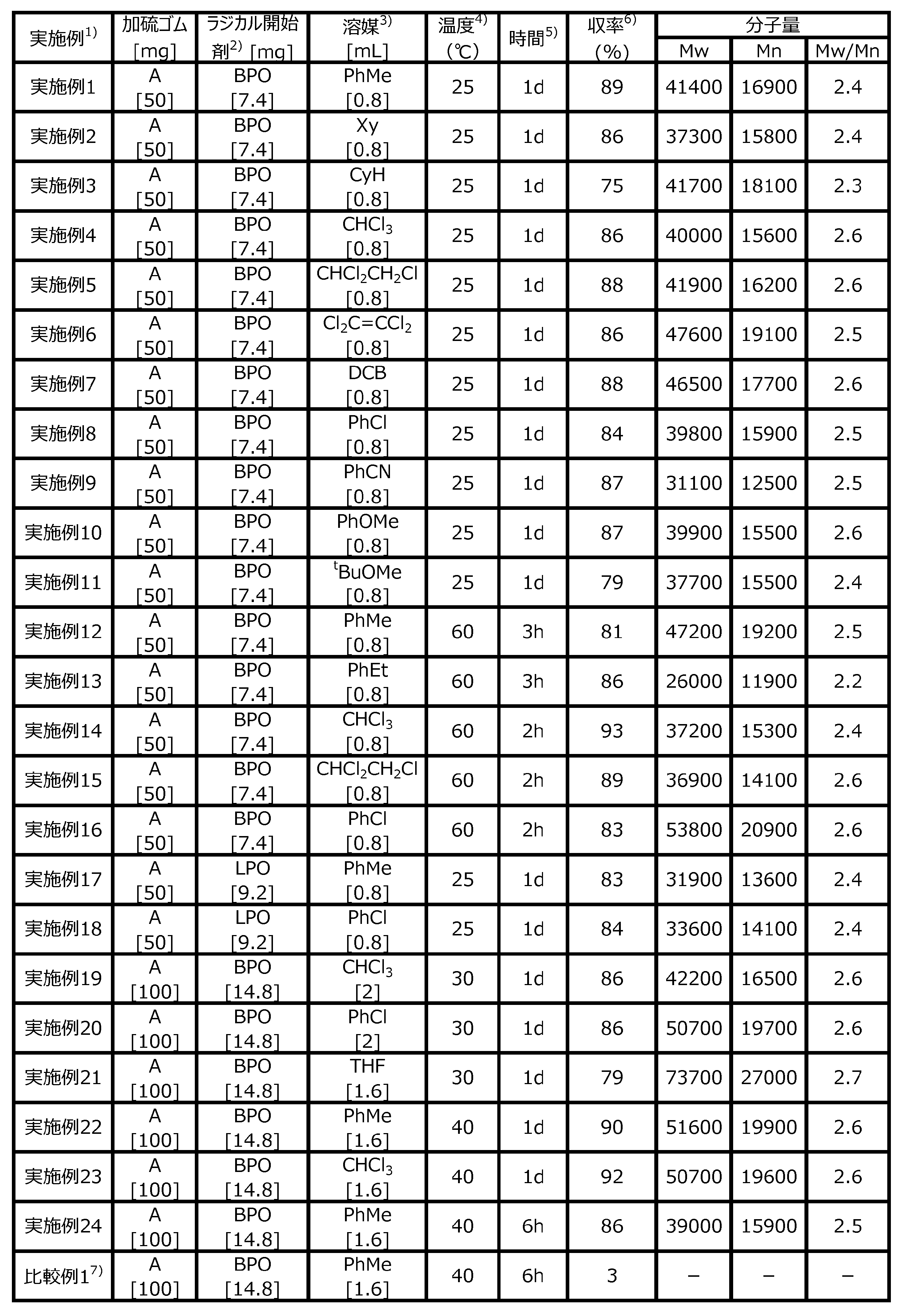
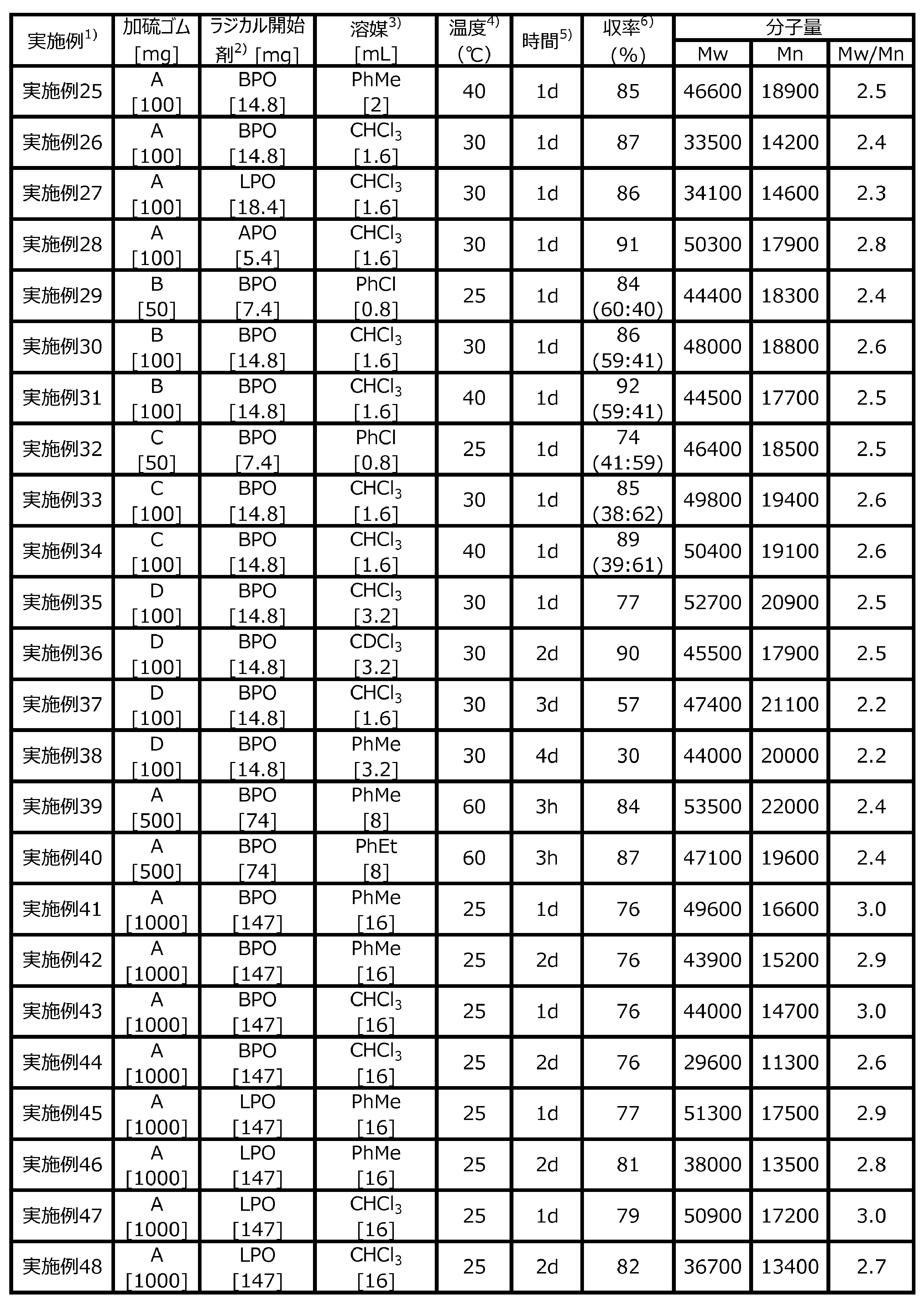
- Examples 2 to 48 The decomposition reaction and analysis of the products were carried out in the same manner as in Example 1, while changing the reaction conditions (type of vulcanized rubber, type of radical initiator, type of solvent, reaction temperature, type of container, etc.). The results are shown in Tables 1 and 2.
- reaction vessels used are as follows (all reactions were carried out under sealed conditions): Examples 1 to 18, 29, 32: 5 mL Spitz-type vial tube Examples 19 to 28, 30, 31, 33 to 38, Comparative Example 1: 10 mL round-bottom vial tube Examples 39, 40: 20 mL round-bottom vial tube Examples 41 to 48: 150 mL flat-bottom vial bottle 2)
- the radical initiators used are as follows.
- BPO benzoyl peroxide
- LPO lauroyl peroxide
- APO acetyl peroxide 3
- the solvents used are as follows: PhMe: toluene, Xy: xylene, CyH: cyclohexane, CHCl 3 : chloroform, CHCl 2 CH 2 Cl: 1,1,2-trichloroethane, Cl 2 C ⁇ CCl 2 : tetrachloroethene, DCB: o-dichlorobenzene, PhCl: chlorobenzene, PhCN: benzonitrile, PhOMe: anisole, t BuOMe: tert-butyl methyl ether, PhEt: ethylbenzene, THF: tetrahydrofuran, CDCl 3 : deuterated chloroform 4) Regarding temperature, 25°C indicates decomposition at room temperature, 30°C and 40°C indicate decomposition in a thermostatic bath, and
- Comparative Example 1 shows a reaction example in which a deoxygenated solvent was used under a nitrogen atmosphere.
- Tables 1 and 2 show that compounded vulcanized rubbers containing natural rubber, butadiene rubber, and/or styrene butadiene rubber and carbon black are decomposed in various solvents under air atmosphere by radical initiators such as acyl peroxide to give soluble polymers.
- radical initiators such as acyl peroxide
- the decomposition reaction proceeds smoothly even at room temperature.
- styrene-butadiene rubber has a larger solvent effect than natural rubber and butadiene rubber, and the decomposition reaction proceeds efficiently by using chlorinated hydrocarbons such as chloroform and chlorobenzene as a solvent.
- Example 1 Comparative Example 1 In the reaction of Example 29 (vulcanized rubber A, benzoyl peroxide initiator, toluene solvent, 40°C, 6 hours), a deoxygenated solvent was used as the solvent and the reaction was carried out under a nitrogen atmosphere. As a result, the yield of the soluble polymer decreased from 83% to 3%.
- Comparative Example 1 show that the decomposition reaction proceeds in an air atmosphere, but hardly proceeds in a nitrogen atmosphere. The presence of oxygen in the air is thought to be extremely important for the progress of the decomposition reaction.
- the carbon black When decomposing compounded rubber containing carbon black, the carbon black can be separated by filtration, centrifugation, etc. to obtain a soluble polymer. Specific examples are shown below.
- Example 49 A mixture of 50 mg of the vulcanized rubber sample A, 7.4 mg of benzoyl peroxide (water-containing product, 75% purity), and 0.8 mL of chlorobenzene was stirred with a magnetic stirrer using a Teflon (registered trademark) rotor in an air atmosphere at 25° C. for one day in a 20 mL round-bottom vial (sealed) to carry out a decomposition reaction.
- the yield of the soluble polymer generated by the decomposition of the vulcanized rubber was calculated by 1 H NMR measurement of the reaction solution, and the yield was calculated to be 94%.
- Chlorobenzene was added to the reaction solution, and the insoluble solid was removed by filtration, and the insoluble solid was washed with toluene. The insoluble solid was heated and dried under vacuum to recover the carbon black component (20 mg).
- the filtrate and the washings were combined and concentrated under reduced pressure to obtain a soluble polymer composition (P1) having an isoprene skeleton (30 mg). A part of the mixture was sampled, and an internal standard substance (hexamethyldisilane) was added to perform 1 H NMR measurement.
- the proportion of the isoprene skeleton in the soluble polymer composition (P1) was calculated to be 65%.
- Example 50 150 mg of the vulcanized rubber sample A, 23 mg of benzoyl peroxide (water-containing product, 75% purity), and 2.4 mL of chlorobenzene were stirred with a magnetic stirrer using a Teflon (registered trademark) rotor in a 100 mL round-bottom flask (sealed) under an air atmosphere at 25° C. for 2 days to carry out a decomposition reaction.
- the yield of the soluble polymer generated by the decomposition of the vulcanized rubber was calculated by 1 H NMR measurement of the reaction solution, and the yield was calculated to be 94%.
- Chlorobenzene was added to the reaction solution, and the insoluble solid was removed by filtration, and the insoluble solid was washed with toluene.
- the insoluble solid was heated and dried under vacuum to recover the carbon black component (40 mg). Meanwhile, the filtrate and the washings were combined and concentrated under reduced pressure to obtain a soluble polymer composition having an isoprene skeleton (100 mg).
- Example 51 A mixture of 200 mg of the vulcanized rubber sample A, 30 mg of benzoyl peroxide (water-containing product, 75% purity), and 3.2 mL of chloroform was stirred with a magnetic stirrer using a Teflon (registered trademark) rotor in an air atmosphere at 25° C. for 2 days in a 20 mL round-bottom vial (sealed) to carry out a decomposition reaction.
- the yield of the soluble polymer generated by the decomposition of the vulcanized rubber was calculated by 1 H NMR measurement of the reaction solution, and the yield was calculated to be 89%.
- the reaction solution was concentrated under reduced pressure, diluted with tetrahydrofuran, and centrifuged to separate the insoluble solids. Tetrahydrofuran was added to the separated insoluble solids, mixed, and centrifuged again to recover the insoluble carbon black component (70 mg).
- the supernatant after centrifugation was combined and concentrated under reduced pressure to obtain a soluble polymer composition having an isoprene skeleton (147 mg). A part of the mixture was sampled, and an internal standard substance (hexamethyldisilane) was added to perform 1 H NMR measurement.
- Example 52 A mixture of 200 mg of the vulcanized rubber sample A, 30 mg of benzoyl peroxide (water-containing product, 75% purity), and 3.2 mL of chloroform was stirred with a magnetic stirrer using a Teflon (registered trademark) rotor in an air atmosphere at 60° C. for 5 hours in a 20 mL round-bottom vial (sealed) to carry out a decomposition reaction.
- the yield of the soluble polymer generated by the decomposition of the vulcanized rubber was calculated by 1 H NMR measurement of the reaction solution, and the yield was calculated to be 87%.
- the reaction solution was concentrated under reduced pressure, diluted with tetrahydrofuran, and centrifuged to separate the insoluble solids. Tetrahydrofuran was added to the separated insoluble solids, mixed, and centrifuged again to recover the insoluble carbon black component (67 mg).
- the supernatant after centrifugation was combined and concentrated under reduced pressure to obtain a soluble polymer composition having an isoprene skeleton (148 mg). A part of the mixture was sampled, and an internal standard (hexamethyldisilane) was added to perform 1 H NMR measurement.
- Example 53 A mixture of 200 mg of the vulcanized rubber sample A, 37 mg of lauroyl peroxide, and 3.2 mL of chloroform was stirred with a magnetic stirrer using a Teflon (registered trademark) rotor in a 20 mL round-bottom vial (sealed) under air atmosphere at 25° C. for 2 days to carry out a decomposition reaction.
- the yield of the soluble polymer generated by the decomposition of the vulcanized rubber was calculated by 1 H NMR measurement of the reaction solution, and the yield was calculated to be 80%.
- Example 54 A mixture of 200 mg of the vulcanized rubber sample A, 37 mg of lauroyl peroxide, and 3.2 mL of chloroform was stirred with a magnetic stirrer using a Teflon (registered trademark) rotor in an air atmosphere at 60° C. for 5 hours in a 20 mL round-bottom vial (sealed), and decomposition reaction was carried out.
- the yield of the soluble polymer generated by decomposition of the vulcanized rubber was calculated by 1 H NMR measurement of the reaction solution, and the yield was calculated to be 87%.
- Example 55 A mixture of 1000 mg of the vulcanized rubber sample A, 147 mg of benzoyl peroxide (water-containing product, 75% purity), and 16 mL of toluene was stirred with a magnetic stirrer using a Teflon (registered trademark) rotor in an air atmosphere at 25° C. for 5 days in a 150 mL flat-bottomed vial (sealed) to carry out a decomposition reaction.
- the yield of the soluble polymer generated by the decomposition of the vulcanized rubber was calculated by 1 H NMR measurement of the reaction solution, and the yield was calculated to be 80%.
- the reaction solution was diluted with toluene, and the insoluble solid was separated by centrifugation. Toluene was added to the separated insoluble solid, mixed, and centrifuged again. The insoluble solid was heated and dried under vacuum to recover the insoluble carbon black component (368 mg). On the other hand, the supernatant after centrifugation was combined and concentrated under reduced pressure to obtain a soluble polymer composition having an isoprene skeleton (731 mg).
- Example 56 A mixture of 1000 mg of the vulcanized rubber sample A, 147 mg of benzoyl peroxide (water-containing product, 75% purity), and 16 mL of chloroform was stirred with a magnetic stirrer using a Teflon (registered trademark) rotor in an air atmosphere at 25° C. for 5 days in a 150 mL flat-bottomed vial (sealed) to carry out a decomposition reaction. The yield of the soluble polymer generated by the decomposition of the vulcanized rubber was calculated by 1 H NMR measurement of the reaction solution, and the yield was calculated to be 85%.
- the reaction solution was diluted with toluene, and the insoluble solid was separated by centrifugation. Toluene was added to the separated insoluble solid, mixed, and centrifuged again. The insoluble solid was heated and dried under vacuum to recover the insoluble carbon black component (351 mg). On the other hand, the supernatant after centrifugation was combined and concentrated under reduced pressure to obtain a soluble polymer composition having an isoprene skeleton (731 mg).
- Example 57 A mixture of 1000 mg of the vulcanized rubber sample A, 183 mg of lauroyl peroxide, and 16 mL of toluene was stirred with a magnetic stirrer using a Teflon (registered trademark) rotor in a 150 mL flat-bottomed vial (sealed) under air atmosphere at 25° C. for 5 days to carry out a decomposition reaction.
- the yield of the soluble polymer generated by the decomposition of the vulcanized rubber was calculated by 1 H NMR measurement of the reaction solution, and the yield was calculated to be 85%.
- Example 58 A mixture of 1000 mg of the vulcanized rubber sample A, 183 mg of lauroyl peroxide, and 16 mL of chloroform was stirred with a magnetic stirrer using a Teflon (registered trademark) rotor in a 150 mL flat-bottomed vial (sealed) under an air atmosphere at 25° C. for 5 days to carry out a decomposition reaction.
- the yield of the soluble polymer generated by the decomposition of the vulcanized rubber was calculated by 1 H NMR measurement of the reaction solution, and the yield was calculated to be 85%.
- Example 59 A mixture of 6000 mg of the vulcanized rubber sample A, 886 mg of benzoyl peroxide (water-containing product, 75% purity), and 100 mL of toluene was stirred with a magnetic stirrer using a Teflon (registered trademark) rotor in an air atmosphere at 25° C. for 4 days in a 1000 mL flat-bottomed vial (non-sealed) equipped with a PTFE membrane with a pore size of 0.2 ⁇ m, to carry out a decomposition reaction.
- the yield of the soluble polymer generated by the decomposition of the vulcanized rubber was calculated to be 80% by 1 H NMR measurement of the reaction solution.
- the reaction solution was diluted with tetrahydrofuran, and the insoluble solid was separated by centrifugation and dried by heating under vacuum to recover the insoluble carbon black component (2257 mg).
- the supernatant was concentrated under reduced pressure to obtain a soluble polymer composition having an isoprene skeleton (4460 mg).
- the proportion of the isoprene skeleton in the soluble polymer composition was calculated to be 66%.
- Example 60 A mixture of 6000 mg of the vulcanized rubber sample A, 886 mg of benzoyl peroxide (water-containing product, 75% purity), and 110 mL of toluene was stirred with a magnetic stirrer using a Teflon (registered trademark) rotor in an air atmosphere at 25° C. for 4 days in a 1000 mL flat-bottomed vial (non-sealed) equipped with a PTFE membrane with a pore size of 0.45 ⁇ m, to carry out a decomposition reaction. From the 1 H NMR measurement of the reaction solution, the yield of the soluble polymer composition produced by the decomposition of the vulcanized rubber was calculated to be 80%.
- the reaction solution was diluted with toluene, and the insoluble solid was separated by centrifugation and dried by heating under vacuum to recover the insoluble carbon black component (2304 mg).
- the supernatant was concentrated under reduced pressure to obtain a soluble polymer composition having an isoprene skeleton (4351 mg).
- the proportion of the isoprene skeleton in the soluble polymer composition was calculated to be 66%.
- the soluble polymer obtained by the decomposition process of the present invention basically maintains the polymer skeleton in the raw vulcanized rubber.
- cis-polyisoprene can be selectively obtained.
- Example 61 A mixture of 100 mg of vulcanized rubber sample A, 14.8 mg of benzoyl peroxide, and 1.6 mL of toluene was stirred with a magnetic stirrer using a Teflon (registered trademark) rotor in an air atmosphere at 60° C. for 1 hour in a 10 mL vial (sealed) to carry out a decomposition reaction.
- the yield of the soluble polymer generated by the decomposition of the vulcanized rubber was calculated by 1 H NMR measurement of the reaction solution, and the yield was calculated to be 68%.
- Example 69 As a pretreatment step, 10 g of the vulcanized rubber sample A was immersed in 100 mL of toluene solvent, and was shaken and stirred at room temperature for one day to dissolve the additives in the vulcanized rubber, and then the vulcanized rubber was taken out of the solution and dried under reduced pressure. A mixture of 200 mg of the vulcanized rubber sample A after the pretreatment step, 7.3 mg of lauroyl peroxide, and 3.2 mL of chloroform was stirred with a magnetic stirrer using a Teflon (registered trademark) rotor in a 30 mL vial (sealed) under air atmosphere at room temperature for one day to carry out a decomposition reaction.
- Teflon registered trademark
- the yield of the soluble polymer generated by the decomposition of the vulcanized rubber was calculated by 1 H NMR measurement of the reaction solution, and the yield was calculated to be 84%.
- the yield of the soluble polymer was 11% under similar decomposition reaction conditions, and it was found that the pretreatment step promoted the decomposition reaction.
- the present invention provides an efficient method for decomposing vulcanized rubber, which is useful for chemical recycling of vulcanized rubber, and is therefore highly valuable and of great industrial significance.
Landscapes
- Chemical & Material Sciences (AREA)
- Health & Medical Sciences (AREA)
- Chemical Kinetics & Catalysis (AREA)
- Medicinal Chemistry (AREA)
- Polymers & Plastics (AREA)
- Organic Chemistry (AREA)
- General Chemical & Material Sciences (AREA)
- Life Sciences & Earth Sciences (AREA)
- Sustainable Development (AREA)
- Addition Polymer Or Copolymer, Post-Treatments, Or Chemical Modifications (AREA)
Abstract
Description
加硫ゴムは、基本的には硫黄により架橋された構造を有し、一般的に不溶性で加工性が乏しい。そのため、加硫ゴムを効率よく再利用するためには、不溶性で加工性が低い加硫ゴムを、脱硫(以下、脱架橋のことを脱硫と称する場合がある。)等の反応により、溶媒溶解性等が高く、取り扱いが容易で加工しやすい可溶性ポリマー等に分解する技術の開発が重要である。
加硫ゴムの脱硫による分解方法としては、(A)高温(一般には180℃以上)に加熱する方法(特許文献1)、(B)チオール化合物を添加する方法(特許文献2)、(C)アルカリ金属を添加する方法(特許文献3)、(D)微生物を添加する方法(特許文献4)、(E)溶媒中で加硫ゴムを膨潤させた後、過酸化物を添加する(特許文献5)、あるいは、溶媒中、加硫ゴムに過酸化物を添加して80℃以上に加熱する方法(非特許文献1、2)などが知られている。
<1>
加硫ゴム又はそれを含む組成物に、酸素ガスを含む雰囲気下、過酸化物から選ばれるラジカル開始剤を、溶媒中、0~60℃で作用させて、可溶性分解物に変換する、加硫ゴムの分解方法。
<2>
前記加硫ゴムのゴム成分が、天然ゴム(NR)、合成イソプレンゴム(IR)、ブタジエンゴム(BR)、スチレンブタジエンゴム(SBR)から選ばれる少なくとも1種類を含むゴム成分である、<1>に記載の分解方法。
<3>
前記加硫ゴムを含む組成物が、カーボンブラック又はシリカを含むタイヤゴムから選ばれる組成物である、<1>又は<2>に記載の分解方法。
<4>
前記過酸化物が、過酸化アシルから選ばれる過酸化物である、<1>~<3>の何れか1項に記載の分解方法。
<5>
前記過酸化アシルが、過酸化ベンゾイル、過酸化ラウロイル、過酸化アセチルから選ばれる過酸化アシルである、<4>に記載の分解方法。
<6>
前記分解方法が、塩素化炭化水素又は芳香族炭化水素を溶媒として用いる分解方法である、<1>~<5>の何れか1項に記載の分解方法。
<7>
前記塩素化炭化水素が、クロロホルム又はクロロベンゼンから選ばれる塩素化炭化水素である、<6>に記載の分解方法。
<8>
前記芳香族炭化水素が、エチルベンゼンである、<6>に記載の分解方法。
<9>
前記加硫ゴムが、溶媒で洗浄する前処理工程を施した加硫ゴムである、<1>~<8>の何れか1項に記載の分解方法。
本発明で使用されるラジカル開始剤は、過酸化物から選ばれる。
過酸化物としては、過酸化アシル、過カルボン酸、ジアルキルペルオキシド、アルキルヒドロペルオキシド等が挙げられる。これらの中では、反応速度の観点から、過酸化アシル、過カルボン酸が好ましく使用され、過酸化アシルが更に好ましく使用される。
それらの具体例を示すと、過酸化アシルとしては、過酸化ベンゾイル、過酸化トルオイル、過酸化クロロベンゾイル、過酸化ジクロロベンゾイル、過酸化メトキシベンゾイル、過酸化フタロイル、過酸化アセチル、過酸化プロパノイル、過酸化カプリリル、過酸化デカノイル、過酸化ラウロイル、過酸化ミリストイル、過酸化ステアロイル等が挙げられる。過酸化アシルの中では、反応速度、入手容易性等の観点から、過酸化ベンゾイル、過酸化ラウロイル、過酸化アセチルが好ましく使用される。反応速度及び過酸化物の安定性の観点からは、過酸化ベンゾイルよりも過酸化ラウロイルが好ましい。
また、過カルボン酸としては、過安息香酸、クロロ過安息香酸、過酢酸、過プロピオン酸等が挙げられる。さらに、ジアルキルペルオキシドとしては、ジ-tert-ブチルペルオキシド、ジクミルペルオキシド、tert-ブチルクミルペルオキシド等が挙げられ、アルキルヒドロペルオキシドとしては、tert-ブチルヒドロペルオキシド、クメンヒドロペルオキシド等が挙げられる
これらの過酸化物は、安全性、入手容易性等の観点から、含水物の形態でもよい。好適な開始剤を用いることにより、加硫ゴムを温和な条件で効率よく分解できる。
本実施形態の加硫ゴムの分解方法では、前記過酸化物から選ばれるラジカル開始剤を用いて、加硫ゴム又はそれを含む組成物を分解する。
本実施形態の分解方法の分解対象である加硫ゴムは、例えば、硫黄原子を含む架橋部位を有するジエン系ゴムを含有するもので、更に、カーボンブラック、シリカ等を含有してもよい。
なお、前記加硫ゴムの形態は、特に限定されず、例えば、粉ゴム、粉末ゴム等であってもよい。該粉ゴム、粉末ゴムは、廃タイヤ等の使用済ゴム製品を裁断、粉砕して、得ることができる。粉砕工程は、予備粉砕工程、微粉砕工程等の複数の工程を含んでもよく、また、粉砕工程の後に、分級工程を経て、使用する粉ゴムの粒径を調整してもよい。
また、前記加硫ゴムを含む組成物としては、リサイクルに供された廃ゴム、使用済みゴム製品等であってもよい。廃ゴムはゴム製品から発生するものに限らず、ゴム製品の生産又は補修等で生じる不要な端材などを含む全ての廃棄されたゴムを指す。端材は、例えばバフ粉、ピーリングゴム等が挙げられる。バフ粉は、例えばタイヤのリトレッドにおける、台タイヤに残っているトレッド部分を削るバフ工程で発生する細かいゴムである。ピーリングゴムは、タイヤ等ゴム製品の表面から剥ぎ取られた、例えば1~2cm幅の長尺なゴムである。ピーリングゴムは、先がU字状又はV字状のナイフをピーラー(peeler)のように用いてタイヤ等ゴム製品の表面を削ることによって発生する。ゴム製品は、例えばタイヤ、ゴムホース、ゴムコンベアベルトなどの最終製品及び最終製品の製造段階におけるゴムの部品又はパーツを含む。使用済みタイヤは、例えばリトレッドが行われるものであってよいし、タイヤ交換、廃車などに伴って生じる廃タイヤ及びタイヤとしての寿命を終えたELT(End-of-Life Tire)など何らかの理由で廃棄されたものであってよい。前記加硫ゴムを含む組成物としては、カーボンブラック又はシリカを含むタイヤゴムが好ましい。
前記ジエン系ゴムは、ジエン系モノマー由来の単位(ジエン系単位)を含むゴムであり、更に、共重合可能なコモノマー由来の単位を含んでもよい。
前記ジエン系モノマー由来の単位は、ジエン系ゴムの架橋(加硫)を可能とし、また、ゴムの様な伸びや強度を発現することができる。なお、架橋ゴム中においてジエン系ゴムは、通常は架橋された状態で存在するが、一部は架橋されていなくてもよい。ジエン系モノマー(ジエン系化合物)として、具体的には、1,3-ブタジエン、イソプレン、1,3-ペンタジエン、2,3-ジメチル-1,3-ブタジエン等が挙げられる。
一方、前記共重合可能なコモノマーとしては、芳香族ビニル化合物等が挙げられる。該芳香族ビニル化合物として、具体的には、スチレン、o-メチルスチレン、m-メチルスチレン、p-メチルスチレン、o,p-ジメチルスチレン、o-エチルスチレン、m-エチルスチレン、p-エチルスチレン等が挙げられる。
また、前記ジエン系ゴムとしては、イソプレン骨格ゴム、スチレン-ブタジエンゴム(SBR)、ブタジエンゴム(BR)、クロロプレンゴム(CR)等が挙げられる。ここで、イソプレン骨格ゴムは、イソプレン単位を主たる骨格とするゴムであり、具体的には、天然ゴム(NR)、合成イソプレンゴム(IR)等が挙られる。これらの中でも、前記ジエン系ゴムは、イソプレン骨格ゴム、スチレン-ブタジエンゴム、及びブタジエンゴムからなる群から選択される少なくとも1種を含むことが好ましい。前記ジエン系ゴムが、イソプレン骨格ゴム、スチレン-ブタジエンゴム、及びブタジエンゴムからなる群から選択される少なくとも1種を含む場合、イソプレンやブタジエン等の骨格を含み、再利用し易いジエン系可溶性ポリマーが得られる。
前記加硫ゴム中の前記ジエン系ゴムの含有率は、特に限定されず、例えば、10~100質量%の範囲であることが好ましく、可溶性ポリマーの収率がより向上する観点では、30~100質量%の範囲であることがより好ましい。
前記加硫ゴムは、基本的には硫黄を含んでいる。なお、加硫ゴム中において硫黄は、通常はジエン系ゴムを架橋した状態で、ジエン系ゴムの橋架結合として存在するが、一部が遊離していてもよい。
本発明の加硫ゴムの分解方法は、主に、ラジカル開始剤の作用により、架橋結合の分解を行うことで、加硫ゴムを分解して、可溶性ポリマーを与える。その際、硫黄は、基本的には可溶性ポリマーに残存すると考えられるが、溶液中に遊離する硫黄成分があっても、再沈殿等の精製操作により、硫黄成分を分離して、可溶性ポリマーを精製することができる。
前記加硫ゴム中の硫黄の含有量は、特に限定されず、例えば、前記ジエン系ゴム100質量部に対して0.1~10質量部の範囲であり、1~5質量部の範囲が好ましい。
前記加硫ゴムは、更にカーボンブラックを含んでいてもよい。本発明の加硫ゴムの分解方法は、分解工程において、加硫ゴムを可溶性ポリマーに分解する。そのため、加硫ゴムがカーボンブラックを含んでいても、分解工程の後に、例えば、固液分離により、カーボンブラックを容易に分離・回収することができる。したがって、加硫ゴムがカーボンブラックを含む場合でも、加硫ゴムを効率的に分解することができる。
前記架橋ゴム中のカーボンブラックの含有量は、特に限定されず、例えば、前記ジエン系ゴム100質量部に対して10~150質量部の範囲であり、30~120質量部の範囲が好ましい。
前記加硫ゴムは、上述のジエン系ゴム、カーボンブラック、硫黄の他にも、ゴム工業界で通常使用される各種成分、例えば、ジエン系ゴム以外のゴム成分、カーボンブラック以外の充填剤(シリカ、炭酸カルシウム等)、シランカップリング剤、老化防止剤、軟化剤、加工助剤、樹脂、界面活性剤、有機酸(ステアリン酸等)、酸化亜鉛(亜鉛華)、加硫促進剤、硫黄以外の架橋剤等を含有していてもよい。
前記ラジカル開始剤の使用量は、前記加硫ゴム100質量部に対して、0.1質量部以上が好ましく、1質量部以上が更に好ましく、また、30質量部以下が好ましく、20質量部以下が更に好ましい。前記触媒の使用量が、前記配合ゴム100質量部に対して、0.1質量部以上であれば、加硫ゴムの分解反応が更に進行し、また、前記触媒の使用量が、前記加硫ゴム100質量部に対して、30質量部以下であれば、コストの点で好ましい。
前記分解工程は、酸素ガスを含む雰囲気下、溶媒中、0℃以上60℃以下で実施される。
反応雰囲気における酸素ガスの濃度(体積%)は、通常1~100%であり、好ましくは1~80%、更に好ましくは、大気中の酸素濃度である約20%を含む、5~50%である。酸素ガスの濃度が100%ではない場合、残りのガス成分としては、窒素ガス等の不活性ガスを使用できる。分解反応は、一般には、酸素濃度が高いほど有利であるが、好ましくない副反応も生じやすくなるため、酸素濃度が高い場合は、反応時間、反応温度等を適切に制御する必要がある。
一方、酸素濃度が約20%の大気中の空気を用いる場合は、酸素ガスを別に用意する必要がなく、装置的及び経済的に有利である。空気雰囲気下の反応において、加硫ゴムの量が少ない場合は、内容積が十分大きい密閉系容器でも反応は進行する。その場合の反応容器の内容積としては、一般には、加硫ゴム1体積部に対して50体積部以上で、100体積部以上が更に好ましい。
分解反応を密閉系で行う場合、加硫ゴムの量が多くなると、大きな内容積の反応容器が必要になり、装置的に好ましいとはいえない。そのため、装置的な観点では、空気等の流通が可能な非密閉系で反応を行うことが好ましい。反応系を非密閉系にするためには、反応容器の一部を開放する、空気等の流通が可能なメンブレンを装着する、空気等をオーバーフローさせる、等の方法が考えられる。また、空気等を、連続的あるいは断続的に、溶液中に吹き込みながら反応を行う方法も、有利な形態である。その場合の吹き込み速度については、特に制限はないが、加硫ゴム1g当たり、通常1~1000mL/分、好ましくは2~500mL/分、更に好ましくは3~200mL/分である。
それらを具体的に示すと、芳香族系炭化水素としては、トルエン、キシレン、エチルベンゼン、トリメチルベンゼン、プロピルベンゼン等が挙げられ、塩素化炭化水素としては、クロロホルム、ジクロロメタン、ジクロロエタン、トリクロロエタン、テトラクロロエタン、テトラクロロエテン、クロロベンゼン、ジクロロベンゼン等が挙げられ、脂肪族炭化水素としては、ペンタン、ヘキサン、オクタン等が挙げられ、脂環式炭化水素としては、シクロヘキサン、シクロオクタン等が挙げられ、エーテルとしては、テトラヒドロフラン、メチルテトラヒドロフラン、テトラヒドロピラン、ジオキサン、ベンゾニトリル等が挙げられる。
これらの中では、反応速度、入手容易性等の観点から、芳香族炭化水素、塩素化炭化水素が好ましい。それらの具体例を示すと、トルエン、キシレン、エチルベンゼン、クロロホルム、クロロベンゼン、ジクロロベンゼン等が挙げられる。芳香族炭化水素の中では、反応速度の観点からは、トルエンよりもエチルベンゼンが好ましい。
分解反応に適した溶媒は、加硫ゴムの種類にも依存する。たとえば、加硫ゴムが、NR系、IR系、BR系の場合は、反応速度、生成物の溶解性等の観点から、芳香族炭化水素、塩素化炭化水素が好ましく、それらの具体例としては、トルエン、エチルベンゼン、クロロホルム、クロロベンゼン等が挙げられる。一方、SBR系加硫ゴムにおいては、反応速度等の観点から、塩素化炭化水素がより好ましく、それらの具体例と示すと、クロロホルム、クロロベンゼン等が挙げられる。
好ましい溶媒を使用することにより、加硫ゴムの分解が進行しやすくなり、可溶性ポリマーをより効率よく製造することができる。
前記溶媒の使用量は、前記加硫ゴム1g当たり、2mL以上が好ましく、10mL以上が更に好ましく、また、100mL以下が好ましく、50mL以下が更に好ましい。前記溶媒の使用量が、前記加硫ゴム1g当たり、2mL以上であれば、加硫ゴムの分解反応が促進され、また、前記溶媒の使用量が、前記架橋ゴム1g当たり、50mL以下であれば、コストの点で好ましい。
本発明の分解反応は、基本的には、室温(20~30℃)付近でスムーズに進行するため、加熱又は冷却のための特別な装置を必要としないことも、本発明の分解方法の利点である。
また、反応を促進するために、超音波照射、マイクロ波照射、光照射等を併用してもよい。それらは、組み合わせて使用することもできる。
本実施形態の加硫ゴムの分解方法においては、その分解工程を経て、前記加硫ゴム中のゴム成分の50質量%以上を、重量平均分子量が200~200000の可溶性ポリマーに分解することが好ましく、重量平均分子量が300~150000の可溶性ポリマーに分解することが更に好ましい。
なお、重量平均分子量(Mw)は、ゲル浸透クロマトグラフィー(以下、GPCと称する場合がある。)で測定することができる。
また、分解工程後には、不溶性のカーボンブラックが回収される。回収カーボンブラックは、通常、加硫ゴム由来の有機分を含有している。回収カーボンブラックにおける有機分の割合としては、5~35質量%が好ましく、7~25質量%が更に好ましい。
本実施形態の加硫ゴムの分解方法は、更に別の工程を含んでもよい。かかる工程としては、加硫ゴムの前処理工程(例えば、裁断工程、粉砕工程)等が挙げられる。
加硫ゴムの前処理工程としては、溶媒で洗浄する工程も挙げられる。溶媒で洗浄することにより、加硫ゴム中に残存する老化防止剤等、分解反応を阻害すると考えられる添加物を除去することができるため、開始剤の使用量を低減することができる。前処理工程で使用する溶媒の種類は特に限定されないが、老化防止剤等、添加物を溶解しやすい溶媒が好ましく、具体的には、トルエン等の炭化水素類、アセトン等のケトン類、クロロホルム等の塩素化炭化水素類、テトラヒドロフラン等のエーテル類等が挙げられる。
また、本実施形態の加硫ゴムの分解方法は、バッチ式、流通式等、何れの形式の反応器でも実施できる。
分解反応後のポリマー生成物は、カーボンブラックを主成分とする不溶成分を、遠心分離、濾過等で分離後、貧溶媒を用いて沈殿させる、カラムクロマトグラフィーや分取GPCで不純物を除去する、等の方法により回収・精製できる。得られたポリマー生成物や不溶成分である回収カーボンブラックは、配合ゴムの原料等として再利用できる。
カーボンブラックを含む配合ゴム分解の好適例では、分解反応後の回収カーボンブラック成分(mg)と溶媒(mL)の比は、一般には1:25以上であり、好ましくは1:20以上である。
・ゲル浸透クロマトグラフィー(以下、GPCと称する場合がある。):分析システム 島津製作所製LabSolutions(送液ユニット:島津製作所製LC-20AB、カラム:東ソー社製TSKgel SuperHM-H×2本、検出器:島津製作所製示差屈折率計RID-10A、溶離液:テトラヒドロフラン、流速:0.6mL/min、測定温度:40℃、重量平均分子量(Mw)及び数平均分子量(Mn)は標準ポリスチレン基準)
・核磁気共鳴分析装置(以下、NMRと称する場合がある。):ブルカー社製AVANCE III HD 600(溶媒:CDCl3)
(加硫ゴムA)
天然ゴム100質量部に対して、カーボンブラック50質量部、ステアリン酸2質量部、酸化亜鉛2.25質量部、老化防止剤6PPD[N-フェニル-N’-(1,3-ジメチルブチル)-p-フェニレンジアミン]2質量部、加硫促進剤CBS[N-シクロヘキシル-2-ベンゾチアゾリルスルフェンアミド]0.6質量部、硫黄1.8質量部、及び老化防止剤TMDQ[トリメチルジヒドロキノリン重合物]1質量部を配合してゴム組成物を調製し、該ゴム組成物を加熱架橋させて加硫ゴムを調製した。
天然ゴム60質量部及びブタジエンゴム40質量部に対して、カーボンブラック50質量部、ステアリン酸2質量部、酸化亜鉛2.25質量部、老化防止剤6PPD[N-フェニル-N’-(1,3-ジメチルブチル)-p-フェニレンジアミン]2質量部、加硫促進剤CBS[N-シクロヘキシル-2-ベンゾチアゾリルスルフェンアミド]0.6質量部、硫黄1.8質量部、及び老化防止剤TMDQ[トリメチルジヒドロキノリン重合物]1質量部を配合してゴム組成物を調製し、該ゴム組成物を加熱架橋させて加硫ゴムを調製した。
天然ゴム40質量部及びブタジエンゴム60質量部に対して、カーボンブラック50質量部、ステアリン酸2質量部、酸化亜鉛2.25質量部、老化防止剤6PPD[N-フェニル-N’-(1,3-ジメチルブチル)-p-フェニレンジアミン]2質量部、加硫促進剤CBS[N-シクロヘキシル-2-ベンゾチアゾリルスルフェンアミド]0.6質量部、硫黄1.8質量部、及び老化防止剤TMDQ[トリメチルジヒドロキノリン重合物]1質量部を配合してゴム組成物を調製し、該ゴム組成物を加熱架橋させて加硫ゴムを調製した。
スチレンブタジエンゴム100質量部に対して、カーボンブラック50質量部、ステアリン酸2質量部、酸化亜鉛2.25質量部、ワックス1質量部、老化防止剤6PPD[N-フェニル-N’-(1,3-ジメチルブチル)-p-フェニレンジアミン]1質量部、加硫促進剤DPG[1,3-ジフェニルグアニジン]0.3質量部、加硫促進剤MBTS[ジベンゾチアゾリルジスルフィド]0.5質量部、加硫促進剤TBBS[N-t-ブチル-2-ベンゾチアゾールスルフェンアミド]0.5質量部、硫黄1.5質量部、及び老化防止剤TMDQ[トリメチルジヒドロキノリン重合物]1質量部を配合してゴム組成物を調製し、該ゴム組成物を加熱架橋させて加硫ゴムを調製した。
なお、加硫ゴムの第1の分解工程では、得られた加硫ゴムを、裁断したもの(5mm角程度)、又は、それをさらに凍結粉砕したもの(1~2mm角程度)を使用した。
(収率の計算)
第1の分解工程の収率は、反応液に一定量の内部標準物質(ヘキサメチルジシラン)を添加した後、反応液の一部を採取し、1H NMR測定を行って、可溶化したゴム成分のモノマー骨格の重量を算出し、反応前の加硫ゴム中のモノマー骨格の重量(加硫ゴムの配合割合より算出)との比率によって、次式に従い算出した。
第1の分解工程の収率(%)=(反応後に可溶化したゴム成分のモノマー骨格の重量÷反応前の加硫ゴム成分のモノマー骨格の重量)×100
例えば、天然ゴムの場合、1H NMR(CDCl3溶媒)では、内部標準物質(ヘキサメチルジシラン)のプロトンシグナル及び可溶化したゴム成分のイソプレン骨格(アルケニル基)のプロトンシグナルは、それぞれ、0.04及び5.13ppm付近に観察される。内部標準物質のシグナル積分値に対するイソプレン骨格のシグナル積分値の比率より、収率を算出できる。なお、天然ゴム中のポリイソプレン含有率は93%とした。
(実施例1)
前記加硫ゴム試料A 50mg、過酸化ベンゾイル(含水品、75%純度) 7.4mg、及びトルエン0.8mLの混合物を、5mLスピッツ型バイアル管(密閉)中、空気雰囲気下、25℃(室温)で1日、テフロン(登録商標)回転子を用いてマグネチックスターラーで撹拌し、分解反応を行った。反応液の1H NMR測定により、加硫ゴムの分解により生成した可溶性ポリマーの収率を算出した結果、収率は89%と算出できた。また、反応液のGPC測定により、分子量は、Mw=41400、Mn=16900、Mw/Mn=2.4と見積もられた(表1参照)。
反応条件(加硫ゴムの種類、ラジカル開始剤の種類、溶媒の種類、反応温度、容器の種類等)を変えて、実施例1と同様に分解反応と生成物の分析を行った結果を、表1及び表2に示す。
1)使用した反応容器の種類は次の通りである(何れも密閉条件下での反応)。
実施例1~18、29、32:5mLスピッツ型バイアル管
実施例19~28、30、31、33~38、比較例1:10mL丸底バイアル管
実施例39、40:20mL丸底バイアル管
実施例41~48:150mL平底バイアル瓶
2)使用したラジカル開始剤は次通りである。
BPO:過酸化ベンゾイル
LPO:過酸化ラウロイル
APO:過酸化アセチル
3)使用した溶媒は次の通りである。
PhMe:トルエン、Xy:キシレン、CyH:シクロヘキサン、CHCl3:クロロホルム、CHCl2CH2Cl:1,1,2-トリクロロエタン、Cl2C=CCl2:テトラクロロエテン、DCB:o-ジクロロベンゼン、PhCl:クロロベンゼン、PhCN:ベンゾニトリル、PhOMe:アニソール、tBuOMe:tert-ブチルメチルエーテル、PhEt:エチルベンゼン、THF:テトラヒドロフラン、CDCl3:重クロロホルム
4)温度において、25℃は室温での分解、30℃及び40℃は恒温槽中での分解、60℃はオイルバス又は水浴での分解を示す。
5)時間において、mは分、hは時間、dは日を示す。
6)加硫ゴムB、Cの分解反応における収率の括弧内の数字は、イソプレン骨格とブタジエン骨格の収率の比を示す。
7)比較例1は、脱酸素溶媒を使用した窒素雰囲気下での反応例を示す。
また、ゴムの種類に関しては、天然ゴム、ブタジエンゴムと比べると、スチレンブタジエンゴムでは溶媒効果が大きく、溶媒として、クロロホルム、クロロベンゼン等の塩素化炭化水素を用いることにより、分解反応が効率よく進行する。たとえば、スチレンブタジエンゴムを含む前記加硫ゴムDでは、トルエン溶媒では、30℃、4日の反応条件でも、収率は30%だったが(実施例38)、クロロホルム溶媒では、30℃、1日の反応条件で、77%の高い収率を得ることができた(実施例35)。
これらの分解反応では、次の比較例に示すように、酸素の存在が重要である。
実施例29の反応(加硫ゴムA、過酸化ベンゾイル開始剤、トルエン溶媒、40℃、6時間)において、溶媒として脱酸素溶媒を使用し、窒素雰囲気下で反応を行った結果、可溶性ポリマーの収率は83%から3%に低下した。
前記加硫ゴム試料A 50mg、過酸化ベンゾイル(含水品、75%純度) 7.4mg、及びクロロベンゼン 0.8mLの混合物を、20mL丸底バイアル管(密閉)中、空気雰囲気下、25℃で1日、テフロン(登録商標)回転子を用いてマグネチックスターラーで撹拌し、分解反応を行った。反応液の1H NMR測定により、加硫ゴムの分解により生成した可溶性ポリマーの収率を算出した結果、収率は94%と算出できた。また、GPC測定により、分子量は、Mw=42900、Mn=17000、Mw/Mn=2.5と見積もられた。
反応液にクロロベンゼンを添加し、濾過により不溶固体を除去し、不溶固体をトルエンで洗浄した。不溶固体を、真空下加熱乾燥して、カーボンブラック成分を回収した(20mg)。一方、濾液と洗浄液を合わせて減圧下濃縮した結果、イソプレン骨格を有する可溶性ポリマー組成物(P1)が得られた(30mg)。その一部を採取し、内部標準物質(ヘキサメチルジシラン)を添加して1H NMR測定を行った結果、可溶性ポリマー組成物(P1)中のイソプレン骨格の割合は65%と算出された。また、GPC測定により、分子量は、Mw=45200、Mn=18300、Mw/Mn=2.5と見積もられた。
前記加硫ゴム試料A 150mg、過酸化ベンゾイル(含水品、75%純度) 23mg、及びクロロベンゼン2.4mLを、100mLナスフラスコ(密閉)中、空気雰囲気下、25℃で2日、テフロン(登録商標)回転子を用いてマグネチックスターラーで撹拌し、分解反応を行った。反応液の1H NMR測定により、加硫ゴムの分解により生成した可溶性ポリマーの収率を算出した結果、収率は94%と算出できた。また、GPC測定により、分子量は、Mw=37800、Mn=14800、Mw/Mn=2.6と見積もられた。
反応液にクロロベンゼンを添加し、濾過により不溶固体を除去し、不溶固体をトルエンで洗浄した。不溶固体を、真空下加熱乾燥して、カーボンブラック成分を回収した(40mg)。一方、濾液と洗浄液を合わせて減圧下濃縮した結果、イソプレン骨格を有する可溶性ポリマー組成物が得られた(100mg)。その一部を採取し、内部標準物質(ヘキサメチルジシラン)を添加して1H NMR測定を行った結果、可溶性ポリマー組成物中のイソプレン骨格の割合は62%と算出された。また、GPC測定により、分子量は、Mw=41800、Mn=15600、Mw/Mn=2.7と見積もられた。
さらに、その可溶性ポリマー組成物の精製を行うために、得られた可溶性ポリマー組成物の一部をテトラヒドロフランに溶解し、メタノール中に滴下した。沈殿した液状ポリマーを分離し、メタノールで洗浄後、減圧下で乾燥した結果、精製可溶性ポリマー組成物(P2)が得られた(65mg)。その一部を採取し、内部標準物質(ヘキサメチルジシラン)を添加して1H NMR測定を行った結果、精製可溶性ポリマー組成物(P2)中のイソプレン骨格の割合は81%と算出された。また、GPC測定により、分子量は、Mw=45800、Mn=16100、Mw/Mn=2.5と見積もられた。
前記加硫ゴム試料A 200mg、過酸化ベンゾイル(含水品、75%純度) 30mg、及びクロロホルム 3.2mLの混合物を、20mL丸底バイアル管(密閉)中、空気雰囲気下、25℃で2日、テフロン(登録商標)回転子を用いてマグネチックスターラーで撹拌し、分解反応を行った。反応液の1H NMR測定により、加硫ゴムの分解により生成した可溶性ポリマーの収率を算出した結果、収率は89%と算出できた。また、GPC測定により、分子量は、Mw=38300、Mn=15300、Mw/Mn=2.5と見積もられた。
反応液を減圧下濃縮し、テトラヒドロフランで希釈して、遠心分離により不溶固体を分離し、分離した不溶固体にテトラヒドロフランを添加、混合して、さらに遠心分離を行い、不溶のカーボンブラック成分を回収した(70mg)。一方、遠心分離後の上澄液を合わせて減圧下濃縮した結果、イソプレン骨格を有する可溶性ポリマー組成物が得られた(147mg)。その一部を採取し、内部標準物質(ヘキサメチルジシラン)を添加して1H NMR測定を行った結果、可溶性ポリマー組成物中のイソプレン骨格の割合は69%と算出された。また、GPC測定により、分子量は、Mw=43700、Mn=16300、Mw/Mn=2.7と見積もられた。
前記加硫ゴム試料A 200mg、過酸化ベンゾイル(含水品、75%純度) 30mg、及びクロロホルム 3.2mLの混合物を、20mL丸底バイアル管(密閉)中、空気雰囲気下、60℃で5時間、テフロン(登録商標)回転子を用いてマグネチックスターラーで撹拌し、分解反応を行った。反応液の1H NMR測定により、加硫ゴムの分解により生成した可溶性ポリマーの収率を算出した結果、収率は87%と算出できた。また、GPC測定により、分子量は、Mw=31900、Mn=13400、Mw/Mn=2.4と見積もられた。
反応液を減圧下濃縮し、テトラヒドロフランで希釈して、遠心分離により不溶固体を分離し、分離した不溶固体にテトラヒドロフランを添加、混合して、さらに遠心分離を行い、不溶のカーボンブラック成分を回収した(67mg)。一方、遠心分離後の上澄液を合わせて減圧下濃縮した結果、イソプレン骨格を有する可溶性ポリマー組成物が得られた(148mg)。その一部を採取し、内部標準物質(ヘキサメチルジシラン)を添加して1H NMR測定を行った結果、可溶性ポリマー組成物中のイソプレン骨格の割合は68%と算出された。また、GPC測定により、分子量は、Mw=35200、Mn=14800、Mw/Mn=2.4と見積もられた。
前記加硫ゴム試料A 200mg、過酸化ラウロイル 37mg、及びクロロホルム 3.2mLの混合物を、20mL丸底バイアル管(密閉)中、空気雰囲気下、25℃で2日、テフロン(登録商標)回転子を用いてマグネチックスターラーで撹拌し、分解反応を行った。反応液の1H NMR測定により、加硫ゴムの分解により生成した可溶性ポリマーの収率を算出した結果、収率は80%と算出できた。また、GPC測定により、分子量は、Mw=39700、Mn=16000、Mw/Mn=2.5と見積もられた。
反応液を減圧下濃縮し、テトラヒドロフランで希釈して、遠心分離により不溶固体を分離し、分離した不溶固体にテトラヒドロフランを添加、混合して、さらに遠心分離を行った。不溶固体を、真空下加熱乾燥して、不溶のカーボンブラック成分を回収した(74mg)。一方、遠心分離後の上澄液を合わせて減圧下濃縮した結果、イソプレン骨格を有する可溶性ポリマー組成物が得られた(162mg)。その一部を採取し、内部標準物質(ヘキサメチルジシラン)を添加して1H NMR測定を行った結果、可溶性ポリマー組成物中のイソプレン骨格の割合は61%と算出された。また、GPC測定により、分子量は、Mw=44400、Mn=17000、Mw/Mn=2.6と見積もられた。
前記加硫ゴム試料A 200mg、過酸化ラウロイル 37mg、及びクロロホルム 3.2mLの混合物を、20mL丸底バイアル管(密閉)中、空気雰囲気下、60℃で5時間、テフロン(登録商標)回転子を用いてマグネチックスターラーで撹拌し、分解反応を行った。反応液の1H NMR測定により、加硫ゴムの分解により生成した可溶性ポリマーの収率を算出した結果、収率は87%と算出できた。また、GPC測定により、分子量は、Mw=31900、Mn=13400、Mw/Mn=2.4と見積もられた。
反応液を減圧下濃縮し、テトラヒドロフランで希釈して、遠心分離により不溶固体を分離し、分離した不溶固体にトルエンを添加、混合して、さらに遠心分離を行った。不溶固体を、真空下加熱乾燥して、不溶のカーボンブラック成分を回収した(76mg)。一方、遠心分離後の上澄液を合わせて減圧下濃縮した結果、イソプレン骨格を有する可溶性ポリマー組成物が得られた(159mg)。その一部を採取し、内部標準物質(ヘキサメチルジシラン)を添加して1H NMR測定を行った結果、可溶性ポリマー組成物中のイソプレン骨格の割合は61%と算出された。また、GPC測定により、分子量は、Mw=27600、Mn=12900、Mw/Mn=2.1と見積もられた。
前記加硫ゴム試料A 1000mg、過酸化ベンゾイル(含水品、75%純度) 147mg、及びトルエン 16mLの混合物を、150mL平底バイアル瓶(密閉)中、空気雰囲気下、25℃で5日、テフロン(登録商標)回転子を用いてマグネチックスターラーで撹拌し、分解反応を行った。反応液の1H NMR測定により、加硫ゴムの分解により生成した可溶性ポリマーの収率を算出した結果、収率は80%と算出できた。また、GPC測定により、分子量は、Mw=42400、Mn=14900、Mw/Mn=2.8と見積もられた。
反応液をトルエンで希釈して、遠心分離により不溶固体を分離し、分離した不溶固体にトルエンを添加し、混合して、さらに遠心分離を行った。不溶固体を、真空下加熱乾燥して、不溶のカーボンブラック成分を回収した(368mg)。一方、遠心分離後の上澄液を合わせて減圧下濃縮した結果、イソプレン骨格を有する可溶性ポリマー組成物が得られた(731mg)。その一部を採取し、内部標準物質(ヘキサメチルジシラン)を添加して1H NMR測定を行った結果、可溶性ポリマー組成物中のイソプレン骨格の割合は64%と算出された。また、GPC測定により、分子量は、Mw=47000、Mn=15600、Mw/Mn=3.0と見積もられた。
前記加硫ゴム試料A 1000mg、過酸化ベンゾイル(含水品、75%純度) 147mg、及びクロロホルム 16mLの混合物を、150mL平底バイアル瓶(密閉)中、空気雰囲気下、25℃で5日、テフロン(登録商標)回転子を用いてマグネチックスターラーで撹拌し、分解反応を行った。反応液の1H NMR測定により、加硫ゴムの分解により生成した可溶性ポリマーの収率を算出した結果、収率は85%と算出できた。また、GPC測定により、分子量は、Mw=25400、Mn=10300、Mw/Mn=2.5と見積もられた。
反応液をトルエンで希釈して、遠心分離により不溶固体を分離し、分離した不溶固体にトルエンを添加、混合して、さらに遠心分離を行った。不溶固体を、真空下加熱乾燥して、不溶のカーボンブラック成分を回収した(351mg)。一方、遠心分離後の上澄液を合わせて減圧下濃縮した結果、イソプレン骨格を有する可溶性ポリマー組成物が得られた(731mg)。その一部を採取し、内部標準物質(ヘキサメチルジシラン)を添加して1H NMR測定を行った結果、可溶性ポリマー組成物中のイソプレン骨格の割合は61%と算出された。また、GPC測定により、分子量は、Mw=28900、Mn=10700、Mw/Mn=2.7と見積もられた。
前記加硫ゴム試料A 1000mg、過酸化ラウロイル 183mg、及びトルエン 16mLの混合物を、150mL平底バイアル瓶(密閉)中、空気雰囲気下、25℃で5日、テフロン(登録商標)回転子を用いてマグネチックスターラーで撹拌し、分解反応を行った。反応液の1H NMR測定により、加硫ゴムの分解により生成した可溶性ポリマーの収率を算出した結果、収率は85%と算出できた。また、GPC測定により、分子量は、Mw=27100、Mn=10900、Mw/Mn=2.5と見積もられた。
反応液をトルエンで希釈して、遠心分離により不溶固体を分離し、分離した不溶固体にトルエンを添加、混合して、さらに遠心分離を行った。不溶固体を、真空下加熱乾燥して、不溶のカーボンブラック成分を回収した(392mg)。一方、遠心分離後の上澄液を合わせて減圧下濃縮した結果、イソプレン骨格を有する可溶性ポリマー組成物が得られた(782mg)。その一部を採取し、内部標準物質(ヘキサメチルジシラン)を添加して1H NMR測定を行った結果、可溶性ポリマー組成物中のイソプレン骨格の割合は58%と算出された。また、GPC測定により、分子量は、Mw=30100、Mn=11100、Mw/Mn=2.7と見積もられた。
前記加硫ゴム試料A 1000mg、過酸化ラウロイル 183mg、及びクロロホルム 16mLの混合物を、150mL平底バイアル瓶(密閉)中、空気雰囲気下、25℃で5日、テフロン(登録商標)回転子を用いてマグネチックスターラーで撹拌し、分解反応を行った。反応液の1H NMR測定により、加硫ゴムの分解により生成した可溶性ポリマーの収率を算出した結果、収率は85%と算出できた。また、GPC測定により、分子量は、Mw=23200、Mn=9800、Mw/Mn=2.4と見積もられた。
反応液をトルエンで希釈して、遠心分離により不溶固体を分離し、分離した不溶固体にトルエンを添加、混合して、さらに遠心分離を行った。不溶固体を、真空下加熱乾燥して、不溶のカーボンブラック成分を回収した(381mg)。さらに、遠心分離後の上澄液を合わせて減圧下濃縮した結果、イソプレン骨格を有する可溶性ポリマー組成物が得られた(798mg)。その一部を採取し、内部標準物質(ヘキサメチルジシラン)を添加して1H NMR測定を行った結果、可溶性ポリマー組成物中のイソプレン骨格の割合は60%と算出された。また、GPC測定により、分子量は、Mw=27200、Mn=10500、Mw/Mn=2.6と見積もられた。
前記加硫ゴム試料A 6000mg、過酸化ベンゾイル(含水品、75%純度) 886mg、及びトルエン100mLの混合物を、0.2μm孔径のPTFEメンブレンを装着した1000mL平底バイアル瓶(非密閉)中、空気雰囲気下、25℃で4日、テフロン(登録商標)回転子を用いてマグネチックスターラーで撹拌し、分解反応を行った。反応液の1H NMR測定により、加硫ゴムの分解により生成した可溶性ポリマーの収率は80%と算出された。また、GPC測定により、分子量は、Mw=45800、Mn=14800、Mw/Mn=3.1と見積もられた。
反応液をテトラヒドロフランで希釈して、不溶固体を遠心分離で分離し、真空下加熱乾燥して、不溶のカーボンブラック成分を回収した(2257mg)。一方、上澄液を減圧下濃縮した結果、イソプレン骨格を有する可溶性ポリマー組成物が得られた(4460mg)。内部標準物質(ヘキサメチルジシラン)を添加して1H NMR測定を行った結果、可溶性ポリマー組成物中のイソプレン骨格の割合は66%と算出された。また、GPC測定により、分子量は、Mw=51100、Mn=16700、Mw/Mn=3.1と見積もられた。
前記加硫ゴム試料A 6000mg、過酸化ベンゾイル(含水品、75%純度) 886mg、及びトルエン110mLの混合物を、0.45μm孔径のPTFEメンブレンを装着した1000mL平底バイアル瓶(非密閉)中、空気雰囲気下、25℃で4日、テフロン(登録商標)回転子を用いてマグネチックスターラーで撹拌し、分解反応を行った。反応液の1H NMR測定により、加硫ゴムの分解により生成した可溶性ポリマー組成物の収率は80%と算出された。また、GPC測定により、分子量は、Mw=50400、Mn=15900、Mw/Mn=3.2と見積もられた。
反応液をトルエンで希釈して、不溶固体を遠心分離で分離し、真空下加熱乾燥して、不溶のカーボンブラック成分を回収した(2304mg)。一方、上澄液を減圧下濃縮した結果、イソプレン骨格を有する可溶性ポリマー組成物が得られた(4351mg)。内部標準物質(ヘキサメチルジシラン)を添加して1H NMR測定を行った結果、可溶性ポリマー組成物中のイソプレン骨格の割合は66%と算出された。また、GPC測定により、分子量は、Mw=51400、Mn=16200、Mw/Mn=3.2と見積もられた。
1H NMR (CDCl3): δ(ppm) 1.68 (s, 3H, CH3), 2.00-2.09 (m, 4H, CH2), 5.12 (t, J = 6.2 Hz, 1H, =CH)
13C NMR (CDCl3): δ(ppm) 23.5, 26.4, 32.2, 125.0, 135.2
観察された1H及び13C NMRデータは、得られた可溶性ポリマーがシス型ポリイソプレン骨格を有し、加硫ゴム中のポリマー成分の基本骨格を維持していることを示している。
加硫ゴム試料A 100mg、過酸化ベンゾイル 14.8mg、及びトルエン 1.6mLの混合物を、10mLバイアル管(密閉)中、空気雰囲気下、60℃で1時間、テフロン(登録商標)回転子を用いてマグネチックスターラーで撹拌し、分解反応を行った。反応液の1H NMR測定により、加硫ゴムの分解により生成した可溶性ポリマーの収率を算出した結果、収率は68%と算出できた。また、GPC測定により、分子量は、Mw=57900、Mn=15100、Mw/Mn=3.8と見積もられた。
実施例61において、分解反応の時間を1時間の代わりに2時間とする以外は、実施例61と同様に分解反応を行い、生成物を分析した。その結果、可溶性ポリマーの収率は87%と算出でき、可溶性ポリマーの分子量は、Mw=64600、Mn=21200、Mw/Mn=3.0と見積もられた。
実施例61において、過酸化ベンゾイル 14.8mgの代わりに、過酸化ラウロイル 18.4mgを使用する以外は、実施例61と同様に分解反応を行い、生成物を分析した。その結果、可溶性ポリマーの収率は85%と算出でき、可溶性ポリマーの分子量は、Mw=59800、Mn=21600、Mw/Mn=2.8と見積もられた。
可溶性ポリマーの収率を実施例61の収率と比較すると、過酸化ベンゾイルを使用した場合は68%だったが、過酸化ラウロイルを使用した場合は85%であり、過酸化ラウロイルを用いる方が分解反応が速く進行することがわかった。
実施例63において、分解反応の時間を1時間の代わりに2時間とする以外は、実施例63と同様に分解反応を行い、生成物を分析した。その結果、可溶性ポリマーの収率は88%と算出でき、可溶性ポリマーの分子量は、Mw=37100、Mn=14800、Mw/Mn=2.6と見積もられた。
可溶性ポリマーの分子量を実施例62の分子量と比較すると、過酸化ベンゾイルを使用した場合は、Mw=64600、Mn=21200、Mw/Mn=3.0だったが、過酸化ラウロイルを使用した場合は、Mw=37100、Mn=14800、Mw/Mn=2.6であり、過酸化ラウロイルを用いる方が分解反応が速く進行し、低分子量の可溶性ポリマーが得られることがわかった。
実施例61において、トルエン溶媒の代わりにエチルベンゼン溶媒を使用する以外は、実施例61と同様に分解反応を行い、生成物を分析した。その結果、可溶性ポリマーの収率は87%と算出でき、可溶性ポリマーの分子量は、Mw=35800、Mn=14000、Mw/Mn=3.0と見積もられた。
可溶性ポリマーの収率を実施例61の収率と比較すると、トルエン溶媒を使用した場合は68%だったが、エチルベンゼン溶媒を使用した場合は87%であり、エチルベンゼン溶媒を用いる方が分解反応が速く進行することがわかった。
実施例65において、分解反応の時間を1時間の代わりに2時間とする以外は、実施例65と同様に分解反応を行い、生成物を分析した。その結果、可溶性ポリマーの収率は88%と算出でき、可溶性ポリマーの分子量は、Mw=35300、Mn=13900、Mw/Mn=2.5と見積もられた。
可溶性ポリマーの分子量を実施例62の分子量と比較すると、トルエン溶媒を使用した場合は、Mw=64600、Mn=21200、Mw/Mn=3.0だったが、エチルベンゼン溶媒を使用した場合は、Mw=35300、Mn=13900、Mw/Mn=2.5であり、エチルベンゼン溶媒を用いる方が分解反応が速く進行し、低分子量の可溶性ポリマーが得られることがわかった。
実施例65において、過酸化ベンゾイル 14.8mgの代わりに、過酸化ラウロイル 18.4mgを使用する以外は、実施例65と同様に分解反応を行い、生成物を分析した。その結果、可溶性ポリマーの収率は88%と算出でき、可溶性ポリマーの分子量は、Mw=43300、Mn=17000、Mw/Mn=2.5と見積もられた。
実施例67において、分解反応の時間を1時間の代わりに2時間とする以外は、実施例67と同様に分解反応を行い、生成物を分析した。その結果、可溶性ポリマーの収率は88%と算出でき、可溶性ポリマーの分子量は、Mw=27600、Mn=11700、Mw/Mn=2.4と見積もられた。
前処理工程として、前記加硫ゴム試料A 10gを、トルエン溶媒 100mLに浸漬させて、室温で1日、振とう撹拌し、加硫ゴム中の添加物を溶出させた後、加硫ゴムを溶液から取り出して減圧下で乾燥させた。前処理工程後の加硫ゴム試料A 200mg、過酸化ラウロイル 7.3mg、及びクロロホルム 3.2mLの混合物を、30mLバイアル管(密閉)中、空気雰囲気下、室温で1日、テフロン(登録商標)回転子を用いてマグネチックスターラーで撹拌し、分解反応を行った。反応液の1H NMR測定により、加硫ゴムの分解により生成した可溶性ポリマーの収率を算出した結果、収率は84%と算出できた。また、GPC測定により、分子量は、Mw=70200、Mn=20700、Mw/Mn=3.4と見積もられた。
前処理工程を行わなかった場合には、同様の分解反応条件では、可溶性ポリマーの収率は11%であり、前処理工程により、分解反応が促進されることがわかった。
実施例69において、分解反応の時間を1日の代わりに2日とする以外は、実施例69と同様に、前処理及び分解反応を行い、生成物を分析した。その結果、可溶性ポリマーの収率は86%と算出でき、可溶性ポリマーの分子量は、Mw=57100、Mn=17700、Mw/Mn=3.2と見積もられた。
前処理工程を行わなかった場合には、同様の分解反応条件では、可溶性ポリマーの収率は13%であり、前処理工程により、分解反応が促進されることがわかった。
実施例69の前処理工程において、トルエン溶媒 100mLの代わりに、アセトン溶媒 40mLを使用する以外は、実施例69と同様に、前処理及び分解反応を行い、生成物を分析した。その結果、可溶性ポリマーの収率は83%と算出でき、可溶性ポリマーの分子量はMw=67800、Mn=21100、Mw/Mn=3.2と見積もられた。
実施例71において、分解反応の時間を1日の代わりに2日とする以外は、実施例71と同様に、前処理及び分解反応を行い、生成物を分析した。その結果、可溶性ポリマーの収率は84%と算出でき、可溶性ポリマーの分子量は、Mw=62500、Mn=18600、Mw/Mn=3.4と見積もられた。
Claims (9)
- 加硫ゴム又はそれを含む組成物に、酸素ガスを含む雰囲気下、過酸化物から選ばれるラジカル開始剤を、溶媒中、0~60℃で作用させて、可溶性分解物に変換する、加硫ゴムの分解方法。
- 前記加硫ゴムのゴム成分が、天然ゴム(NR)、合成イソプレンゴム(IR)、ブタジエンゴム(BR)、スチレンブタジエンゴム(SBR)から選ばれる少なくとも1種類を含むゴム成分である、請求項1に記載の分解方法。
- 前記加硫ゴムを含む組成物が、カーボンブラック又はシリカを含むタイヤゴムから選ばれる組成物である、請求項1に記載の分解方法。
- 前記過酸化物が、過酸化アシルから選ばれる過酸化物である、請求項1に記載の分解方法。
- 前記過酸化アシルが、過酸化ベンゾイル、過酸化ラウロイル、過酸化アセチルから選ばれる過酸化アシルである、請求項4に記載の分解方法。
- 前記分解方法が、塩素化炭化水素又は芳香族炭化水素を溶媒として用いる分解方法である、請求項1に記載の分解方法。
- 前記塩素化炭化水素が、クロロホルム又はクロロベンゼンから選ばれる塩素化炭化水素である、請求項6に記載の分解方法。
- 前記芳香族炭化水素が、エチルベンゼンである、請求項6に記載の分解方法。
- 前記加硫ゴムが、溶媒で洗浄する前処理工程を施した加硫ゴムである、請求項1に記載の分解方法。
Priority Applications (2)
| Application Number | Priority Date | Filing Date | Title |
|---|---|---|---|
| EP24851580.1A EP4755925A1 (en) | 2023-08-04 | 2024-07-22 | Method for decomposing vulcanized rubber |
| JP2025539255A JPWO2025033151A1 (ja) | 2023-08-04 | 2024-07-22 |
Applications Claiming Priority (2)
| Application Number | Priority Date | Filing Date | Title |
|---|---|---|---|
| JP2023-128047 | 2023-08-04 | ||
| JP2023128047 | 2023-08-04 |
Publications (1)
| Publication Number | Publication Date |
|---|---|
| WO2025033151A1 true WO2025033151A1 (ja) | 2025-02-13 |
Family
ID=94534365
Family Applications (1)
| Application Number | Title | Priority Date | Filing Date |
|---|---|---|---|
| PCT/JP2024/026168 Ceased WO2025033151A1 (ja) | 2023-08-04 | 2024-07-22 | 加硫ゴムの分解方法 |
Country Status (3)
| Country | Link |
|---|---|
| EP (1) | EP4755925A1 (ja) |
| JP (1) | JPWO2025033151A1 (ja) |
| WO (1) | WO2025033151A1 (ja) |
Citations (13)
| Publication number | Priority date | Publication date | Assignee | Title |
|---|---|---|---|---|
| JPS54117594A (en) | 1978-03-02 | 1979-09-12 | Toyo Tire & Rubber Co Ltd | Preparation of reclaimed rubber |
| JPS5641202A (en) * | 1979-09-14 | 1981-04-17 | Bridgestone Corp | Decomposition of vulcanized rubber |
| JPS6040193A (ja) * | 1983-07-21 | 1985-03-02 | フリード・クルツプ・ゲゼルシヤフト・ミト・ベシユレンクテル・ハフツング | 液状炭化水素の製法 |
| JPH09136903A (ja) * | 1995-11-10 | 1997-05-27 | Kao Corp | 解重合天然ゴムの製造方法 |
| JPH11209511A (ja) | 1998-01-26 | 1999-08-03 | Toyota Central Res & Dev Lab Inc | ゴムの変性方法 |
| JPH11514020A (ja) | 1995-10-27 | 1999-11-30 | エクソン リサーチ アンド エンジニアリング カンパニー | ゴム脱硫方法 |
| JP2000119438A (ja) * | 1998-08-11 | 2000-04-25 | Yokohama Rubber Co Ltd:The | ゴム複合体及び加硫ゴム組成物の分離方法 |
| JP2002097386A (ja) | 2000-09-22 | 2002-04-02 | Yokohama Rubber Co Ltd:The | 加硫ゴムから良質なカーボンブラックを回収する方法、およびそのカーボンブラックを用いたゴム組成物 |
| JP2004315766A (ja) * | 2003-02-28 | 2004-11-11 | Yokohama Rubber Co Ltd:The | 加硫ゴムの分解方法および分解ゴム組成物 |
| JP2004313031A (ja) | 2003-04-14 | 2004-11-11 | Mitsuo Akiba | 加硫ゴムの脱硫方法 |
| JP2005232347A (ja) * | 2004-02-20 | 2005-09-02 | Sumitomo Rubber Ind Ltd | リグニン分解酵素によって分解処理された酵素分解ゴムを含有するゴム組成物およびその製造方法、ならびにこれを用いた空気入りタイヤ |
| JP2009256645A (ja) * | 2008-03-24 | 2009-11-05 | Institute Of National Colleges Of Technology Japan | ゴムの分解剤および分解方法 |
| JP2011153272A (ja) * | 2010-01-28 | 2011-08-11 | Bridgestone Corp | 加硫ゴムの分解回収方法 |
-
2024
- 2024-07-22 JP JP2025539255A patent/JPWO2025033151A1/ja active Pending
- 2024-07-22 WO PCT/JP2024/026168 patent/WO2025033151A1/ja not_active Ceased
- 2024-07-22 EP EP24851580.1A patent/EP4755925A1/en active Pending
Patent Citations (13)
| Publication number | Priority date | Publication date | Assignee | Title |
|---|---|---|---|---|
| JPS54117594A (en) | 1978-03-02 | 1979-09-12 | Toyo Tire & Rubber Co Ltd | Preparation of reclaimed rubber |
| JPS5641202A (en) * | 1979-09-14 | 1981-04-17 | Bridgestone Corp | Decomposition of vulcanized rubber |
| JPS6040193A (ja) * | 1983-07-21 | 1985-03-02 | フリード・クルツプ・ゲゼルシヤフト・ミト・ベシユレンクテル・ハフツング | 液状炭化水素の製法 |
| JPH11514020A (ja) | 1995-10-27 | 1999-11-30 | エクソン リサーチ アンド エンジニアリング カンパニー | ゴム脱硫方法 |
| JPH09136903A (ja) * | 1995-11-10 | 1997-05-27 | Kao Corp | 解重合天然ゴムの製造方法 |
| JPH11209511A (ja) | 1998-01-26 | 1999-08-03 | Toyota Central Res & Dev Lab Inc | ゴムの変性方法 |
| JP2000119438A (ja) * | 1998-08-11 | 2000-04-25 | Yokohama Rubber Co Ltd:The | ゴム複合体及び加硫ゴム組成物の分離方法 |
| JP2002097386A (ja) | 2000-09-22 | 2002-04-02 | Yokohama Rubber Co Ltd:The | 加硫ゴムから良質なカーボンブラックを回収する方法、およびそのカーボンブラックを用いたゴム組成物 |
| JP2004315766A (ja) * | 2003-02-28 | 2004-11-11 | Yokohama Rubber Co Ltd:The | 加硫ゴムの分解方法および分解ゴム組成物 |
| JP2004313031A (ja) | 2003-04-14 | 2004-11-11 | Mitsuo Akiba | 加硫ゴムの脱硫方法 |
| JP2005232347A (ja) * | 2004-02-20 | 2005-09-02 | Sumitomo Rubber Ind Ltd | リグニン分解酵素によって分解処理された酵素分解ゴムを含有するゴム組成物およびその製造方法、ならびにこれを用いた空気入りタイヤ |
| JP2009256645A (ja) * | 2008-03-24 | 2009-11-05 | Institute Of National Colleges Of Technology Japan | ゴムの分解剤および分解方法 |
| JP2011153272A (ja) * | 2010-01-28 | 2011-08-11 | Bridgestone Corp | 加硫ゴムの分解回収方法 |
Non-Patent Citations (2)
| Title |
|---|
| J. POLYM. ENVIRON., vol. 19, 2011, pages 382 - 390 |
| POLYM. DEGRAD. STAB., vol. 118, 2015, pages 88 - 95 |
Also Published As
| Publication number | Publication date |
|---|---|
| JPWO2025033151A1 (ja) | 2025-02-13 |
| EP4755925A1 (en) | 2026-06-10 |
Similar Documents
| Publication | Publication Date | Title |
|---|---|---|
| US6525105B1 (en) | Methods of separating vulcanized or unvulcanized rubber and separating rubber composite, rubber composition containing recovered rubber or recovered carbon black, and process for producing carbon black | |
| Kojima et al. | Devulcanization of sulfur-cured isoprene rubber in supercritical carbon dioxide | |
| JPH11514020A (ja) | ゴム脱硫方法 | |
| MXPA03011991A (es) | Desvulcanizacion de caucho curado. | |
| US20250115732A1 (en) | Method for decomposing crosslinked rubber | |
| WO2024013343A1 (en) | Rubber product made out of pyrolysis oil via a polymerization | |
| WO2023153378A1 (ja) | 架橋ゴムの分解方法 | |
| US4305850A (en) | Process for decomposing vulcanized rubber | |
| WO2025033268A1 (ja) | 再生カーボンブラック、再生カーボンブラックと液状ポリマーとの混合体、ゴム組成物、及びゴム製品 | |
| WO2025033152A1 (ja) | 加硫ゴムの分解方法 | |
| EP4232482A1 (en) | Process for the preparation of styrene-butadiene rubbers comprising recycled rubber powder | |
| EP0328291B1 (en) | Halogenated polybutadiene series elastomers, method of producing the same, and rubber compositions for tires containing the elastomer | |
| JP2002097386A (ja) | 加硫ゴムから良質なカーボンブラックを回収する方法、およびそのカーボンブラックを用いたゴム組成物 | |
| JP2006070127A (ja) | 加硫ゴムの分解方法および分解ゴム組成物 | |
| JP2003072313A (ja) | 乗用車用タイヤ | |
| JP2006070121A (ja) | ゴム分解方法およびゴム組成物 | |
| Rajan | Devulcanisation of NR Based Latex Products for Tyre Applications; Comparative investigation of different devulcanisation agents in terms of efficiency and reaction mechanism | |
| JP2000119438A (ja) | ゴム複合体及び加硫ゴム組成物の分離方法 | |
| JP2004263041A (ja) | 加硫ゴムの分解方法、それにより回収される分解ゴムおよびその分解ゴムを含有する分解ゴム組成物 | |
| WO2025033326A1 (ja) | 液状ポリマー、液状ポリマーと再生カーボンブラックとの混合体、及びジエン系モノマーの回収方法 | |
| JP2003082163A (ja) | 回収ゴムおよびそれを用いたゴム組成物 | |
| WO2025033267A1 (ja) | 再生カーボンブラック、再生カーボンブラックと液状ポリマーとの混合体、ゴム組成物、及びゴム製品 | |
| JP2001226519A (ja) | 未加硫ゴム複合体及び未加硫ゴム組成物の分離方法 | |
| WO2025033269A1 (ja) | 再生カーボンブラック、再生カーボンブラックと液状ポリマーとの混合体、ゴム組成物、及びゴム製品 | |
| JP2001226520A (ja) | 回収カーボンブラックを用いたゴム組成物 |
Legal Events
| Date | Code | Title | Description |
|---|---|---|---|
| 121 | Ep: the epo has been informed by wipo that ep was designated in this application |
Ref document number: 24851580 Country of ref document: EP Kind code of ref document: A1 |
|
| ENP | Entry into the national phase |
Ref document number: 2025539255 Country of ref document: JP Kind code of ref document: A |
|
| WWE | Wipo information: entry into national phase |
Ref document number: 2025539255 Country of ref document: JP |
|
| WWE | Wipo information: entry into national phase |
Ref document number: 2024851580 Country of ref document: EP |
|
| NENP | Non-entry into the national phase |
Ref country code: DE |