WO2025027678A1 - 超硬合金および切削工具 - Google Patents
超硬合金および切削工具 Download PDFInfo
- Publication number
- WO2025027678A1 WO2025027678A1 PCT/JP2023/027733 JP2023027733W WO2025027678A1 WO 2025027678 A1 WO2025027678 A1 WO 2025027678A1 JP 2023027733 W JP2023027733 W JP 2023027733W WO 2025027678 A1 WO2025027678 A1 WO 2025027678A1
- Authority
- WO
- WIPO (PCT)
- Prior art keywords
- cemented carbide
- intensity
- volume
- less
- binder phase
- Prior art date
- Legal status (The legal status is an assumption and is not a legal conclusion. Google has not performed a legal analysis and makes no representation as to the accuracy of the status listed.)
- Pending
Links
Images

Classifications
-
- B—PERFORMING OPERATIONS; TRANSPORTING
- B23—MACHINE TOOLS; METAL-WORKING NOT OTHERWISE PROVIDED FOR
- B23B—TURNING; BORING
- B23B27/00—Tools for turning or boring machines; Tools of a similar kind in general; Accessories therefor
- B23B27/14—Cutting tools of which the bits or tips or cutting inserts are of special material
- B23B27/148—Composition of the cutting inserts
-
- C—CHEMISTRY; METALLURGY
- C22—METALLURGY; FERROUS OR NON-FERROUS ALLOYS; TREATMENT OF ALLOYS OR NON-FERROUS METALS
- C22C—ALLOYS
- C22C29/00—Alloys based on carbides, oxides, nitrides, borides, or silicides, e.g. cermets, or other metal compounds, e.g. oxynitrides, sulfides
- C22C29/02—Alloys based on carbides, oxides, nitrides, borides, or silicides, e.g. cermets, or other metal compounds, e.g. oxynitrides, sulfides based on carbides or carbonitrides
- C22C29/06—Alloys based on carbides, oxides, nitrides, borides, or silicides, e.g. cermets, or other metal compounds, e.g. oxynitrides, sulfides based on carbides or carbonitrides based on carbides, but not containing other metal compounds
- C22C29/08—Alloys based on carbides, oxides, nitrides, borides, or silicides, e.g. cermets, or other metal compounds, e.g. oxynitrides, sulfides based on carbides or carbonitrides based on carbides, but not containing other metal compounds based on tungsten carbide
-
- C—CHEMISTRY; METALLURGY
- C22—METALLURGY; FERROUS OR NON-FERROUS ALLOYS; TREATMENT OF ALLOYS OR NON-FERROUS METALS
- C22C—ALLOYS
- C22C1/00—Making non-ferrous alloys
- C22C1/04—Making non-ferrous alloys by powder metallurgy
- C22C1/05—Mixtures of metal powder with non-metallic powder
- C22C1/051—Making hard metals based on borides, carbides, nitrides, oxides or silicides; Preparation of the powder mixture used as the starting material therefor
-
- B—PERFORMING OPERATIONS; TRANSPORTING
- B22—CASTING; POWDER METALLURGY
- B22F—WORKING METALLIC POWDER; MANUFACTURE OF ARTICLES FROM METALLIC POWDER; MAKING METALLIC POWDER; APPARATUS OR DEVICES SPECIALLY ADAPTED FOR METALLIC POWDER
- B22F5/00—Manufacture of workpieces or articles from metallic powder characterised by the special shape of the product
- B22F2005/001—Cutting tools, earth boring or grinding tool other than table ware
-
- B—PERFORMING OPERATIONS; TRANSPORTING
- B22—CASTING; POWDER METALLURGY
- B22F—WORKING METALLIC POWDER; MANUFACTURE OF ARTICLES FROM METALLIC POWDER; MAKING METALLIC POWDER; APPARATUS OR DEVICES SPECIALLY ADAPTED FOR METALLIC POWDER
- B22F3/00—Manufacture of workpieces or articles from metallic powder characterised by the manner of compacting or sintering; Apparatus specially adapted therefor ; Presses and furnaces
- B22F3/12—Both compacting and sintering
- B22F3/14—Both compacting and sintering simultaneously
- B22F3/15—Hot isostatic pressing
Definitions
- This disclosure relates to cemented carbide and cutting tools.
- cemented carbide alloys containing tungsten carbide (WC) particles and a binder phase mainly composed of cobalt, etc. have been used as materials for cutting tools (Patent Documents 1 and 2).
- the cemented carbide of the present disclosure is A cemented carbide comprising a plurality of tungsten carbide particles and a binder phase,
- the cemented carbide contains 80 volume % or more of the tungsten carbide particles and the binder phase in total,
- the cemented carbide contains the binder phase in an amount of 0.1% by volume or more and 20% by volume or less,
- the cemented carbide contains at least one first element selected from the group consisting of titanium, tantalum, niobium, zirconium, cerium, yttrium, and boron;
- the cemented carbide contains the first element in a total amount of 0.01 atomic % or more and 20 atomic % or less,
- the binder phase contains 50% by mass or more of cobalt,
- a first graph showing the results of line analysis performed using an energy dispersive X-ray spectrometer attached to a transmission electron microscope along a first direction from adjacent binder phases toward the tungsten carbide particles, the results being plotted on
- FIG. 1 is a schematic cross-sectional view of a cemented carbide according to a first embodiment.
- FIG. 2 shows an example of a first graph of the cemented carbide according to the first embodiment.
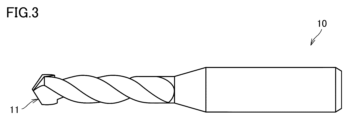
- FIG. 3 is a schematic diagram of a cutting tool according to a second embodiment.
- the present disclosure therefore aims to provide a cemented carbide that, when used as a tool material, can provide a cutting tool with a long tool life, particularly when cutting high-hardness materials, and a cutting tool with a long tool life.
- the cemented carbide of the present disclosure is A cemented carbide comprising a plurality of tungsten carbide particles and a binder phase, The cemented carbide contains 80 volume % or more of the tungsten carbide particles and the binder phase in total, The cemented carbide contains the binder phase in an amount of 0.1% by volume or more and 20% by volume or less, The cemented carbide contains at least one first element selected from the group consisting of titanium, tantalum, niobium, zirconium, cerium, yttrium, and boron; The cemented carbide contains the first element in a total amount of 0.01 atomic % or more and 20 atomic % or less, The binder phase contains 50% by mass or more of cobalt, A first graph showing the results of line analysis performed using an energy dispersive X-ray spectrometer attached to a transmission electron microscope along a first direction from adjacent binder phases
- a cemented carbide that, when used as a cutting tool material, can provide a cutting tool with a long tool life, particularly when cutting high-hardness materials, and a cutting tool with a long tool life.
- the cemented carbide may contain 18 volume percent or less of the binder phase. This further improves the tool life.
- the cutting tool disclosed herein is a cutting tool having a cutting edge made of the cemented carbide alloy described in (1) or (2) above.
- the cutting tools disclosed herein can have a long tool life.
- a ⁇ B means the upper and lower limits of a range (i.e., greater than or equal to A and less than or equal to B). If no unit is stated for A and only a unit is stated for B, the units of A and B are the same.
- any one numerical value listed as the lower limit and any one numerical value listed as the upper limit is also considered to be disclosed.
- a1 or more, b1 or more, and c1 or more are listed as the lower limit and a2 or less, b2 or less, and c2 or less are listed as the upper limit, a1 or more and a2 or less, a1 or more and b2 or less, a1 or more and c2 or less, b1 or more and a2 or less, b1 or more and b2 or less, b1 or more and c2 or less, c1 or more and a2 or less, c1 or more and b2 or less, and c1 or more and c2 or less are considered to be disclosed.
- the cemented carbide according to one embodiment of the present disclosure (hereinafter also referred to as "embodiment 1") is A cemented carbide comprising a plurality of tungsten carbide particles and a binder phase, The cemented carbide contains 80 volume % or more of the tungsten carbide particles and the binder phase in total, The cemented carbide contains 0.1% by volume or more and 20% by volume or less of the binder phase, The cemented carbide comprises at least one first element selected from the group consisting of titanium, tantalum, niobium, zirconium, cerium, yttrium, and boron; The cemented carbide contains the first element in a total amount of 0.01 atomic % or more and 20 atomic % or less, The binder phase contains at least 50% by weight of cobalt, a first graph showing the results of line analysis performed using an energy dispersive X-ray spectrometer attached to a transmission electron microscope along a first direction from
- the cemented carbide of embodiment 1 When used as a tool material, the cemented carbide of embodiment 1 can provide a cutting tool with a long tool life, particularly in cutting high-hardness materials, and can provide a cutting tool with a long tool life. The reason for this is not clear, but is presumed to be as follows.
- the cemented carbide of the first embodiment comprises a plurality of tungsten carbide particles (hereinafter also referred to as "WC particles") and a binder phase, and the total content of the WC particles and binder phase in the cemented carbide is 80 volume % or more.
- WC particles tungsten carbide particles
- the cemented carbide has high hardness and strength, and a cutting tool using the cemented carbide can have excellent wear resistance and chipping resistance.
- the cemented carbide of embodiment 1 contains a binder phase of 0.1 volume % or more and 20 volume % or less, and the binder phase contains cobalt of 50 mass % or more.
- the cemented carbide has high hardness and strength, and a cutting tool using the cemented carbide can have excellent wear resistance and chipping resistance.
- the cemented carbide of embodiment 1 contains at least one first element selected from the group consisting of titanium, tantalum, niobium, zirconium, cerium, yttrium, and boron in a total amount of 0.01 atomic % to 20 atomic %.
- the maximum peak M of each first element is present between the tungsten peak W1 closest to the origin and another tungsten peak W2 closest to peak W1. This indicates that a maximum concentration region of the first element is present in the surface layer portion of the tungsten carbide particle.
- the ratio IB/IA of the intensity IB to the maximum peak intensity IA is greater than 0.5. This indicates that the first element penetrates deep into the interior of the tungsten carbide particle.
- the first element penetrates deep into the tungsten carbide particles, and it is presumed that the presence of the first element affects the physical properties of the tungsten carbide particles, increasing the hardness of the tungsten carbide particles.
- the cemented carbide of embodiment 1 has improved wear resistance, and when the cemented carbide of embodiment 1 is used as a material for a cutting tool, the occurrence of damage caused by wear during cutting is suppressed.
- the cemented carbide 3 of the first embodiment includes a plurality of tungsten carbide particles 1 (hereinafter, also referred to as "WC particles") and a binder phase 2, and the total content of the WC particles and the binder phase of the cemented carbide 3 is 80% by volume or more.
- the lower limit of the total content of the WC particles and the binder phase of the cemented carbide may be 82% by volume or more, 84% by volume or more, 85% by volume or more, or 86% by volume or more.
- the upper limit of the total content of the WC particles and the binder phase of the cemented carbide may be 100% by volume or less.
- the upper limit of the total content of the WC particles and the binder phase of the cemented carbide may be 99% by volume or less, or 98% by volume or less.
- the total content of the WC particles and the binder phase of the cemented carbide may be 80% by volume or more and 100% by volume or less, 82% by volume or more and 100% by volume or less, or 84% by volume or more and 100% by volume or less.
- the cemented carbide of the first embodiment can be composed of a plurality of tungsten carbide particles and a binder phase.
- the cemented carbide of the present embodiment can include other phases in addition to the tungsten carbide particles and the binder phase.
- the other phases can include at least one phase selected from the group consisting of TiCN, TiC, TiO 2 , TaC, Ta 2 O 5 , ZrC, ZrO 2 , CeC 2 , CeO 2 , YC, Y 2 O 3 , B 4 C and B 2 O 3 .
- the cemented carbide of embodiment 1 may be composed of tungsten carbide particles, a binder phase, and other phases.
- the content of other phases in the cemented carbide is acceptable within a range that does not impair the effects of the present disclosure.
- the content of other phases in the cemented carbide may be 0 vol.% or more and 20 vol.% or less, 0 vol.% or more and 18 vol.% or less, or 0 vol.% or more and 16 vol.% or less.
- the total content of WC particles and binder phases in the cemented carbide may be 80 vol.% or more and less than 100 vol.%, 82 vol.% or more and less than 100 vol.%, or 84 vol.% or more and less than 100 vol.%.
- the cemented carbide of the first embodiment may contain impurities.
- impurities include manganese (Mn), magnesium (Mg), calcium (Ca), and sulfur (S).
- the impurity content of the cemented carbide is acceptable within a range that does not impair the effects of the present disclosure.
- the impurity content of the cemented carbide is preferably 0% by mass or more and less than 0.1% by mass.
- the impurity content of the cemented carbide is measured by ICP optical emission spectroscopy (measuring device: Shimadzu Corporation "ICPS-8100" (trademark)).
- the lower limit of the content of tungsten carbide particles in the cemented carbide of embodiment 1 may be 60 volume% or more, 65 volume% or more, 66 volume% or more, or 68 volume% or more.
- the upper limit of the content of tungsten carbide particles in the cemented carbide may be 99.9 volume% or less, 99.8 volume% or less, 99 volume% or less, 98 volume% or less, 96 volume% or less, or 94 volume% or less.
- the content of tungsten carbide particles in the cemented carbide may be 60 volume% or more and 99.9 volume% or less, 65 volume% or more and 99.8 volume% or less, 66 volume% or more and 99 volume% or less, or 68 volume% or more and 98 volume% or less.
- the cemented carbide of embodiment 1 contains a binder phase of 0.1 volume % or more and 20 volume % or less.
- the lower limit of the binder phase content of the cemented carbide is 0.1 volume % or more, 1 volume % or more, 2 volume % or more, 3 volume % or more, 5 volume % or more, or 8 volume % or more, from the viewpoint of improving toughness.
- the upper limit of the binder phase content of the cemented carbide is 20 volume % or less, 19 volume % or less, 18 volume % or less, 17 volume % or less, 16 volume % or less, or 15 volume % or less, from the viewpoint of improving hardness.
- the binder phase content of the cemented carbide may be 0.1 volume % or more and 18 volume % or less, 1 volume % or more and 18 volume % or less, 3 volume % or more and 17 volume % or less, 5 volume % or more and 16 volume % or less, or 8 volume % or more and 15 volume % or less.
- content of the binder phase in the cemented carbide is 18 volume percent or less, the hardness and wear resistance of the cemented carbide are further improved, and the tool life of cutting tools using the cemented carbide as a material is further improved.
- the method for measuring the tungsten carbide particle content (volume %) of the cemented carbide and the binder phase content (volume %) of the cemented carbide is as follows.
- the mirror-finished surface of the cemented carbide is photographed with a scanning electron microscope (SEM) to obtain a backscattered electron image.
- the area photographed for the image is set to the center of the cross section of the cemented carbide, that is, a position that does not include areas with properties that are clearly different from the bulk part, such as near the surface of the cemented carbide (a position where the entire imaged area is the bulk part of the cemented carbide).
- the observation magnification is 5000x.
- the measurement conditions are an acceleration voltage of 3 kV, a current value of 2 nA, and a working distance (WD) of 5 mm.
- (D1) The photographed area of (C1) above is analyzed using an energy dispersive X-ray analyzer (SEM-EDX) attached to a SEM to determine the distribution of the elements identified in (B1) above in the photographed area, and an element mapping image is obtained.
- SEM-EDX energy dispersive X-ray analyzer
- the above measurement (G1) is performed in five different non-overlapping measurement fields.
- the average of the area percentages of tungsten carbide particles in the five measurement fields corresponds to the content (volume %) of tungsten carbide particles in the cemented carbide
- the average of the area percentages of the binder phase in the five measurement fields corresponds to the content (volume %) of the binder phase in the cemented carbide.
- the content of the other phases in the cemented carbide can be obtained by subtracting the content (volume %) of the tungsten carbide grains and the content (volume %) of the binder phase measured by the above procedure from the total cemented carbide (100 volume %).
- the cut-out location of the cemented carbide cross section, the photographed area described in (C1) above, and the measurement field described in (G1) above can be arbitrarily set, and even when the tungsten carbide particle content and binder phase content of the cemented carbide are measured multiple times according to the above procedure, there is little variation in the measurement results, and it has been confirmed that the cut-out location of the cemented carbide cross section, the photographed area, and the measurement field can be arbitrarily set without being arbitrary.
- the tungsten carbide particles include tungsten carbide and a first element.
- the inclusion of the first element in the tungsten carbide particles is indicated by confirming that the maximum peak M of each of the first elements is between the tungsten peak W1 closest to the origin and another tungsten peak W2 closest to the peak W1 in a first graph obtained by performing line analysis on the cemented carbide.
- the tungsten carbide particles may contain impurity elements other than carbon, tungsten, and the first element.
- the impurity content of the tungsten carbide particles (if the impurity elements are two or more types, the total concentration of the elements) is less than 0.1 mass%.
- the impurity element content of the tungsten carbide particles is measured by ICP emission spectrometry.
- the average particle size of the tungsten carbide particles is not particularly limited.
- the average particle size of the tungsten carbide particles can be, for example, 0.1 ⁇ m or more and 3.5 ⁇ m or less. It has been confirmed that the cemented carbide of the first embodiment can have a long tool life regardless of the average particle size of the tungsten carbide particles.
- the binder phase contains 50% by mass or more of cobalt. This can impart excellent toughness to the cemented carbide.
- the lower limit of the cobalt content of the binder phase may be 55% by mass or more, 60% by mass or more, or 65% by mass or more.
- the upper limit of the cobalt content of the binder phase may be 100% by mass or less, less than 100% by mass, 99% by mass or less, 98% by mass or less, 95% by mass or less, or 90% by mass or less.
- the cobalt content of the binder phase may be 50% by mass or more and less than 100% by mass, 60% by mass or more and 99% by mass or less, 65% by mass or more and 98% by mass or less, 65% by mass or more and 95% by mass or less, or 65% by mass or more and 90% by mass or less.
- the method for measuring the cobalt content of the binder phase is as follows. Using the same method as (A1) to (F1) for measuring the tungsten carbide particle content and binder phase content of the cemented carbide above, the area where the binder phase exists is identified on the image after binarization processing. The area where the binder phase exists is analyzed using SEM-EDX to measure the cobalt content of the binder phase.
- the bonding phase may contain, in addition to cobalt, at least one second element selected from the group consisting of boron (B), aluminum (Al), silicon (Si), iron (Fe), nickel (Ni), germanium (Ge), ruthenium (Ru), rhenium (Re), osmium (Os), iridium (Ir), platinum (Pt), tantalum (Ta) and niobium (Nb).
- the bonding phase may be composed of cobalt, a second element and unavoidable impurities. Examples of the unavoidable impurities include manganese (Mn), magnesium (Mg), calcium (Ca) and sulfur (S).
- the content of the unavoidable impurities in the bonding phase is less than 0.1% by mass.
- the content of the impurity elements in the bonding phase is measured by ICP emission spectrometry.
- the cemented carbide of the first embodiment contains at least one first element selected from the group consisting of titanium, tantalum, niobium, zirconium, cerium, yttrium, and boron.
- the total content of the first elements in the cemented carbide is 0.01 atomic % or more and 20 atomic % or less.
- the total content of the first elements means the content of one type of first element when the cemented carbide contains one type of first element, and means the total content of all first elements contained in the cemented carbide when the cemented carbide contains two or more types of first elements.
- the lower limit of the total content of the first element in the cemented carbide is 0.01 atomic % or more, may be 0.07 atomic % or more, may be 0.09 atomic % or more, may be 0.10 atomic % or more, may be 0.50 atomic % or more, may be 1.0 atomic % or more, may be 3.0 atomic % or more, may be 5.0 atomic % or more, or may be 7.0 atomic % or more, from the viewpoint of improving hardness.
- the upper limit of the content of the first element in the cemented carbide is 20.0 atomic % or less, may be 17.0 atomic % or less, may be 15.0 atomic % or less, may be 14.0 atomic % or less, or may be 10.0 atomic % or less, from the viewpoint of suppressing deterioration of the basic physical properties of the cemented carbide.
- the total content of the first element in the cemented carbide may be 0.07 atomic % or more and 17.0 atomic % or less, 0.09 atomic % or more and 15.0 atomic % or less, 0.10 atomic % or more and 15.0 atomic % or less, 0.50 atomic % or more and 15.0 atomic % or less, 1.0 atomic % or more and 14.0 atomic % or less, 3.0 atomic % or more and 14.0 atomic % or less, 5.0 atomic % or more and 10.0 atomic % or less, or 7.0 atomic % or more and 10.0 atomic % or less.
- the type of the first element contained in the cemented carbide and the content of the first element contained in the cemented carbide are determined by ICP optical emission spectrometry.
- FIG. 2 is an example of a first graph showing the results obtained by performing line analysis on the cemented carbide of the first embodiment, tungsten, cobalt, and the first element (titanium in FIG. 2), which are elements contained in the cemented carbide, in a coordinate system in which the X axis is the distance [nm] from the position where cobalt shows the maximum intensity, and the Y axis is the normalized intensity (normalized intensity) [a.u.].
- the binder phase is cobalt.
- the origin O is 0 nm away from the X axis, and corresponds to the position where cobalt shows the maximum intensity in the line analysis results.
- the normalized intensity is the intensity shown relatively to the maximum intensity in the area where the line analysis was performed, which is 100.
- the maximum peak M of the first element is present between the peak W1 of tungsten closest to the origin O of the first graph and another peak W2 of tungsten closest to the peak W1.
- the other peak W2 is located farther from the origin O than the peak W1. That is, the distance Pw1 at the maximum peak intensity Iw1 of the peak W1, the distance Pw2 at the maximum peak intensity Iw2 of the peak W2, and the distance P1 at the maximum peak intensity IA of the maximum peak M show a relationship of Pw1 ⁇ P1 ⁇ Pw2 .
- the peak intensity of the peak of each element in the first graph means the normalized intensity of the peak of each element.
- the ratio IB/IA of the intensity IB to the maximum peak intensity IA of the maximum peak M is greater than 0.5.
- the intensity IB is the intensity of the first element at position P2, which is 0.2 nm away from the position P1 of the maximum peak intensity toward the opposite side of the origin.
- the first element is one type of element (titanium), so there is one peak M.
- the maximum peaks of the first element exist in the same number as the types of elements, all peaks exist between peaks W1 and W2, and the ratio IB/IA for each peak is greater than 0.5.
- the lower limit of the ratio IB/IA is more than 0.5, and may be 0.51 or more, 0.54 or more, 0.55 or more, 0.59 or more, 0.60 or more, 0.65 or more, or 0.70 or more.
- the upper limit of the ratio IB/IA may be 0.95 or less, 0.92 or less, 0.90 or less, 0.87 or less, 0.85 or less, or 0.80 or less.
- the ratio IB/IA may be 0.51 or more and 0.95 or less, 0.54 or more and 0.92 or less, 0.55 or more and 0.90 or less, 0.59 or more and 0.87 or less, 0.60 or more and 0.85 or less, 0.65 or more and 0.80 or less, or 0.70 or more and 0.80 or less.
- the line analysis of the cemented carbide and the acquisition of the first graph based on the analysis results are performed as follows.
- the cemented carbide is sliced to a thickness of 30 to 100 nm using an argon ion slicer ("Cryo Ion Slicer IB-09060BCIS” (trademark) manufactured by JEOL Ltd.) at an accelerating voltage of 6 kV and finishing voltage of 2 kV to prepare a measurement sample.
- the measurement sample is then observed at 200,000 times magnification using a TEM (Transmission Electron Microscopy) ("JEM-ARM300F2" (trademark) manufactured by JEOL Ltd.) at an accelerating voltage of 200 V to obtain a first image (not shown).
- TEM Transmission Electron Microscopy
- the tungsten carbide particles are observed as white areas and the binder phase is observed as black areas.
- the interface between the tungsten carbide particles and the binder phase is arbitrarily selected.
- the selected interface is positioned so as to pass through the center of the image, and the observation magnification is adjusted so that the field of view size is 10 nm x 10 nm, and a second image is obtained (not shown).
- the extension direction of the interface is confirmed.
- Line analysis is performed using an energy dispersive X-ray spectrometer (TEM-EDX) attached to a transmission electron microscope along a first direction perpendicular to the extension direction and extending from a position X1 in the bonding phase to a position X2 in a tungsten carbide particle adjacent to the bonding phase, and the distribution of tungsten, cobalt, and the first element is measured.
- TEM-EDX energy dispersive X-ray spectrometer
- the direction perpendicular to the extension direction of the interface means the direction along a straight line that intersects with the tangent of the extension direction at an angle of 90° ⁇ 5°.
- the position X1 in the bonding phase is set to a position in the first graph where the distance from the distance P1 of the peak M to the origin side is 0.5 nm or more and 5 nm or less, and where the peak of cobalt can be confirmed.
- Position X2 in the tungsten carbide particle is set to a position in the first graph where the distance from the distance P1 of the peak M to the opposite side of the origin is 2 nm or more and 5 nm or less.
- the conditions for performing EDX are an acceleration voltage of 200 kV, a camera length of 10 cm, a pixel count of 128 x 128 pixels, and a dwell time of 0.02 to 3 s/pixel.
- the first graph is obtained by plotting the measurement results for tungsten, cobalt, and the first element in a coordinate system in which the X-axis represents the distance from the position where cobalt shows the maximum intensity, and the Y-axis represents the normalized intensity.
- first images of non-overlapping fields of view are arbitrarily obtained for a cemented carbide, and the above-mentioned analysis is performed based on each of the first images to obtain five first graphs. If, in four or more first graphs, "the maximum peak M of each of the first elements is between peak W1 and peak W2, and the ratio IB/IA is greater than 0.5," it is determined that, in the first graph of the cemented carbide, "the maximum peak M of each of the first elements is between peak W1 and peak W2, and the ratio IB/IA is greater than 0.5.” In order to obtain this judgment criterion, the inventors performed multiple line analyses for each of multiple cemented carbide.
- the cemented carbide exhibits the effect of the present disclosure.
- the manufacturing method of cemented carbide it is presumed that the presence of tungsten and the first element in the interface region between the WC grains and the binder phase will be roughly the same within the same cemented carbide.
- the cemented carbide of this embodiment can be manufactured by carrying out the steps of preparing raw material powder, mixing, molding, sintering, cooling and HIP in the above-mentioned order. Each step will be described below.
- the preparation step is a step of preparing raw material powders of materials constituting the cemented carbide material.
- raw material powders include tungsten carbide powder (hereinafter also referred to as "WC powder"), cobalt (Co) powder, and first element-containing powder.
- first element-containing powders include TiCN powder, TaC powder, NbC powder , ZrC powder, CeC2 powder, Y2O3 powder, and B4C powder .
- nickel (Ni) powder and the like can be prepared. These raw material powders can be commercially available.
- the average particle size of these raw material powders is not particularly limited and can be, for example, 0.1 to 3.0 ⁇ m.
- the average particle size of the raw material powder means the average particle size measured by the FSSS (Fisher Sub-Sieve Sizer) method. The average particle size is measured using a "Sub-Sieve Sizer Model 95" (trademark) manufactured by Fisher Scientific.
- the mixing step is a step of mixing the raw material powders prepared in the preparation step in a predetermined ratio.
- a mixed powder in which the raw material powders are mixed is obtained by the mixing step.
- the mixing ratio of the raw material powders is appropriately adjusted depending on the composition of the target cemented carbide.
- the mixed powder may be granulated as necessary. Granulating the mixed powder makes it easier to fill the mixed powder into a die or mold during the molding step described below.
- a known granulation method can be used for granulation, and for example, a commercially available granulator such as a spray dryer can be used.
- the cooling step is a step of cooling the cemented carbide intermediate body after the sintering step.
- the cemented carbide intermediate body can be quenched in Ar gas under a pressure condition of 100 to 400 MPaG.
- ⁇ HIP process> The cooled cemented carbide intermediate is subjected to a pressure of 100 MPa for 120 minutes in a hot isostatic pressing (HIP) apparatus, thereby obtaining a cemented carbide.
- HIP hot isostatic pressing
- the mixing step is performed using a ball mill at a rotation speed of 200 rpm for 20 hours, and the sintering step is performed in two stages, firstly by holding at a pressure of 5 MPa and a temperature of 1450°C for 400 minutes (first sintering step), and then by holding at a pressure of 5 MPa and a temperature of 1350°C for 300 minutes (second sintering step), and then by HIP treatment at 100 MPa for 120 minutes.
- first sintering step first sintering step
- second sintering step a pressure of 5 MPa and a temperature of 1350°C for 300 minutes
- HIP treatment 100 MPa for 120 minutes.
- the mixing time is about 10 hours at a rotation speed of 100 rpm, and the sintering process is carried out in one step by raising the temperature to a specified temperature and maintaining it for a specified time.
- the first element is randomly arranged in the interface region between the WC particles and the binder phase, and in the first graph, there is no maximum peak M of the first element between peaks W1 and W2.
- the cutting tool of this embodiment includes a cutting edge made of the cemented carbide of embodiment 1.
- the cutting edge means a portion involved in cutting. More specifically, the cutting edge means a region surrounded by a cutting edge ridge and a virtual surface that is 0.5 nm or 2 mm away from the cutting edge ridge toward the cemented carbide side.
- Cutting tools include, for example, cutting tools, drills, end mills, indexable cutting tips for milling, indexable cutting tips for turning, metal saws, gear cutting tools, reamers, taps, etc.
- the cutting tool 10 of this embodiment can be highly effective in the case of a small diameter drill for machining printed circuit boards.
- the cutting edge 11 of the cutting tool 10 shown in FIG. 3 is made of the cemented carbide of embodiment 1.
- the cemented carbide of this embodiment may constitute the entirety of these tools, or may constitute only a part of them.
- "constitute a part” refers to a mode in which the cemented carbide of this embodiment is brazed to a predetermined position of any substrate to form a cutting edge.
- the cutting tool of this embodiment may further include a hard film that covers at least a portion of the surface of the substrate made of cemented carbide.
- a hard film that covers at least a portion of the surface of the substrate made of cemented carbide.
- diamond-like carbon or diamond can be used as the hard film.
- WC powder (average particle size 0.5 ⁇ m), Co powder (average particle size 1.0 ⁇ m), TiCN powder (average particle size 0.1 ⁇ m), TaC powder (average particle size 0.3 ⁇ m), NbC powder (average particle size 0.3 ⁇ m), ZrC powder (average particle size 0.5 ⁇ m), CeC2 powder (average particle size 0.5 ⁇ m), Y2O3 powder (average particle size 0.5 ⁇ m), and B4C powder (average particle size 0.5 ⁇ m) were prepared in the proportions shown in the "Raw Powder" column of Tables 1 to 3.
- the raw material powders were mixed in a bead mill to obtain a mixed powder.
- the mixing conditions were as follows.
- "Packing ratio” refers to the bead packing ratio. ⁇ Samples 1 to 48> Media diameter 6 mm, rotation speed 200 rpm, filling rate 40%, mixing time 20 hours. ⁇ Samples 49 to 76> Media diameter 6 mm, rotation speed 100 rpm, filling rate 40%, mixing time 10 hours.
- the "first sintering step” refers to a sintering step carried out immediately after the start of sintering.
- the “second sintering step” refers to a second sintering step carried out after the first sintering step.
- the description “none” for the second sintering step indicates that the second sintering step was not carried out.
- the cemented carbide intermediate was quenched in Ar gas under a pressure of 200 MPaG.
- the cemented carbide intermediate after cooling was subjected to a hot isostatic pressing (HIP) process in a HIP device to obtain each sample of cemented carbide.
- the conditions of the HIP process are as follows: ⁇ Samples 1 to 48> A pressure of 100 MPa was applied for 120 minutes. ⁇ Samples 49 to 76> A pressure of 10 MPa was applied for 60 minutes.
- ⁇ Total content of first element in cemented carbide The type and total content of the first element in each sample of cemented carbide were measured. The specific measurement method is as described in embodiment 1. The results are shown in the "Type of first element” and “Total content of first element” columns of "Cemented carbide” in Tables 7 to 9.
- the cemented carbide and cutting tools of Samples 1 to 48 correspond to Examples.
- the cemented carbide and cutting tools of Samples 49 to 76 correspond to Comparative Examples. It was confirmed that the cutting tools of Samples 1 to 48 (Examples) exhibited longer tool life in cutting high hardness materials than the cutting tools of Samples 49 to 76 (Comparative Examples). This is presumably because the cemented carbide of Samples 1 to 48 (Examples) had a peak M and a ratio IB/IA of more than 0.5, thereby improving wear resistance.
Landscapes
- Chemical & Material Sciences (AREA)
- Engineering & Computer Science (AREA)
- Mechanical Engineering (AREA)
- Materials Engineering (AREA)
- Metallurgy (AREA)
- Organic Chemistry (AREA)
- Powder Metallurgy (AREA)
- Cutting Tools, Boring Holders, And Turrets (AREA)
- Drilling Tools (AREA)
Priority Applications (5)
| Application Number | Priority Date | Filing Date | Title |
|---|---|---|---|
| JP2023577963A JP7589840B1 (ja) | 2023-07-28 | 2023-07-28 | 超硬合金および切削工具 |
| US18/686,442 US12390862B2 (en) | 2023-07-28 | 2023-07-28 | Cemented carbide and cutting tool |
| CN202380100088.1A CN121420085A (zh) | 2023-07-28 | 2023-07-28 | 硬质合金以及切削工具 |
| PCT/JP2023/027733 WO2025027678A1 (ja) | 2023-07-28 | 2023-07-28 | 超硬合金および切削工具 |
| TW113114916A TW202509246A (zh) | 2023-07-28 | 2024-04-22 | 超硬合金及切削工具 |
Applications Claiming Priority (1)
| Application Number | Priority Date | Filing Date | Title |
|---|---|---|---|
| PCT/JP2023/027733 WO2025027678A1 (ja) | 2023-07-28 | 2023-07-28 | 超硬合金および切削工具 |
Publications (1)
| Publication Number | Publication Date |
|---|---|
| WO2025027678A1 true WO2025027678A1 (ja) | 2025-02-06 |
Family
ID=93588081
Family Applications (1)
| Application Number | Title | Priority Date | Filing Date |
|---|---|---|---|
| PCT/JP2023/027733 Pending WO2025027678A1 (ja) | 2023-07-28 | 2023-07-28 | 超硬合金および切削工具 |
Country Status (5)
| Country | Link |
|---|---|
| US (1) | US12390862B2 (https=) |
| JP (1) | JP7589840B1 (https=) |
| CN (1) | CN121420085A (https=) |
| TW (1) | TW202509246A (https=) |
| WO (1) | WO2025027678A1 (https=) |
Citations (9)
| Publication number | Priority date | Publication date | Assignee | Title |
|---|---|---|---|---|
| JP2000336451A (ja) * | 1999-05-28 | 2000-12-05 | Toshiba Tungaloy Co Ltd | 改質焼結合金、被覆焼結合金及びその製造方法 |
| JP2005068515A (ja) * | 2003-08-26 | 2005-03-17 | Hitachi Tool Engineering Ltd | 微粒超硬合金 |
| JP2016020540A (ja) * | 2014-06-17 | 2016-02-04 | 住友電気工業株式会社 | 超硬合金及び切削工具 |
| JP2016098393A (ja) | 2014-11-20 | 2016-05-30 | 日本特殊合金株式会社 | 超硬合金 |
| WO2019116614A1 (ja) * | 2017-12-11 | 2019-06-20 | 住友電工ハードメタル株式会社 | 超硬合金及び切削工具 |
| JP2021110010A (ja) | 2020-01-14 | 2021-08-02 | 日本特殊合金株式会社 | 超微粒超硬合金,およびこれを用いた切断用もしくは切削用工具または耐摩耗用工具 |
| JP2022109485A (ja) * | 2021-01-15 | 2022-07-28 | 株式会社Moldino | Wc基超硬合金および該合金を用いた切削工具 |
| WO2022172729A1 (ja) * | 2021-02-15 | 2022-08-18 | 住友電気工業株式会社 | 超硬合金及びそれを基材として含む切削工具 |
| JP7311826B1 (ja) * | 2022-03-15 | 2023-07-20 | 住友電気工業株式会社 | 超硬合金 |
Family Cites Families (11)
| Publication number | Priority date | Publication date | Assignee | Title |
|---|---|---|---|---|
| US5310605A (en) | 1992-08-25 | 1994-05-10 | Valenite Inc. | Surface-toughened cemented carbide bodies and method of manufacture |
| JP4127651B2 (ja) | 2003-01-28 | 2008-07-30 | 京セラ株式会社 | プリント基板加工用ドリル |
| US20080101977A1 (en) * | 2005-04-28 | 2008-05-01 | Eason Jimmy W | Sintered bodies for earth-boring rotary drill bits and methods of forming the same |
| US20120040183A1 (en) | 2010-08-11 | 2012-02-16 | Kennametal, Inc. | Cemented Carbide Compositions Having Cobalt-Silicon Alloy Binder |
| JP2012162753A (ja) | 2011-02-03 | 2012-08-30 | Sumitomo Electric Hardmetal Corp | 超硬合金およびその製造方法、並びにマイクロドリル |
| US20130105231A1 (en) | 2011-11-01 | 2013-05-02 | Tdy Industries, Inc. | Earth boring cutting inserts and earth boring bits including the same |
| AT15143U1 (de) | 2016-03-11 | 2017-01-15 | Ceratizit Austria Gmbh | Zerspanungswerkzeug |
| US11536091B2 (en) | 2018-05-30 | 2022-12-27 | Baker Hughes Holding LLC | Cutting elements, and related earth-boring tools and methods |
| CN113179647B (zh) | 2019-11-26 | 2022-08-12 | 住友电气工业株式会社 | 硬质合金以及包括其作为基材的切削工具 |
| JP7392423B2 (ja) | 2019-11-26 | 2023-12-06 | 住友電気工業株式会社 | 超硬合金及びそれを基材として含む切削工具 |
| CN114507800A (zh) | 2021-12-29 | 2022-05-17 | 中南大学 | 含锇硬质合金及其制备方法和应用 |
-
2023
- 2023-07-28 WO PCT/JP2023/027733 patent/WO2025027678A1/ja active Pending
- 2023-07-28 US US18/686,442 patent/US12390862B2/en active Active
- 2023-07-28 JP JP2023577963A patent/JP7589840B1/ja active Active
- 2023-07-28 CN CN202380100088.1A patent/CN121420085A/zh active Pending
-
2024
- 2024-04-22 TW TW113114916A patent/TW202509246A/zh unknown
Patent Citations (9)
| Publication number | Priority date | Publication date | Assignee | Title |
|---|---|---|---|---|
| JP2000336451A (ja) * | 1999-05-28 | 2000-12-05 | Toshiba Tungaloy Co Ltd | 改質焼結合金、被覆焼結合金及びその製造方法 |
| JP2005068515A (ja) * | 2003-08-26 | 2005-03-17 | Hitachi Tool Engineering Ltd | 微粒超硬合金 |
| JP2016020540A (ja) * | 2014-06-17 | 2016-02-04 | 住友電気工業株式会社 | 超硬合金及び切削工具 |
| JP2016098393A (ja) | 2014-11-20 | 2016-05-30 | 日本特殊合金株式会社 | 超硬合金 |
| WO2019116614A1 (ja) * | 2017-12-11 | 2019-06-20 | 住友電工ハードメタル株式会社 | 超硬合金及び切削工具 |
| JP2021110010A (ja) | 2020-01-14 | 2021-08-02 | 日本特殊合金株式会社 | 超微粒超硬合金,およびこれを用いた切断用もしくは切削用工具または耐摩耗用工具 |
| JP2022109485A (ja) * | 2021-01-15 | 2022-07-28 | 株式会社Moldino | Wc基超硬合金および該合金を用いた切削工具 |
| WO2022172729A1 (ja) * | 2021-02-15 | 2022-08-18 | 住友電気工業株式会社 | 超硬合金及びそれを基材として含む切削工具 |
| JP7311826B1 (ja) * | 2022-03-15 | 2023-07-20 | 住友電気工業株式会社 | 超硬合金 |
Also Published As
| Publication number | Publication date |
|---|---|
| US20250033121A1 (en) | 2025-01-30 |
| US12390862B2 (en) | 2025-08-19 |
| JPWO2025027678A1 (https=) | 2025-02-06 |
| TW202509246A (zh) | 2025-03-01 |
| CN121420085A (zh) | 2026-01-27 |
| JP7589840B1 (ja) | 2024-11-26 |
Similar Documents
| Publication | Publication Date | Title |
|---|---|---|
| JP6459106B1 (ja) | 超硬合金及び切削工具 | |
| WO2019138599A1 (ja) | 超硬合金及び切削工具 | |
| EP4350022B1 (en) | Cemented carbide and tool containing same | |
| JP7501798B1 (ja) | 超硬合金およびそれを用いた切削工具 | |
| JP7589840B1 (ja) | 超硬合金および切削工具 | |
| JP7589839B1 (ja) | 超硬合金および切削工具 | |
| JP7666745B1 (ja) | 超硬合金および切削工具 | |
| JP7616426B1 (ja) | 超硬合金およびそれを用いた切削工具 | |
| JP2025076775A (ja) | 超硬合金および切削工具 | |
| JP7501800B1 (ja) | 超硬合金およびそれを用いた切削工具 | |
| WO2023139726A1 (ja) | 超硬合金およびそれを含む工具 | |
| JP7670234B1 (ja) | 超硬合金および切削工具 | |
| JP7666744B1 (ja) | 超硬合金および切削工具 | |
| JP7694813B1 (ja) | 超硬合金 | |
| JP7782777B1 (ja) | 超硬合金および切削工具 | |
| EP4397779B1 (en) | Cemented carbide and tool containing same | |
| WO2025069213A1 (ja) | 超硬合金 | |
| WO2026088288A1 (ja) | 超硬合金および切削工具 | |
| CN121569055A (zh) | 硬质合金 | |
| WO2026088289A1 (ja) | 超硬合金および切削工具 | |
| CN121605209A (zh) | 硬质合金以及切削工具 |
Legal Events
| Date | Code | Title | Description |
|---|---|---|---|
| WWE | Wipo information: entry into national phase |
Ref document number: 2023577963 Country of ref document: JP |
|
| 121 | Ep: the epo has been informed by wipo that ep was designated in this application |
Ref document number: 23947477 Country of ref document: EP Kind code of ref document: A1 |
|
| WWG | Wipo information: grant in national office |
Ref document number: 18686442 Country of ref document: US |
|
| WWE | Wipo information: entry into national phase |
Ref document number: 2023947477 Country of ref document: EP |
|
| NENP | Non-entry into the national phase |
Ref country code: DE |