WO2025018397A1 - 接着剤組成物及び接着体 - Google Patents
接着剤組成物及び接着体 Download PDFInfo
- Publication number
- WO2025018397A1 WO2025018397A1 PCT/JP2024/025837 JP2024025837W WO2025018397A1 WO 2025018397 A1 WO2025018397 A1 WO 2025018397A1 JP 2024025837 W JP2024025837 W JP 2024025837W WO 2025018397 A1 WO2025018397 A1 WO 2025018397A1
- Authority
- WO
- WIPO (PCT)
- Prior art keywords
- meth
- acrylate
- component
- mass
- adhesive composition
- Prior art date
- Legal status (The legal status is an assumption and is not a legal conclusion. Google has not performed a legal analysis and makes no representation as to the accuracy of the status listed.)
- Ceased
Links
Classifications
-
- C—CHEMISTRY; METALLURGY
- C09—DYES; PAINTS; POLISHES; NATURAL RESINS; ADHESIVES; COMPOSITIONS NOT OTHERWISE PROVIDED FOR; APPLICATIONS OF MATERIALS NOT OTHERWISE PROVIDED FOR
- C09J—ADHESIVES; NON-MECHANICAL ASPECTS OF ADHESIVE PROCESSES IN GENERAL; ADHESIVE PROCESSES NOT PROVIDED FOR ELSEWHERE; USE OF MATERIALS AS ADHESIVES
- C09J11/00—Features of adhesives not provided for in group C09J9/00, e.g. additives
- C09J11/02—Non-macromolecular additives
- C09J11/06—Non-macromolecular additives organic
-
- C—CHEMISTRY; METALLURGY
- C09—DYES; PAINTS; POLISHES; NATURAL RESINS; ADHESIVES; COMPOSITIONS NOT OTHERWISE PROVIDED FOR; APPLICATIONS OF MATERIALS NOT OTHERWISE PROVIDED FOR
- C09J—ADHESIVES; NON-MECHANICAL ASPECTS OF ADHESIVE PROCESSES IN GENERAL; ADHESIVE PROCESSES NOT PROVIDED FOR ELSEWHERE; USE OF MATERIALS AS ADHESIVES
- C09J133/00—Adhesives based on homopolymers or copolymers of compounds having one or more unsaturated aliphatic radicals, each having only one carbon-to-carbon double bond, and at least one being terminated by only one carboxyl radical, or of salts, anhydrides, esters, amides, imides, or nitriles thereof; Adhesives based on derivatives of such polymers
- C09J133/04—Homopolymers or copolymers of esters
-
- C—CHEMISTRY; METALLURGY
- C09—DYES; PAINTS; POLISHES; NATURAL RESINS; ADHESIVES; COMPOSITIONS NOT OTHERWISE PROVIDED FOR; APPLICATIONS OF MATERIALS NOT OTHERWISE PROVIDED FOR
- C09J—ADHESIVES; NON-MECHANICAL ASPECTS OF ADHESIVE PROCESSES IN GENERAL; ADHESIVE PROCESSES NOT PROVIDED FOR ELSEWHERE; USE OF MATERIALS AS ADHESIVES
- C09J163/00—Adhesives based on epoxy resins; Adhesives based on derivatives of epoxy resins
-
- C—CHEMISTRY; METALLURGY
- C09—DYES; PAINTS; POLISHES; NATURAL RESINS; ADHESIVES; COMPOSITIONS NOT OTHERWISE PROVIDED FOR; APPLICATIONS OF MATERIALS NOT OTHERWISE PROVIDED FOR
- C09J—ADHESIVES; NON-MECHANICAL ASPECTS OF ADHESIVE PROCESSES IN GENERAL; ADHESIVE PROCESSES NOT PROVIDED FOR ELSEWHERE; USE OF MATERIALS AS ADHESIVES
- C09J4/00—Adhesives based on organic non-macromolecular compounds having at least one polymerisable carbon-to-carbon unsaturated bond ; adhesives, based on monomers of macromolecular compounds of groups C09J183/00 - C09J183/16
Definitions
- the present disclosure relates to adhesive compositions and adhesive bodies.
- a photocurable adhesive composition containing a (meth)acrylate compound, an epoxy compound, and a photoacid generator is known (see, for example, Patent Document 1).
- Polymers of compounds having fluorine-containing organic groups have attracted attention as materials that exhibit a low refractive index.
- the present inventors focused on an adhesive composition containing a (meth)acrylate compound, an epoxy compound, and a photoacid generator, and when they examined the curing reaction using a (meth)acrylate having a fluorine-containing organic group as the (meth)acrylate compound, they found that the adhesive strength of the cured product of the adhesive composition obtained decreased, and furthermore, the infrared transmittance of the cured product of the adhesive composition also tended to decrease.
- the main objective of this disclosure is to provide an adhesive composition that, when used with a (meth)acrylate having a fluorine-containing organic group, can provide a cured product that has sufficient adhesive strength and high infrared transmittance.
- a composition comprising a (meth)acrylate compound, an epoxy compound, a crosslinking agent, and a photoacid generator,
- the (meth)acrylate compound contains a (meth)acrylate having a fluorine-containing organic group
- the crosslinking agent contains a (meth)acrylic resin having a first structural unit derived from a (meth)acrylate having a fluorine-containing organic group and a second structural unit derived from a (meth)acrylate having a cyclic ether group
- Adhesive composition Adhesive composition.
- the content of the first structural unit is 10 to 90 mol% based on the total structural units of the (meth)acrylic resin
- the content of the second structural unit is 10 to 90 mol% based on the total structural units of the (meth)acrylic resin.
- the epoxy compound includes an aliphatic epoxy compound.
- the epoxy compound further contains an alicyclic epoxy compound.
- [5] Further containing an oxetane compound The adhesive composition according to any one of [1] to [4].
- a method for manufacturing a substrate comprising: a first adherend; a second adherend; and an adhesive portion that adheres the first adherend and the second adherend to each other;
- the adhesive part contains a cured product of the adhesive composition according to any one of [1] to [5].
- Adhesive body
- an adhesive composition that, when a (meth)acrylate having a fluorine-containing organic group is used, can give a cured product that has sufficient adhesive strength and high infrared transmittance.
- an adhesive body using such an adhesive composition is provided.
- a numerical range indicated using “ ⁇ ” indicates a range that includes the numerical values before and after " ⁇ " as the minimum and maximum values, respectively.
- the upper or lower limit of a certain numerical range may be replaced with the upper or lower limit of a numerical range of another stage.
- the upper or lower limit of the numerical range may be replaced with a value shown in an example.
- the upper and lower limits described individually can be arbitrarily combined.
- the numerical values A and B at both ends are included in the numerical range as the lower and upper limits, respectively.
- the description “10 or more” means “10” and “a numerical value exceeding 10", and this also applies when the numerical values are different.
- the description “10 or less” means “10” and “a numerical value less than 10", and this also applies when the numerical values are different.
- a (meth)acrylate compound means a compound having one or more (meth)acryloyl groups
- a (meth)acrylic resin means a (co)polymer having at least a structural unit derived from a (meth)acrylate compound.
- the (meth)acrylate compound may be a compound having no epoxy group or no oxetanyl group.
- a (meth)acryloyl group means an acryloyl group or the corresponding methacryloyl group. The same applies to other similar expressions such as (meth)acrylate.
- "A or B" may include either A or B, or may include both.
- a cyclic ether group refers to a group obtained by removing one hydrogen atom directly bonded to a carbon atom from a compound having a cyclic ether such as oxirane or oxetane.
- a cyclic ether group may be a group obtained by removing one hydrogen atom directly bonded to a carbon atom from a compound having a three- or four-membered cyclic ether.
- Examples of such cyclic ether groups include an epoxy group (oxiranyl group) and an oxetanyl group.
- Epoxy groups include alicyclic epoxy groups (epoxy groups formed together with the two carbon atoms that constitute an alicyclic ring) such as an epoxycyclohexyl group.
- the materials exemplified below may be used alone or in combination of two or more.
- the amount or content of each component means the total amount of the multiple substances present in the composition, unless otherwise specified.
- the adhesive composition of one embodiment contains a (meth)acrylate compound (hereinafter sometimes referred to as “component (A)”), an epoxy compound (hereinafter sometimes referred to as “component (B)”), a crosslinking agent (hereinafter sometimes referred to as “component (C)”), and a photoacid generator (hereinafter sometimes referred to as “component (D)”).
- component (A) a (meth)acrylate compound
- component (B)) an epoxy compound
- component (C) crosslinking agent
- component (D) a photoacid generator
- the adhesive composition may further contain, for example, a photoradical generator (hereinafter sometimes referred to as “component (E)”) and an oxetane compound (hereinafter sometimes referred to as “component (F)”).
- Component (A) (meth)acrylate compound
- Component (A) contains a (meth)acrylate having a fluorine-containing organic group (hereinafter, may be referred to as “component (A1)”).
- Component (A) may further contain a (meth)acrylate having a hydroxy group (hereinafter, may be referred to as “component (A2)”).
- Component (A) may further contain a (meth)acrylate having an alkoxy group (hereinafter, may be referred to as "component (A3)").
- Component (A1) may be, for example, a (meth)acrylate having a fluoroalkyl group.
- (meth)acrylates having a fluoroalkyl group include trifluoromethyl (meth)acrylate, 2,2,2-trifluoroethyl (meth)acrylate, 1,1,1,3,3,3-hexafluoro-2-propyl (meth)acrylate, perfluoroethylmethyl (meth)acrylate, perfluoropropylmethyl (meth)acrylate, perfluorobutylmethyl (meth)acrylate, perfluoropentylmethyl (meth)acrylate, perfluorohexylmethyl (meth)acrylate, perfluoroheptylmethyl (meth)acrylate, perfluorooctylmethyl (meth)acrylate, perfluorononylmethyl (meth)
- the number of carbon atoms in the fluoroalkyl group may be, for example, 1 to 20, 2 or more, 3 or more, 4 or more, or 6 or more, or 18 or less, 16 or less, 14 or less, or 12 or less, from the viewpoint of lowering the refractive index of the cured product.
- the proportion of fluorine atoms in the fluoroalkyl group is calculated based on the total amount of hydrogen atoms and fluorine atoms directly bonded to the carbon atoms constituting the fluoroalkyl group.
- the trifluoromethyl group of trifluoromethyl (meth)acrylate has three fluorine atoms and no hydrogen atoms, so the proportion of fluorine atoms is 100%.
- the 2,2,2-trifluoroethyl group of 2,2,2-trifluoroethyl (meth)acrylate has three fluorine atoms and two hydrogen atoms, so the proportion of fluorine atoms is 60%.
- the proportion of fluorine atoms may be, for example, 100% or less, 90% or less, or 80% or less, or 30% or more, 40% or more, or 50% or more.
- the content of the (A1) component may be 15 mass% or more, 25 mass% or more, 30 mass% or more, 35 mass% or more, 40 mass% or more, or 45 mass% or more, and may be 70 mass% or less, 65 mass% or less, or 60 mass% or less, based on the total amount of the (A) component.
- Component (A2) may be, for example, a (meth)acrylate having a hydroxyalkyl group.
- (meth)acrylates having a hydroxyalkyl group include 2-hydroxyethyl (meth)acrylate, 2-hydroxypropyl (meth)acrylate, 3-hydroxypropyl (meth)acrylate, and 4-hydroxybutyl (meth)acrylate.
- the content of the (A2) component may be 0.1 mass% or more, 1 mass% or more, or 2 mass% or more, and may be 15 mass% or less, 12 mass% or less, 10 mass% or less, or 8 mass% or less, based on the total amount of the (A) component, from the viewpoint of the curability and adhesion of the adhesive composition.
- the (A3) component may be, for example, a (meth)acrylate having an alkoxyalkyl group.
- examples of the (A3) component include 2-methoxyethyl acrylate and 2-ethoxyethyl (meth)acrylate.
- the content of the (A3) component may be 5% by mass or more, 10% by mass or more, 20% by mass or more, 30% by mass or more, or 35% by mass or more, and may be 65% by mass or less, 60% by mass or less, 55% by mass or less, or 50% by mass or less, based on the total amount of the (A) component, from the viewpoint of the solubility of the (C) component.
- the (A) component may contain other (meth)acrylates (hereinafter, sometimes referred to as "(A4) component”) to the extent that the effect of the present disclosure is not impaired.
- (A4) component include monofunctional (meth)acrylates having one (meth)acryloyl group other than the (A1), (A2), and (A3) components, and polyfunctional (meth)acrylates having two or more (meth)acryloyl groups other than the (A1), (A2), and (A3) components.
- Examples of monofunctional (meth)acrylates include alkyl (meth)acrylates having an alkyl group such as methyl (meth)acrylate, ethyl (meth)acrylate, n-butyl (meth)acrylate, isobutyl (meth)acrylate, tert-butyl (meth)acrylate, n-hexyl (meth)acrylate, n-octyl (meth)acrylate, isooctyl (meth)acrylate, 2-ethylhexyl (meth)acrylate, isodecyl (meth)acrylate, and dodecyl (meth)acrylate; alkenyl (meth)acrylates having an alkenyl group such as 3-butenyl (meth)acrylate; (meth)acrylates having an aromatic group such as benzyl (meth)acrylate and phenoxyethyl (meth)acrylate; cyclohexyl (meth)acrylate
- alkoxy polyalkylene glycol (meth)acrylates such as methoxyethylene glycol (meth)acrylate, methoxyte
- polyfunctional (meth)acrylates include ethylene glycol di(meth)acrylate, diethylene glycol di(meth)acrylate, triethylene glycol di(meth)acrylate, tetraethylene glycol di(meth)acrylate, polyethylene glycol di(meth)acrylate, propylene glycol di(meth)acrylate, dipropylene glycol di(meth)acrylate, tripropylene glycol di(meth)acrylate, tetrapropylene glycol di(meth)acrylate, polypropylene glycol di(meth)acrylate, ethoxylated polypropylene glycol di(meth)acrylate, 1,3-butanediol di(meth)acrylate, 1,4-butanediol di(meth)acrylate, neopentyl glycol di(meth)acrylate, 3-methyl-1,5-pentanediol di(meth)acrylate, 1,6-hexanediol di(meth
- the content of component (A4) may be 0-45% by mass, 0-40% by mass, 0-30% by mass, 0-25% by mass, 0-10% by mass, or 0-5% by mass based on the total amount of component (A).
- the content of the (A) component may be 20% by mass or more or 30% by mass or more, and may be 70% by mass or less, 65% by mass or less, 60% by mass or less, or 55% by mass or less, based on the total amount of the adhesive composition.
- Component (B) Epoxy Compound Component (B) is a compound having one or more epoxy groups.
- Component (B) may be a compound having no (meth)acryloyl group or oxetanyl group.
- Component (B) may be a compound having two or more epoxy groups.
- Component (B) may contain an aliphatic epoxy compound (hereinafter, sometimes referred to as "component (B1)”).
- Component (B1) is a compound having an epoxy group other than an alicyclic epoxy group.
- Component (B) may contain an alicyclic epoxy compound (hereinafter, sometimes referred to as "component (B2)").
- Component (B2) is a compound having an alicyclic epoxy group.
- Component (B) may contain both component (B1) and component (B2).
- Component (B1) may be, for example, an aliphatic diglycidyl ether having at least one aliphatic group (linking group) selected from the group consisting of an alkylene group, an oxyalkylene group, and a cycloalkylene group.
- Component (B1) may also be an epoxy compound that does not have an aromatic ring.
- Examples of aliphatic diglycidyl ethers include diglycidyl ethers having an alkylene group, such as ethylene glycol diglycidyl ether, propylene glycol diglycidyl ether, neopentyl glycol diglycidyl ether, 1,4-butanediol diglycidyl ether, and 1,6-hexanediol diglycidyl ether; diglycidyl ethers having an oxyalkylene group, such as diethylene glycol diglycidyl ether, tripropylene glycol diglycidyl ether, and polyethylene glycol diglycidyl ether; and diglycidyl ethers having a cycloalkylene group, such as hydrogenated bisphenol A diglycidyl ether, 1,4-cyclohexanedimethanol diglycidyl ether, and diglycidyl-1,2-cyclohexanedicarboxylate.
- alkylene group such as
- components (B1) other than aliphatic diglycidyl ethers include EHPE3150 (1,2-epoxy-4-(2-oxiranyl)cyclohexane adduct of 2,2-bis(hydroxymethyl)-1-butanol, manufactured by Daicel Corporation).
- the content of the (B1) component may be 5% by mass or more, 10% by mass or more, 20% by mass or more, 30% by mass or more, 40% by mass or more, or 50% by mass or more, and may be 100% by mass or less, 95% by mass or less, 90% by mass or less, or 80% by mass or less, based on the total amount of the (B) component.
- the (B2) component is a compound having an epoxy group (e.g., an epoxycyclohexyl group) formed together with two carbon atoms constituting an alicyclic ring.
- an epoxy group e.g., an epoxycyclohexyl group
- the heat resistance and crosslinking property of the adhesive composition tend to be improved.
- Examples of commercially available products of the (B2) component include Celoxide (registered trademark) 8010, 2021P, and 2081 (product names, all manufactured by Daicel Corporation).
- the (B2) component may also be an epoxy compound that does not have an aromatic ring.
- the content of the (B2) component may be 0% by mass or more, 5% by mass or more, 10% by mass or more, or 20% by mass or more, and may be 95% by mass or less, 90% by mass or less, 80% by mass or less, 70% by mass or less, 60% by mass or less, or 55% by mass or less, based on the total amount of the (B) component.
- the (B) component may contain other epoxy compounds (hereinafter, sometimes referred to as "component (B3)") to the extent that the effects of the present disclosure are not impaired.
- component (B3) examples include epoxy compounds having an aromatic ring.
- Examples of the (B3) component include diglycidyl phthalate, bisphenol A type epoxy resin, bisphenol F type epoxy resin, bisphenol AD type epoxy resin, bisphenol S type epoxy resin, phenol novolac type epoxy resin, cresol novolac type epoxy resin, biphenyl type epoxy resin, and biphenyl aralkyl type epoxy resin.
- the content of the (B3) component may be 0-40 mass%, 0-30 mass%, 0-20 mass%, or 0-10 mass% based on the total amount of the (B) component.
- the content of the (B) component may be 5 mass% or more, 10 mass% or more, 15 mass% or more, or 20 mass% or more, based on the total amount of the adhesive composition, and may be 50 mass% or less, 45 mass% or less, or 40 mass% or less.
- Component (C) contains a (meth)acrylic resin having a first structural unit derived from a (meth)acrylate having a fluorine-containing organic group and a second structural unit derived from a (meth)acrylate having a cyclic ether group.
- the crosslinking agent may be composed of the (meth)acrylic resin.
- the (meth)acrylate having a fluorine-containing organic group that provides the first structural unit may be, for example, a (meth)acrylate having a fluoroalkyl group.
- (meth)acrylates having a fluoroalkyl group include those exemplified as component (A1).
- the number of carbon atoms in the fluoroalkyl group may be, for example, 1 to 10, 2 or more, or 8 or less, 6 or less, 4 or less, or 3 or less, from the viewpoint of compatibility with component (A) or a polymer thereof.
- the proportion of fluorine atoms in the fluoroalkyl group may be, for example, 100% or less, 80% or less, or 70% or less, or 30% or more, 40% or more, or 50% or more, from the viewpoint of compatibility with component (A) or a polymer thereof.
- the content of the first structural unit may be 10 to 90 mol%, 20 to 90 mol%, 30 to 90 mol%, or 40 to 90 mol%, based on the total structural units of the (meth)acrylic resin, from the viewpoint of compatibility with component (A) or a polymer thereof.
- the (meth)acrylate having a cyclic ether group that provides the second structural unit may be, for example, at least one selected from the group consisting of (meth)acrylates having an epoxy group and (meth)acrylates having an oxetanyl group.
- examples of the (meth)acrylate having an epoxy group include (meth)acrylates having an alicyclic epoxy group such as 3,4-epoxycyclohexylmethyl (meth)acrylate, and (meth)acrylates having an epoxy group other than an alicyclic epoxy group such as glycidyl (meth)acrylate.
- Examples of the (meth)acrylate having an oxetanyl group include (3-ethyloxetan-3-yl)methyl (meth)acrylate.
- the (meth)acrylate having a cyclic ether group may be, for example, a (meth)acrylate having an alicyclic epoxy group.
- the content of the second structural unit may be 10 to 90 mol%, 10 to 80 mol%, 10 to 70 mol%, or 10 to 60 mol% based on the total structural units of the (meth)acrylic resin, from the viewpoint of crosslinking with the (B) component, etc.
- the (meth)acrylic resin may have structural units other than the first structural unit and the second structural unit, as long as the effect of the present disclosure is not impaired.
- compounds that provide other structural units include monofunctional (meth)acrylates having one (meth)acryloyl group, such as alkyl (meth)acrylates having an alkyl group, (meth)acrylates having an aromatic group, (meth)acrylates having an alicyclic group, (meth)acrylates having a nitrogen-containing oxygen heterocyclic group, alkoxy polyalkylene glycol (meth)acrylates, polyalkylene glycol mono(meth)acrylates, and (meth)acrylates having a siloxane skeleton; polyfunctional (meth)acrylates having two or more (meth)acryloyl groups, such as aliphatic poly(meth)acrylates and aromatic poly(meth)acrylates; and compounds having radical polymerizable groups other than (meth)acryloyl groups, such as styrene, 4-methylst
- the content of other structural units may be 0 to 40 mol%, 0 to 30 mol%, 0 to 20 mol%, or 0 to 10 mol% based on the total structural units of the (meth)acrylic resin.
- the weight average molecular weight (Mw) of the (meth)acrylic resin may be, for example, 1,000 to 200,000, or may be 3,000 or more, 5,000 or more, or 10,000 or more, or may be 150,000 or less, 100,000 or less, 60,000 or less, or 50,000 or less.
- the weight average molecular weight (Mw) is a polystyrene-equivalent value obtained by gel permeation chromatography (GPC) using a calibration curve based on standard polystyrene.
- the weight average molecular weight (Mw) can be measured, for example, by the method described in the Examples.
- the (meth)acrylic resin can be obtained, for example, by radical polymerization using a solution polymerization method. More specifically, it can be obtained by polymerizing monomers including a (meth)acrylate having a cyclic ether group and a (meth)acrylate having a fluorine-containing organic group in a solvent.
- the solvent may be an organic solvent generally used in the field of radical polymerization.
- the solvent may be a solvent having a cyclic ether group (epoxy group or oxetanyl group) and no radical polymerizable group, since the crosslinking agent ((meth)acrylic resin) can be used as is in the polymerization reaction for the curing reaction of a curable resin such as a compound having a cyclic ether group (epoxy resin) without isolating the crosslinking agent ((meth)acrylic resin) (without removing or replacing the solvent).
- the solvent include those generally used in the field of epoxy resin diluents.
- Examples of the solvent include epoxy resins that are liquid at 25°C.
- the solvent may be, for example, an aliphatic diglycidyl ether, from the viewpoint of being usable as component (B1). Examples of the aliphatic diglycidyl ether include those exemplified as component (B1).
- a radically polymerizable group refers to a group having a carbon-carbon double bond.
- examples of radically polymerizable groups include (meth)acryloyl groups, vinyl groups, allyl groups, styryl groups, alkenyl groups, alkenylene groups, and maleimide groups.
- the amount of solvent used can be set appropriately depending on the type of monomer, reaction conditions, solids concentration of the (meth)acrylic resin solution, etc.
- thermal radical generators When polymerizing the monomers, thermal radical generators, additives, etc. may be added as necessary.
- thermal radical generators include organic peroxides such as cumene hydroperoxide, diisopropylbenzene hydroperoxide, di-t-butyl peroxide, lauroyl peroxide, benzoyl peroxide, t-butylperoxyisopropylcarbonate, t-amylperoxy-2-ethylhexanoate, and t-butylperoxy-2-ethylhexanoate; and azo compounds such as 2,2'-azobis(isobutyronitrile), 1,1'-azobis(cyclohexanecarbonitrile), 2,2'-azobis(2,4-dimethylvaleronitrile), and dimethyl-2,2'-azobis(2-methylpropionate).
- organic peroxides such as cumene hydroperoxide, diisopropylbenzene hydroperoxide, di-t-butyl peroxide, lauroyl peroxide, benzoyl peroxide, t-but
- the amount of thermal radical generator added may be appropriately set depending on the type of monomer, reaction conditions, etc., and is not particularly limited, but may be 100 to 200,000 ppm by mass, 100 to 100,000 ppm by mass, 1,000 to 100,000 ppm by mass, 1,000 to 50,000 ppm by mass, 3,000 to 30,000 ppm by mass, or 10,000 to 80,000 ppm by mass based on the total amount of monomer.
- Additives include chain transfer agents, antioxidants, light stabilizers, weather stabilizers, ultraviolet absorbers, and radical scavengers.
- the amount of additives added is not particularly limited, but may be 0.001 to 2% by mass or 0.005 to 1% by mass based on the total amount of monomers.
- the polymerization temperature may be 40 to 120°C, 50 to 100°C, or 60 to 90°C.
- the polymerization time may be 0.1 to 24 hours, 0.5 to 20 hours, or 1 to 12 hours.
- the content of component (C) may be 5 mass% or more, 8 mass% or more, 10 mass% or more, 12 mass% or more, or 15 mass% or more, based on the total amount of the adhesive composition, and may be 40 mass% or less, 35 mass% or less, or 30 mass% or less.
- Component (D) is a component that generates an acid that initiates polymerization when irradiated with light.
- Component (D) may be a component that generates an acid that initiates polymerization when irradiated with light having a wavelength in the range of 150 to 750 nm or light having a wavelength in the range of 254 to 405 nm.
- Component (D) may also be a component that generates radicals that initiate radical polymerization when irradiated with light.
- Component (D) may be a component that generates radicals and an acid when irradiated with light, or a component that generates radicals and an acid when irradiated with ultraviolet light.
- Examples of the component (D) include onium salts such as sulfonium salts, phosphonium salts, ammonium salts, diazonium salts, iodonium salts, and anilinium salts.
- Examples of the anion of the onium salt include BF 4 ⁇ , BR 4 ⁇ (R is a phenyl group substituted with two or more fluorine atoms or two or more trifluoromethyl groups), PF 6 ⁇ , SbF 6 ⁇ , AsF 6 ⁇ , and SO 4 R ⁇ (R is an alkyl group).
- component (D) Commercially available products of component (D) include, for example, CPI-100P, CPI-110P, CPI-101A, CPI-200K, CPI-210S (all manufactured by San-Apro Ltd.), UVI-6990, UVI-6992, UVI-6976 (all manufactured by Dow Chemical Japan Ltd.), SP-150, SP-152, SP-170, SP-172, SP-300 (all manufactured by ADEKA Corporation), etc.
- the content of the (D) component may be, for example, 0.1 parts by mass or more, 0.5 parts by mass or more, or 1 part by mass or more, and may be 15 parts by mass or less, 10 parts by mass or less, or 8 parts by mass or less, relative to 100 parts by mass of the total amount of the (B) component and the (C) component.
- Component (E) Photoradical generator Component (E) may be a component that generates radicals when irradiated with light having a wavelength in the range of 150 to 750 nm or light having a wavelength in the range of 254 to 405 nm. Component (E) may be a component that generates radicals when irradiated with ultraviolet light. Component (E) may be a component that acts mainly on component (A).
- Component (E) generates free radicals when exposed to light.
- component (E) is a compound that generates radicals when exposed to external light energy.
- Component (E) may be a compound having an oxime ester structure, a bisimidazole structure, an acridine structure, an ⁇ -aminoalkylphenone structure, an aminobenzophenone structure, an N-phenylglycine structure, an acylphosphine oxide structure, a benzyl dimethyl ketal structure, an ⁇ -hydroxyalkylphenone structure, or the like.
- Component (E) may be, for example, a compound having a structure selected from the group consisting of an oxime ester structure, an ⁇ -aminoalkylphenone structure, and an acylphosphine oxide structure, or may be a compound having an acylphosphine oxide structure.
- compounds having an oxime ester structure include 1-phenyl-1,2-butanedione-2-(o-methoxycarbonyl)oxime, 1-phenyl-1,2-propanedione-2-(o-methoxycarbonyl)oxime, 1-phenyl-1,2-propanedione-2-(o-ethoxycarbonyl)oxime, 1-phenyl-1,2-propanedione-2-(o-ethoxycarbonyl)oxime, 1-phenyl-1,2-propanedione-2-o-benzoyloxime, 1,3-diphenylpropanetrione-2-(o-ethoxycarbonyl)oxime, and 1-phenyl-3-ethoxypropanetrione-2-(o-benzoyl)oxime.
- compounds having an ⁇ -aminoalkylphenone structure include 2-methyl-1-[4-(methylthio)phenyl]-2-morpholinopropan-1-one, 2-benzyl-2-dimethylamino-1-morpholinophenyl)-butanone-1, etc.
- compounds having an acylphosphine oxide structure include bis(2,6-dimethoxybenzoyl)-2,4,4-trimethyl-pentylphosphine oxide, bis(2,4,6-trimethylbenzoyl)phenylphosphine oxide, and diphenyl(2,4,6-trimethylbenzoyl)phosphine oxide.
- the content of component (E) may be 0.1 to 15 parts by mass, 0.5 to 10 parts by mass, or 1 to 8 parts by mass per 100 parts by mass of the total amount of component (A).
- Component (F) Oxetane Compound Component (F) is a compound having one or more oxetanyl groups. Component (F) may be a compound having no (meth)acryloyl group or no epoxy group. Component (F) may be a compound having two or more oxetanyl groups. When the adhesive composition further contains component (F), the cured product of the adhesive composition tends to have a lower refractive index.
- component (F) Commercially available products of component (F) include, for example, ARON OXETANE (registered trademark) OXT-101, OXT-211, OXT-213, OXT-212, OXT-121, and OXT-221 (product names, all manufactured by Toagosei Co., Ltd.).
- the content of component (F) may be 1 mass% or more, 3 mass% or more, or 5 mass% or more, and may be 30 mass% or less, 20 mass% or less, or 10 mass% or less, based on the total amount of the adhesive composition.
- the adhesive composition may contain other components.
- other components include coupling agents, antioxidants, photosensitizers, etc.
- the coupling agent may be, for example, a silane coupling agent.
- the silane coupling agent may be, for example, a compound having a hydrolyzable silyl group and a functional group capable of reacting with either a (meth)acrylate compound or an epoxy compound.
- the hydrolyzable silyl group is, for example, a group having a silicon atom and 1 to 3 alkoxy groups bonded to the silicon atom.
- the number of carbon atoms in the alkoxy group bonded to the silicon atom may be, for example, 1 to 4.
- Examples of functional groups include amino groups such as primary amino groups and secondary amino groups, epoxy groups, mercapto groups, and (meth)acryloyl groups.
- compounds having a hydrolyzable silyl group and a (meth)acryloyl group, and compounds having a hydrolyzable silyl group and an epoxy group are classified as silane coupling agents.
- silane coupling agents include, for example, KBM-303, KBM-402, KBM-403, KBE-402, KBE-403, KBM-4803, KBM-502, KBM-503, KBE-502, KBE-503, KBM-5103, KBM-5803, KBM-602, KBM-603, KBM-903, KBE-903, KBE-9103P, KBM-573, KBM-575, KBM-802, and KBM-803 (product names, all manufactured by Shin-Etsu Chemical Co., Ltd.).
- the content of the silane coupling agent may be 0.1 mass% or more, 0.2 mass% or more, or 0.5 mass% or more, and may be 10 mass% or less, 8 mass% or less, 5 mass% or less, 3 mass% or less, or 2 mass% or less, based on the total amount of the adhesive composition.
- antioxidants examples include quinone derivatives such as benzoquinone and hydroquinone, phenol derivatives (hindered phenol derivatives) such as 4-methoxyphenol and 4-t-butylcatechol, aminoxyl derivatives such as 2,2,6,6-tetramethylpiperidine-1-oxyl and 4-hydroxy-2,2,6,6-tetramethylpiperidine-1-oxyl, and hindered amine derivatives such as tetramethylpiperidyl methacrylate.
- quinone derivatives such as benzoquinone and hydroquinone
- phenol derivatives hindered amine derivatives
- hindered amine derivatives such as tetramethylpiperidyl methacrylate.
- the content of the antioxidant may be 0.1 to 10 mass % based on the total amount of the adhesive composition.
- photosensitizers include benzoflavin, anthracene, pyrene, thioxanthone, benzophenone, anthraquinone, camphorquinone, coumarin dyes, and oxazole compounds.
- the content of the photosensitizer may be 0.01 to 10% by mass, or 0.01 to 1% by mass, based on the total amount of the adhesive composition.
- the adhesive composition can be prepared by mixing (or kneading) components (A), (B), (C), and (D), as well as component (E) and other components. Mixing can be performed using an appropriate combination of a normal stirrer and a dispersing machine such as a planetary mixer. In addition, during mixing, degassing treatment can be performed as appropriate by vacuum degassing, etc.
- the adhesive composition can form an adhesive part (adhesive layer) that has excellent adhesion to various adherends.
- the adhesive part can be obtained by forming an adhesive part precursor by placing the adhesive composition at a predetermined position, and irradiating the placed adhesive part precursor with light. The light irradiation may be performed while heating.
- the adhesive part contains a cured product of the adhesive composition. The light irradiation may be performed directly on the adhesive composition, or may be performed via a transparent resin, glass, etc.
- the light for photoirradiation may be light having a wavelength in the range of 150 to 750 nm or light having a wavelength in the range of 254 to 405 nm, or may be ultraviolet light.
- Examples of light sources for light irradiation include low pressure mercury lamps, medium pressure mercury lamps, high pressure mercury lamps, ultra-high pressure mercury lamps, xenon lamps, metal halide lamps, LED light sources, etc.
- the integrated light amount of light irradiation can be appropriately set and may be, for example, 100 to 5000 mJ/ cm2 .
- the atmosphere for light irradiation is not particularly limited, but may be, for example, an air atmosphere or an inert gas atmosphere such as nitrogen or argon.
- the heating conditions may be, for example, 60 to 150°C.
- the adhesive precursor may be further subjected to a heat treatment.
- the heat treatment may be performed, for example, at a heating temperature of 60 to 180°C and for a holding time of 5 to 60 minutes.
- the infrared transmittance of the cured product of the adhesive composition may be 70% or more, 75% or more, 80% or more, 85% or more, or 90% or more.
- the infrared transmittance can be determined by measuring the transmittance at a wavelength of 1310 nm using a spectrophotometer.
- the measurement sample can be prepared by the following procedure. First, a spacer film having a thickness of 500 ⁇ m is placed on a release film so that the dimensions are 50 mm wide x 50 mm wide and 500 ⁇ m thick, and the adhesive composition is applied onto the release film.
- the adhesive composition is irradiated with light using an LED lamp (manufactured by Ushio Electric Co., Ltd., wavelength: 365 nm) under conditions of 30 mW/cm 2 and 30 seconds, and the one 600 seconds after the end of the light irradiation is peeled off from the release film to obtain a measurement sample.
- an LED lamp manufactured by Ushio Electric Co., Ltd., wavelength: 365 nm
- glass used as a substrate can be used as the baseline.
- An adhesive article includes a first adherend, a second adherend, and an adhesive part that adheres the first adherend and the second adherend to each other.
- the adhesive part contains a cured product of the adhesive composition.
- first and second adherends examples include organic materials such as polyolefin resins, polyamide resins, ABS (acrylonitrile butadiene styrene) resins, PC (polycarbonate) resins, PET (polyethylene terephthalate) resins, PPS (polyphenylene sulfide) resins, acrylic resins, and transparent resins; inorganic materials such as steel, stainless steel, metals (aluminum, copper, nickel, chromium, etc.) or alloys of these metals, glass, and silicon wafers; wood; and rubber.
- first and second adherends 1 and 2 include composite materials of the above plastics and the above inorganic materials. Either the first or second adherend 1 or 2 may be a transparent resin or glass from the viewpoint of light irradiation.
- the thickness of the first adherend and the second adherend may be, for example, 0.1 to 2.0 mm, 0.1 to 1.0 mm, or 0.1 to 0.5 mm.
- the adhesive can be obtained, for example, by a method including the steps of applying an adhesive composition onto a first adherend to form an adhesive precursor containing the adhesive composition, placing a second adherend on the adhesive precursor to produce a laminate, and irradiating the adhesive precursor of the laminate with light to form an adhesive containing a cured product of the adhesive composition.
- the adhesive composition can be applied using a knife coater, roll coater, applicator, comma coater, die coater, dispenser, etc.
- the light irradiation conditions (light wavelength, light source, accumulated light amount, etc.) for the adhesive portion precursor of the laminate may be the same as the light irradiation conditions (light wavelength, light source, accumulated light amount, etc.) described above.
- the adhesive precursor of the laminate may be irradiated with light while being heated.
- the heating conditions heating temperature, etc.
- the heating conditions may be the same as the heating conditions (heating temperature, etc.) described above.
- the adhesive precursor of the laminate After the adhesive precursor of the laminate is irradiated with light, the adhesive precursor may be further subjected to a heat treatment.
- the heat treatment conditions heating temperature, holding time, etc.
- the heat treatment conditions may be the same as the heat treatment conditions (heating temperature, holding time, etc.) described above.
- the thickness of the adhesive joint containing the cured adhesive composition may be, for example, 0.01 to 1.0 mm, 0.01 to 0.5 mm, or 0.01 to 0.2 mm.
- solution (b-1) was prepared by dissolving 1.82 g of V-601 in 7.29 g of NPG (D).
- solution (b-2) was prepared by dissolving 1.87 g of V-601 in 7.46 g of NPG (D).
- a solution containing the (meth)acrylic resin (crosslinking agent a) of Comparative Production Example 1 was obtained by the same procedure as in Production Example 1, except that mixture (a-1) was changed to mixture (a-3).
- a solution containing the (meth)acrylic resin (crosslinking agent b) of Comparative Production Example 2 was obtained by the same procedure as in Production Example 2, except that mixture (a-2) was changed to mixture (a-4).
- Measuring device Showdex (registered trademark) GPC-101 (manufactured by Resonac Co., Ltd.)
- Detector Differential refractometer Shodex RI-71S (manufactured by Resonac Co., Ltd.)
- Eluent tetrahydrofuran (THF)
- Flow rate 1 mL/min
- Examples 1 to 15 and Comparative Examples 1 to 4 The adhesive compositions of Examples 1 to 15 and Comparative Examples 1 to 4 containing component (A), component (B), component (C), and component (D) were prepared by mixing each of the components in the amounts (unit: parts by mass) shown in Tables 2 and 3 using a planetary mixer (5 min/1,500 rpm).
- the amounts of the (meth)acrylic resins (crosslinking agents A, B, and a, b) in Production Examples 1 and 2 and Comparative Production Examples 1 and 2, which are crosslinking agents, and the epoxy compound NPG (D) added were prepared using the solution containing the (meth)acrylic resin (crosslinking agent) obtained above.
- a spacer film having a thickness of 50 ⁇ m was placed on the glass slide so that the dimensions were 5 mm wide x 5 mm thick and 50 ⁇ m thick, and the adhesive composition was applied onto the glass slide.
- a glass chip having a width of 7 mm x 7 mm and a thickness of 1.0 mm was placed on the applied adhesive composition, and the adhesive composition was irradiated with light using an LED lamp (manufactured by Ushio Electric Co., Ltd., wavelength: 365 nm) at 30 mW/cm 2 for 30 seconds.
- the shear strength was measured using a bond tester (manufactured by Nordson, product name: DAGE4000) at a shear rate of 180 mm/min, using a sample 270 seconds after the end of light irradiation. The results are shown in Tables 2 and 3.
- the infrared transmittance of the cured product of the adhesive composition was measured at a wavelength of 1310 nm using a spectrophotometer (manufactured by Agilent Technologies, product name: Cary 7000).
- the measurement sample was prepared by the following procedure. First, a spacer film having a thickness of 500 ⁇ m was placed on the release film so that the dimensions were 50 mm wide x 50 mm wide and 500 ⁇ m thick, and the adhesive composition was applied onto the release film.
- the adhesive composition was irradiated with light using an LED lamp (manufactured by Ushio Electric Co., Ltd., wavelength: 365 nm) under conditions of 30 mW/cm 2 and 30 seconds, and the sample 600 seconds after the end of the light irradiation was peeled off from the release film to be used as a measurement sample.
- an LED lamp manufactured by Ushio Electric Co., Ltd., wavelength: 365 nm
- glass used as a substrate was used as a baseline. The results are shown in Tables 2 and 3.
- the adhesive compositions of Examples 1 to 15 had higher shear strength and higher infrared transmittance of the cured product than the adhesive compositions of Comparative Examples 1 to 4. These results confirm that the adhesive composition of the present disclosure, when used with a (meth)acrylate having a fluorine-containing organic group, is capable of providing a cured product with sufficient adhesive strength and high infrared transmittance.
Landscapes
- Chemical & Material Sciences (AREA)
- Organic Chemistry (AREA)
- Adhesives Or Adhesive Processes (AREA)
Abstract
本開示は、含フッ素有機基を有する(メタ)アクリレートを適用した場合において、充分な接着強度を有し、かつ高い赤外線透過率を有する硬化物を与えることが可能な接着剤組成物を提供することを主な目的とする。 当該接着剤組成物は、(メタ)アクリレート化合物と、エポキシ化合物と、架橋剤と、光酸発生剤とを含有する。(メタ)アクリレート化合物は、含フッ素有機基を有する(メタ)アクリレートを含む。架橋剤は、含フッ素有機基を有する(メタ)アクリレートに由来する第一の構造単位、及び、環状エーテル基を有する(メ タ)アクリレートに由来する第二の構造単位を有する(メタ)アクリル樹脂を含む。
Description
本開示は、接着剤組成物及び接着体に関する。
接着剤組成物として、(メタ)アクリレート化合物と、エポキシ化合物と、光酸発生剤とを含有する光硬化性組成物が知られている(例えば、特許文献1参照)。
含フッ素有機基を有する化合物の重合体は、低屈折率を示す材料として注目されている。本発明者らが、(メタ)アクリレート化合物と、エポキシ化合物と、光酸発生剤とを含有する接着剤組成物に着目し、(メタ)アクリレート化合物として、含フッ素有機基を有する(メタ)アクリレートを適用して硬化反応を検討したところ、得られる接着剤組成物の硬化物の接着強度が低下し、さらには接着剤組成物の硬化物の赤外線透過率も低下する傾向があることが見出された。
本開示は、含フッ素有機基を有する(メタ)アクリレートを適用した場合において、充分な接着強度を有し、かつ高い赤外線透過率を有する硬化物を与えることが可能な接着剤組成物を提供することを主な目的とする。
本発明者らが上記課題を解決すべく鋭意検討したところ、接着剤組成物に所定の架橋剤を適用することによって、充分な接着強度を有し、さらには硬化物の赤外線透過率も向上することを見出し、本開示の発明を完成するに至った。
本開示は、以下の[1]~[6]を含む。
[1](メタ)アクリレート化合物と、エポキシ化合物と、架橋剤と、光酸発生剤とを含有し、
前記(メタ)アクリレート化合物が、含フッ素有機基を有する(メタ)アクリレートを含み、
前記架橋剤が、含フッ素有機基を有する(メタ)アクリレートに由来する第一の構造単位、及び、環状エーテル基を有する(メタ)アクリレートに由来する第二の構造単位を有する(メタ)アクリル樹脂を含む、
接着剤組成物。
[2]前記第一の構造単位の含有量が、前記(メタ)アクリル樹脂の全構造単位を基準として、10~90モル%であり、
前記第二の構造単位の含有量が、前記(メタ)アクリル樹脂の全構造単位を基準として、10~90モル%である、
[1]に記載の接着剤組成物。
[3]前記エポキシ化合物が、脂肪族エポキシ化合物を含む、
[1]又は[2]に記載の接着剤組成物。
[4]前記エポキシ化合物が、脂環式エポキシ化合物をさらに含む、
[3]に記載の接着剤組成物。
[5]オキセタン化合物をさらに含有する、
[1]~[4]のいずれかに記載の接着剤組成物。
[6]第一の被着体と、第二の被着体と、前記第一の被着体及び前記第二の被着体を互いに接着する接着部とを備え、
前記接着部が、[1]~[5]のいずれかに記載の接着剤組成物の硬化物を含有する、
接着体。
[1](メタ)アクリレート化合物と、エポキシ化合物と、架橋剤と、光酸発生剤とを含有し、
前記(メタ)アクリレート化合物が、含フッ素有機基を有する(メタ)アクリレートを含み、
前記架橋剤が、含フッ素有機基を有する(メタ)アクリレートに由来する第一の構造単位、及び、環状エーテル基を有する(メタ)アクリレートに由来する第二の構造単位を有する(メタ)アクリル樹脂を含む、
接着剤組成物。
[2]前記第一の構造単位の含有量が、前記(メタ)アクリル樹脂の全構造単位を基準として、10~90モル%であり、
前記第二の構造単位の含有量が、前記(メタ)アクリル樹脂の全構造単位を基準として、10~90モル%である、
[1]に記載の接着剤組成物。
[3]前記エポキシ化合物が、脂肪族エポキシ化合物を含む、
[1]又は[2]に記載の接着剤組成物。
[4]前記エポキシ化合物が、脂環式エポキシ化合物をさらに含む、
[3]に記載の接着剤組成物。
[5]オキセタン化合物をさらに含有する、
[1]~[4]のいずれかに記載の接着剤組成物。
[6]第一の被着体と、第二の被着体と、前記第一の被着体及び前記第二の被着体を互いに接着する接着部とを備え、
前記接着部が、[1]~[5]のいずれかに記載の接着剤組成物の硬化物を含有する、
接着体。
本開示によれば、含フッ素有機基を有する(メタ)アクリレートを適用した場合において、充分な接着強度を有し、かつ高い赤外線透過率を有する硬化物を与えることが可能な接着剤組成物が提供される。また、本開示によれば、このような接着剤組成物を用いた接着体が提供される。
以下、本開示の実施形態について説明する。ただし、本開示は以下の実施形態に限定されるものではない。
本明細書中、「~」を用いて示された数値範囲は、「~」の前後に記載される数値をそれぞれ最小値及び最大値として含む範囲を示す。本明細書中に段階的に記載されている数値範囲において、ある段階の数値範囲の上限値又は下限値は、他の段階の数値範囲の上限値又は下限値に置き換えてもよい。また、本明細書中に記載されている数値範囲において、その数値範囲の上限値又は下限値は、実施例に示されている値に置き換えてもよい。また、個別に記載した上限値及び下限値は任意に組み合わせ可能である。数値範囲「A~B」という表記においては、両端の数値A及びBがそれぞれ下限値及び上限値として数値範囲に含まれる。本明細書において、例えば、「10以上」という記載は、「10」と「10を超える数値」とを意味し、数値が異なる場合もこれに準ずる。また、例えば、「10以下」という記載は、「10」と「10未満の数値」とを意味し、数値が異なる場合もこれに準ずる。
本明細書において、(メタ)アクリレート化合物は、(メタ)アクリロイル基を1個以上有する化合物を意味し、(メタ)アクリル樹脂は、少なくとも(メタ)アクリレート化合物に由来する構造単位を有する(共)重合体を意味する。(メタ)アクリレート化合物は、エポキシ基及びオキセタニル基を有しない化合物であってよい。(メタ)アクリロイル基は、アクリロイル基又はそれに対応するメタクリロイル基を意味する。(メタ)アクリレート等の他の類似表現についても同様である。また、「A又はB」とは、A及びBのどちらか一方を含んでいればよく、両方とも含んでいてもよい。
本明細書において、環状エーテル基は、オキシラン、オキセタン等の環状エーテルを有する化合物から炭素原子に直接結合する水素原子を1個除いた基を意味する。環状エーテル基は、三員環又は四員環の環状エーテルを有する化合物から炭素原子に直接結合する水素原子を1個除いた基であってよい。このような環状エーテル基としては、例えば、エポキシ基(オキシラニル基)、オキセタニル基等が挙げられる。エポキシ基には、エポキシシクロヘキシル基等の脂環式エポキシ基(脂環式環を構成する2個の炭素原子とともに形成されるエポキシ基)が包含される。
以下で例示する材料は、特に断らない限り、1種単独で用いてもよく、2種以上を組み合わせて用いてもよい。各成分の使用量又は含有量は、組成物中に各成分に該当する物質が複数存在する場合、特に断らない限り、組成物中に存在する当該複数の物質の合計量を意味する。
[接着剤組成物]
一実施形態の接着剤組成物は、(メタ)アクリレート化合物(以下、「(A)成分」という場合がある。)と、エポキシ化合物(以下、「(B)成分」という場合がある。)と、架橋剤(以下、「(C)成分」という場合がある。)と、光酸発生剤(以下、「(D)成分」という場合がある。)とを含有する。接着剤組成物は、例えば、光ラジカル発生剤(以下、「(E)成分」という場合がある。)、オキセタン化合物(以下、「(F)成分」という場合がある。)をさらに含有していてもよい。
一実施形態の接着剤組成物は、(メタ)アクリレート化合物(以下、「(A)成分」という場合がある。)と、エポキシ化合物(以下、「(B)成分」という場合がある。)と、架橋剤(以下、「(C)成分」という場合がある。)と、光酸発生剤(以下、「(D)成分」という場合がある。)とを含有する。接着剤組成物は、例えば、光ラジカル発生剤(以下、「(E)成分」という場合がある。)、オキセタン化合物(以下、「(F)成分」という場合がある。)をさらに含有していてもよい。
(A)成分:(メタ)アクリレート化合物
(A)成分は、含フッ素有機基を有する(メタ)アクリレート(以下、「(A1)成分」という場合がある。)を含む。(A)成分は、ヒドロキシ基を有する(メタ)アクリレート(以下、「(A2)成分」という場合がある。)をさらに含んでいてもよい。(A)成分は、アルコキシ基を有する(メタ)アクリレート(以下、「(A3)成分」という場合がある。)をさらに含んでいてもよい。
(A)成分は、含フッ素有機基を有する(メタ)アクリレート(以下、「(A1)成分」という場合がある。)を含む。(A)成分は、ヒドロキシ基を有する(メタ)アクリレート(以下、「(A2)成分」という場合がある。)をさらに含んでいてもよい。(A)成分は、アルコキシ基を有する(メタ)アクリレート(以下、「(A3)成分」という場合がある。)をさらに含んでいてもよい。
(A)成分が(A1)成分を含むことにより、接着剤組成物の硬化物において、低屈折率化が可能となる。(A1)成分は、例えば、フルオロアルキル基を有する(メタ)アクリレートであってよい。フルオロアルキル基を有する(メタ)アクリレートとしては、例えば、トリフルオロメチル(メタ)アクリレート、2,2,2-トリフルオロエチル(メタ)アクリレート、1,1,1,3,3,3-ヘキサフルオロ-2-プロピル(メタ)アクリレート、パーフルオロエチルメチル(メタ)アクリレート、パーフルオロプロピルメチル(メタ)アクリレート、パーフルオロブチルメチル(メタ)アクリレート、パーフルオロペンチルメチル(メタ)アクリレート、パーフルオロヘキシルメチル(メタ)アクリレート、パーフルオロヘプチルメチル(メタ)アクリレート、パーフルオロオクチルメチル(メタ)アクリレート、パーフルオロノニルメチル(メタ)アクリレート、パーフルオロデシルメチル(メタ)アクリレート、パーフルオロウンデシルメチル(メタ)アクリレート、パーフルオロドデシルメチル(メタ)アクリレート、パーフルオロトリデシルメチル(メタ)アクリレート、パーフルオロテトラデシルメチル(メタ)アクリレート、2-(トリフルオロメチル)エチル(メタ)アクリレート、2-(パーフルオロエチル)エチル(メタ)アクリレート、2-(パーフルオロプロピル)エチル(メタ)アクリレート、2-(パーフルオロブチル)エチル(メタ)アクリレート、2-(パーフルオロペンチル)エチル(メタ)アクリレート、2-(パーフルオロヘキシル)エチル(メタ)アクリレート、2-(パーフルオロヘプチル)エチル(メタ)アクリレート、2-(パーフルオロオクチル)エチル(メタ)アクリレート、2-(パーフルオロノニル)エチル(メタ)アクリレート、2-(パーフルオロトリデシル)エチル(メタ)アクリレート、2-(パーフルオロテトラデシル)エチル(メタ)アクリレート等が挙げられる。
(A1)成分としてのフルオロアルキル基を有する(メタ)アクリレートにおいて、フルオロアルキル基の炭素原子数は、硬化物の低屈折率化の観点から、例えば、1~20であってよく、2以上、3以上、4以上、又は6以上であってもよく、18以下、16以下、14以下、又は12以下であってもよい。
(A1)成分としてのフルオロアルキル基を有する(メタ)アクリレートにおいて、フルオロアルキル基のフッ素原子の割合は、フルオロアルキル基を構成する炭素原子に直接結合する水素原子及びフッ素原子の全量を基準として算出される。例えば、トリフルオロメチル(メタ)アクリレートのトリフルオロメチル基において、フッ素原子は3個であり、水素原子は0個であることから、フッ素原子の割合は100%である。例えば、2,2,2-トリフルオロエチル(メタ)アクリレートの2,2,2-トリフルオロエチル基において、フッ素原子は3個であり、水素原子は2個であることから、フッ素原子の割合は60%である。当該フッ素原子の割合は、硬化物の低屈折率化の観点から、例えば、100%以下、90%以下、又は80%以下であってよく、30%以上、40%以上、又は50%以上であってよい。
(A1)成分の含有量は、硬化物の低屈折率化の観点から、(A)成分の総量を基準として、15質量%以上、25質量%以上、30質量%以上、35質量%以上、40質量%以上、又は45質量%以上であってよく、70質量%以下、65質量%以下、又は60質量%以下であってよい。
(A)成分が(A2)成分を含むことにより、接着剤組成物の硬化性及び密着性をより向上させることができる。(A2)成分は、例えば、ヒドロキシアルキル基を有する(メタ)アクリレートであってよい。ヒドロキシアルキル基を有する(メタ)アクリレートとしては、例えば、2-ヒドロキシエチル(メタ)アクリレート、2-ヒドロキシプロピル(メタ)アクリレート、3-ヒドロキシプロピル(メタ)アクリレート、4-ヒドロキシブチル(メタ)アクリレート等が挙げられる。
(A2)成分の含有量は、接着剤組成物の硬化性及び密着性の観点から、(A)成分の総量を基準として、0.1質量%以上、1質量%以上、又は2質量%以上であってよく、15質量%以下、12質量%以下、10質量%以下、又は8質量%以下であってよい。
(A)成分が(A3)成分を含むことにより、後述の(C)成分の溶解性より向上させることができ、さらには、接着剤組成物の硬化物の透過率をより向上させることができる。(A3)成分は、例えば、アルコキシアルキル基を有する(メタ)アクリレートであってよい。(A3)成分としては、例えば、2-メトキシエチルアクリレート、2-エトキシエチル(メタ)アクリレート等が挙げられる。
(A3)成分の含有量は、(C)成分の溶解性の観点から、(A)成分の総量を基準として、5質量%以上、10質量%以上、20質量%以上、30質量%以上、又は35質量%以上であってよく、65質量%以下、60質量%以下、55質量%以下、又は50質量%以下であってよい。
(A)成分は、本開示の効果を阻害しない範囲で、その他の(メタ)アクリレート(以下、「(A4)成分」という場合がある。)を含んでいてもよい。(A4)成分としては、(A1)成分、(A2)成分、及び(A3)成分以外の(メタ)アクリロイル基を1個有する単官能(メタ)アクリレート、(A1)成分、(A2)成分、及び(A3)成分以外の(メタ)アクリロイル基を2個以上有する多官能(メタ)アクリレート等が挙げられる。
単官能(メタ)アクリレートとしては、例えば、メチル(メタ)アクリレート、エチル(メタ)アクリレート、n-ブチル(メタ)アクリレート、イソブチル(メタ)アクリレート、tert-ブチル(メタ)アクリレート、n-ヘキシル(メタ)アクリレート、n-オクチル(メタ)アクリレート、イソオクチル(メタ)アクリレート、2-エチルヘキシル(メタ)アクリレート、イソデシル(メタ)アクリレート、ドデシル(メタ)アクリレート等のアルキル基を有するアルキル(メタ)アクリレート;3-ブテニル(メタ)アクリレート等のアルケニル基を有するアルケニル(メタ)アクリレート;ベンジル(メタ)アクリレート、フェノキシエチル(メタ)アクリレート等の芳香族基を有する(メタ)アクリレート;シクロヘキシル(メタ)アクリレート、イソボルニル(メタ)アクリレート、ジシクロペンタニル(メタ)アクリレート等の脂環式基を有する(メタ)アクリレート;4-(メタ)アクリロイルモルホリン等の複素環基を有する(メタ)アクリレート;メトキシエチレングリコール(メタ)アクリレート、メトキシテトラエチレングリコール(メタ)アクリレート、メトキシヘキサエチレングリコール(メタ)アクリレート、メトキシオクタエチレングリコール(メタ)アクリレート等のアルコキシポリアルキレングリコール(メタ)アクリレート;テトラエチレングリコールモノ(メタ)アクリレート、ヘキサエチレングリコールモノ(メタ)アクリレート、オクタプロピレングリコールモノ(メタ)アクリレート等のポリアルキレングリコールモノ(メタ)アクリレート;シロキサン骨格を有する(メタ)アクリレートなどが挙げられる。
多官能(メタ)アクリレートとしては、例えば、エチレングリコールジ(メタ)アクリレート、ジエチレングリコールジ(メタ)アクリレート、トリエチレングリコールジ(メタ)アクリレート、テトラエチレングリコールジ(メタ)アクリレート、ポリエチレングリコールジ(メタ)アクリレート、プロピレングリコールジ(メタ)アクリレート、ジプロピレングリコールジ(メタ)アクリレート、トリプロピレングリコールジ(メタ)アクリレート、テトラプロピレングリコールジ(メタ)アクリレート、ポリプロピレングリコールジ(メタ)アクリレート、エトキシ化ポリプロピレングリコールジ(メタ)アクリレート、1,3-ブタンジオールジ(メタ)アクリレート、1,4-ブタンジオールジ(メタ)アクリレート、ネオペンチルグリコールジ(メタ)アクリレート、3-メチル-1,5-ペンタンジオールジ(メタ)アクリレート、1,6-ヘキサンジオールジ(メタ)アクリレート、1,10-デカンジオールジ(メタ)アクリレート、グリセリンジ(メタ)アクリレート、トリシクロデカンジメタノール(メタ)アクリレート、エトキシ化2-メチル-1,3-プロパンジオールジ(メタ)アクリレート、トリメチロールプロパントリ(メタ)アクリレート、エトキシ化トリメチロールプロパントリ(メタ)アクリレート等の脂肪族(メタ)アクリレート;エトキシ化ビスフェノールA型ジ(メタ)アクリレート、プロポキシ化ビスフェノールA型ジ(メタ)アクリレート、エトキシ化プロポキシ化ビスフェノールA型ジ(メタ)アクリレート、エトキシ化ビスフェノールF型ジ(メタ)アクリレート、プロポキシ化ビスフェノールF型ジ(メタ)アクリレート、エトキシ化プロポキシ化ビスフェノールF型ジ(メタ)アクリレート、エトキシ化フルオレン型ジ(メタ)アクリレート、プロポキシ化フルオレン型ジ(メタ)アクリレート、エトキシ化プロポキシ化フルオレン型ジ(メタ)アクリレート等の芳香族(メタ)アクリレートなどが挙げられる。
(A4)成分の含有量は、(A)成分の総量を基準として、0~45質量%、0~40質量%、0~30質量%、0~25質量%、0~10質量%、又は0~5質量%であってよい。
(A)成分((A1)成分、(A2)成分、(A3)成分、及び(A4)成分の総量)の含有量は、接着剤組成物の総量を基準として、20質量%以上又は30質量%以上であってよく、70質量%以下、65質量%以下、60質量%以下、又は55質量%以下であってよい。
(B)成分:エポキシ化合物
(B)成分は、エポキシ基を1個以上有する化合物である。(B)成分は、(メタ)アクリロイル基及びオキセタニル基を有しない化合物であってよい。(B)成分は、エポキシ基を2個以上有する化合物であってよい。(B)成分は、脂肪族エポキシ化合物(以下、「(B1)成分」という場合がある。)を含んでいてもよい。(B1)成分は、脂環式エポキシ基以外のエポキシ基を有する化合物である。(B)成分は、脂環式エポキシ化合物(以下、「(B2)成分」という場合がある。)を含んでいてもよい。(B2)成分は、脂環式エポキシ基を有する化合物である。(B)成分は、(B1)成分及び(B2)成分の両方を含んでいてもよい。
(B)成分は、エポキシ基を1個以上有する化合物である。(B)成分は、(メタ)アクリロイル基及びオキセタニル基を有しない化合物であってよい。(B)成分は、エポキシ基を2個以上有する化合物であってよい。(B)成分は、脂肪族エポキシ化合物(以下、「(B1)成分」という場合がある。)を含んでいてもよい。(B1)成分は、脂環式エポキシ基以外のエポキシ基を有する化合物である。(B)成分は、脂環式エポキシ化合物(以下、「(B2)成分」という場合がある。)を含んでいてもよい。(B2)成分は、脂環式エポキシ基を有する化合物である。(B)成分は、(B1)成分及び(B2)成分の両方を含んでいてもよい。
(B)成分が(B1)成分を含むことにより、接着剤組成物の相溶性及び架橋性が向上する傾向がある。(B1)成分は、例えば、アルキレン基、オキシアルキレン基、及びシクロアルキレン基からなる群より選ばれる少なくとも1種の脂肪族基(連結基)を有する脂肪族ジグリシジルエーテルであってよい。また、(B1)成分は、芳香族環を有しないエポキシ化合物であってよい。
脂肪族ジグリシジルエーテルとしては、例えば、エチレングリコールジグリシジルエーテル、プロピレングリコールジグリシジルエーテル、ネオペンチルグリコールジグリシジルエーテル、1,4-ブタンジオールジグリシジルエーテル、1,6-ヘキサンジオールジグリシジルエーテル等のアルキレン基を有するジグリシジルエーテル;ジエチレングリコールジグリシジルエーテル、トリプロピレングリコールジグリシジルエーテル、ポリエチレングリコールジグリシジルエーテル等のオキシアルキレン基を有するジグリシジルエーテル;水添ビスフェノールAジグリシジルエーテル、1,4-シクロヘキサンジメタノールジグリシジルエーテル、ジグリシジル-1,2-シクロヘキサンジカルボキシレート等のシクロアルキレン基を有するジグリシジルエーテルなどが挙げられる。
脂肪族ジグリシジルエーテル以外の(B1)成分としては、例えば、EHPE3150(2,2-ビス(ヒドロキシメチル)-1-ブタノールの1,2-エポキシ-4-(2-オキシラニル)シクロヘキサン付加物、株式会社ダイセル製)等が挙げられる。
(B1)成分の含有量は、(B)成分の総量を基準として、5質量%以上、10質量%以上、20質量%以上、30質量%以上、40質量%以上、又は50質量%以上であってよく、100質量%以下、95質量%以下、90質量%以下、又は80質量%以下であってよい。
(B2)成分は、脂環式環を構成する2個の炭素原子とともに形成されるエポキシ基(例えば、エポキシシクロヘキシル基)を有する化合物である。(B)成分が(B2)成分を含むことにより、接着剤組成物の耐熱性及び架橋性が向上する傾向がある。(B2)成分の市販品としては、例えば、セロキサイド(登録商標)8010、2021P、2081(商品名、いずれも株式会社ダイセル製)等が挙げられる。また、(B2)成分は、芳香族環を有しないエポキシ化合物であってよい。
(B2)成分の含有量は、(B)成分の総量を基準として、0質量%以上、5質量%以上、10質量%以上、又は20質量%以上であってよく、95質量%以下、90質量%以下、80質量%以下、70質量%以下、60質量%以下、又は55質量%以下であってよい。
(B)成分は、(B1)成分及び(B2)成分に加えて、本開示の効果を阻害しない範囲で、その他のエポキシ化合物(以下、「(B3)成分」という場合がある。)を含んでいてもよい。その他のエポキシ化合物としては、例えば、芳香族環を有するエポキシ化合物等が挙げられる。
(B3)成分としては、例えば、フタル酸ジグリシジルエステル、ビスフェノールA型エポキシ樹脂、ビスフェノールF型エポキシ樹脂、ビスフェノールAD型エポキシ樹脂、ビスフェノールS型エポキシ樹脂、フェノールノボラック型エポキシ樹脂、クレゾールノボラック型エポキシ樹脂、ビフェニル型エポキシ樹脂、ビフェニルアラルキル型エポキシ樹脂が挙げられる。
(B3)成分の含有量は、(B)成分の総量を基準として、0~40質量%、0~30質量%、0~20質量%、又は0~10質量%であってよい。
(B)成分((B1)成分、(B2)成分、及び(B3)成分の総量)の含有量は、接着剤組成物の総量を基準として、5質量%以上、10質量%以上、15質量%以上、又は20質量%以上であってよく、50質量%以下、45質量%以下、又は40質量%以下であってよい。
(C)成分:架橋剤
(C)成分は、含フッ素有機基を有する(メタ)アクリレートに由来する第一の構造単位、及び、環状エーテル基を有する(メタ)アクリレートに由来する第二の構造単位を有する(メタ)アクリル樹脂を含む。架橋剤は、当該(メタ)アクリル樹脂からなるものであってよい。
(C)成分は、含フッ素有機基を有する(メタ)アクリレートに由来する第一の構造単位、及び、環状エーテル基を有する(メタ)アクリレートに由来する第二の構造単位を有する(メタ)アクリル樹脂を含む。架橋剤は、当該(メタ)アクリル樹脂からなるものであってよい。
第一の構造単位を与えるフッ素有機基を有する(メタ)アクリレートは、例えば、フルオロアルキル基を有する(メタ)アクリレートであってよい。フルオロアルキル基を有する(メタ)アクリレートとしては、例えば、(A1)成分で例示したものが挙げられる。
フルオロアルキル基を有する(メタ)アクリレートにおいて、フルオロアルキル基の炭素原子数は、(A)成分又はその重合体との相溶性の観点から、例えば、1~10であってよく、2以上であってもよく、8以下、6以下、4以下、又は3以下であってもよい。
フルオロアルキル基を有する(メタ)アクリレートにおいて、フルオロアルキル基のフッ素原子の割合は、(A)成分又はその重合体との相溶性の観点から、例えば、100%以下、80%以下、又は70%以下であってよく、30%以上、40%以上、又は50%以上であってよい。
第一の構造単位の含有量は、(メタ)アクリル樹脂の全構造単位を基準として、(A)成分又はその重合体との相溶性の観点から、10~90モル%、20~90モル%、30~90モル%、又は40~90モル%であってよい。
第二の構造単位を与える環状エーテル基を有する(メタ)アクリレートは、例えば、エポキシ基を有する(メタ)アクリレート及びオキセタニル基を有する(メタ)アクリレートからなる群より選ばれる少なくとも1種であってよい。エポキシ基を有する(メタ)アクリレートとしては、例えば、3,4-エポキシシクロヘキシルメチル(メタ)アクリレート等の脂環式エポキシ基を有する(メタ)アクリレート、グリシジル(メタ)アクリレート等の脂環式エポキシ基以外のエポキシ基を有する(メタ)アクリレートなどが挙げられる。オキセタニル基を有する(メタ)アクリレートとしては、例えば、(3-エチルオキセタン-3-イル)メチル(メタ)アクリレート等が挙げられる。環状エーテル基を有する(メタ)アクリレートは、例えば、脂環式エポキシ基を有する(メタ)アクリレートであってよい。
(メタ)アクリル樹脂において、第二の構造単位の含有量は、(B)成分等との架橋性の観点から、(メタ)アクリル樹脂の全構造単位を基準として、10~90モル%、10~80モル%、10~70モル%、又は10~60モル%であってよい。
(メタ)アクリル樹脂は、本開示の発明の効果を阻害しない範囲で、第一の構造単位及び第二の構造単位以外のその他の構造単位を有していてもよい。その他の構造単位を与える化合物としては、例えば、アルキル基を有するアルキル(メタ)アクリレート、芳香族基を有する(メタ)アクリレート、脂環式基を有する(メタ)アクリレート、含窒素酸素複素環基を有する(メタ)アクリレート、アルコキシポリアルキレングリコール(メタ)アクリレート、ポリアルキレングリコールモノ(メタ)アクリレート、シロキサン骨格を有する(メタ)アクリレート等の(メタ)アクリロイル基を1個有する単官能(メタ)アクリレート;脂肪族ポリ(メタ)アクリレート、芳香族ポリ(メタ)アクリレート等の(メタ)アクリロイル基を2個以上有する多官能(メタ)アクリレート;スチレン、4-メチルスチレン、ビニルピリジン、ビニルピロリドン、酢酸ビニル、シクロヘキシルマレイミド、フェニルマレイミド等の(メタ)アクリロイル基以外のラジカル重合性基を有する化合物などが挙げられる。
その他の構造単位の含有量は、(メタ)アクリル樹脂の全構造単位を基準として、0~40モル%、0~30モル%、0~20モル%、又は0~10モル%であってよい。
(メタ)アクリル樹脂の重量平均分子量(Mw)は、例えば、1000~200000であってよく、3000以上、5000以上、又は10000以上であってもよく、150000以下、100000以下、60000以下、又は50000以下であってもよい。重量平均分子量(Mw)は、ゲルパーミエーションクロマトグラフィー法(GPC)で標準ポリスチレンによる検量線を用いたポリスチレン換算値である。重量平均分子量(Mw)は、例えば、実施例に記載の方法によって測定することができる。
(メタ)アクリル樹脂は、例えば、溶液重合法を用いてラジカル重合により得ることができる。より具体的には、溶媒中、環状エーテル基を有する(メタ)アクリレート及び含フッ素有機基を有する(メタ)アクリレートを含む単量体を重合することによって得ることができる。
溶媒は、ラジカル重合の分野で一般的に使用される有機溶媒を適宜選択して用いることができる。溶媒は、環状エーテル基を有する化合物(エポキシ樹脂)等の硬化性樹脂の硬化反応に、架橋剤((メタ)アクリル樹脂)の単離操作を行わなくとも(溶媒の除去及び置換を行わなくとも)、架橋剤((メタ)アクリル樹脂)を重合反応にそのまま用いて配合できることから、環状エーテル基(エポキシ基又はオキセタニル基)を有し、かつラジカル重合性基を有しない溶媒であってよい。溶媒としては、例えば、エポキシ樹脂の希釈剤の分野で一般的に使用されるものが挙げられる。また、溶媒としては、例えば、25℃で液状のエポキシ樹脂が挙げられる。溶媒は、(B1)成分として使用できる観点から、例えば、脂肪族ジグリシジルエーテルであってよい。脂肪族ジグリシジルエーテルとしては、例えば、(B1)成分で例示したものが挙げられる。
なお、本明細書において、ラジカル重合性基は、炭素-炭素二重結合を有する基を意味する。ラジカル重合性基としては、例えば、(メタ)アクリロイル基、ビニル基、アリル基、スチリル基、アルケニル基、アルケニレン基、マレイミド基等が挙げられる。
溶媒の使用量は、単量体の種類、反応条件、(メタ)アクリル樹脂溶液の固形分濃度等に応じて適宜設定することができる。
単量体を重合する際には、必要に応じて、熱ラジカル発生剤、添加剤等を添加してもよい。
熱ラジカル発生剤としては、例えば、クメンハイドロパーオキサイド、ジイソプロピルベンゼンハイドロパーオキサイド、ジ-t-ブチルパーオキサイド、ラウロイルパーオキサイド、ベンゾイルパーオキサイド、t-ブチルパーオキシイソプロピルカーボネート、t-アミルパーオキシ-2-エチルヘキサノエート、t-ブチルパーオキシ-2-エチルヘキサノエート等の有機過酸化物;2,2’-アゾビス(イソブチロニトリル)、1,1’-アゾビス(シクロヘキサンカルボニトリル)、2,2’-アゾビス(2,4-ジメチルバレロニトリル)、ジメチル-2,2’-アゾビス(2-メチルプロピオネート)等のアゾ化合物などが挙げられる。
熱ラジカル発生剤の添加量は、単量体の種類、反応条件等に応じて適宜設定すればよく、特に制限されないが、単量体の総量を基準として、100~200000質量ppm、100~100000質量ppm、1000~100000質量ppm、1000~50000質量ppm、3000~30000質量ppm、又は10000~80000質量ppmであってよい。
添加剤としては、連鎖移動剤、酸化防止剤、耐光安定剤、耐候安定剤、紫外線吸収剤、ラジカル捕捉剤等が挙げられる。添加剤の添加量は、特に制限されないが、単量体の総量を基準として、0.001~2質量%又は0.005~1質量%であってよい。
重合温度は、40~120℃、50~100℃、又は60~90℃であってよい。また、重合時間は、0.1~24時間、0.5~20時間、又は1~12時間であってよい。
(C)成分の含有量は、接着剤組成物の総量を基準として、5質量%以上、8質量%以上、10質量%以上、12質量%以上、又は15質量%以上であってよく、40質量%以下、35質量%以下、又は30質量%以下であってよい。
(D)成分:光酸発生剤
(D)成分は、光の照射によって重合を開始させる酸を発生する成分である。(D)成分は、150~750nmの範囲内の波長を含む光又は254~405nmの範囲内の波長を含む光の照射によって重合を開始させる酸を発生する成分であってよい。(D)成分は、光の照射によってラジカル重合を開始させるラジカルを発生する成分でもあり得る。(D)成分は、光の照射によってラジカル及び酸を発生する成分であってよく、紫外光の照射によってラジカル及び酸を発生する成分であってよい。
(D)成分は、光の照射によって重合を開始させる酸を発生する成分である。(D)成分は、150~750nmの範囲内の波長を含む光又は254~405nmの範囲内の波長を含む光の照射によって重合を開始させる酸を発生する成分であってよい。(D)成分は、光の照射によってラジカル重合を開始させるラジカルを発生する成分でもあり得る。(D)成分は、光の照射によってラジカル及び酸を発生する成分であってよく、紫外光の照射によってラジカル及び酸を発生する成分であってよい。
(D)成分としては、スルホニウム塩、ホスホニウム塩、アンモニウム塩、ジアゾニウム塩、ヨードニウム塩、アニリニウム塩等のオニウム塩などが挙げられる。オニウム塩のアニオンとしては、例えば、BF4
-、BR4
-(Rは、2以上のフッ素原子又は2以上のトリフルオロメチル基で置換されたフェニル基を示す。)、PF6
-、SbF6
-、AsF6
-、SO4R-(Rは、アルキル基を示す。)等が挙げられる。
(D)成分の市販品としては、例えば、CPI-100P、CPI-110P、CPI-101A、CPI-200K、CPI-210S(いずれもサンアプロ株式会社製)、UVI-6990、UVI-6992、UVI-6976(いずれもダウ・ケミカル日本株式会社製)、SP-150、SP-152、SP-170、SP-172、SP-300(いずれも株式会社ADEKA製)等が挙げられる。
(D)成分の含有量は、(B)成分及び(C)成分の総量100質量部に対して、例えば、0.1質量部以上、0.5質量部以上、又は1質量部以上であってよく、15質量部、10質量部以下、又は8質量部以下であってよい。
(E)成分:光ラジカル発生剤
(E)成分は、150~750nmの範囲内の波長を含む光又は254~405nmの範囲内の波長を含む光の照射によってラジカルを発生する成分であり得る。(E)成分は、紫外光の照射によってラジカルを発生する成分であってよい。(E)成分は、主に、(A)成分に対して作用する成分であり得る。
(E)成分は、150~750nmの範囲内の波長を含む光又は254~405nmの範囲内の波長を含む光の照射によってラジカルを発生する成分であり得る。(E)成分は、紫外光の照射によってラジカルを発生する成分であってよい。(E)成分は、主に、(A)成分に対して作用する成分であり得る。
(E)成分は、光により遊離ラジカルを発生する。つまり、(E)成分は、外部からの光エネルギーの付与によりラジカルを発生する化合物である。(E)成分は、オキシムエステル構造、ビスイミダゾール構造、アクリジン構造、α-アミノアルキルフェノン構造、アミノベンゾフェノン構造、N-フェニルグリシン構造、アシルホスフィンオキサイド構造、ベンジルジメチルケタール構造、α-ヒドロキシアルキルフェノン構造等の構造を有する化合物であってよい。(E)成分は、例えば、オキシムエステル構造、α-アミノアルキルフェノン構造、及びアシルホスフィンオキサイド構造からなる群より選択される構造を有する化合物であってよく、アシルホスフィンオキサイド構造を有する化合物であってもよい。
オキシムエステル構造を有する化合物の具体例としては、1-フェニル-1,2-ブタンジオン-2-(o-メトキシカルボニル)オキシム、1-フェニル-1,2-プロパンジオン-2-(o-メトキシカルボニル)オキシム、1-フェニル-1,2-プロパンジオン-2-(o-エトキシカルボニル)オキシム、1-フェニル-1,2-プロパンジオン-2-o-ベンゾイルオキシム、1,3-ジフェニルプロパントリオン-2-(o-エトキシカルボニル)オキシム、1-フェニル-3-エトキシプロパントリオン-2-(o-ベンゾイル)オキシム等が挙げられる。
α-アミノアルキルフェノン構造を有する化合物の具体例としては、2-メチル-1-[4-(メチルチオ)フェニル]-2-モルホリノプロパン-1-オン、2-ベンジル-2-ジメチルアミノ-1-モルホリノフェニル)-ブタノン-1等が挙げられる。
アシルホスフィンオキサイド構造を有する化合物の具体例としては、ビス(2,6-ジメトキシベンゾイル)-2,4,4-トリメチル-ペンチルホスフィンオキサイド、ビス(2,4,6,-トリメチルベンゾイル)フェニルホスフィンオキサイド、ジフェニル(2,4,6-トリメチルベンゾイル)ホスフィンオキサイド等が挙げられる。
(E)成分の含有量は、(A)成分の総量100質量部に対して、0.1~15質量部、0.5~10質量部、又は1~8質量部であってよい。
(F)成分:オキセタン化合物
(F)成分は、オキセタニル基を1個以上有する化合物である。(F)成分は、(メタ)アクリロイル基及びエポキシ基を有しない化合物であってよい。(F)成分は、オキセタニル基を2個以上有する化合物であってよい。接着剤組成物が(F)成分をさらに含有することにより、接着剤組成物の硬化物において、低屈折率化がより一層可能となる傾向がある。
(F)成分は、オキセタニル基を1個以上有する化合物である。(F)成分は、(メタ)アクリロイル基及びエポキシ基を有しない化合物であってよい。(F)成分は、オキセタニル基を2個以上有する化合物であってよい。接着剤組成物が(F)成分をさらに含有することにより、接着剤組成物の硬化物において、低屈折率化がより一層可能となる傾向がある。
(F)成分の市販品としては、例えば、アロンオキセタン(登録商標)OXT-101、OXT-211、OXT-213、OXT-212、OXT-121、OXT-221(商品名、いずれも東亞合成株式会社製)等が挙げられる。
(F)成分の含有量は、接着剤組成物の総量を基準として、1質量%以上、3質量%以上、又は5質量%以上であってよく、30質量%以下、20質量%以下、又は10質量%以下であってよい。
接着剤組成物は、その他の成分を含有していてもよい。その他の成分としては、例えば、カップリング剤、酸化防止剤、光増感剤等が挙げられる。
カップリング剤は、例えば、シランカップリング剤であってよい。シランカップリング剤は、例えば、加水分解性シリル基と、(メタ)アクリレート化合物又はエポキシ化合物のいずれかと反応し得る官能基とを有する化合物であってよい。加水分解性シリル基は、例えば、ケイ素原子と、当該ケイ素原子に結合している1~3個のアルコキシ基とを有する基である。ケイ素原子に結合しているアルコキシ基の炭素数は、例えば、1~4個であってよい。官能基としては、例えば、1級アミノ基、2級アミノ基等のアミノ基、エポキシ基、メルカプト基、(メタ)アクリロイル基などが挙げられる。なお、本明細書において、加水分解性シリル基及び(メタ)アクリロイル基を有する化合物、並びに、加水分解性シリル基及びエポキシ基を有する化合物は、シランカップリング剤に分類される。
シランカップリング剤の市販品としては、例えば、KBM-303、KBM-402、KBM-403、KBE-402、KBE-403、KBM-4803、KBM-502、KBM-503、KBE-502、KBE-503、KBM-5103、KBM-5803、KBM-602、KBM-603、KBM-903、KBE-903、KBE-9103P、KBM-573、KBM-575、KBM-802、KBM-803(商品名、いずれも信越化学工業株式会社製)が挙げられる。
シランカップリング剤の含有量は、接着剤組成物の総量を基準として、0.1質量%以上、0.2質量%以上、又は0.5質量%以上であってよく、10質量%以下、8質量%以下、5質量%以下、3質量%以下、又は2質量%以下であってよい。
酸化防止剤としては、例えば、ベンゾキノン、ハイドロキノン等のキノン誘導体、4-メトキシフェノール、4-t-ブチルカテコール等のフェノール誘導体(ヒンダードフェノール誘導体)、2,2,6,6-テトラメチルピペリジン-1-オキシル、4-ヒドロキシ-2,2,6,6-テトラメチルピペリジン-1-オキシル等のアミノキシル誘導体、テトラメチルピペリジルメタクリレート等のヒンダードアミン誘導体などが挙げられる。
酸化防止剤の含有量は、接着剤組成物の総量を基準として、0.1~10質量%であってよい。
光増感剤としては、例えば、ベンゾフラビン、アントラセン、ピレン、チオキサントン、ベンゾフェノン、アントラキノン、カンファーキノン、クマリン系色素、オキサゾール化合物等が挙げられる。
光増感剤の含有量は、接着剤組成物の総量を基準として、0.01~10質量%であってよく、0.01~1質量%であってもよい。
接着剤組成物は、(A)成分、(B)成分、(C)成分、及び(D)成分、並びに、(E)成分及びその他の成分を混合(又は混練)することによって調製することができる。混合は、通常の撹拌機、自公転ミキサー等の分散機を適宜、組み合わせて行うことができる。また、混合においては、適宜、真空脱気等によって脱泡処理を施してもよい。
接着剤組成物は、各種被着体に対する接着性に優れる接着部(接着剤層)を形成することができる。接着部は、接着剤組成物を所定の位置に配置して接着部前駆体を形成し、配置された接着部前駆体に対して光照射することによって得ることができる。光照射は、加熱しながら行ってもよい。接着部は、接着剤組成物の硬化物を含有する。光照射は、接着剤組成物に対して直接行ってもよく、透明樹脂、ガラス等を介して行ってもよい。
光照射の光は、150~750nmの範囲内の波長を含む光又は254~405nmの範囲内の波長を含む光であってよく、紫外光であってもよい。
光照射の光源としては、例えば、低圧水銀灯、中圧水銀灯、高圧水銀灯、超高圧水銀灯、キセノンランプ、メタルハライドランプ、LED光源等が挙げられる。光照射の積算光量は、適宜設定することができ、例えば、100~5000mJ/cm2であってよい。
光照射の雰囲気は、特に制限されないが、例えば、空気雰囲気、又は、窒素、アルゴン等の不活性ガス雰囲気であってよい。
加熱しながら光照射を行う場合、加熱条件は、例えば、60~150℃であってよい。
接着部前駆体に対して光照射を行った後、接着部前駆体に対してさらに加熱処理を行ってもよい。加熱処理は、例えば、60~180℃の加熱温度及び5~60分の保持時間の条件で行うことができる。
接着剤組成物の硬化物の赤外線透過率は、70%以上であってよく、75%以上、80%以上、85%以上、又は90%以上であってよい。赤外線透過率は、分光光度計を用いて1310nmの波長の透過率を測定することによって求めることができる。測定サンプルは、以下の手順によって作製することができる。まず、寸法が幅50mm×50mm、厚さが500μmとなるように、離型フィルムに厚さ500μmのスペーサーフィルムを配置し、接着剤組成物を離型フィルム上に塗布する。次いで、LEDランプ(ウシオ電機株式会社製、波長:365nm)を用いて、30mW/cm2、30秒の条件で接着剤組成物に対して光を照射し、光の照射を終了してから600秒経過した後のものを離型フィルムから剥がし、測定サンプルとする。また、ベースラインには、基材として用いるガラスを採用することができる。
[接着体]
一実施形態の接着体は、第一の被着体と、第二の被着体と、第一の被着体及び第二の被着体を互いに接着する接着部とを備える。接着部は、上記の接着剤組成物の硬化物を含有する。
一実施形態の接着体は、第一の被着体と、第二の被着体と、第一の被着体及び第二の被着体を互いに接着する接着部とを備える。接着部は、上記の接着剤組成物の硬化物を含有する。
第一の被着体及び第二の被着体としては、例えば、ポリオレフィン樹脂、ポリアミド樹脂、ABS(アクリロニトリル・ブタジエン・スチレン)樹脂、PC(ポリカーボネート)樹脂、PET(ポリエチレンテレフタレート)樹脂、PPS(ポリフェニレンサルファイド)樹脂、アクリル樹脂、透明樹脂等の有機材料;鉄鋼、ステンレス鋼、金属(アルミニウム、銅、ニッケル、クロム等)単体又はこれら金属の合金、ガラス、シリコンウエハ等の無機材料;木材;ゴムなどが挙げられる。また、第一の被着体1及び第二の被着体2としては、上記プラスチックと上記無機材料とが複合化された材料も挙げられる。第一の被着体1又は第二の被着体2のいずれか一方は、光照射の観点から、透明樹脂又はガラスであってよい。
第一の被着体及び第二の被着体の厚さは、例えば、0.1~2.0mm、0.1~1.0mm、又は0.1~0.5mmであってよい。
接着体は、例えば、第一の被着体上に接着剤組成物を塗布して、接着剤組成物を含有する接着部前駆体を形成する工程と、接着部前駆体上に、第二の被着体を配置して積層体を作製する工程と、積層体の接着部前駆体に対して光照射することによって、接着剤組成物の硬化物を含有する接着部を形成する工程と含む方法によって得ることができる。
接着剤組成物は、ナイフコーター、ロールコーター、アプリケーター、コンマコーター、ダイコーター、ディスペンサー等を用いて塗布することができる。
積層体の接着部前駆体に対する光照射条件(光の波長、光源、積算光量等)は、上記の光照射条件(光の波長、光源、積算光量等)と同様であってよい。
積層体の接着部前駆体に対する光照射は、加熱しながら行ってもよい。加熱条件(加熱温度等)は、上記の加熱条件(加熱温度等)と同様であってよい。
積層体の接着部前駆体に対して光照射を行った後、接着部前駆体に対してさらに加熱処理を行ってもよい。加熱処理条件(加熱温度、保持時間等)は、上記の加熱処理条件(加熱温度、保持時間等)と同様であってよい。
接着剤組成物の硬化物を含有する接着部の厚さは、例えば、0.01~1.0mm、0.01~0.5mm、又は0.01~0.2mmであってよい。
以下、実施例により本開示を具体的に説明するが、本開示はこれらの実施例に限定されるものではない。
[(メタ)アクリル樹脂(架橋剤)の合成]
以下の原料を準備した。
・(メタ)アクリレート化合物
M-3F:トリフルオロエチルメタクリレート(ライトエステルM-3F、共栄社化学株式会社製)
TTA-15:3,4-エポキシシクロヘキシルメチルメタクリレート(サンケミカル株式会社製)
BA:ブチルアクリレート(東亞合成株式会社製)
MMA:メチルメタクリレート(アクリエステルM、三菱ケミカル株式会社製)
GMA:グリシジルメタクリレート(三菱ガス化学株式会社製)
・熱ラジカル発生剤
V-601:ジメチル-2,2’-アゾビス(2-メチルプロピオネート)(富士フイルム和光純薬株式会社製)
・溶媒
NPG(D):ネオペンチルグリコールジグリシジルエーテル(エポゴーセー(登録商標)NPG(D))(四日市合成株式会社製)
以下の原料を準備した。
・(メタ)アクリレート化合物
M-3F:トリフルオロエチルメタクリレート(ライトエステルM-3F、共栄社化学株式会社製)
TTA-15:3,4-エポキシシクロヘキシルメチルメタクリレート(サンケミカル株式会社製)
BA:ブチルアクリレート(東亞合成株式会社製)
MMA:メチルメタクリレート(アクリエステルM、三菱ケミカル株式会社製)
GMA:グリシジルメタクリレート(三菱ガス化学株式会社製)
・熱ラジカル発生剤
V-601:ジメチル-2,2’-アゾビス(2-メチルプロピオネート)(富士フイルム和光純薬株式会社製)
・溶媒
NPG(D):ネオペンチルグリコールジグリシジルエーテル(エポゴーセー(登録商標)NPG(D))(四日市合成株式会社製)
<製造例1>
84.06gのM-3F及び98.12gのTTA-15(M-3F/TTA-15のモル比=50%/50%)と、10.17gのV-601と、23.72gのNPG(D)とを混合し、混合物(a-1)を調製した。別途、1.82gのV-601を7.29gのNPG(D)に溶解して溶液(b-1)を調製した。
84.06gのM-3F及び98.12gのTTA-15(M-3F/TTA-15のモル比=50%/50%)と、10.17gのV-601と、23.72gのNPG(D)とを混合し、混合物(a-1)を調製した。別途、1.82gのV-601を7.29gのNPG(D)に溶解して溶液(b-1)を調製した。
撹拌装置、滴下ロート、コンデンサー、温度計、及びガス導入管を備えたフラスコに、163.2gのNPG(D)を仕込み、窒素雰囲気下でガス置換しながら撹拌し、85℃に昇温した。次いで、混合物(a-1)を2時間かけてフラスコ内に滴下した。滴下終了後、85℃で20分撹拌した後、溶液(b-1)を加えて、さらに7時間撹拌した。次いで、撹拌を続けたまま、室温(25℃)まで冷却して、製造例1の(メタ)アクリル樹脂(架橋剤A)を含む溶液を得た。固形分濃度は50質量%であった。なお、(メタ)アクリル樹脂を含む溶液の固形分は、(メタ)アクリル樹脂を含む溶液の溶媒以外の成分を意味する。
<製造例2>
144.38gのM-3F及び42.13gのTTA-15(M-3F/TTA-15のモル比=80%/20%)と、5.78gのV-601と、24.11gのNPG(D)とを混合し、混合物(a-2)を調製した。別途、1.87gのV-601を7.46gのNPG(D)に溶解して溶液(b-2)を調製した。
144.38gのM-3F及び42.13gのTTA-15(M-3F/TTA-15のモル比=80%/20%)と、5.78gのV-601と、24.11gのNPG(D)とを混合し、混合物(a-2)を調製した。別途、1.87gのV-601を7.46gのNPG(D)に溶解して溶液(b-2)を調製した。
撹拌装置、滴下ロート、コンデンサー、温度計、及びガス導入管を備えたフラスコに、162.44gのNPG(D)を仕込み、窒素雰囲気下でガス置換しながら撹拌し、85℃に昇温した。次いで、混合物(a-2)を2時間かけてフラスコ内に滴下した。滴下終了後、85℃で20分撹拌した後、溶液(b-2)を加えて、さらに7時間撹拌した。次いで、撹拌を続けたまま、室温(25℃)まで冷却して、製造例2の(メタ)アクリル樹脂(架橋剤B)を含む溶液を得た。固形分濃度は50質量%であった。
<比較製造例1>
182.17gのM-3F(M-3F/TTA-15のモル比=100%/0%)と、10.17gのV-601と、23.72gのNPG(D)とを混合し、混合物(a-3)を調製した。混合物(a-1)を混合物(a-3)に変更した以外は、製造例1と同様の手順により、比較製造例1の(メタ)アクリル樹脂(架橋剤a)を含む溶液を得た。
182.17gのM-3F(M-3F/TTA-15のモル比=100%/0%)と、10.17gのV-601と、23.72gのNPG(D)とを混合し、混合物(a-3)を調製した。混合物(a-1)を混合物(a-3)に変更した以外は、製造例1と同様の手順により、比較製造例1の(メタ)アクリル樹脂(架橋剤a)を含む溶液を得た。
<比較製造例2>
95.41gのBA、82.81gのMMA、及び11.76gのGMA(BA/MMA/GMAのモル比=45%/50%/5%)と、2.28gのV-601と、24.42gのNPG(D)とを混合し、混合物(a-4)を調製した。混合物(a-2)を混合物(a-4)に変更した以外は、製造例2と同様の手順により、比較製造例2の(メタ)アクリル樹脂(架橋剤b)を含む溶液を得た。
95.41gのBA、82.81gのMMA、及び11.76gのGMA(BA/MMA/GMAのモル比=45%/50%/5%)と、2.28gのV-601と、24.42gのNPG(D)とを混合し、混合物(a-4)を調製した。混合物(a-2)を混合物(a-4)に変更した以外は、製造例2と同様の手順により、比較製造例2の(メタ)アクリル樹脂(架橋剤b)を含む溶液を得た。
[(メタ)アクリル樹脂(架橋剤)の評価]
(粘度(25℃)の測定)
(メタ)アクリル樹脂を含む溶液の25℃における粘度は、E型粘度計(東機産業株式会社製、製品名:VISCOMETER-TV22、適用コーンプレート型ロータ:3°×R17.65)に、サンプルが0.5~1.0mLとなるようにセットした後、回転数10rpmの条件で測定した。結果を表1に示す。
(粘度(25℃)の測定)
(メタ)アクリル樹脂を含む溶液の25℃における粘度は、E型粘度計(東機産業株式会社製、製品名:VISCOMETER-TV22、適用コーンプレート型ロータ:3°×R17.65)に、サンプルが0.5~1.0mLとなるようにセットした後、回転数10rpmの条件で測定した。結果を表1に示す。
(重量平均分子量(Mw)の測定)
Mw測定用の試料として、(メタ)アクリル樹脂を含む溶液をテトラヒドロフラン(THF)に溶解して、0.2質量%THF溶液を調製した。Mwは、ゲルパーミエーションクロマトグラフィー(GPC)法によって測定し、標準ポリスチレンの検量線を用いて換算することにより導出した。GPCの条件を以下に示す。また、結果を表1に示す。
測定装置:ショウデックス(登録商標)GPC-101(株式会社レゾナック製)
検出器:示差屈折計 ショウデックス RI-71S(株式会社レゾナック製)
カラム:ショウデックス LF-804+LF-804(株式会社レゾナック製)
カラム温度:40℃
溶離液:テトラヒドロフラン(THF)
流速:1mL/分
Mw測定用の試料として、(メタ)アクリル樹脂を含む溶液をテトラヒドロフラン(THF)に溶解して、0.2質量%THF溶液を調製した。Mwは、ゲルパーミエーションクロマトグラフィー(GPC)法によって測定し、標準ポリスチレンの検量線を用いて換算することにより導出した。GPCの条件を以下に示す。また、結果を表1に示す。
測定装置:ショウデックス(登録商標)GPC-101(株式会社レゾナック製)
検出器:示差屈折計 ショウデックス RI-71S(株式会社レゾナック製)
カラム:ショウデックス LF-804+LF-804(株式会社レゾナック製)
カラム温度:40℃
溶離液:テトラヒドロフラン(THF)
流速:1mL/分

[接着剤組成物の調製]
<実施例1~15及び比較例1~4>
表2及び表3に示す量(単位:質量部)の各成分を、自公転ミキサー(5分/1500rpm)で混合することによって、(A)成分と、(B)成分と、(C)成分と、(D)成分とを含有する、実施例1~15及び比較例1~4の接着剤組成物を調製した。
<実施例1~15及び比較例1~4>
表2及び表3に示す量(単位:質量部)の各成分を、自公転ミキサー(5分/1500rpm)で混合することによって、(A)成分と、(B)成分と、(C)成分と、(D)成分とを含有する、実施例1~15及び比較例1~4の接着剤組成物を調製した。
なお、各原料の詳細は以下のとおりである。
・(メタ)アクリレート化合物
V-13F:1H,1H,2H,2H-トリデカフルオロオクチルアクリレート(2-(パーフルオロヘキシル)エチルアクリレート)(大阪有機化学工業株式会社製)
M-3F:トリフルオロエチルメタクリレート(ライトエステルM-3F、共栄社化学株式会社製)
4-HBA:4-ヒドロキシブチルアクリレート(大阪有機化学工業株式会社製)
2-MTA:2-メトキシエチルアクリレート(大阪有機化学工業株式会社製)
・エポキシ化合物
NPG(D):ネオペンチルグリコールジグリシジルエーテル(エポゴーセー(登録商標)NPG(D))(四日市合成株式会社製)
HD(D):1,6-ヘキサンジオールジグリシジルエーテル(エポゴーセー(登録商標)HD(D))(四日市合成株式会社製)
EHPE3150:2,2-ビス(ヒドロキシメチル)-1-ブタノールの1,2-エポキシ-4-(2-オキシラニル)シクロヘキサン付加物(株式会社ダイセル製)
2021P:3’,4’-エポキシシクロヘキシルメチル-3,4-エポキシシクロヘキサンカルボキシレート(セロキサイド(登録商標)2021P、株式会社ダイセル製)
BisF:ビスフェノールF型エポキシ樹脂(EPICLON(登録商標)830、DIC株式会社製、25℃で液状)
・オキセタン化合物
OXT-221:3-エチル-3-{[(3-エチルオキセタン-3-イル)メトキシ]メチル}オキセタン(アロンオキセタン(登録商標)OXT-221、東亞合成株式会社製)
OXT-121:1,4-ビス{[(3-エチルオキセタン-3-イル)メトキシ]メチル}ベンゼン(アロンオキセタン(登録商標)OXT-121、東亞合成株式会社製)
・架橋剤
製造例1、2及び比較製造例1、2の(メタ)アクリル樹脂(架橋剤A、B及びa、b)
・光酸発生剤
CPI-110P:スルホニウム塩(サンアプロ株式会社製)
CPI-210S:スルホニウム塩(サンアプロ株式会社製)
・(メタ)アクリレート化合物
V-13F:1H,1H,2H,2H-トリデカフルオロオクチルアクリレート(2-(パーフルオロヘキシル)エチルアクリレート)(大阪有機化学工業株式会社製)
M-3F:トリフルオロエチルメタクリレート(ライトエステルM-3F、共栄社化学株式会社製)
4-HBA:4-ヒドロキシブチルアクリレート(大阪有機化学工業株式会社製)
2-MTA:2-メトキシエチルアクリレート(大阪有機化学工業株式会社製)
・エポキシ化合物
NPG(D):ネオペンチルグリコールジグリシジルエーテル(エポゴーセー(登録商標)NPG(D))(四日市合成株式会社製)
HD(D):1,6-ヘキサンジオールジグリシジルエーテル(エポゴーセー(登録商標)HD(D))(四日市合成株式会社製)
EHPE3150:2,2-ビス(ヒドロキシメチル)-1-ブタノールの1,2-エポキシ-4-(2-オキシラニル)シクロヘキサン付加物(株式会社ダイセル製)
2021P:3’,4’-エポキシシクロヘキシルメチル-3,4-エポキシシクロヘキサンカルボキシレート(セロキサイド(登録商標)2021P、株式会社ダイセル製)
BisF:ビスフェノールF型エポキシ樹脂(EPICLON(登録商標)830、DIC株式会社製、25℃で液状)
・オキセタン化合物
OXT-221:3-エチル-3-{[(3-エチルオキセタン-3-イル)メトキシ]メチル}オキセタン(アロンオキセタン(登録商標)OXT-221、東亞合成株式会社製)
OXT-121:1,4-ビス{[(3-エチルオキセタン-3-イル)メトキシ]メチル}ベンゼン(アロンオキセタン(登録商標)OXT-121、東亞合成株式会社製)
・架橋剤
製造例1、2及び比較製造例1、2の(メタ)アクリル樹脂(架橋剤A、B及びa、b)
・光酸発生剤
CPI-110P:スルホニウム塩(サンアプロ株式会社製)
CPI-210S:スルホニウム塩(サンアプロ株式会社製)
なお、架橋剤である製造例1、2及び比較製造例1、2の(メタ)アクリル樹脂(架橋剤A、B及びa、b)、及び、エポキシ化合物であるNPG(D)の添加量は、上記で得られた、(メタ)アクリル樹脂(架橋剤)を含む溶液を用いて調製した。
[接着剤組成物の評価]
(外観評価)
接着剤組成物を調製した後、室温(25℃)で30分静置し、濁り、析出物の有無を目視にて確認した。濁り、析出物の発生が観察されなかった場合を「A」、濁り、析出物の発生が観察された場合を「B」と評価した。結果を表2及び表3に示す。
(外観評価)
接着剤組成物を調製した後、室温(25℃)で30分静置し、濁り、析出物の有無を目視にて確認した。濁り、析出物の発生が観察されなかった場合を「A」、濁り、析出物の発生が観察された場合を「B」と評価した。結果を表2及び表3に示す。
(屈折率の測定)
接着剤組成物の室温(25℃)における屈折率は、Abbemat300(Anton Paar社製、波長:589nm)にサンプルが0.1~0.2mLとなるようにセットし測定した。結果を表2及び表3に示す。
接着剤組成物の室温(25℃)における屈折率は、Abbemat300(Anton Paar社製、波長:589nm)にサンプルが0.1~0.2mLとなるようにセットし測定した。結果を表2及び表3に示す。
(せん断強度の測定)
寸法が幅5mm×5mm、厚さが50μmとなるように、スライドガラスに厚さ50μmのスペーサーフィルムを配置し、接着剤組成物をスライドガラス上に塗布した。塗布した接着剤組成物の上に、幅7mm×7mm、厚さ1.0mmのガラスチップを配置し、LEDランプ(ウシオ電機株式会社製、波長:365nm)を用いて、30mW/cm2、30秒の条件で接着剤組成物に対して光を照射した。せん断強度は、ボンドテスター(Nordson社製、製品名:DAGE4000)を用いて、光照射を終了してから270秒経過した後のものを測定サンプルとして、せん断速度180mm/分の条件で測定した。結果を表2及び表3に示す。
寸法が幅5mm×5mm、厚さが50μmとなるように、スライドガラスに厚さ50μmのスペーサーフィルムを配置し、接着剤組成物をスライドガラス上に塗布した。塗布した接着剤組成物の上に、幅7mm×7mm、厚さ1.0mmのガラスチップを配置し、LEDランプ(ウシオ電機株式会社製、波長:365nm)を用いて、30mW/cm2、30秒の条件で接着剤組成物に対して光を照射した。せん断強度は、ボンドテスター(Nordson社製、製品名:DAGE4000)を用いて、光照射を終了してから270秒経過した後のものを測定サンプルとして、せん断速度180mm/分の条件で測定した。結果を表2及び表3に示す。
(赤外線透過率の測定)
接着剤組成物の硬化物の赤外線透過率は、分光光度計(アジレントテクノロジー社製、製品名:Cary7000)を用いて1310nmの波長の透過率を測定した。測定サンプルは、以下の手順によって作製した。まず、寸法が幅50mm×50mm、厚さが500μmとなるように、離型フィルムに厚さ500μmのスペーサーフィルムを配置し、接着剤組成物を離型フィルム上に塗布した。次いで、LEDランプ(ウシオ電機株式会社製、波長:365nm)を用いて、30mW/cm2、30秒の条件で接着剤組成物に対して光を照射し、光の照射を終了してから600秒経過した後のものを離型フィルムから剥がし、測定サンプルとした。また、ベースラインには基材として用いるガラスを用いた。結果を表2及び表3に示す。
接着剤組成物の硬化物の赤外線透過率は、分光光度計(アジレントテクノロジー社製、製品名:Cary7000)を用いて1310nmの波長の透過率を測定した。測定サンプルは、以下の手順によって作製した。まず、寸法が幅50mm×50mm、厚さが500μmとなるように、離型フィルムに厚さ500μmのスペーサーフィルムを配置し、接着剤組成物を離型フィルム上に塗布した。次いで、LEDランプ(ウシオ電機株式会社製、波長:365nm)を用いて、30mW/cm2、30秒の条件で接着剤組成物に対して光を照射し、光の照射を終了してから600秒経過した後のものを離型フィルムから剥がし、測定サンプルとした。また、ベースラインには基材として用いるガラスを用いた。結果を表2及び表3に示す。
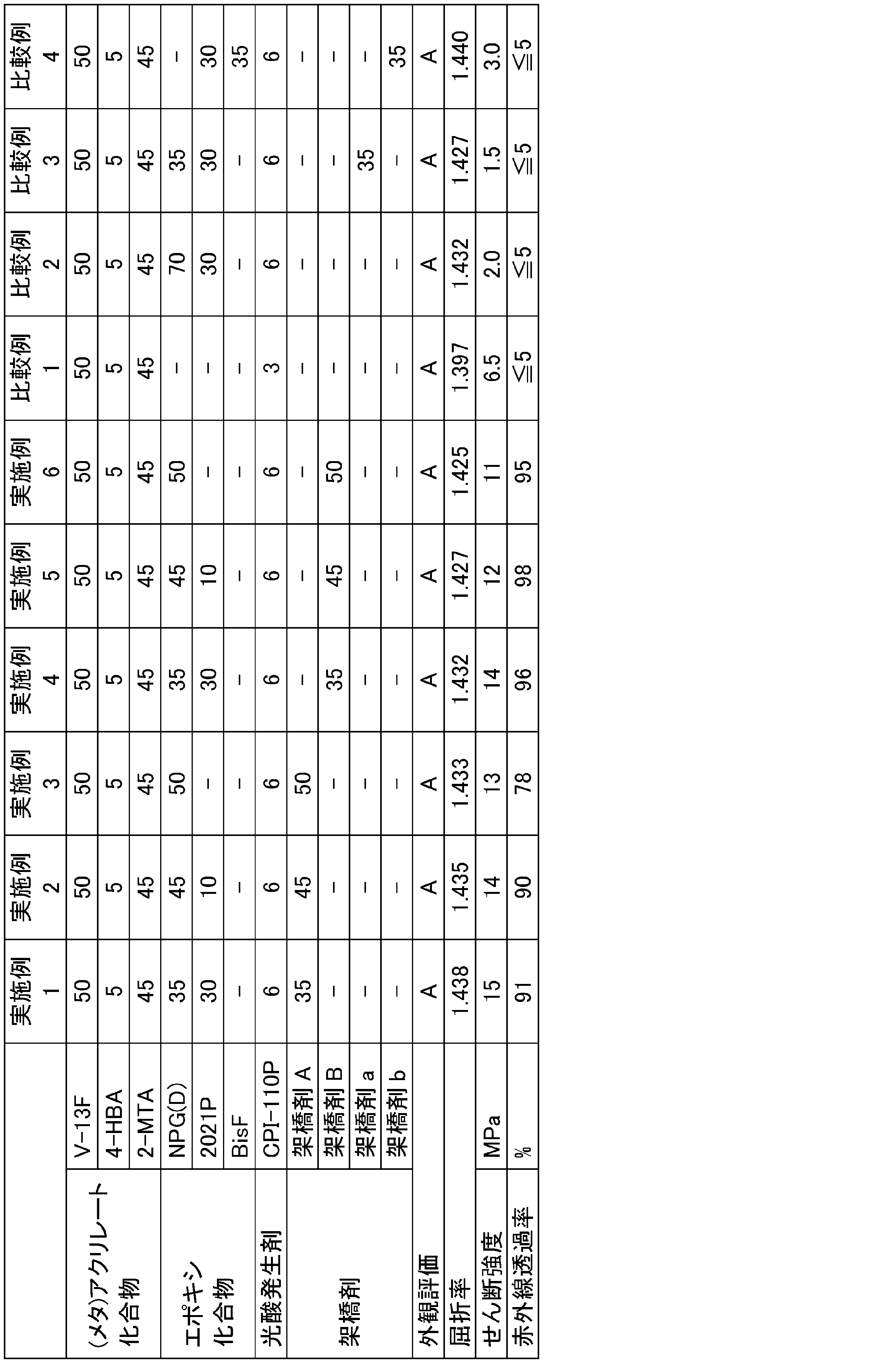

表2及び表3に示すとおり、実施例1~15の接着剤組成物は、比較例1~4の接着剤組成物に比べて、硬化物のせん断強度が高く、硬化物の赤外線透過率も高かった。以上の結果から、本開示の接着剤組成物が、含フッ素有機基を有する(メタ)アクリレートを適用した場合において、充分な接着強度を有し、かつ高い赤外線透過率を有する硬化物を与えることが可能であることが確認された。
Claims (6)
- (メタ)アクリレート化合物と、エポキシ化合物と、架橋剤と、光酸発生剤とを含有し、
前記(メタ)アクリレート化合物が、含フッ素有機基を有する(メタ)アクリレートを含み、
前記架橋剤が、含フッ素有機基を有する(メタ)アクリレートに由来する第一の構造単位、及び、環状エーテル基を有する(メタ)アクリレートに由来する第二の構造単位を有する(メタ)アクリル樹脂を含む、
接着剤組成物。 - 前記第一の構造単位の含有量が、前記(メタ)アクリル樹脂の全構造単位を基準として、10~90モル%であり、
前記第二の構造単位の含有量が、前記(メタ)アクリル樹脂の全構造単位を基準として、10~90モル%である、
請求項1に記載の接着剤組成物。 - 前記エポキシ化合物が、脂肪族エポキシ化合物を含む、
請求項1に記載の接着剤組成物。 - 前記エポキシ化合物が、脂環式エポキシ化合物をさらに含む、
請求項3に記載の接着剤組成物。 - オキセタン化合物をさらに含有する、
請求項1に記載の接着剤組成物。 - 第一の被着体と、第二の被着体と、前記第一の被着体及び前記第二の被着体を互いに接着する接着部とを備え、
前記接着部が、請求項1~4のいずれか一項に記載の接着剤組成物の硬化物を含有する、
接着体。
Priority Applications (2)
| Application Number | Priority Date | Filing Date | Title |
|---|---|---|---|
| CN202480035233.7A CN121195034A (zh) | 2023-07-20 | 2024-07-18 | 黏合剂组合物及黏合体 |
| JP2025534102A JPWO2025018397A1 (ja) | 2023-07-20 | 2024-07-18 |
Applications Claiming Priority (2)
| Application Number | Priority Date | Filing Date | Title |
|---|---|---|---|
| JP2023-118503 | 2023-07-20 | ||
| JP2023118503 | 2023-07-20 |
Publications (1)
| Publication Number | Publication Date |
|---|---|
| WO2025018397A1 true WO2025018397A1 (ja) | 2025-01-23 |
Family
ID=94282316
Family Applications (1)
| Application Number | Title | Priority Date | Filing Date |
|---|---|---|---|
| PCT/JP2024/025837 Ceased WO2025018397A1 (ja) | 2023-07-20 | 2024-07-18 | 接着剤組成物及び接着体 |
Country Status (4)
| Country | Link |
|---|---|
| JP (1) | JPWO2025018397A1 (ja) |
| CN (1) | CN121195034A (ja) |
| TW (1) | TW202511326A (ja) |
| WO (1) | WO2025018397A1 (ja) |
Cited By (1)
| Publication number | Priority date | Publication date | Assignee | Title |
|---|---|---|---|---|
| WO2025127042A1 (ja) * | 2023-12-12 | 2025-06-19 | 株式会社レゾナック | 接着剤組成物及び接着体 |
Citations (8)
| Publication number | Priority date | Publication date | Assignee | Title |
|---|---|---|---|---|
| US5045397A (en) * | 1987-02-13 | 1991-09-03 | Hughes Aircraft Company | Optical adhesive system having low refractive index |
| JP2004238481A (ja) * | 2003-02-06 | 2004-08-26 | Nippon Kayaku Co Ltd | 接着剤用低屈折率樹脂組成物 |
| WO2006001320A1 (ja) * | 2004-06-24 | 2006-01-05 | Nagase Chemtex Corporation | 光学接着剤組成物及び光部品の接着方法 |
| JP2006063148A (ja) * | 2004-08-25 | 2006-03-09 | Nippon Kayaku Co Ltd | 光硬化性接着剤用樹脂組成物およびその硬化物 |
| JP2006257190A (ja) * | 2005-03-16 | 2006-09-28 | Nippon Kayaku Co Ltd | 光硬化性樹脂組成物 |
| JP2013181140A (ja) * | 2012-03-02 | 2013-09-12 | Fujifilm Corp | 光学用樹脂組成物、硬化物、光学部品、半導体発光装置用封止剤、光学レンズ、光学用接着剤、光学用シール剤、光導波路 |
| JP2022045143A (ja) * | 2020-09-08 | 2022-03-18 | セントラル硝子株式会社 | 光硬化性組成物、その硬化物、電子デバイスおよび光学部材 |
| JP2022187462A (ja) * | 2021-06-07 | 2022-12-19 | 富士フイルム株式会社 | 硬化層形成用組成物、積層体、積層体の製造方法、積層体を備えた物品、画像表示装置及びフレキシブルディスプレイ |
-
2024
- 2024-07-18 CN CN202480035233.7A patent/CN121195034A/zh active Pending
- 2024-07-18 TW TW113126965A patent/TW202511326A/zh unknown
- 2024-07-18 WO PCT/JP2024/025837 patent/WO2025018397A1/ja not_active Ceased
- 2024-07-18 JP JP2025534102A patent/JPWO2025018397A1/ja active Pending
Patent Citations (8)
| Publication number | Priority date | Publication date | Assignee | Title |
|---|---|---|---|---|
| US5045397A (en) * | 1987-02-13 | 1991-09-03 | Hughes Aircraft Company | Optical adhesive system having low refractive index |
| JP2004238481A (ja) * | 2003-02-06 | 2004-08-26 | Nippon Kayaku Co Ltd | 接着剤用低屈折率樹脂組成物 |
| WO2006001320A1 (ja) * | 2004-06-24 | 2006-01-05 | Nagase Chemtex Corporation | 光学接着剤組成物及び光部品の接着方法 |
| JP2006063148A (ja) * | 2004-08-25 | 2006-03-09 | Nippon Kayaku Co Ltd | 光硬化性接着剤用樹脂組成物およびその硬化物 |
| JP2006257190A (ja) * | 2005-03-16 | 2006-09-28 | Nippon Kayaku Co Ltd | 光硬化性樹脂組成物 |
| JP2013181140A (ja) * | 2012-03-02 | 2013-09-12 | Fujifilm Corp | 光学用樹脂組成物、硬化物、光学部品、半導体発光装置用封止剤、光学レンズ、光学用接着剤、光学用シール剤、光導波路 |
| JP2022045143A (ja) * | 2020-09-08 | 2022-03-18 | セントラル硝子株式会社 | 光硬化性組成物、その硬化物、電子デバイスおよび光学部材 |
| JP2022187462A (ja) * | 2021-06-07 | 2022-12-19 | 富士フイルム株式会社 | 硬化層形成用組成物、積層体、積層体の製造方法、積層体を備えた物品、画像表示装置及びフレキシブルディスプレイ |
Cited By (1)
| Publication number | Priority date | Publication date | Assignee | Title |
|---|---|---|---|---|
| WO2025127042A1 (ja) * | 2023-12-12 | 2025-06-19 | 株式会社レゾナック | 接着剤組成物及び接着体 |
Also Published As
| Publication number | Publication date |
|---|---|
| JPWO2025018397A1 (ja) | 2025-01-23 |
| TW202511326A (zh) | 2025-03-16 |
| CN121195034A (zh) | 2025-12-23 |
Similar Documents
| Publication | Publication Date | Title |
|---|---|---|
| CN103562267B (zh) | 能量线固化性树脂组合物 | |
| CN118829671A (zh) | 具有改善的可冲压性的可固化的胶粘剂 | |
| CN103842459B (zh) | 粘接性组合物以及使用其的图像显示装置 | |
| US8981040B2 (en) | Cationically polymerizable resin, cationically polymerizable resin composition, and cured products thereof | |
| JPWO2018038221A1 (ja) | 硬化性樹脂組成物、画像表示装置及び画像表示装置の製造方法 | |
| JP6539488B2 (ja) | 硬化物の製造方法、硬化物、硬化性組成物および接着剤 | |
| JPWO2008153076A1 (ja) | 基板貼り合わせ用光学接着剤、及び、基板貼り合わせ用光学接着剤硬化体 | |
| JP2006008819A (ja) | 光硬化性組成物 | |
| JP7481011B2 (ja) | 熱カチオン重合性樹脂組成物 | |
| JP6567399B2 (ja) | 紫外線硬化型粘着剤組成物 | |
| CN121195034A (zh) | 黏合剂组合物及黏合体 | |
| CN101928381A (zh) | 光固化型树脂组合物及使用该树脂组合物的光学部件 | |
| CN102892796B (zh) | 组合物和粘合剂 | |
| JP2009091462A (ja) | カルバゾイル基含有共重合体、光学材料用樹脂組成物および光学材料用部材 | |
| JP2025093697A (ja) | 接着剤組成物及び接着体 | |
| JP6437776B2 (ja) | 光硬化性樹脂組成物及びその用途 | |
| WO2026034566A1 (ja) | 接着剤組成物及び接着体 | |
| WO2025127042A1 (ja) | 接着剤組成物及び接着体 | |
| WO2005019298A1 (ja) | 熱硬化型エポキシ樹脂組成物および透明材料 | |
| JP2018062590A (ja) | 光硬化性組成物 | |
| JP5212368B2 (ja) | 活性エネルギー線硬化型組成物及び光学材料 | |
| JP2006008740A (ja) | 紫外線硬化型樹脂組成物 | |
| CN106414544B (zh) | 固化性树脂组合物 | |
| JP2008208149A (ja) | アクリル共重合体の製造方法 | |
| JP5418783B2 (ja) | 光硬化型接着剤組成物 |
Legal Events
| Date | Code | Title | Description |
|---|---|---|---|
| 121 | Ep: the epo has been informed by wipo that ep was designated in this application |
Ref document number: 24843185 Country of ref document: EP Kind code of ref document: A1 |
|
| ENP | Entry into the national phase |
Ref document number: 2025534102 Country of ref document: JP Kind code of ref document: A |
|
| NENP | Non-entry into the national phase |
Ref country code: DE |