WO2025018292A1 - 蛍光体粉末、複合体および発光装置 - Google Patents
蛍光体粉末、複合体および発光装置 Download PDFInfo
- Publication number
- WO2025018292A1 WO2025018292A1 PCT/JP2024/025248 JP2024025248W WO2025018292A1 WO 2025018292 A1 WO2025018292 A1 WO 2025018292A1 JP 2024025248 W JP2024025248 W JP 2024025248W WO 2025018292 A1 WO2025018292 A1 WO 2025018292A1
- Authority
- WO
- WIPO (PCT)
- Prior art keywords
- phosphor powder
- less
- phosphor
- light
- mass
- Prior art date
- Legal status (The legal status is an assumption and is not a legal conclusion. Google has not performed a legal analysis and makes no representation as to the accuracy of the status listed.)
- Pending
Links
Images
Classifications
-
- C—CHEMISTRY; METALLURGY
- C09—DYES; PAINTS; POLISHES; NATURAL RESINS; ADHESIVES; COMPOSITIONS NOT OTHERWISE PROVIDED FOR; APPLICATIONS OF MATERIALS NOT OTHERWISE PROVIDED FOR
- C09K—MATERIALS FOR MISCELLANEOUS APPLICATIONS, NOT PROVIDED FOR ELSEWHERE
- C09K11/00—Luminescent materials, e.g. electroluminescent or chemiluminescent
- C09K11/08—Luminescent materials, e.g. electroluminescent or chemiluminescent containing inorganic luminescent materials
- C09K11/64—Luminescent materials, e.g. electroluminescent or chemiluminescent containing inorganic luminescent materials containing aluminium
-
- G—PHYSICS
- G02—OPTICS
- G02B—OPTICAL ELEMENTS, SYSTEMS OR APPARATUS
- G02B5/00—Optical elements other than lenses
- G02B5/20—Filters
Definitions
- the present invention relates to phosphor powders, composites, and light-emitting devices.
- Patent Document 1 describes a phosphor that contains a crystal phase represented by the general formula M a Sr b Ca c Al d Si e N f and has a quantum efficiency maintenance rate of 85% or more when excited by 4000 mW/mm 2 light, with the aim of providing a nitride phosphor that has excellent luminescence characteristics even when excited by high - density light, particularly a narrow half-width of the emission spectrum and a high quantum efficiency maintenance rate of light emission.
- the present invention provides a phosphor powder with improved reliability, as well as a composite body and a light-emitting device that use the phosphor powder with improved reliability.
- a phosphor powder containing one or more types of phosphor particles selected from the group consisting of CASN phosphor particles and SCASN phosphor particles, and having an oxygen content increase rate within a specific range, can improve reliability, and thus completed the present invention.
- the present invention provides the following phosphor powder, composite, and light-emitting device.
- a phosphor powder comprising one or more phosphor particles selected from the group consisting of CASN phosphor particles and SCASN phosphor particles, A phosphor powder having an oxygen content increase rate of 100% or more and 500% or less, obtained by the following method 1: (Method 1)
- the oxygen content of the phosphor powder is X1 (mass%)
- the oxygen content of the phosphor powder after 5 g of the phosphor powder is held for 53 hours under an atmosphere of 130°C, relative humidity of 98%, and 0.16 MPaG using a pressure cooker tester is X2 (mass%)
- the oxygen increase rate (%) is 100 ⁇ X2 / X1 .
- [2] The phosphor powder according to [1], wherein X1 is 0.10 mass% or more and 5.00 mass% or less.
- [3] The phosphor powder according to [1] or [2], comprising phosphor particles represented by a general formula, Eu a Sr b Ca c Al d Si e N f O g, in which 0 ⁇ a ⁇ 1.00, 0 ⁇ b ⁇ 1.00, 0 ⁇ c ⁇ 1.00, 0.70 ⁇ a + b + c ⁇ 1.30, 0.70 ⁇ d ⁇ 1.30, 0.70 ⁇ e ⁇ 1.30, 0 ⁇ f ⁇ 3.00, 0 ⁇ g ⁇ 3.00, and 2.50 ⁇ f + g ⁇ 3.50.
- the absorptance of the phosphor powder for light with a wavelength of 455 nm measured using a spectrophotometer is defined as Z1 (%)
- the absorptance of the phosphor powder for light with a wavelength of 455 nm after 5 g of the phosphor powder is held for 53 hours in an atmosphere of 130°C, relative humidity 98%, and 0.16 MPaG using a pressure cooker tester is defined as Z2 (%), where 100 ⁇ ( Z1 - Z2 )/ Z1 is the absorptance reduction rate (%).
- the present invention provides a phosphor powder with improved reliability, as well as a composite body and a light-emitting device that use the phosphor powder with improved reliability.
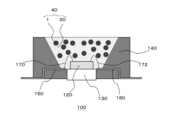
- FIG. 1 is a schematic cross-sectional view showing an example of the structure of a light-emitting device.
- a to B indicating a numerical range means greater than or equal to A and less than or equal to B, unless otherwise specified.
- the phosphor powder of the present embodiment contains one or more phosphor particles selected from the group consisting of CASN phosphor particles and SCASN phosphor particles. From the viewpoint of further improving the fluorescent properties of the phosphor powder, the phosphor powder of the present embodiment preferably contains SCASN phosphor particles.
- the CASN phosphor particles of this embodiment are phosphor particles that are composed of (Si,Al) -N4 regular tetrahedrons bonded together, with Ca atoms located in the gaps between the skeletons, and with some of the Ca 2+ ions being substituted with activator elements such as Eu 2+ ions that act as luminescence centers.
- the SCASN phosphor particles of this embodiment are phosphor particles that are composed of (Si, Al) -N4 regular tetrahedrons bonded together, in which some of the Ca atoms located in the gaps between the skeletons are replaced with Sr atoms to form a solid solution, and further in which some of the Ca2 + are replaced with an activator element such as Eu2 + that acts as a luminescence center.
- the increase rate of the oxygen amount before and after the pressure cooker test is 100% or more and 500% or less.
- the oxygen amount increase rate is calculated by 100 ⁇ X2/X1, where X1 (mass%) is the oxygen content of the phosphor powder, and X2 (mass%) is the oxygen content of the phosphor powder after 5 g of the phosphor powder is held in an atmosphere of 130° C., 98% relative humidity, and 0.16 MPaG for 53 hours using a pressure cooker tester.
- the inventors have found that when the oxygen content of a phosphor powder is X1 (mass %) and the oxygen content of the phosphor powder after holding 5 g of the phosphor powder for 53 hours under an atmosphere of 130°C, relative humidity 98%, and 0.16 MPaG using a pressure cooker tester is X2 (mass %), the reliability of the phosphor powder can be improved by using the oxygen content increase rate calculated by 100 ⁇ X2 / X1 as an index and setting the oxygen content increase rate within the range of 100% or more and 500% or less, thereby completing the present invention.
- the oxygen content increase rate of the phosphor powder of this embodiment is 100% or more, preferably 101% or more, more preferably 103% or more, and 500% or less, preferably 460% or less, more preferably 430% or less, even more preferably 400% or less, even more preferably 380% or less, even more preferably 350% or less, even more preferably 300% or less, even more preferably 250% or less, even more preferably 200% or less, even more preferably 180% or less.
- the oxygen content increase rate of the phosphor powder of this embodiment is 100% or more and 500% or less, preferably 100% or more and 460% or less, more preferably 100% or more and 430% or less, even more preferably 100% or more and 400% or less, even more preferably 100% or more and 380% or less, even more preferably 100% or more and 350% or less, even more preferably 100% or more and 300% or less, even more preferably 100% or more and 250% or less, even more preferably 101% or more and 200% or less, and even more preferably 103% or more and 180% or less.
- the oxygen content X1 of the phosphor powder of this embodiment is preferably 0.10 mass% or more, more preferably 0.50 mass% or more, even more preferably 1.00 mass% or more, even more preferably 1.30 mass% or more, even more preferably 1.50 mass% or more, and is preferably 5.00 mass% or less, more preferably 4.00 mass% or less, even more preferably 3.50 mass% or less, even more preferably 3.00 mass% or less, even more preferably 2.50 mass% or less, and even more preferably 2.40 mass% or less.
- the oxygen content X2 of the phosphor powder after the pressure cooker test of this embodiment is preferably 0.10 mass% or more, more preferably 0.50 mass% or more, even more preferably 1.00 mass% or more, even more preferably 1.30 mass% or more, even more preferably 1.50 mass% or more, and is preferably 12.00 mass% or less, more preferably 11.00 mass% or less, even more preferably 10.00 mass% or less, even more preferably 9.50 mass% or less, even more preferably 9.00 mass% or less, even more preferably 7.00 mass% or less, even more preferably 5.00 mass% or less, and even more preferably 4.00 mass% or less.
- the oxygen content X1 of the phosphor powder of this embodiment is preferably 0.10 mass% or more and 5.00 mass% or less, more preferably 0.10 mass% or more and 4.00 mass% or less, even more preferably 0.50 mass% or more and 3.50 mass% or less, even more preferably 1.00 mass% or more and 3.00 mass% or less, even more preferably 1.30 mass% or more and 2.50 mass% or less, and even more preferably 1.50 mass% or more and 2.40 mass% or less.
- the oxygen content X2 of the phosphor powder after the pressure cooker test of this embodiment is preferably 0.10 mass% or more and 12.00 mass% or less, more preferably 0.10 mass% or more and 11.00 mass% or less, even more preferably 0.10 mass% or more and 10.00 mass% or less, even more preferably 0.10 mass% or more and 9.50 mass% or less, even more preferably 0.50 mass% or more and 9.00 mass% or less, even more preferably 1.00 mass% or more and 7.00 mass% or less, even more preferably 1.30 mass% or more and 5.00 mass% or less, and even more preferably 1.50 mass% or more and 4.00 mass% or less.
- the oxygen content (mass%) of the phosphor powder can be determined, for example, by weighing out 0.03 g of the phosphor powder and measuring the oxygen content using an oxygen/nitrogen analyzer.
- the phosphor powder of this embodiment can be obtained by appropriately selecting the raw materials, the ratio of each raw material used, the manufacturing procedure and manufacturing conditions, etc. Regarding the selection of raw materials and the ratio of raw materials, it is preferable to use a larger amount of Sr-containing raw materials and add a "core" as described below. Regarding the manufacturing procedure and manufacturing conditions, it is preferable to perform atmospheric heat treatment under appropriate conditions, and to perform firing and annealing using a sealed container. These details will be described later.
- the phosphor particles of this embodiment are made of phosphor particles expressed by the general formula Eu a Sr b Ca c Al d Si e N f O g, which has the same crystal phase as CaAlSiN 3.
- the crystalline phase can be confirmed by powder X-ray diffraction.
- a single crystalline phase is preferable, but other phases may be included as long as they do not significantly affect the phosphor properties.
- the presence or absence of other phases can be determined by, for example, the presence or absence of peaks other than those due to the desired crystalline phase using powder X-ray diffraction.
- a be 0.01 ⁇ a, more preferably 0.03 ⁇ a, even more preferably 0.05 ⁇ a, even more preferably 0.06 ⁇ a, even more preferably 0.07 ⁇ a, and it is preferable that a be ⁇ 0.30, more preferably a ⁇ 0.25, even more preferably a ⁇ 0.20, even more preferably a ⁇ 0.15, even more preferably a ⁇ 0.10.
- a from the viewpoint of improving the fluorescent characteristics of the phosphor powder, it is preferable that 0.01 ⁇ a ⁇ 0.30, more preferably 0.03 ⁇ a ⁇ 0.25, even more preferably 0.05 ⁇ a ⁇ 0.20, even more preferably 0.06 ⁇ a ⁇ 0.15, and even more preferably 0.07 ⁇ a ⁇ 0.10.
- b from the viewpoint of improving the fluorescent characteristics of the phosphor powder, it is preferable that 0.50 ⁇ b, more preferably 0.60 ⁇ b, even more preferably 0.70 ⁇ b, even more preferably 0.80 ⁇ b, even more preferably 0.83 ⁇ b, and it is preferable that b ⁇ 0.99, more preferably b ⁇ 0.95, even more preferably b ⁇ 0.90. Furthermore, from the viewpoint of improving the fluorescent characteristics of the phosphor powder, b is preferably 0.50 ⁇ b ⁇ 0.99, more preferably 0.60 ⁇ b ⁇ 0.99, even more preferably 0.70 ⁇ b ⁇ 0.99, even more preferably 0.80 ⁇ b ⁇ 0.95, and even more preferably 0.83 ⁇ b ⁇ 0.90.
- the molar ratio of b/(b+c) is preferably 0.96 or more, more preferably 0.97 or more, even more preferably 0.98 or more, and preferably 0.99 or less, from the viewpoint of improving the fluorescent characteristics of the phosphor powder.
- the molar ratio of b/(b+c) is preferably 0.96 or more and 0.99 or less, more preferably 0.97 or more and 0.99 or less, and even more preferably 0.98 or more and 0.99 or less.
- c is 0 ⁇ c, and preferably c ⁇ 0.20, more preferably c ⁇ 0.15, even more preferably c ⁇ 0.10, even more preferably c ⁇ 0.05, and even more preferably c ⁇ 0.03. Furthermore, from the viewpoint of improving the fluorescent characteristics of the phosphor powder, c is preferably 0 ⁇ c ⁇ 0.20, more preferably 0 ⁇ c ⁇ 0.15, even more preferably 0 ⁇ c ⁇ 0.10, even more preferably 0 ⁇ c ⁇ 0.05, and even more preferably 0 ⁇ c ⁇ 0.03.
- d be 0.80 ⁇ d, more preferably 0.85 ⁇ d, even more preferably 0.90 ⁇ d, even more preferably 0.95 ⁇ d, and it is preferable that d be d ⁇ 1.20, more preferably d ⁇ 1.15, even more preferably d ⁇ 1.10, and even more preferably d ⁇ 1.05.
- d is preferably 0.80 ⁇ d ⁇ 1.20, more preferably 0.85 ⁇ d ⁇ 1.15, even more preferably 0.90 ⁇ d ⁇ 1.10, and still more preferably 0.95 ⁇ d ⁇ 1.05.
- e from the viewpoint of improving the fluorescent characteristics of the phosphor powder, it is preferable that 0.75 ⁇ e, more preferably 0.80 ⁇ e, even more preferably 0.85 ⁇ e, and even more preferably 0.90 ⁇ e, and it is preferable that e ⁇ 1.20, more preferably e ⁇ 1.10, even more preferably e ⁇ 1.05, even more preferably e ⁇ 1.00, and even more preferably e ⁇ 0.97. Furthermore, from the viewpoint of improving the fluorescent characteristics of the phosphor powder, e is preferably 0.75 ⁇ e ⁇ 1.20, more preferably 0.75 ⁇ e ⁇ 1.10, even more preferably 0.80 ⁇ e ⁇ 1.05, even more preferably 0.85 ⁇ e ⁇ 1.00, and even more preferably 0.90 ⁇ e ⁇ 0.97.
- f be 2.55 ⁇ f, more preferably 2.60 ⁇ f, even more preferably 2.65 ⁇ f, even more preferably 2.70 ⁇ f, and even more preferably 2.75 ⁇ f, and it is preferable that f be ⁇ 3.40, more preferably f ⁇ 3.20, even more preferably f ⁇ 3.10, even more preferably f ⁇ 3.00, even more preferably f ⁇ 2.90, even more preferably f ⁇ 2.85, and even more preferably f ⁇ 2.82.
- f from the viewpoint of improving the fluorescent characteristics of the phosphor powder, it is preferable that 2.55 ⁇ f ⁇ 3.40, more preferably 2.55 ⁇ f ⁇ 3.20, even more preferably 2.55 ⁇ f ⁇ 3.10, even more preferably 2.60 ⁇ f ⁇ 3.00, even more preferably 2.65 ⁇ f ⁇ 2.90, even more preferably 2.70 ⁇ f ⁇ 2.85, and even more preferably 2.75 ⁇ f ⁇ 2.82.
- g from the viewpoint of improving the fluorescent characteristics of the phosphor powder, it is preferable that 0.01 ⁇ g, more preferably 0.05 ⁇ g, even more preferably 0.10 ⁇ g, even more preferably 0.15 ⁇ g, and it is preferable that g ⁇ 0.80, more preferably g ⁇ 0.50, even more preferably g ⁇ 0.40, even more preferably g ⁇ 0.35, even more preferably g ⁇ 0.30, even more preferably g ⁇ 0.25.
- g from the viewpoint of improving the fluorescent characteristics of the phosphor powder, it is preferable that 0.01 ⁇ g ⁇ 0.80, more preferably 0.01 ⁇ g ⁇ 0.50, even more preferably 0.01 ⁇ g ⁇ 0.40, even more preferably 0.05 ⁇ g ⁇ 0.35, even more preferably 0.10 ⁇ g ⁇ 0.30, and even more preferably 0.15 ⁇ g ⁇ 0.25.
- the molar ratios of Eu, Sr, Ca, Al and Si among the molar ratios of each element contained in the phosphor powder can be measured, for example, by dissolving the phosphor powder by pressurized acid decomposition to prepare a sample solution, and performing quantitative analysis of the elements in the obtained sample solution using an ICP optical emission spectrometer.
- the molar ratio of N and O among the molar ratios of each element contained in the phosphor powder can be determined, for example, by weighing out 0.03 g of the phosphor powder and measuring the oxygen and nitrogen contents using an oxygen/nitrogen analyzer.
- the median diameter D50 of the phosphor particles of this embodiment is preferably 1 ⁇ m or more, more preferably 5 ⁇ m or more, even more preferably 10 ⁇ m or more, even more preferably 15 ⁇ m or more, even more preferably 17 ⁇ m or more, even more preferably 20 ⁇ m or more, and is preferably 40 ⁇ m or less, more preferably 36 ⁇ m or less, even more preferably 33 ⁇ m or less, even more preferably 30 ⁇ m or less.
- a median diameter of this order is preferable in terms of the balance of various performances such as brightness, conversion efficiency, and reliability.
- the median diameter D50 of the phosphor particles of this embodiment is preferably 1 ⁇ m or more and 40 ⁇ m or less, more preferably 5 ⁇ m or more and 40 ⁇ m or less, even more preferably 10 ⁇ m or more and 40 ⁇ m or less, even more preferably 15 ⁇ m or more and 36 ⁇ m or less, even more preferably 17 ⁇ m or more and 33 ⁇ m or less, and even more preferably 20 ⁇ m or more and 30 ⁇ m or less.
- the median diameter D 50 of the phosphor powder can be measured as a volume-based value by, for example, a laser diffraction scattering method.
- the median diameter D50 can be adjusted by appropriately applying known means such as pulverization, sieving, etc. The details will be described later.
- the absorptance Z1 of the phosphor powder of this embodiment for light with a wavelength of 455 nm is preferably 90.0% or more, more preferably 92.0% or more, even more preferably 94.0% or more, even more preferably 95.0% or more, and is preferably 99.9% or less, more preferably 99.0% or less, even more preferably 98.0% or less.
- the absorptance Z1 of the phosphor powder of this embodiment for light with a wavelength of 455 nm is preferably 90.0% or more and 99.9% or less, more preferably 92.0% or more and 99.9% or less, even more preferably 94.0% or more and 99.0% or less, and still more preferably 95.0% or more and 98.0% or less, from the viewpoint of further improving the performance balance of the reliability and fluorescent characteristics of the phosphor powder.
- the absorptance Z1 of the phosphor powder with respect to light having a wavelength of 455 nm can be determined, for example, by the following method.
- the phosphor powder is filled into a concave cell so that the surface is smooth, and the cell is attached to the opening of an integrating sphere.
- monochromatic light with a wavelength of 455 nm is split from a Xe lamp, which is a light source, and introduced into the integrating sphere using an optical fiber as excitation light for the phosphor.
- the phosphor powder is irradiated with this monochromatic light, which is the excitation light, and the fluorescence spectrum is measured using a spectrophotometer.
- the emission intensity of the phosphor powder is determined, and the number of excitation reflected light photons (Qref) and the number of fluorescence photons (Qem) are calculated.
- the number of excitation reflected light photons is calculated in the wavelength range of 450 to 465 nm, and the number of fluorescence photons is calculated in the range of 465 to 800 nm.
- a standard reflector with a reflectance of 99% (Spectralon (registered trademark) manufactured by Labsphere) is attached to the opening of the integrating sphere to measure the spectrum of excitation light with a wavelength of 455 nm.
- the internal quantum efficiency of the phosphor powder of this embodiment when excited by light with a wavelength of 455 nm is, from the viewpoint of further improving the performance balance of the reliability and fluorescent properties of the phosphor powder, preferably 60.0% or more, more preferably 64.0% or more, even more preferably 67.0% or more, even more preferably 70.0% or more, and preferably 99.0% or less, more preferably 90.0% or less, even more preferably 85.0% or less, and even more preferably 80.0% or less.
- the internal quantum efficiency of the phosphor powder of this embodiment when excited by light with a wavelength of 455 nm is preferably 60.0% or more and 99.0% or less, more preferably 64.0% or more and 90.0% or less, even more preferably 67.0% or more and 85.0% or less, and even more preferably 70.0% or more and 80.0% or less, from the viewpoint of further improving the reliability of the phosphor powder and the performance balance of the fluorescent properties.
- the internal quantum efficiency of the phosphor powder when excited by light with a wavelength of 455 nm can be calculated, for example, based on the calculation results of the above-mentioned excitation reflected light photon number (Qref), fluorescence photon number (Qem), and excitation light photon number (Qex) based on the calculation formula shown below.
- Internal quantum efficiency (Qem / (Qex - Qref)) x 100
- the external quantum efficiency of the phosphor powder of this embodiment when excited by light with a wavelength of 455 nm is, from the viewpoint of further improving the performance balance of the reliability and fluorescent properties of the phosphor powder, preferably 60.0% or more, more preferably 63.0% or more, even more preferably 66.0% or more, even more preferably 68.0% or more, and preferably 99.0% or less, more preferably 90.0% or less, even more preferably 85.0% or less, and even more preferably 80.0% or less.
- the external quantum efficiency of the phosphor powder when excited by light with a wavelength of 455 nm can be calculated based on the calculation results of the above-mentioned excitation reflected light photon number (Qref), fluorescence photon number (Qem), and excitation light photon number (Qex), for example, based on the calculation formula shown below.
- the half-width of the peak of this fluorescent spectrum is preferably 70.0 nm or more, more preferably 71.0 nm or more, even more preferably 72.0 nm or more, even more preferably 73.0 nm or more, and is preferably 77.0 nm or less, more preferably 76.0 nm or less, even more preferably 75.0 nm or less.
- the fluorescence spectrum when the phosphor powder is irradiated with light having a wavelength of 455 nm can be measured, for example, by a method similar to the method for measuring the absorptance Z1 described above.
- the relative fluorescence intensity Y1 of the phosphor powder can be obtained by taking the peak intensity of the emission spectrum obtained by irradiating YAG:Ce with monochromatic light of 455 nm as 100%, and expressing the peak intensity in the fluorescence spectrum measured by the same method as the above-mentioned method for measuring the absorptance Z1 as a relative peak intensity (%).
- the relative fluorescence intensity Y1 is a relative value to the standard sample.
- the absorptance Z2 of the phosphor powder of this embodiment with respect to light having a wavelength of 455 nm is preferably 92.0% or more, more preferably 93.0% or more, even more preferably 94.0% or more, even more preferably 94.5% or more, and is preferably 99.9% or less, more preferably 99.0% or less, and even more preferably 98.5% or less.
- the absorptance Z2 of the phosphor powder with respect to light having a wavelength of 455 nm can be determined, for example, by a method similar to the method for measuring the absorptance Z1 described above.
- the absorptance Z2 of the phosphor powder of this embodiment with respect to light having a wavelength of 455 nm is preferably 92.0% or more and 99.9% or less, more preferably 93.0% or more and 99.9% or less, even more preferably 94.0% or more and 99.0% or less, and even more preferably 94.5% or more and 98.5% or less.
- the absorptance reduction rate (%) of the phosphor powder of this embodiment is preferably -5.0% or more, more preferably -1.0% or more, even more preferably 0.0% or more, and is preferably 5.0% or less, more preferably 4.0% or less, even more preferably 3.0% or less, even more preferably 2.5% or less, even more preferably 2.0% or less.
- the absorptance reduction rate (%) of the phosphor powder of this embodiment is preferably -5.0% or more and 5.0% or less, more preferably -5.0% or more and 4.0% or less, even more preferably -5.0% or more and 3.0% or less, even more preferably -1.0% or more and 2.5% or less, and even more preferably 0.0% or more and 2.0% or less.
- the relative fluorescence intensity Y2 of the phosphor powder of this embodiment is preferably 221% or more, more preferably 223% or more, even more preferably 225% or more, and is preferably 400% or less, more preferably 300% or less, and even more preferably 260% or less.
- the relative fluorescence intensity Y2 is preferably 130% or more, more preferably 150% or more, even more preferably 170% or more, even more preferably 190% or more, even more preferably 200% or more, even more preferably 210% or more, even more preferably 220% or more, and is preferably 400% or less, more preferably 300% or less, even more preferably 260% or less.
- the relative fluorescence intensity Y2 of the phosphor powder of this embodiment after this is preferably 221% or more and 400% or less, more preferably 223% or more and 300% or less, and even more preferably 225% or more and 260% or less, from the viewpoint of further improving the reliability of the phosphor powder.
- the relative fluorescence intensity Y2 is, from the viewpoint of further improving the reliability of the phosphor powder, preferably 130% or more and 400% or less, more preferably 150% or more and 400% or less, even more preferably 170% or more and 400% or less, even more preferably 190% or more and 400% or less, even more preferably 200% or more and 400% or less, even more preferably 210% or more and 300% or less, and even more preferably 220% or more and 260% or less.
- the relative fluorescence intensity reduction rate (%) calculated by 100 ⁇ ( Y1 - Y2 )/ Y1 is preferably -5.0% or more, more preferably -1.0% or more, even more preferably 0.0% or more, and is preferably 10.0% or less, more preferably 8.0% or less, even more preferably 6.0% or less, even more preferably 5.0% or less.
- the relative fluorescence intensity reduction rate (%) calculated by 100 ⁇ ( Y1 - Y2 )/ Y1 is preferably -5.0% or more and 10.0% or less, more preferably -5.0% or more and 8.0% or less, even more preferably -1.0% or more and 6.0% or less, and even more preferably 0.0% or more and 5.0% or less.
- the phosphor powder of this embodiment can be obtained by appropriately selecting raw materials, the ratio of each raw material, the manufacturing procedure and manufacturing conditions, etc.
- the phosphor powder of this embodiment is preferably A mixing step of mixing the starting materials to obtain a raw material mixture powder; A firing process for firing the raw material mixed powder to obtain a lump-shaped fired powder; A powdering step of powdering the lump-shaped fired powder; An annealing step of heat-treating the powdered sintered powder to obtain annealed powder; an acid treatment step of treating the annealed powder with an acid to obtain an acid-treated powder; - An elutriation step for removing fine particles from the acid-treated powder by elutriation; An atmospheric heat treatment step of atmospherically heat treating the acid-treated powder to obtain atmospherically heat-treated powder;
- the phosphor powder can be produced through the steps. In addition, the phosphor powder may be produced through additional steps other than those described above.
- the starting materials are mixed to form a raw material mixed powder.
- the starting material of this embodiment preferably contains all of a europium compound, a strontium compound, a calcium compound, silicon nitride and aluminum nitride, and more preferably contains all of europium oxide, strontium nitride, calcium nitride, silicon nitride and aluminum nitride.
- Each starting material in this embodiment is preferably in powder form.
- the europium compound of this embodiment preferably contains only one selected from the group consisting of europium oxide, europium nitride, and europium fluoride, and more preferably contains only europium oxide.
- europium is divided into those that form a solid solution, those that volatilize, and those that remain as heterogeneous phase components.
- Heterogeneous phase components that contain europium can be removed by acid treatment or the like. However, if too much heterogeneous phase component that contains europium is produced, insoluble components are produced by acid treatment, and the brightness decreases. Also, if the heterogeneous phase does not absorb excess light, it may remain, and europium may be contained in this heterogeneous phase.
- the amount of europium compound in this embodiment is preferably used in such an amount that a in the general formula described above in the charging ratio satisfies 0.05 ⁇ a ⁇ 0.15, and more preferably 0.07 ⁇ a ⁇ 0.10.
- a in the above inequality does not include the amount of europium in the core particles.
- the amount of the strontium compound in this embodiment is preferably used in such an amount that b in the above general formula in the charging ratio is preferably 0.85 ⁇ b ⁇ 1.00, and more preferably 0.95 ⁇ b ⁇ 0.98.
- b in the above inequality does not include the amount of strontium in the core particles.
- the starting material (mixed raw material powder) of this embodiment preferably contains SCASN phosphor core particles having a median diameter of 10 ⁇ m or more and 20 ⁇ m or less.
- a part of the starting material is preferably SCASN phosphor core particles having a median diameter of 10 ⁇ m or more and 20 ⁇ m or less.
- the median diameter of the SCASN phosphor core particles of this embodiment is preferably 10 ⁇ m or more, more preferably 15 ⁇ m or more, and is preferably 20 ⁇ m or less, more preferably 17 ⁇ m or less.
- the SCASN phosphor core particle is also referred to simply as a "core particle" or "core”.
- the core particles of this embodiment can be, for example, a phosphor powder represented by the same general formula as the phosphor powder of this embodiment described above.
- the core particles have the same or similar composition as the phosphor powder of this embodiment, although the increase in oxygen content before and after the pressure cooker test by the above-mentioned method is not necessarily 100% or more and 500% or less.
- core particles When core particles are used, their amount is preferably 7% by mass or more, more preferably 9% by mass or more, and preferably 13% by mass or less, more preferably 11% by mass or less, of the total amount of the raw material mixed powder, from the viewpoint of further improving the fluorescent properties of the phosphor powder.
- the core particles can be obtained, for example, through a process that is substantially the same as that for the phosphor powder of this embodiment. That is, in the manufacturing process of the phosphor powder of this embodiment, the core particles can be obtained in the same manner except that the core particles are not added in the mixing process.
- the composition (general formula) of the core particles is also preferably the same as that of the phosphor powder of this embodiment.
- the raw material mixed powder can be obtained, for example, by a method of dry mixing the starting materials, or a method of wet mixing in an inert solvent that does not substantially react with each starting material and then removing the solvent.
- a mixing device for example, a small mill mixer, a V-type mixer, a rocking mixer, a ball mill, a vibration mill, etc. can be used.
- the raw material mixed powder can be obtained by removing aggregates using a sieve as necessary.
- the mixing step of this embodiment is preferably carried out in a nitrogen atmosphere or in an environment with as little moisture (humidity) as possible.
- the raw material mixed powder obtained in the mixing step is fired to obtain a fired powder.
- the firing temperature in the firing step of this embodiment is preferably 1850°C or higher, more preferably 1900°C or higher, and preferably 2050°C or lower, more preferably 2000°C or lower, from the viewpoint of further improving the performance balance of the reliability and fluorescent properties of the phosphor powder.
- the firing temperature is equal to or higher than the lower limit, the grain growth of the phosphor particles proceeds more effectively. Therefore, the reliability and the performance balance of the fluorescent properties of the phosphor powder can be further improved.
- the firing temperature is equal to or lower than the upper limit, the decomposition of the phosphor particles can be further suppressed. Therefore, the reliability and the performance balance of the fluorescent properties of the phosphor powder can be further improved.
- the heating and holding time in the firing process of this embodiment is preferably 5 hours or more, more preferably 7 hours or more, and preferably 15 hours or less, and even more preferably 10 hours or less, from the viewpoint of further improving the performance balance of the reliability and fluorescent properties of the phosphor powder.
- the pressure in the firing process of this embodiment is preferably 0.7 MPaG or more, more preferably 0.8 MPaG or more, and preferably 1 MPaG or less, more preferably 0.9 MPaG or less, from the viewpoint of further improving the performance balance of the reliability and fluorescent properties of the phosphor powder.
- the firing step of this embodiment is preferably performed in a nitrogen gas atmosphere, that is, the firing step is preferably performed in a nitrogen gas atmosphere with a pressure of 0.7 MPaG or more and 1 MPaG or less.
- the firing process of this embodiment from the viewpoint of further improving the reliability of the phosphor powder and the performance balance of the fluorescent properties, it is preferable to fill the mixture in a container that is unlikely to react with the raw material mixed powder during firing and heat it. Specifically, it is preferable to use a high melting point container, and it is even more preferable to use a tungsten container. This makes it possible to suppress the generation of heterogeneous phases.
- the container is preferably a sealed container with high airtightness.
- the structure of the sealed container is preferably such that the inside of the container is sealed by narrowing the gap between the lid and the body of the container.
- the sintered powder is once pulverized by using a single or a combination of processes such as crushing, grinding, and classification. Since the sintered powder obtained through the sintering step is usually a sintered block, the sintered powder is pulverized to make it easier to handle.
- Specific processing methods for the powdering step of this embodiment include, for example, a method in which the sintered body is pulverized to a predetermined particle size using a general pulverizer such as a ball mill, vibration mill, or jet mill.
- a general pulverizer such as a ball mill, vibration mill, or jet mill.
- the sintered powder is annealed at a temperature lower than the sintering temperature in the sintering step to obtain an annealed powder.
- This can sufficiently improve the luminous efficiency of the phosphor powder, and also can improve the reliability of the phosphor powder and the performance balance of the fluorescent properties, since the rearrangement of the elements removes distortions and defects.
- the annealing step may result in the generation of heterogeneous phases, but these can be sufficiently removed by the acid treatment step described below.
- the annealing process of this embodiment is preferably carried out in a hydrogen gas atmosphere or an argon atmosphere, and more preferably in an argon atmosphere, from the viewpoint of further improving the performance balance of the reliability and fluorescent properties of the phosphor powder.
- the pressure in the annealing process of this embodiment is preferably 0.7 MPaG or more, more preferably 0.8 MPaG or more, and preferably 1 MPaG or less, more preferably 0.9 MPaG or less, from the viewpoint of further improving the performance balance of the reliability and fluorescent characteristics of the phosphor powder.
- the heat treatment temperature in the annealing step of this embodiment is preferably 1250°C or higher, more preferably 1300°C or higher, from the viewpoint of further improving the performance balance of the reliability and fluorescent properties of the phosphor powder, and is preferably 1450°C or lower, more preferably 1400°C or lower.
- the heat treatment time in the annealing step of this embodiment is preferably 5 hours or more, more preferably 7 hours or more, and preferably 10 hours or less, and even more preferably 9 hours or less, from the viewpoint of further improving the performance balance of the reliability and fluorescent properties of the phosphor powder.
- the annealing step of this embodiment similarly to the sintering step, it is preferable to fill the mixture in a container that is unlikely to react with the sintered powder during heat treatment, for example, a high-melting-point container, specifically a container whose inner wall is made of tungsten, and heat it.
- a container that is unlikely to react with the sintered powder during heat treatment for example, a high-melting-point container, specifically a container whose inner wall is made of tungsten, and heat it.
- the container used in the annealing process is a sealed container as described above, and it is even more preferable that both the containers used in the firing process and the annealing process are sealed containers.
- the annealed powder obtained in the annealing step is subjected to an acid treatment to obtain an acid-treated powder.
- an acid treatment to obtain an acid-treated powder.
- an aqueous solution containing one or more acids selected from the group consisting of hydrofluoric acid, sulfuric acid, phosphoric acid, hydrochloric acid, and nitric acid can be used as the acid.
- the aqueous solution preferably contains hydrochloric acid, hydrofluoric acid, nitric acid, and a mixed acid of hydrofluoric acid and nitric acid, and more preferably contains hydrochloric acid.
- the acid treatment step of this embodiment can be carried out by dispersing the annealed powder in an aqueous solution containing the above-mentioned acid.
- the stirring time is preferably 30 minutes or more, more preferably 45 minutes or more, and preferably 3 hours or less, more preferably 2 hours or less.
- the temperature during stirring is preferably 50°C or more, more preferably 60°C or more, and preferably 100°C or less, more preferably 90°C or less.
- the liquid in which the annealed powder is dispersed may be boiled, and substances other than the phosphor powder may be separated by filtration, and substances adhering to the phosphor particles may be washed with water if necessary.
- the phosphor powder is usually dried by natural drying or drying in a dryer. The dried phosphor powder may be placed in a crucible and heated to modify the surface.
- the elutriation process is carried out by putting the acid-treated powder into a dispersion medium, preparing a dispersion liquid and stirring it, then precipitating the acid-treated powder in the dispersion liquid and removing the supernatant. After removing the supernatant, the precipitate is filtered and collected, and dried to obtain acid-treated powder from which the fine powder has been removed.
- the above-mentioned preparation of the dispersion liquid and removal of the supernatant may be repeated. From the viewpoint of further improving the reliability of the phosphor powder and the performance balance of the fluorescent properties, it is preferable to use an aqueous solution of sodium hexametaphosphate as the dispersion medium.
- the acid-treated powder is subjected to atmospheric heat treatment to obtain atmospheric heat-treated powder.
- This improves the performance balance between the reliability and the fluorescent properties of the phosphor powder.
- excessive atmospheric heat treatment deteriorates the fluorescent properties of the phosphor powder, it is important to perform the atmospheric heat treatment under appropriate conditions in order to improve the performance balance between the reliability and the fluorescent properties of the phosphor powder.
- the atmospheric heat treatment step of the present embodiment is preferably carried out in the atmosphere under atmospheric pressure from the viewpoint of further improving the performance balance of the reliability and the fluorescent properties of the phosphor powder.
- the heat treatment temperature in the atmospheric heat treatment step of this embodiment is preferably 250° C. or higher, more preferably 280° C. or higher, even more preferably 320° C. or higher, even more preferably 350° C. or higher, even more preferably 380° C. or higher, and preferably 450° C. or lower, more preferably 420° C. or lower.
- the heat treatment time in the atmospheric heat treatment step of this embodiment is preferably 0.5 hours or more, more preferably 2 hours or more, even more preferably 3.5 hours or more, and is preferably 6 hours or less, more preferably 5 hours or less, from the viewpoint of further improving the performance balance of the reliability and fluorescent properties of the phosphor powder.
- the heat treatment time be equal to or more than the lower limit, the reliability of the phosphor powder can be further improved, and by having the heat treatment time be equal to or less than the upper limit, the deterioration of the fluorescent properties of the phosphor powder can be suppressed.
- the heating rate in the atmospheric heating treatment process of this embodiment is preferably 1°C/min or more, more preferably 2°C/min or more, and is preferably 10°C/min or less, more preferably 5°C/min or less, and even more preferably 3°C/min or less, from the viewpoint of further improving the performance balance of the reliability and fluorescent properties of the phosphor powder.
- the composite of the present embodiment includes, for example, the above-described phosphor powder and a sealant that seals the phosphor powder.
- the above-described phosphor powder is dispersed in the sealant.
- the sealing material of the present embodiment preferably contains one or more materials selected from the group consisting of silicone resin, epoxy resin, urethane resin, glass, and ceramics.
- the content of the phosphor powder in this embodiment when the total amount of the composite is taken as 100 mass%, is preferably 0.1 mass% or more, more preferably 0.5 mass% or more, even more preferably 1 mass% or more, from the viewpoint of further improving the reliability of the composite, and is preferably 20 mass% or less, more preferably 15 mass% or less, even more preferably 10 mass% or less, even more preferably 5 mass% or less.
- the content of the phosphor powder in this embodiment when the total amount of the composite is taken as 100 mass%, is preferably 0.1 mass% to 20 mass% inclusive, more preferably 0.1 mass% to 15 mass% inclusive, even more preferably 0.5 mass% to 10 mass% inclusive, and even more preferably 1 mass% to 5 mass% inclusive, from the viewpoint of further improving the reliability of the composite.
- the composite of this embodiment can be produced by adding the phosphor powder of this embodiment to liquid resin, glass, ceramics, etc., mixing the mixture uniformly, and then curing or sintering the mixture by heat treatment.
- the light emitting device of the present embodiment includes a light emitting element that emits excitation light, and the composite of the present embodiment that converts the wavelength of the excitation light.
- the light emitting device of this embodiment will be described below with reference to Fig. 1, which is a schematic cross-sectional view showing an example of the structure of the light emitting device of this embodiment.
- the light emitting device 100 includes a light emitting element 120, a heat sink 130, a case 140, a first lead frame 150, a second lead frame 160, a bonding wire 170, a bonding wire 172, and a composite body 40.
- the light emitting element 120 is mounted in a specified area on the upper surface of the heat sink 130. By mounting the light emitting element 120 on the heat sink 130, the heat dissipation properties of the light emitting element 120 can be improved. Note that a packaging substrate may be used instead of the heat sink 130.
- the light-emitting element 120 is a semiconductor element that emits excitation light.
- an LED chip that emits light with a wavelength of 300 nm or more and 500 nm or less, which corresponds to near ultraviolet to blue light, can be used as the light-emitting element 120.
- One electrode (not shown) arranged on the upper surface side of the light-emitting element 120 is connected to the surface of the first lead frame 150 via a bonding wire 170 such as a gold wire.
- the other electrode (not shown) formed on the upper surface of the light-emitting element 120 is connected to the surface of the second lead frame 160 via a bonding wire 172 such as a gold wire.
- the case 140 has a generally funnel-shaped recess whose diameter gradually expands from the bottom surface upward.
- the light-emitting element 120 is provided on the bottom surface of the recess.
- the wall surface of the recess surrounding the light-emitting element 120 acts as a reflector.
- the composite 40 is filled in the recess whose wall surface is formed by the case 140.
- the composite 40 is a wavelength conversion member that converts the excitation light emitted from the light emitting element 120 into light with a longer wavelength.
- the composite of this embodiment is used as the composite 40, and the above-mentioned phosphor powder 1 is dispersed in the sealing material 30 such as a resin.
- the light emitting device 100 emits a mixed color of the light of the light emitting element 120 and the light generated from the phosphor powder 1 that absorbs and is excited by the light of the light emitting element 120.
- the composite 40 contains, for example, LuAG phosphor powder in addition to the phosphor powder 1 (it is preferable that LuAG phosphor powder is dispersed in the sealing material 30 in addition to the phosphor powder 1).
- LuAG phosphor powder is dispersed in the sealing material 30 in addition to the phosphor powder 1.
- FIG. 1 shows a surface-mounted light-emitting device as an example, the light-emitting device is not limited to the surface-mounted type.
- the light-emitting device may be a bullet type, a COB (chip-on-board) type, a CSP (chip-scale package) type, or the like.
- Example 1 Preparation of nucleating agent> First, 60.61 g of ⁇ -type silicon nitride (Si 3 N 4 , manufactured by Ube Industries, Ltd., SN-E10 grade), 53.13 g of aluminum nitride (AlN, manufactured by Tokuyama Corporation, E grade), and 13.68 g of europium oxide (Eu 2 O 3 , manufactured by Shin-Etsu Chemical Co., Ltd.) were placed in a container and premixed.
- Si 3 N 4 manufactured by Ube Industries, Ltd., SN-E10 grade
- AlN aluminum nitride
- Eu 2 O 3 manufactured by Shin-Etsu Chemical Co., Ltd.
- the sealed container has a structure in which the body and lid fit together, so the gap between the lid and body is narrower than in conventional containers, improving the sealing performance.
- the temperature inside the electric furnace was raised to 600°C. After reaching 600°C, nitrogen gas was introduced into the electric furnace and the pressure inside the electric furnace was adjusted to 0.85 MPaG. The temperature inside the electric furnace was then raised to 1950°C in a nitrogen gas atmosphere, and after reaching 1950°C, heat treatment was carried out for 8 hours. Heating was then terminated and the material was cooled to room temperature. After cooling to room temperature, red lumps were collected from the container. The collected lumps were crushed and sieved in a mortar to prepare core particles (nucleating agent) with a median diameter of 16 ⁇ m.
- ⁇ Production of phosphor powder> In a container, 51.50 g of ⁇ -type silicon nitride (Si 3 N 4 , manufactured by Ube Industries, Ltd., SN-E10 grade), 45.14 g of aluminum nitride (AlN, manufactured by Tokuyama Corporation, E grade), 15.50 g of europium oxide (Eu 2 O 3 , manufactured by Shin-Etsu Chemical Co., Ltd.), and 24.00 g of the nucleating agent prepared as described above were weighed and premixed.
- ⁇ -type silicon nitride Si 3 N 4 , manufactured by Ube Industries, Ltd., SN-E10 grade
- AlN aluminum nitride
- Eu 2 O 3 manufactured by Shin-Etsu Chemical Co., Ltd.
- a glove box 240 g of the mixed powder was filled into a sealed tungsten container. After closing the lid of the sealed container, it was removed from the glove box and placed in an electric furnace equipped with a carbon heater. The electric furnace was then evacuated sufficiently until the pressure inside was 0.1 PaG or less.
- the temperature inside the electric furnace was raised to 600°C. After reaching 600°C, nitrogen gas was introduced into the electric furnace and the pressure inside the electric furnace was adjusted to 0.85 MPaG. The temperature inside the electric furnace was then raised to 1950°C in a nitrogen gas atmosphere, and after reaching 1950°C, heat treatment was carried out for 8 hours. Heating was then terminated and the material was allowed to cool to room temperature. After cooling to room temperature, red lumps were collected from the container. The collected lumps were crushed and sieved to adjust the particle size and obtain sintered powder.
- the resulting sintered powder was filled into a sealed tungsten container and quickly transferred to an electric furnace equipped with a carbon heater, and the furnace was thoroughly evacuated until the pressure inside was 0.1 PaG or less. Heating was started while continuing the vacuum evacuation, and when the temperature reached 600°C, argon gas was introduced into the furnace and the pressure inside the furnace was adjusted to atmospheric pressure. The temperature continued to rise to 1350°C even after the introduction of argon gas began. After the temperature reached 1350°C, the heat treatment was carried out for 8 hours. Heating was then stopped and the mixture was cooled to room temperature. After cooling to room temperature, the annealed powder was collected from the container. The collected powder was passed through a sieve to adjust the particle size. In this way, annealed powder was obtained.
- the obtained annealed powder was placed in 2.0 M hydrochloric acid at room temperature so that the slurry concentration was 25% by mass, and soaked for 1 hour at 70-80°C. This resulted in acid treatment.
- the hydrochloric acid slurry was boiled for 1 hour while stirring.
- the boiled slurry was cooled to room temperature and filtered to separate the acid treatment liquid from the solids, yielding an acid-treated product.
- the acid-treated product was placed in a dryer set at a temperature range of 100-120°C for 12 hours to dry, yielding an acid-treated powder.
- the obtained acid-treated powder was put into an aqueous solution of sodium hexametaphosphate to prepare a dispersion liquid, which was then stirred.
- the acid-treated powder in the dispersion liquid was then allowed to settle, and the supernatant was then removed. After removing the supernatant, the precipitate was collected by filtration and dried to obtain an acid-treated powder from which the fine particle powder had been removed.
- the preparation of the dispersion liquid and the removal of the supernatant were repeated five times.
- the obtained acid-treated powder was then filled into an alumina crucible and quickly transferred into an electric furnace equipped with a carbon heater, and heated at a rate of 2.5° C./min under atmospheric pressure and in an air atmosphere until the temperature reached 300° C. Then, air heat treatment was carried out for 1 hour after the temperature reached 300° C. After that, heating was terminated and the powder was cooled to room temperature to obtain air-heat-treated powder. In this manner, the phosphor powder of Example 1 was obtained.
- the obtained phosphor sample was subjected to powder X-ray diffraction using CuK ⁇ radiation using an X-ray diffractometer (Ultima IV manufactured by Rigaku Corporation).
- the obtained X-ray diffraction pattern was identical to that of CaAlSiN3 crystals, and it was confirmed that the main crystal phase had the same crystal structure as CaAlSiN3 crystals.
- Example 2 A phosphor powder of Example 2 was obtained in the same manner as in Example 1, except that the atmospheric heat treatment was performed at a temperature of 400°C.
- Example 3 A phosphor powder of Example 3 was obtained in the same manner as in Example 1, except that the heat treatment in air was carried out for 4 hours.
- Example 4 A phosphor powder of Example 4 was obtained in the same manner as in Example 1, except that the atmospheric heat treatment was performed at a treatment temperature of 400° C. for a treatment time of 4 hours.
- Comparative Example 1 A phosphor powder of Comparative Example 1 was obtained in the same manner as in Example 1, except that the heat treatment in air was not carried out.
- Comparative Example 2 A phosphor powder of Comparative Example 2 was obtained in the same manner as in Example 1, except that the atmospheric heat treatment was performed at a temperature of 200°C.
- Comparative Example 3 A phosphor powder of Comparative Example 3 was obtained in the same manner as in Example 1, except that a non-sealed tungsten container was used instead of a sealed tungsten container for firing and annealing.
- the non-sealed container is a container having a structure in which a lid is simply placed on a main body.
- the oxygen content X 1 (mass%) of the phosphor powder was obtained by weighing 0.03 g of the phosphor powder and measuring the oxygen content with an oxygen/nitrogen analyzer (EMGA-920, manufactured by Horiba, Ltd.). Next, using a pressure cooker tester (EHS-221M, manufactured by Espec Corp.), the oxygen content X 2 (mass% ) of the phosphor powder after 53 hours of holding 5 g of the phosphor powder under an atmosphere of 130°C, relative humidity 98%, and 0.16 MPaG was measured in the same manner as X 1. From the above measured values, the oxygen amount increase rate (%) of the phosphor powder before and after the pressure cooker test was calculated by 100 ⁇ X 2 /X 1. The results are shown in Table 2.
- the phosphor powder was dissolved by pressure acid decomposition to prepare a sample solution.
- the obtained sample solution was subjected to quantitative element analysis using an ICP emission spectrometer (Shimadzu Corporation, ICPE-9000) to measure the molar ratios of Eu, Sr, Ca, Al, and Si contained in the phosphor powder.
- the results are shown in Table 1.
- 0.03 g of the phosphor powder was weighed out, and the oxygen and nitrogen contents were measured using an oxygen/nitrogen analyzer to determine the molar ratios of N and O. The results are shown in Table 1.
- Fluorescence measurements were carried out using a spectrofluorophotometer (Hitachi High-Technologies Corporation, F-7000) corrected using rhodamine B and a secondary standard light source. Specifically, the phosphor powder was first filled into a concave cell so that the surface was smooth, and the cell was attached to the opening of an integrating sphere. Next, monochromatic light with a wavelength of 455 nm was split from a Xe lamp, which is a light source, and introduced into the integrating sphere using an optical fiber as excitation light for the phosphor. The phosphor powder was irradiated with the monochromatic light, which was the excitation light, and the fluorescence spectrum was measured using a spectrophotometer.
- the fluorescent spectrum obtained by irradiating the obtained phosphor powder with light having a wavelength of 455 nm was used to determine the peak wavelength and the half-width of the peak.
- the relative fluorescent intensity Y1 of the phosphor powder was also calculated from the peak intensity.
- Table 2 the relative fluorescence intensity Y1 was determined by taking the peak height of the emission spectrum obtained by irradiating YAG:Ce (P46Y3, manufactured by Kasei Optonix Co., Ltd.) with monochromatic light of 455 nm as 100% and expressing the peak intensity of the fluorescence spectrum as a relative peak intensity (%).
- the relative fluorescence intensity Y1 is a relative value to the standard sample.
- the phosphor powders of Examples 1 to 4 in which the oxygen content increase rate was 100% or more and 500% or less, had a relative fluorescence intensity decrease rate of 3.7% or less and an absorptivity decrease rate of 1.6% or less.
- the phosphor powders of Comparative Examples 1 to 3 in which the oxygen amount increase rate exceeded 500%, had a relative fluorescence intensity decrease rate of 10.5% or more and an absorptivity decrease rate of 5.2% or more. From this, it can be understood that the phosphor powders of Examples 1-4 have improved reliability compared to the phosphor powders of Comparative Examples 1-3.
Landscapes
- Chemical & Material Sciences (AREA)
- Physics & Mathematics (AREA)
- Inorganic Chemistry (AREA)
- Engineering & Computer Science (AREA)
- Materials Engineering (AREA)
- Organic Chemistry (AREA)
- General Physics & Mathematics (AREA)
- Optics & Photonics (AREA)
- Luminescent Compositions (AREA)
Priority Applications (1)
| Application Number | Priority Date | Filing Date | Title |
|---|---|---|---|
| JP2025534029A JPWO2025018292A1 (https=) | 2023-07-20 | 2024-07-12 |
Applications Claiming Priority (2)
| Application Number | Priority Date | Filing Date | Title |
|---|---|---|---|
| JP2023-118509 | 2023-07-20 | ||
| JP2023118509 | 2023-07-20 |
Publications (1)
| Publication Number | Publication Date |
|---|---|
| WO2025018292A1 true WO2025018292A1 (ja) | 2025-01-23 |
Family
ID=94282166
Family Applications (1)
| Application Number | Title | Priority Date | Filing Date |
|---|---|---|---|
| PCT/JP2024/025248 Pending WO2025018292A1 (ja) | 2023-07-20 | 2024-07-12 | 蛍光体粉末、複合体および発光装置 |
Country Status (2)
| Country | Link |
|---|---|
| JP (1) | JPWO2025018292A1 (https=) |
| WO (1) | WO2025018292A1 (https=) |
Citations (8)
| Publication number | Priority date | Publication date | Assignee | Title |
|---|---|---|---|---|
| JP2009132916A (ja) * | 2007-11-09 | 2009-06-18 | Mitsubishi Chemicals Corp | 蛍光体、及びその製造方法 |
| JP2014221890A (ja) * | 2013-05-14 | 2014-11-27 | 三菱化学株式会社 | 蛍光体、蛍光体含有組成物、発光装置、画像表示装置及び照明装置 |
| CN106753327A (zh) * | 2016-11-21 | 2017-05-31 | 北京宇极科技发展有限公司 | 一种荧光粉的表面热处理修饰方法以及由其制成的cob光源 |
| JP2020128498A (ja) * | 2019-02-08 | 2020-08-27 | 日亜化学工業株式会社 | 窒化物蛍光体の製造方法及び窒化物蛍光体 |
| WO2022123997A1 (ja) * | 2020-12-07 | 2022-06-16 | デンカ株式会社 | 蛍光体粉末、発光装置、画像表示装置および照明装置 |
| JP2023082287A (ja) * | 2021-12-02 | 2023-06-14 | デンカ株式会社 | 蛍光体粉末の製造方法 |
| WO2023176564A1 (ja) * | 2022-03-15 | 2023-09-21 | デンカ株式会社 | 蛍光体粉末、蛍光体粉末の製造方法、及び発光装置 |
| JP2023135147A (ja) * | 2022-03-15 | 2023-09-28 | デンカ株式会社 | 蛍光体粒子を含む粉末の製造方法 |
-
2024
- 2024-07-12 JP JP2025534029A patent/JPWO2025018292A1/ja active Pending
- 2024-07-12 WO PCT/JP2024/025248 patent/WO2025018292A1/ja active Pending
Patent Citations (8)
| Publication number | Priority date | Publication date | Assignee | Title |
|---|---|---|---|---|
| JP2009132916A (ja) * | 2007-11-09 | 2009-06-18 | Mitsubishi Chemicals Corp | 蛍光体、及びその製造方法 |
| JP2014221890A (ja) * | 2013-05-14 | 2014-11-27 | 三菱化学株式会社 | 蛍光体、蛍光体含有組成物、発光装置、画像表示装置及び照明装置 |
| CN106753327A (zh) * | 2016-11-21 | 2017-05-31 | 北京宇极科技发展有限公司 | 一种荧光粉的表面热处理修饰方法以及由其制成的cob光源 |
| JP2020128498A (ja) * | 2019-02-08 | 2020-08-27 | 日亜化学工業株式会社 | 窒化物蛍光体の製造方法及び窒化物蛍光体 |
| WO2022123997A1 (ja) * | 2020-12-07 | 2022-06-16 | デンカ株式会社 | 蛍光体粉末、発光装置、画像表示装置および照明装置 |
| JP2023082287A (ja) * | 2021-12-02 | 2023-06-14 | デンカ株式会社 | 蛍光体粉末の製造方法 |
| WO2023176564A1 (ja) * | 2022-03-15 | 2023-09-21 | デンカ株式会社 | 蛍光体粉末、蛍光体粉末の製造方法、及び発光装置 |
| JP2023135147A (ja) * | 2022-03-15 | 2023-09-28 | デンカ株式会社 | 蛍光体粒子を含む粉末の製造方法 |
Also Published As
| Publication number | Publication date |
|---|---|
| JPWO2025018292A1 (https=) | 2025-01-23 |
Similar Documents
| Publication | Publication Date | Title |
|---|---|---|
| JP5353192B2 (ja) | 蛍光体、及びその製造方法 | |
| JPWO2020054351A1 (ja) | 蛍光体及び発光装置 | |
| TWI829904B (zh) | 螢光體粉末、複合體及發光裝置 | |
| TW202104550A (zh) | 螢光體粉末及發光裝置 | |
| TWI848088B (zh) | 螢光體粉末、複合體及發光裝置 | |
| JP7638367B2 (ja) | 蛍光体粉末、複合体および発光装置 | |
| WO2019073864A1 (ja) | 赤色蛍光体及び発光装置 | |
| TW202043435A (zh) | 螢光體粉末、複合體及發光裝置 | |
| WO2025018292A1 (ja) | 蛍光体粉末、複合体および発光装置 | |
| JP2025015220A (ja) | 蛍光体粉末、複合体および発光装置 | |
| JP2025015272A (ja) | 蛍光体粉末、複合体および発光装置 | |
| JP2025059381A (ja) | 蛍光体粉末、複合体および発光装置 | |
| JP2025152278A (ja) | 蛍光体粉末、複合体および発光装置 | |
| JP7733641B2 (ja) | 蛍光体粉末、複合体、発光装置および蛍光体粉末の製造方法 | |
| JP2025067085A (ja) | 蛍光体粉末、複合体および発光装置 | |
| JP2022116885A (ja) | 蛍光体粉末の製造方法 | |
| JP7760608B2 (ja) | β型サイアロン蛍光体、発光部材、および発光装置 | |
| JP7778554B2 (ja) | β型サイアロン蛍光体の製造方法、波長変換部材の製造方法、及び発光装置の製造方法 | |
| JP2025140349A (ja) | 蛍光体粉末、複合体および発光装置 | |
| JP2024094873A (ja) | 蛍光体粉末の製造方法 | |
| JP2025018510A (ja) | 蛍光体粉末の製造方法 | |
| WO2024203864A1 (ja) | α型サイアロン蛍光体の製造方法および発光装置の製造方法 | |
| WO2024101330A1 (ja) | 蛍光体、および発光装置 | |
| JP2024175935A (ja) | 蛍光体粉末の製造方法 | |
| JP2024129351A (ja) | 蛍光体粉末の製造方法 |
Legal Events
| Date | Code | Title | Description |
|---|---|---|---|
| 121 | Ep: the epo has been informed by wipo that ep was designated in this application |
Ref document number: 24843083 Country of ref document: EP Kind code of ref document: A1 |
|
| ENP | Entry into the national phase |
Ref document number: 2025534029 Country of ref document: JP Kind code of ref document: A |
|
| WWE | Wipo information: entry into national phase |
Ref document number: 2025534029 Country of ref document: JP |
|
| NENP | Non-entry into the national phase |
Ref country code: DE |