WO2025018181A1 - 冷凍装置 - Google Patents
冷凍装置 Download PDFInfo
- Publication number
- WO2025018181A1 WO2025018181A1 PCT/JP2024/024421 JP2024024421W WO2025018181A1 WO 2025018181 A1 WO2025018181 A1 WO 2025018181A1 JP 2024024421 W JP2024024421 W JP 2024024421W WO 2025018181 A1 WO2025018181 A1 WO 2025018181A1
- Authority
- WO
- WIPO (PCT)
- Prior art keywords
- compressor
- air
- blower
- control device
- wall portion
- Prior art date
- Legal status (The legal status is an assumption and is not a legal conclusion. Google has not performed a legal analysis and makes no representation as to the accuracy of the status listed.)
- Pending
Links
Images
Classifications
-
- F—MECHANICAL ENGINEERING; LIGHTING; HEATING; WEAPONS; BLASTING
- F25—REFRIGERATION OR COOLING; COMBINED HEATING AND REFRIGERATION SYSTEMS; HEAT PUMP SYSTEMS; MANUFACTURE OR STORAGE OF ICE; LIQUEFACTION SOLIDIFICATION OF GASES
- F25B—REFRIGERATION MACHINES, PLANTS OR SYSTEMS; COMBINED HEATING AND REFRIGERATION SYSTEMS; HEAT PUMP SYSTEMS
- F25B1/00—Compression machines, plants or systems with non-reversible cycle
-
- F—MECHANICAL ENGINEERING; LIGHTING; HEATING; WEAPONS; BLASTING
- F25—REFRIGERATION OR COOLING; COMBINED HEATING AND REFRIGERATION SYSTEMS; HEAT PUMP SYSTEMS; MANUFACTURE OR STORAGE OF ICE; LIQUEFACTION SOLIDIFICATION OF GASES
- F25D—REFRIGERATORS; COLD ROOMS; ICE-BOXES; COOLING OR FREEZING APPARATUS NOT OTHERWISE PROVIDED FOR
- F25D19/00—Arrangement or mounting of refrigeration units with respect to devices or objects to be refrigerated, e.g. infrared detectors
-
- F—MECHANICAL ENGINEERING; LIGHTING; HEATING; WEAPONS; BLASTING
- F25—REFRIGERATION OR COOLING; COMBINED HEATING AND REFRIGERATION SYSTEMS; HEAT PUMP SYSTEMS; MANUFACTURE OR STORAGE OF ICE; LIQUEFACTION SOLIDIFICATION OF GASES
- F25D—REFRIGERATORS; COLD ROOMS; ICE-BOXES; COOLING OR FREEZING APPARATUS NOT OTHERWISE PROVIDED FOR
- F25D29/00—Arrangement or mounting of control or safety devices
Definitions
- the present invention relates to a refrigeration device.
- refrigeration devices equipped with a box body having a storage chamber are known.
- Such refrigeration devices are equipped with a cooling device that cools the storage chamber.
- the cooling device has a compressor that compresses and sends out the refrigerant.
- the temperature of the compressor of the cooling device rises.
- This rise in temperature of the compressor causes a rise in temperature in the storage space in which the compressor is housed.
- This rise in temperature in the storage space may have a detrimental effect on other electronic components placed in the storage space.
- the present invention was made in consideration of these circumstances, and aims to provide a refrigeration device that can efficiently cool the compressor.
- a housing having a machine housing section;
- a cooling device having a compressor disposed in a machine housing section and a control device disposed in the machine housing section and controlling the compressor; a blower provided in front of the compressor and configured to blow air toward the compressor from the front,
- the compressor divides the air into at least left and right directions of the compressor,
- the control device is disposed on one side of the compressor in the left-right direction, and guides air diverted by the compressor rearward while being cooled by the air.
- the present invention provides a refrigeration system that can efficiently cool the compressor.
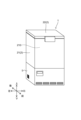
- FIG. 1 is a perspective view showing the overall configuration of a refrigeration device.
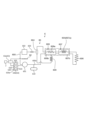
- FIG. 2 is a circuit diagram of the cooling device.
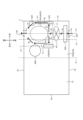
- FIG. 3 is a schematic plan view showing the internal configuration of the machine housing section.
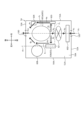
- FIG. 4 is a schematic plan view showing an example of a modified example of the refrigeration device.
- FIG. 1 is a perspective view of a refrigeration device 1 according to an embodiment of the present invention.
- FIG. 2 is a circuit diagram of a cooling device 6.
- FIG. 3 is a schematic plan view showing the internal configuration of a machine storage section 5.
- the freezer 1 is, for example, an ultra-low temperature freezer.
- An ultra-low temperature freezer is one that cools the interior of the freezer to an ultra-low temperature (for example, about -80°C).
- the freezer 1 may also be a medicine refrigerator, a blood refrigerator, or an incubator.
- the Cartesian coordinate system (X, Y, Z) shown in each figure may be used.
- the X direction corresponds to the front-to-rear direction of the refrigeration device 1.
- the + side of the X direction corresponds to the front side of the refrigeration device 1.
- the - side of the X direction corresponds to the rear side of the refrigeration device 1.
- the Y direction corresponds to the left-right direction and width direction of the refrigeration device 1.
- the + side of the Y direction corresponds to the left side when the refrigeration device 1 is viewed from the front.
- the - side of the Y direction corresponds to the right side when the refrigeration device 1 is viewed from the front.
- the Z direction corresponds to the up-down direction of the refrigeration device 1.
- the + side of the Z direction corresponds to the top side of the refrigeration device 1.
- the - side of the Z direction corresponds to the bottom side of the refrigeration device 1.
- the refrigeration device 1 includes a main body 2, a machine storage section 5, and a cooling device 6.
- the main body 2 has a housing 21 and a door 22 that opens and closes the opening.
- the housing 21 has a storage chamber 210 inside that opens upward.
- the storage chamber 210 is a space in which samples are stored, and is cooled to an ultra-low temperature.
- the door 22 opens and closes the opening of the storage chamber 210.
- the machine storage section 5 is provided at the bottom of the main body section 2.
- the machine storage section 5 stores several elements that make up the cooling device 6 that cools the storage chamber 210 of the main body section 2.
- the specific configuration of the machine storage section 5 and the elements that make up the cooling device 6 housed in the machine storage section 5 will be described later.
- the cooling device 6 has a cooling circuit 60, a blower 62, and a control device 63.
- the cooling circuit 60 cools the storage chamber 210 of the housing 21.
- the cooling circuit 60 has a compressor 601, a condenser 602, a dryer 603, a gas-liquid separator 604, an expansion device 605, an evaporator 606, a heat exchanger 607, a second heat exchanger 608, and a second expansion device 609.
- each element 601 to 609 that constitutes the cooling circuit 60 is connected via piping 600.
- the refrigerant then circulates through the cooling circuit 60.
- Compressor 601 compresses the refrigerant so that the pressure value of the refrigerant is 1 MPa or more. This causes the refrigerant to circulate through the cooling circuit 60.
- the high-temperature refrigerant compressed by compressor 601 flows into condenser 602.
- the refrigerant is a non-azeotropic refrigerant mixture that is a mixture of a high-boiling point refrigerant, a medium-boiling point refrigerant with a boiling point lower than that of the high-boiling point refrigerant, and a low-boiling point refrigerant with a boiling point lower than that of the medium-boiling point refrigerant.
- the condenser 602 is, for example, a wire tube type condenser. This allows the refrigerant to be cooled efficiently.
- the refrigerant that passes through the condenser 602 flows into the dryer 603.
- the condenser 602 may also be, for example, a pipe-on-sheet type condenser, a cross-fin type condenser, or a microchannel condenser.
- the dryer 603 removes moisture contained in the refrigerant.
- the function of the dryer 603 is similar to that of dryers in conventional refrigeration systems, so a detailed explanation is omitted.
- the gas-liquid separator 604 is disposed between the dryer 603 and the second heat exchanger 608 described below.
- the gas-liquid separator 604 separates the refrigerant flowing from the dryer 603 to the second heat exchanger 608 into gas-phase refrigerant and liquid-phase refrigerant.
- a portion of the high boiling point refrigerant is liquefied in the refrigerant flowing from the dryer 603 to the second heat exchanger 608.
- the liquid phase refrigerant flowing out of the gas-liquid separator 604 is depressurized by the second expansion device 609.
- the liquid phase refrigerant then flows into the outer tube 608b of the second heat exchanger 608.
- the liquid phase refrigerant merges with the return refrigerant and cools the refrigerant flowing through the inner tube 608a of the second heat exchanger 608.
- the gas phase refrigerant is a high boiling point refrigerant, a medium boiling point refrigerant, and a low boiling point refrigerant in a gaseous state.
- the gas phase refrigerant flowing out of the gas-liquid separator 604 flows into the inner tube 608a of the second heat exchanger 608.
- the heat exchanger 607 is a double-tube type heat exchanger.
- the heat exchanger 607 is disposed between the dryer 603 and the evaporator 606.
- the inner tube 607a of the heat exchanger 607 constitutes the expansion device 605.
- the expansion device 605 is, for example, a capillary tube.
- the refrigerant flows from the compressor 601 to the evaporator 606 through the expansion device 605.
- the refrigerant flows from the evaporator 606 to the compressor 601 through the outer tube 607b of the heat exchanger 607.
- the refrigerant flowing from the evaporator 606 to the compressor 601 is referred to as the return refrigerant.
- the second heat exchanger 608 is a double-pipe type heat exchanger.
- the second heat exchanger 608 is disposed between the dryer 603 and the heat exchanger 607.
- the refrigerant flows from the compressor 601 toward the evaporator 606 through the inner pipe 608a of the second heat exchanger 608.
- the return refrigerant flows through the outer pipe 608b of the second heat exchanger 608.
- the second heat exchanger 608 may be covered with a heat insulating material (e.g., foam).
- the evaporator 606 is arranged around the storage chamber 210 of the housing 21.
- the evaporator 606 vaporizes the refrigerant that flows in from the expansion device 605.
- an expansion tank 610 is connected to the piping element 600a that is connected to the inlet of the compressor 601.
- the expansion tank 610 has the function of adjusting the amount of refrigerant circulating through the cooling circuit 60 by storing a portion of the gas phase refrigerant flowing through the piping element 600a.
- the compressor 601, condenser 602, dryer 603, gas-liquid separator 604, and expansion tank 610 are arranged in the machine storage section 5.
- the blower 62 is a blower such as a fan.
- the cooling device 6 has at least one blower 62 that cools the compressor 601 and the condenser 602.
- the blower 62 is composed of one AC fan motor.
- the blower 62 is disposed in the machine storage section 5.
- the blower 62 is disposed in a position in the machine storage section 5 where it can simultaneously cool the compressor 601 and the condenser 602. The specific location of the blower 62 will be described later.
- the control device 63 controls the operation of the compressor 601.
- the control device 63 has a main control unit 63a and a control relay unit 63b.
- the main control unit 63a is, for example, an electronic circuit board.
- the main control unit 63a controls the operation of the compressor 601 based on the detection value of the temperature sensor 7 (see FIG. 2) described below.
- the control relay unit 63b is connected to a circuit that connects the main control unit 63a and the compressor 601.
- the control relay unit 63b switches the compressor 601 between stopped and driven under the control of the main control unit 63a.
- the control device 63 having the above configuration controls the operation of the compressor 601 at startup and during normal operation. In other words, the control device 63 switches between stopping and driving the compressor 601 in the cooling control (hereinafter sometimes simply referred to as "cooling control") that cools the storage chamber 210 of the housing 21.
- cooling control hereinafter sometimes simply referred to as "cooling control”
- Such a control device 63 is connected to a power source (not shown) and the compressor 601.
- the compressor 601 is connected to the power source via the control device 63.
- the control relay unit 63b is a so-called starting relay device, and has a housing 630, a starting relay 631, an operating capacitor 632, and a starting capacitor 633.
- the housing 630 is box-shaped and has a storage section 630a.
- the starting relay 631 is accommodated in the accommodation section 630a of the housing 630.
- the portion of the accommodation section 630a in which the starting relay 631 is accommodated is sometimes referred to as a first accommodation section (not shown).
- the first accommodation section may be a space surrounded by the walls that constitute the housing 630 (in other words, a closed space).
- the operating capacitor 632 is accommodated in the accommodation section 630a of the housing 630.
- the portion of the accommodation section 630a in which the operating capacitor 632 is accommodated is sometimes referred to as a second accommodation section (not shown).
- the second accommodation section may be a space surrounded by the wall sections that constitute the housing 630.
- the second accommodation section may be a space that is partially open to the external space of the housing 630.
- the second accommodation section may be a closed space.
- the starting capacitor 633 is accommodated in the accommodation section 630a of the housing 630.
- the portion of the accommodation section 630a in which the starting capacitor 633 is accommodated is sometimes referred to as a third accommodation section (not shown).
- the third accommodation section may be a space surrounded by the wall sections that constitute the housing 630.
- the third accommodation section may be a space that is partially open to the external space of the housing 630.
- the third accommodation section may also be a closed space.
- the control device 63 (specifically, the main control unit 63a) also controls the operation of the blower device 62.
- the control device 63 having the above-mentioned configuration is arranged in the machine storage section 5.
- the specific arrangement of the control device 63 will be described later. Note that the function of the control device 63 is almost the same as that of a conventionally known starting relay device, so a detailed explanation will be omitted.
- Figure 3 is a plan view of the machine storage section 5 as viewed from above.
- the upper side in FIG. 3 corresponds to the rear side of the refrigeration device 1.
- the lower side in FIG. 3 corresponds to the front side of the refrigeration device 1.
- the right side in FIG. 3 corresponds to the right side of the refrigeration device 1.
- the left side in FIG. 3 corresponds to the left side of the refrigeration device 1.
- the machine storage section 5 has a box-shaped storage space 50.
- the machine storage section 5 has a bottom wall section 51, a front wall section 52, a rear wall section 53, a left wall section 54, a right wall section 55, and an upper wall section (not shown).
- the space surrounded by the bottom wall portion 51, the front wall portion 52, the rear wall portion 53, the left wall portion 54, the right wall portion 55, and the top wall portion (not shown) is the storage space 50.
- the bottom wall portion 51 is a rectangular plate that is parallel in the front-to-back and left-to-right directions, and forms the bottom surface of the machine storage section 5.
- the front wall 52 is a rectangular plate parallel in the vertical and horizontal directions, and constitutes the front side of the machine storage section 5.
- the front wall 52 has a front ventilation opening 520 that penetrates the front wall 52 in the front-rear direction.
- the rear wall portion 53 is a rectangular plate parallel in the vertical and horizontal directions, and constitutes the rear side of the machine storage section 5.
- the rear wall portion 53 faces the front wall portion 52 in the front-to-rear direction.
- the rear wall portion 53 has a rear ventilation opening 530 that penetrates the rear wall portion 53 in the front-to-rear direction.
- the left wall 54 is a rectangular plate that is parallel in the vertical and front-to-rear directions and forms the left side of the machine storage section 5.
- the right wall portion 55 is a rectangular plate that is parallel in the vertical and front-to-rear directions, and forms the right side of the machine storage section 5.
- the right wall portion 55 faces the left wall portion 54 in the left-right direction.
- the upper wall portion (not shown) is a rectangular plate parallel in the front-to-back and left-to-right directions, and forms the upper surface of the machine storage section 5.
- the upper wall portion (not shown) faces the bottom wall portion 51 in the up-down direction.
- the upper wall portion (not shown) may be considered to be the bottom wall portion of the main body portion 2.
- a compressor 601, a condenser 602, a dryer 603, a gas-liquid separator 604, an expansion tank 610, a blower 62, and a control relay section 63b are arranged.
- the compressor 601, condenser 602, dryer 603, gas-liquid separator 604, expansion tank 610, blower 62, and control relay unit 63b are all arranged in the right-side storage space 500a, which is the space in one half of the storage space 50 in the left-right direction (specifically, the space in the right half).
- the compressor 601, the condenser 602, the dryer 603, the gas-liquid separator 604, the expansion tank 610, the blower 62, and the control relay unit 63b are all disposed in the space to the right of the two-dot chain line ⁇ 1 shown in Fig. 3 in the storage space 50.
- the two-dot chain line ⁇ 1 is a straight line parallel to the front-rear direction and indicates the center position in the left-right direction of the storage space 50.
- the space to the right of the two-dot chain line ⁇ 1 shown in Fig. 3 is the right storage space 500a.
- the compressor 601 is disposed in the rear half of the right-side storage space 500a.
- the condenser 602 is disposed in the front half of the right-side storage space 500a. More specifically, the condenser 602 is disposed in the right-side storage space 500a, near the front wall portion 52.
- the compressor 601 and the condenser 602 are provided on a straight line (a two-dot chain line ⁇ 2 in FIG. 3) that is parallel to the front-rear direction.
- the two-dot chain line ⁇ 2 in FIG. 3 may be regarded as a straight line that passes through the centers of the compressor 601 and the condenser 602 in the left-right direction.
- the right half of the right storage space 500a may be regarded as the rightmost space when the storage space 50 is divided into four in the left-right direction.
- the centers of the compressor 601 and the condenser 602 in the left-right direction are located in the right half of the right-side storage space 500a.
- the right half of the right-side storage space 500a is the space to the right of the two-dot chain line ⁇ 3 in FIG. 3.
- the compressor 601 and the condenser 602 are positioned toward the right side in the storage space 50. The effects and advantages of this configuration will be described later.
- the blower 62 is disposed between the compressor 601 and the condenser 602 in the front-rear direction. Specifically, the blower 62 is disposed in front of the compressor 601. The blower 62 is also disposed behind the condenser 602.
- the blower 62 is disposed on a two-dot chain line ⁇ 2 shown in Fig. 3. That is, the compressor 601, the condenser 602, and the blower 62 are provided on a straight line (the two-dot chain line ⁇ 2 shown in Fig. 3) that is parallel to the front-rear direction.
- the blower 62 draws in air (cooling air) from the front side and blows it out to the rear side as shown by arrows A2 and A3 in Fig. 3.
- the air drawn in by the blower 62 is air that has entered the storage space 50 of the machine storage section 5 from the outside through the front ventilation opening 520 of the front wall portion 52.
- the air sucked in by the blower 62 flows around the condenser 602, thereby cooling the condenser 602. In this way, the blower 62 cools the condenser 602.
- blower 62 blows air towards the compressor 601.
- the air blown by the blower 62 flows around the compressor 601, thereby cooling the compressor 601. In this way, the blower 62 cools the compressor 601.
- the compressor 601 and the condenser 602 are cooled by a single blower device 62.
- This configuration contributes to reducing the number of parts in the cooling device 6 and to making the cooling device 6 more compact.
- the air flow in the storage space 50 will be described later.
- the control device 63 is also arranged on one side of the compressor 601 (specifically, on the left side) in the left-right direction of the compressor 601.
- control device 63 is disposed to the left of the compressor 601 and between the compressor 601 and the condenser 602 in the front-rear direction. In other words, the control device 63 is disposed at a position facing, from the left side, the front passage P1 that is present between the compressor 601 and the condenser 602. The front passage P1 extends in the left-right direction.
- the control device 63 blocks the air flowing in the direction indicated by the arrow A4 in FIG. 3 in the front passage P1 .
- the control device 63 then guides the air rearward while being cooled by the air.
- the expansion tank 610 corresponds to an example of a first device, and is disposed behind the control device 63.
- the expansion tank 610 is disposed on a straight line (a two-dot chain line ⁇ 4 shown in FIG. 3 ) that passes through the center of the control device 63 and is parallel to the front-rear direction.
- the dryer 603 and the gas-liquid separator 604 are arranged in the right-side storage space 500a to the right of the compressor 601 and to the left of the right wall portion 55 of the machine storage section 5.
- the compressor 601, condenser 602, dryer 603, gas-liquid separator 604, expansion tank 610, blower 62, and control relay unit 63b are connected to each other as shown in FIG. 2.
- the front, rear, left, and right sides of the air flow in the storage space 50 are determined based on the relative positions of the compressor 601 and the blower 62.
- the direction of the air flow in the storage space 50 may differ from the direction indicated by the Cartesian coordinate system (X, Y, Z) shown in Figures 1 and 3.
- the direction in which the blower device 62 is arranged relative to the compressor 601 is the front side.
- the opposite direction to the direction in which the blower device 62 is arranged relative to the compressor 601 is the rear side.
- the front-to-rear direction of the air flow in the storage space 50 coincides with the front-to-rear direction of the refrigeration device 1 (i.e., the X direction in the Cartesian coordinate system shown in Figures 1 and 3).
- the left-right direction when the compressor 601 is viewed from the blower 62 coincides with the left-right direction of the air flow in the storage space 50.
- the left-right direction of the air flow in the storage space 50 coincides with the left-right direction of the refrigeration device 1 (i.e., the Y direction in the Cartesian coordinate system shown in Figures 1 and 3).
- the left side of the compressor 601 when viewed from the blower 62 is the left side in terms of the air flow in the storage space 50.
- the right side of the compressor 601 when viewed from the blower 62 is the right side in terms of the air flow in the storage space 50.
- the direction of air flow in the storage space 50 also applies to the direction of arrangement of the compressor 601, condenser 602, dryer 603, gas-liquid separator 604, expansion tank 610, blower 62, and control relay unit 63b in the storage space 50.
- Air that has entered the storage space 50 from outside passes through the condenser 602 and is sucked into the blower device 62 from the front side, as shown by the arrow A2 in Fig. 3. At this time, the condenser 602 is cooled by the air passing through the condenser 602.
- the air sucked into the blower 62 is sent out to the rear side of the blower 62 as shown by the arrow A3 in Fig. 3.
- the air sent out from the blower 62 is blown onto the compressor 601 from the front side as shown by the arrow A3 in Fig. 3.
- the compressor 601 is cooled by the air blown by the blower 62.
- the air blown into the compressor 601 is diverted by the housing 601a of the compressor 601.
- Compressor 601 has housing 601a. As shown in FIG. 3, housing 601a has an elliptical shape in a plan view. In other words, compressor 601 has an elliptical shape in a plan view. Note that plan view means viewing compressor 601 from above.
- Compressor 601 (specifically, housing 601a) is disposed on a straight line (specifically, dashed two-dot line ⁇ 2 in FIG. 3) that includes the major axis of the ellipse that is the shape of housing 601a in a plan view. Therefore, blower 62 and condenser 602 are also disposed on a straight line (specifically, dashed two-dot line ⁇ 2 in FIG. 3) that includes the major axis of the ellipse that is the shape of housing 601a in a plan view.
- the air blown onto the housing 601a hits the front surface of the housing 601a and is diverted at least in the left and right directions so as to follow the front surface of the housing 601a. Specifically, the air blown onto the housing 601a hits the front surface of the housing 601a and is diverted radially so as to follow the front surface of the housing 601a.
- the amount of air diverted in each direction by the front surface of the housing 601a is determined by the shape of the front surface of the housing 601a. In this embodiment, the amount of air diverted by the front surface of the housing 601a is greatest in the left-right direction. Below, the air flow diverted in the left-right direction by the front surface of the housing 601a will be described. A description of the air flow diverted in directions other than the left-right direction by the front surface of the housing 601a will be omitted.
- the air diverted to the left by the front surface of the housing 601a flows leftward through a front passage P1 existing between the compressor 601 and the condenser 602, as indicated by an arrow A4 in Fig. 3. Then, the air flowing leftward through the front passage P1 hits the control device 63.
- the control device 63 is cooled by the air that flows through the front passage P1 and hits the control device 63.
- a portion i.e., the second storage portion
- the second storage portion opens to the right.
- the second storage portion opens in the direction in which the air flowing through the front passage P1 hits the control device 63. Therefore, the operation condenser 632 stored in the second storage portion is efficiently cooled by the air that hits the control device 63.
- a portion of the housing 630 (specifically, the accommodation portion 630a) of the control device 63 that accommodates the starting condenser 633 (see FIG. 2) i.e., the third accommodation portion
- the third accommodation portion opens in a direction in which the air flowing through the front passage P1 strikes the control device 63. Therefore, the starting condenser 633 accommodated in the third accommodation portion is efficiently cooled by the air striking the control device 63.
- the capacitors constituting the running capacitor 632 and the starting capacitor 633 have different life spans depending on the temperature of the usage environment. Specifically, the life span of the capacitors is estimated by the Arrhenius law shown in the following formula (1). According to this embodiment, the usage temperature T0 in the above formula (1) can be lowered, so that the estimated life span L of the running capacitor 632 and the starting capacitor 633 can be increased.
- the control device 63 guides the air that flows through the front passage P1 and hits the control device 63 rearward as shown by the arrow A5 in Fig. 3. It is not necessary for the control device 63 to guide all of the air that flows through the front passage P1 and hits the control device 63 rearward.
- the air guided rearward by the control device 63 flows rearward through a left passage P2 formed on the left side of the compressor 601.
- the left passage P2 corresponds to an example of a first passage.
- the left passage P2 is a passage that is formed by the compressor 601, the control device 63, and the expansion tank 610 and extends in the front-rear direction.
- the compressor 601 functions as a wall portion on one side (specifically, the right side) of the left passage P2 .
- the control device 63 and the expansion tank 610 function as a wall portion on the other side (specifically, the left side) of the left passage P2 .
- the expansion tank 610 together with the control device 63, guides the air diverted by the compressor 601 rearward.
- another device i.e., a first device
- the gas-liquid separator 604 may have a cylindrical separation section (not shown) that separates the refrigerant, and a plate-shaped base section (not shown) that supports the separation section on the bottom wall section 51 of the machine housing section 5.
- the gas-liquid separator 604 may be disposed at the position of the expansion tank 610 in Fig. 3 with the base section aligned along the left passage P2 in Fig. 3.
- the air flowing through the left passage P2 flows along one side surface (specifically, the left side surface) of the compressor 601. At this time, the compressor 601 is cooled by the air flowing through the left passage P2 .
- the air flowing through the left passage P2 flows rearward of the compressor 601 as indicated by an arrow A6 in Fig. 3. Then, the air flowing rearward of the compressor 601 passes through the rear ventilation opening 530 of the rear wall portion 53 as indicated by an arrow A10 in Fig. 3, and is discharged to the outside of the storage space 50.
- the air diverted to the right by the front surface of the housing 601a flows rightward through a front passage P1 existing between the compressor 601 and the condenser 602, as indicated by an arrow A7 in Fig. 3. Then, the air flowing rightward through the front passage P1 hits the right wall portion 55 of the machine housing portion 5.
- the right wall portion 55 guides the air that flows through the front passage P1 and hits the right wall portion 55 rearward as shown by an arrow A8 in Fig. 3. It is not necessary for the right wall portion 55 to guide rearward all of the air that flows through the front passage P1 and hits the right wall portion 55.
- the right wall portion 55 corresponds to an example of a side wall portion.
- the air guided rearward by the right wall portion 55 flows rearward through a right passage P3 formed on the right side of the compressor 601.
- the right passage P3 corresponds to an example of a second passage.
- the right passage P3 is a passage that is formed by the compressor 601 and the right wall portion 55 and extends in the front-rear direction.
- the compressor 601 functions as a wall portion on one side (specifically, the left side) of the right passage P3 .
- the right wall portion 55 functions as a wall portion on the other side (specifically, the right side) of the right passage P3 .
- the compressor 601, the condenser 602, and the blower 62 are disposed in a position biased toward the right side in the accommodation space 50. Therefore, the right wall portion 55 can be used as a right wall portion of the right passage P3 .
- the air flowing through the right passage P3 flows along the other side surface (specifically, the right side surface) of the compressor 601. At this time, the compressor 601 is cooled by the air flowing through the right passage P3 . In addition, the air flowing through the right passage P3 cools the dryer 603 and the gas-liquid separator 604. Note that if the dryer 603 and the gas-liquid separator 604 are configured to be low in height, they do not interfere with the flow of air flowing through the right passage P3 .
- the configuration of the machine storage section is not limited to the configuration of the machine storage section 5 described above.
- the machine storage section may be the machine storage section 5A shown in Fig. 4.
- the machine storage section 5A is narrower than the machine storage section 5 in the above embodiment.
- the dimension of the machine storage section 5A in the left-right direction is half the dimension of the machine storage section 5 in the left-right direction.
- the machine storage section 5A has a box-shaped storage space 50A.
- the machine storage section 5A also has a bottom wall 51A, a front wall 52A, a rear wall 53A, a left wall 54A, a right wall 55A, and a top wall (not shown).
- the configurations of the storage space 50A, the bottom wall 51A, the front wall 52A, the rear wall 53A, the left wall 54A, the right wall 55A, and the top wall (not shown) are substantially the same as the configurations of the storage space 50, the bottom wall 51, the front wall 52, the rear wall 53, the left wall 54, the right wall 55, and the top wall in the above-mentioned embodiment, except for the difference in size. Otherwise, the configuration shown in FIG. 4 is the same as the configuration shown in FIG. 3.
- the compressor 601, the condenser 602, and the blower 62 are arranged on a straight line (double-dashed line ⁇ 2 in FIG. 3) parallel to the front-rear direction.
- the compressor, the condenser, and the blower may be arranged on a straight line (not shown) parallel to a direction other than the front-rear direction (for example, the left-right direction).
- a straight line not shown
- a direction other than the front-rear direction for example, the left-right direction
- the blower device 62 in the above embodiment is configured with one AC fan motor
- the configuration of the blower device is not limited to the configuration of the blower device 62.
- the blower device may be configured with multiple (e.g., four) DC fan motors that are smaller than the AC fan motor that configures the blower device 62.
- the four DC fan motors may be arranged in two rows, one above the other and two rows, one left and one right.
- the refrigeration device does not need to have all of the configurations described above.
- the configurations of the refrigeration device may be selected as appropriate within the scope of technical compatibility.
- the present invention can be applied to various types of refrigeration equipment.
- Refrigeration equipment 2 Main unit 21 Housing 210 Storage room 22 Door 5 Machine storage 50, 50A Housing space 500a Right housing space 51, 51A Bottom wall 52, 52A Front wall 520 Front ventilation port 53, 53A Rear wall 530 Rear ventilation port 54, 54A Left wall section 55, 55A Right wall section P 1 Front passage P 2 Left passage P 3 Right passage 6 Cooling device 60 Cooling circuit 600 Piping 600a Piping element 601 Compressor 601a Housing 602 Condenser 603 Dryer 604 Gas-liquid separator 605 Expansion Device 606 Evaporator 607 Heat exchanger 607a inner tube 607b outer tube 608 Second heat exchanger 608a Inner pipe 609 Second expansion device 610 Expansion tank 62 Blower device 63 Control device 63a Main control section 63b Control relay section 630 Housing 630a Storage section 631 Starting relay 632 Operating capacitor 633 Starting capacitor
Landscapes
- Engineering & Computer Science (AREA)
- Physics & Mathematics (AREA)
- Mechanical Engineering (AREA)
- Thermal Sciences (AREA)
- General Engineering & Computer Science (AREA)
- Chemical & Material Sciences (AREA)
- Combustion & Propulsion (AREA)
- Devices That Are Associated With Refrigeration Equipment (AREA)
Priority Applications (1)
| Application Number | Priority Date | Filing Date | Title |
|---|---|---|---|
| JP2025533974A JPWO2025018181A1 (https=) | 2023-07-14 | 2024-07-05 |
Applications Claiming Priority (2)
| Application Number | Priority Date | Filing Date | Title |
|---|---|---|---|
| JP2023115973 | 2023-07-14 | ||
| JP2023-115973 | 2023-07-14 |
Publications (1)
| Publication Number | Publication Date |
|---|---|
| WO2025018181A1 true WO2025018181A1 (ja) | 2025-01-23 |
Family
ID=94281962
Family Applications (1)
| Application Number | Title | Priority Date | Filing Date |
|---|---|---|---|
| PCT/JP2024/024421 Pending WO2025018181A1 (ja) | 2023-07-14 | 2024-07-05 | 冷凍装置 |
Country Status (2)
| Country | Link |
|---|---|
| JP (1) | JPWO2025018181A1 (https=) |
| WO (1) | WO2025018181A1 (https=) |
Citations (4)
| Publication number | Priority date | Publication date | Assignee | Title |
|---|---|---|---|---|
| JPH0979732A (ja) * | 1995-09-11 | 1997-03-28 | Matsushita Refrig Co Ltd | コンデンシングユニット |
| JP2005180768A (ja) * | 2003-12-18 | 2005-07-07 | Rikio Sato | 温度調整システム |
| JP2020169748A (ja) * | 2019-04-01 | 2020-10-15 | 東芝ライフスタイル株式会社 | 冷蔵庫 |
| WO2023127459A1 (ja) * | 2021-12-27 | 2023-07-06 | Phc株式会社 | 冷凍装置 |
-
2024
- 2024-07-05 JP JP2025533974A patent/JPWO2025018181A1/ja active Pending
- 2024-07-05 WO PCT/JP2024/024421 patent/WO2025018181A1/ja active Pending
Patent Citations (4)
| Publication number | Priority date | Publication date | Assignee | Title |
|---|---|---|---|---|
| JPH0979732A (ja) * | 1995-09-11 | 1997-03-28 | Matsushita Refrig Co Ltd | コンデンシングユニット |
| JP2005180768A (ja) * | 2003-12-18 | 2005-07-07 | Rikio Sato | 温度調整システム |
| JP2020169748A (ja) * | 2019-04-01 | 2020-10-15 | 東芝ライフスタイル株式会社 | 冷蔵庫 |
| WO2023127459A1 (ja) * | 2021-12-27 | 2023-07-06 | Phc株式会社 | 冷凍装置 |
Also Published As
| Publication number | Publication date |
|---|---|
| JPWO2025018181A1 (https=) | 2025-01-23 |
Similar Documents
| Publication | Publication Date | Title |
|---|---|---|
| JP5799924B2 (ja) | 冷凍サイクル装置 | |
| US11338642B2 (en) | Vehicle cabin air conditioning system | |
| KR102594045B1 (ko) | 냉장고 | |
| CN101779091B (zh) | 冰箱 | |
| US7216506B2 (en) | Refrigerator | |
| WO2018047540A1 (ja) | 機器温調装置 | |
| KR20140133722A (ko) | 일체형 공기조화기 | |
| KR101565387B1 (ko) | 냉장고 | |
| JP6992778B2 (ja) | 圧縮機 | |
| US20250042225A1 (en) | Compressor module | |
| KR20230004409A (ko) | 냉장고 | |
| WO2025018181A1 (ja) | 冷凍装置 | |
| EP3575114A1 (en) | Vehicle air conditioner | |
| WO2025018180A1 (ja) | 冷凍装置 | |
| US20080245093A1 (en) | Apparatus for refrigeration | |
| KR20060041721A (ko) | 가열/냉각 시스템 | |
| JP5954511B1 (ja) | ヒートポンプ式蒸気生成装置 | |
| CN114562838A (zh) | 制冷剂回路装置 | |
| KR100602693B1 (ko) | 공기조화기의 실외기 | |
| KR20050008333A (ko) | 전기 냉동/냉장 쇼케이스 | |
| US20240074096A1 (en) | Electronics Cooling in an Environmental Control Unit | |
| JP2010127507A (ja) | 冷凍車 | |
| JP6481824B2 (ja) | ヒートポンプ式空調装置 | |
| WO2021187358A1 (ja) | 冷凍機 | |
| EP4394287A1 (en) | Transport refrigeration unit |
Legal Events
| Date | Code | Title | Description |
|---|---|---|---|
| 121 | Ep: the epo has been informed by wipo that ep was designated in this application |
Ref document number: 24842974 Country of ref document: EP Kind code of ref document: A1 |
|
| ENP | Entry into the national phase |
Ref document number: 2025533974 Country of ref document: JP Kind code of ref document: A |
|
| WWE | Wipo information: entry into national phase |
Ref document number: 2025533974 Country of ref document: JP |
|
| NENP | Non-entry into the national phase |
Ref country code: DE |