WO2025013525A1 - リン酸塩の製造方法 - Google Patents
リン酸塩の製造方法 Download PDFInfo
- Publication number
- WO2025013525A1 WO2025013525A1 PCT/JP2024/021829 JP2024021829W WO2025013525A1 WO 2025013525 A1 WO2025013525 A1 WO 2025013525A1 JP 2024021829 W JP2024021829 W JP 2024021829W WO 2025013525 A1 WO2025013525 A1 WO 2025013525A1
- Authority
- WO
- WIPO (PCT)
- Prior art keywords
- phosphate
- acid
- phosphorus
- producing
- phosphoric acid
- Prior art date
- Legal status (The legal status is an assumption and is not a legal conclusion. Google has not performed a legal analysis and makes no representation as to the accuracy of the status listed.)
- Pending
Links
Images



Classifications
-
- C—CHEMISTRY; METALLURGY
- C01—INORGANIC CHEMISTRY
- C01B—NON-METALLIC ELEMENTS; COMPOUNDS THEREOF; METALLOIDS OR COMPOUNDS THEREOF NOT COVERED BY SUBCLASS C01C
- C01B25/00—Phosphorus; Compounds thereof
- C01B25/16—Oxyacids of phosphorus; Salts thereof
- C01B25/26—Phosphates
- C01B25/37—Phosphates of heavy metals
- C01B25/375—Phosphates of heavy metals of iron
-
- C—CHEMISTRY; METALLURGY
- C01—INORGANIC CHEMISTRY
- C01B—NON-METALLIC ELEMENTS; COMPOUNDS THEREOF; METALLOIDS OR COMPOUNDS THEREOF NOT COVERED BY SUBCLASS C01C
- C01B25/00—Phosphorus; Compounds thereof
- C01B25/16—Oxyacids of phosphorus; Salts thereof
- C01B25/26—Phosphates
- C01B25/32—Phosphates of magnesium, calcium, strontium, or barium
-
- Y—GENERAL TAGGING OF NEW TECHNOLOGICAL DEVELOPMENTS; GENERAL TAGGING OF CROSS-SECTIONAL TECHNOLOGIES SPANNING OVER SEVERAL SECTIONS OF THE IPC; TECHNICAL SUBJECTS COVERED BY FORMER USPC CROSS-REFERENCE ART COLLECTIONS [XRACs] AND DIGESTS
- Y02—TECHNOLOGIES OR APPLICATIONS FOR MITIGATION OR ADAPTATION AGAINST CLIMATE CHANGE
- Y02P—CLIMATE CHANGE MITIGATION TECHNOLOGIES IN THE PRODUCTION OR PROCESSING OF GOODS
- Y02P10/00—Technologies related to metal processing
- Y02P10/20—Recycling
Definitions
- the present invention relates to a method for producing phosphates.
- phosphorus While phosphorus is used in a wide range of fields, including agriculture, food, medicine, and industry, it is a resource that is unevenly distributed around the world, and is only produced in a limited number of countries, including China, the United States, and Morocco.
- the phosphorus resources circulating in Japan are phosphorus products such as yellow phosphorus and crude phosphoric acid, and the raw material for these, phosphate rock, and the entire supply is imported.
- the phosphorus concentration of molten iron tapped from a blast furnace is about 0.1% by mass, and the phosphorus concentration in steelmaking slag produced by subjecting this molten iron to conventional general treatments (dephosphorization treatment, decarburization refining) is as low as about 5% by mass at most, calculated as P2O5 .
- dephosphorization treatment, decarburization refining is as low as about 5% by mass at most, calculated as P2O5 .
- Patent Document 1 discloses a method for recovering phosphorus in the form of calcium phosphate (i.e., producing calcium phosphate) from dephosphorization slag, a type of steelmaking slag.
- Calcium phosphate produced by the method described in Patent Document 1 may contain large amounts of impurities such as silicon.
- phosphorus (phosphate) cannot be recovered in a form other than calcium phosphate.
- the present invention has been made in consideration of the above points, and aims to provide a method for producing phosphate that can obtain the desired phosphate with few impurities.
- a method for producing a target phosphate comprising: a precipitation step of adding an alkali to a phosphorus-containing liquid to obtain a precipitate; and a dissolution step of dissolving the precipitate with an acid to obtain a phosphoric acid liquid, wherein in the precipitation step, the composition of the precipitate is changed by changing the timing of adding the alkali depending on the type of the phosphate.
- the desired phosphate can be obtained with few impurities.
- 1 is a flowchart showing the flow of a method for producing a phosphate according to the present embodiment.
- 1 is a graph showing the relationship between the timing of adding an alkali to a phosphorus-containing liquid and the precipitation rate of each element.
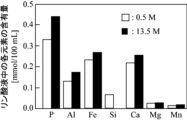
- 1 is a graph showing the content (unit: mmol/100 mL) of each element in a phosphoric acid solution for each concentration (0.5 M and 13.5 M) of acid used.
- 1 is an X-ray diffraction pattern of the residue (III) obtained when an acid (nitric acid) having a concentration of 13.5 M was used.
- FIG. 1 is a flow chart showing the flow of the method for producing a phosphate according to the present embodiment.
- the method for producing a phosphate according to the present embodiment is a method for recovering phosphorus from a starting material in the form of a target phosphate (calcium phosphate, iron phosphate, etc.), and includes an acid leaching step (S0), a precipitation step (S1), a dissolution step (S2), and a cation exchange step (S3), in this order.
- the acid leaching step (S0) and the cation exchange step (S3) are optional steps and may be omitted.
- the method for producing a phosphate according to this embodiment may include an addition step (S4) after the dissolving step (S2) or the cation exchange step (S3).
- ⁇ Acid leaching step (S0)> the components contained in the starting material are leached in acid to obtain a phosphorus-containing liquid. Specifically, for example, the starting material is added to the acid, stirred, and then filtered. This produces a residue (I) and a leachate (A). The leachate (A) is the phosphorus-containing liquid.
- the acid used in the acid leaching step (S0) may be at least one selected from the group consisting of nitric acid, hydrochloric acid, sulfuric acid, phosphoric acid, and organic acids (e.g., citric acid), of which nitric acid or hydrochloric acid is preferred, and nitric acid is more preferred.
- the concentration of the acid is not particularly limited, but is preferably 0.1 to 1.5M, and more preferably 0.3 to 0.8M.
- the starting material examples include steelmaking slag such as dephosphorization slag and decarburization slag.
- the starting material is a phosphorus - containing compound, and preferably contains at least CaO, P2O5 , Al2O3 , and FetO .
- the pH of the acid used in the acid leaching step (S0) is preferably 4.0 or less, more preferably 1.0 or less, and even more preferably 0.5 or less.
- the pH of the acid is within this range, if the ratio of the starting material to the acid is high, the amount of silicon eluted increases accordingly, and the resulting phosphorus-containing liquid may gel. For this reason, it is preferable to determine the ratio of the starting material to the acid by carefully examining the conditions of each step described below.
- pH is measured in accordance with JIS Z8802:2011 "pH measurement method" (hereinafter the same).
- the temperature when measuring pH is 25°C unless otherwise specified.
- ⁇ Precipitation Step (S1)> an alkali is added to the phosphorus-containing liquid to obtain a precipitate. Specifically, for example, an alkali is added to the phosphorus-containing liquid, and then the liquid is filtered. As a result, a precipitate (II) and a filtrate (B) are obtained. The precipitate (II) is the precipitate.
- the phosphorus-containing liquid for example, the leachate (A) obtained in the acid leaching step (S0) is used, but one obtained in another step may also be used.
- the phosphorus-containing liquid preferably contains at least the elements calcium (Ca), phosphorus (P), aluminum (Al) and iron (Fe).
- the phosphorus-containing liquid may further contain elements such as silicon (Si), magnesium (Mg) and manganese (Mn).
- Examples of the alkali used in the precipitation step (S1) include sodium hydroxide, potassium hydroxide, calcium hydroxide, and aqueous ammonia (NH 4 OH). Of these, aqueous ammonia is preferred because it does not contain unnecessary cations.
- the concentration of the aqueous ammonia is not particularly limited, but is preferably from 20 to 40% by mass, and more preferably from 25 to 35% by mass.
- impurities are elements other than the elements that constitute the target phosphate.
- the "impurities” are elements (Fe, Si, Al, etc.) other than calcium (Ca), phosphorus (P) and oxygen (O).
- FIG. 2 is a graph showing the relationship between the timing of adding an alkali to the phosphorus-containing liquid and the precipitation rate of each element.
- the timing of adding an alkali to the phosphorus-containing liquid specifically means, for example, the time from when the phosphorus-containing liquid is obtained in the acid leaching step (S0) to when the alkali is added to the phosphorus-containing liquid.
- the vertical axis in FIG. 2 indicates, for each element, the ratio of the content in the precipitate obtained by adding the alkali (precipitation ratio) to the content in the phosphorus-containing liquid before adding the alkali.
- the precipitation ratio of element M is 100%, it means that all of element M in the phosphorus-containing liquid has been transferred to the precipitate, whereas when the precipitation ratio is 0%, it means that none of element M in the phosphorus-containing liquid has been transferred to the precipitate.
- the timing of adding an alkali to the phosphorus-containing liquid is changed depending on the type of the target phosphate, thereby changing the composition of the resulting precipitate. Specifically, for example, the time from obtaining the phosphorus-containing solution in the acid leaching step (S0) to adding the alkali thereto is changed.
- the timing of adding the alkali is delayed in order to allow the precipitate to contain a sufficient amount of Fe, which is a necessary element.
- the time from obtaining the phosphorus-containing liquid to adding the alkali is preferably 4 hours or more.
- the precipitate since the precipitate also contains a large amount of Si as an impurity, it is preferable to remove Si in the dissolving step (S2) described below.
- the timing of adding the alkali is made earlier in order to reduce the impurities of Si and Fe from the precipitate.
- the time from obtaining the phosphorus-containing liquid to adding the alkali is preferably 1 hour or less.
- the precipitate contains only a small amount of the necessary Ca, it is preferable to add an additional raw material (calcium nitrate) corresponding to the target phosphate (calcium phosphate) in the addition step (S4) described below.
- Si may be removed in the dissolving step (S2) described below.
- ⁇ Dissolving step (S2)> the precipitate (II) obtained in the precipitation step (S1) is dissolved using an acid. This results in a phosphoric acid solution. Specifically, for example, the precipitate is added to an acid, stirred, and then filtered. This results in a residue (III) and a filtrate (C). The filtrate (C) is the phosphoric acid solution.
- the acid used in the dissolution step (S2) may be at least one selected from the group consisting of nitric acid, hydrochloric acid, sulfuric acid, phosphoric acid, and organic acids (e.g., citric acid), with nitric acid or hydrochloric acid being preferred, and nitric acid being more preferred.
- Fig. 3 is a graph showing the content (unit: mmol/100 mL) of each element in the phosphoric acid solution for each concentration of acid used (0.5 M and 13.5 M).
- Fig. 4 shows the X-ray diffraction pattern of the residue (III) obtained when an acid (nitric acid) having a concentration of 13.5 M was used. From Fig. 4, it can be seen that the residue (III) contains silica (SiO 2 ), and Si was separated as silica.
- the concentration of the acid used in the dissolving step (S2) is preferably 10.0 M or more, more preferably 11.5 M or more, and even more preferably 13.0 M or more. This makes it possible to reduce the Si content in the resulting phosphoric acid solution.
- the target phosphate is iron phosphate, calcium phosphate, or the like, since Si is an impurity, it is very beneficial to reduce the Si content in the resulting phosphoric acid solution.
- ⁇ Cation exchange step (S3)> It is preferred to provide a cation exchange step (S3) after the dissolution step (S2).
- the phosphoric acid solution obtained in the dissolving step (S2) is treated with a cation exchange resin (cation exchange treatment), which removes cations from the phosphoric acid solution and increases the purity of the phosphate salt finally obtained.
- the treatment using a cation exchange resin may be, for example, the same treatment as that described in paragraphs [0022] to [0024] of Patent Document 1.
- ⁇ Addition step (S4)> It is preferable to provide an addition step (S4) after the dissolution step (S2) or the cation exchange step (S3).
- an addition step (S4) an additional raw material according to the type of target phosphate is added to the phosphoric acid solution obtained in the dissolving step (S2) (or the phosphoric acid solution treated in the cation exchange step (S3)). In this way, the target phosphate is obtained.
- the target phosphate is calcium phosphate
- calcium nitrate is added as an additional raw material to the phosphoric acid solution in the adding step (S4).
- An alkali is then added to the phosphoric acid solution to which calcium nitrate has been added, thereby obtaining a precipitate of calcium phosphate.
- the alkali to be added is preferably one of those described as the alkali used in the precipitation forming step (S1) above.
- the content of impurities such as Si and Fe in the finally obtained phosphate (calcium phosphate) can be reduced.
- the target phosphate is iron phosphate
- iron nitrate is added as an additional raw material to the phosphoric acid solution, thereby obtaining a precipitate of iron phosphate.
- the content of the impurity Si in the finally obtained phosphate (iron phosphate) can be reduced.
- the desired phosphate can be obtained with few impurities.
- the desired phosphate was obtained.
- the timing of adding the alkali in the precipitation step (S1) and the concentration of the acid (nitric acid) in the dissolution step (S2) were changed.
- Ammonia water concentration: 28% by mass was used as the alkali.
- slag 1 steelmaking slag having the composition shown in Table 1 below were leached in nitric acid (concentration: 0.5 M) to obtain a phosphorus-containing liquid.
- Example 1 The desired phosphate was calcium phosphate.
- the timing of addition of the alkali (the time from obtaining the phosphorus-containing liquid to adding the alkali thereto) was set to 1 hour or less to obtain a precipitate.
- the precipitate was dissolved using nitric acid having a concentration of 13.5 M to obtain a phosphoric acid solution.
- the phosphoric acid solution was passed through a cation exchange resin to obtain a phosphoric acid solution having the composition shown in Table 2 below.
- the adding step (S4) calcium nitrate was added as an additional raw material to the phosphoric acid solution to obtain single-phase calcium phosphate.
- Example 2 In the precipitation step (S1), the timing of adding the alkali was changed to 4 h. Otherwise, a phosphoric acid solution having the composition shown in Table 2 below was obtained in the same manner as in Example 1. Thereafter, in the adding step (S4), calcium nitrate was added as an additional raw material to the phosphoric acid solution to obtain single-phase calcium phosphate. As shown in Table 2 below, the phosphoric acid solution in Example 2 had a higher content of Fe as an impurity than that in Example 1. As a result, the calcium phosphate obtained from the phosphoric acid solution had a higher content of Fe as an impurity.
- Example 3 The desired phosphate was iron phosphate.
- the timing of addition of the alkali (the time from obtaining the phosphorus-containing liquid to adding the alkali thereto) was set to 4 hours, and a precipitate was obtained.
- the precipitate was dissolved using nitric acid having a concentration of 13.5 M to obtain a phosphoric acid solution.
- the phosphoric acid solution was passed through a cation exchange resin to obtain a phosphoric acid solution having the composition shown in Table 3 below.
- iron nitrate was added to the phosphoric acid solution as an additional raw material to obtain iron phosphate.
- Example 4 In the dissolution step (S2), nitric acid having a concentration of 8.5 M was used. Otherwise, the procedure was the same as in Example 3 to obtain a phosphoric acid solution having the composition shown in Table 3 below. Thereafter, in the adding step (S4), iron nitrate was added to the phosphoric acid solution as an additional raw material to obtain iron phosphate. As shown in Table 3 below, the phosphoric acid solution in Example 4 had a higher content of Si, which was an impurity, than that in Example 3. As a result, the iron phosphate obtained from the phosphoric acid solution had a higher content of Si, which was an impurity.
Landscapes
- Chemical & Material Sciences (AREA)
- Organic Chemistry (AREA)
- Inorganic Chemistry (AREA)
- Processing Of Solid Wastes (AREA)
- Manufacture And Refinement Of Metals (AREA)
Priority Applications (3)
| Application Number | Priority Date | Filing Date | Title |
|---|---|---|---|
| JP2024562268A JP7795004B2 (ja) | 2023-07-12 | 2024-06-17 | リン酸塩の製造方法 |
| KR1020257041202A KR20260008131A (ko) | 2023-07-12 | 2024-06-17 | 인산염의 제조 방법 |
| EP24839421.5A EP4711330A1 (en) | 2023-07-12 | 2024-06-17 | Phosphoric acid salt production method |
Applications Claiming Priority (2)
| Application Number | Priority Date | Filing Date | Title |
|---|---|---|---|
| JP2023-114238 | 2023-07-12 | ||
| JP2023114238 | 2023-07-12 |
Publications (1)
| Publication Number | Publication Date |
|---|---|
| WO2025013525A1 true WO2025013525A1 (ja) | 2025-01-16 |
Family
ID=94215410
Family Applications (1)
| Application Number | Title | Priority Date | Filing Date |
|---|---|---|---|
| PCT/JP2024/021829 Pending WO2025013525A1 (ja) | 2023-07-12 | 2024-06-17 | リン酸塩の製造方法 |
Country Status (4)
| Country | Link |
|---|---|
| EP (1) | EP4711330A1 (https=) |
| JP (1) | JP7795004B2 (https=) |
| KR (1) | KR20260008131A (https=) |
| WO (1) | WO2025013525A1 (https=) |
Citations (6)
| Publication number | Priority date | Publication date | Assignee | Title |
|---|---|---|---|---|
| JP2014133196A (ja) * | 2013-01-09 | 2014-07-24 | Kobelco Eco-Solutions Co Ltd | 下水汚泥焼却灰又は製鋼スラグからのリン酸回収方法 |
| JP2017505280A (ja) * | 2013-12-02 | 2017-02-16 | エコフォス・エス・アー | 農業及び食品産業向けのリン酸塩源 |
| JP2020018951A (ja) * | 2018-07-30 | 2020-02-06 | 日本製鉄株式会社 | 鉄鋼スラグからリン酸塩を回収する方法 |
| JP2020192483A (ja) * | 2019-05-24 | 2020-12-03 | 国立大学法人 新潟大学 | 処理方法 |
| JP2022150640A (ja) | 2021-03-26 | 2022-10-07 | 株式会社北匠 | リン化合物の製造方法 |
| CN116395695A (zh) * | 2023-05-10 | 2023-07-07 | 昆明理工大学 | 一种利用赤泥制备磷酸盐的方法 |
-
2024
- 2024-06-17 EP EP24839421.5A patent/EP4711330A1/en active Pending
- 2024-06-17 WO PCT/JP2024/021829 patent/WO2025013525A1/ja active Pending
- 2024-06-17 JP JP2024562268A patent/JP7795004B2/ja active Active
- 2024-06-17 KR KR1020257041202A patent/KR20260008131A/ko active Pending
Patent Citations (6)
| Publication number | Priority date | Publication date | Assignee | Title |
|---|---|---|---|---|
| JP2014133196A (ja) * | 2013-01-09 | 2014-07-24 | Kobelco Eco-Solutions Co Ltd | 下水汚泥焼却灰又は製鋼スラグからのリン酸回収方法 |
| JP2017505280A (ja) * | 2013-12-02 | 2017-02-16 | エコフォス・エス・アー | 農業及び食品産業向けのリン酸塩源 |
| JP2020018951A (ja) * | 2018-07-30 | 2020-02-06 | 日本製鉄株式会社 | 鉄鋼スラグからリン酸塩を回収する方法 |
| JP2020192483A (ja) * | 2019-05-24 | 2020-12-03 | 国立大学法人 新潟大学 | 処理方法 |
| JP2022150640A (ja) | 2021-03-26 | 2022-10-07 | 株式会社北匠 | リン化合物の製造方法 |
| CN116395695A (zh) * | 2023-05-10 | 2023-07-07 | 昆明理工大学 | 一种利用赤泥制备磷酸盐的方法 |
Non-Patent Citations (1)
| Title |
|---|
| SUGIYAMA SHIGERU, HSIAO LI-HAO, TOKUNAGA TAIZO, HASHIMOTO TAKUMI, HABARA MASAKI, SHIMODA NAOHIRO, LIU JHY-CHERN, ABE SEIICHI, YAMA: "PHOSPHORUS RECOVERY FROM SEWAGE-SLUDGE MOLTEN SLAG USING A COMBINATION OF ACID-DISSOLUTION, ALKALI-PRECIPITATION, AND ION-EXCHANGE", PHOSPHORUS RESEARCH BULLETIN, TOKYO, JP, vol. 38, no. 0, 1 January 2022 (2022-01-01), JP , pages 60 - 66, XP093261036, ISSN: 0918-4783, DOI: 10.3363/prb.38.60 * |
Also Published As
| Publication number | Publication date |
|---|---|
| JPWO2025013525A1 (https=) | 2025-01-16 |
| TW202508963A (zh) | 2025-03-01 |
| KR20260008131A (ko) | 2026-01-15 |
| EP4711330A1 (en) | 2026-03-18 |
| JP7795004B2 (ja) | 2026-01-06 |
Similar Documents
| Publication | Publication Date | Title |
|---|---|---|
| CN106185853B (zh) | 生产饲料级湿法净化磷酸联产高纯度高白度半水石膏的方法 | |
| CN112771185B (zh) | 对磷石膏中的稀土进行提纯和浓缩的工艺 | |
| CN105600763B (zh) | 一种氟化盐净化法生产工业磷酸一铵的方法 | |
| CN101724757B (zh) | 一种制取低硅低磷钒液的方法 | |
| CN103663506A (zh) | 精制氢氧化铍的制备方法以及利用该精制氢氧化铍制备核纯级金属铍珠的方法 | |
| JP6119361B2 (ja) | 肥料用リン酸含有スラグの製造方法 | |
| CN114572952A (zh) | 应用冷冻硝酸磷肥工艺制备磷酸并副产肥料的方法 | |
| JP7795004B2 (ja) | リン酸塩の製造方法 | |
| JP6003911B2 (ja) | リン酸質肥料原料、リン酸質肥料およびその製造方法 | |
| CN104192850B (zh) | 一种蛇纹石处理石墨烯废硫酸液的方法 | |
| CN109369026B (zh) | 电炉法生产黄磷同时制备高钙复相微晶玻璃的方法 | |
| CN104030331B (zh) | 一种利用高铝粉煤灰生产氧化铝的方法 | |
| CN111041243A (zh) | 酸性高磷钒液提钒的方法 | |
| CN105018736B (zh) | 一种碳素铬铁冶炼渣中镁、铝、铬、铁综合回收的方法 | |
| TWI921838B (zh) | 磷酸鹽之製造方法 | |
| JPS60166230A (ja) | 硫酸マンガン溶液を製造する方法 | |
| CN112624805A (zh) | 一种降低硝酸磷肥中和料浆粘度的方法和应用 | |
| WO2025013527A1 (ja) | リン酸塩の製造方法 | |
| TWI922199B (zh) | 磷酸鐵之製造方法 | |
| KR102075051B1 (ko) | 플루오린화 나트륨, 용매 추출을 이용하여 조황산니켈, 수산화니켈, 탄산니켈, 황화니켈 및 니켈을 함유한 원료로부터 고순도의 황산니켈6수화물 결정 제조 방법 | |
| US2316330A (en) | Process of treating chromite ores, particularly masinloc ore to obtain therefrom aluminum, chromium, and other products | |
| CN108773856A (zh) | 一种净化钨酸钠溶液的净化工艺 | |
| TW202535774A (zh) | 磷酸鐵之製造方法 | |
| JPWO2025013525A5 (https=) | ||
| JP2025066471A (ja) | リン化合物の製造方法 |
Legal Events
| Date | Code | Title | Description |
|---|---|---|---|
| WWE | Wipo information: entry into national phase |
Ref document number: 2024562268 Country of ref document: JP |
|
| 121 | Ep: the epo has been informed by wipo that ep was designated in this application |
Ref document number: 24839421 Country of ref document: EP Kind code of ref document: A1 |
|
| ENP | Entry into the national phase |
Ref document number: 1020257041202 Country of ref document: KR Free format text: ST27 STATUS EVENT CODE: A-0-1-A10-A15-NAP-PA0105 (AS PROVIDED BY THE NATIONAL OFFICE) |
|
| WWE | Wipo information: entry into national phase |
Ref document number: 1020257041202 Country of ref document: KR |
|
| WWE | Wipo information: entry into national phase |
Ref document number: 2024839421 Country of ref document: EP |
|
| WWE | Wipo information: entry into national phase |
Ref document number: 202517125405 Country of ref document: IN |
|
| ENP | Entry into the national phase |
Ref document number: 2024839421 Country of ref document: EP Effective date: 20251210 |
|
| ENP | Entry into the national phase |
Ref document number: 2024839421 Country of ref document: EP Effective date: 20251210 |
|
| WWP | Wipo information: published in national office |
Ref document number: 202517125405 Country of ref document: IN |
|
| ENP | Entry into the national phase |
Ref document number: 2024839421 Country of ref document: EP Effective date: 20251210 |
|
| REG | Reference to national code |
Ref country code: BR Ref legal event code: B01A Ref document number: 112025028111 Country of ref document: BR |
|
| ENP | Entry into the national phase |
Ref document number: 2024839421 Country of ref document: EP Effective date: 20251210 |
|
| ENP | Entry into the national phase |
Ref document number: 2024839421 Country of ref document: EP Effective date: 20251210 |
|
| WWP | Wipo information: published in national office |
Ref document number: 1020257041202 Country of ref document: KR |
|
| ENP | Entry into the national phase |
Ref document number: 2024839421 Country of ref document: EP Effective date: 20251210 |
|
| ENP | Entry into the national phase |
Ref document number: 2024839421 Country of ref document: EP Effective date: 20251210 |
|
| ENP | Entry into the national phase |
Ref document number: 2024839421 Country of ref document: EP Effective date: 20251210 |
|
| ENP | Entry into the national phase |
Ref document number: 2024839421 Country of ref document: EP Effective date: 20251210 |
|
| NENP | Non-entry into the national phase |
Ref country code: DE |
|
| WWP | Wipo information: published in national office |
Ref document number: 2024839421 Country of ref document: EP |