WO2025009566A1 - 吸熱体及び当該吸熱体を備えた二次電池モジュール - Google Patents
吸熱体及び当該吸熱体を備えた二次電池モジュール Download PDFInfo
- Publication number
- WO2025009566A1 WO2025009566A1 PCT/JP2024/024115 JP2024024115W WO2025009566A1 WO 2025009566 A1 WO2025009566 A1 WO 2025009566A1 JP 2024024115 W JP2024024115 W JP 2024024115W WO 2025009566 A1 WO2025009566 A1 WO 2025009566A1
- Authority
- WO
- WIPO (PCT)
- Prior art keywords
- heat absorber
- mass
- heat
- inorganic
- hydrogel
- Prior art date
- Legal status (The legal status is an assumption and is not a legal conclusion. Google has not performed a legal analysis and makes no representation as to the accuracy of the status listed.)
- Ceased
Links
Images




Classifications
-
- Y—GENERAL TAGGING OF NEW TECHNOLOGICAL DEVELOPMENTS; GENERAL TAGGING OF CROSS-SECTIONAL TECHNOLOGIES SPANNING OVER SEVERAL SECTIONS OF THE IPC; TECHNICAL SUBJECTS COVERED BY FORMER USPC CROSS-REFERENCE ART COLLECTIONS [XRACs] AND DIGESTS
- Y02—TECHNOLOGIES OR APPLICATIONS FOR MITIGATION OR ADAPTATION AGAINST CLIMATE CHANGE
- Y02E—REDUCTION OF GREENHOUSE GAS [GHG] EMISSIONS, RELATED TO ENERGY GENERATION, TRANSMISSION OR DISTRIBUTION
- Y02E60/00—Enabling technologies; Technologies with a potential or indirect contribution to GHG emissions mitigation
- Y02E60/10—Energy storage using batteries
Definitions
- This disclosure relates to a heat absorber and a secondary battery module equipped with the heat absorber.
- Secondary batteries which can control the time difference between energy storage and demand, are used in a variety of applications including automobiles and mobile devices, and are becoming increasingly important as they are needed to expand the introduction of renewable energy from the perspective of building a low-carbon society and ensuring energy security.
- a secondary battery such as a lithium-ion battery
- rises due to heat generation during high-speed charging or high-output discharging there is a risk of the battery being damaged by thermal runaway.
- ultra-high-speed charging progresses in the future, it is predicted that the amount of heat generated will increase, and there is a demand for the development of a method for suppressing temperature rise in order to improve the safety of batteries.
- Secondary batteries can also go into thermal runaway due to internal short circuits, etc., which can cause problems such as fire or smoke. Therefore, in order to minimize the damage caused by such malfunctions, there is a demand for technology that can extinguish the heat from abnormally high temperatures by absorbing heat, or that can suppress, prevent, or delay the explosion by suppressing the transfer of heat to other cells through heat absorption and insulation.
- Patent Document 2 describes an insulating sheet for a battery pack, which has an insulating layer made of at least inorganic fibers or inorganic powder, and a heat absorbing layer made of at least an inorganic hydrate formed on both sides of the insulating layer. According to Patent Document 2, when the inorganic hydrate in the heat absorbing layer, which is the outer layer, is heated by heat generated in the battery cell, the inorganic hydrate exerts a heat absorbing effect of absorbing the heat and releasing moisture, thereby effectively reducing the amount of heat generated by the battery cell.
- the water contained in layer A (for example, water molecules in sodium silicate) undergoes an endothermic reaction in the temperature range of 100 to 300° C., so the water content is limited and a sufficient endothermic effect cannot be obtained.
- a heat absorbing layer made of an inorganic hydrate is used, so the amount of heat absorbed is about 1000 J/g or less, and the content of the inorganic hydrate is limited due to the constraints of the thickness or flexibility of the sheet, so a sufficient endothermic effect cannot be obtained.
- a heat absorber containing a bag, an inorganic mesh, and an aqueous solvent has excellent heat absorption and temperature rise suppression effects, and can change from a heat absorption effect to an insulating effect in the high temperature range, and thus completed the present invention.
- the present disclosure relates to a heat absorber having a bag capable of being filled with a content, and an inorganic mesh body and an aqueous solvent that are filled into the bag as the content.
- a heat absorber according to any one of [1] to [8], which has excellent pressure resistance when heated, and in which a bag capable of being filled with a content, an aqueous solvent, and an inorganic mesh body are filled with the content.
- the heat absorber of [14], [7] or [8] is a high-cushion heat absorber.
- Any of the heat absorbers [9] to [11] is a high pressure resistant heat absorber.
- the heat absorber of the present disclosure has an excellent heat absorption amount and a temperature rise suppression effect, and can change from a heat absorption effect to a heat insulating effect in a high temperature range.
- a highly safe secondary battery module can be provided by including a heat absorber that has an excellent heat absorption amount and temperature rise suppression effect, and that can change from a heat absorption effect to an insulating effect in a high temperature range.
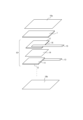
- FIG. 1 shows an example of a secondary battery module on which the heat absorber of the present embodiment can be mounted.
- FIG. 2 is a perspective view that shows a schematic exploded view of the secondary battery module of FIG.
- FIG. 3 is a graph showing the results of a cone calorimeter test (test conditions: radiation intensity 50 kW/m 2 , heating time 20 minutes) of the heat absorbers of the examples and comparative examples, where the vertical axis indicates temperature and the horizontal axis indicates elapsed time.
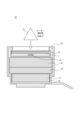
- FIG. 4 shows a schematic diagram of a cone calorimeter test device used in the examples and comparative examples.
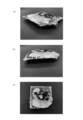
- FIG. 5 shows photographs of the heat absorber of Example 5 before and after the cone calorimeter test: (a) the heat absorber of Example 5 before the cone calorimeter test, (b) the heat absorber of Example 5 during the cone calorimeter test, and (c) the heat absorber of Example 5 after the cone calorimeter test.
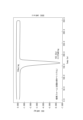
- 1 shows the results of DSC measurement of the heat absorber of Example 2.
- 1 shows the results of DSC measurement of the heat absorber of Comparative Example 2.
- 1 shows the results of DSC measurement of the heat absorber of Comparative Example 3.
- the present embodiment an embodiment of the present invention (hereinafter referred to as the "present embodiment") will be described in detail, but the present disclosure is not limited to the following description and can be implemented in various modified forms within the scope of its gist.
- the term "mesh body made of inorganic material” is a general term for a network structure made of inorganic material and having fine pores or gaps. Therefore, it is preferable that the structure is capable of trapping air bubbles.
- the "mesh body made of inorganic material” refers to a structure that is, for example, a fiber aggregate in which fibers made of inorganic material are entangled with each other or a porous body made of inorganic material and can trap air bubbles, and specific examples thereof include woven fabrics, nonwoven fabrics, cotton-like bodies (including not only glass wool, rock wool, and ceramic wool but also spongy bodies (sponge bodies)), and porous bodies.
- reaction raw material refers to a compound that is used to obtain a target compound through a chemical reaction such as synthesis or decomposition and that partially constitutes the chemical structure of the target compound, and excludes substances that play the role of auxiliary agents in chemical reactions, such as solvents, catalysts, and polymerization initiators.
- structural unit refers to a (repeating) unit of a chemical structure formed during a reaction or polymerization, in other words, refers to a partial structure other than the structure of the chemical bonds involved in the reaction or polymerization in a product compound formed during a reaction or polymerization, i.e., a so-called residue.
- hydrogel refers to a three-dimensional network of polymers that contains an aqueous solvent such as water, and includes, for example, jelly, absorbent diapers, konjac, agar, etc.
- the three-dimensional network polymer that is the skeleton of the hydrogel is called the hydrogel body, and the hydrogel body contains an aqueous solvent.
- the hydrogel contains the hydrogel body and an aqueous solvent.
- the heat absorber of the present disclosure includes a bag that can be filled with a content, an inorganic mesh body filled in the bag, and an aqueous solvent. This provides excellent heat absorption and temperature rise suppression effects, and the heat absorption effect can be changed to a heat insulating effect in the high temperature range.
- the heat can be absorbed by the latent heat of vaporization of the aqueous solvent contained in the inorganic material mesh or the aqueous solvent in the bag. Therefore, the latent heat of vaporization of water, which has a larger heat absorption capacity than general hydrates, can be used.
- the temperature since it is absorbed as sensible heat of the aqueous solvent, the temperature can be stabilized even at room temperature.
- the aqueous solvent evaporates, and voids are generated in the inorganic material mesh, which exhibits heat insulation and fire prevention effects. More specifically, the air bubbles captured in the inorganic material mesh or the voids in the inorganic material mesh generated by the evaporation of the aqueous solvent (for example, gaps between fibers) act as pores, so that the entire heat absorber can become a porous body. As a result, heat insulation and fire prevention effects are exhibited. Therefore, in a relatively low temperature range (for example, from room temperature to around 100°C), it mainly works as a heat absorber.
- the entire heat absorber becomes a porous body, so it can also act as a heat insulator.
- the critical temperature for example, 150°C
- the thermal runaway temperature for example, around 1000°C
- the content may further contain one or more selected from the group consisting of a hydrogel body, an inorganic powder, and an antifreeze agent.
- a hydrogel body When the hydrogel body is contained as the content, it is possible to impart cushioning and impact resistance to the heat absorber.
- the inorganic powder When the inorganic powder is contained as the content, it is possible to continuously absorb heat at a different endothermic temperature from that of the aqueous solvent.
- the aqueous solvent evaporates, voids are generated in the inorganic material mesh, and the composite containing the inorganic material mesh and the inorganic powder is likely to form a porous body, so that the heat absorber changes from a heat insulator to an insulator, and both the heat absorption and heat insulation effects can be more effectively exerted throughout the thickness of the heat absorber.
- an antifreeze is contained as the content, it is possible to suppress freezing below the freezing point.
- by utilizing the heat of solidification of the aqueous solvent it is possible to suppress the temperature drop of the battery in a cold environment. In the case of water, heat of solidification occurs at around 0°C, but by using an antifreeze at this time, it is possible to lower the temperature at which this heat of solidification occurs, and it is possible to suppress the temperature drop of the battery at a lower temperature.
- the endothermic onset temperature of the heat absorber of this embodiment is preferably 400°C or less, more preferably 160°C or less, even more preferably 120°C or less, more preferably 110°C or less, and even more preferably 100°C or less.
- the range of the endothermic start temperature of the heat absorber of this embodiment is preferably 35° C. or more and 400° C. or less, more preferably 37° C. or more and 160° C. or less, and even more preferably 40° C. or more and 110° C. or less.
- the upper and lower limits of the endothermic starting temperature of the heat absorber can be appropriately changed.
- the endothermic onset temperature is the temperature of the intersection of a straight line extending the low-temperature side baseline to the high-temperature side in a DSC measurement curve, which is the measurement result of a differential scanning calorimeter (DSC), and a tangent drawn at the point where the gradient is maximum on the low-temperature side curve of the endothermic peak associated with evaporation.
- the intersection of a straight line extending the low-temperature side baseline to the high-temperature side and a tangent drawn at the point where the gradient is maximum on the low-temperature side curve of each of the multiple endothermic peaks is calculated for each of the multiple endothermic peaks, and the lowest temperature among the multiple intersections is taken as the endothermic onset temperature.
- the endothermic peak temperature of the heat absorber of this embodiment is preferably in the range of at least 80°C to 400°C, and more preferably in the range of 90°C to 160°C.
- the endothermic peak temperature refers to the temperature (°C) at the maximum value of the endothermic peak due to evaporation in a DSC measurement curve, which is the measurement result of a differential scanning calorimeter (DSC).
- DSC differential scanning calorimeter
- the heat absorption amount of the heat absorber of this embodiment is not particularly limited, but at the endothermic peak temperature (range of 80°C to 160°C), it is preferably 100 J/g or more, more preferably 200 J/g or more, even more preferably 300 J/g or more, and even more preferably 500 J/g or more, and preferably 3000 J/g or less, more preferably 2500 J/g or less, and even more preferably 2000 J/g or less.
- the range of the heat absorption amount of the heat absorber of this embodiment is preferably 100 J/g or more and 3000 J/g or less, more preferably 200 J/g or more and 2500 J/g or less, and even more preferably 300 J/g or more and 2000 J/g or less.
- the preferable range of the endothermic heat amount can be appropriately changed by changing the upper and lower limits.
- the endothermic start temperature, endothermic peak temperature and endothermic amount of the heat absorber of this embodiment are values determined using a differential scanning calorimeter (DSC) according to the method of the examples described later.
- the shape or size of the heat absorber of this embodiment is not particularly limited, and may be, for example, substantially spherical, substantially flat, or amorphous, and is appropriately selected depending on the application to be used.
- a substantially flat heat absorber is preferable because it is easy to install between adjacent battery cells.
- the average thickness of the heat absorber of the present embodiment when it is substantially flat is not particularly limited, but may be in the range of 100 ⁇ m to 50,000 ⁇ m.
- the lower limit of the average thickness is preferably 100 ⁇ m or more, more preferably 200 ⁇ m or more, even more preferably 500 ⁇ m or more, and particularly preferably 1,000 ⁇ m or more.
- the upper limit of the average thickness is preferably 50,000 ⁇ m or less, more preferably 20,000 ⁇ m or less, even more preferably 10,000 ⁇ m or less, and particularly preferably 8,000 ⁇ m or less.
- the upper and lower limits of the preferred range of the average thickness can be appropriately changed.
- the bag of the present embodiment is not particularly limited as long as it can be filled with the contents such as the aqueous solvent or the inorganic material mesh body.
- a three-sided bag having an opening on the upper end side, a body part with a closed lower end, and a structure that is heat-sealed so that the opening is closed after the contents such as the inorganic material mesh body and the aqueous solvent are all contained therein is preferable.
- the three-sided bag is constructed by gluing together the lower ends and side portions of two sheets on three sides and then sealing the bag after filling it with contents through the opening, making it highly airtight, and its approximately flat shape makes it easy to insert between battery cells.
- the bag body of this embodiment is preferably made of a sheet.
- two sheets of film of a desired size and shape e.g., rectangular or (approximately) circular
- a predetermined heat seal area e.g., edge of the film
- This forms an internal space area in which the contents can be filled, and has an opening so that the contents can be filled into the internal space area through the opening, and a three-sided bag in which the heat seal areas of the two sheets are bonded together can be produced. Then, after filling the contents, the openings can be heat-sealed by pressing them together.
- the term “sealed” refers to a state in which the inside and outside of the bag are substantially sealed off.
- the sheet used in the bag body of this embodiment is not particularly limited as long as it exhibits water impermeability, and examples thereof include known resin films, resin films having a metal layer, and films having a metal layer.
- the average thickness of the sheet used in the bag of this embodiment is not particularly limited, but is preferably 30 ⁇ m to 200 ⁇ m, and more preferably 60 ⁇ m to 150 ⁇ m.
- the resin film examples include one or more resins such as polyester resin, nylon resin, polycarbonate resin, polypropylene resin, polyethylene resin, cyclic polyolefin resin, polystyrene resin, fluororesin, and elastomer. These plastics can be used for the bag as a film, sheet, tube, etc.
- the resin film having the metal layer may be laminated on the resin film as a metal foil, a vapor deposition film, or the like, of a metal such as aluminum, or a metal oxide such as silica or alumina. By using a resin film having a metal layer, the water vapor permeability of the resin film can be reduced.
- the water vapor permeability of the sheet can be adjusted by the selection, thickness, combination, or the like of materials.
- the lamination method include dry lamination, extrusion lamination, heat lamination, coextrusion, multilayer blow molding, laminate injection molding, coating, and the like.
- a preferred form of the resin film having a metal layer is an aluminum laminate film (a film in which an aluminum foil (including an aluminum vapor deposition layer) and a thermoplastic resin film (e.g., a polyethylene film, a PP film, a PET film) laminated on at least one surface of the aluminum foil are integrated).
- an adhesive layer may be formed in the heat seal area and the opening to be closed for the purpose of sealing.
- a laminate adhesive such as a polyester adhesive, a polyether adhesive, or a polyurethane adhesive
- the nature of the adhesive is not particularly limited, and for example, any of a solvent type, a solventless type, and a water-based type can be used.
- a bag-shaped body made of a laminate film in a bag shape is preferred, and the laminate film with a void is preferably a film in which a metal foil and a resin film are laminated, and an example of a laminate film having a three-layer structure consisting of an outer resin film/metal foil/inner resin film is an example.
- a bag body made of a resin film having an aluminum vapor deposition layer on the outside sealed through a polyurethane-based laminate adhesive layer a bag body made of a three-layer laminate film having a nylon film on the outside, an aluminum foil in the center, and an adhesive layer such as modified polypropylene on the inside sealed through a polyurethane-based laminate adhesive layer, or a bag body made of a laminate film having a PET layer, an aluminum layer, and a polyethylene layer sealed through a polyurethane-based laminate adhesive layer can be preferably used.
- gas barrier aluminum bag AB series manufactured by Mitsubishi Gas Chemical Co., Ltd.
- Lamizip AL type manufactured by Seisan Nippon Co., Ltd.
- the water vapor permeability ([g/( m2 ⁇ 24h)]) of the sheet constituting the bag body of this embodiment is preferably 50 g/( m2 ⁇ 24h) or less, more preferably 10 g/( m2 ⁇ 24h) or less, and even more preferably 5 g/( m2 ⁇ 24h) or less. If the water vapor permeability of the sheet constituting the bag is in the range of 50 g/( m2 ⁇ 24 h) or less, it is possible to prevent moisture inside the bag from leaking to the outside, which is preferable from the viewpoint of preventing a decrease in heat absorption performance over time.
- the water vapor permeability ([g/(m 2 ⁇ 24 h)]) in this specification is measured in an environment of a temperature of 40° C. and a relative humidity of 90% in accordance with the standard of JIS K7129.
- the inorganic material mesh body may have a structure capable of trapping air bubbles, and may be, for example, a fiber aggregate in which fibers made of an inorganic material are entangled with each other, or a porous body made of an inorganic material.
- Specific examples of the inorganic material mesh body include woven or knitted fabrics (glass cloth or silica cloth), nonwoven fabrics (made of glass fibers or ceramic fibers (for example, glass wool, rock wool, or ceramic wool), or porous bodies made of inorganic materials.
- the inorganic material mesh body of this embodiment preferably has a heat resistance of 300° C. or higher, more preferably 700° C. or higher, and even more preferably 1200° C. or higher.
- the heat resistance is determined by changing the temperature of a test specimen from 200 to 700°C in 100°C increments and holding each temperature for 30 minutes, and measuring the temperature at which the rate of volume change (thickness direction) becomes -20%.
- the inorganic mesh body of this embodiment is a porous body having at least one of a specific air flow resistance, a specific porosity, a specific tortuosity, and a specific porosity
- the entire heat absorber becomes a relatively stable porous body even in a high temperature range (a temperature range exceeding a critical temperature (e.g., 150°C) to a thermal runaway temperature (e.g., about 1000°C)), and therefore tends to act as a heat insulator.
- a critical temperature e.g. 150°C
- a thermal runaway temperature e.g., about 1000°C
- the average porosity of the inorganic material mesh body of this embodiment is preferably 30% or more and 99.7% or less, more preferably 50% or more and 99.5% or less, even more preferably 70% or more and 99.3% or less, and particularly preferably 90% or more and 99% or less.
- the average porosity of an inorganic mesh body is a value calculated from the bulk density and true density described below, and is a density based on the volume occupied by the inorganic mesh body.
- the bulk density is a density based on the volume including the voids contained in the inorganic mesh body.
- the true density is a density based on the volume occupied by the material of the inorganic mesh body.
- Average porosity (%) ((1/ ⁇ f)-(1/ ⁇ r))/(1/ ⁇ f) ⁇ 100...Formula (1)
- the bulk density ⁇ f of the inorganic material mesh body of this embodiment is preferably 0.020 g/ cm3 or more and 1 g/cm3 or less, more preferably 0.022 g/ cm3 or more and 0.5 g/cm3 or less , even more preferably 0.024 g/ cm3 or more and 0.1 g/cm3 or less , and particularly preferably 0.026 g/cm3 or more and 0.07 g/cm3 or less .
- the true density ⁇ r of the inorganic material mesh body of this embodiment is preferably 0.5 g/ cm3 or more and 10 g/cm3 or less , more preferably 1 g/cm3 or more and 7 g/cm3 or less , even more preferably 1.5 g/cm3 or more and 5 g/cm3 or less, and particularly preferably 2 g/cm3 or more and 3 g/ cm3 or less.
- the method for measuring the true density ⁇ r of the inorganic mesh body is not particularly limited, but it can be calculated by the float-sink method using a mixed liquid consisting of n-heptane, carbon tetrachloride, and ethylene dibromide.
- a sample piece of the inorganic mesh body of an appropriate size is placed in a stoppered test tube.
- a mixed solvent of three types of solvents is added to the test tube, and the tube is immersed in a thermostatic bath at 30°C. If the sample piece floats, n-heptane, which has a low density, is added. On the other hand, if the test piece sinks, ethylene dibromide, which has a high density, is added. This operation is repeated until the test piece floats in the liquid. Finally, the density of the mixed solvent is measured using a Gay-Lussac pycnometer.
- Examples of materials constituting the inorganic material mesh body of this embodiment or inorganic materials contained in the inorganic material mesh body include elements selected from the group consisting of silicon, titanium, barium, zirconium, zinc, calcium, magnesium, cerium, aluminum, indium, tin and lanthanum, single oxides of the elements or composite oxides of the elements, single sulfides of the elements or composite sulfides of the elements, and single phosphate compounds of the elements or composite phosphate compounds of the elements, with silicon, titanium, zirconium, magnesium, aluminum, indium, tin and single or composite oxides thereof being preferred.
- examples of inorganic materials constituting the inorganic material mesh body include glass, shirasu, silica, silica gel, alumina, clay, ceramics, vermiculite, bentonite, perovskite compounds (strontium titanate), talc, mica, wollastonite, potassium titanate, calcium oxide, basic magnesium sulfate, sepiolite, xonotlite, perlite, zeolite, apatite, hydroxyapatite, kaolinite, montmorillonite, acid clay, diatomaceous earth, basalt, wet silica, dry silica, aerogel, mica, and vermiculite.
- alumina and silica are particularly preferred from the viewpoint of heat resistance.
- the shape of the inorganic material mesh body of this embodiment is not particularly limited as long as the inorganic material mesh body as a whole has a porous structure, and depending on the mode of use, a powder, particle, plate, thread, fiber, fiber bundle, fiber aggregate, cotton, woven or knitted fabric, nonwoven fabric, pellet, rod, or other shape can be selected.
- woven or knitted fabric refers to woven fabric or knitted fabric.
- the weaving method of the woven fabric can be any known weaving method, such as plain weave, twill weave, satin weave, tatami weave, leno weave, or sudare weave.
- a weaving method that provides a predetermined range of resistance to passage of a fluid (e.g., airflow resistance, described below) between the communicating holes, i.e., between the spaces per mesh formed by the intersection of vertical and horizontal lines. From these perspectives, it is preferable to use a weaving method such as plain weave, twill weave, satin weave, leno weave, or tatami weave.
- the knitting method may be warp knitting, which is knitted vertically, such as lace knitting, raschel knitting, tricot knitting, or van Dyke knitting, or weft knitting, which is knitted horizontally, such as weft knitting, flat knitting, elastic knitting, tubular knitting, jersey knitting, canako knitting, milling knitting, or jacquard knitting, and any known knitting method may be used as appropriate.
- warp knitting which is knitted vertically, such as lace knitting, raschel knitting, tricot knitting, or van Dyke knitting
- weft knitting which is knitted horizontally, such as weft knitting, flat knitting, elastic knitting, tubular knitting, jersey knitting, canako knitting, milling knitting, or jacquard knitting, and any known knitting method may be used as appropriate.
- the passage resistance of the fluid passing through the communicating holes for example, the airflow resistance described below
- various knitting machines may be used, such as warp knitting machines, weft knitting machines, circular knitting machines, and raschel knitting machines.
- the woven or knitted yarn used is not particularly limited, and the fineness is preferably 50 dtex or more and 8000 dtex or less, more preferably 100 dtex or more and 3000 dtex or less.
- the twisting method of the woven or knitted yarn is also not limited, and the twisting method may be any of dry twisting, wet twisting performed by immersion in water, or a combination of these.
- the twisting direction is also not particularly limited, and may be any of right twisting, left twisting, or a combination of these.
- the woven or knitted yarn used in this embodiment may be a false twist textured yarn or a filament yarn, or a yarn processed by the POY/DTY method or the PTY (Producers Textured Yarn) method.
- the conditions for the woven or knitted yarn used can be appropriately selected depending on the purpose of use, the type of aqueous solvent, etc.
- the material for the woven or knitted yarn is the material constituting the inorganic material mesh body described above or the inorganic material contained in the inorganic material mesh body.
- the inorganic material mesh body of this embodiment is in the form of powder or particles
- the inorganic material mesh body is preferably a porous powder or particles of an inorganic material selected from the group consisting of silica gel, shirasu balloons, silica aerogel, mesoporous silica, diatomaceous earth, activated carbon, zeolite, alumina, metal organic framework, and porous concrete.
- an inorganic material selected from the group consisting of silica gel, shirasu balloons, silica aerogel, mesoporous silica, diatomaceous earth, activated carbon, zeolite, alumina, metal organic framework, and porous concrete.
- the average particle size of the inorganic material mesh of the powder or particles is preferably 0.01 to 2000 ⁇ m, more preferably 0.02 to 1500 ⁇ m, and even more preferably 0.02 to 1300 ⁇ m.
- the average particle size of the inorganic mesh body is measured by photographing the particulate or powdered inorganic mesh body with a scanning electron microscope (SEM) and measuring the maximum distance between two points on the contour line of 50 randomly selected primary particles (i.e., primary particles) that constitute the aggregates in the two-dimensional image, and then averaging the distance.
- SEM scanning electron microscope
- the BET specific surface area of the powdered or particulate inorganic material mesh body may be 0.3 to 5000 m 2 /g, 10 to 2000 m 2 /g, or 30 to 1600 m 2 /g.
- the BET specific surface area of the inorganic mesh body was measured using a specific surface area meter (BELSORP-mini, manufactured by Microtrack-Bell Corporation), and the surface area per 1 g of sample measured from the amount of nitrogen gas adsorbed by the BET method was calculated as the specific surface area (m 2 /g).
- the average fiber diameter of all fibers (fibers made of the inorganic raw material) that compose the nonwoven fabric is preferably 1 to 100 ⁇ m, and more preferably 2 to 10 ⁇ m. If the average fiber diameter of the fibers that compose the nonwoven fabric is within the above range, it is preferable because it is easier to ensure the desired porosity.
- the average fiber diameter can be measured by microscope observation or image analysis using a fiber length measuring device (e.g., KAJAANI Fiber Lab.).
- the average fiber length of all fibers (raw fibers) constituting the nonwoven fabric is preferably 3 mm or more and 200 mm or less, more preferably 5 mm or more and 100 mm or less, and more preferably 10 mm or more and 50 mm or less. If the average fiber length of all fibers constituting the nonwoven fabric is within the above range, it is preferable that the average fiber diameter of the fibers constituting the nonwoven fabric is within the above range, since it is easy to ensure a desired porosity.
- the average fiber length can be measured by microscope observation or the average fiber diameter from the image analysis results using a fiber length measuring device (e.g., KAJAANI Fiber Lab.).
- the average fiber length of all fibers (raw fibers) constituting the cotton-like body is preferably 0.5 ⁇ m to 50 ⁇ m, more preferably 0.8 ⁇ m to 32 ⁇ m, and more preferably 1 ⁇ m to 25 ⁇ m. If the average fiber length of all fibers constituting the cotton-like body is within the above range, it is preferable that the average fiber diameter of the fibers constituting the cotton-like body is within the above range, since it is easy to ensure the desired porosity.
- the average fiber length can be measured by microscope observation or the average fiber diameter from the image analysis results using a fiber length measuring device (e.g., KAJAANI Fiber Lab.).
- the cotton-like material is also a type of nonwoven fabric, but the cotton-like material refers to a material that is in the form of fibers and has a shape other than a cloth (or flat plate).
- Preferred embodiments of the inorganic mesh body of this embodiment are glass cloth, plate-like zeolite or plate-like silica, porous powder made of silica gel, ceramic wool, rock wool, and glass wool.
- the upper limit of the content of the inorganic mesh body in this embodiment is preferably 50% by mass or less, more preferably 30% by mass or less, even more preferably 10% by mass or less, preferably 5% by mass or less, and particularly preferably 3% by mass or less, based on the total amount (100% by mass) of the contents of the heat absorber.
- the lower limit of the content of the inorganic mesh body is preferably 1% by mass or more based on the total amount (100% by mass) of the contents of the heat absorber.
- the content of the inorganic material mesh body in this embodiment may be preferably 1 mass % or more and 50 mass % or less, more preferably 2 mass % or more and 30 mass % or less, and even more preferably 2.3 mass % or more and 10 mass % or less, relative to the total amount (100 mass %) of the contents of the heat absorber.
- the preferable range of the content of the inorganic material mesh body can be appropriately changed by changing the above upper and lower limits. When the content of the inorganic mesh body is within the above range, the material has a better heat absorption amount and temperature rise suppression effect, and the heat absorption effect can be changed to a heat insulation effect in the high temperature range.
- the heat absorber of this embodiment contains an aqueous solvent as its content. This allows the heat to be absorbed by the latent heat of vaporization of the aqueous solvent in the bag, particularly water, and therefore the latent heat of vaporization of water, which has a larger heat absorption capacity than a typical hydrate, can be utilized. In addition, since the heat is absorbed as sensible heat of the aqueous solvent, the temperature can be stabilized even in a room temperature body. On the other hand, when exposed to high heat such as combustion, the aqueous solvent evaporates, and voids are generated in the inorganic material mesh, which can provide heat insulation and fire protection.
- the aqueous solvent may be filled into the bag alone, or may be filled into the bag as a hydrogel composed of a hydrogel body and the aqueous solvent.
- a preferred embodiment of the heat absorber of the present disclosure includes a bag capable of being filled with a content, and the content includes a hydrogel composed of a hydrogel body and the aqueous solvent, and an inorganic material mesh body.
- the aqueous solvent is preferably present mainly in the hydrogel, for example, an organic-inorganic composite hydrogel.
- the aqueous solvent of the present embodiment may contain water as the main component, and means water or a solvent containing water as the main component. Therefore, the aqueous solvent includes a mixed solvent with a solvent other than water, an aqueous solution containing a salt (e.g., a buffer solution, an electrolyte solution), or the like.
- a salt e.g., a buffer solution, an electrolyte solution
- containing water as the main component means that the aqueous solvent contains 45% by mass or more of water based on the entire aqueous solvent.
- the water can be purified water, pure water, ultrapure water, distilled water, or the like, without any particular limitation.
- the salt examples include alkali metal halides such as sodium chloride or potassium chloride, alkaline earth metal halides such as magnesium chloride or calcium chloride, and salts having buffering capacity such as tris-hydrochloric acid, glycine hydrochloride, citric acid-sodium citrate, acetic acid-sodium acetate, citric acid-disodium hydrogen phosphate, sodium dihydrogen phosphate-disodium hydrogen phosphate, glycine-sodium hydroxide, sodium carbonate-sodium hydrogen carbonate, etc.
- Good's buffers such as HEPES or MOPS may be used as the aqueous solvent.
- the solvent other than water that constitutes the mixed solvent include organic solvents that are uniformly miscible with water (e.g., lower alcohols, lower ketones, etc.), and low-volatility solvents used as antifreeze agents.
- the upper limit of the water content in the aqueous solvent of the present embodiment is preferably 100% by mass or less, more preferably 99% by mass or less, even more preferably 90% by mass or less, and particularly preferably 80% by mass or less, based on the total amount of the aqueous solvent.
- the lower limit of the water content is preferably 5% by mass or more, more preferably 10% by mass or more, even more preferably 20% by mass or more, and particularly preferably 45% by mass or more.
- the content of water in the aqueous solvent may be preferably 5% by mass or more and 100% by mass or less, and more preferably 10% by mass or more and 100% by mass or less, relative to the entire aqueous solvent (100% by mass).
- the preferred range of the water content in the aqueous solvent can be determined by appropriately adjusting the upper and lower limits.
- the upper limit of the content of the aqueous solvent in this embodiment is preferably 99% by mass or less, more preferably 90% by mass or less, even more preferably 80% by mass or less, and particularly preferably 70% by mass or less, based on the total amount (100% by mass) of the contents of the heat endotherm.
- the lower limit of the content of the aqueous solvent is preferably 15% by mass or more, preferably 20% by mass or more, preferably 30% by mass or more, and preferably 50% by mass or more, based on the total amount (100% by mass) of the contents of the heat endotherm.
- the content of the aqueous solvent may be preferably 15% by mass or more and 99% by mass or less, more preferably 20% by mass or more and 90% by mass or less, and even more preferably 30% by mass or more and 80% by mass or less, relative to the total amount (100% by mass) of the contents of the heat endothermic body.
- the preferred range of the content of the aqueous solvent can be determined by appropriately adjusting the upper and lower limits. When the content of the aqueous solvent main body is within the above range, the composition has a better heat absorption amount and temperature rise suppression effect, and the heat absorption effect can be changed to a heat insulating effect in the high temperature range.
- an antifreeze may be added to the aqueous solvent as necessary to improve the effect of suppressing a temperature drop below the freezing point.
- the antifreezing agent of the present embodiment may be an inorganic antifreezing agent or an organic antifreezing agent, and may be in the form of a liquid, powder, solid, or the like.
- the inorganic antifreeze agent is preferably a chloride such as sodium chloride, calcium chloride or magnesium chloride (including hydrates such as magnesium chloride hexahydrate).
- the organic antifreeze agent is preferably a salt of an organic acid or a low volatility substance (a low volatility solvent or urea), and more preferably a salt of an organic acid or a low volatility solvent.
- the salt (including hydrates) of the organic acid it is preferable to use a salt of sodium, potassium, magnesium, ammonium, or the like of formic acid, acetic acid, propionic acid, succinic acid, or the like, and examples thereof include sodium acetate (including hydrates such as sodium acetate trihydrate), potassium acetate (including hydrates such as calcium acetate monohydrate), magnesium acetate (including hydrates such as magnesium acetate tetrahydrate), disodium succinate (including hydrates such as disodium succinate hexahydrate), and sodium propionate.
- an organic solvent having a volatility of 0.1 g or less per 1 cm2 per hour in an open system at 60°C and 1 atm is more preferred, more preferably 0.05 g or less, and even more preferably 0.01 g or less.
- a solvent that is easily miscible with water is preferred, and therefore polyhydric alcohols such as glycerin (0.001 g or less/ cm2 hr 60°C 1 atm), diglycerin (0.001 g or less/ cm2 hr 60°C 1 atm), ethylene glycol (0.01 g or less/ cm2 hr 60°C 1 atm), propylene glycol (0.001 g or less/ cm2 hr 60°C 1 atm), and polyethylene glycol (0.001 g or less/cm2 hr 60°C 1 atm) are preferred, and glycerin and diglycerin are more preferred.
- These low-volatile solvents may be used alone or in combination of two or more kinds.
- the hydrogel of the present embodiment is preferably, for example, a three-dimensional network structure (three-dimensional network) mainly composed of a polymer synthesized from a water-soluble organic monomer, etc., in which an aqueous solvent is held, and more preferably, a three-dimensional network structure (three-dimensional network) mainly composed of a polymer synthesized from a water-soluble organic monomer in the presence of a water-swellable clay mineral, in which an aqueous solvent is held.
- a three-dimensional network structure mainly composed of a polymer synthesized from a water-soluble organic monomer, etc., in which an aqueous solvent is held
- the content of the aqueous solvent in the hydrogel is in the range of 5 to 99% by mass relative to the entire hydrogel, and the hydrogel is suitable as a heat absorber because it can exhibit a heat absorbing effect at a level that can effectively prevent ignition or damage due to thermal runaway of the secondary battery.
- the upper limit of the content of the aqueous solvent in the hydrogel is preferably 99% by mass or less, more preferably 90% by mass or less, and even more preferably 80% by mass or less, relative to the entire gel.
- the lower limit of the content of the aqueous solvent is preferably 5% by mass or more, more preferably 10% by mass or more, and even more preferably 20% by mass or more.
- the preferred range of the content of the aqueous solvent can be an appropriate combination of the upper and lower limits.
- hydrogels include organic-inorganic composite hydrogels (NC gels), interpenetrating network hydrogels (DN gels), sliding ring gels (SR gels), and hydrogels known as aquamaterials.
- NC gels organic-inorganic composite hydrogels
- DN gels interpenetrating network hydrogels
- SR gels sliding ring gels
- aquamaterials hydrogels known as aquamaterials.
- organic-inorganic composite hydrogels also called organic-inorganic hydrogels or NC gels (nanocomposite gels)
- NC gels nanocomposite gels
- the content of the hydrogel may be preferably 10% by mass or more and 95% by mass or less, more preferably 15% by mass or more and 80% by mass or less, and even more preferably 15% by mass or more and 40% by mass or less, relative to the total amount (100% by mass) of the contents of the heat absorber.
- the preferred range of the content of the hydrogel can be determined by appropriately adjusting the upper and lower limits. When the content of the hydrogel is within the above range, a heat absorber with excellent cushioning properties can be provided. As a result, by providing the heat absorber, the heat absorbency is exerted, and the temperature effect on other battery cells is suppressed, and a highly safe secondary battery module can be provided.
- the heat absorber of the present disclosure has a strength that allows it to be used alone. In addition, an additive may be further filled into the bag as necessary.
- Examples of preferred hydrogels of this embodiment include an interpenetrating network gel in which two types of acrylic polymers each form a three-dimensional network structure separately, a slide-ring gel in which cyclodextrin forms the skeleton of the three-dimensional network structure, and an aquamaterial in which a multi-branched dendrimer forms the main skeleton of the three-dimensional network structure and a water-swellable clay mineral is added.
- an organic-inorganic composite hydrogel which is one aspect of this embodiment.
- the organic-inorganic composite hydrogel of this embodiment has a three-dimensional network structure containing a water-soluble organic monomer structural unit and a water-swellable clay mineral as the hydrogel body.
- the swollen organic-inorganic composite hydrogel not only has heat absorption capabilities and exhibits excellent cushioning properties that accommodate relatively short-term deformations such as expansion and contraction due to charging and discharging of the battery cell, but also exhibits excellent creep resistance that can relieve internal pressure caused by expansion of the battery cell over time.
- the organic-inorganic composite hydrogel preferably has a three-dimensional network structure and is made from water-soluble organic monomers and water-swellable clay minerals as reaction raw materials.
- the organic-inorganic composite hydrogel which is one aspect of this embodiment, is preferably produced using at least a water-soluble organic monomer structural unit and a water-swellable clay mineral as reaction raw materials.
- a method for producing the organic-inorganic composite hydrogel which is one aspect of this embodiment, a method of polymerizing the water-soluble organic monomer in a dispersion liquid (a) containing a water-soluble organic monomer, a water-swellable clay mineral, an aqueous solvent, and, if necessary, a polymerization initiator and an additive, is preferred, since this method allows for the easy production of an organic-inorganic composite hydrogel having a three-dimensional network structure.
- the obtained polymer of the water-soluble organic monomer forms a three-dimensional network structure together with the water-swellable clay mineral, and becomes a component of the organic-inorganic composite hydrogel (hydrogel body).
- the content of the hydrogel body may be preferably 1% by mass or more and 50% by mass or less, more preferably 10% by mass or more and 40% by mass or less, and even more preferably 20% by mass or more and 30% by mass or less, relative to the total amount of the hydrogel (100% by mass).
- the preferred range of the content of the hydrogel body can be determined by appropriately adjusting the upper and lower limits. The content of the hydrogel body was calculated based on the mass change (%) before and after drying the hydrogel at 120° C. for 2 hours.
- the water-soluble organic monomer used in this embodiment constitutes the organic-inorganic hybrid hydrogel body as the water-soluble organic monomer structural unit.
- the lower limit of the content of the water-soluble organic monomer structural unit in the hydrogel according to this embodiment may be preferably 0.9% by mass or more, more preferably 1% by mass or more, and even more preferably 5% by mass or more, based on the total amount of the hydrogel.
- the upper limit of the content of the water-soluble organic monomer structural unit may be 50% by mass or less, 40% by mass or less, or 30% by mass or less.
- the content of the water-soluble organic monomer structural unit may be preferably 0.9% by mass or more and 50% by mass or less, more preferably 1% by mass or more and 40% by mass or less, and even more preferably 5% by mass or more and 30% by mass or less, relative to the total amount of the hydrogel (100% by mass).
- the preferred range of the content of the water-soluble organic monomer structural unit can be determined by appropriately adjusting the upper and lower limits.
- the type of water-soluble organic monomer used in the present embodiment is not particularly limited, but examples thereof include monomers having a (meth)acrylamide group, monomers having a (meth)acryloyloxy group, and acrylic monomers having a hydroxyl group.
- (meth)acrylamide refers to one or both of acrylamide and methacrylamide
- (meth)acryloyloxy refers to one or both of acryloyloxy and (meth)acryloyloxy
- (meth)acrylate refers to one or both of acrylate and methacrylate
- (meth)acrylic monomer refers to one or both of acrylic monomer and methacrylic monomer.
- Examples of the monomer having a (meth)acrylamide group include acrylamide, N,N-dimethylacrylamide, N,N-diethylacrylamide, N-methylacrylamide, N-ethylacrylamide, N-isopropylacrylamide, N-cyclopropylacrylamide, N,N-dimethylaminopropylacrylamide, N,N-diethylaminopropylacrylamide, acryloylmorpholine, methacrylamide, N,N-dimethylmethacrylamide, N,N-diethylmethacrylamide, N-methylmethacrylamide, N-ethylmethacrylamide, N-isopropylmethacrylamide, N-cyclopropylmethacrylamide, N,N-dimethylaminopropylmethacrylamide, and N,N-diethylaminopropylmethacrylamide.
- Preferred examples of the monomer having a (meth)acrylamide group include acrylamide, N,N-dimethylacrylamide, N-methylacrylamide, N-ethylacrylamide, acryloylmorpholine, methacrylamide, N,N-dimethylmethacrylamide, N-methylmethacrylamide, and N-ethylmethacrylamide.
- acrylic monomer having a hydroxyl group examples include hydroxyethyl acrylate and hydroxyethyl methacrylate.
- the water-soluble organic monomer used in this embodiment may be one of the acrylic monomers having a hydroxyl group, or two or more of them may be used.
- the lower critical solution temperature (°C) of the obtained homopolymer is preferably 50°C or higher, more preferably 60°C or higher, and preferably does not have a lower critical solution temperature (°C), i.e., the lower critical solution temperature (°C) cannot be observed in an aqueous solvent.
- the upper limit of the lower critical solution temperature (°C) of the homopolymer may be, for example, 100°C.
- the organic-inorganic composite hydrogel according to one aspect of the present embodiment has, as a constituent component, a polymer chain composed of a water-soluble organic monomer structural unit obtained by polymerization or reaction of a water-soluble organic monomer. Therefore, when the temperature reaches or exceeds the lower critical solution temperature (°C) of the polymer chain composed of the water-soluble organic monomer structural unit, the polymer chain undergoes a phase transition due to desolvation, and is separated into a phase containing the polymer chain and a phase containing the aqueous solvent. As a result, the three-dimensional network structure of the organic-inorganic composite hydrogel containing the aqueous solvent cannot be maintained, and it becomes difficult to exhibit cushioning properties.
- a polymer chain composed of a water-soluble organic monomer structural unit obtained by polymerization or reaction of a water-soluble organic monomer. Therefore, when the temperature reaches or exceeds the lower critical solution temperature (°C) of the polymer chain composed of the water-soluble organic monomer structural unit, the
- the lower critical solution temperature (°C) of the organic-inorganic composite hydrogel in an aqueous solvent is preferably 50°C or higher, more preferably 60°C or higher, and it is preferable that the organic-inorganic composite hydrogel does not have a lower critical solution temperature (°C), i.e., the lower critical solution temperature (°C) cannot be observed in an aqueous solvent.
- the upper limit of the lower critical solution temperature (°C) of the organic-inorganic composite hydrogel may be, for example, 100°C.
- the water-soluble organic monomer used in the present embodiment is preferably a water-soluble organic monomer having a repeating unit in a homopolymer that does not have a lower critical solution temperature in an aqueous solvent, specifically, (meth)acrylamide, N,N-dimethyl(meth)acrylamide, acryloylmorpholine, methoxyethyl acrylate, ethoxyethyl acrylate, methoxyethyl methacrylate, ethoxyethyl methacrylate, methoxymethyl acrylate, ethoxymethyl acrylate, hydroxyethyl acrylate, or hydroxyethyl methacrylate.
- (meth)acrylamide, N,N-dimethyl(meth)acrylamide, acryloylmorpholine methoxyethyl acrylate, ethoxyethyl acrylate, methoxyethyl methacrylate, ethoxyethyl methacrylate, meth
- the organic-inorganic composite hydrogel When the organic-inorganic composite hydrogel is heated to a temperature equal to or higher than the lower critical solution temperature (°C) of the organic-inorganic composite hydrogel or the polymer chain constituting the organic-inorganic composite hydrogel, the organic-inorganic composite hydrogel undergoes a phase transition and is separated into a phase in which the polymer chains containing the water-soluble organic monomer structural units constituting the organic-inorganic composite hydrogel are aggregated, and a phase of the aqueous solvent contained in the organic-inorganic composite hydrogel. Therefore, it is particularly preferable that the polymer chains constituting the organic-inorganic composite hydrogel do not have a lower critical solution temperature in the aqueous solvent.
- the lower critical solution temperature (°C) of the copolymer composed of the two or more water-soluble organic monomers is preferably 50°C or higher, more preferably 60°C or higher, and preferably does not have a lower critical solution temperature (°C), i.e., the lower critical solution temperature (°C) cannot be observed in an aqueous solvent.
- the upper limit of the lower critical solution temperature (°C) of the copolymer composed of the two or more water-soluble organic monomers may be, for example, 100°C.
- water-soluble organic monomers from the viewpoints of solubility and cushioning properties of the resulting organic-inorganic composite hydrogel, it is preferable to use a monomer having a (meth)acrylamide group, it is more preferable to use acrylamide, N,N-dimethylacrylamide, or acryloylmorpholine, it is even more preferable to use N,N-dimethylacrylamide or acryloylmorpholine, and from the viewpoint of easy polymerization progression, N,N-dimethylacrylamide is particularly preferable.
- the water-soluble organic monomers described above may be used alone or in combination of two or more kinds.
- the water-swellable clay mineral used in this embodiment forms a three-dimensional network structure together with the polymer chain having the above-mentioned water-soluble organic monomer structural unit (polymer having a water-soluble organic monomer structural unit), and becomes a component of the organic-inorganic composite hydrogel and the organic-inorganic composite hydrogel body.
- the water-swellable clay mineral used in the present embodiment is not particularly limited, and examples thereof include water-swellable smectite, water-swellable mica, etc.
- Examples of the water-swellable smectite include water-swellable hectorite, water-swellable montmorillonite, water-swellable saponite, etc.
- water-swellable mica examples include water-swellable synthetic mica, etc.
- water-swellable hectorite and water-swellable montmorillonite examples of the water-swellable hectorite.
- the water-swellable clay mineral used in the present embodiment may be a natural clay mineral, a synthetic clay mineral, or a clay mineral whose surface has been modified.
- examples of the water-swellable clay mineral whose surface has been modified include phosphonic acid-modified hectorite and fluorine-modified hectorite. From the viewpoint of the heat absorption and cushioning properties of the resulting organic-inorganic composite hydrogel, it is preferable to use phosphonic acid-modified hectorite.
- the above-mentioned water-swellable clay minerals may be used alone or in combination of two or more kinds.
- the phosphonic acid modified hectorite forms a three-dimensional network structure together with the polymer of the water-soluble organic monomer, and becomes a component of the organic-inorganic composite hydrogel.
- the phosphonic acid modified hectorite for example, pyrophosphoric acid modified hectorite, etidronic acid modified hectorite, alendronic acid modified hectorite, methylenediphosphonic acid modified hectorite, phytic acid modified hectorite, etc. can be used.
- These phosphonic acid modified hectorites can be used alone or in combination of two or more kinds.
- the content of the water-swellable clay mineral of this embodiment is preferably 50% by mass or less, more preferably 30% by mass or less, even more preferably 20% by mass or less, and particularly preferably 10% by mass or less, based on the total amount of the polymer derived from the water-soluble organic monomer contained in the organic-inorganic composite hydrogel, the water-swellable clay mineral, the polymerization initiator, and the aqueous solvent.
- the lower limit of the content of the water-swellable clay mineral is preferably 0.1% by mass or more, more preferably 1% by mass or more, even more preferably 2% by mass or more, and particularly preferably 3% by mass or more.
- the content of the water-swellable clay mineral may be preferably 0.1 mass % or more and 50 mass % or less, more preferably 2 mass % or more and 30 mass % or less, and even more preferably 3 mass % or more and 20 mass % or less, based on the total combined amount of the polymer derived from the water-soluble organic monomer contained in the organic-inorganic composite hydrogel, the water-swellable clay mineral, the polymerization initiator, and the aqueous solvent.
- the upper and lower limits of the content of the water-swellable clay mineral in the organic-inorganic composite hydrogel can be appropriately changed.
- the heat absorber of this embodiment when the heat absorber of this embodiment includes a hydrogel, the heat absorber includes a bag, an organic-inorganic composite hydrogel as the contents of the bag, and an inorganic material mesh.
- the organic-inorganic composite hydrogel which is one aspect of this embodiment, preferably uses at least a water-swellable clay mineral and a water-soluble organic monomer as reaction raw materials.
- the organic-inorganic composite hydrogel may be filled into a bag as a gel body together with the inorganic material mesh, and then the bag may be sealed.
- the water-soluble organic monomer and the water-swellable clay mineral which are reaction raw materials of the organic-inorganic composite hydrogel, may be filled into a bag together with an aqueous solvent and an inorganic material mesh (an organic solvent and a polymerization initiator may be added as necessary), and then the water-soluble organic monomer and the water-swellable clay mineral inside the bag may be gelled while the bag is sealed.
- an organic-inorganic composite hydrogel As a method for producing an organic-inorganic composite hydrogel according to one aspect of the present embodiment, a method of polymerizing a water-soluble organic monomer in a dispersion liquid (a) containing a water-soluble organic monomer and a water-swellable clay mineral as reaction raw materials, a polymerization initiator, and an aqueous solvent is preferred, since the organic-inorganic composite hydrogel can be easily obtained.
- a method of filling the dispersion liquid (a) (containing a water-soluble organic monomer and a water-swellable clay mineral as reaction raw materials, a polymerization initiator, and an aqueous solvent) together with an inorganic material mesh body into a bag, and then polymerizing the water-soluble organic monomer under predetermined polymerization conditions while sealing the bag is preferred.
- the content of the water-soluble organic monomer in the dispersion (a) is, for example, in the range of 0.9 to 50% by mass, based on the total amount (mass) of the water-soluble organic monomer, the water-swellable clay mineral, and the aqueous solvent.
- the lower limit of the content of the water-soluble organic monomer is preferably 0.9% by mass or more, more preferably 1% by mass or more, and even more preferably 5% by mass or more.
- the upper limit of the content of the water-soluble organic monomer is preferably 50% by mass or less, and more preferably 30% by mass or less. The upper and lower limits of the content can be appropriately combined. If the content of the water-soluble organic monomer is 0.9% by mass or more, it is preferable because a hydrogel having excellent mechanical properties can be obtained. On the other hand, if the content of the water-soluble organic monomer is 50% by mass or less, it is preferable because the dispersion can be easily prepared.
- the content of the water-swellable clay mineral in the dispersion liquid (a) is, for example, in the range of 0.1 to 50 mass% based on the total amount (mass) of the water-soluble organic monomer, the water-swellable clay mineral, and the aqueous solvent.
- the lower limit of the content of the water-swellable clay mineral is preferably 0.1 mass% or more, more preferably 1 mass% or more, and even more preferably 3 mass% or more.
- the upper limit of the content of the water-swellable clay mineral is preferably 50 mass% or less, more preferably 30 mass% or less, and even more preferably 10 mass% or less. The upper and lower limits of the content can be appropriately combined.
- the content of the water-swellable clay mineral is 0.1 mass% or more because the mechanical properties of the obtained hydrogel are further improved.
- the content of the water-swellable clay mineral is 50 mass% or less because the increase in the viscosity of the dispersion liquid (a) can be further suppressed.
- the dispersion (a) has better storage stability by using phosphonic acid-modified hectorite as the water-swellable clay mineral, but may contain other water-swellable clay minerals as long as the storage stability is not impaired.
- the content of the aqueous solvent in the dispersion (a) is, for example, in the range of 50 to 99% by mass, based on the total amount (mass) of the water-soluble organic monomer, the water-swellable clay mineral, and the aqueous solvent.
- the lower limit of the aqueous solvent content is preferably 50% by mass or more, more preferably 60% by mass or more.
- the upper limit of the aqueous solvent content is preferably 99% by mass or less, more preferably 90% by mass or less. The upper and lower limits of the above contents can be appropriately combined. If the aqueous solvent content is 90% by mass or less, it is preferable because a hydrogel having excellent mechanical properties can be obtained.
- the aqueous solvent content is 60% by mass or more, it is preferable because it is easy to prepare a dispersion (a) in which each component is uniformly dispersed.
- the dispersion liquid (a) may contain one or more selected from the group consisting of low-volatility solvents and additives described below, in addition to the water-soluble organic monomer and water-swellable clay mineral, which are reaction raw materials, the polymerization initiator, and the aqueous solvent.
- the dispersion liquid (a) of the present embodiment preferably contains a polymerization initiator.
- the polymerization initiator is not particularly limited, but may be a water-soluble peroxide, a water-soluble azo compound, or the like.
- the water-soluble peroxide include potassium peroxodisulfate, ammonium peroxodisulfate, sodium peroxodisulfate, and t-butyl hydroperoxide.
- the water-soluble azo compound include 2,2'-azobis(2-methylpropionamidine) dihydrochloride and 4,4'-azobis(4-cyanovaleric acid).
- water-soluble peroxides more preferably potassium peroxodisulfate, ammonium peroxodisulfate, or sodium peroxodisulfate, and even more preferably sodium peroxodisulfate or ammonium peroxodisulfate.
- the above-mentioned polymerization initiators may be used alone or in combination of two or more kinds.
- the polymerization initiator is not essential, but if used, the molar ratio of the polymerization initiator to the water-soluble organic monomer in the dispersion liquid (a) (polymerization initiator/water-soluble organic monomer) is preferably 0.01 or more, more preferably 0.02 to 0.1, and even more preferably 0.04 to 0.1.
- the content of the polymerization initiator in the dispersion liquid (a) is not essential, but if used, it is preferably 0.1 to 10 mass %, and more preferably 0.2 to 5 mass %, based on the total amount (mass) of the water-soluble organic monomer, the water-swellable clay mineral, the aqueous solvent, and the polymerization initiator. If the content of the polymerization initiator is 0.1 mass % or more, it is preferable because the polymerization of the water-soluble organic monomer is possible even in an air atmosphere. On the other hand, if the content of the polymerization initiator is 10 mass % or less, it is preferable because the dispersion liquid can be used without agglomerating before polymerization, improving handleability.
- the dispersion liquid (a) contains a water-soluble organic monomer, a water-swellable clay mineral, and an aqueous solvent, and may further contain an organic solvent, a catalyst, an organic crosslinking agent, a preservative, a thickener, etc., as necessary.
- the organic solvent include alcohol compounds such as methanol, ethanol, propanol, isopropyl alcohol, and 1-butanol; ether compounds such as ethyl ether and ethylene glycol monoethyl ether; amide compounds such as dimethylformamide and N-methylpyrrolidone; and ketone compounds such as acetone and methyl ethyl ketone.
- an alcohol compound more preferably methanol, ethanol, n-propyl alcohol, or isopropyl alcohol, and even more preferably methanol or ethanol.
- organic solvents may be used alone or in combination of two or more kinds.
- the catalyst has a function of increasing the polymerization rate when polymerizing a water-soluble organic monomer.
- the catalyst is not particularly limited, and examples thereof include tertiary amine compounds, thiosulfates, ascorbic acids, etc.
- tertiary amine compounds include N,N,N',N'-tetramethylethylenediamine, 3-dimethylaminopropionitrile, etc.
- thiosulfates include sodium thiosulfate and ammonium thiosulfate.
- the ascorbic acids include L-ascorbic acid and sodium L-ascorbate.
- the content of the catalyst in the dispersion (a) is preferably 0.01 to 1 mass % relative to the total amount (mass) of the water-soluble organic monomer, the water-swellable clay mineral, the aqueous solvent, and the catalyst, and more preferably 0.05 to 0.5 mass %.
- the method for preparing the dispersion (a) may be, for example, a method in which a water-soluble organic monomer, a water-swellable clay mineral, a polymerization initiator, an aqueous solvent such as water, etc. are mixed all at once; or a multi-liquid mixing method in which a dispersion (a1) containing a water-soluble organic monomer and a solution (a2) containing a polymerization initiator are prepared as separate dispersions or solutions and mixed immediately before use. From the viewpoints of dispersibility, storage stability, viscosity control, etc., the multi-liquid mixing method is preferred.
- the dispersion (a1) containing the water-soluble organic monomer may be, for example, a dispersion in which a water-soluble organic monomer and a water-swellable clay mineral are mixed.
- the solution (a2) containing the polymerization initiator can be, for example, an aqueous solution of a mixture of a polymerization initiator and water.
- the organic-inorganic composite hydrogel is obtained by polymerizing a water-soluble organic monomer in the dispersion liquid (a).
- the polymerization method is not particularly limited and can be carried out by a known method. Specific examples include radical polymerization by heating or ultraviolet irradiation, and radical polymerization using a redox reaction.
- the polymerization temperature for polymerizing the organic-inorganic composite hydrogel is preferably 10 to 80° C., and more preferably 20 to 80° C.
- a polymerization temperature of 10° C. or higher is preferable because the radical reaction can proceed in a chain reaction.
- a polymerization temperature of 80° C. or lower is preferable because the water contained in the dispersion liquid (a) can be polymerized without boiling.
- the polymerization time for the organic-inorganic composite hydrogel varies depending on the type of polymerization initiator and catalyst, but is carried out between several tens of seconds and 24 hours. In particular, in the case of radical polymerization using heating or redox, the polymerization time is preferably 1 to 24 hours, and more preferably 5 to 24 hours.
- a polymerization time of 1 hour or more is preferable because the polymer of the water-swellable clay mineral and the water-soluble organic monomer can form a three-dimensional network structure.
- a polymerization time of 24 hours or less is preferable.
- the heat absorber containing the inorganic powder mainly acts as a heat absorber in a relatively low temperature range (for example, from room temperature to around 100°C).
- a temperature range from the critical temperature (for example, 150°C) to the thermal runaway temperature (for example, around 1000°C) the inorganic powder and the inorganic material mesh as a whole become porous bodies, so that they can also act as heat insulators.
- the heat absorber of this embodiment is disposed between cells of a battery stack in which a plurality of cells are stacked, it is possible to block or suppress the thermal effect on adjacent cells.
- the inorganic powder of the present embodiment is preferably an inorganic powder having a heat absorbing effect, and more preferably is one or more types selected from the group consisting of heat absorbing materials, porous powders, hollow particles, and other inorganic powders.
- the upper limit of the heat absorption amount of the inorganic powder is not particularly limited, but is preferably 4000 J/g or less.
- the heat absorption amount of the inorganic powder may be preferably 100 J/g or more and 4000 J/g or less.
- the heat absorption amount of the inorganic powder is within the above range, the heat absorption effect is improved, and a synergistic effect with the heat absorption of the aqueous solvent is exhibited, making it easier to suppress ignition.
- the upper and lower limits of the heat absorption amount of the inorganic powder can be appropriately changed.
- the endothermic heat of the inorganic powder can be measured by a differential scanning calorimeter (DSC) as described in the Examples section.
- the upper limit of the thermal decomposition start temperature of the inorganic powder of this embodiment is preferably 800° C. or less, more preferably 500° C. or less, even more preferably 350° C. or less, and even more preferably 150° C. or less.
- the thermal decomposition start temperature of the inorganic powder is, for example, 80° C. or more, preferably 90° C. or more, more preferably 100° C. or more, and even more preferably 110° C. or more.
- the thermal decomposition initiation temperature of the inorganic powder is preferably 80° C.
- the thermal decomposition initiation temperature can be appropriately changed.
- the thermal decomposition onset temperature can be measured by a differential scanning calorimeter (DSC).
- the shape of the inorganic powder of the present embodiment is not particularly limited, and may be, for example, a powder, a particle, or a plate.
- the average particle size of the inorganic powder is preferably 0.1 to 200 ⁇ m, more preferably 1 to 140 ⁇ m, and even more preferably 10 to 100 ⁇ m. By setting the average particle size within the above range, the inorganic powder is easily dispersed in the system.
- the average particle size may be a median diameter (D50) value measured by a laser diffraction/scattering type particle size distribution measuring device.
- the inorganic powder of the present embodiment is not particularly limited, but is preferably one or more types selected from the group consisting of hydrated metal compounds, inorganic materials other than the hydrated metal compounds, hollow materials, and porous powders, and is preferably a hydrated metal compound having a thermal decomposition onset temperature of 350° C. or lower and an endothermic amount of 700 J/g or higher.
- the hydrated metal compound is preferably at least one selected from the group consisting of aluminum hydroxide, magnesium hydroxide, sodium acetate (including anhydride and trihydrate), calcium hydroxide, calcium sulfate, calcium sulfate 0.5-hydrate, calcium sulfate dihydrate, zinc borate, calcium carbonate, basic magnesium carbonate, magnesium oxide, aluminum oxide, talc, potassium clay, dawsonite, boehmite, hydrotalcite, calcium aluminate, and magnesium sulfate heptahydrate.
- At least one selected from the group consisting of sodium acetate, aluminum hydroxide, magnesium hydroxide, calcium sulfate dihydrate, and magnesium sulfate heptahydrate is more preferable.
- aluminum hydroxide or calcium sulfate dihydrate is particularly preferred as the hydrated metal compound.
- the term "endothermic material” refers to a material that has the property of absorbing heat by physical change, desorption of water of crystallization, phase transition, dissolution, chemical reaction, etc., and can be a material whose endothermic peak is measured in the range of about 80 ° C. to 400 ° C.
- Porous powder refers to a material in the form of powder particles having a plurality of continuous or independent pores in the powder particles.
- Hollow particles refers to a material having a single independent pore in the powder particles.
- other inorganic powders refer to materials that do not have the above characteristics (for example, a thermal decomposition onset temperature of 350 ° C. or less and a heat absorption amount of 500 J / g or more), but can reinforce an inorganic material mesh body by sintering.
- the hollow material or porous powder include hollow silica, shirasu balloons, hollow calcium carbonate particles, and glass balloons.
- inorganic materials other than the hydrated metal compounds include elements selected from the group consisting of silicon, titanium, barium, zirconium, zinc, calcium, magnesium, cerium, aluminum, indium, tin, and lanthanum, single oxides of the elements or composite oxides of the elements, single sulfides of the elements or composite sulfides of the elements, and single phosphate compounds of the elements or composite phosphate compounds of the elements. Silicon, titanium, zirconium, magnesium, aluminum, indium, tin, and single or composite oxides thereof that are not included in the above-mentioned examples of hydrated metal compounds are preferred.
- the inorganic material examples include clay, ceramics, vermiculite, bentonite, perovskite compounds (strontium titanate), mica, wollastonite, potassium titanate, calcium oxide, basic magnesium sulfate, sepiolite, xonotlite, perlite, zeolite, apatite, hydroxyapatite, kaolinite, montmorillonite, acid clay, diatomaceous earth, basalt, wet silica, dry silica, aerogel, mica, and vermiculite.
- the content of the inorganic powder in this embodiment is preferably 10 to 60 mass %, more preferably 20 to 50 mass %, and even more preferably 25 to 35 mass %, relative to the total amount (100 mass %) of the contents of the heat absorber.
- the contents or dispersion (a) of the heat absorber of this embodiment may contain various additives such as ultraviolet absorbers, antioxidants, organic solvents, inorganic fillers other than the water-swellable clay minerals, viscosity modifiers such as thickeners, crosslinking agents, and flame retardants, as necessary.
- various additives are optional components, when they are used, it is preferable to use them in a ratio that does not impair the effects of the present disclosure and that corresponds to the purpose of each additive.
- the content of the various additives is preferably 0% by mass or more, and more preferably 10% by mass or more, relative to the total amount (mass) of the aqueous solvent and various additives used in the present disclosure. In addition, it is preferably 50% by mass or less, and more preferably 40% by mass or less.
- Examples of the ultraviolet absorbers include triazine derivatives such as 2-[4- ⁇ (2-hydroxy-3-dodecyloxypropyl)oxy ⁇ -2-hydroxyphenyl]-4,6-bis(2,4-dimethylphenyl)-1,3,5-triazine and 2-[4- ⁇ (2-hydroxy-3-tridecyloxypropyl)oxy ⁇ -2-hydroxyphenyl]-4,6-bis(2,4-dimethylphenyl)-1,3,5-triazine, 2-(2'-xanthenecarboxy-5'-methylphenyl)benzotriazole, 2-(2'-o-nitrobenzyloxy-5'-methylphenyl)benzotriazole, 2-xanthenecarboxy-4-dodecyloxybenzophenone, and 2-o-nitrobenzyloxy-4-dodecyloxybenzophenone. These ultraviolet absorbers can be used alone or in combination of two or more.
- antioxidants examples include “Sumilizer BBM-S” and “Sumilizer GA-80” manufactured by Sumitomo Chemical Co., Ltd.
- organic solvent examples include aromatic hydrocarbons such as toluene and xylene, glycols such as ethylene glycol and propylene glycol, polyether glycols which are polymers thereof, cellosolves, carbitols, aliphatic alcohols such as methanol, etc.
- the organic solvents can be used alone or in combination of two or more kinds.
- the inorganic filler include fused silica, crystalline silica, alumina, silicon nitride, and aluminum hydroxide.
- viscosity adjuster such as the thickener
- various tackifying resins such as rosin-based, polymerized rosin-based, polymerized rosin ester-based, rosin phenol-based, stabilized rosin ester-based, disproportionated rosin ester-based, terpene-based, terpene phenol-based oils, and petroleum resin-based tackifier resins.
- crosslinking agent examples include known crosslinking agents such as isocyanate-based, epoxy-based, aziridine-based, polyvalent metal salt-based, metal chelate-based, ketohydrazide-based, oxazoline-based, carbodiimide-based, silane-based, and glycidyl (alkoxy)epoxysilane-based crosslinking agents.
- the above flame retardants include, for example, inorganic phosphorus compounds such as red phosphorus, ammonium phosphates such as monoammonium phosphate, diammonium phosphate, triammonium phosphate, and ammonium polyphosphate, and phosphoric acid amides; phosphoric acid ester compounds, phosphonic acid compounds, phosphinic acid compounds, phosphine oxide compounds, phosphorane compounds, organic nitrogen-containing phosphorus compounds, 9,10-dihydro-9-oxa-10-phosphaphenanthrene-10-oxide, 10-(2,5-dihydroxyphenyl)-10H-9-oxa-10-phosphaphenanthrene-10-oxo
- suitable flame retardants include organic phosphorus compounds such as cyclic organic phosphorus compounds such as 10-(2,7-dihydroxynaphthyl)-10H-9-oxa-10-phosphaphenanthrene-10-oxide and derivatives thereof reacted with compounds such as epoxy resins and
- These flame retardants can be used alone or in combination of two or more.
- the amount of the flame retardant is in the range of 0.1 to 20% by mass based on the entire contents of the heat absorber or the entire dispersion liquid (a).
- Method of manufacturing heat absorber As an example of a method for manufacturing the heat absorber of this embodiment, it is preferable to have a step of filling an aqueous solvent and an inorganic material mesh body into a bag body through an opening thereof, and a step of sealing the opening of the bag body to hermetically seal the bag body.
- the aqueous solvent and the inorganic mesh body may be filled separately from the opening of the bag, or the aqueous solvent may be used in advance to prepare a mixed solution (1) in which the inorganic mesh body is impregnated or dispersed in the aqueous solvent, and then the mixed solution may be filled from the opening of the bag.
- the mixed solution (1) contains an inorganic mesh body and an aqueous solvent, and, if necessary, contains one or more selected from the group consisting of an antifreeze agent, an inorganic powder, and an additive.
- the inorganic powder is preferably one or more types selected from the group consisting of heat absorbing materials, porous powders, hollow particles, and other inorganic powders.
- the mixed solution (1) preferably contains 2 to 30 mass % of an inorganic material mesh, 10 to 98 mass % of an aqueous solvent, 0 to 50 mass % of an antifreeze, 0 to 60 mass % of an inorganic powder, and 0 to 10 mass % of an additive, relative to the total amount (100 mass %) of the mixed solution (1), and more preferably contains 3 to 12 mass % of an inorganic material mesh, 20 to 95 mass % of an aqueous solvent, 0 to 25 mass % of an antifreeze, 0 to 50 mass % of an inorganic powder, and 0 to 50 mass % of an additive.
- the method for producing the heat absorber includes, as described above, a step of preparing a dispersion liquid (a) containing a water-soluble organic monomer and a water-swellable clay mineral as reaction raw materials, an aqueous solvent, and, if necessary, a polymerization initiator, a catalyst, a low-volatile solvent, and/or an additive; a step of filling a bag with the dispersion liquid (a) and a mesh body made of an inorganic material through an opening thereof, followed by sealing the bag; and a step of gelling the water-soluble organic monomer in the bag at a desired polymerization temperature.
- a dispersion liquid (b) may be used in which an inorganic powder, an antifreeze agent, and an additive are mixed with the dispersion liquid (a) as required.
- another method for producing the heat absorber includes the steps of: preparing a mixed solution (2) by mixing reaction raw materials, i.e., a water-soluble organic monomer and a water-swellable clay mineral, a polymerization initiator, an aqueous solvent or an organic solvent, and an inorganic material mesh body; heating and gelling the mixed solution (2) to prepare an organic-inorganic composite hydrogel body; immersing the inorganic material mesh body and the organic-inorganic composite hydrogel body in the aqueous solvent for a desired period of time to cause the organic-inorganic composite hydrogel to swell in the aqueous solvent; and filling the swollen organic-inorganic composite hydrogel and the inorganic material mesh
- the heat absorber can be molded by the above method.
- the mixed solution (2) preferably contains 4 to 10% by mass of inorganic material mesh and 90 to 96% by mass of dispersion liquid (a) relative to the total amount (100% by mass) of the mixed solution (2).
- a suitable heat absorber for this embodiment may be a heat absorber that includes a bag and, as the contents of the bag, an inorganic material mesh body (e.g., 4-9% by mass of rock wool relative to the total amount of the contents), an aqueous solvent (e.g., 20-60% by mass of water relative to the total amount of the contents), a hydrogel body (e.g., 5-30% by mass of NC gel relative to the total amount of the contents), and an inorganic powder (e.g., 10-50% by mass of aluminum hydroxide relative to the total amount of the contents).
- an inorganic material mesh body e.g., 4-9% by mass of rock wool relative to the total amount of the contents
- an aqueous solvent e.g., 20-60% by mass of water relative to the total amount of the contents
- a hydrogel body e.g., 5-30% by mass of NC gel relative to the total amount of the contents
- an inorganic powder e.g., 10-50% by mass of aluminum hydro
- the total content of the inorganic material mesh body, the aqueous solvent, the hydrogel body, and the inorganic powder in the bag content may be preferably 80 to 100 mass %, more preferably 92 to 99.5 mass %, and even more preferably 93 to 99 mass %, relative to the total amount (100 mass %) of the bag content.
- the total content of the inorganic material mesh body, aqueous solvent, hydrogel body, inorganic powder, antifreeze agent, and additives in the bag contents may be preferably 83 to 100 mass%, more preferably 94 to 99.5 mass%, and even more preferably more than 95 mass% but not more than 99 mass%, relative to the total amount (100 mass%) of the bag contents.
- the upper and lower limits of the total content can be appropriately changed.
- a preferred heat absorber of this embodiment is a heat absorber exhibiting high cushioning properties, which comprises a bag body and a hydrogel and an inorganic material mesh body contained as contents of the bag body, and the hydrogel body comprises a hydrogel body formed from three-dimensional polymer chains and an aqueous solvent.
- a heat absorber exhibiting high cushioning properties is also referred to as a high cushioning heat absorber.
- high cushioning property means excellent cushioning properties, and when the contents of the bag contain hydrogel (hydrogel body and aqueous solvent), there is a tendency for the bag to exhibit high cushioning properties.
- "exhibiting high cushioning properties” specifically means that the cushioning properties (%) represented by the following formula (I) is more preferably 80% or more, more preferably 90% or more, and even more preferably 93% or more.
- the content of the antifreeze agent is preferably 40% by mass or less, more preferably 30% by mass or less, even more preferably 20% by mass or less, still more preferably 12% by mass or less, even more preferably 9% by mass or less, even more preferably 6% by mass or less, and particularly preferably substantially free (0.5% by mass or less) of the total amount of the contents. If the content of the antifreeze exceeds a certain amount relative to the total amount of the contents, the number of crosslinking points in the gel decreases, making the gel flexible, which is thought to result in a decrease in cushioning properties.
- the gel acts to lubricate the inorganic powder during the vaporization process, allowing the inorganic powder to be uniformly arranged within the inorganic material network, which is thought to result in increased strength.
- the content of the antifreeze agent but also the amount of hydrogel contained in the contents preferably the total amount of the inorganic material mesh body, the hydrogel (the hydrogel main body and the aqueous solvent), and the inorganic powder which is an optional component, may be preferably more than 80 mass%, more preferably 83 mass% or more, even more preferably 87 mass% or more, still more preferably 91 mass% or more, even more preferably 94 mass% or more, even more preferably 98 mass% or more, and particularly preferably 100 mass% relative to the total amount of the contents.
- the hydrogel which has a high rate of recovery after deformation, is reinforced by the inorganic mesh body and inorganic powder, resulting in high cushioning properties.
- a particularly preferred embodiment of the heat absorber of the present embodiment has a bag capable of being filled with a content, and an inorganic material mesh and an aqueous solvent that are filled into the bag as the content,
- the following formula (I): [Equation 4] "Cushioning (%) h a / h b ⁇ 100 (In the above formula (I), h a represents the height (mm) of the pressed part 5 minutes after the surface of the highly cushioning heat absorber is pressed at 1 MPa for 60 seconds and then released from the pressing, and h b represents the height (mm) before the surface of the highly cushioning heat absorber is pressed at 1 MPa for 60 seconds.))
- the heat absorber has a cushioning property of 80% or more.
- the heat absorber exhibits high cushioning properties. Furthermore, when an inorganic mesh body is combined with an inorganic powder and/or a hydrogel, it tends to exhibit high cushioning properties. With high cushioning properties, the battery expansion and contraction can be absorbed, and since it is easy to arrange it between multiple battery elements, it is possible to better suppress the spread of heat to adjacent battery elements in the event of an abnormality. As a result, it has a higher heat absorption capacity and a better effect of suppressing temperature rise, and since it has excellent cushioning properties, it is easy to stably change from a heat absorption effect to a heat insulation effect in the high temperature range.
- a preferred heat absorber of this embodiment is a bag that can be filled with a content, an aqueous solvent, and an inorganic mesh body that are filled with the content, and has excellent pressure resistance when heated.
- a heat absorber having excellent pressure resistance during heating is also referred to as a high-pressure resistant heat absorber.
- the high-pressure resistant heat absorber tends to exhibit excellent pressure resistance when heated to high temperatures (e.g., 800° C. or higher) due to thermal runaway of a battery or the like.
- the expression "exhibiting pressure resistance when heated” means that the heat absorber exhibits high pressure resistance when heated, and when the contents of the bag further contain hydrogel (hydrogel body and aqueous solvent), the effect of improving pressure resistance is exhibited.
- the contents of the bag when the contents of the bag further contain inorganic powder, the effect of improving pressure resistance is exhibited.
- the contents of the bag coexist with hydrogel (hydrogel body and aqueous solvent) and inorganic powder, there is a tendency for the bag to exhibit excellent high pressure resistance, particularly when heated.
- a preferred embodiment of the high pressure resistant heat absorber of this embodiment may be a high pressure resistant heat absorber having a bag capable of being filled with contents, a hydrogel composed of a hydrogel body and an aqueous solvent, and an inorganic material mesh body, in which the hydrogel and the inorganic material mesh body form a composite and are filled with the contents.
- a more preferred embodiment of the high pressure resistant heat absorber of this embodiment may be a high pressure resistant heat absorber having a bag capable of being filled with a content, a hydrogel composed of a hydrogel body and an aqueous solvent, an inorganic mesh body, and inorganic powder, the hydrogel and the inorganic mesh body being filled into the content as a composite.
- the inorganic powder is uniformly dispersed in the content.
- the hydrogel promotes the dispersibility of the inorganic powder when hydrogel and inorganic powder coexist, which is thought to result in a synergistic effect of high pressure resistance.
- uniform dispersion means, for example, that when the composite content is taken out, the difference in concentration (mass %) of the inorganic powder at both ends present in a portion extending up to about 3 mm from the end of the composite is within ⁇ 15%.
- the thickness change rate (%) represented by the following formula (II) is preferably 70% or more, more preferably 75% or more, and even more preferably 85% or more.
- the type of secondary battery that can be equipped with the heat absorber of this embodiment is not particularly limited, and examples thereof include lithium ion batteries, lithium ion polymer batteries, lead storage batteries, nickel hydrogen storage batteries, nickel cadmium storage batteries, nickel iron storage batteries, nickel zinc storage batteries, silver oxide zinc storage batteries, metal air batteries, polyvalent cation batteries, condensers, and capacitors, etc.
- a lithium ion battery is a suitable application.
- the secondary battery module capable of mounting the heat absorber of this embodiment is a secondary battery mounted on a moving object such as a vehicle or an aircraft (particularly a drone), and has a plurality of battery cells and a case for housing the plurality of battery cells.
- the battery cells (hereinafter also referred to as battery cells) constituting the secondary battery module can be battery cells in which a battery element including at least a positive electrode material layer, a negative electrode material layer, a separator, a positive electrode current collector, and a negative electrode current collector, etc., is enclosed within an exterior material, for example, a battery exterior film.
- FIG. 1 shows a cross-sectional view of a stacked battery 20 as an example of a secondary battery.
- the secondary battery capable of mounting the heat absorber of this embodiment is not limited to the flat stacked battery 20 as shown in FIG. 1.
- the secondary battery capable of mounting the heat absorber of this embodiment may be cylindrical, such as a wound secondary battery, or may be a cylindrical secondary battery deformed into a rectangular flat shape.
- the stacked battery 20 has a structure in which a flat, approximately rectangular battery element 10, in which a charge/discharge reaction substantially proceeds, is sealed inside the battery exterior material 18a, b.
- the battery element 10 has a structure in which a positive electrode, an electrolyte layer (or separator) 14, and a negative electrode are stacked.
- the positive electrode has a structure in which a positive electrode material layer 11 containing a positive electrode active material is arranged on both sides of a positive electrode collector 12.
- the negative electrode has a structure in which a negative electrode material layer 16 containing a negative electrode active material is arranged on both sides of a negative electrode collector 17.
- One positive electrode material layer 11 and a negative electrode material layer 16 adjacent to the positive electrode material layer 11 are arranged to face each other through the electrolyte layer 14, and the positive electrode, the electrolyte layer 14, and the negative electrode are stacked in sequence.
- the adjacent positive electrode, the electrolyte layer 14, and the negative electrode form one single cell body.
- the stacked battery 20 shown in FIG. 1 has a structure in which a plurality of such single cell bodies are stacked and electrically connected in parallel.
- an activated carbon layer 19 is provided to adsorb components derived from the positive electrode active material caused by melting or sublimation of the positive electrode active material when the battery is exposed to high temperatures.
- the positive electrode collector 12 and the negative electrode collector 17 are respectively attached with a positive electrode terminal 13 and a negative electrode terminal 15 for conducting the positive and negative electrodes, and are structured to be led out of the battery exterior materials 18a and b so as to be sandwiched between the ends of the battery exterior materials 18a and b.
- the positive electrode terminal 13 and the negative electrode terminal 15 can be attached to the positive electrode collector 12 and the negative electrode collector 17 of each electrode by welding or the like via a positive electrode lead and a negative electrode lead (not shown) as necessary.
- the battery exterior materials 18a and 18b are laminate films, and usually, the sealant layers formed on the surfaces of the battery exterior materials 18a and 18b are heat-sealed to each other. Also, the battery exterior materials 18a and 18b have regions on their peripheries where the sealant layers are in close contact with each other by heat sealing.
- FIG. 2 is a perspective view showing a schematic disassembly of the secondary battery module of FIG. 1.
- the battery element 10 shown in FIG. 2 has a configuration in which a positive electrode formed on a positive electrode collector 12 (aluminum foil or the like) having a positive electrode terminal 13 and a negative electrode disposed on a negative electrode collector 17 (metal foil or the like) having a negative electrode terminal 15 are stacked so as to face each other through a separator 14 containing an electrolyte. Then, a plurality of battery elements 10 are stacked and sealed with battery exterior materials 18a, b (for example, aluminum laminate exterior body or the like).
- battery exterior materials 18a, b for example, aluminum laminate exterior body or the like.
- the heat absorber 1 of this embodiment is arranged so as to be in contact with the negative electrode collector 17.
- the heat absorber 1 may be arranged so as to be in contact with not only the negative electrode collector 17 but also the positive electrode collector 12. Therefore, a secondary battery module having a heat absorber 1 mounted on a battery element 10 has one or more laminates in which a positive electrode formed on a positive electrode collector 12 (aluminum foil or the like) having a positive electrode terminal 13, a separator 14 containing an electrolyte, and a negative electrode disposed on a negative electrode collector 17 (metal foil or the like) having a negative electrode terminal 15 are sequentially laminated, and the one or more heat absorbers 1 can be arranged so as to abut against the positive electrode collector 12 and/or the negative electrode collector 17 but not against the separator 14.
- the separator 14 may be replaced by the electrolyte interposed between the electrodes.
- a suitable heat absorber for a secondary battery of this embodiment has an aqueous solvent or hydrogel, a bag filled with the aqueous solvent, and an inorganic material mesh body, but the content of the bag does not include the hydrogel or aqueous solvent in such a way that it comes into direct contact with the battery element 10, and more preferably, the content of the bag of the heat absorber for a secondary battery does not include the above-mentioned battery element 10.
- the secondary battery module of the present disclosure may have the heat absorber 1 of the present embodiment sandwiched between adjacent battery elements 10 (also referred to as battery cells) housed in a plurality of cases (not shown) or a plurality of battery exterior films 18 a, b.
- the cases can be made of, for example, aluminum, iron, or metal materials containing these, or resin materials such as polyphenylene sulfide, and being made of a resin material can contribute to reducing the weight of the secondary battery module.
- the heat absorber 1 can be sandwiched between the plurality of battery elements 10 by, for example, an adhesive, fusion (ultrasonic fusion, high-frequency fusion, heat fusion), pressure sensitive adhesive, or the like.
- the heat absorber 1 sandwiched between the battery elements 10 absorbs heat generated during charging of the secondary battery, thereby suppressing a sudden temperature rise of the battery elements 10 and preventing deterioration, ignition, etc. of the battery elements 10. Furthermore, when the heat absorber 1 has a hydrogel that has absorbed an aqueous solvent as its content, if the heat absorber 1 is sandwiched between the battery elements 10, the temperature effect between the battery elements 10 can be suppressed by the heat insulating property, and further, the cushioning property of the swollen hydrogel acts as a buffer for the volume change caused by the expansion of the battery elements 10, which is thought to easily mitigate the rise in internal pressure of the secondary battery module.
- the endothermic start temperature and the endothermic peak temperature were measured as follows. Using a differential scanning calorimeter (DSC; DSC-7020 manufactured by Hitachi High-Tech Corporation), the temperature was raised from 20°C to 350°C at a rate of 1°C/min under a nitrogen atmosphere, and the temperature at the intersection of a straight line extending the baseline on the low-temperature side of the DSC measurement curve to the high-temperature side and a tangent drawn at the point where the gradient of the curve on the low-temperature side of the endothermic peak associated with evaporation is maximum was taken as the endothermic onset temperature (°C), and the point where the difference from the baseline of the DSC measurement curve is maximum was taken as the endothermic peak temperature (°C). In addition, the integral value of the endothermic peak based on the baseline of the DSC measurement curve divided
- the cushioning properties of the heat absorbers prepared in the present embodiment and the comparative example were evaluated using the following method. Specifically, at room temperature (23 ° C.), the heat absorber was placed in a Tensilon universal testing machine ("RTE-1210" manufactured by Orientec Co., Ltd.) equipped with a 7 mm ⁇ indentation jig with a size of 100 mm length x 100 mm width x 4.8 mm height, and an indentation test was performed.
- RTE-1210 manufactured by Orientec Co., Ltd.
- the surface of the heat absorber was indented at 1 MPa for 60 seconds, and then the height (mm) h a of the indented part of the surface 5 minutes after the indentation was released and the height (mm) h b before the surface of the heat absorber was indented at 1 MPa for 60 seconds were measured, and the following formula (I) was evaluated by observing the cushioning properties (also referred to as the return state) according to the following criteria.
- the indentation test was performed at two points on the surface of the heat absorber, the height (or thickness) was measured at each point, and the cushioning property (%) was calculated from the following formula (I), and the average value is shown in Table 1.
- the heat absorber 1 is placed as a test specimen at the top of the holder 32, and heated by the cone 31 with a heat amount of 50 kW/ m2 . Then, the temperature change until it reaches 160°C is measured by the thermocouple 33 on the back side of the heat absorber 1. In addition, the presence or absence of combustion was also observed along with the temperature change.
- the thickness change rate when pressed was calculated according to the following formula (II) and evaluated according to the following criteria.
- the indentation was performed at two points on the surface of the heat absorber after heating using the above-mentioned cone calorimeter, the height (or thickness) was measured at each point, and the thickness change rate was calculated according to the following formula (II), and the average value is shown in Table 1.
- the thickness change rate was marked as "A” when it was in the range of 70 to 100%.
- the thickness change rate was rated as "good” when it was in the range of 40 to 69%.
- the thickness change rate in the range of 0 to 39% was rated as " ⁇ ".
- the best pressure resistance is achieved when the thickness change rate is in the range of 70 to 100%.
- the lower the amount of compression ( amount of crushing), the better the pressure resistance.
- the average porosity of the inorganic material mesh body was calculated using the following formula (1) from the bulk density ⁇ f and true density ⁇ r measured by the following method.
- Average porosity (%) ((1/ ⁇ f)-(1/ ⁇ r))/(1/ ⁇ f) ⁇ 100...Formula (1) ⁇ True density measurement>
- the inorganic mesh removed from the contents of the heat absorber or the inorganic mesh before being sealed in the bag was thoroughly washed with distilled water and dried overnight. The dried inorganic mesh was then placed in a stoppered test tube, and a mixed solvent of three solvents was added to the stoppered test tube, which was then immersed in a thermostatic bath at 30°C.
- the inorganic mesh floats, n-heptane, which has a low density, is added. On the other hand, if the inorganic mesh sinks, ethylene dibromide, which has a high density, is added. This operation was repeated until the inorganic mesh floated in the liquid, and the density of the mixed solvent was measured using a Gay-Lussac pycnometer. ⁇ Measurement of bulk density> The inorganic mesh body removed from the contents of the heat absorber or the inorganic mesh body before being sealed in a bag was thoroughly washed with distilled water and dried overnight, and then the dimensions of the dried inorganic mesh body were measured to calculate the bulk volume V of the inorganic mesh body.
- the inorganic powders used in the examples and comparative examples are as follows.
- Aluminum hydroxide (product name: Aluminum hydroxide Grade 1, manufactured by Kanto Chemical Co., Ltd.)
- Calcium sulfate dihydrate (product name: "Calcium sulfate dihydrate special grade", manufactured by Kanto Chemical Co., Ltd.)
- Sodium bicarbonate (Product name: "Sodium bicarbonate special grade", manufactured by Kanto Chemical Co., Ltd.)
- Example 1 Ten parts by mass of ceramic wool (average porosity 97%, true density 3, bulk density 0.092) were inserted into a container made of an aluminum pouch ("gas barrier bag” manufactured by Mitsubishi Gas Chemical Company, Inc., thickness 0.094 mm, composed of a laminate of PET, aluminum foil, and polyethylene) in the shape of a bag having dimensions of 116 mm in length and 116 mm in width. Next, 100 parts by mass of pure water was poured to fill the inside of the aluminum pouch bag, and the inlet was closed by heat sealing.
- gas barrier bag manufactured by Mitsubishi Gas Chemical Company, Inc., thickness 0.094 mm, composed of a laminate of PET, aluminum foil, and polyethylene
- the aluminum pouch bag was then placed flat between gap members having a thickness of 4.8 mm, and a flat plate was placed on top of the bag and allowed to stand at 20°C for 10 minutes to produce a sheet-like heat absorber (I) having a thickness of 4.8 mm.
- the obtained heat absorber (I) was then subjected to various evaluations according to the procedures described in the above evaluation column. The results are shown in Table 1 and FIG. 3. In the system of Example 1, since DSC of the liquid could not be measured, data on the endothermic heat (J/g or mJ/mg) could not be obtained. Therefore, the approximate value of 2000 J/g of the literature value of 2257 J/g is entered in the table.
- Example 2 In 100 parts by mass of pure water, 20 parts by mass of N,N-dimethylacrylamide (hereinafter abbreviated as "DMAA”), 4.8 parts by mass of water-swellable synthetic hectorite (manufactured by BYK Japan K.K., “Laponite RD”), 0.5 parts by mass of sodium peroxodisulfate (hereinafter abbreviated as “NPS”), and 0.8 parts by mass of N,N,N',N'-tetramethylethylenediamine (hereinafter abbreviated as “TEMED”) were mixed and stirred to obtain a uniform dispersion (a-1).
- DMAA N,N-dimethylacrylamide
- Laponite RD water-swellable synthetic hectorite
- NPS sodium peroxodisulfate
- TEMED N,N,N',N'-tetramethylethylenediamine
- the dispersion (a-1) 100 parts by mass of the dispersion (a-1) was injected into the aluminum pouch bag-like body to fill it, and the injection port was closed by heat sealing, and then the aluminum pouch bag-like body was placed flat between gap materials having a thickness of 4.8 mm, and a flat plate was placed on top of it and left at 20°C for 15 hours to produce a sheet-like heat absorber (H) having a thickness of 4.8 mm. Then, the obtained heat absorber (H) was subjected to each evaluation according to the procedures described in the above evaluation column. The results are shown in Table 1 and FIG. Further, for the heat absorber (H) of Example 2, the endothermic peak temperature and the endothermic amount were evaluated under the above-mentioned DSC measurement conditions.
- the ceramic wool in Example 2 and the ceramic wool in Example 8 described below are made of the same type of material, but the average porosity of the two is slightly different due to the amount of aqueous solvent being changed to keep the thickness of the aluminum pouch constant.
- Example 3 14 parts by mass of ceramic wool (average porosity 97%, true density 3, bulk density 0.094) was inserted into a container in the form of an aluminum pouch similar to that in Example 1, which was made into a bag-like shape having dimensions of 116 mm length x 116 mm width.
- a dispersion liquid (a-2) in which 43 parts by mass of aluminum hydroxide was mixed with 100 parts by mass of pure water was injected into the bag-shaped body of the aluminum pouch to fill it, and the inlet was closed by heat sealing, and then the bag-shaped body of the aluminum pouch was placed flat between gap materials having a thickness of 4.8 mm, and a flat plate was placed on top of it and left at 20 ° C.
- Example 4 A dispersion (a-3) was prepared by mixing 43 parts by mass of calcium sulfate dihydrate instead of "43 parts by mass of aluminum hydroxide" in the dispersion (a-2) of Example 3, and the dispersion (a-3) was poured instead of the dispersion (a-2) of Example 3, and a sheet-like heat absorber (K) having a thickness of 4.8 mm was produced in the same manner as in Example 3. Then, the obtained heat absorber (K) was subjected to each evaluation according to the procedures described in the above evaluation column. The results are shown in Table 1 and FIG. 3. In the system of Example 4, since DSC of the liquid could not be measured, data on the endothermic heat (J/g or mJ/mg) could not be obtained. Therefore, the calculated value of 1628 J/g is entered in the table.
- Example 5 100 parts by mass of aluminum hydroxide was further mixed with 100 parts by mass of the dispersion (a-1) described in Example 2 to prepare a dispersion (a-4). Eight parts by mass of ceramic wool (average porosity 98%, true density 3, bulk density 0.049) were inserted into a container made of an aluminum pouch ("gas barrier bag” manufactured by Mitsubishi Gas Chemical Company, Inc., thickness 0.094 mm, composed of a laminate of PET, aluminum foil, and polyethylene) in the shape of a bag having dimensions of 116 mm in length and 116 mm in width.
- an aluminum pouch gas barrier bag manufactured by Mitsubishi Gas Chemical Company, Inc., thickness 0.094 mm, composed of a laminate of PET, aluminum foil, and polyethylene
- Example 6 Dispersion liquid (a-5) was prepared by further mixing 43 parts by mass of sodium acetate with 100 parts by mass of the above dispersion liquid (a-1) described in the Example 2 column. Seven parts by mass of ceramic wool (average porosity 98%, true density 3, bulk density 0.049) were inserted into a container made of an aluminum pouch ("gas barrier bag” manufactured by Mitsubishi Gas Chemical Company, Inc., thickness 0.094 mm, laminated structure of PET, aluminum foil and polyethylene) in the shape of a bag having dimensions of 116 mm in length and 116 mm in width.
- gas barrier bag manufactured by Mitsubishi Gas Chemical Company, Inc., thickness 0.094 mm, laminated structure of PET, aluminum foil and polyethylene
- Example 7 In 60 parts by mass of pure water, 39 parts by mass of glycerin, 20 parts by mass of N,N-dimethylacrylamide (hereinafter abbreviated as "DMAA”), 4.8 parts by mass of water-swellable synthetic hectorite (manufactured by BYK Japan K.K., “Laponite RD”), 0.5 parts by mass of sodium peroxodisulfate (hereinafter abbreviated as "NPS”), and 0.8 parts by mass of N,N,N',N'-tetramethylethylenediamine (hereinafter abbreviated as "TEMED”) were mixed and stirred to obtain a uniform dispersion (a-6).
- DMAA N,N-dimethylacrylamide
- Laponite RD water-swellable synthetic hectorite
- NPS sodium peroxodisulfate
- TEMED N,N,N',N'-tetramethylethylenediamine
- Example 8 A sheet-like heat absorber (G) having a thickness of 4.8 mm was produced in the same manner as in Example 7, except that 7 parts by mass of rock wool (average porosity 98.4%, true density 3, bulk density 0.046) was inserted instead of the ceramic wool in Example 7. Then, the obtained heat absorber (G) was subjected to various evaluations according to the procedures described in the above evaluation column. The results are shown in Table 1 and FIG. 3.
- Comparative Example 1 As Comparative Example 1, a commercially available material "Xiaomei silica aerogel mat material, thickness 4.8 mm (actual measurement), thermal conductivity: 0.012 to 0.018 W/m ⁇ K" was used as the comparative sheet (A). The nominal thickness of the silica aerogel mat material in Comparative Example 1 was 3 mm. The obtained comparative sheet (A) was then subjected to various evaluations according to the procedures described in the above evaluation column. The results are shown in Table 1 and FIG. 3.
- the binder thus prepared was stirred and foamed to a foaming ratio of 2 times, and 174 parts by mass of calcium sulfate dihydrate was added as an inorganic powder to the binder, followed by further stirring for 5 minutes to obtain a foamable mixture.
- PET polyethylene terephthalate
- the comparative sheets (B) and (C) thus obtained were subjected to various evaluations according to the procedures described in the above evaluation section. The results are shown in Table 1 and FIG.
- Comparative Example 4 A container in the form of a bag-shaped aluminum pouch having a length of 116 mm and a width of 116 mm similar to that of Example 1 was filled with 100 parts by mass of the dispersion liquid (a-1), and the inlet was closed by heat sealing. The bag-shaped aluminum pouch was then placed flat between gap members having a thickness of 4.8 mm, and a flat plate was placed on top of the bag-shaped aluminum pouch and allowed to stand at 20° C. for 15 hours to produce a comparative sheet (D) having a thickness of 4.8 mm.
- Comparative Example 4 did not contain an inorganic mesh body and the content was essentially only the gel body and the aqueous solvent, the true density, bulk density and average porosity of the inorganic mesh body were not measured, and the corresponding items in the table were marked with "-".
- the heat absorber of this embodiment consisting of the filled contents and the pouch as a whole, acts as a porous body, and therefore has sufficient heat absorption effect, flame retardancy, and changes from a heat absorber to a heat insulator even when the battery temperature rises or over time.
- the content values of each component of the contents in Table 1 are rounded off to the nearest whole number.
Landscapes
- Engineering & Computer Science (AREA)
- Thermal Insulation (AREA)
- Manufacturing & Machinery (AREA)
- Chemical & Material Sciences (AREA)
- Chemical Kinetics & Catalysis (AREA)
- Electrochemistry (AREA)
- General Chemical & Material Sciences (AREA)
- General Engineering & Computer Science (AREA)
- Secondary Cells (AREA)
- Mechanical Engineering (AREA)
Priority Applications (1)
| Application Number | Priority Date | Filing Date | Title |
|---|---|---|---|
| JP2025530624A JPWO2025009566A1 (https=) | 2023-07-03 | 2024-07-03 |
Applications Claiming Priority (6)
| Application Number | Priority Date | Filing Date | Title |
|---|---|---|---|
| JP2023109644 | 2023-07-03 | ||
| JP2023-109644 | 2023-07-03 | ||
| JP2023218613 | 2023-12-25 | ||
| JP2023-218613 | 2023-12-25 | ||
| JP2023-218614 | 2023-12-25 | ||
| JP2023218614 | 2023-12-25 |
Publications (1)
| Publication Number | Publication Date |
|---|---|
| WO2025009566A1 true WO2025009566A1 (ja) | 2025-01-09 |
Family
ID=94171762
Family Applications (3)
| Application Number | Title | Priority Date | Filing Date |
|---|---|---|---|
| PCT/JP2024/024115 Ceased WO2025009566A1 (ja) | 2023-07-03 | 2024-07-03 | 吸熱体及び当該吸熱体を備えた二次電池モジュール |
| PCT/JP2024/024117 Ceased WO2025009568A1 (ja) | 2023-07-03 | 2024-07-03 | 吸熱体及び当該吸熱体を備えた二次電池モジュール |
| PCT/JP2024/024116 Ceased WO2025009567A1 (ja) | 2023-07-03 | 2024-07-03 | 吸熱体及び当該吸熱体を備えた二次電池モジュール |
Family Applications After (2)
| Application Number | Title | Priority Date | Filing Date |
|---|---|---|---|
| PCT/JP2024/024117 Ceased WO2025009568A1 (ja) | 2023-07-03 | 2024-07-03 | 吸熱体及び当該吸熱体を備えた二次電池モジュール |
| PCT/JP2024/024116 Ceased WO2025009567A1 (ja) | 2023-07-03 | 2024-07-03 | 吸熱体及び当該吸熱体を備えた二次電池モジュール |
Country Status (4)
| Country | Link |
|---|---|
| JP (4) | JPWO2025009567A1 (https=) |
| KR (1) | KR20260033476A (https=) |
| CN (1) | CN121336066A (https=) |
| WO (3) | WO2025009566A1 (https=) |
Citations (6)
| Publication number | Priority date | Publication date | Assignee | Title |
|---|---|---|---|---|
| JP2009046532A (ja) * | 2007-08-14 | 2009-03-05 | Dic Corp | 有機無機複合ヒドロゲルの製造方法 |
| WO2010098067A1 (ja) * | 2009-02-24 | 2010-09-02 | パナソニック株式会社 | 電池モジュールとそれを用いた電池モジュール集合体 |
| US20200287252A1 (en) * | 2016-11-29 | 2020-09-10 | Beijing Key Power Technologies Co., Ltd. | Heat Absorption and Heat Insulation Structure for Battery Module |
| WO2023120545A1 (ja) * | 2021-12-21 | 2023-06-29 | イビデン株式会社 | 断熱シート及び組電池 |
| WO2023120544A1 (ja) * | 2021-12-23 | 2023-06-29 | イビデン株式会社 | 熱伝達抑制シート及び組電池 |
| CN116365088A (zh) * | 2021-12-28 | 2023-06-30 | 揖斐电株式会社 | 热传递抑制片以及电池组 |
Family Cites Families (12)
| Publication number | Priority date | Publication date | Assignee | Title |
|---|---|---|---|---|
| JP4271498B2 (ja) * | 2003-06-03 | 2009-06-03 | 財団法人川村理化学研究所 | 多孔質材料およびその製造法 |
| JP2009022493A (ja) * | 2007-07-19 | 2009-02-05 | Takabishi Kagaku Kk | 冷却用包装体 |
| JP5398383B2 (ja) * | 2009-06-30 | 2014-01-29 | 一般財団法人川村理化学研究所 | 有機無機複合体粒子、その製造方法および有機無機複合体ヒドロゲル粒子の製造方法 |
| JP7167802B2 (ja) | 2019-03-26 | 2022-11-09 | 三菱ケミカル株式会社 | 仕切り部材及び組電池 |
| JP7115395B2 (ja) * | 2019-03-29 | 2022-08-09 | 王子ホールディングス株式会社 | 耐熱断熱シートとその製造方法、及び組電池 |
| GB201906147D0 (en) * | 2019-05-02 | 2019-06-19 | Thermal Ceram Inc | Endothermic article and composition thereof |
| JP7426553B2 (ja) * | 2019-05-29 | 2024-02-02 | パナソニックIpマネジメント株式会社 | 断熱シートおよびその製造方法、ならびに電子機器および電池ユニット |
| EP3980485A4 (en) * | 2019-06-10 | 2023-06-21 | 3M Innovative Properties Company | HEAT REMOVING FOIL |
| JP7181179B2 (ja) * | 2019-12-16 | 2022-11-30 | 三菱製紙株式会社 | 熱暴走抑制耐火シート |
| JP2024110013A (ja) | 2021-06-24 | 2024-08-15 | デンカ株式会社 | 延焼防止材、組電池及び自動車 |
| JP2023058123A (ja) * | 2021-10-13 | 2023-04-25 | 株式会社川邑研究所 | 延焼抑制材 |
| JP7060179B1 (ja) | 2022-01-27 | 2022-04-26 | 日新電機株式会社 | Dabコンバータおよび制御方法 |
-
2024
- 2024-07-03 JP JP2025526872A patent/JPWO2025009567A1/ja active Pending
- 2024-07-03 KR KR1020257038831A patent/KR20260033476A/ko active Pending
- 2024-07-03 JP JP2025503020A patent/JP7806964B2/ja active Active
- 2024-07-03 JP JP2025530624A patent/JPWO2025009566A1/ja active Pending
- 2024-07-03 CN CN202480040483.XA patent/CN121336066A/zh active Pending
- 2024-07-03 WO PCT/JP2024/024115 patent/WO2025009566A1/ja not_active Ceased
- 2024-07-03 WO PCT/JP2024/024117 patent/WO2025009568A1/ja not_active Ceased
- 2024-07-03 WO PCT/JP2024/024116 patent/WO2025009567A1/ja not_active Ceased
-
2026
- 2026-01-14 JP JP2026004718A patent/JP2026065114A/ja active Pending
Patent Citations (6)
| Publication number | Priority date | Publication date | Assignee | Title |
|---|---|---|---|---|
| JP2009046532A (ja) * | 2007-08-14 | 2009-03-05 | Dic Corp | 有機無機複合ヒドロゲルの製造方法 |
| WO2010098067A1 (ja) * | 2009-02-24 | 2010-09-02 | パナソニック株式会社 | 電池モジュールとそれを用いた電池モジュール集合体 |
| US20200287252A1 (en) * | 2016-11-29 | 2020-09-10 | Beijing Key Power Technologies Co., Ltd. | Heat Absorption and Heat Insulation Structure for Battery Module |
| WO2023120545A1 (ja) * | 2021-12-21 | 2023-06-29 | イビデン株式会社 | 断熱シート及び組電池 |
| WO2023120544A1 (ja) * | 2021-12-23 | 2023-06-29 | イビデン株式会社 | 熱伝達抑制シート及び組電池 |
| CN116365088A (zh) * | 2021-12-28 | 2023-06-30 | 揖斐电株式会社 | 热传递抑制片以及电池组 |
Also Published As
| Publication number | Publication date |
|---|---|
| WO2025009568A1 (ja) | 2025-01-09 |
| JPWO2025009567A1 (https=) | 2025-01-09 |
| JP7806964B2 (ja) | 2026-01-27 |
| JP2026065114A (ja) | 2026-04-14 |
| JPWO2025009568A1 (https=) | 2025-01-09 |
| CN121336066A (zh) | 2026-01-13 |
| WO2025009567A1 (ja) | 2025-01-09 |
| KR20260033476A (ko) | 2026-03-10 |
| JPWO2025009566A1 (https=) | 2025-01-09 |
Similar Documents
| Publication | Publication Date | Title |
|---|---|---|
| US20250055078A1 (en) | Devices, systems, and methods for controlling vent gases and ejecta from thermal runaway events in energy storage systems | |
| JP7578847B2 (ja) | 電池ベースのエネルギー貯蔵システムにおける熱伝播を軽減するシステム及び方法 | |
| US12062770B2 (en) | Thermal barrier component for mitigating thermal runaway in batteries | |
| Yang et al. | Review on organic phase change materials for sustainable energy storage | |
| WO2021000927A1 (zh) | 一种隔热防火材料及其用途 | |
| US20240313300A1 (en) | Materials, systems, and methods for mitigation of electrical energy storage thermal events | |
| CN219778976U (zh) | 用于电力系统的阻隔件元件、电池模块、电力系统、设备或车辆 | |
| JP2024509596A (ja) | 複合熱管理シート、製作の方法、及びそれを使用する物品 | |
| JP2022119679A (ja) | 仕切り部材及び組電池 | |
| CN117546342A (zh) | 用于控制能量储存系统中热失控事件的排放气体和喷射物的装置、系统及方法 | |
| CN117157806A (zh) | 用于缓解基于电池的能量存储系统中热传递的系统及方法 | |
| WO2025009566A1 (ja) | 吸熱体及び当該吸熱体を備えた二次電池モジュール | |
| Nasinathan et al. | 2D MXene based nanocomposite phase change material for battery thermal management in electric vehicles: preparation, characterization and thermal properties | |
| Yang et al. | Typical Applications and Flame‐Retardant Strategies for Organic Phase‐Change Materials | |
| US20260128422A1 (en) | Heat absorber and secondary battery module provided with heat absorber | |
| JP7640010B2 (ja) | 吸熱体及び当該吸熱体を備えた二次電池モジュール | |
| Wang et al. | Composite phase change material based on double network pore structure for enhanced shape stability and compression resistance in lithium-ion battery thermal management | |
| Li et al. | Development of phase change material for thermal management of lithium-ion batteries: a review | |
| US20250062478A1 (en) | Spacer and assembled battery | |
| EP4668445A1 (en) | Partition member and battery assembly | |
| KR20250144186A (ko) | 배터리 열폭주 방지용 시트 및 이를 포함하는 배터리 셀 조립체 | |
| KR20260001384A (ko) | 배터리 열폭주 방지용 시트 및 이를 포함하는 배터리 셀 조립체 | |
| KR20260004900A (ko) | 이차전지 배터리 면압제어 및 열 폭주 지연을 위한 압축패드용 조성물 및 이를 이용하여 제조된 압축패드 | |
| Yu et al. | Research Progress on Preparation and Application of Expanded Graphite Composites | |
| Tang et al. | Bentonite Synergistically Modulates Crystallization Kinetics and Interfacial Stability of TiN/V2C aerogel-based composite phase change material for Efficient Solar-driven Thermoelectric Conversion |
Legal Events
| Date | Code | Title | Description |
|---|---|---|---|
| 121 | Ep: the epo has been informed by wipo that ep was designated in this application |
Ref document number: 24836079 Country of ref document: EP Kind code of ref document: A1 |
|
| ENP | Entry into the national phase |
Ref document number: 2025530624 Country of ref document: JP Kind code of ref document: A |
|
| WWE | Wipo information: entry into national phase |
Ref document number: 2025530624 Country of ref document: JP |
|
| NENP | Non-entry into the national phase |
Ref country code: DE |