WO2025009535A1 - 廃材の形状調整方法、輸送方法及び樹脂組成物の製造方法 - Google Patents
廃材の形状調整方法、輸送方法及び樹脂組成物の製造方法 Download PDFInfo
- Publication number
- WO2025009535A1 WO2025009535A1 PCT/JP2024/023970 JP2024023970W WO2025009535A1 WO 2025009535 A1 WO2025009535 A1 WO 2025009535A1 JP 2024023970 W JP2024023970 W JP 2024023970W WO 2025009535 A1 WO2025009535 A1 WO 2025009535A1
- Authority
- WO
- WIPO (PCT)
- Prior art keywords
- shape
- resin
- waste material
- waste
- adjusting
- Prior art date
- Legal status (The legal status is an assumption and is not a legal conclusion. Google has not performed a legal analysis and makes no representation as to the accuracy of the status listed.)
- Ceased
Links
Images


Classifications
-
- Y—GENERAL TAGGING OF NEW TECHNOLOGICAL DEVELOPMENTS; GENERAL TAGGING OF CROSS-SECTIONAL TECHNOLOGIES SPANNING OVER SEVERAL SECTIONS OF THE IPC; TECHNICAL SUBJECTS COVERED BY FORMER USPC CROSS-REFERENCE ART COLLECTIONS [XRACs] AND DIGESTS
- Y02—TECHNOLOGIES OR APPLICATIONS FOR MITIGATION OR ADAPTATION AGAINST CLIMATE CHANGE
- Y02W—CLIMATE CHANGE MITIGATION TECHNOLOGIES RELATED TO WASTEWATER TREATMENT OR WASTE MANAGEMENT
- Y02W30/00—Technologies for solid waste management
- Y02W30/50—Reuse, recycling or recovery technologies
- Y02W30/62—Plastics recycling; Rubber recycling
Definitions
- the present invention relates to a method for adjusting the shape of waste material to be recycled, a transportation method, and a method for producing a resin composition using waste resin material whose shape has been adjusted by the adjustment method.
- US Pat. No. 5,399,433 discloses a method for pre-treating, reprocessing or recycling various forms of plastic waste, which allows many different plastic products to be reprocessed in a gentle, efficient and economical manner.
- the present invention aims to provide a method for adjusting the shape of waste materials that can improve the transportation efficiency and regeneration efficiency of recycled waste materials, a method for transporting waste materials whose shape has been adjusted by the method for adjusting the shape of waste materials, and a method for producing a resin composition using waste resin materials whose shape has been adjusted by the method for adjusting the shape of waste materials.
- This method for adjusting the shape of recycled waste material is characterized in that, when the bulk density W1 of the waste material is defined as "the mass of the waste material (kg/ m3 ) per 1 m3 of a container when the shape is adjusted and packed into a container" and the bulk density W2 is defined as "the mass of the waste material (kg/ m3 ) per 1 m3 of a container when the waste material is crushed until the mass per grain is less than 50 g after shape adjustment and packed into a container," the shape of the waste material is adjusted so that the ratio W1 / W2 of bulk density W1 to bulk density W2 is 0.55 or more.
- [2] The method for adjusting the shape of waste material described in [1], wherein the mass of each of the shape-adjusted waste materials is 50 g or more and 50 kg or less.
- [3] The method for adjusting the shape of waste material described in [1] or [2], wherein the shape of the shape-adjusted waste material is a cylinder, a plate, a rectangular prism or a cube.
- [4] The method for adjusting the shape of waste material according to any one of [1] to [3], wherein the waste material is resin waste material.
- the method for adjusting the shape of waste material described in [4] includes a step of melting the resin in the waste resin material to obtain a molten resin waste material, and discharging the molten material into a formwork and cooling and solidifying it, wherein the shape of the formwork is cylindrical, plate-shaped, rectangular prism-shaped or cubic.
- a method for transporting waste material comprising a transporting step of transporting waste material whose shape has been adjusted by the method for adjusting the shape of waste material according to any one of [1] to [7].
- a method for producing a resin composition comprising: a regeneration step of regenerating a resin from a resin waste material whose shape has been adjusted by the method for adjusting the shape of the waste material according to any one of [4] to [7]; and a compounding step of compounding the regenerated resin obtained in the regeneration step to obtain a resin composition.
- a method for producing a resin composition comprising: a transporting step of transporting a resin waste material whose shape has been adjusted by the method for adjusting a waste material shape according to any one of [4] to [7]; a regenerating step of regenerating a resin from the resin waste material transported by the transporting step; and a compounding step of compounding the regenerated resin obtained by the regenerating step to obtain a resin composition.
- the present invention provides a method for adjusting the shape of waste materials that can improve the transportation efficiency and regeneration efficiency of recycled waste materials, a method for transporting waste materials whose shape has been adjusted by the method for adjusting the shape of waste materials, and a method for producing a resin composition using waste resin materials whose shape has been adjusted by the method for adjusting the shape of waste materials.
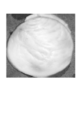
- FIG. 1 is a photograph of the waste material whose shape was adjusted in Example 1.
- FIG. 2 is a photograph of the waste material whose shape was adjusted in Example 2.
- FIG. 3 is a photograph of the waste material whose shape was adjusted in Comparative Example 1.
- the present embodiment is an example for explaining the present invention, and the present invention is not limited to the embodiment. In other words, the present invention can be modified in various ways without departing from the gist of the invention.
- the method for adjusting the shape of waste material in this embodiment is a method for adjusting the shape of recycled waste material, and is characterized in that, when the bulk density W1 of the waste material is defined as "the mass of the waste material per 1 m3 of container when it is shaped and packed into a container (kg/ m3 ), " and the bulk density W2 is defined as "the mass of the waste material per 1 m3 of container when it is shaped, crushed until the mass per particle is 50 g or less , and packed into a container," the shape of the waste material is adjusted so that the ratio W1 / W2 of bulk density W1 to bulk density W2 is 0.55 or more.
- the term "container” refers to a packaging material capable of containing, storing, and transporting waste materials.
- the container may change shape slightly to accommodate the shape of the contents (waste materials), but the volume remains the same.
- the size of the container is not particularly limited, but examples include a flexible container (M-1A, manufactured by Tani Kogyo Co., Ltd.) with a capacity of 1.0 m 3 , a diameter of 1,100 mm, a height of 1,100 mm, and a load capacity of 1,000 kg.
- "packing" waste materials into a container means storing as much waste material as possible within the container within the limits of what can be stored in the container, and there are no particular specifications regarding how the waste materials are placed into the container or the order in which they are packed, etc.
- an example of a flexible container is shown below as a method for "packing" waste materials into a container. The flexible container is placed on the ground, and waste materials are poured into it as much as possible. The flexible container is then lifted up once with a forklift, and the weight of the waste materials fills the gaps between the waste materials.
- the flexible container is then placed back on the ground, and as much waste material as possible is poured into the vacant space, to the extent that the mouth of the flexible container can be tied up.
- the crushing of the waste material is not particularly limited except that the number average mass of each crushed waste material per grain is less than 50 g, but it is preferable to crush the waste material so that the mass of each crushed waste material is 10 g to 50 g per grain, which accounts for 90% or more of the total. This suppresses the variation of W2 , and the range of W1 / W2 tends to be stably determined.
- the crushing device and conditions may be appropriately selected depending on the type and size of the waste material.
- the bulk density ratio W1 / W2 is a parameter that indicates the degree of shape adjustment of the waste material by comparing the bulk density ( W2 ) when the waste material is crushed so that as much waste material as possible can be packed into a container with the bulk density ( W1 ) when the waste material is shape-adjusted.
- W 1 /W 2 is 0.55 or more, preferably 0.60 or more, more preferably 0.65 or more.
- W 1 /W 2 is in the above range, a large amount of waste material can be transported at one time, and the transportation efficiency when transporting the waste material to a facility such as a recycling plant and the regeneration efficiency when regenerating the waste material at a recycling plant can be improved.
- the upper limit of W 1 /W 2 is not particularly limited, and may be, for example, 1.00 or less, 0.95 or less, or 0.90 or less. Specifically, W 1 /W 2 can be calculated by the method described in the Examples below.
- the shape adjustment means of the waste material (method of changing the shape and/or size of the waste material), the conditions of each means (temperature, pressure, time, etc.) and the equipment used are not particularly limited and may be appropriately selected according to the type of waste material, the shape, size, state, etc. when the method of adjusting the shape of the waste material of this embodiment is not applied.
- Examples of the shape adjustment means of the waste material include crushing, melt extrusion, use of a mold that forms a specific shape, a method of cooling the molten material, and combinations thereof.
- a method of using a mold that forms a specific shape and cooling the molten material is preferable.
- the specific shape of the reshaped waste is preferably a cylinder, a plate, a rectangular prism, or a cube.
- the mass per piece of waste material whose shape has been adjusted by the waste material shape adjustment method of this embodiment is not particularly limited, but from the standpoint of portability and workability, it is preferably 50 g or more and 50 kg or less, more preferably 50 g or more and 30 kg or less, even more preferably 50 g or more and 25 kg or less, and even more preferably 50 g or more and 20 kg or less.
- the mass of each shape-adjusted scrap piece is the average mass of five or more scrap pieces.
- the waste material to which the method for adjusting the shape of the waste material of the present embodiment is applied is not particularly limited as long as it is a waste material that is to be recycled, and examples thereof include various used products, non-standard products (products with poor shapes, products containing foreign matter, etc.) generated during the manufacturing and processing of various products, scraps, scraps, etc.
- the type of recycling is not particularly limited, and may be any of chemical recycling, material recycling, and thermal recycling.
- the waste material may be one type alone or a combination of multiple types.
- the shape and size of each waste material are not particularly limited and may be of various shapes and sizes.
- main component refers to a component that is contained in a proportion of more than 50% by mass in 100% by mass of the waste material, preferably contained in a proportion of 70% by mass or more, more preferably contained in a proportion of 90% by mass or more, and particularly preferably contained in a proportion of 100% by mass.
- waste resin materials include, but are not limited to, used resin products (for example, various mechanical parts such as automobile parts, electric and electronic parts, building supplies, industrial parts, and medical parts, household goods, etc.), non-standard products (products with defective shapes, products containing foreign matter or black spots, etc.) generated during the manufacturing and processing of these resin products, scraps, and scraps, etc.
- the waste resin materials may be foamed resin waste materials or non-foamed resin materials.
- the shape of the waste resin after shape adjustment varies depending on the process (source) in which the waste was generated, such as the manufacturing/processing process in which the waste was discharged and how it was discharged.
- Examples include cylindrical, plate-like, rectangular or cubic shapes made by melting resin and cooling and solidifying it; resin extruded from an extruder that is discarded in a plate-like shape without being cut; and resin in waste resin that has been melted and discharged into a cylindrical, plate-like, rectangular or cubic mold, and cooled and solidified to adjust the shape.
- the type of resin contained in the waste resin is not particularly limited, and may be a thermoplastic resin or a thermosetting resin.
- the thermoplastic resin is not particularly limited, and examples thereof include polyamide resins (polyamide 6, polyamide 66, polyamide 610, polyamide 612, polyamide 6I, polyamide 66/6, polyamide 66/610, polyamide 66/6I, etc.), polyphenylene ether resins, polyolefin resins (polyethylene, polypropylene, etc.), polyester resins (polyethylene terephthalate, polybutylene terephthalate, etc.), polyacetal resins, polycarbonate resins, polystyrene resins (polystyrene, acrylonitrile-styrene copolymers, acrylonitrile-butadiene-styrene copolymers, etc.), poly(meth)acrylic resins (polyethyl(meth)acrylate, polymethyl(meth)acrylate, etc.
- the resin waste material contains a polyamide resin
- the resin is one that is greatly affected by water absorption on its physical properties, and therefore, even if it is exposed to a high humidity environment when applied to the waste material transportation method or resin composition manufacturing method described later, the effect of water absorption tends to be uniform among the waste materials, which is preferable.
- the thermosetting resin include epoxy resins, phenol resins, polyurethane resins, unsaturated polyester resins, and melamine resins.
- the resins contained in the resin waste may be the same type or a combination of different types, but it is preferable that they be the same type, as this can simplify the means for adjusting the shape of the waste and makes it easier to adjust the shape.
- the term "same type of resin” refers to resin components, excluding additives such as plasticizers and heat stabilizers, that are composed of the same resins as classified according to JIS K-6899-1: 2006. More specifically, resins that are classified as the same resin using a combination of "5. Abbreviations for homopolymer materials, copolymer materials, and natural polymer materials" and "6. Symbols indicating characteristics" in the above JIS standard are considered to be of the same type.
- the resin content in 100% by mass of waste resin is preferably 70-100% by mass, more preferably 90-100% by mass, and particularly preferably 100% by mass, from the viewpoint that this allows for a simpler means of adjusting the shape of the waste and makes it easier to adjust the shape.
- the waste resin may contain other ingredients, such as flame retardants, antioxidants, UV absorbers, heat stabilizers, plasticizers, lubricants, colorants, compatibilizers, and fillers (glass fibers, carbon fibers, mineral fillers such as wollastonite and talc, etc.).
- other ingredients such as flame retardants, antioxidants, UV absorbers, heat stabilizers, plasticizers, lubricants, colorants, compatibilizers, and fillers (glass fibers, carbon fibers, mineral fillers such as wollastonite and talc, etc.).
- the resin waste When the resin waste is waste discarded during the manufacturing and processing process of a resin product, the resin waste may be only waste generated from one process or a combination of waste generated from multiple processes.
- waste resin materials discarded in the manufacturing and processing of resin products include waste resin materials discharged in at least one or more steps in the manufacturing and processing of resin products, including a resin polymerization step, a compounding step in which a resin (synthesized virgin resin, recycled resin regenerated by recycling, etc.) is compounded with other components (various additives, etc.) to obtain a resin composition, and a molding step in which a resin (or a resin composition) is molded to obtain a resin molded product. Since waste resin discharged from the resin polymerization process often does not contain any components other than the polymerized resin, its chemical and physical properties tend to be consistent, and when waste resin is recycled, the recycled materials tend to be of uniform quality.
- the waste material whose shape has been adjusted by the method for adjusting the shape of the waste material of the present embodiment can be transported by any method.
- the transport efficiency of the waste material can be improved without performing secondary shape adjustment such as crushing.
- the loading efficiency during transportation can be improved without performing additional shape adjustment such as crushing.
- the method of transporting the waste material in this embodiment is not particularly limited, but a method of transporting a large amount at once using a truck, ship, or the like as a means of transportation is preferable because it allows efficient transportation without secondary shape adjustment such as crushing.
- the shape of the waste material is adjusted by the above-mentioned method of adjusting the shape of the waste material in this embodiment, uniformity can be maintained among the waste materials regarding the effects of oxidation deterioration and water absorption, etc., even during long-term movement and storage during transportation, and the quality of the recycled products tends to be uniform when recycled.
- the method for producing a resin composition of this embodiment includes a regeneration step of regenerating a resin from a resin waste material whose shape has been adjusted by the method for adjusting the shape of the waste material of this embodiment described above, and a compounding step of compounding the regenerated resin obtained in the regeneration step to obtain a resin composition.
- the method for producing a resin composition of this embodiment may include a transporting step of transporting the resin waste material before the regeneration step.
- the method for producing a resin composition of this embodiment includes a transporting step of transporting the resin waste material whose shape has been adjusted by the method for adjusting the shape of the waste material of this embodiment described above, a regeneration step of regenerating a resin from the resin waste material transported by the transporting step, and a compounding step of compounding the regenerated resin obtained in the regeneration step to obtain a resin composition.
- the method for producing a resin composition according to the present embodiment uses waste resin whose shape has been adjusted by the method for adjusting the shape of waste according to the present embodiment described above, and therefore has excellent waste transportation efficiency and regeneration efficiency, and increases the freedom and flexibility of handling the waste during recycling. For example, in thermal recycling, omitting the crushing step leads to improved energy efficiency and reduced costs.
- the method for producing a resin composition of the present embodiment further includes a cleaning step of cleaning the waste material, The method may include other steps such as a step of separating impurities from the waste material.
- the transporting process is a process of transporting the waste resin material whose shape has been adjusted by the method for adjusting the shape of the waste resin material of the present embodiment described above to a location where the regeneration process is carried out (a facility such as a recycling plant, etc.).
- the method for transporting the waste resin material is not particularly limited, and for example, the method for transporting the waste material according to the present embodiment described above can be used.
- the regeneration process is a process for regenerating resin from the waste resin material whose shape has been adjusted by the method for adjusting the shape of the waste material of the present embodiment described above or that has been transported by the transport process described above, thereby obtaining a recycled resin.
- the method for regenerating the resin is not particularly limited, and examples thereof include a material recycling method such as a method for separating the target resin from waste resin materials, and a chemical recycling method such as a method for decomposing waste resin materials to obtain raw material monomers for the target resin, and then repolymerizing the target resin using the obtained raw material monomers.
- the conditions of each reaction in regenerating the resin such as the equipment used, temperature, pressure, and the like, and the reagents may be appropriately selected depending on the target resin.
- the compounding step is a step in which other components are added to the recycled resin obtained in the recycling step and compounded to obtain a resin composition.
- the other components to be added are not particularly limited and may be appropriately selected depending on the desired physical properties of the resin composition, etc.
- a virgin resin of the same type as the recycled resin may be added in order to further stabilize the physical properties of the resin.
- Compounding conditions such as equipment used, temperature, and pressure may be appropriately set depending on the constituent components of the resin composition (recycled resin and other components).
- the waste material whose shape had been adjusted in each of the Examples and Comparative Examples was pulverized using a pulverizer (Daiko Seiki Co., Ltd.'s "DAS-54") until the mass of each individual waste material was less than 50 g.
- the pulverized waste material was packed into a container similar to that described above (volume 1.0 m 3 , diameter 1,100 mm, height 1,100 mm, load capacity 1,000 kg (flexible container "M-1A", Tani Kogyo Co., Ltd.)), and the mass of the waste material in the container was measured. The measurement was performed five times, and the average value was taken as the bulk density W 2 (kg/m 3 ) of the waste material. From the obtained W 1 and W 2 , the bulk density ratio W 1 /W 2 was calculated.
- ⁇ Transportation efficiency> The loading efficiency onto a transport vehicle was calculated for each of the waste materials whose shape had been adjusted in each Example and Comparative Example, and for the waste materials whose shape had been adjusted in each Example and Comparative Example, and which had been crushed according to the method described above in ⁇ Shape adjustment (bulk density ratio W1 / W2 )>, using the formula below.
- Loading efficiency (%) (mass of waste material loaded on a transport vehicle/mass that can be loaded on a transport vehicle) x 100
- the difference in loading efficiency between the shape-adjusted waste material and the shape-adjusted and crushed waste material (loading efficiency of the shape-adjusted and crushed waste material - loading efficiency of the shape-adjusted waste material) was calculated, and the transportation efficiency was evaluated according to the following evaluation criteria.
- the container exchange frequency was defined as "the number of times a container (capacity 1.0 m3 , diameter 1,100 mm, height 1,100 mm, load capacity 1,000 kg (flexible container "M-1A", manufactured by Tani Kogyo Co., Ltd.)) required to supply 10 tons of waste material in recycling the waste material is replaced (the number of times a container that has been emptied by supplying the waste material it contained is replaced with a container containing waste material)," and each container exchange frequency was calculated.
- the difference in container exchange frequency between the shape-adjusted waste material and the waste material crushed after shape adjustment was calculated, and the recycling efficiency was evaluated according to the following evaluation criteria.
- Example 1 The waste material (main component: PA66, no filler) discharged from the polymerization process of polyamide 66 (PA66) was subjected to shape adjustment according to the following procedure. A photograph of the shape-adjusted waste material (shape: nearly cylindrical) is shown in Figure 1. The molten polyamide 66 waste material was received in a metal frame (diameter 30 cm, height 10 cm) so as to form a cylindrical shape, and cooled to adjust the shape of the waste material. The results of the measurements and evaluations are shown in Table 1. The mass of each of the shaped waste materials was 7 kg.
- Example 2 The waste material (main component: PA610, no filler) discharged from the polymerization process of polyamide 610 (PA610) was shaped according to the following procedure. A photograph of the shaped waste material (shape: strands gathered together to form a shape close to a plate) is shown in Figure 2. The molten polyamide 610 waste material was formed into a strand shape, which was then received in a metal frame (length 100 cm, width 10 cm, height 10 cm) so as to form a plate, and cooled to adjust the shape of the waste material. The results of the measurements and evaluations are shown in Table 1. The mass of each of the shaped waste materials was 11 kg.
- Example 3 The shape of waste material (main component: PA6, no filler) discharged from a compounding process in which polyamide 6 (PA6) and other components (lubricants) are compounded was adjusted by the following procedure.
- the molten polyamide 6 waste material was formed into a strand shape, which was then placed in a metal frame (50 cm long, 10 cm wide, 10 cm high) so as to form a rectangular parallelepiped shape, and cooled to adjust the shape of the waste material (shape: close to a rectangular parallelepiped).
- the results of the measurements and evaluations are shown in Table 1.
- the mass of each of the shaped waste materials was 5 kg.
- Example 4 The waste material (main component: PA66/6I, filler: present (glass fiber)) discharged from the compounding process in which polyamide 66/6I (PA66/6I) and other components (lubricant, colorant) are compounded was subjected to shape adjustment by the following procedure.
- the molten polyamide 66/6I waste material was formed into a strand shape, which was then placed in a metal frame (length 50 cm, width 10 cm, height 10 cm) that would give it a rectangular parallelepiped shape, and cooled to adjust the shape of the waste material (shape: close to a rectangular parallelepiped).
- the results of the measurements and evaluations are shown in Table 1.
- the mass of each of the shaped waste materials was 6 kg.
- a waste material (main component: PA66/PPE, filler: present (glass fiber)) discharged from a molding process for molding a polyamide 66/polyphenylene ether (PA66/PPE) resin composition was subjected to shape adjustment by the following procedure.
- the molten polyamide 66/polyphenylene ether waste material was received in a metal frame (length 10 cm, width 10 cm, height 10 cm) so as to form a cube, and was cooled to adjust the shape of the waste material (shape: close to a cube).
- the results of the measurements and evaluations are shown in Table 1.
- the mass of each of the shaped waste materials was 1 kg.
- a waste material (main component: PA66/6I, filler: present (glass fiber)) discharged from a molding process for molding a polyamide 66/6I (PA66/6I) resin composition was subjected to shape adjustment by the following procedure.
- the molten polyamide 66/6I waste material was received in a metal frame (length 8 cm, width 8 cm, height 8 cm) so as to form a cube, and cooled to adjust the shape of the waste material (shape: close to a cube).
- the results of the measurements and evaluations are shown in Table 1.
- the mass of each of the shaped waste materials was 0.7 kg.
- Example 7 The scrap material used in Example 1 (main component: PA66, filler: none) and the scrap material used in Example 2 (main component: PA610, filler: none) were mixed in a 1:1 ratio, and the shape of the scrap material was adjusted by the following procedure. Each waste material was melted, placed in a metal frame (diameter 30 cm, height 30 cm) so as to form a cylindrical shape, and cooled to adjust the shape of the waste material (shape: close to cylindrical). The results of the measurements and evaluations are shown in Table 1. The mass of each of the shaped waste materials was 20 kg.
- a waste material (main component: PA66/PPE, filler: present (glass fiber)) discharged from a molding process for molding a polyamide 66/polyphenylene ether (PA66/PPE) resin composition was subjected to shape adjustment by the following procedure.
- the molten polyamide 66/polyphenylene ether waste material was cooled in a strand shape and cut into a certain size (diameter about 0.4 cm, length about 300 cm) to adjust the shape of the waste material (shape: strand shape).
- the results of the measurements and evaluations are shown in Table 1.
- the mass of each of the shaped waste materials was 0.06 kg.
- the method for adjusting the shape of waste material of the present invention can improve the transportation efficiency and recycling efficiency of recycled waste material.
- the method for producing a resin composition of the present invention uses waste resin material whose shape has been adjusted by the method for adjusting the shape of waste material of the present invention, and therefore has excellent transportation efficiency and recycling efficiency, can improve energy efficiency, and can reduce production costs.
Landscapes
- Separation, Recovery Or Treatment Of Waste Materials Containing Plastics (AREA)
Priority Applications (2)
| Application Number | Priority Date | Filing Date | Title |
|---|---|---|---|
| JP2025531563A JPWO2025009535A1 (https=) | 2023-07-03 | 2024-07-02 | |
| CN202480034115.4A CN121219350A (zh) | 2023-07-03 | 2024-07-02 | 废料的形状调整方法、输送方法和树脂组合物的制造方法 |
Applications Claiming Priority (2)
| Application Number | Priority Date | Filing Date | Title |
|---|---|---|---|
| JP2023109511 | 2023-07-03 | ||
| JP2023-109511 | 2023-07-03 |
Publications (1)
| Publication Number | Publication Date |
|---|---|
| WO2025009535A1 true WO2025009535A1 (ja) | 2025-01-09 |
Family
ID=94171552
Family Applications (1)
| Application Number | Title | Priority Date | Filing Date |
|---|---|---|---|
| PCT/JP2024/023970 Ceased WO2025009535A1 (ja) | 2023-07-03 | 2024-07-02 | 廃材の形状調整方法、輸送方法及び樹脂組成物の製造方法 |
Country Status (3)
| Country | Link |
|---|---|
| JP (1) | JPWO2025009535A1 (https=) |
| CN (1) | CN121219350A (https=) |
| WO (1) | WO2025009535A1 (https=) |
Citations (6)
| Publication number | Priority date | Publication date | Assignee | Title |
|---|---|---|---|---|
| JP3086562U (ja) * | 2001-12-10 | 2002-06-28 | シグマ機器株式会社 | クラッシャ付押出成形機 |
| JP2004331912A (ja) * | 2003-05-12 | 2004-11-25 | Power System Kk | プラスチック廃棄物の集中処理システム |
| JP2010509413A (ja) | 2006-11-13 | 2010-03-25 | エレマ エンジニアリング リサイクリング マシネン ウント アンラーゲン ゲゼルシャフト ミット ベシュレンクテル ハフトフング | 熱可塑性材料の前処理、再処理、又はリサイクル方法 |
| JP2013241608A (ja) * | 2003-10-17 | 2013-12-05 | Ube Industries Ltd | 固形異物を含む廃プラスチック材料粉砕物から得た再生樹脂組成物 |
| JP2017014316A (ja) * | 2015-06-26 | 2017-01-19 | グリーンプラ株式会社 | フレキシブルコンテナより製造された複合再生樹脂組成物 |
| WO2021200892A1 (ja) * | 2020-03-31 | 2021-10-07 | 三菱瓦斯化学株式会社 | 再生樹脂の製造方法 |
-
2024
- 2024-07-02 JP JP2025531563A patent/JPWO2025009535A1/ja active Pending
- 2024-07-02 WO PCT/JP2024/023970 patent/WO2025009535A1/ja not_active Ceased
- 2024-07-02 CN CN202480034115.4A patent/CN121219350A/zh active Pending
Patent Citations (6)
| Publication number | Priority date | Publication date | Assignee | Title |
|---|---|---|---|---|
| JP3086562U (ja) * | 2001-12-10 | 2002-06-28 | シグマ機器株式会社 | クラッシャ付押出成形機 |
| JP2004331912A (ja) * | 2003-05-12 | 2004-11-25 | Power System Kk | プラスチック廃棄物の集中処理システム |
| JP2013241608A (ja) * | 2003-10-17 | 2013-12-05 | Ube Industries Ltd | 固形異物を含む廃プラスチック材料粉砕物から得た再生樹脂組成物 |
| JP2010509413A (ja) | 2006-11-13 | 2010-03-25 | エレマ エンジニアリング リサイクリング マシネン ウント アンラーゲン ゲゼルシャフト ミット ベシュレンクテル ハフトフング | 熱可塑性材料の前処理、再処理、又はリサイクル方法 |
| JP2017014316A (ja) * | 2015-06-26 | 2017-01-19 | グリーンプラ株式会社 | フレキシブルコンテナより製造された複合再生樹脂組成物 |
| WO2021200892A1 (ja) * | 2020-03-31 | 2021-10-07 | 三菱瓦斯化学株式会社 | 再生樹脂の製造方法 |
Also Published As
| Publication number | Publication date |
|---|---|
| JPWO2025009535A1 (https=) | 2025-01-09 |
| CN121219350A (zh) | 2025-12-26 |
Similar Documents
| Publication | Publication Date | Title |
|---|---|---|
| US5312573A (en) | Process for extruding mixtures of thermoplastic and thermoset materials | |
| US4795603A (en) | Method for producing composite material of plastic and rubber | |
| EP1731283A1 (en) | A method for recycling carpet | |
| NL2005319C2 (nl) | Werkwijze voor het vervaardigen van een geschuimd vormdeel alsmede een bijzondere toepassing daarvoor. | |
| CN118103435A (zh) | 聚丙烯类树脂发泡颗粒的制造方法 | |
| WO2025009535A1 (ja) | 廃材の形状調整方法、輸送方法及び樹脂組成物の製造方法 | |
| JP2012210716A (ja) | 高発泡プラスチック成型体のリサイクル方法 | |
| US11111350B2 (en) | Method for production of low density polyester foam and articles made thereof utilizing low I.V. polyester feedstock | |
| JP5603629B2 (ja) | 熱可塑性樹脂予備発泡粒子の製造方法、熱可塑性樹脂発泡成形体の製造方法 | |
| WO2024057883A1 (ja) | 発泡粒子の製造方法 | |
| CN110128701B (zh) | 一种复配添加剂的制造方法、复配添加剂及包含其的聚合物组合物 | |
| CA2290493C (en) | Method of recycling polyester foam | |
| US20080139679A1 (en) | Method for producing a starting material for a foamed moulded product, as well as the foamed moulded product | |
| JP4648887B2 (ja) | 廃プラスチックの高密度成形方法 | |
| US9878468B2 (en) | Method for manufacturing articles from e-waste feedstocks | |
| Dvorak | Applicability of recycled HDPE for rotational molding | |
| CA3071565C (en) | Method for production of low density polyester foam and articles made thereof utilizing low i.v. polyester feedstock | |
| BE1031733B1 (nl) | Werkwijze voor het spuitgieten van een polymeerproduct startende van post-consumer gerecycleerd materiaal | |
| JP4013031B2 (ja) | 回収ポリエチレンテレフタレート再生品の製造方法 | |
| JP2003236832A (ja) | フレコン袋廃材の成形品への再生方法及びフレコン袋廃材を原料とした粒状の再生成形材料 | |
| KR101560800B1 (ko) | 균일한 재생플라스틱펠릿을 제조하는 방법 | |
| JP2010280112A (ja) | 発泡体成形用押出成形機の原料投入用ホッパー | |
| JP2006175740A (ja) | プラスチック廃材の再資源化方法、プラスチック原料の製造方法、プラスチック成形体の製造方法、ならびにプラスチック原料、プラスチック成形体 | |
| JP2004268505A (ja) | 樹脂ペレットの製造方法 | |
| WO2017135817A1 (en) | Process for preparing automotive shredder fibre residue pellets |
Legal Events
| Date | Code | Title | Description |
|---|---|---|---|
| 121 | Ep: the epo has been informed by wipo that ep was designated in this application |
Ref document number: 24836048 Country of ref document: EP Kind code of ref document: A1 |
|
| ENP | Entry into the national phase |
Ref document number: 2025531563 Country of ref document: JP Kind code of ref document: A |
|
| WWE | Wipo information: entry into national phase |
Ref document number: 2025531563 Country of ref document: JP |
|
| WWE | Wipo information: entry into national phase |
Ref document number: 2024836048 Country of ref document: EP |
|
| NENP | Non-entry into the national phase |
Ref country code: DE |
|
| ENP | Entry into the national phase |
Ref document number: 2024836048 Country of ref document: EP Effective date: 20260203 |