WO2025005098A1 - イソシアネートの製造方法 - Google Patents
イソシアネートの製造方法 Download PDFInfo
- Publication number
- WO2025005098A1 WO2025005098A1 PCT/JP2024/023065 JP2024023065W WO2025005098A1 WO 2025005098 A1 WO2025005098 A1 WO 2025005098A1 JP 2024023065 W JP2024023065 W JP 2024023065W WO 2025005098 A1 WO2025005098 A1 WO 2025005098A1
- Authority
- WO
- WIPO (PCT)
- Prior art keywords
- compound
- isocyanate
- producing
- reaction
- group
- Prior art date
- Legal status (The legal status is an assumption and is not a legal conclusion. Google has not performed a legal analysis and makes no representation as to the accuracy of the status listed.)
- Ceased
Links
Classifications
-
- C—CHEMISTRY; METALLURGY
- C07—ORGANIC CHEMISTRY
- C07C—ACYCLIC OR CARBOCYCLIC COMPOUNDS
- C07C263/00—Preparation of derivatives of isocyanic acid
-
- C—CHEMISTRY; METALLURGY
- C07—ORGANIC CHEMISTRY
- C07C—ACYCLIC OR CARBOCYCLIC COMPOUNDS
- C07C265/00—Derivatives of isocyanic acid
- C07C265/10—Derivatives of isocyanic acid having isocyanate groups bound to carbon atoms of rings other than six-membered aromatic rings
-
- C—CHEMISTRY; METALLURGY
- C07—ORGANIC CHEMISTRY
- C07C—ACYCLIC OR CARBOCYCLIC COMPOUNDS
- C07C267/00—Carbodiimides
Definitions
- the present invention relates to a method for producing isocyanates.
- the main industrial method for producing isocyanates has been the phosgene process, in which amines are reacted with phosgene.
- the phosgene process has many problems from the standpoint of environmental impact and safety, such as the fact that phosgene is highly toxic and that hydrogen chloride is generated as a by-product.
- Patent Documents 1 and 2 describe a method in which a carbamate is produced from an amine, carbon dioxide, and an alcohol through a multi-stage reaction, and then an isocyanate is produced by a thermal decomposition reaction of the carbamate.
- Patent Document 3 describes a method in which a carbamate is produced using an amine, an N-unsubstituted carbamate, and an alcohol, and then an isocyanate is produced by a thermal decomposition reaction of the carbamate.
- the above-mentioned method for producing isocyanates involves complicated manufacturing steps.
- the present invention aims to provide a new method for producing isocyanates using a simple process.
- the present invention relates to A step (1) of reacting a compound A having an element M-oxygen double bond with a compound B having an amino group to obtain a product C; (2) reacting the product C with at least one selected from the group consisting of carbon dioxide, a carbonate, and a hydrogen carbonate to obtain an isocyanate; Including, The element M is a metal element or P; In the step (1), a ratio of the number of double bonds in the compound A to the number of moles of the amino groups in the compound B is 0.5 or more.
- the present invention allows for the production of isocyanates through a simple process.
- the method for producing an isocyanate according to the first aspect of the present invention comprises the steps of: A step (1) of reacting a compound A having an element M-oxygen double bond with a compound B having an amino group to obtain a product C; (2) reacting the product C with at least one selected from the group consisting of carbon dioxide, a carbonate, and a hydrogen carbonate to obtain an isocyanate; Including, The element M is a metal element or P; In the step (1), the ratio of the number of double bonds in the compound A to the number of moles of the amino groups in the compound B is 0.5 or more.
- the ratio is 1.0 or more.
- the reaction temperature in step (2) is 100°C or lower.
- the steps (1) and (2) are carried out in one pot.
- the element M is V, Fe, Mo, Ta, Nb, Ti, W, or P.
- the compound B is a primary amine.
- the compound B is a compound represented by the following general formula (B): R- NX2 (B)
- R represents a hydrocarbon group which may have a substituent.
- Two X's each independently represent a hydrogen atom or a protecting group.
- the hydrocarbon group includes at least one selected from the group consisting of an aliphatic ring and an aromatic ring.
- the product C has an element M-nitrogen double bond.
- the compound A is further obtained by the reaction.
- step (1) in the method for producing an isocyanate according to any one of the first to tenth aspects, in step (1), the reaction is carried out in an inert atmosphere.
- the reaction is carried out in a solvent, and the solvent contains at least one selected from the group consisting of toluene, 1,4-dioxane, and acetonitrile.
- the reaction is carried out in the presence of a base.
- a method for producing an isocyanate derivative according to a fourteenth aspect of the present invention includes the steps of: The method includes a step (3) of converting the isocyanate obtained by the method for producing an isocyanate according to any one of the first to thirteenth aspects into an isocyanate derivative.
- the method for producing an isocyanate according to the first embodiment of the present invention includes a step (1) of reacting a compound A having an element M-oxygen double bond with a compound B having an amino group to obtain a product C, and a step (2) of reacting the product C obtained in the step (1) with at least one selected from the group consisting of carbon dioxide, carbonates, and hydrogencarbonates to obtain an isocyanate.
- the element M is a metal element or P.
- the ratio of the number of element M-oxygen double bonds of compound A to the number of moles of amino groups of compound B is 0.5 or more.
- steps (1) and (2) may be carried out using a batch reactor or a flow reactor (e.g., a plug flow reactor (PFR) or a continuous stirred tank reactor (CSTR)).
- a flow reactor e.g., a plug flow reactor (PFR) or a continuous stirred tank reactor (CSTR)
- Step (1) and step (2) may be carried out in one pot.
- a step of isolating and purifying product C means a step of making the purity of product C excluding the solvent 95% or more.
- Step (1) and step (2) may be carried out in the same reaction vessel.
- the reaction in step (1) and the reaction in step (2) may be carried out consecutively in the same reaction vessel.
- Compound A is a compound having an element M-oxygen double bond.
- the number of element M-oxygen double bonds in one molecule of compound A may be 1 or more, for example, 1 to 5.
- the number of element M-oxygen double bonds in one molecule of compound A is preferably 1. However, in some cases, the number of element M-oxygen double bonds in one molecule of compound A may be 2 or more.
- the element M is a metal element or P.
- the element M may be a metal element.
- Element M may be V, Fe, Mo, Ta, Nb, Ti, W, or P, may be V, Fe, Mo, Ta, Nb, Ti, or W, may be V, Fe, Mo, or Nb, or may be V. That is, compound A may have a vanadium-oxygen double bond.
- compound A may be a complex having a ligand that coordinates to element M.
- Examples of the ligand include a hydrocarbon group which may have a substituent, an oxyhydrocarbon group which may have a substituent, and a halogen.
- the number of carbon atoms in the hydrocarbon group is not particularly limited as long as it is 1 or more.
- the number of carbon atoms in the hydrocarbon group may be, for example, 20 or less, 15 or less, 10 or less, 5 or less, or 3 or less.
- the hydrocarbon group may be a linear or branched chain hydrocarbon group.
- the hydrocarbon group may be an alkyl group, an alkenyl group, or an alkynyl group.
- the alkyl group include a methyl group, an ethyl group, a propyl group, an isopropyl group, a butyl group, an isobutyl group, a tert-butyl group, and a sec-butyl group.
- Examples of the alkenyl group include a vinyl group and an allyl group.
- Examples of the alkynyl group include an ethynyl group.
- substituents on the hydrocarbon group include halogens, amino groups, alkoxy groups, alkyl ester groups, carboxyl groups, and hydroxyl groups.
- the hydrocarbon group contained in the oxyhydrocarbon group may be any of those mentioned above.
- the oxyhydrocarbon group may be an alkoxy group. Examples of the alkoxy group include a methoxy group, an ethoxy group, and an isopropoxy group. Examples of the substituent of the oxyhydrocarbon group include those mentioned above for the hydrocarbon group.
- An example of an oxyhydrocarbon group having a substituent is a group derived from triethanolamine (TEA).
- Halogen includes fluorine, chlorine, bromine, iodine, etc., for example, chlorine.
- the ligand is preferably an isopropoxy group, an ethyl group, an ethoxy group, chlorine, or TEA.
- the number of ligands can be adjusted appropriately depending on the type of element M, etc.
- the number of ligands may be 1 or more, for example, 1 to 5.
- the number of ligands may be 3 or 4.
- the number of ligands is preferably 3.
- Compound A may be a compound represented by the following general formula (A).
- L n VO (A) L represents a hydrocarbon group which may have a substituent, an oxyhydrocarbon group which may have a substituent, or a halogen, and n is a natural number of 1 to 5.
- n is 2 or more, the multiple Ls are independent of each other. At least two selected from the multiple Ls may be linked to each other.
- Examples of the optionally substituted hydrocarbon group and the optionally substituted oxyhydrocarbon group include those mentioned above.
- n may be 3 or 4. n is preferably 3.
- L is preferably an alkoxy group, more preferably an isopropoxy group.
- Compound A may be vanadium(V) oxytriisopropoxide (VO( OiPr ) 3 ), VO(OEt) 3 , VO(OEt) Cl2 , VOCl3 , or VO(TEA).
- Compound A is not limited to the above complexes.
- compound A may be an oxide of element M or an inorganic salt containing element M.
- examples of compound A include V2O5 , NH4VO3 , Na3VO4 , TiO2 , WO3 , FeO, Fe2O3 , NbO2 , Nb2O5 , and ( NH4 ) 2MoO4 .
- the oxide of element M or the inorganic salt containing element M as compound A may be supported on a carrier. That is, in step (1), product C may be obtained by reacting a complex of compound A having an element M-oxygen double bond and a carrier supporting compound A with compound B having an amino group.
- the carrier is preferably a solid capable of supporting compound A.
- solid refers to a substance in a solid state at atmospheric pressure and 20°C.
- the carrier may contain a compound S having a cation D1 with an ionic radius of more than 60.5 pm.
- the compound S is different from the above-mentioned compound A.
- the "ionic radius” is a value based on the definition described in Shannon et al., Acta Cryst. A 32 (1976) 751. The ionic radius is usually determined by the type of cation, the valence of the cation, and the coordination number of the cation.
- the ionic radius of cation D1 may be greater than 60.5 pm, 61 pm or more, 63 pm or more, 65 pm or more, 68 pm or more, 70 pm or more, 75 pm or more, 80 pm or more, 85 pm or more, 90 pm or more, 95 pm or more, or even 100 pm or more.
- the upper limit of the ionic radius of cation D1 is not particularly limited, and may be, for example, 200 pm or less, or 150 pm or less.
- the ionic radius of cation D1 may be 100 pm or less in some cases.
- the valence of cation D1 is, for example, 1 to 6, and preferably 1 to 4. In some cases, the valence of cation D1 may be 3 or less, or 2 or less.
- the Cation D1 is preferably a metal cation.
- the metal cation preferably includes at least one selected from the group consisting of magnesium ions, cerium ions, zirconium ions, sodium ions, calcium ions, manganese ions, cobalt ions, lanthanum ions, zinc ions, potassium ions, indium ions, niobium ions, barium ions, strontium ions, iron ions, and yttrium ions, more preferably includes at least one selected from the group consisting of magnesium ions and cerium ions, and particularly preferably includes magnesium ions.
- Compound S typically further has an anion D2 bonded to cation D1.
- anion D2 include oxide ions, hydroxide ions, carbonate ions, and phosphate ions, and are preferably oxide ions.
- Compound S preferably has a metal cation as cation D1 and an oxide ion as anion D2.
- compound S is preferably a metal oxide having a metal cation.
- metal oxides include MgO (ionic radius of magnesium ion: 72 pm), CeO 2 (ionic radius of cerium ion: 97 pm), ZrO 2 (ionic radius of zirconium ion: 78 pm), CaO (ionic radius of calcium ion: 100 pm), MnO (ionic radius of manganese ion: 67 to 83 pm), CoO (ionic radius of cobalt ion: 65 to 74.5 pm), Fe 2 O 3 (ionic radius of iron ion: 78 pm), and Y 2 O 3 (ionic radius of yttrium ion: 90 pm).
- Compound S preferably contains at least one selected from the group consisting of MgO and CeO 2 , and particularly preferably contains MgO.
- Compound S may be a compound other than a metal oxide, such as a hydroxide salt such as NaOH (ionic radius of sodium ion: 102 pm), a carbonate salt such as CaCO 3 (ionic radius of calcium ion: 112 pm), or a hydroxyphosphate salt such as Ca 5 (PO 4 ) 3 (OH) (ionic radius of calcium ion: 118 pm).
- a hydroxide salt such as NaOH (ionic radius of sodium ion: 102 pm)
- a carbonate salt such as CaCO 3 (ionic radius of calcium ion: 112 pm)
- a hydroxyphosphate salt such as Ca 5 (PO 4 ) 3 (OH) (ionic radius of calcium ion: 118 pm).
- the carrier may contain compound S as a main component.
- “main component” means the component contained in the carrier in the largest amount by weight.
- the content of compound S in the carrier may be, for example, 80 wt % or more, and may be 90 wt % or more, 95 wt % or more, or even 99 wt % or more.
- the carrier may be substantially composed of compound S.
- the carrier content is, for example, 99.9 wt% or less, and may be 99.5 wt% or less, 99 wt% or less, 97 wt% or less, 95 wt% or less, 92 wt% or less, or even 90 wt% or less.
- the lower limit of the carrier content is, for example, 50 wt% or more, 70 wt% or more, or even 80 wt% or more.
- the shape of the carrier is not particularly limited, and may be, for example, particulate.
- particulate includes spherical, ellipsoidal, scaly, fibrous, etc.
- Compound B is a compound having an amino group.
- Compound B is preferably a primary amine.
- the number of amino groups in one molecule of compound B may be one or two or more.
- Compound B may include a cyclic structure.
- Compound B may include one cyclic structure, or may include two or more cyclic structures.
- the cyclic structure may or may not have a heteroatom.
- the cyclic structure may be an aliphatic ring or an aromatic ring.
- An example of compound B that includes a cyclic structure with a heteroatom is tetrahydrofuranamine.
- Aliphatic rings include, for example, cyclohexane, cyclopentane, and adamantane.
- Aromatic rings include, for example, benzene, naphthalene, and anthracene.
- compound B the cyclic structure and the nitrogen may or may not be directly bonded.
- compound B the aliphatic ring and the nitrogen may be directly bonded.
- Compound B may be a primary amine in which an amino group and an aliphatic ring are directly bonded.
- Compound B may be a compound represented by the following general formula (B): R- NX2 (B)
- R represents a hydrocarbon group which may have a substituent, and two Xs each independently represent a hydrogen atom or a protecting group.
- Examples of the protecting group include silyl-based protecting groups and carbamate-based protecting groups.
- Examples of the silyl-based protecting group include trimethylsilyl group (TMS group), triethylsilyl group (TES group), triisopropylsilyl group (TIPS group), tert-butyldimethylsilyl group (TBDMS group), and tert-butyldiphenylsilyl group (TBDPS group).
- Examples of the carbamate-based protecting group include tert-butoxycarbonyl group (Boc group) and benzyloxycarbonyl group (Cbz group).
- X is preferably a hydrogen atom.
- the number of carbon atoms in the hydrocarbon group is not particularly limited as long as it is 1 or more.
- the number of carbon atoms in the hydrocarbon group may be, for example, 20 or less, 15 or less, 12 or less, or 10 or less.
- the hydrocarbon group in general formula (B), includes a cyclic structure.
- the hydrocarbon group may include at least one ring selected from the group consisting of an aliphatic ring and an aromatic ring.
- Hydrocarbon groups containing a cyclic structure are, for example, alicyclic hydrocarbon groups or aromatic cyclic hydrocarbon groups.
- alicyclic hydrocarbon groups refers to hydrocarbon groups that contain only aliphatic rings as a cyclic structure and do not contain aromatic rings, and includes both monocyclic alicyclic hydrocarbon groups and polycyclic alicyclic hydrocarbon groups.
- the alicyclic hydrocarbon group does not have to be composed of only aliphatic rings, and may contain a chain structure as part of it.
- “Aromatic cyclic hydrocarbon group” refers to a hydrocarbon group that contains an aromatic ring as a cyclic structure.
- the aromatic cyclic hydrocarbon group does not have to be composed of only aromatic rings, and may contain an aliphatic ring or a chain structure as part of it.
- the alicyclic hydrocarbon group is, for example, a cyclohexyl group, a cyclopentyl group, or an adamantyl group.
- the alicyclic hydrocarbon group is preferably a cyclohexyl group.
- the aromatic hydrocarbon group may contain a benzene ring.
- the aromatic hydrocarbon group may contain, for example, a phenyl group, a methylphenyl group, a methoxyphenyl group, a benzyl group, etc.
- the hydrocarbon group may be a linear or branched chain hydrocarbon group.
- the hydrocarbon group may be an alkyl group, an alkenyl group, or an alkynyl group.
- alkyl group examples include methyl, ethyl, propyl, isopropyl, butyl, isobutyl, tert-butyl, sec-butyl, pentyl, hexyl, heptyl, octyl, nonyl, and decyl groups.
- alkenyl group examples include vinyl and allyl groups.
- alkynyl group examples include ethynyl groups.
- the substituent may be any substituent, for example, those described above for compound A.
- Examples of compound B include ethylamine, propylamine, butylamine, pentylamine, hexylamine, heptylamine, octylamine, nonylamine, decylamine, cyclohexylamine, cyclopentylamine, 2-phenylmethylamine, 2-phenylethylamine (phenethylamine), 1-phenylethylamine, 2-phenylpropylamine, 3-phenylpropylamine, 3,3-diphenylpropylamine, 2-(4-methylphenyl)ethylamine, 2-(4-bromophenyl)ethylamine, 2-(4-trifluoromethylphenyl)ethylamine, 3-ethoxypropylamine, 1-adamantanamine, 4-methoxyaniline, tetrahydrofuran-2-methaneamine, hexamethylenediamine, 1,5-pentamethylenediamine, toluenediamine
- step (1) compound A and compound B are reacted to obtain product C.
- the ratio of the number of element M-oxygen double bonds of compound A to the number of moles of amino groups of compound B is 0.5 or more.
- the "ratio of the number of element M-oxygen double bonds of compound A to the number of moles of amino groups of compound B in step (1)" is a value calculated by the formula: (the number of element M-oxygen double bonds contained in one molecule of compound A multiplied by the amount of substance of compound A used in step (1))/(the number of amino groups contained in one molecule of compound B multiplied by the amount of substance of compound B used in step (1)).
- the ratio of the number of elemental M-oxygen double bonds of compound A to the number of moles of amino groups of compound B may be 0.8 or more, and preferably 1.0 or more. In step (1), the ratio of the number of elemental M-oxygen double bonds of compound A to the number of moles of amino groups of compound B may be 10.0 or less, 7.0 or less, 5.0 or less, 3.0 or less, or even 2.0 or less.
- the ratio of the number of elemental M-oxygen double bonds of compound A to the number of moles of amino groups of compound B may be, for example, 0.5 or more and 10.0 or less, 0.8 or more and 3.0 or less, 1.0 or more and 1.5 or less, 1.0 or more and 1.2 or less, or 1.0 or more and 1.1 or less.
- the ratio of the number of elemental M-oxygen double bonds of compound A to the number of moles of amino groups of compound B may be 1.0.
- the ratio of the amount of substance of compound A to the amount of substance of compound B may be 0.8 or more, and preferably 1.0 or more.
- the ratio of the amount of substance of compound A to the amount of substance of compound B may be 10.0 or less, 7.0 or less, 5.0 or less, 3.0 or less, or even 2.0 or less.
- the ratio of the amount of substance of compound A to the amount of substance of compound B may be 1.0 or more and 2.0 or less, 1.0 or more and 1.5 or less, 1.0 or more and 1.2 or less, or 1.0 or more and 1.1 or less.
- the ratio of the amount of substance of compound A to the amount of substance of compound B may be 1.0.
- Product C obtained by reacting compound A with compound B may have an element M-nitrogen double bond.
- the element M contained in product C is derived from compound A.
- the number of element M-nitrogen double bonds in one molecule of product C may be 1 or more, for example, 1 to 5.
- the number of element M-nitrogen double bonds in one molecule of product C is preferably 1. However, in some cases, the number of element M-nitrogen double bonds in one molecule of product C may be 2 or more.
- Product C may contain a cyclic structure.
- Compound B may contain one cyclic structure or two or more cyclic structures. The cyclic structures are as described above for compound B.
- the cyclic structure and the nitrogen may or may not be directly bonded.
- the aliphatic ring and the nitrogen may be directly bonded.
- product C may have a ligand that coordinates to element M.
- ligands examples include those mentioned above for compound A.
- the product C may be a compound represented by the following general formula (C): LnVNR (C)
- R represents a hydrocarbon group which may have a substituent
- L represents a hydrocarbon group which may have a substituent, an oxyhydrocarbon group which may have a substituent, or a halogen
- n is a natural number of 1 to 5.
- the multiple Ls are independent of each other. At least two selected from the multiple Ls may be linked to each other. That is, R is the same as that in general formula (B) above, and L is the same as that in general formula (A) above.
- N is bonded to V and R, and L is coordinated to V.
- n may be 3 or 4.
- n is preferably 3.
- Product C is not limited to the above. In another preferred embodiment of the present invention, product C may not have a ligand that coordinates to element M.
- step (1) the reaction between compound A and compound B may be carried out in an inert atmosphere.
- the inert atmosphere may be a nitrogen atmosphere.
- the reaction between compound A and compound B may be carried out in the presence of a base.
- the base is not particularly limited and may be an inorganic base or an organic base.
- inorganic bases include hydride salts such as sodium hydride and lithium hydride, hydroxides such as sodium hydroxide, potassium hydroxide, lithium hydroxide, and barium hydroxide, carbonates such as sodium carbonate, potassium carbonate, lithium carbonate, barium carbonate, sodium hydrogen carbonate, and potassium hydrogen carbonate, and ammonia.
- organic bases include amines, nitrogen-containing aromatic compounds, and urea. These bases may be used alone or in combination.
- the base is preferably sodium hydride, N,N-diisopropylethylamine, diazabicycloundecene (DBU), or 1,8-bis(dimethylamino)naphthalene (DMAN).
- the base may function as a dehydrating agent.
- sodium hydride when used as the base in step (1), it is converted into sodium hydroxide by a reaction and can be used as a dehydrating agent as described below.
- the amount of base used is not particularly limited.
- the ratio of the amount of base used to the number of moles of amino groups in compound B is 0.20 or more, 0.50 or more, 0.70 or more, 0.80 or more, 0.90 or more, or even 1.0 or more.
- the ratio of the amount of base used to the number of moles of amino groups in compound B is the amount of base (mol)/(number of amino groups contained in one molecule of compound B ⁇ amount of compound B) (mol).
- the reaction temperature is, for example, 150°C or less, 130°C or less, 120°C or less, 100°C or less, 90°C or less, 80°C or less, and preferably 70°C or less.
- the reaction temperature is, for example, 20°C or more, 25°C or more, or even 30°C or more.
- the reaction temperature may be 20°C or more and 130°C or less, or 20°C or more and 70°C or less. In this specification, the reaction temperature means the temperature of the reaction system.
- the reaction time is not particularly limited. From the viewpoint of obtaining a sufficient amount of product C, the reaction time is, for example, 10 minutes or more, 1 hour or more, or even 2 hours or more. In addition, the reaction time is, for example, 48 hours or less, 24 hours or less, 12 hours or less, 6 hours or less, or even 2 hours or less.
- the reaction between compound A and compound B may be carried out in a solvent.
- the solvent may be a polar solvent or a non-polar solvent.
- a non-polar solvent is a solvent having a relative dielectric constant of 8.0 or less at 25°C.
- a polar solvent is a solvent having a relative dielectric constant of more than 8.0 at 25°C.
- non-polar solvents examples include toluene, benzene, xylene, hexane, 1,4-dioxane, tetrahydrofuran, ethyl acetate, cyclopentyl methyl ether, and mixtures thereof.
- the non-polar solvent is preferably toluene.
- polar solvents examples include acetonitrile, dimethyl sulfoxide, dichloromethane, propylene carbonate, methanol, ethanol, dimethylacetamide (DMA), and mixtures thereof.
- the polar solvent is preferably DMA, acetonitrile, or dichloromethane.
- the solvent is a non-polar solvent. This allows the production method of the present invention to be more efficient by using the same solvent in the subsequent step (2). Even if the solvent is a polar solvent, the production method of the present invention can be more efficient by using the same solvent in the subsequent step (2).
- a dehydrating agent may be further used. This can suppress decomposition of product C.
- a dehydrating agent for example, a known dehydrating agent such as molecular sieves, N,N'-dicyclohexylcarbodiimide (DCC), sodium sulfate, or magnesium oxide may be used.
- a base that can also function as a dehydrating agent may be used.
- additives may be further used.
- additives include antioxidants and reaction accelerators.
- step (2) the product C obtained in step (1) is reacted with at least one selected from the group consisting of carbon dioxide, carbonates, and hydrogencarbonates to obtain an isocyanate.
- the ratio of the total amount of carbon dioxide, carbonate, and bicarbonate to the amount of compound B, which is the starting material may be 1 or more. It is preferable that carbon dioxide, carbonate, and bicarbonate are in excess relative to the amount of compound B, which is the starting material.
- the ratio of the total amount of carbon dioxide, carbonate, and bicarbonate to the amount of product C may be 1 or more.
- Examples of carbonates and bicarbonates include carbonates and bicarbonates of alkali metals and alkaline earth metals.
- Examples of bicarbonates include sodium bicarbonate and potassium bicarbonate.
- Examples of carbonates include sodium carbonate, potassium carbonate, sodium potassium carbonate, and sodium sesquicarbonate.
- Carbonates and bicarbonates can be produced by the reaction of carbon dioxide with a base.
- carbonates and bicarbonates can be produced by introducing carbon dioxide into a basic solution.
- step (2) product C may be reacted with carbon dioxide to obtain an isocyanate.
- Step (2) may be carried out in an atmosphere containing carbon dioxide, or in a carbon dioxide atmosphere.
- the atmosphere containing carbon dioxide may be obtained by replacing the entire atmosphere in the reaction vessel containing the product C obtained in step (1) with carbon dioxide, or by bubbling carbon dioxide into the solution containing the product C obtained in step (1). That is, the reaction of product C with carbon dioxide in step (2) may be carried out after replacing the atmosphere in the reaction vessel containing the product C obtained in step (1) with carbon dioxide, or may be carried out while bubbling carbon dioxide into the solution containing the product C obtained in step (1).
- the reaction temperature may be, for example, less than 130°C or 100°C or less.
- the reaction temperature is, for example, 90°C or less, 80°C or less, preferably 70°C or less, and more preferably 30°C or less.
- the reaction temperature is, for example, 20°C or more, and further 25°C or more.
- the reaction temperature may be 20°C or more and 70°C or less.
- the reaction temperature may be 25°C or more and 50°C or less, or 30°C or more and 50°C or less.
- the above configuration can improve the yield of isocyanate.
- the reaction time is not particularly limited.
- the reaction time is 3 minutes or more, 10 minutes or more, 1 hour or more, or even 2 hours or more.
- the reaction time is, for example, 24 hours or less, 12 hours or less, 7 hours or less, or even 2 hours or less.
- step (2) the reaction of product C with at least one selected from the group consisting of carbon dioxide, carbonates, and hydrogen carbonates may be carried out in the presence of a solvent.
- a solvent examples include those described above for step (1).
- the solvent may be a non-polar solvent. It is presumed that the above-mentioned configuration suppresses side reactions and improves the yield of isocyanate. For example, when a non-polar solvent is used, the aggregation of compound A with itself suppresses the coordination of isocyanate with element M of compound A, so it is presumed that side reactions are suppressed.
- the solvent may be a polar solvent.
- the solvent may include at least one selected from the group consisting of toluene, 1,4-dioxane, and acetonitrile.
- the solvent is preferably toluene.
- the solvent is preferably DMA.
- the solvent in step (1) and the solvent in step (2) may be the same. With the above configuration, the production method of the present invention can be made more efficient.
- an isocyanate represented by the following general formula (I) can be produced.
- R represents a hydrocarbon group which may have a substituent, i.e., R is the same as that in formula (B) above.
- step (2) compound A may be further obtained by reacting product C with at least one selected from the group consisting of carbon dioxide, carbonates, and hydrogen carbonates. That is, in step (2), product C may be reacted with at least one selected from the group consisting of carbon dioxide, carbonates, and hydrogen carbonates to obtain isocyanate and compound A. This allows the starting material compound A to be recovered and reused, thereby increasing the productivity of isocyanate.
- a dehydrating agent may be further used. This can suppress decomposition of product C.
- dehydrating agents include those mentioned above in step (1).
- an additive may be further used.
- the additive include an antioxidant and a reaction accelerator.
- Specific examples of the additive include triethanolamine (TEA) and tris(2-hydroxyphenyl)amine. This can improve the yield of isocyanate.
- TAA triethanolamine
- the additive may be added to the system containing product C before supplying at least one selected from the group consisting of carbon dioxide, carbonates, and hydrogen carbonates.
- product C may be reacted with at least one selected from the group consisting of carbon dioxide, carbonates, and hydrogen carbonates.
- the stirring time is, for example, 5 to 30 minutes.
- the yield of the obtained isocyanate can be measured, for example, by subjecting the reaction solution in step (2) to gas chromatography. This makes it possible to measure the yield of the isocyanate without subjecting the reaction solution to further treatment.
- step (1) and step (2) may be carried out consecutively.
- another step may be included between step (1) and step (2).
- step (1) An example of another step between step (1) and step (2) is a step of removing the solvent used in step (1).
- Methods for removing the solvent include, for example, reduced pressure drying and vacuum drying. This allows different solvents to be used in step (1) and step (2).
- the method for producing an isocyanate according to the first embodiment of the present invention does not need to include a step of removing the solvent used in step (1) between steps (1) and (2).
- a step of removing the solvent used in step (1) between steps (1) and (2).
- the step of removing the solvent used in step (1) can be omitted, and an isocyanate can be produced simply and easily.
- step (1) Another example of a step between step (1) and step (2) is a step of removing substances that are not necessary in step (2).
- An example of a method of removal is filtration.
- the dehydrating agent may be removed by filtration, and the filtrate may be used in step (2).
- the method for producing an isocyanate according to the first embodiment of the present invention may include a step of isolating and purifying product C between steps (1) and (2).
- isocyanate can be synthesized by carrying out steps (1) and (2) using compounds A and B. It is known that when a catalytic amount of compound A is reacted with compound B under a carbon dioxide atmosphere, a urea compound is synthesized instead of an isocyanate (T. Moriuchi et al. "Oxovanadium(V)-catalyzed amination of carbon dioxide under ambient pressure for the synthesis of ureas" RSC Adv., 2021, 11, 27121-27125).
- the method for producing an isocyanate derivative according to the second embodiment of the present invention includes a step (3) of converting the isocyanate obtained by the method for producing an isocyanate according to the first embodiment into an isocyanate derivative.
- Isocyanate derivatives include, for example, carbodiimides, isocyanurates, urethanes, ureas, and urea derivatives.
- step (3) carbodiimide is obtained, for example, by heat treating isocyanate.
- the temperature of the heat treatment is, for example, 50°C or higher, 70°C or higher, 100°C or higher, or even 130°C or higher.
- the duration of the heat treatment is not particularly limited, but may be, for example, 1 hour or more, 2 hours or more, or even 5 hours or more.
- urethane can be obtained by adding, for example, alcohol and reacting it.
- the alcohol can be isopropyl alcohol (IPA).
- Steps (1), (2) and (3) may be carried out in one pot, or only steps (1) and (2) may be carried out in one pot.
- Step (3) may be carried out in a vessel different from that of steps (1) and (2).
- “Steps (1), (2) and (3) are carried out in one pot” means that the reactions of steps (1), (2) and (3) are carried out without a step of isolating and purifying product C between steps (1) and (2) and without a step of isolating and purifying isocyanate between steps (2) and (3).
- the reactions of steps (1), (2) and (3) are carried out without an operation of distilling off product C and isocyanate from the system.
- the solvent used in step (2) and the solvent used in step (3) may be the same.
- Example 1 In a glove box, 0.60 mmol of compound A, 0.60 mmol of compound B, 0.60 mmol of base, and the solvent of step (1) were charged into a reaction vessel.
- compound A 142 ⁇ L of vanadium (V) oxytriisopropoxide (VO( OiPr ) 3 ) was used.
- compound B 69 ⁇ L of cyclohexylamine (Cyamine) was used.
- As the base 14.4 mg of sodium hydride (NaH, 60% oil dispersion) was used.
- As the solvent of step (1) 5 mL of dichloromethane was used. These were reacted by stirring at 25°C for 24 hours under a nitrogen atmosphere.
- Step (2) In a glove box, 1 mL of toluene was added as a solvent for step (2) to the yellow oily liquid in the reaction vessel, and the reaction vessel was sealed. The solution in the reaction vessel was frozen using liquid nitrogen. Then, the atmosphere in the reaction vessel was replaced with carbon dioxide using a balloon filled with carbon dioxide and a pump. With the balloon connected to the reaction vessel, the reaction was carried out at 30° C. for 2 hours. That is, steps (1) and (2) were carried out in one pot.
- the reaction solution in the reaction vessel was analyzed by gas chromatography. Using a calibration curve prepared in advance using a standard sample, the amount of substance X (mol) of the obtained isocyanate (cyclohexyl isocyanate in Example 1 and the following Examples 2 to 8, phenethyl isocyanate in Examples 9 to 10, and 1-adamantyl isocyanate in Examples 11 to 16) was calculated.
- Example 2 An isocyanate was produced in the same manner as in Example 1, except that the solvent in step (2) was changed to 1,4-dioxane.
- Example 3 An isocyanate was produced in the same manner as in Example 1, except that the solvent in step (2) was changed to acetonitrile.
- Example 4 In a glove box, 0.60 mmol of compound A, 0.60 mmol of compound B, 0.60 mmol of base, and the solvent of step (1) were charged into a reaction vessel.
- compound A 142 ⁇ L of vanadium (V) oxytriisopropoxide (VO( OiPr ) 3 ) was used.
- compound B 69 ⁇ L of cyclohexylamine (Cyamine) was used.
- As the base 14.4 mg of sodium hydride (NaH, 60% oil dispersion) was used.
- As the solvent of step (1) 5 mL of toluene was used. These were reacted by stirring at 25°C for 6 hours under a nitrogen atmosphere.
- Step (2) After the reaction was completed, the solution in the reaction vessel was frozen using liquid nitrogen. The atmosphere in the reaction vessel was then replaced with carbon dioxide using a balloon filled with carbon dioxide and a pump. With the balloon still connected to the reaction vessel, the reaction was carried out at 30° C. for 2 hours.
- Example 5 An isocyanate was produced in the same manner as in Example 4, except that the reaction temperature in step (1) was 70°C.
- Example 6 An isocyanate was produced in the same manner as in Example 5, except that the reaction temperature in step (2) was 50°C.
- Example 7 An isocyanate was produced in the same manner as in Example 5, except that the reaction temperature in step (2) was 70°C.
- Step (2) After the reaction was completed, the solution in the reaction vessel was cooled to 25° C. Then, a tube connected to a carbon dioxide cylinder was immersed in the solution, and carbon dioxide was bubbled through the solution at a flow rate of 100 mL/min for 3 minutes.
- Step (2) After the reaction was completed, the reaction vessel was cooled until the temperature inside the reaction vessel reached 25°C, and then 0.15 mmol of triethanolamine (TEA) was added to the reaction vessel in a glove box under an argon atmosphere. At this time, TEA diluted with a small amount of toluene was added. After the addition of TEA, the mixture was stirred at 25°C for 10 minutes. Then, the solution in the reaction vessel was frozen using liquid nitrogen. Then, the atmosphere in the reaction vessel was replaced with carbon dioxide using a balloon filled with carbon dioxide and a pump. With the balloon connected to the reaction vessel, the reaction was carried out at 25°C for 10 minutes.
- TEA triethanolamine
- Step (2) After the reaction was completed, the solution in the reaction vessel was cooled to 25°C, and then 0.15 mmol of TEA was added to the reaction vessel in a glove box with an argon atmosphere. At this time, TEA diluted with a small amount of DMA was added. After the addition of TEA, the mixture was stirred at 25°C for 10 minutes. Then, the solution in the reaction vessel was frozen using liquid nitrogen. Then, the atmosphere in the reaction vessel was replaced with carbon dioxide using a balloon filled with carbon dioxide and a pump. The reaction was carried out at 25°C for 10 minutes while the balloon was connected to the reaction vessel.
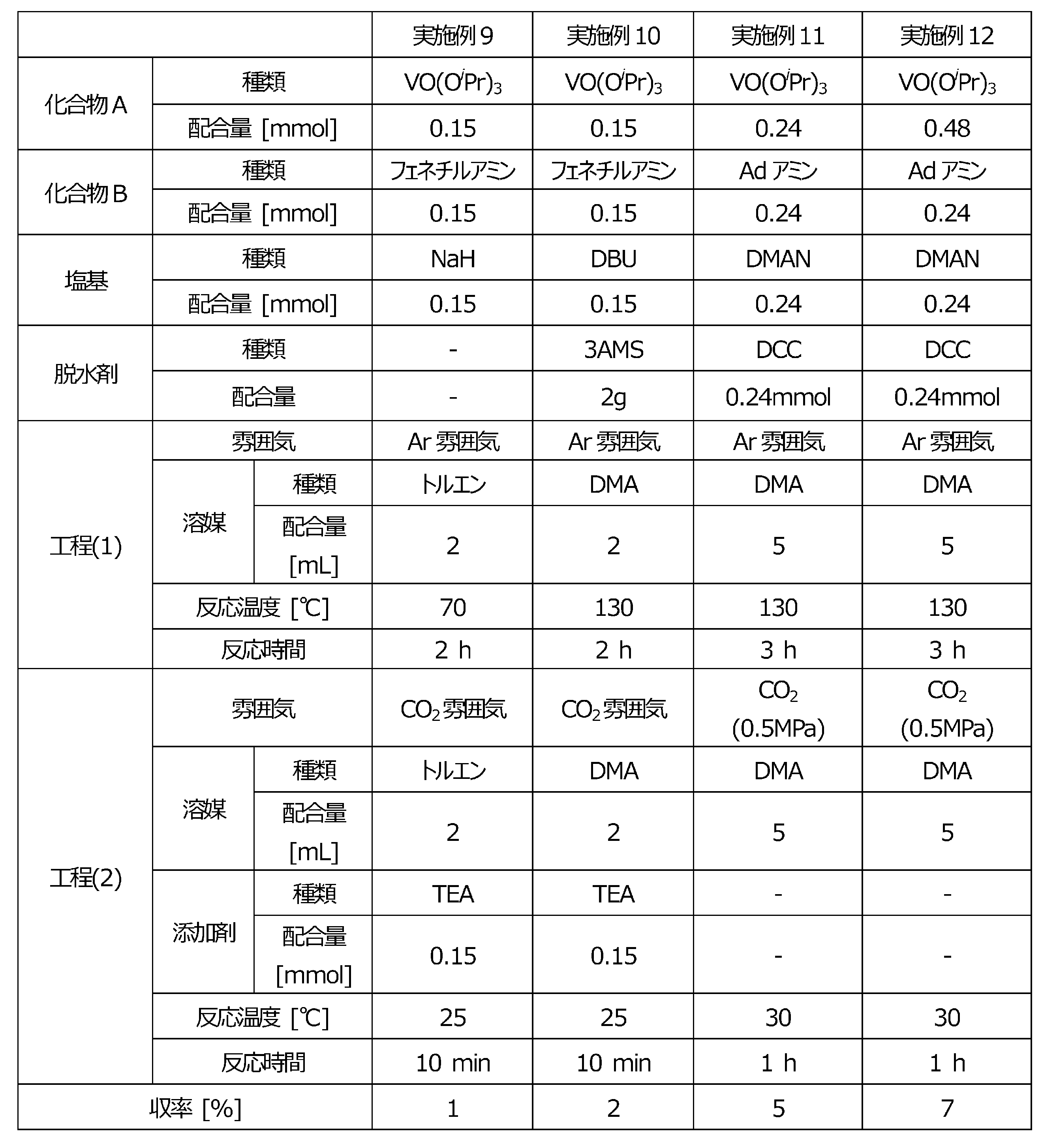
- Example 11 [Step (1)] In a glove box, 0.24 mmol of compound A, 0.24 mmol of compound B, 0.24 mmol of base, 0.24 mmol of dehydrating agent, and the solvent of step (1) were charged into a reaction vessel. Vanadium (V) oxytriisopropoxide (VO(O i Pr) 3 ) was used as compound A. 1-adamantanamine (Ad amine) was used as compound B. 1,8-bis(dimethylamino)naphthalene (DMAN) was used as the base. N,N'-dicyclohexylcarbodiimide (DCC) was used as the dehydrating agent. 5 mL of dimethylacetamide (DMA) was used as the solvent of step (1). These were reacted by stirring at 130°C for 3 hours under an argon atmosphere.
- Step (2) Next, the reaction vessel was cooled until the temperature inside the reaction vessel reached 30°C. Carbon dioxide was introduced into the reaction vessel up to 0.6 MPa, and released to 0.1 MPa three times to replace the inside of the reaction tube with carbon dioxide. After that, the carbon dioxide was pressurized to 0.5 MPa. In this state, the inside of the reaction vessel was stirred and reacted at 30°C for 1 hour.
- Example 12 An isocyanate was produced in the same manner as in Example 11, except that the amount of compound A was changed to 0.48 mmol.
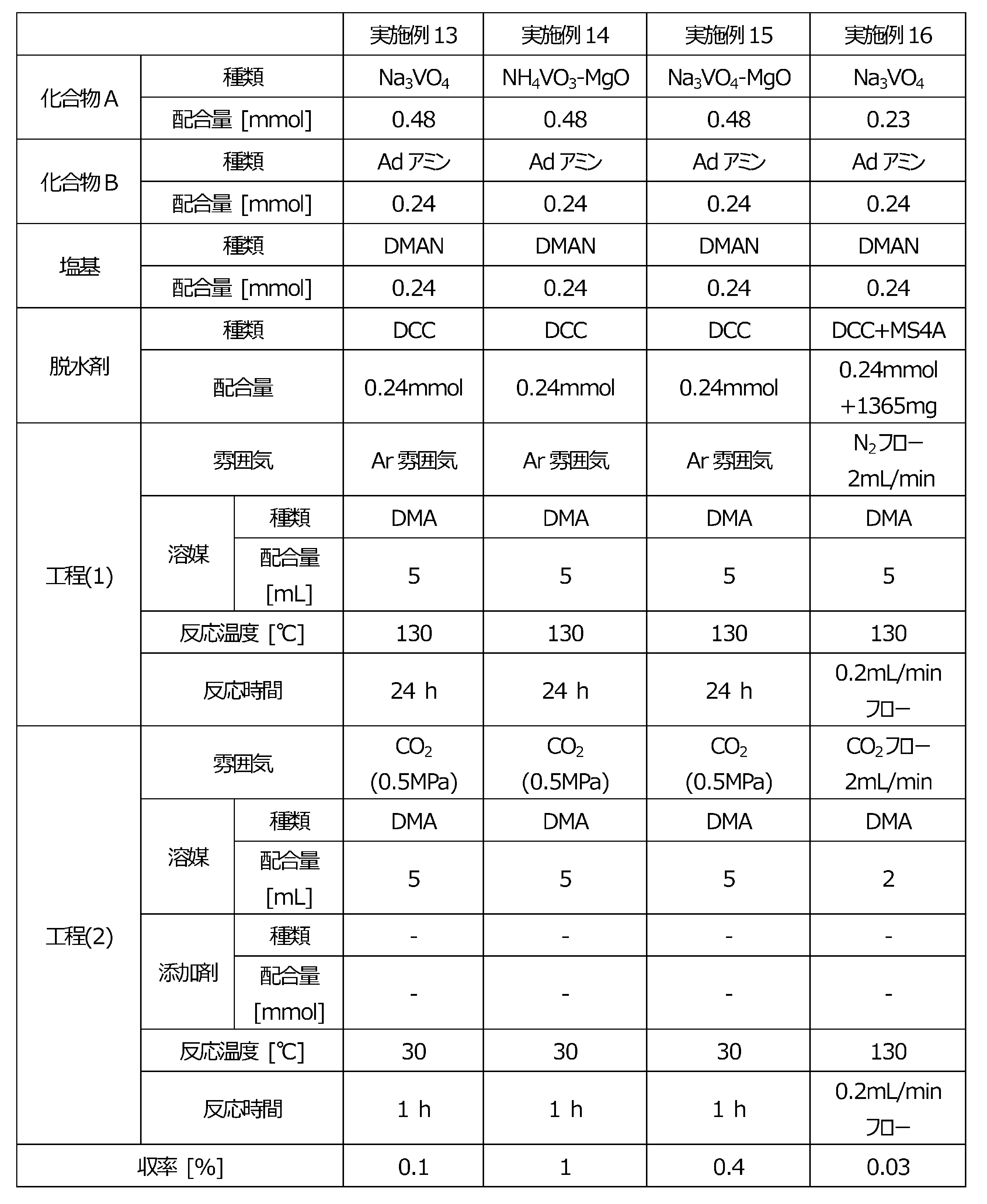
- Example 13 An isocyanate was produced in the same manner as in Example 12, except that Na 3 VO 4 was used as compound A and the reaction time in step (1) was 24 hours.
- Example 14 First, 450 mg of MgO particles (manufactured by Fujifilm Wako Pure Chemical Industries, Ltd., 131-00282) was prepared. Next, the particles (support) were placed in a muffle furnace and fired at 700° C. for 5 hours.
- NH 4 VO 3 was prepared as compound A.
- NH 4 VO 3 was mixed with 10 mL of distilled water, and NH 4 VO 3 was dissolved in the distilled water using ultrasonic waves.
- a carrier was immersed in the obtained solution, and the two were mixed to bring NH 4 VO 3 into contact with the carrier.
- the mixture was dried by removing water from the obtained mixture using an evaporator. This produced NH 4 VO 3 supported on a carrier.
- the compound A was further calcined at 500° C. for 5 hours using a muffle furnace, and the compound A was ground in a mortar after calcination to obtain a composite of the carrier and the carrier.
- An isocyanate was produced in the same manner as in Example 13, except that the above complex was used instead of compound A.
- the amount of the complex was adjusted so that the amount of NH 4 VO 3 present in the reaction vessel was 0.48 mmol.
- Example 15 An isocyanate was produced in the same manner as in Example 14 , except that Na3VO4 was used instead of NH4VO3 . The amount of the complex was adjusted so that the amount of Na3VO4 present in the reaction vessel was 0.48 mmol .
- Step (1) A cylindrical container (hereinafter referred to as "flow reactor") was filled with 0.23 mmol of compound A and 1365 mg of molecular sieves (MS4A, Fujifilm Wako Pure Chemical Industries, Ltd. synthetic zeolite, A-4, spherical (8-12 mesh)).
- MS4A Fujifilm Wako Pure Chemical Industries, Ltd. synthetic zeolite, A-4, spherical (8-12 mesh)
- a mixture of 0.24 mmol of compound B, 0.24 mmol of base, a dehydrating agent, and the solvent of step (1) was supplied to the flow reactor at a flow rate of 0.2 mL/min, and nitrogen was supplied at a flow rate of 2 mL/min.
- the flow reactor was heated so that the temperature inside the flow reactor was 130°C.
- compound A Na 3 VO 4 was used.
- compound B 1-adamantanamine was used.
- DMAN was used.
- the dehydrating agent 0.24 mmol of DCC was used.
- Step (2) After all the liquid was discharged from the outlet, the supply of nitrogen was stopped, 2 mL of DMA was supplied at a flow rate of 0.2 mL/min, and CO2 was supplied at a flow rate of 2 mL/min to the flow reactor. The reaction solution discharged from the outlet of the flow reactor was collected, and the yield of isocyanate was calculated in the same manner as in Example 1.
- Table 1 shows the yields of isocyanates for Examples 1 to 8.
- Table 2 shows the yields of isocyanates for Examples 9 to 12.
- Table 3 shows the yields of isocyanates for Examples 13 to 16.
- Isocyanates could be produced by the production methods of Examples 1 to 16. From the results of Examples 1 to 3, it can be seen that under the production conditions of the Examples, the highest yield was achieved when the solvent in step (2) was toluene. Furthermore, from the results of Examples 4 to 7, it can be seen that the yield tends to increase as the reaction temperature in step (2) decreases.
- Step (2) After the reaction was completed, the solution in the reaction vessel was frozen using liquid nitrogen. The reaction vessel was cooled until the temperature inside the reaction vessel reached 25° C. Then, the atmosphere inside the reaction vessel was replaced with carbon dioxide using a balloon filled with carbon dioxide and a pump. With the balloon still connected to the reaction vessel, the reaction was carried out at 25° C. for 2 hours. After the reaction was completed, the production of isocyanate was confirmed.
- Step (3) After the reaction was completed, 1 mL of isopropyl alcohol (IPA) was added to the reaction vessel, and the mixture was reacted by stirring at 25° C. for 10 minutes under an argon atmosphere.
- IPA isopropyl alcohol
- Example 18 A urethane was produced in the same manner as in Example 17, except that the dehydrating agent was changed to sodium sulfate.
- Step (2) After the reaction was completed, the solution in the reaction vessel was frozen using liquid nitrogen. The reaction vessel was cooled until the temperature inside the reaction vessel reached 25° C. Then, the atmosphere inside the reaction vessel was replaced with carbon dioxide using a balloon filled with carbon dioxide and a pump. With the balloon still connected to the reaction vessel, the reaction was carried out at 25° C. for 2 hours. After the reaction was completed, the production of isocyanate was confirmed.
- Step (3) After the reaction was completed, 1 mL of isopropyl alcohol (IPA) was added to the reaction vessel, and the mixture was reacted by stirring at 25° C. for 10 minutes under a nitrogen atmosphere.
- IPA isopropyl alcohol
- Step (2) After the reaction was completed, the reaction vessel was cooled until the temperature inside the reaction vessel reached 30° C. Carbon dioxide was introduced into the reaction vessel up to 0.6 MPa, and released to 0.1 MPa, three times, to replace the inside of the reaction tube with carbon dioxide. Then, the carbon dioxide was pressurized to 0.5 MPa. In this state, the reaction vessel was stirred and reacted at 30° C. for 2 hours. After the reaction was completed, the production of isocyanate was confirmed.
- Step (3) After the reaction was completed, the reaction vessel was cooled until the temperature inside the reaction vessel reached 25° C. 1 mL of isopropyl alcohol (IPA) was added to the reaction vessel, and the mixture was reacted by stirring at 25° C. for 10 minutes under an argon atmosphere.
- IPA isopropyl alcohol
- Example 21 A urethane was produced in the same manner as in Example 20, except that the dehydrating agent was changed to 0.4 g of molecular sieves (MS3A) and the solvent was changed to toluene.
- MS3A molecular sieves
- Example 22 A urethane was produced in the same manner as in Example 21, except that no antioxidant was used.
- Step (2) After the reaction was completed, the solution in the reaction vessel was frozen using liquid nitrogen. The reaction vessel was cooled until the temperature inside the reaction vessel reached 25° C. Then, the atmosphere inside the reaction vessel was replaced with carbon dioxide using a balloon filled with carbon dioxide and a pump. With the balloon still connected to the reaction vessel, the reaction was carried out at 25° C. for 2 hours. After the reaction was completed, the production of isocyanate was confirmed.
- Step (3) After the reaction was completed, 2 mL of isopropyl alcohol (IPA) was added to the reaction vessel, and the mixture was reacted by stirring at 25° C. for 30 minutes under an argon atmosphere.
- IPA isopropyl alcohol
- Table 4 shows the yields of isocyanate derivatives (urethane) for Examples 17 to 19.
- Table 5 shows the yields of urethane for Examples 20 to 23.
- the method for producing isocyanate according to this embodiment allows isocyanate to be produced efficiently.
Landscapes
- Chemical & Material Sciences (AREA)
- Organic Chemistry (AREA)
- Organic Low-Molecular-Weight Compounds And Preparation Thereof (AREA)
Abstract
本発明のイソシアネートの製造方法は、元素M-酸素二重結合を有する化合物Aと、アミノ基を有する化合物Bとを反応させて、生成物Cを得る工程(1)と、生成物Cと、二酸化炭素、炭酸塩、及び炭酸水素塩からなる群より選択される少なくとも1つとを反応させて、イソシアネートを得る工程(2)と、を含み、元素Mは、金属元素、又はPであり、工程(1)において、化合物Bのアミノ基のモル数に対する化合物Aの元素M-酸素二重結合の数の比が0.5以上である。
Description
本発明は、イソシアネートの製造方法に関する。
従来、イソシアネートの主な工業的製造方法として、アミンとホスゲンとを反応させるホスゲン法が用いられている。しかし、ホスゲンは極めて毒性が高いこと、及び副生成物として塩化水素が発生することなど、ホスゲン法には環境負荷及び安全性の観点から多くの問題がある。
そこで、近年、ホスゲンを使用しないイソシアネートの製造方法が検討されている。例えば、特許文献1及び2には、多段階の反応によってアミンと二酸化炭素とアルコールとからカルバメートを製造した後、カルバメートの熱分解反応によりイソシアネートを製造する方法が記載されている。特許文献3には、アミンとN-無置換カルバメートとアルコールとを用いてカルバメートを製造した後、カルバメートの熱分解反応によりイソシアネートを製造する方法が記載されている。
上記のイソシアネートの製造方法は、製造工程が煩雑である。
そこで、本発明は、簡便なプロセスでイソシアネートを製造する新たな方法を提供することを目的とする。
本発明は、
元素M-酸素二重結合を有する化合物Aと、アミノ基を有する化合物Bとを反応させて、生成物Cを得る工程(1)と、
前記生成物Cと、二酸化炭素、炭酸塩、及び炭酸水素塩からなる群より選択される少なくとも1つとを反応させて、イソシアネートを得る工程(2)と、
を含み、
前記元素Mは、金属元素、又はPであり、
前記工程(1)において、前記化合物Bの前記アミノ基のモル数に対する前記化合物Aの前記二重結合の数の比が0.5以上である、イソシアネートの製造方法を提供する。
元素M-酸素二重結合を有する化合物Aと、アミノ基を有する化合物Bとを反応させて、生成物Cを得る工程(1)と、
前記生成物Cと、二酸化炭素、炭酸塩、及び炭酸水素塩からなる群より選択される少なくとも1つとを反応させて、イソシアネートを得る工程(2)と、
を含み、
前記元素Mは、金属元素、又はPであり、
前記工程(1)において、前記化合物Bの前記アミノ基のモル数に対する前記化合物Aの前記二重結合の数の比が0.5以上である、イソシアネートの製造方法を提供する。
本発明によれば、簡便なプロセスでイソシアネートを製造できる。
本発明の第1態様に係るイソシアネートの製造方法は、
元素M-酸素二重結合を有する化合物Aと、アミノ基を有する化合物Bとを反応させて、生成物Cを得る工程(1)と、
前記生成物Cと、二酸化炭素、炭酸塩、及び炭酸水素塩からなる群より選択される少なくとも1つとを反応させて、イソシアネートを得る工程(2)と、
を含み、
前記元素Mは、金属元素、又はPであり、
前記工程(1)において、前記化合物Bの前記アミノ基のモル数に対する前記化合物Aの前記二重結合の数の比が0.5以上である。
元素M-酸素二重結合を有する化合物Aと、アミノ基を有する化合物Bとを反応させて、生成物Cを得る工程(1)と、
前記生成物Cと、二酸化炭素、炭酸塩、及び炭酸水素塩からなる群より選択される少なくとも1つとを反応させて、イソシアネートを得る工程(2)と、
を含み、
前記元素Mは、金属元素、又はPであり、
前記工程(1)において、前記化合物Bの前記アミノ基のモル数に対する前記化合物Aの前記二重結合の数の比が0.5以上である。
本発明の第2態様において、例えば、第1態様に係るイソシアネートの製造方法では、前記比が1.0以上である。
本発明の第3態様において、例えば、第1又は第2態様に係るイソシアネートの製造方法では、前記工程(2)において、反応温度が100℃以下である。
本発明の第4態様において、例えば、第1~第3態様のいずれか1つに係るイソシアネートの製造方法では、前記工程(1)及び前記工程(2)はワンポットで行われる。
本発明の第5態様において、例えば、第1~第4態様のいずれか1つに係るイソシアネートの製造方法では、前記元素Mは、V、Fe、Mo、Ta、Nb、Ti、W、又はPである。
本発明の第6態様において、例えば、第1~第5態様のいずれか1つに係るイソシアネートの製造方法では、前記化合物Bは、1級アミンである。
本発明の第7態様において、例えば、第1~第6態様のいずれか1つに係るイソシアネートの製造方法では、前記化合物Bは、下記の一般式(B)で表される化合物である。
R-NX2 (B)
一般式(B)において、Rは、置換基を有していてもよい炭化水素基を表し、
2つのXは、互いに独立して、水素原子、又は保護基を表す。
R-NX2 (B)
一般式(B)において、Rは、置換基を有していてもよい炭化水素基を表し、
2つのXは、互いに独立して、水素原子、又は保護基を表す。
本発明の第8態様において、例えば、第7態様に係るイソシアネートの製造方法では、前記炭化水素基が、脂肪族環及び芳香環からなる群より選択される少なくとも1つを含む。
本発明の第9態様において、例えば、第1~第8態様のいずれか1つに係るイソシアネートの製造方法では、前記生成物Cが元素M-窒素二重結合を有する。
本発明の第10態様において、例えば、第1~第9態様のいずれか1つに係るイソシアネートの製造方法では、前記工程(2)において、前記反応によって前記化合物Aがさらに得られる。
本発明の第11態様において、例えば、第1~第10態様のいずれか1つに係るイソシアネートの製造方法では、前記工程(1)において、前記反応は不活性雰囲気下で行われる。
本発明の第12態様において、例えば、第1~第11態様のいずれか1つに係るイソシアネートの製造方法では、前記工程(2)において、前記反応は溶媒下で行われ、前記溶媒は、トルエン、1,4-ジオキサン、及びアセトニトリルからなる群より選択される少なくとも1つを含む。
本発明の第13態様において、例えば、第1~第12態様のいずれか1つに係るイソシアネートの製造方法は、前記工程(1)において、前記反応は塩基の存在下で行われる。
本発明の第14態様に係るイソシアネート誘導体の製造方法は、
第1から第13態様のいずれか1つに係るイソシアネートの製造方法によって得られたイソシアネートをイソシアネート誘導体に変換する工程(3)、を含む。
第1から第13態様のいずれか1つに係るイソシアネートの製造方法によって得られたイソシアネートをイソシアネート誘導体に変換する工程(3)、を含む。
以下、本発明の詳細を説明するが、以下の説明は、本発明を特定の実施形態に制限する趣旨ではない。
[イソシアネートの製造方法]
本発明の第1実施形態に係るイソシアネートの製造方法は、元素M-酸素二重結合を有する化合物Aと、アミノ基を有する化合物Bとを反応させて、生成物Cを得る工程(1)と、工程(1)で得られた生成物Cと、二酸化炭素、炭酸塩、及び炭酸水素塩からなる群より選択される少なくとも1つとを反応させて、イソシアネートを得る工程(2)とを含む。元素Mは、金属元素、又はPである。工程(1)において、化合物Bのアミノ基のモル数に対する化合物Aの元素M-酸素二重結合の数の比が0.5以上である。
本発明の第1実施形態に係るイソシアネートの製造方法は、元素M-酸素二重結合を有する化合物Aと、アミノ基を有する化合物Bとを反応させて、生成物Cを得る工程(1)と、工程(1)で得られた生成物Cと、二酸化炭素、炭酸塩、及び炭酸水素塩からなる群より選択される少なくとも1つとを反応させて、イソシアネートを得る工程(2)とを含む。元素Mは、金属元素、又はPである。工程(1)において、化合物Bのアミノ基のモル数に対する化合物Aの元素M-酸素二重結合の数の比が0.5以上である。
工程(1)及び工程(2)の反応は、バッチ式の反応器を用いて行われてもよいし、フローリアクター(例えば、PFR:plug flow reactor、CSTR:continuous stirred tank reactor)を用いて行われてもよい。
工程(1)及び工程(2)はワンポットで行われてもよい。
本明細書において、「工程(1)及び工程(2)がワンポットで行われる」とは、工程(1)及び工程(2)の間に生成物Cを単離精製する工程を含まずに、工程(1)及び工程(2)の反応が行われることを意味する。生成物Cを単離精製する工程を含まない限り、工程(1)及び工程(2)は、同じ反応容器で行われてもよく、異なる反応容器で行われてもよい。工程(1)及び工程(2)をワンポットで行うことで、例えば製造工程の効率化を実現できる。本明細書において、「生成物Cを単離精製する工程」とは、溶剤を除いた場合の生成物Cの純度を95%以上とする工程を意味する。
工程(1)及び工程(2)は、同じ反応容器で行われてもよい。工程(1)の反応及び工程(2)の反応は、同じ反応容器内で連続的に行われてもよい。
以下、各工程について詳細に説明する。
<工程(1)>
化合物Aは、元素M-酸素二重結合を有する化合物である。
化合物Aは、元素M-酸素二重結合を有する化合物である。
一分子の化合物Aにおける元素M-酸素二重結合の数は1以上であってもよく、例えば1~5である。一分子の化合物Aにおける元素M-酸素二重結合の数は、好ましくは1である。ただし、場合によっては、一分子の化合物Aにおける元素M-酸素二重結合の数は2以上であってもよい。
元素Mは、金属元素又はPである。元素Mは、金属元素であってもよい。
元素Mは、V、Fe、Mo、Ta、Nb、Ti、W、又はPであってもよく、V、Fe、Mo、Ta、Nb、Ti、又はWであってもよく、V、Fe、Mo、又はNbであってもよく、Vであってもよい。すなわち、化合物Aは、バナジウム-酸素二重結合を有してもよい。
本発明の好ましい一形態では、化合物Aは、元素Mに配位する配位子を有する錯体であってもよい。
配位子としては、例えば、置換基を有していてもよい炭化水素基、置換基を有していてもよいオキシ炭化水素基、及びハロゲンが挙げられる。
炭化水素基の炭素数は、1以上であれば特に限定されない。炭化水素基の炭素数は、例えば20以下であってもよく、15以下であってもよく、10以下であってもよく、5以下であってもよく、3以下であってもよい。
炭化水素基は、直鎖状又は分岐鎖状の鎖式炭化水素基であってもよい。炭化水素基は、アルキル基、アルケニル基、又はアルキニル基であってもよい。アルキル基は、例えば、メチル基、エチル基、プロピル基、イソプロピル基、ブチル基、イソブチル基、tert-ブチル基、sec-ブチル基、である。アルケニル基は、例えば、ビニル基、アリル基、である。アルキニル基は、例えば、エチニル基である。
炭化水素基の置換基としては、例えば、ハロゲン、アミノ基、アルコキシ基、アルキルエステル基、カルボキシル基、水酸基、が挙げられる。
オキシ炭化水素基に含まれる炭化水素基としては、上述したものが挙げられる。オキシ炭化水素基は、アルコキシ基であってもよい。アルコキシ基としては、例えばメトキシ基、エトキシ基、イソプロポキシ基が挙げられる。オキシ炭化水素基の置換基としては、炭化水素基について上述したものが挙げられる。置換基を有するオキシ炭化水素基は、例えば、トリエタノールアミン由来の基(TEA)が挙げられる。
ハロゲンとしては、フッ素、塩素、臭素、ヨウ素などが挙げられ、例えば塩素である。
配位子は、好ましくは、イソプロポキシ基、エチル基、エトキシ基、塩素、又はTEAである。
配位子の数は、元素Mの種類などに応じて適宜調整することができる。配位子の数は、1以上であってもよく、例えば1~5である。配位子の数は、3又は4であってもよい。配位子の数は、好ましくは3である。
化合物Aは、下記の一般式(A)で表される化合物であってもよい。
LnVO (A)
一般式(A)において、Lは、置換基を有していてもよい炭化水素基、置換基を有していてもよいオキシ炭化水素基、又はハロゲンを表し、nは1~5の自然数である。nが2以上であるとき、複数のLは、互いに独立している。複数のLより選ばれる少なくとも2つは、互いに連結していてもよい。
LnVO (A)
一般式(A)において、Lは、置換基を有していてもよい炭化水素基、置換基を有していてもよいオキシ炭化水素基、又はハロゲンを表し、nは1~5の自然数である。nが2以上であるとき、複数のLは、互いに独立している。複数のLより選ばれる少なくとも2つは、互いに連結していてもよい。
置換基を有していてもよい炭化水素基及び置換基を有していてもよいオキシ炭化水素基の例は、上述したものが挙げられる。
一般式(A)において、nは3又は4であってもよい。nは、好ましくは3である。
一般式(A)において、Lは、好ましくはアルコキシ基であり、より好ましくはイソプロポキシ基である。
化合物Aは、バナジウム(V)オキシトリイソプロポキシド(VO(OiPr)3)、VO(OEt)3、VO(OEt)Cl2、VOCl3、又はVO(TEA)であってもよい。
化合物Aは、上述の錯体に限定されない。本発明の別の好ましい一形態では、化合物Aは、元素Mの酸化物、又は元素Mを含む無機塩であってもよい。化合物Aは、例えばV2O5、NH4VO3、Na3VO4、TiO2、WO3、FeO、Fe2O3、NbO2、Nb2O5、(NH4)2MoO4が挙げられる。
本発明のさらに別の好ましい一形態では、化合物Aとしての上記の元素Mの酸化物又は元素Mを含む無機塩は、担体に担持されていてもよい。すなわち、工程(1)において、元素M-酸素二重結合を有する化合物Aおよび当該化合物Aを担持する担体の複合体と、アミノ基を有する化合物Bとを反応させることで生成物Cを得てもよい。担体は、化合物Aを担持することが可能な固体であることが好ましい。なお、本明細書において、「固体」は、大気圧下、20℃で固体状態の物質を意味する。
担体は、イオン半径が60.5pmより大きいカチオンD1を有する化合物Sを含んでいてもよい。なお、複合体において、化合物Sは、上述の化合物Aとは異なるものであることが好ましい。本明細書において、「イオン半径」は、Shannon et al., Acta Cryst. A 32(1976) 751.に記載された定義に基づく値である。イオン半径は、通常、カチオンの種類、カチオンの価数、及び、カチオンの配位数によって定まる。
カチオンD1のイオン半径は、60.5pmより大きく、61pm以上、63pm以上、65pm以上、68pm以上、70pm以上、75pm以上、80pm以上、85pm以上、90pm以上、95pm以上、さらには100pm以上であってもよい。カチオンD1のイオン半径の上限は、特に限定されず、例えば200pm以下であり、150pm以下であってもよい。カチオンD1のイオン半径は、場合によっては100pm以下であってもよい。
カチオンD1の価数は、例えば1~6であり、1~4であることが好ましい。カチオンD1の価数は、場合によっては3以下であってもよく、2以下であってもよい。
カチオンD1は、金属カチオンであることが好ましい。金属カチオンは、マグネシウムイオン、セリウムイオン、ジルコニウムイオン、ナトリウムイオン、カルシウムイオン、マンガンイオン、コバルトイオン、ランタンイオン、亜鉛イオン、カリウムイオン、インジウムイオン、ニオブイオン、バリウムイオン、ストロンチウムイオン、鉄イオン及びイットリウムイオンからなる群より選ばれる少なくとも1つを含むことが好ましく、マグネシウムイオン及びセリウムイオンからなる群より選ばれる少なくとも1つを含むことがより好ましく、マグネシウムイオンを含むことが特に好ましい。
化合物Sは、典型的には、カチオンD1と結合しているアニオンD2をさらに有する。アニオンD2としては、酸化物イオン、水酸化物イオン、炭酸イオン、リン酸イオンなどが挙げられ、好ましくは酸化物イオンである。
化合物Sは、カチオンD1として金属カチオンを有し、アニオンD2として酸化物イオンを有していることが好ましい。すなわち、化合物Sは、金属カチオンを有する金属酸化物であることが好ましい。
金属酸化物の具体例としては、MgO(マグネシウムイオンのイオン半径:72pm)、CeO2(セリウムイオンのイオン半径:97pm)、ZrO2(ジルコニウムイオンのイオン半径:78pm)、CaO(カルシウムイオンのイオン半径:100pm)、MnO(マンガンイオンのイオン半径:67~83pm)、CoO(コバルトイオンのイオン半径:65~74.5pm)、Fe2O3(鉄イオンのイオン半径:78pm)、Y2O3(イットリウムイオンのイオン半径:90pm)などが挙げられる。化合物Sは、MgO及びCeO2からなる群より選ばれる少なくとも1つを含むことが好ましく、MgOを含むことが特に好ましい。
化合物Sは、金属酸化物以外の他の化合物であってもよい。他の化合物としては、NaOH(ナトリウムイオンのイオン半径:102pm)などの水酸化物塩;CaCO3(カルシウムイオンのイオン半径:112pm)などの炭酸塩;Ca5(PO4)3(OH)(カルシウムイオンのイオン半径:118pm)などの水酸化リン酸塩などが挙げられる。
担体は、化合物Sを主成分として含んでいてもよい。本明細書において、「主成分」は、担体に重量比で最も多く含まれた成分を意味する。担体において、化合物Sの含有率は、例えば80wt%以上であり、90wt%以上、95wt%以上、さらには99wt%以上であってもよい。担体は、実質的に化合物Sから構成されていてもよい。
複合体において、担体の含有率は、例えば99.9wt%以下であり、99.5wt%以下、99wt%以下、97wt%以下、95wt%以下、92wt%以下、さらには90wt%以下であってもよい。担体の含有率の下限は、例えば50wt%以上であり、70wt%以上、さらには80wt%以上であってもよい。
担体の形状は、特に限定されず、例えば粒子状である。本明細書において、粒子状は、球状、楕円体状、鱗片状、繊維状などを含む。
化合物Bは、アミノ基を有する化合物である。
化合物Bは、好ましくは1級アミンである。
一分子の化合物Bにおけるアミノ基の数は1個であってもよいし、2個以上であってもよい。
化合物Bは、環状構造を含んでもよい。化合物Bは、1の環状構造を含んでもよいし、2以上の環状構造を含んでもよい。環状構造はヘテロ原子を有していてもよいし、ヘテロ原子を有していなくてもよい。環状構造は、脂肪族環又は芳香環であってもよい。ヘテロ原子を有する環状構造を含む化合物Bは、例えば、テトラヒドロフラナミンである。
脂肪族環は、例えばシクロヘキサン、シクロペンタン、アダマンタン、である。芳香環は、例えばベンゼン、ナフタレン、アントラセン、である。
化合物Bにおいて、環状構造と窒素とが直接結合していてもよいし、直接結合していなくてもよい。化合物Bにおいて、脂肪族環と窒素とが直接結合していてもよい。化合物Bは、アミノ基と脂肪族環とが直接結合した1級アミンであってもよい。
化合物Bは、下記の一般式(B)で表される化合物であってもよい。
R-NX2 (B)
式(B)において、Rは、置換基を有していてもよい炭化水素基を表し、2つのXは、互いに独立して、水素原子、又は保護基を表す。
R-NX2 (B)
式(B)において、Rは、置換基を有していてもよい炭化水素基を表し、2つのXは、互いに独立して、水素原子、又は保護基を表す。
保護基としては、例えば、シリル系保護基、カルバメート系保護基、が挙げられる。シリル系保護基としては、例えば、トリメチルシリル基(TMS基)、トリエチルシリル基(TES基)、トリイソプロピルシリル基(TIPS基)、tert-ブチルジメチルシリル基(TBDMS基)、tert-ブチルジフェニルシリル基(TBDPS基)、が挙げられる。カルバメート系保護基としては、例えば、tert-ブトキシカルボニル基(Boc基)、ベンジルオキシカルボニル基(Cbz基)、が挙げられる。
一般式(B)において、Xは好ましくは水素原子である。
一般式(B)において、炭化水素基の炭素数は、1以上であれば特に限定されない。炭化水素基の炭素数は、例えば20以下であってもよく、15以下であってもよく、12以下であってもよく、10以下であってもよい。
本発明の好ましい一形態では、一般式(B)において、炭化水素基は、環状構造を含む。一般式(B)において、上記の炭化水素基が、脂肪族環及び芳香環からなる群より選択される少なくとも1つを含んでもよい。
環状構造を含む炭化水素基は、例えば脂環式炭化水素基又は芳香環式炭化水素基である。本明細書において、「脂環式炭化水素基」とは、環状構造としては脂肪族環のみを含み、芳香環を含まない炭化水素基を意味し、単環の脂環式炭化水素基及び多環の脂環式炭化水素基の両方を含む。ここで、脂環式炭化水素基は、脂肪族環のみで構成されている必要はなく、その一部に鎖状構造を含んでいてもよい。「芳香環式炭化水素基」とは、環状構造として芳香環を含む炭化水素基を意味する。ここで、芳香環式炭化水素基は、芳香環のみで構成されている必要はなく、その一部に脂肪族環や鎖状構造を含んでいてもよい。
脂環式炭化水素基は、例えばシクロヘキシル基、シクロペンチル基、アダマンチル基、である。脂環式炭化水素基は、好ましくはシクロヘキシル基である。
芳香環式炭化水素基は、ベンゼン環を含んでいてもよい。芳香環式炭化水素基は、例えば、フェニル基、メチルフェニル基、メトキシフェニル基、ベンジル基などを含んでいてもよい。
本発明の別の好ましい一形態では、一般式(B)において、炭化水素基は、直鎖状又は分岐鎖状の鎖式炭化水素基であってもよい。炭化水素基は、アルキル基、アルケニル基、又はアルキニル基であってもよい。
アルキル基は、例えば、メチル基、エチル基、プロピル基、イソプロピル基、ブチル基、イソブチル基、tert-ブチル基、sec-ブチル基、ペンチル基、ヘキシル基、ヘプチル基、オクチル基、ノニル基、デシル基、である。アルケニル基は、例えば、ビニル基、アリル基、である。アルキニル基は、例えば、エチニル基である。
置換基は任意の置換基であってもよく、例えば、化合物Aについて上述したものが挙げられる。
化合物Bは、例えば、エチルアミン、プロピルアミン、ブチルアミン、ペンチルアミン、ヘキシルアミン、ヘプチルアミン、オクチルアミン、ノニルアミン、デシルアミン、シクロヘキシルアミン、シクロペンチルアミン、2-フェニルメチルアミン、2-フェニルエチルアミン(フェネチルアミン)、1-フェニルエチルアミン、2-フェニルプロピルアミン、3-フェニルプロピルアミン、3,3-ジフェニルプロピルアミン、2-(4-メチルフェニル)エチルアミン、2-(4-ブロモフェニル)エチルアミン、2-(4-トリフルオロメチルフェニル)エチルアミン、3-エトキシプロピルアミン、1-アダマンタンアミン、4-メトキシアニリン、テトラヒドロフラン-2-メタンアミン、ヘキサメチレンジアミン、1,5-ペンタメチレンジアミン、トルエンジアミン、トルエンジアミン、4,4’-メチレンジアニリン、2,4,6-トリメチルアニリンなどが挙げられる。上記例示した化合物に構造異性体が存在する場合は、その構造異性体も例示に含まれる。化合物Bは、好ましくはシクロヘキシルアミンである。
第1実施形態に係るイソシアネートの製造方法では、化合物Bの選択によってさまざまな種類のイソシアネートを製造することができる。
上述の通り、工程(1)では、化合物Aと化合物Bとを反応させて、生成物Cを得る。工程(1)において、化合物Bのアミノ基のモル数に対する化合物Aの元素M-酸素二重結合の数の比が0.5以上である。本明細書において、「工程(1)における化合物Bのアミノ基のモル数に対する化合物Aの元素M-酸素二重結合の数の比」は、計算式:(化合物A一分子に含まれる元素M-酸素二重結合の数に工程(1)で用いる化合物Aの物質量を乗じた値)/(化合物B一分子に含まれるアミノ基の数に工程(1)で用いる化合物Bの物質量を乗じた値)で算出される値である。
工程(1)において、化合物Bのアミノ基のモル数に対する化合物Aの元素M-酸素二重結合の数の比は、0.8以上であってもよく、好ましくは1.0以上である。工程(1)において、化合物Bのアミノ基のモル数に対する化合物Aの元素M-酸素二重結合の数の比は、10.0以下であってもよく、7.0以下、5.0以下、3.0以下、さらには2.0以下であってもよい。工程(1)において、化合物Bのアミノ基のモル数に対する化合物Aの元素M-酸素二重結合の数の比は、例えば0.5以上かつ10.0以下であってもよく、0.8以上かつ3.0以下であってもよく、1.0以上かつ1.5以下であってもよく、1.0以上かつ1.2以下であってもよく、1.0以上かつ1.1以下であってもよい。工程(1)において、化合物Bのアミノ基のモル数に対する化合物Aの元素M-酸素二重結合の数の比が1.0であってもよい。
工程(1)において、化合物Bの物質量に対する化合物Aの物質量の比は、0.8以上であってもよく、好ましくは1.0以上である。工程(1)において、化合物Bの物質量に対する化合物Aの物質量の比は、10.0以下であってもよく、7.0以下、5.0以下、3.0以下、さらには2.0以下であってもよい。工程(1)において、化合物Bの物質量に対する化合物Aの物質量の比が1.0以上かつ2.0以下であってもよく、1.0以上かつ1.5以下であってもよく、1.0以上かつ1.2以下であってもよく、1.0以上かつ1.1以下であってもよい。工程(1)において、化合物Bの物質量に対する化合物Aの物質量の比が1.0であってもよい。
化合物Aと化合物Bとを反応させて得られる生成物Cは、元素M-窒素二重結合を有してもよい。生成物Cに含まれる元素Mは、化合物Aに由来している。
一分子の生成物Cにおける元素M-窒素二重結合の数は1以上であってもよく、例えば1~5である。一分子の生成物Cにおける元素M-窒素二重結合の数は、好ましくは1である。ただし、場合によっては、一分子の生成物Cにおける元素M-窒素二重結合の数は2以上であってもよい。
生成物Cは、環状構造を含んでもよい。化合物Bは、1の環状構造を含んでもよいし、2以上の環状構造を含んでもよい。環状構造は、化合物Bについて上述したとおりである。
生成物Cにおいて、環状構造と窒素とが直接結合していてもよいし、直接結合していなくてもよい。生成物Cにおいて、脂肪族環と窒素とが直接結合していてもよい。
本発明の好ましい一形態では、生成物Cは、元素Mに配位する配位子を有していてもよい。
配位子の例は、化合物Aについて上述したものが挙げられる。
生成物Cは、下記の一般式(C)で表される化合物であってもよい。
LnVNR (C)
一般式(C)において、Rは、置換基を有していてもよい炭化水素基を表し、Lは、置換基を有していてもよい炭化水素基、置換基を有していてもよいオキシ炭化水素基、又はハロゲンを表し、nは1~5の自然数である。nが2以上であるとき、複数のLは、互いに独立している。複数のLより選ばれる少なくとも2つは、互いに連結していてもよい。すなわち、Rは上記一般式(B)のものと同じであり、Lは上記一般式(A)のものと同じである。一般式(C)において、NはV及びRと結合し、LはVに配位している。一般式(C)において、nは3又は4であってもよい。nは、好ましくは3である。
LnVNR (C)
一般式(C)において、Rは、置換基を有していてもよい炭化水素基を表し、Lは、置換基を有していてもよい炭化水素基、置換基を有していてもよいオキシ炭化水素基、又はハロゲンを表し、nは1~5の自然数である。nが2以上であるとき、複数のLは、互いに独立している。複数のLより選ばれる少なくとも2つは、互いに連結していてもよい。すなわち、Rは上記一般式(B)のものと同じであり、Lは上記一般式(A)のものと同じである。一般式(C)において、NはV及びRと結合し、LはVに配位している。一般式(C)において、nは3又は4であってもよい。nは、好ましくは3である。
生成物Cは、上述のものに限定されない。本発明の別の好ましい一形態では、生成物Cは、元素Mに配位する配位子を有していなくてもよい。
工程(1)において、化合物Aと化合物Bとの反応は、不活性雰囲気下で行われてもよい。不活性雰囲気は、窒素雰囲気であってもよい。
工程(1)において、化合物Aと化合物Bとの反応は塩基の存在下で行われてもよい。塩基は特に限定されず、無機塩基又は有機塩基であってもよい。無機塩基の例は、水素化ナトリウム、及び水素化リチウムなどの水素化物塩類、水酸化ナトリウム、水酸化カリウム、水酸化リチウム、及び水酸化バリウムなどの水酸化物類、炭酸ナトリウム、炭酸カリウム、炭酸リチウム、炭酸バリウム、炭酸水素ナトリウム、及び炭酸水素カリウムなどの炭酸塩類、アンモニアなどが挙げられる。有機塩基の例は、アミン、含窒素芳香族化合物、尿素などが挙げられる。これらの塩基を単独又は混合して用いてもよい。塩基は、好ましくは、水素化ナトリウム、N,N-ジイソプロピルエチルアミン、ジアザビシクロウンデセン(DBU)、又は1,8-ビス(ジメチルアミノ)ナフタレン(DMAN)である。
塩基は、脱水剤として機能できるものであってもよい。例えば、工程(1)の塩基として水素化ナトリウムを使用した場合、反応により水酸化ナトリウムに変換され、後述する脱水剤として用いることができる。
塩基の使用量は特に限定されない。例えば、化合物Bのアミノ基のモル数に対する塩基の使用量の比は、0.20以上、0.50以上、0.70以上、0.80以上、0.90以上、さらには1.0以上である。なお、化合物Bのアミノ基のモル数に対する塩基の使用量の比は、塩基の物質量(mol)/(化合物B一分子に含まれるアミノ基の数×化合物Bの物質量)(mol)である。
工程(1)において、反応温度は、例えば150℃以下、130℃以下、120℃以下、100℃以下、90℃以下、80℃以下、好ましくは70℃以下である。反応温度は、例えば20℃以上、25℃以上、さらには30℃以上である。反応温度は、20℃以上130℃以下であってもよく、20℃以上かつ70℃以下であってもよい。本明細書では、反応温度は反応系の温度を意味する。
工程(1)において、反応時間は、特に限定されない。生成物Cを十分に得る観点から、例えば10分間以上、1時間以上、さらには2時間以上である。また、反応時間は、例えば、48時間以下、24時間以下、12時間以下、6時間以下、さらには2時間以下である。
工程(1)において、化合物Aと化合物Bとの反応は溶媒下で行われてもよい。溶媒は、極性溶媒及び非極性溶媒を用いることができる。本明細書において、非極性溶媒は、25℃での比誘電率が8.0以下の溶媒である。本明細書において、極性溶媒は、25℃での比誘電率が8.0より大きい溶媒である。
非極性溶媒は、例えば、トルエン、ベンゼン、キシレン、ヘキサン、1,4-ジオキサン、テトラヒドロフラン、酢酸エチル、シクロペンチルメチルエーテル、及びこれらの混合溶媒などが挙げられる。非極性溶媒は、好ましくはトルエンである。
極性溶媒は、例えば、アセトニトリル、ジメチルスルホキシド、ジクロロメタン、プロピレンカーボネート、メタノール、エタノール、ジメチルアセトアミド(DMA)、及びこれらの混合溶媒などが挙げられる。極性溶媒は、好ましくはDMA、アセトニトリル又はジクロロメタンである。
効率の観点から、溶媒は非極性溶媒であることが好ましい。これにより、続く工程(2)で同じ溶媒を使用することで、本発明の製造方法を効率化し得る。溶媒が極性溶媒である場合も、続く工程(2)で同じ溶媒を使用することで、本発明の製造方法を効率化し得る。
工程(1)において、さらに脱水剤を使用してもよい。これにより、生成物Cの分解を抑制することができる。脱水剤としては、例えばモレキュラーシーブ、N,N’-ジシクロヘキシルカルボジイミド(DCC)、硫酸ナトリウム、酸化マグネシウムのような公知の脱水剤が使用できる。また、塩基について上述したように、脱水剤としても機能できる塩基を用いてもよい。
工程(1)において、さらに添加剤を使用してもよい。添加剤としては、酸化防止剤、反応促進剤等が挙げられる。
<工程(2)>
上述の通り、工程(2)では、工程(1)で得られた生成物Cと、二酸化炭素、炭酸塩、及び炭酸水素塩からなる群より選択される少なくとも1つとを反応させて、イソシアネートを得る。
上述の通り、工程(2)では、工程(1)で得られた生成物Cと、二酸化炭素、炭酸塩、及び炭酸水素塩からなる群より選択される少なくとも1つとを反応させて、イソシアネートを得る。
出発原料である化合物Bの物質量に対する二酸化炭素、炭酸塩、及び炭酸水素塩の物質量の合計の比は、1以上であってもよい。二酸化炭素、炭酸塩、及び炭酸水素塩は、出発原料である化合物Bに対して過剰量であることが好ましい。工程(2)において、生成物Cの物質量に対する二酸化炭素、炭酸塩、及び炭酸水素塩の物質量の合計との比は、1以上であってもよい。
炭酸塩及び炭酸水素塩としては、例えば、アルカリ金属やアルカリ土類金属の炭酸塩又は炭酸水素塩が挙げられる。炭酸水素塩としては、例えば、炭酸水素ナトリウム、炭酸水素カリウムなどが挙げられる。炭酸塩としては、例えば、炭酸ナトリウム、炭酸カリウム、炭酸カリウムナトリウム、セスキ炭酸ナトリウムなどが挙げられる。
炭酸塩及び炭酸水素塩は、二酸化炭素と塩基との反応により生成することが可能である。例えば、塩基性溶液中に二酸化炭素を導入することにより炭酸塩及び炭酸水素塩を生成してもよい。
工程(2)では、生成物Cと二酸化炭素とを反応させて、イソシアネートを得てもよい。
工程(2)は、二酸化炭素を含む雰囲気下で行われてもよく、二酸化炭素雰囲気下で行われてもよい。
二酸化炭素を含む雰囲気は、工程(1)で得られた生成物Cを含む反応容器内の雰囲気の全体を二酸化炭素に置換することで得られてもよいし、工程(1)で得られた生成物Cを含む溶液に二酸化炭素をバブリングすることで得られてもよい。すなわち、工程(2)における生成物Cと二酸化炭素との反応は、工程(1)で得られた生成物Cを含む反応容器内の雰囲気を二酸化炭素に置換してから行われてもよいし、工程(1)で得られた生成物Cを含む溶液に二酸化炭素をバブリングしながら行われてもよい。
工程(2)において、反応温度は、例えば130℃未満であってもよく、100℃以下であってもよい。反応温度は、例えば、90℃以下、80℃以下、好ましくは70℃以下、さらに好ましくは30℃以下である。反応温度は、例えば20℃以上、さらには25℃以上である。反応温度は、20℃以上かつ70℃以下であってもよい。反応温度は、25℃以上かつ50℃以下であってもよく、30℃以上かつ50℃以下であってもよい。以上の構成により、イソシアネートの収率を向上し得る。
工程(2)において、反応時間は特に限定されない。反応時間は、例えば、3分間以上、10分間以上、1時間以上、さらには2時間以上である。また、反応時間は、例えば、24時間以下、12時間以下、7時間以下、さらには2時間以下である。
工程(2)において、生成物Cと、二酸化炭素、炭酸塩、及び炭酸水素塩からなる群より選択される少なくとも1つとの反応は溶媒下で行われてもよい。溶媒は、例えば、工程(1)について上述したものが挙げられる。
工程(2)において、溶媒は非極性溶媒であってもよい。以上の構成により、副反応が抑制されて、イソシアネートの収率を向上できると推測される。例えば、非極性溶媒を用いた場合は、化合物A同士の凝集により、イソシアネートが化合物Aの元素Mへ配位することが抑制されるので、副反応が抑制されると推測される。または、溶媒は、極性溶媒であってもよい。
工程(2)において、溶媒は、トルエン、1,4-ジオキサン、及びアセトニトリルからなる群より選択される少なくとも1つを含んでもよい。溶媒は、好ましくはトルエンである。または、溶媒は、好ましくはDMAである。
工程(1)における溶媒と工程(2)における溶媒とは、互いに同じであってもよい。以上の構成により、本発明の製造方法を効率化し得る。
以上によって、イソシアネートを製造できる。本発明の第1実施形態に係るイソシアネートの製造方法では、例えば下記の一般式(I)で示されるイソシアネートを製造できる。
R-N=C=O (I)
一般式(I)において、Rは、置換基を有していてもよい炭化水素基を表す。すなわち、Rは上記一般式(B)のものと同じである。
R-N=C=O (I)
一般式(I)において、Rは、置換基を有していてもよい炭化水素基を表す。すなわち、Rは上記一般式(B)のものと同じである。
工程(2)において、生成物Cと、二酸化炭素、炭酸塩、及び炭酸水素塩からなる群より選択される少なくとも1つとの反応によってさらに化合物Aが得られてもよい。すなわち、工程(2)において、生成物Cと、二酸化炭素、炭酸塩、及び炭酸水素塩からなる群より選択される少なくとも1つとを反応させて、イソシアネートと化合物Aとを得てもよい。これにより、出発原料である化合物Aを回収し、再利用することにより、イソシアネートの生産性を高め得る。
工程(2)において、さらに脱水剤を使用してもよい。これにより、生成物Cの分解を抑制することができる。脱水剤としては、工程(1)において上述したものが挙げられる。
工程(2)において、さらに添加剤を使用してもよい。添加剤としては、酸化防止剤、反応促進剤等が挙げられる。添加剤の具体例としては、トリエタノールアミン(TEA)、トリス(2-ヒドロキシフェニル)アミンなどが挙げられる。これにより、イソシアネートの収率を向上し得る。添加剤は、二酸化炭素、炭酸塩、及び炭酸水素塩からなる群より選択される少なくとも1つを供給する前に、生成物Cを含む系中に添加されてもよい。工程(2)では、例えば、添加剤を加えて攪拌した後に、生成物Cと二酸化炭素、炭酸塩、及び炭酸水素塩からなる群より選択される少なくとも1つとの反応が行われてもよい。撹拌時間は例えば5分~30分である。
第1実施形態に係るイソシアネートの製造方法において、得られたイソシアネートの収率は、例えば工程(2)における反応溶液をガスクロマトグラフィーに供して測定できる。これにより、反応溶液にさらなる処理をすることなくイソシアネートの収率を測定することができる。
本発明の第1実施形態に係るイソシアネートの製造方法は、工程(1)と工程(2)とが連続して行われてもよい。本発明の第1実施形態に係るイソシアネートの製造方法は、工程(1)と工程(2)との間に他の工程を含んでもよい。
工程(1)と工程(2)との間の他の工程の一例は、工程(1)で用いた溶媒を除去する工程である。溶媒を除去する方法としては、例えば、減圧乾燥、真空乾燥などが挙げられる。これにより、工程(1)と工程(2)とで互いに異なる溶媒を使用できる。
本発明の第1実施形態に係るイソシアネートの製造方法は、工程(1)と工程(2)との間に、工程(1)で用いた溶媒を除去する工程を含まなくてもよい。例えば、工程(1)で用いる溶媒と工程(2)で用いる溶媒とが互いに同じである場合は、工程(1)で用いた溶媒を除去する工程を省略でき、簡便にイソシアネートを製造できる。
工程(1)と工程(2)との間の他の工程の別の例は、工程(2)においては不要である物質を除去する工程である。除去する方法としては、例えば、ろ過が挙げられる。例えば、工程(1)の後、ろ過により脱水剤を除去し、ろ液を工程(2)に用いてもよい。
なお、本発明の第1実施形態に係るイソシアネートの製造方法は、工程(1)及び工程(2)の間に生成物Cを単離精製する工程を含んでいてもよい。
以上のとおり、本実施形態の製造方法では、化合物A及びBを用いて、工程(1)及び(2)を行うことによって、イソシアネートを合成することができる。なお、二酸化炭素の雰囲気下で、触媒量の化合物Aを化合物Bと反応させた場合には、イソシアネートではなく、尿素化合物が合成されることが知られている(T.Moriuchi et al. “Oxovanadium(V)-catalyzed amination of carbon dioxide under ambient pressure for the synthesis of ureas” RSC Adv., 2021, 11, 27121-27125)。
[イソシアネート誘導体の製造方法]
本発明の第2実施形態に係るイソシアネート誘導体の製造方法は、第1実施形態に係るイソシアネートの製造方法によって得られたイソシアネートをイソシアネート誘導体に変換する工程(3)を含む。
本発明の第2実施形態に係るイソシアネート誘導体の製造方法は、第1実施形態に係るイソシアネートの製造方法によって得られたイソシアネートをイソシアネート誘導体に変換する工程(3)を含む。
イソシアネート誘導体は、例えば、カルボジイミド、イソシアヌレート、ウレタン、ウレア及びウレア誘導体である。
工程(3)において、例えばイソシアネートを加熱処理することによって、カルボジイミドが得られる。
加熱処理の温度は、例えば、50℃以上、70℃以上、100℃以上、さらには130℃以上である。
加熱処理の時間は、特に限定されず、例えば1時間以上、2時間以上さらには5時間以上である。
または、工程(3)において、例えばアルコールを添加して反応させることによって、ウレタンが得られる。アルコールは、イソプロピルアルコール(IPA)であってもよい。
工程(1)、工程(2)及び工程(3)はワンポットで行われてもよいし、工程(1)及び工程(2)のみがワンポットで行われてもよい。工程(3)は、工程(1)及び工程(2)とは異なる容器内で行われてもよい。「工程(1)、工程(2)及び工程(3)がワンポットで行われる」とは、工程(1)及び工程(2)の間に生成物Cを単離精製する工程を含まず、かつ、工程(2)及び工程(3)の間にイソシアネートを単離精製する工程を含まずに、工程(1)、工程(2)及び工程(3)の反応が行われることを意味する。例えば、本発明の第2実施形態に係るイソシアネート誘導体の製造方法は、生成物C及びイソシアネートを系外に留去する操作を経ず、工程(1)、工程(2)及び工程(3)の反応を行う。
工程(2)で用いる溶媒と工程(3)で用いる溶媒とは互いに同じであってもよい。
以下に、本発明をさらに詳細に説明するが、本発明はこれに限定されるものではない。
(実施例1)
[工程(1)]
グローブボックス内で、0.60mmolの化合物A、0.60mmolの化合物B、0.60mmolの塩基、及び工程(1)の溶媒を反応容器に投入した。化合物Aとしては、バナジウム(V)オキシトリイソプロポキシド(VO(OiPr)3)142μLを用いた。化合物Bとしては、シクロへキシルアミン(Cyアミン)69μLを用いた。塩基としては、水素化ナトリウム(NaH、60%オイルディスパージョン)14.4mgを用いた。工程(1)の溶媒としては、ジクロロメタン5mLを用いた。これらを、窒素雰囲気下、25℃で24時間攪拌することで反応させた。
[工程(1)]
グローブボックス内で、0.60mmolの化合物A、0.60mmolの化合物B、0.60mmolの塩基、及び工程(1)の溶媒を反応容器に投入した。化合物Aとしては、バナジウム(V)オキシトリイソプロポキシド(VO(OiPr)3)142μLを用いた。化合物Bとしては、シクロへキシルアミン(Cyアミン)69μLを用いた。塩基としては、水素化ナトリウム(NaH、60%オイルディスパージョン)14.4mgを用いた。工程(1)の溶媒としては、ジクロロメタン5mLを用いた。これらを、窒素雰囲気下、25℃で24時間攪拌することで反応させた。
減圧下にてジクロロメタンを除去した後、真空乾燥を1.5時間行った。真空乾燥後、反応容器内に黄色のオイル状液体が得られた。
[工程(2)]
グローブボックス内で、上記反応容器内の黄色のオイル状液体に、工程(2)の溶媒としてトルエン1mLを添加して、反応容器を密閉した。液体窒素を用いて反応容器内の溶液を凍結させた。その後、二酸化炭素を充填した風船とポンプとを用いて反応容器内の雰囲気を二酸化炭素に置換した。反応容器に風船を接続したまま、30℃で2時間反応させた。すなわち、工程(1)と工程(2)とはワンポットで行われた。
グローブボックス内で、上記反応容器内の黄色のオイル状液体に、工程(2)の溶媒としてトルエン1mLを添加して、反応容器を密閉した。液体窒素を用いて反応容器内の溶液を凍結させた。その後、二酸化炭素を充填した風船とポンプとを用いて反応容器内の雰囲気を二酸化炭素に置換した。反応容器に風船を接続したまま、30℃で2時間反応させた。すなわち、工程(1)と工程(2)とはワンポットで行われた。
反応終了後、反応容器内の反応溶液についてガスクロマトグラフィーを用いて分析を実施した。あらかじめ標品にて作成した検量線を用いて、得られたイソシアネート(実施例1及び以下の実施例2~8ではイソシアン酸シクロヘキシル、実施例9~10ではイソシアン酸フェネチル、実施例11~16ではイソシアン酸1-アダマンチル)の物質量X(mоl)を算出した。得られたイソシアネートの物質量Xと、反応に用いた化合物Bの物質量Y(実施例1及び以下の実施例2~8では0.60mmоl、実施例9~10では0.15mmоl、実施例11~16では0.24mmоl)とに基づいて、下記式(1)により、イソシアネートの収率(%)を算出した。
イソシアネートの収率(%)=100×X/Y (1)
イソシアネートの収率(%)=100×X/Y (1)
(実施例2)
工程(2)の溶媒を1,4-ジオキサンに変更したこと以外は実施例1と同様の操作を行い、イソシアネートを製造した。
工程(2)の溶媒を1,4-ジオキサンに変更したこと以外は実施例1と同様の操作を行い、イソシアネートを製造した。
(実施例3)
工程(2)の溶媒をアセトニトリルに変更したこと以外は実施例1と同様の操作を行い、イソシアネートを製造した。
工程(2)の溶媒をアセトニトリルに変更したこと以外は実施例1と同様の操作を行い、イソシアネートを製造した。
(実施例4)
[工程(1)]
グローブボックス内で、0.60mmolの化合物A、0.60mmolの化合物B、0.60mmolの塩基、及び工程(1)の溶媒を反応容器に投入した。化合物Aとしては、バナジウム(V)オキシトリイソプロポキシド(VO(OiPr)3)142μLを用いた。化合物Bとしては、シクロへキシルアミン(Cyアミン)69μLを用いた。塩基としては、水素化ナトリウム(NaH、60%オイルディスパージョン)14.4mgを用いた。工程(1)の溶媒としては、トルエン5mLを用いた。これらを、窒素雰囲気下、25℃で6時間攪拌することで反応させた。
[工程(1)]
グローブボックス内で、0.60mmolの化合物A、0.60mmolの化合物B、0.60mmolの塩基、及び工程(1)の溶媒を反応容器に投入した。化合物Aとしては、バナジウム(V)オキシトリイソプロポキシド(VO(OiPr)3)142μLを用いた。化合物Bとしては、シクロへキシルアミン(Cyアミン)69μLを用いた。塩基としては、水素化ナトリウム(NaH、60%オイルディスパージョン)14.4mgを用いた。工程(1)の溶媒としては、トルエン5mLを用いた。これらを、窒素雰囲気下、25℃で6時間攪拌することで反応させた。
[工程(2)]
上記反応終了後、液体窒素を用いて反応容器内の溶液を凍結させた。その後、二酸化炭素を充填した風船とポンプとを用いて反応容器内の雰囲気を二酸化炭素に置換した。反応容器に風船を接続したまま、30℃で2時間反応させた。
上記反応終了後、液体窒素を用いて反応容器内の溶液を凍結させた。その後、二酸化炭素を充填した風船とポンプとを用いて反応容器内の雰囲気を二酸化炭素に置換した。反応容器に風船を接続したまま、30℃で2時間反応させた。
反応終了後、実施例1と同様にして、イソシアネートの収率を算出した。
(実施例5)
工程(1)の反応温度を70℃としたこと以外は実施例4と同様の操作を行い、イソシアネートを製造した。
工程(1)の反応温度を70℃としたこと以外は実施例4と同様の操作を行い、イソシアネートを製造した。
(実施例6)
工程(2)の反応温度を50℃としたこと以外は実施例5と同様の操作を行い、イソシアネートを製造した。
工程(2)の反応温度を50℃としたこと以外は実施例5と同様の操作を行い、イソシアネートを製造した。
(実施例7)
工程(2)の反応温度を70℃としたこと以外は実施例5と同様の操作を行い、イソシアネートを製造した。
工程(2)の反応温度を70℃としたこと以外は実施例5と同様の操作を行い、イソシアネートを製造した。
(実施例8)
[工程(1)]
グローブボックス内で、0.60mmolの化合物A、0.60mmolの化合物B、0.60mmolの塩基、及び工程(1)の溶媒を反応容器に投入した。化合物Aとしては、バナジウム(V)オキシトリイソプロポキシド(VO(OiPr)3)142μLを用いた。化合物Bとしては、シクロへキシルアミン(69μL)を用いた。塩基としては、水素化ナトリウム(NaH、60%オイルディスパージョン)14.4mgを用いた。工程(1)の溶媒としては、ジクロロメタン5mLを用いた。これらを、窒素雰囲気下、70℃で2時間攪拌することで反応させた。
[工程(1)]
グローブボックス内で、0.60mmolの化合物A、0.60mmolの化合物B、0.60mmolの塩基、及び工程(1)の溶媒を反応容器に投入した。化合物Aとしては、バナジウム(V)オキシトリイソプロポキシド(VO(OiPr)3)142μLを用いた。化合物Bとしては、シクロへキシルアミン(69μL)を用いた。塩基としては、水素化ナトリウム(NaH、60%オイルディスパージョン)14.4mgを用いた。工程(1)の溶媒としては、ジクロロメタン5mLを用いた。これらを、窒素雰囲気下、70℃で2時間攪拌することで反応させた。
[工程(2)]
上記反応終了後、反応容器内の溶液を25℃まで冷却した。その後、当該溶液に二酸化炭素ボンベに接続したチューブを浸し、二酸化炭素を100mL/minの流量で3分間バブリングした。
上記反応終了後、反応容器内の溶液を25℃まで冷却した。その後、当該溶液に二酸化炭素ボンベに接続したチューブを浸し、二酸化炭素を100mL/minの流量で3分間バブリングした。
反応終了後、反応容器内の反応溶液について、実施例1と同様にしてイソシアネートの収率を算出した。
(実施例9)
[工程(1)]
グローブボックス内で、0.15mmolの化合物A、0.15mmolの化合物B、0.15mmolの塩基、及び工程(1)の溶媒を反応容器に投入した。化合物Aとしては、バナジウム(V)オキシトリイソプロポキシド(VO(OiPr)3)を用いた。化合物Bとしては、フェネチルアミンを用いた。塩基としては、水素化ナトリウム(NaH、60%オイルディスパージョン)を用いた。工程(1)の溶媒としては、トルエン2mLを用いた。これらを、アルゴン雰囲気下、70℃で2時間攪拌することで反応させた。
[工程(1)]
グローブボックス内で、0.15mmolの化合物A、0.15mmolの化合物B、0.15mmolの塩基、及び工程(1)の溶媒を反応容器に投入した。化合物Aとしては、バナジウム(V)オキシトリイソプロポキシド(VO(OiPr)3)を用いた。化合物Bとしては、フェネチルアミンを用いた。塩基としては、水素化ナトリウム(NaH、60%オイルディスパージョン)を用いた。工程(1)の溶媒としては、トルエン2mLを用いた。これらを、アルゴン雰囲気下、70℃で2時間攪拌することで反応させた。
[工程(2)]
上記反応終了後、反応容器内の温度が25℃のなるまで反応容器を冷却後、アルゴン雰囲気のグローブボックス内で反応容器に0.15mmоlのトリエタノールアミン(TEA)を添加した。このとき、TEAを少量のトルエンで希釈したものを添加した。TEAの添加後、25℃で10分間攪拌した。その後、液体窒素を用いて反応容器内の溶液を凍結させた。その後、二酸化炭素を充填した風船とポンプとを用いて反応容器内の雰囲気を二酸化炭素に置換した。反応容器に風船を接続したまま、25℃で10分間反応させた。
上記反応終了後、反応容器内の温度が25℃のなるまで反応容器を冷却後、アルゴン雰囲気のグローブボックス内で反応容器に0.15mmоlのトリエタノールアミン(TEA)を添加した。このとき、TEAを少量のトルエンで希釈したものを添加した。TEAの添加後、25℃で10分間攪拌した。その後、液体窒素を用いて反応容器内の溶液を凍結させた。その後、二酸化炭素を充填した風船とポンプとを用いて反応容器内の雰囲気を二酸化炭素に置換した。反応容器に風船を接続したまま、25℃で10分間反応させた。
反応終了後、反応容器内の反応溶液について、実施例1と同様にしてイソシアネートの収率を算出した。
(実施例10)
[工程(1)]
グローブボックス内で、0.15mmolの化合物A、0.15mmolの化合物B、0.15mmolの塩基、脱水剤、及び工程(1)の溶媒を反応容器に投入した。化合物Aとしては、バナジウム(V)オキシトリイソプロポキシド(VO(OiPr)3)を用いた。化合物Bとしては、フェネチルアミンを用いた。塩基としては、ジアザビシクロウンデセン(DBU)を用いた。脱水剤としては、モレキュラーシーブ(MS3A)2gを用いた。工程(1)の溶媒としては、ジメチルアセトアミド(DMA)2mLを用いた。これらを、アルゴン雰囲気下、130℃で2時間攪拌することで反応させた。
[工程(1)]
グローブボックス内で、0.15mmolの化合物A、0.15mmolの化合物B、0.15mmolの塩基、脱水剤、及び工程(1)の溶媒を反応容器に投入した。化合物Aとしては、バナジウム(V)オキシトリイソプロポキシド(VO(OiPr)3)を用いた。化合物Bとしては、フェネチルアミンを用いた。塩基としては、ジアザビシクロウンデセン(DBU)を用いた。脱水剤としては、モレキュラーシーブ(MS3A)2gを用いた。工程(1)の溶媒としては、ジメチルアセトアミド(DMA)2mLを用いた。これらを、アルゴン雰囲気下、130℃で2時間攪拌することで反応させた。
[工程(2)]
上記反応終了後、反応容器内の溶液を25℃まで冷却後、アルゴン雰囲気のグローブボックス内で反応容器に0.15mmоlのTEAを添加した。このとき、TEAを少量のDMAで希釈したものを添加した。TEAの添加後、25℃で10分間攪拌した。その後、液体窒素を用いて反応容器内の溶液を凍結させた。その後、二酸化炭素を充填した風船とポンプとを用いて反応容器内の雰囲気を二酸化炭素に置換した。反応容器に風船を接続したまま、25℃で10分間反応させた。
上記反応終了後、反応容器内の溶液を25℃まで冷却後、アルゴン雰囲気のグローブボックス内で反応容器に0.15mmоlのTEAを添加した。このとき、TEAを少量のDMAで希釈したものを添加した。TEAの添加後、25℃で10分間攪拌した。その後、液体窒素を用いて反応容器内の溶液を凍結させた。その後、二酸化炭素を充填した風船とポンプとを用いて反応容器内の雰囲気を二酸化炭素に置換した。反応容器に風船を接続したまま、25℃で10分間反応させた。
反応終了後、反応容器内の反応溶液について、実施例1と同様にしてイソシアネートの収率を算出した。
(実施例11)
[工程(1)]
グローブボックス内で、0.24mmolの化合物A、0.24mmolの化合物B、0.24mmolの塩基、0.24mmolの脱水剤、及び工程(1)の溶媒を反応容器に投入した。化合物Aとしては、バナジウム(V)オキシトリイソプロポキシド(VO(OiPr)3)を用いた。化合物Bとしては、1-アダマンタンアミン(Adアミン)を用いた。塩基としては、1,8-ビス(ジメチルアミノ)ナフタレン(DMAN)を用いた。脱水剤としては、N,N’-ジシクロヘキシルカルボジイミド(DCC)を用いた。工程(1)の溶媒としては、ジメチルアセトアミド(DMA)5mLを用いた。これらを、アルゴン雰囲気下、130℃で3時間攪拌することで反応させた。
[工程(2)]
次に、反応容器内の温度が30℃になるまで反応容器を冷却した。反応容器内に二酸化炭素を0.6MPaまで導入し、0.1MPaまで開放する作業を3回行い、反応管内を二酸化炭素に置換した。その後、二酸化炭素を0.5MPaの加圧雰囲気とした。この状態で反応容器内を攪拌し、30℃で1時間反応させた。
次に、反応容器内の温度が30℃になるまで反応容器を冷却した。反応容器内に二酸化炭素を0.6MPaまで導入し、0.1MPaまで開放する作業を3回行い、反応管内を二酸化炭素に置換した。その後、二酸化炭素を0.5MPaの加圧雰囲気とした。この状態で反応容器内を攪拌し、30℃で1時間反応させた。
反応終了後、反応容器内の反応溶液について、実施例1と同様にしてイソシアネートの収率を算出した。
(実施例12)
化合物Aの配合量を0.48mmоlに変更したこと以外は実施例11と同様の操作を行い、イソシアネートを製造した。
化合物Aの配合量を0.48mmоlに変更したこと以外は実施例11と同様の操作を行い、イソシアネートを製造した。
(実施例13)
化合物AとしてNa3VO4を使用したこと、及び工程(1)の反応時間を24時間としたこと以外は実施例12と同様の操作を行い、イソシアネートを製造した。
化合物AとしてNa3VO4を使用したこと、及び工程(1)の反応時間を24時間としたこと以外は実施例12と同様の操作を行い、イソシアネートを製造した。
(実施例14)
まず、MgO粒子(富士フイルム和光純薬社製、131-00282)を450mg準備した。次に、この粒子(担体)をマッフル炉にセットし、700℃で5時間焼成した。
まず、MgO粒子(富士フイルム和光純薬社製、131-00282)を450mg準備した。次に、この粒子(担体)をマッフル炉にセットし、700℃で5時間焼成した。
次に、化合物AとしてNH4VO3を50mg準備した。NH4VO3と蒸留水10mLとを混合し、超音波を使用して、NH4VO3を蒸留水に溶解させた。次に、得られた溶液に担体を浸漬させ、これらを混合することにより、NH4VO3を担体と接触させた。エバポレーターを用いて、得られた混合物から水を取り除くことにより、混合物を乾燥させた。これにより、担体に担持されたNH4VO3を作製した。マッフル炉を用いて、500℃で5時間の焼成をさらに行い、焼成後に乳鉢ですりつぶすことにより、化合物Aと担体との複合体を得た。
化合物Aに代えて上記の複合体を使用したこと以外は実施例13と同様の操作を行い、イソシアネートを製造した。なお、複合体の配合量は、反応容器内に存在するNH4VO3の物質量が0.48mmоlとなるように調整した。
(実施例15)
NH4VO3に代えてNa3VO4を使用したこと以外は実施例14と同様にして、イソシアネートを製造した。なお、複合体の配合量は、反応容器内に存在するNa3VO4の物質量が0.48mmоlとなるように調整した。
NH4VO3に代えてNa3VO4を使用したこと以外は実施例14と同様にして、イソシアネートを製造した。なお、複合体の配合量は、反応容器内に存在するNa3VO4の物質量が0.48mmоlとなるように調整した。
(実施例16)
[工程(1)]
筒状の容器(以下、「フローリアクター」と記載する)に、0.23mmolの化合物Aおよび1365mgのモレキュラーシーブ(MS4A、富士フイルム和光純薬社製 合成ゼオライト,A-4,球状(8~12mesh))を充填した。次いで、フローリアクターに0.24mmolの化合物B、0.24mmolの塩基、脱水剤、及び工程(1)の溶媒の混合物を0.2mL/minの流速で供給し、かつ、窒素を2mL/minの流速で供給した。このとき、フローリアクター内の温度が130℃になるようにフローリアクターが加熱されていた。化合物Aとしては、Na3VO4を用いた。化合物Bとしては、1-アダマンタンアミンを用いた。塩基としては、DMANを用いた。脱水剤としては、0.24mmolのDCCを用いた。工程(1)の溶媒としては、DMA5mLを用いた。
[工程(2)]
すべての液体が出口から排出された後、窒素の供給を止め、DMA2mLを0.2mL/minの流速で供給し、かつ、CO2を2mL/minの流速でフローリアクターに供給した。フローリアクターの出口から排出された反応溶液を回収し、実施例1と同様にしてイソシアネートの収率を算出した。
すべての液体が出口から排出された後、窒素の供給を止め、DMA2mLを0.2mL/minの流速で供給し、かつ、CO2を2mL/minの流速でフローリアクターに供給した。フローリアクターの出口から排出された反応溶液を回収し、実施例1と同様にしてイソシアネートの収率を算出した。
表1に、実施例1~8のイソシアネートの収率を示す。表2に、実施例9~12のイソシアネートの収率を示す。表3に、実施例13~16のイソシアネートの収率を示す。

実施例1~16の製造方法によって、イソシアネートを製造することができた。実施例1~3の結果から、実施例の製造条件においては、工程(2)の溶媒がトルエンであるときに最も収率が高くなることがわかる。また、実施例4~7の結果から、工程(2)の反応温度が低くなるにつれ、収率が高くなる傾向があることがわかる。
[イソシアネート誘導体の製造]
(実施例17)
[工程(1)]
グローブボックス内で、0.60mmolの化合物A、0.60mmolの化合物B、1.8mmolの塩基、1.8mmolの脱水剤、及び工程(1)の溶媒を反応容器に投入した。化合物Aとしては、バナジウム(V)オキシトリイソプロポキシド(VO(OiPr)3)を用いた。化合物Bとしては、4-メトキシアニリンを用いた。塩基としては、DBUを用いた。脱水剤としては、DCCを用いた。工程(1)の溶媒としては、DMA5mLを用いた。これらを、アルゴン雰囲気下、130℃で24時間攪拌することで反応させた。
(実施例17)
[工程(1)]
グローブボックス内で、0.60mmolの化合物A、0.60mmolの化合物B、1.8mmolの塩基、1.8mmolの脱水剤、及び工程(1)の溶媒を反応容器に投入した。化合物Aとしては、バナジウム(V)オキシトリイソプロポキシド(VO(OiPr)3)を用いた。化合物Bとしては、4-メトキシアニリンを用いた。塩基としては、DBUを用いた。脱水剤としては、DCCを用いた。工程(1)の溶媒としては、DMA5mLを用いた。これらを、アルゴン雰囲気下、130℃で24時間攪拌することで反応させた。
[工程(2)]
上記反応終了後、液体窒素を用いて反応容器内の溶液を凍結させた。また、反応容器内の温度が25℃になるまで反応容器を冷却した。その後、二酸化炭素を充填した風船とポンプとを用いて反応容器内の雰囲気を二酸化炭素に置換した。反応容器に風船を接続したまま、25℃で2時間反応させた。反応終了後、イソシアネートの生成を確認した。
上記反応終了後、液体窒素を用いて反応容器内の溶液を凍結させた。また、反応容器内の温度が25℃になるまで反応容器を冷却した。その後、二酸化炭素を充填した風船とポンプとを用いて反応容器内の雰囲気を二酸化炭素に置換した。反応容器に風船を接続したまま、25℃で2時間反応させた。反応終了後、イソシアネートの生成を確認した。
[工程(3)]
上記の反応終了後、上記反応容器にイソプロピルアルコール(IPA)1mLを添加し、アルゴン雰囲気下、25℃で10分間撹拌することで反応させた。
上記の反応終了後、上記反応容器にイソプロピルアルコール(IPA)1mLを添加し、アルゴン雰囲気下、25℃で10分間撹拌することで反応させた。
反応終了後、溶液をフィルターでろ過、濃縮後、1H-NMRを用いて分析を実施した。あらかじめ標品にて作成した検量線を用いて、得られたイソシアネート誘導体(ウレタン)の物質量Z(mоl)を算出した。得られたウレタンの物質量Zと、反応に用いた化合物Bの物質量Yとに基づいて、下記式(2)により、ウレタンの収率(%)を算出した。
ウレタンの収率(%)=100×Z/Y (2)
ウレタンの収率(%)=100×Z/Y (2)
(実施例18)
脱水剤を硫酸ナトリウムに変更したこと以外は実施例17と同様の操作を行い、ウレタンの製造を行った。
脱水剤を硫酸ナトリウムに変更したこと以外は実施例17と同様の操作を行い、ウレタンの製造を行った。
(実施例19)
[工程(1)]
グローブボックス内で、0.60mmolの化合物A、0.60mmolの化合物B、1.8mmolの塩基、0.60mmolの脱水剤、及び工程(1)の溶媒を反応容器に投入した。化合物Aとしては、バナジウム(V)オキシトリイソプロポキシド(VO(OiPr)3)を用いた。化合物Bとしては、4-メトキシアニリンを用いた。塩基としては、DBUを用いた。脱水剤としては、酸化マグネシウムを用いた。工程(1)の溶媒としては、DMA5mLを用いた。これらを、窒素雰囲気下、130℃で24時間攪拌することで反応させた。
[工程(1)]
グローブボックス内で、0.60mmolの化合物A、0.60mmolの化合物B、1.8mmolの塩基、0.60mmolの脱水剤、及び工程(1)の溶媒を反応容器に投入した。化合物Aとしては、バナジウム(V)オキシトリイソプロポキシド(VO(OiPr)3)を用いた。化合物Bとしては、4-メトキシアニリンを用いた。塩基としては、DBUを用いた。脱水剤としては、酸化マグネシウムを用いた。工程(1)の溶媒としては、DMA5mLを用いた。これらを、窒素雰囲気下、130℃で24時間攪拌することで反応させた。
[工程(2)]
上記反応終了後、液体窒素を用いて反応容器内の溶液を凍結させた。また、反応容器内の温度が25℃になるまで反応容器を冷却した。その後、二酸化炭素を充填した風船とポンプとを用いて反応容器内の雰囲気を二酸化炭素に置換した。反応容器に風船を接続したまま、25℃で2時間反応させた。反応終了後、イソシアネートの生成を確認した。
上記反応終了後、液体窒素を用いて反応容器内の溶液を凍結させた。また、反応容器内の温度が25℃になるまで反応容器を冷却した。その後、二酸化炭素を充填した風船とポンプとを用いて反応容器内の雰囲気を二酸化炭素に置換した。反応容器に風船を接続したまま、25℃で2時間反応させた。反応終了後、イソシアネートの生成を確認した。
[工程(3)]
上記反応終了後、反応容器にイソプロピルアルコール(IPA)1mLを添加し、窒素雰囲気下、25℃で10分間撹拌することで反応させた。
上記反応終了後、反応容器にイソプロピルアルコール(IPA)1mLを添加し、窒素雰囲気下、25℃で10分間撹拌することで反応させた。
反応終了後、反応容器内の反応溶液について、実施例17と同様にしてウレタンの収率を算出した。
(実施例20)
[工程(1)]
グローブボックス内で、0.24mmolの化合物A、0.24mmolの化合物B、0.72mmolの塩基、0.72mmolの脱水剤、酸化防止剤、及び工程(1)の溶媒を反応容器に投入した。化合物Aとしては、バナジウム(V)オキシトリイソプロポキシド(VO(OiPr)3)を用いた。化合物Bとしては、4-メトキシアニリンを用いた。塩基としては、DBUを用いた。脱水剤としては、酸化マグネシウムを用いた。酸化防止剤としては、1.3mgのジブチルヒドロキシトルエン(BHT)を用いた。工程(1)の溶媒としては、DMA5mLを用いた。これらを、アルゴン雰囲気下、130℃で3時間攪拌することで反応させた。
[工程(2)]
上記反応終了後、反応容器内の温度が30℃になるまで反応容器を冷却した。反応容器内に二酸化炭素を0.6MPaまで導入し、0.1MPaまで開放する作業を3回行い、反応管内を二酸化炭素に置換した。その後、二酸化炭素を0.5MPaの加圧雰囲気とした。この状態で反応容器内を攪拌し、30℃で2時間反応させた。反応終了後、イソシアネートの生成を確認した。
上記反応終了後、反応容器内の温度が30℃になるまで反応容器を冷却した。反応容器内に二酸化炭素を0.6MPaまで導入し、0.1MPaまで開放する作業を3回行い、反応管内を二酸化炭素に置換した。その後、二酸化炭素を0.5MPaの加圧雰囲気とした。この状態で反応容器内を攪拌し、30℃で2時間反応させた。反応終了後、イソシアネートの生成を確認した。
[工程(3)]
上記反応終了後、反応容器内の温度が25℃になるまで反応容器を冷却した。反応容器にイソプロピルアルコール(IPA)1mLを添加し、アルゴン雰囲気下、25℃で10分間撹拌することで反応させた。
上記反応終了後、反応容器内の温度が25℃になるまで反応容器を冷却した。反応容器にイソプロピルアルコール(IPA)1mLを添加し、アルゴン雰囲気下、25℃で10分間撹拌することで反応させた。
反応終了後、反応容器内の反応溶液について、実施例17と同様にしてウレタンの収率を算出した。
(実施例21)
脱水剤を0.4gのモレキュラーシーブ(MS3A)に変更したこと、及び溶媒をトルエンに変更したこと以外は、実施例20と同様の操作を行い、ウレタンの製造を行った。
脱水剤を0.4gのモレキュラーシーブ(MS3A)に変更したこと、及び溶媒をトルエンに変更したこと以外は、実施例20と同様の操作を行い、ウレタンの製造を行った。
(実施例22)
酸化防止剤を使用しなかったこと以外は実施例21と同様の操作を行い、ウレタンの製造を行った。
酸化防止剤を使用しなかったこと以外は実施例21と同様の操作を行い、ウレタンの製造を行った。
(実施例23)
[工程(1)]
グローブボックス内で、1.2mmolの化合物A、1.2mmolの化合物B、3.6mmolの塩基、及び工程(1)の溶媒を反応容器に投入した。化合物Aとしては、バナジウム(V)オキシトリイソプロポキシド(VO(OiPr)3)を用いた。化合物Bとしては、2,4,6-トリメチルアニリンを用いた。塩基としては、DBUを用いた。工程(1)の溶媒としては、トルエン10mLを用いた。反応容器は、脱水剤としてのモレキュラーシーブ(MS3A)2gを、反応により発生する蒸気をトラップできるように、反応溶液に接しない状態で備えていた。これらを、アルゴン雰囲気下、125℃で7時間攪拌することで反応させた。
[工程(2)]
上記反応終了後、液体窒素を用いて反応容器内の溶液を凍結させた。また、反応容器内の温度が25℃になるまで反応容器を冷却した。その後、二酸化炭素を充填した風船とポンプとを用いて反応容器内の雰囲気を二酸化炭素に置換した。反応容器に風船を接続したまま、25℃で2時間反応させた。反応終了後、イソシアネートの生成を確認した。
上記反応終了後、液体窒素を用いて反応容器内の溶液を凍結させた。また、反応容器内の温度が25℃になるまで反応容器を冷却した。その後、二酸化炭素を充填した風船とポンプとを用いて反応容器内の雰囲気を二酸化炭素に置換した。反応容器に風船を接続したまま、25℃で2時間反応させた。反応終了後、イソシアネートの生成を確認した。
[工程(3)]
上記反応終了後、反応容器にイソプロピルアルコール(IPA)2mLを添加し、アルゴン雰囲気下、25℃で30分間撹拌することで反応させた。
上記反応終了後、反応容器にイソプロピルアルコール(IPA)2mLを添加し、アルゴン雰囲気下、25℃で30分間撹拌することで反応させた。
反応終了後、反応容器内の反応溶液について、実施例17と同様にしてウレタンの収率を算出した。
表4に、実施例17~19のイソシアネート誘導体(ウレタン)の収率を示す。表5に、実施例20~23のウレタンの収率を示す。
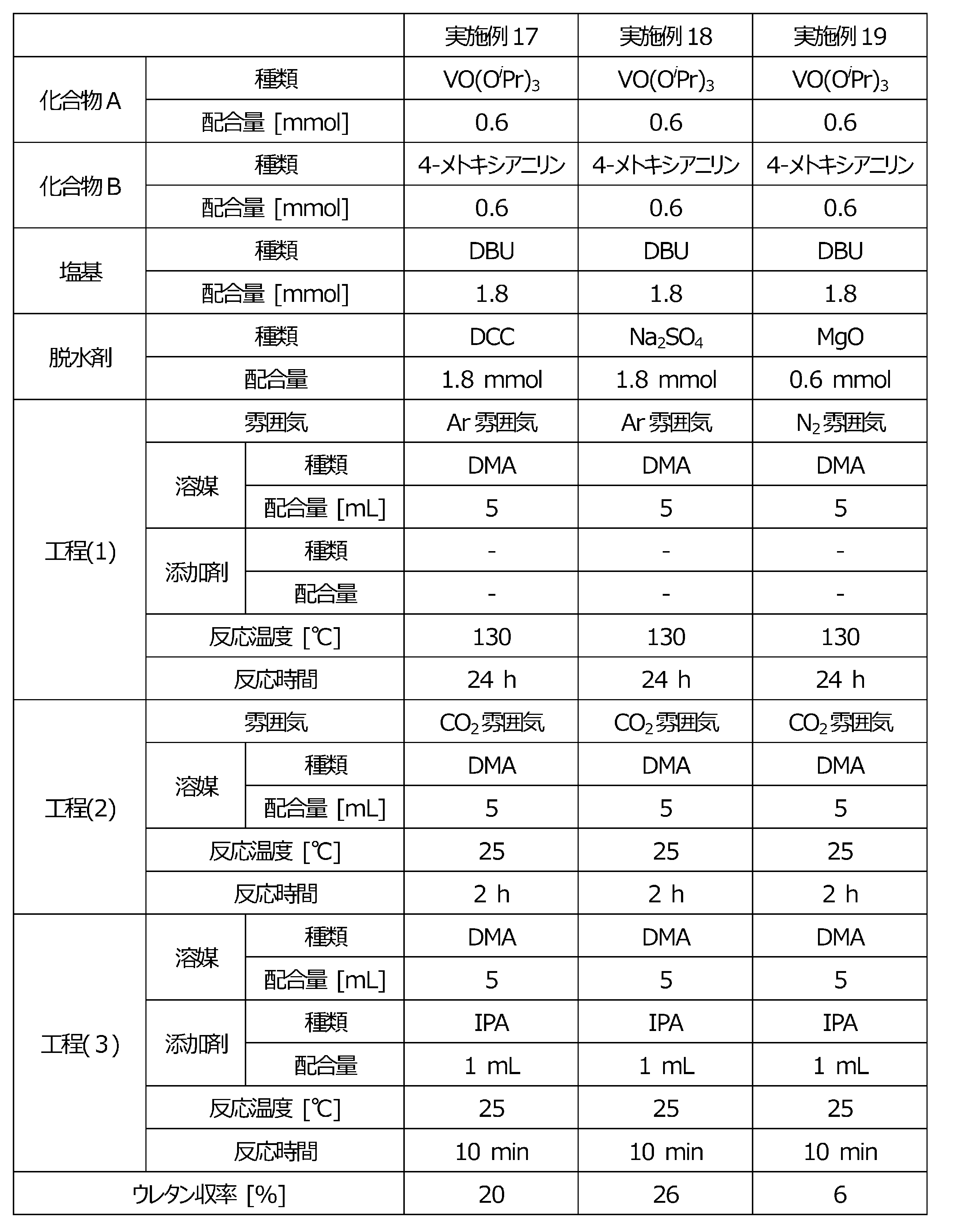
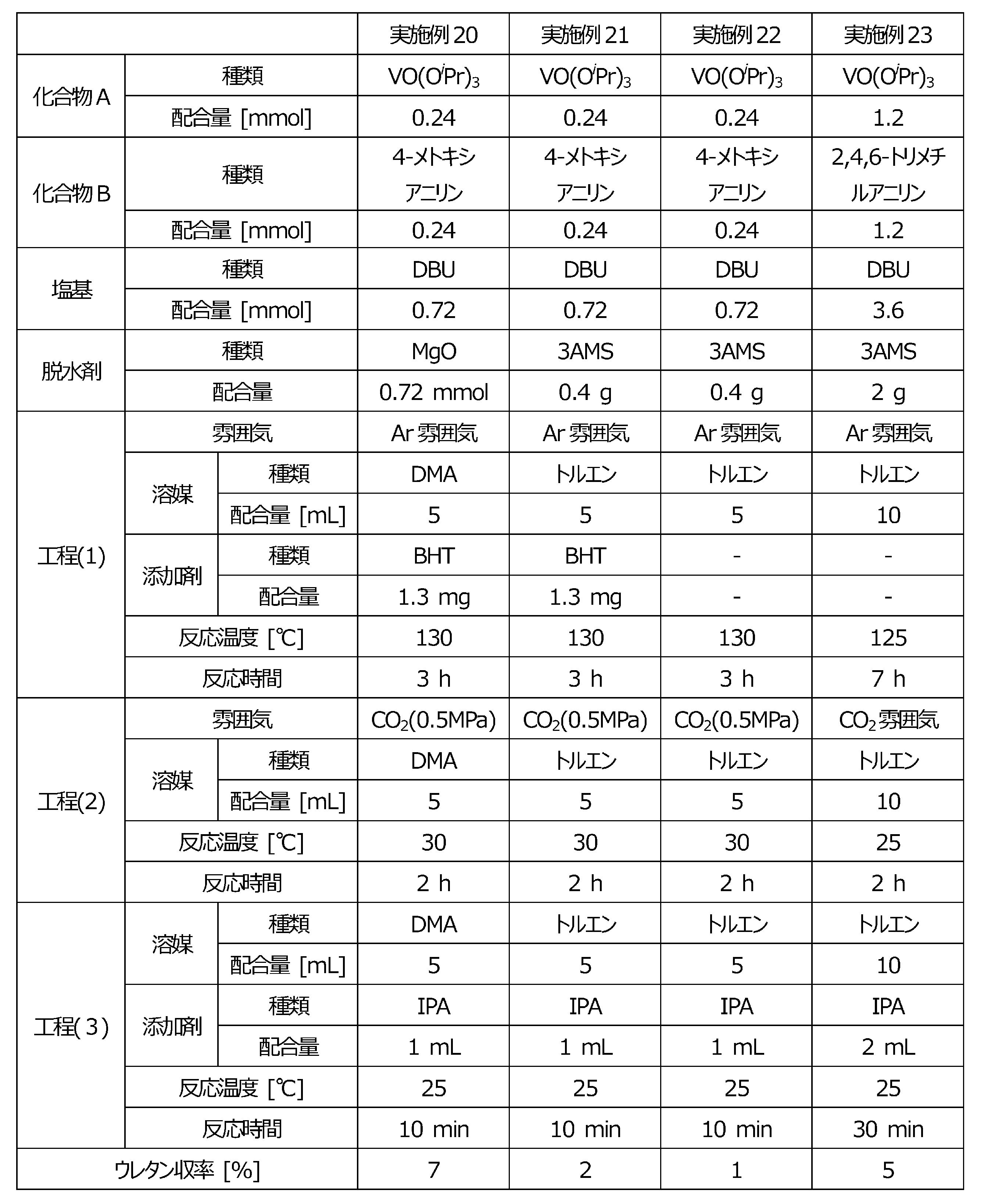
実施例17~23の製造方法によって、イソシアネート誘導体であるウレタンを製造することができた。
本実施形態のイソシアネートの製造方法によれば、例えば、イソシアネートを効率的に製造できる。
Claims (14)
- 元素M-酸素二重結合を有する化合物Aと、アミノ基を有する化合物Bとを反応させて、生成物Cを得る工程(1)と、
前記生成物Cと、二酸化炭素、炭酸塩、及び炭酸水素塩からなる群より選択される少なくとも1つとを反応させて、イソシアネートを得る工程(2)と、
を含み、
前記元素Mは、金属元素、又はPであり、
前記工程(1)において、前記化合物Bの前記アミノ基のモル数に対する前記化合物Aの前記二重結合の数の比が0.5以上である、イソシアネートの製造方法。 - 前記比が1.0以上である、請求項1に記載のイソシアネートの製造方法。
- 前記工程(2)において、反応温度が100℃以下である、請求項1に記載のイソシアネートの製造方法。
- 前記工程(1)及び前記工程(2)はワンポットで行われる、請求項1に記載のイソシアネートの製造方法。
- 前記元素Mは、V、Fe、Mo、Ta、Nb、Ti、W、又はPである、請求項1に記載のイソシアネートの製造方法。
- 前記化合物Bは、1級アミンである、請求項1に記載のイソシアネートの製造方法。
- 前記化合物Bは、下記の一般式(B)で表される化合物である、請求項1に記載のイソシアネートの製造方法。
R-NX2 (B)
一般式(B)において、Rは、置換基を有していてもよい炭化水素基を表し、
2つのXは、互いに独立して、水素原子、又は保護基を表す。 - 前記炭化水素基が、脂肪族環及び芳香環からなる群より選択される少なくとも1つを含む、請求項7に記載のイソシアネートの製造方法。
- 前記生成物Cが元素M-窒素二重結合を有する、請求項1に記載のイソシアネートの製造方法。
- 前記工程(2)において、前記反応によって前記化合物Aがさらに得られる、請求項1に記載のイソシアネートの製造方法。
- 前記工程(1)において、前記反応は不活性雰囲気下で行われる、請求項1に記載のイソシアネートの製造方法。
- 前記工程(2)において、前記反応は溶媒下で行われ、
前記溶媒は、トルエン、1,4-ジオキサン、及びアセトニトリルからなる群より選択される少なくとも1つを含む、請求項1に記載のイソシアネートの製造方法。 - 前記工程(1)において、前記反応は塩基の存在下で行われる、請求項1に記載のイソシアネートの製造方法。
- 請求項1から13のいずれか1項に記載のイソシアネートの製造方法によって得られたイソシアネートをイソシアネート誘導体に変換する工程(3)、
を含む、イソシアネート誘導体の製造方法。
Applications Claiming Priority (2)
| Application Number | Priority Date | Filing Date | Title |
|---|---|---|---|
| JP2023106074 | 2023-06-28 | ||
| JP2023-106074 | 2023-06-28 |
Publications (1)
| Publication Number | Publication Date |
|---|---|
| WO2025005098A1 true WO2025005098A1 (ja) | 2025-01-02 |
Family
ID=93939220
Family Applications (1)
| Application Number | Title | Priority Date | Filing Date |
|---|---|---|---|
| PCT/JP2024/023065 Ceased WO2025005098A1 (ja) | 2023-06-28 | 2024-06-25 | イソシアネートの製造方法 |
Country Status (1)
| Country | Link |
|---|---|
| WO (1) | WO2025005098A1 (ja) |
Citations (1)
| Publication number | Priority date | Publication date | Assignee | Title |
|---|---|---|---|---|
| JP2023008318A (ja) * | 2021-07-05 | 2023-01-19 | 出光興産株式会社 | オレフィンオリゴマーの製造方法、錯体及び触媒 |
-
2024
- 2024-06-25 WO PCT/JP2024/023065 patent/WO2025005098A1/ja not_active Ceased
Patent Citations (1)
| Publication number | Priority date | Publication date | Assignee | Title |
|---|---|---|---|---|
| JP2023008318A (ja) * | 2021-07-05 | 2023-01-19 | 出光興産株式会社 | オレフィンオリゴマーの製造方法、錯体及び触媒 |
Non-Patent Citations (2)
| Title |
|---|
| MATSUTANI TAKANARI, AOYAMA KOTARO, MORIUCHI TOSHIYUKI: "Oxovanadium(V)-Catalyzed Synthesis of Ureas from Disilylamines and Carbon Dioxide under Ambient Pressure", ACS OMEGA, ACS PUBLICATIONS, US, vol. 7, no. 12, 29 March 2022 (2022-03-29), US , pages 10476 - 10482, XP093255477, ISSN: 2470-1343, DOI: 10.1021/acsomega.1c07367 * |
| MORIUCHI TOSHIYUKI, SAKURAMOTO TAKASHI, MATSUTANI TAKANARI, KAWAI RYOTA, DONAKA YOSUKE, TOBISU MAMORU, HIRAO TOSHIKAZU: "Oxovanadium(v)-catalyzed amination of carbon dioxide under ambient pressure for the synthesis of ureas", RSC ADVANCES, ROYAL SOCIETY OF CHEMISTRY, GB, vol. 11, no. 44, 9 August 2021 (2021-08-09), GB , pages 27121 - 27125, XP093255472, ISSN: 2046-2069, DOI: 10.1039/D1RA04125H * |
Similar Documents
| Publication | Publication Date | Title |
|---|---|---|
| JP6049757B2 (ja) | 液相中での第二級アミンの製造法 | |
| EP3630717B1 (en) | A process for the synthesis of aromatic carbamates | |
| KR101540636B1 (ko) | 산화세륨 촉매를 이용한 n,n′- 치환 우레아의 제조방법 | |
| CN103170365B (zh) | 一种高活性双功能催化剂及其制备方法和应用 | |
| US5349077A (en) | Process for producing alkylene carbonates | |
| EP0443758A1 (en) | A process for preparing alkylene carbonates | |
| JPH04270252A (ja) | アミノエーテル類を製造する方法 | |
| JP2018076235A (ja) | ε−カプロラクタムの製造方法 | |
| KR101660560B1 (ko) | a-히드록시카르복시산 에스테르의 제조 방법 | |
| CN102285957B (zh) | 一种甘油碳酸酯的制备方法 | |
| CN112574067A (zh) | 非光气制备高纯度间苯二亚甲基二异氰酸酯的方法 | |
| CN111116420B (zh) | 一种对称脲类化合物的制备方法 | |
| JP2003212835A (ja) | アルキルカルバメートの製造方法 | |
| WO2009110217A1 (ja) | 表面銀固定化ハイドロキシアパタイト | |
| CN101759600A (zh) | 由nh3、co2和小分子脂肪醇合成氨基甲酸烷基酯方法 | |
| JP7525112B2 (ja) | 尿素誘導体の製造方法 | |
| CN111393402B (zh) | BrØnsted酸/季铵盐复合催化CO2与环氧化物环加成制备环状碳酸酯的方法 | |
| JPH04261166A (ja) | 環状エーテルの製造方法 | |
| JP5434919B2 (ja) | カルバメート化合物の製造方法 | |
| WO2010116871A1 (ja) | ウレタン化合物およびその製造方法、および、イソシアネートおよびその製造方法 | |
| EP3411355B1 (en) | Process for the preparation of trans-4-amino-1-cyclohexanecarboxylic acid | |
| WO2021246485A1 (ja) | カルバミン酸塩の製造方法、カルバミン酸エステルの製造方法、及び尿素誘導体の製造方法 | |
| CN102336687B (zh) | 催化合成氨基甲酸羟烷基酯的方法 | |
| JP2025138461A (ja) | ウレア化合物の製造方法 | |
| CN105152931B (zh) | 一种一步催化合成乙二醇甲醚苯甲酸酯的方法 |
Legal Events
| Date | Code | Title | Description |
|---|---|---|---|
| 121 | Ep: the epo has been informed by wipo that ep was designated in this application |
Ref document number: 24831958 Country of ref document: EP Kind code of ref document: A1 |
|
| NENP | Non-entry into the national phase |
Ref country code: DE |
|
| 122 | Ep: pct application non-entry in european phase |
Ref document number: 24831958 Country of ref document: EP Kind code of ref document: A1 |