WO2025004797A1 - 鋼板およびその製造方法 - Google Patents
鋼板およびその製造方法 Download PDFInfo
- Publication number
- WO2025004797A1 WO2025004797A1 PCT/JP2024/021239 JP2024021239W WO2025004797A1 WO 2025004797 A1 WO2025004797 A1 WO 2025004797A1 JP 2024021239 W JP2024021239 W JP 2024021239W WO 2025004797 A1 WO2025004797 A1 WO 2025004797A1
- Authority
- WO
- WIPO (PCT)
- Prior art keywords
- less
- temperature
- steel
- plate thickness
- toughness
- Prior art date
- Legal status (The legal status is an assumption and is not a legal conclusion. Google has not performed a legal analysis and makes no representation as to the accuracy of the status listed.)
- Ceased
Links
Classifications
-
- C—CHEMISTRY; METALLURGY
- C22—METALLURGY; FERROUS OR NON-FERROUS ALLOYS; TREATMENT OF ALLOYS OR NON-FERROUS METALS
- C22C—ALLOYS
- C22C38/00—Ferrous alloys, e.g. steel alloys
- C22C38/04—Ferrous alloys, e.g. steel alloys containing manganese
-
- C—CHEMISTRY; METALLURGY
- C21—METALLURGY OF IRON
- C21D—MODIFYING THE PHYSICAL STRUCTURE OF FERROUS METALS; GENERAL DEVICES FOR HEAT TREATMENT OF FERROUS OR NON-FERROUS METALS OR ALLOYS; MAKING METAL MALLEABLE, e.g. BY DECARBURISATION OR TEMPERING
- C21D8/00—Modifying the physical properties of ferrous metals or ferrous alloys by deformation combined with, or followed by, heat treatment
- C21D8/02—Modifying the physical properties of ferrous metals or ferrous alloys by deformation combined with, or followed by, heat treatment during manufacturing of plates or strips
-
- C—CHEMISTRY; METALLURGY
- C21—METALLURGY OF IRON
- C21D—MODIFYING THE PHYSICAL STRUCTURE OF FERROUS METALS; GENERAL DEVICES FOR HEAT TREATMENT OF FERROUS OR NON-FERROUS METALS OR ALLOYS; MAKING METAL MALLEABLE, e.g. BY DECARBURISATION OR TEMPERING
- C21D8/00—Modifying the physical properties of ferrous metals or ferrous alloys by deformation combined with, or followed by, heat treatment
- C21D8/02—Modifying the physical properties of ferrous metals or ferrous alloys by deformation combined with, or followed by, heat treatment during manufacturing of plates or strips
- C21D8/0221—Modifying the physical properties of ferrous metals or ferrous alloys by deformation combined with, or followed by, heat treatment during manufacturing of plates or strips characterised by the working steps
- C21D8/0226—Hot rolling
-
- C—CHEMISTRY; METALLURGY
- C21—METALLURGY OF IRON
- C21D—MODIFYING THE PHYSICAL STRUCTURE OF FERROUS METALS; GENERAL DEVICES FOR HEAT TREATMENT OF FERROUS OR NON-FERROUS METALS OR ALLOYS; MAKING METAL MALLEABLE, e.g. BY DECARBURISATION OR TEMPERING
- C21D8/00—Modifying the physical properties of ferrous metals or ferrous alloys by deformation combined with, or followed by, heat treatment
- C21D8/02—Modifying the physical properties of ferrous metals or ferrous alloys by deformation combined with, or followed by, heat treatment during manufacturing of plates or strips
- C21D8/0247—Modifying the physical properties of ferrous metals or ferrous alloys by deformation combined with, or followed by, heat treatment during manufacturing of plates or strips characterised by the heat treatment
- C21D8/0263—Modifying the physical properties of ferrous metals or ferrous alloys by deformation combined with, or followed by, heat treatment during manufacturing of plates or strips characterised by the heat treatment following hot rolling
-
- C—CHEMISTRY; METALLURGY
- C22—METALLURGY; FERROUS OR NON-FERROUS ALLOYS; TREATMENT OF ALLOYS OR NON-FERROUS METALS
- C22C—ALLOYS
- C22C38/00—Ferrous alloys, e.g. steel alloys
-
- C—CHEMISTRY; METALLURGY
- C22—METALLURGY; FERROUS OR NON-FERROUS ALLOYS; TREATMENT OF ALLOYS OR NON-FERROUS METALS
- C22C—ALLOYS
- C22C38/00—Ferrous alloys, e.g. steel alloys
- C22C38/001—Ferrous alloys, e.g. steel alloys containing N
-
- C—CHEMISTRY; METALLURGY
- C22—METALLURGY; FERROUS OR NON-FERROUS ALLOYS; TREATMENT OF ALLOYS OR NON-FERROUS METALS
- C22C—ALLOYS
- C22C38/00—Ferrous alloys, e.g. steel alloys
- C22C38/02—Ferrous alloys, e.g. steel alloys containing silicon
-
- C—CHEMISTRY; METALLURGY
- C22—METALLURGY; FERROUS OR NON-FERROUS ALLOYS; TREATMENT OF ALLOYS OR NON-FERROUS METALS
- C22C—ALLOYS
- C22C38/00—Ferrous alloys, e.g. steel alloys
- C22C38/06—Ferrous alloys, e.g. steel alloys containing aluminium
-
- C—CHEMISTRY; METALLURGY
- C22—METALLURGY; FERROUS OR NON-FERROUS ALLOYS; TREATMENT OF ALLOYS OR NON-FERROUS METALS
- C22C—ALLOYS
- C22C38/00—Ferrous alloys, e.g. steel alloys
- C22C38/12—Ferrous alloys, e.g. steel alloys containing tungsten, tantalum, molybdenum, vanadium, or niobium
-
- C—CHEMISTRY; METALLURGY
- C22—METALLURGY; FERROUS OR NON-FERROUS ALLOYS; TREATMENT OF ALLOYS OR NON-FERROUS METALS
- C22C—ALLOYS
- C22C38/00—Ferrous alloys, e.g. steel alloys
- C22C38/14—Ferrous alloys, e.g. steel alloys containing titanium or zirconium
-
- C—CHEMISTRY; METALLURGY
- C22—METALLURGY; FERROUS OR NON-FERROUS ALLOYS; TREATMENT OF ALLOYS OR NON-FERROUS METALS
- C22C—ALLOYS
- C22C38/00—Ferrous alloys, e.g. steel alloys
- C22C38/18—Ferrous alloys, e.g. steel alloys containing chromium
- C22C38/40—Ferrous alloys, e.g. steel alloys containing chromium with nickel
- C22C38/58—Ferrous alloys, e.g. steel alloys containing chromium with nickel with more than 1.5% by weight of manganese
-
- C—CHEMISTRY; METALLURGY
- C21—METALLURGY OF IRON
- C21D—MODIFYING THE PHYSICAL STRUCTURE OF FERROUS METALS; GENERAL DEVICES FOR HEAT TREATMENT OF FERROUS OR NON-FERROUS METALS OR ALLOYS; MAKING METAL MALLEABLE, e.g. BY DECARBURISATION OR TEMPERING
- C21D2211/00—Microstructure comprising significant phases
- C21D2211/002—Bainite
Definitions
- the present invention relates to a steel plate, particularly a steel plate applicable to high heat input welding, and a manufacturing method thereof. Specifically, the present invention relates to a steel plate having excellent toughness in the heat affected zone (hereinafter, the heat affected zone will be referred to as HAZ) after high heat input welding. Furthermore, the steel plate of the present invention can be suitably used for large structures such as ships, marine structures, low-temperature storage tanks, and architectural and civil engineering structures.
- Patent Documents 1 and 2 disclose technologies that attempt to solve this problem using controlled rolling and controlled cooling methods, for example, as described in Patent Documents 1 and 2.
- Patent Document 3 also discloses a technology that ensures the Charpy toughness of the base material by refining the crystal structure of the steel plate through measures such as the application of direct quenching and tempering technology.
- Patent Document 5 discloses a method of preventing a decrease in the Charpy toughness of the HAZ by adding an appropriate amount of B to the steel.
- B is a nitride-forming element, and has a fast diffusion rate, especially in high temperature regions, and fixes the solute N, which has a negative effect on Charpy toughness, as nitrides during cooling during welding, thereby achieving high toughness in the HAZ.
- the above-mentioned technology utilizing TiN for refining austenite has a problem that, when large heat input welding is performed, the weld heat affected zone is heated to the melting temperature range of TiN, so that TiN decomposes and the effect of suppressing coarsening of austenite grains is lost, and the base structure of the steel is embrittled by dissolved Ti and N produced by the decomposition of TiN, resulting in a significant decrease in the toughness of the weld heat affected zone.
- the technology utilizing Ti oxides also has a problem in that it is difficult to disperse a specified oxide finely and uniformly in the steel plate.
- the conventional technology is not yet sufficient as a technology for a steel plate having excellent Charpy toughness in the HAZ generated when large heat input welding is performed, and also having excellent strength at the 1/2 plate thickness position of the base material and excellent Charpy toughness after strain aging treatment.
- an object of the present invention is to provide a steel plate having excellent Charpy toughness in the HAZ generated during high heat input welding, and also having excellent strength at the 1/2 plate thickness position of the base material and Charpy toughness after strain aging treatment, and a method for manufacturing such a steel plate.
- excellent Charpy toughness (HAZ toughness)" of the HAZ generated when large heat input welding is performed means that, in a welded joint produced using the obtained steel plate with a welding heat input of 500 kJ/cm, vE-40°C ⁇ 53J on average.
- the term "excellent strength at 1/2 the plate thickness position” refers to a yield strength (YS) of 460 MPa or more when a tensile test is performed at the 1/2 plate thickness position in accordance with the provisions of JIS Z 2241 (2022).
- excellent Charpy toughness (base material toughness) after strain aging treatment” in the base material means that, in accordance with the provisions of JIS Z 2242 (2023), a Charpy fracture transition temperature (vTrs) at the 1/2 sheet thickness position after strain aging treatment in which a 5 to 10% strain is applied at room temperature and then held at 200 to 250°C for 1 to 2 hours is vTrs ⁇ 40°C.
- the present inventors have conducted extensive research into a steel plate having excellent toughness (base material toughness) while ensuring the strength of the base material and excellent HAZ toughness in large heat input welds, and a manufacturing method for stably obtaining the steel plate.
- base material toughness base material toughness
- HAZ toughness high strength of the base material
- the following findings were obtained. Specifically, they discovered that by controlling the amounts of C, Si, Mn, Al, Nb, Ti, B, N, and O in the steel plate within predetermined ranges, it is possible to effectively suppress the formation of island martensite (MA) in the HAZ and prevent a decrease in toughness.
- MA island martensite
- the base material toughness In order to obtain the above-mentioned base material toughness, it is effective to heat the steel material to 950 to 1150°C in the casting process. This allows the austenite grain size to be refined, and the final average grain size of bainite grains to be refined. In addition, it is effective to control the cumulative reduction ratio in the hot rolling process to 15.0% or more and the average value of the reduction ratio/pass to 5.0% or more when the temperature at the 1/2 thickness position is in the austenite recrystallization temperature range, and the cumulative reduction ratio in the austenite non-recrystallization temperature range to 50.0% or more.
- the rolling end temperature at the 1/2 thickness position is controlled to be ( Ar3 point + 100) ° C. or more in the hot rolling process. This control reduces the precipitation of B nitrides at the 1/2 thickness position as much as possible, and allows solute B to remain until the accelerated cooling, thereby improving hardenability. This makes it possible to achieve the desired strength without containing a large amount of alloy elements that adversely affect HAZ toughness.
- the present invention has been completed based on the above findings and further investigations, and the gist of the present invention is as follows.
- C 0.020-0.080%, Si: 0.02-0.09%, Mn: 1.00-2.50%, P: 0.020% or less, S: 0.010% or less, Al: 0.010-0.100%, Nb: 0.005-0.040%, Ti: 0.010 to 0.030%, B: 0.0001 to 0.0020%, Contains N: 0.0010 to 0.0100% and O: 0.0100% or less, and has a Ceq defined by formula (1) of 0.350 to 0.450%, The mass% ratio of Ti to N (Ti/N) is 2.00 or more and 4.50 or less, The balance is Fe and unavoidable impurities,
- the steel has a structure in which, at a position at 1/2 of the plate thickness, the structure is composed of 80% or more of a bainite phase by area ratio and the remaining structure, and the average grain size of the bainite phase crystal grains surrounded
- Ceq C+Mn/6+Cu/15+Ni/15+Cr/5+Mo/5+V/5...Formula (1)
- C, Mn, Cu, Ni, Cr, Mo and V in formula (1) represent the content (mass %) of each element, and the content of an element that is not contained is set to 0 (zero).
- Group A one or more selected from Cu: 1.00% or less, Ni: 2.00% or less, Cr: 1.00% or less;
- Group B one or more selected from Mo: 0.30% or less, V: 0.30% or less, W: 0.30% or less, Co: 0.30% or less, Ca: 0.0100% or less, Mg: 0.0100% or less, and REM (rare earth metal): 0.0200% or less;
- Group C one or more selected from Sn: 0.20% or less, As: 0.10% or less, Bi: 0.20% or less [3]
- a steel material having the above-mentioned composition is heated to a heating temperature of 950 to 1150°C, Next, the rolling start temperature at the plate thickness 1/2 position is ( Ar3 point + 200) ° C.
- the steel sheet of the present invention contains, by mass%, C: 0.020 to 0.080%, Si: 0.02 to 0.09%, Mn: 1.00 to 2.50%, P: 0.020% or less, S: 0.010% or less, Al: 0.010 to 0.100%, Nb: 0.005 to 0.040%, Ti: 0.010 to 0.030%, B: 0.0001 to 0.0020%, N: 0.0010 to 0.0100%, and O: 0.0100% or less, and has a component composition in which Ceq defined by formula (1) is 0.350 to 0.450%, the mass% ratio of Ti to N (Ti/N) is 2.00 to 4.50, and the balance is Fe and unavoidable impurities, and
- the steel has a steel structure in which the bainite phase accounts for 80% or more and the remaining structure, the bainite phase crystal grains being surrounded by grain boundaries having an orientation difference of 15° or more with adjacent crystal
- C 0.020-0.080% C is an element that has the effect of increasing the hardenability of steel and is necessary to achieve a desired strength.
- the C content is set to 0.020% or more. do.
- the amount of MA Martensite-Austenite constituent
- the toughness of the base material decreases.
- the austenite becomes coarse and transforms due to high heat input welding, and MA is generated, so the HAZ toughness is significantly reduced.
- the lower limit of the C content is preferably 0.025% or more, and more preferably 0.030% or more.
- the upper limit of the C content is preferably 0.075% or less. , and more preferably 0.070% or less.
- Si 0.02-0.09% Silicon is an element that suppresses the formation of coarse carbides and enhances the toughness of the HAZ, and is necessary to achieve the desired HAZ toughness value. It is also necessary for ensuring the strength of the base material and for deoxidization.
- the Si content is set to 0.02% or more.
- the Si content exceeds 0.09%, not only does it impair the surface properties of the steel, but also MA is generated due to high heat input welding, and the toughness of the HAZ is significantly reduced.
- the Si content is in the range of 0.02 to 0.09%.
- the lower limit of the Si content is preferably 0.03% or more, and the upper limit of the Si content is preferably 0.07% or less.
- Mn 1.00-2.50%
- Mn is an element that increases the hardenability of steel, suppresses the formation of coarse carbides, contributes to ensuring the strength of the base material, and has the effect of increasing the toughness of the HAZ.
- the Mn content is set to 1.00% or more.
- the Mn content is set to 2.50% or less.
- the lower limit of the Mn content is preferably 1.40% or more, and the upper limit of the Mn content is preferably 2.30% or less.
- P 0.020% or less
- S 0.010% or less
- P and S are unavoidable impurities in steel. If their contents increase, the toughness of the base material decreases.
- the P content is suppressed to 0.020% or less and the S content is suppressed to 0.010% or less.
- the P content is preferably 0.015% or less, and more preferably 0.010% or less.
- the S content is preferably 0.007% or less, and more preferably 0.004% or less.
- the lower limits of the P content and the S content are not particularly limited.
- the P content and the S content are preferably set to P: 0.001% or more and S: 0.0005% or more, respectively. More preferably, P: 0.003% or more and S: 0.0010% or more.
- Al acts as a deoxidizer, reduces oxide inclusions, and improves the toughness of the HAZ. To obtain this effect, the Al content must be 0.010% or more. be. On the other hand, if the Al content exceeds 0.100%, the oxide inclusions increase, the cleanliness decreases, and the toughness of the HAZ decreases.
- the range of Al content is 100%.
- the lower limit of the Al content is preferably 0.020% or more.
- the upper limit of the Al content is preferably 0.070% or less, and more preferably 0.050% or less. be.
- Nb is an element that enhances the hardenability of steel and also has the effect of improving the strength and toughness of the base material.
- the Nb content is set to 0.005% or more. It is preferable that the content of Si is 0.010% or more, and more preferably 0.015% or more.
- the Nb content exceeds 0.040%, the strength increases excessively, and in addition, the toughness of the base material decreases, and MA is generated in the weld heat affected zone, which decreases the HAZ toughness.
- the upper limit of the Nb content is 0.040%. From the viewpoint of improving the toughness of the HAZ, the Nb content is preferably 0.035% or less, and more preferably 0.030% or less. .
- Ti 0.010-0.030%
- Ti is an element that precipitates as TiN during the solidification of steel, suppresses the coarsening of austenite grains in the HAZ, and acts as a ferrite transformation nucleus, thereby contributing to high toughness of the HAZ.
- the Ti content is set to 0.010% or more.
- the Ti content is more preferably set to 0.012% or more, and more preferably set to 0.014% or more. Even more preferred.
- the Ti content exceeds 0.030%, a large amount of TiN is generated and the TiN particles become coarse, so that the expected effect cannot be obtained. Therefore, the toughness of the HAZ is deteriorated.
- the Ti content is set to 0.030% or less.
- the upper limit of the Ti content is From the viewpoint of improving toughness, the content is more preferably 0.020% or less.
- B 0.0001-0.0020%
- B is an element that has the effect of significantly improving hardenability even when added in small amounts. Therefore, it is possible to improve the strength of the steel plate (base material).
- the B content is set to 0.0001% or more.
- the B content exceeds 0.0020%, there is a risk of coarse Fe-B carbides being formed. Such coarse Fe-B carbides become the starting points of fracture, and the HAZ toughness is significantly reduced.
- the toughness of the base material may also decrease. Therefore, the B content is set to 0.0020% or less.
- the B content is more preferably set to 0.0018% or less, and more preferably set to 0. It is more preferable that the content be 0.0015% or less, and further more preferable that the content be 0.0012% or less.
- N combines with Al in the steel, adjusts the grain size during rolling, and strengthens the steel. To obtain this effect, the N content must be 0.0010% or more. If the N content is less than 0.0010%, the HAZ toughness decreases. On the other hand, if the N content exceeds 0.0100%, the toughness of the base material and the HAZ toughness decrease. Therefore, the N content is set to the range of 0.0010 to 0.0100%. The N content is 0.0020% or more, and the upper limit of the N content is preferably 0.0070% or less.
- O 0.0100% or less
- O oxygen
- the O content is preferably 0.0050% or less, and more preferably 0.0040% or less.
- the lower limit of the O content is not particularly limited and may be 0.0000%, but O is usually inevitably contained in steel as an impurity.
- the O content is preferably 0.0010% or more, and more preferably 0.0020% or more.
- each element is contained within the above range, and Ceq (carbon equivalent) (%) defined by formula (1) satisfies the following range.
- Ceq C+Mn/6+Cu/15+Ni/15+Cr/5+Mo/5+V/5...Formula (1)
- C, Mn, Cu, Ni, Cr, Mo and V in formula (1) represent the content (mass %) of each element, and the content of an element that is not contained is set to 0 (zero).
- Ceq 0.350-0.450%
- the value of Ceq expressed by formula (1) is adjusted to 0.350% or more. This improves the hardenability of the steel sheet and increases the cooling rate. Even at the 1/2 plate thickness position, which is lower than the 1/2 plate thickness position, the steel structure becomes bainite entirely, and the strength improving effect is obtained.
- the value of Ceq exceeds 0.450%, the hardenability becomes excessive, the strength of the matrix structure increases excessively, and the amount of MA (island martensite) that becomes the starting point of brittle fracture increases.
- the Ceq value is set to 0.450% or less, and preferably set to 0.370% or more, and more preferably set to 0.435% or less.
- Ti/N 2.00 or more and 4.50 or less
- Ti/N is set to 2.00 or more.
- Ti/N is preferably set to 2.10 or more, and more preferably set to 2.20 or more.
- the upper limit of Ti/N is set to 4.50.
- Ti/N is preferably set to 4.40 or less, and more preferably set to 4.30 or less.
- each element is represented by its content (mass%) in the steel.
- the basic composition of the steel sheet of the present invention is the above, with the balance being Fe and unavoidable impurities.
- the steel sheet of the present invention can obtain the intended properties.
- Other unavoidable impurities include Zn, Pb, Sb, and the like.
- each of the elements Cu, Ni, Cr, Mo, V, W, Co, Ca, Mg, REM, Sn, As, and Bi can be contained as necessary, so the content of these elements may be 0%.
- Group A Cu: 1.00% or less, Ni: 2.00% or less, and Cr: 1.00% or less.
- Group A Cu: 1.00% or less, Ni: 2.00% or less, and Cr: 1.00% or less.
- Ni 2.00% or less
- Ni is an element that enhances the hardenability of steel. Ni contributes to improving the strength after rolling. In addition, Ni can be contained to improve functions such as toughness, high-temperature strength, and weather resistance. In order to obtain the above effects of Ni, it is preferable that the Ni content is 0.05% or more. On the other hand, if the Ni content exceeds 2.00%, it leads to deterioration of weldability, decrease in toughness, and increase in alloy cost. Therefore, when Ni is contained, the Ni content is set to 2.00% or less, and preferably to 1.80% or less. The Ni content is more preferably set to 0.20% or more.
- Cr 1.00% or less
- Cr is an element that enhances the hardenability of steel. Cr contributes to improving the strength after rolling. In addition, Cr can be contained to improve functions such as toughness, high-temperature strength, and weather resistance. In order to obtain the above effects of Cr, the Cr content is preferably 0.01% or more. On the other hand, if the Cr content exceeds 1.00%, it leads to deterioration of weldability, decrease in toughness, and increase in alloy cost. Therefore, when Cr is contained, the Cr content is set to 1.00% or less, and preferably to 0.50% or less. The Cr content is more preferably set to 0.05% or more.
- Group B One or more selected from the following: Mo: 0.30% or less, V: 0.30% or less, W: 0.30% or less, Co: 0.30% or less, Ca: 0.0100% or less, Mg: 0.0100% or less, and REM: 0.0200% or less
- Mo 0.30% or less
- Mo is an element that enhances the hardenability of steel. Mo contributes to improving the strength after rolling. In addition, Mo can be contained to improve functions such as toughness, high-temperature strength, and weather resistance. In order to obtain the above effects of Mo, it is preferable that the Mo content is 0.01% or more. On the other hand, if the Mo content exceeds 0.30%, it leads to deterioration of weldability, decrease in toughness, and increase in alloy cost. Therefore, when Mo is contained, the Mo content is set to 0.30% or less, and preferably 0.20% or less. The Mo content is more preferably 0.03% or more.
- V 0.30% or less
- V is an element that improves the strength of steel by precipitation strengthening, where V precipitates as V(CN). This effect is exerted by setting the V content to 0.01% or more. Therefore, the V content is preferably set to 0.01% or more. On the other hand, if the V content exceeds 0.30%, the toughness may decrease. Therefore, when V is contained, the V content is set to 0.30% or less, and preferably 0.20% or less. The V content is more preferably 0.03% or more.
- W 0.30% or less
- W is an element that has the effect of improving the strength of a steel sheet.
- the W content is preferably 0.01% or more.
- the W content is set to 0.30% or less, preferably 0.20% or less.
- the W content is more preferably 0.03% or more.
- Co 0.30% or less
- Co is an element that has the effect of improving the strength of a steel sheet.
- the Co content is preferably 0.01% or more.
- the Co content is set to 0.30% or less, and preferably 0.20% or less.
- the Co content is more preferably 0.03% or more.
- Ca 0.0100% or less Ca refines the structure of the weld heat affected zone and improves toughness.
- the Ca content is preferably 0.0005% or more, and more preferably 0.0020% or more.
- the Ca content is set to 0.0100% or less, and preferably 0.0050% or less.
- Mg 0.0100% or less Like Ca, Mg refines the structure of the weld heat affected zone and improves toughness. In order to obtain this effect, when Mg is contained, the Mg content is preferably 0.0005% or more, and more preferably 0.0020% or more. On the other hand, if the Mg content exceeds 0.0100%, coarse inclusions are formed and the toughness is reduced, so that when Mg is contained, the Mg content is set to 0.0100% or less, and preferably 0.0050% or less.
- REM 0.0200% or less Like Ca, REM refines the structure of the weld heat affected zone and improves toughness. In order to obtain this effect, when REM is contained, the REM content is preferably 0.0005% or more, and more preferably 0.0015% or more. On the other hand, if the REM content exceeds 0.0200%, coarse inclusions are formed and the toughness is reduced, so that when REM is contained, the REM content is set to 0.0200% or less, and preferably 0.0100% or less.
- REM refers to scandium (Sc) with atomic number 21, yttrium (Y) with atomic number 39, and lanthanoid elements with atomic numbers from lanthanum (La) with atomic number 57 to lutetium (Lu) with atomic number 71.
- the REM content is the total content of one or more elements selected from the above REMs.
- Group C One or more selected from the following: Sn: 0.20% or less, As: 0.10% or less, Bi: 0.20% or less
- Sn 0.20% or less
- Sn is an element that has the effect of improving the strength of a steel sheet.
- the Sn content is preferably 0.01% or more, and more preferably 0.02% or more.
- the Sn content is set to 0.20% or less, and preferably 0.10% or less.
- the As content is preferably 0.001% or more, and more preferably 0.002% or more.
- the As content is set to 0.10% or less, and preferably 0.05% or less.
- Bi 0.20% or less Bi refines the structure of the weld heat affected zone and improves the toughness of the HAZ.
- the Bi content is preferably 0.001% or more, and more preferably 0.002% or more.
- the Bi content exceeds 0.20%, coarse inclusions are formed and the HAZ toughness is reduced. Therefore, when Bi is contained, the Bi content is set to 0.20% or less, and preferably 0.10% or less.
- the steel structure at the 1/2 sheet thickness position is a structure containing, in terms of area ratio, 80% or more of bainite phase, and the average grain size of the bainite phase crystal grains surrounded by grain boundaries having an orientation difference of 15° or more with adjacent crystal grains is 30 ⁇ m or less.
- the steel plate of the present invention needs to have an area fraction of the bainite phase at the 1/2 plate thickness position of 80% or more. If the area fraction of the bainite phase is less than 80%, the fraction of hard structures decreases, and strength decreases. Therefore, the area fraction of the bainite phase at the 1/2 plate thickness position is set to 80% or more. In order to further increase the strength, the above area fraction is preferably 85% or more, and more preferably 90% or more. The area fraction of the bainite phase may be 100%. The remainder other than the bainite phase may be ferrite, the area ratio of which may be 20% or less, preferably 15% or less, and more preferably 10% or less. The balance may be 0%.
- the above average grain size is preferably 25 ⁇ m or less, and more preferably 20 ⁇ m or less. Although there is no particular lower limit for the average grain size, from the viewpoint of rolling efficiency, the average grain size is preferably 5 ⁇ m or more, and more preferably 10 ⁇ m or more.
- Plate thickness 50 mm or more
- the plate thickness of the steel plate of the present invention is 50 mm or more in order to ensure rigidity when the steel plate is used in a large steel structure.
- the plate thickness is preferably 60 mm or more, and more preferably 65 mm or more.
- the plate thickness is preferably 100 mm or less, and more preferably 90 mm or less.
- the steel plate of the present invention has a yield strength of 460 MPa or more, measured using a JIS 14A tensile test piece with a diameter of 14 mm taken from the 1/2 thickness position.
- the use of the steel plate of the present invention is not particularly limited, but for example, ships such as container ships and bulk carriers usually use high-strength and thick steel plate base material that can withstand this bending stress, and if the yield strength is less than 460 MPa, it is not suitable for use. Therefore, the steel plate of the present invention has a yield strength at 1/2 thickness position of 460 MPa or more.
- the upper limit is not particularly limited, but the yield strength at 1/2 thickness position may be 550 MPa or less.
- ⁇ Base material toughness Charpy fracture transition temperature after strain aging treatment> vTrs at 1/2 thickness position: -40°C or less
- vTrs at 1/2 thickness position -40°C or less
- the steel plate of the present invention has a vTrs at 1/2 thickness position of the steel plate after strain aging treatment of -40°C or less.
- the vTrs In order to further increase the brittle fracture resistance, it is preferable to set the vTrs at -45°C or less, and more preferable to set the vTrs at -50°C or less.
- the lower limit of vTrs is not particularly specified, but from the viewpoint of rolling efficiency, the vTrs is preferably set to -80°C or more, and more preferably set to -70°C or more.
- the vTrs can be evaluated by taking a JIS No. 4 impact test piece from the 1/2 position of the plate thickness of the steel plate after strain aging treatment and carrying out a Charpy test in accordance with the provisions of JIS Z 2242 (2023).
- the -40°C Charpy absorbed energy in the HAZ of the weld must be an average of 53 J or more in order to ensure the brittle fracture resistance of the weld heat affected zone in a welded joint obtained by welding with a welding heat input of 500 kJ/cm.
- the average -40°C Charpy absorbed energy in the HAZ is preferably 64 J or more, and more preferably 75 J or more.
- the HAZ toughness can be evaluated by taking a test piece from a joint obtained by large heat input welding.
- the temperature in each process refers to the temperature at the center of the thickness of the steel material and hot-rolled plate (1/2 the plate thickness position) and at the center in the plate width direction. For example, it can be obtained by calculating the temperature distribution in the cross section of the steel plate using heat transfer analysis and correcting the result by the surface temperature of the steel plate.
- the heating temperature of the steel material is set to 1150°C or lower.
- the heating temperature of the steel material is preferably 1000°C or higher, and more preferably 1030°C or higher.
- the heating temperature is preferably 1130°C or lower, and more preferably 1100°C or lower.
- the rolling start temperature is set to ( Ar3 point + 200) ° C. or more.
- the rolling start temperature is preferably set to ( Ar3 point + 210) ° C. or more, and more preferably set to ( Ar3 point + 220) ° C. or more.
- the rolling start temperature is preferably set to ( Ar3 point + 280) ° C. or less.
- the Ar3 point (°C) can be determined according to the following formula (2).
- Ar 3 points (°C) 910-273 x C-74 x Mn-57 x Ni-16 x Cr-9 x Mo-5 x Cu...Formula (2)
- each element symbol represents the content (mass %) of the corresponding element in the steel, and elements that are not contained are regarded as 0 mass %.
- the cumulative reduction in this temperature range is preferably 20.0% or more, and more preferably 25.0% or more.
- the cumulative rolling reduction in this temperature range is preferably 70.0% or less, and more preferably 65.0% or less.
- the cumulative rolling reduction here is, within a pass where the temperature at the 1/2 thickness position is in the austenite recrystallization temperature range, "[100 x (plate thickness before (just before) the first pass (mm) - plate thickness after (just after) the final pass) (mm))] / plate thickness before (just before) the first pass (mm).
- the temperature at half the thickness position is in the austenite recrystallization temperature range
- the temperature at half the thickness position is in the austenite recrystallization temperature range before the start of rolling (immediately before the start of rolling).
- the average reduction rate/pass in this temperature range is preferably 5.5% or more, and more preferably 6.0% or more.
- the average value of the rolling reduction/pass is preferably 7.0% or less, and more preferably 6.5% or less.
- the average reduction rate/pass is the average value of the reduction rate in each pass within a pass in which the temperature at the 1/2 sheet thickness position is in the austenite recrystallization temperature range.
- the reduction ratio of the Nth pass is "100 x [(plate thickness after the (N-1)th pass and before the Nth pass) (mm) - (plate thickness after the Nth pass and before the (N+1)th pass) (mm)] / (plate thickness after the (N-1)th pass and before the Nth pass) (mm)".
- the cumulative rolling reduction in this temperature range is preferably 75.0% or less, and more preferably 70.0% or less.
- the cumulative rolling reduction here is, within a pass where the temperature at the 1/2 thickness position is in the austenite non-recrystallization temperature range, "[100 x (plate thickness before (just before) the first pass (mm) - plate thickness after (just after) the final pass) (mm))] / plate thickness before (just before) the first pass (mm).
- Rolling end temperature at 1/2 plate thickness position ( Ar3 point + 100) ° C. or higher]
- the hot rolling process must be completed when the rolling end temperature at the 1/2 plate thickness position is ( Ar3 point + 100) ° C. or higher. If the temperature of the steel plate during hot rolling is less than ( Ar3 point + 100) ° C., B nitrides will precipitate, and the dissolved B required to improve hardenability will be insufficient during accelerated cooling, resulting in a decrease in strength. Furthermore, the lower the temperature, the higher the deformation resistance will be, which will cause a problem of increased load on the hot rolling machine. Note that the rolling end temperature is preferably ( Ar3 point + 110) ° C.
- the rolling end temperature is preferably ( Ar3 point + 150) ° C. or less, and more preferably ( Ar3 point + 130) ° C. or less.
- the cooling start temperature is preferably ( Ar3 point + 110) ° C. or higher, and is preferably ( Ar3 point + 130) ° C. or lower.
- the average cooling rate when the plate thickness 1/2 position is in the temperature range of 700 to 500°C is set to 5.0°C/s or more. This has the effect of increasing the fraction of bainite, improving the strength.
- the average cooling rate in this temperature range is preferably 5.5°C/s or more.
- the upper limit of the average cooling rate is not particularly limited, but from the viewpoint of avoiding an increase in cooling costs due to excessive rapid cooling, the average cooling rate is preferably 20° C./s or less, and more preferably 10° C./s or less.
- the average cooling rate in the temperature range of 700 to 500°C is "(700 (°C) - 500 (°C)) / cooling time (s) from 700°C to 500°C.”
- the average cooling rate in the temperature range of 700 to 600°C is "(700 (°C) - 600 (°C)) / cooling time (s) from 700°C to 600°C.”
- Cooling must be continued until the temperature at the half-thickness position reaches 500°C or less. If the cooling end temperature exceeds 500°C, a large amount of ferrite is generated in the steel, and the area ratio of the bainite phase must be reduced.
- the cooling stop temperature cannot be increased, resulting in a decrease in strength.
- the cooling stop temperature is preferably 450° C. or lower, and more preferably 400° C. or lower.
- the cooling stop temperature is preferably 250° C. or higher, and more preferably 300° C. or higher. .
- the toughness was evaluated based on the Charpy fracture transition temperature at the 1/2 sheet thickness position after strain aging treatment.
- a JIS No. 4 impact test piece was taken from the obtained steel plate at 1/2 the plate thickness position so that the longitudinal axis of the test piece was parallel to the rolling direction, and a notch was machined in a direction parallel to the plate width direction.
- a Charpy test was performed in the range of 0°C to -80°C in accordance with the provisions of JIS Z 2242 (2023), the Charpy fracture surface ratio at each test temperature was measured, and the Charpy fracture surface transition temperature (vTrs) was calculated. Three pieces were tested per test temperature, and vTrs was calculated from the average brittle fracture surface ratio of the three pieces.
- the examples with vTrs ⁇ 40° C. were evaluated as having excellent Charpy toughness (toughness of the base material).
- a Charpy impact test was performed on the taken impact test piece at a test temperature of -40°C.
- the average value vE-40°C (unit: J) of the absorbed energy obtained by carrying out the same conditions for three impact test pieces taken from the above test plate for joints was taken as the toughness of the HAZ.
- examples with an average vE-40°C ⁇ 53J were evaluated as having excellent HAZ toughness.
- the area ratio of the bainite phase was evaluated by calculating the area ratio by image analysis, assuming that the structure revealed as white chunks in the obtained photograph was ferrite and the remaining part was bainite phase.
- [Average grain size of bainite phase] A sample was taken from the center of the width of the steel plate and at 1/2 the plate thickness so that the surface perpendicular to the rolling direction was the observation surface. The dimensions of the sample were 20 mm in the plate thickness direction, 10 mm in the direction parallel to the rolling direction, and 1 mm in the direction perpendicular to the rolling direction. After mirror polishing the surface perpendicular to the rolling direction of this sample, EBSP analysis was performed at the 1/2 plate thickness position under the following conditions.
Landscapes
- Chemical & Material Sciences (AREA)
- Engineering & Computer Science (AREA)
- Mechanical Engineering (AREA)
- Materials Engineering (AREA)
- Metallurgy (AREA)
- Organic Chemistry (AREA)
- Physics & Mathematics (AREA)
- Thermal Sciences (AREA)
- Crystallography & Structural Chemistry (AREA)
- Heat Treatment Of Steel (AREA)
Abstract
Description
また、上記技術では母材の板厚1/2位置での強度、および歪時効処理後の板厚1/2位置でのシャルピー靭性を所望の値にすることが困難である。
このように、従来の技術では、大入熱溶接を施した際に生じるHAZのシャルピー靭性に優れ、かつ、母材の板厚1/2位置の強度および歪時効処理後のシャルピー靭性に優れた鋼板の技術としては、まだ十分であるとは言えなかった。
そこで、本発明は、上記実情に鑑み、特に、大入熱溶接を施した際に生じるHAZのシャルピー靭性に優れ、かつ、母材の板厚1/2位置の強度および歪時効処理後のシャルピー靭性に優れた鋼板、およびかかる鋼板の製造方法を提供することを目的とするものである。
ここで、大入熱溶接を施した際に生じるHAZのシャルピー靭性(HAZ靭性)に優れるとは、得られた鋼板を用い、溶接入熱500kJ/cmで作製した溶接継手において、平均で、vE-40℃≧53Jであることを指す。
また、母材の板厚1/2位置の強度に優れるとは、板厚1/2位置において、JIS Z 2241(2022)の規定に準拠して引張試験を行い、降伏強度(YS)が460MPa以上であることを指す。
また、母材において歪時効処理後のシャルピー靭性(母材靭性)に優れるとは、JIS Z 2242(2023)の規定に準拠して、室温で5~10%歪を付与した後に200~250℃で1~2時間保持する歪時効処理を施した後の板厚1/2位置におけるシャルピー破面遷移温度(vTrs)がvTrs≦-40℃であることを指す。
具体的には、鋼板中のC、Si、Mn、Al、Nb、Ti、B、N、Oを所定の範囲の量に制御することにより、HAZの島状マルテンサイト(MA)の生成を効果的に抑制でき、靭性の低下を阻止することができることを知見した。
また、板厚1/2位置における降伏強度:460MPa以上を達成するためには、炭素当量(Ceq)を0.350%以上に制御することが有効であり、これにより板厚1/2位置の鋼組織を全面的にベイナイトとすることで強度が向上し、高強度を達成する。
また、上記鋼板の板厚1/2位置において、歪時効処理後に母材の優れた靭性(母材靭性)を達成するためには、板厚1/2位置における鋼組織について、隣接する結晶粒との方位差が15°以上の粒界に囲まれたベイナイトの結晶粒径が平均30μm以下となるように制御することが有効である。これにより、粒径微細化効果により靭性が向上し、最も特性の低くなる板厚1/2位置における歪時効処理後のシャルピー破面遷移温度がvTrs≦-40℃を達成する。
また、板厚1/2位置における降伏強度:460MPa以上の強度を得るためには、熱間圧延工程において、板厚1/2位置における圧延終了温度:(Ar3点+100)℃以上となるように制御する。この制御によって、板厚1/2位置でのB窒化物の析出を可能な限り低減し、加速冷却時までに固溶Bを残存させて焼入れ性を高めることができる。これにより、HAZ靭性に悪影響を及ぼす多量の合金元素を含有させることなく所望の強度を達成することができる。
[1]質量%で、
C:0.020~0.080%、
Si:0.02~0.09%、
Mn:1.00~2.50%、
P:0.020%以下、
S:0.010%以下、
Al:0.010~0.100%、
Nb:0.005~0.040%、
Ti:0.010~0.030%、
B:0.0001~0.0020%、
N:0.0010~0.0100%、および
O:0.0100%以下
を含有し、かつ、式(1)で定義されるCeqが0.350~0.450%であり、
TiとNの質量%比(Ti/N)が2.00以上4.50以下であり、
残部がFeおよび不可避的不純物からなる成分組成を有し、
板厚1/2位置において、面積率で、ベイナイト相:80%以上とその他残部組織からなる組織であり、隣接する結晶粒との方位差が15°以上の粒界に囲まれたベイナイト相の結晶粒の平均粒径:30μm以下である鋼組織を有し、
板厚が50mm以上であり、
板厚1/2位置における降伏強度が460MPa以上であり、
室温で5~10%歪を付与した後に200~250℃で1~2時間保持する歪時効処理を施した後の板厚1/2位置におけるシャルピー破面遷移温度(vTrs)がvTrs≦-40℃であり、
溶接入熱を500kJ/cmとして作製した溶接継手において溶接部のHAZにおける-40℃シャルピー吸収エネルギーが平均53J以上である鋼板。
Ceq=C+Mn/6+Cu/15+Ni/15+Cr/5+Mo/5+V/5 ・・・式(1)
ここで、式(1)におけるC、Mn、Cu、Ni、Cr、MoおよびVは各元素の含有量(質量%)を表し、含有しない元素は含有量を0(零)とする。
[2]前記成分組成に加えて、質量%で、以下のA群、B群およびC群のうちから選ばれた1群または2群以上を含有する、前記[1]に記載の鋼板。
A群:Cu:1.00%以下、Ni:2.00%以下、Cr:1.00%以下のうちから選ばれた1種または2種以上
B群:Mo:0.30%以下、V:0.30%以下、W:0.30%以下、Co:0.30%以下、Ca:0.0100%以下、Mg:0.0100%以下、およびREM(希土類金属):0.0200%以下のうちから選ばれた1種または2種以上
C群:Sn:0.20%以下、As:0.10%以下、Bi:0.20%以下のうちから選ばれた1種または2種以上
[3]前記[1]または[2]に記載の鋼板の製造方法であって、
前記成分組成を有する鋼素材を、950~1150℃の加熱温度に加熱し、
次いで、板厚1/2位置における圧延開始温度:(Ar3点+200)℃以上であり、
板厚1/2位置における温度がオーステナイト再結晶温度域であるときの累積圧下率:15.0%以上、かつ、1パスあたりの圧下率の平均値:5.0%以上であり、
板厚1/2位置における温度がオーステナイト未再結晶温度域であるときの累積圧下率:50.0%以上であり、
さらに、板厚1/2位置における圧延終了温度:(Ar3点+100)℃以上となる条件で圧延を実施し、
次いで、板厚1/2位置における冷却開始温度:(Ar3点+100)℃以上であり、
かつ、板厚1/2位置における温度が700~500℃の温度域であるときの平均冷却速度:5.0℃/s以上であり、
かつ、板厚1/2位置における冷却停止温度:500℃以下となる条件で冷却を施す、鋼板の製造方法。
[4]前記冷却では、さらに、板厚1/2位置における温度が700~600℃の温度域であるときの平均冷却速度:5.5℃/s以上である、前記[3]に記載の鋼板の製造方法。
また、本発明の製造方法によれば、上記の特性を備える鋼板を、特定の成分組成条件下、圧延条件を最適化することで製造できる。
本発明の鋼板は、質量%で、C:0.020~0.080%、Si:0.02~0.09%、Mn:1.00~2.50%、P:0.020%以下、S:0.010%以下、Al:0.010~0.100%、Nb:0.005~0.040%、Ti:0.010~0.030%、B:0.0001~0.0020%、N:0.0010~0.0100%、およびO:0.0100%以下を含有し、かつ、式(1)で定義されるCeqが0.350~0.450%であり、TiとNの質量%比(Ti/N)が2.00以上4.50以下であり、残部がFeおよび不可避的不純物からなる成分組成を有し、板厚1/2位置において、面積率で、ベイナイト相:80%以上とその他残部組織からなる組織であり、隣接する結晶粒との方位差が15°以上の粒界に囲まれたベイナイト相の結晶粒の平均粒径:30μm以下である鋼組織を有し、板厚が50mm以上であり、板厚1/2位置における降伏強度が460MPa以上であり、室温で5~10%歪を付与した後に200~250℃で1~2時間保持する歪時効処理を施した後の板厚1/2位置におけるシャルピー破面遷移温度(vTrs)がvTrs≦-40℃であり、溶接入熱を500kJ/cmとして作製した溶接継手において溶接部のHAZにおける-40℃シャルピー吸収エネルギーが平均53J以上である。
Ceq=C+Mn/6+Cu/15+Ni/15+Cr/5+Mo/5+V/5 ・・・式(1)
ここで、式(1)におけるC、Mn、Cu、Ni、Cr、MoおよびVは各元素の含有量(質量%)を表し、含有しない元素は含有量を0(零)とする。
Cは、鋼の焼入れ性を増加させる作用を有する元素であり、所望の強度を達成するために必要である。本発明では、前記効果を得るために、C含有量を0.020%以上とする。
一方、C含有量が0.080%を超えると、破壊起点となるMA(Martensite-Austenite constituent:島状マルテンサイト)の生成量が増加し母材の靭性が低下する。加えて、溶接熱影響部では大入熱溶接に起因してオーステナイトが粗大化して変態したり、MAが生成したりすることにより、HAZ靭性が大幅に低下する。このため、C含有量は、0.020~0.080%の範囲とする。なお、下限について好ましいC含有量は0.025%以上であり、0.030%以上とすることがより好ましい。上限について好ましいC含有量は0.075%以下であり、0.070%以下とすることがより好ましい。
Siは、粗大な炭化物の生成を抑制しHAZの靭性を高める作用を有する元素であり、所望のHAZ靭性値を達成するために必要である。また、母材の強度確保および脱酸にも必要な成分である。本発明では、前記効果を得るために、Si含有量を0.02%以上とする。
一方、Si含有量が0.09%を超えると鋼の表面性状を損なうばかりか、大入熱溶接に起因してMAが生成することにより、HAZの靭性が大幅に低下する。このため、Si含有量は、0.02~0.09%の範囲とする。なお、下限について好ましいSi含有量は0.03%以上であり、上限について好ましいSi含有量は0.07%以下である。
Mnは、鋼の焼入れ性を増加させ粗大な炭化物の生成を抑制し、母材強度の確保に寄与し、HAZの靭性を高める作用を有する元素であり、所望のHAZ靭性値を達成するために必要である。前記効果を得るためには、Mn含有量を1.00%以上とする。
一方、Mn含有量が多いと、強度が過剰に上がるため、母材の靭性が低下することに加え、HAZの靭性が低下する。これらの観点から、Mn含有量は2.50%以下とする。なお、下限について好ましいMn含有量は1.40%以上であり、上限について好ましいMn含有量は2.30%以下である。
P、Sは、鋼中の不可避的不純物である。これらの含有量が多くなると母材の靭性が低下する。板厚が50mm以上の厚鋼板において、良好な靭性を保つためには、P含有量は0.020%以下、S含有量は0.010%以下に抑制する。なお、P含有量は、0.015%以下が好ましく、0.010%以下がより好ましい。S含有量は、0.007%以下が好ましく、0.004%以下がより好ましい。
なお、P含有量およびS含有量の下限は特に限定しない。ただし、PおよびSの過度の低減は製造コストの増加を招くため、P含有量およびS含有量は、それぞれ、好ましくはP:0.001%以上、S:0.0005%以上とする。より好ましくはP:0.003%以上、S:0.0010%以上とする。
Alは、脱酸剤として作用し、酸化物系介在物を減らしHAZの靭性を向上させる効果がある元素である。その効果を得るために、Al含有量を0.010%以上にする必要がある。
一方、Al含有量が0.100%を超えると、かえって酸化物系介在物が増加して清浄度が低下し、HAZの靭性が低下する。このため、Al含有量は、0.010~0.100%の範囲とする。なお、下限について好ましいAl含有量は、0.020%以上である。上限について好ましいAl含有量は0.070%以下であり、より好ましくは0.050%以下である。
Nbは、鋼の焼入れ性を高める元素であり、母材の強度および靭性を向上させる効果も有する。前記効果を得るために、Nb含有量を0.005%以上とする。なお、Nb含有量は0.010%以上とすることが好ましく、0.015%以上とすることがより好ましい。
一方、Nb含有量が0.040%を超えると、強度が過剰に上がるため、母材の靭性が低下することに加え、溶接熱影響部においてもMAが生成しHAZ靭性を低下させる。そのため、Nb含有量の上限は、0.040%とする。HAZの靭性向上の観点からは、Nb含有量を、0.035%以下とすることが好ましく、0.030%以下とすることがより好ましい。
Tiは、鋼の凝固時にTiNとなって析出し、HAZでのオーステナイトの粗粒化を抑制したりフェライト変態核となったりすることでHAZの高靱性化に寄与する元素である。TiNを必要量確保して良好なHAZ靭性を得るために、Tiを0.010%以上含有させる。なお、Ti含有量は0.012%以上とすることがより好ましく、0.014%以上とすることが更に好ましい。
一方、0.030%を超えてTiを含有すると、TiNが多量に生成したりTiN粒子の粗大化の問題が起こり、期待する効果が得られなくなる。そのため、却ってHAZの靱性を低下させる。また、固溶Tiが増加することにより過度に焼入れ性が上がり、強度が過剰に上がるため、靭性が低下する。よって、Ti含有量は0.030%以下とする。なお、Ti含有量の上限は、0.025%とすることが好ましい。また、靭性向上の観点から、0.020%以下とすることがより好ましい。
Bは、微量の添加でも焼入れ性を著しく向上させる作用を有する元素である。したがって、鋼板(母材)の強度を向上させることができる。また、HAZにおいて焼入れ性の向上に寄与することで、粗大なフェライト組織の生成および成長を抑制するとともに、Nと結合して析出物を形成することで変態核としてはたらき、組織の微細化に寄与することで、HAZ靭性も向上させることができる。前記効果を得るために、B含有量を0.0001%以上とする。
一方、B含有量が0.0020%を超えると、粗大なFe-B系の炭化物が生成するおそれがある。かかる粗大なFe-B系の炭化物は、破壊の起点となってHAZ靭性が著しく低下する。また、母材靭性が低下する場合もある。そのため、B含有量は0.0020%以下とする。なお、B含有量は、0.0018%以下とすることがより好ましく、0.0015%以下とすることがより好ましく、0.0012%以下とすることがさらに好ましい。
Nは、鋼中のAlと結合し、圧延加工時の結晶粒径を調整し、鋼を強化する。この効果を得るためにはN含有量を0.0010%以上にする必要がある。また、N含有量が0.0010%未満であると、HAZ靭性が低下する。
一方、N含有量が0.0100%を超えると母材の靭性およびHAZ靭性が低下する。このため、N含有量は0.0010~0.0100%の範囲とする。なお、下限について好ましいN含有量は、0.0020%以上であり、上限について好ましいN含有量は0.0070%以下である。
O(酸素)は不可避的不純物として含有される元素であるが、特に低減すべき元素であるため、その含有量を規定する。Oは、酸化物を形成し、脆性破壊の発生起点となり、母材の靭性およびHAZ靭性を低下させるといった悪影響を及ぼす。そのため、O含有量を0.0100%以下に制限する。O含有量は、0.0050%以下とすることが好ましく、0.0040%以下とすることがより好ましい。
一方、O含有量の下限は特に限定されず、0.0000%であってもよいが、通常、Oは不純物として鋼中に不可避的に含有される。また、Oを過剰に低減することは精錬コストの高騰を招くため、コストの観点からは、O含有量を0.0010%以上とすることが好ましく、0.0020%以上とすることがより好ましい。
Ceq=C+Mn/6+Cu/15+Ni/15+Cr/5+Mo/5+V/5 ・・・式(1)
ここで、式(1)におけるC、Mn、Cu、Ni、Cr、MoおよびVは各元素の含有量(質量%)を表し、含有しない元素は含有量を0(零)とする。
鋼板の焼入性を向上させ、強度を上昇させるために、式(1)で表すCeqの値を0.350%以上に調整する。これにより鋼板の焼入れ性が上昇し、冷却速度が他の位置よりも低くなる板厚1/2位置であっても鋼組織が全面的にベイナイトとなり、強度向上効果を得られる。
一方、Ceqの値が0.450%を超えると、焼入れ性が過剰となり地の組織の強度が過度に上昇し、かつ脆性破壊起点となるMA(島状マルテンサイト)の生成量が増加し、母材靭性およびHAZ靭性を低下させる。このためCeqは0.450%以下とする。Ceqの値は、好ましくは0.370%以上とし、好ましくは0.435%以下とする。
Ti/Nが2.00未満では、TiNとならない固溶Nが増加し、HAZ靭性を低下させる。そのため、Ti/Nは2.00以上とする。Ti/Nは2.10以上とすることが好ましく、2.20以上とすることがより好ましい。また、Ti/Nが4.50を超えると、TiNが粗大化し、HAZ靭性を低下させる。そのため、Ti/Nの上限は、4.50とする。また、HAZ靭性向上の観点から、Ti/Nは4.40以下とすることが好ましく、4.30以下とすることがより好ましい。なお、Ti/Nにおいて各元素は鋼中の含有量(質量%)とする。
この基本の成分組成を有し、かつ、上記の式(1)で表すCeqの値を0.350%以上、0.450%以下とすることで、本発明の鋼板は目的とする特性を得られる。
その他、不可避的不純物としては、Zn、PbおよびSb等が挙げられる。
Cuは、鋼の焼入れ性を高める元素である。Cuは、圧延後の強度向上に寄与する。これとともに、靭性、高温強度、あるいは耐候性などの機能向上のためにCuを含有させることができる。Cuによる上記の効果を得るためには、Cu含有量を0.01%以上とするのが好ましい。
一方、Cu含有量が1.00%を超えると、溶接性の劣化、靭性の低下、合金コストの上昇を招く。そのため、Cuを含有する場合には、Cu含有量は1.00%以下とし、0.80%以下とすることが好ましい。Cu含有量は、0.05%以上とすることがより好ましい。
Niは、鋼の焼入れ性を高める元素である。Niは、圧延後の強度向上に寄与する。これとともに、靭性、高温強度、あるいは耐候性などの機能向上のためにNiを含有させることができる。Niによる上記の効果を得るためには、Ni含有量を0.05%以上とするのが好ましい。
一方、Ni含有量が2.00%を超えると、溶接性の劣化、靭性の低下、合金コストの上昇を招く。そのため、Niを含有する場合には、Ni含有量を2.00%以下とし、1.80%以下とすることが好ましい。Ni含有量は、0.20%以上とすることがより好ましい。
Crは、鋼の焼入れ性を高める元素である。Crは、圧延後の強度向上に寄与する。これとともに、靭性、高温強度、あるいは耐候性などの機能向上のためにCrを含有させることができる。Crによる上記の効果を得るには、Cr含有量を0.01%以上とするのが好ましい。
一方、Cr含有量が1.00%を超えると、溶接性の劣化、靭性の低下、合金コストの上昇を招く。そのため、Crを含有する場合には、Cr含有量を1.00%以下とし、0.50%以下とすることが好ましい。Cr含有量は、0.05%以上とすることがより好ましい。
Moは、鋼の焼入れ性を高める元素である。Moは、圧延後の強度向上に寄与する。これとともに、靭性、高温強度、あるいは耐候性などの機能向上のためにMoを含有させることができる。Moによる上記の効果を得るには、Mo含有量を0.01%以上とするのが好ましい。
一方、Mo含有量が0.30%を超えると、溶接性の劣化、靭性の低下、合金コストの上昇を招く。そのため、Moを含有する場合には、Mo含有量を0.30%以下とし、0.20%以下とすることが好ましい。Mo含有量は、0.03%以上とすることがより好ましい。
Vは、V(CN)として析出する析出強化によって、鋼の強度を向上させる元素である。この効果は、V含有量を0.01%以上にすることにより発揮される。よって、V含有量は0.01%以上とすることが好ましい。
一方、V含有量が0.30%を超えると、靭性が低下する場合がある。そのため、Vを含有する場合には、V含有量を0.30%以下とし、0.20%以下とすることが好ましい。V含有量は、0.03%以上とすることがより好ましい。
Wは、鋼板の強度を向上させる作用を有する元素である。この効果を得るためにはW含有量を0.01%以上とすることが好ましい。
一方、W含有量が0.30%を超えると、溶接性の劣化や合金コストの上昇を招く。そのため、Wを含有する場合には、W含有量を0.30%以下とし、0.20%以下とすることが好ましい。W含有量は、0.03%以上とすることがより好ましい。
Coは、鋼板の強度を向上させる作用を有する元素である。この効果を得るためにはCo含有量を0.01%以上とすることが好ましい。
一方、Co含有量が0.30%を超えると、溶接性の劣化や合金コストの上昇を招く。そのため、Coを含有する場合には、Co含有量を0.30%以下とし、0.20%以下とすることが好ましい。Co含有量は、0.03%以上とすることがより好ましい。
Caは、溶接熱影響部の組織を微細化し、靭性を向上させる。この効果を得るために、Caを含有する場合には、Ca含有量を0.0005%以上とすることが好ましく、0.0020%以上とすることがより好ましい。
一方、Ca含有量が0.0100%を超えると、粗大な介在物を形成し、靭性を低下させる。そのため、Caを含有する場合には、Ca含有量を0.0100%以下とし、0.0050%以下とすることが好ましい。
Mgは、Caと同様、溶接熱影響部の組織を微細化し、靭性を向上させる。この効果を得るために、Mgを含有する場合には、Mg含有量を0.0005%以上とすることが好ましく、0.0020%以上とすることがより好ましい。
一方、Mg含有量が0.0100%を超えると、粗大な介在物を形成し、靭性を低下させる。そのため、Mgを含有する場合には、Mg含有量を0.0100%以下とし、0.0050%以下とすることが好ましい。
REMは、Caと同様、溶接熱影響部の組織を微細化し、靭性を向上させる。この効果を得るために、REMを含有する場合には、REM含有量を0.0005%以上とすることが好ましく、0.0015%以上とすることがより好ましい。
一方、REM含有量が0.0200%を超えると、粗大な介在物を形成し、靭性を低下させる。そのため、REMを含有する場合には、REM含有量を0.0200%以下とし、0.0100%以下とすることが好ましい。
ここで、REMとは、原子番号21番のスカンジウム(Sc)と原子番号39番のイットリウム(Y)、および原子番号57番のランタン(La)から71番のルテチウム(Lu)までのランタノイドの元素のことを指す。REM含有量とは、上述のREMから選択された1種または2種以上の元素の総含有量である。
Snは、鋼板の強度を向上させる作用を有する元素である。この効果を得るためにはSn含有量を0.01%以上とすることが好ましく、0.02%以上とすることがより好ましい。
一方、Sn含有量が0.20%を超えると、溶接性の劣化や合金コストの上昇を招く。そのため、Snを含有する場合には、Sn含有量を0.20%以下とし、0.10%以下とすることが好ましい。
Asは、溶接熱影響部の組織を微細化し、HAZ靭性を向上させる。この効果を得るためにはAs含有量を0.001%以上とすることが好ましく、0.002%以上とすることがより好ましい。
一方、As含有量が0.10%を超えると、粗大な介在物を形成し、HAZ靭性を低下させる。そのため、Asを含有する場合には、As含有量を0.10%以下とし、0.05%以下とすることが好ましい。
Biは、溶接熱影響部の組織を微細化し、HAZ靭性を向上させる。この効果を得るためにはBi含有量を0.001%以上とすることが好ましく、0.002%以上とすることがより好ましい。
一方、Bi含有量が0.20%を超えると、粗大な介在物を形成し、HAZ靭性を低下させる。そのため、Biを含有する場合には、Bi含有量を0.20%以下とし、0.10%以下とすることが好ましい。
本発明では、板厚1/2位置における鋼組織は、面積率で、ベイナイト相:80%以上を含む組織であり、かつ、隣接する結晶粒との方位差が15°以上の粒界に囲まれたベイナイト相の結晶粒の平均粒径:30μm以下とする。
本発明の鋼板は、板厚1/2位置におけるベイナイト相の面積率が80%以上である必要がある。ベイナイト相の面積分率が80%未満の場合、硬質な組織の分率が低下し、強度が低下する。したがって、板厚1/2位置におけるベイナイト相の面積率を80%以上とする。強度をさらに高めるためには、上記の面積率は、85%以上とすることが好ましく、90%以上とすることがより好ましい。ベイナイト相の面積率は100%であってもよい。
ベイナイト相以外の残部としては、フェライトが、面積率で20%以下含まれていてよく、15%以下であることが好ましく、10%以下であることがより好ましい。残部は0%であってもよい。
本発明の鋼板は、板厚1/2位置において隣接する結晶粒との方位差が15°以上の粒界に囲まれたベイナイト相の結晶粒の平均粒径が30μm以下である必要がある。この平均粒径が30μm超えの場合、粒径粗大化に伴い結晶粒の劈開破面の破面単位が大きくなるため、靭性が低下する。したがって、板厚1/2位置において隣接する結晶粒との方位差が15°以上の粒界に囲まれたベイナイト相の結晶粒の平均粒径を30μm以下とする。靭性をさらに高めるためには、上記の平均粒径は、25μm以下とすることが好ましく、20μm以下とすることがより好ましい。
なお、上記の平均粒径の下限は特に規定しないが、圧延能率の観点から、上記の平均粒径は5μm以上とすることが好ましく、10μm以上とすることがより好ましい。
板厚:50mm以上
本発明の鋼板の板厚は、鋼板を大型の鋼構造物に用いた際、剛性を確保するため、50mm以上とする。板厚は、60mm以上であることが好ましく、65mm以上であることがより好ましい。また、板厚は、製造能率の観点から、100mm以下であることが好ましく、90mm以下であることがより好ましい。
板厚1/2位置における降伏強度:460MPa以上
本発明の鋼板は、板厚1/2位置から採取したΦ14mmのJIS 14A号引張試験片を用いて測定した降伏強度が460MPa以上である。本発明の鋼板の用途は特に限定されないが、例えば、コンテナ船及びバルクキャリアー等の船舶は、この曲げ応力に耐え得る高強度かつ厚肉な鋼板母材を使用することが常であり、降伏強度が460MPa未満の場合には、使用に適さない。よって、本発明の鋼板は、板厚1/2位置における降伏強度を460MPa以上とする。上限値は特に限定されないが、板厚1/2位置における降伏強度を550MPa以下としてよい。
板厚1/2位置におけるvTrs:-40℃以下
加工性を保ちつつ船体の脆性破壊耐性を確保するために、歪時効処理後の鋼板の板厚1/2位置におけるvTrsを-40℃以下とする必要がある。vTrsが-40℃よりも高い場合には加工を施した船体部位が脆性破壊する可能性が高くなる。そのため、本発明の鋼板は、歪時効処理後の鋼板の板厚1/2位置におけるvTrsを-40℃以下とする。さらに脆性破壊耐性を高めるためには、vTrsを-45℃以下とすることが好ましく、vTrsを-50℃以下とすることがより好ましい。なお、vTrsの下限は特に規定しないが、圧延能率の観点から、上記vTrsは-80℃以上とすることが好ましく、-70℃以上とすることがより好ましい。
vTrsは歪時効処理後の鋼板の板厚1/2位置からJIS 4号の衝撃試験片を採取し、JIS Z 2242(2023)の規定に準拠してシャルピー試験を実施することで評価できる。
溶接入熱500kJ/cmで溶接して得られる溶接継手において溶接部のHAZにおける-40℃シャルピー吸収エネルギー:平均53J以上
溶接熱影響部の脆性破壊耐性を確保するためには、溶接入熱500kJ/cmで溶接して得られる溶接継手において溶接部のHAZにおける-40℃シャルピー吸収エネルギーを平均53J以上とする必要がある。HAZにおける-40℃シャルピー吸収エネルギーは平均を64J以上とすることが好ましく、75J以上とすることがより好ましい。
HAZ靭性は、大入熱溶接により得られた継手から試験片を採取することで評価できる。
本発明の鋼板の製造方法では、前述した成分組成を有する鋼素材を、950~1150℃の加熱温度に加熱し、次いで、板厚1/2位置における圧延開始温度:(Ar3点+200)℃以上、板厚1/2位置における温度がオーステナイト再結晶温度域であるときの累積圧下率:15.0%以上、かつ1パスあたりの圧下率の平均値:5.0%以上とし、板厚1/2位置における温度がオーステナイト未再結晶温度域であるときの累積圧下率:50.0%以上、および板厚1/2位置における圧延終了温度:(Ar3点+100)℃以上となる条件で圧延(熱間圧延)を実施し、次いで、板厚1/2位置における冷却開始温度:(Ar3点+100)℃以上、かつ、板厚1/2位置における温度が700~500℃の温度域であるときの平均冷却速度:5.0℃/s以上、かつ、板厚1/2位置における冷却停止温度:500℃以下となる条件で冷却を施す。
まず、上述の成分組成を有する鋼素材を、950~1150℃の加熱温度に加熱する。
[鋼素材の加熱温度:950~1150℃]
鋼素材の加熱温度が950℃未満では、加熱温度が低すぎて変形抵抗が高くなり、熱間圧延機への負荷が増大する。そのため、後に続く熱間圧延工程の実施が困難になる。また、鋼素材の加熱温度が950℃未満では、添加元素が十分に溶解せず、強度が低下する。よって、鋼素材の加熱温度を950℃以上とする。
一方、鋼素材の加熱温度が1150℃を超える高温では、オーステナイト粒が粗大化し、その結果、靭性が低下する。さらに、酸化が著しくなって酸化ロスが増大し、歩留りが低下するおそれがある。このような理由から、鋼素材の加熱温度を1150℃以下とする。なお、鋼素材の加熱温度は、1000℃以上が好ましく、1030℃以上がより好ましい。上記の加熱温度は、1130℃以下が好ましく、1100℃以下がより好ましい。
次いで、加熱工程で加熱された鋼素材に、板厚1/2位置における圧延開始温度:(Ar3点+200)℃以上、板厚1/2位置における温度がオーステナイト再結晶温度域であるときの累積圧下率:15.0%以上、かつ、1パスあたりの圧下率の平均値:5.0%以上であり、板厚1/2位置における温度がオーステナイト未再結晶温度域であるときの累積圧下率:50.0%以上、および板厚1/2位置における圧延終了温度:(Ar3点+100)℃以上となる条件で、圧延(熱間圧延)を施す。
上述の加熱工程で加熱された鋼素材の熱間圧延に際し、熱間圧延を開始するときの板厚1/2位置における温度が(Ar3点+200)℃未満では、熱間圧延工程終了後の熱延板において再結晶が十分に起こらない。そのため、オーステナイト粒径が小さくならず、靭性が低下する。そのため、圧延開始温度は(Ar3点+200)℃以上とする。後述の未再結晶領域において熱間圧延を行う時間を確保する観点からは、圧延開始温度は(Ar3点+210)℃以上とすることが好ましく、(Ar3点+220)℃以上とすることがより好ましい。上限値は特に限定されないが、圧延開始温度は(Ar3点+280)℃以下とすることが好ましい。
Ar3点(℃)=910-273×C-74×Mn-57×Ni-16×Cr-9×Mo-5×Cu ・・・式(2)
ここで、式(2)中、各元素記号は該元素の鋼中含有量(質量%)を表し、含有されない元素については0質量%とする。
板厚1/2位置の温度がオーステナイト再結晶温度域であるときの累積圧下率を15.0%以上とする熱間圧延を行う。この温度域での累積圧下率が15.0%未満であると、オーステナイトの細粒化が不十分であり、靭性が向上せず、その結果、歪時効処理後の板厚1/2位置におけるシャルピー破面遷移温度(vTrs):-40℃以下が達成されない。この温度域での累積圧下率は、好ましくは20.0%以上であり、より好ましくは25.0%以上である。
この温度域での累積圧下率の上限は特に限定されないが、上記のオーステナイト細粒化の効果が飽和するため、この温度域での累積圧下率は70.0%以下とすることが好ましく、65.0%以下とすることがより好ましい。
なお、ここでの累積圧下率は、板厚1/2位置における温度がオーステナイト再結晶温度域であるパス内において、「[100×(第1パス前(直前)の板厚(mm)-最終パス後(直後)の板厚)(mm))]/第1パス前(直前)の板厚(mm)」である。
また、板厚1/2位置における温度がオーステナイト再結晶温度域であるときとは、各パスにおいて、圧延開始前(圧延開始直前)において、板厚1/2位置における温度がオーステナイト再結晶温度域にあればよい。
板厚中心部(板厚1/2位置)の温度がオーステナイト再結晶温度域であるときの圧延の1パスあたりの圧下率(圧下率/パス)の平均値を5.0%以上とする熱間圧延を行う。この温度域での圧下率/パスの平均値が5.0%未満であると、オーステナイトの細粒化が不十分であり、靭性が向上せず、その結果、歪時効処理後の板厚1/2位置におけるシャルピー破面遷移温度(vTrs):-40℃以下が達成されない。この温度域での圧下率/パスの平均値は、好ましくは5.5%以上であり、より好ましくは6.0%以上である。
この温度域での圧下率/パスの平均値の上限は特に限定されないが、製造能率の観点から、7.0%以下とすることが好ましく、6.5%以下とすることがより好ましい。
なお、ここで、圧下率/パスの平均値は、板厚1/2位置における温度がオーステナイト再結晶温度域であるパス内において、各パスにおける圧下率の平均値である。
また、各パスにおける圧下率について、第Nパスの圧下率は、「100×[(第(N-1)パス後、かつ第Nパス前の板厚)(mm)-(第Nパス後、かつ第(N+1)パス前の板厚)(mm)]/(第(N-1)パス後、かつ第Nパス前の板厚)(mm)」である。
さらに、板厚1/2位置の温度がオーステナイト未再結晶温度域にあるときの累積圧下率を50.0%以上とする熱間圧延を行う。この温度域での累積圧下率を50.0%以上とすることにより、オーステナイトに対して十分加工歪を付与することができ、ベイナイト変態時に核生成サイトが増加し粒径が微細化し板厚1/2位置の靭性を向上させることができる。
一方、この温度域での累積圧下率が50.0%未満であると、オーステナイトが圧延方向に十分延伸せずにベイナイト変態時の核生成サイトが減少し、これにより、粗大なベイナイトが生成して粒径微細化ができなくなる。その結果、歪時効処理後の鋼板の母材の板厚1/2位置におけるシャルピー破面遷移温度(vTrs):-40℃以下が達成されない。
したがって、この温度域での累積圧下率は、50.0%以上とする。該累積圧下率は、好ましくは55.0%以上であり、より好ましくは60.0%以上である。
この温度域での累積圧下率の上限は特に限定されない。圧延能率を阻害しない観点から、この温度域での累積圧下率は75.0%以下であることが好ましく、70.0%以下とすることがより好ましい。
なお、ここでの累積圧下率は、板厚1/2位置における温度がオーステナイト未再結晶温度域であるパス内において、「[100×(第1パス前(直前)の板厚(mm)-最終パス後(直後)の板厚)(mm))]/第1パス前(直前)の板厚(mm)」である。
また、板厚1/2位置における温度がオーステナイト未再結晶温度域であるときとは、各パスにおいて、圧延開始前(圧延開始直前)において、板厚1/2位置における温度がオーステナイト未再結晶温度域にあればよい。
熱間圧延工程は、板厚1/2位置における圧延終了温度が(Ar3点+100)℃以上で終了する必要がある。熱間圧延において鋼板の温度が(Ar3点+100)℃未満となると、B窒化物が析出し、焼入れ性を高めるのに必要な固溶Bが加速冷却時に不足し強度が低下する。更に、低温ほど変形抵抗が増加するため、熱間圧延機への負荷が大きくなるといった問題が生じる。なお、上記圧延終了温度は、後工程の冷却開始温度をAr3点(℃)以上とする観点から、(Ar3点+110)℃以上であることが好ましい。
上記圧延終了温度の上限は特に限定されないが、圧延能率の観点から、圧延終了温度は(Ar3点+150)℃以下とすることが好ましく、(Ar3点+130)℃以下とすることがより好ましい。
次いで、熱間圧延工程で熱間圧延された熱延板に、板厚1/2位置における冷却開始温度:(Ar3点+100)℃以上、板厚1/2位置における温度が700~500℃の温度域であるときの平均冷却速度:5.0℃/s以上、かつ、板厚1/2位置における冷却停止温度:500℃以下となる条件で冷却を施す。
上述の熱間圧延工程を経て得られた熱延板に対し、板厚1/2位置における温度として(Ar3点+100)℃以上の温度で冷却を開始する必要がある。冷却開始温度が(Ar3点+100)℃を下回るとB窒化物が析出し焼入れ性を高めるのに必要な固溶Bが加速冷却時に不足し強度が低下する。そのため、上記冷却開始温度は(Ar3点+100)℃以上とする。冷却開始温度は(Ar3点+110)℃以上とすることが好ましく、また(Ar3点+130)℃以下とすることが好ましい。
板厚1/2位置の温度が700~500℃のときの平均冷却速度が5.0℃/s未満であると、徐冷により鋼中に多量のフェライトが生成するため、ベイナイト相の面積率を高めることができない。その結果、強度が低下する。
この平均冷却速度を規定する温度範囲は、大部分のオーステナイト組織の変態が起こり、鋼板の特性に大きく寄与する効果を得るという観点から、700~500℃の温度域とする。
すなわち、本発明では、板厚1/2位置が700~500℃の温度域であるときの平均冷却速度を5.0℃/s以上とする。これにより、ベイナイトの分率を向上させる効果を得られ、強度が向上する。この温度域での平均冷却速度は、好ましくは5.5℃/s以上とする。
なお、該平均冷却速度の上限は特に限定されないが、過度の急冷による冷却コストの増大を回避する観点から、該平均冷却速度は、20℃/s以下とすることが好ましく、10℃/s以下とすることがより好ましい。
板厚1/2位置の温度が700~600℃のときの平均冷却速度を5.5℃/s以上とすることで、未再結晶域での強圧下に伴う変形帯導入により高温域でのフェライト変態が促進された場合でも、鋼中のフェライト生成量増加を抑制し、より強度を向上させることができるので好ましい。この温度域での平均冷却速度は、6.0℃/s以上であることがより好ましい。
冷却は、板厚1/2位置における温度が500℃以下になるまで行う必要がある。冷却停止温度が500℃を超えると、鋼中に多量のフェライトが生成するため、ベイナイト相の面積率を高めることができない。その結果、強度が低下する。冷却停止温度は、好ましくは450℃以下であり、より好ましくは400℃以下である。
一方、冷却停止温度の下限は限定されないが、冷却停止温度が低すぎると鋼板の平坦度が低下する。そのため、冷却停止温度は、好ましくは250℃以上であり、より好ましくは300℃以上である。
なお、鋼BM、鋼CGのB量:「-」についても、上記空欄と同様に、意図的に添加しておらず、元素を含有しない(0%)場合だけでなく、本発明で規定するB量の下限値(0.0001質量%)未満で不可避的に含有していてもよい。

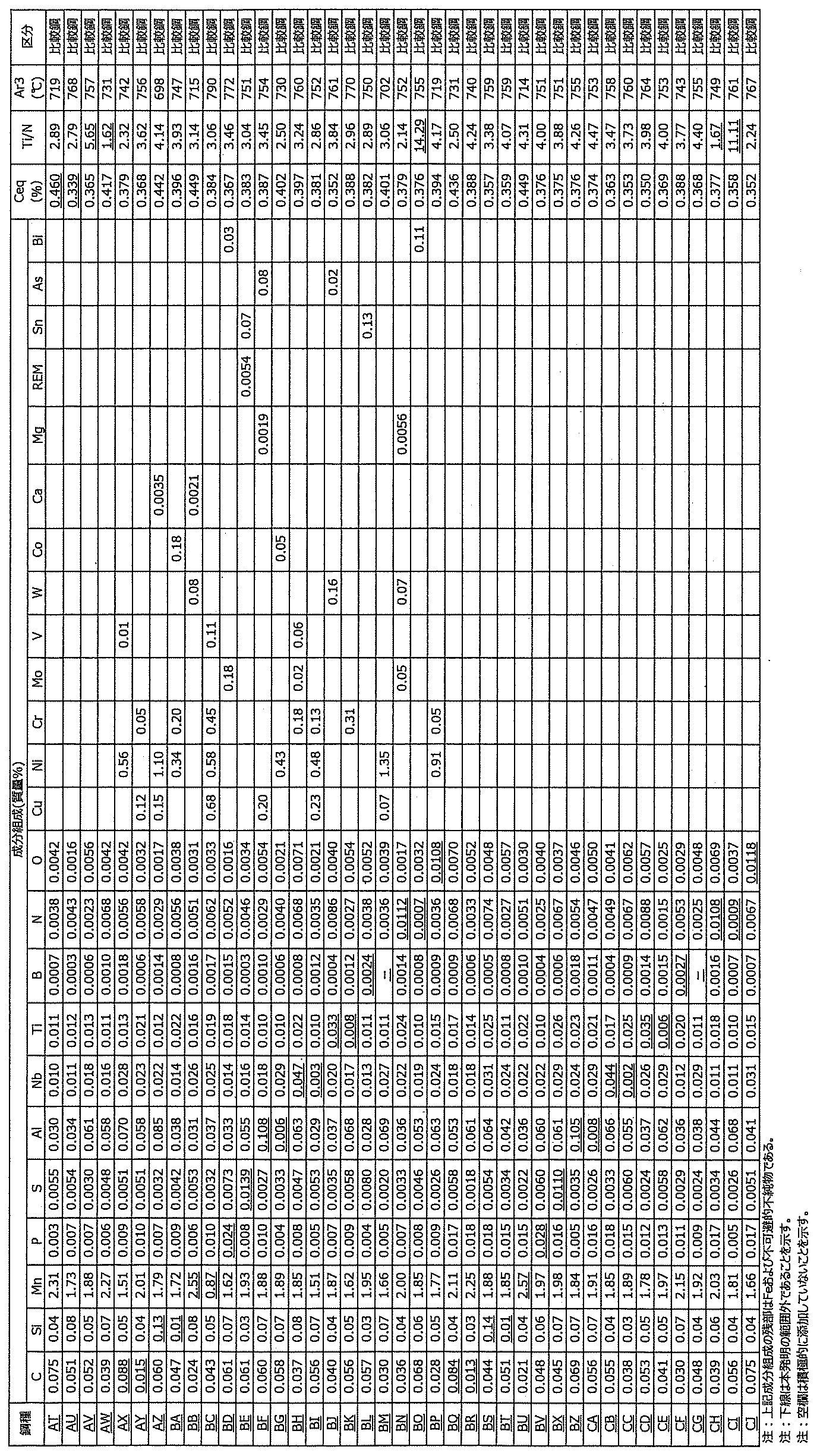
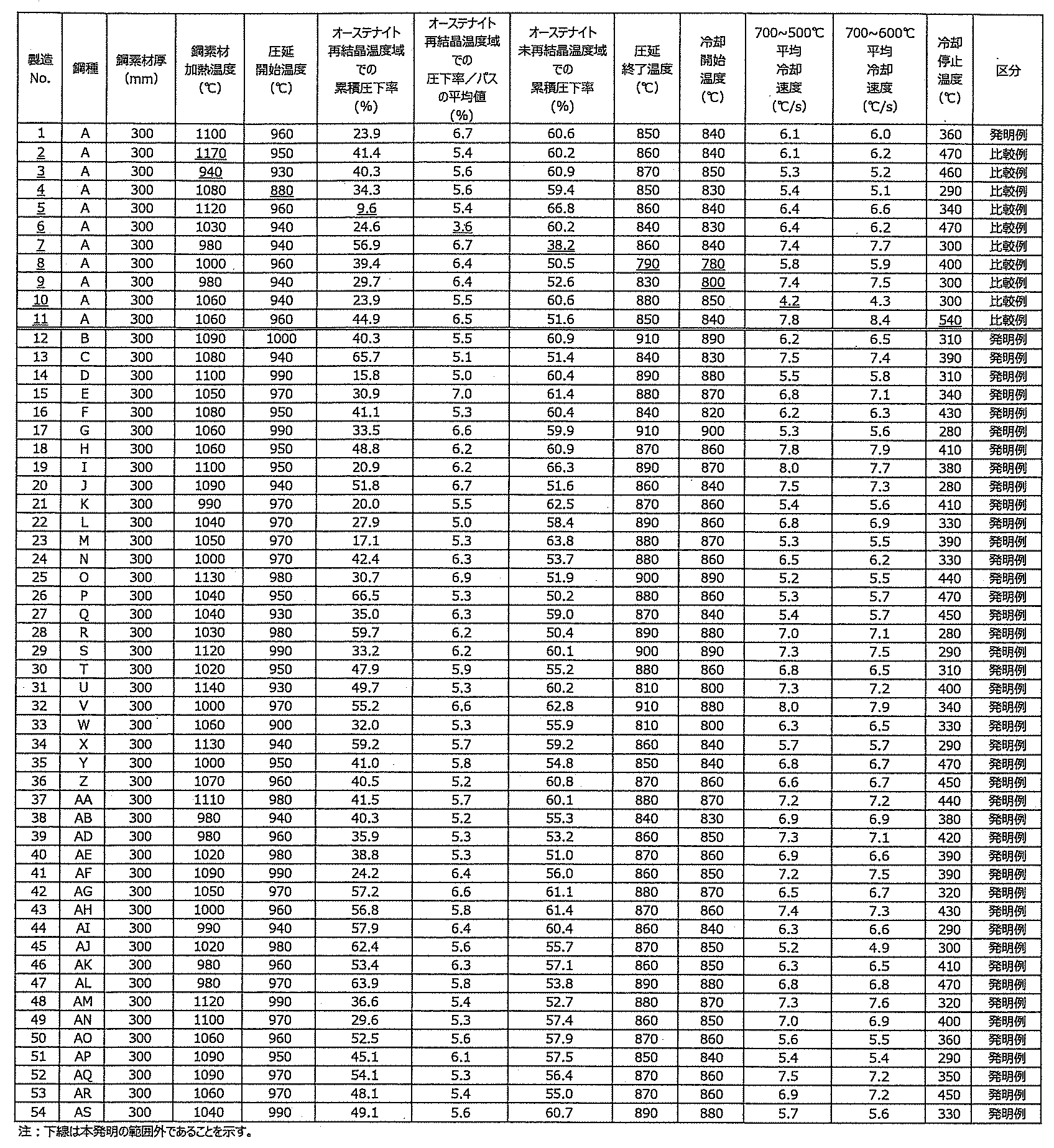
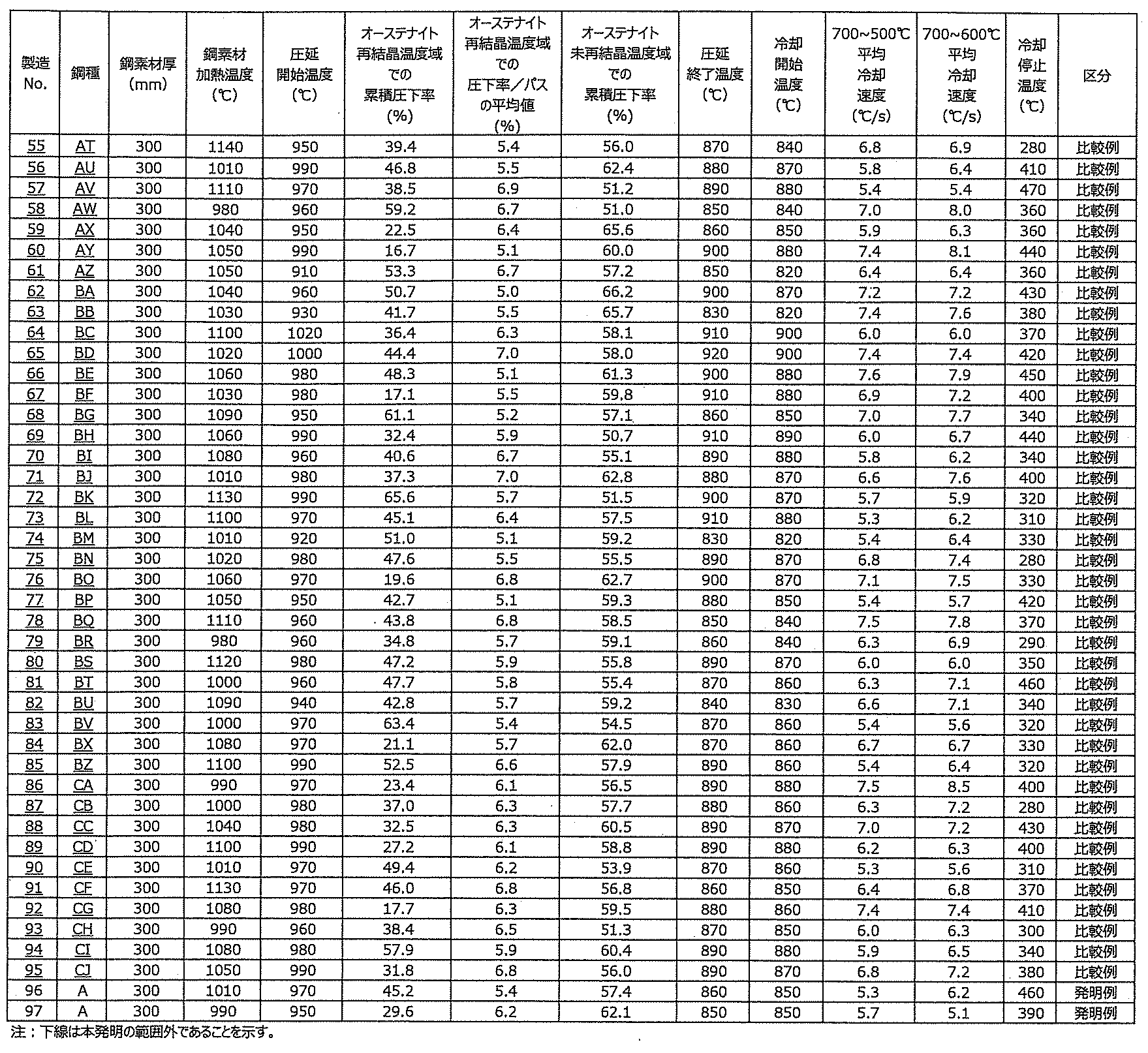
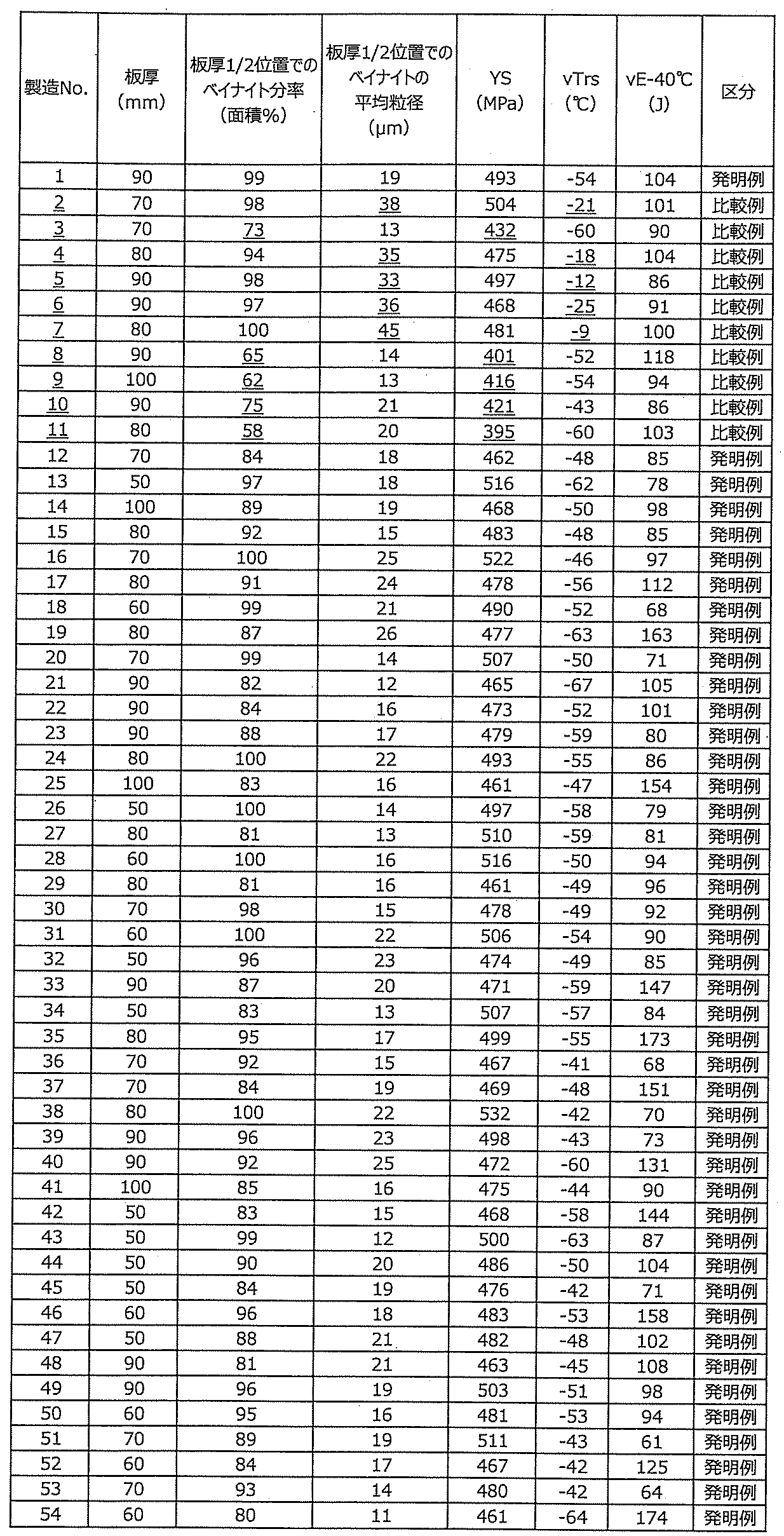
得られた鋼板の板厚1/2位置より、試験片の長手軸の方向が圧延方向と垂直かつ板幅方向と平行となるように、Φ14のJIS 14A号試験片を採取し、JIS Z 2241(2022)の規定に準拠して引張試験を行い、降伏強度(YS)を測定した。
ここでは、降伏強度が460MPa以上の実施例を高強度であると評価した。
靭性の評価は、歪時効処理後の板厚1/2位置のシャルピー破面遷移温度で行った。
得られた鋼板の板厚1/2位置より、試験片の長手軸の方向が圧延方向と平行となるようにJIS4号衝撃試験片を採取し、板幅方向に平行な向きに切欠を加工し、JIS Z 2242(2023)の規定に準拠して0℃~-80℃の範囲でシャルピー試験を実施し、各試験温度におけるシャルピー破面率を測定し、シャルピー破面遷移温度(vTrs)を求めた。なお、1試験温度につき3本試験し、3本の脆性破面率の平均値からvTrsを計算した。
ここでは、vTrs≦-40℃の実施例をシャルピー靭性(母材の靭性)に優れると評価した。
鋼板から採取した継手用試験板に、開先角度:20°、開先ギャップ:10mmとなるV開先加工を施し、市販の低温用鋼用溶接ワイヤを使用して、電流:398A、電圧:44V、溶接速度:21mm/min、溶接入熱500kJ/cmのエレクトロガス溶接(EGW)により継手を作製し、得られた継手の表面から深さ1mmの位置を試験片表層とし、融合部(FL)上で溶接金属と母材が50%ずつとなる位置に切欠を付与し、NK U4号衝撃試験片を採取した。採取した衝撃試験片について、試験温度-40℃でシャルピー衝撃試験を実施した。上記の継手用試験板から採取した衝撃試験片3本について、同一条件で実施して得られた吸収エネルギーの平均値vE-40℃(単位:J)を、HAZの靭性とした。ここでは、平均でvE-40℃≧53Jの実施例をHAZ靭性に優れると評価した。
[鋼組織]
板厚1/2位置の鋼組織は、次の通り観察した。
圧延方向と垂直な面が観察面となるように、鋼板の幅中央かつ板厚1/2位置から試料を採取した。試料の寸法は板厚方向に20mm、圧延方向と平行な方向に10mm、かつ板幅方向に1mmとした。この試料の圧延方向に垂直な面を鏡面研磨した後、ナイタール腐食により現出させた金属組織の光学顕微鏡写真を撮影した。撮影部は板厚1/2位置で倍率は200倍、撮影範囲は250μm×300μmとした。得られた写真から白い塊状として現出した組織をフェライト、残部をベイナイト相として画像解析によって面積率を計算することによりベイナイト相の面積率を評価した。
[ベイナイト相の結晶粒の平均粒径]
圧延方向と垂直な面が観察面となるように、鋼板の幅中央かつ板厚1/2位置から試料を採取した。試料の寸法は板厚方向に20mm、圧延方向と平行な方向に10mm、かつ圧延方向と垂直な方向に1mmとした。この試料の圧延方向に垂直な面を鏡面研磨した後、板厚1/2位置について下記の条件でEBSP解析を行った。得られた結晶方位マップより、隣接する結晶粒との方位差が15°以上の大角粒界で囲まれた組織の円相当直径を求め、下記の解析領域における円相当直径の平均値を平均有効結晶粒径とした。
(EBSP条件)
・加速電圧:20KV、照射電流:50nA
・ビーム径:50nm
・解析領域:板厚1/2位置の1mm×1mm領域
・ステップサイズ:0.4μm

Claims (4)
- 質量%で、
C:0.020~0.080%、
Si:0.02~0.09%、
Mn:1.00~2.50%、
P:0.020%以下、
S:0.010%以下、
Al:0.010~0.100%、
Nb:0.005~0.040%、
Ti:0.010~0.030%、
B:0.0001~0.0020%、
N:0.0010~0.0100%、および
O:0.0100%以下
を含有し、かつ、式(1)で定義されるCeqが0.350~0.450%であり、
TiとNの質量%比(Ti/N)が2.00以上4.50以下であり、
残部がFeおよび不可避的不純物からなる成分組成を有し、
板厚1/2位置において、面積率で、ベイナイト相:80%以上とその他残部組織からなる組織であり、隣接する結晶粒との方位差が15°以上の粒界に囲まれたベイナイト相の結晶粒の平均粒径:30μm以下である鋼組織を有し、
板厚が50mm以上であり、
板厚1/2位置における降伏強度が460MPa以上であり、
室温で5~10%歪を付与した後に200~250℃で1~2時間保持する歪時効処理を施した後の板厚1/2位置におけるシャルピー破面遷移温度(vTrs)がvTrs≦-40℃であり、
溶接入熱を500kJ/cmとして作製した溶接継手において溶接部のHAZにおける-40℃シャルピー吸収エネルギーが平均53J以上である鋼板。
Ceq=C+Mn/6+Cu/15+Ni/15+Cr/5+Mo/5+V/5 ・・・式(1)
ここで、式(1)におけるC、Mn、Cu、Ni、Cr、MoおよびVは各元素の含有量(質量%)を表し、含有しない元素は含有量を0(零)とする。 - 前記成分組成に加えて、質量%で、以下のA群、B群およびC群のうちから選ばれた1群または2群以上を含有する、請求項1に記載の鋼板。
A群:Cu:1.00%以下、Ni:2.00%以下、Cr:1.00%以下のうちから選ばれた1種または2種以上
B群:Mo:0.30%以下、V:0.30%以下、W:0.30%以下、Co:0.30%以下、Ca:0.0100%以下、Mg:0.0100%以下、およびREM(希土類金属):0.0200%以下のうちから選ばれた1種または2種以上
C群:Sn:0.20%以下、As:0.10%以下、Bi:0.20%以下のうちから選ばれた1種または2種以上 - 請求項1または2に記載の鋼板の製造方法であって、
前記成分組成を有する鋼素材を、950~1150℃の加熱温度に加熱し、
次いで、板厚1/2位置における圧延開始温度:(Ar3点+200)℃以上であり、
板厚1/2位置における温度がオーステナイト再結晶温度域であるときの累積圧下率:15.0%以上、かつ、1パスあたりの圧下率の平均値:5.0%以上であり、
板厚1/2位置における温度がオーステナイト未再結晶温度域であるときの累積圧下率:50.0%以上であり、
さらに、板厚1/2位置における圧延終了温度:(Ar3点+100)℃以上となる条件で圧延を実施し、
次いで、板厚1/2位置における冷却開始温度:(Ar3点+100)℃以上であり、
かつ、板厚1/2位置における温度が700~500℃の温度域であるときの平均冷却速度:5.0℃/s以上であり、
かつ、板厚1/2位置における冷却停止温度:500℃以下となる条件で冷却を施す、鋼板の製造方法。 - 前記冷却では、さらに、板厚1/2位置における温度が700~600℃の温度域であるときの平均冷却速度:5.5℃/s以上である、請求項3に記載の鋼板の製造方法。
Priority Applications (3)
| Application Number | Priority Date | Filing Date | Title |
|---|---|---|---|
| KR1020257032157A KR20250168240A (ko) | 2023-06-27 | 2024-06-11 | 강판 및 그의 제조 방법 |
| JP2024558072A JP7700972B2 (ja) | 2023-06-27 | 2024-06-11 | 鋼板およびその製造方法 |
| CN202480022371.1A CN120882894A (zh) | 2023-06-27 | 2024-06-11 | 钢板及其制造方法 |
Applications Claiming Priority (2)
| Application Number | Priority Date | Filing Date | Title |
|---|---|---|---|
| JP2023-104776 | 2023-06-27 | ||
| JP2023104776 | 2023-06-27 |
Publications (1)
| Publication Number | Publication Date |
|---|---|
| WO2025004797A1 true WO2025004797A1 (ja) | 2025-01-02 |
Family
ID=93938836
Family Applications (1)
| Application Number | Title | Priority Date | Filing Date |
|---|---|---|---|
| PCT/JP2024/021239 Ceased WO2025004797A1 (ja) | 2023-06-27 | 2024-06-11 | 鋼板およびその製造方法 |
Country Status (4)
| Country | Link |
|---|---|
| JP (1) | JP7700972B2 (ja) |
| KR (1) | KR20250168240A (ja) |
| CN (1) | CN120882894A (ja) |
| WO (1) | WO2025004797A1 (ja) |
Citations (4)
| Publication number | Priority date | Publication date | Assignee | Title |
|---|---|---|---|---|
| JP2009074111A (ja) * | 2007-09-18 | 2009-04-09 | Kobe Steel Ltd | 母材低温靭性のばらつきが少なく熱影響部の靭性に優れた大入熱溶接用厚肉高強度鋼板およびその製造方法 |
| WO2013150687A1 (ja) * | 2012-04-06 | 2013-10-10 | 新日鐵住金株式会社 | アレスト性に優れた高強度厚鋼板 |
| JP2015183273A (ja) * | 2014-03-26 | 2015-10-22 | 新日鐵住金株式会社 | 鋼板及びその製造方法 |
| WO2022097589A1 (ja) * | 2020-11-05 | 2022-05-12 | Jfeスチール株式会社 | 鋼板およびその製造方法 |
Family Cites Families (5)
| Publication number | Priority date | Publication date | Assignee | Title |
|---|---|---|---|---|
| JPS5751243A (en) | 1980-09-12 | 1982-03-26 | Nippon Steel Corp | Steel products for welding |
| JPS609086B2 (ja) | 1981-02-14 | 1985-03-07 | 川崎製鉄株式会社 | 高靭性高張力鋼の製造法 |
| JPS5983722A (ja) | 1982-11-05 | 1984-05-15 | Kawasaki Steel Corp | 低炭素当量非調質高張力鋼板の製造方法 |
| JPS63223125A (ja) | 1987-03-10 | 1988-09-16 | Sumitomo Metal Ind Ltd | 高靭性高張力鋼板の製造方法 |
| JP2005002476A (ja) | 2004-08-03 | 2005-01-06 | Jfe Steel Kk | 溶接継手 |
-
2024
- 2024-06-11 CN CN202480022371.1A patent/CN120882894A/zh active Pending
- 2024-06-11 JP JP2024558072A patent/JP7700972B2/ja active Active
- 2024-06-11 KR KR1020257032157A patent/KR20250168240A/ko active Pending
- 2024-06-11 WO PCT/JP2024/021239 patent/WO2025004797A1/ja not_active Ceased
Patent Citations (4)
| Publication number | Priority date | Publication date | Assignee | Title |
|---|---|---|---|---|
| JP2009074111A (ja) * | 2007-09-18 | 2009-04-09 | Kobe Steel Ltd | 母材低温靭性のばらつきが少なく熱影響部の靭性に優れた大入熱溶接用厚肉高強度鋼板およびその製造方法 |
| WO2013150687A1 (ja) * | 2012-04-06 | 2013-10-10 | 新日鐵住金株式会社 | アレスト性に優れた高強度厚鋼板 |
| JP2015183273A (ja) * | 2014-03-26 | 2015-10-22 | 新日鐵住金株式会社 | 鋼板及びその製造方法 |
| WO2022097589A1 (ja) * | 2020-11-05 | 2022-05-12 | Jfeスチール株式会社 | 鋼板およびその製造方法 |
Also Published As
| Publication number | Publication date |
|---|---|
| JP7700972B2 (ja) | 2025-07-01 |
| JPWO2025004797A1 (ja) | 2025-01-02 |
| KR20250168240A (ko) | 2025-12-02 |
| CN120882894A (zh) | 2025-10-31 |
Similar Documents
| Publication | Publication Date | Title |
|---|---|---|
| KR101846759B1 (ko) | 강판 및 그 제조 방법 | |
| JP5846311B2 (ja) | 溶接熱影響部ctod特性に優れた厚肉高張力鋼およびその製造方法 | |
| WO2012036307A1 (ja) | 靭性に優れた高強度熱延鋼板およびその製造方法 | |
| EP3378962B1 (en) | High heat input welded steel material | |
| KR20190037303A (ko) | 대입열 용접용 강재 | |
| CN116194602A (zh) | 钢板及其制造方法 | |
| TWI526545B (zh) | 熔接用鋼材 | |
| JP4096839B2 (ja) | 超大入熱溶接熱影響部靱性に優れた低降伏比高張力厚鋼板の製造方法 | |
| JP5151693B2 (ja) | 高張力鋼の製造方法 | |
| WO2021199629A1 (ja) | 鋼板およびその製造方法 | |
| JP5034290B2 (ja) | 低降伏比高強度厚鋼板およびその製造方法 | |
| JP7323090B1 (ja) | 鋼板および鋼板の製造方法 | |
| JP7700972B2 (ja) | 鋼板およびその製造方法 | |
| JP4066879B2 (ja) | 溶接熱影響部ctod特性に優れた厚肉高張力鋼板の製造方法 | |
| CN118679276A (zh) | 大线能量焊接用钢板及其制造方法 | |
| JP5935678B2 (ja) | 高靭性高張力鋼およびその製造方法 | |
| WO2016068094A1 (ja) | 溶接熱影響部の低温靭性に優れる高張力鋼板とその製造方法 | |
| CN117337341B (zh) | 高强度钢板及其制造方法 | |
| CN116323988B (zh) | 钢板以及钢板的制造方法 | |
| JP2017002349A (ja) | 高張力鋼板およびその製造方法 | |
| JP7444090B2 (ja) | 鋼板およびその製造方法 | |
| JP2025173475A (ja) | 鋼板およびその製造方法 | |
| JP3733922B2 (ja) | 超大入熱溶接熱影響部靭性に優れた厚肉高張力鋼板の製造方法 | |
| JP3941596B2 (ja) | 建築構造用厚鋼板の製造方法 | |
| WO2023166935A1 (ja) | 鋼板および鋼板の製造方法 |
Legal Events
| Date | Code | Title | Description |
|---|---|---|---|
| WWE | Wipo information: entry into national phase |
Ref document number: 2024558072 Country of ref document: JP |
|
| 121 | Ep: the epo has been informed by wipo that ep was designated in this application |
Ref document number: 24831663 Country of ref document: EP Kind code of ref document: A1 |
|
| ENP | Entry into the national phase |
Ref document number: 1020257032157 Country of ref document: KR Free format text: ST27 STATUS EVENT CODE: A-0-1-A10-A15-NAP-PA0105 (AS PROVIDED BY THE NATIONAL OFFICE) |
|
| WWE | Wipo information: entry into national phase |
Ref document number: KR1020257032157 Country of ref document: KR |
|
| WWE | Wipo information: entry into national phase |
Ref document number: 202480022371.1 Country of ref document: CN |
|
| WWP | Wipo information: published in national office |
Ref document number: 202480022371.1 Country of ref document: CN |
|
| NENP | Non-entry into the national phase |
Ref country code: DE |