WO2024261871A1 - 制御装置 - Google Patents
制御装置 Download PDFInfo
- Publication number
- WO2024261871A1 WO2024261871A1 PCT/JP2023/022783 JP2023022783W WO2024261871A1 WO 2024261871 A1 WO2024261871 A1 WO 2024261871A1 JP 2023022783 W JP2023022783 W JP 2023022783W WO 2024261871 A1 WO2024261871 A1 WO 2024261871A1
- Authority
- WO
- WIPO (PCT)
- Prior art keywords
- value
- voltage
- motor
- unit
- command value
- Prior art date
- Legal status (The legal status is an assumption and is not a legal conclusion. Google has not performed a legal analysis and makes no representation as to the accuracy of the status listed.)
- Ceased
Links
Images




Classifications
-
- B—PERFORMING OPERATIONS; TRANSPORTING
- B66—HOISTING; LIFTING; HAULING
- B66B—ELEVATORS; ESCALATORS OR MOVING WALKWAYS
- B66B13/00—Doors, gates, or other apparatus controlling access to, or exit from, cages or lift well landings
- B66B13/02—Door or gate operation
- B66B13/06—Door or gate operation of sliding doors
- B66B13/08—Door or gate operation of sliding doors guided for horizontal movement
Definitions
- This disclosure relates to a control device for controlling elevator doors.
- Patent document 1 describes a control device for controlling elevator doors.
- the resistance value of a motor that drives the door is estimated based on the value of the current flowing through the motor and the value of the voltage applied to the motor.
- the temperature of the coil of the motor is estimated based on the estimated resistance value.
- the purpose of this disclosure is to provide a control device that can accurately estimate the temperature of a coil included in a motor that drives an elevator door.
- the control device includes a door state detection unit that detects the state of the elevator door, a voltage command unit that generates a voltage command value so that the value of the current flowing through the motor that drives the door follows the current command value, a voltage estimation unit that estimates a bus voltage value supplied to an inverter for driving the motor when the door state detection unit detects that the door is in an operating state, a resistance estimation unit that estimates an electrical resistance value of the motor when the door state detection unit detects that the door is in a fully open or fully closed state, and a temperature estimation unit that estimates the temperature of a coil included in the motor by correcting the electrical resistance value estimated by the resistance estimation unit using the bus voltage value estimated by the voltage estimation unit.
- FIG. 1 is a diagram showing an example of an elevator system including a control device in a first embodiment.
- FIG. 2 illustrates an example of a control device.
- 4 is a flowchart showing an example of the operation of the control device.
- 4 is a flowchart showing a preferred example of a voltage estimation process.
- 4 is a diagram for explaining a function of a voltage estimation unit;
- FIG. 4 is a flowchart showing a preferred example of a resistance estimation process.
- 5A to 5C are diagrams illustrating examples of a test current command value and a test voltage command value.
- 11A to 11C are diagrams illustrating other examples of the test current command value and the test voltage command value.
- 10 is a flowchart showing another example of the operation of the control device.
- 10 is a flowchart showing another example of the operation of the control device.
- FIG. 2 is a diagram illustrating an example of hardware resources of a control device.
- FIG. 11 is a diagram illustrating another example of
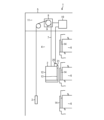
- Fig. 1 is a diagram showing an example of an elevator system 1 including a control device 20 in embodiment 1.
- the elevator system 1 shown in Fig. 1 includes a car 2 and a counterweight 3.
- the car 2 moves up and down in a hoistway 4.
- the hoistway 4 is a space formed in a building 5.
- the hoistway 4 is formed so as to pass through each floor of the building 5.
- a landing 6 at which the car 2 can stop is provided on each floor of the building 5.
- the car 2 and counterweight 3 are suspended in the hoistway 4 by a rope 7.
- the rope 7 is wound around a drive sheave 9 of a hoisting machine 8.
- the hoisting machine 8 is controlled by a control panel 10. That is, the hoisting machine 8 rotates the drive sheave 9 based on commands from the control panel 10.
- the rope 7 moves in a direction corresponding to the direction in which the drive sheave 9 rotates.
- the car 2 moves up or down the hoistway 4 depending on the direction in which the rope 7 moves.
- the counterweight 3 moves up and down the hoistway 4 in the opposite direction to the direction in which the car 2 moves.
- FIG. 1 shows an example in which a machine room 11 is provided above the elevator shaft 4.
- the hoist 8 and control panel 10 are provided in the machine room 11. If the building 5 does not have a machine room 11, the hoist 8 and control panel 10 may be provided in the elevator shaft 4.
- the control panel 10 not only controls the hoist 8, but also controls the overall operation of the elevator system 1.
- the car 2 includes a car chamber 12, a door 13, a control device 20, and a motor 21.
- An entrance/exit is formed in the car chamber 12 for passengers to board and disembark.
- the door 13 opens and closes the entrance/exit by moving horizontally relative to the car chamber 12.
- the door 13 is driven by the motor 21.
- the motor 21 is controlled by the control device 20.
- the control device 20 is a device for controlling the door 13. Specifically, the control device 20 controls the position and movement speed of the door 13, etc.
- FIG. 1 shows a state in which car 2 is stopped at a landing 6 on a certain floor. While car 2 is moving, door 13 is in a fully closed state. When car 2 that has moved from another floor stops at landing 6, control device 20 opens door 13. Note that door 14 provided at landing 6 is linked to door 13 if car 2 is stopped at that landing 6. Passengers can board and disembark from car 2 when door 13 is fully open. While passengers are boarding and disembarking, control device 20 maintains door 13 in a fully open state. Thereafter, control device 20 closes door 13.
- FIG. 2 is a diagram showing an example of the control device 20.
- the motor 21 is a motor that is driven to rotate by, for example, three-phase AC.
- the motor 21 includes coils that correspond to each phase of the three-phase AC. That is, the motor 21 includes a U-phase coil, a V-phase coil, and a W-phase coil.
- the rotational position ⁇ , rotational speed, rotational torque, etc. of the motor 21 are controlled by the supplied power.
- the motor 21 is equipped with a rotation sensor 22.
- the rotation sensor 22 detects the rotation position ⁇ of the motor 21.
- An encoder or a resolver is used as the rotation sensor 22.
- Other types of sensors may also be used as the rotation sensor 22.
- Information on the rotation position ⁇ detected by the rotation sensor 22 is input to the control device 20.
- the information on the rotation position ⁇ is used by the control device 20 for controlling the rotation position and as a control standard for current, etc.
- the rotation sensor 22 may detect the position of the door 13 based on the rotation position ⁇ of the motor 21. Information on the position of the door 13 detected by the rotation sensor 22 is input to the control panel 10. The information on the position of the door 13 is used by the control panel 10 to determine the acceleration position, deceleration position, etc. of the door 13.
- the control device 20 includes a current sensor 23, a door state detection unit 24, a current coordinate conversion unit 25, a current command unit 26, a voltage command unit 27, a voltage coordinate conversion unit 28, a power conversion unit 29, a resistance estimation unit 30, a temperature estimation unit 31, a protection control unit 32, and a voltage estimation unit 33.
- the devices for realizing these functions of the control device 20 may be housed in a single housing, or may be housed separately in multiple housings.
- the current sensor 23 detects the value of the current flowing through each phase of the motor 21. That is, the current sensor 23 detects the value of the current flowing through the U phase, the value of the current flowing through the V phase, and the value of the current flowing through the W phase of the motor 21.
- the value of the current flowing through the U phase detected by the current sensor 23 is also referred to as the actual current value Iu.
- the value of the current flowing through the V phase detected by the current sensor 23 is also referred to as the actual current value Iv.
- the value of the current flowing through the W phase detected by the current sensor 23 is also referred to as the actual current value Iw. Only two of the actual current values Iu, Iv, and Iw may be detected by the current sensor 23.
- the actual current values Iu, Iv, and Iw may be used as feedback signals for current control of the motor 21 in the control device 20.
- the door state detection unit 24 detects the state of the door 13.
- the states of the door 13 detected by the door state detection unit 24 include, for example, a fully open state, a fully closed state, an operating state, and other states.
- the operating states include an opening operation state and a closing operation state.
- the opening operation state is a state in which the door 13 is moving in the direction to open. For example, the period from when the door 13 in the fully closed state starts to open until it reaches the fully open state is the opening operation state.
- the closing operation state is a state in which the door 13 is moving in the direction to close. For example, the period from when the door 13 in the fully open state starts to close until it reaches the fully closed state is the closing operation state.
- the door state detection unit 24 may detect the state of the door 13 in any manner. As an example, the door state detection unit 24 detects the state based on the rotational position ⁇ detected by the rotation sensor 22. The door state detection unit 24 may also detect the state using a sensor attached at the fully closed position and a sensor attached at the fully open position.
- the value of the rotational position ⁇ detected by the rotation sensor 22 is input to the current coordinate conversion unit 25.
- the actual current values Iu, Iv, and Iw detected by the current sensor 23 are input to the current coordinate conversion unit 25.
- the current coordinate conversion unit 25 Based on the rotational position ⁇ , the current coordinate conversion unit 25 converts the coordinate system of the actual current values Iu, Iv, and Iw into a dq coordinate system. That is, based on the input rotational position ⁇ and actual current values Iu, Iv, and Iw, the current coordinate conversion unit 25 calculates and outputs the corresponding actual current value Id of the d axis and actual current value Iq of the q axis.
- the current command unit 26 includes the functions of the control system of the motor 21.
- the functions of the control system are, for example, the functions of a position control system and a speed control system.
- the current command unit 26 generates a current command value for controlling the current flowing through the motor 21.
- the current command value is generated based on, for example, a command from the control panel 10, a signal from the position control system of the motor 21, a signal from the speed control system of the motor 21, etc.
- the current command unit 26 generates a current command value expressed in a dq coordinate system. That is, the current command unit 26 generates and outputs a d-axis current command value Id* and a q-axis current command value Iq*.
- the actual current value Iq on the q-axis is a current value related to the rotational torque of the motor 21.
- the current command unit 26 When performing control to open the door 13 and control to keep the door 13 fully open, the current command unit 26 generates a current command value Iq* that causes the motor 21 to generate torque in the direction to open the door 13.
- the current command unit 26 When performing control to close the door 13 and control to keep the door 13 fully closed, the current command unit 26 generates a current command value Iq* that causes the motor 21 to generate torque in the direction to close the door 13.
- the actual current value Id of the d-axis is a current value that does not contribute to the rotational torque.
- the current command unit 26 sets the current command value Id* to 0 when performing control to open the door 13, control to close the door 13, control to maintain the door 13 in a fully open state, and control to maintain the door 13 in a fully closed state.
- the current command value Id* may be set to a value other than 0 in order to perform flux weakening control.
- the current command unit 26 sets the current command value Id* to 0 when control is performed to maintain the door 13 in a fully open or fully closed state.
- the voltage command unit 27 controls the current flowing through the motor 21.
- the voltage command unit 27 generates a voltage command value so that the value of the current flowing through the motor 21 follows the current command value from the current command unit 26.
- the voltage command unit 27 generates and outputs a voltage command value for controlling the voltage applied to the motor 21, as a value expressed in the dq coordinate system, based on the actual current value and the current command value.
- the voltage command unit 27 may include the function of the subtractor 34.
- the actual current values Id and Iq calculated by the current coordinate conversion unit 25 are input to the voltage command unit 27.
- the current command values Id* and Iq* generated by the current command unit 26 are input to the voltage command unit 27.
- the voltage command unit 27 calculates and outputs a d-axis voltage command value Vd* and a q-axis voltage command value Vq* such that the actual current values Id and Iq follow the current command values Id* and Iq*.
- the voltage command unit 27 performs a control calculation such that the actual current values Id and Iq match the current command values Id* and Iq*.
- the control performed by the voltage command unit 27 can be realized by any control such as PID control.
- the value of the rotational position ⁇ detected by the rotation sensor 22 is input to the voltage coordinate conversion unit 28.
- the voltage command values Vd* and Vq* generated by the voltage command unit 27 are input to the voltage coordinate conversion unit 28.
- the voltage coordinate conversion unit 28 converts the coordinate system of the voltage command values Vd* and Vq* into a UVW coordinate system. That is, based on the input rotational position ⁇ and voltage command values Vd* and Vq*, the voltage coordinate conversion unit 28 calculates and outputs the corresponding U-phase voltage command value Vu*, V-phase voltage command value Vv*, and W-phase voltage command value Vw*.
- the voltage coordinate conversion unit 28 may convert the voltage command values Vu*, Vv*, and Vw* into duty ratios according to the design values of the power conversion unit 29 and output them.
- the power conversion unit 29 is electrically connected to the motor 21.
- the current sensor 23 is provided between the power conversion unit 29 and the motor 21.
- the power conversion unit 29 is supplied with power from an operating power supply (not shown).
- the voltage value of the power supplied to the power conversion unit 29 from the operating power supply is also referred to as the bus voltage value Vdc.
- the power conversion unit 29 is an amplifier that supplies power for controlling the rotation of the motor 21.
- the power conversion unit 29 has a function of a PWM inverter.
- the power conversion unit 29 generates a corresponding PWM signal by performing carrier comparison of the voltage command values Vu*, Vv*, and Vw* from the voltage coordinate conversion unit 28.
- the power conversion unit 29 uses the generated PWM signal as a switching command for the switching elements of the inverter.
- the power conversion unit 29 converts the power from the operating power source based on the switching command, and supplies the power to the motor 21.
- the control device 20 also performs temperature estimation processing.
- the temperature estimation processing is processing for estimating the temperature of the coil included in the motor 21.
- the coil included in the motor 21 is also simply referred to as coil C.
- the temperature estimation processing includes resistance estimation processing and voltage estimation processing.
- the resistance estimation processing is processing for estimating the electrical resistance value of the motor 21.
- the voltage estimation processing is processing for estimating the bus voltage value supplied to the power conversion unit 29.
- the control device 20 may further perform overheat protection processing after the temperature estimation processing.
- the resistance estimation unit 30, the temperature estimation unit 31, and the voltage estimation unit 33 are functions provided in the control device 20 to perform temperature estimation processing.
- the protection control unit 32 is a function provided in the control device 20 to perform overheat protection processing.
- the resistance estimation unit 30 estimates the electrical resistance value R ⁇ of the motor 21. That is, R ⁇ represents the estimated value of the electrical resistance.
- the resistance estimation unit 30 estimates the electrical resistance value R ⁇ when the door state detection unit 24 detects that the door 13 is in a fully open or fully closed state.
- the actual current value Id calculated by the current coordinate conversion unit 25 is input to the resistance estimation unit 30.
- the voltage command value Vd* generated by the voltage command unit 27 is input to the resistance estimation unit 30.
- the resistance estimation unit 30 estimates the electrical resistance value R ⁇ based on the input actual current value Id and voltage command value Vd*. As an example, the resistance estimation unit 30 estimates the overall electrical resistance value of the electrical circuit consisting of the U-phase coil, V-phase coil, and W-phase coil as the electrical resistance value R ⁇ .
- the voltage estimation unit 33 estimates the bus voltage value Vdc ⁇ supplied to the power conversion unit 29, i.e., the inverter for driving the motor 21. That is, Vdc ⁇ represents the estimated value of the bus voltage.
- the voltage estimation unit 33 estimates the bus voltage value Vdc ⁇ when the door state detection unit 24 detects that the door 13 is in an operating state, i.e., an open operating state or a closed operating state.
- the actual current values Id and Iq calculated by the current coordinate conversion unit 25 are input to the voltage estimation unit 33.
- the voltage command value Vq* generated by the voltage command unit 27 is input to the voltage estimation unit 33.
- the rotational angular velocity ⁇ based on the rotational position ⁇ detected by the rotation sensor 22 is input to the voltage estimation unit 33.
- the voltage estimation unit 33 estimates the bus voltage value Vdc ⁇ based on the input actual current values Id and Iq, the voltage command value Vq*, and the rotational angular velocity ⁇ .
- the temperature estimation unit 31 estimates the temperature T of the coil C included in the motor 21.
- the electrical resistance value R ⁇ estimated by the resistance estimation unit 30 is input to the temperature estimation unit 31.
- the bus voltage value Vdc ⁇ estimated by the voltage estimation unit 33 is input to the temperature estimation unit 31.
- the temperature estimation unit 31 estimates the temperature T of the coil C based on the input electrical resistance value R ⁇ and bus voltage value Vdc ⁇ . Specifically, the temperature estimation unit 31 corrects the electrical resistance value R ⁇ using the bus voltage value Vdc ⁇ .
- the temperature estimation unit 31 estimates the temperature T of the coil C based on the corrected electrical resistance value R ⁇ .
- the value of the temperature T estimated by the temperature estimation unit 31 is input to the protection control unit 32. Based on the temperature T estimated by the temperature estimation unit 31, the protection control unit 32 determines whether or not to execute protection control for the coil C.
- control device 20 The principles of the functions of the control device 20 are explained in detail below. First, the principles of how the electrical resistance value R ⁇ is calculated in the resistance estimation process are explained.
- Equation (1) is the voltage equation for the d-axis.
- Equation (2) is the voltage equation for the q-axis.
- R is the total resistance value of the coils included in the motor 21.
- Ld is the inductance of the d-axis.
- Lq is the inductance of the q-axis.
- ⁇ is the electrical angular velocity.
- ⁇ is the induced voltage constant.
- Equation (1) can be regarded as equation (3).
- Equation (2) can be regarded as equation (4).
- the resistance value R can be calculated based on Ohm's law from the pair of Vd and Id or the pair of Vq and Iq.
- the actual current values Id and Iq are calculated by the current coordinate conversion unit 25 based on the actual current values Iu, Iv, and Iw and the rotational position ⁇ .
- the actual current values Iu, Iv, and Iw and the rotational position ⁇ are measured values.
- the actual current values Id and Iq are values calculated based on measured values, and therefore can be considered to be accurate values.
- the voltage command values Vd* and Vq* generated by the voltage command unit 27 are used instead of the applied voltage values Vd and Vq.
- the estimated resistance value R may contain various estimation errors.
- the design difference may cause an error between the voltage command values Vd* and Vq* and the voltage value actually applied to the motor 21.
- the design difference may cause an error in the dead time correction performed by the power conversion unit 29.
- the voltage command unit 27 generates the voltage command values Vd* and Vq* so that various errors resulting from the design difference are reduced or eliminated. Specifically, the voltage command unit 27 calculates and generates the voltage command values Vd* and Vq* so as to absorb the difference between the bus voltage value supplied to the power conversion unit 29 and the voltage value used as the design value. The voltage command unit 27 calculates and generates the voltage command values Vd* and Vq* so as to compensate for the error in the dead time correction resulting from the design difference. However, even if such calculations are performed, an error will occur between the voltage command values Vd* and Vq* and the voltage value actually applied.
- This error can be divided into additive error and multiplicative error.
- Additive error includes the error in dead time correction.
- Multiplicative error includes the error between the design value of the bus voltage and the actual voltage value when calculating the duty ratio.
- Equation (5) shows the relationship between the voltage command value Vd* and the applied voltage value Vd.
- Equation (6) shows the relationship between the voltage command value Vq* and the applied voltage value Vq.
- ⁇ is a coefficient indicating the multiplicative error.
- ⁇ Vd is the additive error on the d-axis.
- ⁇ Vq is the additive error on the q-axis.
- the difference between the voltage command value and the actual current value is used in the resistance estimation process.
- the formula (7) is used in the resistance estimation process.
- the difference ⁇ V is the amount of change in the voltage command value on the d-axis or the amount of change in the voltage command value on the q-axis.
- the difference ⁇ I is the amount of change in the actual current value on the d-axis or the amount of change in the actual current value on the q-axis.
- the difference ⁇ V is the difference between two voltage command values. Therefore, the difference ⁇ V is a value in which the additive errors ⁇ Vd and ⁇ Vq that exist between the voltage command values Vd* and Vq* and the values of the voltages actually applied are offset. It is preferable to use such values in the resistance estimation process.
- At least two sets of voltage command values Vd* and Vq* are required.
- Three or more sets of voltage command values Vd* and Vq* may be used to calculate the difference ⁇ V.
- a specific example of generating multiple sets of voltage command values Vd* and Vq* will be described later. For example, by applying the first value Vd1* and the second value Vd2*, which are voltage command values, and the first value Id1 and the second value Id2, which are corresponding actual current values, to equation (7) with the q-axis current command value Iq* set to a constant value, equation (8) can be obtained.
- the resistance estimation unit 30 can estimate the electrical resistance value R ⁇ of the motor 21.
- Vd*/Vdc* and Vq*/Vdc* are values equivalent to the so-called duty ratio.
- the duty ratio is calculated in the control device 20, and the voltage value applied to the motor 21 is determined by multiplying the calculation result by the actual value Vdc of the bus voltage. If the actual bus voltage value Vdc matches the design value Vdc* of the bus voltage, the applied voltage value matches the voltage command value.
- equation (9) for the voltage command value Vd*
- equation (11) By solving equation (9) for the voltage command value Vd*, the relationship between the voltage command value Vd* and the applied voltage value Vd can be obtained as shown in equation (11).
- equation (10) for the voltage command value Vd* the relationship between the voltage command value Vq* and the applied voltage value Vq can be obtained as shown in equation (12).
- Vdc/Vdc* is the coefficient ⁇ in equations (5) and (6).
- the multiplicative voltage error cannot be canceled out by calculating the resistance value using the voltage difference as in equation (7). Therefore, the voltage error becomes an estimation error in the resistance value, i.e., an estimation error in the temperature.
- equation (14) the voltage of the motor 21 is expressed by a voltage equation.
- equation (13) By substituting the applied voltage value Vd in equation (11), i.e., the actual voltage value of the motor 21, into the voltage equation in equation (1), equation (13) can be obtained.
- equation (12) By substituting the applied voltage value Vq in equation (12), i.e., the actual voltage value of the motor 21, into the voltage equation in equation (2), equation (14) can be obtained.
- equation (15) if the current value is small, the voltage command value Vd* is approximately 0. For this reason, when the current value is small, equation (15) cannot be used in the voltage estimation process. On the other hand, if the rotational angular velocity ⁇ of the motor 21 is relatively large, the voltage command value Vq* does not become 0. For this reason, the voltage estimation unit 33 can estimate the bus voltage value Vdc ⁇ from equation (17), which is a modification of equation (16).
- the actual q-axis voltage value of the motor 21 can be expressed as the product of the rotational angular velocity ⁇ and the induced voltage constant ⁇ when the current is small. In the following, this value is also referred to as the theoretically calculated q-axis voltage value ⁇ .
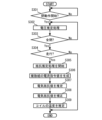
- Fig. 3 is a flowchart showing an example of the operation of the control device 20.
- the control device 20 determines whether the door 13 has started to open (S001). When the state of the door 13 detected by the door state detection unit 24 changes from a fully closed state to an opening state, the determination in S001 is Yes.
- the voltage estimation process is started (S002).
- the voltage estimator 33 estimates the bus voltage value Vdc ⁇ .
- S001 If S001 is judged as Yes, it is judged whether the door 13 is fully open (S003). If the door state detection unit 24 detects that the door 13 is fully open after S001 is judged as Yes, S003 is judged as Yes. The voltage estimation process continues until S003 is judged as Yes. If S003 is judged as Yes, the voltage estimation process ends.
- the processes shown in S001 to S003 in FIG. 3 show an example in which the voltage estimation process is performed when the door 13 is being opened.
- the voltage estimation process may also be performed when the door 13 is being closed.
- S001 it is determined whether the door 13 has started to close.
- S003 it is determined whether the door 13 is fully closed. After a Yes determination is made in S001, the voltage estimation process continues until a Yes determination is made in S003.
- FIG. 4 is a flowchart showing a preferred example of the voltage estimation process.
- FIG. 4 shows an example of the process performed in S002 of FIG. 3.
- the bus voltage value Vdc ⁇ is estimated when the rotational angular velocity ⁇ of the motor 21 is relatively large and the value of the current flowing through the motor 21 is small.
- the voltage estimation unit 33 determines whether the rotational angular velocity ⁇ of the motor 21 is equal to or greater than a first reference value Th1 (S101).
- the first reference value Th1 is set in advance. If the rotational angular velocity ⁇ is equal to or greater than the first reference value Th1, the result of S101 is Yes.
- the sign of the rotational angular velocity ⁇ is different when the door 13 is opening and when the door 13 is closing. Taking into consideration the case where the door 13 is closing, in S101, if the absolute value of the rotational angular velocity ⁇ is equal to or greater than the first reference value Th1, the result is Yes. To make the determination in S101, different values may be used as the first reference value Th1 when the door 13 is opening and when the door 13 is closing.
- the voltage estimation unit 33 determines whether the value of the current flowing through the motor 21 is equal to or less than the second reference value Th2 (S102).
- the second reference value Th2 is set in advance. If the value of the current flowing through the motor 21 is equal to or less than the second reference value Th2, S102 returns Yes.
- the sign of the current flowing through the motor 21 is different when the door 13 is opening and when the door 13 is closing. Taking into consideration the case where the door 13 is closing, in S102, if the absolute value of the current is equal to or less than the second reference value Th2, the result is Yes. To make the determination in S102, different values may be used as the second reference value Th2 when the door 13 is opening and when the door 13 is closing.
- the bus voltage value Vdc ⁇ is estimated (S103). That is, when the absolute value of the rotational angular velocity ⁇ is equal to or greater than the first reference value Th1 and the absolute value of the current flowing through the motor 21 is equal to or less than the second reference value Th2, the voltage estimation unit 33 calculates the bus voltage value Vdc ⁇ using equation (17).
- S101 is determined as No. If S101 is determined as No, the voltage estimation unit 33 does not perform an estimation calculation of the bus voltage value Vdc ⁇ . Furthermore, if the absolute value of the current flowing through the motor 21 is not equal to or less than the second reference value Th2, S102 is determined as No. If S102 is determined as No, the voltage estimation unit 33 does not perform an estimation calculation of the bus voltage value Vdc ⁇ .
- Figure 5 is a diagram for explaining the function of the voltage estimation unit 33.
- the top part of Figure 5 shows the change over time in the rotational angular velocity ⁇ of the motor 21 when the door 13 is opened or closed.
- the middle part of Figure 5 shows the change over time in the actual current value Id on the d-axis when the door 13 is opened or closed.
- the bottom part of Figure 5 shows the change over time in the actual current value Iq on the q-axis when the door 13 is opened or closed.
- the rotational angular velocity ⁇ increases after the door 13 starts to open or close, and then decreases.
- the motor 21 is a typical permanent magnet synchronous motor
- the actual d-axis current value Id is controlled to 0 when the door 13 opens or closes.
- the actual q-axis current value Iq is a value equivalent to the torque required for the rotational angular velocity ⁇ to follow the command value.
- the estimation condition for performing an estimation calculation of the bus voltage value Vdc ⁇ is met when both a first condition related to the rotational angular velocity ⁇ and a second condition related to the current flowing through the motor 21 are met.
- the first condition is a condition in which the rotational angular velocity ⁇ is equal to or greater than the first reference value Th1, i.e., ⁇ is sufficiently large in the voltage equation of the motor 21.
- the second condition is a condition in which each of the actual current values Id and Iq is equal to or less than the second reference value Th2, i.e., the voltage equation of the motor 21 is not affected by the resistance value R and inductance L.
- the voltage estimation unit 33 estimates the bus voltage value Vdc ⁇ based on equation (17).
- the q-axis voltage command value Vq* and the theoretically calculated q-axis voltage value ⁇ calculated based on the q-axis voltage equation of the motor 21 are used. More specifically, in this estimation, the ratio of the theoretically calculated q-axis voltage value ⁇ to the q-axis voltage command value Vq* is used. That is, in S103 of FIG. 4, the voltage estimation unit 33 multiplies the rotational angular velocity ⁇ by the induced voltage constant ⁇ and the design value Vdc* of the bus voltage, and divides the result by the voltage command value Vq* to obtain the bus voltage value Vdc ⁇ .
- the resistance estimation process is started (S004).
- the resistance estimation process is started on the condition that the door 13 is fully open or fully closed.
- FIG. 3 shows an example in which the resistance estimation process is performed when the door 13 is fully open. As will be described in detail later, the resistance estimation process may also be performed when the door 13 is fully closed.
- the resistance estimation unit 30 can estimate the electrical resistance value R ⁇ of the motor 21 from equation (8).
- the current command unit 26 In order to estimate the electrical resistance value R ⁇ from equation (8), multiple sets of voltage command values are required. Therefore, when the resistance estimation process is started, the current command unit 26 generates multiple sets of current command values (S005).
- the current command values are values generated to estimate the temperature T of the coil C.
- the current command values are also referred to as test current command values.
- the current command unit 26 When performing the resistance estimation process when the door 13 is fully open, the current command unit 26 generates, in S005, multiple sets of test current command values that will keep the door 13 fully open. When performing the resistance estimation process when the door 13 is fully closed, the current command unit 26 generates, in S005, multiple sets of test current command values that will keep the door 13 fully closed.
- Each test current command value includes a d-axis test current command value Id* and a q-axis test current command value Iq*.
- the test current command values Iq* included in the multiple sets of test current command values are of the same magnitude.
- the test current command values Id* included in the multiple sets of test current command values are of different magnitudes. That is, the current command unit 26 fixes the test current command value Iq* to a constant value and generates multiple sets of test current command values Id* and Iq* in which the test current command value Id* is set to different values.
- the test current command value Iq* is fixed to a constant value because if the test current command value Iq* is changed, there is a possibility that the door 13 cannot be maintained in a fully open or fully closed state.
- the current command unit 26 generates the test current command values Id* and Iq* one set at a time in sequence.
- the motor 21 has a surface permanent magnet structure (SPM: Surface Permanent Magnet), no rotational torque is generated even when the d-axis current flows.
- SPM Surface Permanent Magnet
- IPM Interior Permanent Magnet
- reluctance torque is generated when the d-axis current flows. Reluctance torque is often relatively smaller than magnet torque, and its effect is small.
- the d-axis test current command value Id* may be generated taking into account the effect of reluctance torque.
- the voltage command unit 27 When multiple sets of test current command values Id* and Iq* are generated in S005, the voltage command unit 27 generates multiple corresponding sets of voltage command values Vd* and Vq*.
- the voltage command values are also referred to as test voltage command values.
- the motor 21 operates according to the generated test voltage command values Vd* and Vq*.
- the actual current values Iu, Iv, and Iw at this time are detected by the current sensor 23.
- the resistance estimation unit 30 estimates the electrical resistance value R ⁇ from equation (8) based on the test voltage command value Vq* from the voltage command unit 27 and the actual current values Id and Iq from the current coordinate conversion unit 25 (S006).
- FIG. 6 is a flowchart showing a preferred example of the resistance estimation process.
- FIG. 7 shows a specific example of the process performed in S005 and S006 in FIG. 3.
- the current command unit 26 generates multiple sets of test current command values in which the d-axis current value is not 0.
- three sets of test current command values with different values are generated in sequence at regular time intervals.
- the current command unit 26 When the resistance estimation process is started in S004, the current command unit 26 generates a first set of test current command values, i.e., a first test current command value Id1* on the d-axis and a first test current command value Iq1* on the q-axis (S201).
- the voltage command unit 27 generates a first test voltage command value Vd1* on the d-axis corresponding to the first test current command value Id1*.
- the voltage command unit 27 generates a first test voltage command value Vq1* on the q-axis corresponding to the first test current command value Iq1*.
- the resistance estimation unit 30 obtains the first test voltage command value Vd1* from the voltage command unit 27.
- the power conversion unit 29 supplies power based on the first test voltage command values Vd1* and Vq1* to the motor 21.
- the actual current values Iu1, Iv1, and Iw1 corresponding to the first test voltage command values Vd1* and Vq1* are detected by the current sensor 23, and the corresponding first actual current value Id1 on the d-axis and first actual current value Iq1 on the q-axis are output from the current coordinate conversion unit 25.
- the resistance estimation unit 30 acquires the first actual current value Id1, which is the current value of the motor 21 that follows the first test current command value Id1*, from the current coordinate conversion unit 25 (S202).
- the current command unit 26 generates a second set of test current command values, i.e., a second test current command value Id2* on the d-axis and a second test current command value Iq2* on the q-axis (S203).
- the second test current command value Id2* is a value of a magnitude different from that of the first test current command value Id1*.
- the voltage command unit 27 generates a second test voltage command value Vd2* on the d-axis corresponding to the second test current command value Id2*.
- the voltage command unit 27 generates a second test voltage command value Vq2* on the q-axis corresponding to the second test current command value Iq2*.
- the resistance estimation unit 30 obtains the second test voltage command value Vd2* from the voltage command unit 27.
- the power conversion unit 29 supplies power based on the second test voltage command values Vd2* and Vq2* to the motor 21.
- the actual current values Iu2, Iv2, and Iw2 corresponding to the second test voltage command values Vd2* and Vq2* are detected by the current sensor 23, and the corresponding second actual current value Id2 on the d-axis and second actual current value Iq2 on the q-axis are output from the current coordinate conversion unit 25.
- the resistance estimation unit 30 obtains the second actual current value Id2, which is the current value of the motor 21 that follows the second test current command value Id2*, from the current coordinate conversion unit 25 (S204).
- the current command unit 26 generates a third set of test current command values, i.e., a third test current command value Id3* on the d-axis and a third test current command value Iq3* on the q-axis (S205).
- the third test current command value Id3* is a value of a magnitude different from the first test current command value Id1* and the second test current command value Id2*.
- the voltage command unit 27 generates a third test voltage command value Vd3* on the d-axis corresponding to the third test current command value Id3*.
- the voltage command unit 27 generates a third test voltage command value Vq3* on the q-axis corresponding to the third test current command value Iq3*.
- the resistance estimation unit 30 obtains the third test voltage command value Vd3* from the voltage command unit 27.
- the power conversion unit 29 supplies power based on the third test voltage command values Vd3* and Vq3* to the motor 21.
- the actual current values Iu3, Iv3, and Iw3 corresponding to the third test voltage command values Vd3* and Vq3* are detected by the current sensor 23, and the corresponding third actual current value Id3 on the d-axis and third actual current value Iq3 on the q-axis are output from the current coordinate conversion unit 25.
- the resistance estimation unit 30 acquires the third actual current value Id3, which is the current value of the motor 21 that follows the third test current command value Id3*, from the current coordinate conversion unit 25 (S206).
- the resistance estimation unit 30 estimates the electrical resistance value R ⁇ from equation (8) based on the information acquired in S202, S204, and S206 (S207).
- FIG. 7 shows examples of the test current command value and the test voltage command value.
- the upper part of FIG. 7 shows an example of the test current command value Id* of the d-axis generated by the current command unit 26. Note that when the actual current value Id quickly follows the test current command value Id*, the upper part of FIG. 7 also shows an example of the actual current value Id.
- the lower part of FIG. 7 shows an example of the test voltage command value Vd* of the d-axis generated by the voltage command unit 27.
- the current command unit 26 outputs a pulse waveform as the test current command value Id* on the d-axis. That is, of the three pulse outputs shown in the upper part of FIG. 7, the left pulse output corresponds to the first test current command value Id1*. The center pulse output corresponds to the second test current command value Id2*. The right pulse output corresponds to the third test current command value Id3*.
- the current command unit 26 intermittently generates pulse outputs of different magnitudes as the test current command value Id* on the d-axis.
- the voltage command unit 27 outputs a pulse waveform as the test voltage command value Vd* on the d-axis.
- the width of each pulse output is set to a width equal to or greater than the settling time.
- the settling time is the time required for the actual current value Id to follow and settle with respect to the current command value Id*.
- the settling time is determined by the design of the control gain of the current command unit 26.
- the settling time is set in advance.
- the second test current command value Id2* is generated. Between the end of generation of the first test current command value Id1* and the start of generation of the second test current command value Id2*, there is a time during which the d-axis current command value Id* becomes 0.
- the third test current command value Id3* is generated. Between the end of generation of the second test current command value Id2* and the start of generation of the third test current command value Id3*, there is a time during which the d-axis current command value Id* becomes 0.
- the first test current command value Id1*, the second test current command value Id2*, and the third test current command value Id3* are generated in sequence
- the first test voltage command value Vd1*, the second test voltage command value Vd2*, and the third test voltage command value Vd3* are also generated in sequence.
- the first actual current value Id1, the second actual current value Id2, and the third actual current value Id3 are also detected in sequence.
- FIG. 8 shows other examples of the test current command value and the test voltage command value.
- the upper part of FIG. 8 shows an example of the test current command value Id* of the d-axis generated by the current command unit 26. Note that when the actual current value Id quickly follows the test current command value Id*, the upper part of FIG. 8 also shows an example of the actual current value Id.
- the lower part of FIG. 8 shows an example of the test voltage command value Vd* of the d-axis generated by the voltage command unit 27.
- the current command unit 26 outputs a ramp wave shape as the test current command value Id* of the d-axis. That is, the current command unit 26 outputs a test current command value Id* of the d-axis that increases continuously from 0.
- the example shown in FIG. 8 can be applied when heat generation in the coil C is not an issue, and when the delay in the response of the actual current value Id to the test current command value Id* is not an issue.
- the method of generating the d-axis test current command value Id* is not limited to the example shown in FIG. 7 and the example shown in FIG. 8.
- the electrical resistance value R ⁇ is estimated by dividing the amount of change in the d-axis test voltage command value Vd*, which changes due to the d-axis test current command value Id*, by the amount of change in the current flowing through the motor 21, which changes due to the d-axis test current command value Id*.
- the amount of change in the test voltage command value can be calculated as the difference between the first test voltage command value Vd1* and the second test voltage command value Vd2*.
- the amount of change in the current can be calculated as the difference between the first actual current value Id1 and the second actual current value Id2.
- the resistance estimation unit 30 may estimate the average value of the multiple calculated resistance values R as the electrical resistance value R ⁇ . To achieve safer operation, in S207, the resistance estimation unit 30 may estimate the largest of the multiple calculated resistance values R as the electrical resistance value R ⁇ .
- filtering may be performed on the current and voltage. This makes it possible to suppress high-frequency noise contained in the current and voltage values, improving the accuracy of estimating the electrical resistance value R ⁇ .
- filtering When filtering is performed, filtering must be performed with the same cutoff frequency. This is to match the temporal correspondence between the current and voltage values. After filtering is performed and multiple resistance values R are calculated, the average value of the calculated multiple resistance values R may be estimated as the electrical resistance value R ⁇ .
- the temperature estimation unit 31 corrects the electrical resistance value R ⁇ estimated in S006 using the bus voltage value Vdc ⁇ estimated in S002 (S007).
- Equation (18) the estimated electrical resistance value R ⁇ has an error equal to the ratio between the design value Vdc* of the bus voltage and the actual bus voltage value Vdc.
- equation (19) can be obtained. Equation (19) shows that by performing correction using the bus voltage value Vdc ⁇ , the corrected value matches the true value of the resistance.
- the temperature estimation unit 31 corrects the electrical resistance value R ⁇ estimated in S006 using equation (19).
- the temperature estimation unit 31 uses the electrical resistance value R ⁇ corrected in S007 to estimate the temperature T of the coil C (S008).
- the temperature estimation unit 31 estimates the temperature T based on a temperature formula model that indicates the relationship between the electrical resistance value of the motor 21 and the temperature of the coil C.
- the temperature formula model is stored in advance in a memory area of the control device 20.
- the temperature formula model may be created by a test that measures the resistance value of the motor 21 while changing the temperature of the coil C.
- a theoretically derived model may be used as the temperature formula model. Equation (20) shows an example of the temperature formula model.
- Equation (20) shows an example of a model in which there is a linear relationship between the temperature T of the coil C and the resistance value R of the motor 21.
- ⁇ and ⁇ are constants.
- ⁇ and ⁇ are set in advance.
- Equation (21) shows another example of the temperature formula model.
- Equation (21) is a logical model of the temperature T of coil C.
- T0' is the reference temperature.
- R0 is the reference resistance value of coil C at the reference temperature.
- the temperature formula model may be expressed by a formula other than equations (20) and (21).
- the temperature formula model may be a function of higher order than first order.
- FIG. 9 is a flowchart showing another example of the operation of the control device 20.
- FIG. 9 shows another example of the temperature estimation process. Specifically, FIG. 9 shows an example in which the voltage estimation process is performed when the door 13 is being closed. Also, FIG. 9 shows an example in which the resistance estimation process is performed when the car 2 is traveling. Note that matters that are not explained in detail below are the same as the above-mentioned example.
- the control device 20 determines whether the door 13 has started to close (S301).
- S301 determines whether the door 13 has started to close.
- S301 returns Yes.
- voltage estimation processing is started (S302).
- the voltage estimation processing performed in S302 is the same as the voltage estimation processing performed in S002.
- the voltage estimation unit 33 estimates the bus voltage value Vdc ⁇ .
- S301 If S301 returns Yes, it is determined whether the door 13 is fully closed (S303). If the door state detection unit 24 detects that the door 13 is fully closed after S301 returns Yes, S303 returns Yes. The voltage estimation process continues until S303 returns Yes. If S303 returns Yes, the voltage estimation process ends.
- the control device 20 determines whether car 2 is traveling or not (S304). As one example, the control device 20 acquires information from the control panel 10 for determining whether car 2 is traveling or not. The determination in S304 is made based on that information. As another example, the current command unit 26 may make the determination in S304.
- S304 When car 2 starts traveling after S303 is judged as Yes, S304 is judged as Yes. If S304 is judged as Yes, resistance estimation processing is started (S305). While car 2 is traveling, the control device 20 performs control to keep the door 13 in a fully closed state. In the example shown in FIG. 9, resistance estimation processing is performed during this time. If S303 is not judged as Yes, resistance estimation processing is not started. Note that the processing shown in S305 to S309 in FIG. 9 is similar to the processing shown in S004 to S008 in FIG. 3.
- FIG. 10 is a flowchart showing another example of the operation of the control device 20.
- FIG. 10 shows an example of the overheat protection process that is performed after the temperature T of the coil C is estimated in the temperature estimation process.
- the overheat protection process is a process for preventing accidents such as the motor 21 burning out due to the temperature T of the coil C becoming too high.
- the temperature T of the coil C may rise if an abnormality occurs in the body of the motor 21. Specifically, the temperature T rises when the bearings of the motor 21 are worn out, when the motor 21 is nearing the end of its life, etc.
- the temperature T of the coil C may rise when the door 13 is opened and closed frequently. Specifically, the temperature T rises when calls are made frequently to the car 2 and when the door 13 is frequently reversed.
- the temperature T of the coil C may rise due to a malfunction occurring in the door 13. For example, when a malfunction occurs in the mechanical system of the door 13, the movement resistance of the door 13 increases. When the movement resistance of the door 13 increases, the rotation load of the motor 21 increases. This causes the temperature T of the coil C to rise.
- the temperature T of the coil C may rise when the environmental temperature, i.e., the temperature inside the elevator shaft 4, is high.
- the overheat protection process is a process for preventing accidents such as the motor 21 burning out, and is performed following the temperature estimation process. Therefore, when the overheat protection process starts, the door 13 is fully open or fully closed.
- the protection control unit 32 acquires the temperature T estimated by the temperature estimation process (S401). Next, the protection control unit 32 determines whether the temperature T estimated by the temperature estimation unit 31 is equal to or greater than a third reference value (S402).
- the third reference value is a value for determining whether the temperature of the coil C has risen to a temperature that may lead to burning out of the motor 21.
- the third reference value is set in advance based on the thermal design of the coil C, etc.
- S402 If the temperature T is less than the third reference value, S402 is determined as No. If S402 is determined as No, drive control of the motor 21 continues (S403).
- the voltage command unit 27 generates voltage command values Vd* and Vq* based on the current command values Id* and Iq* from the current command unit 26 and the actual current values Id and Iq from the current coordinate conversion unit 25. That is, normal operation continues in the elevator system 1.
- S402 If the temperature T is equal to or greater than the third reference value, S402 returns Yes. If S402 returns Yes, the voltage command unit 27 stops the drive control of the motor 21 as protective control (S404). The voltage command unit 27 also transmits information to the control panel 10 that the temperature T of the coil C is equal to or greater than the third reference value. Upon receiving this information, the control panel 10 starts control to bring the car 2 to an emergency stop.
- the drive control of the motor 21 When the drive control of the motor 21 is stopped, the door 13 cannot be opened or closed. For this reason, the drive control of the motor 21 may be stopped after control is performed to allow the passenger to disembark from the car 2.
- the control panel 10 may provide the user with information that the service will be stopped.
- the temperature estimation unit 31 corrects the electrical resistance value R ⁇ estimated by the resistance estimation unit 30 using the bus voltage value Vdc ⁇ estimated by the voltage estimation unit 33. Then, the temperature estimation unit 31 estimates the temperature T of the coil C based on the corrected electrical resistance value R ⁇ . Therefore, the temperature T of the coil C can be estimated with high accuracy.
- the voltage estimation unit 33 estimates the bus voltage value Vdc ⁇ when the door 13 is in an operating state, the absolute value of the rotational angular velocity ⁇ is equal to or greater than the first reference value Th1, and the absolute value of the current flowing through the motor 21 is equal to or less than the second reference value Th2. Therefore, the bus voltage value Vdc ⁇ can be calculated with high accuracy using the simple formula (17).
- the voltage estimation unit 33 estimates the bus voltage value Vdc ⁇ using the q-axis voltage command value Vq* and the theoretically calculated voltage value ⁇ of the q-axis.
- the voltage estimation unit 33 also estimates the bus voltage value Vdc ⁇ using the ratio between the q-axis voltage command value Vq* and the theoretically calculated voltage value ⁇ of the q-axis. Therefore, the bus voltage value Vdc ⁇ can be calculated with high accuracy using the simple equation (17).
- the current command unit 26 generates a first test current command value and a second test current command value.
- the voltage command unit 27 generates a first test voltage command value corresponding to the first test current command value and a second test voltage command value corresponding to the second test current command value.
- the resistance estimation unit 30 estimates the electrical resistance value R ⁇ using the first test voltage command value and the second test voltage command value.
- values suitable for estimating the electrical resistance value R ⁇ can be adopted as the first test voltage command value and the second test voltage command value. Therefore, the electrical resistance value R ⁇ can be estimated with high accuracy.
- the current command unit 26 may generate only one new test current command value.
- the current command value generated immediately before the test current command value may be regarded as another test current command value, and the electrical resistance value R ⁇ may be generated.
- the current command unit 26 generates a first test current command value and a second test current command value in which the d-axis current value is not zero. Even if the d-axis current value changes, there is almost no effect on the open/closed state of the door 13. Therefore, even if such a test current command value is adopted, the electrical resistance value R ⁇ can be estimated with high accuracy.
- the resistance estimation process is performed while car 2 is traveling. That is, a test current command value is generated while car 2 is traveling.
- a test current command value is generated while car 2 is traveling.
- a d-axis current flows through motor 21, but when a d-axis current flows, noise caused by magnetostriction can be generated from motor 21.
- the noise can be drowned out by the running sound of car 2. Therefore, it is possible to prevent passengers in car 2 from feeling uncomfortable due to noise caused by magnetostriction.
- the temperature estimation unit 31 estimates the temperature T of the coil C based on a temperature formula model. Therefore, the temperature T can be estimated with high accuracy.
- control device 20 Other functions that can be adopted by the control device 20 are described below. In the example shown below, only the differences from the example described above are described in detail. Explanations of the same points as the example described above are omitted.
- the voltage estimation unit 33 may estimate the bus voltage value Vdc ⁇ based on a state estimation observer without using equation (17).
- the voltage estimation unit 33 can also estimate the bus voltage value Vdc ⁇ based on the operation flow shown in FIG. 4. That is, the voltage estimation unit 33 estimates the bus voltage value Vdc ⁇ when the door state detection unit 24 detects that the door 13 is in an operating state. In addition, it is preferable for the voltage estimation unit 33 to estimate the bus voltage value Vdc ⁇ when the absolute value of the rotational angular velocity ⁇ is equal to or greater than the first reference value Th1 and the absolute value of the current flowing through the motor 21 is equal to or less than the second reference value Th2.
- the relationship between the applied voltage value Vd and the voltage command value Vd* is expressed by equation (9).
- the relationship between the applied voltage value Vq and the voltage command value Vq* is expressed by equation (10).
- the resistance value R and the inductance L are not used as parameters, i.e., the condition is that the current value is small. Under this condition, the voltage command value for the d-axis is nearly 0, so only the q-axis will be explained below.
- Equation (23) shows the difference between equations (10) and (22). If equation (23) becomes 0, the estimated bus voltage value Vdc ⁇ and the actual bus voltage value Vdc will match.
- equation (24) can be obtained as an example of a state estimation observer for estimating the bus voltage value Vdc ⁇ .
- the actual q-axis applied voltage value Vq of motor 21 can be expressed as ⁇ under conditions where the current is small.
- the estimated applied voltage value Vq ⁇ is as shown in equation (22).
- the voltage estimation unit 33 can estimate the bus voltage value Vdc ⁇ based on the state estimation observer shown in equation (24) using the theoretically calculated q-axis voltage value ⁇ and the q-axis voltage command value Vq*.
- K is a gain that determines the convergence speed of the state estimation observer; the larger it is, the shorter the time required for convergence, but if it is too large, oscillation will occur. Conversely, if it is small, the time required for convergence will be longer, but the observer will be stable. The designer must set the gain K appropriately, taking into account the convergence speed and stability.
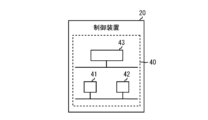
- FIG. 11 is a diagram showing an example of hardware resources of the control device 20.
- the control device 20 has, as hardware resources, a processing circuit 40 including a processor 41 and a memory 42.
- the processing circuit 40 may include multiple processors 41.
- the processing circuit 40 may include multiple memories 42.
- the parts denoted by the reference numerals 24 to 33 indicate functions possessed by the control device 20.
- the functions of the parts denoted by the reference numerals 24 to 33 can be realized by software written as a program, firmware, or a combination of software and firmware.
- the program is stored in the memory 42.
- the control device 20 realizes the functions of the parts denoted by the reference numerals 24 to 33 by executing the program stored in the memory 42 by the processor 41 (computer).
- the processor 41 is also called a CPU (Central Processing Unit), central processing unit, processing unit, arithmetic unit, microprocessor, microcomputer, or DSP.
- the memory 42 may be a semiconductor memory, a magnetic disk, a flexible disk, an optical disk, a compact disk, a mini disk, or a DVD. Possible semiconductor memories include RAM, ROM, flash memory, EPROM, and EEPROM.
- FIG. 12 is a diagram showing another example of the hardware resources of the control device 20.
- the control device 20 includes a processing circuit 40 including a processor 41, a memory 42, and dedicated hardware 43.
- FIG. 12 shows an example in which some of the functions of the control device 20 are realized by the dedicated hardware 43. All of the functions of the control device 20 may be realized by the dedicated hardware 43.
- the dedicated hardware 43 As an example, among the parts indicated by the reference numerals 24 to 33, only the current command unit 26 may be realized by the dedicated hardware 43. In such a case, the parts indicated by the reference numerals 24, 25, and 27 to 33 are realized by the processor 41 (computer) executing a program stored in the memory 42.
- the dedicated hardware 43 a single circuit, a composite circuit, a programmed processor, a parallel programmed processor, an ASIC, an FPGA, or a combination of these may be used.
- This disclosure can be applied to a control device that controls elevator doors.
Landscapes
- Control Of Ac Motors In General (AREA)
Priority Applications (3)
| Application Number | Priority Date | Filing Date | Title |
|---|---|---|---|
| PCT/JP2023/022783 WO2024261871A1 (ja) | 2023-06-20 | 2023-06-20 | 制御装置 |
| CN202380093668.2A CN121335851A (zh) | 2023-06-20 | 2023-06-20 | 控制装置 |
| JP2025527272A JPWO2024261871A1 (https=) | 2023-06-20 | 2023-06-20 |
Applications Claiming Priority (1)
| Application Number | Priority Date | Filing Date | Title |
|---|---|---|---|
| PCT/JP2023/022783 WO2024261871A1 (ja) | 2023-06-20 | 2023-06-20 | 制御装置 |
Publications (1)
| Publication Number | Publication Date |
|---|---|
| WO2024261871A1 true WO2024261871A1 (ja) | 2024-12-26 |
Family
ID=93935159
Family Applications (1)
| Application Number | Title | Priority Date | Filing Date |
|---|---|---|---|
| PCT/JP2023/022783 Ceased WO2024261871A1 (ja) | 2023-06-20 | 2023-06-20 | 制御装置 |
Country Status (3)
| Country | Link |
|---|---|
| JP (1) | JPWO2024261871A1 (https=) |
| CN (1) | CN121335851A (https=) |
| WO (1) | WO2024261871A1 (https=) |
Citations (7)
| Publication number | Priority date | Publication date | Assignee | Title |
|---|---|---|---|---|
| JP2006290507A (ja) * | 2005-04-08 | 2006-10-26 | Mitsubishi Electric Corp | エレベータの制御装置 |
| JP2007315994A (ja) * | 2006-05-29 | 2007-12-06 | Toyota Motor Corp | 回転電機の温度変化検知方法およびその装置 |
| JP2010148322A (ja) * | 2008-12-22 | 2010-07-01 | Aisin Seiki Co Ltd | モータ制御装置 |
| JP2011063404A (ja) * | 2009-09-18 | 2011-03-31 | Toshiba Elevator Co Ltd | エレベータのドア制御装置 |
| CN208561335U (zh) * | 2018-06-22 | 2019-03-01 | 东芝电梯株式会社 | 电梯 |
| US20200014326A1 (en) * | 2018-07-05 | 2020-01-09 | Panasonic Automotive Systems Company Of America, Division Of Panasonic Corporation Of North America | Motor winding temperature estimator |
| JP2022065240A (ja) * | 2020-10-15 | 2022-04-27 | キヤノンプレシジョン株式会社 | 温度検出システム及びそれを有する制御装置 |
-
2023
- 2023-06-20 JP JP2025527272A patent/JPWO2024261871A1/ja active Pending
- 2023-06-20 CN CN202380093668.2A patent/CN121335851A/zh active Pending
- 2023-06-20 WO PCT/JP2023/022783 patent/WO2024261871A1/ja not_active Ceased
Patent Citations (7)
| Publication number | Priority date | Publication date | Assignee | Title |
|---|---|---|---|---|
| JP2006290507A (ja) * | 2005-04-08 | 2006-10-26 | Mitsubishi Electric Corp | エレベータの制御装置 |
| JP2007315994A (ja) * | 2006-05-29 | 2007-12-06 | Toyota Motor Corp | 回転電機の温度変化検知方法およびその装置 |
| JP2010148322A (ja) * | 2008-12-22 | 2010-07-01 | Aisin Seiki Co Ltd | モータ制御装置 |
| JP2011063404A (ja) * | 2009-09-18 | 2011-03-31 | Toshiba Elevator Co Ltd | エレベータのドア制御装置 |
| CN208561335U (zh) * | 2018-06-22 | 2019-03-01 | 东芝电梯株式会社 | 电梯 |
| US20200014326A1 (en) * | 2018-07-05 | 2020-01-09 | Panasonic Automotive Systems Company Of America, Division Of Panasonic Corporation Of North America | Motor winding temperature estimator |
| JP2022065240A (ja) * | 2020-10-15 | 2022-04-27 | キヤノンプレシジョン株式会社 | 温度検出システム及びそれを有する制御装置 |
Also Published As
| Publication number | Publication date |
|---|---|
| JPWO2024261871A1 (https=) | 2024-12-26 |
| CN121335851A (zh) | 2026-01-13 |
Similar Documents
| Publication | Publication Date | Title |
|---|---|---|
| EP2953261B1 (en) | Synchronous motor control device for electric automobile | |
| JP3399156B2 (ja) | ブラシレスdcモータの制御装置 | |
| US7902790B2 (en) | Induction motor drive unit, motor drive system, and elevating system | |
| JP4737087B2 (ja) | 永久磁石式同期モータの制御装置 | |
| US9628017B2 (en) | Motor control device, and motor control method | |
| CN102742147B (zh) | 电梯控制装置 | |
| JP2010200430A (ja) | 電動機の駆動制御装置 | |
| JP2010105763A (ja) | 電力変換装置およびそれを用いたエレベータ | |
| JP2013005618A (ja) | インバータ制御装置および車両 | |
| JP2003219504A (ja) | 電気車の駆動制御方法および制御装置 | |
| WO2019229999A1 (ja) | インバータ制御方法及びインバータ制御システム | |
| KR20190108301A (ko) | 모터 회전속도 제어방법 및 제어시스템 | |
| WO2011064846A1 (ja) | 電気車の電力変換装置 | |
| JP4659477B2 (ja) | 交流電動機の制御装置及びその交流電動機の制御装置を用いたエレベータの制御装置 | |
| CN1922783B (zh) | 感应电动机的停止方法及控制装置 | |
| JP7732582B2 (ja) | エレベータードアの制御装置 | |
| JP7537645B2 (ja) | エレベータードアの制御装置 | |
| WO2024261871A1 (ja) | 制御装置 | |
| EP3402067B1 (en) | Motor drive device | |
| JP2015023611A (ja) | 電動車両 | |
| JP2003047300A (ja) | モータ制御装置及び方法 | |
| JP2000191248A (ja) | エレベ―タ制御装置 | |
| JP7729445B1 (ja) | 電動機の制御装置 | |
| JP7639958B1 (ja) | 電動機の制御装置 | |
| JP7740405B1 (ja) | 電動機の制御装置 |
Legal Events
| Date | Code | Title | Description |
|---|---|---|---|
| 121 | Ep: the epo has been informed by wipo that ep was designated in this application |
Ref document number: 23942308 Country of ref document: EP Kind code of ref document: A1 |
|
| WWE | Wipo information: entry into national phase |
Ref document number: 2025527272 Country of ref document: JP |
|
| NENP | Non-entry into the national phase |
Ref country code: DE |