WO2024257777A1 - 植物寄生性センチュウ防除剤 - Google Patents
植物寄生性センチュウ防除剤 Download PDFInfo
- Publication number
- WO2024257777A1 WO2024257777A1 PCT/JP2024/021268 JP2024021268W WO2024257777A1 WO 2024257777 A1 WO2024257777 A1 WO 2024257777A1 JP 2024021268 W JP2024021268 W JP 2024021268W WO 2024257777 A1 WO2024257777 A1 WO 2024257777A1
- Authority
- WO
- WIPO (PCT)
- Prior art keywords
- plant
- polypeptide
- rmir1
- amino acid
- seq
- Prior art date
- Legal status (The legal status is an assumption and is not a legal conclusion. Google has not performed a legal analysis and makes no representation as to the accuracy of the status listed.)
- Ceased
Links
Images


Classifications
-
- A—HUMAN NECESSITIES
- A01—AGRICULTURE; FORESTRY; ANIMAL HUSBANDRY; HUNTING; TRAPPING; FISHING
- A01P—BIOCIDAL, PEST REPELLANT, PEST ATTRACTANT OR PLANT GROWTH REGULATORY ACTIVITY OF CHEMICAL COMPOUNDS OR PREPARATIONS
- A01P5/00—Nematocides
-
- A—HUMAN NECESSITIES
- A01—AGRICULTURE; FORESTRY; ANIMAL HUSBANDRY; HUNTING; TRAPPING; FISHING
- A01H—NEW PLANTS OR NON-TRANSGENIC PROCESSES FOR OBTAINING THEM; PLANT REPRODUCTION BY TISSUE CULTURE TECHNIQUES
- A01H1/00—Processes for modifying genotypes ; Plants characterised by associated natural traits
-
- A—HUMAN NECESSITIES
- A01—AGRICULTURE; FORESTRY; ANIMAL HUSBANDRY; HUNTING; TRAPPING; FISHING
- A01H—NEW PLANTS OR NON-TRANSGENIC PROCESSES FOR OBTAINING THEM; PLANT REPRODUCTION BY TISSUE CULTURE TECHNIQUES
- A01H5/00—Angiosperms, i.e. flowering plants, characterised by their plant parts; Angiosperms characterised otherwise than by their botanic taxonomy
-
- A—HUMAN NECESSITIES
- A01—AGRICULTURE; FORESTRY; ANIMAL HUSBANDRY; HUNTING; TRAPPING; FISHING
- A01H—NEW PLANTS OR NON-TRANSGENIC PROCESSES FOR OBTAINING THEM; PLANT REPRODUCTION BY TISSUE CULTURE TECHNIQUES
- A01H6/00—Angiosperms, i.e. flowering plants, characterised by their botanic taxonomy
- A01H6/46—Gramineae or Poaceae, e.g. ryegrass, rice, wheat or maize
-
- A—HUMAN NECESSITIES
- A01—AGRICULTURE; FORESTRY; ANIMAL HUSBANDRY; HUNTING; TRAPPING; FISHING
- A01N—PRESERVATION OF BODIES OF HUMANS OR ANIMALS OR PLANTS OR PARTS THEREOF; BIOCIDES, e.g. AS DISINFECTANTS, AS PESTICIDES OR AS HERBICIDES; PEST REPELLANTS OR ATTRACTANTS; PLANT GROWTH REGULATORS
- A01N37/00—Biocides, pest repellants or attractants, or plant growth regulators containing organic compounds containing a carbon atom having three bonds to hetero atoms with at the most two bonds to halogen, e.g. carboxylic acids
- A01N37/44—Biocides, pest repellants or attractants, or plant growth regulators containing organic compounds containing a carbon atom having three bonds to hetero atoms with at the most two bonds to halogen, e.g. carboxylic acids containing at least one carboxylic group or a thio analogue, or a derivative thereof, and a nitrogen atom attached to the same carbon skeleton by a single or double bond, this nitrogen atom not being a member of a derivative or of a thio analogue of a carboxylic group, e.g. amino-carboxylic acids
- A01N37/46—N-acyl derivatives
-
- C—CHEMISTRY; METALLURGY
- C07—ORGANIC CHEMISTRY
- C07K—PEPTIDES
- C07K14/00—Peptides having more than 20 amino acids; Gastrins; Somatostatins; Melanotropins; Derivatives thereof
- C07K14/415—Peptides having more than 20 amino acids; Gastrins; Somatostatins; Melanotropins; Derivatives thereof from plants
-
- C—CHEMISTRY; METALLURGY
- C12—BIOCHEMISTRY; BEER; SPIRITS; WINE; VINEGAR; MICROBIOLOGY; ENZYMOLOGY; MUTATION OR GENETIC ENGINEERING
- C12N—MICROORGANISMS OR ENZYMES; COMPOSITIONS THEREOF; PROPAGATING, PRESERVING, OR MAINTAINING MICROORGANISMS; MUTATION OR GENETIC ENGINEERING; CULTURE MEDIA
- C12N5/00—Undifferentiated human, animal or plant cells, e.g. cell lines; Tissues; Cultivation or maintenance thereof; Culture media therefor
- C12N5/10—Cells modified by introduction of foreign genetic material
-
- Y—GENERAL TAGGING OF NEW TECHNOLOGICAL DEVELOPMENTS; GENERAL TAGGING OF CROSS-SECTIONAL TECHNOLOGIES SPANNING OVER SEVERAL SECTIONS OF THE IPC; TECHNICAL SUBJECTS COVERED BY FORMER USPC CROSS-REFERENCE ART COLLECTIONS [XRACs] AND DIGESTS
- Y02—TECHNOLOGIES OR APPLICATIONS FOR MITIGATION OR ADAPTATION AGAINST CLIMATE CHANGE
- Y02A—TECHNOLOGIES FOR ADAPTATION TO CLIMATE CHANGE
- Y02A40/00—Adaptation technologies in agriculture, forestry, livestock or agroalimentary production
- Y02A40/10—Adaptation technologies in agriculture, forestry, livestock or agroalimentary production in agriculture
- Y02A40/146—Genetically Modified [GMO] plants, e.g. transgenic plants
Definitions
- the present invention relates to a plant parasitic nematode control agent, a plant transformant, and a method for producing the plant transformant.
- Plant-parasitic nematodes are said to infest more than 2,000 species of plants, and are known to have an extremely wide host range. Potential host plants include many agriculturally important crops, and damage caused by them has been reported to amount to $150 billion worldwide.
- root-knot nematodes three species are known to cause particularly great damage to agriculture: root-knot nematodes, root-leak nematodes, and cyst nematodes.
- the sweet potato root-knot nematode (Meloidogyne incognita), a type of root-knot nematode, has a wide host range and parasitizes a variety of plants around the world, including agricultural crops, and has been reported to cause effects such as reduced yields, reduced quality, growth inhibition, and death. This is also a problem worldwide from the perspective of stabilizing food production, and measures are urgently needed.
- Agricultural damage caused by plant-parasitic nematodes is generally difficult to control because they progress while hidden in the soil. For this reason, spraying highly toxic chemicals (nematicides) has been used as an effective control technique for plant-parasitic nematodes.
- highly toxic chemicals such as nematicides can cause soil contamination, which is a problem.
- the use of methyl bromide, the main nematicide, has been banned since 2005 due to its ozone layer depletion. Therefore, there is a demand for an effective nematode control technique that does not rely on nematicides.
- Non-Patent Document 1 Tomatoes into which the Mi-1 gene has been introduced exhibit strong resistance against the sweet potato root-knot nematode, and tomatoes with this gene introduced are widely used in agricultural fields. It has also been reported that lettuce into which the tomato-derived Mi-1 gene has been introduced acquires nematode resistance (Non-Patent Document 2).
- the object of the present invention is to discover a novel gene that causes a difference in resistance between the plant parasitic nematode-resistant rice cultivar ARC10313 and the plant parasitic nematode-susceptible cultivar T65, and to provide a plant parasitic nematode control agent based on the novel gene.
- the present inventors focused on the indica variety Kalo Dhan, which was found in previous research to be resistant to sweet potato root-knot nematodes, and created 128 recombinant inbred lines (RILs) between Kalo Dhan and the susceptible japonica variety Taichung 65 (T65), and carried out QTL analysis and gene mapping based on the RILs (Patent Document 1). As a result, they revealed that the Os04g0112100 gene (referred to herein as ROOT KNOT NEMATODE RESISTANCE 1 or RKNR1) is one of the genes that causes differences in nematode resistance between the two varieties, Kalo Dhan and T65.
- ROOT KNOT NEMATODE RESISTANCE 1 or RKNR1 is one of the genes that causes differences in nematode resistance between the two varieties, Kalo Dhan and T65.
- the inventors attempted to identify additional resistance genes between the two varieties, Kalo Dhan/T65, using the above-mentioned RIL line, but were unable to map resistance genes other than the RKNR1 gene in the RIL line. Therefore, genes other than the RKNR1 gene that cause differences in nematode resistance between the two varieties, Kalo Dhan/T65, have not been identified and remain unknown at present.
- the present inventors focused on ARC10313, a resistant cultivar different from that in the above study, and came up with the idea of searching for a new nematode resistance gene different from that in the above study. Specifically, in order to search for a gene that causes a difference in resistance between the resistant cultivar ARC10313 and the susceptible cultivar T65, a new RIL line was created between the two cultivars ARC10313/T65. QTL analysis was performed on this new RIL, and further gene mapping was performed using a chromosome segment substitution line (CSSL line).
- CSSL line chromosome segment substitution line
- the Os06g0621600 gene (referred to herein as ROOT MELOIDOGYNE INCOGNITA RESISTANCE 1 or RMIR1) was found to be a new gene related to the difference in nematode resistance between the two cultivars ARC10313/T65. Furthermore, they introduced the RMIR1 gene of a nematode-resistant variety into a nematode-susceptible variety to produce a transformed strain, and found that nematode resistance was obtained, leading to the completion of the present invention.
- the present invention is based on the above findings and provides the following:
- a plant-parasitic nematode control agent comprising an RMIR1 polypeptide having any one of the amino acid sequences shown in (a) to (c) below, or a fragment thereof: (a) the amino acid sequence shown in SEQ ID NO: 13; (b) an amino acid sequence in which one or more amino acids are deleted, substituted or added in the amino acid sequence shown in SEQ ID NO: 13, or (c) an amino acid sequence having 90% or more identity to the amino acid sequence shown in SEQ ID NO: 13.
- a plant parasitic nematode control agent according to (3) or (4), further comprising an RKNR1 polynucleotide encoding the RKNR1 polypeptide or a fragment thereof described in (2).
- a plant parasitic nematode control agent comprising an expression vector containing the RMIR1 polynucleotide described in (7), (3) or (4).
- the plant parasitic nematode control agent according to any one of (1) to (7), wherein the plant parasitic nematode is a root-knot nematode.
- a plant transformant having resistance to a plant parasitic nematode comprising the plant parasitic nematode control agent according to any one of (1) or (2) or (3) to (9), or a progeny thereof retaining the polynucleotide or the expression vector.
- a method for producing a plant transformant having resistance to a plant parasitic nematode comprising the steps of: (7) A method comprising the steps of: introducing the expression vector according to (7) into a plant; and selecting a plant into which the expression vector has been introduced.
- This specification includes the disclosure of Japanese Patent Application No. 2023-097058, which is the priority basis of this application.
- the present invention provides a plant parasitic nematode control agent based on the RMIR1 gene that confers resistance to plant parasitic nematodes.
- the double arrow indicates the genomic region where the RMIR1 gene is mapped.
- the structures of the polypeptides encoded by the RMIR1 genes in ARC10313, N22, Kalo Dhan, T65, and Nipponbare are shown.
- the results of evaluating the resistance of RMIR1 transformed lines to the sweet potato root-knot nematode are shown below. ** indicates P ⁇ 0.01 (Student's t-test). Error bars indicate standard error.
- the results of evaluating the resistance of 77 rice cultivars, RKNR1 transformed lines, and RMIR1 transformed lines to sweet potato root-knot nematode are shown. Error bars indicate standard error.
- Plant parasitic nematode control agent 1-1 Overview
- a first aspect of the present invention is a plant parasitic nematode control agent.
- the plant parasitic nematode control agent of the present invention consists of or contains a nematode-resistant RMIR1 polypeptide or a fragment thereof, or contains a polynucleotide encoding either of them or an expression vector containing the same.
- the plant parasitic nematode control agent of the present invention has a control effect against plant parasitic nematodes.
- plant parasitic nematode is not particularly limited as long as it is a nematode that can parasitize plants.
- Known plant parasitic nematodes include root-knot nematodes (Meloidogyne), Pratylenchus, cyst nematodes (six genera of cyst nematodes are known: Afenestrata, Cactodera, Dolichodera, Globodera, Heterodera, and Punctodera), Aphelenchoides, and Ditylenchus.
- the plant parasitic nematode to be controlled by the present invention is preferably a root-knot nematode.
- Root-knot nematodes parasitize the roots of plants, deriving nutrients from the protoplasm of plant cells and forming nodules on the plant roots. Root-knot nematode larvae molt once inside the egg and become second stage (J2) larvae before hatching. The second stage larvae move through the soil, invade the tissue near the apex of the plant root, settle near the vascular bundle and ingest nutrients, then molt a second time to become adults.
- Adult body lengths are approximately 0.5-1 mm, and female adults excrete egg capsules into which they lay approximately 400-1500 eggs.
- Examples of species belonging to the genus Meloidogyne include Meloidogyne oryzae, Meloidogyne javanica, Meloidogyne incognita (often referred to as "Mi" in this specification), Meloidogyne hapla, Meloidogyne mali, and Meloidogyne arenaria.
- Examples of species belonging to the root-leakage nematode family include the northern root-leakage nematode (Pratylenchus penetrans), southern root-leakage nematode (Pratylenchus coffeee), wheat root-leakage nematode (Pratylenchus neglectus), sawtooth root-leakage nematode (Pratylenchus crenatus), walnut root-leakage nematode (Pratylenchus vulnus), and channel root-leakage nematode (Pratylenchus loosi).
- cyst nematode family examples include the potato cyst nematode (Globodera rostochiensis), the soybean cyst nematode (Heterodera glycines), and the clover cyst nematode (Heterodera trifolii).
- Examples of species belonging to the genus Aphelenchoides include the peel nematode (Aphelenchoides ritzemabosi), the strawberry nematode (Aphelenchoides fragariae), and the rice root nematode (Aphelenchoides besseyi).
- stem nematode examples include the stem nematode (Dithlenchus destructor) and the stem nematode (Ditylenchus dipsaci).
- the plant is not particularly limited as long as it is a plant species that can be parasitized by plant parasitic nematodes, and may be either angiosperms or gymnosperms.
- Angiosperms also include both dicotyledonous and monocotyledonous plants.
- Representative plants include important plants in agriculture, particularly in the seed and floriculture industries, such as crop plants such as grains, flowers, vegetables, and fruits.
- monocotyledonous plants include species belonging to the Poaceae family (e.g., rice, wheat, barley, rye, corn, sugarcane, foxtail millet, millet, barnyard millet, sorghum, and sorghum), species belonging to the Musaceae family (e.g., banana and musa), and Bromeliaceae family (e.g., pineapple).
- Poaceae family e.g., rice, wheat, barley, rye, corn, sugarcane, foxtail millet, millet, barnyard millet, sorghum, and sorghum
- Musaceae family e.g., banana and musa
- Bromeliaceae family e.g., pineapple
- Dicotyledonous plants include species belonging to the Brassicaceae family (e.g., cabbage, radish, Chinese cabbage, rapeseed), species belonging to the Fabaceae family (e.g., soybean, peanut, pea, kidney bean, adzuki bean, broad bean, sweet pea), species belonging to the Solanaceae family (e.g., tomato, eggplant, potato, tobacco, bell pepper, chili pepper, petunia), species belonging to the Convolvulaceae family (e.g., sweet potato, water spinach), species belonging to the Rosaceae family (e.g., strawberry, rose, apple, pear, peach, loquat, almond, plum, plum, cherry), and species belonging to the Orchidaceae family (e.g., Cymbidium, Phalaenopsis, Cattleya, Dendrobium), species belonging to the Liliaceae family (e.g., lily, tulip), Asparagaceae family (e.g., hy
- Root-knot nematodes have been reported to infect over 2,000 species of plants, and although the hosts they infest vary depending on the nematode species, they have a wide host range, including Solanaceae, Poaceae, Brassicaceae, Legumes, Cucurbitaceae, Convolvulaceae, Liliaceae, Asteraceae, Chenopodiaceae, Apiaceae, Araceae, Zingiberaceae, and Malvaceae, and parasitize a variety of agricultural crops, causing plant diseases.
- Examples of host plant species for root-knot nematodes include tomatoes, bell peppers, melons, potatoes, sweet potatoes, eggplants, carrots, burdock, spinach, Swiss chard, garland chrysanthemums, leeks, ginger, peas, kidney beans, cowpeas, and rice.
- Citivated varieties of rice are classified as Asian rice (Oryza sativa) and African rice (Oryza glaberrima).
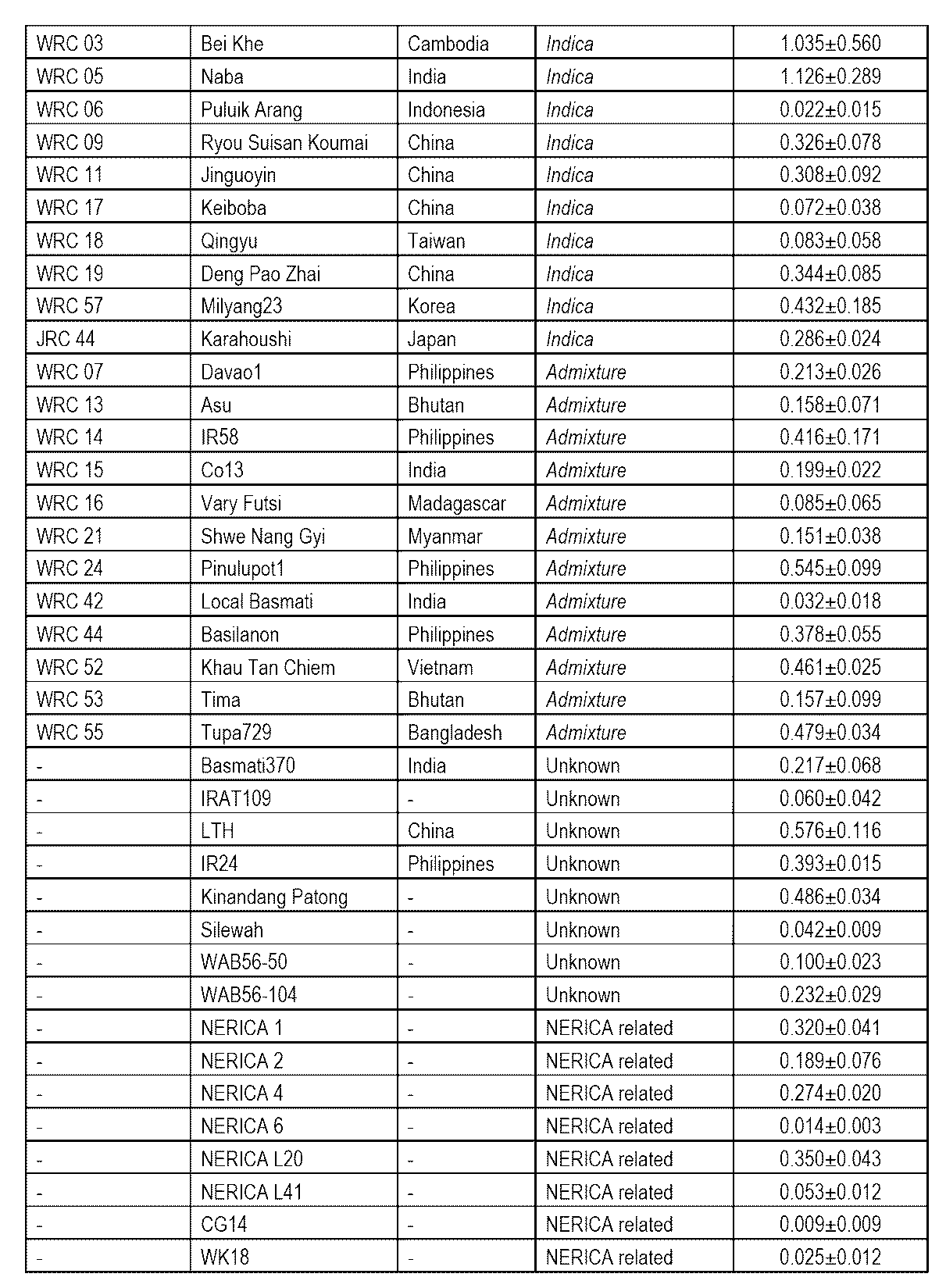
- Asian rice is classified into two subspecies, Indica and Japonica, and Japonica is classified into Temperate Japonica (shown as “Temperate Japonica” in Table 1) and Tropical Japonica (shown as “Tropical Japonica” in Table 1).
- Cultivars belonging to the Temperate Japonica category include, for example, Taichung65 (T65), Ginbouzu, Nipponbare, Kinmaze, Hinohikari, Yukihikari, Aikoku, Kameji, Kyotoasahi, Akage, and Dianyu1.
- Examples of varieties belonging to the tropical japonica category include Ma Sho, Khao Nok, Jaguary, Khau Mac Kho, Padi Perak, Rexmont, Senshou, Kahei, etc. Indica can be classified into Indica (shown as “Indica” in Table 1) and Aus (shown as “Aus” in Table 1). Examples of varieties belonging to the Indica category include Bei Khe, Naba, Passik Arang, Ryou Suisan Koumai, Jinguoyin, Keiboba, Qingyu, Deng Pao Zhai, Milang23, Karahoushi, etc.
- Examples of varieties that belong to Aus include Kasalath, Jena035, Muha, Jhona2, Nepal8, Jarjan, Kalo Dhan, Anjana Dhan, Shoni, Surjamukhi, ARC7291, ARC5955, ARC7047, ARC11094, Badari Dhan, Nepal555, Kaluheenati, DV85, ARC10313, and N22.
- Nerica is a hybrid between Oryza sativa and Oryza sativa.
- Examples of varieties that belong to NERICA include NERICA 1, NERICA 2, NERICA 4, NERICA 6, NERICA L20, and NERICA L41 (in Table 1, NERICA-related varieties, including NERICA varieties, are shown as "NERICA related").
- Hybrids not classified into any of the above groups include Davao1, Asu, IR58, Co13, Vary Futsi, Shwe Nang Gyi, Pinulupot1, Local Basmati, Basilanon, Khau Tan Chiem, Tima1, and Tupa729.
- Varieties of unknown classification include Basmati370, IRAT109, LTH, IR24, Kinandang Patong, and Silewah.
- Rice varieties can be classified into varieties susceptible to plant parasitic nematodes and varieties resistant to plant parasitic nematodes.
- an evaluation value (EV) can be calculated using the evaluation method described in the examples of this specification, and rice varieties with evaluation values equal to or greater than a certain value can be classified as nematode-susceptible varieties, and rice varieties with evaluation values below a certain value can be classified as nematode-resistant varieties.
- resistance to plant parasitic nematodes refers to the action of preventing or suppressing damage and/or parasitism (infection) of a host plant by plant parasitic nematodes.
- the resistance of a plant to plant parasitic nematodes such as root-knot nematodes can be tested using methods known to those skilled in the art. For example, a certain number (e.g., 200) of root-knot nematode J2 larvae are inoculated into the culture soil of a test plant, and the infection state is evaluated after a certain period of time (e.g., two months). The evaluation is preferably carried out by counting the number of nodules on the roots of the plant body and/or the number of egg masses of root-knot nematodes. The number of nodules can be counted visually.
- control of plant parasitic nematodes refers to the action of preventing or suppressing damage and/or parasitism (infection) of plant parasitic nematodes to host plants.
- RMIR1 (ROOT MELOIDOGYNE INCOGNITA RESISTANCE 1) gene” refers to the Os06g0621600 gene on the Nipponbare genome, which is associated with resistance to plant parasitic nematodes in rice, an orthologous gene corresponding to the Os06g0621600 gene in any rice cultivar, an orthologous gene corresponding to the Os06g0621600 gene in any plant species, or a mutant gene derived from either of them.
- the RMIR1 gene is referred to as the Os06g0621600 gene in RAP-db, but is referred to as the LOC_Os06g41670.1 gene in the Rice Genome Annotation Project (RGAP).
- RMIR1 gene includes wild-type and mutant RMIR1 genes derived from any biological species (referred to as “wild-type RMIR1 gene” and “mutant RMIR1 gene”, respectively), and also includes the L-type RMIR1 gene and S-type RMIR1 gene described below.
- RMIR1 gene sequence There may be differences in the RMIR1 gene sequence between rice varieties.
- the RMIR1 gene of ARC10313 encodes a protein consisting of 1154 amino acid residues
- the RMIR1 gene of T65 encodes a deletion-type protein consisting of 579 amino acid residues with the C-terminal region deleted.
- rice RMIR1 genes are classified into L-type RMIR1 genes and S-type RMIR1 genes depending on the presence or absence of the above-mentioned C-terminal region.
- S-type RMIR1 genes encode deletion-type proteins with the C-terminal region deleted compared to the L-type RMIR1 gene.
- L-type RMIR1 genes include the RMIR1 genes of ARC10313, N22, and Kalo Dhan.
- the base sequences of the RMIR1 genes of ARC10313, N22, and Kalo Dhan are all shown in SEQ ID NO:14 and are 100% identical.
- S-type RMIR1 genes include the RMIR1 genes of T65 and Nipponbare.
- the base sequences of the RMIR1 genes of T65 and Nipponbare are both shown in SEQ ID NO:16 and are 100% identical.
- RMIR1 polypeptide refers to a polypeptide encoded by the Os06g0621600 gene on the Nipponbare genome, which is associated with resistance to plant parasitic nematodes in rice (i.e., a polypeptide encoded by the RMIR1 gene), its corresponding ortholog in any rice variety, its corresponding ortholog in any plant species, or a mutant polypeptide derived from either of them.
- RMIR1 polypeptide when simply referring to “RMIR1 polypeptide” in this specification, it includes wild-type and mutant RMIR1 polypeptides derived from any biological species (referred to as “wild-type RMIR1 polypeptide” and “mutant RMIR1 polypeptide”, respectively), and also includes the L-type RMIR1 polypeptide and S-type RMIR1 polypeptide described below.
- Wild-type rice RMIR1 polypeptides are classified into L-type RMIR1 polypeptides encoded by L-type RMIR1 genes and S-type RMIR1 polypeptides encoded by S-type RMIR1 genes.
- L-type RMIR1 polypeptides are NB-LRR proteins that contain a nucleotide-binding domain (NB-ARC domain) and 13 leucine-rich repeat (LRR) domains.
- S-type RMIR1 polypeptides lack 11 LRR domains on the C-terminus side of L-type RMIR1 polypeptides because the position corresponding to the serine residue at position 580 in the L-type RMIR1 polypeptide is a stop codon.
- amino acid sequence of an L-type RMIR1 polypeptide is SEQ ID NO:13.
- the amino acid sequences of RMIR1 polypeptides in ARC10313, N22, and Kalo Dhan are all shown in SEQ ID NO:13 and are 100% identical.
- An example of the amino acid sequence of an S-type RMIR1 polypeptide is SEQ ID NO:15.
- the amino acid sequences of the RMIR1 polypeptides of T65 and Nipponbare are both shown in SEQ ID NO:15 and are 100% identical.
- the RMIR1 polypeptides of T65 and Nipponbare lack 575 amino acid residues on the C-terminus, and the alanine residue at position 138 is replaced with a threonine residue, and the arginine residue at position 548 is replaced with a leucine residue ( Figure 3).
- RKNR1 ROOT KNOT NEMATODE RESISTANCE 1 gene
- Os04g0112100 gene on the Nipponbare genome which is associated with resistance to plant parasitic nematodes in rice
- orthologous gene corresponding to the Os04g0112100 gene in any rice cultivar an orthologous gene corresponding to the Os04g0112100 gene in any plant species, or a mutant gene derived from either of them.
- RKNR1 gene when simply referring to the "RKNR1 gene,” it includes wild-type and mutant RKNR1 genes derived from any biological species (referred to as the "wild-type RKNR1 gene” and the “mutant RKNR1 gene,” respectively), and also includes the L-type RKNR1 gene and the S-type RKNR1 gene described below.
- the RKNR1 gene sequence may differ between rice varieties. For example, it is known that the presence or absence of a sequence region in the RKNR1 gene ORF that extends from the center of the NB-ARC domain to the C-terminal end of the LRR domain in the RKNR1 amino acid sequence differs between rice varieties.
- rice RKNR1 genes are classified into L-type RKNR1 genes and S-type RKNR1 genes based on the presence or absence of this sequence region.
- L-type RKNR1 genes include the RKNR1 genes of some cultivars belonging to the temperate japonica species (e.g., Akage and Ginbozu), as well as cultivars belonging to the indica, tropical japonica, Aus, and NERICA species.
- Examples of the base sequences of L-type RKNR1 genes include SEQ ID NO: 2 (N22 and Kalo Dhan), SEQ ID NO: 5 (Naba), SEQ ID NO: 6 (Bei Khe), and SEQ ID NO: 7 (Akage).
- the base sequences of the RKNR1 genes are 100% identical between N22 and Kalo Dhan, and both are shown in SEQ ID NO: 2.
- S-type RKNR1 gene examples include the RKNR1 genes of some temperate Japonica varieties (e.g., T65, Nipponbare, Kinnampu, Hinohikari, Yukihikari, Aikoku, Kameji, Kyotoasahi, and Dianyu1).
- RKNR1 genes of some temperate Japonica varieties e.g., T65, Nipponbare, Kinnampu, Hinohikari, Yukihikari, Aikoku, Kameji, Kyotoasahi, and Dianyu1
- base sequence of the S-type RKNR1 gene examples include SEQ ID NO: 3 (T65) and SEQ ID NO: 4 (Nipponbare).
- RKNR1 polypeptide refers to a polypeptide encoded by the Os04g0112100 gene on the Nipponbare genome, which is associated with resistance to plant parasitic nematodes in rice (i.e., a polypeptide encoded by the RKNR1 gene), its corresponding ortholog in any rice variety, its corresponding ortholog in any plant species, or a mutant polypeptide derived from either of them.
- RKNR1 polypeptide includes wild-type and mutant RKNR1 polypeptides derived from any biological species (referred to as “wild-type RKNR1 polypeptide” and “mutant RKNR1 polypeptide”, respectively), and also includes the L-type RKNR1 polypeptide and S-type RKNR1 polypeptide described below.
- Wild-type RKNR1 polypeptides in rice are classified into L-type RKNR1 polypeptides encoded by L-type RKNR1 genes and S-type RKNR1 polypeptides encoded by S-type RKNR1 genes.
- L-type RKNR1 polypeptides are NB-LRR proteins that have a nucleotide-binding domain (NB-ARC domain) and seven leucine-rich repeat (LRR) domains.
- S-type RKNR1 polypeptides are L-type RKNR1 polypeptides that lack part of the nucleotide-binding domain and most of the LRR domain.
- RKNR1 polypeptides of Bei Khe and Naba are classified as L-type RKNR1 polypeptides because the 1754 bp region is not deleted in their gene sequences, but they become proteins with a short amino acid length due to a stop codon generated by a frameshift.
- Examples of amino acid sequences of S-type RKNR1 polypeptides include SEQ ID NO: 8 (T65) and SEQ ID NO: 9 (Nipponbare).
- amino acid sequences of L-type RKNR1 polypeptides include SEQ ID NO: 1 (N22 and Kalo Dhan), SEQ ID NO: 10 (Naba), SEQ ID NO: 11 (Bei Khe), and SEQ ID NO: 12 (Red Hair).
- the amino acid sequences of RKNR1 polypeptides are 100% identical between Kalo Dhan and N22, both of which are shown in SEQ ID NO: 1.
- all of a plant refers to all regions that make up a living plant.
- a "part” of a plant refers to a part of a region that makes up a living plant, specifically an organ (e.g., roots, stems, leaves, flowers, epidermis, or a combination thereof, or pollen, egg cells, seeds, etc.), tissue or a part thereof consisting of a group of morphologically and/or functionally differentiated cells, or a cell.
- organ e.g., roots, stems, leaves, flowers, epidermis, or a combination thereof, or pollen, egg cells, seeds, etc.
- amino acid identity refers to the percentage of the number of identical amino acid residues in the total number of amino acid residues when the amino acid sequences of two polypeptides to be compared are aligned by inserting appropriate gaps into one or both of them as necessary to maximize the number of identical amino acid residues.
- the alignment of two amino acid sequences to calculate amino acid identity can be performed using known programs such as Blast, FASTA, and ClustalW. "Base identity" is calculated in the same manner.
- amino acid substitution refers to substitution within a conservative amino acid group that has similar properties such as charge, side chain, polarity, and aromaticity among the 20 types of amino acids that make up natural proteins. Examples include substitutions within the uncharged polar amino acid group with low polarity side chains (Gly, Asn, Gln, Ser, Thr, Cys, Tyr), branched chain amino acids (Leu, Val, Ile), neutral amino acids (Gly, Ile, Val, Leu, Ala, Met, Pro), neutral amino acids with hydrophilic side chains (Asn, Gln, Thr, Ser, Tyr, Cys), acidic amino acids (Asp, Glu), basic amino acids (Arg, Lys, His), and aromatic amino acids (Phe, Tyr, Trp). Amino acid substitutions within these groups are preferred because they are known to be less likely to cause changes in the properties of the polypeptide.
- stringent conditions refers to conditions under which non-specific hybrids are unlikely to form.
- Highly stringent conditions refers to conditions under which non-specific hybrids are unlikely to form or are not formed at all.
- the lower the salt concentration and the higher the temperature of the reaction conditions the more stringent the conditions.
- washing after hybridization is performed at 50°C to 70°C, 55°C to 68°C, or 65°C to 68°C, with 0.1xSSC and 0.1% SDS.
- the stringency of hybridization can be increased by appropriately combining other conditions such as probe concentration, probe base length, and hybridization time.
- the plant parasitic nematode control agent of the present invention contains, as an active ingredient, (1) a plant parasitic nematode-resistant RMIR1 polypeptide or a fragment thereof, (2) a polynucleotide encoding a plant parasitic nematode-resistant RMIR1 polypeptide or a fragment thereof, or (3) an expression vector comprising a polynucleotide encoding a plant parasitic nematode-resistant RMIR1 polypeptide or a fragment thereof.
- Plant parasitic nematode-resistant RMIR1 polypeptide or a fragment thereof In one embodiment, the plant parasitic nematode control agent of the present invention consists of or contains a plant parasitic nematode-resistant RMIR1 polypeptide or a fragment thereof.
- RMIR1 polypeptide resistant to plant parasitic nematodes refers to a RMIR1 polypeptide that confers resistance to plant parasitic nematodes to a host plant and/or enhances the resistance of a host plant to plant parasitic nematodes, and refers to a wild-type or mutant RMIR1 polypeptide derived from a plant resistant to plant parasitic nematodes.
- Wild-type RMIR1 polypeptides resistant to plant parasitic nematodes include wild-type L-type RMIR1 polypeptides.
- wild-type L-type RMIR1 polypeptides include the wild-type RMIR1 polypeptides of ARC10313, N22, and Kalo Dhan shown in SEQ ID NO: 13, and their wild-type L-type RMIR1 orthologues of other rice varieties or other plant species.
- mutant RMIR1 polypeptides that are resistant to plant parasitic nematodes include an amino acid sequence in which one or more amino acids have been deleted, substituted or added in the amino acid sequence of any of the above-mentioned wild-type RMIR1 polypeptides that are resistant to plant parasitic nematodes, or a polypeptide containing an amino acid sequence that has 60% or more, 65% or more, 70% or more, 75% or more, 80% or more, 82% or more, 85% or more, 87% or more, 90% or more, 91% or more, 92% or more, 93% or more, 94% or more, 95% or more, 96% or more, 97% or more, 98% or more, or 99% or more identity to the amino acid sequence of any of the above-mentioned wild-type RMIR1 polypeptides that are resistant to plant parasitic nematodes.
- the amino acid sequence shown in SEQ ID NO: 13 may include an amino acid sequence in which one or more amino acids have been deleted, substituted, or added, or a polypeptide containing an amino acid sequence having 60% or more, 65% or more, 70% or more, 75% or more, 80% or more, 82% or more, 85% or more, 87% or more, 90% or more, 91% or more, 92% or more, 93% or more, 94% or more, 95% or more, 96% or more, 97% or more, 98% or more, or 99% or more identity to the amino acid sequence shown in SEQ ID NO: 13.
- the plant parasitic nematode-resistant mutant RMIR1 polypeptide preferably has 50% or more, 60% or more, 70% or more, 80% or more, or 90% or more activity of the plant parasitic nematode-resistant wild-type RMIR1 polypeptide, or an activity equal to or greater than that.
- the plant parasitic nematode-resistant RMIR1 polypeptide comprises a polypeptide or a fragment thereof that includes either (a) the amino acid sequence shown in SEQ ID NO: 13, (b) the amino acid sequence shown in SEQ ID NO: 13 in which one or more amino acids have been deleted, substituted, or added, or (c) an amino acid sequence that has 90% or more identity to the amino acid sequence shown in SEQ ID NO: 13.
- a "fragment" of a plant parasitic nematode-resistant RMIR1 polypeptide refers to a fragment of the above-mentioned plant parasitic nematode-resistant RMIR1 polypeptide that has the activity of conferring resistance to plant parasitic nematodes to a host plant and/or enhancing the resistance of a host plant to plant parasitic nematodes, for example, a fragment having 50% or more, 60% or more, 70% or more, 80% or more, or 90% or more of the activity of the plant parasitic nematode-resistant RMIR1 polypeptide, or an activity equivalent thereto or more.
- a polypeptide fragment of the plant parasitic nematode-resistant RMIR1 polypeptide that contains one, two, or three or more LRR domains can be mentioned.
- the amino acid length of the polypeptide constituting this fragment is not particularly limited, but may be, for example, a region of at least 50, 100, 150, 200, 250, 300, 350, 400, 450, 500, 550, 600, 650, 700, 750, 800, 850, 900, 950, or 1000 consecutive amino acids in the plant parasitic nematode-resistant RMIR1 polypeptide.
- the plant parasitic nematode control agent further comprises a plant parasitic nematode-resistant RKNR1 polypeptide or a fragment thereof in addition to a plant parasitic nematode-resistant RMIR1 polypeptide or a fragment thereof.
- RKNR1 polypeptide resistant to plant parasitic nematodes refers to a RKNR1 polypeptide that confers resistance to plant parasitic nematodes to a host plant and/or enhances the resistance of a host plant to plant parasitic nematodes, and is a wild-type or mutant RKNR1 polypeptide derived from a plant resistant to plant parasitic nematodes.
- Patent Document 1 discloses that the RKNR1 gene is a gene that can enhance the resistance of a plant to plant parasitic nematodes, and also discloses that it can suppress the nematode attractant activity of the plant, the migration of nematodes into the roots, gall formation, gall maturation, nematode growth in the roots, and/or the induction of giant cells in the host plant.
- Wild-type RKNR1 polypeptides resistant to plant parasitic nematodes include L-type RKNR1 polypeptides other than the RKNR1 polypeptides of Bei Khe, Naba, and Akage.
- L-type RKNR1 polypeptides other than the RKNR1 polypeptides of Bei Khe, Naba, and Akage include the wild-type RKNR1 polypeptide of N22 shown in SEQ ID NO: 1, the wild-type RKNR1 polypeptide of Kalo Dhan shown in SEQ ID NO: 1, and their wild-type RKNR1 orthologues of other rice varieties or other plant species.
- the wild-type RKNR1 polypeptide from Ma Sho the wild-type RKNR1 polypeptide from Khao Nok, the wild-type RKNR1 polypeptide from Jaguary, the wild-type RKNR1 polypeptide from Khau Mac Kho, the wild-type RKNR1 polypeptide from Padi Perak, the wild-type RKNR1 polypeptide from Rexmont, the wild-type RKNR1 polypeptide from Senshou, the wild-type RKNR1 polypeptide from Kahei, the wild-type RKNR1 polypeptide from Passik Arang, the wild-type RKNR1 polypeptide from Ryou Suisan Koumai, the wild-type RKNR1 polypeptide from Jinguoyin, the wild-type RKNR1 polypeptide from Keiboba, the wild-type RKNR1 polypeptide from Qingyu, the wild-type RKNR1 polypeptide from Deng Pao Zhai, the wild-type RKNR1 polypeptide from
- mutant RKNR1 polypeptides that are resistant to plant parasitic nematodes include an amino acid sequence in which one or more amino acids have been deleted, substituted or added in the amino acid sequence of any of the above-mentioned wild-type RKNR1 polypeptides that are resistant to plant parasitic nematodes, or a polypeptide containing an amino acid sequence that has 60% or more, 65% or more, 70% or more, 75% or more, 80% or more, 82% or more, 85% or more, 87% or more, 90% or more, 91% or more, 92% or more, 93% or more, 94% or more, 95% or more, 96% or more, 97% or more, 98% or more, or 99% or more identity to the amino acid sequence of any of the above-mentioned wild-type RKNR1 polypeptides that are resistant to plant parasitic nematodes.
- the amino acid sequence shown in SEQ ID NO: 1 may include an amino acid sequence in which one or more amino acids have been deleted, substituted, or added, or a polypeptide containing an amino acid sequence having 60% or more, 65% or more, 70% or more, 75% or more, 80% or more, 82% or more, 85% or more, 87% or more, 90% or more, 91% or more, 92% or more, 93% or more, 94% or more, 95% or more, 96% or more, 97% or more, 98% or more, or 99% or more identity to the amino acid sequence shown in SEQ ID NO: 1.
- the plant parasitic nematode-resistant mutant RKNR1 polypeptide preferably has 50% or more, 60% or more, 70% or more, 80% or more, or 90% or more activity of the plant parasitic nematode-resistant wild-type RKNR1 polypeptide, or an activity equal to or greater than that.
- the plant parasitic nematode-resistant mutant RKNR1 polypeptide has an amino acid residue other than Gly (e.g., Asp) at position 315 in the amino acid sequence shown in SEQ ID NO: 12, an amino acid residue other than Asp (e.g., Glu) at position 505 in the amino acid sequence shown in SEQ ID NO: 12, an amino acid residue other than Val (e.g., Ala) at position 745 in the amino acid sequence shown in SEQ ID NO: 12, and/or an amino acid residue other than Gln (e.g., Leu) at position 1040 in the amino acid sequence shown in SEQ ID NO: 12.
- the plant parasitic nematode-resistant mutant RKNR1 polypeptide preferably has an amino acid residue other than Gln (e.g., Leu) at position 1040 in the amino acid sequence shown in SEQ ID NO: 12.
- the plant parasitic nematode-resistant RKNR1 polypeptide comprises a polypeptide or a fragment thereof that includes either (a) the amino acid sequence shown in SEQ ID NO: 1, (b) the amino acid sequence shown in SEQ ID NO: 1 in which one or more amino acids have been deleted, substituted, or added, or (c) an amino acid sequence that has 90% or more identity to the amino acid sequence shown in SEQ ID NO: 1.
- a "fragment" of a plant parasitic nematode-resistant RKNR1 polypeptide refers to a fragment of the above-mentioned plant parasitic nematode-resistant RKNR1 polypeptide that has the activity of conferring resistance to plant parasitic nematodes to a host plant and/or enhancing the resistance of a host plant to plant parasitic nematodes, for example, a fragment having 50% or more, 60% or more, 70% or more, 80% or more, or 90% or more of the activity of the plant parasitic nematode-resistant RKNR1 polypeptide, or an activity equivalent to or greater than that.
- a polypeptide fragment containing an LRR domain in a plant parasitic nematode-resistant RKNR1 polypeptide is included.
- the amino acid length of the polypeptide constituting this fragment is not particularly limited, but may be, for example, a region of at least 50, 100, 150, 200, 250, 300, 350, 400, 450, 500, 550, 600, 650, 700, 750, 800, 850, 900, 950, or 1000 consecutive amino acids in the plant parasitic nematode-resistant RKNR1 polypeptide.
- the plant parasitic nematode control agent of the present invention comprises or consists of a polynucleotide encoding a plant parasitic nematode-resistant RMIR1 polypeptide or a fragment thereof (herein referred to as an "RMIR1 polynucleotide").
- the RMIR1 polynucleotide encodes the above-mentioned plant parasitic nematode-resistant RMIR1 polypeptide or a fragment thereof.
- the base sequence of the RMIR1 polynucleotide is not particularly limited, so long as it encodes a plant parasitic nematode-resistant RMIR1 polypeptide or a fragment thereof.
- it is a polynucleotide that encodes a wild-type RMIR1 polypeptide of ARC10313 consisting of the amino acid sequence shown in SEQ ID NO: 13 (for example, a polynucleotide that is a wild-type RMIR1 gene of ARC10313 and consists of the base sequence shown in SEQ ID NO: 14).
- the RMIR1 polynucleotide includes any one of (g) the base sequence shown in SEQ ID NO: 14, (h) the base sequence shown in SEQ ID NO: 14 in which one or more bases are deleted, substituted or added, (i) a base sequence having 60% or more, 65% or more, 70% or more, 75% or more, 80% or more, 82% or more, 85% or more, 87% or more, 90% or more, 91% or more, 92% or more, 93% or more, 94% or more, 95% or more, 96% or more, 97% or more, 98% or more, or 99% or more identity to the base sequence shown in SEQ ID NO: 14, or (j) a base sequence that hybridizes under highly stringent conditions to a base sequence complementary to the base sequence shown in SEQ ID NO: 14.
- the plant parasitic nematode control agent of the present invention further comprises a polynucleotide encoding a plant parasitic nematode-resistant RMIR1 polypeptide or a fragment thereof (herein referred to as a "RKNR1 polynucleotide”) that encodes a plant parasitic nematode-resistant RKNR1 polypeptide or a fragment thereof in addition to the polynucleotide encoding the plant parasitic nematode-resistant RMIR1 polypeptide or a fragment thereof.
- a polynucleotide encoding a plant parasitic nematode-resistant RMIR1 polypeptide or a fragment thereof
- the RKNR1 polynucleotide encodes the above-mentioned plant parasitic nematode-resistant RKNR1 polypeptide or a fragment thereof.
- the base sequence of the RKNR1 polynucleotide is not particularly limited, so long as it encodes a plant parasitic nematode-resistant RKNR1 polypeptide or a fragment thereof.
- polynucleotide that encodes the wild-type RKNR1 polypeptide of N22 consisting of the amino acid sequence shown in SEQ ID NO:1 e.g., a polynucleotide that is the wild-type RKNR1 gene of N22 and consists of the base sequence shown in SEQ ID NO:2
- a polynucleotide that encodes the RKNR1 polypeptide of Kalo Dhan consisting of the amino acid sequence shown in SEQ ID NO:1 e.g., a polynucleotide that is the wild-type RKNR1 gene of Kalo Dhan and consists of the base sequence shown in SEQ ID NO:2
- the RKNR1 polynucleotide comprises any one of (k) the base sequence shown in SEQ ID NO:2, (l) the base sequence shown in SEQ ID NO:2 in which one or more bases are deleted, substituted or added, (m) a base sequence having 60% or more, 65% or more, 70% or more, 75% or more, 80% or more, 82% or more, 85% or more, 87% or more, 90% or more, 91% or more, 92% or more, 93% or more, 94% or more, 95% or more, 96% or more, 97% or more, 98% or more, or 99% or more identity to the base sequence shown in SEQ ID NO:2, or (n) a base sequence that hybridizes under highly stringent conditions to a base sequence complementary to the base sequence shown in SEQ ID NO:2.
- the base sequence of the RMIR1 polynucleotide and/or the RKNR1 polynucleotide may be a base sequence that is codon-optimized to match the codon usage frequency in the cell into which the polynucleotide is introduced.
- the RMIR1 polynucleotide and/or the RKNR1 polynucleotide may be DNA or RNA, such as mRNA.
- the base sequence may be an mRNA containing, as a coding region, a base sequence in which thymine (T) in any of the above-exemplified base sequences is replaced with uracil (U).
- the mRNA corresponding to the polynucleotide of the present invention may contain, in addition to the coding region, a cap structure at the 5'-end, a polyA tail at the 3'-end, a 5' untranslated region (5' UTR) upstream of the start codon, and/or a 3' untranslated region (3' UTR) downstream of the stop codon, etc.
- the 5' UTR and/or 3' UTR, etc. may contain a sequence for regulating the amount of translation from the mRNA.
- the plant parasitic nematode control agent of the present invention comprises or consists of an expression vector containing an RMIR1 polynucleotide encoding a plant parasitic nematode-resistant RMIR1 polypeptide or a fragment thereof.
- the expression vector of the present invention contains, in an expressible state, an RMIR1 polynucleotide encoding the plant parasitic nematode-resistant RMIR1 polypeptide of the present invention or a fragment thereof.
- expressible state means that the gene to be expressed is located downstream of the promoter under the control of the promoter.
- the expression vector of the present invention contains, as essential components, a promoter and a polynucleotide described in "(2) RMIR1 polynucleotide encoding a plant parasitic nematode-resistant RMIR1 polypeptide or a fragment thereof.”
- the expression vector of the present invention further comprises, in addition to the RMIR1 polynucleotide encoding the RMIR1 polypeptide or a fragment thereof conferring resistance to plant parasitic nematodes, a RKNR1 polynucleotide encoding the RKNR1 polypeptide or a fragment thereof conferring resistance to plant parasitic nematodes in an expressible state.
- Vectors that can be used as the expression vector of the present invention are, for example, expression vectors that utilize plasmids or viruses.
- expression vector includes recombinant vectors.
- the plasmid may be, but is not limited to, a pPZP series, a pSMA series, a pUC series, a pBR series, a pBluescript series (Agilent Technologies), a pTriEXTM series (TaKaRa), or a binary vector of a pBI series, a pRI series, or a pGW series.
- viruses that can be used include cauliflower mosaic virus (CaMV), bean golden mosaic virus (BGMV), and tobacco mosaic virus (TMV).
- CaMV cauliflower mosaic virus
- BGMV bean golden mosaic virus
- TMV tobacco mosaic virus
- expression vectors suitable for the Agrobacterium method such as binary vectors, or modified vectors thereof, can also be used.
- expression vectors include pBI121, pBIN19, pSMAB704, pCAMBIA, and pGreen.
- promoters such as overexpression promoters, constitutive promoters, site-specific promoters, time-specific promoters, and/or inducible promoters
- promoters can be used as promoters.
- Specific examples of overexpression constitutive promoters that can operate in plant cells include the 35S promoter derived from cauliflower mosaic virus (CaMV), the promoter Pnos of the nopaline synthase gene derived from Ti plasmid, the ubiquitin promoter derived from maize, the actin promoter derived from rice, and the PR protein promoter derived from tobacco.
- the small subunit (Rubisco ssu) promoter of ribulose bisphosphate carboxylase of various plant species or histone promoters can also be used.
- inducible promoters include inducible promoters such as heat shock promoters that can be controlled by temperature and tetracycline-responsive promoters that can be controlled by the presence or absence of tetracycline.
- the expression vector may also contain a terminator, an enhancer, a polyA addition signal, a 5'-UTR (untranslated region) sequence, an intron sequence, a ribosome binding sequence, a labeling or selection marker gene, a multicloning site, a nuclease recognition sequence, and/or a replication origin.
- a terminator an enhancer
- a polyA addition signal a 5'-UTR (untranslated region) sequence
- an intron sequence a ribosome binding sequence
- a labeling or selection marker gene a multicloning site
- a nuclease recognition sequence and/or a replication origin.
- Terminators include, for example, the nopaline synthase (NOS) gene terminator, the octopine synthase (OCS) gene terminator, the CaMV 35S terminator, the 3' terminator of Escherichia coli lipopolyprotein lpp, the trp operon terminator, the amyB terminator, the ADH1 gene terminator, and the like.
- NOS nopaline synthase
- OCS octopine synthase
- CaMV 35S terminator the 3' terminator of Escherichia coli lipopolyprotein lpp
- the trp operon terminator the amyB terminator
- the ADH1 gene terminator and the like.
- an enhancer is an enhancer region that includes an upstream sequence in the CaMV 35S promoter. There are no particular limitations as long as it can enhance the expression efficiency of a nucleic acid that encodes an active peptide.
- nuclease recognition sequences include restriction enzyme recognition sequences, loxP sequences recognized by Cre recombinase, sequences that are targets of artificial nucleases such as ZFN and TALEN, and sequences that are targets of the CRISPR/Cas9 system.
- An example of the replication origin sequence is the SV40 replication origin sequence.
- Selection marker genes include drug resistance genes (e.g., tetracycline resistance gene, ampicillin resistance gene, kanamycin resistance gene, hygromycin resistance gene, spectinomycin resistance gene, chloramphenicol resistance gene, dihydrofolate reductase gene, or neomycin resistance gene), fluorescent or luminescent reporter genes (e.g., luciferase, ⁇ -galactosidase, ⁇ -glucuronidase (GUS), or green fluorescent protein (GFP)), and enzyme genes such as neomycin phosphotransferase II (NPT II) and dihydrofolate reductase.
- drug resistance genes e.g., tetracycline resistance gene, ampicillin resistance gene, kanamycin resistance gene, hygromycin resistance gene, spectinomycin resistance gene, chloramphenicol resistance gene, dihydrofolate reductase gene, or neomycin resistance gene
- fluorescent or luminescent reporter genes e.
- the selection marker gene that may be included in the expression vector of the present invention is a selection marker gene that allows the selection of cells into which the expression vector of the present invention has been introduced.
- Specific examples of selection marker genes include drug resistance genes such as an ampicillin resistance gene, a kanamycin resistance gene, a tetracycline resistance gene, a chloramphenicol resistance gene, a neomycin resistance gene, a puromycin resistance gene, or a hygromycin resistance gene.
- the reporter gene that may be contained in the expression vector of the present invention is a gene that encodes a reporter that can identify cells into which the expression vector of the present invention has been introduced.
- reporter genes include genes that encode fluorescent proteins such as GFP and RFP, and luciferase genes.
- the plant-parasitic nematode control agent of the present invention may consist only of the active ingredients described in "1-3-1. Active ingredients", but may contain other ingredients as necessary.
- the plant parasitic nematode control agent of the present invention may contain an agriculturally acceptable carrier.
- agriculturally acceptable carrier refers to a substance that does not substantially affect the activity of the plant parasitic nematode control agent of the present invention, and that has no or only a small harmful effect on the environment, such as soil and water quality, when applied to plant cultivation, or has no or only a small harmful effect on animals, particularly humans. Examples include solvents, adjuvants, excipients, emulsifiers, dispersants, surfactants, etc.
- the plant parasitic nematode control agent of the present invention can also contain other ingredients with pharmacological action, i.e., nematocides, herbicides, fertilizers (e.g., urea, ammonium nitrate, superphosphates), to the extent that the activity of the active ingredient is not affected.
- nematocides e.g., nematocides, herbicides, fertilizers (e.g., urea, ammonium nitrate, superphosphates), to the extent that the activity of the active ingredient is not affected.
- fertilizers e.g., urea, ammonium nitrate, superphosphates
- the dosage form of the plant parasitic nematode control agent of the present invention may be in any state as long as the plant parasitic nematode control agent of the present invention can enter the plant body to which it is applied, and may be, for example, a liquid agent in a liquid state or a solid agent in a solid state.
- a liquid agent examples of the liquid agent include a solution agent in which the active ingredient is suspended in a suitable solution, an oil-based dispersion agent, an emulsion agent, and a suspension agent.
- the solid agent there is no particular limitation as long as the active ingredient can act on the plant to which it is applied.
- the solid agent include a dust agent, a powder agent, a paste agent, and a gel agent.
- the plant parasitic nematode control agent of the present invention can confer resistance to plant parasitic nematodes to plants susceptible to plant parasitic nematodes.
- the plant parasitic nematode control agent of the present invention can enhance the resistance to plant parasitic nematodes in plants resistant to plant parasitic nematodes.
- the plant parasitic nematode control agent of the present invention can suppress nematode attractant activity, nematode migration into the roots, nodule formation, nodule maturation, nematode growth in the roots, and/or giant cell induction in the host plant in the plant to which the agent is applied.
- a second aspect of the present invention is a plant transformant or its progeny having resistance to plant parasitic nematodes.
- the plant transformant of the present invention or its progeny contains the plant parasitic nematode control agent described in the first aspect, for example the polynucleotide or expression vector described in the first aspect, and has resistance to plant parasitic nematodes such as root-knot nematodes.
- the plant transformant of the present invention or its progeny has suppressed nematode attractant activity, nematode migration into roots, nodule formation, nodule maturation, nematode growth in roots, and/or induction of giant cells in the host plant, and has resistance to plant parasitic nematodes.
- transformed plant refers to a plant host that has been genetically modified to acquire resistance to plant parasitic nematodes.
- the plant transformant of the present invention comprises an RMIR1 polynucleotide encoding the plant parasitic nematode-resistant RMIR1 polypeptide or a fragment thereof described in the first aspect, or an expression vector comprising said polynucleotide. More specifically, the plant transformant of the present invention is transformed with an RMIR1 polynucleotide encoding the plant parasitic nematode-resistant RMIR1 polypeptide or a fragment thereof described in the first aspect, or an expression vector comprising said polynucleotide.
- the plant transformant of the present invention is The present invention comprises an RMIR1 polynucleotide encoding the RMIR1 polypeptide or a fragment thereof resistant to plant parasitic nematodes described in the first aspect, or an expression vector comprising said polynucleotide, and an RKNR1 polynucleotide encoding the RKNR1 polypeptide or a fragment thereof resistant to plant parasitic nematodes described in the first aspect, or an expression vector comprising said polynucleotide, and is, for example, transformed with the above two types of polynucleotides or expression vectors.
- the host plant species to be transformed in the present invention is not limited.
- the host plant may be a monocotyledonous or dicotyledonous plant, but a monocotyledonous plant is particularly preferred.
- the monocotyledonous plant may be a species belonging to the Poaceae family (e.g., rice, wheat, barley, rye, corn, sugarcane, foxtail millet, millet, barnyard millet, sorghum, sorghum), a species belonging to the Musaceae family (e.g., banana, musa), a species belonging to the Amaryllidaceae family (e.g., leek, onion, garlic, Chinese chive), or a species belonging to the Bromeliaceae family (e.g., pineapple).
- the Poaceae family e.g., rice, wheat, barley, rye, corn, sugarcane, foxtail millet, millet, barnyard millet, sorg
- the host plant is preferably a plant species susceptible to plant parasitic nematodes or a plant species with low resistance to plant parasitic nematodes, for example, a rice variety having an S-type RMIR1 gene and/or an S-type RKNR1 gene, or a plant species not having an L-type RMIR1 gene and/or an L-type RKNR1 gene.
- Examples of rice varieties susceptible to plant parasitic nematodes include rice varieties that show an evaluation value of 1.0 or more in Figure 1, or rice varieties that show an evaluation value of 0.8 or more.
- the plant transformant of the present invention includes clones having the same genetic information.
- the plant transformant of the present invention also includes parts of the plant body collected from the first generation plant transformant, for example, plant tissues such as epidermis, phloem, parenchyma, xylem, or vascular bundles, plant organs such as leaves, petals, stems, roots, or seeds, or clones obtained from plant cells by plant tissue culture, cuttings, grafting, or layering, new clones newly generated from vegetative propagation organs obtained by asexual reproduction from the first generation plant transformant, such as rhizomes, tuberous roots, corms, runners, etc., and somatic embryos induced by dedifferentiation treatment from the first generation plant transformant or clones derived therefrom.
- the transformed plant of the present invention may be a genetically modified plant.
- progeny refers to a host plant that is a descendant of the first generation of the plant transformant through sexual reproduction, that retains an RMIR1 polynucleotide encoding a plant parasitic nematode-resistant RMIR1 polypeptide or a fragment thereof, or an expression vector containing the polynucleotide, and that has resistance to plant parasitic nematodes.
- the progeny generation is not important.
- a plant transformant containing the RMIR1 polynucleotide encoding the plant parasitic nematode-resistant RMIR1 polypeptide of the present invention or a fragment thereof, or an expression vector containing the polynucleotide exhibits resistance to plant parasitic nematodes. Furthermore, a plant transformant containing the plant parasitic nematode-resistant RMIR1 polypeptide, etc.
- RKNR1 polypeptide encoding the plant parasitic nematode-resistant RKNR1 polypeptide or a fragment thereof, or an expression vector containing the polynucleotide (hereinafter referred to as "RKNR1 polypeptide, etc.") has further enhanced nematode resistance compared to a transformant containing only either the RMIR1 polypeptide, etc. or the RKNR1 polypeptide, etc.
- the third aspect of the present invention relates to a method for producing a plant transformant resistant to plant parasitic nematodes. According to the production method of the present invention, a resistant plant transformant can be produced from a plant susceptible to plant parasitic nematodes.
- the method for producing a plant transformant having resistance to a plant parasitic nematode of the present invention includes an introduction step and a selection step as essential steps. Each step will be specifically described below.
- the "introduction step” is a step of introducing an expression vector containing an RMIR1 polynucleotide encoding a plant parasitic nematode-resistant RMIR1 polypeptide or a fragment thereof into a host plant.
- the introduction step is a step of introducing into a host plant an expression vector containing an RMIR1 polynucleotide encoding a plant parasitic nematode-resistant RMIR1 polypeptide or a fragment thereof, in addition to an expression vector containing an RKNR1 polynucleotide encoding a plant parasitic nematode-resistant RKNR1 polypeptide or a fragment thereof.
- the configuration of the expression vector introduced in this step is as described in "(3) Expression vector containing an RMIR1 polynucleotide encoding a plant parasitic nematode-resistant RMIR1 polypeptide or a fragment thereof" in the first embodiment.
- the expression vector can be introduced by any method known in the art, such as the Agrobacterium method, the PEG-calcium phosphate method, the electroporation method, the liposome method, the particle gun method, or the microinjection method.
- the introduced polynucleotide may be incorporated into the genomic DNA of the host, or may exist in the state of the introduced polynucleotide (e.g., as contained in the foreign vector). Furthermore, the introduced polynucleotide may continue to be maintained in the host cell as when it is incorporated into the genomic DNA of the host, or may be retained transiently.
- a polynucleotide encoding the RMIR1 polypeptide or a fragment thereof that is resistant to plant parasitic nematodes is inserted into an expression vector suitable for the Agrobacterium method, and then introduced into a suitable Agrobacterium, such as Agrobacterium tumefaciens, by electroporation or other methods, and this strain is inoculated into plant cells, callus, cotyledon segments, or the like to infect them.
- suitable Agrobacterium strains that can be used include, but are not limited to, GV3101, C58, C58C1Rif(R), EHA101, EHA105, AGL1, LBA4404, and the like.
- a slice of a plant leaf or the like may be used, or a protoplast may be prepared and used (Christou P, et al., Bio/Technology (1991) 9: 957-962).
- a gene introduction device e.g., PDS-1000 (BIO-RAD)
- PDS-1000 BIO-RAD
- the operation conditions are usually a pressure of about 450 to 2000 psi and a distance of about 4 to 12 cm.
- the "selection step” is a step of selecting a plant into which the expression vector has been introduced.
- This step may be carried out by a method known in the art after introducing the expression vector into the host using the method described above.
- transformants can be selected using the activity of a protein encoded by a selection marker gene or reporter gene in the expression vector.
- plant cells or cotyledon segments into which an expression vector or polynucleotide of the present invention has been introduced are cultured in a selective medium according to the plant tissue culture method, and the surviving callus is cultured in a regeneration medium (containing an appropriate concentration of a plant hormone (auxin, cytokinin, gibberellin, abscisic acid, ethylene, brassinolide, etc.)), thereby allowing the transformed plant to be regenerated. In this way, the transformant can be selected.
- a plant hormone auxin, cytokinin, gibberellin, abscisic acid, ethylene, brassinolide, etc.
- Example 1 Examination of resistance of various rice varieties to sweet potato root-knot nematode (the purpose) Various rice varieties are examined for resistance to the sweet potato root-knot nematode (Mi).
- rice seeds were soaked in a disinfectant solution (a 1000-fold diluted solution of Kao Corporation kitchen bleach) at 26°C for three days (water absorption period) to kill mold and bacteria and induce germination.
- a disinfectant solution a 1000-fold diluted solution of Kao Corporation kitchen bleach
- the germinated seeds were then sown in paper pouches (CYG Seed Germination Pouch, Mega International, USA), two seeds per pouch.
- the pouches containing the germinated seeds were placed in a dark place at 26°C for three days.
- ten pouches were sandwiched between wooden boards and secured with spring clamps, and then grown for eight days under a 12-hour light (26°C)/12-hour dark (24°C) regime.
- the number of egg masses was counted 48 days after imbibition (34 days after inoculation).
- the entire root system was stained by immersing it in 50 ng/ ⁇ L erioglossin for at least 15 minutes, and the number of egg masses stained blue was counted.
- the root system was placed in a 50°C incubator for at least 5 days, and the roots were weighed after completely removing the moisture from the roots.
- the number of egg masses per unit dry root weight was calculated from the obtained dry root weight and number of egg masses.
- Rice varieties with an evaluation value of 0.6 or more were classified as Mi susceptible varieties, and those with an evaluation value of less than 0.6 were classified as Mi resistant varieties.
- Example 2 Mapping and identification of the Mi resistance gene (the purpose)
- the Mi resistance gene is identified by QTL analysis using RIL lines and gene mapping using CSSL lines.
- the three CSSL lines used here (TACSSL-42, TACSL-45, and TACSL-47) have sequences derived from the resistant cultivar ARC10313 in different regions in the 0.596-29.229 Mb region on chromosome 6, but have sequences derived from the susceptible cultivar T65 in other regions.
- the three CSSL strains (TACSSL-42, TACSSSL-45, and TACSSSL-47) and the parent strains T65 and ARC10313 were subjected to Mi inoculation tests using the method described in Example 1 to evaluate their resistance.
- the evaluation values for TACSSSL-42, TACSSSL-45, and TACSSSL-47 were 1.517 ⁇ 0.035, 0.505 ⁇ 0.015, and 1.236 ⁇ 0.372, respectively ( Figure 2A). From these results, the Mi resistance gene on chromosome 6 was identified in TACSSSL-45 in the range of 20.258 to 27.829 Mb (a region of approximately 7.6 Mb) derived from ARC10313.
- the rice database RAP-db https://rapdb.dna.affrc.go.jp/ was used to search for genes within the mapped range.
- the above database was created based on genome information from Nipponbare, and 449 genes were annotated in the above-mentioned region of approximately 7.6 Mb.
- the Os06g0621600 gene hereinafter referred to as the ROOT MELOIDOGYNE INCOGNITA RESISTANCE 1 gene or RMIR1 gene
- the Os06g0621600 gene on RAP-db corresponds to the LOC_Os06g41670.1 gene of the Rice Genome Annotation Project (RGAP).
- RGAP Rice Genome Annotation Project
- the amino acid sequence based on the base sequence of the RGAP LOC_Os06g41670.1 gene was used as the sequence of the polypeptide encoded by the RMIR1 gene (hereinafter referred to as "RMIR1 polypeptide").
- the RMIR1 gene of ARC10313 encodes a 1,154 amino acid long L-type RMIR1 polypeptide containing a nucleotide-binding domain (NB-ARC domain) and 13 leucine-rich repeat (LRR) domains.
- the nucleotide sequences of the RMIR1 genes of ARC10313, N22, and Kalo Dhan are all shown in SEQ ID NO:14 and are 100% identical.
- the RMIR1 gene of T65 is substituted with a stop codon for serine at position 580, resulting in a deletion of 575 amino acid residues on the C-terminus, and furthermore, alanine at position 138 is substituted with threonine, and arginine at position 548 is substituted with leucine, resulting in the coding of a 579 amino acid long S-type RMIR1 polypeptide. Therefore, it was estimated that 11 of the 13 LRR domains are deleted in the RMIR1 gene of T65.
- the RMIR1 gene of T65 has a 141 base long insertion sequence downstream of the stop codon that is not present in ARC10313.
- the base sequences of the RMIR1 genes of T65 and Nipponbare are both shown in SEQ ID NO: 16 and are 100% identical.
- the amino acid identity between the RMIR1 polypeptide of ARC10313 (sequence number 13) and the RKNR1 polypeptide of Kalo Dhan (sequence number 1) is 62.64%.
- Example 3 Effect of introduction of RMIR1 gene on Mi resistance trait (the purpose)
- RMIR1 gene on Mi resistance trait
- the RMIR1 transformation vector was generated by PCR amplification of a 12 kb genomic region containing the Os06g0621600 gene (RMIR1 gene) of wild-type Kalo Dhan and cloning it into a vector.
- the RMIR1 transformation vector or a control vector not containing the RMIR1 genomic region was introduced into Agrobacterium tumefaciens strain EHA105 by electroporation.
- Rice transformation was performed according to the method described in the literature (Toki S., et al, Plant J. 47:969-976). Specifically, Nipponbare seeds were placed on 2N6 at 28°C for 7 days, immersed in Agrobacterium suspension for a few minutes, and then transferred onto 2N6-AS medium.
- the seeds were washed with sterile water containing 25 mg/L meropenem (Wako) to remove Agrobacterium. Thereafter, the plants were cultured in N6D medium containing 50 mg/L hygromycin at 32° C. under continuous light for 2 weeks, followed by regeneration and recovery of plantlets.
- the RMIR1 transformed line transformed with the RMIR1 transformation vector and the vector control line transformed with the control vector were subjected to a Mi resistance test in the same manner as in Example 1.
- the results are shown in Figures 4 and 5.
- the evaluation score of the RMIR1 transformant was calculated as a relative value to the average evaluation score of the vector control.
- the evaluation score of the vector control strain was 1.003 ⁇ 0.150, and the evaluation score of the RMIR1 transformant was 0.510 ⁇ 0.056, and a significant difference was detected at the 1% level as a result of a t-test.
- This result demonstrated that the RMIR1 gene is the causative gene for the Mi resistance trait, and that Mi resistance can be conferred by introducing the RMIR1 gene of a Mi-resistant variety into a Mi-susceptible variety. All publications, patents, and patent applications cited herein are hereby incorporated by reference in their entirety.
Landscapes
- Life Sciences & Earth Sciences (AREA)
- Health & Medical Sciences (AREA)
- Chemical & Material Sciences (AREA)
- Genetics & Genomics (AREA)
- Engineering & Computer Science (AREA)
- Environmental Sciences (AREA)
- Botany (AREA)
- Organic Chemistry (AREA)
- General Health & Medical Sciences (AREA)
- Wood Science & Technology (AREA)
- Zoology (AREA)
- Developmental Biology & Embryology (AREA)
- Biotechnology (AREA)
- Pest Control & Pesticides (AREA)
- Physiology (AREA)
- Biomedical Technology (AREA)
- Plant Pathology (AREA)
- Biochemistry (AREA)
- Bioinformatics & Cheminformatics (AREA)
- Biophysics (AREA)
- Agronomy & Crop Science (AREA)
- General Engineering & Computer Science (AREA)
- Dentistry (AREA)
- General Chemical & Material Sciences (AREA)
- Gastroenterology & Hepatology (AREA)
- Molecular Biology (AREA)
- Microbiology (AREA)
- Cell Biology (AREA)
- Proteomics, Peptides & Aminoacids (AREA)
- Natural Medicines & Medicinal Plants (AREA)
- Chemical Kinetics & Catalysis (AREA)
- Medicinal Chemistry (AREA)
- Breeding Of Plants And Reproduction By Means Of Culturing (AREA)
Abstract
Description
(a)配列番号13で示すアミノ酸配列、
(b)配列番号13で示すアミノ酸配列において1若しくは複数個のアミノ酸が欠失、置換若しくは付加されたアミノ酸配列、又は
(c)配列番号13で示すアミノ酸配列と90%以上の同一性を有するアミノ酸配列
(2)以下の(d)~(f)で示すいずれかのアミノ酸配列を含むRKNR1ポリペプチド又はその断片をさらに含む、(1)に記載の植物寄生性センチュウ防除剤。
(d)配列番号1で示すアミノ酸配列、
(e)配列番号1で示すアミノ酸配列において1若しくは複数個のアミノ酸が欠失、置換若しくは付加されたアミノ酸配列、又は
(f)配列番号1で示すアミノ酸配列と90%以上の同一性を有するアミノ酸配列
(3)(1)に記載のRMIR1ポリペプチド又はその断片をコードするRMIR1ポリヌクレオチドを含む、植物寄生性センチュウ防除剤。
(4)前記RMIR1ポリヌクレオチドが以下の(g)~(j)で示すいずれかの塩基配列を含む、(3)に記載の植物寄生性センチュウ防除剤。
(g)配列番号14で示す塩基配列、
(h)配列番号14で示す塩基配列において1若しくは複数個の塩基が欠失、置換若しくは付加された塩基配列、
(i)配列番号14で示す塩基配列と90%以上の同一性を有する塩基配列、又は
(j)配列番号14で示す塩基配列に相補的な塩基配列と高ストリンジェントな条件でハイブリダイズする塩基配列
(5)(2)に記載のRKNR1ポリペプチド又はその断片をコードするRKNR1ポリヌクレオチドをさらに含む、(3)又は(4)に記載の植物寄生性センチュウ防除剤。
(6)前記RKNR1ポリヌクレオチドが以下の(k)~(n)で示すいずれかの塩基配列を含む、(5)に記載の植物寄生性センチュウ防除剤。
(k)配列番号2で示す塩基配列、
(l)配列番号2で示す塩基配列において1若しくは複数個の塩基が欠失、置換若しくは付加された塩基配列、
(m)配列番号2で示す塩基配列と90%以上の同一性を有する塩基配列、又は
(n)配列番号2で示す塩基配列に相補的な塩基配列と高ストリンジェントな条件でハイブリダイズする塩基配列
(7)(3)又は(4)に記載のRMIR1ポリヌクレオチドを含む発現ベクターを含む、植物寄生性センチュウ防除剤。
(8)前記植物寄生性センチュウがネコブセンチュウである、(1)~(7)のいずれかに記載の植物寄生性センチュウ防除剤。
(9)前記ネコブセンチュウが、イネネコブセンチュウ、サツマイモネコブセンチュウ、キタネコブセンチュウ、及びジャワネコブセンチュウからなる群から選択される、(8)に記載の植物寄生性センチュウ防除剤。
(10)(1)若しくは(2)又は(3)~(9)のいずれかに記載の植物寄生性センチュウ防除剤を含む、植物寄生性センチュウに対して抵抗性を有する植物形質転換体、又は前記ポリヌクレオチド若しくは前記発現ベクターを保持したその後代。
(11)単子葉植物である、(10)に記載の植物形質転換体又はその後代。
(12)前記単子葉植物がイネ科植物である(11)に記載の植物形質転換体又はその後代。
(13)前記イネ科植物が、イネ、コムギ、オオムギ、ライムギ、トウモロコシ、サトウキビ、アワ、キビ、ヒエ、及びソルガムからなる群から選択される、(12)に記載の植物形質転換体又はその後代。
(14)遺伝子組換え体である、(10)~(13)のいずれかに記載の植物形質転換体又はその後代。
(15)植物寄生性センチュウに対して抵抗性を有する植物形質転換体を製造する方法であって、
(7)に記載の発現ベクターを植物に導入する工程、及び
前記発現ベクターが導入された植物を選択する工程
を含む、方法。
本明細書は本願の優先権の基礎となる日本国特許出願番号2023-097058号の開示内容を包含する。
1-1.概要
本発明の第1の態様は、植物寄生性センチュウ防除剤である。本発明の植物寄生性センチュウ防除剤は、センチュウ抵抗性のRMIR1ポリペプチド若しくはその断片からなる若しくはそれを含むか、又はそのいずれかをコードするポリヌクレオチド若しくはそれを含む発現ベクターを含む。本発明の植物寄生性センチュウ防除剤は、植物寄生性センチュウに対して防除効果を有する。
本明細書において「植物寄生性センチュウ」は、植物に寄生し得るセンチュウであれば特に限定しない。植物寄生性センチュウとして、ネコブセンチュウ(Root-knot nematode;Meloidogyne)、ネグサレセンチュウ(Pratylenchus)、シストセンチュウ(シストセンチュウには、Afenestrata、Cactodera、Dolichodera、Globodera、Heterodera、及びPunctoderaの6つの属が知られている)、ハセンチュウ(Aphelenchoides)、クキセンチュウ(Ditylenchus)等が知られている。本発明の防除対象となる植物寄生性センチュウは、好ましくはネコブセンチュウである。
本発明の植物寄生性センチュウ防除剤は、有効成分として、(1)植物寄生性センチュウ抵抗性のRMIR1ポリペプチド若しくはその断片を含むか、(2)植物寄生性センチュウ抵抗性のRMIR1ポリペプチド又はその断片をコードするポリヌクレオチドを含むか、又は(3)植物寄生性センチュウ抵抗性のRMIR1ポリペプチド又はその断片をコードするポリヌクレオチドを含む発現ベクターを含む。
(1)植物寄生性センチュウ抵抗性のRMIR1ポリペプチド若しくはその断片
一実施形態において、本発明の植物寄生性センチュウ防除剤は、植物寄生性センチュウ抵抗性のRMIR1ポリペプチド若しくはその断片からなる、又はそれを含む。
一実施形態において、本発明の植物寄生性センチュウ防除剤は、植物寄生性センチュウ抵抗性のRMIR1ポリペプチド又はその断片をコードするポリヌクレオチド(本明細書において「RMIR1ポリヌクレオチド」という)を含む、又はそれからなる。
RMIR1ポリヌクレオチド及び/又はRKNR1ポリヌクレオチドがmRNAである場合、その塩基配列は、上で例示したいずれかの塩基配列においてチミン(T)をウラシル(U)に置換した塩基配列をコーディング領域として含むmRNAとすることができる。本発明のポリヌクレオチドに該当するmRNAは、前記コーディング領域に加えて、5'末端のキャップ構造、3'末端のポリA鎖、開始コドン上流の5’非翻訳領域(5' UTR)、及び/又は終止コドン下流の3’非翻訳領域(3' UTR)等を含んでもよい。5' UTR及び/又は3' UTR等には、mRNAからの翻訳量を調節するための配列が含まれていてもよい。
一実施形態において、本発明の植物寄生性センチュウ防除剤は、植物寄生性センチュウ抵抗性のRMIR1ポリペプチド又はその断片をコードするRMIR1ポリヌクレオチドを含む発現ベクターを含む、又はそれからなる。
複製起点配列としては、SV40複製起点配列が例示される。
本発明の植物寄生性センチュウ防除剤は、「1-3-1.有効成分」に記載した有効成分のみから構成されていてもよいが、必要に応じてその他の成分を含むことができる。
本発明の植物寄生性センチュウ防除剤の剤形は、本発明の植物寄生性センチュウ防除剤が施用される植物体内に侵入し得る状態であれば、いかなる状態であってもよく、例えば、液体状態の液剤、固体状態の固形剤とすることができる。液剤の場合、有効成分を適当な溶液に懸濁した溶液剤、油性分散液剤、エマルジョン剤、懸濁剤が挙げられる。固形剤の場合、有効成分が施用植物に作用し得る状態であれば、特に制限しない。例えば、粉剤、散剤、ペースト剤、ゲル剤が挙げられる。
本発明の植物寄生性センチュウ防除剤によれば、植物寄生性センチュウに罹患性の植物に、植物寄生性センチュウに対する抵抗性を付与することができる。また、本発明の植物寄生性センチュウ防除剤によれば、植物寄生性センチュウに抵抗性の植物において、植物寄生性センチュウに対する抵抗性を増強することができる。
2-1.概要
本発明の第2の態様は、植物寄生性センチュウに対して抵抗性を有する植物形質転換体又はその後代である。本発明の植物形質転換体又はその後代は、第1態様に記載の植物寄生性センチュウ防除剤、例えば第1態様に記載のポリヌクレオチド又は発現ベクターを含み、ネコブセンチュウ等の植物寄生性センチュウに対して抵抗性を有する。本発明の植物形質転換体又はその後代は、センチュウ誘引活性、根部内へのセンチュウの移行、瘤形成、瘤成熟、根部内におけるセンチュウの成長、及び/又は宿主植物における巨大細胞の誘導が抑制されており、植物寄生性センチュウに対して抵抗性を有する。
本明細書における「植物形質転換体」は、植物寄生性センチュウに対して抵抗性を獲得するように遺伝子改変された植物宿主をいう。
第1態様に記載の植物寄生性センチュウ抵抗性のRMIR1ポリペプチド若しくはその断片をコードするRMIR1ポリヌクレオチド、又は前記ポリヌクレオチドを含む発現ベクター、及び
第1態様に記載の植物寄生性センチュウ抵抗性のRKNR1ポリペプチド若しくはその断片をコードするRKNR1ポリヌクレオチド、又は前記ポリヌクレオチドを含む発現ベクター
を含み、例えば上記2種のポリヌクレオチド又は発現ベクターで形質転換されている。
一実施形態において、本発明の植物形質転換体は遺伝子組換え体であってもよい。
本発明の植物寄生性センチュウ抵抗性のRMIR1ポリペプチド若しくはその断片をコードするRMIR1ポリヌクレオチド、又は前記ポリヌクレオチドを含む発現ベクター(以下、「RMIR1ポリペプチド等」と表記する)を含む植物形質転換体は、植物寄生性センチュウに対して抵抗性を示す。また、本発明の植物寄生性センチュウ抵抗性のRMIR1ポリペプチド等、及び植物寄生性センチュウ抵抗性のRKNR1ポリペプチド若しくはその断片をコードするRKNR1ポリヌクレオチド、又は前記ポリヌクレオチドを含む発現ベクター(以下、「RKNR1ポリペプチド等」と表記する)を含む植物形質転換体は、RMIR1ポリペプチド等又はRKNR1ポリペプチド等のいずれか一方のみを含む形質転換体と比較してセンチュウ抵抗性がさらに増強されている。
3-1.概要
本発明の第3の態様は、植物寄生性センチュウに対して抵抗性を有する植物形質転換体を製造する方法に関する。本発明の製造方法によれば、植物寄生性センチュウ罹患性の植物から、抵抗性の植物形質転換体を製造することができる。
本発明の植物寄生性センチュウに対して抵抗性を有する植物形質転換体を製造する方法は、必須の工程として導入工程、及び選択工程を含む。以下、各工程について具体的に説明をする。
本態様において「導入工程」は、植物寄生性センチュウ抵抗性のRMIR1ポリペプチド又はその断片をコードするRMIR1ポリヌクレオチドを含む発現ベクターを宿主植物に導入する工程である。
本態様において「選択工程」は、前記発現ベクターが導入された植物を選択する工程である。
(目的)
様々なイネ品種について、サツマイモネコブセンチュウ(Mi)に対する抵抗性を検討する。
(1)イネ品種
本実施例において評価の対象としたイネ品種は、温帯ジャポニカに属する11品種、熱帯ジャポニカに属する8品種、アウスに属する20品種、インディカに属する10品種、12種類の交雑品種、ネリカ関連系統に属する8品種、及び分類不明の8品種であった。上記の品種は農業・食品産業技術総合研究機構(NARO)Genbank、及び名古屋大学から得た。
Mi抵抗性の評価は、本発明者の報告(Sunohara, H., Kaida, S., and Sawa, S., 2020, Plant Biotechnol., 37, 343-347)に記載の方法に従って行った。
各品種について得られた評価値を図1及び以下の表1に示す。

(目的)
RIL系統を用いるQTL解析とCSSL系統を用いる遺伝子マッピングによってMi抵抗性遺伝子を同定する。
(1)RILを用いたQTL解析
T65とARC10313を交配親とした組換え自殖系統(Recombinant inbred line;RIL)を113系統作製し、2,144個のSNPを用いてQTL(量的形質遺伝子座)解析を行った。その結果、主要なQTLの1つが第6染色体上で見出され、qRMIR1(qROOT MELOIDOGYNE INCOGNITA RESISTANCE 1)と命名した。
qRMIR1の遺伝子マッピングでは、上記RILにおいてqRMIR1遺伝子を含むゲノム領域をヘテロ接合で有する系統が存在しなかった。そのため、さらなる組換え体の取得に基づいて遺伝子座を絞り込むことができなかった。しかしながら、T65及びARC10313の2品種間では染色体断片置換系統(chromosome segment substitution line; CSSL)がOryzabaseから配布されているため、Oryzabaseから入手した染色体断片置換系統を使用して遺伝子座の絞り込みを行った。ここで使用したCSSLの3系統(TACSSL-42、TACSSL-45、及びTACSSL-47)は、第6染色体上の0.596~29.229Mbの領域において系統ごとに異なる領域に抵抗性品種ARC10313由来の配列を有するが、この領域以外は罹患性品種T65由来の配列を有する。
(目的)
センチュウ抵抗性品種であるKalo Dhan由来のRMIR1遺伝子を含むゲノム領域を日本晴に導入した形質転換株を作製し、Mi抵抗性が得られるか否かを検証する。
野生型Kalo DhanのOs06g0621600遺伝子(RMIR1遺伝子)を含む12 kbのゲノム領域をPCR増幅して、ベクターにクローニングすることによって、RMIR1形質転換ベクターを作製した。RMIR1形質転換ベクター又はRMIR1ゲノム領域を含まない対照ベクターを、エレクトロポレーションによりAgrobacterium tumefaciens株EHA105に導入した。イネの形質転換は、文献(Toki S., et al, Plant J. 47:969-976)に記載の方法に従って行った。具体的には、日本晴の種子を2N6上に28℃にて7日間置き、アグロバクテリウム懸濁液に数分間浸漬した後、2N6-AS培地上に移した。2℃にて暗所で3日間共培養した後、種子を25mg/Lのメロペネム(Wako)を含む滅菌水で洗浄してアグロバクテリウムを除去した。その後、50mg/Lのハイグロマイシンを含むN6D培地で、32℃にて連続光下で2週間培養し、続いて小植物体の再生と回収を行った。RMIR1形質転換ベクターが形質転換されたRMIR1形質転換株、及び対照ベクターが形質転換されたベクターコントロール株に対して実施例1と同様の方法によりMi抵抗性の試験を行った。
結果を図4及び図5に示す。RMIR1形質転換体の評価値は、ベクターコントロールの評価値の平均に対する相対値として算出した。ベクターコントロール株の評価値は1.003±0.150、RMIR1形質転換体の評価値は0.510±0.056で、t検定の結果1%水準で有意差が検出された。この結果から、RMIR1遺伝子がMi抵抗性形質の原因遺伝子であり、Mi抵抗性品種のRMIR1遺伝子をMi罹患性品種に導入することによって、Mi抵抗性が付与されることが実証された。
本明細書で引用した全ての刊行物、特許及び特許出願はそのまま引用により本明細書に組み入れられるものとする。
Claims (15)
- 以下の(a)~(c)で示すいずれかのアミノ酸配列を含むRMIR1ポリペプチド又はその断片を含む植物寄生性センチュウ防除剤。
(a)配列番号13で示すアミノ酸配列、
(b)配列番号13で示すアミノ酸配列において1若しくは複数個のアミノ酸が欠失、置換若しくは付加されたアミノ酸配列、又は
(c)配列番号13で示すアミノ酸配列と90%以上の同一性を有するアミノ酸配列 - 以下の(d)~(f)で示すいずれかのアミノ酸配列を含むRKNR1ポリペプチド又はその断片をさらに含む、請求項1に記載の植物寄生性センチュウ防除剤。
(d)配列番号1で示すアミノ酸配列、
(e)配列番号1で示すアミノ酸配列において1若しくは複数個のアミノ酸が欠失、置換若しくは付加されたアミノ酸配列、又は
(f)配列番号1で示すアミノ酸配列と90%以上の同一性を有するアミノ酸配列 - 請求項1に記載のRMIR1ポリペプチド又はその断片をコードするRMIR1ポリヌクレオチドを含む、植物寄生性センチュウ防除剤。
- 前記RMIR1ポリヌクレオチドが以下の(g)~(j)で示すいずれかの塩基配列を含む、請求項3に記載の植物寄生性センチュウ防除剤。
(g)配列番号14で示す塩基配列、
(h)配列番号14で示す塩基配列において1若しくは複数個の塩基が欠失、置換若しくは付加された塩基配列、
(i)配列番号14で示す塩基配列と90%以上の同一性を有する塩基配列、又は
(j)配列番号14で示す塩基配列に相補的な塩基配列と高ストリンジェントな条件でハイブリダイズする塩基配列 - 請求項2に記載のRKNR1ポリペプチド又はその断片をコードするRKNR1ポリヌクレオチドをさらに含む、請求項3に記載の植物寄生性センチュウ防除剤。
- 前記RKNR1ポリヌクレオチドが以下の(k)~(n)で示すいずれかの塩基配列を含む、請求項5に記載の植物寄生性センチュウ防除剤。
(k)配列番号2で示す塩基配列、
(l)配列番号2で示す塩基配列において1若しくは複数個の塩基が欠失、置換若しくは付加された塩基配列、
(m)配列番号2で示す塩基配列と90%以上の同一性を有する塩基配列、又は
(n)配列番号2で示す塩基配列に相補的な塩基配列と高ストリンジェントな条件でハイブリダイズする塩基配列 - 請求項3に記載のRMIR1ポリヌクレオチドを含む発現ベクターを含む、植物寄生性センチュウ防除剤。
- 前記植物寄生性センチュウがネコブセンチュウである、請求項1に記載の植物寄生性センチュウ防除剤。
- 前記ネコブセンチュウが、イネネコブセンチュウ、サツマイモネコブセンチュウ、キタネコブセンチュウ、及びジャワネコブセンチュウからなる群から選択される、請求項8に記載の植物寄生性センチュウ防除剤。
- 請求項3~9のいずれか一項に記載の植物寄生性センチュウ防除剤を含む、植物寄生性センチュウに対して抵抗性を有する植物形質転換体、又は前記ポリヌクレオチド若しくは前記発現ベクターを保持したその後代。
- 単子葉植物である、請求項10に記載の植物形質転換体又はその後代。
- 前記単子葉植物がイネ科植物である、請求項11に記載の植物形質転換体又はその後代。
- 前記イネ科植物が、イネ、コムギ、オオムギ、ライムギ、トウモロコシ、サトウキビ、アワ、キビ、ヒエ、及びソルガムからなる群から選択される、請求項12に記載の植物形質転換体又はその後代。
- 遺伝子組換え体である、請求項10に記載の植物形質転換体又はその後代。
- 植物寄生性センチュウに対して抵抗性を有する植物形質転換体を製造する方法であって、
請求項7に記載の発現ベクターを植物に導入する工程、及び
前記発現ベクターが導入された植物を選択する工程
を含む、方法。
Priority Applications (2)
| Application Number | Priority Date | Filing Date | Title |
|---|---|---|---|
| JP2025527952A JPWO2024257777A1 (ja) | 2023-06-13 | 2024-06-12 | |
| EP24823392.6A EP4728866A1 (en) | 2023-06-13 | 2024-06-12 | Plant parasitic nematode controlling agent |
Applications Claiming Priority (2)
| Application Number | Priority Date | Filing Date | Title |
|---|---|---|---|
| JP2023097058 | 2023-06-13 | ||
| JP2023-097058 | 2023-06-13 |
Publications (1)
| Publication Number | Publication Date |
|---|---|
| WO2024257777A1 true WO2024257777A1 (ja) | 2024-12-19 |
Family
ID=93852005
Family Applications (1)
| Application Number | Title | Priority Date | Filing Date |
|---|---|---|---|
| PCT/JP2024/021268 Ceased WO2024257777A1 (ja) | 2023-06-13 | 2024-06-12 | 植物寄生性センチュウ防除剤 |
Country Status (3)
| Country | Link |
|---|---|
| EP (1) | EP4728866A1 (ja) |
| JP (1) | JPWO2024257777A1 (ja) |
| WO (1) | WO2024257777A1 (ja) |
Citations (6)
| Publication number | Priority date | Publication date | Assignee | Title |
|---|---|---|---|---|
| WO2003008540A2 (en) * | 2001-06-22 | 2003-01-30 | Syngenta Participations Ag | Abiotic stress responsive polynucleotides and polypeptides |
| US20040123343A1 (en) * | 2000-04-19 | 2004-06-24 | La Rosa Thomas J. | Rice nucleic acid molecules and other molecules associated with plants and uses thereof for plant improvement |
| JP2005185101A (ja) * | 2002-05-30 | 2005-07-14 | National Institute Of Agrobiological Sciences | 植物の全長cDNAおよびその利用 |
| US20150082481A1 (en) * | 1999-05-06 | 2015-03-19 | Monsanto Technology Llc | Nucleic acid molecules and other molecules associated with transcription in plants and uses thereof for plant improvement |
| WO2022176971A1 (ja) | 2021-02-19 | 2022-08-25 | 国立大学法人 熊本大学 | 植物寄生性センチュウ防除剤 |
| JP2023097058A (ja) | 2021-12-27 | 2023-07-07 | 大阪瓦斯株式会社 | 燃料電池システム |
-
2024
- 2024-06-12 JP JP2025527952A patent/JPWO2024257777A1/ja active Pending
- 2024-06-12 WO PCT/JP2024/021268 patent/WO2024257777A1/ja not_active Ceased
- 2024-06-12 EP EP24823392.6A patent/EP4728866A1/en active Pending
Patent Citations (6)
| Publication number | Priority date | Publication date | Assignee | Title |
|---|---|---|---|---|
| US20150082481A1 (en) * | 1999-05-06 | 2015-03-19 | Monsanto Technology Llc | Nucleic acid molecules and other molecules associated with transcription in plants and uses thereof for plant improvement |
| US20040123343A1 (en) * | 2000-04-19 | 2004-06-24 | La Rosa Thomas J. | Rice nucleic acid molecules and other molecules associated with plants and uses thereof for plant improvement |
| WO2003008540A2 (en) * | 2001-06-22 | 2003-01-30 | Syngenta Participations Ag | Abiotic stress responsive polynucleotides and polypeptides |
| JP2005185101A (ja) * | 2002-05-30 | 2005-07-14 | National Institute Of Agrobiological Sciences | 植物の全長cDNAおよびその利用 |
| WO2022176971A1 (ja) | 2021-02-19 | 2022-08-25 | 国立大学法人 熊本大学 | 植物寄生性センチュウ防除剤 |
| JP2023097058A (ja) | 2021-12-27 | 2023-07-07 | 大阪瓦斯株式会社 | 燃料電池システム |
Non-Patent Citations (10)
| Title |
|---|
| BRIDGE, J.PLOWRIGHT, R. A.PENG, D., PLANT PARASITIC NEMATODES IN SUBTROPICAL AND TROPICAL AGRICULTURE, 2005, pages 87 - 130 |
| CHRISTOU P ET AL., BIO/TECHNOLOGY, vol. 9, 1991, pages 957 - 962 |
| DE WAELE, D.ELSEN, A., ANNU. REV. PHYTOPATHOL., vol. 45, 2007, pages 457 - 485 |
| KOJIMA ET AL., BREEDING SCIENCE, vol. 55, 2005, pages 431 - 440 |
| MILLIGAN, S. B. ET AL., PLANT CELL, vol. 10, 1998, pages 1307 - 1319 |
| NISHIYAMA H. ET AL., NEMATOL. RES., vol. 45, 2015, pages 45 - 49 |
| SUNOHARA, H.KAIDA, S.SAWA, S., PLANT BIOTECHNOL., vol. 37, 2020, pages 343 - 347 |
| TOKI S. ET AL., PLANT J., vol. 47, pages 969 - 976 |
| YONEMARU ET AL., PLANT CELL PHYSIOL., vol. 55, no. 1, 2014, pages e9 |
| ZHANG, L.-Y. ET AL., PLANT MOLBIOL REPORT, vol. 28, 2010, pages 204 - 211 |
Also Published As
| Publication number | Publication date |
|---|---|
| JPWO2024257777A1 (ja) | 2024-12-19 |
| EP4728866A1 (en) | 2026-04-22 |
Similar Documents
| Publication | Publication Date | Title |
|---|---|---|
| EP3425046B1 (en) | Herbicide tolerant protein, encoding gene and use thereof | |
| RU2714724C2 (ru) | Конститутивные промоторы сои | |
| US10285333B2 (en) | Pathogen resistant citrus compositions, organisms, systems, and methods | |
| KR20000029910A (ko) | 획득내성npr유전자및그의용도 | |
| US11608505B2 (en) | Genome-edited plant production method | |
| ES2373318T3 (es) | Modificación del desarrollo y morfología de una planta. | |
| CN101501200A (zh) | 病原体抗性改进的植物的产生 | |
| JP7742993B2 (ja) | 植物寄生性センチュウ防除剤 | |
| KR100742193B1 (ko) | 신규한 환경 스트레스 저항성 전사인자 및 이를 이용하여식물체의 환경 스트레스 저항성을 증가시키는 방법 | |
| WO2024257777A1 (ja) | 植物寄生性センチュウ防除剤 | |
| JP6153154B2 (ja) | ジェミニウイルス複製阻害剤 | |
| Singh et al. | In planta transformation of Polianthes tuberosa for concomitant knockdown of flp-1, flp-12 and flp-18 genes induced root-knot nematode resistance | |
| CN102325442B (zh) | 改造植物热稳定的疾病抗性 | |
| AU2018203072A1 (en) | Geminivirus replication inhibitor | |
| MX2008011055A (es) | Plantas resistentes a enfermedades. | |
| JP2955643B2 (ja) | 抗菌性植物及びその作出方法 | |
| JP5516993B2 (ja) | 複数の病害に対して抵抗性を示す植物及びその作出法 | |
| JP5246910B2 (ja) | アブラナ科野菜類炭疽病菌に抵抗性を示す新規遺伝子及びその利用 | |
| KR101592357B1 (ko) | 식물의 냉해 스트레스 내성과 관련된 신규 유전자 및 그의 용도 | |
| BR112018069243B1 (pt) | Proteína e gene que conferem tolerância a herbicida, cassete de expressão, vetor recombinante, métodos para produzir uma proteína, para aumentar a gama de herbicidas que podem ser tolerados, para selecionar células vegetais transformadas, para controlar ervas, para proteger uma planta, método para controlar ervas, para conferir a uma planta tolerância a herbicida de sulfonilureia, para produzir uma planta que é tolerante a um herbicida de sulfonilureia, para cultivar uma planta que é tolerante a um herbicida de sulfonilureia, sistema de plantação, e, uso de uma proteína | |
| Yadeta et al. | The Brassicaceae-Specific EWR1 Gene Provides Resistance to Vascular Wilt | |
| MISHRA et al. | KIRTI 2 6 | |
| BR112015022495B1 (pt) | Promotores de feijão-soja constitutivos |
Legal Events
| Date | Code | Title | Description |
|---|---|---|---|
| 121 | Ep: the epo has been informed by wipo that ep was designated in this application |
Ref document number: 24823392 Country of ref document: EP Kind code of ref document: A1 |
|
| ENP | Entry into the national phase |
Ref document number: 2025527952 Country of ref document: JP Kind code of ref document: A |
|
| WWE | Wipo information: entry into national phase |
Ref document number: 2024823392 Country of ref document: EP |
|
| NENP | Non-entry into the national phase |
Ref country code: DE |
|
| ENP | Entry into the national phase |
Ref document number: 2024823392 Country of ref document: EP Effective date: 20260113 |
|
| ENP | Entry into the national phase |
Ref document number: 2024823392 Country of ref document: EP Effective date: 20260113 |
|
| ENP | Entry into the national phase |
Ref document number: 2024823392 Country of ref document: EP Effective date: 20260113 |
|
| ENP | Entry into the national phase |
Ref document number: 2024823392 Country of ref document: EP Effective date: 20260113 |
|
| WWP | Wipo information: published in national office |
Ref document number: 2024823392 Country of ref document: EP |