WO2024257291A1 - 半導体モジュールおよび半導体モジュールの製造方法 - Google Patents
半導体モジュールおよび半導体モジュールの製造方法 Download PDFInfo
- Publication number
- WO2024257291A1 WO2024257291A1 PCT/JP2023/022188 JP2023022188W WO2024257291A1 WO 2024257291 A1 WO2024257291 A1 WO 2024257291A1 JP 2023022188 W JP2023022188 W JP 2023022188W WO 2024257291 A1 WO2024257291 A1 WO 2024257291A1
- Authority
- WO
- WIPO (PCT)
- Prior art keywords
- heat sink
- flexible sheet
- case
- semiconductor module
- heat dissipation
- Prior art date
- Legal status (The legal status is an assumption and is not a legal conclusion. Google has not performed a legal analysis and makes no representation as to the accuracy of the status listed.)
- Ceased
Links
Images






Classifications
-
- H—ELECTRICITY
- H05—ELECTRIC TECHNIQUES NOT OTHERWISE PROVIDED FOR
- H05K—PRINTED CIRCUITS; CASINGS OR CONSTRUCTIONAL DETAILS OF ELECTRIC APPARATUS; MANUFACTURE OF ASSEMBLAGES OF ELECTRICAL COMPONENTS
- H05K7/00—Constructional details common to different types of electric apparatus
- H05K7/20—Modifications to facilitate cooling, ventilating, or heating
-
- H—ELECTRICITY
- H10—SEMICONDUCTOR DEVICES; ELECTRIC SOLID-STATE DEVICES NOT OTHERWISE PROVIDED FOR
- H10W—GENERIC PACKAGES, INTERCONNECTIONS, CONNECTORS OR OTHER CONSTRUCTIONAL DETAILS OF DEVICES COVERED BY CLASS H10
- H10W40/00—Arrangements for thermal protection or thermal control
- H10W40/10—Arrangements for heating
-
- H—ELECTRICITY
- H10—SEMICONDUCTOR DEVICES; ELECTRIC SOLID-STATE DEVICES NOT OTHERWISE PROVIDED FOR
- H10W—GENERIC PACKAGES, INTERCONNECTIONS, CONNECTORS OR OTHER CONSTRUCTIONAL DETAILS OF DEVICES COVERED BY CLASS H10
- H10W40/00—Arrangements for thermal protection or thermal control
- H10W40/60—Securing means for detachable heating or cooling arrangements, e.g. clamps
-
- H—ELECTRICITY
- H10—SEMICONDUCTOR DEVICES; ELECTRIC SOLID-STATE DEVICES NOT OTHERWISE PROVIDED FOR
- H10W—GENERIC PACKAGES, INTERCONNECTIONS, CONNECTORS OR OTHER CONSTRUCTIONAL DETAILS OF DEVICES COVERED BY CLASS H10
- H10W90/00—Package configurations
Definitions
- This disclosure relates to a semiconductor module and a method for manufacturing a semiconductor module.
- Semiconductor modules such as semiconductor power modules are used as power conversion devices.
- the semiconductor chips IGBT: Insulated Gate Bipolar Transistor, MOSFET: Metal-Oxide-Semiconductor Field Effect Transistor
- the semiconductor device is equipped with, for example, a metal heat sink, and dissipates heat by contacting the heat sink with the heat sink. If the mounting surface of the heat sink and the heat sink is not flat or has irregularities, the contact area becomes small and the heat dissipation performance decreases. For this reason, heat dissipation grease is sandwiched between the heat sink and the heat sink and deformed to fit the shape of the mounting surface to improve heat dissipation.
- the present disclosure has been made to solve the above-mentioned problems, and aims to provide a semiconductor module and a method for manufacturing the semiconductor module that suppresses the occurrence of pump-out of the heat dissipation member.
- the semiconductor module according to the present disclosure is characterized in that it comprises a semiconductor device including a heat sink, an insulating layer disposed on the upper surface of the heat sink, circuit electrodes disposed on the upper surface of the insulating layer, a semiconductor chip disposed on the upper surface of the circuit electrode, a case formed in a frame shape surrounding the periphery of the heat sink with the lower surface of the heat sink exposed and in contact with the peripheral portion of the upper surface of the insulating layer so as to surround the semiconductor chip, a heat sink fastened to the case, a heat dissipation member sandwiched between the upper surface of the heat sink and the lower surface of the heat sink, and a flexible sheet formed in a frame shape surrounding the periphery of the heat dissipation member and sandwiched between the upper surface of the heat sink and the bottom surface of the case, the heat sink being fastened to the case via the flexible sheet.
- the semiconductor module according to the present disclosure includes a semiconductor device including a heat sink, an insulating layer disposed on the upper surface of the heat sink, circuit electrodes disposed on the upper surface of the insulating layer, a semiconductor chip disposed on the upper surface of the circuit electrode, a case formed in a frame shape surrounding the periphery of the heat sink with the lower surface of the heat sink exposed and in contact with the peripheral portion of the upper surface of the insulating layer so as to surround the semiconductor chip, a heat sink fastened to the case, a heat dissipation member sandwiched between the upper surface of the heat sink and the lower surface of the heat sink, and a flexible sheet formed in a frame shape surrounding the periphery of the heat dissipation member and sandwiched between the upper surface of the heat sink and the bottom surface of the case, and the heat sink is fastened to the case via the flexible sheet, thereby suppressing the occurrence of pump-out of the heat dissipation member.
- FIG. 1 is a schematic cross-sectional view of a semiconductor device in a first embodiment.
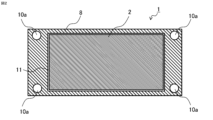
- 1 is a bottom view of a semiconductor device according to a first embodiment.
- 1 is a schematic cross-sectional view of a semiconductor module of a first comparative example.
- 1 is a schematic cross-sectional view of a semiconductor module according to a first embodiment;
- 2 is a bottom view of the flexible sheet and the semiconductor device according to the first embodiment;
- FIG. 1 is a bottom view of the semiconductor device after a flexible sheet is provided in the first embodiment.
- FIG. 3A to 3C are process diagrams of a method for manufacturing a semiconductor module according to the first embodiment.
- 1A and 1B are diagrams showing a semiconductor module according to a first embodiment in the process of being manufactured; 1A and 1B are diagrams showing a semiconductor module according to a first embodiment in the process of being manufactured; 13A and 13B are diagrams illustrating a semiconductor module of a second comparative example in the process of being manufactured. 13 is a diagram showing the semiconductor module according to the first embodiment after a third process. FIG. 13A and 13B are diagrams showing a semiconductor module according to the second embodiment in the process of being manufactured; FIG. 11 is a diagram showing the semiconductor module according to the second embodiment after a third process.
- FIGS. 13A and 13B are diagrams showing a semiconductor module according to a third embodiment in the process of being manufactured; 13A and 13B are diagrams showing a semiconductor module according to a third embodiment in the process of being manufactured; FIG. 11 is a diagram showing the semiconductor module according to the third embodiment after a third process.
- FIG. 1 is a schematic cross-sectional view of a semiconductor device 1 according to a first embodiment.
- An insulating layer 3 is disposed on the upper surface, which is the front surface, of a metal heat sink 2, a circuit electrode 4 is disposed on the upper surface of the insulating layer 3, and a semiconductor chip 5 is disposed on the upper surface of the circuit electrode 4.
- the semiconductor chip 5 is connected to a terminal 7 through the circuit electrode 4 and a wire 6.
- the semiconductor chip 5 is surrounded by a case 8, and the inside of the case 8 is filled with an insulating sealant 9 for insulation.
- the insulating sealant 9 is filled in a space surrounded by the case 8, the insulating layer 3, the circuit electrode 4, the semiconductor chip 5, and the terminal 7.
- the case 8 is formed in a frame shape surrounding the periphery of the heat sink 2 with the lower surface, which is the rear surface of the heat sink 2, exposed, and is in contact with the peripheral portion of the upper surface of the insulating layer 3 so as to surround the semiconductor chip 5.
- FIG. 2 is a bottom view of the semiconductor device 1 according to the first embodiment when viewed from the lower surface, which is the rear surface.
- the case 8 has through holes 10a for screw fixing at the four corners.
- FIG. 3 is a schematic cross-sectional view of a semiconductor module according to a first comparative example.
- the semiconductor device 1 When the semiconductor device 1 is in operation, heat generated from the semiconductor chip 5 is transferred to the heat sink 2.
- the case 8 and the heat sink 12 are fastened together with screws 13.
- the case 8 and the heat sink 12 are fastened together with screws 13.
- the contact surface between the heat sink 2 and the heat sink 12 if the contact surface between the heat sink 2 and the heat sink 12 is uneven and the contact area is small, the heat dissipation efficiency decreases. Therefore, by sandwiching a heat dissipation member 14 between the upper surface of the heat sink 12 and the lower surface of the heat sink 2, the contact area can be increased and the heat dissipation efficiency can be improved.
- the heat dissipation member 14 is, for example, heat dissipation grease, for example, silicone mixed with a filler of a material with high thermal conductivity.
- the heat dissipation member 14 is, for example, a heat dissipation sheet, for example, a resin mixed with a filler of high thermal conductivity.
- heat dissipation grease for the heat dissipation member 14.
- partial discharge may occur in the gap 11 between the side of the heat sink 2 and the case 8 due to an electric field generated between a high-voltage part such as the terminal 7 and the end of the heat sink 2.
- a high-voltage part such as the terminal 7 and the end of the heat sink 2.
- Partial discharge is a factor in insulation deterioration or a noise source, so it is necessary to suppress it.
- One method of suppressing discharge in the gap 11 between the side of the heat sink 2 and the case 8 is to fill the gap 11 with an insulating material, but this requires a process of filling the insulating material without leaving voids, which increases costs.
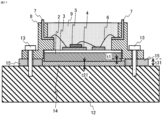
- FIG. 4 is a schematic cross-sectional view of a semiconductor module according to embodiment 1.
- the semiconductor module according to embodiment 1 shown in FIG. 4 is different from the semiconductor module according to the first comparative example shown in FIG. 3 in that a flexible sheet 15 is added.
- the flexible sheet 15 is formed in a frame shape that surrounds the periphery of the heat dissipation member 14, and is sandwiched between the top surface of the heat sink 12 and the bottom surface of the case 8 when the case 8 and the heat sink 12 are fastened together.
- the flexible sheet 15 may surround the periphery of the heat dissipation member 14 without any gaps.
- the flexible sheet 15 is made of, for example, silicone rubber and is elastic.
- FIG. 5 is a bottom view showing the flexible sheet 15 and the semiconductor device 1 before the flexible sheet 15 is installed on the semiconductor device 1.
- the lower view of FIG. 5 is a bottom view of the semiconductor device 1 as viewed from the bottom of the heat sink 2
- the upper view of FIG. 5 is a bottom view of the semiconductor device 1 as viewed from the bottom, which is the back surface of the flexible sheet 15.
- FIG. 6 is a bottom view of the flexible sheet 15 after it has been installed on the semiconductor device 1, showing the semiconductor device 1 with the flexible sheet 15 installed as viewed from the bottom of the heat sink 2.
- the heat sink 12 and the heat dissipation member 14 are not shown.
- the flexible sheet 15 is formed in a frame shape having a through hole 16 in the portion that overlaps with the heat sink 2.
- the size of the through hole 16 in the flexible sheet 15 is larger than the size of the heat sink 2 and smaller than the size of the outer periphery of the case 8.
- the inner peripheral edge of the flexible sheet 15 when viewed from the bottom surface of the heat sink 2 is located outside the outer peripheral edge of the heat sink 2 when viewed from the bottom surface of the heat sink 2.
- the flexible sheet 15 has a through hole 10b at a position corresponding to the through hole 10a of the case 8, and when the flexible sheet 15 is superimposed on the case 8, the through hole 10a and the through hole 10b become one through hole, and the case 8 and the heat sink 12 are fastened via the flexible sheet 15 by the screw 13.
- the heat dissipation member 14 is sandwiched between the upper surface of the heat sink 12 and the lower surface of the heat sink 2 at the position of the through hole 16 of the flexible sheet 15. As a result, the entire lower surface of the heat sink 2 comes into contact with the heat dissipation member 14, and a high heat dissipation effect can be obtained.
- the flexible sheet 15 is deformed when the case 8 and the heat sink 12 are fastened by the screws 13, and the flexible sheet 15 and the case 8 are in close contact with each other, and the flexible sheet 15 and the heat sink 12 are in close contact with each other. Since the peripheral portion of the upper surface of the insulating layer 3 is in close contact with the case 8, the space surrounded by the heat sink 12, the flexible sheet 15, the case 8, the heat sink 2, and the insulating layer 3 is sealed, and the heat sink 14 is surrounded by the flexible sheet 15 in the sealed space. As a result, even when heat is generated during operation of the semiconductor device 1 and the heat sink 2 is warped, the heat sink 14 does not leak out of the sealed space, and the outflow of the heat sink 14 due to pump-out is suppressed. Furthermore, since the gap 11 is a space sealed from the outside of the semiconductor module, the air pressure in the gap 11 does not decrease even in a low-pressure environment such as a high-altitude environment, and the occurrence of partial discharge in the gap 11 is suppressed.
- FIG. 7 is a process diagram of the manufacturing method of the semiconductor module according to the first embodiment, and shows a method of manufacturing a semiconductor module from the semiconductor device 1 shown in FIG. 1, the heat dissipation member 14, the flexible sheet 15, and the heat sink 12.
- the flexible sheet 15 is placed on the upper surface of the heat sink 12, and the process proceeds to the second step of step S2.
- the heat dissipation member 14 is placed on the upper surface of the heat sink 12 inside the inner circumference of the flexible sheet 15 so that the heat dissipation member 14 is surrounded by the flexible sheet 15, and the process proceeds to the third step of step S3.
- the heat dissipation member 14 is sandwiched between the heat sink 12 and the heat sink 2, and the case 8 and the heat sink 12 are fastened via the flexible sheet 15.
- FIG. 8 and 9 are diagrams showing the semiconductor module according to embodiment 1 in the middle of manufacture.
- FIG. 8 is a diagram showing the state before the heat sink 2 and the heat sink 14 come into contact before the third step
- FIG. 9 is a diagram showing the state when the heat sink 2 and the heat sink 14 come into contact before the case 8 and the heat sink 12 are fastened.
- the difference between the vertical height of the bottom surface of the heat sink 2 and the vertical height of the bottom surface of the case 8 is t1
- the vertical thickness of the heat sink 14 is t2
- the vertical thickness of the flexible sheet 15 is t3. If the heat sink 14 is heat dissipation grease, the thickness of the applied heat dissipation grease is t2.
- FIG. 10 is a diagram showing a semiconductor module of the second comparative example in the middle of manufacture. As in the semiconductor module of the second comparative example shown in FIG. 10, before the case 8 and the heat sink 12 are fastened together, if t1+t2 ⁇ t3, air remains between the heat sink 2 and the heat dissipation member 14.
- FIG. 11 is a diagram showing the semiconductor module according to embodiment 1 after the third step.
- the case 8 and the heat sink 12 are fastened together by the screws 13, so that the heat dissipation member 14 spreads laterally and the thickness of the heat dissipation member 14 decreases, the bottom surface of the case 8 and the flexible sheet 15 come into contact, and the thickness of the flexible sheet 15 is then slightly compressed, sealing the space surrounded by the heat sink 12, the flexible sheet 15, the case 8, the heat sink 2, and the insulating layer 3.
- the heat dissipation member 14 becomes thinner and spreads laterally, and when the heat dissipation member 14 comes into contact with the flexible sheet 15 and can no longer spread laterally, the screws 13 cannot be tightened any further. If excessive force is applied to the flexible sheet 15 due to the force tightening the screws 13 being too strong, a creep phenomenon may occur over the long term, and the sealing performance of the space surrounded by the heat sink 12, the flexible sheet 15, the case 8, the heat dissipation plate 2, and the insulating layer 3 may be reduced. However, in the semiconductor module according to embodiment 1, the thickness t31 of the flexible sheet 15 shown in FIG. 11 does not fall below t1+t21.
- the thickness t3 of the flexible sheet 15 before deformation and the thickness t2 of the heat dissipation member 14 before deformation are set, thereby preventing excessive force from being applied to the flexible sheet 15 and preventing the occurrence of the creep phenomenon.
- the semiconductor module according to the first embodiment includes a semiconductor device 1 including a heat sink 2, an insulating layer 3 arranged on the upper surface of the heat sink 2, a circuit electrode 4 arranged on the upper surface of the insulating layer 3, a semiconductor chip 5 arranged on the upper surface of the circuit electrode 4, a case 8 formed in a frame shape surrounding the periphery of the heat sink 2 with the lower surface of the heat sink 2 exposed and in contact with the peripheral portion of the upper surface of the insulating layer 3 so as to surround the semiconductor chip 5, a heat sink 12 fastened to the case 8, a heat dissipation member 14 sandwiched between the upper surface of the heat sink 12 and the lower surface of the heat sink 2, and a flexible sheet 15 formed in a frame shape surrounding the periphery of the heat dissipation member 14 and sandwiched between the upper surface of the heat sink 12 and the bottom surface of the case 8, and the heat sink 12 is fastened to the case 8 via the flexible sheet 15, thereby suppressing the occurrence of pump-out of the heat dis
- the width of the through hole 16 of the flexible sheet 15 is made larger than the width of the heat sink 2, that is, the inner peripheral edge of the flexible sheet 15 when viewed from the bottom surface of the heat sink 2 is located outside the outer peripheral edge of the heat sink 2 when viewed from the bottom surface of the heat sink 2.
- the narrow portion on the bottom surface of the case 8 may enter the through hole 16 of the flexible sheet 15 if the positional accuracy when attaching the case 8 to the flexible sheet 15 is low.
- the width of through hole 16 in flexible sheet 15 is made smaller than the width of heat sink 2, thereby preventing the narrow portion of the bottom surface of case 8 from entering through hole 16 in flexible sheet 15.
- FIG. 12 is a diagram showing a semiconductor module according to embodiment 2 in the middle of manufacture, and shows the state of the semiconductor device 1, the heat sink 12, the flexible sheet 15, and the heat dissipation member 14 after the first and second steps in FIG. 7 and before the third step.
- the steps of the manufacturing method of the semiconductor module according to embodiment 2 are the same as the steps of the manufacturing method of the semiconductor module according to embodiment 1 shown in FIG. 7.
- the width of the through hole 16 of the flexible sheet 15 is smaller than the width of the heat sink 2, and a part of the flexible sheet 15 overlaps with the end of the heat sink 2.
- the inner edge of the flexible sheet 15 when viewed from the bottom of the heat sink 2 is located inside the outer edge of the heat sink 2 when viewed from the bottom of the heat sink 2.
- the outer edge of the flexible sheet 15 when viewed from the bottom of the heat sink 2 is located outside the outer edge of the heat sink 2 when viewed from the bottom of the heat sink 2.
- a portion of the flexible sheet 15 near the inner edge overlaps with the edge of the heat sink 2. This makes it easy to place the case 8 on the flexible sheet 15 even if the positional accuracy when attaching the case 8 to the flexible sheet 15 is low.
- the vertical thickness t2 of the heat dissipation member 14 is smaller than the vertical thickness t3 of the flexible sheet 15 before the case 8 and the heat sink 12 are fastened together, air will remain between the heat sink 2 and the heat dissipation member 14 in the semiconductor module after the third step. Therefore, as shown in FIG. 12, before the case 8 and the heat sink 12 are fastened together with the screws 13, the vertical thickness t2 of the heat dissipation member 14 is made larger than the vertical thickness t3 of the flexible sheet 15.
- Figure 13 is a diagram showing the semiconductor module according to embodiment 2 after the third process.
- the vertical thickness of the flexible sheet 15 at the position where it is in contact with the heat sink 2 is smaller than the vertical thickness of the flexible sheet 15 at the position where it is not in contact with the heat sink 2. That is, the flexible sheet 15 of the semiconductor module according to embodiment 2 has a smaller thickness at a position inside the outer circumferential edge of the heat sink 2 than the thickness at a position outside the outer circumferential edge of the heat sink 2.
- the vertical thickness of the flexible sheet 15 at the position where it is in contact with the heat sink 2 is smaller than the vertical thickness at the position where it is in contact with the case 8.
- the volume of the heat dissipation member 14 can be made smaller than that of the semiconductor module according to embodiment 1. Also, in the semiconductor module according to embodiment 2, the space surrounded by the heat sink 12, flexible sheet 15, case 8, heat sink 2, and insulating layer 3 is sealed, suppressing the occurrence of pump-out of the heat dissipation member 14, and suppressing the occurrence of partial discharge in the gap 11 even in low-pressure environments such as high-altitude environments.
- the thickness t2 of heat dissipation member 14 is determined in accordance with the thickness t3 of flexible sheet 15. Therefore, when it is desired to reduce the thickness t2 of heat dissipation member 14, it is necessary to reduce the thickness t3 of flexible sheet 15; however, if the thickness t3 of flexible sheet 15 is made too small, it becomes impossible to maintain the airtightness between the bottom surface of case 8 and the upper surface of flexible sheet 15, and between the lower surface of flexible sheet 15 and the upper surface of heat sink 12.
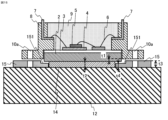
- FIG. 14 and 15 are diagrams showing a semiconductor module according to embodiment 3 in the middle of manufacture.
- FIG. 14 is a diagram showing the state before the heat sink 2 and the heat dissipation member 14 come into contact with each other before the third step
- FIG. 15 is a diagram showing the state when the heat sink 2 and the heat dissipation member 14 come into contact with each other before the case 8 and the heat sink 12 are fastened.
- the steps of the manufacturing method of the semiconductor module according to embodiment 3 are the same as the steps of the manufacturing method of the semiconductor module according to embodiment 1 shown in FIG. 7.
- the inner edge of the flexible sheet 15 when viewed from the bottom of the heat sink 2 is located inside the outer edge of the heat sink 2 when viewed from the bottom of the heat sink 2, and the outer edge of the flexible sheet 15 when viewed from the bottom of the heat sink 2 is located outside the outer edge of the heat sink 2 when viewed from the bottom of the heat sink 2.
- the vertical thickness of flexible sheet 15 at a position where it overlaps with heat sink 2 when viewed from the underside of heat sink 2 after the case 8 and the heat sink 12 are fastened together is made smaller than the vertical thickness of flexible sheet 15 at a position where it contacts the bottom surface of case 8 after the case 8 and the heat sink 12 are fastened together, and the vertical thickness of heat dissipation member 14 is made larger than the vertical thickness of flexible sheet 15 at a position where it overlaps with heat sink 2 when viewed from the underside of heat sink 2 after the case 8 and the heat sink 12 are fastened together.
- the vertical thickness of the flexible sheet 15 at the position where it will come into contact with the heat sink 2 after the case 8 and the heat sink 12 are fastened is made smaller than the vertical thickness of the flexible sheet 15 at the position where it will come into contact with the bottom surface of the case 8 after the case 8 and the heat sink 12 are fastened, and the vertical thickness of the heat dissipation member 14 is made larger than the vertical thickness of the flexible sheet 15 at the position where it will come into contact with the heat sink 2 after the case 8 and the heat sink 12 are fastened.
- the flexible sheet 15 of the semiconductor module according to the third embodiment has a stepped cross section, for example, and when the vertical thickness of the step portion 151 at the position where it will overlap with the heat sink 2 after the case 8 and the heat sink 12 are fastened is t4 before the case 8 and the heat sink 12 are fastened, "t2>t4" and "t1+t2>t3".
- the flexible sheet 15 of the semiconductor module according to embodiment 3 has a smaller vertical thickness at the position where it contacts the heat sink 2 than at the position where it contacts the case 8.
- the thickness of the heat sink member 14 can be reduced while maintaining the thickness of the flexible sheet 15 required for fastening.
- the space surrounded by the heat sink 12, flexible sheet 15, case 8, heat sink 2, and insulating layer 3 is sealed, and the thickness of the heat sink 14 can be made smaller than that of the semiconductor module according to embodiment 2. Also, for example, by aligning the position of the step portion 151 of the flexible sheet 15 with the position of the outer edge of the heat sink 2, it is possible to suppress misalignment of the installation in the third step.
Landscapes
- Physics & Mathematics (AREA)
- Thermal Sciences (AREA)
- Engineering & Computer Science (AREA)
- Microelectronics & Electronic Packaging (AREA)
- Cooling Or The Like Of Semiconductors Or Solid State Devices (AREA)
- Cooling Or The Like Of Electrical Apparatus (AREA)
Priority Applications (2)
| Application Number | Priority Date | Filing Date | Title |
|---|---|---|---|
| JP2024534281A JP7551039B1 (ja) | 2023-06-15 | 2023-06-15 | 半導体モジュールおよび半導体モジュールの製造方法 |
| PCT/JP2023/022188 WO2024257291A1 (ja) | 2023-06-15 | 2023-06-15 | 半導体モジュールおよび半導体モジュールの製造方法 |
Applications Claiming Priority (1)
| Application Number | Priority Date | Filing Date | Title |
|---|---|---|---|
| PCT/JP2023/022188 WO2024257291A1 (ja) | 2023-06-15 | 2023-06-15 | 半導体モジュールおよび半導体モジュールの製造方法 |
Publications (1)
| Publication Number | Publication Date |
|---|---|
| WO2024257291A1 true WO2024257291A1 (ja) | 2024-12-19 |
Family
ID=92676080
Family Applications (1)
| Application Number | Title | Priority Date | Filing Date |
|---|---|---|---|
| PCT/JP2023/022188 Ceased WO2024257291A1 (ja) | 2023-06-15 | 2023-06-15 | 半導体モジュールおよび半導体モジュールの製造方法 |
Country Status (2)
| Country | Link |
|---|---|
| JP (1) | JP7551039B1 (https=) |
| WO (1) | WO2024257291A1 (https=) |
Families Citing this family (1)
| Publication number | Priority date | Publication date | Assignee | Title |
|---|---|---|---|---|
| JP2026055602A (ja) * | 2024-09-18 | 2026-03-31 | 株式会社デンソー | 電子装置 |
Citations (5)
| Publication number | Priority date | Publication date | Assignee | Title |
|---|---|---|---|---|
| JP2013062506A (ja) * | 2011-09-12 | 2013-04-04 | Infineon Technologies Ag | クラッド型ベースプレートを含む半導体装置 |
| JP2015115417A (ja) * | 2013-12-10 | 2015-06-22 | 株式会社豊田自動織機 | 半導体装置および半導体装置の組付方法 |
| JP2019047049A (ja) * | 2017-09-06 | 2019-03-22 | 三菱電機株式会社 | 半導体装置 |
| JP2021022603A (ja) * | 2019-07-25 | 2021-02-18 | 三菱電機株式会社 | 半導体装置および半導体装置の製造方法 |
| JP2022018033A (ja) * | 2020-07-14 | 2022-01-26 | 富士電機株式会社 | 半導体モジュール、電力変換装置及び半導体モジュールの製造方法 |
Family Cites Families (1)
| Publication number | Priority date | Publication date | Assignee | Title |
|---|---|---|---|---|
| KR102658452B1 (ko) * | 2021-06-09 | 2024-04-17 | 주식회사 비엠씨 | 가열 접착식 적층 코어 제조 장치 |
-
2023
- 2023-06-15 JP JP2024534281A patent/JP7551039B1/ja active Active
- 2023-06-15 WO PCT/JP2023/022188 patent/WO2024257291A1/ja not_active Ceased
Patent Citations (5)
| Publication number | Priority date | Publication date | Assignee | Title |
|---|---|---|---|---|
| JP2013062506A (ja) * | 2011-09-12 | 2013-04-04 | Infineon Technologies Ag | クラッド型ベースプレートを含む半導体装置 |
| JP2015115417A (ja) * | 2013-12-10 | 2015-06-22 | 株式会社豊田自動織機 | 半導体装置および半導体装置の組付方法 |
| JP2019047049A (ja) * | 2017-09-06 | 2019-03-22 | 三菱電機株式会社 | 半導体装置 |
| JP2021022603A (ja) * | 2019-07-25 | 2021-02-18 | 三菱電機株式会社 | 半導体装置および半導体装置の製造方法 |
| JP2022018033A (ja) * | 2020-07-14 | 2022-01-26 | 富士電機株式会社 | 半導体モジュール、電力変換装置及び半導体モジュールの製造方法 |
Also Published As
| Publication number | Publication date |
|---|---|
| JPWO2024257291A1 (https=) | 2024-12-19 |
| JP7551039B1 (ja) | 2024-09-13 |
Similar Documents
| Publication | Publication Date | Title |
|---|---|---|
| US7902653B2 (en) | Semiconductor module | |
| US9721861B2 (en) | Semiconductor device | |
| US8637979B2 (en) | Semiconductor device | |
| JP6093455B2 (ja) | 半導体モジュール | |
| CN108292655B (zh) | 功率模块 | |
| US20140367842A1 (en) | Power semiconductor device and method of manufacturing the same | |
| US12489031B2 (en) | Semiconductor device and manufacturing method thereof | |
| JP7551039B1 (ja) | 半導体モジュールおよび半導体モジュールの製造方法 | |
| US6774468B2 (en) | Power semiconductor device | |
| JP4046623B2 (ja) | パワー半導体モジュールおよびその固定方法 | |
| US12033916B2 (en) | Semiconductor device and semiconductor module with improved heat dissipation | |
| JP3126297B2 (ja) | 樹脂封止型半導体装置 | |
| JP2023127609A (ja) | 半導体装置 | |
| CN219658693U (zh) | 一种功率半导体模块 | |
| JP4150324B2 (ja) | パワー半導体モジュール | |
| WO2021261056A1 (ja) | パワーモジュール | |
| US20240282668A1 (en) | Protection dam for a power module with spacers | |
| JP7771709B2 (ja) | 実装基板、及び実装基板を搭載した電気機器 | |
| US20240282664A1 (en) | Semiconductor device and method of manufacturing semiconductor device | |
| JP7192998B2 (ja) | 半導体装置 | |
| CN111033723A (zh) | 功率半导体模块 | |
| JP2025138291A (ja) | 半導体装置及びヒートシンク | |
| JP2025006030A (ja) | 半導体装置 | |
| WO2024232094A1 (ja) | 半導体装置 | |
| JP2022142594A (ja) | 電力変換装置 |
Legal Events
| Date | Code | Title | Description |
|---|---|---|---|
| WWE | Wipo information: entry into national phase |
Ref document number: 2024534281 Country of ref document: JP |
|
| 121 | Ep: the epo has been informed by wipo that ep was designated in this application |
Ref document number: 23941595 Country of ref document: EP Kind code of ref document: A1 |
|
| NENP | Non-entry into the national phase |
Ref country code: DE |