WO2024257277A1 - 光モジュール - Google Patents
光モジュール Download PDFInfo
- Publication number
- WO2024257277A1 WO2024257277A1 PCT/JP2023/022126 JP2023022126W WO2024257277A1 WO 2024257277 A1 WO2024257277 A1 WO 2024257277A1 JP 2023022126 W JP2023022126 W JP 2023022126W WO 2024257277 A1 WO2024257277 A1 WO 2024257277A1
- Authority
- WO
- WIPO (PCT)
- Prior art keywords
- optical
- semiconductor chip
- optical semiconductor
- stress relief
- relief groove
- Prior art date
- Legal status (The legal status is an assumption and is not a legal conclusion. Google has not performed a legal analysis and makes no representation as to the accuracy of the status listed.)
- Ceased
Links
Images



Classifications
-
- H—ELECTRICITY
- H01—ELECTRIC ELEMENTS
- H01S—DEVICES USING THE PROCESS OF LIGHT AMPLIFICATION BY STIMULATED EMISSION OF RADIATION [LASER] TO AMPLIFY OR GENERATE LIGHT; DEVICES USING STIMULATED EMISSION OF ELECTROMAGNETIC RADIATION IN WAVE RANGES OTHER THAN OPTICAL
- H01S5/00—Semiconductor lasers
- H01S5/20—Structure or shape of the semiconductor body to guide the optical wave ; Confining structures perpendicular to the optical axis, e.g. index or gain guiding, stripe geometry, broad area lasers, gain tailoring, transverse or lateral reflectors, special cladding structures, MQW barrier reflection layers
- H01S5/22—Structure or shape of the semiconductor body to guide the optical wave ; Confining structures perpendicular to the optical axis, e.g. index or gain guiding, stripe geometry, broad area lasers, gain tailoring, transverse or lateral reflectors, special cladding structures, MQW barrier reflection layers having a ridge or stripe structure
- H01S5/227—Buried mesa structure ; Striped active layer
-
- H—ELECTRICITY
- H01—ELECTRIC ELEMENTS
- H01S—DEVICES USING THE PROCESS OF LIGHT AMPLIFICATION BY STIMULATED EMISSION OF RADIATION [LASER] TO AMPLIFY OR GENERATE LIGHT; DEVICES USING STIMULATED EMISSION OF ELECTROMAGNETIC RADIATION IN WAVE RANGES OTHER THAN OPTICAL
- H01S5/00—Semiconductor lasers
- H01S5/02—Structural details or components not essential to laser action
- H01S5/022—Mountings; Housings
- H01S5/0233—Mounting configuration of laser chips
- H01S5/0234—Up-side down mountings, e.g. Flip-chip, epi-side down mountings or junction down mountings
-
- H—ELECTRICITY
- H01—ELECTRIC ELEMENTS
- H01S—DEVICES USING THE PROCESS OF LIGHT AMPLIFICATION BY STIMULATED EMISSION OF RADIATION [LASER] TO AMPLIFY OR GENERATE LIGHT; DEVICES USING STIMULATED EMISSION OF ELECTROMAGNETIC RADIATION IN WAVE RANGES OTHER THAN OPTICAL
- H01S5/00—Semiconductor lasers
- H01S5/02—Structural details or components not essential to laser action
- H01S5/022—Mountings; Housings
- H01S5/0233—Mounting configuration of laser chips
- H01S5/02345—Wire-bonding
-
- H—ELECTRICITY
- H01—ELECTRIC ELEMENTS
- H01S—DEVICES USING THE PROCESS OF LIGHT AMPLIFICATION BY STIMULATED EMISSION OF RADIATION [LASER] TO AMPLIFY OR GENERATE LIGHT; DEVICES USING STIMULATED EMISSION OF ELECTROMAGNETIC RADIATION IN WAVE RANGES OTHER THAN OPTICAL
- H01S5/00—Semiconductor lasers
- H01S5/02—Structural details or components not essential to laser action
- H01S5/022—Mountings; Housings
- H01S5/0235—Method for mounting laser chips
- H01S5/02355—Fixing laser chips on mounts
- H01S5/0237—Fixing laser chips on mounts by soldering
-
- H—ELECTRICITY
- H01—ELECTRIC ELEMENTS
- H01S—DEVICES USING THE PROCESS OF LIGHT AMPLIFICATION BY STIMULATED EMISSION OF RADIATION [LASER] TO AMPLIFY OR GENERATE LIGHT; DEVICES USING STIMULATED EMISSION OF ELECTROMAGNETIC RADIATION IN WAVE RANGES OTHER THAN OPTICAL
- H01S5/00—Semiconductor lasers
- H01S5/02—Structural details or components not essential to laser action
- H01S5/026—Monolithically integrated components, e.g. waveguides, monitoring photo-detectors, drivers
- H01S5/0265—Intensity modulators
-
- H—ELECTRICITY
- H01—ELECTRIC ELEMENTS
- H01S—DEVICES USING THE PROCESS OF LIGHT AMPLIFICATION BY STIMULATED EMISSION OF RADIATION [LASER] TO AMPLIFY OR GENERATE LIGHT; DEVICES USING STIMULATED EMISSION OF ELECTROMAGNETIC RADIATION IN WAVE RANGES OTHER THAN OPTICAL
- H01S5/00—Semiconductor lasers
- H01S5/04—Processes or apparatus for excitation, e.g. pumping, e.g. by electron beams
- H01S5/042—Electrical excitation ; Circuits therefor
- H01S5/0425—Electrodes, e.g. characterised by the structure
- H01S5/04252—Electrodes, e.g. characterised by the structure characterised by the material
-
- H—ELECTRICITY
- H01—ELECTRIC ELEMENTS
- H01S—DEVICES USING THE PROCESS OF LIGHT AMPLIFICATION BY STIMULATED EMISSION OF RADIATION [LASER] TO AMPLIFY OR GENERATE LIGHT; DEVICES USING STIMULATED EMISSION OF ELECTROMAGNETIC RADIATION IN WAVE RANGES OTHER THAN OPTICAL
- H01S5/00—Semiconductor lasers
- H01S5/04—Processes or apparatus for excitation, e.g. pumping, e.g. by electron beams
- H01S5/042—Electrical excitation ; Circuits therefor
- H01S5/0425—Electrodes, e.g. characterised by the structure
- H01S5/04254—Electrodes, e.g. characterised by the structure characterised by the shape
-
- H—ELECTRICITY
- H01—ELECTRIC ELEMENTS
- H01S—DEVICES USING THE PROCESS OF LIGHT AMPLIFICATION BY STIMULATED EMISSION OF RADIATION [LASER] TO AMPLIFY OR GENERATE LIGHT; DEVICES USING STIMULATED EMISSION OF ELECTROMAGNETIC RADIATION IN WAVE RANGES OTHER THAN OPTICAL
- H01S5/00—Semiconductor lasers
- H01S5/04—Processes or apparatus for excitation, e.g. pumping, e.g. by electron beams
- H01S5/042—Electrical excitation ; Circuits therefor
- H01S5/0425—Electrodes, e.g. characterised by the structure
- H01S5/04256—Electrodes, e.g. characterised by the structure characterised by the configuration
-
- H—ELECTRICITY
- H01—ELECTRIC ELEMENTS
- H01S—DEVICES USING THE PROCESS OF LIGHT AMPLIFICATION BY STIMULATED EMISSION OF RADIATION [LASER] TO AMPLIFY OR GENERATE LIGHT; DEVICES USING STIMULATED EMISSION OF ELECTROMAGNETIC RADIATION IN WAVE RANGES OTHER THAN OPTICAL
- H01S5/00—Semiconductor lasers
- H01S5/04—Processes or apparatus for excitation, e.g. pumping, e.g. by electron beams
- H01S5/042—Electrical excitation ; Circuits therefor
- H01S5/0425—Electrodes, e.g. characterised by the structure
- H01S5/04256—Electrodes, e.g. characterised by the structure characterised by the configuration
- H01S5/04257—Electrodes, e.g. characterised by the structure characterised by the configuration having positive and negative electrodes on the same side of the substrate
-
- H—ELECTRICITY
- H01—ELECTRIC ELEMENTS
- H01S—DEVICES USING THE PROCESS OF LIGHT AMPLIFICATION BY STIMULATED EMISSION OF RADIATION [LASER] TO AMPLIFY OR GENERATE LIGHT; DEVICES USING STIMULATED EMISSION OF ELECTROMAGNETIC RADIATION IN WAVE RANGES OTHER THAN OPTICAL
- H01S5/00—Semiconductor lasers
- H01S5/10—Construction or shape of the optical resonator, e.g. extended or external cavity, coupled cavities, bent-guide, varying width, thickness or composition of the active region
- H01S5/1082—Construction or shape of the optical resonator, e.g. extended or external cavity, coupled cavities, bent-guide, varying width, thickness or composition of the active region with a special facet structure, e.g. structured, non planar, oblique
- H01S5/1085—Oblique facets
-
- H—ELECTRICITY
- H01—ELECTRIC ELEMENTS
- H01S—DEVICES USING THE PROCESS OF LIGHT AMPLIFICATION BY STIMULATED EMISSION OF RADIATION [LASER] TO AMPLIFY OR GENERATE LIGHT; DEVICES USING STIMULATED EMISSION OF ELECTROMAGNETIC RADIATION IN WAVE RANGES OTHER THAN OPTICAL
- H01S5/00—Semiconductor lasers
- H01S5/10—Construction or shape of the optical resonator, e.g. extended or external cavity, coupled cavities, bent-guide, varying width, thickness or composition of the active region
- H01S5/12—Construction or shape of the optical resonator, e.g. extended or external cavity, coupled cavities, bent-guide, varying width, thickness or composition of the active region the resonator having a periodic structure, e.g. in distributed feedback [DFB] lasers
-
- H—ELECTRICITY
- H01—ELECTRIC ELEMENTS
- H01S—DEVICES USING THE PROCESS OF LIGHT AMPLIFICATION BY STIMULATED EMISSION OF RADIATION [LASER] TO AMPLIFY OR GENERATE LIGHT; DEVICES USING STIMULATED EMISSION OF ELECTROMAGNETIC RADIATION IN WAVE RANGES OTHER THAN OPTICAL
- H01S5/00—Semiconductor lasers
- H01S5/20—Structure or shape of the semiconductor body to guide the optical wave ; Confining structures perpendicular to the optical axis, e.g. index or gain guiding, stripe geometry, broad area lasers, gain tailoring, transverse or lateral reflectors, special cladding structures, MQW barrier reflection layers
- H01S5/22—Structure or shape of the semiconductor body to guide the optical wave ; Confining structures perpendicular to the optical axis, e.g. index or gain guiding, stripe geometry, broad area lasers, gain tailoring, transverse or lateral reflectors, special cladding structures, MQW barrier reflection layers having a ridge or stripe structure
-
- H—ELECTRICITY
- H01—ELECTRIC ELEMENTS
- H01S—DEVICES USING THE PROCESS OF LIGHT AMPLIFICATION BY STIMULATED EMISSION OF RADIATION [LASER] TO AMPLIFY OR GENERATE LIGHT; DEVICES USING STIMULATED EMISSION OF ELECTROMAGNETIC RADIATION IN WAVE RANGES OTHER THAN OPTICAL
- H01S2301/00—Functional characteristics
- H01S2301/17—Semiconductor lasers comprising special layers
- H01S2301/176—Specific passivation layers on surfaces other than the emission facet
Definitions
- This disclosure relates to an optical module.
- Non-Patent Document 1 discloses a distributed feedback (DFB) laser chip with both p-type and n-type electrodes arranged on the top surface of the chip.
- the chip is flip-chip mounted on a subcarrier, and an underfill material is poured into the gap between the subcarrier and the chip to fix the chip and form an optical module.
- the underfill material prevents breakage of the electrode junction caused by stress due to differences in the thermal expansion coefficient between the chip and the subcarrier.
- bonding methods such as soldering, conductive adhesives, and ultrasonic bonding are used to electrically bond the chip to the subcarrier.
- bonding is performed at high temperatures, and when the temperature is then returned to room temperature, the bond between the chip and the subcarrier may shrink and generate stress. This poses the problem that the stress generated at the bond may cause changes in the chip characteristics, such as a shift in the laser oscillation wavelength.
- This disclosure has been made in consideration of the above problems. Its purpose is to provide an optical module in which fluctuations in chip characteristics are suppressed when the chip is electrically joined to a subcarrier.
- an optical module comprises an optical semiconductor chip, a subcarrier, and an electrode junction that electrically connects the optical semiconductor chip and the subcarrier.
- the optical semiconductor chip comprises an optical waveguide, a first stress relief groove and a second stress relief groove that are arranged along the optical waveguide so as to sandwich the optical waveguide when viewed from above the optical semiconductor chip, and a p-type electrode and an n-type electrode that are arranged on either side of the first stress relief groove and the second stress relief groove.
- the electrode junction connects to the p-type electrode and the n-type electrode, and the first stress relief groove and the second stress relief groove are each deeper than the core portion of the optical waveguide.
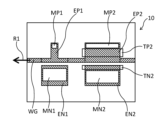
- FIG. 1 is a top view of an optical semiconductor chip included in an optical module according to a first embodiment of the present disclosure.
- FIG. 2 is a cross-sectional view of the optical semiconductor chip of FIG. 1 taken along line AA.
- FIG. 3 is a layout diagram of electrode junctions for the optical semiconductor chip of FIG.
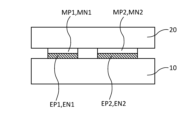
- FIG. 4 is a side view of the optical module according to the first embodiment of the present disclosure.
- FIG. 5 is a top view of an optical semiconductor chip included in an optical module according to the second embodiment of the present disclosure.
- Fig. 1 is a top view of an optical semiconductor chip included in an optical module according to a first embodiment of the present disclosure.
- Fig. 2 is a cross-sectional view of the optical semiconductor chip of Fig. 1 taken along line A-A.
- Fig. 3 is a layout diagram of electrode bonding parts for the optical semiconductor chip of Fig. 1.
- Fig. 4 is a side view of the optical module according to the first embodiment of the present disclosure.
- the optical module includes an optical semiconductor chip 10, a subcarrier 20, and an electrode bonding part.
- the optical semiconductor chip 10 is at least one of a directly modulated DFB laser chip and an electroabsorption optical modulator integrated laser chip.
- the optical semiconductor chip 10 is a chip created on an indium phosphide (InP) substrate.
- Light output from the optical semiconductor chip 10 (output light R1) is introduced into a lightwave circuit (not shown).
- the optical semiconductor chip 10 is not limited to the examples given here.
- the subcarrier 20 incorporates wiring for supplying power to the optical semiconductor chip 10, or wiring for transmitting signals from the optical semiconductor chip 10.
- the subcarrier 20 has an aluminum nitride substrate and a gold wiring pattern.
- the subcarrier 20 is not limited to the examples given here.
- the thermal expansion coefficient of the subcarrier 20 and the thermal expansion coefficient of the optical semiconductor chip 10 may be equal. This prevents breakage of the electrode junction caused by stress due to the difference in the thermal expansion coefficient between the optical semiconductor chip 10 and the subcarrier 20.
- the optical semiconductor chip 10 includes an optical waveguide WG, a stress relief groove TP2 (first stress relief groove), a stress relief groove TN2 (second stress relief groove), p-type electrodes EP1, EP2, and n-type electrodes EN1, EN2.
- the stress relief grooves TP2, TN2 are arranged along the optical waveguide WG so as to sandwich the optical waveguide WG when viewed from above the optical semiconductor chip 10.
- the stress relief grooves TP2, TN2 are arranged along the extension direction of the optical waveguide WG.
- the stress relief groove TP2 may also serve as a groove for drawing out the p-type electrode EP2.
- the stress relief groove TN2 may also serve as a groove for drawing out the n-type electrode EN2.
- the p-type electrode EP2 is disposed on the upper surface of the optical semiconductor chip 10, on the side opposite the optical waveguide WG, across the stress relief groove TP2.
- the n-type electrode EN2 is disposed on the upper surface of the optical semiconductor chip 10, on the side opposite the optical waveguide WG, across the stress relief groove TN2.
- the n-type electrode EN2, stress relief groove TN2, optical waveguide WG, stress relief groove TP2, and p-type electrode EP2 are arranged in that order.
- the optical waveguide WG has a core portion CR, and both side surfaces of the core portion CR are filled with a semi-insulating semiconductor SR.
- the p-type electrodes EP1, EP2 and the n-type electrodes EN1, EN2 are electrically connected to wiring built into the subcarrier 20 via electrode junctions.
- the electrode junctions are at least one of solder, conductive adhesive, and metal.
- a conductive adhesive is applied to these electrodes of the optical semiconductor chip 10, and the optical semiconductor chip 10 is flip-chip mounted on the subcarrier 20.
- the p-type electrodes EP1, EP2 and the n-type electrodes EN1, EN2 are electrically connected to wiring built into the subcarrier 20.
- electrical connections may also be obtained using solder, metal, or ultrasonic bonding.
- the stress relief grooves TP2, TN2 are each formed deeper than the core portion CR of the optical waveguide WG. Also, compared to the laser portion (not shown) of the optical semiconductor chip 10, the stress relief grooves TP2, TN2 are formed longer along the extension direction of the optical waveguide WG.
- an optical semiconductor chip 10 that does not have the stress relief grooves TP2, TN2 was prepared as a comparative example.
- the optical semiconductor chip 10 shown in Figures 1 and 2 was then compared with the comparative example.
- the optical semiconductor chip 10 was an electroabsorption type optical modulator integrated laser chip, and was fabricated on an InP substrate.
- the subcarrier 20 had an aluminum nitride substrate. Gold-tin solder was used for the electrode junctions.
- the optical semiconductor chip 10 was mounted so that its top surface, on which the electrodes are located, was in contact with the wiring side of the subcarrier 20, and the optical module was assembled by heating it to 320 degrees, which is above the melting point of the gold-tin solder, and holding it there for about 30 seconds, and then cooling it to room temperature.
- the oscillation wavelength of the optical semiconductor chip 10 shown in Figures 1 and 2 was measured before mounting on the subcarrier 20
- the oscillation wavelength was 1308.1 nm at a chip temperature of 25 degrees and a laser current value of 100 mA.
- the oscillation wavelength was 1308.3 nm under the same operating conditions. In other words, the deviation in the oscillation wavelength was 0.2 nm.
- the oscillation wavelength of the comparative example when the oscillation wavelength of the comparative example was measured before mounting on the subcarrier 20, the oscillation wavelength was 1306.5 nm at a chip temperature of 25 degrees and a laser current value of 100 mA. Furthermore, when the oscillation wavelength was measured after mounting on the subcarrier 20, the oscillation wavelength was 1305.0 nm under the same operating conditions. In other words, the deviation in the oscillation wavelength was 1.5 nm.
- the optical semiconductor chip and optical module of this embodiment are able to suppress fluctuations in the oscillation wavelength caused by stress.
- FIG. 5 is a top view of an optical semiconductor chip included in an optical module according to a second embodiment of the present disclosure.
- the optical semiconductor chip included in the optical module according to the present embodiment further includes a stress relief groove TP1 (first stress relief groove) and a stress relief groove TN1 (second stress relief groove).
- the stress relief groove TP1 may also serve as a groove for drawing out the p-type electrode EP1.
- the stress relief groove TN1 may also serve as a groove for drawing out the n-type electrode EN1.
- an optical semiconductor chip that does not have the stress relief grooves TP1, TN1 was prepared as a comparative example. Then, the optical semiconductor chip 10 shown in FIG. 5 was compared with the comparative example.
- the optical semiconductor chip 10 was an electroabsorption type optical modulator integrated laser chip, and was fabricated on an InP substrate.
- the subcarrier 20 had an aluminum nitride substrate. Gold bumps and conductive adhesive were used for the electrode junctions.
- the optical semiconductor chip 10 After applying the conductive adhesive to the wiring surface of the subcarrier 20, the optical semiconductor chip 10 was mounted so that the top surface on which the electrodes are arranged was in contact with the wiring surface of the subcarrier 20. After that, it was held at 150 degrees, the hardening temperature of the conductive adhesive, for about 20 minutes, and then cooled to assemble the optical module.
- the oscillation wavelength of the optical semiconductor chip 10 shown in FIG. 5 was measured before mounting on the subcarrier 20
- the oscillation wavelength was 1550.4 nm at a chip temperature of 25 degrees and a laser current value of 120 mA.
- the oscillation wavelength was measured after mounting on the subcarrier 20
- the oscillation wavelength was 1550.7 nm under the same operating conditions. In other words, the deviation in the oscillation wavelength was 0.3 nm.
- the oscillation wavelength of the comparative example when the oscillation wavelength of the comparative example was measured before mounting on the subcarrier 20, the oscillation wavelength was 1545.5 nm at a chip temperature of 25 degrees and a laser current value of 120 mA. Furthermore, when the oscillation wavelength was measured after mounting on the subcarrier 20, the oscillation wavelength was 1546.9 nm under the same operating conditions. In other words, the deviation in the oscillation wavelength was 1.4 nm.
- the optical semiconductor chip and optical module of this embodiment are able to suppress fluctuations in the oscillation wavelength caused by stress.
- the difference in optical output power of the optical semiconductor chip 10 shown in Figure 5 was 12.0 dB. After mounting on the subcarrier 20, under the same operating conditions, the difference in optical output power was 11.9 dB.
- the chip temperature was 25 degrees
- the laser current was 120 mA
- the optical output power was measured at EA modulator bias voltages of 0 V and -2.5 V.
- the difference in optical output power was 13.0 dB.
- the difference in optical output power was 14.0 dB under the same operating conditions.
- the optical semiconductor chip and optical module of this embodiment are able to suppress fluctuations in the extinction characteristics of the EA modulator caused by stress.
- the optical module according to the present embodiment includes an optical semiconductor chip, a subcarrier, and an electrode junction that electrically connects the optical semiconductor chip and the subcarrier.
- the optical semiconductor chip includes an optical waveguide, a first stress relief groove and a second stress relief groove that are arranged along the optical waveguide so as to sandwich the optical waveguide when viewed from above the optical semiconductor chip, a p-type electrode that is arranged on the upper surface of the optical semiconductor chip on the opposite side to the optical waveguide across the first stress relief groove, and an n-type electrode that is arranged on the upper surface of the optical semiconductor chip on the opposite side to the optical waveguide across the second stress relief groove.
- the electrode junction is connected to the p-type electrode and the n-type electrode, and the first stress relief groove and the second stress relief groove are each deeper than a core portion of the optical waveguide.
- the optical semiconductor chip may further include a laser section, and the first stress relief groove and the second stress relief groove may each be longer than the laser section. This prevents stress generated at the electrode junction from being transmitted to the laser section. As a result, deviations in the laser oscillation wavelength are suppressed.
- the optical semiconductor chip is at least one of a directly modulated DFB laser chip and an electroabsorption optical modulator integrated laser chip, which improves the high frequency characteristics and increases the wavelength stability in the directly modulated DFB laser chip and the electroabsorption optical modulator integrated laser chip.
- both side surfaces of the core may be filled with a semi-insulating semiconductor. This insulates the core from the p-type electrode and n-type electrode that are arranged nearby. As a result, fluctuations in the characteristics of the core are suppressed.
- the p-type electrode and the n-type electrode are electrically connected to the wiring built into the subcarrier via the electrode junction, and the electrode junction may be at least one of solder, conductive adhesive, and metal. This ensures electrical connection between the electrodes of the optical semiconductor chip 10 and the wiring built into the subcarrier.
- the thermal expansion coefficient of the subcarrier and the thermal expansion coefficient of the optical semiconductor chip may be equal. This suppresses stress caused by the difference in thermal expansion coefficient between the optical semiconductor chip and the subcarrier when the optical semiconductor chip is mounted on the subcarrier. As a result, breakage of the electrode joint between the optical semiconductor chip and the subcarrier is suppressed.
Landscapes
- Physics & Mathematics (AREA)
- Condensed Matter Physics & Semiconductors (AREA)
- General Physics & Mathematics (AREA)
- Electromagnetism (AREA)
- Optics & Photonics (AREA)
- Geometry (AREA)
- Optical Modulation, Optical Deflection, Nonlinear Optics, Optical Demodulation, Optical Logic Elements (AREA)
Priority Applications (4)
| Application Number | Priority Date | Filing Date | Title |
|---|---|---|---|
| EP23941581.3A EP4730576A1 (en) | 2023-06-14 | 2023-06-14 | Optical module |
| PCT/JP2023/022126 WO2024257277A1 (ja) | 2023-06-14 | 2023-06-14 | 光モジュール |
| CN202380099281.8A CN121336331A (zh) | 2023-06-14 | 2023-06-14 | 光模块 |
| JP2025527007A JPWO2024257277A1 (https=) | 2023-06-14 | 2023-06-14 |
Applications Claiming Priority (1)
| Application Number | Priority Date | Filing Date | Title |
|---|---|---|---|
| PCT/JP2023/022126 WO2024257277A1 (ja) | 2023-06-14 | 2023-06-14 | 光モジュール |
Publications (1)
| Publication Number | Publication Date |
|---|---|
| WO2024257277A1 true WO2024257277A1 (ja) | 2024-12-19 |
Family
ID=93851523
Family Applications (1)
| Application Number | Title | Priority Date | Filing Date |
|---|---|---|---|
| PCT/JP2023/022126 Ceased WO2024257277A1 (ja) | 2023-06-14 | 2023-06-14 | 光モジュール |
Country Status (4)
| Country | Link |
|---|---|
| EP (1) | EP4730576A1 (https=) |
| JP (1) | JPWO2024257277A1 (https=) |
| CN (1) | CN121336331A (https=) |
| WO (1) | WO2024257277A1 (https=) |
Citations (3)
| Publication number | Priority date | Publication date | Assignee | Title |
|---|---|---|---|---|
| JPH07135369A (ja) * | 1993-11-11 | 1995-05-23 | Nippon Telegr & Teleph Corp <Ntt> | 半導体レーザおよびその製造方法 |
| JPH09162484A (ja) * | 1995-12-11 | 1997-06-20 | Oki Electric Ind Co Ltd | プレーナ電極型半導体光素子及びその製造方法 |
| JP2003264334A (ja) * | 2002-03-08 | 2003-09-19 | Hitachi Ltd | 半導体レーザ素子及び半導体レーザモジュール |
-
2023
- 2023-06-14 JP JP2025527007A patent/JPWO2024257277A1/ja active Pending
- 2023-06-14 WO PCT/JP2023/022126 patent/WO2024257277A1/ja not_active Ceased
- 2023-06-14 EP EP23941581.3A patent/EP4730576A1/en active Pending
- 2023-06-14 CN CN202380099281.8A patent/CN121336331A/zh active Pending
Patent Citations (3)
| Publication number | Priority date | Publication date | Assignee | Title |
|---|---|---|---|---|
| JPH07135369A (ja) * | 1993-11-11 | 1995-05-23 | Nippon Telegr & Teleph Corp <Ntt> | 半導体レーザおよびその製造方法 |
| JPH09162484A (ja) * | 1995-12-11 | 1997-06-20 | Oki Electric Ind Co Ltd | プレーナ電極型半導体光素子及びその製造方法 |
| JP2003264334A (ja) * | 2002-03-08 | 2003-09-19 | Hitachi Ltd | 半導体レーザ素子及び半導体レーザモジュール |
Non-Patent Citations (1)
| Title |
|---|
| A. MARININS: "Wafer-Scale Hybrid Integration of InP DFB Lasers on Si Photonics by Flip-Chip Bonding With sub-300 nm Alignment Precision", J OF SEL. IN QUANTUM ELECTRONICS, vol. 29, no. 3, pages 8200311 |
Also Published As
| Publication number | Publication date |
|---|---|
| EP4730576A1 (en) | 2026-04-22 |
| CN121336331A (zh) | 2026-01-13 |
| JPWO2024257277A1 (https=) | 2024-12-19 |
Similar Documents
| Publication | Publication Date | Title |
|---|---|---|
| JP5728964B2 (ja) | 光半導体装置及びその製造方法 | |
| JP6723451B2 (ja) | 波長可変レーザ装置および波長可変レーザ装置の製造方法 | |
| US11934007B2 (en) | Assembly of an active semiconductor component and of a silicon-based passive optical component | |
| JP6984801B1 (ja) | 半導体レーザ光源装置 | |
| JP2002314184A (ja) | 光半導体モジュール | |
| JP7020590B1 (ja) | レーザ光源装置 | |
| Li et al. | A novel hybrid photonic integration scheme based on flip-chip bonding combined with vertical coupling | |
| JP2011192878A (ja) | 半導体レーザー装置 | |
| WO2024257277A1 (ja) | 光モジュール | |
| JP2012222336A (ja) | 半導体レーザモジュール及びその製造方法 | |
| JP2017107920A (ja) | 半導体レーザ及び光半導体モジュール | |
| JP2006072171A (ja) | 光モジュール | |
| TWI699571B (zh) | 光傳輸裝置 | |
| JP2002031731A (ja) | ハイブリッド光集積回路 | |
| US20250383577A1 (en) | Optical device and optical transmission apparatus using the same | |
| KR102075764B1 (ko) | 이종 광 집적회로 및 이의 제조 방법 | |
| JP5759401B2 (ja) | 多チャネル光送信モジュールおよびその作製方法 | |
| JP7635886B2 (ja) | 半導体レーザ光源装置 | |
| WO2024257276A1 (ja) | 光モジュール | |
| CN111308739B (zh) | 光学调制器 | |
| US20260126675A1 (en) | Optical Transmitter | |
| JP7246590B1 (ja) | 半導体レーザ光源装置 | |
| JP7778551B2 (ja) | 集積型半導体光素子 | |
| US20260003121A1 (en) | Photonic integrated circuits with aligned photonic dies | |
| WO2026062918A1 (ja) | 光送信モジュール |
Legal Events
| Date | Code | Title | Description |
|---|---|---|---|
| 121 | Ep: the epo has been informed by wipo that ep was designated in this application |
Ref document number: 23941581 Country of ref document: EP Kind code of ref document: A1 |
|
| ENP | Entry into the national phase |
Ref document number: 2025527007 Country of ref document: JP Kind code of ref document: A |
|
| WWE | Wipo information: entry into national phase |
Ref document number: 2025527007 Country of ref document: JP |
|
| WWE | Wipo information: entry into national phase |
Ref document number: 2023941581 Country of ref document: EP |
|
| NENP | Non-entry into the national phase |
Ref country code: DE |
|
| ENP | Entry into the national phase |
Ref document number: 2023941581 Country of ref document: EP Effective date: 20260114 |
|
| ENP | Entry into the national phase |
Ref document number: 2023941581 Country of ref document: EP Effective date: 20260114 |
|
| ENP | Entry into the national phase |
Ref document number: 2023941581 Country of ref document: EP Effective date: 20260114 |
|
| ENP | Entry into the national phase |
Ref document number: 2023941581 Country of ref document: EP Effective date: 20260114 |
|
| WWP | Wipo information: published in national office |
Ref document number: 2023941581 Country of ref document: EP |