WO2024253162A1 - 非水電解液二次電池用電解液、及びこれを用いた非水電解液二次電池 - Google Patents
非水電解液二次電池用電解液、及びこれを用いた非水電解液二次電池 Download PDFInfo
- Publication number
- WO2024253162A1 WO2024253162A1 PCT/JP2024/020724 JP2024020724W WO2024253162A1 WO 2024253162 A1 WO2024253162 A1 WO 2024253162A1 JP 2024020724 W JP2024020724 W JP 2024020724W WO 2024253162 A1 WO2024253162 A1 WO 2024253162A1
- Authority
- WO
- WIPO (PCT)
- Prior art keywords
- group
- nonaqueous electrolyte
- lithium
- sodium
- carbonate
- Prior art date
- Legal status (The legal status is an assumption and is not a legal conclusion. Google has not performed a legal analysis and makes no representation as to the accuracy of the status listed.)
- Ceased
Links
Classifications
-
- H—ELECTRICITY
- H01—ELECTRIC ELEMENTS
- H01M—PROCESSES OR MEANS, e.g. BATTERIES, FOR THE DIRECT CONVERSION OF CHEMICAL ENERGY INTO ELECTRICAL ENERGY
- H01M10/00—Secondary cells; Manufacture thereof
- H01M10/05—Accumulators with non-aqueous electrolyte
- H01M10/056—Accumulators with non-aqueous electrolyte characterised by the materials used as electrolytes, e.g. mixed inorganic/organic electrolytes
- H01M10/0564—Accumulators with non-aqueous electrolyte characterised by the materials used as electrolytes, e.g. mixed inorganic/organic electrolytes the electrolyte being constituted of organic materials only
- H01M10/0566—Liquid materials
- H01M10/0567—Liquid materials characterised by the additives
-
- H—ELECTRICITY
- H01—ELECTRIC ELEMENTS
- H01M—PROCESSES OR MEANS, e.g. BATTERIES, FOR THE DIRECT CONVERSION OF CHEMICAL ENERGY INTO ELECTRICAL ENERGY
- H01M10/00—Secondary cells; Manufacture thereof
- H01M10/05—Accumulators with non-aqueous electrolyte
- H01M10/052—Li-accumulators
- H01M10/0525—Rocking-chair batteries, i.e. batteries with lithium insertion or intercalation in both electrodes; Lithium-ion batteries
-
- H—ELECTRICITY
- H01—ELECTRIC ELEMENTS
- H01M—PROCESSES OR MEANS, e.g. BATTERIES, FOR THE DIRECT CONVERSION OF CHEMICAL ENERGY INTO ELECTRICAL ENERGY
- H01M10/00—Secondary cells; Manufacture thereof
- H01M10/05—Accumulators with non-aqueous electrolyte
- H01M10/056—Accumulators with non-aqueous electrolyte characterised by the materials used as electrolytes, e.g. mixed inorganic/organic electrolytes
- H01M10/0564—Accumulators with non-aqueous electrolyte characterised by the materials used as electrolytes, e.g. mixed inorganic/organic electrolytes the electrolyte being constituted of organic materials only
- H01M10/0566—Liquid materials
- H01M10/0568—Liquid materials characterised by the solutes
-
- H—ELECTRICITY
- H01—ELECTRIC ELEMENTS
- H01M—PROCESSES OR MEANS, e.g. BATTERIES, FOR THE DIRECT CONVERSION OF CHEMICAL ENERGY INTO ELECTRICAL ENERGY
- H01M10/00—Secondary cells; Manufacture thereof
- H01M10/05—Accumulators with non-aqueous electrolyte
- H01M10/056—Accumulators with non-aqueous electrolyte characterised by the materials used as electrolytes, e.g. mixed inorganic/organic electrolytes
- H01M10/0564—Accumulators with non-aqueous electrolyte characterised by the materials used as electrolytes, e.g. mixed inorganic/organic electrolytes the electrolyte being constituted of organic materials only
- H01M10/0566—Liquid materials
- H01M10/0569—Liquid materials characterised by the solvents
-
- H—ELECTRICITY
- H01—ELECTRIC ELEMENTS
- H01M—PROCESSES OR MEANS, e.g. BATTERIES, FOR THE DIRECT CONVERSION OF CHEMICAL ENERGY INTO ELECTRICAL ENERGY
- H01M10/00—Secondary cells; Manufacture thereof
- H01M10/42—Methods or arrangements for servicing or maintenance of secondary cells or secondary half-cells
- H01M10/4235—Safety or regulating additives or arrangements in electrodes, separators or electrolyte
-
- H—ELECTRICITY
- H01—ELECTRIC ELEMENTS
- H01M—PROCESSES OR MEANS, e.g. BATTERIES, FOR THE DIRECT CONVERSION OF CHEMICAL ENERGY INTO ELECTRICAL ENERGY
- H01M4/00—Electrodes
- H01M4/02—Electrodes composed of, or comprising, active material
- H01M4/36—Selection of substances as active materials, active masses, active liquids
- H01M4/362—Composites
- H01M4/364—Composites as mixtures
-
- H—ELECTRICITY
- H01—ELECTRIC ELEMENTS
- H01M—PROCESSES OR MEANS, e.g. BATTERIES, FOR THE DIRECT CONVERSION OF CHEMICAL ENERGY INTO ELECTRICAL ENERGY
- H01M4/00—Electrodes
- H01M4/02—Electrodes composed of, or comprising, active material
- H01M4/36—Selection of substances as active materials, active masses, active liquids
- H01M4/38—Selection of substances as active materials, active masses, active liquids of elements or alloys
- H01M4/386—Silicon or alloys based on silicon
-
- H—ELECTRICITY
- H01—ELECTRIC ELEMENTS
- H01M—PROCESSES OR MEANS, e.g. BATTERIES, FOR THE DIRECT CONVERSION OF CHEMICAL ENERGY INTO ELECTRICAL ENERGY
- H01M4/00—Electrodes
- H01M4/02—Electrodes composed of, or comprising, active material
- H01M4/36—Selection of substances as active materials, active masses, active liquids
- H01M4/48—Selection of substances as active materials, active masses, active liquids of inorganic oxides or hydroxides
- H01M4/483—Selection of substances as active materials, active masses, active liquids of inorganic oxides or hydroxides for non-aqueous cells
-
- H—ELECTRICITY
- H01—ELECTRIC ELEMENTS
- H01M—PROCESSES OR MEANS, e.g. BATTERIES, FOR THE DIRECT CONVERSION OF CHEMICAL ENERGY INTO ELECTRICAL ENERGY
- H01M4/00—Electrodes
- H01M4/02—Electrodes composed of, or comprising, active material
- H01M4/36—Selection of substances as active materials, active masses, active liquids
- H01M4/58—Selection of substances as active materials, active masses, active liquids of inorganic compounds other than oxides or hydroxides, e.g. sulfides, selenides, tellurides, halogenides or LiCoFy; of polyanionic structures, e.g. phosphates, silicates or borates
- H01M4/583—Carbonaceous material, e.g. graphite-intercalation compounds or CFx
- H01M4/587—Carbonaceous material, e.g. graphite-intercalation compounds or CFx for inserting or intercalating light metals
-
- H—ELECTRICITY
- H01—ELECTRIC ELEMENTS
- H01M—PROCESSES OR MEANS, e.g. BATTERIES, FOR THE DIRECT CONVERSION OF CHEMICAL ENERGY INTO ELECTRICAL ENERGY
- H01M4/00—Electrodes
- H01M4/02—Electrodes composed of, or comprising, active material
- H01M2004/026—Electrodes composed of, or comprising, active material characterised by the polarity
- H01M2004/027—Negative electrodes
-
- H—ELECTRICITY
- H01—ELECTRIC ELEMENTS
- H01M—PROCESSES OR MEANS, e.g. BATTERIES, FOR THE DIRECT CONVERSION OF CHEMICAL ENERGY INTO ELECTRICAL ENERGY
- H01M2300/00—Electrolytes
- H01M2300/0017—Non-aqueous electrolytes
- H01M2300/0025—Organic electrolyte
- H01M2300/0028—Organic electrolyte characterised by the solvent
-
- Y—GENERAL TAGGING OF NEW TECHNOLOGICAL DEVELOPMENTS; GENERAL TAGGING OF CROSS-SECTIONAL TECHNOLOGIES SPANNING OVER SEVERAL SECTIONS OF THE IPC; TECHNICAL SUBJECTS COVERED BY FORMER USPC CROSS-REFERENCE ART COLLECTIONS [XRACs] AND DIGESTS
- Y02—TECHNOLOGIES OR APPLICATIONS FOR MITIGATION OR ADAPTATION AGAINST CLIMATE CHANGE
- Y02E—REDUCTION OF GREENHOUSE GAS [GHG] EMISSIONS, RELATED TO ENERGY GENERATION, TRANSMISSION OR DISTRIBUTION
- Y02E60/00—Enabling technologies; Technologies with a potential or indirect contribution to GHG emissions mitigation
- Y02E60/10—Energy storage using batteries
Definitions
- This disclosure relates to an electrolyte for a non-aqueous electrolyte secondary battery that contains a sulfate ester compound having a specific bicyclic structure (or spiro structure) or a phosphate ester having a specific unsaturated bond, and a non-aqueous electrolyte secondary battery that uses the electrolyte.
- nonaqueous electrolyte secondary batteries such as lithium ion batteries, lithium batteries, lithium ion capacitors, and sodium ion batteries have been actively developed.
- Non-aqueous electrolyte secondary batteries are required to achieve high levels of battery characteristics, such as cycle characteristics, input/output characteristics, storage characteristics, continuous charging characteristics, safety, etc.
- non-aqueous electrolyte secondary batteries Although many of these non-aqueous electrolyte secondary batteries have already been put to practical use, further improvement in terms of capacity is desired.
- an alloy-based active material particularly an active material containing Si atoms
- the negative electrode active material it is expected that the battery will have a high capacity, but it is known that the battery performance is significantly deteriorated with long-term use. Therefore, for example, attempts are being made to increase the capacity and improve the durability in order to extend the driving range of automobiles, etc.
- optimization of various battery components, including the active materials of the positive and negative electrodes has been studied as a means of improving the high-temperature characteristics of non-aqueous electrolyte secondary batteries and their battery characteristics (cycle characteristics) when repeatedly charged and discharged.
- Non-aqueous electrolyte-related technologies are no exception, and it has been proposed to use various additives to suppress deterioration caused by decomposition of the electrolyte on the surfaces of active positive and negative electrodes.
- Patent Documents 1 and 2 propose a method of suppressing deterioration of cycle characteristics and storage characteristics and a method of suppressing the amount of gas generation by adding a silane compound having an unsaturated bond or a cyclic sulfur compound such as ethylene sulfate to a non-aqueous electrolyte solution.
- Patent Documents 3 to 7 propose a method of improving cycle characteristics, high-temperature storage characteristics, and low-temperature characteristics by suppressing an increase in internal resistance by adding a silane compound having an unsaturated bond to a non-aqueous electrolyte solution.
- Patent Document 8 proposes a method of suppressing deterioration of cycle characteristics and increasing initial capacity by adding a phosphorus compound having an unsaturated bond to a non-aqueous electrolyte solution
- Patent Document 9 proposes a method of improving cycle characteristics and the effect of suppressing resistance increase by adding a phosphoric acid ester or a sulfonic acid ester having an unsaturated bond to a non-aqueous electrolyte solution
- Patent Documents 10 and 11 report methods of improving stability at high temperatures, low temperature characteristics, and cycle characteristics by adding a spiro structure or a dimerized sulfate ester compound to a non-aqueous electrolyte solution.
- non-aqueous electrolytes that contain, for example, silane compounds having unsaturated bonds as described in Patent Documents 1 to 7, phosphate esters having unsaturated bonds as described in Patent Document 8, and phosphate esters and sulfonate esters having unsaturated bonds as described in Patent Document 9, when Si or silicon oxide (for example, with a content of 0.1 to 50% by mass) is used as the negative electrode active material, it has been found that the cycle characteristics of non-aqueous electrolyte secondary batteries are prone to deterioration due to repeated charging and discharging, and there is room for further improvement.
- Si or silicon oxide for example, with a content of 0.1 to 50% by mass
- nonaqueous electrolytes containing the spiro structure or dimerized sulfate ester compounds described in Patent Documents 10 and 11 tend to increase the amount of gas generated during high-temperature storage in nonaqueous electrolyte secondary batteries using Si, particularly silicon oxide (for example, with a content of 0.1 to 50% by mass), as the negative electrode active material, and that there is room for further improvement.
- the present disclosure relates to providing an electrolyte for a nonaqueous electrolyte secondary battery that can achieve at least one of improving the capacity retention rate after cycling and suppressing the amount of gas generation during high-temperature storage in a nonaqueous electrolyte secondary battery containing Si and/or silicon oxide as a negative electrode, and a nonaqueous electrolyte secondary battery using the electrolyte.
- the inventors conducted extensive research to achieve the above object, and discovered that the above object can be achieved by incorporating (III) a specific bicyclic sulfate ester compound or (IV) a specific phosphate ester compound in a nonaqueous electrolyte secondary battery containing Si and/or silicon oxide as the negative electrode active material, together with (I) a nonaqueous organic solvent and (II) a solute that is an ionic salt, in the nonaqueous electrolyte used in the battery, and thus arrived at the present invention.
- the present disclosure relates to a nonaqueous electrolyte for a nonaqueous electrolyte secondary battery including a negative electrode containing Si and/or silicon oxide as a negative electrode active material, (I) a non-aqueous organic solvent, (II) a solute which is an ionic salt, and (III) the following compound:
- a bicyclic sulfate compound represented by the following general formula (1) hereinafter, also simply referred to as "a compound represented by formula (1)”
- (2) a phosphoric acid ester represented by the following general formula (3) hereinafter, also simply referred to as "a compound represented by formula (3)
- a combination of a bicyclic sulfate compound represented by the following general formula (1) and a silane compound having an unsaturated bond represented by the following general formula (2) hereinafter, also simply referred to as "a compound represented by formula (2)
- a phosphoric acid ester represented by the following general formula (3) The present invention relates to a non-
- R 1 's each independently represent a hydrogen atom, a halogen atom, a linear alkyl group having 1 to 12 carbon atoms, or a branched alkyl group having 3 to 12 carbon atoms, and the alkyl group may contain an oxygen atom between a carbon atom-carbon atom bond, and any hydrogen atom in the alkyl group may be substituted with a fluorine atom.
- R 2 each independently represents an alkenyl group or an alkynyl group
- R 3 each independently represents a fluorine atom, an alkyl group, an alkoxy group, an aryl group, or an aryloxy group. wherein a hydrogen atom in these groups may be substituted with a fluorine atom, and x is an integer of 2 to 4.
- R 4 each independently represents an alkenyl group or an alkynyl group
- R 5 represents an alkyl group or an aryl group
- the hydrogen atoms of these groups are substituted with fluorine atoms.
- y is an integer from 2 to 3. If necessary, graphite may be used in combination with Si and/or silicon oxide as the negative electrode active material.
- a non-aqueous electrolyte for a non-aqueous electrolyte secondary battery containing a negative electrode containing Si and/or silicon oxide as a negative electrode active material comprising the following components: (I) a non-aqueous organic solvent, (II) a solute which is an ionic salt, and (III) a compound represented by the formula (1),
- a non-aqueous electrolyte comprising: 2.
- a non-aqueous electrolyte for a non-aqueous electrolyte secondary battery containing a negative electrode containing Si and/or silicon oxide as a negative electrode active material comprising the following components: (I) a non-aqueous organic solvent, (II) a solute which is an ionic salt; and (IV) a compound represented by the formula (3), A non-aqueous electrolyte comprising: 3.
- a non-aqueous electrolyte for a non-aqueous electrolyte secondary battery containing a negative electrode containing Si and/or silicon oxide as a negative electrode active material comprising the following components: (I) a non-aqueous organic solvent, (II) a solute which is an ionic salt; (III) A compound represented by the formula (1), and (V) a compound represented by the formula (2) and/or a compound represented by the formula (3), A non-aqueous electrolyte comprising: 4. The nonaqueous electrolyte solution according to the above 1 or 3, wherein at least one of the eight R 1s is a hydrogen atom.
- each R 2 is independently a group selected from the group consisting of a vinyl group, a 2-propenyl group, a 1-propenyl group, an ethynyl group, and a 2-propynyl group
- each R 3 is independently a group selected from the group consisting of a fluorine atom, a methyl group, an ethyl group, a propyl group, a 2,2,2-trifluoroethyl group, a 2,2,3,3-tetrafluoropropyl group, a 1,1,1-trifluoroisopropyl group, a 1,1,1,3,3,3-hexafluoroisopropyl group, a 2,2,2-trifluoroethoxy group, a 2,2,3,3-tetrafluoropropoxy group, a 2,2,3,3,3-pentafluoropropoxy group, a 1,1,1-trifluoroisopropoxy
- each R 4 is independently a group selected from the group consisting of a 2-propenyl group, a 2-propynyl group and a 2-butynyl group, and R 5 is a methyl group or an ethyl group.
- y is 3.
- nonaqueous electrolyte solution according to any one of items 1 to 15 above, wherein the nonaqueous organic solvent is at least one selected from the group consisting of cyclic esters, chain esters, cyclic ethers, chain ethers, sulfone compounds, and sulfoxide compounds. 17.
- the chain ester is a chain carbonate. 19.
- non-aqueous electrolyte solution according to any one of items 1 to 15 above, wherein the non-aqueous organic solvent is at least one selected from the group consisting of propylene carbonate, ethylene carbonate, butylene carbonate, diethyl carbonate, dimethyl carbonate, ethyl methyl carbonate, ⁇ -butyrolactone, ⁇ -valerolactone, methyl acetate, methyl propionate, ethyl propionate, tetrahydrofuran, 2-methyltetrahydrofuran, dioxane, dimethoxyethane, diethyl ether, dimethyl sulfoxide, and sulfolane. 20.
- the non-aqueous organic solvent is at least one selected from the group consisting of propylene carbonate, ethylene carbonate, butylene carbonate, diethyl carbonate, dimethyl carbonate, ethyl methyl carbonate, ⁇ -butyrolactone, ⁇ -valerolact
- the alkali metal ion is a lithium ion or a sodium ion.
- the non-aqueous electrolyte solution comprising at least one selected from the group consisting of lithium (fluorosulfonyl)imide, sodium (pentafluoroethanesulfonyl)(fluorosulfonyl)imide, lithium tris(trifluoromethanesulfonyl)methide, sodium tris(trifluoromethanesulfonyl)methide, lithium acrylate, sodium acrylate, lithium methacrylate, sodium methacrylate, lithium methyl sulfate, sodium methyl sulfate, lithium ethyl sulfate, and sodium ethyl sulfate. 23.
- non-aqueous electrolyte solution comprising at least one selected from the group consisting of thiolane-2,2-dioxide, 4-propyl-1,3,2-dioxathiolane-2,2-dioxide, methylenemethane disulfonate, dimethylemethane disulfonate, trimethylenemethane disulfonate, methyl methanesulfonate, methanesulfonyl fluoride, ethenesulfonyl fluoride, phenyl difluorophosphate, 1,2-ethanedisulfonic anhydride, tris(trimethylsilyl)borate, succinonitrile, (ethoxy)pentafluorocyclotriphosphazene, tetrafluoro(picolinato)phosphate, difluoro(picolinato)borate, and 1,3-dimethyl-1,3-divinyl-1,3-di(1,1,1,1,1,1,1,1,1,
- a negative electrode containing Si and/or silicon oxide as a negative electrode active material A positive electrode and The nonaqueous electrolyte solution according to any one of claims 1 to 23,
- a non-aqueous electrolyte secondary battery comprising: 25.
- the nonaqueous electrolyte of the present disclosure when used in a nonaqueous electrolyte secondary battery containing Si and/or silicon oxide as the negative electrode active material, it can achieve at least one of the following: improving the capacity retention rate after cycling of the nonaqueous electrolyte secondary battery, and suppressing the amount of gas generation during high-temperature storage.
- the configuration of the electrolyte for a nonaqueous electrolyte secondary battery according to the present disclosure will be described in detail below.
- component (I) nonaqueous organic solvent
- the nonaqueous organic solvent used in the electrolyte for a nonaqueous electrolyte secondary battery in the present disclosure is not particularly limited as long as it can dissolve component (II), the compound represented by formula (1), the compound represented by formula (2), and the compound represented by formula (3), which will be described in detail below, and any nonaqueous organic solvent can be used.
- nonaqueous organic solvents include cyclic carbonates that are also cyclic esters, such as propylene carbonate (hereinafter sometimes referred to as "PC"), ethylene carbonate (hereinafter sometimes referred to as “EC”), and butylene carbonate; chain carbonates that are also chain esters, such as diethyl carbonate (hereinafter sometimes referred to as “DEC”), dimethyl carbonate (hereinafter sometimes referred to as “DMC”), and ethyl methyl carbonate (hereinafter sometimes referred to as "EMC”); cyclic esters, such as ⁇ -butyrolactone and ⁇ -valerolactone; chain esters, such as methyl acetate, methyl propionate, and ethyl propionate (hereinafter sometimes referred to as "EP”); cyclic ethers, such as tetrahydrofuran, 2-methyltetrahydrofuran, and dioxane; chain ethers, such as dimethylene carbon
- the nonaqueous organic solvent of the present disclosure may be used alone or in any combination and ratio of two or more depending on the application.
- propylene carbonate, ethylene carbonate, diethyl carbonate, dimethyl carbonate, ethyl methyl carbonate, methyl propionate, and ethyl propionate are particularly preferred from the viewpoints of electrochemical stability against oxidation and reduction and chemical stability related to heat and reactions with the above-mentioned solutes.
- the nonaqueous organic solvent contains, for example, one or more cyclic carbonates having a high dielectric constant and one or more chain carbonates or chain esters having a low liquid viscosity, since this increases the ionic conductivity of the electrolyte solution.
- the solute used in the electrolyte for non-aqueous electrolyte secondary batteries in the present disclosure is an ionic salt consisting of a pair of any cation and an anion, and any solute that is an ionic salt can be used without any particular limitation as long as it exists in an ionic state as a cation and an anion in a non-aqueous organic solvent.
- ionic salt solutes include alkali metal ions such as lithium ions and sodium ions, alkaline earth metal ions, and quaternary ammonium ions as cations, and hexafluorophosphate, tetrafluoroboric acid, perchloric acid, hexafluoroarsenic acid, hexafluoroantimonic acid, and bis(fluorosulfonyl)imide as anions.
- the solute which is an ionic salt in the present disclosure, may be used alone or in any combination or ratio of two or more depending on the application. Among them, in consideration of the energy density, output characteristics, life, etc.
- lithium, sodium, magnesium, quaternary ammonium, etc. are preferably used as the cation, and hexafluorophosphate, tetrafluoroboric acid, bis(fluorosulfonyl)imide, etc. are preferably used as the anion.
- the concentration of the solute that is an ionic salt in the electrolyte for a non-aqueous electrolyte secondary battery in the present disclosure is not particularly limited as long as it is a concentration that can fully exhibit the function of the solute that is an ionic salt, but for example, the lower limit may be 0.5 mol/L or more, preferably 0.7 mol/L or more, more preferably 0.9 mol/L or more, and the upper limit may be 5 mol/L or less, preferably 4 mol/L or less, more preferably 2 mol/L or less.
- the ionic conductivity is unlikely to decrease, and the cycle characteristics and output characteristics of the non-aqueous electrolyte battery are unlikely to decrease, so it is preferable.
- the viscosity of the electrolyte for a non-aqueous electrolyte battery is unlikely to increase, and the ionic conductivity is unlikely to decrease, so it is preferable.
- the total concentration of those solutes is in the above-mentioned range.
- the liquid temperature when dissolving an ionic salt solute in a nonaqueous organic solvent is not particularly limited, but is preferably -20 to 80°C, more preferably 0 to 60°C, for example.
- compound (1) used in the electrolyte for a nonaqueous electrolyte secondary battery of the present disclosure is a bicyclic sulfate compound represented by the following formula (1).
- each R 1 independently represents a hydrogen atom, a halogen atom, a linear alkyl group having 1 to 12 carbon atoms, or a branched alkyl group having 3 to 12 carbon atoms, and the alkyl group may contain an oxygen atom between a carbon atom-carbon atom bond. Any hydrogen atom in the alkyl group may be substituted with a fluorine atom.
- halogen atom examples include a fluorine atom, a chlorine atom, and a bromine atom.
- a particularly preferred halogen atom is a fluorine atom.
- Suitable examples of the linear alkyl group having 1 to 12 carbon atoms include alkyl groups having 1 to 6 carbon atoms, such as a methyl group, an ethyl group, an n-propyl group, an n-butyl group, and an n-pentyl group.
- Suitable examples of the branched alkyl group having 3 to 12 carbon atoms include branched alkyl groups having 3 to 6 carbon atoms, such as an isopropyl group, an isobutyl group, a secondary butyl group, a tertiary butyl group, a neopentyl group, an isopentyl group, a secondary pentyl group, a 3-pentyl group, and a tert-pentyl group.
- an oxygen atom may be contained between the carbon atom-carbon atom bond in the alkyl group, and any hydrogen atom in the alkyl group may be substituted with a fluorine atom.
- Examples of groups containing an oxygen atom between the carbon atom-carbon atom bond in an alkyl group include alkoxyalkyl groups, specific examples of which include a methoxymethyl group, an ethoxymethyl group, a propoxymethyl group, a methoxyethyl group, an ethoxyethyl group, a 1-methylethoxymethyl group, etc.
- examples of alkyl groups in which any hydrogen atom in the alkyl group is substituted with a fluorine atom preferably include a trifluoromethyl group, a 2,2-difluoroethyl group, a 2,2,2-trifluoroethyl group, a 2,2,3,3-tetrafluoropropyl group, a 1,1,1,3,3,3-hexafluoroisopropyl group, a 1-trifluoromethylethyl group, a 1,2-difluoropropyl group, etc.
- At least one of the eight R 1 s is preferably a hydrogen atom, and it is particularly preferred that all R 1 s are hydrogen atoms.
- Compound (1) used in the electrolyte for a nonaqueous electrolyte secondary battery in the present disclosure the following compounds can be suitably exemplified as representative bicyclic sulfate compounds. These compounds are referred to as Compound 1-1 and Compound 1-2 in the present disclosure, respectively, by their compound numbers, as follows. These compounds are known compounds, and their production methods are disclosed, for example, in Can. J. Chem., 79, 1040-1048 (2001), etc.
- the compound (1) is generally suitably blended in an amount of 0.1 to 5 mass %, preferably 0.1 to 4 mass %, based on 100 mass % of the total amount of the non-aqueous electrolyte.
- compound (2) used in the electrolyte for a nonaqueous electrolyte secondary battery of the present disclosure is a silane compound represented by the following general formula (2): Si(R 2 ) x (R 3 ) 4-x (2)
- x is an integer of 2 to 4.
- Each R2 independently represents an alkenyl group or an alkynyl group.
- the number of carbon atoms in each is preferably 2 to 5, and more preferably 2 or 3.
- Each R3 independently represents a group selected from the group consisting of a fluorine atom, an alkyl group, an alkoxy group, an aryl group, and an aryloxy group, and a hydrogen atom of these groups may be substituted with a fluorine atom.
- R2's that are preferably used independently include vinyl, 2-propenyl, 1-propenyl, ethynyl and 2-propynyl groups. It is particularly important that the compound (2) is a compound having two or more alkenyl groups or alkynyl groups represented by R2 . That is, in the general formula (2), x is 2 or more. Furthermore, it is preferable that the x is 3 or 4 from the viewpoint of cycle characteristics and/or gas suppression effect, and it is particularly preferable that the x is 4.
- the alkyl group represented by R3 is preferably an alkyl group having 1 to 5 carbon atoms, preferably 1 to 3 carbon atoms, and may be a straight-chain alkyl group or a branched alkyl group.
- Suitable straight-chain alkyl groups include, for example, a methyl group, an ethyl group, and a propyl group.
- Suitable branched alkyl groups include, for example, an isopropyl group and an isobutyl group.
- Suitable alkoxy groups include alkoxy groups corresponding to the straight-chain or branched alkyl groups, specifically, for example, a methoxy group, an ethoxy group, a propoxy group, and an isopropoxy group.
- the hydrogen atoms of these alkyl groups or alkoxy groups may be substituted with fluorine atoms, and suitable examples of such fluorinated alkyl groups or alkoxy groups include 2,2,2-trifluoroethyl groups, 2,2,3,3-tetrafluoropropyl groups, 1,1,1-trifluoroisopropyl groups, 1,1,1,3,3,3-hexafluoroisopropyl groups, 2,2,2-trifluoroethoxy groups, 2,2,3,3-tetrafluoropropoxy groups, 2,2,3,3,3-pentafluoropropoxy groups, 1,1,1-trifluoroisopropoxy groups, and 1,1,1,3,3,3-hexafluoroisopropoxy groups.
- At least one of R 3 may be, in particular, a methyl group or a fluorine atom. It is preferable that at least one of x R 2s is a vinyl group, and at least one of (4-x) R 3s is a methyl group or a fluorine atom.
- the aryl group may be, for example, a phenyl group.
- the aryl group may be one in which the hydrogen atom is substituted with a fluorine atom.
- the aryl group substituted with such a fluorine atom may be, for example, a pentafluorophenyl group.
- the aryloxy group is an oxy group corresponding to the aryl group, and an aryloxy group having a fluorine atom may be, for example, a pentafluorophenyl group.
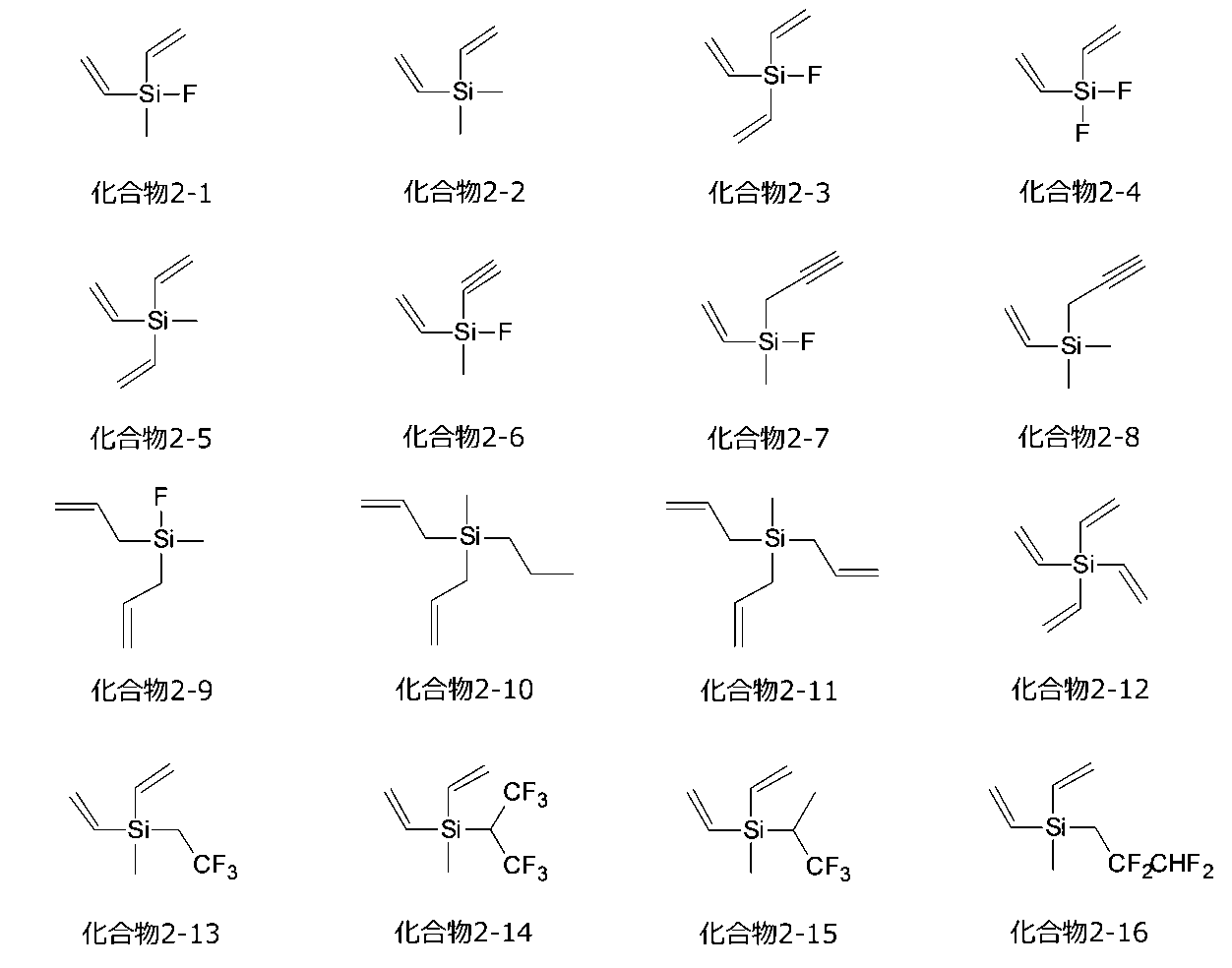
- compound (2) the following compounds can be suitably cited as representative compounds (2) of silane compounds. In this disclosure, these compounds are referred to by the two series numbers described below as compound numbers below, which are listed under the chemical formulas. All of these compounds are known compounds, and their production methods are disclosed in, for example, JP-A-2000-143677, JP-A-2004-256494, JP-A-05-104541, etc.
- Compound (2) is generally used in an amount of 0.01 to 5 mass%, preferably 0.1 to 2.5 mass%, assuming the total amount of the nonaqueous electrolyte to be 100 mass%.
- compound (3) used in the electrolyte for a nonaqueous electrolyte secondary battery of the present disclosure is a compound represented by the following general formula (3): PO (OR 4 ) y (OR 5 ) 3-y (3)
- y is 2 or 3.
- R4 independently represents an alkenyl group or an alkynyl group.
- the number of carbon atoms in each is preferably 2 to 5, more preferably 2 to 3.
- a phosphate ester containing a plurality of alkynyl groups is preferred.
- R 4 is preferably, independently, a vinyl group, a 2-propenyl group, a 1-propenyl group, an ethynyl group, a 2-propynyl group, a 1-propynyl group, a 2-butynyl group, or the like, and among these, a 2-propenyl group, a 2-propynyl group, a 2-butynyl group, or the like is preferable.
- the compound (3) used in the electrolyte for a nonaqueous electrolyte secondary battery in the present disclosure has two or more alkenyl groups or alkynyl groups represented by the above R4 . That is, y in the formula is 2 or more. When the above y is 3, it is particularly preferable from the viewpoint of the effect of improving cycle characteristics and/or gas suppression.
- R 5 represents an alkyl group or an aryl group, and the hydrogen atom of these groups may be substituted with a fluorine atom.
- the alkyl group represented by R5 is preferably an alkyl group having 1 to 5 carbon atoms, preferably 1 to 3 carbon atoms, and may be a linear or branched alkyl group. Suitable examples of the linear alkyl group include a methyl group, an ethyl group, and a propyl group. Suitable examples of the branched alkyl group include an isopropyl group and an isobutyl group.
- the hydrogen atom of the alkyl group may be substituted with a fluorine atom.
- Suitable examples of such an alkyl group substituted with a fluorine atom include a 2,2,2-trifluoroethyl group, a 2,2,3,3-tetrafluoropropyl group, a 1,1,1-trifluoroisopropyl group, and a 1,1,1,3,3,3-hexafluoroisopropyl group.
- the aryl group may be, for example, a phenyl group.
- the aryl group may be an aryl group in which a hydrogen atom is substituted with a fluorine atom.
- the aryl group may be, for example, a pentafluorophenyl group.
- compound (3) the following compounds can be preferably cited as representative compounds. In the present disclosure, these compounds are referred to by the three series of numbers described below under the chemical formula as compound numbers. All of these compounds are known compounds.
- the amount of compound (3) used in the electrolyte for a nonaqueous electrolyte secondary battery in the present disclosure is generally 0.01 to 5 mass %, preferably 0.1 to 2.5 mass %, based on the total amount of the nonaqueous electrolyte being 100 mass %.
- Compound (1) may be used in combination with compound (2) and/or compound (3).
- the total concentration of compound (1), compound (2) and/or compound (3) is, for example, 0.1 to 5 mass %, preferably 0.5 to 4 mass %, relative to the total amount of the nonaqueous electrolyte.
- the electrolyte solution for a nonaqueous electrolyte secondary battery uses compound (1) in combination with compound (2) and/or compound (3), and when used in a nonaqueous electrolyte secondary battery containing a negative electrode having Si and/or silicon oxide as a negative electrode active material, the electrolyte solution exhibits both excellent cycle characteristics and excellent gas suppression characteristics in a well-balanced manner.
- Additives generally used in this technical field may be added in any ratio to the electrolyte for a nonaqueous electrolyte battery of the present disclosure, as long as the gist of the present disclosure is not impaired.
- the nonaqueous electrolyte solution of the present disclosure contains the additive, the content thereof may be 0.01% by mass or more and 10% by mass or less with respect to the total amount of the nonaqueous electrolyte solution.
- additives examples include cyclohexylbenzene, cyclohexylfluorobenzene, biphenyl, 2-fluorobiphenyl, t-butylbenzene, t-amylbenzene, 2-fluorotoluene, fluorobenzene, vinylene carbonate (hereinafter sometimes referred to as "VC"), vinylene carbonate oligomer (having a number average molecular weight of 170 to 5000 in terms of polystyrene), vinylethylene carbonate, difluoroanisole, fluoroethylene carbonate (hereinafter sometimes referred to as "FEC"), 1,6-diisocyanatohexane, ethynylethylene carbonate, trans-difluoroethylene carbonate, methylpropargyl carbonate, ethylpropargyl carbonate, dipropargyl carbonate, maleic anhydride, succinic anhydride, 1,3-propane sulf
- additives include lithium difluorophosphate, sodium difluorophosphate, lithium fluorosulfate, sodium fluorosulfate, lithium trifluoromethanesulfonate, sodium trifluoromethanesulfonate, lithium difluorobis(oxalato)phosphate, sodium difluorobis(oxalato)phosphate, lithium difluorooxalatoborate, sodium difluorooxalatoborate, lithium bis(oxalato)borate, sodium bis(oxalato)borate, lithium tetrafluorooxalatophosphate, sodium tetrafluorooxalatophosphate, Lithium, lithium tris(oxalato)phosphate, sodium tris(oxalato)phosphate, lithium difluoro(malonato)borate, sodium difluoro(malonato)borate, lithium tetrafluoro(malonato)phosphate, sodium te
- the electrolyte for a non-aqueous electrolyte battery can be quasi-solidified with a gelling agent or a crosslinked polymer and used.
- the nonaqueous electrolyte secondary battery of the present disclosure basically adopts a configuration used in a general nonaqueous secondary battery. That is, it is composed of a positive electrode and a negative electrode capable of absorbing and releasing lithium, a current collector, a separator, a container, etc.
- the electrolyte for a nonaqueous electrolyte secondary battery of the present disclosure is applied to a nonaqueous electrolyte secondary battery employing a negative electrode using a specific negative electrode active material, which is desired from the viewpoint of increasing capacity, it can achieve at least one of the following, which have not been achieved so far: improvement in capacity retention rate after cycling and suppression of gas generation amount during high-temperature storage.
- the electrolyte solution for nonaqueous electrolyte secondary batteries provides an electrolyte solution for nonaqueous electrolyte secondary batteries that, when used in a nonaqueous electrolyte secondary battery containing Si and/or silicon oxide as a negative electrode active material, can achieve at least one of an improvement in capacity retention rate after cycling and a suppression of the amount of gas generation during high-temperature storage.
- the positive electrode may contain at least one selected from the group consisting of an oxide containing at least nickel and a phosphate containing nickel as a positive electrode active material.
- the positive electrode active material constituting the positive electrode is not particularly limited as long as it contains at least one selected from the group consisting of nickel-containing oxides and nickel-containing phosphates and is a material capable of being charged and discharged.
- A a lithium transition metal composite oxide containing nickel or, in addition to nickel, one or more metals selected from the group consisting of manganese, cobalt, and aluminum, and having a layered structure
- B a lithium manganese composite oxide having a spinel structure and containing nickel
- C a lithium-containing olivine-type phosphate containing nickel
- D a lithium-excess layered transition metal oxide having a layered rock salt structure and containing nickel.
- lithium transition metal composite oxides containing nickel or, in addition to nickel, one or more metals selected from the group consisting of manganese, cobalt, and aluminum and having a layered structure include lithium nickel composite oxide, lithium nickel cobalt composite oxide, lithium nickel cobalt aluminum composite oxide, lithium nickel manganese composite oxide, lithium nickel manganese cobalt composite oxide, etc.
- some of the transition metal atoms that are the main components of these lithium transition metal composite oxides may be replaced with other elements such as Al, Ti, V, Cr, Fe, Cu, Zn, Mg, Ga, Zr, Si, B, Ba, Y, and Sn.
- Specific examples of lithium-nickel composite oxides include LiNiO 2 and lithium nickel oxide LiNiO 2 particles having a part of the particle surface coated with aluminum oxide, which may be added with different elements such as Mg, Zr, Al, and Ti.
- the lithium-nickel-cobalt composite oxide and the lithium-nickel-cobalt-aluminum composite oxide are represented by the following general formula [1-1].
- M 1 is at least one element selected from the group consisting of Al, Fe, Mg, Zr, Ti, and B, a satisfies the conditions of 0.9 ⁇ a ⁇ 1.2, and b and c satisfy the conditions of 0.1 ⁇ b ⁇ 0.3 and 0 ⁇ c ⁇ 0.1.
- LiNi 0.8 Co 0.2 O 2 LiNi 0.85 Co 0.10 Al 0.05 O 2 , LiNi 0.87 Co 0.10 Al 0.03 O 2 , LiNi 0.6 Co 0.3 Al 0.1 O 2 and the like are preferably mentioned.
- lithium-nickel-manganese composite oxide examples include LiNi 0.5 Mn 0.5 O 2 and LiCo 0.5 Mn 0.5 O 2 .
- the lithium-nickel-manganese-cobalt composite oxide may be a lithium-containing composite oxide represented by the following general formula [1-2].
- M2 is at least one element selected from the group consisting of Al, Fe, Mg, Zr, Ti, B, and Sn
- d is 0.9 ⁇ d ⁇ 1.2
- the lithium-nickel-manganese-cobalt composite oxide preferably contains manganese in the range shown in the general formula [1-2] in order to enhance the structural stability and improve the safety of lithium secondary batteries at high temperatures.
- the lithium-nickel-manganese-cobalt composite oxide further contains cobalt in the range shown in the general formula [1-2] in order to enhance the high-rate characteristics of lithium ion secondary batteries.
- Li[Ni1 / 3Mn1/3Co1 / 3 ] O2 (hereinafter, sometimes referred to as "NCM111"), Li[ Ni0.45Mn0.35Co0.2 ]O2, Li[ Ni0.5Mn0.3Co0.2 ] O2 , Li[ Ni0.6Mn0.2Co0.2 ] O2 (hereinafter, sometimes referred to as “ NCM622 "), Li[ Ni0.8Mn0.1Co0.1 ] O2 (hereinafter, sometimes referred to as “ NCM811 “), Li[ Ni0.49Mn0.3Co0.2Zr0.01 ] O2 , which have a charge / discharge range of 4.3 V or more , , Li[Ni 0.49 Mn 0.3 Co 0.2 Mg 0.01 ]O 2 and the like are preferred.
- Lithium manganese composite oxide having a spinel structure positive electrode active material
- An example of the lithium manganese composite oxide having a spinel structure is a spinel-type lithium manganese composite oxide represented by the general formula [1-3].
- M3 contains Ni and may contain at least one metal element selected from the group consisting of Co, Fe, Mg, Cr, Cu, Al, and Ti.
- j is 1.05 ⁇ j ⁇ 1.15, and k is 0 ⁇ k ⁇ 0.20.
- Specific examples include LiMn1.9Ni0.1O4 and LiMn1.5Ni0.5O4 .
- Lithium-containing olivine-type phosphate Positive electrode active material
- An example of the lithium-containing olivine-type phosphate is one represented by the following general formula [1-4].
- M4 contains Ni and may also contain at least one selected from Co, Mn, Cu, Zn, Nb, Mg, Al, Ti, W, Zr, and Cd, and n is 0 ⁇ n ⁇ 1.
- LiNiPO4 is a suitable example.
- Lithium-excess layered transition metal oxide Positive electrode active material
- An example of the lithium-rich layered transition metal oxide having a layered rock salt structure is one represented by the following general formula [1-5].
- x is a number satisfying 0 ⁇ x ⁇ 1
- M5 is at least one metal element having an average oxidation number of 3+
- M6 is at least one metal element having an average oxidation number of 4+
- M5 is preferably one metal element selected from trivalent Mn, Ni, Co, Fe, V, and Cr, but the average oxidation number may be trivalent with equal amounts of divalent and tetravalent metals.
- M6 is preferably one or more metal elements selected from Mn, Zr and Ti. Either M5 or M6 necessarily contains nickel. Specifically, 0.5 [LiNi 0.5 Mn 0.5 O 2 ] ⁇ 0.5 [Li 2 MnO 3 ], 0.5 [LiNi 1/3 Co 1/3 Mn 1/3 O 2 ] ⁇ 0.5 [Li 2 MnO 3 ], 0.5 [LiNi 0.375 Co 0.25 Mn 0.375 O 2 ] ⁇ 0.5 [Li 2 MnO 3 ], 0.5 [LiNi 0.375 Co 0.125 Fe 0.125 Mn 0.375 O 2 ] ⁇ 0.5 [Li 2 MnO 3 ], 0.45 [LiNi 0.375 Co 0.25 Mn 0.375 [ Li2O2 ].0.10[ Li2TiO3 ] .0.45[ Li2MnO3 ] and the like are preferred.
- the positive electrode active material (D) represented by the above general formula [1-5] is known to exhibit high capacity upon high-voltage charging of 4.4 V (based on Li) or more (for example, US Pat. No. 7,135,252).
- These positive electrode active materials can be prepared in accordance with the manufacturing methods described in, for example, JP-A-2008-270201, WO2013/118661, JP-A-2013-030284, and the like.
- the positive electrode active material may contain at least one selected from the above (A) to (D) as a main component, and other components may include, for example, transition element chalcogenides such as FeS2 , TiS2 , TiO2 , V2O5 , MoO3 , and MoS2 , conductive polymers such as polyacetylene, polyparaphenylene, polyaniline, and polypyrrole, activated carbon, polymers that generate radicals, and carbon materials.
- transition element chalcogenides such as FeS2 , TiS2 , TiO2 , V2O5 , MoO3 , and MoS2
- conductive polymers such as polyacetylene, polyparaphenylene, polyaniline, and polypyrrole
- activated carbon polymers that generate radicals, and carbon materials.
- the positive electrode has a positive electrode current collector.
- the positive electrode current collector for example, aluminum, stainless steel, nickel, titanium, or an alloy thereof can be used.
- the positive electrode may have a positive electrode active material layer formed on at least one surface of a positive electrode current collector.
- the positive electrode active material layer may include, for example, the positive electrode active material described above, a binder, and, if necessary, a conductive agent.
- the binder include polytetrafluoroethylene, polyvinylidene fluoride, tetrafluoroethylene-perfluoroalkyl vinyl ether copolymer, styrene butadiene rubber (SBR), carboxymethyl cellulose, methyl cellulose, cellulose acetate phthalate, hydroxypropyl methyl cellulose, and polyvinyl alcohol.
- the conductive agent for example, carbon materials such as acetylene black, ketjen black, furnace black, carbon fiber, graphite (granular graphite or flake graphite), fluorinated graphite, etc. can be used.
- carbon materials such as acetylene black, ketjen black, furnace black, carbon fiber, graphite (granular graphite or flake graphite), fluorinated graphite, etc.
- the negative electrode active material As the negative electrode active material, as described above, Si and/or silicon oxide (hereinafter, sometimes referred to as "SiOx”) is used. If necessary, graphite may be further used in combination. Specifically, the negative electrode active material in the present disclosure contains Si and/or silicon oxide. Silicon oxide is a compound represented by SiOx, where x has a value of 0.5 to 1.5. The negative electrode active material may be silicon metal or silicon oxide (SiOx).
- the content of Si and/or silicon oxide contained in the negative electrode active material is generally 0.1 to 50 mass %, and preferably 0.1 to 30 mass %, relative to the total amount of the Si and/or silicon oxide and graphite contained in the negative electrode active material being 100 mass %.
- the graphite to be used various types of artificial graphite and natural graphite are used. Since the change in the crystal structure of graphite accompanying the absorption and release of lithium is very small, a high energy density and excellent cycle characteristics can be obtained.
- the shape of the graphite may be any of fibrous, spherical, granular, and scaly.
- amorphous carbon and graphite with an amorphous carbon coating on the surface are more preferable because the reactivity between the material surface and the electrolyte is low.
- the graphite is capable of doping and dedoping lithium ions, and examples of such graphite include graphite having a d value of the lattice plane (002 plane) of 0.340 nm or less in X-ray diffraction, graphite having a d value of the lattice plane (002 plane) of more than 0.340 nm in X-ray diffraction, etc.
- These negative electrode active materials can be used alone or in combination of two or more kinds.
- the negative electrode has a negative electrode current collector.
- the negative electrode current collector for example, copper, stainless steel, nickel, titanium, or an alloy thereof can be used.
- the negative electrode has, for example, a negative electrode active material layer formed on at least one surface of a negative electrode current collector.
- the negative electrode active material layer is composed of, for example, the above-mentioned negative electrode active material, a binder, and, if necessary, a conductive agent.
- the binder include polytetrafluoroethylene, polyvinylidene fluoride, tetrafluoroethylene-perfluoroalkyl vinyl ether copolymer, styrene butadiene rubber (SBR), carboxymethyl cellulose, methyl cellulose, cellulose acetate phthalate, hydroxypropyl methyl cellulose, and polyvinyl alcohol.
- the conductive agent for example, acetylene black, ketjen black, furnace black, carbon materials such as carbon fiber, etc. can be used.
- the electrode can be obtained, for example, by dispersing and kneading the active material, the binder, and optionally the conductive agent in a predetermined blending amount in a solvent such as N-methyl-2-pyrrolidone (NMP) or water, applying the resulting paste to a current collector, and drying to form an active material layer.
- NMP N-methyl-2-pyrrolidone
- the resulting electrode is preferably compressed by a method such as roll pressing to adjust the electrode to an appropriate density.
- the nonaqueous electrolyte battery of the present disclosure may include a separator.
- a separator for example, a nonwoven fabric or a porous sheet made of polyolefin such as polypropylene or polyethylene, cellulose, paper, glass fiber, etc. is used. These films are preferably microporous so that the electrolyte can penetrate and ions can easily pass through.
- the polyolefin separator include a film that electrically insulates the positive electrode and the negative electrode, such as a microporous polymer film, such as a porous polyolefin film, and is permeable to lithium ions.
- porous polyolefin film examples include a porous polyethylene film alone, or a multilayer film formed by overlapping a porous polyethylene film and a porous polypropylene film.
- Other examples include a film obtained by combining a porous polyethylene film and a polypropylene film.
- the nonaqueous electrolyte of the present disclosure is impregnated and held in the separator.
- the impregnation method There is no particular limitation on the impregnation method, and the impregnation may be carried out by a known method. Specifically, the electrolyte can be impregnated by finally injecting the electrolyte into a battery having a positive electrode, a separator, and a negative electrode.
- a coin-shaped, cylindrical, or rectangular metal can, or a laminated outer casing, etc. can be suitably used as the outer casing for the electrolyte for nonaqueous electrolyte secondary batteries.
- metal can materials include nickel-plated steel plate, stainless steel plate, nickel-plated stainless steel plate, aluminum or its alloy, nickel, titanium, etc.
- laminated outer casing include aluminum laminate film, SUS laminate film, silica-coated polypropylene, polyethylene, etc. laminate film, etc.
- the configuration of the nonaqueous electrolyte secondary battery according to this embodiment is not particularly limited, but for example, it can be configured such that an electrode element in which a positive electrode and a negative electrode are arranged opposite each other, and a nonaqueous electrolyte are enclosed in an exterior body.
- the shape of the nonaqueous electrolyte secondary battery is not particularly limited, but an electrochemical device in the shape of a coin, cylinder, square, aluminum laminate sheet, or the like can be assembled from the above elements.
- a nonaqueous electrolyte secondary battery containing the electrolyte for nonaqueous electrolyte secondary batteries of the present disclosure can be manufactured, for example, by impregnating a separator with the electrolyte for nonaqueous electrolyte secondary batteries, disposing the separator between a positive electrode having at least one selected from the group consisting of nickel-containing oxides and phosphates as a positive electrode active material, and a negative electrode containing Si and/or silicon oxide (SiOx) as a negative electrode active material, and assembling the cell.
- LiPF 6 in an amount to give a concentration of 0.9 mol/L relative to the total amount of the nonaqueous electrolyte, and FEC in an amount to give a concentration of 10.0 mass % relative to the total amount of the nonaqueous electrolyte were added, and the mixture was stirred for 1 hour to dissolve, thereby preparing comparative nonaqueous electrolyte 1-1.
- Example 1-1 (Preparation of non-aqueous electrolyte 1-1)
- LiPF 6 in an amount to have a concentration of 0.9 mol / L with respect to the total amount of nonaqueous electrolyte
- FEC in an amount to have a concentration of 10.0 mass % with respect to the total amount of nonaqueous electrolyte
- compound (1-1) corresponding to compound (1) with a concentration of 0.5 mass %
- compound (2-3) corresponding to compound (2) with a concentration of 0.5 mass % were added, and the mixture was stirred for 1 hour to dissolve, thereby preparing nonaqueous electrolyte 1-1 of Example 1-1.
- Non-aqueous electrolyte solutions 1-2 to 1-12 of the examples were prepared in the same manner as in the preparation of non-aqueous electrolyte solution 1-1 of the example, except that the types and contents of compound (1), compound (2), and the comparative compound were changed as shown in Table 1.
- Examples 2-1 to 2-20 and Comparative Example 2-1> (Preparation of non-aqueous electrolytes 2-1 to 2-20 and comparative non-aqueous electrolyte 2-1) Except for changing the types and contents of compound (1), compound (3), and the comparative compound as shown in Table 2, nonaqueous electrolyte solutions 2-1 to 2-20 of the examples and comparative nonaqueous electrolyte solution 2-1 were prepared in the same manner as in the preparation of nonaqueous electrolyte solution 1-1 of the examples.
- LiPF 6 in an amount to give a concentration of 0.9 mol/L relative to the total amount of the nonaqueous electrolyte, FEC in an amount to give a concentration of 5.0 mass % relative to the total amount of the nonaqueous electrolyte, and VC in an amount to give a concentration of 1.0 mass % were added, and the mixture was stirred for 1 hour to dissolve, thereby preparing comparative nonaqueous electrolyte 3-1.
- Example 3-1> (Preparation of non-aqueous electrolyte 3-1)
- LiPF 6 in an amount of 0.9 mol / L with respect to the total amount of non-aqueous electrolyte
- FEC in a concentration of 5.0 mass % with respect to the total amount of non-aqueous electrolyte
- VC in an amount of 1.0 mass %
- compound (1-1) corresponding to a concentration of 1.0 mass %
- compound (2-3) corresponding to a concentration of 0.5 mass %
- further lithium difluorophosphate in an amount of 1.0 mass % as other additives were added and dissolved by stirring for 1 hour to prepare non-aqueous electrolyte 3-1 of the example.
- Non-aqueous electrolyte solutions 3-2 to 3-6 of the examples were obtained in the same manner as in the preparation of non-aqueous electrolyte solution 3-1 of the examples, except that the type and content of compound (1), compound (2), compound (3), or other additives and solutes were changed as shown in Table 3 below.
- Table 3 also lists Examples 1-3V, 1-5V, and 1-6V, which used non-aqueous electrolyte solutions 1-3V, 1-5V, and 1-6V prepared using the "other additives and solutes" shown in Table 3 instead of "other additives" for non-aqueous electrolyte solutions 1-3, 1-5, and 1-6 of the non-aqueous electrolyte solutions of the Example 1 series.
- Table 3 also lists Examples 2-3V, 2-5V, and 2-7V, which used nonaqueous electrolytes 2-3V, 2-5V, and 2-7V prepared using the "other additives/solutes” shown in Table 3 instead of the "other additives" for nonaqueous electrolytes 2-3, 2-5, and 2-7 of the nonaqueous electrolytes of Example 2 series.
- LiPF 6 in an amount to give a concentration of 0.9 mol/L relative to the total amount of the nonaqueous electrolyte, and FEC in an amount to give a concentration of 10.0 mass % relative to the total amount of the nonaqueous electrolyte were added, and the mixture was stirred for 1 hour to dissolve, thereby preparing comparative nonaqueous electrolyte 4-1.
- LiPF 6 in an amount to have a concentration of 0.9 mol / L with respect to the total amount of nonaqueous electrolyte
- FEC in an amount to have a concentration of 10.0 mass % with respect to the total amount of nonaqueous electrolyte
- compound (1-1) corresponding to compound (1) in a concentration of 0.5 mass %
- compound (2-12) corresponding to compound (2) in an amount to have a concentration of 0.5 mass % were added, and the mixture was stirred for 1 hour to dissolve, thereby preparing nonaqueous electrolyte 4-1 of the example.
- Examples 4-2 to 4-3, Reference Examples 4-2 to 4-3, and Examples 4-2V to 4-3V> Preparation of non-aqueous electrolytes 4-2 to 4-3 and non-aqueous electrolytes 4-2V to 4-3V) Except for changing the type and content of compound (1), compound (2), and/or compound (3) as shown in Table 4, nonaqueous electrolyte solutions 4-2 to 4-3 and nonaqueous electrolyte solutions 4-2V to 4-3V were prepared in the same manner as in the preparation of nonaqueous electrolyte solution 4-1 of the example.
- Example 4-4 and Example 4-4V> (Preparation of nonaqueous electrolyte 4-4V)
- LiPF 6 in an amount to give a concentration of 0.9 mol/L relative to the total amount of the nonaqueous electrolyte
- FEC in an amount to give a concentration of 10.0 mass% relative to the total amount of the nonaqueous electrolyte
- VC in an amount to give a concentration of 0.5 mass%
- Example 4-4> (Preparation of non-aqueous electrolyte 4-4)
- LiPF 6 in an amount of 0.9 mol / L with respect to the total amount of nonaqueous electrolyte, FEC in a concentration of 10.0 mass % with respect to the total amount of nonaqueous electrolyte, compound (1-1) corresponding to a concentration of 1.0 mass %, compound (2-3) corresponding to a concentration of 0.5 mass %, and VC in an amount of 0.5 mass % as other additives were added and dissolved by stirring for 1 hour to prepare nonaqueous electrolyte 4-4.
- Examples 4-5 to 4-7 (Preparation of non-aqueous electrolytes 4-5 to 4-7) Except for changing the type of compound (2) or compound (3) as shown in Table 4, nonaqueous electrolyte solutions 4-5 to 4-7 were prepared in the same manner as in the preparation of nonaqueous electrolyte solution 4-4.
- a positive electrode composite paste was prepared by mixing 92.0% by mass of LiNi0.8Co0.1Mn0.1O2 powder with 3.5% by mass of polyvinylidene fluoride (hereinafter also referred to as PVDF) as a binder and 4.5% by mass of acetylene black as a conductive material, and further adding N-methyl-2-pyrrolidone.
- PVDF polyvinylidene fluoride
- This paste was applied to both sides of aluminum foil (A1085), dried and pressed, and then punched out to 4 cm x 5 cm to obtain a test NCM811 positive electrode.
- a positive electrode composite paste was prepared by mixing 90.0% by mass of LiNi0.6Co0.2Mn0.2O2 powder with 5.0% by mass of PVDF as a binder and 5.0% by mass of acetylene black as a conductive material, and then adding N-methyl-2-pyrrolidone. This paste was applied to both sides of an aluminum foil (A1085), dried, pressed, and then punched out to 4 cm x 5 cm to obtain a test NCM622 positive electrode.
- a positive electrode composite paste was prepared by mixing 90.0% by mass of Li[Ni1 /3Mn1 /3Co1 /3 ] O2 powder with 5.0% by mass of PVDF as a binder and 5.0% by mass of acetylene black as a conductive material, and then adding N-methyl-2-pyrrolidone. This paste was applied to both sides of an aluminum foil (A1085), dried, pressed, and then punched out to 4 cm x 5 cm to obtain a test NCM111 positive electrode.
- graphite negative electrode (referred to as "graphite” in the table)
- a negative electrode composite paste was prepared by mixing 98.0% by mass of artificial graphite powder, 1.0% by mass of styrene-butadiene rubber, 1.0% by mass of carboxymethyl cellulose, and water.
- the paste was applied to one side of a copper foil, dried and pressed, and then punched out to a size of 4 cm x 5 cm to obtain a graphite negative electrode for testing.
- the discharge capacity retention rate after 500 cycles was calculated using the following formula.
- Discharge capacity retention rate (%) (discharge capacity after 500 cycles) x 100/(initial charge/discharge capacity)
- the numerical values of the discharge capacity retention ratio after 500 cycles in all the examples listed in Table 1 are relative values when the discharge capacity retention ratio after 500 cycles in Comparative Example 1-1 is set to 100.
- the numerical values of the discharge capacity retention ratio after 500 cycles in all the examples listed in Table 2 are relative values when the discharge capacity retention ratio after 500 cycles in Comparative Example 2-1 is set to 100.
- the numerical values of the discharge capacity retention ratio after 500 cycles in all the examples listed in Table 3 are relative values when the discharge capacity retention ratio after 500 cycles in Comparative Example 3-1 is set to 100.
- the numerical values of the discharge capacity retention ratio after 500 cycles in all the examples listed in Table 4 are relative values when the discharge capacity retention ratio after 500 cycles in Comparative Example 4-1 is set to 100.
- the numerical values of the discharge capacity retention ratio after 500 cycles in all the reference examples listed in Table 4 are relative values when the discharge capacity retention ratio after 500 cycles in Reference Example 4-1 is set to 100.
- ⁇ Gas generation amount during high temperature storage (80°C)> The battery was charged at a current density of 0.38 mA/ cm2 by a constant current/constant voltage method up to a charging upper limit voltage of 4.2 V at an ambient temperature of 25° C., and then stored for 10 days at an ambient temperature of 80° C. The volume of the battery was measured before and after storage, and the difference was taken as the amount of gas generated.
- the numerical values of the amount of gas generated in all the examples listed in Table 1 are relative values when the amount of gas generated in Comparative Example 1-1 is taken as 100.
- the numerical values of the amount of gas generated in all the examples listed in Table 2 are relative values when the amount of gas generated in Comparative Example 2-1 is taken as 100.
- the numerical values of the amount of gas generated in all the examples listed in Table 3 are relative values when the amount of gas generated in Comparative Example 3-1 is taken as 100.
- the numerical values of the amount of gas generated in all the examples listed in Table 4 are relative values when the amount of gas generated in Comparative Example 4-1 is taken as 100.
- the numerical values of the amount of gas generated in all the reference examples listed in Table 4 are relative values when the amount of gas generated in Reference Example 4-1 is taken as 100.
- graphite is not necessarily required as the negative electrode active material.
- a "negative electrode containing Si as the negative electrode active material" formed using Si powder, as described in paragraph 0094 of JP 2022-191483 A, may be applied to this disclosure.
- the negative electrode active material contains Si and/or silicon oxide, compound (1) with a spiro structure and compound (2) or compound (3) with multiple groups with unsaturated bonds co-decompose during charging and discharging, forming a high-quality coating on the negative electrode surface.
Landscapes
- Chemical & Material Sciences (AREA)
- Electrochemistry (AREA)
- General Chemical & Material Sciences (AREA)
- Chemical Kinetics & Catalysis (AREA)
- Engineering & Computer Science (AREA)
- Manufacturing & Machinery (AREA)
- Inorganic Chemistry (AREA)
- Physics & Mathematics (AREA)
- Condensed Matter Physics & Semiconductors (AREA)
- General Physics & Mathematics (AREA)
- Composite Materials (AREA)
- Materials Engineering (AREA)
- Secondary Cells (AREA)
Abstract
Description
非水電解液二次電池に対しては、電池特性として、例えば、サイクル特性や、入出力特性、保存特性、連続充電特性、安全性等の諸特性を高い水準で達成することが求められている。また、近年においては、車載用電池において、航続距離の拡大に向けた高容量化への要求がますます高くなっている。
これまで非水電解液二次電池の高温特性及び充放電を繰り返した場合の電池特性(サイクル特性)を改善する手段として、正極や負極の活物質をはじめとする様々な電池構成要素の最適化が検討されてきた。非水電解液関連技術もその例外ではなく、活性な正極や負極の表面で電解液が分解することによる劣化を種々の添加剤で抑制することが提案されている。
特許文献3~7には、不飽和結合を有するシラン化合物を非水電解液に添加することで、サイクル特性や、内部抵抗の増加を抑制して高温貯蔵特性や低温特性を向上させる方法が提案されている。
特許文献8には、不飽和結合を有するリン化合物を非水電解液に添加することで、サイクル特性の劣化を抑制し、初期容量を増加する方法が提案されている。また、特許文献9には、不飽和結合を有するリン酸エステルや、スルホン酸エステルを非水電解液に添加することで、サイクル特性と抵抗上昇抑制効果を改善する方法が提案されている。
特許文献10や11には、スピロ構造や、2量化した硫酸エステル化合物等を非水電解液に添加することで、高温下での安定性や、低温特性、サイクル特性を改善する方法が報告されている。
従って、本開示は、負極として、Si及び/又は酸化ケイ素を含む非水電解液二次電池において、サイクル後の容量維持率の向上及び高温貯蔵時のガス発生量の抑制のうち少なくとも1つを発揮できる非水電解液二次電池用電解液、及びそれを用いた非水電解液二次電池を提供することに関するものである。
(I)非水有機溶媒、
(II)イオン性塩である溶質、及び
(III)以下の化合物、
(1)下記一般式(1)で示される二環式硫酸エステル化合物(以下、単に、「式(1)で示される化合物」とも言う)、
(2)下記一般式(3)で示されるリン酸エステル(以下、単に、「式(3)で示される化合物」とも言う)、又は
(3)下記一般式(1)で示される二環式硫酸エステル化合物と、下記一般式(2)で示される不飽和結合を有するシラン化合物(以下、単に、「式(2)で示される化合物」とも言う)及び/又は下記一般式(3)で示されるリン酸エステルとの組合わせ、
を含むことを特徴とする、非水電解液に関するものである。

Si(R2)x(R3)4-x (2)
[一般式(2)中、R2は、それぞれ独立して、アルケニル基又はアルキニル基を表し、R3は、それぞれ独立して、フッ素原子、アルキル基、アルコキシ基、アリール基、及びアリールオキシ基からなる群から選ばれる基を表し、これらの基の水素原子は、フッ素原子に置換されていてもよく、そして、xは、2~4の整数である。]
PO(OR4)y(OR5)3-y (3)
[一般式(3)中、R4は、それぞれ独立して、アルケニル基又はアルキニル基を表し、R5は、アルキル基又はアリール基を表し、これらの基の水素原子は、フッ素原子に置換されていてもよく、そして、yは、2~3の整数である。]
また、必要に応じて、負極活物質として、Si及び/又は酸化ケイ素とともに、黒鉛を併用してもよい。
1.負極活物質として、Si及び/又は酸化ケイ素を含む負極を含有する非水電解液二次電池用の非水電解液であって、以下の成分、
(I)非水有機溶媒、
(II)イオン性塩である溶質、及び、
(III)前記式(1)で示される化合物、
を含むことを特徴とする非水電解液。
2.負極活物質として、Si及び/又は酸化ケイ素を含む負極を含有する非水電解液二次電池用の非水電解液であって、以下の成分、
(I)非水有機溶媒、
(II)イオン性塩である溶質、及び、
(IV)前記式(3)で示される化合物、
を含むことを特徴とする非水電解液。
3.負極活物質として、Si及び/又は酸化ケイ素を含む負極を含有する非水電解液二次電池用の非水電解液であって、以下の成分、
(I)非水有機溶媒、
(II)イオン性塩である溶質、
(III)前記式(1)で示される化合物、及び、
(V)前記式(2)で示される化合物及び/又は前記式(3)で示される化合物、
を含むことを特徴とする非水電解液。
4.前記8個のR1の内少なくとも1個が、水素原子である、上記1又は3に記載の非水電解液。
6.前記x個のR2の内少なくとも1個が、ビニル基であり、前記(4-x)個のR3の内少なくとも1個が、メチル基又はフッ素原子である、上記3又は5に記載の非水電解液。
7.前記xが、3又は4である、上記3に記載の記載の非水電解液。
8.前記R4が、それぞれ独立して、1-プロペニル基、2-プロペニル基、エチニル基、2-プロピニル基、及び2-ブチニル基からなる群から選択される基であり、前記R5が、アルキル基である、上記2又は3に記載の非水電解液。
9.前記R4が、それぞれ独立して、2-プロペニル基、2-プロピニル基、及び2-ブチニル基からなる群から選択される基であり、前記R5が、メチル基又はエチル基である、上記2、3又は8に記載の非水電解液。
10.前記yが、3である、上記2又は3に記載の非水電解液。
11.前記式(1)で示される化合物の濃度が、非水電解液の総量に対して、0.1~5質量%である、上記1又は3に記載の非水電解液。
12.前記式(3)で示される化合物の濃度が、非水電解液の総量に対して、0.01~5質量%である、上記2又は3に記載の非水電解液。
13.前記式(2)で示される化合物の濃度が、非水電解液の総量に対して、0.01~5質量%である、上記3に記載の非水電解液。
14.前記負極活物質が、更に、黒鉛を含む、上記1~13のいずれか1項に記載の非水電解液。
15.前記Si及び/又は酸化ケイ素の含有量が、前記負極活物質に含まれる前記Si及び/又は酸化ケイ素と、黒鉛との合計量に対して、0.1~50質量%である、上記14に記載の非水電解液。
17.前記環状エステルが、環状カーボネートである、上記16に記載の非水電解液。
18.前記鎖状エステルが、鎖状カーボネートである、上記16に記載の非水電解液。
19.前記非水有機溶媒が、プロピレンカーボネート、エチレンカーボネート、ブチレンカーボネート、ジエチルカーボネート、ジメチルカーボネート、エチルメチルカーボネート、γ―ブチロラクトン、γ―バレロラクトン、酢酸メチル、プロピオン酸メチル、プロピオン酸エチル、テトラヒドロフラン、2-メチルテトラヒドロフラン、ジオキサン、ジメトキシエタン、ジエチルエーテル、ジメチルスルホキシド、及びスルホランからなる群から選択される少なくとも1つである、上記1~15のいずれか1項に記載の非水電解液。
20.前記イオン性塩である溶質が、カチオンとアニオンとから構成され、前記カチオンが、アルカリ金属イオン、アルカリ土類金属イオン、及び四級アンモニウムからなる群から選択され、前記アニオンが、ヘキサフルオロリン酸、テトラフルオロホウ酸、過塩素酸、ヘキサフルオロヒ酸、ヘキサフルオロアンチモン酸、及びビス(フルオロスルホニル)イミドからなる群から選択される、上記1~19のいずれか1項に記載の非水電解液。
21.前記アルカリ金属イオンが、リチウムイオン又はナトリウムイオンである、上記20に記載の非水電解液。
23.更に、シクロヘキシルベンゼン、シクロヘキシルフルオロベンゼン、ビフェニル、2-フルオロビフェニル、t-ブチルベンゼン、t-アミルベンゼン、2-フルオロトルエン、フルオロベンゼン、ビニレンカーボネート、ビニレンカーボネートのオリゴマー(ポリスチレン換算の数平均分子量が170~5000)、ビニルエチレンカーボネート、ジフルオロアニソール、フルオロエチレンカーボネート、1,6-ジイソシアナトヘキサン、エチニルエチレンカーボネート、trans-ジフルオロエチレンカーボネート、メチルプロパルギルカーボネート、エチルプロパルギルカーボネート、ジプロパルギルカーボネート、無水マレイン酸、無水コハク酸、1,3-プロパンスルトン、1,3-プロペンスルトン、1,4-ブタンスルトン、ジメチルビニレンカーボネート、1,3,2-ジオキサチオラン-2,2-ジオキシド、4-プロピル-1,3,2-ジオキサチオラン-2,2-ジオキシド、メチレンメタンジスルホネート、ジメチレンメタンジスルホネート、トリメチレンメタンジスルホネート、メタンスルホン酸メチル、メタンスルホニルフルオリド、エテンスルホニルフルオリド、ジフルオロリン酸フェニル、1,2-エタンジスルホン酸無水物、トリス(トリメチルシリル)ボレート、スクシノニトリル、(エトキシ)ペンタフルオロシクロトリホスファゼン、テトラフルオロ(ピコリナト)ホスフェート、ジフルオロ(ピコリナト)ボレート、及び1,3-ジメチル-1,3-ジビニル-1,3-ジ(1,1,1,3,3,3-ヘキサフルオロイソプロピル)ジシロキサンからなる群から選択される少なくとも1つを含有する、上記1~22のいずれか1項に記載の非水電解液。
24.負極活物質としてSi及び/又は酸化ケイ素を含有する負極と、
正極と、
上記1~23のいずれか1項に記載の非水電解液と、
を含有することを特徴とする、非水電解液二次電池。
25.前記負極活物質が、更に、黒鉛を含有する上記24に記載の非水電解液二次電池。
成分(I)(非水有機溶媒)について
本開示における非水電解液二次電池用電解液に使用される非水有機溶媒は、以下で詳述する、成分(II)、式(1)で示される化合物、式(2)で示される化合物及び式(3)で示される化合物を溶解できるものであれば、特に限定されず、任意の非水有機溶媒を用いることができる。そのような非水有機溶媒としては、具体例としては、例えば、プロピレンカーボネート(以下、「PC」と記載する場合がある)や、エチレンカーボネート(以下、「EC」と記載する場合がある)、ブチレンカーボネート等の、環状エステルでもある環状カーボネート、ジエチルカーボネート(以下、「DEC」と記載する場合がある)、ジメチルカーボネート(以下、「DMC」と記載する場合がある)、エチルメチルカーボネート(以下、「EMC」と記載する場合がある)等の、鎖状エステルでもある鎖状カーボネート、γ―ブチロラクトン、γ―バレロラクトン等の環状エステル、酢酸メチル、プロピオン酸メチル、プロピオン酸エチル(以下、「EP」と記載する場合がある)等の鎖状エステル、テトラヒドロフラン、2-メチルテトラヒドロフラン、ジオキサン等の環状エーテル、ジメトキシエタン、ジエチルエーテル等の鎖状エーテル、ジメチルスルホキシド、スルホラン等のスルホン化合物や、スルホキシド化合物等が挙げられる。本開示の非水有機溶媒は、一種類を単独で用いてもよく、二種類以上を用途に合わせて任意の組み合わせ、比率で混合して用いてもよい。これらの中ではその酸化還元に対する電気化学的な安定性と熱や上記溶質との反応に関わる化学的安定性の観点から、特にプロピレンカーボネートや、エチレンカーボネート、ジエチルカーボネート、ジメチルカーボネート、エチルメチルカーボネート、プロピオン酸メチル、プロピオン酸エチルが好ましい。
(1)ECとEMCの組合せ、
(2)ECとDECの組合せ、
(3)ECとDMCとEMCの組合せ、
(4)ECとDECとEMCの組合せ、
(5)ECとEMCとEPの組合せ、
(6)PCとDECの組合せ、
(7)PCとEMCの組合せ、
(8)PCとEPの組合せ、
(9)PCとDMCとEMCの組合せ、
(10)PCとDECとEMCの組合せ、
(11)PCとDECとEPの組合せ、
(12)PCとECとEMCの組合せ、
(13)PCとECとDMCとEMCの組合せ、
(14)PCとECとDECとEMCの組合せ、
(15)PCとECとEMCとEPの組合せ
本開示における非水電解液二次電池用電解液に使用される溶質としては、任意のカチオンとアニオンとの対からなるイオン性塩であり、非水有機溶媒中において、カチオン及びアニオンとしてイオン状態で存在しているものであれば、特に限定されることなく、各種のイオン性塩である溶質を用いることができる。そのようなイオン性塩である溶質としては、具体例としては、カチオンとして、リチウムイオンや、ナトリウムイオンを始めとするアルカリ金属イオン、アルカリ土類金属イオン、四級アンモニウム等が挙げられ、アニオンとして、ヘキサフルオロリン酸、テトラフルオロホウ酸、過塩素酸、ヘキサフルオロヒ酸、ヘキサフルオロアンチモン酸、ビス(フルオロスルホニル)イミド等が挙げられる。
本開示におけるイオン性塩である溶質は、一種類を単独で用いてもよく、二種類以上を用途に合わせて任意の組合せ、比率で混合して用いてもよい。中でも、電池としてのエネルギー密度、出力特性、寿命等から考えると、カチオンとしては、リチウムや、ナトリウム、マグネシウム、四級アンモニウム等が好適に使用され、アニオンとしては、ヘキサフルオロリン酸や、テトラフルオロホウ酸、ビス(フルオロスルホニル)イミド等が好適に使用される。
式(1)で示される化合物(簡易に、「化合物(1)」とも言う)について
本開示の非水電解液二次電池用電解液に使用される化合物(1)は、下記式(1)で示される二環式硫酸エステル化合物である。
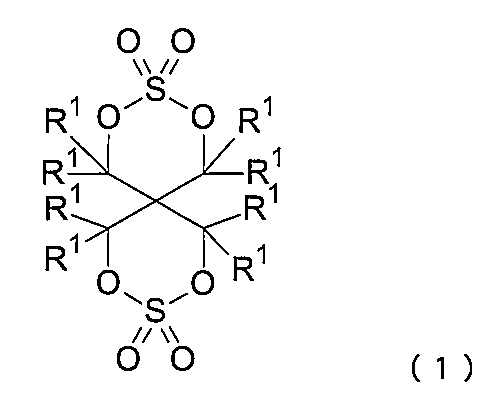
炭素原子数1~12の直鎖アルキル基としては、例えば、メチル基や、エチル基、n-プロピル基、n-ブチル基、n-ペンチル基等の、炭素原子数1~6のアルキル基等が好適に挙げられる。
炭素原子数3~12の分岐状のアルキル基としては、例えば、イソプロピル基や、イソブチル基、第二ブチル基、第三ブチル基、ネオペンチル基、イソペンチル基、第二ペンチル基、3-ペンチル基、tert-ペンチル基等の、炭素原子数3~6の分岐状のアルキル基が好適に挙げられる。
また、上記アルキル基中の炭素原子-炭素原子結合間には、酸素原子が含まれていてもよく、また、上記アルキル基の任意の水素原子はフッ素原子に置換されていてもよい。
アルキル基中の炭素原子-炭素原子結合間に酸素原子が含まれている基としては、例えば、アルコキシアルキル基が挙げられ、その具体例としては、メトキシメチル基や、エトキシメチル基、プロポキシメチル基、メトキシエチル基、エトキシエチル基、1-メチルエトキシメチル基等が挙げられる。また、アルキル基の任意の水素原子がフッ素原子で置換されてるアルキル基としては、例えば、トリフルオロメチル基や、2,2-ジフルオロエチル基、2,2,2-トリフルオロエチル基、2,2,3,3-テトラフルオロプロピル基、1,1,1,3,3,3-ヘキサフルオロイソプロピル基、1-トリフルオロメチルエチル基、1,2-ジフルオロプロピル基等が、好適に挙げることができる。
前記8個のR1の内少なくとも1個が水素原子であることが好ましく、特に、全てのR1が水素原子であることが好ましい。
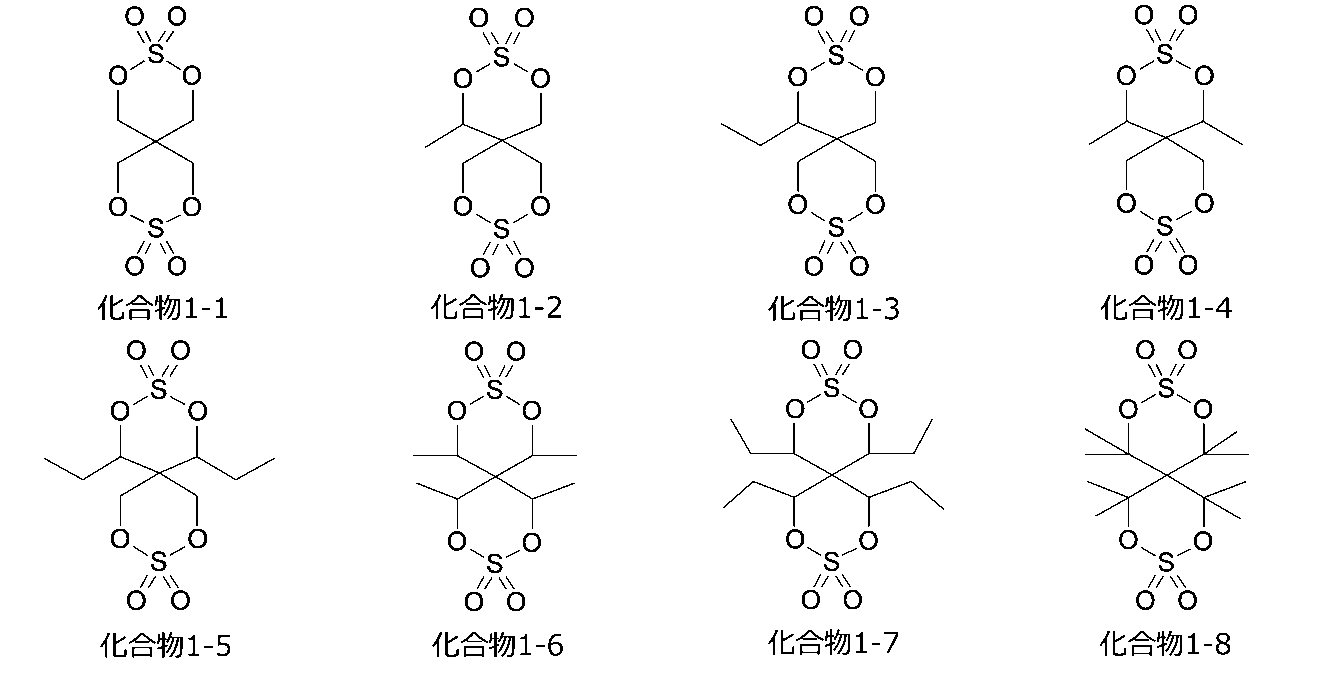

化合物(1)は、非水電解液の総量を100質量%とした場合に、一般に、0.1~5質量%、好ましくは、0.1~4質量%で配合することが適当である。
本開示の非水電解液二次電池用電解液に使用される化合物(2)は、以下の一般式(2)で示されるシラン化合物である。
Si(R2)x(R3)4-x (2)
一般式(2)中、xは、2~4の整数である。R2は、それぞれ独立して、アルケニル基又はアルキニル基を示す。また、それぞれの炭素原子数は、好ましくは、2~5、更に好ましくは、2又は3である。
また、R3は、それぞれ独立して、フッ素原子、アルキル基、アルコキシ基、アリール基、及びアリールオキシ基からなる群から選ばれる基を表し、これらの基の水素原子は、フッ素原子に置換されていてもよい。
上記化合物(2)としては、特に、上記R2で表されるアルケニル基又はアルキニル基を2個以上有する化合物であることが重要である。即ち、一般式(2)において、xが、2以上である。更に、上記xが、3又は4であると、サイクル特性及び/又はガス抑制の効果の観点で好ましく、上記xが、4であると特に好ましい。
具体的な化合物(2)としては、以下の化合物が、シラン化合物の代表的な化合物(2)として好適に挙げることができる。これらの化合物は、それぞれ、以下のように、本開示において、化合物番号として、化学式の下に記載された2シリーズの番号で言及される。これらの化合物は、いずれも、公知の化合物であり、例えば、特開2000-143677号公報、特開2004-256494号公報、特開平05-104541号公報等に製造方法が開示されている。

本開示の非水電解液二次電池用電解液に使用される化合物(3)は、以下の一般式(3)で示される化合物である。
PO(OR4)y(OR5)3-y (3)
一般式(3)中、yは、2又は3である。R4は、それぞれ独立して、アルケニル基又はアルキニル基を表す。それぞれの炭素原子数は、好ましくは、2~5、更に好ましくは、2~3である。特に、アルキニル基を複数含むリン酸エステルが好ましい。
R4としては、具体的には、それぞれ独立して、ビニル基や、2-プロペニル基、1-プロペニル基、エチニル基、2-プロピニル基、1-プロピニル基、2-ブチニル基等が好ましく、中でも、2-プロペニル基、2-プロピニル基や、2-ブチニル基等が好ましい。
本開示における非水電解液二次電池用電解液に使用される化合物(3)は、上記R4で表されるアルケニル基又はアルキニル基を2以上有する。即ち、式中のyが、2以上である。上記yが、3であると、サイクル特性及び/又はガス抑制の改善効果の観点で特に好ましい。
R5としてのアルキル基としては、炭素原子数が1~5、好ましくは、1~3を有するアルキル基が好適であり、直鎖アルキル基であっても、分岐状アルキル基であってもよい。直鎖アルキル基としては、例えば、メチル基や、エチル基、プロピル基等が好適に挙げられる。分岐状アルキル基としては、例えば、イソプロピル基や、イソブチル基等が好適に挙げられる。また、アルキル基の水素原子がフッ素原子で置換されていてもよく、そのようなフッ素原子で置換されたアルキル基としては、例えば、2,2,2-トリフルオロエチル基や、2,2,3,3-テトラフルオロプロピル基、1,1,1-トリフルオロイソプロピル基、1,1,1,3,3,3-ヘキサフルオロイソプロピル基等が好適に挙げられる。
アリール基としては、例えば、フェニル基等が好適に挙げられる。その水素原子がフッ素で置換されたアリール基であってもよい。そのようなフッ素原子で置換されたアリール基としては、例えば、ペンタフルオロフェニル基等が好適に挙げられる。

化合物(1)に対して、化合物(2)及び/又は化合物(3)を、併用してもよい。
この場合、化合物(1)と、化合物(2)及び/又は化合物(3)との合計濃度は、非水電解液の総量に対して、例えば、0.1~5質量%、好ましくは、0.5~4質量%であることが好適である。
本開示における非水電解液二次電池用電解液は、化合物(1)と、化合物(2)及び/又は化合物(3)とを併用することにより、負極活物質としてSi及び/又は酸化ケイ素を有する負極を含有する非水電解液二次電池に使用すると、優れたサイクル特性と、優れたガス抑制特性との両特性がバランスよく発揮される。
本開示の非水電解液電池用電解液は、本開示の要旨を損なわない限りにおいて、この技術分野において、一般的に用いられる添加剤を任意の比率で添加してもよい。
本開示の非水電解液が上記添加剤を含む場合、その含有量は、非水電解液の総量に対して0.01質量%以上10質量%以下であってもよい。
そのような添加剤としては、例えば、シクロヘキシルベンゼン、シクロヘキシルフルオロベンゼン、ビフェニル、2-フルオロビフェニル、t-ブチルベンゼン、t-アミルベンゼン、2-フルオロトルエン、フルオロベンゼン、ビニレンカーボネート(以降「VC」と記載する場合がある)、ビニレンカーボネートのオリゴマー(ポリスチレン換算の数平均分子量が170~5000)、ビニルエチレンカーボネート、ジフルオロアニソール、フルオロエチレンカーボネート(以降「FEC」と記載する場合がある)、1,6-ジイソシアナトヘキサン、エチニルエチレンカーボネート、trans-ジフルオロエチレンカーボネート、メチルプロパルギルカーボネート、エチルプロパルギルカーボネート、ジプロパルギルカーボネート、無水マレイン酸、無水コハク酸、1,3-プロパンスルトン、1,3-プロペンスルトン、1,4-ブタンスルトン、ジメチルビニレンカーボネート、1,3,2-ジオキサチオラン-2,2-ジオキシド、4-プロピル-1,3,2-ジオキサチオラン-2,2-ジオキシド、メチレンメタンジスルホネート、ジメチレンメタンジスルホネート、トリメチレンメタンジスルホネート、メタンスルホン酸メチル、メタンスルホニルフルオリド、エテンスルホニルフルオリド、ジフルオロリン酸フェニル、1,2-エタンジスルホン酸無水物、トリス(トリメチルシリル)ボレート、スクシノニトリル、(エトキシ)ペンタフルオロシクロトリホスファゼン、テトラフルオロ(ピコリナト)ホスフェート、ジフルオロ(ピコリナト)ボレート、1,3-ジメチル-1,3-ジビニル-1,3-ジ(1,1,1,3,3,3-ヘキサフルオロイソプロピル)ジシロキサン等が挙げられる。
また、リチウムポリマー電池と呼ばれる非水電解液電池に使用される場合のように非水電解液電池用電解液をゲル化剤や架橋ポリマーにより擬固体化して使用することも可能である。
本開示の非水電解液二次電池用電解液が使用される非水電解液二次電池の構成について説明する。
本開示における非水電解液二次電池は、基本的に、一般の非水二次電池に使用されている構成が採用される。即ち、リチウムの吸蔵及び放出が可能な正極及び負極、集電体、セパレータ、容器等から成る。特に、本開示の非水電解液二次電池用電解液は、高容量化の観点で要望されている、特定の負極活物質を使用する負極を採用する非水電解液二次電池に適用された場合においても、これまで達成できなかった、サイクル後の容量維持率の向上、及び高温貯蔵時のガス発生量の抑制のうち少なくとも1つを発揮できる。
即ち、本開示の非水電解液二次電池用電解液は、負極活物質として、Si及び/又は酸化ケイ素を含む非水電解液二次電池に使用されると、サイクル後の容量維持率の向上、及び高温貯蔵時のガス発生量の抑制のうち少なくとも1つを発揮できる非水電解液二次電池用電解液を提供するものである。
正極は、少なくともニッケルが含まれた酸化物及びニッケルが含まれたリン酸塩からなる群から選択される少なくとも1種を正極活物質として含んでもよい。
非水電解液中のカチオンがリチウム主体となるリチウムイオン二次電池の場合、正極を構成する正極活物質は、ニッケルが含まれた酸化物及びニッケルが含まれたリン酸塩からなる群から選択される少なくとも1種を有し、充放電が可能な種々の材料であれば特に限定されるものでないが、例えば、(A)ニッケル、又はニッケルに加えてマンガン、コバルト、アルミニウムからなる群から選ばれる一つ以上の金属を含有し、かつ層状構造を有するリチウム遷移金属複合酸化物、(B)スピネル構造を有し、ニッケルを含有するリチウムマンガン複合酸化物、(C)ニッケルを含有するリチウム含有オリビン型リン酸塩、及び(D)層状岩塩型構造を有し、ニッケルを含有するリチウム過剰層状遷移金属酸化物から少なくとも1種を含有するものが挙げられる。
正極活物質(A)
ニッケル、又はニッケルに加えてマンガン、コバルト及びアルミニウムからなる群から選ばれる一つ以上の金属を含有し、かつ層状構造を有するリチウム遷移金属複合酸化物としては、例えば、リチウム・ニッケル複合酸化物、リチウム・ニッケル・コバルト複合酸化物、リチウム・ニッケル・コバルト・アルミニウム複合酸化物、リチウム・ニッケル・マンガン複合酸化物、リチウム・ニッケル・マンガン・コバルト複合酸化物等が好適に挙げられる。また、これらリチウム遷移金属複合酸化物の主体となる遷移金属原子の一部を、Al、Ti、V、Cr、Fe、Cu、Zn、Mg、Ga、Zr、Si、B、Ba、Y、Sn等の他の元素で置換したものを用いてもよい。
リチウム・ニッケル複合酸化物の具体例としては、LiNiO2や、Mg、Zr、Al、Ti等の異種元素を添加したニッケル酸リチウムLiNiO2粒子粉末の粒子表面の一部に酸化アルミニウムが被覆したものを用いてもよい。
LiaNi1-b-cCobM1 cO2 [1-1]
式[1-1]中、M1は、Al、Fe、Mg、Zr、Ti及びBからなる群より選ばれる少なくとも1つの元素であり、aは、0.9≦a≦1.2であり、b及びcは、0.1≦b≦0.3、0≦c≦0.1の条件を満たす。
これらは、例えば、特開2009-137834号公報等に記載される製造方法等に準じて調製することができる。具体的には、LiNi0.8Co0.2O2や、LiNi0.85Co0.10Al0.05O2、LiNi0.87Co0.10Al0.03O2、LiNi0.6Co0.3Al0.1O2等が好適に挙げられる。
LidNieMnfCogM2 hO2 [1-2]
式[1-2]中、M2は、Al、Fe、Mg、Zr、Ti、B及びSnからなる群より選ばれる少なくとも1つの元素であり、dは、0.9≦d≦1.2であり、e、f、g及びhは、e+f+g+h=1、0≦e≦0.9、0≦f≦0.5、0≦g≦0.5、及びh≧0の条件を満たす。
具体的には、例えば4.3V以上に充放電領域を有する、Li[Ni1/3Mn1/3Co1/3]O2(以降、「NCM111」と表記する場合がある)、Li[Ni0.45Mn0.35Co0.2]O2、Li[Ni0.5Mn0.3Co0.2]O2、Li[Ni0.6Mn0.2Co0.2]O2(以降、「NCM622」と表記する場合がある)、Li[Ni0.8Mn0.1Co0.1]O2(以降、「NCM811」と表記する場合がある)、Li[Ni0.49Mn0.3Co0.2Zr0.01]O2、Li[Ni0.49Mn0.3Co0.2Mg0.01]O2等が好適に挙げられる。
正極活物質(B)
スピネル構造を有するリチウムマンガン複合酸化物としては、例えば、一般式[1-3]で示されるスピネル型リチウムマンガン複合酸化物が挙げられる。
Lij(Mn2-kM3 k)O4 [1-3]
式[1-3]中、M3は、Niを含み、それ以外にCo、Fe、Mg、Cr、Cu、Al及びTiからなる群より選ばれる少なくとも1つの金属元素を含んでもよい。jは1.05≦j≦1.15であり、kは0<k≦0.20である。
具体的には、例えば、LiMn1.9Ni0.1O4、LiMn1.5Ni0.5O4等が挙げられる。
正極活物質(C)
リチウム含有オリビン型リン酸塩としては、例えば、以下の一般式[1-4]で示されるものが挙げられる。
LiFe1-nM4 nPO4 [1-4]
式[1-4]中、M4は、Niを含み、それ以外にCo、Mn、Cu、Zn、Nb、Mg、Al、Ti、W、Zr及びCdから選ばれる少なくとも1つを含んでもよく、nは、0<n≦1である。
具体的には、例えば、LiNiPO4等が好適に挙げられる。
正極活物質(D)
層状岩塩型構造を有するリチウム過剰層状遷移金属酸化物としては、例えば、以下の一般式[1-5]で示されるものが挙げられる。
xLiM5O2・(1-x)Li2M6O3 [1-5]
式[1-5]中、xは、0<x<1を満たす数であり、M5は、平均酸化数が3+である少なくとも1種以上の金属元素であり、M6は、平均酸化数が4+である少なくとも1種の金属元素である。式[1-5]中、M5は、好ましくは3価のMn、Ni、Co、Fe、V及びCrから選ばれてなる1種の金属元素であるが、2価と4価の等量の金属で平均酸化数を3価にしてもよい。
上記一般式[1-5]で表される正極活物質(D)は、4.4V(Li基準)以上の高電圧充電で高容量を発現することが知られている(例えば、米国特許7,135,252)。
これら正極活物質は、例えば、特開2008-270201号公報や、WO2013/118661号公報、特開2013-030284号公報等に記載される製造方法等に準じて調製することができる。
正極は、正極集電体を有する。正極集電体としては、例えば、アルミニウムや、ステンレス鋼、ニッケル、チタン又はこれらの合金等を用いることができる。
正極は、例えば、正極集電体の少なくとも一方の面に正極活物質層が形成される。正極活物質層は、例えば、前述の正極活物質と、結着剤と、必要に応じて導電剤とにより構成される。
結着剤としては、ポリテトラフルオロエチレンや、ポリフッ化ビニリデン、テトラフルオロエチレン-パーフルオロアルキルビニルエーテル共重合体、スチレンブタジエンゴム(SBR)、カルボキシメチルセルロース、メチルセルロース、酢酸フタル酸セルロース、ヒドロキシプロピルメチルセルロース、ポリビニルアルコール等が挙げられる。
導電剤としては、例えば、アセチレンブラックや、ケッチェンブラック、ファーネスブラック、炭素繊維、黒鉛(粒状黒鉛や燐片状黒鉛)、フッ素化黒鉛等の炭素材料を用いることができる。正極においては、結晶性の低いアセチレンブラックや、ケッチェンブラック等を用いることが好ましい。
負極活物質としては、上記のように、Si及び/又は酸化ケイ素(以降、「SiOx」と記載する場合がある)が使用される。必要に応じて、更に、黒鉛を併用してもよい。
具体的には、本開示における負極活物質は、Si及び/又は酸化ケイ素を含む。
酸化ケイ素は、SiOxとして示される化合物である。ここで、xは、0.5~1.5の値を有する。負極活物質としては、ケイ素金属であってもよく、酸化ケイ素(SiOx)でもよい。
負極活物質として黒鉛が含まれる場合には、負極活物質に含まれるSi及び/又は酸化ケイ素の含有量は、負極活物質に含まれる前記Si及び/又は酸化ケイ素と、黒鉛との総量を100質量%とした場合に、一般に、0.1~50質量%であり、好ましくは、0.1~30質量%であることが好適である。
黒鉛は、非水電解液中のカチオンがリチウム主体となるリチウムイオン二次電池の場合、リチウムイオンのドープ・脱ドープが可能なものであり、例えばX線回折における格子面(002面)のd値が0.340nm以下の黒鉛や、X線回折における格子面(002面)のd値が0.340nmを超える黒鉛等が挙げられる。これら負極活物質は、1種を単独で用いることができ、2種以上を組合せて用いることもできる。
負極は、負極集電体を有する。負極集電体としては、例えば、銅や、ステンレス鋼、ニッケル、チタン又はこれらの合金等を用いることができる。
(ウ)負極は、例えば負極集電体の少なくとも一方の面に負極活物質層が形成される。負極活物質層は、例えば、前述の負極活物質と、結着剤と、必要に応じて導電剤とにより構成される。
結着剤としては、ポリテトラフルオロエチレンや、ポリフッ化ビニリデン、テトラフルオロエチレン-パーフルオロアルキルビニルエーテル共重合体、スチレンブタジエンゴム(SBR)、カルボキシメチルセルロース、メチルセルロース、酢酸フタル酸セルロース、ヒドロキシプロピルメチルセルロース、ポリビニルアルコール等が挙げられる。
導電剤としては、例えば、アセチレンブラックや、ケッチェンブラック、ファーネスブラック、炭素繊維等の炭素材料を用いることができる。
電極は、例えば、活物質と、結着剤と、必要に応じて導電剤とを所定の配合量でN-メチル-2-ピロリドン(NMP)や水等の溶媒中に分散混練し、得られたペーストを集電体に塗布、乾燥して活物質層を形成することで得ることができる。得られた電極は、ロールプレス等の方法により圧縮して、適当な密度の電極に調節することが好ましい。
本開示の非水電解液電池は、セパレータを備えることができる。正極と、負極との接触を防ぐためのセパレータとしては、例えば、ポリプロピレンや、ポリエチレン等のポリオレフィン、セルロースや、紙、ガラス繊維等で作られた不織布や多孔質シートが使用される。これらのフィルムは、電解液がしみ込んでイオンが透過し易いように、微多孔化されているものが好ましい。
ポリオレフィンセパレ-タとしては、例えば、多孔性ポリオレフィンフィルム等の微多孔性高分子フィルムといった正極と負極とを電気的に絶縁し、かつリチウムイオンが透過可能な膜が挙げられる。多孔性ポリオレフィンフィルムの具体例としては、例えば多孔性ポリエチレンフィルム単独、又は多孔性ポリエチレンフィルムと多孔性ポリプロピレンフィルムとを重ね合わせて複層フィルムとして用いてもよい。また、多孔性のポリエチレンフィルムとポリプロピレンフィルムとを複合化したフィルム等が挙げられる。
本開示の非水電解液は、上記のセパレータに含浸されて保持される。含浸方法については、特に制限はなく、既知の方法で実施すればよい。具体的には、正極、セパレータ、負極を備えた電池に最後に電解液を注液することで含浸できる。
本開示の非水電解液二次電池用電解液を含む非水電解液二次電池を構成するにあたり、非水電解液二次電池用電解液の外装体としては、例えば、コイン型や、円筒型、角型等の金属缶、更には、ラミネート外装体等を好適に用いることができる。金属缶材料としては、例えば、ニッケルメッキを施した鉄鋼板や、ステンレス鋼板、ニッケルメッキを施したステンレス鋼板、アルミニウム又はその合金、ニッケル、チタン等が好適に挙げられる。ラミネート外装体としては、例えば、アルミニウムラミネートフィルムや、SUS製ラミネートフィルム、シリカをコーティングしたポリプロピレン、ポリエチレン等のラミネートフィルム等を用いることができる。
なお、以下の説明において、比較例において使用される具体的な比較化合物は、以下の化合物である。これらの化合物は、その化学式の下に記載される番号により、言及される。

<比較例1-1>
(LiPF6溶液の調製)
露点-60℃以下のグローブボックス内において、EC、EMC及びDECを、EC:EMC:DEC=3:5:2の体積比率で混合させた。その後、内温を40℃以下に保ちながら非水電解液総量に対して、0.9mol/Lの濃度となる量のLiPF6、非水電解液総量に対して10.0質量%の濃度となる量のFECを加え、1時間攪拌して溶解させることで比較非水電解液1-1を調製した。
(非水電解液1-1の調製)
露点-60℃以下のグローブボックス内において、EC、EMC及びDECを、EC:EMC:DEC=3:5:2の体積比率で混合させた。その後、内温を40℃以下に保ちながら非水電解液総量に対して、0.9mol/Lの濃度となる量のLiPF6、非水電解液総量に対して10.0質量%の濃度となる量のFEC、0.5質量%の濃度となる化合物(1)に該当する化合物(1-1)、0.5質量%の濃度となる量の化合物(2)に該当する化合物(2-3)を加え、1時間攪拌して溶解させることで実施例1-1の非水電解液1-1を調製した。
(非水電解液1-2~1-12の調製)
化合物(1)、化合物(2)、及び比較化合物の種類及び含有量を表1に記載のように変更した以外は実施例の非水電解液1-1の調製と同様にして、実施例の非水電解液1-2~1-12を調製した。
(非水電解液2-1~2-20、及び比較非水電解液2-1の調製)
化合物(1)、化合物(3)、及び比較化合物の種類及び含有量を表2に記載のように変更した以外は実施例の非水電解液1-1の調製と同様にして、実施例の非水電解液2-1~2-20、及び比較非水電解液2-1を調製した。
(LiPF6溶液の調製)
露点-60℃以下のグローブボックス内において、EC、EMC及びDECを、EC:EMC:DEC=3:5:2の体積比率で混合させた。その後、内温を40℃以下に保ちながら非水電解液総量に対して、0.9mol/Lの濃度となる量のLiPF6、非水電解液総量に対して5.0質量%の濃度となる量のFEC、1.0質量%の濃度となる量のVCを加え、1時間攪拌して溶解させることで比較非水電解液3-1を調製した。
(非水電解液3-1の調製)
露点-60℃以下のグローブボックス内において、EC、EMC及びDECを、EC:EMC:DEC=3:5:2の体積比率で混合させた。その後、内温を40℃以下に保ちながら非水電解液総量に対して、0.9mol/Lの濃度となる量のLiPF6、非水電解液総量に対して5.0質量%の濃度となるFEC、1.0質量%の濃度となる量のVC、1.0質量%の濃度となる量の化合物(1)に該当する化合物(1-1)、0.5質量%の濃度となる量の化合物(2)に該当する化合物(2-3)、更にその他の添加剤として、1.0質量%の濃度となる量のジフルオロリン酸リチウムを加え、1時間攪拌して溶解させることで実施例の非水電解液3-1を調製した。
(非水電解液3-2~3-6の調製)
化合物(1)、化合物(2)、化合物(3)、又はその他の添加剤・溶質の種類や含有量を以下の表3に記載のように変更した以外は、実施例の非水電解液3-1の調製と同様にして、実施例の非水電解液3-2~3-6を得た。なお、表3には、参考のため、実施例1シリーズの非水電解液のうち、非水電解液1-3、1-5、1-6について、「その他添加剤」の代わりに、表3に示す「その他の添加剤・溶質」を使用して調製した非水電解液1-3V、1-5V、1-6Vを用いた実施例1-3V、1-5V、1-6Vについても記載されている。
また、表3には、参考のため、実施例2シリーズの非水電解液のうち、非水電解液2-3、2-5、2-7について、「その他添加剤」の代わりに、表3に示す「その他の添加剤・溶質」を使用して調製した非水電解液2-3V、2-5V、2-7Vを用いた実施例2-3V、2-5V、2-7Vについても記載されている。
(比較非水電解液4-1の調製)
露点-60℃以下のグローブボックス内において、EC、EMC及びDECを、EC:EMC:DEC=3:5:2の体積比率で混合させた。その後、内温を40℃以下に保ちながら非水電解液総量に対して、0.9mol/Lの濃度となる量のLiPF6、非水電解液総量に対して10.0質量%の濃度となる量のFECを加え、1時間攪拌して溶解させることで比較非水電解液4-1を調製した。
(非水電解液4-1の調製)
露点-60℃以下のグローブボックス内において、EC、EMC及びDECを、EC:EMC:DEC=3:5:2の体積比率で混合させた。その後、内温を40℃以下に保ちながら非水電解液総量に対して、0.9mol/Lの濃度となる量のLiPF6、非水電解液総量に対して10.0質量%の濃度となる量のFEC、0.5質量%の濃度となる化合物(1)に該当する化合物(1-1)、0.5質量%の濃度となる量の化合物(2)に該当する化合物(2-12)を加え、1時間攪拌して溶解させることで実施例の非水電解液4-1を調製した。
(非水電解液4-2~4-3、及び非水電解液4-2V~4-3Vの調製)
化合物(1)、化合物(2)、及び/又は化合物(3)の種類及び含有量を表4に記載のように変更した以外は、実施例の非水電解液4-1の調製と同様にして、非水電解液4-2~4-3、及び非水電解液4-2V~4-3Vを調製した。
(非水電解液4-4Vの調製)
露点-60℃以下のグローブボックス内において、EC、EMC及びDECを、EC:EMC:DEC=3:5:2の体積比率で混合させた。その後、内温を40℃以下に保ちながら非水電解液総量に対して、0.9mol/Lの濃度となる量のLiPF6、非水電解液総量に対して10.0質量%の濃度となる量のFEC、0.5質量%の濃度となる量のVCを加え、1時間攪拌して溶解させることで非水電解液4-4Vを調製した。
なお、下記表4において、参考例は、負極活物質として黒鉛のみを使用する負極を含有する非水電解液二次電池に使用されるものとして示されている。
(非水電解液4-4の調製)
露点-60℃以下のグローブボックス内において、EC、EMC及びDECを、EC:EMC:DEC=3:5:2の体積比率で混合させた。その後、内温を40℃以下に保ちながら非水電解液総量に対して、0.9mol/Lの濃度となる量のLiPF6、非水電解液総量に対して10.0質量%の濃度となるFEC、1.0質量%の濃度となる量の化合物(1)に該当する化合物(1-1)、0.5質量%の濃度となる量の化合物(2)に該当する化合物(2-3)、更にその他の添加剤として、0.5質量%の濃度となる量のVCを加え、1時間攪拌して溶解させることで非水電解液4-4を調製した。
(非水電解液4-5~4-7の調製)
化合物(2)又は化合物(3)の種類を表4に記載のように変更した以外は、非水電解液4-4の調製と同様にして、非水電解液4-5~4-7を調製した。
(NCM811正極の作製)
LiNi0.8Co0.1Mn0.1O2粉末92.0質量%に、バインダーとしてポリフッ化ビニリデン(以下、PVDFとも記載する)を3.5質量%、導電材としてアセチレンブラックを4.5質量%混合し、更にN-メチル-2-ピロリドンを添加し、正極合材ペーストを作製した。このペーストをアルミニウム箔(A1085)の両面に塗布して、乾燥及び加圧を行った後に、4cm×5cmに打ち抜くことで試験用NCM811正極を得た。
LiNi0.6Co0.2Mn0.2O2粉末90.0質量%に、バインダーとしてPVDFを5.0質量%、及び導電材としてアセチレンブラックを5.0質量%混合し、更にN-メチル-2-ピロリドンを添加し、正極合材ペーストを作製した。このペーストをアルミニウム箔(A1085)の両面に塗布して、乾燥、加圧を行った後に、4cm×5cmに打ち抜くことで試験用NCM622正極を得た。
Li[Ni1/3Mn1/3Co1/3]O2粉末90.0質量%に、バインダーとしてPVDFを5.0質量%、及び導電材としてアセチレンブラックを5.0質量%混合し、更にN-メチル-2-ピロリドンを添加し、正極合材ペーストを作製した。このペーストをアルミニウム箔(A1085)の両面に塗布して、乾燥、加圧を行った後に、4cm×5cmに打ち抜くことで試験用NCM111正極を得た。
人造黒鉛粉末72.0質量%に、SiOx(x=1)20.0質量%、導電材(HS-100)3.0質量%、カーボンナノファイバー(VGCF)2.0質量%、スチレンブタジエンゴム2.0質量%、及びカルボキシメチルセルロースナトリウム1.0質量%と水を混合し、負極合材ペーストを作製した。このペーストを銅箔の片面に塗布して、乾燥、加圧を行った後に、4cm×5cmに打ち抜くことで試験用ケイ素含有黒鉛負極を得た。
人造黒鉛粉末82.0質量%に、SiOx(x=1)10.0質量%、導電材(HS-100)3.0質量%、カーボンナノファイバー(VGCF)2.0質量%、スチレンブタジエンゴム2.0質量%、及びカルボキシメチルセルロースナトリウム1.0質量%と水を混合し、負極合材ペーストを作製した。このペーストを銅箔の片面に塗布して、乾燥及び加圧を行った後に、4cm×5cmに打ち抜くことで試験用ケイ素含有黒鉛負極を得た。
人造黒鉛粉末98.0質量%に、スチレンブタジエンゴム1.0質量%、及びカルボキシメチルセルロース1.0質量%と水を混合し、負極合材ペーストを作製した。このペーストを銅箔の片面に塗布して、乾燥及び加圧を行った後に、4cm×5cmに打ち抜くことで試験用黒鉛負極を得た。
露点-50℃以下のアルゴン雰囲気で、上述のNCM811正極、NCM622正極、又はNCM111正極に端子を溶接した後に、その両側をポリエチレン製セパレータ(5cm×6cm)2枚で挟み、更にその外側を予め端子を溶接したケイ素含有黒鉛負極、又は黒鉛負極2枚で、負極活物質面が正極活物質面と対向するように挟み込んだ。そして、それらを一辺の開口部が残されたアルミラミネートの袋に入れ、非水電解液を真空注液した後に、開口部を熱で封止する事によって、実施例及び比較例のアルミラミネート型の非水電解液電池を作製した。使用された非水電解液は、非水電解液として表1~4に記載のものを用いた。
以上のような方法で作製したセルを用いて、後述の方法でサイクル特性及び高温貯蔵時に発生するガスの発生量を評価した。
<サイクル特性試験>
25℃の環境温度での充放電試験を実施し、サイクル特性を評価した。初期コンディショニングとして充電は4.2Vまで、放電は2.5Vまで行い、電流密度1.9mA/cm2で充放電サイクルを行った。これを1サイクルとし、計3サイクルの充放電を行うことで、電池を安定化させた。その後、4サイクル目に測定した放電容量を初充放電容量とした。その後、充電は4.2Vまで、放電は2.5Vまで行い、電流密度1.9mA/cm2で500サイクルほど充放電サイクルを繰り返し、500サイクル後の放電容量維持率でセルの劣化具合を評価した。500サイクル後の放電容量維持率は下記式で求めた。
放電容量維持率(%)=(500サイクル後の放電容量)×100/(初充放電容量)
なお、表1に記載の全ての実施例の500サイクル後の放電容量維持率の数値は、比較例1-1の500サイクル後の放電容量維持率を100とした場合の相対値である。また、表2に記載の全ての実施例に記載の500サイクル後の放電容量維持率の数値は、比較例2-1の500サイクル後の放電容量維持率を100とした場合の相対値である。また、表3に記載の全ての実施例に記載の500サイクル後の放電容量維持率の数値は、比較例3-1の500サイクル後の放電容量維持率を100とした場合の相対値である。また、表4に記載の全ての実施例に記載の500サイクル後の放電容量維持率の数値は、比較例4-1の500サイクル後の放電容量維持率を100とした場合の相対値である。また、表4に記載の全ての参考例に記載の500サイクル後の放電容量維持率の数値は、参考例4-1の500サイクル後の放電容量維持率を100とした場合の相対値である。
25℃の環境温度において充電上限電圧4.2Vまで定電流定電圧法で、電流密度0.38mA/cm2で充電した後、80℃の環境温度で10日間保存した。保存前後で電池の容積を測定し、その差分をガス発生量とした。
なお、表1に記載の全ての実施例のガス発生量の数値は、比較例1-1のガス発生量を100とした場合の相対値である。また、表2に記載の全ての実施例のガス発生量の数値は、比較例2-1のガス発生量を100とした場合の相対値である。また、表3に記載の全ての実施例のガス発生量の数値は、比較例3-1のガス発生量を100とした場合の相対値である。また、表4に記載の全ての実施例のガス発生量の数値は、比較例4-1のガス発生量を100とした場合の相対値である。また、表4に記載の全ての参考例のガス発生量の数値は、参考例4-1のガス発生量を100とした場合の相対値である。
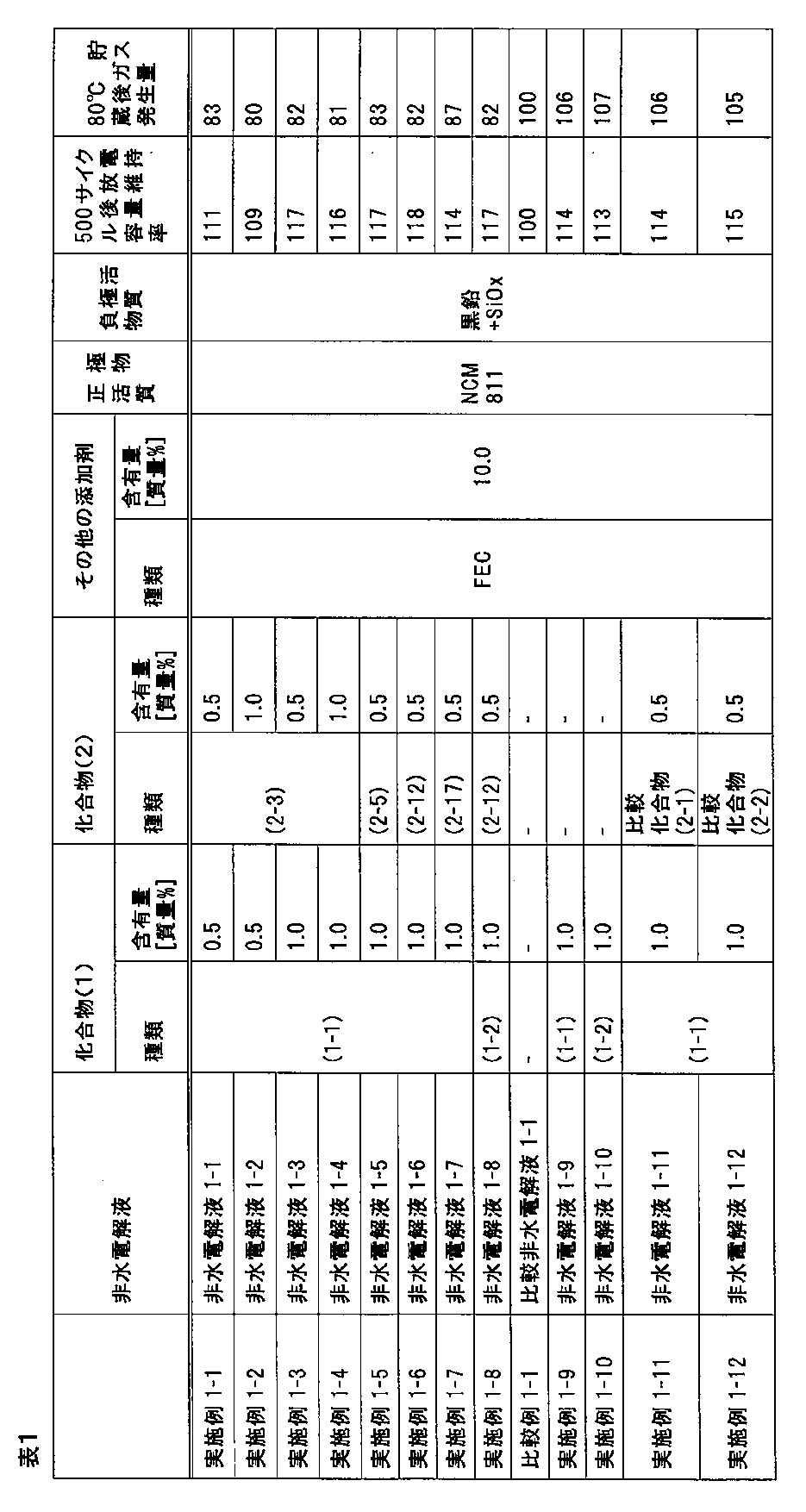
更に、化合物(3)を単独で用いる場合(実施例2-11~2-14)でも、少なくとも高温貯蔵時のガス発生量の抑制を改善することが分かる。この状況は、化合物(3)を、化合物(1)の構造から外れた構造を有する(スピロ構造を有していない)硫酸エステル化合物と併用する場合(実施例2-15~2-18)において、同様であった。従って、化合物(3)単独でも、サイクル後の容量維持率の向上、及び高温貯蔵時のガス発生量の抑制のうち少なくとも1つを発揮できることが分かる。

また、化合物(1)と、化合物(2)及び/又は化合物(3)と、更に、その他の添加剤又は追加の溶質として、フルオロ硫酸リチウム、(ジフルオロホスホリル)(フルオロスルホニル)イミドリチウム、又はビス(フルオロスルホニル)イミドリチウムとを併用することで、それぞれ、そのような添加剤を配合していない実施例と対比して、高温貯蔵時に発生するガス量の更なる低減が確認された。


Claims (25)
- 負極活物質として、Si及び/又は酸化ケイ素を含む負極を含有する非水電解液二次電池用の非水電解液であって、以下の成分、
(I)非水有機溶媒、
(II)イオン性塩である溶質、及び、
(III)下記式(1)で示される化合物、
を含むことを特徴とする非水電解液。
[一般式(1)中、R1は、それぞれ独立して、水素原子、ハロゲン原子、又は炭素原子数1~12の直鎖若しくは炭素原子数3~12の分岐状のアルキル基を表し、前記アルキル基中の炭素原子-炭素原子結合間には、酸素原子が含まれていてもよく、また、前記アルキル基の任意の水素原子は、フッ素原子に置換されていてもよい。]
- 負極活物質として、Si及び/又は酸化ケイ素を含む負極を含有する非水電解液二次電池用の非水電解液であって、以下の成分、
(I)非水有機溶媒、
(II)イオン性塩である溶質、及び、
(IV)下記式(3)で示される化合物、
を含むことを特徴とする非水電解液。
PO(OR4)y(OR5)3-y (3)
[一般式(3)中、R4は、それぞれ独立して、アルケニル基又はアルキニル基を表し、R5は、アルキル基又はアリール基を表し、これらの基の水素原子は、フッ素原子に置換されていてもよく、そして、yは、2~3の整数である。] - 負極活物質として、Si及び/又は酸化ケイ素を含む負極を含有する非水電解液二次電池用の非水電解液であって、以下の成分、
(I)非水有機溶媒、
(II)イオン性塩である溶質、
(III)下記式(1)で示される化合物、及び、
(V)下記式(2)で示される化合物及び/又は下記式(3)で示される化合物、
を含むことを特徴とする非水電解液。
[一般式(1)中、R1は、それぞれ独立して、水素原子、ハロゲン原子、又は炭素原子数1~12の直鎖若しくは炭素原子数3~12の分岐状のアルキル基を表し、前記アルキル基中の炭素原子-炭素原子結合間には、酸素原子が含まれていてもよく、また、前記アルキル基の任意の水素原子は、フッ素原子に置換されていてもよい。]
Si(R2)x(R3)4-x (2)
[一般式(2)中、R2は、それぞれ独立して、アルケニル基又はアルキニル基を表し、R3は、それぞれ独立して、フッ素原子、アルキル基、アルコキシ基、アリール基、及びアリールオキシ基からなる群から選ばれる基を表し、これらの基の水素原子は、フッ素原子に置換されていてもよく、そして、xは、2~4の整数である。]
PO(OR4)y(OR5)3-y (3)
[一般式(3)中、R4は、それぞれ独立して、アルケニル基又はアルキニル基を表し、R5は、アルキル基又はアリール基を表し、これらの基の水素原子は、フッ素原子に置換されていてもよく、そして、yは、2~3の整数である。] - 前記8個のR1の内少なくとも1個が、水素原子である、請求項1又は3に記載の非水電解液。
- 前記R2が、それぞれ独立して、ビニル基、2-プロペニル基、1-プロペニル基、エチニル基、及び2-プロピニル基からなる群から選択される基であり、前記R3が、それぞれ独立して、フッ素原子、メチル基、エチル基、プロピル基、2,2,2-トリフルオロエチル基、2,2,3,3-テトラフルオロプロピル基、1,1,1-トリフルオロイソプロピル基、1,1,1,3,3,3-ヘキサフルオロイソプロピル基、2,2,2-トリフルオロエトキシ基、2,2,3,3-テトラフルオロプロポキシ基、2,2,3,3,3-ペンタフルオロプロポキシ基、1,1,1-トリフルオロイソプロポキシ基、及び1,1,1,3,3,3-ヘキサフルオロイソプロポキシ基からなる群から選択される基である、請求項3に記載の非水電解液。
- 前記x個のR2の内少なくとも1個が、ビニル基であり、前記(4-x)個のR3の内少なくとも1個が、メチル基又はフッ素原子である、請求項3又は5に記載の非水電解液。
- 前記xが、3又は4である、請求項3に記載の記載の非水電解液。
- 前記R4が、それぞれ独立して、1-プロペニル基、2-プロペニル基、エチニル基、2-プロピニル基、及び2-ブチニル基からなる群から選択される基であり、前記R5が、アルキル基である、請求項2又は3に記載の非水電解液。
- 前記R4が、それぞれ独立して、2-プロペニル基、2-プロピニル基、及び2-ブチニル基からなる群から選択される基であり、前記R5が、メチル基又はエチル基である、請求項2、3又は8に記載の非水電解液。
- 前記yが、3である、請求項2又は3に記載の非水電解液。
- 前記式(1)で示される化合物の濃度が、非水電解液の総量に対して、0.1~5質量%である、請求項1又は3に記載の非水電解液。
- 前記式(3)で示される化合物の濃度が、非水電解液の総量に対して、0.01~5質量%である、請求項2又は3に記載の非水電解液。
- 前記式(2)で示される化合物の濃度が、非水電解液の総量に対して、0.01~5質量%である、請求項3に記載の非水電解液。
- 前記負極活物質が、更に、黒鉛を含む、請求項1~13のいずれか1項に記載の非水電解液。
- 前記Si及び/又は酸化ケイ素の含有量が、前記負極活物質に含まれる前記Si及び/又は酸化ケイ素と、黒鉛との合計量に対して、0.1~50質量%である、請求項14に記載の非水電解液。
- 前記非水有機溶媒が、環状エステル、鎖状エステル、環状エーテル、鎖状エーテル、スルホン化合物、及びスルホキシド化合物からなる群から選択される少なくとも1つである、請求項1~15のいずれか1項に記載の非水電解液。
- 前記環状エステルが、環状カーボネートである、請求項16に記載の非水電解液。
- 前記鎖状エステルが、鎖状カーボネートである、請求項16に記載の非水電解液。
- 前記非水有機溶媒が、プロピレンカーボネート、エチレンカーボネート、ブチレンカーボネート、ジエチルカーボネート、ジメチルカーボネート、エチルメチルカーボネート、γ―ブチロラクトン、γ―バレロラクトン、酢酸メチル、プロピオン酸メチル、プロピオン酸エチル、テトラヒドロフラン、2-メチルテトラヒドロフラン、ジオキサン、ジメトキシエタン、ジエチルエーテル、ジメチルスルホキシド、及びスルホランからなる群から選択される少なくとも1つである、請求項1~15のいずれか1項に記載の非水電解液。
- 前記イオン性塩である溶質が、カチオンとアニオンとから構成され、前記カチオンが、アルカリ金属イオン、アルカリ土類金属イオン、及び四級アンモニウムからなる群から選択され、前記アニオンが、ヘキサフルオロリン酸、テトラフルオロホウ酸、過塩素酸、ヘキサフルオロヒ酸、ヘキサフルオロアンチモン酸、及びビス(フルオロスルホニル)イミドからなる群から選択される、請求項1~19のいずれか1項に記載の非水電解液。
- 前記アルカリ金属イオンが、リチウムイオン又はナトリウムイオンである、請求項20に記載の非水電解液。
- 更に、ジフルオロリン酸リチウム、ジフルオロリン酸ナトリウム、フルオロ硫酸リチウム、フルオロ硫酸ナトリウム、トリフルオロメタンスルホン酸リチウム、トリフルオロメタンスルホン酸ナトリウム、ジフルオロビス(オキサラト)リン酸リチウム、ジフルオロビス(オキサラト)リン酸ナトリウム、ジフルオロオキサラトホウ酸リチウム、ジフルオロオキサラトホウ酸ナトリウム、ビス(オキサラト)ホウ酸リチウム、ビス(オキサラト)ホウ酸ナトリウム、テトラフルオロオキサラトリン酸リチウム、テトラフルオロオキサラトリン酸ナトリウム、トリス(オキサラト)リン酸リチウム、トリス(オキサラト)リン酸ナトリウム、ジフルオロ(マロナト)ホウ酸リチウム、ジフルオロ(マロナト)ホウ酸ナトリウム、テトラフルオロ(マロナト)リン酸リチウム、テトラフルオロ(マロナト)リン酸ナトリウム、モノフルオロリン酸リチウム、モノフルオロリン酸ナトリウム、ビス(ジフルオロホスホリル)イミドリチウム、ビス(ジフルオロホスホリル)イミドナトリウム、(ジフルオロホスホリル)(フルオロスルホニル)イミドリチウム、(ジフルオロホスホリル)(フルオロスルホニル)イミドナトリウム、ビス(トリフルオロメタンスルホニル)イミドリチウム、ビス(トリフルオロメタンスルホニル)イミドナトリウム、ビス(ペンタフルオロエタンスルホニル)イミドリチウム、ビス(ペンタフルオロエタンスルホニル)イミドナトリウム、(トリフルオロメタンスルホニル)(ペンタフルオロエタンスルホニル)イミドリチウム、(トリフルオロメタンスルホニル)(ペンタフルオロエタンスルホニル)イミドナトリウム、(トリフルオロメタンスルホニル)(フルオロスルホニル)イミドリチウム、(トリフルオロメタンスルホニル)(フルオロスルホニル)イミドナトリウム、(ペンタフルオロエタンスルホニル)(フルオロスルホニル)イミドリチウム、(ペンタフルオロエタンスルホニル)(フルオロスルホニル)イミドナトリウム、トリス(トリフルオロメタンスルホニル)メチドリチウム、トリス(トリフルオロメタンスルホニル)メチドナトリウム、アクリル酸リチウム、アクリル酸ナトリウム、メタクリル酸リチウム、メタクリル酸ナトリウム、リチウムメチルサルフェート、ナトリウムメチルサルフェート、リチウムエチルサルフェート、及びナトリウムエチルサルフェートからなる群から選択される少なくとも1つを含有する、請求項1~21のいずれか1項に記載の非水電解液。
- 更に、シクロヘキシルベンゼン、シクロヘキシルフルオロベンゼン、ビフェニル、2-フルオロビフェニル、t-ブチルベンゼン、t-アミルベンゼン、2-フルオロトルエン、フルオロベンゼン、ビニレンカーボネート、ビニレンカーボネートのオリゴマー(ポリスチレン換算の数平均分子量が170~5000)、ビニルエチレンカーボネート、ジフルオロアニソール、フルオロエチレンカーボネート、1,6-ジイソシアナトヘキサン、エチニルエチレンカーボネート、trans-ジフルオロエチレンカーボネート、メチルプロパルギルカーボネート、エチルプロパルギルカーボネート、ジプロパルギルカーボネート、無水マレイン酸、無水コハク酸、1,3-プロパンスルトン、1,3-プロペンスルトン、1,4-ブタンスルトン、ジメチルビニレンカーボネート、1,3,2-ジオキサチオラン-2,2-ジオキシド、4-プロピル-1,3,2-ジオキサチオラン-2,2-ジオキシド、メチレンメタンジスルホネート、ジメチレンメタンジスルホネート、トリメチレンメタンジスルホネート、メタンスルホン酸メチル、メタンスルホニルフルオリド、エテンスルホニルフルオリド、ジフルオロリン酸フェニル、1,2-エタンジスルホン酸無水物、トリス(トリメチルシリル)ボレート、スクシノニトリル、(エトキシ)ペンタフルオロシクロトリホスファゼン、テトラフルオロ(ピコリナト)ホスフェート、ジフルオロ(ピコリナト)ボレート、及び1,3-ジメチル-1,3-ジビニル-1,3-ジ(1,1,1,3,3,3-ヘキサフルオロイソプロピル)ジシロキサンからなる群から選択される少なくとも1つを含有する、請求項1~22のいずれか1項に記載の非水電解液。
- 負極活物質としてSi及び/又は酸化ケイ素を含有する負極と、
正極と、
請求項1~23のいずれか1項に記載の非水電解液と、
を含有することを特徴とする、非水電解液二次電池。 - 前記負極活物質が、更に、黒鉛を含有する請求項24に記載の非水電解液二次電池。
Priority Applications (4)
| Application Number | Priority Date | Filing Date | Title |
|---|---|---|---|
| CN202480037975.3A CN121285889A (zh) | 2023-06-08 | 2024-06-06 | 非水电解液二次电池用电解液、及使用了该电解液的非水电解液二次电池 |
| KR1020257043727A KR20260022336A (ko) | 2023-06-08 | 2024-06-06 | 비수전해액 이차전지용 전해액 및 이것을 사용한 비수전해액 이차전지 |
| EP24819390.6A EP4712192A1 (en) | 2023-06-08 | 2024-06-06 | Electrolyte solution for nonaqueous electrolyte secondary battery, and nonaqueous electrolyte secondary battery containing same |
| JP2025526145A JPWO2024253162A1 (ja) | 2023-06-08 | 2024-06-06 |
Applications Claiming Priority (2)
| Application Number | Priority Date | Filing Date | Title |
|---|---|---|---|
| JP2023094565 | 2023-06-08 | ||
| JP2023-094565 | 2023-06-08 |
Publications (1)
| Publication Number | Publication Date |
|---|---|
| WO2024253162A1 true WO2024253162A1 (ja) | 2024-12-12 |
Family
ID=93795546
Family Applications (1)
| Application Number | Title | Priority Date | Filing Date |
|---|---|---|---|
| PCT/JP2024/020724 Ceased WO2024253162A1 (ja) | 2023-06-08 | 2024-06-06 | 非水電解液二次電池用電解液、及びこれを用いた非水電解液二次電池 |
Country Status (5)
| Country | Link |
|---|---|
| EP (1) | EP4712192A1 (ja) |
| JP (1) | JPWO2024253162A1 (ja) |
| KR (1) | KR20260022336A (ja) |
| CN (1) | CN121285889A (ja) |
| WO (1) | WO2024253162A1 (ja) |
Citations (26)
| Publication number | Priority date | Publication date | Assignee | Title |
|---|---|---|---|---|
| JPH05104541A (ja) | 1991-10-15 | 1993-04-27 | Bridgestone Corp | 生タイヤの加硫方法 |
| JP2000143677A (ja) | 1998-08-25 | 2000-05-26 | Mitsui Chemicals Inc | ケイ素化合物の製造方法 |
| US20030113635A1 (en) | 1998-10-22 | 2003-06-19 | Hong Gan | Phosphate additives for nonaqueous electrolyte rechargeable electrochemical cells |
| JP2004256494A (ja) | 2003-02-27 | 2004-09-16 | Japan Science & Technology Agency | ビニルシランの製造方法 |
| US7135252B2 (en) | 2000-06-22 | 2006-11-14 | Uchicago Argonne Llc | Lithium metal oxide electrodes for lithium cells and batteries |
| JP2008270201A (ja) | 2007-03-27 | 2008-11-06 | Univ Kanagawa | リチウムイオン電池用正極材料 |
| JP2009137834A (ja) | 2007-11-12 | 2009-06-25 | Toda Kogyo Corp | 非水電解液二次電池用Li−Ni系複合酸化物粒子粉末及びその製造方法、並びに非水電解質二次電池 |
| WO2012120597A1 (ja) | 2011-03-04 | 2012-09-13 | 株式会社デンソー | 電池用非水電解液及び該電解液を用いた非水電解液二次電池 |
| JP2013030284A (ja) | 2011-07-26 | 2013-02-07 | Mitsubishi Chemicals Corp | 非水系電解液電池 |
| WO2013118661A1 (ja) | 2012-02-06 | 2013-08-15 | 日本電気株式会社 | リチウムイオン電池およびその製造方法 |
| JP2016027028A (ja) | 2014-07-02 | 2016-02-18 | セントラル硝子株式会社 | イオン性錯体、非水電解液電池用電解液、非水電解液電池及びイオン性錯体の合成法 |
| JP2016035820A (ja) | 2014-08-01 | 2016-03-17 | セントラル硝子株式会社 | 非水電解液電池用電解液、及びこれを用いた非水電解液電池 |
| WO2016133169A1 (ja) | 2015-02-19 | 2016-08-25 | セントラル硝子株式会社 | 非水電解液電池用電解液、及びこれを用いた非水電解液電池 |
| US20160359196A1 (en) | 2015-06-08 | 2016-12-08 | Sk Innovation Co., Ltd. | Electrolyte for Lithium Secondary Battery and Lithium Secondary Battery Containing the Same |
| EP3205655A1 (en) | 2016-02-12 | 2017-08-16 | Samsung SDI Co., Ltd. | Organic electrolyte solution of 3,3,9,9-tetraoxide-2,4,8,10-tetraoxa-3,9-dithiaspiro[5.5]undecane for use in a lithium battery |
| WO2017138452A1 (ja) | 2016-02-08 | 2017-08-17 | セントラル硝子株式会社 | 非水電解液電池用電解液、及びこれを用いた非水電解液電池 |
| JP2019102459A (ja) | 2017-12-06 | 2019-06-24 | セントラル硝子株式会社 | 非水電解液電池用電解液及びそれを用いた非水電解液電池 |
| JP2019106362A (ja) | 2017-12-12 | 2019-06-27 | セントラル硝子株式会社 | 非水電解液電池用電解液及びそれを用いた非水電解液電池 |
| JP2020087690A (ja) | 2018-11-26 | 2020-06-04 | セントラル硝子株式会社 | 非水電解液電池用電解液及びそれを用いた非水電解液電池 |
| WO2021111931A1 (ja) * | 2019-12-06 | 2021-06-10 | 三洋電機株式会社 | 非水電解液二次電池 |
| CN113130993A (zh) * | 2019-12-30 | 2021-07-16 | 深圳市研一新材料有限责任公司 | 一种电解液及其电化学装置 |
| CN113809401A (zh) * | 2021-10-26 | 2021-12-17 | 远景动力技术(江苏)有限公司 | 锂离子电池非水电解液及其应用 |
| CN114883648A (zh) * | 2022-05-23 | 2022-08-09 | 香河昆仑新能源材料股份有限公司 | 一种锂离子电池非水电解液和锂离子电池 |
| CN114914542A (zh) * | 2022-04-18 | 2022-08-16 | 深圳市比克动力电池有限公司 | 电解液添加剂、电池电解液以及锂离子电池 |
| CN115053362A (zh) * | 2021-09-30 | 2022-09-13 | 宁德新能源科技有限公司 | 电化学装置和包含其的电子装置 |
| JP2022191483A (ja) | 2017-11-02 | 2022-12-27 | 国立大学法人 東京大学 | 二次電池用負極の製造方法及び二次電池の製造方法 |
-
2024
- 2024-06-06 CN CN202480037975.3A patent/CN121285889A/zh active Pending
- 2024-06-06 KR KR1020257043727A patent/KR20260022336A/ko active Pending
- 2024-06-06 EP EP24819390.6A patent/EP4712192A1/en active Pending
- 2024-06-06 JP JP2025526145A patent/JPWO2024253162A1/ja active Pending
- 2024-06-06 WO PCT/JP2024/020724 patent/WO2024253162A1/ja not_active Ceased
Patent Citations (26)
| Publication number | Priority date | Publication date | Assignee | Title |
|---|---|---|---|---|
| JPH05104541A (ja) | 1991-10-15 | 1993-04-27 | Bridgestone Corp | 生タイヤの加硫方法 |
| JP2000143677A (ja) | 1998-08-25 | 2000-05-26 | Mitsui Chemicals Inc | ケイ素化合物の製造方法 |
| US20030113635A1 (en) | 1998-10-22 | 2003-06-19 | Hong Gan | Phosphate additives for nonaqueous electrolyte rechargeable electrochemical cells |
| US7135252B2 (en) | 2000-06-22 | 2006-11-14 | Uchicago Argonne Llc | Lithium metal oxide electrodes for lithium cells and batteries |
| JP2004256494A (ja) | 2003-02-27 | 2004-09-16 | Japan Science & Technology Agency | ビニルシランの製造方法 |
| JP2008270201A (ja) | 2007-03-27 | 2008-11-06 | Univ Kanagawa | リチウムイオン電池用正極材料 |
| JP2009137834A (ja) | 2007-11-12 | 2009-06-25 | Toda Kogyo Corp | 非水電解液二次電池用Li−Ni系複合酸化物粒子粉末及びその製造方法、並びに非水電解質二次電池 |
| WO2012120597A1 (ja) | 2011-03-04 | 2012-09-13 | 株式会社デンソー | 電池用非水電解液及び該電解液を用いた非水電解液二次電池 |
| JP2013030284A (ja) | 2011-07-26 | 2013-02-07 | Mitsubishi Chemicals Corp | 非水系電解液電池 |
| WO2013118661A1 (ja) | 2012-02-06 | 2013-08-15 | 日本電気株式会社 | リチウムイオン電池およびその製造方法 |
| JP2016027028A (ja) | 2014-07-02 | 2016-02-18 | セントラル硝子株式会社 | イオン性錯体、非水電解液電池用電解液、非水電解液電池及びイオン性錯体の合成法 |
| JP2016035820A (ja) | 2014-08-01 | 2016-03-17 | セントラル硝子株式会社 | 非水電解液電池用電解液、及びこれを用いた非水電解液電池 |
| WO2016133169A1 (ja) | 2015-02-19 | 2016-08-25 | セントラル硝子株式会社 | 非水電解液電池用電解液、及びこれを用いた非水電解液電池 |
| US20160359196A1 (en) | 2015-06-08 | 2016-12-08 | Sk Innovation Co., Ltd. | Electrolyte for Lithium Secondary Battery and Lithium Secondary Battery Containing the Same |
| WO2017138452A1 (ja) | 2016-02-08 | 2017-08-17 | セントラル硝子株式会社 | 非水電解液電池用電解液、及びこれを用いた非水電解液電池 |
| EP3205655A1 (en) | 2016-02-12 | 2017-08-16 | Samsung SDI Co., Ltd. | Organic electrolyte solution of 3,3,9,9-tetraoxide-2,4,8,10-tetraoxa-3,9-dithiaspiro[5.5]undecane for use in a lithium battery |
| JP2022191483A (ja) | 2017-11-02 | 2022-12-27 | 国立大学法人 東京大学 | 二次電池用負極の製造方法及び二次電池の製造方法 |
| JP2019102459A (ja) | 2017-12-06 | 2019-06-24 | セントラル硝子株式会社 | 非水電解液電池用電解液及びそれを用いた非水電解液電池 |
| JP2019106362A (ja) | 2017-12-12 | 2019-06-27 | セントラル硝子株式会社 | 非水電解液電池用電解液及びそれを用いた非水電解液電池 |
| JP2020087690A (ja) | 2018-11-26 | 2020-06-04 | セントラル硝子株式会社 | 非水電解液電池用電解液及びそれを用いた非水電解液電池 |
| WO2021111931A1 (ja) * | 2019-12-06 | 2021-06-10 | 三洋電機株式会社 | 非水電解液二次電池 |
| CN113130993A (zh) * | 2019-12-30 | 2021-07-16 | 深圳市研一新材料有限责任公司 | 一种电解液及其电化学装置 |
| CN115053362A (zh) * | 2021-09-30 | 2022-09-13 | 宁德新能源科技有限公司 | 电化学装置和包含其的电子装置 |
| CN113809401A (zh) * | 2021-10-26 | 2021-12-17 | 远景动力技术(江苏)有限公司 | 锂离子电池非水电解液及其应用 |
| CN114914542A (zh) * | 2022-04-18 | 2022-08-16 | 深圳市比克动力电池有限公司 | 电解液添加剂、电池电解液以及锂离子电池 |
| CN114883648A (zh) * | 2022-05-23 | 2022-08-09 | 香河昆仑新能源材料股份有限公司 | 一种锂离子电池非水电解液和锂离子电池 |
Non-Patent Citations (1)
| Title |
|---|
| CAN. J. CHEM., vol. 79, 2001, pages 1040 - 1048 |
Also Published As
| Publication number | Publication date |
|---|---|
| KR20260022336A (ko) | 2026-02-19 |
| CN121285889A (zh) | 2026-01-06 |
| JPWO2024253162A1 (ja) | 2024-12-12 |
| EP4712192A1 (en) | 2026-03-18 |
Similar Documents
| Publication | Publication Date | Title |
|---|---|---|
| JP7116311B2 (ja) | 非水電解液電池用電解液及びそれを用いた非水電解液電池 | |
| CA2693692C (en) | Non-aqueous electrolytic solutions and electrochemical cells comprising the same | |
| JP7168851B2 (ja) | 非水電解液電池用電解液及びそれを用いた非水電解液電池 | |
| JP7645446B2 (ja) | 非水系電解液、及び非水系電解液二次電池 | |
| JP7172015B2 (ja) | 非水電解液用添加剤、非水電解液電池用電解液、及び非水電解液電池 | |
| JP7223221B2 (ja) | 非水電解液用添加剤、非水電解液、及び非水電解液電池 | |
| CN113782817A (zh) | 非水电解液电池用电解液和使用其的非水电解液电池 | |
| JP7610126B2 (ja) | 非水電解液及び非水電解液電池 | |
| WO2012053553A1 (ja) | 非水系二次電池用電極、それを備えた非水系二次電池及び組電池 | |
| CN105720304A (zh) | 一种非水电解液和一种锂离子电池 | |
| CN111048831A (zh) | 用于二次电池的电解液以及包含电解液的锂二次电池 | |
| CN104868168A (zh) | 非水电解质二次电池 | |
| JP2022534928A (ja) | 層状カリウム金属酸化物を含む電極材料、電極材料を含む電極、および電気化学における電極材料の使用 | |
| JP2025157453A (ja) | リチウム二次電池用電解質、及びそれを含むリチウム二次電池 | |
| KR20240062915A (ko) | 전해액 첨가제, 이를 포함하는 전지용 전해액 및 이를 포함하는 이차전지 | |
| JP7695556B2 (ja) | 非水電解液、及びこれを用いた非水電解液電池 | |
| CN116097491A (zh) | 非水电解液和非水电解液电池 | |
| JP7636095B2 (ja) | リチウム二次電池用非水電解液およびそれを含むリチウム二次電池 | |
| CN117199535A (zh) | 一种电解液、电化学装置及电子装置 | |
| JP7553827B2 (ja) | 非水電解液 | |
| WO2025070769A1 (ja) | 非水電解液、及びこれを用いた非水電解液電池 | |
| WO2025159037A1 (ja) | 非水電解液、非水電解液電池、非水電解液電池の製造方法、化合物、及び化合物の製造方法 | |
| WO2024253162A1 (ja) | 非水電解液二次電池用電解液、及びこれを用いた非水電解液二次電池 | |
| WO2022244046A1 (ja) | 非水系電解液及びそれを用いた非水系電解液二次電池 | |
| JP7562220B2 (ja) | リチウム二次電池用非水電解液およびそれを含むリチウム二次電池 |
Legal Events
| Date | Code | Title | Description |
|---|---|---|---|
| 121 | Ep: the epo has been informed by wipo that ep was designated in this application |
Ref document number: 24819390 Country of ref document: EP Kind code of ref document: A1 |
|
| ENP | Entry into the national phase |
Ref document number: 2025526145 Country of ref document: JP Kind code of ref document: A |
|
| WWE | Wipo information: entry into national phase |
Ref document number: 2025526145 Country of ref document: JP |
|
| WWE | Wipo information: entry into national phase |
Ref document number: 2024819390 Country of ref document: EP |
|
| ENP | Entry into the national phase |
Ref document number: 2024819390 Country of ref document: EP Effective date: 20251211 |
|
| ENP | Entry into the national phase |
Ref document number: 2024819390 Country of ref document: EP Effective date: 20251211 |
|
| ENP | Entry into the national phase |
Ref document number: 1020257043727 Country of ref document: KR Free format text: ST27 STATUS EVENT CODE: A-0-1-A10-A15-NAP-PA0105 (AS PROVIDED BY THE NATIONAL OFFICE) |
|
| ENP | Entry into the national phase |
Ref document number: 2024819390 Country of ref document: EP Effective date: 20251211 |
|
| NENP | Non-entry into the national phase |
Ref country code: DE |
|
| ENP | Entry into the national phase |
Ref document number: 2024819390 Country of ref document: EP Effective date: 20251211 |
|
| ENP | Entry into the national phase |
Ref document number: 2024819390 Country of ref document: EP Effective date: 20251211 |
|
| ENP | Entry into the national phase |
Ref document number: 2024819390 Country of ref document: EP Effective date: 20251211 |
|
| ENP | Entry into the national phase |
Ref document number: 2024819390 Country of ref document: EP Effective date: 20251211 |
|
| ENP | Entry into the national phase |
Ref document number: 2024819390 Country of ref document: EP Effective date: 20251211 |
|
| WWP | Wipo information: published in national office |
Ref document number: 2024819390 Country of ref document: EP |