WO2024252972A1 - 難燃剤、組成物、及び成形品 - Google Patents
難燃剤、組成物、及び成形品 Download PDFInfo
- Publication number
- WO2024252972A1 WO2024252972A1 PCT/JP2024/019426 JP2024019426W WO2024252972A1 WO 2024252972 A1 WO2024252972 A1 WO 2024252972A1 JP 2024019426 W JP2024019426 W JP 2024019426W WO 2024252972 A1 WO2024252972 A1 WO 2024252972A1
- Authority
- WO
- WIPO (PCT)
- Prior art keywords
- flame retardant
- group
- parts
- mass
- hindered amine
- Prior art date
- Legal status (The legal status is an assumption and is not a legal conclusion. Google has not performed a legal analysis and makes no representation as to the accuracy of the status listed.)
- Ceased
Links
Classifications
-
- C—CHEMISTRY; METALLURGY
- C08—ORGANIC MACROMOLECULAR COMPOUNDS; THEIR PREPARATION OR CHEMICAL WORKING-UP; COMPOSITIONS BASED THEREON
- C08K—Use of inorganic or non-macromolecular organic substances as compounding ingredients
- C08K5/00—Use of organic ingredients
- C08K5/16—Nitrogen-containing compounds
- C08K5/34—Heterocyclic compounds having nitrogen in the ring
- C08K5/3412—Heterocyclic compounds having nitrogen in the ring having one nitrogen atom in the ring
- C08K5/3432—Six-membered rings
- C08K5/3435—Piperidines
-
- C—CHEMISTRY; METALLURGY
- C08—ORGANIC MACROMOLECULAR COMPOUNDS; THEIR PREPARATION OR CHEMICAL WORKING-UP; COMPOSITIONS BASED THEREON
- C08K—Use of inorganic or non-macromolecular organic substances as compounding ingredients
- C08K5/00—Use of organic ingredients
- C08K5/16—Nitrogen-containing compounds
- C08K5/17—Amines; Quaternary ammonium compounds
-
- C—CHEMISTRY; METALLURGY
- C08—ORGANIC MACROMOLECULAR COMPOUNDS; THEIR PREPARATION OR CHEMICAL WORKING-UP; COMPOSITIONS BASED THEREON
- C08K—Use of inorganic or non-macromolecular organic substances as compounding ingredients
- C08K5/00—Use of organic ingredients
- C08K5/16—Nitrogen-containing compounds
- C08K5/34—Heterocyclic compounds having nitrogen in the ring
- C08K5/3412—Heterocyclic compounds having nitrogen in the ring having one nitrogen atom in the ring
- C08K5/3432—Six-membered rings
-
- C—CHEMISTRY; METALLURGY
- C08—ORGANIC MACROMOLECULAR COMPOUNDS; THEIR PREPARATION OR CHEMICAL WORKING-UP; COMPOSITIONS BASED THEREON
- C08K—Use of inorganic or non-macromolecular organic substances as compounding ingredients
- C08K5/00—Use of organic ingredients
- C08K5/49—Phosphorus-containing compounds
- C08K5/51—Phosphorus bound to oxygen
-
- C—CHEMISTRY; METALLURGY
- C08—ORGANIC MACROMOLECULAR COMPOUNDS; THEIR PREPARATION OR CHEMICAL WORKING-UP; COMPOSITIONS BASED THEREON
- C08K—Use of inorganic or non-macromolecular organic substances as compounding ingredients
- C08K5/00—Use of organic ingredients
- C08K5/49—Phosphorus-containing compounds
- C08K5/51—Phosphorus bound to oxygen
- C08K5/53—Phosphorus bound to oxygen bound to oxygen and to carbon only
- C08K5/5313—Phosphinic compounds, e.g. R2=P(:O)OR'
-
- C—CHEMISTRY; METALLURGY
- C08—ORGANIC MACROMOLECULAR COMPOUNDS; THEIR PREPARATION OR CHEMICAL WORKING-UP; COMPOSITIONS BASED THEREON
- C08K—Use of inorganic or non-macromolecular organic substances as compounding ingredients
- C08K5/00—Use of organic ingredients
- C08K5/49—Phosphorus-containing compounds
- C08K5/51—Phosphorus bound to oxygen
- C08K5/53—Phosphorus bound to oxygen bound to oxygen and to carbon only
- C08K5/5317—Phosphonic compounds, e.g. R—P(:O)(OR')2
- C08K5/5333—Esters of phosphonic acids
-
- C—CHEMISTRY; METALLURGY
- C08—ORGANIC MACROMOLECULAR COMPOUNDS; THEIR PREPARATION OR CHEMICAL WORKING-UP; COMPOSITIONS BASED THEREON
- C08L—COMPOSITIONS OF MACROMOLECULAR COMPOUNDS
- C08L101/00—Compositions of unspecified macromolecular compounds
-
- C—CHEMISTRY; METALLURGY
- C09—DYES; PAINTS; POLISHES; NATURAL RESINS; ADHESIVES; COMPOSITIONS NOT OTHERWISE PROVIDED FOR; APPLICATIONS OF MATERIALS NOT OTHERWISE PROVIDED FOR
- C09K—MATERIALS FOR MISCELLANEOUS APPLICATIONS, NOT PROVIDED FOR ELSEWHERE
- C09K21/00—Fireproofing materials
- C09K21/06—Organic materials
- C09K21/10—Organic materials containing nitrogen
-
- C—CHEMISTRY; METALLURGY
- C09—DYES; PAINTS; POLISHES; NATURAL RESINS; ADHESIVES; COMPOSITIONS NOT OTHERWISE PROVIDED FOR; APPLICATIONS OF MATERIALS NOT OTHERWISE PROVIDED FOR
- C09K—MATERIALS FOR MISCELLANEOUS APPLICATIONS, NOT PROVIDED FOR ELSEWHERE
- C09K21/00—Fireproofing materials
- C09K21/06—Organic materials
- C09K21/12—Organic materials containing phosphorus
-
- C—CHEMISTRY; METALLURGY
- C08—ORGANIC MACROMOLECULAR COMPOUNDS; THEIR PREPARATION OR CHEMICAL WORKING-UP; COMPOSITIONS BASED THEREON
- C08K—Use of inorganic or non-macromolecular organic substances as compounding ingredients
- C08K5/00—Use of organic ingredients
- C08K5/0008—Organic ingredients according to more than one of the "one dot" groups of C08K5/01 - C08K5/59
- C08K5/0066—Flame-proofing or flame-retarding additives
Definitions
- the present invention relates to a flame retardant containing a hindered amine compound having a specific structure, as well as a composition containing the flame retardant and a molded article thereof.
- Synthetic resins are used for a wide range of purposes due to their convenience, but they have the disadvantage of being highly flammable.
- Various technologies have been developed to impart flame retardancy to synthetic resins.
- One such technology is hindered amine compounds, which are known to be effective as flame retardants.
- Patent Document 1 describes a technology in which a NOR-HALS compound having a specific structure is used as a flame retardant for a polymer.
- Patent Document 2 describes a resin composition for a solar cell encapsulant that contains a NOR-type hindered amine flame retardant for an olefin resin material.
- Patent Document 3 describes a laminate of multiple layers that contains a polypropylene resin and a NOR-type hindered amine compound.
- paragraph [0076] of Patent Document 2 describes that it is believed that N-methyl hindered amine compounds do not exhibit flame retardant performance like NOR-type hindered amine derivatives.
- paragraph [0067] of Patent Document 3 describes that when an N-methyl hindered amine stabilizer is used, flame retardancy is reduced compared to when a NOR-type hindered amine stabilizer is used.
- Patent Document 4 proposes a flame-retardant resin composition that contains a base resin containing a polyolefin resin, a flame retardant, and a flame retardant auxiliary, and contains a hindered amine compound as the flame retardant auxiliary, and in the examples, an N-alkyl type hindered amine compound is used.
- Patent Document 4 describes that the flame retardancy of the flame-retardant resin composition can be further improved by containing a NOR-containing group in the hindered amine compound, and the examples also describe the results that a hindered amine compound containing a NOR-containing group has better flame retardancy than a hindered amine compound that does not contain a NOR-containing group. Furthermore, the hindered amine compound in Patent Document 4 is used as a flame retardant auxiliary in combination with the main flame retardant, and there is no description that it functions as a flame retardant alone.
- the N-alkoxy hindered amine compound described in Patent Document 1 can impart excellent flame retardant properties to resins, but it is liquid at room temperature. When blending liquid additives with synthetic resins, special equipment is required to handle liquid substances, making them more difficult to handle than solid additives. In addition, the N-alkoxy hindered amine compounds described in Patent Documents 1 to 4 have the problem of high production costs due to the expensive raw materials and complex production processes.
- N-alkyl hindered amine compounds are made from inexpensive raw materials and have the potential for cost reduction, but as described in Patent Documents 1 to 4, there has been a problem in that no compounds that provide excellent flame retardancy have been found.
- the problem that this invention aims to solve is to provide a flame retardant that uses an N-alkyl hindered amine compound and imparts excellent flame retardancy to synthetic resins.
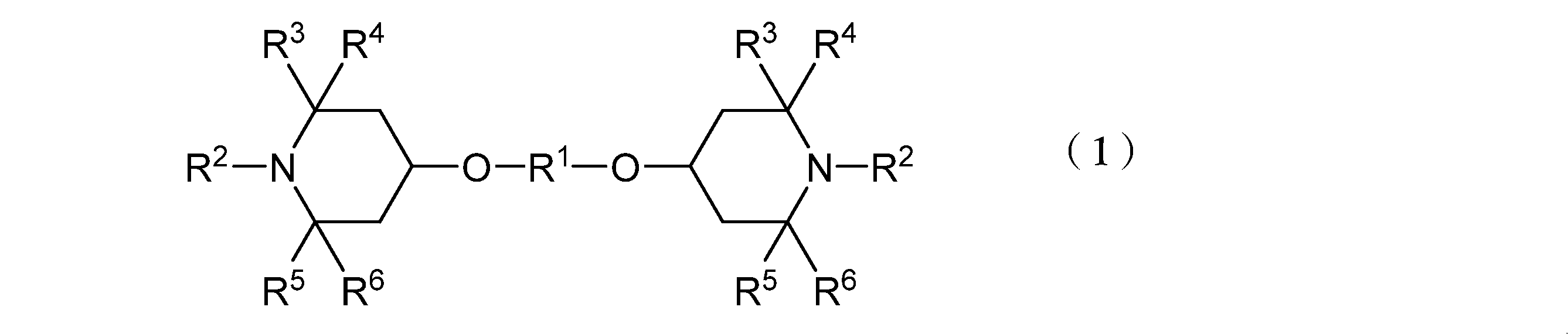
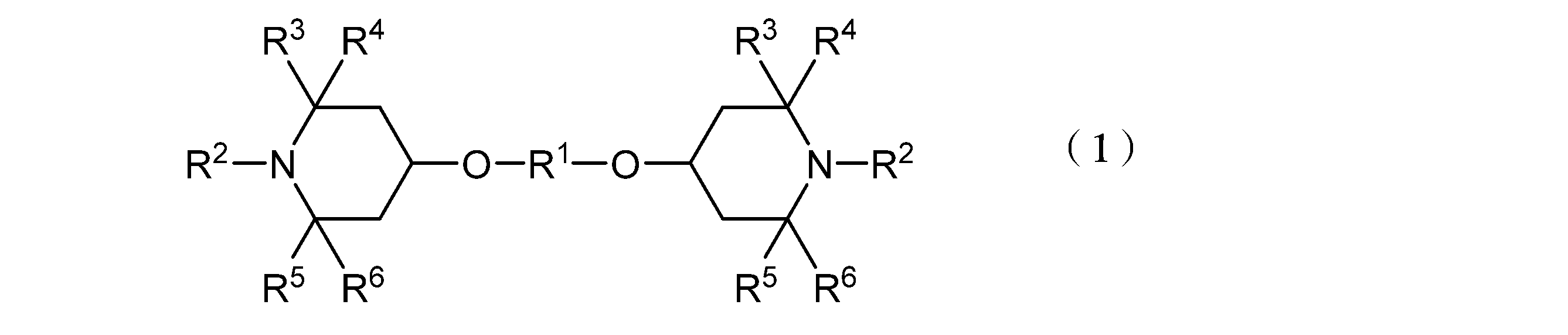
- the present invention provides a flame retardant containing (A) a hindered amine compound, the hindered amine compound (A) being a compound represented by the following general formula (1):
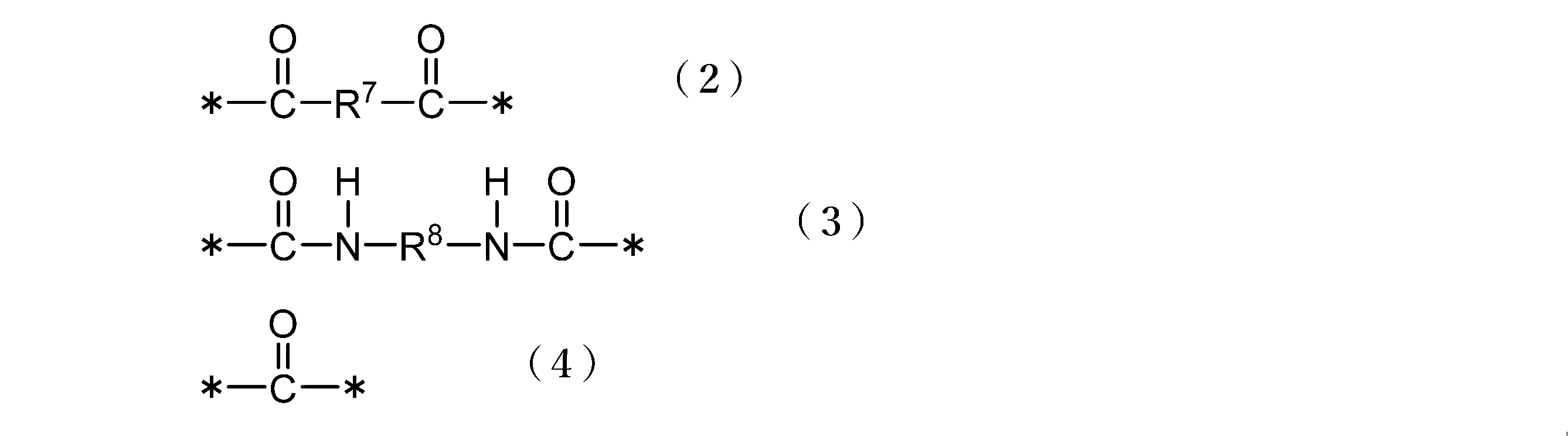
- R 1 represents a group represented by the following general formula (2), (3) or (4)
- R 2 represents a hydrocarbon group having 1 to 18 carbon atoms
- R 3 to R 6 each independently represent an alkyl group having 1 to 4 carbon atoms.
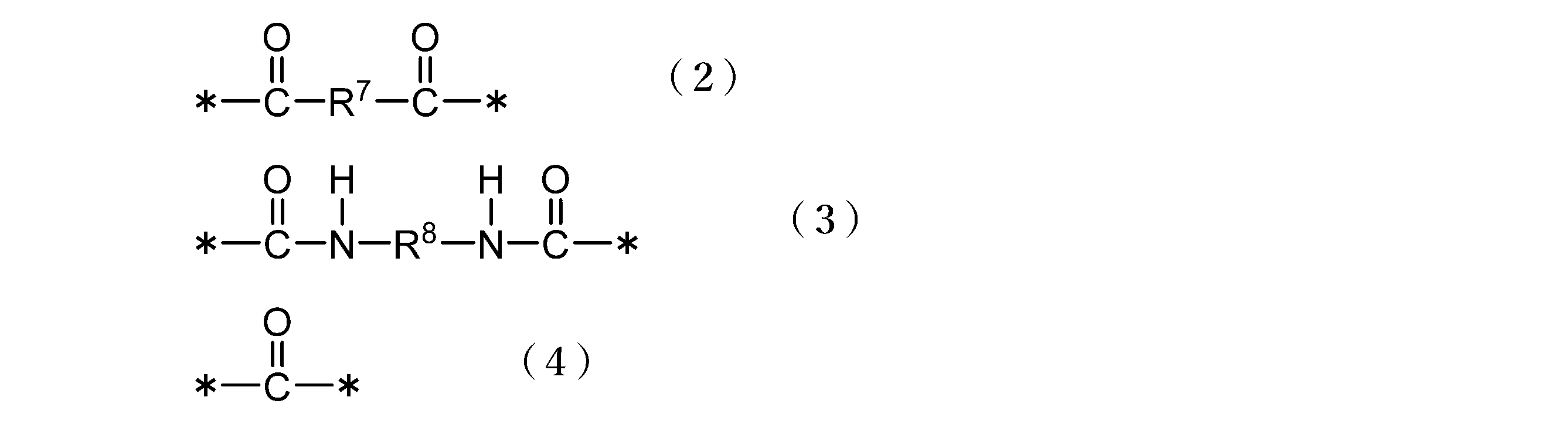
- R 7 in formula (2) and R 8 in formula (3) represent a direct bond or a divalent hydrocarbon group having 1 to 18 carbon atoms.
- * represents a bond.
- the present invention also relates to a composition containing the above flame retardant and a synthetic resin, and a flame retardant obtained from the composition.
- the present invention provides a flame retardant that imparts excellent flame retardancy to synthetic resins. It also provides a composition containing the flame retardant and a molded article thereof.
- the flame retardant of the present invention contains (A) a hindered amine compound.
- the hindered amine compound (A) is a compound represented by the following general formula (1).
- R 1 represents a group represented by the following general formula (2), (3) or (4)
- R 2 represents a hydrocarbon group having 1 to 18 carbon atoms
- R 3 to R 6 each independently represent an alkyl group having 1 to 4 carbon atoms.
- R 7 in formula (2) and R 8 in formula (3) represent a direct bond or a divalent hydrocarbon group having 1 to 18 carbon atoms.
- * represents a bond.
- the flame retardant of the present invention has excellent flame retardancy by containing, among hindered amine compounds, the hindered amine compound having the specific structure is not clear, but is presumed to be as follows.
- Hindered amine flame retardants exert their flame retardant effect by capturing hydroxyl radicals and alkylperoxy radicals generated in the gas phase during combustion with the hindered amine structure.
- the hindered amine structure is arranged at both ends of the linear molecular chain, so that the hindered amine structure is appropriately dispersed in the synthetic resin, and the radical capturing efficiency in the gas phase during combustion is improved, resulting in excellent flame retardancy.
- R 1 in general formula (1) a group represented by general formula (2) or a group represented by general formula (3) is preferable, and a group represented by general formula (2) is more preferable. This further improves the flame retardant performance of the flame retardant of the present invention.
- Examples of the hydrocarbon group having 1 to 18 carbon atoms represented by R 2 in the general formula (1) include aliphatic hydrocarbon groups having 1 to 18 carbon atoms and aromatic hydrocarbon groups having 6 to 18 carbon atoms.
- Examples of the aliphatic hydrocarbon group having 1 to 18 carbon atoms include an alkyl group having 1 to 18 carbon atoms, an alkenyl group having 2 to 18 carbon atoms, and a cycloalkyl group having 3 to 18 carbon atoms.
- alkyl group having 1 to 18 carbon atoms examples include linear or branched alkyl groups such as methyl, ethyl, propyl, isopropyl, butyl, isobutyl, sec-butyl, tert-butyl, pentyl, isopentyl, neopentyl, tert-pentyl, hexyl, heptyl, octyl, isooctyl, tert-octyl, 2-ethylhexyl, nonyl, isononyl, decyl, isodecyl, 2-propylheptyl, undecyl, dodecyl, tetradecyl, hexadecyl, and octadecyl.
- linear or branched alkyl groups such as methyl, ethyl, propyl, isopropyl, butyl, isobutyl
- alkenyl group having 2 to 18 carbon atoms examples include linear and cyclic alkenyl groups such as vinyl, 2-propenyl, 2-butenyl, 3-butenyl, 3-pentenyl, 4-pentenyl, 2-hexenyl, 3-hexenyl, 5-hexenyl, 2-heptenyl, 3-heptenyl, 4-heptenyl, 3-octenyl, 3-nonenyl, 4-decenyl, 3-undecenyl, 4-dodecenyl, 3-cyclohexenyl, 2,5-cyclohexadienyl-1-methyl, and 4,8,12-tetradecatrienyl allyl groups.
- linear and cyclic alkenyl groups such as vinyl, 2-propenyl, 2-butenyl, 3-butenyl, 3-pentenyl, 4-pentenyl, 2-hexenyl, 3-hexenyl, 5-hexenyl, 2-heptenyl
- Examples of the cycloalkyl group having 3 to 18 carbon atoms include cyclopropyl, cyclobutyl, cyclopentyl, cyclohexyl, cycloheptyl, cyclooctyl, cyclooctadecyl, 2-bornyl, 2-isobornyl, 1-adamantyl, methylcyclopentyl, methylcyclohexyl, dimethylcyclohexyl, and methylcycloheptyl groups.
- Examples of the aromatic hydrocarbon group having 6 to 18 carbon atoms include a phenyl group, a tolyl group, a xylyl group, a cumenyl group, a mesityl group, a benzyl group, a naphthyl group, an azulenyl group, an indenyl group, an indanyl group, a tetralinyl group, a phenanthryl group, a pyrenyl group, and a biphenyl group.
- an alkyl group having 1 to 18 carbon atoms and a cycloalkyl group having 3 to 18 carbon atoms are preferred.
- the alkyl group is preferably an alkyl group having 1 to 8 carbon atoms, more preferably an alkyl group having 1 to 4 carbon atoms, and even more preferably a methyl group.
- R2 is a cycloalkyl group having 3 to 18 carbon atoms
- a cycloalkyl group having 3 to 8 carbon atoms is preferred, more preferably a cycloalkyl group having 5 to 7 carbon atoms, and even more preferably a cyclohexyl group. This further improves the flame retardant performance of the flame retardant of the present invention.
- Examples of the alkyl group having 1 to 4 carbon atoms represented by R 3 to R 6 in general formula (1) include a methyl group, an ethyl group, a propyl group, an isopropyl group, a butyl group, an isobutyl group, a sec-butyl group, and a tert-butyl group.
- R 3 to R 6 are preferably a methyl group or an ethyl group, and more preferably a methyl group, which further improves the flame retardant performance of the flame retardant of the present invention.
- Examples of the divalent hydrocarbon group having 1 to 18 carbon atoms represented by R7 in general formula (2) and R8 in general formula (3) include an alkylene group having 1 to 18 carbon atoms, an alkenylene group having 2 to 18 carbon atoms, a cycloalkylene group having 4 to 18 carbon atoms, and an arylene group having 6 to 18 carbon atoms.
- alkylene group having 1 to 18 carbon atoms examples include linear or branched alkylene groups such as methylene, ethylene, n-propylene, isopropylene, n-butylene, isobutylene, n-pentylene, isopentylene, n-hexylene, isohexylene, n-heptylene, isoheptylene, n-octylene, isooctylene, n-nonylene, isononylene, n-decylene, isodecylene, n-undecylene, isoundecylene, n-dodecylene, isododecylene, tridecylene, tetradecylene, pentadecylene, hexadecylene, heptadecylene, and octadecylene.
- alkylene group having 1 to 18 carbon atoms examples include linear or
- alkenylene group having 2 to 18 carbon atoms examples include linear or branched alkenylene groups such as vinylene group, 1-methylethenylene group, 2-methylethenylene group, propenylene group, butenylene group, isobutenylene group, pentenylene group, hexenylene group, heptenylene group, octenylene group, decenylene group, dodecenylene group, tetradecenylene group, hexadecenylene group, and octadecenylene group.
- linear or branched alkenylene groups such as vinylene group, 1-methylethenylene group, 2-methylethenylene group, propenylene group, butenylene group, isobutenylene group, pentenylene group, hexenylene group, heptenylene group, octenylene group, decenylene group, dodecenylene group, te
- Examples of the cycloalkylene group having 4 to 18 carbon atoms include cyclobutylene, cyclopentylene, 2-methylcyclopentylene, cyclohexylene, 1,3-dimethylcyclohexylene, cycloheptylene, 1-ethylcyclopentylene, cyclooctylene, cyclononylene, cyclodecylene, cycloundecylene, cyclododecylene, cyclotridene, cyclotetradecylene, cyclopentadecylene, cyclohexadecylene, cycloheptadecylene, cyclooctadecylene, norbornylene, dicyclopentylene, isopropylidenedicyclohexylene, and cyclohexanedimethylene.
- Examples of the arylene group having 6 to 18 carbon atoms include a phenylene group, a tolylene group, a xylylene group, a naphthylene group, a biphenylene group, a phenanthrylene group, a fluorenylene group, an indenylene group, an isopropylidenediphenylene group, and a dimethylenephenylene group.
- R 7 in the general formula (2) and R 8 in the general formula (3) are preferably a direct bond, an alkylene group having 1 to 18 carbon atoms, and an arylene group having 6 to 18 carbon atoms, more preferably an alkylene group having 1 to 18 carbon atoms.
- R 7 or R 8 is an alkylene group having 1 to 18 carbon atoms
- the alkylene group is preferably an alkylene group having 2 to 14 carbon atoms, more preferably an alkylene group having 2 to 10 carbon atoms, and even more preferably an alkylene group having 4 to 8 carbon atoms.
- R 7 or R 8 is an arylene group having 6 to 18 carbon atoms
- the arylene group is preferably an arylene group having 6 to 12 carbon atoms, more preferably an arylene group having 6 to 10 carbon atoms, and even more preferably a phenylene group. This further improves the flame retardant performance of the flame retardant of the present invention.
- a conventional method can be used as a method for producing the compound represented by general formula (1).
- a dicarboxylic acid or dicarboxylic acid derivative corresponding to general formula (2), a diisocyanate corresponding to general formula (3), or a carbonate precursor corresponding to general formula (4) may be combined and reacted with an alcohol having an N-alkyl-2,2,6,6-tetramethylpiperidinol skeleton.
- direct esterification of an acid and an alcohol a reaction of an acid halide with an alcohol, an ester exchange reaction, a urethane bond formation reaction by an isocyanate and an alcohol, etc. are possible.
- a dicarboxylic acid or dicarboxylic acid derivative corresponding to general formula (2), a diisocyanate corresponding to general formula (3), or a carbonate precursor corresponding to general formula (4) may be combined and reacted with an alcohol having an N-H-2,2,6,6-tetramethylpiperidinol skeleton, and then N-alkylation may be performed using an alkyl halide or the like.
- the compounds obtained by the above methods may be further separated and purified, if necessary, by separation and purification means such as filtration, concentration, distillation, extraction, crystallization, recrystallization, adsorption, and column chromatography, or a combination of these means.
- the hindered amine compound (A) may be used as a single compound, or as a combination of two or more compounds having different R 1 to R 6 in general formula (1).
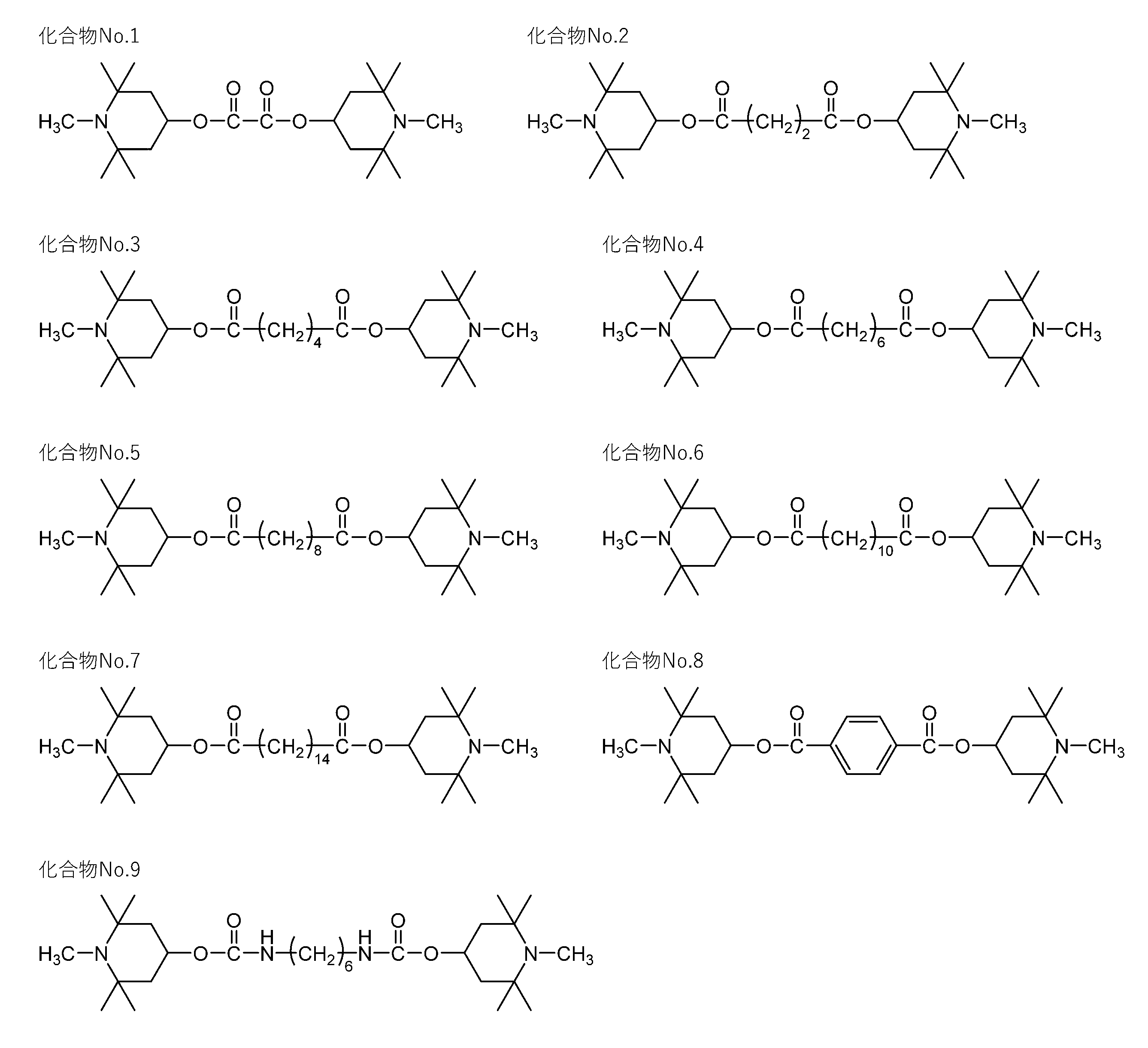
- Specific examples of compounds represented by general formula (1) include the following compounds No. 1 to No. 16. These compounds may be used alone or in combination of two or more.
- compounds No. 2 to No. 13 are preferred, compounds No. 2, No. 3, No. 4, No. 5, No. 6, No. 8 and No. 9 are more preferred, and compounds No. 3, No. 4 and No. 5 are even more preferred.
- the content of the hindered amine compound (A) in the flame retardant of the present invention is preferably 50 parts by mass or more, more preferably 80 parts by mass or more, and even more preferably 90 parts by mass or more, per 100 parts by mass of the flame retardant. This allows the flame retardant performance of the hindered amine compound (A) to be stably exhibited.
- the content of the hindered amine compound (A) in the flame retardant of the present invention is preferably 2 parts by mass or more, more preferably 3 parts by mass or more, and even more preferably 5 parts by mass or more, relative to 100 parts by mass of the flame retardant. This allows the flame retardant performance of the hindered amine compound (A) to be stably exhibited.
- the flame retardant of the present invention contains a phosphorus-based flame retardant (B)
- the content of the hindered amine compound (A) is preferably 50 parts by mass or less, more preferably 30 parts by mass or less, and even more preferably 20 parts by mass or less, relative to 100 parts by mass of the flame retardant. This allows the flame retardant improvement effect to be fully obtained by using the hindered amine compound (A) and the phosphorus-based flame retardant (B) in combination.
- the flame retardant of the present invention preferably contains a phosphorus-based flame retardant (B), which further improves the flame retardancy of the flame retardant of the present invention.
- the phosphorus-based flame retardant (B) is not particularly limited as long as it is a flame retardant containing phosphorus element, and those obtained by conventionally known methods and commercially available products can be used.
- Examples of phosphorus-based flame retardants include phosphate ester-based flame retardants, phosphonate ester-based flame retardants, phosphinate ester-based flame retardants, metal phosphinate salt-based flame retardants, phosphazene-based flame retardants, phosphate-based flame retardants, and red phosphorus.
- the above-mentioned phosphoric acid ester flame retardants include, for example, triaryl phosphoric acid esters such as triphenyl phosphate, tricresyl phosphate, trixylenyl phosphate, cresyl diphenyl phosphate, xylyl diphenyl phosphate, cresyl bis(2,6-xylenyl)phosphate, and 2-ethylhexyl diphenyl phosphate; aromatic phosphoric acid esters or polycondensates thereof such as resorcinol bis(diphenyl phosphate), hydroquinone bis(diphenyl phosphate), bisphenol A bis(diphenyl phosphate), bisphenol A bis(dicresyl phosphate), 4,4'-biphenol bis(diphenyl phosphate), resorcinol bis(2,6-xylenyl phosphate), and 4,4'-biphenol bis(2,6-xylenyl
- Examples of the phosphonate ester flame retardants include divinyl phenylphosphonate, diallyl phenylphosphonate, 1-butenyl phenylphosphonate, pentaerythritol bis(methylphosphonate), pentaerythritol bis(benzylphosphonate), 10-phenoxy-9,10-dihydro-9-oxa-10-phosphaphenanthrene-10-oxide, 6,6'-(1,3-phenylenebis(oxy))bis(6H-dibenz[c,e][1,2]oxaphosphorine)-6,6'-dioxide, etc.
- phosphinic acid ester flame retardants examples include phenyl diphenylphosphinate, methyl diphenylphosphinate, 9,10-dihydro-9-oxa-10-phosphaphenanthrene-10-oxide (hereinafter also referred to as DOPO), DOPO derivatives, etc.
- DOPO derivatives examples include 10-benzyl-9,10-dihydro-9-oxa-10-phosphaphenanthrene-10-oxide, 10-(2,5-dihydroxyphenyl)-9,10-dihydro-9-oxa-10-phosphaphenanthrene-10-oxide, 10-(2,7-dihydroxynaphthyl)-9,10-dihydro-9-oxa-10-phosphaphenanthrene-10-oxide, and 6,6'-(1,2-ethanediyl)bis(6H-dibenz[c,e][1,2]oxaphosphorine)-6,6'-dioxide.
- metal phosphinate flame retardants examples include aluminum diethylphosphinate, calcium diethylphosphinate, and zinc diethylphosphinate.
- phosphazene-based flame retardants examples include bis(2-allylphenoxy)phosphazene, dicresylphosphazene, propoxyphosphazene, phenoxyphosphazene, aminophosphazene, poly(fluoroalkylphosphazene), dipropoxyphosphazene, etc.
- phosphate-based flame retardants examples include melamine phosphate, melamine pyrophosphate, melamine polyphosphate, melam polyphosphate, ammonium phosphate, ammonium pyrophosphate, ammonium polyphosphate, piperazine phosphate, piperazine pyrophosphate, piperazine polyphosphate, etc.
- phosphorus-based flame retardant from the viewpoint of improving flame retardancy, phosphate ester-based flame retardants, phosphonate ester-based flame retardants, phosphinate ester-based flame retardants, and metal phosphinate-based flame retardants are preferred, with phosphonate ester-based flame retardants and phosphinate ester-based flame retardants being more preferred.
- DOPO and DOPO derivatives are preferred from the viewpoint of improving flame retardancy, and 6,6'-(1,2-ethanediyl)bis(6H-dibenz[c,e][1,2]oxaphosphorine)-6,6'-dioxide is more preferred.
- the phosphorus-based flame retardant (B) may be used as a single compound, or as a combination of two or more different compounds.
- two or more different phosphorus-based flame retardants are combined, from the viewpoint of improving flame retardancy, it is preferable to use two or more different phosphonate ester-based flame retardants in combination, a phosphonate ester-based flame retardant and a phosphate ester-based flame retardant in combination, or a phosphonate ester-based flame retardant and a metal phosphinate-based flame retardant in combination.
- the content of the phosphorus-based flame retardant (B) is preferably 10 parts by mass or more, more preferably 200 parts by mass or more, and even more preferably 300 parts by mass or more, relative to 100 parts by mass of the hindered amine compound (A). This allows the flame retardancy improvement effect of the combined use of the hindered amine compound (A) and the phosphorus-based flame retardant (B) to be fully obtained.
- the flame retardant of the present invention contains a phosphorus-based flame retardant (B)
- the content of the phosphorus-based flame retardant (B) is preferably 5,000 parts by mass or less, more preferably 3,000 parts by mass or less, and even more preferably 1,500 parts by mass or less, relative to 100 parts by mass of the hindered amine compound (A). This allows the flame retardant performance of the hindered amine compound (A) to be stably exhibited, and also results in less bleeding when blended with a resin.
- the flame retardant of the present invention preferably contains a nitrogen-based flame retardant (C) in addition to the phosphorus-based flame retardant (B), which further improves the flame retardancy of the flame retardant of the present invention.
- the nitrogen-based flame retardant (C) is not particularly limited as long as it is a flame retardant containing a nitrogen element, and those obtained by a conventionally known method and commercially available products can be used, except for those included in the phosphorus-based flame retardant (B).
- nitrogen-based flame retardants (C) examples include melamine, melamine cyanurate, poly-[2,4-(piperazin-1,4-yl)-6-(morpholino-4-yl)-1,3,5-triazine], melamine sulfate, guanidine sulfate, and guanidine sulfamate.
- the nitrogen-based flame retardant (C) may be used as a single compound, or as a combination of two or more different compounds.
- the content of the nitrogen-based flame retardant (C) is preferably 10 parts by mass or more, more preferably 200 parts by mass or more, and even more preferably 300 parts by mass or more, relative to 100 parts by mass of the hindered amine compound (A). This allows the flame retardancy improvement effect of the combined use of the hindered amine compound (A), the phosphorus-based flame retardant (B), and the nitrogen-based flame retardant (C) to be fully obtained.
- the flame retardant of the present invention contains a nitrogen-based flame retardant (C)
- the content of the nitrogen-based flame retardant (C) is preferably 4,000 parts by mass or less, more preferably 2,000 parts by mass or less, and even more preferably 1,000 parts by mass or less, relative to 100 parts by mass of the hindered amine compound (A). This allows the flame retardant performance of the hindered amine compound (A) to be stably exhibited, and also results in less bleeding when blended with a resin.
- the content of the nitrogen-based flame retardant (C) is preferably 10 parts by mass or more, more preferably 20 parts by mass or more, and even more preferably 30 parts by mass or more, relative to 100 parts by mass of the phosphorus-based flame retardant (B). This allows the flame retardancy improvement effect of the combined use of the hindered amine compound (A), the phosphorus-based flame retardant (B), and the nitrogen-based flame retardant (C) to be fully obtained.
- the flame retardant of the present invention contains a nitrogen-based flame retardant (C)
- the content of the nitrogen-based flame retardant (C) is preferably 700 parts by mass or less, more preferably 300 parts by mass or less, and even more preferably 200 parts by mass or less, relative to 100 parts by mass of the phosphorus-based flame retardant (B). This allows the flame retardant performance of the hindered amine compound (A) to be stably exhibited.
- composition of the present invention contains the above-mentioned flame retardant and a synthetic resin.
- the flame retardant of the present invention can be used as a composition by blending it with a synthetic resin, particularly preferably a thermoplastic resin.
- the content of the flame retardant in the composition of the present invention is preferably 0.1 parts by mass or more, more preferably 0.3 parts by mass or more, even more preferably 0.5 parts by mass or more, and particularly preferably 1 part by mass or more, per 100 parts by mass of the composition. This allows the performance of the flame retardant to be fully exhibited.
- the content of the flame retardant is preferably 20 parts by mass or less, more preferably 15 parts by mass or less, and even more preferably 10 parts by mass or less, per 100 parts by mass of the composition. This reduces bleeding of the flame retardant component.
- the content of the flame retardant in the composition of the present invention is preferably 0.1 parts by mass or more, more preferably 0.3 parts by mass or more, even more preferably 0.5 parts by mass or more, and particularly preferably 0.1 parts by mass or more, per 100 parts by mass of synthetic resin. This allows the performance of the flame retardant to be fully exhibited.
- the content of the flame retardant is preferably 20 parts by mass or less, more preferably 15 parts by mass or less, and even more preferably 10 parts by mass or less, per 100 parts by mass of synthetic resin. This reduces bleeding of the flame retardant component.
- thermoplastic resins such as polyolefin resins, styrene-based resins, polyester resins, polycarbonate resins, polysulfide resins, polyamide resins, polyether resins, and halogen-containing resins.
- the above polyolefin resins include polyethylene-based resins such as low-density polyethylene, linear low-density polyethylene, high-density polyethylene, cross-linked polyethylene, and ultra-high molecular weight polyethylene; polypropylene-based resins such as homopolypropylene, random copolymer polypropylene, block copolymer polypropylene, impact copolymer polypropylene, high impact copolymer polypropylene, and maleic anhydride-modified polypropylene; ⁇ -olefin polymers such as polybutene-1, cycloolefin polymer, poly-3-methyl-1-butene, poly-3-methyl-1-pentene, and poly-4-methyl-1-pentene; and ⁇ -olefin copolymers such as ethylene-methyl methacrylate copolymer and ethylene-vinyl acetate copolymer.
- polyethylene-based resins such as low-density polyethylene, linear low-dens
- the melt flow rate (hereinafter also referred to as MFR) of these polyolefin resins is preferably 0.05 g/10 min or more, more preferably 0.5 g/10 min or more, and even more preferably 0.8 g/10 min or more, from the viewpoint of improving flame retardancy. Furthermore, the MFR of these polyolefin resins is preferably 30 g/10 min or less, more preferably 20 g/10 min or less, and even more preferably 15 g/10 min or less, from the viewpoint of improving flame retardancy.
- the MFR here is a value measured in accordance with JIS K 7210.
- styrene-based resin examples include syndiotactic polystyrene and acrylonitrile-butadiene-styrene terpolymers.
- the polysulfide resin may, for example, be polyphenylene sulfide.
- the polyamide resin may, for example, be polyhexamethylene adipamide.
- polyester resins examples include polyalkylene terephthalates such as polyethylene terephthalate, polybutylene terephthalate, polytetramethylene terephthalate, and polycyclohexanedimethylene terephthalate; polyalkylene naphthalates such as polyethylene naphthalate and polybutylene naphthalate; and degradable aliphatic polyesters such as polyhydroxybutyrate, polycaprolactone, polybutylene succinate, polyethylene succinate, polylactic acid, polymalic acid, polyglycolic acid, polydioxane, and poly(2-oxetanone).
- the polycarbonate resin is a resin having a carbonate bond, and is obtained, for example, by a polymerization reaction between a divalent hydroxy aromatic compound and a carbonate precursor.
- divalent hydroxy aromatic compounds include dihydroxybenzenes such as resorcin and hydroquinone; bishydroxyaryls such as 4,4'-dihydroxydiphenyl; bis(hydroxyaryl)alkanes such as bis(4-hydroxyphenyl)methane, 1,1-bis(4-hydroxyphenyl)ethane, 1,2-bis(4-hydroxyphenoxy)ethane, and 2,2-bis(4-hydroxyphenyl)propane; dihydroxyaryl ketones such as bis(4-hydroxyphenyl)ketone and bis(4-hydroxy-3-methylphenyl)ketone; 4,4'-dihydroxydiphenyl ether and 4,4'-dihydroxy-3,3'-dimethylphenyl ether.
- dihydroxyaryl ethers such as 4,4'-dihydroxy-2,5-dihydroxydiphenyl ether; dihydroxyaryl sulfur compounds such as 4,4'-thiodiphenol, bis(4-hydroxyphenyl)sulfide, 4,4'-dihydroxy-3,3'-dimethyldiphenyl sulfide, 4,4'-dihydroxy-3,3'-dimethyldiphenyl sulfoxide, 4,4'-dihydroxy-3,3'-dimethyldiphenyl sulfoxide, 2,2-bis(4-hydroxyphenyl)sulfone, 4,4'-dihydroxydiphenyl sulfone, and 4,4'-dihydroxy-3,3'-dimethyldiphenyl sulfone, and phenolphthalein.
- dihydroxyaryl ethers such as 4,4'-dihydroxy-2,5-dihydroxydiphenyl ether
- dihydroxyaryl sulfur compounds such as 4,4'-thiodiphenol, bis
- divalent hydroxy aromatic compounds may be used alone or in combination of two or more. Furthermore, they may be used in combination with a polyvalent hydroxy aromatic compound having three or more hydroxy groups.
- Specific preferred examples of the carbonate precursor include phosgene, carbonic acid diesters, diphenyl carbonate, dihaloformates of dihydric phenols, and mixtures thereof.
- synthetic resins include petroleum resins, coumarone resins, polyvinyl acetate, acrylic resins, polymethyl methacrylate, polyvinyl alcohol, polyvinyl formal, polyvinyl butyral, polyurethane, cellulose resins, polyimide resins, polysulfones, liquid crystal polymers, and other synthetic resins, as well as blends of these.
- the synthetic resin may also be a thermoplastic elastomer such as isoprene rubber, butadiene rubber, ethylene-propylene rubber, ethylene-propylene-diene rubber, acrylonitrile-butadiene copolymer rubber, styrene-butadiene copolymer rubber, olefin-based elastomer, styrene-based elastomer, polyester-based elastomer, nitrile-based elastomer, nylon-based elastomer, vinyl chloride-based elastomer, polyamide-based elastomer, or polyurethane-based elastomer.
- a thermoplastic elastomer such as isoprene rubber, butadiene rubber, ethylene-propylene rubber, ethylene-propylene-diene rubber, acrylonitrile-butadiene copolymer rubber, styrene-butadiene copolymer rubber, ole
- polyolefin resins from the viewpoint of more effectively exerting the flame retardant properties of the flame retardant, one or more selected from the group consisting of polyolefin resins, styrene-based resins and copolymers thereof are preferred, polyolefin resins are more preferred, high density polyethylene, low density polyethylene and linear low density polyethylene are even more preferred, and it is also preferred to use them in combination with a thermoplastic elastomer.
- These synthetic resins can be used regardless of the molecular weight, degree of polymerization, polymerization method, density, softening point, proportion of insoluble matter in a solvent, degree of stereoregularity, presence or absence of catalyst residue, types and blending ratios of raw monomers, type of polymerization catalyst, etc. These synthetic resins may be used alone or in combination of two or more kinds. The synthetic resins may be alloyed.
- the content of the synthetic resin in the composition of the present invention is preferably 80 parts by mass or more, more preferably 85 parts by mass or more, and even more preferably 90 parts by mass or more, per 100 parts by mass of the composition. This allows the inherent physical properties of the synthetic resin to be fully exhibited.
- the content of the synthetic resin in the composition of the present invention is preferably 99.9 parts by mass or less, more preferably 99.7 parts by mass or less, even more preferably 99.5 parts by mass or less, and particularly preferably 99 parts by mass or less, per 100 parts by mass of the composition. This allows the composition of the present invention to contain the amount of flame retardant necessary to exhibit flame retardant performance.
- composition of the present invention may contain other optional components in addition to the flame retardant.
- the composition can be stabilized by adding a phenol-based antioxidant, a phosphorus-based antioxidant, a thioether-based antioxidant, an ultraviolet absorber, a hindered amine-based light stabilizer, etc.
- phenol-based antioxidants examples include 2,6-di-tert-butyl p-cresol, 2,6-diphenyl-4-octadecyloxyphenol, distearyl (3,5-di-tert-butyl-4-hydroxybenzyl)phosphonate, 1,6-hexamethylenebis[(3,5-di-tert-butyl-4-hydroxyphenyl)propionic acid amide], 4,4'-thiobis(6-tert-butyl-m-cresol), 2,2'-methylenebis(4-methyl-6-tert-butylphenol), 2,2'-methylenebis(4-ethyl-6-tert-butylphenol), 4,4'-butylidenebis(6-tert-butyl -m-cresol), 2,2'-ethylidenebis(4,6-di-tert-butylphenol), 2,2'-ethylidenebis(4-sec-butyl-6-tert-
- phenolic antioxidants may be used alone or in combination of two or more.
- the amount of the phenolic antioxidant added is preferably 0.001 to 10 parts by weight, more preferably 0.05 to 5 parts by weight, based on 100 parts by weight of the synthetic resin, from the viewpoint of the antioxidant effect.
- Examples of the phosphorus-based antioxidants include trisnonylphenyl phosphite, tris(2,4-di-tert-butylphenyl) phosphite, tris[2-tert-butyl-4-(3-tert-butyl-4-hydroxy-5-methylphenylthio)-5-methylphenyl] phosphite, tridecyl phosphite, octyldiphenyl phosphite, didecyl monophenyl phosphite, bis(tridecyl)pentaerythritol diphosphite, bis(nonylphenyl)pentaerythritol diphosphite, thritol diphosphite, bis(2,4-di-tert-butylphenyl)pentaerythritol diphosphite, bis(2,6-di-tert-butyl-4-
- phosphorus-based antioxidants may be used alone or in combination of two or more.
- the amount of phosphorus-based antioxidant added is preferably 0.001 to 10 parts by weight, more preferably 0.05 to 5 parts by weight, per 100 parts by weight of the synthetic resin, from the viewpoint of antioxidant effect.
- thioether-based antioxidants examples include dialkyl thiodipropionates such as dilauryl thiodipropionate, dimyristyl thiodipropionate, and distearyl thiodipropionate, and pentaerythritol tetrakis( ⁇ -alkyl mercaptopropionates. These thioether-based antioxidants may be used alone or in combination of two or more. From the viewpoint of antioxidant effect, the amount of thioether-based antioxidant added is preferably 0.001 to 10 parts by weight, more preferably 0.05 to 5 parts by weight, per 100 parts by weight of the synthetic resin.
- the above-mentioned ultraviolet absorbers include, for example, 2-hydroxybenzophenones such as 2,4-dihydroxybenzophenone, 2-hydroxy-4-methoxybenzophenone, 2-hydroxy-4-octoxybenzophenone, and 5,5'-methylenebis(2-hydroxy-4-methoxybenzophenone); 2-(2'-hydroxy-5'-methylphenyl)benzotriazole, 2-(2'-hydroxy-3',5'-di-tert-butylphenyl)-5-chlorobenzotriazole, 2-(2'-hydroxy-3',5'-di-tert-butylphenyl)-5-chlorobenzotriazole, 2-(2'-hydroxyphenyl)benzotriazoles such as 2-(2'-hydroxy-5'-tert-butyl-5'-methylphenyl)-5-chlorobenzotriazole, 2-(2'-hydroxy-5'-tert-octylphenyl)benzotriazole, 2-(2
- cyanoacrylates such as ethyl-2-cyano-3-methyl-3-(p-methoxyphenyl)acrylate; and triaryltriazines such as 2-(2-hydroxy-4-octoxyphenyl)-4,6-bis(2,4-di-tert-butylphenyl)-s-triazine, 2-(2-hydroxy-4-methoxyphenyl)-4,6-diphenyl-s-triazine, and 2-(2-hydroxy-4-propoxy-5-methylphenyl)-4,6-bis(2,4-di-tert-butylphenyl)-s-triazine.
- These ultraviolet absorbers may be used alone or in combination of two or more.
- the amount of ultraviolet absorber added is preferably 0.001 to 30 parts by weight, more preferably 0.05 to 10 parts by weight, relative to 100 parts by weight of the synthetic resin, from the viewpoint of ultraviolet absorbing effect.
- hindered amine light stabilizers examples include 2,2,6,6-tetramethyl-4-piperidyl stearate, 1,2,2,6,6-pentamethyl-4-piperidyl stearate, 2,2,6,6-tetramethyl-4-piperidyl benzoate, bis(2,2,6,6-tetramethyl-4-piperidyl)sebacate, bis(1,2,2,6,6-pentamethyl-4-piperidyl)sebacate, tetrakis(2,2,6,6-tetramethyl-4-piperidyl)-1,2,3,4-butane tetracarboxylate, tetrakis(1,2,2,6,6-pentamethyl-4-piperidyl)-1,2,3,4-butane tetracarboxylate, and tetrakis(1,2,2,6,6-pentamethyl-4-piperidyl)-1,2,3,4-butane tetracarboxylate.
- hindered amine light stabilizers may be used alone or in combination of two or more types.
- the amount of hindered amine light stabilizer added is preferably 0.001 to 30 parts by mass, and more preferably 0.05 to 10 parts by mass, per 100 parts by mass of synthetic resin.
- composition of the present invention may further contain additives that are typically used in synthetic resins, such as crosslinking agents, antistatic agents, anti-fogging agents, anti-plate-out agents, surface treatment agents, plasticizers, lubricants, reinforcing agents, nucleating agents, flame retardants other than those of the present invention, flame retardant assistants, fluorescent agents, antifungal agents, bactericides, foaming agents, metal deactivators, release agents, silicone oils, silane coupling agents, fillers, hydrotalcites, metal soaps, pigments, dyes, etc., as long as they do not impair the effects of the present invention.
- additives that are typically used in synthetic resins, such as crosslinking agents, antistatic agents, anti-fogging agents, anti-plate-out agents, surface treatment agents, plasticizers, lubricants, reinforcing agents, nucleating agents, flame retardants other than those of the present invention, flame retardant assistants, fluorescent agents, antifungal agents, bactericides, foaming agents, metal
- each component other than the synthetic resin may be mixed sequentially with the synthetic resin.
- each component may be crushed and then mixed, or mixed and then crushed.
- each component other than the synthetic resin may be added to a compound that is already an alloy, or may be added during the alloying process.
- the method of mixing the flame retardant and the synthetic resin may involve mixing the flame retardant with the entire amount of the synthetic resin to be mixed, or it may involve mixing the flame retardant with a portion of the synthetic resin in advance to prepare a master batch, and then mixing the master batch with the remaining synthetic resin.
- the master batch may also contain the other optional components mentioned above.
- the content of the flame retardant in the master batch may be 1 part by mass or more, and may be 10 parts by mass or more and 90 parts by mass or less, per 100 parts by mass of the master batch.
- the form of the composition of the present invention is not particularly limited, but from the viewpoint of the handleability of the composition, it is preferably in the form of pellets, powder, granules or flakes, and more preferably in the form of pellets.
- the composition of the present invention can be used alone or in combination with a composition other than the present invention, an additive component, or a mixture thereof for molding, etc.
- the composition of the present invention can also be used as a masterbatch.
- the molded article of the present invention can be obtained by molding the composition of the present invention by a known method.
- the molding method is not particularly limited, and includes molding methods such as extrusion molding, calendar molding, injection molding, roll molding, compression molding, and blow molding. By using these molding methods, molded articles of various shapes such as resin plates, sheets, films, pellets, and irregular shapes can be produced.
- composition of the present invention and its molded products can be used in a wide range of industrial fields, including electricity, electronics, and communications, agriculture, forestry, fisheries, mining, construction, food, textiles, clothing, medicine, coal, petroleum, rubber, leather, automobiles, precision instruments, wood, building materials, civil engineering, furniture, printing, and musical instruments.
- office equipment such as printers, personal computers, word processors, keyboards, PDAs (personal digital assistants), telephones, copiers, facsimiles, ECRs (electronic cash registers), calculators, electronic organizers, cards, holders, and stationery; home appliances such as washing machines, refrigerators, vacuum cleaners, microwave ovens, lighting equipment, game consoles, irons, and kotatsu; AV equipment such as TVs, VTRs, video cameras, radio cassette players, tape recorders, minidiscs, CD players, speakers, and liquid crystal displays; and electrical and electronic components and communication devices such as connectors, relays, capacitors, switches, printed circuit boards, coil bobbins, semiconductor encapsulation materials, LED encapsulation materials, electric wires, cables, transformers, deflection yokes, distribution boards, and clocks.
- office equipment such as printers, personal computers, word processors, keyboards, PDAs (personal digital assistants), telephones, copiers, facsimiles, ECRs (electronic cash registers),
- composition of the present invention and its molded products can also be used for optical materials such as optical disks, CD disks, DVD disks, and lenses, and as a replacement for glass.
- composition of the present invention and its molded articles can be used in seats (padding, outer material, etc.), belts, ceiling coverings, convertible tops, armrests, door trims, rear package trays, carpets, mats, sun visors, wheel covers, mattress covers, airbags, insulation materials, handrails, handrail straps, wire covering materials, electrical insulation materials, paints, coating materials, upholstery materials, flooring materials, bulkheads, carpets, wallpaper, wall covering materials, exterior materials, interior materials, roofing materials, deck materials, walls
- the present invention includes the following aspects.
- R 1 represents a group represented by the following general formula (2), (3) or (4)
- R 2 represents a hydrocarbon group having 1 to 18 carbon atoms
- R 3 to R 6 each independently represent an alkyl group having 1 to 4 carbon atoms.
- R 7 in formula (2) and R 8 in formula (3) represent a direct bond or a divalent hydrocarbon group having 1 to 18 carbon atoms.
- * represents a bond.
- the phosphorus-based flame retardant (B) is at least one selected from the group consisting of a phosphate ester-based flame retardant, a phosphonate ester-based flame retardant, a phosphinate ester-based flame retardant, and a metal phosphinate-based flame retardant.
- the content of the phosphorus-based flame retardant (B) is 10 parts by mass or more and 5,000 parts by mass or less per 100 parts by mass of the hindered amine compound (A).
- a composition comprising the flame retardant according to any one of [1] to [8] and a synthetic resin.
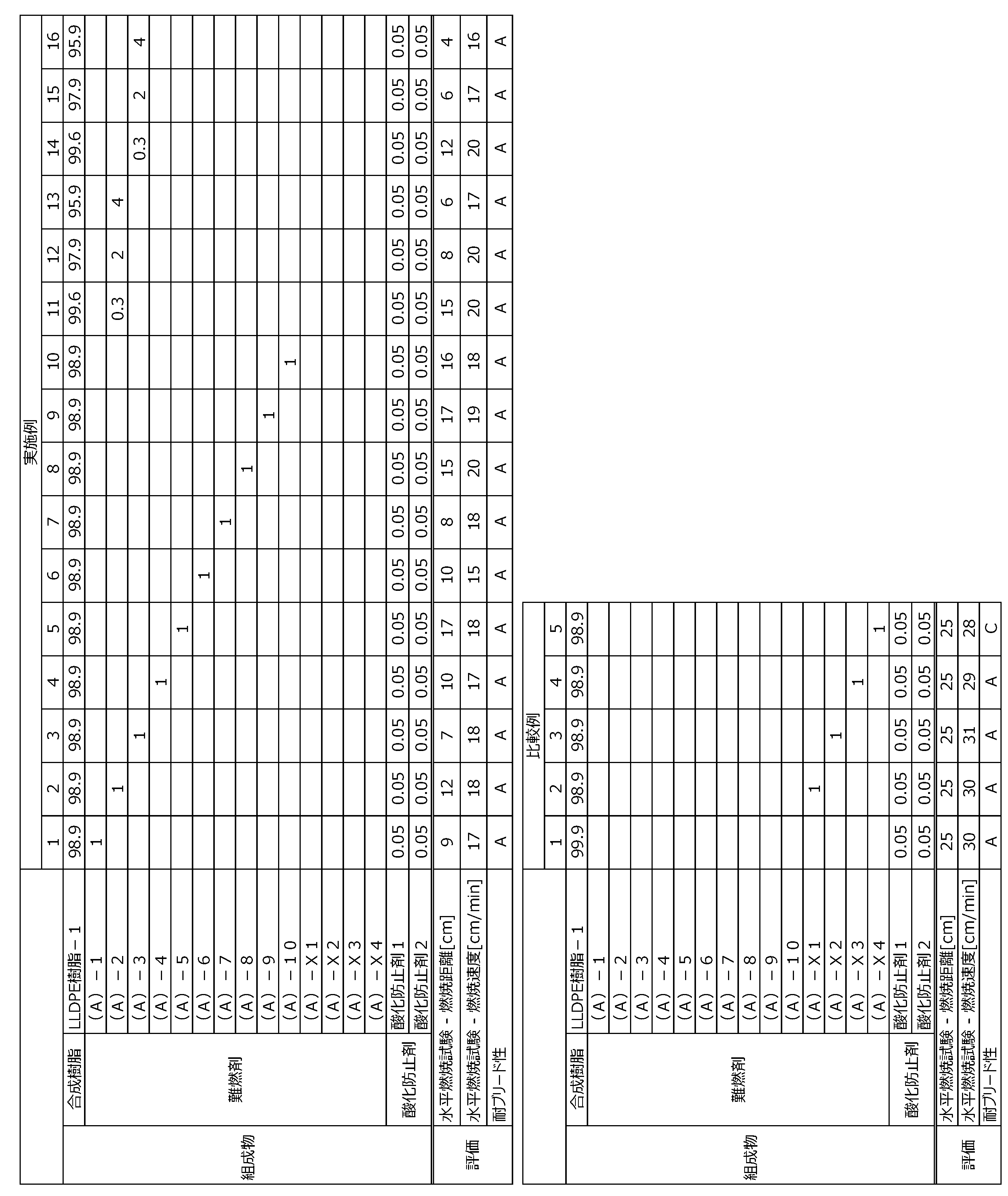
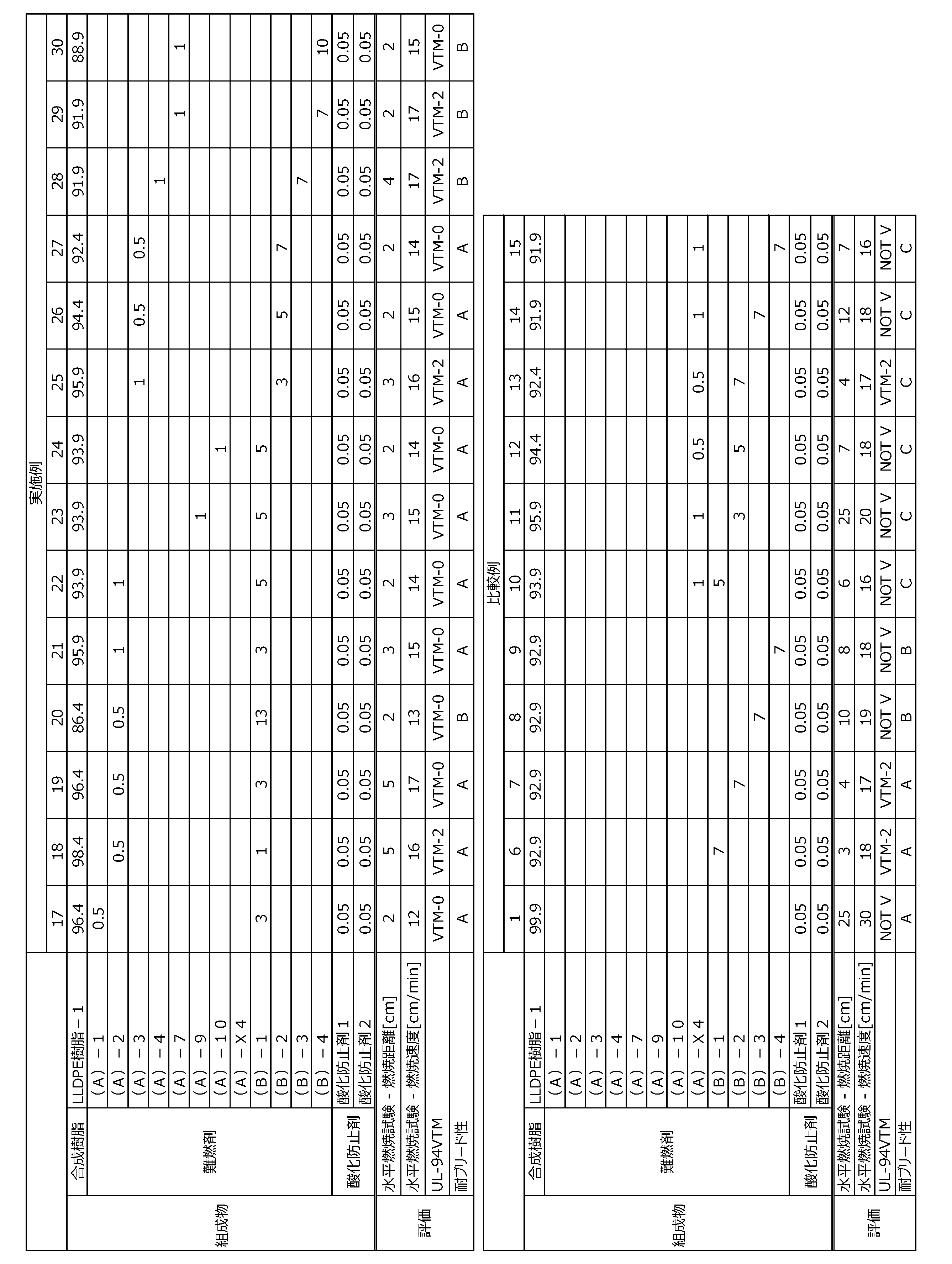
- Examples 1 to 30, Comparative Examples 1 to 15 The components were mixed in the amounts shown in Tables 1 to 3, and melt-kneaded using a device consisting of a twin-screw extruder (product name: 2D15W) connected to a Labo Plastomill ⁇ manufactured by Toyo Seiki Seisakusho at a melt temperature of 200°C and a screw speed of 25 rpm to obtain resin strands. The obtained resin strands were cut with a pelletizer to obtain pellet-shaped compositions.
- the amounts shown in Tables 1 and 2 are all based on parts by mass.
- A)-2 Compound No. 3
- A)-3 Compound No.
- A)-X1 tetrakis(1,2,2,6,6-pentamethyl-4-piperidyl)butane-1,2,3,4-tetracarboxylate
- A)-X2 polycondensate of dimethyl succinate and 4-hydroxy-1-(2-hydroxyethyl)-2,2,6,6-tetramethylpiperidine
- A)-X3 N,N',4,7-tetrakis ⁇ 4,6-bis[N-butyl-N-(1,2,2,6,6-pentamethyl-4-piperidyl)amino]-1,3,5-triazin-2-yl ⁇ -4,7-diazadecane-1,10-diamine
- A)-X4 bis(2,2,6,6-tetramethylpiperidyl)sebacate
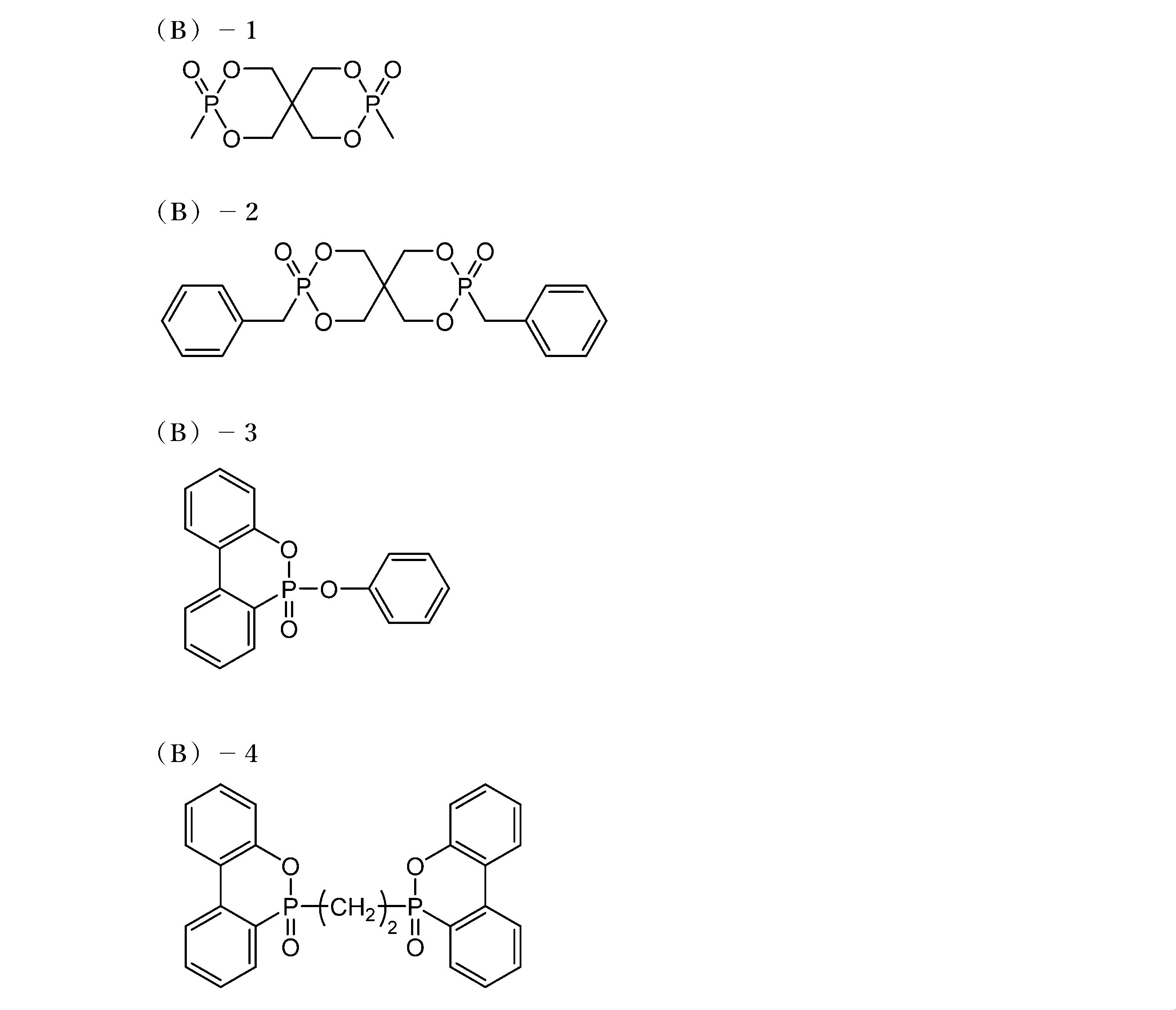
- B)-1 pentaerythritol bis(methylphosphonate)
- B)-2 Pentaerythritol bis(benzylphosphonate)
- B)-3 10-phenyl
- the pellet-like composition obtained above was used to prepare a cast film having a thickness of 200 ⁇ m.
- the film was prepared using a device in which a single-screw extruder (product name: D1220B) and a T-die (product name: MT60B) were connected to a Labo Plastomill ⁇ manufactured by Toyo Seiki Seisakusho Co., Ltd., and was performed under the conditions of a melt temperature of 200° C., a screw speed of 30 rpm, a T-die extrusion temperature of 200° C., a chill roll temperature of 60° C., and a roll rotation speed of 0.40 to 0.45 rpm.
- a test piece of 25 cm ⁇ 5 cm and a test piece of 20 cm ⁇ 5 cm were cut out from the obtained film, and the test piece was left at 23 ⁇ 2° C. and 50 ⁇ 5% RH for 48 hours, and then the following flame retardancy evaluation was performed.
- ⁇ Flame retardancy rating: UL-94VTM> The test specimen prepared above was rolled up in a cylindrical shape so that the lower ends did not overlap, and the lower end of the sample was held vertically 10 mm above the burner.
- a Bunsen burner with an inner diameter of 9.5 mm and a flame length of 20 mm was used as a heat source, and the flame was applied to the lower end of the test specimen for 3 seconds, and the number of seconds for burning was measured. After the flame was extinguished, the flame was applied again for 3 seconds, and the number of seconds for burning was measured.
- Table 1 shows the evaluation results of the combustion test of test pieces containing LLDPE resin and hindered amine compounds.
- the flame did not go out until the test piece burned out in the test piece that did not contain a flame retardant (Comparative Example 1) and the test piece that contained a compound with a structure different from the general formula (1) of the present invention.
- the test pieces that contained the compound represented by the general formula (1) of the present invention (Examples 1 to 16) had a shorter burning distance and a slower burning speed compared to the test pieces of Comparative Examples 1 to 5.
- Table 2 shows the evaluation results of the combustion test of test pieces containing LLDPE resin, a hindered amine compound, and a phosphorus-based flame retardant.
- the test pieces containing the compound represented by the general formula (1) of the present invention (Examples 17 to 30) had superior burning distances in the horizontal burning test, burning rates, and UL-94VTM evaluation ranks compared to the test pieces containing compounds with structures different from the general formula (1) of the present invention (Comparative Examples 6 to 15).
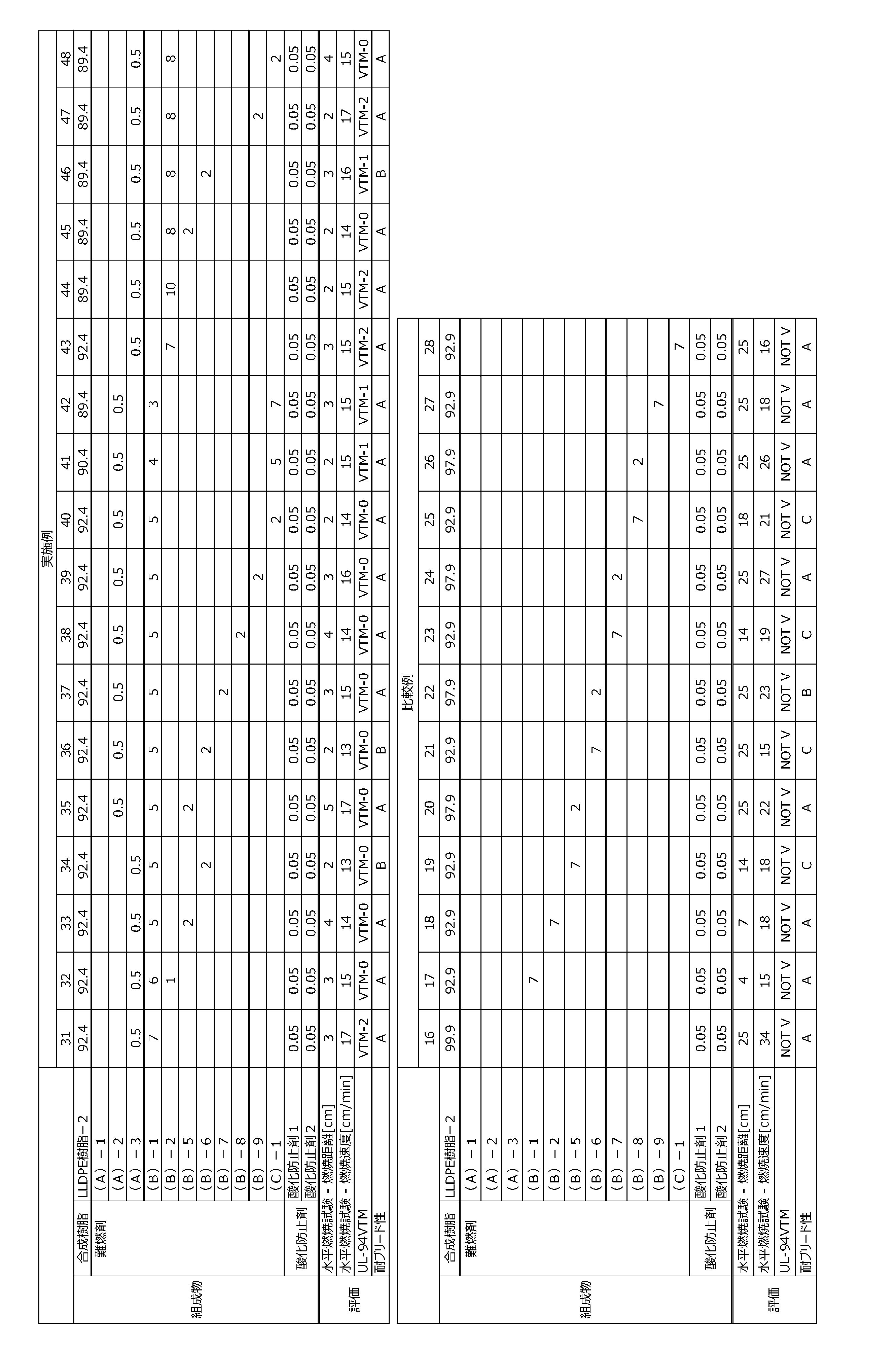
- Table 3 shows the results of the evaluation of the combustion test of test pieces containing an LLDPE resin with a different MFR from the LLDPE resin used in Tables 1 and 2, a hindered amine compound, a phosphorus-based flame retardant, and a nitrogen-containing flame retardant.
- test pieces containing the compound represented by the general formula (1) of the present invention and two types of phosphorus-based flame retardants with different structures Examples 32 to 39, 45 to 47
- test pieces containing the compound represented by the general formula (1) of the present invention, a phosphorus-based flame retardant, and a nitrogen-based flame retardant Examples 40 to 42, 48
Landscapes
- Chemical & Material Sciences (AREA)
- Organic Chemistry (AREA)
- Health & Medical Sciences (AREA)
- Chemical Kinetics & Catalysis (AREA)
- Medicinal Chemistry (AREA)
- Polymers & Plastics (AREA)
- Engineering & Computer Science (AREA)
- Materials Engineering (AREA)
- Compositions Of Macromolecular Compounds (AREA)
Abstract
Description
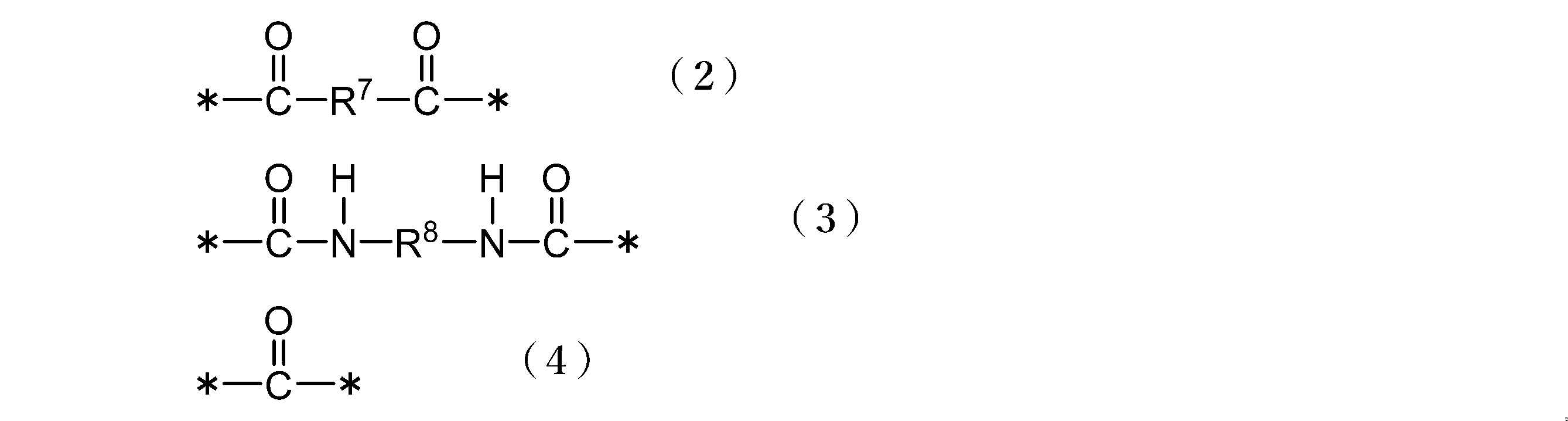
一般式(2)、(3)及び(4)において、*は結合手を表す。
<難燃剤>
本発明の難燃剤は、(A)ヒンダードアミン化合物を含む。
前記(A)ヒンダードアミン化合物は、下記一般式(1)で表される化合物である。
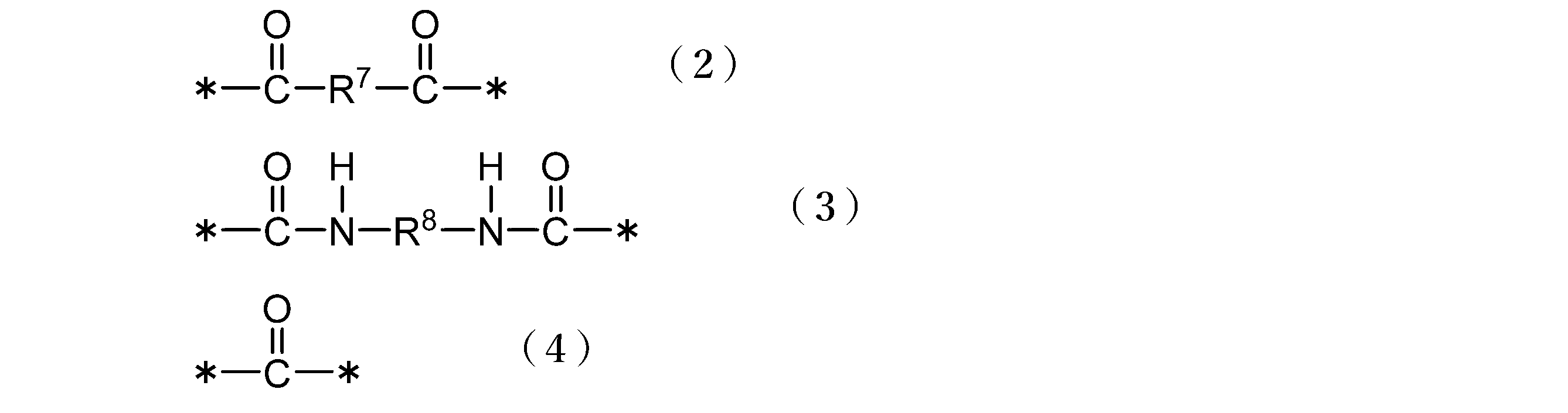
一般式(2)、(3)及び(4)において、*は結合手を表す。
ヒンダードアミン型難燃剤は、燃焼時の気相に発生するヒドロキシラジカルやアルキルパーオキシラジカルをヒンダードアミン構造部分で捕捉することにより難燃効果を発揮する。本発明の難燃剤では、ヒンダードアミン構造が直鎖状分子鎖の両末端に配置されていることにより、合成樹脂中でヒンダードアミン構造が適度に分散されることとなり、燃焼時の気相におけるラジカル捕捉効率が向上した結果、優れた難燃性を発揮するのである。
上記炭素原子数1~18の脂肪族炭化水素基としては、例えば、炭素原子数1~18のアルキル基、炭素原子数2~18のアルケニル基、炭素原子数3~18のシクロアルキル基が挙げられる。
一般式(1)中のR3~R6としては、メチル基及びエチル基が好ましく、メチル基がより好ましい。これにより、本発明の難燃剤の難燃性能がより向上する。

(B)リン系難燃剤は、リン元素を含む難燃剤であれば特に制限されず、従来公知の方法によって得られるもの、及び市販品を用いることができる。
異なる2種以上のリン系難燃剤を組み合わせる場合、難燃性向上の点から、異なる2種以上のホスホン酸エステル系難燃剤の併用、ホスホン酸エステル系難燃剤とリン酸エステル系難燃剤との併用、ホスホン酸エステル系難燃剤とホスフィン酸金属塩系難燃剤との併用が好ましい。
(C)窒素系難燃剤は、窒素元素を含む難燃剤であれば特に制限されず、従来公知の方法によって得られるもの、及び市販品を用いることができる。ただし、(B)リン系難燃剤に含まれるものを除く。
(C)窒素系難燃剤は、1種の化合物を単独で使用してもよく、異なる2種以上の化合物を組み合わせて使用してもよい。
本発明の組成物は、上述の難燃剤と合成樹脂とを含む。
本発明の難燃剤は、合成樹脂、特に好ましくは、熱可塑性樹脂に配合して、組成物として使用できる。
上記ポリスルフィド樹脂としては、ポリフェニレンスルフィド等が挙げられる。
上記ポリアミド樹脂としては、ポリヘキサメチレンアジパミド等が挙げられる。
上記二価ヒドロキシ芳香族化合物としては、レゾルシン、ハイドロキノン等のジヒドロキシベンゼン類;4,4’-ジヒドロキシジフェニル等のビスヒドロキシアリール類;ビス(4-ヒドロキシフェニル)メタン、1,1-ビス(4-ヒドロキシフェニル)エタン、1,2-ビス(4-ヒドロキシフェノキシ)エタン、2,2-ビス(4-ヒドロキシフェニル)プロパン等のビス(ヒドロキシアリール)アルカン類;ビス(4-ヒドロキシフェニル)ケトン、ビス(4-ヒドロキシ-3-メチルフェニル)ケトン等のジヒドロキシアリールケトン類;4,4’-ジヒドロキシジフェニルエーテル、4,4’-ジヒドロキシ-3,3’-ジメチルフェニルエーテル、4,4’-ジヒドロキシ-2,5-ジヒドロキシジフェニルエーテル等のジヒドロキシアリールエーテル類;4,4’-チオジフェノール、ビス(4-ヒドロキシフェニル)スルフィド、4,4’-ジヒドロキシ-3,3’-ジメチルジフェニルスルフィド、4,4’-ジヒドロキシ-3,3’-ジメチルジフェニルスルホキシド、4,4’-ジヒドロキシ-3,3’-ジメチルジフェニルスルホキシド、2,2-ビス(4-ヒドロキシフェニル)スルホン、4,4’-ジヒドロキシジフェニルスルホン、4,4’-ジヒドロキシ-3,3’-ジメチルジフェニルスルホン等のジヒドロキシアリール硫黄化合物類やフェノールフタレインが挙げられる。これらの二価ヒドロキシ芳香族化合物は単独で使用してもよく、2種以上を組み合わせて使用してもよい。さらに、3つ以上のヒドロキシ基を有する多価ヒドロキシ芳香族化合物と組み合わせて使用してもよい。
上記カーボネート前駆体の好適な具体例としては、ホスゲン、炭酸ジエステル、ジフェニルカーボネート、二価フェノールのジハロホルメート及びこれらの混合物等が挙げられる。
これらの合成樹脂は、単独で使用してもよく、2種以上を組み合わせて使用してもよい。また、合成樹脂はアロイ化されていてもよい。
本発明の組成物は単独で、若しくは、本発明以外の組成物、添加剤成分又はそれらの混合物と併用して、成形などに用いることができる。また、本発明の組成物は、マスターバッチとして使用することができる。
本発明の成形品は、本発明の組成物を公知の方法によって成形することにより得られる。上記成形方法は特に限定されるものではなく、押し出し加工成形、カレンダー加工成形、射出成形、ロール成形、圧縮成形、ブロー成形等の成形方法が挙げられる。これらの成形方法によって、樹脂板、シート、フィルム、ペレット、異形品等の、種々の形状の成形品を製造することができる。
本発明は、以下の態様を含むものである。
[1]
(A)ヒンダードアミン化合物を含む難燃剤であって、
前記(A)ヒンダードアミン化合物が下記一般式(1)で表される化合物である、難燃剤。

一般式(2)、(3)及び(4)において、*は結合手を表す。
一般式(1)中のR1が、一般式(2)で表される基である、[1]に記載の難燃剤。
[3]
一般式(2)中のR7が、炭素原子数2~14のアルキレン基である、[1]又は[2]に記載の難燃剤。
[4]
さらに(B)リン系難燃剤を含む、[1]~[3]のいずれか1項に記載の難燃剤。
[5]
(B)リン系難燃剤が、リン酸エステル系難燃剤、ホスホン酸エステル系難燃剤、ホスフィン酸エステル系難燃剤及びホスフィン酸金属塩系難燃剤からなる群から選択される1種以上である、[4]に記載の難燃剤。
[6]
(B)リン系難燃剤の含有量が、(A)ヒンダードアミン化合物100質量部に対して、10質量部以上5,000質量部以下である、[4]又は[5]に記載の難燃剤。
[7]
(B)リン系難燃剤が、異なる2種以上の化合物を含む、[4]~[6]のいずれか1項に記載の難燃剤。
[8]
さらに(C)窒素系難燃剤を含む、[4]~[7]のいずれか1項に記載の難燃剤。
[1]~[8]のいずれか1項に記載の難燃剤と、合成樹脂とを含む、組成物。
[10]
[9]に記載の組成物から得られる成形品。
表1~3に記載の配合量で各成分を混合し、東洋精機製作所製ラボプラストミルμに二軸押出機(製品名:2D15W)を接続した装置を用いて、溶融温度200℃、スクリュー速度25rpmの条件で溶融混練し、樹脂ストランドを得た。得られた樹脂ストランドをペレタイザーで切断し、ペレット状の組成物を得た。なお、表1~2に記載の配合量はすべて質量部基準である。
LLDPE樹脂-1:直鎖低密度ポリエチレン樹脂(日本ポリエチレン株式会社製 製品名:UR952G MFR(JIS K 7210に準拠、荷重2.16kg、温度190℃)=5.0g/10分)
LLDPE樹脂-2:直鎖低密度ポリエチレン樹脂(日本ポリエチレン株式会社製 製品名:F30FG MFR(JIS K 7210に準拠、荷重2.16kg、温度190℃)=1.0g/10分)
(A)-1:上記化合物No.2
(A)-2:上記化合物No.3
(A)-3:上記化合物No.5
(A)-4:上記化合物No.6
(A)-5:上記化合物No.7
(A)-6:上記化合物No.8
(A)-7:上記化合物No.9
(A)-8:上記化合物No.10
(A)-9:上記化合物No.12
(A)-10:上記化合物No.13
(A)-X1:テトラキス(1,2,2,6,6-ペンタメチル-4-ピペリジル)ブタン-1,2,3,4-テトラカルボキシレート
(A)-X2:コハク酸ジメチルと4-ヒドロキシ-1-(2-ヒドロキシエチル)-2,2,6,6-テトラメチルピペリジンとの重縮合物
(A)-X3:N,N’,4,7-テトラキス{4,6-ビス[N-ブチル-N-(1,2,2,6,6-ペンタメチル-4-ピペリジル)アミノ]-1,3,5-トリアジン-2-イル}-4,7-ジアザデカン-1,10-ジアミン
(A)-X4:ビス(2,2,6,6-テトラメチルピペリジル)セバケート
(B)-1:ペンタエリスリトールビス(メチルホスホネート)
(B)-2:ペンタエリスリトールビス(ベンジルホスホネート)
(B)-3:10-フェノキシ-9,10-ジヒドロ-9-オキサ-10-ホスファフェナントレン-10-オキシド
(B)-4:6,6’-(1,2-エタンジイル)ビス(6H-ジベンズ[c,e][1,2]オキサホスホリン)-6,6’ -ジオキシド
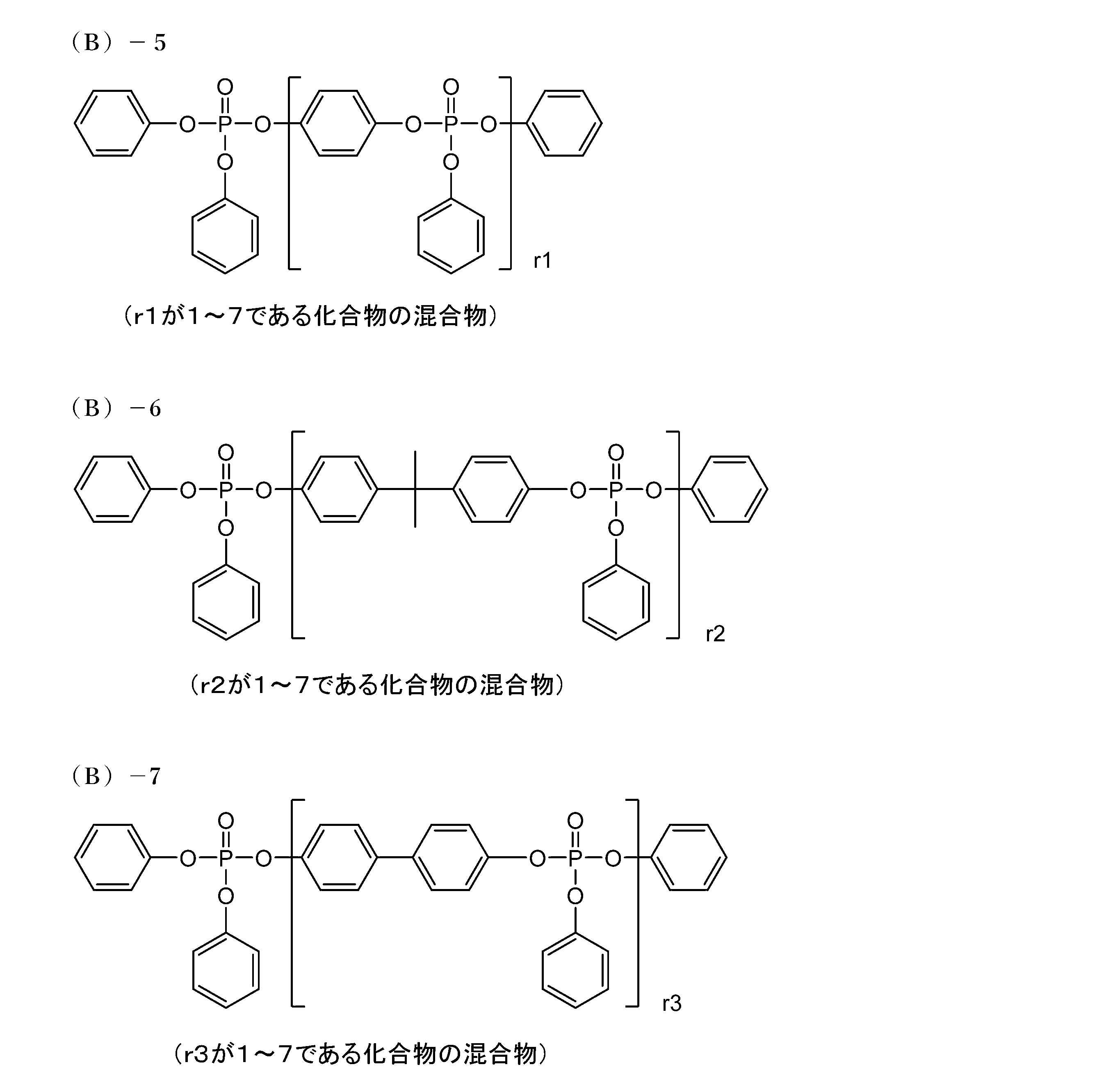
(B)-5:ハイドロキノンビス(ジフェニルホスフェート)の重縮合物
(B)-6:ビスフェノールAビス(ジフェニルホスフェート)の重縮合物
(B)-7:4,4’-ビフェノールビス(ジフェニルホスフェート)の重縮合物
(B)-8:レゾルシノールビス(2,6-キシレニルホスフェート)
(B)-9:ジエチルホスフィン酸アルミニウム
(C)-1:メラミンシアヌレート
酸化防止剤1:ステアリル(3,5-ジ-tert-ブチル-4-ヒドロキシフェニル)プロピオネート
酸化防止剤2:トリス(2,4-ジ-tert-ブチルフェニル)ホスファイト


上記で得られたペレット状の組成物を用いて、厚さ200μmのキャストフィルムを作成した。フィルム作成は、(株)東洋精機製作所製ラボプラストミルμに単軸押出機(製品名:D1220B)及びTダイ(製品名:MT60B)を接続した装置を使用し、溶融温度200℃、スクリュー速度30rpm、Tダイ押出温度200℃、チルロール温度60℃、ロール回転速度0.40~0.45rpmの条件で行った。得られたフィルムから25cmm×5cmの試験片及び20cm×5cmの試験片を切り出し、23±2℃、50±5%RH中で48時間静置した後、下記の難燃性評価を行った。
上記で得られた25cm×5cmの試験片を水平に保持し、内径9.5mm、炎長38mmのブンゼンバーナーを加熱源とし、試験片の短辺中央に15秒間接炎した後、炎が消えるまでの長辺方向の燃焼距離及び燃焼時間を測定した。前記燃焼距離と前記燃焼時間から燃焼速度を算出した。各試験片についてn=3で測定し、その平均値を算出した。難燃性が優れるほど、燃焼距離が短くなり、燃焼速度は遅くなる。結果を表1~2に示す。
上記で作成した試験片を下端が重ならないように円筒状に巻き、試料の下端をバーナーから10mm上方に離し垂直に保持した。内径9.5mm、炎長20mmのブンゼンバーナーを加熱源とし、試験片下端に3秒間接炎した後、燃焼秒数を測定した。消炎後、再度3秒間接炎し、燃焼秒数を測定した。VTM-0、VTM-1、VTM-2の評価基準に沿って難燃性を評価し、n=5の測定回数のうち、最も低い基準に該当した試験片のランクを樹脂組成物の評価ランクとした。VTM-0~VTM-2のランクのいずれにも該当しないものはNot Vとした。結果を表1~2に示す。
上記で得られたフィルムを30mm×40mmの大きさに切り取り、23±2℃、50±5%RH中で240時間静置した。その後フィルム表面を目視で観察し、以下の評価基準にて耐ブリード性を評価した。この評価結果がA又はBであれば、実用上問題ないと判断される。結果を表1~2に示す。
A:ブリード物が観察されなかった。
B:ブリード物がわずかに観察されたが、実用上問題ない。
C:ブリード物がはっきりと観察され、実用に適さない。
Claims (10)
- (A)ヒンダードアミン化合物を含む難燃剤であって、
前記(A)ヒンダードアミン化合物が下記一般式(1)で表される化合物である、難燃剤。

一般式(1)中、R1は、下記一般式(2)、(3)又は(4)で表される基を表し、R2は、炭素原子数1~18の炭化水素基を表し、R3~R6は、それぞれ独立に、炭素原子数1~4のアルキル基を表す。
一般式(2)、(3)及び(4)において、*は結合手を表す。 - 一般式(1)中のR1が、一般式(2)で表される基である、請求項1に記載の難燃剤。
- 一般式(2)中のR7が、炭素原子数2~14のアルキレン基である、請求項2に記載の難燃剤。
- さらに(B)リン系難燃剤を含む、請求項1に記載の難燃剤。
- (B)リン系難燃剤が、リン酸エステル系難燃剤、ホスホン酸エステル系難燃剤、ホスフィン酸エステル系難燃剤及びホスフィン酸金属塩系難燃剤からなる群から選択される1種以上である、請求項4に記載の難燃剤。
- (B)リン系難燃剤の含有量が、(A)ヒンダードアミン化合物100質量部に対して、10質量部以上5,000質量部以下である、請求項4に記載の難燃剤。
- (B)リン系難燃剤が、異なる2種以上の化合物を含む、請求項4に記載の難燃剤。
- さらに(C)窒素系難燃剤を含む、請求項4に記載の難燃剤。
- 請求項1~8のいずれか1項に記載の難燃剤と、合成樹脂とを含む、組成物。
- 請求項9に記載の組成物から得られる成形品。
Priority Applications (4)
| Application Number | Priority Date | Filing Date | Title |
|---|---|---|---|
| CN202480027719.6A CN121013899A (zh) | 2023-06-09 | 2024-05-27 | 阻燃剂、组合物和成形品 |
| EP24819204.9A EP4726011A1 (en) | 2023-06-09 | 2024-05-27 | Flame retardant, composition, and molded article |
| JP2025526058A JPWO2024252972A1 (ja) | 2023-06-09 | 2024-05-27 | |
| KR1020257035160A KR20260020908A (ko) | 2023-06-09 | 2024-05-27 | 난연제, 조성물, 및 성형품 |
Applications Claiming Priority (4)
| Application Number | Priority Date | Filing Date | Title |
|---|---|---|---|
| JP2023095888 | 2023-06-09 | ||
| JP2023-095888 | 2023-06-09 | ||
| JP2024-016994 | 2024-02-07 | ||
| JP2024016994 | 2024-02-07 |
Publications (1)
| Publication Number | Publication Date |
|---|---|
| WO2024252972A1 true WO2024252972A1 (ja) | 2024-12-12 |
Family
ID=93795882
Family Applications (1)
| Application Number | Title | Priority Date | Filing Date |
|---|---|---|---|
| PCT/JP2024/019426 Ceased WO2024252972A1 (ja) | 2023-06-09 | 2024-05-27 | 難燃剤、組成物、及び成形品 |
Country Status (6)
| Country | Link |
|---|---|
| EP (1) | EP4726011A1 (ja) |
| JP (1) | JPWO2024252972A1 (ja) |
| KR (1) | KR20260020908A (ja) |
| CN (1) | CN121013899A (ja) |
| TW (1) | TW202500729A (ja) |
| WO (1) | WO2024252972A1 (ja) |
Citations (4)
| Publication number | Priority date | Publication date | Assignee | Title |
|---|---|---|---|---|
| JP2016130376A (ja) * | 2015-01-14 | 2016-07-21 | Jxエネルギー株式会社 | 難燃性網状構造体 |
| JP2018009120A (ja) * | 2016-07-15 | 2018-01-18 | 株式会社イノアック技術研究所 | 硬質ウレタン樹脂組成物 |
| JP2019119825A (ja) * | 2018-01-10 | 2019-07-22 | 株式会社イノアック技術研究所 | 硬質ウレタン樹脂組成物 |
| CN115648761A (zh) * | 2022-09-06 | 2023-01-31 | 苏州华苏塑料有限公司 | 具有低表面电阻的夹网阻燃耐候pvc透明膜及其制备方法 |
Family Cites Families (4)
| Publication number | Priority date | Publication date | Assignee | Title |
|---|---|---|---|---|
| JP5581133B2 (ja) | 2010-07-02 | 2014-08-27 | 日本ポリエチレン株式会社 | 太陽電池封止材用樹脂組成物、及びそれを用いた太陽電池封止材、その製造方法、ならびに太陽電池モジュール |
| JP6188734B2 (ja) | 2012-03-16 | 2017-08-30 | ビーエーエスエフ ソシエタス・ヨーロピアBasf Se | 難燃剤としてのnor−hals化合物 |
| JP6689715B2 (ja) | 2016-09-05 | 2020-04-28 | 出光ユニテック株式会社 | ポリプロピレン系積層体、並びにそれを含む成形体及びその製造方法 |
| JP2021042334A (ja) | 2019-09-12 | 2021-03-18 | 株式会社フジクラ | 難燃性樹脂組成物、これを用いたケーブル及びワイヤハーネス |
-
2024
- 2024-05-27 EP EP24819204.9A patent/EP4726011A1/en active Pending
- 2024-05-27 KR KR1020257035160A patent/KR20260020908A/ko active Pending
- 2024-05-27 CN CN202480027719.6A patent/CN121013899A/zh active Pending
- 2024-05-27 JP JP2025526058A patent/JPWO2024252972A1/ja active Pending
- 2024-05-27 WO PCT/JP2024/019426 patent/WO2024252972A1/ja not_active Ceased
- 2024-05-29 TW TW113119806A patent/TW202500729A/zh unknown
Patent Citations (4)
| Publication number | Priority date | Publication date | Assignee | Title |
|---|---|---|---|---|
| JP2016130376A (ja) * | 2015-01-14 | 2016-07-21 | Jxエネルギー株式会社 | 難燃性網状構造体 |
| JP2018009120A (ja) * | 2016-07-15 | 2018-01-18 | 株式会社イノアック技術研究所 | 硬質ウレタン樹脂組成物 |
| JP2019119825A (ja) * | 2018-01-10 | 2019-07-22 | 株式会社イノアック技術研究所 | 硬質ウレタン樹脂組成物 |
| CN115648761A (zh) * | 2022-09-06 | 2023-01-31 | 苏州华苏塑料有限公司 | 具有低表面电阻的夹网阻燃耐候pvc透明膜及其制备方法 |
Non-Patent Citations (1)
| Title |
|---|
| See also references of EP4726011A1 * |
Also Published As
| Publication number | Publication date |
|---|---|
| TW202500729A (zh) | 2025-01-01 |
| CN121013899A (zh) | 2025-11-25 |
| EP4726011A1 (en) | 2026-04-15 |
| KR20260020908A (ko) | 2026-02-12 |
| JPWO2024252972A1 (ja) | 2024-12-12 |
Similar Documents
| Publication | Publication Date | Title |
|---|---|---|
| CN102056992B (zh) | 阻燃性热塑性树脂组合物 | |
| BR112017000918B1 (pt) | Agente antiestático, composição de agente antiestático, composição de resinaantiestática, e corpo moldado | |
| KR20110030651A (ko) | 난연성 열가소성 수지 조성물 | |
| EP3604482B1 (en) | Flame retardant composition and flame-retardant synthetic resin composition containing same | |
| KR20170133445A (ko) | 수지 첨가제 조성물 및 대전 방지성 열가소성 수지 조성물 | |
| EP2716734A1 (en) | Flame-retardant agent and flame-retardant resin composition | |
| US10227447B2 (en) | Antistatic agent, antistatic agent composition, antistatic resin composition, and molded article | |
| EP3222693B1 (en) | Ultraviolet absorber and synthetic resin composition | |
| KR102206409B1 (ko) | 자외선 흡수성 폴리카보네이트 | |
| JP2023026250A (ja) | 流動性向上剤、熱可塑性樹脂組成物および成形品 | |
| WO2024185557A1 (ja) | 樹脂用添加剤、組成物、成形品及び化合物 | |
| JP4155645B2 (ja) | 難燃性合成樹脂組成物 | |
| KR20260020908A (ko) | 난연제, 조성물, 및 성형품 | |
| EP4406726A1 (en) | Thermoplastic resin composition, method for producing shaped object, and shaped object | |
| CN115385961A (zh) | 一种腰果酚衍生亚磷酸酯类抗氧剂及使用其的合成树脂组合物 | |
| CN115368632A (zh) | 一种亚磷酸酯抗氧剂组合物和使用其的合成树脂组合物 | |
| WO2024048380A1 (ja) | 難燃性積層造形物の製造方法および難燃性積層造形物 | |
| WO2026014230A1 (ja) | ビスフェノール類抑制剤、樹脂組成物、及び成形品 | |
| JP2025061829A (ja) | 樹脂組成物、成形品および樹脂組成物の製造方法 | |
| WO2026053811A1 (ja) | 流動性向上剤、樹脂組成物、及び成形品 | |
| WO2016080259A1 (ja) | 紫外線吸収剤及び合成樹脂組成物 |
Legal Events
| Date | Code | Title | Description |
|---|---|---|---|
| 121 | Ep: the epo has been informed by wipo that ep was designated in this application |
Ref document number: 24819204 Country of ref document: EP Kind code of ref document: A1 |
|
| WWE | Wipo information: entry into national phase |
Ref document number: 2025526058 Country of ref document: JP |
|
| WWE | Wipo information: entry into national phase |
Ref document number: 202517100113 Country of ref document: IN |
|
| WWP | Wipo information: published in national office |
Ref document number: 202517100113 Country of ref document: IN |
|
| WWE | Wipo information: entry into national phase |
Ref document number: 2024819204 Country of ref document: EP |
|
| NENP | Non-entry into the national phase |
Ref country code: DE |
|
| ENP | Entry into the national phase |
Ref document number: 2024819204 Country of ref document: EP Effective date: 20260109 |
|
| ENP | Entry into the national phase |
Ref document number: 2024819204 Country of ref document: EP Effective date: 20260109 |
|
| ENP | Entry into the national phase |
Ref document number: 2024819204 Country of ref document: EP Effective date: 20260109 |
|
| ENP | Entry into the national phase |
Ref document number: 2024819204 Country of ref document: EP Effective date: 20260109 |
|
| ENP | Entry into the national phase |
Ref document number: 2024819204 Country of ref document: EP Effective date: 20260109 |
|
| WWP | Wipo information: published in national office |
Ref document number: 2024819204 Country of ref document: EP |