WO2024252805A1 - 伸縮性デバイス - Google Patents
伸縮性デバイス Download PDFInfo
- Publication number
- WO2024252805A1 WO2024252805A1 PCT/JP2024/015712 JP2024015712W WO2024252805A1 WO 2024252805 A1 WO2024252805 A1 WO 2024252805A1 JP 2024015712 W JP2024015712 W JP 2024015712W WO 2024252805 A1 WO2024252805 A1 WO 2024252805A1
- Authority
- WO
- WIPO (PCT)
- Prior art keywords
- wiring
- protective layer
- substrate
- main surface
- stretchable
- Prior art date
- Legal status (The legal status is an assumption and is not a legal conclusion. Google has not performed a legal analysis and makes no representation as to the accuracy of the status listed.)
- Ceased
Links
Images





Classifications
-
- B—PERFORMING OPERATIONS; TRANSPORTING
- B32—LAYERED PRODUCTS
- B32B—LAYERED PRODUCTS, i.e. PRODUCTS BUILT-UP OF STRATA OF FLAT OR NON-FLAT, e.g. CELLULAR OR HONEYCOMB, FORM
- B32B15/00—Layered products comprising a layer of metal
- B32B15/04—Layered products comprising a layer of metal comprising metal as the main or only constituent of a layer, which is next to another layer of the same or of a different material
- B32B15/08—Layered products comprising a layer of metal comprising metal as the main or only constituent of a layer, which is next to another layer of the same or of a different material of synthetic resin
-
- H—ELECTRICITY
- H05—ELECTRIC TECHNIQUES NOT OTHERWISE PROVIDED FOR
- H05K—PRINTED CIRCUITS; CASINGS OR CONSTRUCTIONAL DETAILS OF ELECTRIC APPARATUS; MANUFACTURE OF ASSEMBLAGES OF ELECTRICAL COMPONENTS
- H05K1/00—Printed circuits
- H05K1/02—Details
-
- H—ELECTRICITY
- H05—ELECTRIC TECHNIQUES NOT OTHERWISE PROVIDED FOR
- H05K—PRINTED CIRCUITS; CASINGS OR CONSTRUCTIONAL DETAILS OF ELECTRIC APPARATUS; MANUFACTURE OF ASSEMBLAGES OF ELECTRICAL COMPONENTS
- H05K3/00—Apparatus or processes for manufacturing printed circuits
- H05K3/22—Secondary treatment of printed circuits
- H05K3/28—Applying non-metallic protective coatings
Definitions
- the material of the first substrate 1 may be, for example, a thermoplastic resin.
- the material contains a resin material having elasticity, for example, at least one selected from the group consisting of an acrylic resin, a urethane resin, and a styrene resin.
- a resin material having elasticity for example, at least one selected from the group consisting of an acrylic resin, a urethane resin, and a styrene resin.
- An example of the urethane resin is thermoplastic polyurethane.
- An example of the styrene resin is styrene-butadiene-styrene block copolymer (SBS).
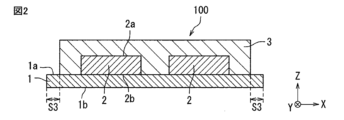
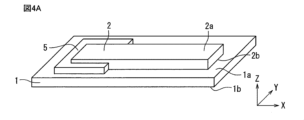
- the wiring 2 has a first surface 2a and a second surface 2b located on opposite sides.
- the second surface 2b of the wiring 2 is located on the first main surface 1a of the first substrate 1.
- the two wirings 2 are arranged parallel to each other along the X direction.
- the shape of the wiring 2 is not particularly limited.
- the wiring 2 may be arranged facing a direction different from the X direction.
- the number of wirings 2 is not particularly limited, and may be one, or may be three or more.
- the wirings 2 are not limited to the arrangement as shown in FIG. 1, and the extension direction is also not limited. Specifically, the longitudinal direction of the first substrate 1 and the extension direction of the wiring 2 do not have to coincide, and they do not have to extend in one direction.
- the wiring 2 is preferably elastic.
- the wiring 2 is formed of a conductive material.
- a metal foil such as silver, copper, or nickel may be used as the conductive material, or a mixture of conductive particles such as silver, copper, or nickel and a resin may be used.
- the resin include epoxy resin, urethane resin, acrylic resin, silicone resin, or an elastomer resin that is a mixture of these. By using such a resin, elasticity can be ensured.
- the average particle size of the conductive particles is not particularly limited, but is preferably 0.01 ⁇ m or more and 10 ⁇ m or less.
- the shape of the conductive particles is preferably spherical, and is not limited to spherical, and may be flat or have a structure with protrusions to improve elasticity.
- the wiring 2 does not have to be elastic.
- the thickness of the wiring 2 is preferably 100 ⁇ m or less, and more preferably 50 ⁇ m or less.
- the thickness of the elastic wiring is more preferably 1 ⁇ m or more, and may be 5 ⁇ m or more. There are no particular limitations on the thickness, width, or length of the wiring 2.
- the protective layer 3 covers a part of the first main surface 1a of the first substrate 1 and the entire wiring 2. That is, the first main surface 1a has an exposed end portion S3. By providing the protective layer 3, the wiring 2 can be protected.
- the protective layer 3 may cover at least a part of the first main surface 1a of the first substrate 1 and at least a part of the wiring 2.
- the protective layer 3 may be a single layer, or may be a laminate of multiple layers.
- the material of the protective layer 3 may be the same as the material of the first substrate 1, or may be a different material.
- the protective layer 3 is formed, for example, from a resin material or a mixture of a resin material and an inorganic material.
- the resin material include silicone resin, acrylic resin, olefin resin such as polyethylene and polypropylene, modified urethane resin, urethane resin, styrene resin, vinyl chloride resin, polyester resin, and polyamide resin.
- examples of the resin material include fluororesin, nitrile rubber, latex rubber and other elastomer resins, epoxy, phenol, imide, rosin, cellulose, polyethylene terephthalate, polyethylene naphthalate, and polycarbonate resins.
- the material of the protective layer 3 may be the same as that of the first substrate. It is preferable that the protective layer 3 has insulating properties. By having the protective layer 3 have insulating properties, ion migration of the wiring 2 can be more reliably suppressed.
- the peel strength between the wiring 2 and the first substrate 1 is greater than the peel strength between the protective layer 3 and the first substrate 1.
- an external force F1 is applied to the stretchable device 100, if no peeling occurs between the protective layer 3 and the first substrate 1, the stretchable device 100 will stretch uniformly.
- the protective layer 3 and the first substrate 1 peel off before the wiring 2 peels off from the first substrate 1, and if peeling occurs between the protective layer 3 and the first substrate 1, the external force F1 can be absorbed at the peeled location.
- the load on the wiring 2 against the external force F1 is reduced, and the wiring 2 can be prevented from peeling off from the first substrate 1 and breaking.
- the portion S1 and the exposed end S3 can be stretched greatly and can absorb the external force F1.
- the load on the wiring 2 against the external force F1 is reduced, and the wiring 2 can be prevented from peeling off from the first substrate 1 and breaking, and the wiring 2 can be protected.
- FIG. 3 illustrates a case where the entire area between the wirings 2 is peeled off and a gap S is formed, only a portion between the wirings 2 may be peeled off.
- the portion with relatively low peel strength does not have to be the entire area where the protective layer 3 and the first substrate 1 contact each other, but may be only a portion.
- the location of the portion with low peel strength is not limited, and may be in an area other than between the wirings 2.
- the first surface 2a of the wiring 2 may be reinforced with Kapton tape, a coating agent, or the like.
- the release film 5 is removed and the first substrate 1 and the wiring 2 are cut into strips with a width W of 10 mm in the Y direction.
- clamps 6 are attached to a part of the separated region.
- a tensile force F2 is applied to the clamps 6 in a direction away from each other, i.e., in a direction 180° apart, to peel them off.
- a force gauge is used to measure the peel strength.
- the first substrate 1 and the protective layer 3 are used instead of the first substrate 1 and the wiring 2, and the same operation as above is performed.
- the protective layer 3 and the wiring 2 are used instead of the first substrate 1 and the wiring 2, and the same operation as above is performed.
- the protective layer 3 is a sheet layer 31.
- the protective layer 3 is formed by applying a conductive material, if the conductive material contains a solvent, at least a part of the wiring 2 may dissolve, causing electrical resistance.
- the sheet layer 31 is used as the protective layer 3, the wiring 2 does not dissolve and electrical resistance is unlikely to occur.
- the peel strength between the wiring 2 and the first substrate 1 is not reduced.
- the sheet layer 31 is preferably formed in a vacuum state so that no air bubbles are trapped between the wiring 2 and the sheet layer 31. At this time, it is preferable to laminate them while applying pressure and temperature.
- the thickness of the sheet layer 31 is preferably 1 ⁇ m or more and 100 ⁇ m or less, more preferably 10 ⁇ m or more and 50 ⁇ m or less.
- the protective layer 3 covers a part of the first main surface 1a of the first substrate 1.
- the first main surface 1a of the first substrate 1 has one exposed end S3 parallel to the direction in which the wiring 2 extends, a contact portion in contact with the exposed end S3 and the protective layer 3 and the wiring 2, and the other exposed end S3 in contact with the contact portion.
- the exposed end S3 is an end of the first main surface 1a parallel to the direction in which the wiring 2 extends.
- the exposed end S3, which is the exposed portion of the first substrate 1 can also greatly stretch the first substrate 1 and absorb the external force F1. This makes it possible to suppress stress concentration on the wiring 2.
- the peel strength between the protective layer 3 and the wiring 2 is greater than the peel strength between the protective layer 3 and the first substrate 1.
- the peel strength between the wiring 2 and the first substrate 1 may be greater than the peel strength between the wiring 2 and the protective layer 3. In this case, peeling of the wiring 2 from the first substrate 1 due to the tension acting between the portions S1 can be suppressed.
- the peel strength between the wiring 2 and the protective layer 3 may be greater than the peel strength between the wiring 2 and the first substrate 1.
- the applied external force can assist in the elongation of the wiring 2.
- the wiring 2 expands and contracts uniformly, and peeling of the wiring 2 from the first substrate 1 can be suppressed.
- the lower portion 3b and the upper portion 3a may be connected by a flat portion instead of the convex curved portion 3c.
- the width of the lower portion 3b in this specification is the sum of the width of the portion of the protective layer 3 that is in contact with the first substrate 1 and the width of the portion of the wiring 2 that is in contact with the first substrate 1, as shown in FIG. 5.
- Fig. 7 is a top view of the stretchable device 100C.
- Fig. 8 is a cross-sectional view of the stretchable device 100C taken along line VIII-VIII in Fig. 7.
- the fourth embodiment is different from the first embodiment in the overlapping relationship between the protective layer and the first base material.
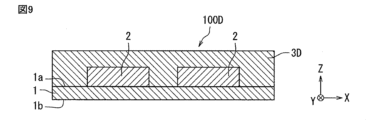
- FIG. 9 is a cross-sectional view of the stretchable device 100D.
- the fifth embodiment is different from the fourth embodiment in the configuration of the protective layer.
- the material of the protective layer 3D is the same as the material of the first substrate 1.
- the wiring 2 is provided on one of the first substrates 1, and then the other first substrate 1 is provided so as to cover the wiring 2, and the other first substrate 1 is provided so as to entirely cover the one of the first substrates 1 and the wiring 2.
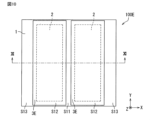
- the protective layer 3E covers the entire wiring 2. Specifically, two wirings 2 and two protective layers 3E are located on the first main surface 1a of the first substrate 1, one protective layer 3E covers one wiring 2, and the other protective layer 3E covers the other wiring 2. One protective layer 3E and the other protective layer 3E are separated.
- the first main surface 1a has, in the X-axis direction, an exposed end S13, a portion S12 that contacts one protective layer 3E and is adjacent to the exposed end S13, an exposed portion S11 that is adjacent to the portion S12, a portion S12 that contacts the other protective layer 3E and is adjacent to the exposed portion S11, and an exposed end S13 that is adjacent to the portion S12, in that order.
- the protective layer 3E is not disposed on the portion S12, so that the area of the portion not restrained by the protective layer 3E can be secured, and the influence of external forces can be more suitably alleviated.
- the gap caused by expansion and contraction may or may not be integrated with exposed portion S11.
- the exposed portion S11 and portion S15 are integrated when the entire portion S15 is peeled off, or when the area of portion S15 on the exposed portion S11 side is peeled off.
- the exposed portion S11 and portion S11 are not integrated when an area of portion S15 other than the exposed portion S11 side is peeled off. For example, this may be the case when the area of portion S15 on the portion S14 side is peeled off.
- the present disclosure includes the following aspects. ⁇ 1> a stretchable first substrate having a first major surface; Wiring provided on the first main surface of the first base material; a protective layer covering at least a portion of the first main surface of the first base material and at least a portion of the wiring; Equipped with a peel strength between the wiring and the first base material is greater than a peel strength between the protective layer and the first base material; Stretchable devices.
- the protective layer has, in a cross section perpendicular to an extension direction of the wiring, a lower portion on the first base material side, an upper portion on an opposite side to the first base material, and convex curved surfaces on both sides in a width direction connecting the lower portion and the upper portion, The width of the lower portion is greater than the width of the upper portion.
- the protective layer includes a sheet layer and an adhesive layer, the adhesive layer is located between the wiring and the sheet layer, and between the first main surface of the first base material and the sheet layer;
- the protective layer is a sheet layer and is in contact with the first main surface of the first base material on which the wiring is provided.
- the stretchable device according to ⁇ 1>. ⁇ 5> The stretchable device according to any one of ⁇ 1> to ⁇ 4>, wherein the protective layer covers the entire first main surface of the first base material.
- ⁇ 6> The stretchable device according to any one of ⁇ 1> to ⁇ 4>, wherein the protective layer covers a portion of the first main surface of the first base material.
- the material of the protective layer is the same as the material of the first substrate.
- ⁇ 8> The stretchable device according to any one of ⁇ 1> to ⁇ 7>, wherein the protective layer covers the entire wiring.
- ⁇ 9> The stretchable device according to any one of ⁇ 1> to ⁇ 8>, wherein a peel strength between the protective layer and the wiring is greater than a peel strength between the protective layer and the first substrate.
Landscapes
- Engineering & Computer Science (AREA)
- Microelectronics & Electronic Packaging (AREA)
- Manufacturing & Machinery (AREA)
- Structure Of Printed Boards (AREA)
Priority Applications (1)
| Application Number | Priority Date | Filing Date | Title |
|---|---|---|---|
| JP2025525978A JPWO2024252805A1 (https=) | 2023-06-05 | 2024-04-22 |
Applications Claiming Priority (2)
| Application Number | Priority Date | Filing Date | Title |
|---|---|---|---|
| JP2023-092419 | 2023-06-05 | ||
| JP2023092419 | 2023-06-05 |
Publications (1)
| Publication Number | Publication Date |
|---|---|
| WO2024252805A1 true WO2024252805A1 (ja) | 2024-12-12 |
Family
ID=93795371
Family Applications (1)
| Application Number | Title | Priority Date | Filing Date |
|---|---|---|---|
| PCT/JP2024/015712 Ceased WO2024252805A1 (ja) | 2023-06-05 | 2024-04-22 | 伸縮性デバイス |
Country Status (2)
| Country | Link |
|---|---|
| JP (1) | JPWO2024252805A1 (https=) |
| WO (1) | WO2024252805A1 (https=) |
Citations (3)
| Publication number | Priority date | Publication date | Assignee | Title |
|---|---|---|---|---|
| WO2019012909A1 (ja) * | 2017-07-14 | 2019-01-17 | ソニー株式会社 | センサおよびセンサの製造方法 |
| WO2019097860A1 (ja) * | 2017-11-17 | 2019-05-23 | 東洋紡株式会社 | 生体情報計測用衣服および伸縮性積層シート |
| WO2020013323A1 (ja) * | 2018-07-13 | 2020-01-16 | 東洋紡株式会社 | 衣服型電子機器およびその製造方法 |
-
2024
- 2024-04-22 JP JP2025525978A patent/JPWO2024252805A1/ja active Pending
- 2024-04-22 WO PCT/JP2024/015712 patent/WO2024252805A1/ja not_active Ceased
Patent Citations (3)
| Publication number | Priority date | Publication date | Assignee | Title |
|---|---|---|---|---|
| WO2019012909A1 (ja) * | 2017-07-14 | 2019-01-17 | ソニー株式会社 | センサおよびセンサの製造方法 |
| WO2019097860A1 (ja) * | 2017-11-17 | 2019-05-23 | 東洋紡株式会社 | 生体情報計測用衣服および伸縮性積層シート |
| WO2020013323A1 (ja) * | 2018-07-13 | 2020-01-16 | 東洋紡株式会社 | 衣服型電子機器およびその製造方法 |
Also Published As
| Publication number | Publication date |
|---|---|
| JPWO2024252805A1 (https=) | 2024-12-12 |
Similar Documents
| Publication | Publication Date | Title |
|---|---|---|
| KR102839087B1 (ko) | 플렉서블 표시장치 | |
| US10470304B2 (en) | Flexible electronics apparatus and associated methods | |
| EP3223120B1 (en) | Film touch sensor and manufacturing method therefor | |
| CN116419613A (zh) | 显示装置 | |
| WO2017173872A1 (zh) | 胶材组件、柔性模组、显示设备及柔性模组的制作方法 | |
| JP5111071B2 (ja) | 圧電センサ | |
| CN103153811A (zh) | 覆盖膜 | |
| WO2018142879A1 (ja) | 熱伝導シートおよび多重熱伝導シート | |
| TW200832659A (en) | Semiconductor device, stacked semiconductor device and interposer substrate | |
| JP2024033004A (ja) | センサ及びその製造方法 | |
| WO2024252805A1 (ja) | 伸縮性デバイス | |
| JP2021123419A (ja) | 電子部品包装用カバーテープ、電子部品包装体およびその製造方法 | |
| KR101899831B1 (ko) | 플렉서블 표시장치 | |
| KR20170029920A (ko) | 더미를 이용하여 강성 조절되는 연성 반도체 기판, 및 연성 반도체 패키지 | |
| JP7718604B2 (ja) | 伸縮性デバイス | |
| KR20180043872A (ko) | 반도체 칩, 이를 구비한 전자장치 및 반도체 칩의 연결방법 | |
| TW202016612A (zh) | 觸控結構及觸控裝置 | |
| JP2020170754A (ja) | 複合基板及びその製造方法 | |
| JPH10250020A (ja) | トップカバーテープ | |
| WO2025192170A1 (ja) | 伸縮性デバイス | |
| JP6691474B2 (ja) | 伸縮性配線基板及び伸縮性基板の製造方法 | |
| US20240357738A1 (en) | Stretchable wiring board | |
| US20250203765A1 (en) | Stretchable device | |
| JP2020174090A (ja) | 配線基板、複合基板及び複合基板の製造方法 | |
| US20250227846A1 (en) | Wiring board |
Legal Events
| Date | Code | Title | Description |
|---|---|---|---|
| 121 | Ep: the epo has been informed by wipo that ep was designated in this application |
Ref document number: 24819043 Country of ref document: EP Kind code of ref document: A1 |
|
| ENP | Entry into the national phase |
Ref document number: 2025525978 Country of ref document: JP Kind code of ref document: A |
|
| WWE | Wipo information: entry into national phase |
Ref document number: 2025525978 Country of ref document: JP |
|
| NENP | Non-entry into the national phase |
Ref country code: DE |